Cesar Collier: A motto that I have, and I always finish my LinkedIn posts and everything, is let’s invest in Brazil. It’s an exciting country, a lot of opportunities, and if you do it with the right people, it can be very interesting.
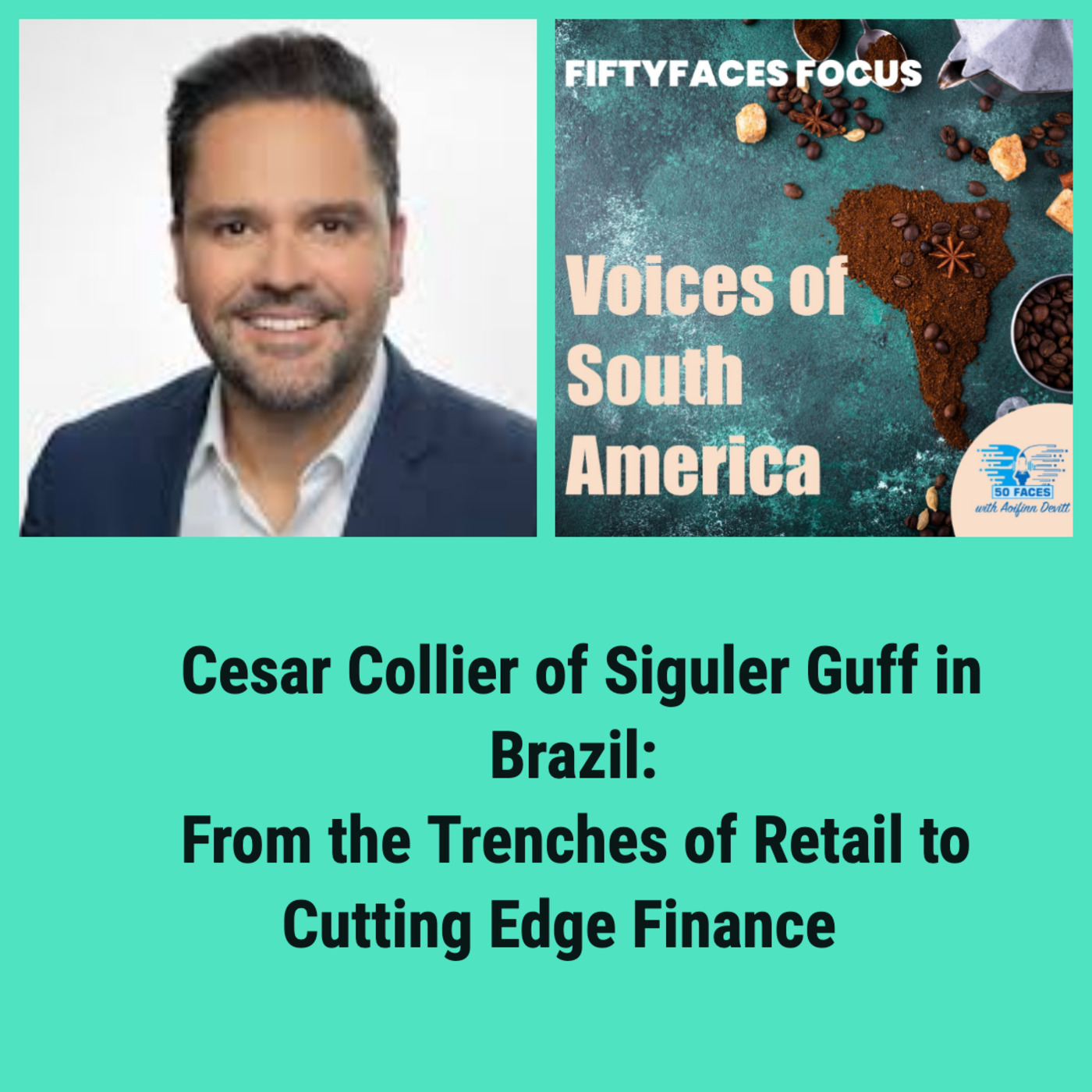
Aoifinn Devitt: I’m Aoifinn Devitt, and welcome to the 50 Faces Podcast, a podcast which showcases inspiring professionals in the world of investment and beyond by focusing on people and their stories. I’m joined today by César Collier, who is Managing Partner and Head of Latin America at Seguller Gough Company. Based in São Paulo, he previously worked in a series of private equity roles, as well as in retail at Walmart and Carrefour Brazil. Welcome, César. Thanks for joining me today.
Cesar Collier: Eefje, thank you very much. It’s a great pleasure to be here.
Aoifinn Devitt: Well, we had the pleasure of meeting in São Paulo. It was a short meeting given time constraints, but we did have a brief chat there about your career journey, which has been a really fascinating one with lots of twists and turns. And you also spoke about having had time in the army. So I’d love if you could take us through that journey and how starting out in the army and then spending time in retail you found your way into finance?
Cesar Collier: Well, actually, I’ll try to go very quickly a little bit back because there was a part of my family history which brought me to where I am. My father studied in London to do a master’s degree in the Imperial College, and then we went to live in New York for his PhD at NYU. And that was kind of half my youth, and I learned to speak in English and learn to think in different cultures. So I would attribute a big piece of working for international companies and being where I am because of that early days and the present that I call it, the present that my father gave me and gave my brothers and sisters. So it was, was lovely. Well, I came back to Brazil. Actually, I started working a little bit earlier than the army. I was not conformed with the situation of the country. And basically my father said, well, you should hang out with a politician that is well known. He was our cousin. He was a senator at the time. So at 16, I, all my free time, my vacation, I would work with him. His name was Marco Maciel. He eventually became vice president of Brazil twice. But that was my earliest working experience, was 16, 17, just learning the politics. And I quickly realized I did not want politics. So I joined immediately afterwards the army. Reserve Lieutenant School. Did that while I was studying law and ended up liking it very much. I come from a tradition of, of people who have served. My grandfather served in ’42, my other grandfather also, 3 of my uncles, my father all served in the same school, which is this reserve school for officers. And that helped me a lot in my early days of work because when I went to work for a bank As an intern, I already had the responsibility of a lieutenant and I just thrived very quickly because of that sense of responsibility and delivery.
Aoifinn Devitt: And we will ask later about just what that time in the military, how that affects an approach to business. But, you know, first retail, which was another important chapter for you. Can you tell us about that chapter and again, what your takeaways were?
Cesar Collier: Yeah, I came into retail through finance. I was hired at 24 to do the IPO of the largest chain in the northeast of Brazil, in New York. They wanted someone who spoke English, knew about law, knew about finance, and knew about commerce. I had worked at a bank. I knew English well. I was studying law. I had just finished law actually. But it was not a lot of experience in all of those. The only very good thing I had was the English at the time. But they gave me the chance and I embraced it. So I stayed in finance for 3 years, migrated— well, went to live in the Netherlands as a consultant, an internal consultant. That was great, amazing experience. Got to know how retail was done all over the world because the company belonged to Royal Ahold, a Dutch retailer. And, and then came back to the operational roles and very quickly became a manager and then director. And eventually, my last days in the 12-year careers of retail I was vice president of Carrefour and then vice president of Walmart in Brazil. So it was a great experience.
Aoifinn Devitt: Absolutely. And I suppose that retail is notoriously tough, volatile. Clearly brand is key. Marketing is key. Were there any key values that you developed or just key truths that you happened upon that you now hold true?
Cesar Collier: Well, you leave retail, retail never really leaves you. In the end of the day, what you realize in retail, two very interesting things. One is you’re always resolving problems. So you have the ability to think quickly, to analyze. And with my financial background, I would put a lot of data into those analysis also. And I think that’s one of the reasons why I strive in those roles. But the second one is what you do, you will see very quickly if it went well or not. It’s a matter sometimes of hours, sometimes of days, not years. So developing and adapting business plans is something very common in the retail space. And I love it because you see the results, you see the customer buying or not an item that you wanted, or a promotion, or a situation, plus the people element to it, right? I think I had eventually more than 50,000 people working at Carrefour, 200 direct reports, and we had a big change of those teams. So learning how to developed and also eventually sometimes changing for better circumstances was a big learning aspect. And actually, I think it made me a better investor because I can detect relatively well some good or bad plans or things that are in front of me.
Aoifinn Devitt: It’s really interesting that point about feedback. You have a short feedback cycle in retail, I guess investing, we try to look so long term. And if you’re not day trading, you’re not going to get that kind of feedback. But really interesting to learn how that trains you. And now Now before we move into the specific work you do at SeguraGov, it’d be great if you could just paint a picture of where we sit in terms of the economic backdrop of Brazil at this juncture. And maybe you can refer that to how it has evolved over the course of your career.
Cesar Collier: Yeah, well, Brazil, I just spoke in a conference in New York and Brazil, I said something, Brazil goes two steps forward, one step back, two steps forward, one step back. It’s never a straight line. But it’s very important to mention that it is a progressive line. So if you consider poverty, if you consider education, and if you consider the reforms we’ve done, we’ve done tremendous reforms which developed countries are not able to, like France with their pension system. We did the pension reform, the labor reform, the tax reform, central bank independence, and others, and I can go on and on. But as Brazilians, when we are here in the middle of all of this, we don’t realize it. But you have to step back, look at the flaws and say, Wow, the country has evolved. And of course, we also have more than 40 years of democracy. We’ve had changes in government. There are some governments that are more propense to spending, others that are not. I think the current one is spending more. There were 27 hikes in taxes since this government took place. And that’s all to pay for the more expense that the government wants to do. I think eventually this will hit a wall. But as you see it right now, we have low-time unemployment rate, we you know, have, so full employment, we have an inflation that’s under control still, we have growth that are better than the predictions. So if you look at the photography as of now, it doesn’t look that bad. But one, the fiscal situation, if you continue to increase your debt and you continue to spend more than what you earn, that will create inflation, that could create a crisis in the near future. So I think the big challenge Brazil will face will be the next presidency, which is going to be elected next year. So far, the current government has the chance to be reelected, has the biggest chance to be reelected, but it changes, it can change very quickly in the country until then. But whoever it is, even if it’s Lula, they will have to do an administrative reform or something of sorts to reduce the fiscal deficit that currently is here. But having said that, Brazil is an enormous opportunity to invest. We have lack of capital. Companies are in dire need. Our interest rates is extremely high, 15%. That is crushing companies. Just to give you a fact, 2 years ago, we had 800 Plus bankruptcies, let’s say in the country now we are closer to 2,000, so they more than doubled. And that is a factor of that interest rate, but that also gives us the chance to help those companies in alternative ways.
Aoifinn Devitt: And we’ll get to that. I suppose that’s the foreign investor’s opportunity. What’s the domestic investor doing to cope with that? And I suppose, wouldn’t a domestic investor want to put their money anywhere other than simply in government bonds with a 15% return does it make other asset classes have a much higher bar to clear for the domestic investor?
Cesar Collier: You are totally right. It is a very difficult time for local hedge funds and local money market investors buying stocks. And all of that has a big competition with the CDI and with the fixed income. I joke that we Brazilians are lazy in investing, right? Because we have such high interest rates. We are accustomed to that. But you see also two movements which are also because of the improvement in legislation. You see, it’s much more easy. It’s easier to send money out abroad, invest there. You can buy stocks now. This was all very bureaucratic in the hands of only the wealthy. Now in an app, you can do that. So very quickly, you can open an app, open account in the US. Buy a stock. So you’re seeing a lot of flow in that direction, but also you see alternatives actually. The families, the Brazilian families, they got extremely sophisticated in the last 10 to 15 years, and they have been the big supporters of the alternative industry in the last years. And because they see the long-term benefit of this, they’re not looking at the interest rate of this year or this, this month. They are looking for higher returns in the longer run.
Aoifinn Devitt: That’s really interesting. That was also my conclusion from my trip down there recently in terms of talking with providers and also consultants to some of these institutional investors. And then in terms of the products that excite you at this time, can you talk us a little bit through Sigulagoff’s, their focus in Latin America? And also there was some particular strategies that you spoke of that perhaps weren’t as well known. Outside Brazil?
Cesar Collier: Yes, well, Cibergolf is a 30-year-old firm with $17 billion under management. Since the beginning, it invested in emerging markets. And that is, I think, a characteristic that’s very uncommon, right? But that gives us actually two things. One is an entrepreneurial spirit in other countries, and also in niche markets in the US, but also the ability to withstand these ups and downs that emerging markets have. So I’ve always had plenty of support. When things went down in Brazil, we said, what are we going to buy more? So now to your question, the firm’s philosophy— George Ziegler was one of the founders of the endowment of Harvard, right? And when he was 22, he wrote that the philosophy was invest with the best GPs and then do co-investments with them. So deal flow is everything in our mindset, and we did the same here. I opened the office 15 years ago. I started investing in the best private equity houses, eventually migrated to also technology. And lastly, 10 years ago, we were the first LPs into the special situations arena where these managers were coming out of investing only their own money and friends and family. And we were the first institutional investors of 3, the 3 first guys out there. What that did was actually create a deal flow of a very interesting asset class, which we became eventually the leaders in the country, which is what we call Brazilian legal claims. And Brazilian legal claims is, to put it shortly, it’s lending to a company using a legal claim that is won against the government but not yet paid as collateral. That is the simplest way to explain it. It’s a little bit more complicated in terms of How you do it, you take over the claim. There’s a number of steps there, and we have a loan to value that is of around 3 to 4 times, and we charge an interest. We charge a daily inflation protection, which is great. Also, it’s kind of an FX hedge. And lastly, when it gets paid, we also split 70/30 between the original owner and ourselves as a kicker. And we have that 30%. So it is a very robust asset class, uncorrelated. Brazil, the Federation pays around $15 billion per year. Another $5 billion is paid by states and municipalities. And these things are very repetitive in nature. Usually it’s taxes that were overpaid or an expropriation that was done in a wrongful calculation. Or a contract that was not paid correctly and things of that sort. Nothing exotic, but things that are— just to give you a number, there are 90 million cases in Brazil, 25 million new, 23 million resolved every year. The federal government pays more or less 100,000 cases per year, but also they collect a lot using the judiciary. So it’s a very active judiciary. I heard This week, very interesting statistics. Brazil is the biggest litigating country in the world, and our judiciary is the most expensive in the world, more than 2% of GDP. So it’s an interesting area that we like, and we’ve put already $2 billion in that category. We’ve already gotten back more than $1.6 billion to our investors, and we have the— I would say, if not the— or number one or number two best DPI in the alternatives industry for Latin America.
Aoifinn Devitt: It’s so interesting because that highly legalistic framework can sometimes be seen as a negative, but I guess it’s possible when you are an insider, so to speak, or at least inside the country, I’ll use those terms. It’s the complexity premium, I think, is quite evident.
Cesar Collier: Yeah. Well, we think Drew Guff says this a lot. He says when you combine the very technical thing with finance, usually you have an edge which is difficult to replicate, right? I mean, for— imagine a fly-in company from New York to come here and do something like this. It’s extremely difficult. We have a 14-people team plus 206 lawyers all working for us and on a daily basis taking decisions of appeals or settlements and all of that. We’ve done 2,000 cases so far. So very difficult to do that, but that’s also the angle, and that’s also how All our team are Brazilians here, but of course the investment committee, the two names on the door, George Sigler Drougoff, myself, and Sean McDonald, we’re very active. We know in depth what’s going on. But the legalistic part, I remember you are also graduated in law, right? And migrated to finance. So I can imagine that you, you, it was interesting. I ran away from the law and it caught me up 10 years ago. And now we, We’re doing this on a daily basis. But to say this, the beauty of the Brazilian judiciary is that it’s improving also as the country is. We have digitalized all our proceedings. It’s all digital, all online. We have repetitive decisions now. So some decisions went to the Supreme Court. So it’s actually an adaptation. We have a Napoleonic type of legal system, But we are adapting common law practices inside the Napoleonic type of system. So, so all of this is improving. An average judge 10 years ago had 10,000 cases in his desk. He now has around 3,000 cases, and that’s going down. That’s going down by the year. They are working productively. I believe artificial intelligence will be a big, big helper here in improving the speed of the judiciary also.
Aoifinn Devitt: Clearing the backlog. But I’d like to turn now to draw together some of your previous experience, just ask about your leadership style, because to be running the, the Sigulric of presence there in Latin America, how do you get the best from your team? And how would you say you draw on your retail experience, your military experience to seek to do that?
Cesar Collier: We have relatively simple criteria in recruiting, which is everyone after me has to be better than the one before. So actually, the youngest people are the most intelligent ones in the firm. So we’ve always raised the bar in the next hire, the next hire. And actually, who— the person responsible for the raise of the bar is exactly the last one in. So it’s funny because I joke that if I did the test to go into Sigler Goff today, I probably wouldn’t pass because they do very, very sophisticated tests. That’s one big criteria. The other one is You have to be self-motivated. I do not like to micromanage. I like missions. I like to give missions and have the person develop itself. I think this also for the team is something they like a lot because they can think about it, they can get it right, they can get it wrong also. But we have tolerance to errors and we correct ourselves. We do it and we try to help ourselves. Those are the main ones, but also we like people. So we don’t admit people that are not nice, period. We’re gonna be living and working for, I’ve been in Cigareo for 15 years, so working every day, every year together. It would be very hard to have someone who’s annoying, even if it’s extremely intelligent. If you’re not a nice person to live with, that was a lesson I learned in the retail. Tough time. When I left retail, I was 33. I had a rhythmic problem in the heart. I had 2 ulcers. I went to a checkup and the doctor said, you’re gonna die, you know. So that was all a consequence of all the stress and all the, the combatant situations that one would have to go through. So I would say the military taught this: you give a mission, if the person is good, they will do the mission right, if you train them right, if you have led them. And many times, if the mission went wrong, it was your training that was wrong. So you have to first admit to yourself, what did I not train that person on? What— where did I not cover this flank or that flank? And then train again, and then give the mission again. So that was, I think, the biggest lesson. Sense of responsibility. One has to go there and do it without anybody having to, oh, are you doing this? Are you doing that? Right? That I really don’t like. My mind does not work well for that. I like to think of plans, new things, business development, relationship with investors. That’s what I’m really, really motivated on.
Aoifinn Devitt: I love that focus on mission. And it’s actually interesting what you said about hiring. The next hire has to be smarter. Another wise manager said to me, and that somebody had to hire— the next person had to hire smarter or they would never delegate to them. So that was the key part. There was no point in hiring someone that wasn’t— that you don’t trust. So I think that was another interesting angle to that. It’s a little dispiriting to hear how stressful retail is, especially considering we think of finance as having the higher pay packets and the higher volatility. I’m glad you found a slightly easier path, stress-wise anyway. In the finance arena. And just moving to some personal reflections now. So you’ve had a very varied career, very different crowds of people you’ve worked with, very different settings. Any highs or lows that you can speak to there and any maybe lessons learned from some of the low points or setbacks?
Cesar Collier: Well, yes, I would say let’s talk on similar stuff. I think we’ve— Brazil, for example, is a tough environment, period. For example, if you’re investing in private equity, it is— there are things that, that we’ve learned along the years, and one of them is governance. And I joke that the deals that were good, it were with good people, and the deals that were bad, with bad people. So where I got it wrong was people selection, not business plan, not the finances of the company. I joke that I used to look at First, the finance of the company, the business model, blah, blah, blah. By the way, the end, the pyramid was like this. The end was the person ahead of the name. Now it’s completely turned around 100%. I will focus my due diligence. I will focus everything on who is the team out there, why are they there, what’s their success, all of that. So, and since then, I would say COVID was the COVID disrupted a lot of companies. We almost lost some of them. Fortunately, we turned them around and they survived. But COVID was a point of a lot of reflection. And we’ve, we’ve changed the strategy. We’ve invested now with companies that are very good in governance. They are large, they are growing, but growing responsibly. They you have, know, good projects going on also on the social side, on the environmental side. So all of the above, we have created a, let’s say, in the private equity space, a portfolio that is much, much better. In the legal claims space, we also started one way and evolved. The main difference was that we used to buy outright these claims and just hold to maturity. We currently will do that structure that I mentioned to you, upfront 20%, take over the claim, manage it and then get paid. And what does that do to us? It gives us the cushion to absorb delays. That was the other lesson learned, where in the sense that we used to do big stuff, big claims, but that has a lot of tension of we do now more pulverized claims, things that are more out there. That, I would say, is more on the work side. On the personal side, I’m very, very happy that many years ago I left retail and came to this industry. I love what I do most sincerely. The biggest thing that I think is exciting is the fact that I’m bringing long-term capital to my country that is underdeveloped and needs that long-term capital, investing in good companies, saving jobs. We estimate that we’ve created more than 30,000 jobs and saved another 30,000 jobs. So coming back to my early years when I came back from the US, my 16, 17, you know, how could I develop, how could I make the country better? I think I’ve done a bit of that, a small contribution, but, but it is a contribution, right? Bringing $3 billion to this country and of course having returns, giving it back to our investors and everything. But this is, I think, a development capital, and that is, I would say, the thing that I’m most happy of these last 30 years of career. Is this role, and I love to sell Brazil outside of— to foreigners. I’m always talking about the good, the bad, and where the angles are that we can explore and do good things here.
Aoifinn Devitt: So interesting. And then just on the staying on reflections, mentorship. Have you had a particular mentor, maybe a coach, a boss, just an inspiring person along this journey that made you who you are today?
Cesar Collier: I am one of the the lucky few who has had coaches, great mentors all my life. My— the biggest one being my father and my mother. Unfortunately, she passed away many years ago in 2007, but she was a tremendous people person, caring. She never had to raise her voice, never had to raise her voice with us, with all the kids. She would just, with a kind look, she would tell everything, and we would be almost ashamed of doing something wrong in front of her. My father, more on the history, technical side, development. You know, my grandfather also got very— he was an entrepreneur. He would always tell me, César, work as an owner and one day you become one. That really marked me because I’m the eldest of 26 grandsons that he had. I was privileged to be with him. But along my career, I had in retail, in finance, I had Marcelo Silva, for example, that was the CFO of Valpreso, who believed in me when I was 24 to do an IPO in New York. Imagine, and at that age. Afterwards, Guido Padovano, when I went to Merrill Lynch, when I migrated from retail to private equity, Guido Padovano also, you know, it was interesting because at the time, when you’re in retail, as I mentioned, you resolve a lot of problems, right? And when you’re looking at investment opportunities, you identify problems and you’re like, okay, I don’t want to invest here. My attitude was in the beginning different, was like, oh, I can resolve this, I can, because I used to resolve much bigger problems. It’s like, no, no, no, Cesar, investing is very difficult. So you have to stay away or just chip away the most things possible so that it can get— it has higher chances of being right. So those lessons in the early days were very important. Lastly, I would say George Ziegler and Drew Goff are very inspiring. George being a tremendous value thinker and taught me so. I joke that I had only one question in my interview with him. When I responded, he said, I think the same way. And we connected very well. He’s one of my largest investors on a personal level. Drew Gough also, and we continue to exchange ideas and talk every week. So I was very lucky in having this kind of people around me, and I try to do the same. I teach in Brazil’s best business school, INSPER. I’m an invited teacher, as I do every 6 months, a 3-hour class for postgraduates and, and graduates. And I’ve been doing this for many years now. I also coach a number of inspiring kids all the way from when they’re still at school. And I, if they’re doing well, just recently one of these kids joined Berkeley. I wrote his recommendation letter, but also during their life in the university, I offer internships in their summer programs. Just right now, today, I decided to hire two for the summer program. From Fundação Estudar. Fundação Estudar is a beautiful foundation that I contribute to. Basically, we give full scholarships for very talented low-income kids in the country. So I opened two positions for a summer program for these talented kids right now. Just respond to the email. So I try to pass along all these lessons and bring and inspire talents for their development and for the development in the end of the day of the country.
Aoifinn Devitt: Well, absolutely wonderful. And I think, you know, through this conversation we’ve had lots of gems of wisdom scattered in there. Usually my last question is around a creed or motto. I think you probably have a few, but maybe do you have any one piece of advice maybe for your younger self, something that you wish you had known when you were a little younger that you would give to these students today?
Cesar Collier: Well, there’s one that I continue to give myself. It is to slow down a little bit. Let me back up. When I was in retail, I was seen as a future development person, and they hired two consultants to spend 3 days with me in an interview. They were psychologists and everything, and it was interesting. And their conclusion was— they gave me a little statue of a turtle And I said, well, why are you giving me this present? And they’re like, oh, because, you know, the turtle is one of the wisest, longest-lasting animals on Earth, and you need to calm down a little bit because you embrace everything at the same time. And I continue to struggle with that. So from time to time, I look at myself like, okay, okay, I need to calm down and everything. So I do a lot of exercise, I do a lot of things to distract myself. I just picked up surfing after 50, very difficult to do, but I leave afterwards extremely happy with mindfulness and all of that. So I would say that is the, my biggest, you know, you don’t need to embrace the entire world very quickly, but I continue to, from time to time, having to reflect on that. But a motto that I have, and I always finish my LinkedIn posts and everything, is let’s invest in Brazil. It’s an exciting country. A lot of opportunities. And if you do it with the right people, it can be very interesting.
Aoifinn Devitt: Well, I have to say, I will now also be reminded to channel my inner turtle from time to time, just to be reminded to slow down. But that’s wonderful to see such optimism and pride, national pride, also to see as your mission to bring capital into there in a way that it is going to be lasting and be win-win both for the recipients as well as for the investors. So I love that we’ve come full circle in the journey we’ve discussed here. And I’m also really loving to take away some of the management insights around mission and lack of micromanaging. So thank you so much, César, for sharing your insights with us.
Cesar Collier: It was a great opportunity. Thank you so much for this. And, uh, also great to see you again. And I hope that we can contact ourselves soon.
Aoifinn Devitt: I’m Aoifinn Devitt. Thank you for listening to our 50 Faces Focus Series with a particular focus on voices from Latin America. If you liked what you heard and would like to tune in to hear more inspiring professionals, please subscribe on Apple Podcasts or wherever you get your podcasts. This podcast is for informational purposes only and should not be construed as investment advice, and all views are personal and should not be attributed to the organizations and affiliations of the host or any guest.
Cesar Collier: A motto that I have, and I always finish my LinkedIn posts and everything, is let’s invest in Brazil. It’s an exciting country, a lot of opportunities, and if you do it with the right people, it can be very interesting.
Aoifinn Devitt: I’m Aoifinn Devitt, and welcome to the 50 Faces Podcast, a podcast which showcases inspiring professionals in the world of investment and beyond by focusing on people and their stories. I’m joined today by César Collier, who is Managing Partner and Head of Latin America at Seguller Gough Company. Based in São Paulo, he previously worked in a series of private equity roles, as well as in retail at Walmart and Carrefour Brazil. Welcome, César. Thanks for joining me today.
Cesar Collier: Eefje, thank you very much. It’s a great pleasure to be here.
Aoifinn Devitt: Well, we had the pleasure of meeting in São Paulo. It was a short meeting given time constraints, but we did have a brief chat there about your career journey, which has been a really fascinating one with lots of twists and turns. And you also spoke about having had time in the army. So I’d love if you could take us through that journey and how starting out in the army and then spending time in retail you found your way into finance?
Cesar Collier: Well, actually, I’ll try to go very quickly a little bit back because there was a part of my family history which brought me to where I am. My father studied in London to do a master’s degree in the Imperial College, and then we went to live in New York for his PhD at NYU. And that was kind of half my youth, and I learned to speak in English and learn to think in different cultures. So I would attribute a big piece of working for international companies and being where I am because of that early days and the present that I call it, the present that my father gave me and gave my brothers and sisters. So it was, was lovely. Well, I came back to Brazil. Actually, I started working a little bit earlier than the army. I was not conformed with the situation of the country. And basically my father said, well, you should hang out with a politician that is well known. He was our cousin. He was a senator at the time. So at 16, I, all my free time, my vacation, I would work with him. His name was Marco Maciel. He eventually became vice president of Brazil twice. But that was my earliest working experience, was 16, 17, just learning the politics. And I quickly realized I did not want politics. So I joined immediately afterwards the army. Reserve Lieutenant School. Did that while I was studying law and ended up liking it very much. I come from a tradition of, of people who have served. My grandfather served in ’42, my other grandfather also, 3 of my uncles, my father all served in the same school, which is this reserve school for officers. And that helped me a lot in my early days of work because when I went to work for a bank As an intern, I already had the responsibility of a lieutenant and I just thrived very quickly because of that sense of responsibility and delivery.
Aoifinn Devitt: And we will ask later about just what that time in the military, how that affects an approach to business. But, you know, first retail, which was another important chapter for you. Can you tell us about that chapter and again, what your takeaways were?
Cesar Collier: Yeah, I came into retail through finance. I was hired at 24 to do the IPO of the largest chain in the northeast of Brazil, in New York. They wanted someone who spoke English, knew about law, knew about finance, and knew about commerce. I had worked at a bank. I knew English well. I was studying law. I had just finished law actually. But it was not a lot of experience in all of those. The only very good thing I had was the English at the time. But they gave me the chance and I embraced it. So I stayed in finance for 3 years, migrated— well, went to live in the Netherlands as a consultant, an internal consultant. That was great, amazing experience. Got to know how retail was done all over the world because the company belonged to Royal Ahold, a Dutch retailer. And, and then came back to the operational roles and very quickly became a manager and then director. And eventually, my last days in the 12-year careers of retail I was vice president of Carrefour and then vice president of Walmart in Brazil. So it was a great experience.
Aoifinn Devitt: Absolutely. And I suppose that retail is notoriously tough, volatile. Clearly brand is key. Marketing is key. Were there any key values that you developed or just key truths that you happened upon that you now hold true?
Cesar Collier: Well, you leave retail, retail never really leaves you. In the end of the day, what you realize in retail, two very interesting things. One is you’re always resolving problems. So you have the ability to think quickly, to analyze. And with my financial background, I would put a lot of data into those analysis also. And I think that’s one of the reasons why I strive in those roles. But the second one is what you do, you will see very quickly if it went well or not. It’s a matter sometimes of hours, sometimes of days, not years. So developing and adapting business plans is something very common in the retail space. And I love it because you see the results, you see the customer buying or not an item that you wanted, or a promotion, or a situation, plus the people element to it, right? I think I had eventually more than 50,000 people working at Carrefour, 200 direct reports, and we had a big change of those teams. So learning how to developed and also eventually sometimes changing for better circumstances was a big learning aspect. And actually, I think it made me a better investor because I can detect relatively well some good or bad plans or things that are in front of me.
Aoifinn Devitt: It’s really interesting that point about feedback. You have a short feedback cycle in retail, I guess investing, we try to look so long term. And if you’re not day trading, you’re not going to get that kind of feedback. But really interesting to learn how that trains you. And now Now before we move into the specific work you do at SeguraGov, it’d be great if you could just paint a picture of where we sit in terms of the economic backdrop of Brazil at this juncture. And maybe you can refer that to how it has evolved over the course of your career.
Cesar Collier: Yeah, well, Brazil, I just spoke in a conference in New York and Brazil, I said something, Brazil goes two steps forward, one step back, two steps forward, one step back. It’s never a straight line. But it’s very important to mention that it is a progressive line. So if you consider poverty, if you consider education, and if you consider the reforms we’ve done, we’ve done tremendous reforms which developed countries are not able to, like France with their pension system. We did the pension reform, the labor reform, the tax reform, central bank independence, and others, and I can go on and on. But as Brazilians, when we are here in the middle of all of this, we don’t realize it. But you have to step back, look at the flaws and say, Wow, the country has evolved. And of course, we also have more than 40 years of democracy. We’ve had changes in government. There are some governments that are more propense to spending, others that are not. I think the current one is spending more. There were 27 hikes in taxes since this government took place. And that’s all to pay for the more expense that the government wants to do. I think eventually this will hit a wall. But as you see it right now, we have low-time unemployment rate, we you know, have, so full employment, we have an inflation that’s under control still, we have growth that are better than the predictions. So if you look at the photography as of now, it doesn’t look that bad. But one, the fiscal situation, if you continue to increase your debt and you continue to spend more than what you earn, that will create inflation, that could create a crisis in the near future. So I think the big challenge Brazil will face will be the next presidency, which is going to be elected next year. So far, the current government has the chance to be reelected, has the biggest chance to be reelected, but it changes, it can change very quickly in the country until then. But whoever it is, even if it’s Lula, they will have to do an administrative reform or something of sorts to reduce the fiscal deficit that currently is here. But having said that, Brazil is an enormous opportunity to invest. We have lack of capital. Companies are in dire need. Our interest rates is extremely high, 15%. That is crushing companies. Just to give you a fact, 2 years ago, we had 800 Plus bankruptcies, let’s say in the country now we are closer to 2,000, so they more than doubled. And that is a factor of that interest rate, but that also gives us the chance to help those companies in alternative ways.
Aoifinn Devitt: And we’ll get to that. I suppose that’s the foreign investor’s opportunity. What’s the domestic investor doing to cope with that? And I suppose, wouldn’t a domestic investor want to put their money anywhere other than simply in government bonds with a 15% return does it make other asset classes have a much higher bar to clear for the domestic investor?
Cesar Collier: You are totally right. It is a very difficult time for local hedge funds and local money market investors buying stocks. And all of that has a big competition with the CDI and with the fixed income. I joke that we Brazilians are lazy in investing, right? Because we have such high interest rates. We are accustomed to that. But you see also two movements which are also because of the improvement in legislation. You see, it’s much more easy. It’s easier to send money out abroad, invest there. You can buy stocks now. This was all very bureaucratic in the hands of only the wealthy. Now in an app, you can do that. So very quickly, you can open an app, open account in the US. Buy a stock. So you’re seeing a lot of flow in that direction, but also you see alternatives actually. The families, the Brazilian families, they got extremely sophisticated in the last 10 to 15 years, and they have been the big supporters of the alternative industry in the last years. And because they see the long-term benefit of this, they’re not looking at the interest rate of this year or this, this month. They are looking for higher returns in the longer run.
Aoifinn Devitt: That’s really interesting. That was also my conclusion from my trip down there recently in terms of talking with providers and also consultants to some of these institutional investors. And then in terms of the products that excite you at this time, can you talk us a little bit through Sigulagoff’s, their focus in Latin America? And also there was some particular strategies that you spoke of that perhaps weren’t as well known. Outside Brazil?
Cesar Collier: Yes, well, Cibergolf is a 30-year-old firm with $17 billion under management. Since the beginning, it invested in emerging markets. And that is, I think, a characteristic that’s very uncommon, right? But that gives us actually two things. One is an entrepreneurial spirit in other countries, and also in niche markets in the US, but also the ability to withstand these ups and downs that emerging markets have. So I’ve always had plenty of support. When things went down in Brazil, we said, what are we going to buy more? So now to your question, the firm’s philosophy— George Ziegler was one of the founders of the endowment of Harvard, right? And when he was 22, he wrote that the philosophy was invest with the best GPs and then do co-investments with them. So deal flow is everything in our mindset, and we did the same here. I opened the office 15 years ago. I started investing in the best private equity houses, eventually migrated to also technology. And lastly, 10 years ago, we were the first LPs into the special situations arena where these managers were coming out of investing only their own money and friends and family. And we were the first institutional investors of 3, the 3 first guys out there. What that did was actually create a deal flow of a very interesting asset class, which we became eventually the leaders in the country, which is what we call Brazilian legal claims. And Brazilian legal claims is, to put it shortly, it’s lending to a company using a legal claim that is won against the government but not yet paid as collateral. That is the simplest way to explain it. It’s a little bit more complicated in terms of How you do it, you take over the claim. There’s a number of steps there, and we have a loan to value that is of around 3 to 4 times, and we charge an interest. We charge a daily inflation protection, which is great. Also, it’s kind of an FX hedge. And lastly, when it gets paid, we also split 70/30 between the original owner and ourselves as a kicker. And we have that 30%. So it is a very robust asset class, uncorrelated. Brazil, the Federation pays around $15 billion per year. Another $5 billion is paid by states and municipalities. And these things are very repetitive in nature. Usually it’s taxes that were overpaid or an expropriation that was done in a wrongful calculation. Or a contract that was not paid correctly and things of that sort. Nothing exotic, but things that are— just to give you a number, there are 90 million cases in Brazil, 25 million new, 23 million resolved every year. The federal government pays more or less 100,000 cases per year, but also they collect a lot using the judiciary. So it’s a very active judiciary. I heard This week, very interesting statistics. Brazil is the biggest litigating country in the world, and our judiciary is the most expensive in the world, more than 2% of GDP. So it’s an interesting area that we like, and we’ve put already $2 billion in that category. We’ve already gotten back more than $1.6 billion to our investors, and we have the— I would say, if not the— or number one or number two best DPI in the alternatives industry for Latin America.
Aoifinn Devitt: It’s so interesting because that highly legalistic framework can sometimes be seen as a negative, but I guess it’s possible when you are an insider, so to speak, or at least inside the country, I’ll use those terms. It’s the complexity premium, I think, is quite evident.
Cesar Collier: Yeah. Well, we think Drew Guff says this a lot. He says when you combine the very technical thing with finance, usually you have an edge which is difficult to replicate, right? I mean, for— imagine a fly-in company from New York to come here and do something like this. It’s extremely difficult. We have a 14-people team plus 206 lawyers all working for us and on a daily basis taking decisions of appeals or settlements and all of that. We’ve done 2,000 cases so far. So very difficult to do that, but that’s also the angle, and that’s also how All our team are Brazilians here, but of course the investment committee, the two names on the door, George Sigler Drougoff, myself, and Sean McDonald, we’re very active. We know in depth what’s going on. But the legalistic part, I remember you are also graduated in law, right? And migrated to finance. So I can imagine that you, you, it was interesting. I ran away from the law and it caught me up 10 years ago. And now we, We’re doing this on a daily basis. But to say this, the beauty of the Brazilian judiciary is that it’s improving also as the country is. We have digitalized all our proceedings. It’s all digital, all online. We have repetitive decisions now. So some decisions went to the Supreme Court. So it’s actually an adaptation. We have a Napoleonic type of legal system, But we are adapting common law practices inside the Napoleonic type of system. So, so all of this is improving. An average judge 10 years ago had 10,000 cases in his desk. He now has around 3,000 cases, and that’s going down. That’s going down by the year. They are working productively. I believe artificial intelligence will be a big, big helper here in improving the speed of the judiciary also.
Aoifinn Devitt: Clearing the backlog. But I’d like to turn now to draw together some of your previous experience, just ask about your leadership style, because to be running the, the Sigulric of presence there in Latin America, how do you get the best from your team? And how would you say you draw on your retail experience, your military experience to seek to do that?
Cesar Collier: We have relatively simple criteria in recruiting, which is everyone after me has to be better than the one before. So actually, the youngest people are the most intelligent ones in the firm. So we’ve always raised the bar in the next hire, the next hire. And actually, who— the person responsible for the raise of the bar is exactly the last one in. So it’s funny because I joke that if I did the test to go into Sigler Goff today, I probably wouldn’t pass because they do very, very sophisticated tests. That’s one big criteria. The other one is You have to be self-motivated. I do not like to micromanage. I like missions. I like to give missions and have the person develop itself. I think this also for the team is something they like a lot because they can think about it, they can get it right, they can get it wrong also. But we have tolerance to errors and we correct ourselves. We do it and we try to help ourselves. Those are the main ones, but also we like people. So we don’t admit people that are not nice, period. We’re gonna be living and working for, I’ve been in Cigareo for 15 years, so working every day, every year together. It would be very hard to have someone who’s annoying, even if it’s extremely intelligent. If you’re not a nice person to live with, that was a lesson I learned in the retail. Tough time. When I left retail, I was 33. I had a rhythmic problem in the heart. I had 2 ulcers. I went to a checkup and the doctor said, you’re gonna die, you know. So that was all a consequence of all the stress and all the, the combatant situations that one would have to go through. So I would say the military taught this: you give a mission, if the person is good, they will do the mission right, if you train them right, if you have led them. And many times, if the mission went wrong, it was your training that was wrong. So you have to first admit to yourself, what did I not train that person on? What— where did I not cover this flank or that flank? And then train again, and then give the mission again. So that was, I think, the biggest lesson. Sense of responsibility. One has to go there and do it without anybody having to, oh, are you doing this? Are you doing that? Right? That I really don’t like. My mind does not work well for that. I like to think of plans, new things, business development, relationship with investors. That’s what I’m really, really motivated on.
Aoifinn Devitt: I love that focus on mission. And it’s actually interesting what you said about hiring. The next hire has to be smarter. Another wise manager said to me, and that somebody had to hire— the next person had to hire smarter or they would never delegate to them. So that was the key part. There was no point in hiring someone that wasn’t— that you don’t trust. So I think that was another interesting angle to that. It’s a little dispiriting to hear how stressful retail is, especially considering we think of finance as having the higher pay packets and the higher volatility. I’m glad you found a slightly easier path, stress-wise anyway. In the finance arena. And just moving to some personal reflections now. So you’ve had a very varied career, very different crowds of people you’ve worked with, very different settings. Any highs or lows that you can speak to there and any maybe lessons learned from some of the low points or setbacks?
Cesar Collier: Well, yes, I would say let’s talk on similar stuff. I think we’ve— Brazil, for example, is a tough environment, period. For example, if you’re investing in private equity, it is— there are things that, that we’ve learned along the years, and one of them is governance. And I joke that the deals that were good, it were with good people, and the deals that were bad, with bad people. So where I got it wrong was people selection, not business plan, not the finances of the company. I joke that I used to look at First, the finance of the company, the business model, blah, blah, blah. By the way, the end, the pyramid was like this. The end was the person ahead of the name. Now it’s completely turned around 100%. I will focus my due diligence. I will focus everything on who is the team out there, why are they there, what’s their success, all of that. So, and since then, I would say COVID was the COVID disrupted a lot of companies. We almost lost some of them. Fortunately, we turned them around and they survived. But COVID was a point of a lot of reflection. And we’ve, we’ve changed the strategy. We’ve invested now with companies that are very good in governance. They are large, they are growing, but growing responsibly. They you have, know, good projects going on also on the social side, on the environmental side. So all of the above, we have created a, let’s say, in the private equity space, a portfolio that is much, much better. In the legal claims space, we also started one way and evolved. The main difference was that we used to buy outright these claims and just hold to maturity. We currently will do that structure that I mentioned to you, upfront 20%, take over the claim, manage it and then get paid. And what does that do to us? It gives us the cushion to absorb delays. That was the other lesson learned, where in the sense that we used to do big stuff, big claims, but that has a lot of tension of we do now more pulverized claims, things that are more out there. That, I would say, is more on the work side. On the personal side, I’m very, very happy that many years ago I left retail and came to this industry. I love what I do most sincerely. The biggest thing that I think is exciting is the fact that I’m bringing long-term capital to my country that is underdeveloped and needs that long-term capital, investing in good companies, saving jobs. We estimate that we’ve created more than 30,000 jobs and saved another 30,000 jobs. So coming back to my early years when I came back from the US, my 16, 17, you know, how could I develop, how could I make the country better? I think I’ve done a bit of that, a small contribution, but, but it is a contribution, right? Bringing $3 billion to this country and of course having returns, giving it back to our investors and everything. But this is, I think, a development capital, and that is, I would say, the thing that I’m most happy of these last 30 years of career. Is this role, and I love to sell Brazil outside of— to foreigners. I’m always talking about the good, the bad, and where the angles are that we can explore and do good things here.
Aoifinn Devitt: So interesting. And then just on the staying on reflections, mentorship. Have you had a particular mentor, maybe a coach, a boss, just an inspiring person along this journey that made you who you are today?
Cesar Collier: I am one of the the lucky few who has had coaches, great mentors all my life. My— the biggest one being my father and my mother. Unfortunately, she passed away many years ago in 2007, but she was a tremendous people person, caring. She never had to raise her voice, never had to raise her voice with us, with all the kids. She would just, with a kind look, she would tell everything, and we would be almost ashamed of doing something wrong in front of her. My father, more on the history, technical side, development. You know, my grandfather also got very— he was an entrepreneur. He would always tell me, César, work as an owner and one day you become one. That really marked me because I’m the eldest of 26 grandsons that he had. I was privileged to be with him. But along my career, I had in retail, in finance, I had Marcelo Silva, for example, that was the CFO of Valpreso, who believed in me when I was 24 to do an IPO in New York. Imagine, and at that age. Afterwards, Guido Padovano, when I went to Merrill Lynch, when I migrated from retail to private equity, Guido Padovano also, you know, it was interesting because at the time, when you’re in retail, as I mentioned, you resolve a lot of problems, right? And when you’re looking at investment opportunities, you identify problems and you’re like, okay, I don’t want to invest here. My attitude was in the beginning different, was like, oh, I can resolve this, I can, because I used to resolve much bigger problems. It’s like, no, no, no, Cesar, investing is very difficult. So you have to stay away or just chip away the most things possible so that it can get— it has higher chances of being right. So those lessons in the early days were very important. Lastly, I would say George Ziegler and Drew Goff are very inspiring. George being a tremendous value thinker and taught me so. I joke that I had only one question in my interview with him. When I responded, he said, I think the same way. And we connected very well. He’s one of my largest investors on a personal level. Drew Gough also, and we continue to exchange ideas and talk every week. So I was very lucky in having this kind of people around me, and I try to do the same. I teach in Brazil’s best business school, INSPER. I’m an invited teacher, as I do every 6 months, a 3-hour class for postgraduates and, and graduates. And I’ve been doing this for many years now. I also coach a number of inspiring kids all the way from when they’re still at school. And I, if they’re doing well, just recently one of these kids joined Berkeley. I wrote his recommendation letter, but also during their life in the university, I offer internships in their summer programs. Just right now, today, I decided to hire two for the summer program. From Fundação Estudar. Fundação Estudar is a beautiful foundation that I contribute to. Basically, we give full scholarships for very talented low-income kids in the country. So I opened two positions for a summer program for these talented kids right now. Just respond to the email. So I try to pass along all these lessons and bring and inspire talents for their development and for the development in the end of the day of the country.
Aoifinn Devitt: Well, absolutely wonderful. And I think, you know, through this conversation we’ve had lots of gems of wisdom scattered in there. Usually my last question is around a creed or motto. I think you probably have a few, but maybe do you have any one piece of advice maybe for your younger self, something that you wish you had known when you were a little younger that you would give to these students today?
Cesar Collier: Well, there’s one that I continue to give myself. It is to slow down a little bit. Let me back up. When I was in retail, I was seen as a future development person, and they hired two consultants to spend 3 days with me in an interview. They were psychologists and everything, and it was interesting. And their conclusion was— they gave me a little statue of a turtle And I said, well, why are you giving me this present? And they’re like, oh, because, you know, the turtle is one of the wisest, longest-lasting animals on Earth, and you need to calm down a little bit because you embrace everything at the same time. And I continue to struggle with that. So from time to time, I look at myself like, okay, okay, I need to calm down and everything. So I do a lot of exercise, I do a lot of things to distract myself. I just picked up surfing after 50, very difficult to do, but I leave afterwards extremely happy with mindfulness and all of that. So I would say that is the, my biggest, you know, you don’t need to embrace the entire world very quickly, but I continue to, from time to time, having to reflect on that. But a motto that I have, and I always finish my LinkedIn posts and everything, is let’s invest in Brazil. It’s an exciting country. A lot of opportunities. And if you do it with the right people, it can be very interesting.
Aoifinn Devitt: Well, I have to say, I will now also be reminded to channel my inner turtle from time to time, just to be reminded to slow down. But that’s wonderful to see such optimism and pride, national pride, also to see as your mission to bring capital into there in a way that it is going to be lasting and be win-win both for the recipients as well as for the investors. So I love that we’ve come full circle in the journey we’ve discussed here. And I’m also really loving to take away some of the management insights around mission and lack of micromanaging. So thank you so much, César, for sharing your insights with us.
Cesar Collier: It was a great opportunity. Thank you so much for this. And, uh, also great to see you again. And I hope that we can contact ourselves soon.
Aoifinn Devitt: I’m Aoifinn Devitt. Thank you for listening to our 50 Faces Focus Series with a particular focus on voices from Latin America. If you liked what you heard and would like to tune in to hear more inspiring professionals, please subscribe on Apple Podcasts or wherever you get your podcasts. This podcast is for informational purposes only and should not be construed as investment advice, and all views are personal and should not be attributed to the organizations and affiliations of the host or any guest.