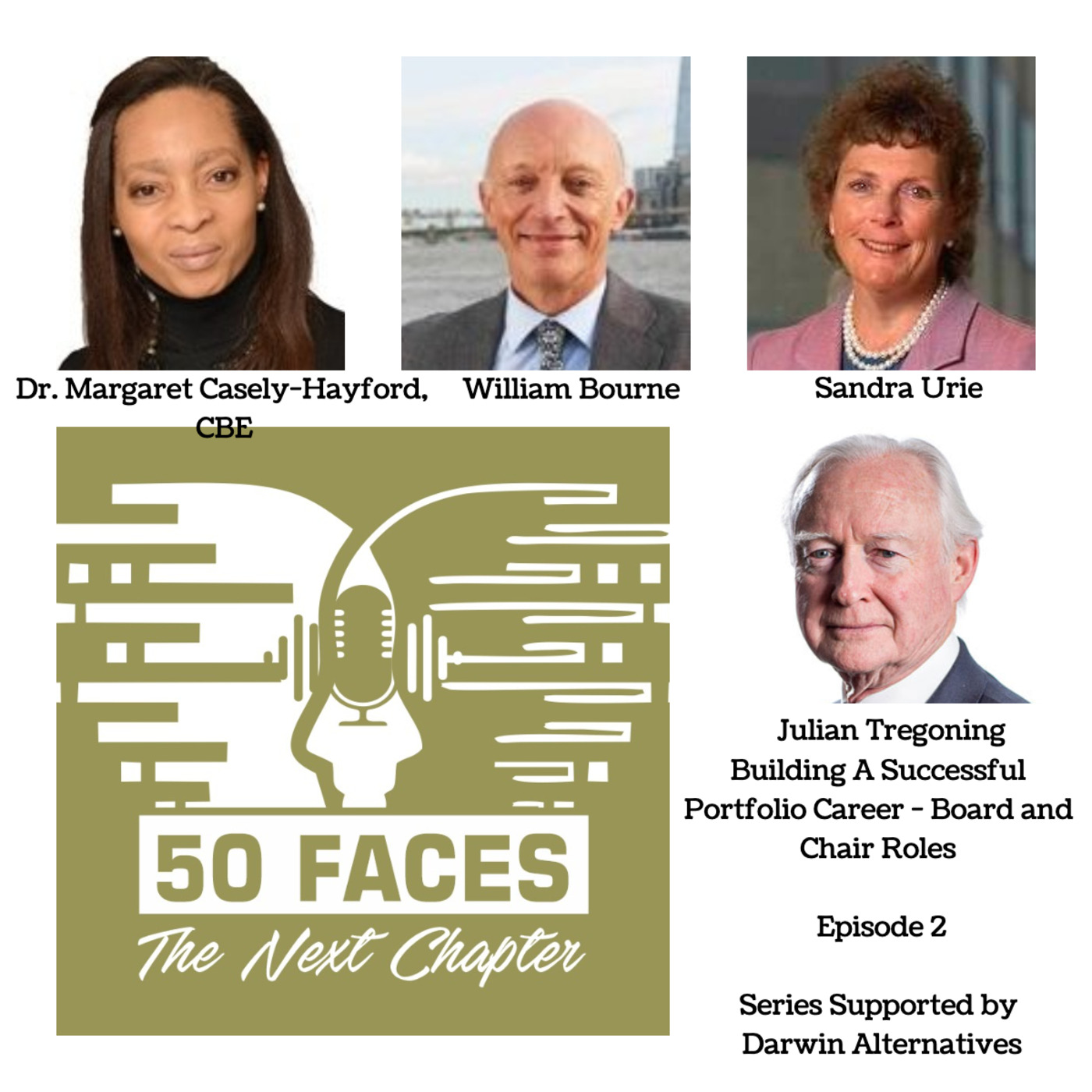
Aoifinn Devitt: This podcast series is brought to you with the kind support of Darwin Alternative Investment Management Limited, which offers innovative, alpha-driven investment solutions that are uncorrelated with traditional asset classes and feature business areas which have not previously been considered by investment funds. The firm aims to create new opportunities for investors to further diversify their portfolios and achieve stable absolute returns. I’m Aoifinn Devitt, and welcome to this special 50 Faces Focus Series, The Next Chapter, focusing on portfolio careers. In each episode of this 4-part series, we will hear from seasoned professionals about what it takes to be an effective board or committee member and chair, and we will share some nuggets of their wisdom for careers and life. In the second podcast, we speak with more veterans of the industry who are using their skills in the charity, nonprofit, and investment management sector, steering investment committees through troubled markets, helping charities to stay afloat as COVID pulled the rug from under them, rethinking the future of third-level education, and helping committees to be their most effective selves. First, we hear from the truly extraordinary Margaret Casely-Hayford, who is Chancellor of Coventry University, a role she has held for close to 4 years. She’s had an extensive career in law, having been a partner at Dentons for close to 20 years, and has held roles as NED of the NHS, as well as, as a special trustee at Great Ormond Street Hospital Children’s Charity, and chair at Shakespeare’s Globe Theatre. She’s also been a board member of Co-op. I asked her about her move into a plural career and what motivated that. You went into a plural or a portfolio career role with many board roles and committee roles. When did you make the decision to do that?
Margaret Casely-Hayford: Well, in fact, I had been on boards during my time as a solicitor, so it wasn’t just when I retired after being a lawyer, after 30-odd years as a lawyer, that I went on to boards, because I’d been on trustee boards. You mentioned Great Ormond Street Children’s Hospital Charity, I was also on the Jeffrey Museum whilst I was an associate solicitor. Those were really— gosh, it was such a steep learning curve because at that stage I didn’t know very much about how boards operated. But being a trustee on charity boards is a really great insight into the relationship between the executive and the— I would say those in supervisory, but it’s not so much supervisory support and challenge roles on the board. And then when I went to John Lewis Partnership, of course, because I was also company secretary, I was obviously involved at board level all that time as well. So all of that gave me a lot of insight, and it was then really not too artificial then to go plural, as they say, once I did retire. And it was fantastic to be given the opportunity to chair ActionAid UK And not least because it just has such a fantastic ambition to eradicate world poverty, global poverty, through focusing on the rights of women and girls and helping women and girls out of poverty. So it was just a brilliant time in my life to transition into some great boards and going on to the board of The Co-op after being at John Lewis. Again, there was a logic to it, and it was another organization with a fantastic ethic and wonderful values. So I feel I’ve been blessed as well. In the transitions that I’ve been enabled to make because I’ve been able to work with organisations that reflect my values.
Aoifinn Devitt: I was so intrigued by her experience that I wanted to know what has made her so effective in these roles, as well as her thoughts on diversity in them. Here’s an excerpt from that conversation.
Margaret Casely-Hayford: I suppose starting with an effective chair, one’s got to be able to listen, and becoming chair of ActionAid UK helped me to realise the importance of listening as ActionAid challenged itself, saying, if we are promoting the rights of women and girls, are we ourselves a feminist organization? In other words, do we allow opportunity to those whose interests and opportunities are normally marginalized? And so we realized that there was a really fundamental shift that we had to take in making sure that we checked the way we ran our enterprise so that we opened up opportunity for people to be heard appropriately, for people to be appointed fairly, recognising that even the way in which you set your criteria can at times exclude certain people. So I suppose being a good chair is understanding the ethic of the organisation, working with the ethic of the organisation, really listening to people, giving people the opportunity to bring their whole selves into that boardroom. I’ve been in some boardrooms that have been quite hostile and heard the executive on leaving saying, “Did you survive?” And I think that if people feel like that, then you’re not running the board appropriately. People should feel supported so that they can come in and really explain what’s happening within the organisation so that the board can add value in terms of giving the right direction. You can’t give the right direction if you’re not hearing the whole story. And people conceal if they’re frightened or worried and don’t trust. So you— a good chair needs to build trust and a feeling of openness, needs to make sure the organisation recognises who are the key stakeholders. And the key stakeholders, of course, need to include the people working within the organisation all the way through the employees as well as those within the supply chain and those who are our neighbours and those who are meant to benefit from the way in which the organisation runs itself. So making sure that there are, I suppose, metrics set so that everybody is aware of how to best protect and promote the interests of the different stakeholders is critical. And in particular, making sure that there’s a proper balance between those who are investing their money want a commercial outturn, and those who are investing their time because they work within the organisation, or those who are impacted by the way in which the organisation operates.
Aoifinn Devitt: That is a very interesting point. Speaking of bringing one’s whole self to the board, what are your thoughts on some of the, the recent initiatives such as the 30% Club to get more diversity onto boards? Have you seen progress in this respect, and do you welcome it?
Margaret Casely-Hayford: There has been progress. It’s very slow. I mean, it’s really interesting that you started off by talking about the 30% Club because, of course, that’s focused on women, and those who champion diversity have done really well in making boards understand the need to bring women onto boards. We’ve done less well in widening diversity to to ensure that there are ethnic minorities within the pipeline and on the board itself, and even less well to champion the interests of disabled people who can also obviously be sensibly accommodated within enterprises and on boards. And I’m actually quite pleased that now there is a much louder voice on the part of some groups, and there are charters emulating the charter that was set up for women, particularly trying to get women onto boards of the FTSE. The charter that was set up in that regard has been something that’s been copied by— I think Mary Matovu, who’s a barrister, has done this for ethnic minorities, for Black and minority ethnic people, to try to get them into some of the big corporates in the city and into the bar. At higher levels. And I know that Lord Billimoria, Karen Billimoria, has also established a charter for the CBI. And what we need next is to see the charters move into implementation so that it’s not just a statement of, well, we recognize we need to do something. It’s actually articulating what we’re doing is and putting a timeline against it so that everybody else can check the progress that’s being made, because It’s not systemic at the moment. It isn’t properly monitored. So as a consequence of that, the progress isn’t linear. You’ll get a blip when something goes wrong and everybody gets terribly excited about it, and then it all sort of subsides and disappears. And it can’t be down to one champion CEO or a good-hearted chair, because of course, if either of them leaves, resigns, retires, gets run over by a bus, all the good intention disappears with them. It’s got to be systemized and within the enterprise in order for it to take hold and be properly embedded. So yes, progress, but not fast enough. And in particular, moving into making people understand that if you do nothing, you’re actually condoning a negative. And the shift that we’ve seen recently into organizations having to look and think about whether they were actually anti-racist by doing something positive has been a really, really helpful one because it’s made people really think differently. So there’s a lot to do, but we are moving forward.
Aoifinn Devitt: And move forward she does. Margaret leaves us with some powerful words.
Margaret Casely-Hayford: For life: Yes, I would say redress the imbalance and all else will follow. So what I mean by that is try and give improved access to education opportunity to everybody, and you’ll bring the best out in them. And you know, what more can we do in the world than try to bring the best out in other people?
Aoifinn Devitt: I was introduced to Margaret by William Bourne, who is a long-time fellow advisor to the local government pension schemes in the UK. And has had over 30 years’ experience on all sides of the asset allocation business. He’s the founder of Linchpin, which provides advice on investments and governance to institutional investors, and has worked in sales as well as investment roles, including a considerable amount of time spent in Japan. He’s a frequent commentator and participant on the investment advice conference circuit and is co-host of an occasional webinar series with me in which we bring together a lively group of investors and their advisors. In addition to his substantial investment career, I asked him what input he wishes to have on boards.
Speaker C: I like to think that the outcome from my input will be better decision-making. And I don’t mean by that that I’m always right, because I’m often not right. But I do mean that I will ask the kind of the questions which maybe haven’t been asked by other people, and particularly that I will bring some diversity of thinking to the table. And I think that’s important and the real reason for diversity, because if you get people who come to the table with different views and who maybe draw different conclusions from a set of facts, you’ll have a much better debate, and that is what leads to better decision-making. Now, I could also talk about experience, etc., but there are many other people who also bring experience to the table, so I’d rather focus on providing some diversity of thought.
Aoifinn Devitt: I also asked about chair roles and the learning curve that he himself has faced there.
Speaker C: When I started acting as the Chair of the Pension Board, it was the first time I’d ever chaired a meeting and I, to be honest, I was a bit nervous. This was 6, 7 years ago. But I’ve realised that to be a good chair, you need to say as little as possible. You need to find ways of making sure that the other people in the room get their chance to say, and your role really is almost to act as a conductor to orchestrate that. Occasionally you’re going to have to come in and actually say, “Okay, we’ve talked too much about this,” or, “You need to think about that.” but it should really all come from the board members rather than the chair. And actually, I was on a meeting today with one of the councils I work with. It was a training meeting, kind of, rather than an actual decision-making meeting, but I was delighted to see that I think 5 members of my board were there out of a total of 16. Who was asking the questions? It was very largely the members of my board.
Aoifinn Devitt: Very interesting. That, I think, for chair as well as getting meetings to run on time, I think seems to be a critical measure.
Speaker C: That’s my other reputation. I don’t always succeed, but I do try to keep to time.
Aoifinn Devitt: William has blended his portfolio career with some entrepreneurial ventures, which is not uncommon among board directors. He has some lessons learned from that experience too.
Speaker C: I’ve been involved in 3 startups of my own, and 2 of them were with other people, and the first absolutely clear lesson I would give to anybody—by the way, both of them really failed—would be, be very careful who you decide to start up with and do your due diligence. In one particular case, I had just failed to read the previous board meeting minutes. I’d been provided with them, and I hadn’t read them carefully. And if I had read them, I wouldn’t have joined that particular startup. The third one was Linchpin, which I set up on my own. And setting up on your own is a lonely business. And again, I would say to people who are thinking of starting up, if you possibly can, do it with somebody else. But as per the first thought, just make sure you do your due diligence on who you’re doing it with.
Aoifinn Devitt: Some powerful words of wisdom there. We now move to one of the first role models in my own professional life, Sandy Ury, who is Chairman Emeritus at Cambridge Associates, a role she has held since 2016, when she retired as Chairman and CEO, having held the CEO role since 2001, capping an over 30-year career at the firm. Her current focuses include sustainability and impact investing. She holds board roles of Stanford Management Company, Social Finance US, the Crane Institute for Sustainability, as well as Plymouth Rock Insurance Company. Sandy has worked with investment committees for most of her professional career, and I was intrigued as to how she classifies an effectively functioning one.
Speaker D: I think about investment committees as having to direct a process. It’s about people and process, let’s put it that way. And so people need to understand that they are working for an institution and they kind of have to park their personal investment hat at the door and put their institutional one, the fiduciary hat on as a steward of the assets. I think you do have to act like it is your own money and take responsibility and be committed to it, to good outcomes. But I think you can’t let your personal preferences drive the decision-making in the committee setting. I think committees ideally are 6 to maybe as high as 10 people. I think 6 to 8 is a good number. I think a committee member should come in, not necessarily as an experienced pro in the field, but someone who is open-minded, inquisitive, willing to listen, willing to engage in debate over issues. It’s why you’re at the table, and so you need to be willing to admit what you don’t know, and if there’s a good chair, a good chair will bring that out in the committee members around the table. The chair has to be committed, dedicated, strong, supportive, not dominant though. The chair’s job is to get everybody’s opinion and to move the group, not necessarily to his or her point of view, but to the right outcome for the institution.
Aoifinn Devitt: I asked her about what makes the difference to an effective committee.
Speaker D: I believe that governance matters. I believe that having a long time horizon matters, that you can really take advantage of opportunities in the markets if you have a long view. I believe that valuation matters and that paying attention to when things are overvalued or undervalued, recognizing they can stay that way for a long period of time, but understanding what valuation means. And I also have learned at Cambridge that a willingness to be an early adopter, whether it’s of new strategies or new managers, contributes to long-term success. With proper due diligence and proper kind of scaffolding around the research, that if you’re willing to invest in venture in the ’70s, invest in hedge funds in the early ’80s, and understand that those new strategies are worth taking a look at and are worth investing in, you’re likely to see some long-term success.
Aoifinn Devitt: When we spoke, markets were strong, but we recall times that markets had not been as forgiving.
Speaker D: The markets, of course, have been just roaring during this time, so investment portfolios have performed, but the institutions themselves have faced some real economic challenges in terms of whether it’s a performing arts organization or, you know, a museum in terms of their revenues. And so figuring out how to help them and help think about weathering this pandemic or weathering the global financial crisis. I think that for people who’ve been at it a long time, and many people sitting on investment committees have been at it a long time, they understand that when markets are high, and I think particularly coming out of the late ’90s when markets, when the tech boom was raging and the valuation just wasn’t there, you just, there weren’t, companies with no earnings that had these incredible valuations. I think when people experience something like that, they understand that when markets are high, you need advice. When markets are low, you need advice. That there is a— having a thoughtful, trusted partner with you through the highs and the lows is a good thing to have. And living through those periods brings some wisdom and some reasonableness about the highs and lows, and also reminds people about the long term. These institutions have existed for a very long time, and we’ll work together to make sure they do well beyond when we’re all still sitting at our desks and no longer sitting at our desks.
Aoifinn Devitt: And after such a long career, what words of wisdom would Sandy have for the next generation?
Speaker D: Yeah, my daughter and I have a motto that we’ve had for a long time, and it’s a funny one because neither of us are runners, but it is: when you’re in the marathon, just keep running. So I, I think I would tell people to be willing to be bold.
Aoifinn Devitt: Finally, on this podcast, we meet with another legend on the London-based investment management scene, Julian Turgoning. Julian has worked in the asset management business for many years, having had senior roles in the Fleming’s Group. He’s now chairman of Halo Global Asset Management and recently retired from the investment committee for SOL, a multi-employer defined benefit scheme for the non-academic employees of the University of London, which is where we met. I asked Julian for his advice on one’s first approach to a board.
Speaker E: There’s one other thing that I would just like to say, particularly if this is listened to by anybody who’s sort of quite early in their career, but perhaps as they’re coming up towards board level, they should perhaps start to— if they’re wary of that, and some people are quite not scared of joining a board, but they’re worried, concerned about it, I would counsel that they consider doing something outside their business like say, joining a charity committee. But it must be a charity that they’re interested in. So don’t just join any old charity, do something that’s going to interest you. Because seeing people outside your firm and the way they react to issues and the way they behave becomes very important in understanding people. It doesn’t have to be a charity, it might be a sports club or a governor of a school. Now, as it happens, in addition to being chairman of the equivalent of the Investment Association many years ago, and the European equivalent. I was also chairman of the City of London Club, so I met a lot of people in different sectors of the city quite early on. I also became master of one of the senior livery companies in the city, and I was master at the beginning of this century. And the other thing that I did was I chaired a very major public school in Northamptonshire for 7 years, having been chairman of the finance committee before that. So I was always trying to do things, if you like, outside the envelope of the city, outside the envelope of my job, partly because I like working with people. I’m quite collegiate, if you like, and I think that, that is very important. And although technology rules today, and I may be a bit behind the curve on some things technological, I do think that those early principles and the fact of doing things outside the envelope of your day job is very important. So I would end by simply saying good luck to anybody coming to the city today. But anybody who’s thinking of leaving school today, or is leaving school today to go to university, I would say consider doing something like technology or engineering, not necessarily just economics or other financial subject.
Aoifinn Devitt: So following your passion and interests, learning to think like a fiduciary, building a process, and listening deeply— some tips from our seasoned board and committee members on this episode. Thank you for listening to the 50 Faces Focus: Next Chapter podcast. I hope you’ve enjoyed listening to these tips, and please follow us on LinkedIn, Twitter, Apple Podcasts, Spotify, or wherever you get your podcasts. This podcast is for informational purposes only and should not be construed as investment advice, and all views are personal and should not be attributed to the organizations and affiliations of the host or any guest.
Aoifinn Devitt: This podcast series is brought to you with the kind support of Darwin Alternative Investment Management Limited, which offers innovative, alpha-driven investment solutions that are uncorrelated with traditional asset classes and feature business areas which have not previously been considered by investment funds. The firm aims to create new opportunities for investors to further diversify their portfolios and achieve stable absolute returns. I’m Aoifinn Devitt, and welcome to this special 50 Faces Focus Series, The Next Chapter, focusing on portfolio careers. In each episode of this 4-part series, we will hear from seasoned professionals about what it takes to be an effective board or committee member and chair, and we will share some nuggets of their wisdom for careers and life. In the second podcast, we speak with more veterans of the industry who are using their skills in the charity, nonprofit, and investment management sector, steering investment committees through troubled markets, helping charities to stay afloat as COVID pulled the rug from under them, rethinking the future of third-level education, and helping committees to be their most effective selves. First, we hear from the truly extraordinary Margaret Casely-Hayford, who is Chancellor of Coventry University, a role she has held for close to 4 years. She’s had an extensive career in law, having been a partner at Dentons for close to 20 years, and has held roles as NED of the NHS, as well as, as a special trustee at Great Ormond Street Hospital Children’s Charity, and chair at Shakespeare’s Globe Theatre. She’s also been a board member of Co-op. I asked her about her move into a plural career and what motivated that. You went into a plural or a portfolio career role with many board roles and committee roles. When did you make the decision to do that?
Margaret Casely-Hayford: Well, in fact, I had been on boards during my time as a solicitor, so it wasn’t just when I retired after being a lawyer, after 30-odd years as a lawyer, that I went on to boards, because I’d been on trustee boards. You mentioned Great Ormond Street Children’s Hospital Charity, I was also on the Jeffrey Museum whilst I was an associate solicitor. Those were really— gosh, it was such a steep learning curve because at that stage I didn’t know very much about how boards operated. But being a trustee on charity boards is a really great insight into the relationship between the executive and the— I would say those in supervisory, but it’s not so much supervisory support and challenge roles on the board. And then when I went to John Lewis Partnership, of course, because I was also company secretary, I was obviously involved at board level all that time as well. So all of that gave me a lot of insight, and it was then really not too artificial then to go plural, as they say, once I did retire. And it was fantastic to be given the opportunity to chair ActionAid UK And not least because it just has such a fantastic ambition to eradicate world poverty, global poverty, through focusing on the rights of women and girls and helping women and girls out of poverty. So it was just a brilliant time in my life to transition into some great boards and going on to the board of The Co-op after being at John Lewis. Again, there was a logic to it, and it was another organization with a fantastic ethic and wonderful values. So I feel I’ve been blessed as well. In the transitions that I’ve been enabled to make because I’ve been able to work with organisations that reflect my values.
Aoifinn Devitt: I was so intrigued by her experience that I wanted to know what has made her so effective in these roles, as well as her thoughts on diversity in them. Here’s an excerpt from that conversation.
Margaret Casely-Hayford: I suppose starting with an effective chair, one’s got to be able to listen, and becoming chair of ActionAid UK helped me to realise the importance of listening as ActionAid challenged itself, saying, if we are promoting the rights of women and girls, are we ourselves a feminist organization? In other words, do we allow opportunity to those whose interests and opportunities are normally marginalized? And so we realized that there was a really fundamental shift that we had to take in making sure that we checked the way we ran our enterprise so that we opened up opportunity for people to be heard appropriately, for people to be appointed fairly, recognising that even the way in which you set your criteria can at times exclude certain people. So I suppose being a good chair is understanding the ethic of the organisation, working with the ethic of the organisation, really listening to people, giving people the opportunity to bring their whole selves into that boardroom. I’ve been in some boardrooms that have been quite hostile and heard the executive on leaving saying, “Did you survive?” And I think that if people feel like that, then you’re not running the board appropriately. People should feel supported so that they can come in and really explain what’s happening within the organisation so that the board can add value in terms of giving the right direction. You can’t give the right direction if you’re not hearing the whole story. And people conceal if they’re frightened or worried and don’t trust. So you— a good chair needs to build trust and a feeling of openness, needs to make sure the organisation recognises who are the key stakeholders. And the key stakeholders, of course, need to include the people working within the organisation all the way through the employees as well as those within the supply chain and those who are our neighbours and those who are meant to benefit from the way in which the organisation runs itself. So making sure that there are, I suppose, metrics set so that everybody is aware of how to best protect and promote the interests of the different stakeholders is critical. And in particular, making sure that there’s a proper balance between those who are investing their money want a commercial outturn, and those who are investing their time because they work within the organisation, or those who are impacted by the way in which the organisation operates.
Aoifinn Devitt: That is a very interesting point. Speaking of bringing one’s whole self to the board, what are your thoughts on some of the, the recent initiatives such as the 30% Club to get more diversity onto boards? Have you seen progress in this respect, and do you welcome it?
Margaret Casely-Hayford: There has been progress. It’s very slow. I mean, it’s really interesting that you started off by talking about the 30% Club because, of course, that’s focused on women, and those who champion diversity have done really well in making boards understand the need to bring women onto boards. We’ve done less well in widening diversity to to ensure that there are ethnic minorities within the pipeline and on the board itself, and even less well to champion the interests of disabled people who can also obviously be sensibly accommodated within enterprises and on boards. And I’m actually quite pleased that now there is a much louder voice on the part of some groups, and there are charters emulating the charter that was set up for women, particularly trying to get women onto boards of the FTSE. The charter that was set up in that regard has been something that’s been copied by— I think Mary Matovu, who’s a barrister, has done this for ethnic minorities, for Black and minority ethnic people, to try to get them into some of the big corporates in the city and into the bar. At higher levels. And I know that Lord Billimoria, Karen Billimoria, has also established a charter for the CBI. And what we need next is to see the charters move into implementation so that it’s not just a statement of, well, we recognize we need to do something. It’s actually articulating what we’re doing is and putting a timeline against it so that everybody else can check the progress that’s being made, because It’s not systemic at the moment. It isn’t properly monitored. So as a consequence of that, the progress isn’t linear. You’ll get a blip when something goes wrong and everybody gets terribly excited about it, and then it all sort of subsides and disappears. And it can’t be down to one champion CEO or a good-hearted chair, because of course, if either of them leaves, resigns, retires, gets run over by a bus, all the good intention disappears with them. It’s got to be systemized and within the enterprise in order for it to take hold and be properly embedded. So yes, progress, but not fast enough. And in particular, moving into making people understand that if you do nothing, you’re actually condoning a negative. And the shift that we’ve seen recently into organizations having to look and think about whether they were actually anti-racist by doing something positive has been a really, really helpful one because it’s made people really think differently. So there’s a lot to do, but we are moving forward.
Aoifinn Devitt: And move forward she does. Margaret leaves us with some powerful words.
Margaret Casely-Hayford: For life: Yes, I would say redress the imbalance and all else will follow. So what I mean by that is try and give improved access to education opportunity to everybody, and you’ll bring the best out in them. And you know, what more can we do in the world than try to bring the best out in other people?
Aoifinn Devitt: I was introduced to Margaret by William Bourne, who is a long-time fellow advisor to the local government pension schemes in the UK. And has had over 30 years’ experience on all sides of the asset allocation business. He’s the founder of Linchpin, which provides advice on investments and governance to institutional investors, and has worked in sales as well as investment roles, including a considerable amount of time spent in Japan. He’s a frequent commentator and participant on the investment advice conference circuit and is co-host of an occasional webinar series with me in which we bring together a lively group of investors and their advisors. In addition to his substantial investment career, I asked him what input he wishes to have on boards.
Speaker C: I like to think that the outcome from my input will be better decision-making. And I don’t mean by that that I’m always right, because I’m often not right. But I do mean that I will ask the kind of the questions which maybe haven’t been asked by other people, and particularly that I will bring some diversity of thinking to the table. And I think that’s important and the real reason for diversity, because if you get people who come to the table with different views and who maybe draw different conclusions from a set of facts, you’ll have a much better debate, and that is what leads to better decision-making. Now, I could also talk about experience, etc., but there are many other people who also bring experience to the table, so I’d rather focus on providing some diversity of thought.
Aoifinn Devitt: I also asked about chair roles and the learning curve that he himself has faced there.
Speaker C: When I started acting as the Chair of the Pension Board, it was the first time I’d ever chaired a meeting and I, to be honest, I was a bit nervous. This was 6, 7 years ago. But I’ve realised that to be a good chair, you need to say as little as possible. You need to find ways of making sure that the other people in the room get their chance to say, and your role really is almost to act as a conductor to orchestrate that. Occasionally you’re going to have to come in and actually say, “Okay, we’ve talked too much about this,” or, “You need to think about that.” but it should really all come from the board members rather than the chair. And actually, I was on a meeting today with one of the councils I work with. It was a training meeting, kind of, rather than an actual decision-making meeting, but I was delighted to see that I think 5 members of my board were there out of a total of 16. Who was asking the questions? It was very largely the members of my board.
Aoifinn Devitt: Very interesting. That, I think, for chair as well as getting meetings to run on time, I think seems to be a critical measure.
Speaker C: That’s my other reputation. I don’t always succeed, but I do try to keep to time.
Aoifinn Devitt: William has blended his portfolio career with some entrepreneurial ventures, which is not uncommon among board directors. He has some lessons learned from that experience too.
Speaker C: I’ve been involved in 3 startups of my own, and 2 of them were with other people, and the first absolutely clear lesson I would give to anybody—by the way, both of them really failed—would be, be very careful who you decide to start up with and do your due diligence. In one particular case, I had just failed to read the previous board meeting minutes. I’d been provided with them, and I hadn’t read them carefully. And if I had read them, I wouldn’t have joined that particular startup. The third one was Linchpin, which I set up on my own. And setting up on your own is a lonely business. And again, I would say to people who are thinking of starting up, if you possibly can, do it with somebody else. But as per the first thought, just make sure you do your due diligence on who you’re doing it with.
Aoifinn Devitt: Some powerful words of wisdom there. We now move to one of the first role models in my own professional life, Sandy Ury, who is Chairman Emeritus at Cambridge Associates, a role she has held since 2016, when she retired as Chairman and CEO, having held the CEO role since 2001, capping an over 30-year career at the firm. Her current focuses include sustainability and impact investing. She holds board roles of Stanford Management Company, Social Finance US, the Crane Institute for Sustainability, as well as Plymouth Rock Insurance Company. Sandy has worked with investment committees for most of her professional career, and I was intrigued as to how she classifies an effectively functioning one.
Speaker D: I think about investment committees as having to direct a process. It’s about people and process, let’s put it that way. And so people need to understand that they are working for an institution and they kind of have to park their personal investment hat at the door and put their institutional one, the fiduciary hat on as a steward of the assets. I think you do have to act like it is your own money and take responsibility and be committed to it, to good outcomes. But I think you can’t let your personal preferences drive the decision-making in the committee setting. I think committees ideally are 6 to maybe as high as 10 people. I think 6 to 8 is a good number. I think a committee member should come in, not necessarily as an experienced pro in the field, but someone who is open-minded, inquisitive, willing to listen, willing to engage in debate over issues. It’s why you’re at the table, and so you need to be willing to admit what you don’t know, and if there’s a good chair, a good chair will bring that out in the committee members around the table. The chair has to be committed, dedicated, strong, supportive, not dominant though. The chair’s job is to get everybody’s opinion and to move the group, not necessarily to his or her point of view, but to the right outcome for the institution.
Aoifinn Devitt: I asked her about what makes the difference to an effective committee.
Speaker D: I believe that governance matters. I believe that having a long time horizon matters, that you can really take advantage of opportunities in the markets if you have a long view. I believe that valuation matters and that paying attention to when things are overvalued or undervalued, recognizing they can stay that way for a long period of time, but understanding what valuation means. And I also have learned at Cambridge that a willingness to be an early adopter, whether it’s of new strategies or new managers, contributes to long-term success. With proper due diligence and proper kind of scaffolding around the research, that if you’re willing to invest in venture in the ’70s, invest in hedge funds in the early ’80s, and understand that those new strategies are worth taking a look at and are worth investing in, you’re likely to see some long-term success.
Aoifinn Devitt: When we spoke, markets were strong, but we recall times that markets had not been as forgiving.
Speaker D: The markets, of course, have been just roaring during this time, so investment portfolios have performed, but the institutions themselves have faced some real economic challenges in terms of whether it’s a performing arts organization or, you know, a museum in terms of their revenues. And so figuring out how to help them and help think about weathering this pandemic or weathering the global financial crisis. I think that for people who’ve been at it a long time, and many people sitting on investment committees have been at it a long time, they understand that when markets are high, and I think particularly coming out of the late ’90s when markets, when the tech boom was raging and the valuation just wasn’t there, you just, there weren’t, companies with no earnings that had these incredible valuations. I think when people experience something like that, they understand that when markets are high, you need advice. When markets are low, you need advice. That there is a— having a thoughtful, trusted partner with you through the highs and the lows is a good thing to have. And living through those periods brings some wisdom and some reasonableness about the highs and lows, and also reminds people about the long term. These institutions have existed for a very long time, and we’ll work together to make sure they do well beyond when we’re all still sitting at our desks and no longer sitting at our desks.
Aoifinn Devitt: And after such a long career, what words of wisdom would Sandy have for the next generation?
Speaker D: Yeah, my daughter and I have a motto that we’ve had for a long time, and it’s a funny one because neither of us are runners, but it is: when you’re in the marathon, just keep running. So I, I think I would tell people to be willing to be bold.
Aoifinn Devitt: Finally, on this podcast, we meet with another legend on the London-based investment management scene, Julian Turgoning. Julian has worked in the asset management business for many years, having had senior roles in the Fleming’s Group. He’s now chairman of Halo Global Asset Management and recently retired from the investment committee for SOL, a multi-employer defined benefit scheme for the non-academic employees of the University of London, which is where we met. I asked Julian for his advice on one’s first approach to a board.
Speaker E: There’s one other thing that I would just like to say, particularly if this is listened to by anybody who’s sort of quite early in their career, but perhaps as they’re coming up towards board level, they should perhaps start to— if they’re wary of that, and some people are quite not scared of joining a board, but they’re worried, concerned about it, I would counsel that they consider doing something outside their business like say, joining a charity committee. But it must be a charity that they’re interested in. So don’t just join any old charity, do something that’s going to interest you. Because seeing people outside your firm and the way they react to issues and the way they behave becomes very important in understanding people. It doesn’t have to be a charity, it might be a sports club or a governor of a school. Now, as it happens, in addition to being chairman of the equivalent of the Investment Association many years ago, and the European equivalent. I was also chairman of the City of London Club, so I met a lot of people in different sectors of the city quite early on. I also became master of one of the senior livery companies in the city, and I was master at the beginning of this century. And the other thing that I did was I chaired a very major public school in Northamptonshire for 7 years, having been chairman of the finance committee before that. So I was always trying to do things, if you like, outside the envelope of the city, outside the envelope of my job, partly because I like working with people. I’m quite collegiate, if you like, and I think that, that is very important. And although technology rules today, and I may be a bit behind the curve on some things technological, I do think that those early principles and the fact of doing things outside the envelope of your day job is very important. So I would end by simply saying good luck to anybody coming to the city today. But anybody who’s thinking of leaving school today, or is leaving school today to go to university, I would say consider doing something like technology or engineering, not necessarily just economics or other financial subject.
Aoifinn Devitt: So following your passion and interests, learning to think like a fiduciary, building a process, and listening deeply— some tips from our seasoned board and committee members on this episode. Thank you for listening to the 50 Faces Focus: Next Chapter podcast. I hope you’ve enjoyed listening to these tips, and please follow us on LinkedIn, Twitter, Apple Podcasts, Spotify, or wherever you get your podcasts. This podcast is for informational purposes only and should not be construed as investment advice, and all views are personal and should not be attributed to the organizations and affiliations of the host or any guest.