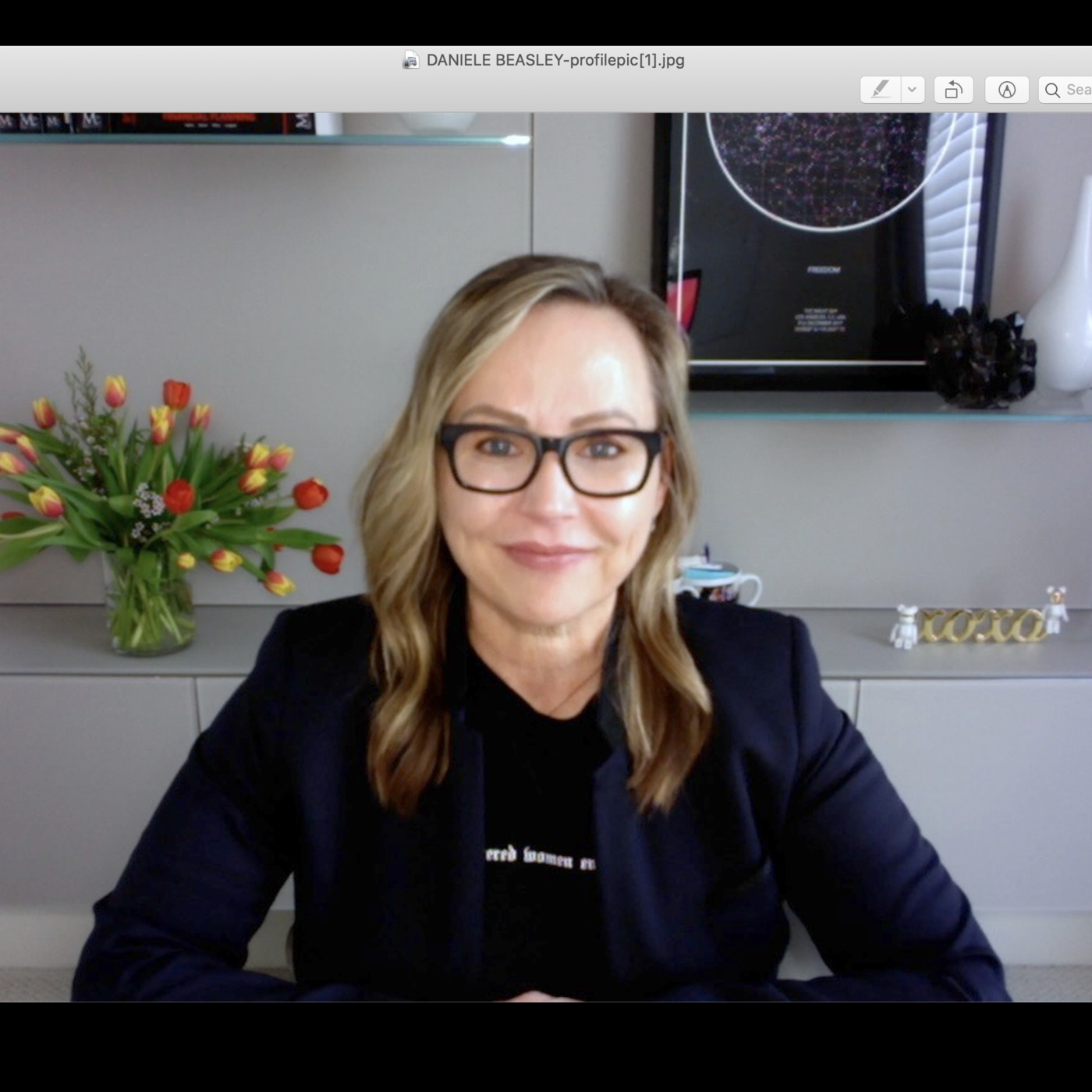
Aoifinn Devitt: We all talk about financial literacy, but is this something only for the younger generations, or do we all need to be made more aware of our knowledge gaps for different stages in our own financial roadmap? Our next guest is on a mission to address this. I’m Aoifinn Devitt, and welcome to the 50 Faces Podcast, a podcast committed to revealing the richness and diversity of the world of investment by focusing on its people and their stories. I’m joined today by Danielle Beazley, who’s a board member at Mission Bank, a role she has held since February 2021. And she’s also a chief client officer at Apex Financial Advisors. She’s a certified financial planner currently focused on using her 30 years’ experience in the sector to educate and mentor clients in what she terms her midlife reset. Welcome, Danielle. Thanks for joining me today.
Daniele Beasley: Thank you, Aoifinn, for having me.
Aoifinn Devitt: Can we start by talking a little bit about your current roles? What do you seek to bring to your role as a board member, and what makes an effective board member in your view?
Daniele Beasley: The number one most important thing why you’re there on the board is to increase shareholder value. I think it’s important to remember that you are there as a representative for the shareholders. It’s important to put together a board with experienced individuals with broad expertise. I was excited to join the board because they were seeking somebody who specialized in the financial services sector, and it was a perfect fit.
Aoifinn Devitt: Just going back then to your journey into that role, can you speak a bit about how you entered the financial sector many years ago?
Daniele Beasley: It’s a funny story, Evelyn. You know, I remember back in high school when I was looking at a career aptitude test, what do you want to be when you grow up? My grandparents were incredibly influential in my life. And my grandfather, every morning I would sit down at the table with him and he would play solitaire. And I knew him to be a potato broker. So when I sat down at that career aptitude test, and I love numbers. And I just said, stockbroker, potato broker, that’s what my grandpa does. So, you know, it was either that or a doctor. And I just knew that, you know, I wanted to follow in what I thought was his footsteps. Obviously, a potato broker is not a stockbroker, but ultimately the passion behind numbers and perfection in numbers and, you know, pennies matter led me to pursue a career in the financial services industry.
Aoifinn Devitt: And did it take any surprising twists or turns along the way?
Daniele Beasley: Absolutely. I think, you know, I saw an article earlier this week where, you know, we think that our career path is just a natural progression upward when sometimes it looks like an extremely volatile market chart. You know, and while before I turned 50, my career trajectory matched that path, I kind of decided in the middle of my career, I woke up and it’s like, what do I really want to be? I found myself, I look back in high school, what do I want to do when I grow up? The reality is we’re all living longer, so what do I want to do with the next 50 years of my life? I took a bold leap and said, some of my friends told me I was brave. I left a firm that I co-founded and built over $1 billion in assets because I wanted to focus on helping educate my clients and mentor my clients to achieve their financial goals. And every goal is different. So I took the knowledge that I learned running these businesses, and I want to apply it to not only the boards in which I work on and helping those shareholders, but specifically work individually with clients and help handhold them through the different stages of asset accumulation throughout their life.
Aoifinn Devitt: It’s really interesting because I’ve spoken to many other guests on this podcast about financial literacy, and the focus is always on young people, that there’s a gap there, maybe even at the very young age. They want to encourage prudence when it comes to financial affairs. Do you perceive that that gap can exist even as people get older and move towards retirement? Is there still a financial literacy gap there?
Daniele Beasley: I think there always will be additional knowledge to acquire, there’s a tagline I like. It’s not how much you make, it’s about how much you keep. And that really goes into our taxes. With every administration that comes in, our taxes are going to change. So that is an ever-moving target, whether it’s the estate, estate planning max has changed, your retirement, the amount that you can contribute to your 401(k) has changed. But those numbers will always be a moving target. Therefore, We always need to be well immersed in current legislation and current rules, always living in the now, but always with a projection in short-term and long-term.
Aoifinn Devitt: What is it that you like most about working with individuals and helping them to plan their future?
Daniele Beasley: Just the reassurance that with the educational background and the knowledge of why they are making these financial decisions, to make sure that they’re aligned with their long-term goals and short-term goals. You know, that’s the most meaningful for me, just to help ease their pain throughout all economic cycles. People just want to know, am I still on track to retire? Can I still send my grandchildren through college? Am I going to be able to retire? I don’t have a partner to be able to rely on. Is Social Security going to be there? Just to be that trusted voice to calm their fears and ease their pain.
Aoifinn Devitt: And you’re based in California, where I know there have been recent— I’m not sure if it’s regulation or requirement around more diversity at board level. What are you seeing now in terms of diversity, both in boards and in the sector in which you work, the financial services sector as a whole?
Daniele Beasley: There definitely has been a lot of movement in board diversity. And, you know, there was a group— it’s, I think it’s now 50 for 50, used to be, you know, 20. There’s legislation that was passed to mandate that every California domiciled public company had at least 20% of their board members be outside, represented by females. Now you see, I think the COVID environment really accelerated that across the entire United States and, and globally. You know, quite honestly, diversity not only by gender, but by race and by sexual orientation, which I think California was definitely a thought leader in the space, putting one of the first states to put forth that legislation. And you are just seeing it adopted, mass adoption has been fantastic.
Aoifinn Devitt: As a female Certified Financial Planner working with, I presume, a mix of male and female clients, do you see that there is an awareness of the need to essentially embrace more diversity in the client base and respond differently to women as clients?
Daniele Beasley: Every client is different. I do work with both men and females all along different stages in the financial planning process, or we call it asset accumulation, whether you’re younger, which is where you’re more focused on asset accumulation, whereas when you get older, you’re more on trying to manage and make tax-efficient ways to withdraw those funds. So every client is absolutely different. The common theme is people tend to avoid it. It’s like going to the dentist. It’s something that you don’t really want to do. But once that they have gone through the process and understand, once we’ve created a plan, it alleviates the pain. Know, You what keeps you up at night is a question that I often ask my clients. And so we devise a plan, whether you are male or female, to help alleviate that. That fear that can all help us sleep better at night.
Aoifinn Devitt: In terms of the financial services industry as a whole, people like yourself in the planning role, do you think that that is as diverse? I work with a number of institutional asset managers and people in the institutional arena, and it definitely is not as well represented as it should be. Is your sector more represented from the planner’s standpoint?
Daniele Beasley: Now, I think all across the board, and especially women in portfolio management roles, which are the people that are making the investment decisions, there’s, across the board, there’s mass underrepresentation with females, but we’re starting to see that trend change. I think that the newer generation of financial planners, I don’t have the statistic in front of me, there are more women. The CFP Board has a program where you— a mentorship program, which I believe is incredibly important. A lot of us need a mentor and especially a female mentor in the space if you are a female, just to, I would say, the love language of finance. I’ve been honored to be part of that program mentoring somebody, a young candidate at Apex, and welcome the opportunity to mentor others.
Aoifinn Devitt: And just before we turn back to some other aspects of your personal journey, I’d just love to ask you in terms of where you are now from your vantage point in investment, what are some of the, the key things on your mind when you work with clients? And you mentioned the tax aspects. Are they focused on inflation? Are they focused on maybe other alternative assets, just on wealth conservation?
Daniele Beasley: All across the board, Aoifinn. But generally speaking, I think that it’s just, you know, we, we talk a lot about diversification because when there’s been run-ups in the market over the last year, everybody, you know, we call them retail investors. Retail investor is somebody who buys it in their Robinhood account versus it’s purchased by an institutional asset manager through your Fidelity account. People think they’re the smartest people in the world. I kind of equate it back to the tulip bulb era where Tulip bulbs were being sold at something about 18,000% of the cost, but it was just everybody thought this is where I’m going to spend my money. It continues to go up and there’s a fallacy in that. I’ve had more conversations about Bitcoin and Tesla and some of these single stock anomalies in the last year. Why? I believe in the 80/20 rule. Well, Let’s leave 80% of your portfolio well-diversified, low-cost, aligned with not only your long-term goals, but maybe some short-term goals, but 20% of it, or even maybe smaller, buy the Tesla if you want. That can be your play money, but don’t spend all of your retirement on speculation.
Aoifinn Devitt: It’s interesting how similar those sentiments are across the institutional spectrum as well when we speak with pension funds. So now going back into your personal story, Were there any mistakes that you made perhaps over the years or any setbacks or challenges that you learned lessons from?
Daniele Beasley: Well, I would say we’re here talking about my midlife reset. My decision to leave a firm that I co-founded with my business partner of 18 years was very brave, my friends would say. I left a job that I knew very well. I built this company, but it didn’t speak to my soul or to who I was as a person and how I wanted to spend the rest of my life. I was continuously having questions from my clients, those pain questions. Their husband had passed away. Am I going to have enough money to last me through retirement? What’s my legacy? Will I have money to leave over to our children? And so having those conversations, that’s how I wanted to spend my day. So I had to be brave enough to walk away from a company that I co-founded, that I was doing very well, but I wasn’t happy. And there’s an article in The Wall Street Journal today that as you look towards retirement, really what it comes down to is, are you happy? And there’s, there’s a chart in there where it talks about as we near retirement, we are having more free time and we align our interests with our goals and what makes us happy. You know, looking back at my career, building a business from $800 million to $4 billion, yes, that was great. And yes, that was a great achievement. And yes, I paid my bills, but there wasn’t any happiness in it. I didn’t really have a direct connect to another human being and see how it impacted my knowledge and my work, how it impacted their lives. And so I, at first I thought, wow, what did I do? Just walked away from this. I sold my interest. And, you know, and so there was a lot of soul searching here, but it took me following my intuition where I’m following what I liked. I liked having those conversations with my clients. I liked solving those problems for my clients. But in, in that construct, in an active management environment, when my personal philosophy was more aligned with 80/20, some passive is completely fine, low cost, you know, taking advantage of those opportunities in the markets, you know, I had to walk away to do what was going to make me happy through the next 50 years of my life.
Aoifinn Devitt: When you look across the course of your career, were there any key people who influenced you or really left an impression that you can share?
Daniele Beasley: Well, besides my grandparents that I talk about, there’s one thing that keeps true today. One of my mentors at Reed, Connor Birdwell told me that at the end of every year, you should create your own personal financial statements. And while I was CFO of the firm and I was doing our financial statements, I had never really done it for myself. Yes, I reconciled my own checking account, but I had never done that. So literally creating— and that was the beginning. And this is in 2000, the year 2000. I started creating my personal financial statements, projecting it out, my statement of net worth, projecting it out short-term, long-term, and defining those goals. And that really is what led me. That was the first time where I was like, oh, this is what a financial planner does. Yes, investments are part of it, but it’s also the behavioral modifications that need to be made. In terms of saving and investing. It correlates with all things in life. So I’ll never forget that. And I still— that’s what I do on New Year’s Eve. I sit down and I take a look and project out and define goals for myself, not only financially, but personally.
Aoifinn Devitt: Besides that very solid discipline of defining goals, are there any other words of wisdom or creed or mottos that you use or have learned from others through life?
Daniele Beasley: Always continue to invest. Following the 80/20 rule, 80% continue to invest in yourself, not only through your education, but also, you know, invest in yourself financially. Pay yourself first. Some people think savings, you know, is a bad thing to take away that 10% and put in savings. But think of it as behavior modification. I’m paying myself. And that other 20%, continue to invest in others, you know, mentor others, share your learnings with others. That’s another way that where, you know, you can leave an impact on younger generations.
Aoifinn Devitt: And looking back now at your younger self, you said your 30-year career in financial planning and financial services industry, are there any words of wisdom that you would want to give to that younger self? Anything you know now that you wish you had known then?
Daniele Beasley: Always remember to give. People say give back, but I think it’s, you know, give. Giving back kind of assumes that you’ve taken something from somebody. So continue to give back, whether that’s mentor, help somebody. If you’re at the grocery store and you see somebody struggling, you know, just kindness or giving in many different ways. Never go a day without, without doing that.
Aoifinn Devitt: Well, thank you so much, Danielle. I think you really do embody what it is to give because you are every day, I think, giving your wisdom and also I think ensuring that the next generation is on a solid footing when it comes to retirement. And thank you very much for sharing your insights here with us. And we will put in the show notes to this episode some resources that you’ve kindly provided about women on boards and where any women who are listening who are interested in pursuing those positions could look.
Daniele Beasley: Thank you, Aoifinn, for the time. It’s been a pleasure.
Aoifinn Devitt: I’m Aoifinn Devitt. Thank you for listening to the 50 Faces Podcast. If you liked what you heard and would like to tune in to hear more inspiring investors and their personal Journeys, please subscribe on Apple Podcasts or wherever you get your podcasts. Series 4 is brought to you with the kind support of Federated Hermes Inc., a leading global investment manager guided by their conviction that responsible investing is the best way to create wealth over the long term. Their investment solutions span equity, fixed income, alternative and private markets, multi-asset and liquidity strategies, and a range of separately managed accounts distributed through intermediaries worldwide. This podcast is for informational purposes only and should not be construed as investment advice, and all views are personal and should not be attributed to the organizations and affiliations of the host or any guest.
Aoifinn Devitt: We all talk about financial literacy, but is this something only for the younger generations, or do we all need to be made more aware of our knowledge gaps for different stages in our own financial roadmap? Our next guest is on a mission to address this. I’m Aoifinn Devitt, and welcome to the 50 Faces Podcast, a podcast committed to revealing the richness and diversity of the world of investment by focusing on its people and their stories. I’m joined today by Danielle Beazley, who’s a board member at Mission Bank, a role she has held since February 2021. And she’s also a chief client officer at Apex Financial Advisors. She’s a certified financial planner currently focused on using her 30 years’ experience in the sector to educate and mentor clients in what she terms her midlife reset. Welcome, Danielle. Thanks for joining me today.
Daniele Beasley: Thank you, Aoifinn, for having me.
Aoifinn Devitt: Can we start by talking a little bit about your current roles? What do you seek to bring to your role as a board member, and what makes an effective board member in your view?
Daniele Beasley: The number one most important thing why you’re there on the board is to increase shareholder value. I think it’s important to remember that you are there as a representative for the shareholders. It’s important to put together a board with experienced individuals with broad expertise. I was excited to join the board because they were seeking somebody who specialized in the financial services sector, and it was a perfect fit.
Aoifinn Devitt: Just going back then to your journey into that role, can you speak a bit about how you entered the financial sector many years ago?
Daniele Beasley: It’s a funny story, Evelyn. You know, I remember back in high school when I was looking at a career aptitude test, what do you want to be when you grow up? My grandparents were incredibly influential in my life. And my grandfather, every morning I would sit down at the table with him and he would play solitaire. And I knew him to be a potato broker. So when I sat down at that career aptitude test, and I love numbers. And I just said, stockbroker, potato broker, that’s what my grandpa does. So, you know, it was either that or a doctor. And I just knew that, you know, I wanted to follow in what I thought was his footsteps. Obviously, a potato broker is not a stockbroker, but ultimately the passion behind numbers and perfection in numbers and, you know, pennies matter led me to pursue a career in the financial services industry.
Aoifinn Devitt: And did it take any surprising twists or turns along the way?
Daniele Beasley: Absolutely. I think, you know, I saw an article earlier this week where, you know, we think that our career path is just a natural progression upward when sometimes it looks like an extremely volatile market chart. You know, and while before I turned 50, my career trajectory matched that path, I kind of decided in the middle of my career, I woke up and it’s like, what do I really want to be? I found myself, I look back in high school, what do I want to do when I grow up? The reality is we’re all living longer, so what do I want to do with the next 50 years of my life? I took a bold leap and said, some of my friends told me I was brave. I left a firm that I co-founded and built over $1 billion in assets because I wanted to focus on helping educate my clients and mentor my clients to achieve their financial goals. And every goal is different. So I took the knowledge that I learned running these businesses, and I want to apply it to not only the boards in which I work on and helping those shareholders, but specifically work individually with clients and help handhold them through the different stages of asset accumulation throughout their life.
Aoifinn Devitt: It’s really interesting because I’ve spoken to many other guests on this podcast about financial literacy, and the focus is always on young people, that there’s a gap there, maybe even at the very young age. They want to encourage prudence when it comes to financial affairs. Do you perceive that that gap can exist even as people get older and move towards retirement? Is there still a financial literacy gap there?
Daniele Beasley: I think there always will be additional knowledge to acquire, there’s a tagline I like. It’s not how much you make, it’s about how much you keep. And that really goes into our taxes. With every administration that comes in, our taxes are going to change. So that is an ever-moving target, whether it’s the estate, estate planning max has changed, your retirement, the amount that you can contribute to your 401(k) has changed. But those numbers will always be a moving target. Therefore, We always need to be well immersed in current legislation and current rules, always living in the now, but always with a projection in short-term and long-term.
Aoifinn Devitt: What is it that you like most about working with individuals and helping them to plan their future?
Daniele Beasley: Just the reassurance that with the educational background and the knowledge of why they are making these financial decisions, to make sure that they’re aligned with their long-term goals and short-term goals. You know, that’s the most meaningful for me, just to help ease their pain throughout all economic cycles. People just want to know, am I still on track to retire? Can I still send my grandchildren through college? Am I going to be able to retire? I don’t have a partner to be able to rely on. Is Social Security going to be there? Just to be that trusted voice to calm their fears and ease their pain.
Aoifinn Devitt: And you’re based in California, where I know there have been recent— I’m not sure if it’s regulation or requirement around more diversity at board level. What are you seeing now in terms of diversity, both in boards and in the sector in which you work, the financial services sector as a whole?
Daniele Beasley: There definitely has been a lot of movement in board diversity. And, you know, there was a group— it’s, I think it’s now 50 for 50, used to be, you know, 20. There’s legislation that was passed to mandate that every California domiciled public company had at least 20% of their board members be outside, represented by females. Now you see, I think the COVID environment really accelerated that across the entire United States and, and globally. You know, quite honestly, diversity not only by gender, but by race and by sexual orientation, which I think California was definitely a thought leader in the space, putting one of the first states to put forth that legislation. And you are just seeing it adopted, mass adoption has been fantastic.
Aoifinn Devitt: As a female Certified Financial Planner working with, I presume, a mix of male and female clients, do you see that there is an awareness of the need to essentially embrace more diversity in the client base and respond differently to women as clients?
Daniele Beasley: Every client is different. I do work with both men and females all along different stages in the financial planning process, or we call it asset accumulation, whether you’re younger, which is where you’re more focused on asset accumulation, whereas when you get older, you’re more on trying to manage and make tax-efficient ways to withdraw those funds. So every client is absolutely different. The common theme is people tend to avoid it. It’s like going to the dentist. It’s something that you don’t really want to do. But once that they have gone through the process and understand, once we’ve created a plan, it alleviates the pain. Know, You what keeps you up at night is a question that I often ask my clients. And so we devise a plan, whether you are male or female, to help alleviate that. That fear that can all help us sleep better at night.
Aoifinn Devitt: In terms of the financial services industry as a whole, people like yourself in the planning role, do you think that that is as diverse? I work with a number of institutional asset managers and people in the institutional arena, and it definitely is not as well represented as it should be. Is your sector more represented from the planner’s standpoint?
Daniele Beasley: Now, I think all across the board, and especially women in portfolio management roles, which are the people that are making the investment decisions, there’s, across the board, there’s mass underrepresentation with females, but we’re starting to see that trend change. I think that the newer generation of financial planners, I don’t have the statistic in front of me, there are more women. The CFP Board has a program where you— a mentorship program, which I believe is incredibly important. A lot of us need a mentor and especially a female mentor in the space if you are a female, just to, I would say, the love language of finance. I’ve been honored to be part of that program mentoring somebody, a young candidate at Apex, and welcome the opportunity to mentor others.
Aoifinn Devitt: And just before we turn back to some other aspects of your personal journey, I’d just love to ask you in terms of where you are now from your vantage point in investment, what are some of the, the key things on your mind when you work with clients? And you mentioned the tax aspects. Are they focused on inflation? Are they focused on maybe other alternative assets, just on wealth conservation?
Daniele Beasley: All across the board, Aoifinn. But generally speaking, I think that it’s just, you know, we, we talk a lot about diversification because when there’s been run-ups in the market over the last year, everybody, you know, we call them retail investors. Retail investor is somebody who buys it in their Robinhood account versus it’s purchased by an institutional asset manager through your Fidelity account. People think they’re the smartest people in the world. I kind of equate it back to the tulip bulb era where Tulip bulbs were being sold at something about 18,000% of the cost, but it was just everybody thought this is where I’m going to spend my money. It continues to go up and there’s a fallacy in that. I’ve had more conversations about Bitcoin and Tesla and some of these single stock anomalies in the last year. Why? I believe in the 80/20 rule. Well, Let’s leave 80% of your portfolio well-diversified, low-cost, aligned with not only your long-term goals, but maybe some short-term goals, but 20% of it, or even maybe smaller, buy the Tesla if you want. That can be your play money, but don’t spend all of your retirement on speculation.
Aoifinn Devitt: It’s interesting how similar those sentiments are across the institutional spectrum as well when we speak with pension funds. So now going back into your personal story, Were there any mistakes that you made perhaps over the years or any setbacks or challenges that you learned lessons from?
Daniele Beasley: Well, I would say we’re here talking about my midlife reset. My decision to leave a firm that I co-founded with my business partner of 18 years was very brave, my friends would say. I left a job that I knew very well. I built this company, but it didn’t speak to my soul or to who I was as a person and how I wanted to spend the rest of my life. I was continuously having questions from my clients, those pain questions. Their husband had passed away. Am I going to have enough money to last me through retirement? What’s my legacy? Will I have money to leave over to our children? And so having those conversations, that’s how I wanted to spend my day. So I had to be brave enough to walk away from a company that I co-founded, that I was doing very well, but I wasn’t happy. And there’s an article in The Wall Street Journal today that as you look towards retirement, really what it comes down to is, are you happy? And there’s, there’s a chart in there where it talks about as we near retirement, we are having more free time and we align our interests with our goals and what makes us happy. You know, looking back at my career, building a business from $800 million to $4 billion, yes, that was great. And yes, that was a great achievement. And yes, I paid my bills, but there wasn’t any happiness in it. I didn’t really have a direct connect to another human being and see how it impacted my knowledge and my work, how it impacted their lives. And so I, at first I thought, wow, what did I do? Just walked away from this. I sold my interest. And, you know, and so there was a lot of soul searching here, but it took me following my intuition where I’m following what I liked. I liked having those conversations with my clients. I liked solving those problems for my clients. But in, in that construct, in an active management environment, when my personal philosophy was more aligned with 80/20, some passive is completely fine, low cost, you know, taking advantage of those opportunities in the markets, you know, I had to walk away to do what was going to make me happy through the next 50 years of my life.
Aoifinn Devitt: When you look across the course of your career, were there any key people who influenced you or really left an impression that you can share?
Daniele Beasley: Well, besides my grandparents that I talk about, there’s one thing that keeps true today. One of my mentors at Reed, Connor Birdwell told me that at the end of every year, you should create your own personal financial statements. And while I was CFO of the firm and I was doing our financial statements, I had never really done it for myself. Yes, I reconciled my own checking account, but I had never done that. So literally creating— and that was the beginning. And this is in 2000, the year 2000. I started creating my personal financial statements, projecting it out, my statement of net worth, projecting it out short-term, long-term, and defining those goals. And that really is what led me. That was the first time where I was like, oh, this is what a financial planner does. Yes, investments are part of it, but it’s also the behavioral modifications that need to be made. In terms of saving and investing. It correlates with all things in life. So I’ll never forget that. And I still— that’s what I do on New Year’s Eve. I sit down and I take a look and project out and define goals for myself, not only financially, but personally.
Aoifinn Devitt: Besides that very solid discipline of defining goals, are there any other words of wisdom or creed or mottos that you use or have learned from others through life?
Daniele Beasley: Always continue to invest. Following the 80/20 rule, 80% continue to invest in yourself, not only through your education, but also, you know, invest in yourself financially. Pay yourself first. Some people think savings, you know, is a bad thing to take away that 10% and put in savings. But think of it as behavior modification. I’m paying myself. And that other 20%, continue to invest in others, you know, mentor others, share your learnings with others. That’s another way that where, you know, you can leave an impact on younger generations.
Aoifinn Devitt: And looking back now at your younger self, you said your 30-year career in financial planning and financial services industry, are there any words of wisdom that you would want to give to that younger self? Anything you know now that you wish you had known then?
Daniele Beasley: Always remember to give. People say give back, but I think it’s, you know, give. Giving back kind of assumes that you’ve taken something from somebody. So continue to give back, whether that’s mentor, help somebody. If you’re at the grocery store and you see somebody struggling, you know, just kindness or giving in many different ways. Never go a day without, without doing that.
Aoifinn Devitt: Well, thank you so much, Danielle. I think you really do embody what it is to give because you are every day, I think, giving your wisdom and also I think ensuring that the next generation is on a solid footing when it comes to retirement. And thank you very much for sharing your insights here with us. And we will put in the show notes to this episode some resources that you’ve kindly provided about women on boards and where any women who are listening who are interested in pursuing those positions could look.
Daniele Beasley: Thank you, Aoifinn, for the time. It’s been a pleasure.
Aoifinn Devitt: I’m Aoifinn Devitt. Thank you for listening to the 50 Faces Podcast. If you liked what you heard and would like to tune in to hear more inspiring investors and their personal Journeys, please subscribe on Apple Podcasts or wherever you get your podcasts. Series 4 is brought to you with the kind support of Federated Hermes Inc., a leading global investment manager guided by their conviction that responsible investing is the best way to create wealth over the long term. Their investment solutions span equity, fixed income, alternative and private markets, multi-asset and liquidity strategies, and a range of separately managed accounts distributed through intermediaries worldwide. This podcast is for informational purposes only and should not be construed as investment advice, and all views are personal and should not be attributed to the organizations and affiliations of the host or any guest.