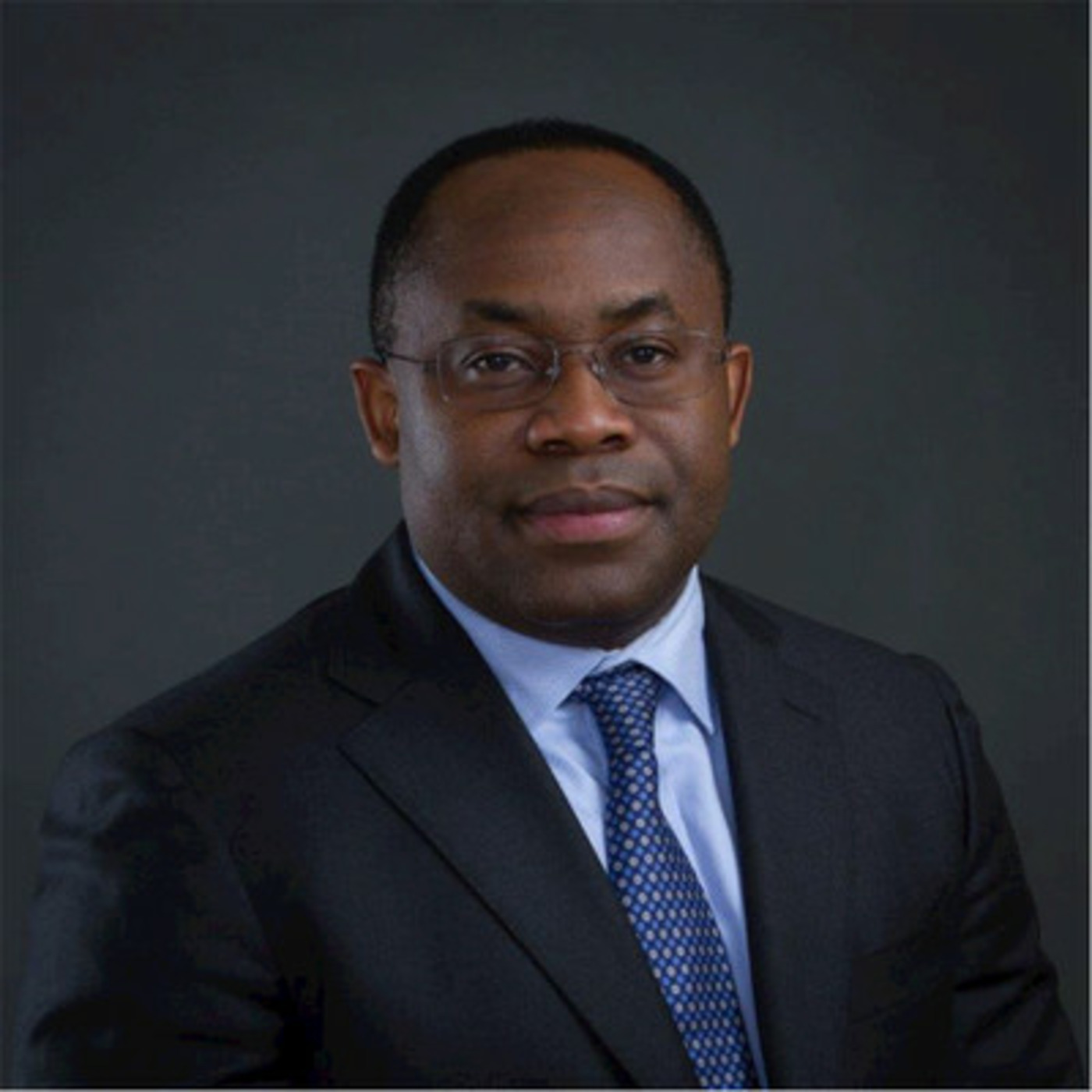
Aoifinn Devitt: This series was made possible by the kind support of Main Street Partners, a London-based independent and dedicated sustainable investment advisor that provides ESG multi-asset and multi-manager portfolios and a range of holistic portfolio analytics tools, including sustainability ratings and bespoke sustainability intelligence. It was also supported by Carbonado Partners, an industry expert in capital raising for all asset classes that endeavors to provide thoughtful solutions that address emerging managers’ perspectives and challenges. Our next guest enjoyed a successful career in international finance before taking on a challenge of an entirely different dimension, a role as CEO of the Nigerian Sovereign Wealth Authority. Let’s hear the unique opportunities and possibilities that the role presents in terms of Nigerian infrastructure, technology, and incorporation of ESG considerations at the outset. I’m Aoifinn Devitt, and welcome to the 50 Faces Podcast, a podcast committed to revealing the richness and diversity of the world of investment by focusing on its people and their stories. I’m joined today by Uche Orji, who is CEO of the Nigerian Sovereign Investment Authority based in Abuja. A native of Nigeria, he’s had over 20 years’ experience in various financial roles, including semiconductor analyst in Europe and the US before returning to Nigeria just over 8 years ago. He also holds a number of board roles. Welcome Uche, thank you for joining me today.
Uche Orji: Thank you for having me, Afshin. Pleasure to be here.
Aoifinn Devitt: Could you start by talking us through your journey into the finance world, starting with your background?
Uche Orji: My journey was a relatively interesting one, at least from my perspective. I had studied chemical engineering in my undergraduate days at a university in Nigeria called the University of Port Harcourt. And whilst I was there, between my uncle, who was my mentor, as well as my professor, I was encouraged to try my hand in financial area like accounting, just for the skills. And interestingly, after I graduated and did my national service, I took a job with Arthur Andersen, which has now been acquired by KPMG, and started to train as an auditor just to acquire the accounting skills. And then from there, I was hired by one of my clients who was starting a commercial bank, a bank called Diamond Bank in Nigeria. And from Diamond Bank, I went on to business school at Harvard Business School, and that was really the beginning of my journey into finance. From Harvard Business School, I then went on to Goldman Sachs Asset Management in London, where I joined the team that was charged with managing a global technology fund as well as a pan-European equity fund. And I was also both the chemicals analyst on the buy side as well as the technology semiconductor analyst on the buy side for Goldman Sachs. That went very well because luckily for me, that was also at the beginning of the bull market of 1998 that peaked in 2000. And I rode that bull market. It was a very good experience starting out. And then in 2001, I left Goldman Sachs Asset Management for JP Morgan. In London as well, as the lead semiconductor analyst for JP Morgan. It was a role I held for 6 years, rising from vice president to managing director. And then from there, I went on to UBS in New York, also as a lead semiconductor analyst covering US semiconductors as well as global semiconductors for UBS. And I was there for 6 years also in that role as managing director and global coordinator of semiconductor research. Covering companies such as Intel, AMD, Samsung, Nvidia, Infineon in Europe, ARM Holdings. These were all the companies that I covered. And then I left from there to join the Nigeria Sovereign Investment Authority, where I responded to a call by a headhunter to turn in my resume, went through the process, and I have been back in Nigeria for 8 years managing the Nigeria Sovereign Investment Authority. So my journey in finance was a journey that started way back in 1991. When I started my training at Arthur Andersen through a commercial bank. And now this is 2021. So yes, it’s been quite an interesting, long journey as well. And I’ve really enjoyed my experience.
Aoifinn Devitt: I’m really intrigued as to what attracted you to the role of running the Nigerian Sovereign Wealth Authority. You were in a successful role already, maybe living the dream of international finance. Why did you come back to Abuja and take that role?
Uche Orji: Sure. It was very interesting because I had I had two opportunities prior to that to join or help start or help run an organization in Nigeria. We all kind of stayed in touch with ourselves, but I had been in New York, and you’re right, my team when I left Europe was number one in semiconductor. I was the lead— I was number one semiconductor analyst in Europe. When I was in the United States, I’d risen to number three in the United States, and my team was highly regarded, highly rated by institutional investors. It was a good life, and it was intense. I enjoyed my work. But then I had turned down two opportunities to come back to Nigeria to work for various entities. The third one that came up was the Nigeria Sovereign Investment Authority. And for me, before I took any role, obviously I had to go through what was a very simple three-point test. You know, can I do it? Should I do it? And can it be done? And for me, in this case, it was very simple. Can I do it? Yes, I’d been a portfolio manager prior to that. I enjoyed actually looking at the markets. I enjoyed investing. And I think Vestas thought I was a good analyst. Should I do it? It was a very complicated question because I had a young family at the time. My youngest then was 5 years old and they were all in school in New York. So the idea of moving to Nigeria was a bit of a challenge, something I had to talk through with my wife. It was a hard decision to make. And can it be done? Yes. And for me, the real test was this. Look, Nigeria always had this reputation for things not being done optimally. And I thought to myself, here is an opportunity to go and do something that you can do well. And if you don’t go back to do it now, give up whatever you think you’re going to give up being in New York, you will abdicate every right to complain if somebody else took that job and didn’t do a good job. And that for me was the clincher for me was go do it. At worst of it, you know, you will try your hand and if it doesn’t work, yeah, I can always go back to Europe or America. But my view was go there and do something and that way you can also prove that it can be done. It was a very intense process, by the way, because it was a process run by a headhunter. I was interviewed. It took a long time before they made a decision, took about 6 months between the interview and finally being made an offer. And so yes, I moved back. And so that was why I made the decision.
Aoifinn Devitt: And I’m really fascinated by what is at the forefront of your mind in a role like that today. And maybe you can speak about both in light of the current market conditions, but also how you’re investing and in particular how you’re investing in African private equity and venture capital funds and other sectors?
Uche Orji: So let’s sit back and look at the funds that we run. We run actually 3 funds. We run a stabilization fund. This fund holds 20% of our assets, and the fund invests in investment-grade fixed income instruments. You really don’t take too much risk in that fund because it’s a fund that you need to make available to the government in times of economic stress. So that’s a low risk, heavy on fixed income, investment-grade fixed income. Treasuries type portfolio. The second fund we run is what is described as the Future Generations Fund, and this is an income fund or a savings fund. And here we take some risk. We invest in private equity, we invest in public equities, we invest in other alternatives, we invest in hedge funds, we invest in all sorts of asset classes. Highly diversified fund, mostly invested internationally, some invested locally. And then there’s a Nigeria Infrastructure Fund, which is the third fund that we run, and this fund is invested in domestic infrastructure opportunities in Nigeria. So those are the three funds that we run. And our assets are held 20% in the Stabilization Fund, 40% in the Future Generations Fund, and 40% in the Nigeria Infrastructure Fund. Recently, we have reallocated any fresh assets being given to us by government to go 20% in stabilization, 30% in future generations, and 50% in infrastructure. This is the recognition of the opportunities that we see in domestic infrastructure investing in Nigeria. Now regarding general markets, you know, we have a few organizing principles about how we see the market this year. Number 1, we are a little bit more cautious this year with risky assets than we were last year. Last year we were quite bullish, especially when we thought we had seen the bottom in the middle of the COVID-19 pandemic, so we went a little bit more aggressive with technology companies, we went a bit aggressive with equities in general. This time around we believe that with The threat of inflation, the rising yields, we’re going to be a bit more cautious with bonds, a bit more cautious with highly valued tech companies. Some of these companies are so richly valued that it’s really— you have little room for error. And in a rising interest rate environment, we believe that these companies might be a bit more vulnerable. So we’re trimming our technology bets. We are looking more to industrial cyclicals, consumer non-discretionary— so consumer discretionary sectors such as airlines or hotels. We believe that As we start to see the end in sight with the COVID pandemic, people are going to get more interested in spending, and so some of these sectors will benefit. So overall, I think it will be a slightly challenging year for equity investors. Not that it’s going to be negative, but it’s not going to be like last year. But it’s now about picking the right sectors and picking the right stocks. So this is how we’re positioning ourselves with regards to equities. We’re also a little concerned about emerging markets. Again, this is also one of the sectors that tend to be very vulnerable in a rising interest rate environment. So all in all, we are still allocated to the equity market, but we are looking at changing some of the sector allocations slightly away from tech and more into the consumer discretionary sectors, or into the broader markets, industrial cyclical sectors as well. These are areas we’re looking to be exposed to. So that’s how we see the market, and this is a reflection of valuation, is reflected, reflection of the fact that we believe that interest rate environment will make it look more challenging for sectors such as tech. As we look into Nigeria, you asked me about private equity and venture capital. We are now in the last 2 years, we started allocating to venture capital sector in aggregate, but also in Nigeria. And it’s been very fascinating. You may have been seeing what’s going on with some of the new venture companies in Nigeria, particularly in tech. But the reason why we are looking at some of these is we have an opportunity to get in very early. Pre any sort of listing in the market for some of these companies. And we believe that this is one area that is emerging as an area where Nigeria can build competitive advantage. And so we’re investing in the infrastructure necessary for technology. We’re also investing in venture capital. We’re looking at making direct investments in some of the technology companies that we see coming up in Nigeria. And this is not for today. This is investments you’re making for the next 4 or 5 years, particularly because of the growth element of this sectors in Nigeria. Of course, my valuation story for public equities, especially in tech, remains intact, but here you’re looking at venture because of the competitive edge we see and the opportunities we see in Nigeria for venture capital, as well as areas such as technology locally.
Aoifinn Devitt: And I’d love to ask also about investing outside Nigeria but within Africa. Do you see a lot of opportunities in other, say, African private equity opportunities, maybe other themes of growth? There in maybe in that future generations fund?
Uche Orji: Correct, we do actually, we do. And one of the things we are working on lately is partnering with other African sovereign wealth funds and looking at cross-country investments. The opportunities we see are driven by a number of factors. The first is the advent of the Africa Continental Free Trade Agreement, which actually starts to open up many other African countries. The second opportunity we see is what we believe is a low-hanging fruit. The intra-Africa trade at the moment stands at 17%, whereas intra-European trade is about 67%. And so we see an opportunity there. And one of the things you’ve seen us do is actually make direct collaborative investments. So 2 weeks ago, we signed an agreement with the OCP of Morocco to develop a basic chemical factory in Nigeria, and this is a factory that will produce ammonia and produce diammonium phosphate. Morocco, as you know, is the biggest exporter of phosphate in the world, and Nigeria has the biggest natural gas reserves in Africa. We believe that combining those two, we can actually use Nigeria’s natural gas reserves to make ammonia to export to Morocco, and then Morocco sends us phosphate rock, which is used as fertilizer in Nigeria, which again we mix with ammonia to produce a product that Nigerian farmers need. Now this type of cross-Africa direct investments is going to be very interesting in the future. Look for that to happen not just in industrials, look for that to happen in technology as well. Because I have explored the idea of building an Africa cloud system. Why not? In technology, especially if you look across certain countries, South Africa, Nigeria, Morocco, we’re building several, you know, megawatts of data center capacity and you have cables running around Africa at the moment by Google that is giving us higher capacity internet access. So these are things that are creating significant opportunities. So I believe that you’re going to see a lot of cross-country co-investments between certain countries in Africa. I look forward to Nigeria, South Africa collaborating on industrialization. There is that opportunity. Secondly, the equity market opportunity across Africa is looking more and more interesting, although the markets are not as deep yet, but we see more in private equity. So I will look forward to collaborations between Nigeria, Egypt, Morocco, Kenya, South Africa, Gabon, Ghana. These are countries that we have worked with in the past. And so more and more of this is what you’ll expect to see happen, especially as each of these African countries are beginning to create their own sovereign wealth funds. At least it gives you an investment entity with whom you can actually discuss on a purely commercial basis. Thirdly, and this is probably my last point that I think is compelling for me, it is this: in Africa, There’s a huge amount said about the human resources. There’s a huge amount said about the young age of African countries, but the real underlying story is how much of that is reflecting in technology. I’m looking at Africa that becomes the next home of business process outsourcing. We’re seeing a lot of that, a lot of programmers out of Nigeria, out of Egypt, out of Kenya who are competing on an international stage. So we expect to invest a lot in our youth across the continent. Especially as we see them take advantage of the tech revolution that is happening in Africa as a real area of interest. We have many companies today who are set up in Nigeria who are writing programs for Silicon Valley companies. We want to encourage that, and I believe that could be a trend across all of Africa.
Aoifinn Devitt: And just two other points I want to ask about on that front. One is the external capital from outside Africa coming in. How do you see that in terms of that level of interest, level of appetite? And secondly, ESG, it seems that given that so many of these industries are really at their initial stages, there is an opportunity to incorporate ESG risks and principles at the initial stage so that when investors start to demand an ESG integrated approach, you will already be there. Could you just comment on those two points?
Uche Orji: Let’s start with the external capital coming into Africa. We, I think, approached it very differently at the beginning, and we made mistakes. And the first mistake we made was to go for external capital co-investments without having actually mobilized our own internal capital to show some real progress. And so we didn’t make a lot of progress getting external capital to co-invest with us. Most of the external investors came in and spotted a few sectors, select sectors. They came in with debt instruments. They didn’t really come in with a lot of equity, and they all come in as portfolio investors who bought Eurobonds. So you never actually saw a lot of direct co-investments in certain areas in Africa, and part of that was because we hadn’t actually shown the way. So one of the things we decided to do at the NSIA was to spend more time mobilizing domestic capital, build out the necessary infrastructure that will make it easy for external capital to come in, mobilize domestic capital, show some traction ourselves, and then external capital will come. And that has been a terrific experience for us because that’s exactly what is playing out. So let me describe this in detail. When I arrived, I realized that we had a lot of voids in the financial services sector. These were things that we take for granted in Europe or in America, but they didn’t really exist. So for investments in infrastructure, we realized that you needed a company that could provide a wrap for infrastructure bonds. Some sort of credit enhancement. It didn’t exist in Nigeria. The only company that played that role was Garantco out of the UK, and their capital allocation was very small. So what did we do? We partnered with Garantco and created a company called InfraCredit. InfraCredit’s role is now to provide credit wraps around infrastructure bond investments. And once we did that, we unlocked a significant potential for domestic pension funds who had hitherto had a lot of their cash in low-yielding government bonds. They were now able to start investing in infrastructure, again, mobilizing domestic capital. We realized that there was gaps in efficient credit allocation for small businesses. We couldn’t lend directly to them, so what did we do? We partnered with some agencies and created Development Bank of Nigeria. We also realized that there was an issue with housing, and the issue with housing was there was no mortgage refinancing company. Again, the NSIA working with partners created the Nigeria Mortgage Refinancing Company. We went, we created so many things, so many companies. I mean, about 6 different entities we have played a role in creating or initiated that we believe are now making, creating the right environment for capital to come in from externally and also from internally. The first thing I observed that I found really fascinating was that there was a lot of capital in country that had not been rightly mobilized, rightly channeled. So we’re now working towards creating some of that level of capital. And the moment we started to do that, to some extent with some success, we are now starting to see interest from outside to invest equity alongside us. And one of them is, for example, what I have done in healthcare. The NSIA invested in healthcare to some extent successfully in the last 2 years, and then suddenly I’m getting requests from international funds to create a healthcare fund with the NSIA to invest in healthcare assets. So these are encouraging signs, but the real lesson here is this: First, you must do something for it by yourself, show some track record. Secondly, you must work to mobilize domestic capital. And then once you do that and show some success and track record of investing directly by yourself, people will come. The same happened in agriculture. We tried to raise a fund for agriculture finance with limited success. Then we invested directly ourselves with some partner, and then it’s a Dutch-based partner. We invested together. Now we have interest in people that want to create a fund and invest alongside us. So there is interest. For capital to come into Africa. But I think to a large extent, what African countries need to do, and particularly Nigeria, what we’ve done successfully to some extent at the NSIE, is to try and show some track record ourselves, create the right environment, make some investments by ourselves actually, and then domestic international investments are coming in. So right now I’m creating a fund for agriculture that’s had a lot of interest. We are programmed for co-investment with Morocco on basic chemicals of ammonia and stuff like that. The equity is already oversubscribed. We are doing some stuff also in healthcare, like I mentioned. So seeing funds wanting now to partner with us, and that has been really, really exciting for me. Now let’s speak about ESG. I’m not one for a lot of acronyms because I think it is easier to describe it to people in a manner that makes sense. We incorporate ESG principles in the way we invest. And, you know, environmental issues for me are very, very important. Sustainability and the right level of governance. So let me start from the bottom of governance. For us, governance is very important. It’s everything for from the way the management is appointed. It has to be done transparently and competently. Two, you have to have the right board, the right board committees, the right competent people on the board. You have to be transparent, you have to be accountable. These are all things for us that are very important, and I think in many places you can check that box very easily. And at the NSIA, which is the organization I lead, we make sure that we rank very highly on governance, very highly. International Sovereign Wealth Fund Association ranks us in the top quartile for governance, transparency, and accountability. In terms of environmental factors, for us it’s very important, but I think when you come to Africa, you need to define environmental factors in a bit more specific manner. So I’ll give an example. Deforestation for me has been the biggest devastating impact on the environment that I have seen in Nigeria, and it is quite sad actually when you realize that these trees are cut and exported to countries that profess to stop deforestation. And that for me is a little bit challenging, honestly. So we must work not just as Africans to deal with all these environmental factors, but companies working in our environment need to also adhere to the same standards as that they’re in their home countries. If you’re an oil company, it is not okay to spill oil and not clean it. You will not do that in Europe. You will not do that in America. But for us, more importantly, specifically for the NSIA, we are addressing it through 3 ways. The first is the use of waste gas. Nigeria flares about 2.4 billion standard cubic feet of gas every day. We believe that this could be turned into productive use. So for example, the ammonia plant we’re building is going to use some of this waste gas. We’re working on a project to turn waste gas to LPG, and this has a very interesting interconnected effect in Africa. Where do we have deforestation? Beyond the fact that some of the trees are exported, it is also because people use the trees to cook. They cook, use firewood. Now, how can you have firewood in a country as a way of means of cooking in a country that flares gas? The reason is because we have not been able to find a way to cost-effectively deliver cooking gas to people so it stops them from deforesting. And so one of the things we’re working on at the moment is to see a way to use some of the flare gas, turn it into LPG, send low-cost LPG cylinders to the rural areas so that people can stop cutting down trees to use that for cooking. I think this is something that is really, really quite exciting for me. And then the final thing that we’re looking at environmental area is we’re investing in land degradation neutrality. What does that mean? We are taking plots of land, vast plots of land, several thousands of hectares of land in various parts of the country that have been deforested and turning them into productive use. So we will not be looking to invest in palm trees if you’re going to have to cut down fresh trees. But if you’re going to turn one of these deforested places into a palm plantation, why the hell not? We’ll invest, right? So it’s all about these things, how we look at environmental factors and sustainability factors. So when I speak about this in international fora, people look at gas in a funny way. The reality is for us, gas is intricately tied into environmental issues for us and intricately tied into sustainability factors for us. We are involved in solar. We’re building the single biggest solar plant in Nigeria at the NSIA. Small by international standards, but is the single biggest one in Nigeria. We’re building it, and hopefully we can use that as a platform to roll out solar across the rest of the country. So these factors are very important for us. And then finally, we will not make any investment that does not pass the Equator Principles of the IFC. Those principles are principles that check a lot of the ESG boxes. So for us, it is really intricate in the way we invest. And it’s actually quite interestingly for us, one of the key areas that we are looking to champion because the survival of several parts of Nigeria depends actually on how well we do on some of these ESG factors. For us, it’s not just a nice to have, it is actually in some cases a matter of life and death.
Aoifinn Devitt: That’s very interesting. And I think it’s also very interesting that you’re looking at, I think, accounting for this, being transparent, providing metrics. At the outset, because ultimately it’s easier when you start providing these at the outset because you can see progress. And also that’s what investors are starting to demand. Very encouraging to hear what you’re doing in that arena. Just want to step back to your personal career a little bit here. One of the themes of this podcast series is diversity in the world of finance, and you’ve had a very successful career outside Nigeria, in the UK and the US. You have been promoted quickly through the ranks and reached a very senior position. During that journey, did you experience any discrimination or any setbacks, maybe what you might term today microaggressions?
Uche Orji: Sincerely, hard to say. And I say that only because I think the— and I’m going to be very careful with my words here. It may have happened and I didn’t really pay attention to it, but I don’t think so. Let me start with the firms where I worked. I didn’t notice it at Harvard Business School. I didn’t notice it at Goldman Sachs Asset Management. At all. In fact, if anything, I think I was fairly promoted quickly, as you may call it. But also note the fact that the fund that I was part of was perhaps the best performing fund in the Goldman Sachs stable back then. I could be wrong, but it’s hard to say. But I also think I acquitted myself well as an analyst, so I didn’t really notice it. Across most of Europe because being an analyst at JPMorgan, I traveled everywhere, right? Within my first full year as an analyst, I was ranked number 1 by Thomson-Reuters poll of investors, and the next year the Institutional Investor ranked me number 1. And so to be ranked number 1 across Europe, which meant on average you were top 3 across almost every country from Sweden to Norway to Germany to France to the UK to Spain, for me, perhaps reflected the fact that I did my job well. But on a social level, I never really experienced it in Europe, not at all. In the United States, I spent time between New York, San Francisco a lot because of the technology companies that I covered. Texas, yes. Chicago and all the— I don’t think I noticed it, not at work, not at work. And if anything, I had— so I may have been very lucky, I may have had a very privileged career, but that was my experience. I’m aware that these issues exist, but I cannot speak to any personal experience of it at all. If anything, I had a terrific experience across all the firms that I worked in— Goldman Sachs, JP Morgan, UBS. And so yes, and I think also maybe because I was in a slightly exclusive sector, technology is really a little bit— semiconductors in particular, I like to think it’s a little bit challenging, but I don’t know that that had any effect, to be honest. I couldn’t really explain it. So I hear about it, I know it exists, but I never had any experience myself at all. I had highly supportive bosses, highly supportive colleagues, and I was treated like an equal, and I enjoyed being there. I believe I sat at the table because I earned my place there as well.
Aoifinn Devitt: So yeah, I think actually your experience is probably one that most professionals would share. The issue may be just that there simply isn’t enough diversity in finance, that there simply isn’t enough examples of people from bringing different perspectives, um, to it. I don’t know whether you are hopeful for maybe the levels of diversity improving over the next, say, 10 years.
Uche Orji: I hope so. I hope so. But I also think that, and again, I have to be very careful with my words, and that’s just to say that this was in the ’90s when I started my career in the City of London, and the level of sensitivity to these factors were not as high as they are today, but not to say it didn’t exist then. I was always pleased to see diversity— women, ethnic minorities, Africans— and there were opportunities given to loads of us. I actually remember when I was at Goldman, I was actually part of the recruitment team, and I also did work in a committee at Goldman back in 1999, uh, 2000, with a role to force and drive diversity. And I remember being in that committee along with big Blod, who was then the head of Goldman Sachs Asset Management, who’s now the senior partner at Generation Investment Management, and Lloyd Blankfein, who was the past CEO of Goldman Sachs. So there was a committee set up back in ’99, 2000, and part of the role of that committee was to see how we can make the place more diverse and more interesting. I have to remember this again because this was almost more than 20 years ago that this effort was being made at Goldman. And of course, JPMorgan, you know, I don’t think anybody really noticed. There’s a lot of effort at JPMorgan to get as many people of minority in the group. And coming to JPMorgan, women had very senior positions and ethnic minority people also had. That was my time. I don’t know what it is like today, but I don’t think it’s changed. And so there could be more. And I think in addressing it, we need to address a number of building blocks. The first building block is training, and the training starts from high school to university, to the right university, to places that suddenly Subject secondly is awareness and mentorship. We need to create a lot of awareness among our people. I grew up in a rural part of Nigeria, and it took an uncle of mine to tell me that growing up here should not stop you from going to Harvard Business School when you finish studying engineering. It was the first time I heard about Harvard University. I was 17 years old when he told me, so look, this is the place to go. Everybody goes there. They this and that. And so that seed was planted in my mind. And growing up in a town called Umuahia in Nigeria, you never heard of it. I don’t think anybody’s heard of it. It’s a really small town. And someone mentored me to start to aspire. So we need to really do that well. And then thirdly, obviously biases exist. They exist. It’s everywhere. I know, but I haven’t experienced it. But I think from everything I’ve heard, it does exist. There must be some level of work done also on the other side to make sure people people are open-minded and accepting because the world is not— there’s no one-size-fits-all formula anymore to development. And so some of these things need to be done. We need to do a lot more work in coaching, mentoring, and among ourselves. And then I think on the other side also, companies need to do more to ensure that they deal with all these unconscious biases that do exist. I know, even though, like I keep saying, I never experienced it myself.
Aoifinn Devitt: That’s very good to hear and some very good pointers there in terms of building blocks Staying on your personal journey, were there some key people, you mentioned your uncle, maybe others like him who influenced you along your way?
Uche Orji: At a Texan village in my case, quite a number of people did of course, but this uncle of mine, Uncle Henry’s his name, and actually two of them, Uncle Michael and Uncle Henry, these were the two men who helped me a lot. I think my first Uncle Henry was one who told me about forging a career in finance, and he was a first-class chemical engineer, and actually I studied chemical engineering because I studied chemical engineering, so he mentored me a lot. And then my other uncle actually introduced me to programming and computing in 1988. And actually, because of that inspiration from Uncle Michael, I ended up writing my research thesis in a subsector of mathematics called nonlinear regression techniques. So I studied chemical engineering, but then I also ended up having to write a lot of programs to model real-life situations in a nonlinear— it’s a part of math called nonlinear regression techniques, actually. So I did a lot of work there for my undergraduate research. So these were very important milestones for me in terms of my career journey. Then along the line, I met a number of really, really inspiring people. First, my first boss, a gentleman called Richard Kramer, who was the head of Andersen back in Nigeria. And then there was Pascal Dozier and Ken Oggi. These were two men. Ken Oggi literally forced me to apply to go to Harvard Business School one day. He’s like, look, young man, you need to— he told me you’re going to apply, and you’ve been here now 3 years at Diamond Bank, you must apply. Apply today. And then Pascal Dozier stood up for me. He made sure I got the funding and backed me all the way through to go to school. And he actually inspired me personally a lot because I worked very closely with him. He gave me the first shot, actually. I was 23 years old, and I was 26 years old when he— I was made acting financial controller. 25, actually, when I was made acting financial controller for Diamond Bank, which was one of the fastest-growing banks in Nigeria in those days. These men were very, very important in my life journey. And then of course, going on to business school and then meeting David Blood at Goldman Sachs Asset Management was also a very important point in my life. And of course, you cannot tell the stories without talking about your parents. My father always is a guy that I’ll come home and say, hey, I had an A. He’s like, what about the guy that had an A*, what’s wrong with you? So there was that push in the family to try and drive you to do better. The only time my father was happy with my result was if I came first in class. You know, if I came second in class, a class of 45 maybe, and I came second, my father is like, not good enough. You know, what about the guy who came first? So that level of drive came from the family, you know. So along the line, many people have inspired my career in terms of driving me to where I am today. And then of course, I was very lucky also to have a very supportive spouse when I got married. And so the rest of the journey was also very important in terms of the support you get from home. In terms of helping you to aspire.
Aoifinn Devitt: It seems like your father and my paternal grandfather must have been two peas in a pod. We would have had exactly the same message. Luckily, because he was my grandfather, it was more my aunts and uncles that got that pressure to be first in the class. In terms of any pieces of advice, words of wisdom, or any creed or motto that you live by, is there anything you can share there?
Uche Orji: I will say a number of things that helped me a lot in my own career journey. This is probably something somebody somewhere may find very inspiring. I left Nigeria in 1996 to go to Harvard Business School. When I left Nigeria, the equity market really didn’t really exist as a market. There was a stock exchange, but it wasn’t really a highly traded stock exchange, so there was no such real concept of a highly liquid equity market. I had never heard of derivatives before then. I’d never heard of various instruments, and 2 years later, I find myself at Goldman Sachs Asset Management and having to deal with some of these instruments. You could never learn enough of them about them in school. And what did I do? I studied. This is one thing they don’t tell you working on Wall Street— you are going to have to do a lot of learning by yourself. So I found myself in the office at weekends studying and working and trying many things, and I actually in that process built my own approach to investing. I remember spending a 2-month period every weekend, Saturday and Sunday, running so many correlations of various data. Back then, the data set that was really available to me was something called DataStream. DataStream was very clunky and difficult, but I was able to pull all sorts of data and then started running correlations across various data sets to see what is really an important lead indicator for equities or for investing in technology. And so along those lines, I developed my own proprietary 10-point process for investing in semiconductors, investing in technology. And I did this by myself. I actually, of course, I read all sorts of materials, but I had to develop my own model. And when I left for the buy-sell side, went to JPMorgan as a sell-side analyst, the first research I published was based on the proprietary model I had developed working on the buy side. And this was several weekends of spending time running various data correlations, and it’s just asking some random questions. What is the correlation between consumer confidence semiconductor index, right? Now today it all seems very sensible, but the truth about it is you also needed to know at what point does it turn, when you have the point of inflection, which is one of these datasets. And I think my personal proprietary model had something in the order of more than 200 different correlations of data leading to different things. And I enjoyed that work. I really enjoyed that work. So the first point here is you need to study, you need to do your own work independently and work a lot, work really hard. The second is what I said earlier, there is just no shortcut to these things. You have to really put in the hours and put in the work and read a lot of stuff. Personally, and that’s one of the things that helps me a lot now in my career, is just being able to draw stories from different random sectors and putting them together. So one of the things I spend a lot of time reading is the history of finance, and I read a lot of materials on history and literature, and I read a lot of random stuff that is normally connected. To the work that I do, because at the end of the day, they all pull together. And the third is, you know, make an effort to acquire different new skills. And I know they all sound the same, but they’re just different variants to it. And I give an example. I thought one day that I needed to really understand how commodity traders worked. So when I was in New York, every weekend I’ll go spend some time with a friend of mine who traded commodities. Show me your Bloomberg screen, what you look at, what makes you decide to buy copper today, what makes you decide to buy What makes you buy gold the next day? What makes you buy silver? Of course, I never thought there was going to be any reason for me to use the knowledge, but I wanted to acquire that knowledge. And so this guy took time and walked me through it 3, 4, 5 weekends, and I began to feel like I acquired that knowledge. And I think for me, the summary of this whole thing is you need to make an effort to acquire new skills. You need to work hard. You need to read diverse materials. But just know that no knowledge is wasted in investing. No knowledge is wasted. You will find it someday useful somewhere. The other thing I’ll probably speak to is when I moved from this buy side to the sell side, everyone said to me, no one does that, why would you do that? You know, people move from the sell side to the buy side, why are you going from the buy side to the sell side? And this is probably where it gets a little bit selfish. I wanted to make a name for myself, right? In the buy side, you’re part of a big team, especially in a firm that doesn’t really push for star analyst. I thought that, you know, I needed to have a name by myself, and the only way was for me to go to the sell side. Well, this was one of the— was not on the top 3 or 4 reasons why I moved to the sell side, but it helped that when I came out to the sell side, I became the brand. I needed to create a name for myself, and I did create a name for myself. So Uche Oji, Semiconductor Analyst, JP Morgan. Uche Semiconductor Oji, Analyst, UBS. Stood out. And I think quite frankly, you must have the courage to do something that stands you out, not something crazy, but something that stands you out. And I think for me being an African on Wall Street and quite frankly in the semiconductor sector, I think in my time I was probably the only one. It helps and I actually turned it to an advantage actually because I was easily recognizable. But beyond that, actually it was the fact that I had to work very hard to make a name for myself. So no knowledge is wasted. Make an effort to learn new skills and then do something to try and send yourself out. I did that at least for myself. It may not necessarily be what everybody else would like to do, but I found it particularly very helpful and very rewarding personally.
Aoifinn Devitt: I completely agree. And also, I think also one thing I try to impress upon my children is there is a particularly incredible feeling of working hard, that really digging deeper and really doing your best and to dig into a topic. And I think that that feeling really, you can’t buy it. It’s really priceless. So I think it’s really important that you reinforce that here. Well, thank you, Uche. This has been a wonderfully rich discussion. I particularly enjoyed you walking us through the opportunities in the Nigerian infrastructure arena, as well as in Africa more generally. You gave us a great deal of richness there. And also I loved your reference back to the village that it took to put you on the course that you have been on and a very successful one at that. So thank you very much for sharing your insights here with us.
Uche Orji: Thank you very much, Aoifinn. Really appreciate the time.
Aoifinn Devitt: I’m Aoifinn Devitt. Thank you for listening to the 50 Faces Podcast. If you liked what you heard and would like to tune in to hear more inspiring investors on their personal journeys, please subscribe on Apple Podcasts or wherever you get your podcasts. This podcast is for informational purposes only and should not be construed as investment advice, and all views are personal and should not be attributed to to the organizations and affiliations of the host or any guest.
Aoifinn Devitt: This series was made possible by the kind support of Main Street Partners, a London-based independent and dedicated sustainable investment advisor that provides ESG multi-asset and multi-manager portfolios and a range of holistic portfolio analytics tools, including sustainability ratings and bespoke sustainability intelligence. It was also supported by Carbonado Partners, an industry expert in capital raising for all asset classes that endeavors to provide thoughtful solutions that address emerging managers’ perspectives and challenges. Our next guest enjoyed a successful career in international finance before taking on a challenge of an entirely different dimension, a role as CEO of the Nigerian Sovereign Wealth Authority. Let’s hear the unique opportunities and possibilities that the role presents in terms of Nigerian infrastructure, technology, and incorporation of ESG considerations at the outset. I’m Aoifinn Devitt, and welcome to the 50 Faces Podcast, a podcast committed to revealing the richness and diversity of the world of investment by focusing on its people and their stories. I’m joined today by Uche Orji, who is CEO of the Nigerian Sovereign Investment Authority based in Abuja. A native of Nigeria, he’s had over 20 years’ experience in various financial roles, including semiconductor analyst in Europe and the US before returning to Nigeria just over 8 years ago. He also holds a number of board roles. Welcome Uche, thank you for joining me today.
Uche Orji: Thank you for having me, Afshin. Pleasure to be here.
Aoifinn Devitt: Could you start by talking us through your journey into the finance world, starting with your background?
Uche Orji: My journey was a relatively interesting one, at least from my perspective. I had studied chemical engineering in my undergraduate days at a university in Nigeria called the University of Port Harcourt. And whilst I was there, between my uncle, who was my mentor, as well as my professor, I was encouraged to try my hand in financial area like accounting, just for the skills. And interestingly, after I graduated and did my national service, I took a job with Arthur Andersen, which has now been acquired by KPMG, and started to train as an auditor just to acquire the accounting skills. And then from there, I was hired by one of my clients who was starting a commercial bank, a bank called Diamond Bank in Nigeria. And from Diamond Bank, I went on to business school at Harvard Business School, and that was really the beginning of my journey into finance. From Harvard Business School, I then went on to Goldman Sachs Asset Management in London, where I joined the team that was charged with managing a global technology fund as well as a pan-European equity fund. And I was also both the chemicals analyst on the buy side as well as the technology semiconductor analyst on the buy side for Goldman Sachs. That went very well because luckily for me, that was also at the beginning of the bull market of 1998 that peaked in 2000. And I rode that bull market. It was a very good experience starting out. And then in 2001, I left Goldman Sachs Asset Management for JP Morgan. In London as well, as the lead semiconductor analyst for JP Morgan. It was a role I held for 6 years, rising from vice president to managing director. And then from there, I went on to UBS in New York, also as a lead semiconductor analyst covering US semiconductors as well as global semiconductors for UBS. And I was there for 6 years also in that role as managing director and global coordinator of semiconductor research. Covering companies such as Intel, AMD, Samsung, Nvidia, Infineon in Europe, ARM Holdings. These were all the companies that I covered. And then I left from there to join the Nigeria Sovereign Investment Authority, where I responded to a call by a headhunter to turn in my resume, went through the process, and I have been back in Nigeria for 8 years managing the Nigeria Sovereign Investment Authority. So my journey in finance was a journey that started way back in 1991. When I started my training at Arthur Andersen through a commercial bank. And now this is 2021. So yes, it’s been quite an interesting, long journey as well. And I’ve really enjoyed my experience.
Aoifinn Devitt: I’m really intrigued as to what attracted you to the role of running the Nigerian Sovereign Wealth Authority. You were in a successful role already, maybe living the dream of international finance. Why did you come back to Abuja and take that role?
Uche Orji: Sure. It was very interesting because I had I had two opportunities prior to that to join or help start or help run an organization in Nigeria. We all kind of stayed in touch with ourselves, but I had been in New York, and you’re right, my team when I left Europe was number one in semiconductor. I was the lead— I was number one semiconductor analyst in Europe. When I was in the United States, I’d risen to number three in the United States, and my team was highly regarded, highly rated by institutional investors. It was a good life, and it was intense. I enjoyed my work. But then I had turned down two opportunities to come back to Nigeria to work for various entities. The third one that came up was the Nigeria Sovereign Investment Authority. And for me, before I took any role, obviously I had to go through what was a very simple three-point test. You know, can I do it? Should I do it? And can it be done? And for me, in this case, it was very simple. Can I do it? Yes, I’d been a portfolio manager prior to that. I enjoyed actually looking at the markets. I enjoyed investing. And I think Vestas thought I was a good analyst. Should I do it? It was a very complicated question because I had a young family at the time. My youngest then was 5 years old and they were all in school in New York. So the idea of moving to Nigeria was a bit of a challenge, something I had to talk through with my wife. It was a hard decision to make. And can it be done? Yes. And for me, the real test was this. Look, Nigeria always had this reputation for things not being done optimally. And I thought to myself, here is an opportunity to go and do something that you can do well. And if you don’t go back to do it now, give up whatever you think you’re going to give up being in New York, you will abdicate every right to complain if somebody else took that job and didn’t do a good job. And that for me was the clincher for me was go do it. At worst of it, you know, you will try your hand and if it doesn’t work, yeah, I can always go back to Europe or America. But my view was go there and do something and that way you can also prove that it can be done. It was a very intense process, by the way, because it was a process run by a headhunter. I was interviewed. It took a long time before they made a decision, took about 6 months between the interview and finally being made an offer. And so yes, I moved back. And so that was why I made the decision.
Aoifinn Devitt: And I’m really fascinated by what is at the forefront of your mind in a role like that today. And maybe you can speak about both in light of the current market conditions, but also how you’re investing and in particular how you’re investing in African private equity and venture capital funds and other sectors?
Uche Orji: So let’s sit back and look at the funds that we run. We run actually 3 funds. We run a stabilization fund. This fund holds 20% of our assets, and the fund invests in investment-grade fixed income instruments. You really don’t take too much risk in that fund because it’s a fund that you need to make available to the government in times of economic stress. So that’s a low risk, heavy on fixed income, investment-grade fixed income. Treasuries type portfolio. The second fund we run is what is described as the Future Generations Fund, and this is an income fund or a savings fund. And here we take some risk. We invest in private equity, we invest in public equities, we invest in other alternatives, we invest in hedge funds, we invest in all sorts of asset classes. Highly diversified fund, mostly invested internationally, some invested locally. And then there’s a Nigeria Infrastructure Fund, which is the third fund that we run, and this fund is invested in domestic infrastructure opportunities in Nigeria. So those are the three funds that we run. And our assets are held 20% in the Stabilization Fund, 40% in the Future Generations Fund, and 40% in the Nigeria Infrastructure Fund. Recently, we have reallocated any fresh assets being given to us by government to go 20% in stabilization, 30% in future generations, and 50% in infrastructure. This is the recognition of the opportunities that we see in domestic infrastructure investing in Nigeria. Now regarding general markets, you know, we have a few organizing principles about how we see the market this year. Number 1, we are a little bit more cautious this year with risky assets than we were last year. Last year we were quite bullish, especially when we thought we had seen the bottom in the middle of the COVID-19 pandemic, so we went a little bit more aggressive with technology companies, we went a bit aggressive with equities in general. This time around we believe that with The threat of inflation, the rising yields, we’re going to be a bit more cautious with bonds, a bit more cautious with highly valued tech companies. Some of these companies are so richly valued that it’s really— you have little room for error. And in a rising interest rate environment, we believe that these companies might be a bit more vulnerable. So we’re trimming our technology bets. We are looking more to industrial cyclicals, consumer non-discretionary— so consumer discretionary sectors such as airlines or hotels. We believe that As we start to see the end in sight with the COVID pandemic, people are going to get more interested in spending, and so some of these sectors will benefit. So overall, I think it will be a slightly challenging year for equity investors. Not that it’s going to be negative, but it’s not going to be like last year. But it’s now about picking the right sectors and picking the right stocks. So this is how we’re positioning ourselves with regards to equities. We’re also a little concerned about emerging markets. Again, this is also one of the sectors that tend to be very vulnerable in a rising interest rate environment. So all in all, we are still allocated to the equity market, but we are looking at changing some of the sector allocations slightly away from tech and more into the consumer discretionary sectors, or into the broader markets, industrial cyclical sectors as well. These are areas we’re looking to be exposed to. So that’s how we see the market, and this is a reflection of valuation, is reflected, reflection of the fact that we believe that interest rate environment will make it look more challenging for sectors such as tech. As we look into Nigeria, you asked me about private equity and venture capital. We are now in the last 2 years, we started allocating to venture capital sector in aggregate, but also in Nigeria. And it’s been very fascinating. You may have been seeing what’s going on with some of the new venture companies in Nigeria, particularly in tech. But the reason why we are looking at some of these is we have an opportunity to get in very early. Pre any sort of listing in the market for some of these companies. And we believe that this is one area that is emerging as an area where Nigeria can build competitive advantage. And so we’re investing in the infrastructure necessary for technology. We’re also investing in venture capital. We’re looking at making direct investments in some of the technology companies that we see coming up in Nigeria. And this is not for today. This is investments you’re making for the next 4 or 5 years, particularly because of the growth element of this sectors in Nigeria. Of course, my valuation story for public equities, especially in tech, remains intact, but here you’re looking at venture because of the competitive edge we see and the opportunities we see in Nigeria for venture capital, as well as areas such as technology locally.
Aoifinn Devitt: And I’d love to ask also about investing outside Nigeria but within Africa. Do you see a lot of opportunities in other, say, African private equity opportunities, maybe other themes of growth? There in maybe in that future generations fund?
Uche Orji: Correct, we do actually, we do. And one of the things we are working on lately is partnering with other African sovereign wealth funds and looking at cross-country investments. The opportunities we see are driven by a number of factors. The first is the advent of the Africa Continental Free Trade Agreement, which actually starts to open up many other African countries. The second opportunity we see is what we believe is a low-hanging fruit. The intra-Africa trade at the moment stands at 17%, whereas intra-European trade is about 67%. And so we see an opportunity there. And one of the things you’ve seen us do is actually make direct collaborative investments. So 2 weeks ago, we signed an agreement with the OCP of Morocco to develop a basic chemical factory in Nigeria, and this is a factory that will produce ammonia and produce diammonium phosphate. Morocco, as you know, is the biggest exporter of phosphate in the world, and Nigeria has the biggest natural gas reserves in Africa. We believe that combining those two, we can actually use Nigeria’s natural gas reserves to make ammonia to export to Morocco, and then Morocco sends us phosphate rock, which is used as fertilizer in Nigeria, which again we mix with ammonia to produce a product that Nigerian farmers need. Now this type of cross-Africa direct investments is going to be very interesting in the future. Look for that to happen not just in industrials, look for that to happen in technology as well. Because I have explored the idea of building an Africa cloud system. Why not? In technology, especially if you look across certain countries, South Africa, Nigeria, Morocco, we’re building several, you know, megawatts of data center capacity and you have cables running around Africa at the moment by Google that is giving us higher capacity internet access. So these are things that are creating significant opportunities. So I believe that you’re going to see a lot of cross-country co-investments between certain countries in Africa. I look forward to Nigeria, South Africa collaborating on industrialization. There is that opportunity. Secondly, the equity market opportunity across Africa is looking more and more interesting, although the markets are not as deep yet, but we see more in private equity. So I will look forward to collaborations between Nigeria, Egypt, Morocco, Kenya, South Africa, Gabon, Ghana. These are countries that we have worked with in the past. And so more and more of this is what you’ll expect to see happen, especially as each of these African countries are beginning to create their own sovereign wealth funds. At least it gives you an investment entity with whom you can actually discuss on a purely commercial basis. Thirdly, and this is probably my last point that I think is compelling for me, it is this: in Africa, There’s a huge amount said about the human resources. There’s a huge amount said about the young age of African countries, but the real underlying story is how much of that is reflecting in technology. I’m looking at Africa that becomes the next home of business process outsourcing. We’re seeing a lot of that, a lot of programmers out of Nigeria, out of Egypt, out of Kenya who are competing on an international stage. So we expect to invest a lot in our youth across the continent. Especially as we see them take advantage of the tech revolution that is happening in Africa as a real area of interest. We have many companies today who are set up in Nigeria who are writing programs for Silicon Valley companies. We want to encourage that, and I believe that could be a trend across all of Africa.
Aoifinn Devitt: And just two other points I want to ask about on that front. One is the external capital from outside Africa coming in. How do you see that in terms of that level of interest, level of appetite? And secondly, ESG, it seems that given that so many of these industries are really at their initial stages, there is an opportunity to incorporate ESG risks and principles at the initial stage so that when investors start to demand an ESG integrated approach, you will already be there. Could you just comment on those two points?
Uche Orji: Let’s start with the external capital coming into Africa. We, I think, approached it very differently at the beginning, and we made mistakes. And the first mistake we made was to go for external capital co-investments without having actually mobilized our own internal capital to show some real progress. And so we didn’t make a lot of progress getting external capital to co-invest with us. Most of the external investors came in and spotted a few sectors, select sectors. They came in with debt instruments. They didn’t really come in with a lot of equity, and they all come in as portfolio investors who bought Eurobonds. So you never actually saw a lot of direct co-investments in certain areas in Africa, and part of that was because we hadn’t actually shown the way. So one of the things we decided to do at the NSIA was to spend more time mobilizing domestic capital, build out the necessary infrastructure that will make it easy for external capital to come in, mobilize domestic capital, show some traction ourselves, and then external capital will come. And that has been a terrific experience for us because that’s exactly what is playing out. So let me describe this in detail. When I arrived, I realized that we had a lot of voids in the financial services sector. These were things that we take for granted in Europe or in America, but they didn’t really exist. So for investments in infrastructure, we realized that you needed a company that could provide a wrap for infrastructure bonds. Some sort of credit enhancement. It didn’t exist in Nigeria. The only company that played that role was Garantco out of the UK, and their capital allocation was very small. So what did we do? We partnered with Garantco and created a company called InfraCredit. InfraCredit’s role is now to provide credit wraps around infrastructure bond investments. And once we did that, we unlocked a significant potential for domestic pension funds who had hitherto had a lot of their cash in low-yielding government bonds. They were now able to start investing in infrastructure, again, mobilizing domestic capital. We realized that there was gaps in efficient credit allocation for small businesses. We couldn’t lend directly to them, so what did we do? We partnered with some agencies and created Development Bank of Nigeria. We also realized that there was an issue with housing, and the issue with housing was there was no mortgage refinancing company. Again, the NSIA working with partners created the Nigeria Mortgage Refinancing Company. We went, we created so many things, so many companies. I mean, about 6 different entities we have played a role in creating or initiated that we believe are now making, creating the right environment for capital to come in from externally and also from internally. The first thing I observed that I found really fascinating was that there was a lot of capital in country that had not been rightly mobilized, rightly channeled. So we’re now working towards creating some of that level of capital. And the moment we started to do that, to some extent with some success, we are now starting to see interest from outside to invest equity alongside us. And one of them is, for example, what I have done in healthcare. The NSIA invested in healthcare to some extent successfully in the last 2 years, and then suddenly I’m getting requests from international funds to create a healthcare fund with the NSIA to invest in healthcare assets. So these are encouraging signs, but the real lesson here is this: First, you must do something for it by yourself, show some track record. Secondly, you must work to mobilize domestic capital. And then once you do that and show some success and track record of investing directly by yourself, people will come. The same happened in agriculture. We tried to raise a fund for agriculture finance with limited success. Then we invested directly ourselves with some partner, and then it’s a Dutch-based partner. We invested together. Now we have interest in people that want to create a fund and invest alongside us. So there is interest. For capital to come into Africa. But I think to a large extent, what African countries need to do, and particularly Nigeria, what we’ve done successfully to some extent at the NSIE, is to try and show some track record ourselves, create the right environment, make some investments by ourselves actually, and then domestic international investments are coming in. So right now I’m creating a fund for agriculture that’s had a lot of interest. We are programmed for co-investment with Morocco on basic chemicals of ammonia and stuff like that. The equity is already oversubscribed. We are doing some stuff also in healthcare, like I mentioned. So seeing funds wanting now to partner with us, and that has been really, really exciting for me. Now let’s speak about ESG. I’m not one for a lot of acronyms because I think it is easier to describe it to people in a manner that makes sense. We incorporate ESG principles in the way we invest. And, you know, environmental issues for me are very, very important. Sustainability and the right level of governance. So let me start from the bottom of governance. For us, governance is very important. It’s everything for from the way the management is appointed. It has to be done transparently and competently. Two, you have to have the right board, the right board committees, the right competent people on the board. You have to be transparent, you have to be accountable. These are all things for us that are very important, and I think in many places you can check that box very easily. And at the NSIA, which is the organization I lead, we make sure that we rank very highly on governance, very highly. International Sovereign Wealth Fund Association ranks us in the top quartile for governance, transparency, and accountability. In terms of environmental factors, for us it’s very important, but I think when you come to Africa, you need to define environmental factors in a bit more specific manner. So I’ll give an example. Deforestation for me has been the biggest devastating impact on the environment that I have seen in Nigeria, and it is quite sad actually when you realize that these trees are cut and exported to countries that profess to stop deforestation. And that for me is a little bit challenging, honestly. So we must work not just as Africans to deal with all these environmental factors, but companies working in our environment need to also adhere to the same standards as that they’re in their home countries. If you’re an oil company, it is not okay to spill oil and not clean it. You will not do that in Europe. You will not do that in America. But for us, more importantly, specifically for the NSIA, we are addressing it through 3 ways. The first is the use of waste gas. Nigeria flares about 2.4 billion standard cubic feet of gas every day. We believe that this could be turned into productive use. So for example, the ammonia plant we’re building is going to use some of this waste gas. We’re working on a project to turn waste gas to LPG, and this has a very interesting interconnected effect in Africa. Where do we have deforestation? Beyond the fact that some of the trees are exported, it is also because people use the trees to cook. They cook, use firewood. Now, how can you have firewood in a country as a way of means of cooking in a country that flares gas? The reason is because we have not been able to find a way to cost-effectively deliver cooking gas to people so it stops them from deforesting. And so one of the things we’re working on at the moment is to see a way to use some of the flare gas, turn it into LPG, send low-cost LPG cylinders to the rural areas so that people can stop cutting down trees to use that for cooking. I think this is something that is really, really quite exciting for me. And then the final thing that we’re looking at environmental area is we’re investing in land degradation neutrality. What does that mean? We are taking plots of land, vast plots of land, several thousands of hectares of land in various parts of the country that have been deforested and turning them into productive use. So we will not be looking to invest in palm trees if you’re going to have to cut down fresh trees. But if you’re going to turn one of these deforested places into a palm plantation, why the hell not? We’ll invest, right? So it’s all about these things, how we look at environmental factors and sustainability factors. So when I speak about this in international fora, people look at gas in a funny way. The reality is for us, gas is intricately tied into environmental issues for us and intricately tied into sustainability factors for us. We are involved in solar. We’re building the single biggest solar plant in Nigeria at the NSIA. Small by international standards, but is the single biggest one in Nigeria. We’re building it, and hopefully we can use that as a platform to roll out solar across the rest of the country. So these factors are very important for us. And then finally, we will not make any investment that does not pass the Equator Principles of the IFC. Those principles are principles that check a lot of the ESG boxes. So for us, it is really intricate in the way we invest. And it’s actually quite interestingly for us, one of the key areas that we are looking to champion because the survival of several parts of Nigeria depends actually on how well we do on some of these ESG factors. For us, it’s not just a nice to have, it is actually in some cases a matter of life and death.
Aoifinn Devitt: That’s very interesting. And I think it’s also very interesting that you’re looking at, I think, accounting for this, being transparent, providing metrics. At the outset, because ultimately it’s easier when you start providing these at the outset because you can see progress. And also that’s what investors are starting to demand. Very encouraging to hear what you’re doing in that arena. Just want to step back to your personal career a little bit here. One of the themes of this podcast series is diversity in the world of finance, and you’ve had a very successful career outside Nigeria, in the UK and the US. You have been promoted quickly through the ranks and reached a very senior position. During that journey, did you experience any discrimination or any setbacks, maybe what you might term today microaggressions?
Uche Orji: Sincerely, hard to say. And I say that only because I think the— and I’m going to be very careful with my words here. It may have happened and I didn’t really pay attention to it, but I don’t think so. Let me start with the firms where I worked. I didn’t notice it at Harvard Business School. I didn’t notice it at Goldman Sachs Asset Management. At all. In fact, if anything, I think I was fairly promoted quickly, as you may call it. But also note the fact that the fund that I was part of was perhaps the best performing fund in the Goldman Sachs stable back then. I could be wrong, but it’s hard to say. But I also think I acquitted myself well as an analyst, so I didn’t really notice it. Across most of Europe because being an analyst at JPMorgan, I traveled everywhere, right? Within my first full year as an analyst, I was ranked number 1 by Thomson-Reuters poll of investors, and the next year the Institutional Investor ranked me number 1. And so to be ranked number 1 across Europe, which meant on average you were top 3 across almost every country from Sweden to Norway to Germany to France to the UK to Spain, for me, perhaps reflected the fact that I did my job well. But on a social level, I never really experienced it in Europe, not at all. In the United States, I spent time between New York, San Francisco a lot because of the technology companies that I covered. Texas, yes. Chicago and all the— I don’t think I noticed it, not at work, not at work. And if anything, I had— so I may have been very lucky, I may have had a very privileged career, but that was my experience. I’m aware that these issues exist, but I cannot speak to any personal experience of it at all. If anything, I had a terrific experience across all the firms that I worked in— Goldman Sachs, JP Morgan, UBS. And so yes, and I think also maybe because I was in a slightly exclusive sector, technology is really a little bit— semiconductors in particular, I like to think it’s a little bit challenging, but I don’t know that that had any effect, to be honest. I couldn’t really explain it. So I hear about it, I know it exists, but I never had any experience myself at all. I had highly supportive bosses, highly supportive colleagues, and I was treated like an equal, and I enjoyed being there. I believe I sat at the table because I earned my place there as well.
Aoifinn Devitt: So yeah, I think actually your experience is probably one that most professionals would share. The issue may be just that there simply isn’t enough diversity in finance, that there simply isn’t enough examples of people from bringing different perspectives, um, to it. I don’t know whether you are hopeful for maybe the levels of diversity improving over the next, say, 10 years.
Uche Orji: I hope so. I hope so. But I also think that, and again, I have to be very careful with my words, and that’s just to say that this was in the ’90s when I started my career in the City of London, and the level of sensitivity to these factors were not as high as they are today, but not to say it didn’t exist then. I was always pleased to see diversity— women, ethnic minorities, Africans— and there were opportunities given to loads of us. I actually remember when I was at Goldman, I was actually part of the recruitment team, and I also did work in a committee at Goldman back in 1999, uh, 2000, with a role to force and drive diversity. And I remember being in that committee along with big Blod, who was then the head of Goldman Sachs Asset Management, who’s now the senior partner at Generation Investment Management, and Lloyd Blankfein, who was the past CEO of Goldman Sachs. So there was a committee set up back in ’99, 2000, and part of the role of that committee was to see how we can make the place more diverse and more interesting. I have to remember this again because this was almost more than 20 years ago that this effort was being made at Goldman. And of course, JPMorgan, you know, I don’t think anybody really noticed. There’s a lot of effort at JPMorgan to get as many people of minority in the group. And coming to JPMorgan, women had very senior positions and ethnic minority people also had. That was my time. I don’t know what it is like today, but I don’t think it’s changed. And so there could be more. And I think in addressing it, we need to address a number of building blocks. The first building block is training, and the training starts from high school to university, to the right university, to places that suddenly Subject secondly is awareness and mentorship. We need to create a lot of awareness among our people. I grew up in a rural part of Nigeria, and it took an uncle of mine to tell me that growing up here should not stop you from going to Harvard Business School when you finish studying engineering. It was the first time I heard about Harvard University. I was 17 years old when he told me, so look, this is the place to go. Everybody goes there. They this and that. And so that seed was planted in my mind. And growing up in a town called Umuahia in Nigeria, you never heard of it. I don’t think anybody’s heard of it. It’s a really small town. And someone mentored me to start to aspire. So we need to really do that well. And then thirdly, obviously biases exist. They exist. It’s everywhere. I know, but I haven’t experienced it. But I think from everything I’ve heard, it does exist. There must be some level of work done also on the other side to make sure people people are open-minded and accepting because the world is not— there’s no one-size-fits-all formula anymore to development. And so some of these things need to be done. We need to do a lot more work in coaching, mentoring, and among ourselves. And then I think on the other side also, companies need to do more to ensure that they deal with all these unconscious biases that do exist. I know, even though, like I keep saying, I never experienced it myself.
Aoifinn Devitt: That’s very good to hear and some very good pointers there in terms of building blocks Staying on your personal journey, were there some key people, you mentioned your uncle, maybe others like him who influenced you along your way?
Uche Orji: At a Texan village in my case, quite a number of people did of course, but this uncle of mine, Uncle Henry’s his name, and actually two of them, Uncle Michael and Uncle Henry, these were the two men who helped me a lot. I think my first Uncle Henry was one who told me about forging a career in finance, and he was a first-class chemical engineer, and actually I studied chemical engineering because I studied chemical engineering, so he mentored me a lot. And then my other uncle actually introduced me to programming and computing in 1988. And actually, because of that inspiration from Uncle Michael, I ended up writing my research thesis in a subsector of mathematics called nonlinear regression techniques. So I studied chemical engineering, but then I also ended up having to write a lot of programs to model real-life situations in a nonlinear— it’s a part of math called nonlinear regression techniques, actually. So I did a lot of work there for my undergraduate research. So these were very important milestones for me in terms of my career journey. Then along the line, I met a number of really, really inspiring people. First, my first boss, a gentleman called Richard Kramer, who was the head of Andersen back in Nigeria. And then there was Pascal Dozier and Ken Oggi. These were two men. Ken Oggi literally forced me to apply to go to Harvard Business School one day. He’s like, look, young man, you need to— he told me you’re going to apply, and you’ve been here now 3 years at Diamond Bank, you must apply. Apply today. And then Pascal Dozier stood up for me. He made sure I got the funding and backed me all the way through to go to school. And he actually inspired me personally a lot because I worked very closely with him. He gave me the first shot, actually. I was 23 years old, and I was 26 years old when he— I was made acting financial controller. 25, actually, when I was made acting financial controller for Diamond Bank, which was one of the fastest-growing banks in Nigeria in those days. These men were very, very important in my life journey. And then of course, going on to business school and then meeting David Blood at Goldman Sachs Asset Management was also a very important point in my life. And of course, you cannot tell the stories without talking about your parents. My father always is a guy that I’ll come home and say, hey, I had an A. He’s like, what about the guy that had an A*, what’s wrong with you? So there was that push in the family to try and drive you to do better. The only time my father was happy with my result was if I came first in class. You know, if I came second in class, a class of 45 maybe, and I came second, my father is like, not good enough. You know, what about the guy who came first? So that level of drive came from the family, you know. So along the line, many people have inspired my career in terms of driving me to where I am today. And then of course, I was very lucky also to have a very supportive spouse when I got married. And so the rest of the journey was also very important in terms of the support you get from home. In terms of helping you to aspire.
Aoifinn Devitt: It seems like your father and my paternal grandfather must have been two peas in a pod. We would have had exactly the same message. Luckily, because he was my grandfather, it was more my aunts and uncles that got that pressure to be first in the class. In terms of any pieces of advice, words of wisdom, or any creed or motto that you live by, is there anything you can share there?
Uche Orji: I will say a number of things that helped me a lot in my own career journey. This is probably something somebody somewhere may find very inspiring. I left Nigeria in 1996 to go to Harvard Business School. When I left Nigeria, the equity market really didn’t really exist as a market. There was a stock exchange, but it wasn’t really a highly traded stock exchange, so there was no such real concept of a highly liquid equity market. I had never heard of derivatives before then. I’d never heard of various instruments, and 2 years later, I find myself at Goldman Sachs Asset Management and having to deal with some of these instruments. You could never learn enough of them about them in school. And what did I do? I studied. This is one thing they don’t tell you working on Wall Street— you are going to have to do a lot of learning by yourself. So I found myself in the office at weekends studying and working and trying many things, and I actually in that process built my own approach to investing. I remember spending a 2-month period every weekend, Saturday and Sunday, running so many correlations of various data. Back then, the data set that was really available to me was something called DataStream. DataStream was very clunky and difficult, but I was able to pull all sorts of data and then started running correlations across various data sets to see what is really an important lead indicator for equities or for investing in technology. And so along those lines, I developed my own proprietary 10-point process for investing in semiconductors, investing in technology. And I did this by myself. I actually, of course, I read all sorts of materials, but I had to develop my own model. And when I left for the buy-sell side, went to JPMorgan as a sell-side analyst, the first research I published was based on the proprietary model I had developed working on the buy side. And this was several weekends of spending time running various data correlations, and it’s just asking some random questions. What is the correlation between consumer confidence semiconductor index, right? Now today it all seems very sensible, but the truth about it is you also needed to know at what point does it turn, when you have the point of inflection, which is one of these datasets. And I think my personal proprietary model had something in the order of more than 200 different correlations of data leading to different things. And I enjoyed that work. I really enjoyed that work. So the first point here is you need to study, you need to do your own work independently and work a lot, work really hard. The second is what I said earlier, there is just no shortcut to these things. You have to really put in the hours and put in the work and read a lot of stuff. Personally, and that’s one of the things that helps me a lot now in my career, is just being able to draw stories from different random sectors and putting them together. So one of the things I spend a lot of time reading is the history of finance, and I read a lot of materials on history and literature, and I read a lot of random stuff that is normally connected. To the work that I do, because at the end of the day, they all pull together. And the third is, you know, make an effort to acquire different new skills. And I know they all sound the same, but they’re just different variants to it. And I give an example. I thought one day that I needed to really understand how commodity traders worked. So when I was in New York, every weekend I’ll go spend some time with a friend of mine who traded commodities. Show me your Bloomberg screen, what you look at, what makes you decide to buy copper today, what makes you decide to buy What makes you buy gold the next day? What makes you buy silver? Of course, I never thought there was going to be any reason for me to use the knowledge, but I wanted to acquire that knowledge. And so this guy took time and walked me through it 3, 4, 5 weekends, and I began to feel like I acquired that knowledge. And I think for me, the summary of this whole thing is you need to make an effort to acquire new skills. You need to work hard. You need to read diverse materials. But just know that no knowledge is wasted in investing. No knowledge is wasted. You will find it someday useful somewhere. The other thing I’ll probably speak to is when I moved from this buy side to the sell side, everyone said to me, no one does that, why would you do that? You know, people move from the sell side to the buy side, why are you going from the buy side to the sell side? And this is probably where it gets a little bit selfish. I wanted to make a name for myself, right? In the buy side, you’re part of a big team, especially in a firm that doesn’t really push for star analyst. I thought that, you know, I needed to have a name by myself, and the only way was for me to go to the sell side. Well, this was one of the— was not on the top 3 or 4 reasons why I moved to the sell side, but it helped that when I came out to the sell side, I became the brand. I needed to create a name for myself, and I did create a name for myself. So Uche Oji, Semiconductor Analyst, JP Morgan. Uche Semiconductor Oji, Analyst, UBS. Stood out. And I think quite frankly, you must have the courage to do something that stands you out, not something crazy, but something that stands you out. And I think for me being an African on Wall Street and quite frankly in the semiconductor sector, I think in my time I was probably the only one. It helps and I actually turned it to an advantage actually because I was easily recognizable. But beyond that, actually it was the fact that I had to work very hard to make a name for myself. So no knowledge is wasted. Make an effort to learn new skills and then do something to try and send yourself out. I did that at least for myself. It may not necessarily be what everybody else would like to do, but I found it particularly very helpful and very rewarding personally.
Aoifinn Devitt: I completely agree. And also, I think also one thing I try to impress upon my children is there is a particularly incredible feeling of working hard, that really digging deeper and really doing your best and to dig into a topic. And I think that that feeling really, you can’t buy it. It’s really priceless. So I think it’s really important that you reinforce that here. Well, thank you, Uche. This has been a wonderfully rich discussion. I particularly enjoyed you walking us through the opportunities in the Nigerian infrastructure arena, as well as in Africa more generally. You gave us a great deal of richness there. And also I loved your reference back to the village that it took to put you on the course that you have been on and a very successful one at that. So thank you very much for sharing your insights here with us.
Uche Orji: Thank you very much, Aoifinn. Really appreciate the time.
Aoifinn Devitt: I’m Aoifinn Devitt. Thank you for listening to the 50 Faces Podcast. If you liked what you heard and would like to tune in to hear more inspiring investors on their personal journeys, please subscribe on Apple Podcasts or wherever you get your podcasts. This podcast is for informational purposes only and should not be construed as investment advice, and all views are personal and should not be attributed to to the organizations and affiliations of the host or any guest.