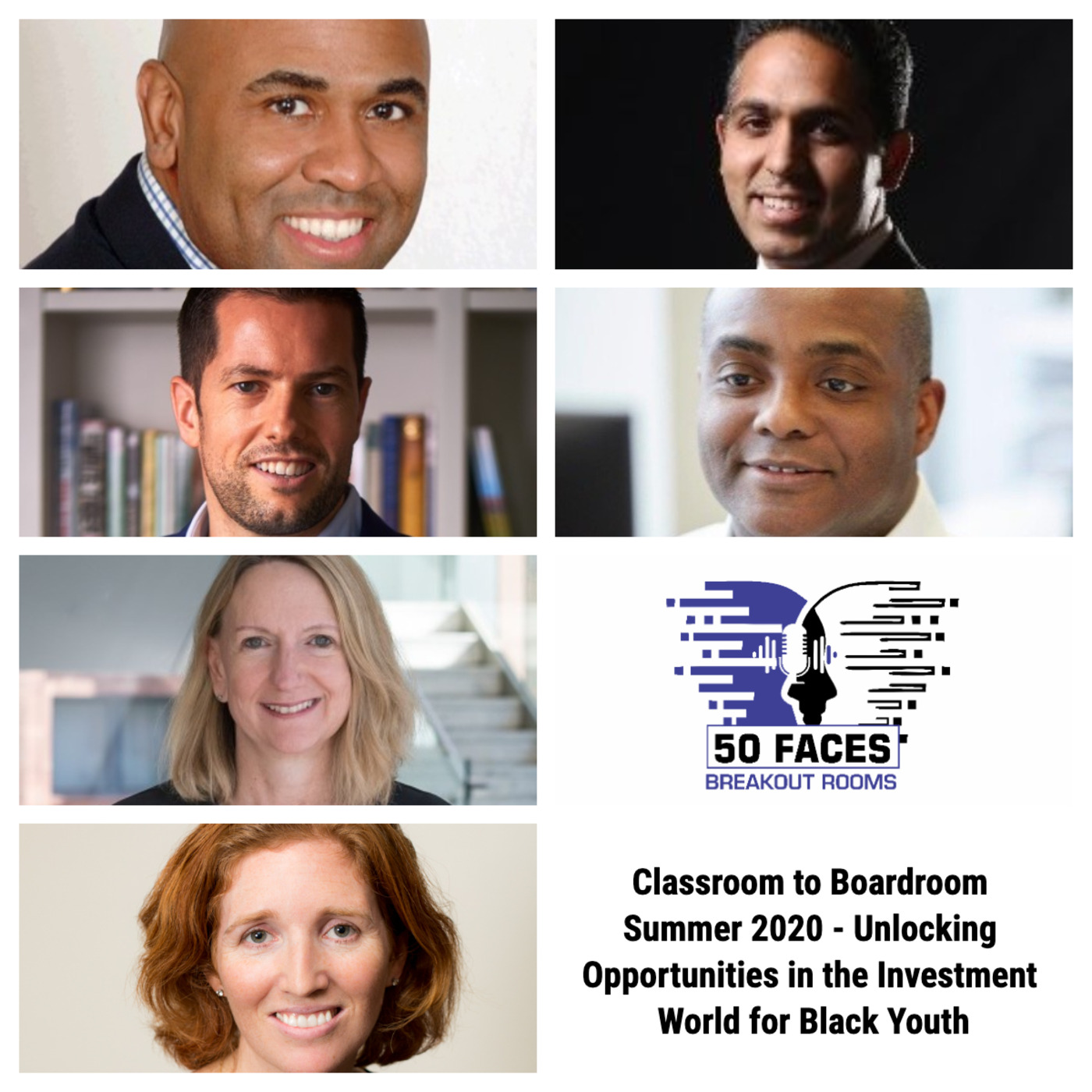
Aoifinn Devitt: In the aftermath of the killing of George Floyd this past summer, the eruption of global social protests, and the summer lockdown, Derek Brown and some industry colleagues heard a call to action to seek to solve the underrepresentation of Black talent in the investment management industry. Let’s hear how they answered that call, about the classroom-to-boardroom session that they organized, and about how it forced them out of their echo chambers to hear from Black youth, and the difference that listening closely can actually make to help us to reboot the investment management industry. Welcome to our breakout room, which is the first spinoff of the 50 Faces podcast, a podcast committed to revealing the richness and diversity of the world of investment by focusing on its people. And their stories. I’m Aoifinn Devitt. Today we’re speaking with an esteemed panel of leaders in the asset management arena. What unites them is that they all participated in an ambitious Classroom to Boardroom event this past summer. Classroom to Boardroom is the brainchild of Derek Brown and Mitesh Shep and was devised as a way to tackle underrepresentation of Black talent in the investment industry. It was designed as a way for executives to get out of their echo chamber, and hear directly from Black youth about their perspectives, challenges they might face, and maybe even identify talent. We’re joined today by a panel consisting of Derek Brown, Chief Executive of Entrepreneurs in Action, Ritesh Sheth, Chief Executive of Reddington, Sally Nelson, Chief People Officer, Fidelity International, Rob Gardner, Director of Investments at St James’s Place, and Alex Hutton-Mills, Managing Director at Lincoln Pensions. Let’s start by hearing from Derek and Mitesh about the origins of this project. Derek, can you tell us a little bit about your own story and why you decided the time was now for this initiative?
Breakout Room 1: Thank you, thank you very much. So my story has always been one of being a minority in the city. I joined Barings in 1989 as a trainee and became the first Black trainees since 1762, uh, on at Barings. And, um, by the time I’d left 7 years later, I was still sort of one of 440, uh, traders and salespeople on the trading floor. And then I left there and joined Merrill Lynch on the private banking side, working with high net worth and ultra high net worth clients, and became a partner in the biggest team in Europe. What was interesting still was I was only one Black banker and partner in the UK and in Europe. After leaving Merrill Lynch, I set up Entrepreneurs in Action, and that’s 17 years ago, and we act as a bridge between businesses to connect with young people and to give them insights around Generation Z, primarily through our classroom-to-boardroom program. And it’s really through the Classrooms Boarding Programme that I’ve met sort of Mitesh and Rob at Reddington. And really the now bit around why now and how we started this conversation, which has led to this event today really, is that after the horrible murder of George Floyd, I had a call from Mitesh and we had a conversation around the lack of Black diversity in the investment management industry and this sort of conversation around BAME, but really the lack of the B in the BAME in representation. And we agreed that, you know, collectively we would do something together about that, and Mitish was very interested in how we could do that with the Classroom to Boardroom program, and we did that by really focusing on giving the industry a chance to not really guess at how to connect and engage with young Black talent, but to hear from themselves, from the young Black talent, and to get those insights directly from them. So I think that really sort of brings us to date as to how Mitesh and I got to work together.
Aoifinn Devitt: Mitesh, why did this project excite you, and what did it have that maybe other projects that have happened in the past were missing?
Speaker C: Thanks for that question, Aoifinn. The reason for this project is actually Rob Gardner had introduced me to Derek maybe 5 years ago, where he had run the Classroom to Boardroom for us, bringing kind of young talent in to help us think about how we engage future generations in saving for their future. And, you know, when we went through the summer and, you know, I participated in the kind of I Am campaign run by the Talk About Black team. Derek was one of the first people I thought of, and I thought, wouldn’t it be great if we could get out of our echo chamber and actually hear from some of the Black students themselves, work with them to engage with their teams, with their colleagues, with their kind of fellow students, as well as their wider community? And have them represent to us what it is they think of our industry, why they’re not applying, and if they are applying, why they aren’t getting through. So it’s really wanting to make sure that we didn’t just tick a box or pretend to ourselves that this time was going to be different, but to really make sure that we stop, recognize that what got us here won’t get us to where we need to get to, and that we really needed to hear from those who were simply not engaging and/or bringing into our firms. So I was delighted to kind of reconnect with Derek and set him the challenge to say, could we have a Classroom to Boardroom with a bit of a difference? Would you be able to accommodate multiple firms? Because it was clear from speaking to my peers and colleagues that this clearly isn’t a Reddington-only issue. It’s something we’ve got to try and tackle together as an industry. And secondly, could we in this occasion just focus on Black students, and would you be able to you get, know, a number of Black students maybe across a couple of schools together to go on to this? And finally, would we be able to do this remotely? So there were kind of three tiers of challenges that definitely, I think, sent Derek’s head spinning initially, and I was delighted to hear his call back over the weekend to say Yep, it’s difficult, but this is important and let’s make it happen.
Aoifinn Devitt: Well, we’re going to hear a little bit later how he made that happen in, I think, what, 3.5 short weeks. But so thanks for that, Mitesh. And just moving to Rob, because I know, Rob, financial literacy is something that you are passionate about and that you spend your time trying to get even very young children to, I think, grasp basic concepts of saving and finance and investment. Why was this project of interest to you?
Speaker D: Yeah, great question. I think the thing that struck me at the end when we were having a conversation was the lack of awareness about our industry, and I use the industry in the broader sense. I mean, representatives were mostly from sort of wealth management and asset management, but I think it’s a real sense that I didn’t know these jobs existed. I wasn’t aware of it. We don’t get taught about this at school, even if we do business studies, it’s not really aware. So I think for me, there’s a kind of— it’s interesting that Derek used the word bridge because I think that’s exactly the issue. On the one side, as an industry, I think we, and I include the firm SJP I work for and the industry I work with, kind of unaware about the challenges young Black men and women face trying to get into our industry. And then the flip side, just how our industry doesn’t make ourselves aware as a career opportunity to young people looking to come and join us. And I think there are very strong parallels with the fact that people feel totally inequipped around financial literacy and making good financial decisions.
Aoifinn Devitt: That’s an excellent, excellent point. And Sally, you’re Chief People Officer at Fidelity, clearly a huge global firm. Have you seen initiatives like this elsewhere, and why did it interest you in particular?
Speaker E: Yeah, Fidelity International is in 27 different operating locations, and I guess the reason why the program Classroom to Boardroom was of considerable interest to a company of our size is that our rich cultural diversity is a huge strength and critical to our business success. And maybe just to give you a bit of context around the diversity of our workforce, we have just over 70% of our employee base outside of the UK. And of that, more than a third of the employees are in India and 10% in China. So we really believe that our business should reflect the full diversity of the communities in which we work so that we can continue to innovate and meet the needs of our really diverse client base. And so this, this summer, as the world considered all the challenging questions raised by Black Lives Matter campaign, we looked more deeply at how we ensure our business is one where everyone has an equal opportunity to thrive regardless of race, ethnicity, or cultural background. And today it’s true that Black people are underrepresented not only within Fidelity International, but within the asset management sector as a whole. So we’re determined to change that, and early careers is a key area of focus. I really jumped at the chance of taking part in Classroom to Boardroom. And what a fantastic, unique opportunity to hear directly from a truly diverse and really talented group of young people as we were ourselves shaping our thinking on how to open up access and inspire young Black people to consider a career in asset management. And I’m personally a trustee on the boards of a couple of education charities, And equal access to opportunities and social mobility are at the heart of what those charities stand for. And I value enormously the voices and contributions of young people, and they really had a lot to tell us about. What I wanted to do was to really be able to help other CEOs and business leaders to understand the benefits of Classroom to Boardroom as a program and how that can help us engage with Black students while still at school. And actually, the whole initiative exceeded our expectations in terms of the quality and the output from the students, because what we found was the programme was all about how we could engage, recruit, and retain Black talent, and it truly showed some really impressive talent that Black students can bring to our sector. In just a week, they, they absorbed and analysed huge amounts of information about our sector, They conducted research into best practice, they came up with recommendations, they investigated their feasibility and turned them into flowing, highly organised presentations. It was just mind-blowing. What I was particularly impressed with was the depth of their thinking, the creativity of the ideas, and the confidence in delivering an engaging presentation. None of them had any hesitation in offering up their views, and they were so confident, it was incredible. So for anyone thinking about taking part in the Classroom to Boardroom programme, it’s just such a great way to hear totally different ideas and make sure that your plans are going to work well for your target audience and that you’re going to, along the way, meet some incredibly talented young people. So I guess the aspiration really is that some of the students who participated might also even have been a little bit inspired to consider a career in asset management as well.
Aoifinn Devitt: That’s certainly a win-win from a talent identification perspective. Alex, what were some of your thoughts? Had you come across a program like this before, and what were you hoping to gain from it?
Speaker F: Yeah, I mean, I have known Dawid and Rob because we started our respective businesses, you know, in what we hoped to be a disruptive way about 12 or 13 years ago, within about 6 months of each other. And I’m Ghanaian, as is Dawid, and I think the I like Mitesh’s concept of the echo chamber because I think as we go about our day jobs, we’re constantly thinking about how we can come up with the right sort of products, the right sort of advisory services for customers and clients. And I think it’s really easy to lose sight of the fact that actually, unless you keep finding the right sort of talent and you recruit and sort of raise and then try and retain that talent, there isn’t really a sustainable business going forwards and a sustainable future for what we’re all participating in at the moment. So for me, a lot of this is about trying to make sure that we get outside the echo chamber, listen to why is it— and I think this was the starkest finding, the fact that why is it that people don’t really understand what goes on in investment management, which then makes it harder for them to think about that as a credible career option going forwards. So it was really interesting hearing from the students to actually recognize the journey they’d been on in the 4 or 5 days when they’d interviewed us, because they were recognizing that it’s not just maths, numbers, you know, dry stuff as they described it, but actually there’s a real kind of richness in marketing, in business development, in other functions within investment management that mean that actually it’s something that they should be thinking about. I think the other thing I personally look at, just because of, you know, my fortunate opportunities to start with a number of internships through my school and through university is that just giving people the opportunity to undertake an internship doesn’t mean they have to stay in investment management. It just means that you’re better equipped to make a decision about the right career for you. So I think it’s as important for us to make sure that people are making good decisions in the early careers to make sure that they’re in the right spot when they are, you know, at the bottom of that foothill starting their careers in earnest. So I think, as I said, that the The biggest learning for me was just, we’ve got to do a lot more to try and help young Black students understand that there’s a lot that they can gain, and it’s a really interesting and attractive industry to work in. And I feel fortunate having done this for 20-odd years, and hopefully many that, more, you know, I can hopefully see that this is an inflection point in where we go in terms of recruiting and retaining Black talent.
Aoifinn Devitt: That’s a really interesting point, because often we talk about the pipeline, as a problem that it’s almost that there aren’t enough people applying. But I think it’s interesting how you frame that as a problem of asset management or investment management, that it’s not getting out you there, know, touting the joys of working there or touting the benefits of this as a career. It seems that that’s entirely on us, those of us who work in here, that we perhaps should be a little more active about selling its attractive features. I’d like to go back to Derek to paint a picture for what this week actually looked like. I think Sally’s already given us a sense of some of the presentations involved, But I know you put it together in about 3.5 short weeks. What exactly did you have in mind? And also with the additional pressure, I suppose, that it all had to be done more or less remotely.
Breakout Room 1: Yeah, so it was really, I think, a massive call to action for me and the team. And if I reflect, it was that sort of lockdown spirit of innovation where you kind of just believe anything’s possible. But typically we have a 6-month leading time for a Classrooms to Boardrooms challenge, that’s with one company and one school, but recognizing that the scale of the task, particularly after an evening call at 6:30 on a Friday with Alex and his business partner, we realized that this was a really serious program for industry. So from our perspective, we had to put together 3 schools, which the headteachers were amazing in taking this up. Because we’ve got young people with different economic backgrounds and access to technology, we agreed that all students would come into school and socially distance, and so they could use the school’s technology. But we had no idea, and the schools had no idea, that they’d be using something called Webex, and that we had lots of technical issues in, in sort of connecting with the businesses. But again, can-do spirit, they got through it. And then from the business leaders, we had this sort of 3.5-week period of speaking rapidly to a number of business leaders to explain what the program was about, what they needed. And I think again, the authentic goal that we set, that we wanted to make it meaningful, we asked businesses to share confidential information regarding HR plans and diversity in early careers, which they did in the spirit of really trying to get to the bottom of this and allowing the students to have the best tools and research to help them. And also, I think that from a student perspective, if you can imagine, many of them were sleeping late into the to the morning, if not lunchtime, because they were about exams, they were in the middle of lockdown, and all of a sudden this opportunity sprung on them. And what was amazing from my perspective is that they just jumped at it. They started at 8:30 in the morning, some starting at 8 o’clock. During the week they were working some nights 10, 11 o’clock in their teams because they saw it as an opportunity to really make a difference, and they got excited by the industry, they got excited by the conversations they had with the HR teams and the directors on the Tuesday. And I think the other side of it, which was very unique for us, as it was such a complex challenge, we actually had 3 schools, so we had students at 16, 17, and 18, GCSE, first-year A-level, and A-level students doing it, as well as first-year and second-year undergraduates from 4 universities, and also one graduate. So we had an amazing group of young people working in a way that we’ve never worked before, and there was amazing learning, which you hopefully, know, we’ll hear another time from the students. So I think They had an amazing time. They really did well. They worked really hard, and the challenge was set to them by Mitesh on the Monday. And literally, the students only have 3 days to put themselves into teams, to analyze all the information that has been shared by the businesses, have the conversations with the businesses, do their own independent research, come up with new ideas. And my team, we’ve been doing it for For our 17th year, we’ve sort of 16,000 young people through the program, so we’ve got a model that we know that’s worked, that works. But again, we were stretched. It was all remotely done, but they bonded as a team. They were excellent. They came up with loads of ideas. And then, as was commented by all the speakers, our job is to prepare them for that moment. We call it the Wembley effect, where they walk in to the big pitch and and they pitched to CEOs. So it was amazing to have 10 senior leaders, a mixture of CEOs and global heads, giving up 2 hours of their time on the Friday to listen to the presentation. And to be honest with you, I heard the pep talk on the Friday morning. They went in to really nail this and they were really confident. They felt they owned the industry. And by the quality and energy of the presentation, I sort of saw it as one of the best presentations we’ve ever seen. So, but that’s me and I kind of stop and I say what the industry can say what they thought about it, but that’s what I thought was brilliant.
Aoifinn Devitt: Well, I think at this point I’ll refer people back to your video on your LinkedIn profile, which does have excerpts from that presentation, The Wembley Effect, and it really is a phenomenally impressive video. I’d love to ask the panel members what their impressions of the week were, in particular if there was anything that resonated with them personally. And one question I’d also like to ask about is, we talked a lot about how impressive everybody is. Was there any clear area maybe for development that there was, it was clear that maybe we can assist at this stage to plug some gaps? Maybe Mitesh.
Speaker C: Yeah, so let me try and answer both of those. If I go with the first one, I mean, the real sucker punch for me in recognizing how little we knew and how much we needed to move forward was right in my first engagement with them. And I think this was when we set the challenge to them at the beginning of the week. And they, I think Sally said earlier, they were just so confident and frank with us. They very boldly said to me, why are you doing this? Is this just to tick, you know, some kind of box, or do you genuinely believe Do you think that Black talent has some value to offer to your industry? It was such an open, honest, and important question. And I reflect on it because I still think about that today. And I answered them at the time to really say to them that, you know, you’re all different and I don’t want to make a generalization. But I absolutely have seen through the different talent and specifically even Black talent that have joined our business, the various different kind of skills, capabilities, and mindset that they’ve brought to our business. And I think being able to really clearly show these young people that we’re not just ticking a box,. And whether it be their perseverance or their grit or their problem solving or their confidence or otherwise, there were so many different things that we think are critical to our success and growth that we need to be able to bring in. And not just kind of maths, maths grades, even though many of them kind of came to us and have since applied to us with fantastic kind of maths and finance grades. But there was this real perception that they had that we had a particular type of profile of candidate that we were looking for. And I think the moment we could shatter that, I think they— we absolutely engaged and got their interest and engagement. And again, to your second question around development from here, I think when we are interviewing these young people, whether they’re the ones from the Classroom to Boardroom for internships or other young kind of Black talent through entry-level programs, I think it’s really important that we can demonstrate to them through our processes that we’re not just ticking boxes, but also that we’re not just using standard processes and that we’re really looking to dig deeper around their motivation and skill sets and the breadth of potential capabilities that they bring to our organizations and ones that’ll be critical to our success.
Aoifinn Devitt: And just building on that with Rob, how do you demonstrate that you’re not just ticking boxes and that you have a genuine commitment to this? And what were your impressions of the week?
Speaker D: Let me start with the presence of the week. I mean, I only got to sort of enjoy the last 2 hours, but as has been said by everyone really, just blown away by the passion, the hard work, and I think the image of shattering the mirror or the glass, I remember one of them playing back to us what it looked like, what the industry looked like, and it was all charts and screens and I was like, oh my God, that is what we do and that is how we look, and I can see how that just doesn’t create it doesn’t create an industry that says, I could work here too. So that was my takeaway. For me, I’m the kind of executive sponsor for race and ethnicity at St. James’s Place, as well as being the director of investments where I’m personally extremely passionate about responsible investing and embedding what’s called environmental, social, and governance factors into the way we invest our money. And there are two sides of that coin because at the end of the day, we need to ensure that as a business, we are diverse and inclusive. And Alex talked about raising the bar to be sustainable for the long term. And actually, that’s exactly what I see our job is. We need to retain, we need to attract, we need to inspire, we need to skill up. We need to empower. And so for me, firstly, it’s demonstrating steps that we are giving opportunities to young Black men and women. And so we’ve taken on an intern and a summer intern through Classrooms to the Boardroom. We’re involved with another initiative called 100 Black Interns, which has now become 10,000 Black Interns, as well as other sort of projects to give either internships or graduate opportunities. The second thing though is ensuring that the retain piece and the development piece and creating those role models within our business to ensure that this is for the long run, and I think that the danger is, as an industry, it’s easy to say we’re on a journey and we’re making progress, but I think it’s important to if you you have a— are on a journey and maybe the destination’s unclear, but I think it’s important to have some clear designated stop-off points and commitments, uh, to sign up to. So I, I think if, if you are not doing this as box ticking and you’re genuinely taking action to, A, understand the problem and the issue— what, why are young Black men and women not and why aren’t— applying, and, and why aren’t we keeping Why aren’t they progressing as well in our industry? So how do we tackle that? And then two, what steps can we put in place to address that?
Aoifinn Devitt: That’s great. And Sally, you’ve already spoken about some of your positive impressions of the program. Is there anything that your fellow panelists have said here that resonates with you? And you’re a chief people officer, so you’re looking at attracting all kinds of people. What were your impressions of the week and anything to take away with you?
Speaker E: Well, I think I’ve already mentioned just how blown away I was with the incredible energy and clarity of thinking and recommendations that the students were able to offer up. For example, you know, some of the insights that they gave us to have a think about was to have a much more targeted strategy and approach around, you know, how we think about attracting Black candidates and improving representation. So, you know, we’re now going to launch a sponsorship scheme, and then the other aspect really which we really have embraced is looking at changing the mix of universities and schools that we target, which was another recommendation that that we had, and the early careers team have been looking at the ethnic diversity of our target universities, and as a result of the conversations we had, have identified a new set of target universities with student bodies that reflect a much greater diversity of ethnicity and social background. And then just to make it really real within the organisation, we’ve now set some specific key performance indicators, not just for recruitment of young Black talent, but also around the number of Black employees in senior management. So, you know, we’ve set ourselves a target to increase the number of Black directors and above within a couple of years. And, you know, we will be actively promoting that and measuring it. So it’s really got us thinking quite deep. And it’s, it’s been an incredible experience.
Aoifinn Devitt: That’s great. And Sally, when you say you’ve set a target, do you actually put a figure on that target or is it at this point?
Speaker E: Yes. Yes. So we put a figure of we would like 5 additional Black directors and above in senior management positions by December of 2023.
Aoifinn Devitt: Alex, just moving to you, did anything of what you heard during that week resonate with you personally or as an entrepreneur, as a finance executive?
Speaker F: Yeah, I mean, like Rob, I— we were trying to make sure that the students had enough access to enough different people, so we had other seniors participate in the interview process, and then I participated in the presentation at the back end. But I mean, I think there’s probably a couple of things that really resonated from the feedback that we chatted about internally before the presentation, and one was Just some really, um, blindingly obvious low-hanging fruit, like make sure you’re sort of with the times. So for example, you know, how do we set up our early careers page not just to be interesting to the sorts of people that we as a business— because we tend to take on not just graduates but graduates with professional qualifications, so they’re typically accountants or someone with a CFA Level 3 And that sort of raises a portcullis immediately. So, you know, we’re having to think about making sure we have some sort of apprenticeship or internship program, which then allows people to start bridging towards that. And if you don’t, you know, it’s just much more difficult because the numbers of people who were interested in getting into that side of the industry, they drop quite dramatically anyway. So we’re trying to, you know, open up the top of the funnel to give ourselves a chance to to find and recruit that talent early enough. And I, so I mean, that was really important. And then again, the other thing is, I you think, know, I feel like a dinosaur sometimes, because it’s fear of social media, given the topic. But actually, it’s so important to engage. And engaging in a meaningful way as part of a retention and a recruitment strategy is really important. So, you know, whilst we’re very client-focused and making sure we’re giving good messages about our kind of specific idiosyncrasies and products and services, actually, we need to make sure, again, back to the early point about sustainability, we’re hiring, finding, hiring, and keeping the right people. Otherwise, you know, we will become extinct to that extent, just to keep the analogy going. So I mean, I think those were the two key things. And actually, I think on the presentation itself, the one thing I try to share with the students as a piece of advice or shared experience back was for them to recognize that actually this cohort was the first of a— if not the first, an early network that they’ve created because they’ve bonded with a group of people. And actually, the thing they should do is just make sure they nurture that network and keep that, because that’s the sort of thing that will sustain and will endure in 20, 30 years’ time as their careers develop. And to try and help that to some extent, what what we’ve, we’ve done is um, we, we had the industry presentation that Friday, but we’ve also then given the students a chance to do a single company version in, in the Cardano and Lincoln Group to us internally, which was to about 120-odd people, which I think gave the students another chance to just reinforce the, the network and the friendships that they developed, but also it’s just another chance to keep developing and sharpening presentation skills and some of the soft skills know, that, you that Derek and others were trying to develop in that week. So hopefully, that was a constructive thing that we were doing. And as I say, it just says there’s a lot to do where we’ve got to think about things like engaging through social media and trying to think harder about how to make sure that we’re seen as an attractive spot to start your career.
Aoifinn Devitt: Absolutely. I mean, what I’m hearing here is our industry has a bit of an image problem, certainly as in terms of making itself attractive to students at this level. And you’re all senior executives, and I think any senior executive I speak with, and I’ve spoken with many over the course of the summer, is everybody underrates, I think, when they’re young, the importance of networking skills and people skills, and perhaps overrate the importance of the hard quantitative skills. And as they move through their career, they actually begin to realize it was the soft skills, the relationship skills that actually mattered all along. So I think it’s interesting that maybe we need to start to convey this to students at an early age. And they also, the students, I think are very good at networking usually, certainly my daughters are. So maybe we should be encouraging them to do that and that it can actually be very fertile for their career. I want to move to the future now and look beyond this initial momentum. And I’m actually going to come to Derek last because I think, Derek, since we started with you, we have to end with you. But I’d like to hear maybe first from Atesh. How do we build on this momentum? Are you optimistic about the future for our industry being diverse in the future? And where do we go from here?
Speaker C: I am optimistic and not just because I am a natural optimist, but really because of the huge engagement I’ve seen Firstly, from the, you know, the other 9 organizations that jumped at the chance to run Classroom to Boardroom alongside us and that really made it possible. But also, I’m really heartened to see the ongoing engagement from them with Derek and the students, but also with the many other excellent programs out there, whether people are working through Bright Networks or Investment 2020, or indeed with the Talk About Black team, and as Rob mentioned earlier, the 100 or now 10,000 Black interns. So I feel like we have turned a corner and there’s a real recognition of the issue. I think, you know, committing to data and reporting is really important. We’ve got to recognize that where we are today as companies and as an industry just isn’t good enough. And that we can’t bury Black within a BAME target, and that we’ve got to be able to specifically recognize the different issues here in an intersectional way, even within the Black community, and work out who are the people who are finding it hardest to, to get through to us. So I am optimistic in having seen that shift. I think some of the things that are a little bit more challenging is that the rebranding of the industry. And what became really clear, and I’d love for Derek to touch on some of the stats later, but I know very few of them aged 17, 18 had ever considered a career in the city or in the savings and investment industry. And yet by the end of the, just the week-long engagement with all of us, a significant number would have seriously considered a career in our industry. And I’d love Derek to share the stats later. But if that’s really possible, then the big message is we’ve got a branding issue and an engagement issue, but really we’ve got to be getting to speak to students when they’re 13 or 14 or 15 or 16 before they’ve made up their mind and dismissed us. So I think that is one of the challenges that I’m still trying to figure out, and I know we can’t do that alone, and so my ask with the others on the panel and the others listening is how can we together respond to the students’ challenge of partnering with schools, of getting into schools earlier, not just for the occasional speech, but specifically helping them with their aspiration and understanding of the industry and the opportunities it offers.
Aoifinn Devitt: Alex, how about you? Are you optimistic about the future? What do you have in mind for your firm for the next say 5 to 10 years?
Speaker F: Yeah, I mean, again, I’m a naturally optimistic person and I think, you know, once you’ve identified something that’s an issue, it’s much easier to start focusing on how you can deal with the issue. So the fact that, and I think I mentioned this a bit earlier, it really does feel through an alignment of different factors that we’ve reached an inflection point and there’s a real momentum to try and make a change and deal with the perception and the image. I think that’ll take longer to change because perception becomes reality, I think, as everyone knows, but we have to persist and, you know, if the whole notion of savings and investment is sustainability, so, you know, if we’re serious about this, then we need to try and create programs that will allow us to kind of sustainably hire and retain and raise and nurture this Black talent going forwards, because I think it’s important, not just for gender purposes, but for, you know, race, ethnicity, that we you are, know, able to tap into different mindsets, different motivations, and different understandings to try and get better outcomes. So I am optimistic that we can make a change as an industry if we persist with it. As I said, I think there’s been enough of a groundswell to have moved things on quite naturally anyway, and we just need to make sure that we kind of keep that momentum up. What are we doing? So we’ve got the single company or the presentation that the students did, which we’re trying to use as further motivation for us as a business to focus on the B of BAME within our diversity and inclusiveness steering group at the top, and then it’s trying to make sure we we can, have slightly different programs for the different arms of the group, which have defined contribution, fiduciary management, and then the credit advisory and transaction advisory. We’ll need different people with different skills there, so that hopefully there are opportunities going forwards to try and be attractive to, you know, to different Black students with different aspirations in their industry.
Aoifinn Devitt: Thank you. And Rob, you are the ultimate long-term investor. You exhort young children to save their acorns. So in the long term, even the short term, what are your thoughts for the industry? Are you optimistic?
Speaker D: Yeah, look, I am optimistic. I think maybe when I pick up how do we get there, and I’ve got a kind of 5-point framework to do that. I think first we need to acknowledge and accept there’s a problem. I used to work at Merrill Lynch with Dawid, who’s been referred to, and actually when I reflect on it 15 and 20 years later, the industry hasn’t got much better. So Derek talked about when he started his career at Barings and Merrill Lynch. So to accept that there is a problem, and it’s not ah, you like, know, the problem is no one applies. The second thing is awareness, and I think the awareness around BAME, I think the conversation about inclusion and diversity has moved from gender, although there’s still a long way to go on that. This concept called BAME emerged, but then even within that, recognizing that different groups face different challenges in their careers and progressions. The third thing is small action, and so for me, the small actions are taking on interns and summer interns and graduate opportunities on the back of this Classroom to Boardroom, participating in 10,000 Black Interns. The fourth stage is adjust, and I think 3 and 4 become an iterative process. We’ll learn stuff, you know, we all learn some stuff through this Classroom to Boardroom initiative. Once we get that right, and I think if we all share, if we’re sharing together, then we can accelerate. So I just want to finish by thanking Derek and Mitesh, make this happen over the summer. It was a brilliant initiative, and I think it was great to get, you know, 10 firms together to collaborate and see to really understand what the issue is and to take some ideas so that we can start to take small actions. And we all know the key to big change is a series of small actions.
Aoifinn Devitt: That’s a great plan there. Thank you very much for that. Sally, you have spoken a lot about the global nature of your firm. This momentum has been a global momentum, I think it’s fair to say. How do we keep on with this momentum?
Speaker E: We have to keep having the right conversations. I mean, one of the things that’s been incredibly powerful over the summer is the tone and focus from the very top of the organization. Internally, we’ve been going through a very similar process of classroom to boardroom by really listening to the voices of our people in focus groups across the firm to inform our plans. So, and these focus groups have been run by members of the executive committee, committee and senior management. And really the conversations have been all about trying to understand and address how race and culture impacts on people’s experiences of working in our firm. I mean, as we probably already acknowledged, as an industry we really need to move the dial on engaging, recruiting, and retaining Black talent because progress up until today has been really too slow. I think it’s right in saying that only 1% of people in asset management identify as Black compared with 13%, I believe it is, of the population in London where many asset managers, including my own, are based. So I think we need to keep the momentum, we need to keep the conversations going, we need to keep listening and we need to be open. I mean, there’s no doubt there’s an acknowledgement that rich cultural diversity, having diverse voices around the table is the way great business and great service to our clients will be done, and it’s critical really for future business success. So, you know, we need to encourage everybody to tell us like it is, and certainly that was my experience of Classroom to Boardroom. I mean, we really got told exactly how it comes across and some of the things we really need to think about. And if we can keep this candid debate that’s already been started going, especially when it’s not easy and when it’s not necessarily comfortable, I you think, know, the most courageous conversations often lead to the most important outcomes. And I really think we’re at that point you where, know, great change and progress is going to happen. So I’m very optimistic about where this is going, but I don’t underestimate the journey that we’re on, and it will need commitment and it will need us all to you really, know, move to action, to measurable action.
Aoifinn Devitt: That’s a really good point, and maybe I’ll bring to Derecka as we close, because I didn’t mention before, but I think that is what I’m hearing here, is that we do need to feel uncomfortable as an industry about some of these conversations. We will feel uncomfortable, and we have to be become comfortable about feeling uncomfortable. But I think that’s why it’s so important to share experiences like this, because the natural instinct when one is uncomfortable is to shut down the conversation and move on or change the subject. And if we can at least have some solidarity in the industry in terms of that we’re all having these same conversations, I think we can definitely move the needle. Back to you, Derek. You have pulled off a Herculean task here with this very ambitious project put together in a short space of time. I think, however, it’s clear that for none of us is our work done at the moment. The work goes on. What are your thoughts for the future? And maybe you can also share what even one week of this project did actually achieve, as I think that Mitesh had mentioned you had some stats maybe for us.
Breakout Room 1: Yeah, I know. Thank you very much. And just to your reference on the uncomfortable peace and what Sally said. I think what’s important about the program, it creates a safe space for young people to talk to leaders and give that level of honesty. But it also creates a safe space for the leaders to listen and learn from the young people and have a debate and the interaction. I think we’re all benefiting from that. Just to share some observations on the stats as well. I think first and foremost what came across from the young people, which isn’t recorded in any of the reports or video, is that they felt a human connection with the industry through the people that they met, and it really dispelled a lot of myths for them around what the sort of investment-type person was. And that’s really borne out in the figures that we’ve got. So before we started, we did a a poll and said, how many of you would be interested in working in the industry? And yes, we had 22%, and no, 78%. And at the end of the program, we turned that round, or the guests and the panel and all of the participants have moved from— they moved from 22% to 70%. 8%. So, so we had a massive— so 72% said that they’ll be interested rather than a no of 28%. So a massive turnaround by the experience, the knowledge they got, the insights and the interactions which they had. And I’ve got just a couple of stories really, and the benefit of that for the industry is that if you get bright talent connecting with your industry, you know, and that’s in this case with the Diversity Games, bright Black talent, the industry wins because we had a number of those students who were exceptionally gifted academic students at top universities and they have a choice in terms of their careers that they can actually take up and I know two particular students who are leading universities who had no interest whatsoever in investment management or the financial services industry, just based on what their friends have said, what they’ve seen in the press. But as a result of the program, as a result of the, the real human connection, the humility of the leaders on this call and the staff that was involved and the experience of the industry through their research. They have decided to join the industry. They want— applying for internships, one’s working with Rob at St James’s Place. These are young people who’ve been turned around by what’s happened. And the final story on that is one of the students has always wanted to be a vet from the age of 4. And after she finished the program, I got a call from her parents saying that she sat down at the dinner table and said, ‘Mum, Dad, I don’t think I want to be a vet anymore. I think I want to join the investment management industry.’ And I don’t want to repeat what happened on that call, but it was a really great call to have. And so that’s that on that point. And just on the how I feel about the industry, I’m optimistic. As was Robin Marks, I left 17 years ago, and speaking to Mitesh.
Speaker F: And.
Breakout Room 1: Coming back into industry, because I haven’t really done anything in industry in that time, I was really surprised how little the industry had progressed in terms of representation despite the huge amount of investment that’s been made in diversity. And for me, my reflections really is it’s— I almost see it as a Ctrl+Alt+Delete moment for the industry, for me, in that we’ve brought these young people in, they’ve brought challenge, and the industry’s finally— the industry’s listening, the industry’s acting, and there are a number of players which have been mentioned that now the industry is creating space for new people, for new ideas and new approaches to work. And it’s with that commitment of the likes of Sally, Mitesh, and Rob, who are making those commitments, and all of the 10 firms. We’ve seen great commitments from Alex as well. And that’s what we need. And what I would say is that yes, it’s important for the industry to think about Black diversity, and we should look at that in terms of pipeline. And I love Sally’s reference to making a commitment, I think it’s to 2023, to having more Black, you know, a specific number of Black executives on the team at director level. But also, I think this is a conversation for businesses to look at supplier diversity. We’ve been able to work with the industry, share our knowledge in a way that we haven’t been able to do before. And as a result of doing this program, we’re having a number of conversations, but the diversity of thought and new ways of thinking has brought great value, which has stimulated the conversations which we’re hearing today. So I also think that businesses should look and challenge themselves at who are their suppliers and think about how they can work with other suppliers who are not within the standard racial mix that they would typically go for. So I’m really excited. I think you’ve made a real difference. I really appreciate everybody in making the time to be on the call, and yeah, the future’s bright. So thank you very much.
Aoifinn Devitt: Thank you, Derek. And Lukesh, did you want to come in there?
Speaker C: Yeah, I was just going to say that I’m so grateful, I think on all of our behalf, to Derek for taking the challenge on, for bringing together what was the impossible, but really opening our eyes. And I think as Derek and the kind of fairly strong team of young people said to us, they’ve handed the baton to us., and we need to make sure we don’t let them down in making sure we pick this up and run with it. And I think all I would say is that we’ve talked a lot about building bridges, and a big part of that is opening our eyes, opening our minds, and opening our hearts. It’s about real empathy. Quite often we find that line managers can become the biggest blockers to change, but not if we can help them open their eyes. Minds and hearts for empathy, and I think they can become the biggest multipliers for this kind of change. And I think for doing that, connecting our line managers to these young Black people as mentors, or even more importantly, to get reverse mentoring so that they can hear from them and use them as a sounding board for making change, I think could be a really powerful way of accelerating this and amplifying that change. But I think let’s make sure this isn’t the one and let’s all make sure that we continue to keep our eyes open and keep the momentum going. But thank you, Derek, and thank you, everybody.
Aoifinn Devitt: Well, thank you, Natasha. And yes, I’d like to extend my own thanks. It’s been a very inspiring conversation. The students clearly, we can hear from you and also based on the video on Derek Brand’s LinkedIn page, are a very inspiring bunch. I would have a lot of hope for the future. But thank you also to all of you, Sally, Derek, Mitesh, Rob, and Alex. You are also an inspiration because you believe not just in talk but in action. And I firmly believe we need both. We don’t just need the action, we also need the talk, because if we don’t talk like we’re doing now, we can’t spread the word. So thank you again. Thank you for listening to the 50 Faces breakout rooms. I’m Aoifinn Devitt. This podcast is for informational purposes only and should not be construed as investment advice, and all views are personal and should not be attributed to the organizations and affiliations of the host or any guest.
Aoifinn Devitt: In the aftermath of the killing of George Floyd this past summer, the eruption of global social protests, and the summer lockdown, Derek Brown and some industry colleagues heard a call to action to seek to solve the underrepresentation of Black talent in the investment management industry. Let’s hear how they answered that call, about the classroom-to-boardroom session that they organized, and about how it forced them out of their echo chambers to hear from Black youth, and the difference that listening closely can actually make to help us to reboot the investment management industry. Welcome to our breakout room, which is the first spinoff of the 50 Faces podcast, a podcast committed to revealing the richness and diversity of the world of investment by focusing on its people. And their stories. I’m Aoifinn Devitt. Today we’re speaking with an esteemed panel of leaders in the asset management arena. What unites them is that they all participated in an ambitious Classroom to Boardroom event this past summer. Classroom to Boardroom is the brainchild of Derek Brown and Mitesh Shep and was devised as a way to tackle underrepresentation of Black talent in the investment industry. It was designed as a way for executives to get out of their echo chamber, and hear directly from Black youth about their perspectives, challenges they might face, and maybe even identify talent. We’re joined today by a panel consisting of Derek Brown, Chief Executive of Entrepreneurs in Action, Ritesh Sheth, Chief Executive of Reddington, Sally Nelson, Chief People Officer, Fidelity International, Rob Gardner, Director of Investments at St James’s Place, and Alex Hutton-Mills, Managing Director at Lincoln Pensions. Let’s start by hearing from Derek and Mitesh about the origins of this project. Derek, can you tell us a little bit about your own story and why you decided the time was now for this initiative?
Breakout Room 1: Thank you, thank you very much. So my story has always been one of being a minority in the city. I joined Barings in 1989 as a trainee and became the first Black trainees since 1762, uh, on at Barings. And, um, by the time I’d left 7 years later, I was still sort of one of 440, uh, traders and salespeople on the trading floor. And then I left there and joined Merrill Lynch on the private banking side, working with high net worth and ultra high net worth clients, and became a partner in the biggest team in Europe. What was interesting still was I was only one Black banker and partner in the UK and in Europe. After leaving Merrill Lynch, I set up Entrepreneurs in Action, and that’s 17 years ago, and we act as a bridge between businesses to connect with young people and to give them insights around Generation Z, primarily through our classroom-to-boardroom program. And it’s really through the Classrooms Boarding Programme that I’ve met sort of Mitesh and Rob at Reddington. And really the now bit around why now and how we started this conversation, which has led to this event today really, is that after the horrible murder of George Floyd, I had a call from Mitesh and we had a conversation around the lack of Black diversity in the investment management industry and this sort of conversation around BAME, but really the lack of the B in the BAME in representation. And we agreed that, you know, collectively we would do something together about that, and Mitish was very interested in how we could do that with the Classroom to Boardroom program, and we did that by really focusing on giving the industry a chance to not really guess at how to connect and engage with young Black talent, but to hear from themselves, from the young Black talent, and to get those insights directly from them. So I think that really sort of brings us to date as to how Mitesh and I got to work together.
Aoifinn Devitt: Mitesh, why did this project excite you, and what did it have that maybe other projects that have happened in the past were missing?
Speaker C: Thanks for that question, Aoifinn. The reason for this project is actually Rob Gardner had introduced me to Derek maybe 5 years ago, where he had run the Classroom to Boardroom for us, bringing kind of young talent in to help us think about how we engage future generations in saving for their future. And, you know, when we went through the summer and, you know, I participated in the kind of I Am campaign run by the Talk About Black team. Derek was one of the first people I thought of, and I thought, wouldn’t it be great if we could get out of our echo chamber and actually hear from some of the Black students themselves, work with them to engage with their teams, with their colleagues, with their kind of fellow students, as well as their wider community? And have them represent to us what it is they think of our industry, why they’re not applying, and if they are applying, why they aren’t getting through. So it’s really wanting to make sure that we didn’t just tick a box or pretend to ourselves that this time was going to be different, but to really make sure that we stop, recognize that what got us here won’t get us to where we need to get to, and that we really needed to hear from those who were simply not engaging and/or bringing into our firms. So I was delighted to kind of reconnect with Derek and set him the challenge to say, could we have a Classroom to Boardroom with a bit of a difference? Would you be able to accommodate multiple firms? Because it was clear from speaking to my peers and colleagues that this clearly isn’t a Reddington-only issue. It’s something we’ve got to try and tackle together as an industry. And secondly, could we in this occasion just focus on Black students, and would you be able to you get, know, a number of Black students maybe across a couple of schools together to go on to this? And finally, would we be able to do this remotely? So there were kind of three tiers of challenges that definitely, I think, sent Derek’s head spinning initially, and I was delighted to hear his call back over the weekend to say Yep, it’s difficult, but this is important and let’s make it happen.
Aoifinn Devitt: Well, we’re going to hear a little bit later how he made that happen in, I think, what, 3.5 short weeks. But so thanks for that, Mitesh. And just moving to Rob, because I know, Rob, financial literacy is something that you are passionate about and that you spend your time trying to get even very young children to, I think, grasp basic concepts of saving and finance and investment. Why was this project of interest to you?
Speaker D: Yeah, great question. I think the thing that struck me at the end when we were having a conversation was the lack of awareness about our industry, and I use the industry in the broader sense. I mean, representatives were mostly from sort of wealth management and asset management, but I think it’s a real sense that I didn’t know these jobs existed. I wasn’t aware of it. We don’t get taught about this at school, even if we do business studies, it’s not really aware. So I think for me, there’s a kind of— it’s interesting that Derek used the word bridge because I think that’s exactly the issue. On the one side, as an industry, I think we, and I include the firm SJP I work for and the industry I work with, kind of unaware about the challenges young Black men and women face trying to get into our industry. And then the flip side, just how our industry doesn’t make ourselves aware as a career opportunity to young people looking to come and join us. And I think there are very strong parallels with the fact that people feel totally inequipped around financial literacy and making good financial decisions.
Aoifinn Devitt: That’s an excellent, excellent point. And Sally, you’re Chief People Officer at Fidelity, clearly a huge global firm. Have you seen initiatives like this elsewhere, and why did it interest you in particular?
Speaker E: Yeah, Fidelity International is in 27 different operating locations, and I guess the reason why the program Classroom to Boardroom was of considerable interest to a company of our size is that our rich cultural diversity is a huge strength and critical to our business success. And maybe just to give you a bit of context around the diversity of our workforce, we have just over 70% of our employee base outside of the UK. And of that, more than a third of the employees are in India and 10% in China. So we really believe that our business should reflect the full diversity of the communities in which we work so that we can continue to innovate and meet the needs of our really diverse client base. And so this, this summer, as the world considered all the challenging questions raised by Black Lives Matter campaign, we looked more deeply at how we ensure our business is one where everyone has an equal opportunity to thrive regardless of race, ethnicity, or cultural background. And today it’s true that Black people are underrepresented not only within Fidelity International, but within the asset management sector as a whole. So we’re determined to change that, and early careers is a key area of focus. I really jumped at the chance of taking part in Classroom to Boardroom. And what a fantastic, unique opportunity to hear directly from a truly diverse and really talented group of young people as we were ourselves shaping our thinking on how to open up access and inspire young Black people to consider a career in asset management. And I’m personally a trustee on the boards of a couple of education charities, And equal access to opportunities and social mobility are at the heart of what those charities stand for. And I value enormously the voices and contributions of young people, and they really had a lot to tell us about. What I wanted to do was to really be able to help other CEOs and business leaders to understand the benefits of Classroom to Boardroom as a program and how that can help us engage with Black students while still at school. And actually, the whole initiative exceeded our expectations in terms of the quality and the output from the students, because what we found was the programme was all about how we could engage, recruit, and retain Black talent, and it truly showed some really impressive talent that Black students can bring to our sector. In just a week, they, they absorbed and analysed huge amounts of information about our sector, They conducted research into best practice, they came up with recommendations, they investigated their feasibility and turned them into flowing, highly organised presentations. It was just mind-blowing. What I was particularly impressed with was the depth of their thinking, the creativity of the ideas, and the confidence in delivering an engaging presentation. None of them had any hesitation in offering up their views, and they were so confident, it was incredible. So for anyone thinking about taking part in the Classroom to Boardroom programme, it’s just such a great way to hear totally different ideas and make sure that your plans are going to work well for your target audience and that you’re going to, along the way, meet some incredibly talented young people. So I guess the aspiration really is that some of the students who participated might also even have been a little bit inspired to consider a career in asset management as well.
Aoifinn Devitt: That’s certainly a win-win from a talent identification perspective. Alex, what were some of your thoughts? Had you come across a program like this before, and what were you hoping to gain from it?
Speaker F: Yeah, I mean, I have known Dawid and Rob because we started our respective businesses, you know, in what we hoped to be a disruptive way about 12 or 13 years ago, within about 6 months of each other. And I’m Ghanaian, as is Dawid, and I think the I like Mitesh’s concept of the echo chamber because I think as we go about our day jobs, we’re constantly thinking about how we can come up with the right sort of products, the right sort of advisory services for customers and clients. And I think it’s really easy to lose sight of the fact that actually, unless you keep finding the right sort of talent and you recruit and sort of raise and then try and retain that talent, there isn’t really a sustainable business going forwards and a sustainable future for what we’re all participating in at the moment. So for me, a lot of this is about trying to make sure that we get outside the echo chamber, listen to why is it— and I think this was the starkest finding, the fact that why is it that people don’t really understand what goes on in investment management, which then makes it harder for them to think about that as a credible career option going forwards. So it was really interesting hearing from the students to actually recognize the journey they’d been on in the 4 or 5 days when they’d interviewed us, because they were recognizing that it’s not just maths, numbers, you know, dry stuff as they described it, but actually there’s a real kind of richness in marketing, in business development, in other functions within investment management that mean that actually it’s something that they should be thinking about. I think the other thing I personally look at, just because of, you know, my fortunate opportunities to start with a number of internships through my school and through university is that just giving people the opportunity to undertake an internship doesn’t mean they have to stay in investment management. It just means that you’re better equipped to make a decision about the right career for you. So I think it’s as important for us to make sure that people are making good decisions in the early careers to make sure that they’re in the right spot when they are, you know, at the bottom of that foothill starting their careers in earnest. So I think, as I said, that the The biggest learning for me was just, we’ve got to do a lot more to try and help young Black students understand that there’s a lot that they can gain, and it’s a really interesting and attractive industry to work in. And I feel fortunate having done this for 20-odd years, and hopefully many that, more, you know, I can hopefully see that this is an inflection point in where we go in terms of recruiting and retaining Black talent.
Aoifinn Devitt: That’s a really interesting point, because often we talk about the pipeline, as a problem that it’s almost that there aren’t enough people applying. But I think it’s interesting how you frame that as a problem of asset management or investment management, that it’s not getting out you there, know, touting the joys of working there or touting the benefits of this as a career. It seems that that’s entirely on us, those of us who work in here, that we perhaps should be a little more active about selling its attractive features. I’d like to go back to Derek to paint a picture for what this week actually looked like. I think Sally’s already given us a sense of some of the presentations involved, But I know you put it together in about 3.5 short weeks. What exactly did you have in mind? And also with the additional pressure, I suppose, that it all had to be done more or less remotely.
Breakout Room 1: Yeah, so it was really, I think, a massive call to action for me and the team. And if I reflect, it was that sort of lockdown spirit of innovation where you kind of just believe anything’s possible. But typically we have a 6-month leading time for a Classrooms to Boardrooms challenge, that’s with one company and one school, but recognizing that the scale of the task, particularly after an evening call at 6:30 on a Friday with Alex and his business partner, we realized that this was a really serious program for industry. So from our perspective, we had to put together 3 schools, which the headteachers were amazing in taking this up. Because we’ve got young people with different economic backgrounds and access to technology, we agreed that all students would come into school and socially distance, and so they could use the school’s technology. But we had no idea, and the schools had no idea, that they’d be using something called Webex, and that we had lots of technical issues in, in sort of connecting with the businesses. But again, can-do spirit, they got through it. And then from the business leaders, we had this sort of 3.5-week period of speaking rapidly to a number of business leaders to explain what the program was about, what they needed. And I think again, the authentic goal that we set, that we wanted to make it meaningful, we asked businesses to share confidential information regarding HR plans and diversity in early careers, which they did in the spirit of really trying to get to the bottom of this and allowing the students to have the best tools and research to help them. And also, I think that from a student perspective, if you can imagine, many of them were sleeping late into the to the morning, if not lunchtime, because they were about exams, they were in the middle of lockdown, and all of a sudden this opportunity sprung on them. And what was amazing from my perspective is that they just jumped at it. They started at 8:30 in the morning, some starting at 8 o’clock. During the week they were working some nights 10, 11 o’clock in their teams because they saw it as an opportunity to really make a difference, and they got excited by the industry, they got excited by the conversations they had with the HR teams and the directors on the Tuesday. And I think the other side of it, which was very unique for us, as it was such a complex challenge, we actually had 3 schools, so we had students at 16, 17, and 18, GCSE, first-year A-level, and A-level students doing it, as well as first-year and second-year undergraduates from 4 universities, and also one graduate. So we had an amazing group of young people working in a way that we’ve never worked before, and there was amazing learning, which you hopefully, know, we’ll hear another time from the students. So I think They had an amazing time. They really did well. They worked really hard, and the challenge was set to them by Mitesh on the Monday. And literally, the students only have 3 days to put themselves into teams, to analyze all the information that has been shared by the businesses, have the conversations with the businesses, do their own independent research, come up with new ideas. And my team, we’ve been doing it for For our 17th year, we’ve sort of 16,000 young people through the program, so we’ve got a model that we know that’s worked, that works. But again, we were stretched. It was all remotely done, but they bonded as a team. They were excellent. They came up with loads of ideas. And then, as was commented by all the speakers, our job is to prepare them for that moment. We call it the Wembley effect, where they walk in to the big pitch and and they pitched to CEOs. So it was amazing to have 10 senior leaders, a mixture of CEOs and global heads, giving up 2 hours of their time on the Friday to listen to the presentation. And to be honest with you, I heard the pep talk on the Friday morning. They went in to really nail this and they were really confident. They felt they owned the industry. And by the quality and energy of the presentation, I sort of saw it as one of the best presentations we’ve ever seen. So, but that’s me and I kind of stop and I say what the industry can say what they thought about it, but that’s what I thought was brilliant.
Aoifinn Devitt: Well, I think at this point I’ll refer people back to your video on your LinkedIn profile, which does have excerpts from that presentation, The Wembley Effect, and it really is a phenomenally impressive video. I’d love to ask the panel members what their impressions of the week were, in particular if there was anything that resonated with them personally. And one question I’d also like to ask about is, we talked a lot about how impressive everybody is. Was there any clear area maybe for development that there was, it was clear that maybe we can assist at this stage to plug some gaps? Maybe Mitesh.
Speaker C: Yeah, so let me try and answer both of those. If I go with the first one, I mean, the real sucker punch for me in recognizing how little we knew and how much we needed to move forward was right in my first engagement with them. And I think this was when we set the challenge to them at the beginning of the week. And they, I think Sally said earlier, they were just so confident and frank with us. They very boldly said to me, why are you doing this? Is this just to tick, you know, some kind of box, or do you genuinely believe Do you think that Black talent has some value to offer to your industry? It was such an open, honest, and important question. And I reflect on it because I still think about that today. And I answered them at the time to really say to them that, you know, you’re all different and I don’t want to make a generalization. But I absolutely have seen through the different talent and specifically even Black talent that have joined our business, the various different kind of skills, capabilities, and mindset that they’ve brought to our business. And I think being able to really clearly show these young people that we’re not just ticking a box,. And whether it be their perseverance or their grit or their problem solving or their confidence or otherwise, there were so many different things that we think are critical to our success and growth that we need to be able to bring in. And not just kind of maths, maths grades, even though many of them kind of came to us and have since applied to us with fantastic kind of maths and finance grades. But there was this real perception that they had that we had a particular type of profile of candidate that we were looking for. And I think the moment we could shatter that, I think they— we absolutely engaged and got their interest and engagement. And again, to your second question around development from here, I think when we are interviewing these young people, whether they’re the ones from the Classroom to Boardroom for internships or other young kind of Black talent through entry-level programs, I think it’s really important that we can demonstrate to them through our processes that we’re not just ticking boxes, but also that we’re not just using standard processes and that we’re really looking to dig deeper around their motivation and skill sets and the breadth of potential capabilities that they bring to our organizations and ones that’ll be critical to our success.
Aoifinn Devitt: And just building on that with Rob, how do you demonstrate that you’re not just ticking boxes and that you have a genuine commitment to this? And what were your impressions of the week?
Speaker D: Let me start with the presence of the week. I mean, I only got to sort of enjoy the last 2 hours, but as has been said by everyone really, just blown away by the passion, the hard work, and I think the image of shattering the mirror or the glass, I remember one of them playing back to us what it looked like, what the industry looked like, and it was all charts and screens and I was like, oh my God, that is what we do and that is how we look, and I can see how that just doesn’t create it doesn’t create an industry that says, I could work here too. So that was my takeaway. For me, I’m the kind of executive sponsor for race and ethnicity at St. James’s Place, as well as being the director of investments where I’m personally extremely passionate about responsible investing and embedding what’s called environmental, social, and governance factors into the way we invest our money. And there are two sides of that coin because at the end of the day, we need to ensure that as a business, we are diverse and inclusive. And Alex talked about raising the bar to be sustainable for the long term. And actually, that’s exactly what I see our job is. We need to retain, we need to attract, we need to inspire, we need to skill up. We need to empower. And so for me, firstly, it’s demonstrating steps that we are giving opportunities to young Black men and women. And so we’ve taken on an intern and a summer intern through Classrooms to the Boardroom. We’re involved with another initiative called 100 Black Interns, which has now become 10,000 Black Interns, as well as other sort of projects to give either internships or graduate opportunities. The second thing though is ensuring that the retain piece and the development piece and creating those role models within our business to ensure that this is for the long run, and I think that the danger is, as an industry, it’s easy to say we’re on a journey and we’re making progress, but I think it’s important to if you you have a— are on a journey and maybe the destination’s unclear, but I think it’s important to have some clear designated stop-off points and commitments, uh, to sign up to. So I, I think if, if you are not doing this as box ticking and you’re genuinely taking action to, A, understand the problem and the issue— what, why are young Black men and women not and why aren’t— applying, and, and why aren’t we keeping Why aren’t they progressing as well in our industry? So how do we tackle that? And then two, what steps can we put in place to address that?
Aoifinn Devitt: That’s great. And Sally, you’ve already spoken about some of your positive impressions of the program. Is there anything that your fellow panelists have said here that resonates with you? And you’re a chief people officer, so you’re looking at attracting all kinds of people. What were your impressions of the week and anything to take away with you?
Speaker E: Well, I think I’ve already mentioned just how blown away I was with the incredible energy and clarity of thinking and recommendations that the students were able to offer up. For example, you know, some of the insights that they gave us to have a think about was to have a much more targeted strategy and approach around, you know, how we think about attracting Black candidates and improving representation. So, you know, we’re now going to launch a sponsorship scheme, and then the other aspect really which we really have embraced is looking at changing the mix of universities and schools that we target, which was another recommendation that that we had, and the early careers team have been looking at the ethnic diversity of our target universities, and as a result of the conversations we had, have identified a new set of target universities with student bodies that reflect a much greater diversity of ethnicity and social background. And then just to make it really real within the organisation, we’ve now set some specific key performance indicators, not just for recruitment of young Black talent, but also around the number of Black employees in senior management. So, you know, we’ve set ourselves a target to increase the number of Black directors and above within a couple of years. And, you know, we will be actively promoting that and measuring it. So it’s really got us thinking quite deep. And it’s, it’s been an incredible experience.
Aoifinn Devitt: That’s great. And Sally, when you say you’ve set a target, do you actually put a figure on that target or is it at this point?
Speaker E: Yes. Yes. So we put a figure of we would like 5 additional Black directors and above in senior management positions by December of 2023.
Aoifinn Devitt: Alex, just moving to you, did anything of what you heard during that week resonate with you personally or as an entrepreneur, as a finance executive?
Speaker F: Yeah, I mean, like Rob, I— we were trying to make sure that the students had enough access to enough different people, so we had other seniors participate in the interview process, and then I participated in the presentation at the back end. But I mean, I think there’s probably a couple of things that really resonated from the feedback that we chatted about internally before the presentation, and one was Just some really, um, blindingly obvious low-hanging fruit, like make sure you’re sort of with the times. So for example, you know, how do we set up our early careers page not just to be interesting to the sorts of people that we as a business— because we tend to take on not just graduates but graduates with professional qualifications, so they’re typically accountants or someone with a CFA Level 3 And that sort of raises a portcullis immediately. So, you know, we’re having to think about making sure we have some sort of apprenticeship or internship program, which then allows people to start bridging towards that. And if you don’t, you know, it’s just much more difficult because the numbers of people who were interested in getting into that side of the industry, they drop quite dramatically anyway. So we’re trying to, you know, open up the top of the funnel to give ourselves a chance to to find and recruit that talent early enough. And I, so I mean, that was really important. And then again, the other thing is, I you think, know, I feel like a dinosaur sometimes, because it’s fear of social media, given the topic. But actually, it’s so important to engage. And engaging in a meaningful way as part of a retention and a recruitment strategy is really important. So, you know, whilst we’re very client-focused and making sure we’re giving good messages about our kind of specific idiosyncrasies and products and services, actually, we need to make sure, again, back to the early point about sustainability, we’re hiring, finding, hiring, and keeping the right people. Otherwise, you know, we will become extinct to that extent, just to keep the analogy going. So I mean, I think those were the two key things. And actually, I think on the presentation itself, the one thing I try to share with the students as a piece of advice or shared experience back was for them to recognize that actually this cohort was the first of a— if not the first, an early network that they’ve created because they’ve bonded with a group of people. And actually, the thing they should do is just make sure they nurture that network and keep that, because that’s the sort of thing that will sustain and will endure in 20, 30 years’ time as their careers develop. And to try and help that to some extent, what what we’ve, we’ve done is um, we, we had the industry presentation that Friday, but we’ve also then given the students a chance to do a single company version in, in the Cardano and Lincoln Group to us internally, which was to about 120-odd people, which I think gave the students another chance to just reinforce the, the network and the friendships that they developed, but also it’s just another chance to keep developing and sharpening presentation skills and some of the soft skills know, that, you that Derek and others were trying to develop in that week. So hopefully, that was a constructive thing that we were doing. And as I say, it just says there’s a lot to do where we’ve got to think about things like engaging through social media and trying to think harder about how to make sure that we’re seen as an attractive spot to start your career.
Aoifinn Devitt: Absolutely. I mean, what I’m hearing here is our industry has a bit of an image problem, certainly as in terms of making itself attractive to students at this level. And you’re all senior executives, and I think any senior executive I speak with, and I’ve spoken with many over the course of the summer, is everybody underrates, I think, when they’re young, the importance of networking skills and people skills, and perhaps overrate the importance of the hard quantitative skills. And as they move through their career, they actually begin to realize it was the soft skills, the relationship skills that actually mattered all along. So I think it’s interesting that maybe we need to start to convey this to students at an early age. And they also, the students, I think are very good at networking usually, certainly my daughters are. So maybe we should be encouraging them to do that and that it can actually be very fertile for their career. I want to move to the future now and look beyond this initial momentum. And I’m actually going to come to Derek last because I think, Derek, since we started with you, we have to end with you. But I’d like to hear maybe first from Atesh. How do we build on this momentum? Are you optimistic about the future for our industry being diverse in the future? And where do we go from here?
Speaker C: I am optimistic and not just because I am a natural optimist, but really because of the huge engagement I’ve seen Firstly, from the, you know, the other 9 organizations that jumped at the chance to run Classroom to Boardroom alongside us and that really made it possible. But also, I’m really heartened to see the ongoing engagement from them with Derek and the students, but also with the many other excellent programs out there, whether people are working through Bright Networks or Investment 2020, or indeed with the Talk About Black team, and as Rob mentioned earlier, the 100 or now 10,000 Black interns. So I feel like we have turned a corner and there’s a real recognition of the issue. I think, you know, committing to data and reporting is really important. We’ve got to recognize that where we are today as companies and as an industry just isn’t good enough. And that we can’t bury Black within a BAME target, and that we’ve got to be able to specifically recognize the different issues here in an intersectional way, even within the Black community, and work out who are the people who are finding it hardest to, to get through to us. So I am optimistic in having seen that shift. I think some of the things that are a little bit more challenging is that the rebranding of the industry. And what became really clear, and I’d love for Derek to touch on some of the stats later, but I know very few of them aged 17, 18 had ever considered a career in the city or in the savings and investment industry. And yet by the end of the, just the week-long engagement with all of us, a significant number would have seriously considered a career in our industry. And I’d love Derek to share the stats later. But if that’s really possible, then the big message is we’ve got a branding issue and an engagement issue, but really we’ve got to be getting to speak to students when they’re 13 or 14 or 15 or 16 before they’ve made up their mind and dismissed us. So I think that is one of the challenges that I’m still trying to figure out, and I know we can’t do that alone, and so my ask with the others on the panel and the others listening is how can we together respond to the students’ challenge of partnering with schools, of getting into schools earlier, not just for the occasional speech, but specifically helping them with their aspiration and understanding of the industry and the opportunities it offers.
Aoifinn Devitt: Alex, how about you? Are you optimistic about the future? What do you have in mind for your firm for the next say 5 to 10 years?
Speaker F: Yeah, I mean, again, I’m a naturally optimistic person and I think, you know, once you’ve identified something that’s an issue, it’s much easier to start focusing on how you can deal with the issue. So the fact that, and I think I mentioned this a bit earlier, it really does feel through an alignment of different factors that we’ve reached an inflection point and there’s a real momentum to try and make a change and deal with the perception and the image. I think that’ll take longer to change because perception becomes reality, I think, as everyone knows, but we have to persist and, you know, if the whole notion of savings and investment is sustainability, so, you know, if we’re serious about this, then we need to try and create programs that will allow us to kind of sustainably hire and retain and raise and nurture this Black talent going forwards, because I think it’s important, not just for gender purposes, but for, you know, race, ethnicity, that we you are, know, able to tap into different mindsets, different motivations, and different understandings to try and get better outcomes. So I am optimistic that we can make a change as an industry if we persist with it. As I said, I think there’s been enough of a groundswell to have moved things on quite naturally anyway, and we just need to make sure that we kind of keep that momentum up. What are we doing? So we’ve got the single company or the presentation that the students did, which we’re trying to use as further motivation for us as a business to focus on the B of BAME within our diversity and inclusiveness steering group at the top, and then it’s trying to make sure we we can, have slightly different programs for the different arms of the group, which have defined contribution, fiduciary management, and then the credit advisory and transaction advisory. We’ll need different people with different skills there, so that hopefully there are opportunities going forwards to try and be attractive to, you know, to different Black students with different aspirations in their industry.
Aoifinn Devitt: Thank you. And Rob, you are the ultimate long-term investor. You exhort young children to save their acorns. So in the long term, even the short term, what are your thoughts for the industry? Are you optimistic?
Speaker D: Yeah, look, I am optimistic. I think maybe when I pick up how do we get there, and I’ve got a kind of 5-point framework to do that. I think first we need to acknowledge and accept there’s a problem. I used to work at Merrill Lynch with Dawid, who’s been referred to, and actually when I reflect on it 15 and 20 years later, the industry hasn’t got much better. So Derek talked about when he started his career at Barings and Merrill Lynch. So to accept that there is a problem, and it’s not ah, you like, know, the problem is no one applies. The second thing is awareness, and I think the awareness around BAME, I think the conversation about inclusion and diversity has moved from gender, although there’s still a long way to go on that. This concept called BAME emerged, but then even within that, recognizing that different groups face different challenges in their careers and progressions. The third thing is small action, and so for me, the small actions are taking on interns and summer interns and graduate opportunities on the back of this Classroom to Boardroom, participating in 10,000 Black Interns. The fourth stage is adjust, and I think 3 and 4 become an iterative process. We’ll learn stuff, you know, we all learn some stuff through this Classroom to Boardroom initiative. Once we get that right, and I think if we all share, if we’re sharing together, then we can accelerate. So I just want to finish by thanking Derek and Mitesh, make this happen over the summer. It was a brilliant initiative, and I think it was great to get, you know, 10 firms together to collaborate and see to really understand what the issue is and to take some ideas so that we can start to take small actions. And we all know the key to big change is a series of small actions.
Aoifinn Devitt: That’s a great plan there. Thank you very much for that. Sally, you have spoken a lot about the global nature of your firm. This momentum has been a global momentum, I think it’s fair to say. How do we keep on with this momentum?
Speaker E: We have to keep having the right conversations. I mean, one of the things that’s been incredibly powerful over the summer is the tone and focus from the very top of the organization. Internally, we’ve been going through a very similar process of classroom to boardroom by really listening to the voices of our people in focus groups across the firm to inform our plans. So, and these focus groups have been run by members of the executive committee, committee and senior management. And really the conversations have been all about trying to understand and address how race and culture impacts on people’s experiences of working in our firm. I mean, as we probably already acknowledged, as an industry we really need to move the dial on engaging, recruiting, and retaining Black talent because progress up until today has been really too slow. I think it’s right in saying that only 1% of people in asset management identify as Black compared with 13%, I believe it is, of the population in London where many asset managers, including my own, are based. So I think we need to keep the momentum, we need to keep the conversations going, we need to keep listening and we need to be open. I mean, there’s no doubt there’s an acknowledgement that rich cultural diversity, having diverse voices around the table is the way great business and great service to our clients will be done, and it’s critical really for future business success. So, you know, we need to encourage everybody to tell us like it is, and certainly that was my experience of Classroom to Boardroom. I mean, we really got told exactly how it comes across and some of the things we really need to think about. And if we can keep this candid debate that’s already been started going, especially when it’s not easy and when it’s not necessarily comfortable, I you think, know, the most courageous conversations often lead to the most important outcomes. And I really think we’re at that point you where, know, great change and progress is going to happen. So I’m very optimistic about where this is going, but I don’t underestimate the journey that we’re on, and it will need commitment and it will need us all to you really, know, move to action, to measurable action.
Aoifinn Devitt: That’s a really good point, and maybe I’ll bring to Derecka as we close, because I didn’t mention before, but I think that is what I’m hearing here, is that we do need to feel uncomfortable as an industry about some of these conversations. We will feel uncomfortable, and we have to be become comfortable about feeling uncomfortable. But I think that’s why it’s so important to share experiences like this, because the natural instinct when one is uncomfortable is to shut down the conversation and move on or change the subject. And if we can at least have some solidarity in the industry in terms of that we’re all having these same conversations, I think we can definitely move the needle. Back to you, Derek. You have pulled off a Herculean task here with this very ambitious project put together in a short space of time. I think, however, it’s clear that for none of us is our work done at the moment. The work goes on. What are your thoughts for the future? And maybe you can also share what even one week of this project did actually achieve, as I think that Mitesh had mentioned you had some stats maybe for us.
Breakout Room 1: Yeah, I know. Thank you very much. And just to your reference on the uncomfortable peace and what Sally said. I think what’s important about the program, it creates a safe space for young people to talk to leaders and give that level of honesty. But it also creates a safe space for the leaders to listen and learn from the young people and have a debate and the interaction. I think we’re all benefiting from that. Just to share some observations on the stats as well. I think first and foremost what came across from the young people, which isn’t recorded in any of the reports or video, is that they felt a human connection with the industry through the people that they met, and it really dispelled a lot of myths for them around what the sort of investment-type person was. And that’s really borne out in the figures that we’ve got. So before we started, we did a a poll and said, how many of you would be interested in working in the industry? And yes, we had 22%, and no, 78%. And at the end of the program, we turned that round, or the guests and the panel and all of the participants have moved from— they moved from 22% to 70%. 8%. So, so we had a massive— so 72% said that they’ll be interested rather than a no of 28%. So a massive turnaround by the experience, the knowledge they got, the insights and the interactions which they had. And I’ve got just a couple of stories really, and the benefit of that for the industry is that if you get bright talent connecting with your industry, you know, and that’s in this case with the Diversity Games, bright Black talent, the industry wins because we had a number of those students who were exceptionally gifted academic students at top universities and they have a choice in terms of their careers that they can actually take up and I know two particular students who are leading universities who had no interest whatsoever in investment management or the financial services industry, just based on what their friends have said, what they’ve seen in the press. But as a result of the program, as a result of the, the real human connection, the humility of the leaders on this call and the staff that was involved and the experience of the industry through their research. They have decided to join the industry. They want— applying for internships, one’s working with Rob at St James’s Place. These are young people who’ve been turned around by what’s happened. And the final story on that is one of the students has always wanted to be a vet from the age of 4. And after she finished the program, I got a call from her parents saying that she sat down at the dinner table and said, ‘Mum, Dad, I don’t think I want to be a vet anymore. I think I want to join the investment management industry.’ And I don’t want to repeat what happened on that call, but it was a really great call to have. And so that’s that on that point. And just on the how I feel about the industry, I’m optimistic. As was Robin Marks, I left 17 years ago, and speaking to Mitesh.
Speaker F: And.
Breakout Room 1: Coming back into industry, because I haven’t really done anything in industry in that time, I was really surprised how little the industry had progressed in terms of representation despite the huge amount of investment that’s been made in diversity. And for me, my reflections really is it’s— I almost see it as a Ctrl+Alt+Delete moment for the industry, for me, in that we’ve brought these young people in, they’ve brought challenge, and the industry’s finally— the industry’s listening, the industry’s acting, and there are a number of players which have been mentioned that now the industry is creating space for new people, for new ideas and new approaches to work. And it’s with that commitment of the likes of Sally, Mitesh, and Rob, who are making those commitments, and all of the 10 firms. We’ve seen great commitments from Alex as well. And that’s what we need. And what I would say is that yes, it’s important for the industry to think about Black diversity, and we should look at that in terms of pipeline. And I love Sally’s reference to making a commitment, I think it’s to 2023, to having more Black, you know, a specific number of Black executives on the team at director level. But also, I think this is a conversation for businesses to look at supplier diversity. We’ve been able to work with the industry, share our knowledge in a way that we haven’t been able to do before. And as a result of doing this program, we’re having a number of conversations, but the diversity of thought and new ways of thinking has brought great value, which has stimulated the conversations which we’re hearing today. So I also think that businesses should look and challenge themselves at who are their suppliers and think about how they can work with other suppliers who are not within the standard racial mix that they would typically go for. So I’m really excited. I think you’ve made a real difference. I really appreciate everybody in making the time to be on the call, and yeah, the future’s bright. So thank you very much.
Aoifinn Devitt: Thank you, Derek. And Lukesh, did you want to come in there?
Speaker C: Yeah, I was just going to say that I’m so grateful, I think on all of our behalf, to Derek for taking the challenge on, for bringing together what was the impossible, but really opening our eyes. And I think as Derek and the kind of fairly strong team of young people said to us, they’ve handed the baton to us., and we need to make sure we don’t let them down in making sure we pick this up and run with it. And I think all I would say is that we’ve talked a lot about building bridges, and a big part of that is opening our eyes, opening our minds, and opening our hearts. It’s about real empathy. Quite often we find that line managers can become the biggest blockers to change, but not if we can help them open their eyes. Minds and hearts for empathy, and I think they can become the biggest multipliers for this kind of change. And I think for doing that, connecting our line managers to these young Black people as mentors, or even more importantly, to get reverse mentoring so that they can hear from them and use them as a sounding board for making change, I think could be a really powerful way of accelerating this and amplifying that change. But I think let’s make sure this isn’t the one and let’s all make sure that we continue to keep our eyes open and keep the momentum going. But thank you, Derek, and thank you, everybody.
Aoifinn Devitt: Well, thank you, Natasha. And yes, I’d like to extend my own thanks. It’s been a very inspiring conversation. The students clearly, we can hear from you and also based on the video on Derek Brand’s LinkedIn page, are a very inspiring bunch. I would have a lot of hope for the future. But thank you also to all of you, Sally, Derek, Mitesh, Rob, and Alex. You are also an inspiration because you believe not just in talk but in action. And I firmly believe we need both. We don’t just need the action, we also need the talk, because if we don’t talk like we’re doing now, we can’t spread the word. So thank you again. Thank you for listening to the 50 Faces breakout rooms. I’m Aoifinn Devitt. This podcast is for informational purposes only and should not be construed as investment advice, and all views are personal and should not be attributed to the organizations and affiliations of the host or any guest.