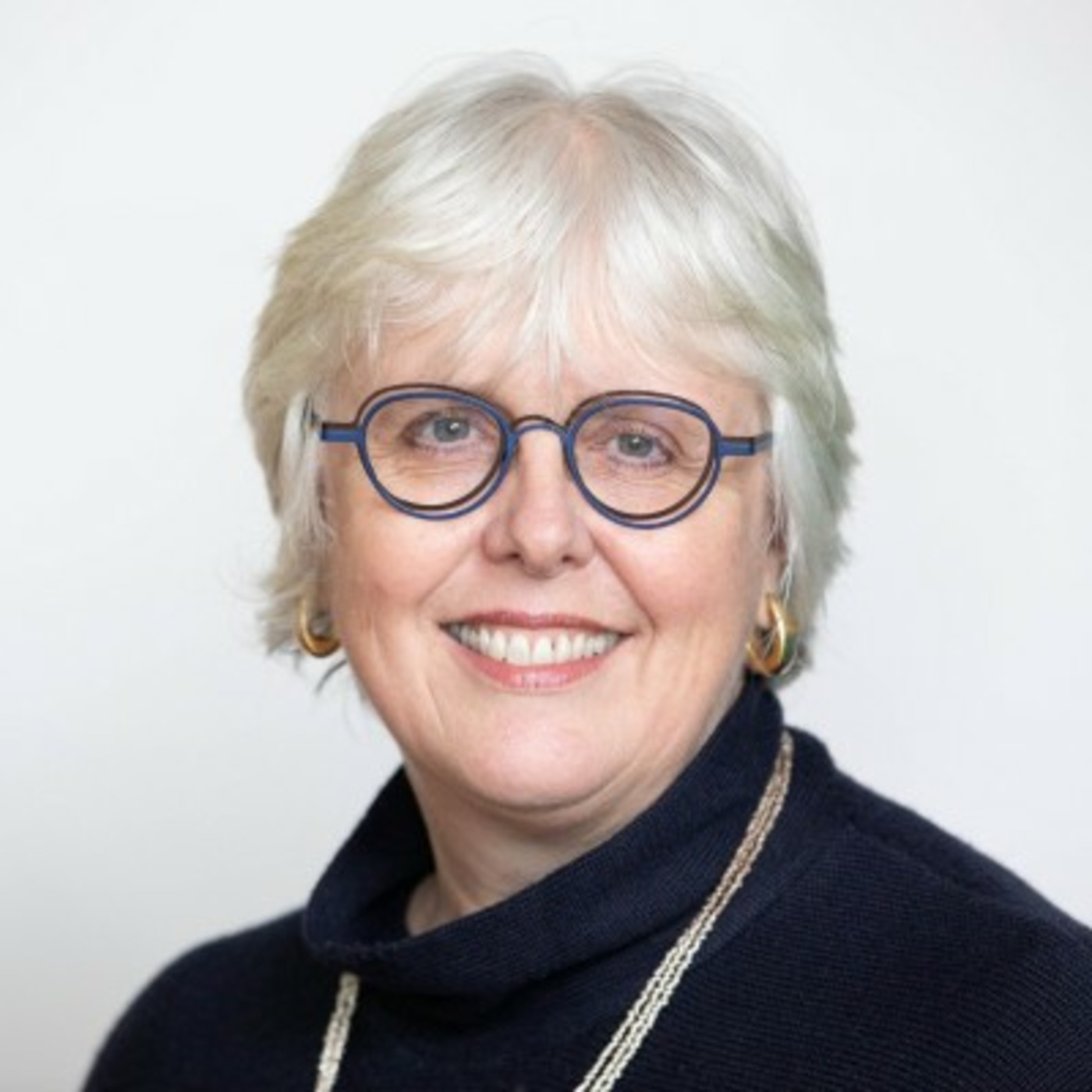
Aoifinn Endeavitt: A career in history, and a vision for change that embraces academic freedom, intellectual autonomy, and a climate-proof and future-proof curriculum. Let’s hear from Jane Ulmeier. I’m Aoifinn Endeavitt, and welcome to this special 50 Faces Focus Series in which we showcase the 3 candidates for the upcoming Provost election at Trinity College Dublin. Which will be held in April 2021. This historic election will see the first female Provost in the institution’s 429-year history. I’m joined today by Jane Ohlmeyer, who is the Erasmus Smiths Professor of Modern History at Trinity College Dublin and Chair of the IRIS Research Council. Welcome, Jane, thank you for joining me today.
Jane Ohlmeyer: Thank you for having me, Aoifinn, it’s lovely to be here.
Aoifinn Endeavitt: Let’s start with looking at your own career journey, going right back to where you grew up and what you studied.
Jane Ohlmeyer: I was born in Africa, basically. I moved to Belfast in 1969, and the Troubles then dominated my childhood and my sort of youth. And on the foot of it, I couldn’t get out of Belfast quickly enough, and I took a year off and I traveled. And then when I did go to university, it wasn’t to Trinity where I actually had a place to read history, but it was to St. Andrews University in Scotland. The benefit of hindsight, obviously I loved the fact that I was out of Ireland, away from what was a very, very grim period in terms of the Troubles. It was a very suffocating period for young people. And I loved then the freedom of being able to travel. And obviously St. Andrews was a fantastic university, a 4-year Scottish undergraduate degree was a great platform then to go on. I did a master’s then at the University of Illinois in Champaign-Urbana, but I came back to Trinity to do my PhD. And I’d always wanted to go to Trinity. So that was for me, a dream come true, and I worked with an amazing man called Aidan Clarke, who was the son of Austin Clarke the poet, but of course who was a hugely distinguished historian, and then became my PhD supervisor, but also then over time a great mentor and, and friend. Sadly, he passed away just before Christmas. So Trinity has always had a very important place in my heart and in my life, and you know, I, I was privileged then to come back in 2003 to actually become the Erasmus Smith Professor of Modern History, which was actually the chair that Aidan had held. I never in my wildest dreams thought I would ever succeed him.
Aoifinn Endeavitt: And did you always know you would pursue a career in academia, or did your career take some surprising turns?
Jane Ohlmeyer: Do you know, I think we never know quite where we’re gonna go in life. No, I did not intend to have a career in academia. It just sort of happened that way. I really was passionate about history, and I had done an undergraduate M.A.S. In the Scottish system, you graduate with an undergraduate master’s, but you do a thesis as part of that. And I had done work on the MacDonalds of Antrim. Obviously, I had grown up in Belfast and was very familiar with the MacDonalds. And so I did that as an undergraduate degree. And then I thought, well, actually, wouldn’t it be interesting to do this as a PhD? So it was sort of by default rather than design that I ended up in academia. And obviously, I mean, I’ve loved it. It’s been an absolute privilege to be an academic historian.
Aoifinn Endeavitt: What aspects of your study of history have shaped your approach to life, and also feeding in your global experience to that?
Jane Ohlmeyer: Well, do you know something? I think when you’re a historian, it’s all about evidence. So in terms of, you know, I’m an empirically grounded historian. It’s about the archives. It’s about finding fresh archives. It’s about telling stories, though, in ways that makes history accessible and exciting to people. I’m a great believer that we can only understand who we are when we understand where we’ve come from, and then of course we don’t know where we’re going until we know who we are. So, so history is such a core part of our identity in Ireland, but also I think as human beings our history shapes us very profoundly. So for me, history is one of those subjects that is so important, and I’m so delighted obviously that we We kept it as part of our school curriculum because I think it is an absolutely core subject at all levels. And the wonderful thing about history is, you know, if you can read, history is a very— should be a very accessible subject. And I’ve always worked very hard to ensure that it is. But it’s been interesting as I go around the globe, and I’ve done a lot of work, say, in a country like India, where history is contested because very often, especially right-wing nationalist regimes, they want to own history. So the victor always wants to write history. And they want to own the narrative because it is so core to identity. So the one thing I have learned as I’ve traveled around the world, and you I’ve, know, lived and worked in many different countries, is that history, it can be a very contested subject because it is about owning the identity of a people.
Aoifinn Endeavitt: Well, that’s a very actually relevant topic. I mean, we’re recording this in February, which is Black History Month in the U.S., um, and also there is a perception— you mentioned that history is written by the victors. But it’s also written perhaps by the white males who maybe were there documenting history at that time. What are your views on that?
Jane Ohlmeyer: Oh, very strong views. I feel that this is core to some of the discussions we’re having around Black Lives Matter, statues must fall. It’s also Rhodes must fall after Cecil Rhodes’ statue both in Cape Town and in Oxford. So the important thing is how we as historians tell the histories of everybody in society, be they Black, white, male, female, rich, poor. And sadly, the archives tend to be those written by white European men, and it’s often very, very difficult to recover the voices of women, but also of those from who were not members of the elite, in other words, ordinary people. So we as historians are constantly looking for ways of telling their stories, albeit when the archives are not helping us. And that’s where I think interdisciplinarity is very important, so particularly the disciplines of English, but also archaeology, material culture. We have to be like truffle hunters and look for, you know, wherever the evidence is, in whatever form it is, whatever media it is, to try and recover the lives and remember, you know, that we’ve always had very diverse populations and telling their stories can be extremely challenging, but that doesn’t mean we shouldn’t be doing that with renewed effort. And that’s where having the constant public gaze on us is very important. And we in Trinity now, for example, have just launched a big project called Slavery, Imperialism, Race and Racism, which is exploring Trinity’s imperial past and colonial past to try and ensure that we are being honest about how we tell our own history. So I think it’s a very important moment for historians to be recovering, as I say, those lost voices, and we’re seeing it across Irish society with obviously what’s going on with the Tuam babies and the amazing work that Catherine Cordes did in giving voice to those who did not have a voice and who the authorities and institutions tried to completely and utterly bury, quite literally, but also in terms of the very fact of their existence. So this is where the work of historians can be incredibly important.
Aoifinn Endeavitt: And speaking of lost voices, you’re in a university today that is probably a shadow of its former self in terms of the volume of voices. We have empty lecture theatres and probably quite relatively deserted buildings. What do you think about the experience of the university community during COVID-19? What’s uppermost in your mind?
Jane Ohlmeyer: Oh, it has to be the well-being, both physical and mental, of our students and of my, my colleagues. And I think COVID has pushed people to the pin of their collars in terms of the stresses that it has caused. We’re seeing very high levels of people suffering from a whole variety of stress-related conditions. However, it’s also made people, and I say my colleagues and our students, particularly innovative. I think people have had been forced to adapt technologies in ways that nobody would have thought was ever possible. And in a funny sort of a way, it has also enhanced access, not just to— through the classroom, but also to what we do more generally in Trinity. I was director of the Trinity Long Room Hub, which is our research institute in the arts and humanities, and all of a sudden, rather than from running events for 100 people in a room, we started to run events that were attracting audiences of thousands of people joining us from literally every corner of the world. So there has been a silver lining, but actually the cost of COVID on our well-being there has been a trauma associated with it, and it could take weeks, months, years even to fully evaluate the impact. So it’s a double-edged sword, I think, what we’ve been experiencing in the past 12 months.
Aoifinn Endeavitt: And I’m sure that’s informing your vision for the Provost role now, as there will be a period of rebuilding, rehabilitation. Can you talk about your vision for what you would do as Provost? What are the core elements of that?
Jane Ohlmeyer: Well, for me, so my tagline as Provost is empowering Trinity, That empowerment occurs by putting people first, by putting the community first, and then making sure that the systems, the structures are there to actually allow people to achieve their full potential. So I think just at the moment there are major issues around people are drowning in bureaucracy, cultural issues. COVID has exacerbated this, and it’s how as Provost I can actually address what’s wrong and then fully unleash the potential of Trinity, because the one thing I know we’re blessed with extraordinary staff, both academic and professional, people who really are at the top of their game, who are world-class, but because they’re overburdened with a whole variety of things are not actually able to focus on, if you want, the academic imperatives of research and education. And equally, students who are operating in sometimes classrooms or laboratories that are overcrowded, not fit for purpose. And obviously COVID has exacerbated these issues around the physical infrastructure. You know, equipment is decades old now, but also the staff-student ratio in Trinity is unacceptably high for a research-intensive university, and I would like to address that as well. But the core is about valuing and inspiring and trusting colleagues and staff, and then creating an environment that really allows them to thrive. And that includes things like interdisciplinarity and how we work across disciplines. So it’s all in my manifesto, it’s all there on the website for people to have a look at. And then over the course of the campaign, we’re having fantastic discussions. I’ve had 3 hustings today, I’ll have 4 tomorrow, even more on Thursday. We’ve got a big climate debate on Thursday night. There’s so many fora where we can really debate, discuss these issues. So the campaign is an opportunity to hit the reset button if you want. On where we want Trinity to be in a decade’s time.
Aoifinn Endeavitt: And in— at the top of your manifesto, you say you will defend academic freedom and intellectual autonomy. In the context of what we’re seeing, some global developments around what might be called cancel culture, what does academic freedom and intellectual autonomy mean to you?
Jane Ohlmeyer: It means that we should feel free to ask awkward questions, free to research things that may not be trendy or seen as being politically correct. You know, you’ve got to give universities— if you can’t have these sort of awkward conversations and do research that is really sort of pioneering and blue skies in universities, you can’t do it anywhere. But of course, that autonomy brings with it responsibilities. So we have to obviously be very responsible about how we do do our research. Let me give you a very example of something that brought it home to me Aoifinn, I was— I did an op-ed in the Irish Times back in December around Ireland and empire. And, you know, you’re always going to get a lot of discussion and debate around this topic because it is a sensitive one, it is a controversial one. But what nothing could have prepared me for, what happened in terms of the online response. I’ve never been trolled before just because I was talking about these sensitive issues. It sort of brought out the white supremacists, it brought out the extreme nationalists and the extremists generally. But because I was a woman though, I was seeing the misogynists out there in force and the racists. I was born in Africa and Olmeyer obviously isn’t an Irish name, so there was a lot of racism as well. It made me think, now hang on, what does this mean for academic freedom? And the answer is that, you know, it’s not for the faint-hearted, but all it does is strengthen my resolve to ensure that we have an academic environment that is free from pressures, whether whether it be from governments or from extremists online, or from any institution or person that would try to interfere with, if you want, our freedom to do our research and education, obviously in a very ethical way, but, you know, without interference or fear from external bodies or individuals.
Aoifinn Endeavitt: And you also talk about developing a climate-proof and a future-proof curriculum. How do you envisage that?
Jane Ohlmeyer: So for me, the climate action is the most pressing issue of the day. We all need to be climate warriors and engage with climate action and biodiversity. Happens to be Green Week at the moment, and we do have a big debate on Friday, so it’s not just— but I mean, this is a hugely important issue for the next decade, and it’s being driven by colleagues and by our students. And I think if we’re as an institution, we’re going to make a meaningful contribution, we have to, if you want, embed climate action in everything that we do, including our curriculum. And that means whether we’re working in the area of literature or history or philosophy or business, issues around climate and our responsibility to our planet need to be embedded. And this constant drive to think, how do we live in harmony with nature? So it’s important in the arts, humanities, social sciences, of course, it’s hugely important in the natural sciences and the physical sciences, who are also working in this space. So in other words, each discipline needs to own climate action. And then we as an institution need to embed best practice in everything that we do. So we become, if you want, a living laboratory or an exemplar for taking these issues, A, very seriously, but really trying to educate a whole generation of, and generations of Trinity graduates who are environmentally literate and who go on themselves to be champions for the environment, for biodiversity, and for climate action. So for me, it has to be absolutely embedded in everything that we do. And obviously at the moment we are doing good stuff, but it tends to be tokenistic, and we need to approach climate action with the same urgency we’ve approached the pandemic. And now is the moment to begin that.
Aoifinn Endeavitt: Describing that, you certainly are looking at Trinity’s role on the global stage. What kind of an impact do you hope that Trinity will have in the global community?
Jane Ohlmeyer: We were recently ranked as the 8th most international university in the world, and that means that we’re first in Europe or the European Union, and obviously that’s fantastic, but the rankings, the other rankings, are also showing that we’ve slipped. So Trinity has a phenomenal global reputation. I want us to be there shaping major discussions. I want to be the destination of choice for students from around the world, but also our colleagues to be collaborators of choice with the very best institutions around the world. I think that Trinity has slipped in the last decade. We need to recover our position on the world stage, but including to be leaders in something like climate action, but obviously not just that. I think we can be leaders in many areas of research, including around artificial intelligence, the contributions that we can make to discussions around I think in discussions around aging, and I’m just sort of picking a few at random where I can already see we’re leading, but it needs to be much, much more than this. But I also think in terms of a Trinity education, you know, there’s a global currency there that, that really means something. And I see our graduates go on to excel in whatever they do, but we can never lose sight of the importance of being players on the world stage as well as the national stage.
Aoifinn Endeavitt: And I mentioned at the beginning that this is a historic election. It will be the first female Provost in the institution’s history. What are your impressions of the experience of women in academia in general and at Trinity in particular?
Jane Ohlmeyer: So first thing is I’ve spoken out very vociferously about this because actually I believe that women should be far more proactive in academia, but sadly universities are often the last bastions of patriarchy and in some pockets of misogyny and bad behavior. We’re very traditional, very conservative. I’m absolutely delighted that Trinity, after 429 years, will have a female Provost. I hope she’s called Jane, but she’s either going to be called Jane or Linda. We will be making history, but not before— you know, I was going to say it’s been a long time coming. And it doesn’t mean that there aren’t real issues on the ground around gender, but more generally around issues of equality, diversity, and inclusion. So Trinity has gone a long way, but we still have a long, long way to go. We wouldn’t be untypical in an Irish or European context, but I think that, you know, things are changing and I’m very hopeful. I think in an Irish context, the work of the Higher Education Authority, of the research councils, and obviously my own is the Irish Research Council, and I’m very proud that we were the first agency to have a gender strategy. We were the first agency to introduce the evaluation of all candidates. It’s done on a gender blind basis. And on the foot of that, the proportion of successful female applicants in arts, humanities, and social sciences increased by about 20%. And in STEM areas— science, technology, engineering, mathematics— it increased by over a third. Now, that was telling me that there was bias. I hope it was unconscious. I know that by having good policies and practice in place, we can do things differently and make a difference. And this Athena Swan process, which the IRC and the other agencies are saying, well, you’ve got to have achieved your your university has to achieve silver by 2022 if you’re going to be eligible for research funding is a huge incentive to the universities to actually engage in the process and obviously the issues that the process throws up. So it’s a work in progress. I think it’s so important we do it. It’s very important that our students see women, but not just women, but colleagues from diverse ethnic, racial, and social economic backgrounds on our staff, that we actually reflect the composition of the student body actually.
Aoifinn Endeavitt: It’s interesting, some of the language you use, because I’ve just been discussing this with somebody else on another podcast around the use of, say, him encouraging us to be colour brave instead of colour blind. And it’s— I think, whereas gender blindness works maybe at the admission stage, I think maybe it doesn’t work later in terms of encouraging progression through the ranks. We have to be a bit braver perhaps at actually reaching out to nurture the female candidates and students so that they thrive not just survive within the setting.
Jane Ohlmeyer: And I love that, color brave or gender brave, because I completely agree with you. You can’t do it blind as people start to publish and become better known, but we can mentor and we can inspire. I think it was Madeleine Albright who said there’s a very special place in hell for women who don’t support other women. I think that is extremely important. And actually, I would go as far as to say it’s very important to have affirmative action. Where the two candidates are very genuinely equal, that these issues around gender diversity really should be kicking in. And our former minister, Mary Mitchell O’Connor, obviously had, you know, was trying to introduce new appointments into the system to try and address this imbalance around gender. That’s grand, it’s very important, and it has to be part of a panoply of strategies that we now unleash to actually change things. Changing a culture, as you— as we all know, is a challenge. So you have to come at it at multiple levels and in multiple ways.
Aoifinn Endeavitt: Absolutely, to reflect its complexity. And well, we certainly could talk a lot more about that topic, but I do want to have a few quickfire questions going back to your personal journey. So you’ve had a long career now. Who were some of the key people who influenced you in your career and in life so far?
Jane Ohlmeyer: Oh my goodness, many people have, but let me pick on 3 people who passed away in the autumn. I lost 3 hugely important mentors. One was Aidan Clarke, I’ve already mentioned, him. He was the man who supervised my PhD and who was very much my mentor when it came to the world of history, but not just history. The way he lived his life was an inspiration. He would have been very important in the civil rights movement. As a young academic, he was based at Magee in Derry and very, very involved in civil rights. He would have helped lead the anti-apartheid movement in Ireland, great pal of Kader Asmal, but also just he brought, I mean, his humanity was inspiring, and I can never repay Aidan for what he did for me, but I can, you know, take his example in my life. The other person who died in the autumn who was a huge inspiration was a woman called Margaret McCurtain. She was one of Ireland’s first feminists, and she really impressed on me the importance of of never, ever, ever taking for granted the achievements that had been made in the gender space, and always trying to advance them further. Margaret was an incredible historian, but she was just, again, an incredible human being. You know, again, she’s somebody who definitely inspired, but she also nurtured me, mentored me, encouraged me. And I feel her presence very much at the moment, because she would have been right behind me, as would Aidan, on this journey. The final person I just want to note, because again she was an inspirational figure, was a woman called Lindy Guinness, who was actually the Marchioness of Dufferin and Ava. So she came from a very privileged background herself, but actually what I found so inspiring about Lindy— she was a phenomenal artist and environmentalist, and it was the work that she did in Clandyboy on her estate around the environment, climate action, and biodiversity, long before. It was seen as being socially important to do that. Lindy was a leading light from an environmental perspective. She, you know, the Clandyboy oak trees were from the ancient forests that were destroyed actually in the 17th century, many of them, and she was able to rewild thousands of her trees are now growing across Ireland. Ancient indigenous breeds of cattle, she saved them from extinction, but it was above all the work work she did of education in and through the environment that I just found totally inspirational, and hopefully will be able to bring some of the insights that I experienced working with Lyndie over a long period of time. I used to take groups of students from Queen’s and Trinity up to the estate in Clandyboy where we literally engaged and lived through nature and the environment over a 3-day period, and I mean, it it was, was just that experience was phenomenal for me, for the students, and I think it made us all reflect on how, as educators and researchers, we can do things differently and live in harmony with nature and our planet. So she was another very, very powerful influencer, mentor for me, and again, somebody whose spirit I hope I can honor if I become Provost.
Aoifinn Endeavitt: It certainly seems like a remarkable legacy of all those three individuals. And when you look at any piece of advice that you received over the years, or any creed or motto that that you live by, what would you share?
Jane Ohlmeyer: Oh, do you know, this is such, again, you know, kindness actually, I think is very important. I think we live in a very busy world. And if I take away something that I’ve just mentioned, 3 very inspirational figures, but be kind to those around you, be kind to yourself. In other words, sometimes the most simple gestures can mean a huge amount to people. We all— it’s a tough old world out there, and I think, you know, being kind and putting people first is something that for me is hugely, hugely, hugely important.
Aoifinn Endeavitt: And is that the advice you might have for your younger self, or is there anything else that you maybe wish you had known as that young student going off to St Andrews that you know now?
Jane Ohlmeyer: Oh my goodness, again, I think there, you know, never take anything for granted. I think when we’re young, sometimes we’re in a rush, and I think COVID has been such an important moment for us. So for me, I’ve taken— nature has been a great tonic to me. I spent much of the first lockdown— we have a family home in northwest Donegal— and the whole pace of life slowed down, and every day was just such a joy because partly the weather helped, but, you know, I would be out walking and, you know, with the cuckoos and the curlews and the hares as my companions. But nature then was very inspiring, whether it was the, you know, the sea pinks or the bog cotton or the, you know, the lovely flaming fuchsia or the yellow furze that smells like Bounty Bars. And I took great pleasure in the simple things. I’m not sure I was doing that when I was 18. And if I could rewind the clock, it would be to pay attention to the simple things, because actually, at the end of the day, it’s the simple things, whether it’s nature our friends and family that actually really matter, and I have that— COVID has really brought that home to me.
Aoifinn Endeavitt: Well, I think on that very inspiring image, it’s a good place to draw the conversation to a close. I’ve always loved Trinity for its historic value and the sense that I get walking through the front arch there, and thank you for weaving the past so well to the present into a very dynamic vision for the future as well. I’ve really enjoyed our conversation, and thank you for sharing your insights with us.
Jane Ohlmeyer: It’s been my absolute pleasure, and I look forward to continuing the conversation maybe in due course. But thank you for your time and for having me.
Aoifinn Endeavitt: I’m Aoifinn Devitt. Thank you for listening to this special 50 Faces Focus Series. To hear the rest of the series, please subscribe on Apple Podcasts or wherever you get your podcasts. Production support for of this series was kindly provided by DLA Piper Ireland and Hermes Fund Managers Ireland Limited. This podcast is for informational purposes only and should not be construed as investment or legal advice. All views are personal and should not be attributed to the organizations or affiliations of the host or any guest.
Aoifinn Endeavitt: A career in history, and a vision for change that embraces academic freedom, intellectual autonomy, and a climate-proof and future-proof curriculum. Let’s hear from Jane Ulmeier. I’m Aoifinn Endeavitt, and welcome to this special 50 Faces Focus Series in which we showcase the 3 candidates for the upcoming Provost election at Trinity College Dublin. Which will be held in April 2021. This historic election will see the first female Provost in the institution’s 429-year history. I’m joined today by Jane Ohlmeyer, who is the Erasmus Smiths Professor of Modern History at Trinity College Dublin and Chair of the IRIS Research Council. Welcome, Jane, thank you for joining me today.
Jane Ohlmeyer: Thank you for having me, Aoifinn, it’s lovely to be here.
Aoifinn Endeavitt: Let’s start with looking at your own career journey, going right back to where you grew up and what you studied.
Jane Ohlmeyer: I was born in Africa, basically. I moved to Belfast in 1969, and the Troubles then dominated my childhood and my sort of youth. And on the foot of it, I couldn’t get out of Belfast quickly enough, and I took a year off and I traveled. And then when I did go to university, it wasn’t to Trinity where I actually had a place to read history, but it was to St. Andrews University in Scotland. The benefit of hindsight, obviously I loved the fact that I was out of Ireland, away from what was a very, very grim period in terms of the Troubles. It was a very suffocating period for young people. And I loved then the freedom of being able to travel. And obviously St. Andrews was a fantastic university, a 4-year Scottish undergraduate degree was a great platform then to go on. I did a master’s then at the University of Illinois in Champaign-Urbana, but I came back to Trinity to do my PhD. And I’d always wanted to go to Trinity. So that was for me, a dream come true, and I worked with an amazing man called Aidan Clarke, who was the son of Austin Clarke the poet, but of course who was a hugely distinguished historian, and then became my PhD supervisor, but also then over time a great mentor and, and friend. Sadly, he passed away just before Christmas. So Trinity has always had a very important place in my heart and in my life, and you know, I, I was privileged then to come back in 2003 to actually become the Erasmus Smith Professor of Modern History, which was actually the chair that Aidan had held. I never in my wildest dreams thought I would ever succeed him.
Aoifinn Endeavitt: And did you always know you would pursue a career in academia, or did your career take some surprising turns?
Jane Ohlmeyer: Do you know, I think we never know quite where we’re gonna go in life. No, I did not intend to have a career in academia. It just sort of happened that way. I really was passionate about history, and I had done an undergraduate M.A.S. In the Scottish system, you graduate with an undergraduate master’s, but you do a thesis as part of that. And I had done work on the MacDonalds of Antrim. Obviously, I had grown up in Belfast and was very familiar with the MacDonalds. And so I did that as an undergraduate degree. And then I thought, well, actually, wouldn’t it be interesting to do this as a PhD? So it was sort of by default rather than design that I ended up in academia. And obviously, I mean, I’ve loved it. It’s been an absolute privilege to be an academic historian.
Aoifinn Endeavitt: What aspects of your study of history have shaped your approach to life, and also feeding in your global experience to that?
Jane Ohlmeyer: Well, do you know something? I think when you’re a historian, it’s all about evidence. So in terms of, you know, I’m an empirically grounded historian. It’s about the archives. It’s about finding fresh archives. It’s about telling stories, though, in ways that makes history accessible and exciting to people. I’m a great believer that we can only understand who we are when we understand where we’ve come from, and then of course we don’t know where we’re going until we know who we are. So, so history is such a core part of our identity in Ireland, but also I think as human beings our history shapes us very profoundly. So for me, history is one of those subjects that is so important, and I’m so delighted obviously that we We kept it as part of our school curriculum because I think it is an absolutely core subject at all levels. And the wonderful thing about history is, you know, if you can read, history is a very— should be a very accessible subject. And I’ve always worked very hard to ensure that it is. But it’s been interesting as I go around the globe, and I’ve done a lot of work, say, in a country like India, where history is contested because very often, especially right-wing nationalist regimes, they want to own history. So the victor always wants to write history. And they want to own the narrative because it is so core to identity. So the one thing I have learned as I’ve traveled around the world, and you I’ve, know, lived and worked in many different countries, is that history, it can be a very contested subject because it is about owning the identity of a people.
Aoifinn Endeavitt: Well, that’s a very actually relevant topic. I mean, we’re recording this in February, which is Black History Month in the U.S., um, and also there is a perception— you mentioned that history is written by the victors. But it’s also written perhaps by the white males who maybe were there documenting history at that time. What are your views on that?
Jane Ohlmeyer: Oh, very strong views. I feel that this is core to some of the discussions we’re having around Black Lives Matter, statues must fall. It’s also Rhodes must fall after Cecil Rhodes’ statue both in Cape Town and in Oxford. So the important thing is how we as historians tell the histories of everybody in society, be they Black, white, male, female, rich, poor. And sadly, the archives tend to be those written by white European men, and it’s often very, very difficult to recover the voices of women, but also of those from who were not members of the elite, in other words, ordinary people. So we as historians are constantly looking for ways of telling their stories, albeit when the archives are not helping us. And that’s where I think interdisciplinarity is very important, so particularly the disciplines of English, but also archaeology, material culture. We have to be like truffle hunters and look for, you know, wherever the evidence is, in whatever form it is, whatever media it is, to try and recover the lives and remember, you know, that we’ve always had very diverse populations and telling their stories can be extremely challenging, but that doesn’t mean we shouldn’t be doing that with renewed effort. And that’s where having the constant public gaze on us is very important. And we in Trinity now, for example, have just launched a big project called Slavery, Imperialism, Race and Racism, which is exploring Trinity’s imperial past and colonial past to try and ensure that we are being honest about how we tell our own history. So I think it’s a very important moment for historians to be recovering, as I say, those lost voices, and we’re seeing it across Irish society with obviously what’s going on with the Tuam babies and the amazing work that Catherine Cordes did in giving voice to those who did not have a voice and who the authorities and institutions tried to completely and utterly bury, quite literally, but also in terms of the very fact of their existence. So this is where the work of historians can be incredibly important.
Aoifinn Endeavitt: And speaking of lost voices, you’re in a university today that is probably a shadow of its former self in terms of the volume of voices. We have empty lecture theatres and probably quite relatively deserted buildings. What do you think about the experience of the university community during COVID-19? What’s uppermost in your mind?
Jane Ohlmeyer: Oh, it has to be the well-being, both physical and mental, of our students and of my, my colleagues. And I think COVID has pushed people to the pin of their collars in terms of the stresses that it has caused. We’re seeing very high levels of people suffering from a whole variety of stress-related conditions. However, it’s also made people, and I say my colleagues and our students, particularly innovative. I think people have had been forced to adapt technologies in ways that nobody would have thought was ever possible. And in a funny sort of a way, it has also enhanced access, not just to— through the classroom, but also to what we do more generally in Trinity. I was director of the Trinity Long Room Hub, which is our research institute in the arts and humanities, and all of a sudden, rather than from running events for 100 people in a room, we started to run events that were attracting audiences of thousands of people joining us from literally every corner of the world. So there has been a silver lining, but actually the cost of COVID on our well-being there has been a trauma associated with it, and it could take weeks, months, years even to fully evaluate the impact. So it’s a double-edged sword, I think, what we’ve been experiencing in the past 12 months.
Aoifinn Endeavitt: And I’m sure that’s informing your vision for the Provost role now, as there will be a period of rebuilding, rehabilitation. Can you talk about your vision for what you would do as Provost? What are the core elements of that?
Jane Ohlmeyer: Well, for me, so my tagline as Provost is empowering Trinity, That empowerment occurs by putting people first, by putting the community first, and then making sure that the systems, the structures are there to actually allow people to achieve their full potential. So I think just at the moment there are major issues around people are drowning in bureaucracy, cultural issues. COVID has exacerbated this, and it’s how as Provost I can actually address what’s wrong and then fully unleash the potential of Trinity, because the one thing I know we’re blessed with extraordinary staff, both academic and professional, people who really are at the top of their game, who are world-class, but because they’re overburdened with a whole variety of things are not actually able to focus on, if you want, the academic imperatives of research and education. And equally, students who are operating in sometimes classrooms or laboratories that are overcrowded, not fit for purpose. And obviously COVID has exacerbated these issues around the physical infrastructure. You know, equipment is decades old now, but also the staff-student ratio in Trinity is unacceptably high for a research-intensive university, and I would like to address that as well. But the core is about valuing and inspiring and trusting colleagues and staff, and then creating an environment that really allows them to thrive. And that includes things like interdisciplinarity and how we work across disciplines. So it’s all in my manifesto, it’s all there on the website for people to have a look at. And then over the course of the campaign, we’re having fantastic discussions. I’ve had 3 hustings today, I’ll have 4 tomorrow, even more on Thursday. We’ve got a big climate debate on Thursday night. There’s so many fora where we can really debate, discuss these issues. So the campaign is an opportunity to hit the reset button if you want. On where we want Trinity to be in a decade’s time.
Aoifinn Endeavitt: And in— at the top of your manifesto, you say you will defend academic freedom and intellectual autonomy. In the context of what we’re seeing, some global developments around what might be called cancel culture, what does academic freedom and intellectual autonomy mean to you?
Jane Ohlmeyer: It means that we should feel free to ask awkward questions, free to research things that may not be trendy or seen as being politically correct. You know, you’ve got to give universities— if you can’t have these sort of awkward conversations and do research that is really sort of pioneering and blue skies in universities, you can’t do it anywhere. But of course, that autonomy brings with it responsibilities. So we have to obviously be very responsible about how we do do our research. Let me give you a very example of something that brought it home to me Aoifinn, I was— I did an op-ed in the Irish Times back in December around Ireland and empire. And, you know, you’re always going to get a lot of discussion and debate around this topic because it is a sensitive one, it is a controversial one. But what nothing could have prepared me for, what happened in terms of the online response. I’ve never been trolled before just because I was talking about these sensitive issues. It sort of brought out the white supremacists, it brought out the extreme nationalists and the extremists generally. But because I was a woman though, I was seeing the misogynists out there in force and the racists. I was born in Africa and Olmeyer obviously isn’t an Irish name, so there was a lot of racism as well. It made me think, now hang on, what does this mean for academic freedom? And the answer is that, you know, it’s not for the faint-hearted, but all it does is strengthen my resolve to ensure that we have an academic environment that is free from pressures, whether whether it be from governments or from extremists online, or from any institution or person that would try to interfere with, if you want, our freedom to do our research and education, obviously in a very ethical way, but, you know, without interference or fear from external bodies or individuals.
Aoifinn Endeavitt: And you also talk about developing a climate-proof and a future-proof curriculum. How do you envisage that?
Jane Ohlmeyer: So for me, the climate action is the most pressing issue of the day. We all need to be climate warriors and engage with climate action and biodiversity. Happens to be Green Week at the moment, and we do have a big debate on Friday, so it’s not just— but I mean, this is a hugely important issue for the next decade, and it’s being driven by colleagues and by our students. And I think if we’re as an institution, we’re going to make a meaningful contribution, we have to, if you want, embed climate action in everything that we do, including our curriculum. And that means whether we’re working in the area of literature or history or philosophy or business, issues around climate and our responsibility to our planet need to be embedded. And this constant drive to think, how do we live in harmony with nature? So it’s important in the arts, humanities, social sciences, of course, it’s hugely important in the natural sciences and the physical sciences, who are also working in this space. So in other words, each discipline needs to own climate action. And then we as an institution need to embed best practice in everything that we do. So we become, if you want, a living laboratory or an exemplar for taking these issues, A, very seriously, but really trying to educate a whole generation of, and generations of Trinity graduates who are environmentally literate and who go on themselves to be champions for the environment, for biodiversity, and for climate action. So for me, it has to be absolutely embedded in everything that we do. And obviously at the moment we are doing good stuff, but it tends to be tokenistic, and we need to approach climate action with the same urgency we’ve approached the pandemic. And now is the moment to begin that.
Aoifinn Endeavitt: Describing that, you certainly are looking at Trinity’s role on the global stage. What kind of an impact do you hope that Trinity will have in the global community?
Jane Ohlmeyer: We were recently ranked as the 8th most international university in the world, and that means that we’re first in Europe or the European Union, and obviously that’s fantastic, but the rankings, the other rankings, are also showing that we’ve slipped. So Trinity has a phenomenal global reputation. I want us to be there shaping major discussions. I want to be the destination of choice for students from around the world, but also our colleagues to be collaborators of choice with the very best institutions around the world. I think that Trinity has slipped in the last decade. We need to recover our position on the world stage, but including to be leaders in something like climate action, but obviously not just that. I think we can be leaders in many areas of research, including around artificial intelligence, the contributions that we can make to discussions around I think in discussions around aging, and I’m just sort of picking a few at random where I can already see we’re leading, but it needs to be much, much more than this. But I also think in terms of a Trinity education, you know, there’s a global currency there that, that really means something. And I see our graduates go on to excel in whatever they do, but we can never lose sight of the importance of being players on the world stage as well as the national stage.
Aoifinn Endeavitt: And I mentioned at the beginning that this is a historic election. It will be the first female Provost in the institution’s history. What are your impressions of the experience of women in academia in general and at Trinity in particular?
Jane Ohlmeyer: So first thing is I’ve spoken out very vociferously about this because actually I believe that women should be far more proactive in academia, but sadly universities are often the last bastions of patriarchy and in some pockets of misogyny and bad behavior. We’re very traditional, very conservative. I’m absolutely delighted that Trinity, after 429 years, will have a female Provost. I hope she’s called Jane, but she’s either going to be called Jane or Linda. We will be making history, but not before— you know, I was going to say it’s been a long time coming. And it doesn’t mean that there aren’t real issues on the ground around gender, but more generally around issues of equality, diversity, and inclusion. So Trinity has gone a long way, but we still have a long, long way to go. We wouldn’t be untypical in an Irish or European context, but I think that, you know, things are changing and I’m very hopeful. I think in an Irish context, the work of the Higher Education Authority, of the research councils, and obviously my own is the Irish Research Council, and I’m very proud that we were the first agency to have a gender strategy. We were the first agency to introduce the evaluation of all candidates. It’s done on a gender blind basis. And on the foot of that, the proportion of successful female applicants in arts, humanities, and social sciences increased by about 20%. And in STEM areas— science, technology, engineering, mathematics— it increased by over a third. Now, that was telling me that there was bias. I hope it was unconscious. I know that by having good policies and practice in place, we can do things differently and make a difference. And this Athena Swan process, which the IRC and the other agencies are saying, well, you’ve got to have achieved your your university has to achieve silver by 2022 if you’re going to be eligible for research funding is a huge incentive to the universities to actually engage in the process and obviously the issues that the process throws up. So it’s a work in progress. I think it’s so important we do it. It’s very important that our students see women, but not just women, but colleagues from diverse ethnic, racial, and social economic backgrounds on our staff, that we actually reflect the composition of the student body actually.
Aoifinn Endeavitt: It’s interesting, some of the language you use, because I’ve just been discussing this with somebody else on another podcast around the use of, say, him encouraging us to be colour brave instead of colour blind. And it’s— I think, whereas gender blindness works maybe at the admission stage, I think maybe it doesn’t work later in terms of encouraging progression through the ranks. We have to be a bit braver perhaps at actually reaching out to nurture the female candidates and students so that they thrive not just survive within the setting.
Jane Ohlmeyer: And I love that, color brave or gender brave, because I completely agree with you. You can’t do it blind as people start to publish and become better known, but we can mentor and we can inspire. I think it was Madeleine Albright who said there’s a very special place in hell for women who don’t support other women. I think that is extremely important. And actually, I would go as far as to say it’s very important to have affirmative action. Where the two candidates are very genuinely equal, that these issues around gender diversity really should be kicking in. And our former minister, Mary Mitchell O’Connor, obviously had, you know, was trying to introduce new appointments into the system to try and address this imbalance around gender. That’s grand, it’s very important, and it has to be part of a panoply of strategies that we now unleash to actually change things. Changing a culture, as you— as we all know, is a challenge. So you have to come at it at multiple levels and in multiple ways.
Aoifinn Endeavitt: Absolutely, to reflect its complexity. And well, we certainly could talk a lot more about that topic, but I do want to have a few quickfire questions going back to your personal journey. So you’ve had a long career now. Who were some of the key people who influenced you in your career and in life so far?
Jane Ohlmeyer: Oh my goodness, many people have, but let me pick on 3 people who passed away in the autumn. I lost 3 hugely important mentors. One was Aidan Clarke, I’ve already mentioned, him. He was the man who supervised my PhD and who was very much my mentor when it came to the world of history, but not just history. The way he lived his life was an inspiration. He would have been very important in the civil rights movement. As a young academic, he was based at Magee in Derry and very, very involved in civil rights. He would have helped lead the anti-apartheid movement in Ireland, great pal of Kader Asmal, but also just he brought, I mean, his humanity was inspiring, and I can never repay Aidan for what he did for me, but I can, you know, take his example in my life. The other person who died in the autumn who was a huge inspiration was a woman called Margaret McCurtain. She was one of Ireland’s first feminists, and she really impressed on me the importance of of never, ever, ever taking for granted the achievements that had been made in the gender space, and always trying to advance them further. Margaret was an incredible historian, but she was just, again, an incredible human being. You know, again, she’s somebody who definitely inspired, but she also nurtured me, mentored me, encouraged me. And I feel her presence very much at the moment, because she would have been right behind me, as would Aidan, on this journey. The final person I just want to note, because again she was an inspirational figure, was a woman called Lindy Guinness, who was actually the Marchioness of Dufferin and Ava. So she came from a very privileged background herself, but actually what I found so inspiring about Lindy— she was a phenomenal artist and environmentalist, and it was the work that she did in Clandyboy on her estate around the environment, climate action, and biodiversity, long before. It was seen as being socially important to do that. Lindy was a leading light from an environmental perspective. She, you know, the Clandyboy oak trees were from the ancient forests that were destroyed actually in the 17th century, many of them, and she was able to rewild thousands of her trees are now growing across Ireland. Ancient indigenous breeds of cattle, she saved them from extinction, but it was above all the work work she did of education in and through the environment that I just found totally inspirational, and hopefully will be able to bring some of the insights that I experienced working with Lyndie over a long period of time. I used to take groups of students from Queen’s and Trinity up to the estate in Clandyboy where we literally engaged and lived through nature and the environment over a 3-day period, and I mean, it it was, was just that experience was phenomenal for me, for the students, and I think it made us all reflect on how, as educators and researchers, we can do things differently and live in harmony with nature and our planet. So she was another very, very powerful influencer, mentor for me, and again, somebody whose spirit I hope I can honor if I become Provost.
Aoifinn Endeavitt: It certainly seems like a remarkable legacy of all those three individuals. And when you look at any piece of advice that you received over the years, or any creed or motto that that you live by, what would you share?
Jane Ohlmeyer: Oh, do you know, this is such, again, you know, kindness actually, I think is very important. I think we live in a very busy world. And if I take away something that I’ve just mentioned, 3 very inspirational figures, but be kind to those around you, be kind to yourself. In other words, sometimes the most simple gestures can mean a huge amount to people. We all— it’s a tough old world out there, and I think, you know, being kind and putting people first is something that for me is hugely, hugely, hugely important.
Aoifinn Endeavitt: And is that the advice you might have for your younger self, or is there anything else that you maybe wish you had known as that young student going off to St Andrews that you know now?
Jane Ohlmeyer: Oh my goodness, again, I think there, you know, never take anything for granted. I think when we’re young, sometimes we’re in a rush, and I think COVID has been such an important moment for us. So for me, I’ve taken— nature has been a great tonic to me. I spent much of the first lockdown— we have a family home in northwest Donegal— and the whole pace of life slowed down, and every day was just such a joy because partly the weather helped, but, you know, I would be out walking and, you know, with the cuckoos and the curlews and the hares as my companions. But nature then was very inspiring, whether it was the, you know, the sea pinks or the bog cotton or the, you know, the lovely flaming fuchsia or the yellow furze that smells like Bounty Bars. And I took great pleasure in the simple things. I’m not sure I was doing that when I was 18. And if I could rewind the clock, it would be to pay attention to the simple things, because actually, at the end of the day, it’s the simple things, whether it’s nature our friends and family that actually really matter, and I have that— COVID has really brought that home to me.
Aoifinn Endeavitt: Well, I think on that very inspiring image, it’s a good place to draw the conversation to a close. I’ve always loved Trinity for its historic value and the sense that I get walking through the front arch there, and thank you for weaving the past so well to the present into a very dynamic vision for the future as well. I’ve really enjoyed our conversation, and thank you for sharing your insights with us.
Jane Ohlmeyer: It’s been my absolute pleasure, and I look forward to continuing the conversation maybe in due course. But thank you for your time and for having me.
Aoifinn Endeavitt: I’m Aoifinn Devitt. Thank you for listening to this special 50 Faces Focus Series. To hear the rest of the series, please subscribe on Apple Podcasts or wherever you get your podcasts. Production support for of this series was kindly provided by DLA Piper Ireland and Hermes Fund Managers Ireland Limited. This podcast is for informational purposes only and should not be construed as investment or legal advice. All views are personal and should not be attributed to the organizations or affiliations of the host or any guest.