Aoifinn Devitt: This series is brought to you with the kind support of Eversheds Sutherland. As a global top 10 law firm, Eversheds Sutherland provides legal services to a global client base. With more than 3,000 lawyers, the firm operates in over 70 offices in more than 30 countries across Africa, Asia, Europe, the Middle East, and the United States. The firm recognizes that having diverse talent across its business brings many benefits. It is committed to accessing a wide range of views, perspectives, and thinking in all of its teams, and in this way is building a culture of inclusion where each person feels able to be their true self at work and reach their full potential. Diversity and inclusion is fundamental to the firm’s purpose of helping their clients, their people, and their communities to thrive, and inclusive is one of its 5 values.
Stephanie Boyce: So for me, legal rights mean absolutely nothing if you don’t know when those rights have been taken away, or indeed you don’t even know how to enforce those rights. So it is right that there is a focus on public legal education. That we ensure the public understand their rights and they know how to recognise from an earlier start a legal issue, a legal dispute, and where to go to. And of course, solicitors are qualified, regulated, and insured, so that is the primary reason to use a solicitor if you have a legal dispute.
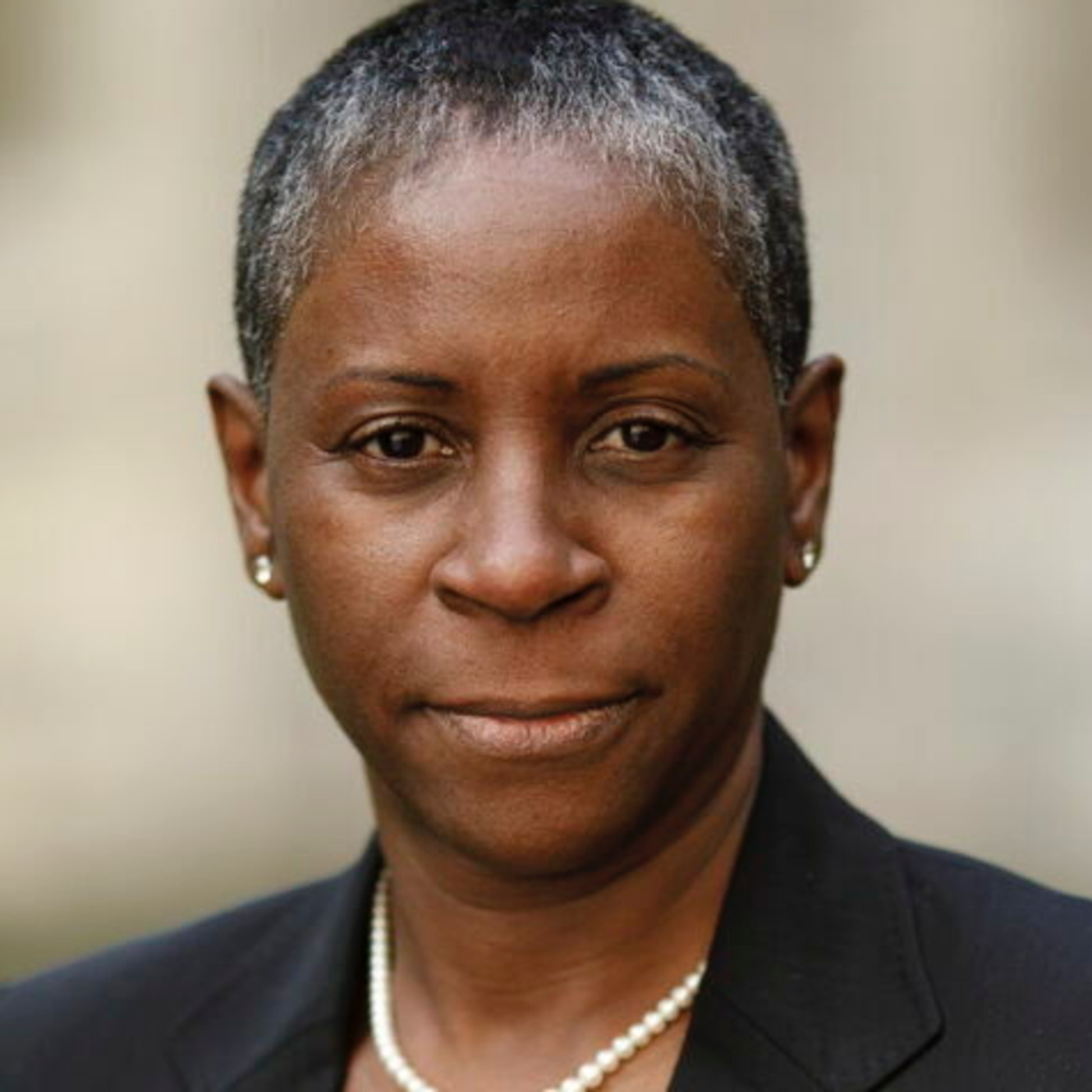
Aoifinn Devitt: Find out why Margaret Thatcher was an early role model for this guest and why the PUSH principle can be the key to unlocking our career potential. I’m Aoifinn Devitt and welcome to this 50 Faces focus series which showcases the richness and diversity of inspiring people in the law. I’m joined today by I. Stephanie Boyce, who’s President of the Law Society of England and Wales. She’s the 177th President, the 6th female and first person of colour to hold the role. She’s had an extensive career in law including periods with the pensions regulator, in her own consulting firm and as a former clerk at the disciplinary and regulatory committees at the Association of Chartered Certified Accountants. She also holds a number of board and trustee roles, including Commissioner of the National Preparedness Commission. She’s a member of the Socioeconomic Task Force, Transforming Women’s Leadership in the Law Advisory Board, among other roles. Welcome, Stephanie. Thanks for joining me today.
Stephanie Boyce: Thank you for having me.
Aoifinn Devitt: Can we start with your background and your career journey? And maybe how you first even thought of entering law and this field in particular.
Stephanie Boyce: Yes, I think for me it started round about the age of 7, as I could remember it. And at that time I used to do a really good impression of Margaret Thatcher, which I can no longer do, I might just add. But for me, Margaret Thatcher was at that time a role model. And of course, I don’t agree, didn’t agree with anything that she went on thereafter to do. But for me, she was the education minister. She was a barrister. She was our first prime minister, a strong female role model for a young Black girl growing up in rural Buckinghamshire. So I— and equally growing up with the sounds of injustices ringing in my ears that I could see domestically and globally unfolding. And later on as a family, as we would emigrate to the United States of America, and I think it’s fair to say that America would have a lasting impression upon me. I’d be overwhelmed by the poverty at times. I’d be overwhelmed by the inability of people to access their rights because of their low socioeconomic status, because of the color of their skin, and how I longed to make a difference, to enable the voiceless to speak. And so that’s what absolutely drove me to the law, to the legal profession. And solicitors, as I am, we are at the heartbeat of society, keeping the wheels of justice turning.
Aoifinn Devitt: Well, that’s very profound, certainly. And can you just, because I’m based in the US, I’d love to know where you moved to and how long that stint was.
Stephanie Boyce: 6 years. So initially we, cuz my stepfather was in the American Air Force, we went to upstate New York, Plattsburgh. Then I went down to North Carolina, Rocky Mount, and then finally settled and graduated from high school in Norristown, Pennsylvania.
Aoifinn Devitt: Well, certainly some high and low points of American society, I’m sure. Especially given sometimes some of the poverty that’s is around Air Force bases and other sort of areas that may be now in decline. So moving now back to your career, so you became a solicitor. Were there any surprising turns along the way?
Stephanie Boyce: Surprising in a good way or just surprising?
Aoifinn Devitt: I mean, did you have a trajectory, a career plan, or did you let sort of opportunities arise and take them?
Stephanie Boyce: I don’t think I had a plan. I mean, I, later on I had a plan. I didn’t know what the plan was, but I had a plan. And that was around my volunteering. But in terms of all I knew was that I wanted to become, qualify as a solicitor and to try and navigate your way through that minefield as it was, because we didn’t have the use of the internet as we do now, you know, drop someone an email, you know, can you ask a question or do an online search to come up with the answer? It was those networks, those human networks that one had to rely on. And of course, because of my background, my low socioeconomic status, I didn’t have those connections, those individuals that I could ask. So I was determined to become a solicitor. I came across, went to university, or actually coming back to England, my high school diploma wasn’t recognized here at that time. So I had to get the UK equivalent to enable me to go on to high school, to university. And I did that part-time. For the Access to High Qualification route. I did it part-time for 2 years, and then when I finished with that, I went on to work. And then eventually I was working part-time and signed up for a part-time course at London Guildhall. And so I would work part-time with British Rail during the after— the mornings, early mornings, afternoons, rush back home to get changed, to travel into London because I’ve got subsidized rail fare because I worked for British Rail as it was, and later a different network. And then I would do all of that until evening classes until about 9 o’clock at night to get home about 11 o’clock at night to get up and be at work for 5-something in the morning. And I did that for about 7 months. And then I decided I wanted to go full-time to university. And I entered London Guildhall as a full-time student in September 1996 and subsequently graduated in 1999. With an LLB Honours with Politics. So my plan was that I knew I wanted to qualify, but I took every obstacle, every hurdle if you like, as it came and just navigated my way around them as they appeared in front of me, rather than thinking ahead because I wasn’t quite sure. And subsequently, that’s how my— to a certain extent, my career has been. So when I started volunteering for lots of bodies and boards and whatever, a good friend of mine said, “What are you doing volunteering, doing all this work for free?” And I said, “Wait and see, I’ve got a plan. I’ve got a plan.” I didn’t know what that plan was, but I had a plan of sorts. And that plan was that whilst lots of these organizations didn’t want to employ me or pay me to be an employee, they were quite happy to have me volunteer. And what that enabled me to do was to work with some of the best legal minds that this country has to offer. I got to be right in the heart of things at the table. They got to hear from me, they got to see me. And so volunteering through, and that’s how I built my networks.
Aoifinn Devitt: That is a fascinating, I was just thinking about it, that volunteering in exchange for that networking value, that’s the currency really that you got paid for it. So looking now, going to the Law Society role, because you’ve written on LinkedIn about how you pursued that role more than once. Can you talk about how you set your sights on that? And maybe some of the setbacks in the initial applications, but how you finally persevered and succeeded.
Stephanie Boyce: Well, absolutely. So I joined Council of the Law Society of England and Wales in 2013, representing the Women Lawyers Division, and it’s still a constituency that I represent today. And by 2015, having seen a number of individuals put themselves forward to become— so you put yourself forward to become Deputy Vice President. And once you’re successfully elected as Deputy Vice President, as I was in July 2019, you then go on— it’s an automatic trajectory to become President, as I did in March 2021. So by 2015, I put myself forward for the first time. And in 2019, I was, after 4 attempts, successfully elected as Deputy Vice President. And can I say, being President is a remarkable honour, a remarkable platform to be on. And one, a platform that’s important, and one where you can really highlight the change that you want to affect, that you want to see, the difference you want to make. So those three previous attempts were an opportunity, if you like, for me to keep trying, to perfect my offering, to develop, and I didn’t see them as failures. I don’t like the word failure because it has a negative connotation to it. I saw those as an opportunity, those other 3 occasions, as an opportunity to try and try. And I tell you, if I didn’t succeed on the 4th occasion, I would have kept going a 5th, a 6th, a 7th time. That’s how much I believed in me becoming Deputy Vice President.
Aoifinn Devitt: And now that you’re in this position, what is at the forefront of your mind as President of the Law Society today?
Stephanie Boyce: Well, as the leading representative of the solicitor profession, It is my job to be the voice of solicitors and speak for their interests and indeed their needs. Those interests are very varied. We are a diverse profession, some 215,000 solicitors in the jurisdiction of England and Wales that I head up. And so being a varied profession in terms of where we practice, what we practice, and with an eye on international practice as well and some of the situations that are unfolding internationally, such as that in Ukraine, domestically and globally, how we can improve access to justice for vulnerable people in cities, towns, and villages across England and Wales. We spend a lot of our time working with member firms, representatives of the profession, jurisdictions at events, podcasts like this, highlighting our work, trying to extend our reach, inform others of what we do. As I say, I use this remarkable platform to provide speaking opportunities to draw attention to the issues of concerns to our profession and put forward ideas to resolve those.
Aoifinn Devitt: So there are two issues there. There’s access to justice, and then you also think there’s probably access to the law for students who might potentially wish to enter that area, but maybe like you mentioned, come from lower socioeconomic status, don’t have role models, don’t have a roadmap in their heads as to how that might happen for them. So just on those two issues, how are you addressing that? First of all, maybe the access to justice. Are you looking at getting more firms to do pro bono? What does that involve?
Stephanie Boyce: So, I mean, the legal profession does a remarkable amount of pro bono work already, and we celebrate, we have a whole week dedicated to pro bono. And so many members do, as I say, so much pro bono work. And a number of us are associated with other bodies outside of our firms, outside of our organizations, charitable institutions where again we contribute to the pro bono work and offer it. But access to justice remains a problem in this jurisdiction of England and Wales. We still see people, some two-thirds of the UK population, do not know where to go to to get legal advice. So there is an issue around recognizing when one has a legal issue dispute, and from the research that the London Legal Walk Trust has done, some two-thirds of those adults in the United Kingdom, even if they knew where to go to, some 15 million of those who are below the poverty line couldn’t afford that advice in any event. So I believe public legal education is key. The law touches every part of your life. You cannot get away from it. So for me, legal rights mean absolutely nothing if you don’t know when those rights have been taken away, or indeed you don’t even know how to enforce those rights. So it is right that there is a focus on public legal education, that we ensure the public understand their rights and they know how to recognize from an earlier start a legal issue, a legal dispute, and where to go to. And of course, solicitors are qualified, regulated, and insured So that is the primary reason to use a solicitor if you have a legal dispute. But also from a social mobility aspect, from a social mobility aspect, for me, teaching law in schools goes some way to addressing the social mobility issue. Some 23% of the solicitor profession have been privately educated in England and Wales. That is against the 7% of the wider UK population. So there’s a disparity there. But if we start to teach law in schools, we start to break down some of those myths, the myths associated with the solicitor doesn’t look like me, doesn’t sound like me, it’s not a profession I belong. But as our young people start to navigate their way through the educational system, they start to think about that roadmap, that plan that we spoke about earlier, that they have to lay in order to think about what qualifications they’ll go on to take, what university they may go on to, because we know that the legal profession here, it draws lots of its recruits from certain universities, whereas we know talent is found everywhere, diverse talent is everywhere and brings so much richness to the business, to the table. But also the most important thing is those networks. How many people have said We don’t know how to network. What is a network? But if we start to get people to focus their thoughts and minds on these opportunities where we know that sponsorship, mentorship, and work experience are drawn from, they’re not at a disadvantage when they go to university. I was second year at university before I found out about these networks, these work experience mentors, sponsors, later on in my life. It’s that currency that we spoke about earlier.
Aoifinn Devitt: It’s so interesting. We speak a lot in the world of investment about financial literacy and the importance of introducing that, like, even to very young children. But your concept of legal literacy, I think, is also intriguing. And I do think that law, because it’s often couched maybe as a cryptic, almost inaccessible thing for people that have not been schooled in it, a massive imposter syndrome will develop, that we will think that it’s not accessible to me, I don’t understand it, I can’t understand it. I won’t approach that. So I think all these barriers being broken down are so important. There’s a number of affinity groups that you’ve already mentioned, but also that you volunteer with and are committed to: LawCare, Access to Justice Foundation, Sutton Trust. Can you talk a little bit about what those groups do and how they resonate with you personally?
Stephanie Boyce: One of the things I did was to, when I became president, was to establish 3 presidential charities to support my presidential priorities. And that was the 3 charities that you have mentioned. LawCare does lots of work around mental health and wellbeing in respect of the profession, the legal profession. We have to get to a point in our lives that we talk about mental health as we do our physical health. Nobody ever thinks twice about saying, oh, I’m going to the gym or I’m going for a bike ride, whatever. But when it comes to some of our wellbeing challenges, we don’t. And we know that the legal profession is a very high-pressured environment, and so we must create a culture and environment where one can speak comfortably about any of the challenges that they may have. So Access to Justice Foundation again is exactly what it says— enabling access to justice. And again, that’s around my point around teaching law in schools, highlighting the value of public legal education and ensuring that our public are informed, better informed about our justice system. Most people do not know about our justice system until they come to us. And dare I say it, that that may be too late. If your liberty is at risk because you’ve been arrested, you’re traumatized potentially. That’s not the right time to start thinking about or learning about how the justice system works or your rights. Or indeed, if you’re stopped and searched, or indeed, you know, going through a divorce, childcare issues. So access to justice enables some of the pro bono work we spoke about, enables exactly access to justice and what it speaks about. And Sutton Trust, one of my priorities is around diversity and inclusion and social mobility, and the Sutton Trust does lots of work with individuals from low socioeconomic position and trying to enable them to to develop their careers and to have opportunities to access professions where they might not otherwise have those opportunities.
Aoifinn Devitt: That’s a perfect segue to my question about diversity and inclusion. There is a sense that the legal profession is doing somewhat better than say the finance and investing profession in terms of diversifying its ranks, in terms of an atmosphere of inclusion. What kind of scorecard would you give it now in terms of diversity, right through from entry level, right through to partner level?
Stephanie Boyce: I mean, first of all, what I would say is that I have made it my mission to leave the legal profession, and I say legal profession with purpose rather than the solicitor profession, but to leave the legal profession more diverse and inclusive than the one I entered. And I’m clear that it must be a shared ambition. That’s my call to action with each and every one of us doing our part. It’s not just my responsibility, it’s our responsibility. Everybody has a role to play here. Despite what some will tell me, I believe that most of us want the same thing, and that is equality of opportunity. We want equity to be recognized for the individuals that we are, the skills, the ability, aptitude that we have, and to be able to put our best version of ourselves forward. So at entry level in the solicitor profession, females make up just over 63%. So very diverse at entry. 52% of practicing solicitors are female. We are in the majority since the last few years, but of that 52% practicing females, only 31% in private practice are partners. So there is a disparity there. 17.5% of our colleagues are from a Black, Asian, Minority Ethnic background, and again, that’s on par with the wider UK population. 5% of our colleagues identify as LGBT+, and just under 17% of our colleagues have identified a mental health issue or disability. But, and of course I spoke about before the 23% privately educated as opposed to 7%, and just one more figure for you as if I hadn’t dazzled you enough with statistics, 8% of partners in the largest 50+ firms are from a Black, Asian, Minority Ethnic background, and that figure has only changed by 1% since 2014. So I’ve given you all those figures. What we see, what we know, is that if you happen to be female, if you happen to be from a Black, Asian, Minority Ethnic background, you are more likely to go and work in-house and in a business, in an organisation. So with all those figures, We are not seeing individuals move through— females, those from a Black, Asian, Minority Ethnic background, those who are disabled, those who identify as LGBT+— we’re not seeing them reach the senior parts of our profession, and that’s across the legal profession. We’re not seeing our diverse members reach the heights to have the opportunity to develop to their full potential. There is a drop-off. And the Law Society published a report around the experiences of Black, Asian, minority ethnic solicitors called our Race for Inclusion report that gave a number of factors as to why. Some of that is around discrimination, some of that is around bullying and harassment, a feeling of, or a sense of feeling that they don’t belong. And so, and also in 2018, the Law Society published its Gender Equality report advocating for change. And some 91% of respondents who responded to that suggested that if we had flexible working, it would be great to have flexible working. We now have flexible working for the most part, hybrid working, we’re not necessarily required to be in the office 5 days a week. But what we do know is, and what we do hear, is that more people are saying that they are working longer hours. Somebody said to me this morning, I don’t come into the office because the time that would take me to commute, I can get on and work and clear some of the work. The difficulty with that, of course, is the question I have is what might be the impact of that in time? So I know, for instance, that— and yes, my diary has never been so busy— but it means that if I have to physically go to catch a train to commute to work, my senses, I’m out in the fresh air, I’m walking, I’m moving, I’m exercising. And if we’re sat in front of a screen all the time, I wonder what the long-term effect might be on us with that.
Aoifinn Devitt: And I think there’s another effect of that too, which is visibility and the networking that you mentioned earlier. I do think that we can get the work done. In this way, but given that the legal profession is definitely— there used to be the term solicitor apprentice, it was called that for a reason. It is an apprenticeship. It is meant to be done closely with a senior person who would be essentially transferring their skills to you and, you know, you would be learning from them. Is that as possible in a virtual or hybrid existence? Is it as possible to gain access to mentoring and to be visible and perhaps to develop those networks that need to be developed? I think these are all, as you said, issues we will continue to see Have you seen anything that has worked well? Obviously, some of the improvements have not been dramatic. As you mentioned, the percentage of, say, Black and Asian ethnic groups partners has not improved a great deal. I might also be interested in that 52% of solicitors being women, but the average earning, what the gender pay gap was there. I would imagine that there’s still the average earning, because they’re not in partner roles, is probably quite a bit lower than the average earning of the male solicitors. I don’t know whether that has been done.
Stephanie Boyce: So the legislation in this country suggests that for those, I think, of 200 or more employees, they have to publish their gender pay gap, and that was suspended. Reporting on that was suspended during the pandemic, but subsequently that has— this year that has been published again. I don’t have the figures in front of me, but I know that there is still a gap. Women are still not on parity of pay with their male colleagues. And there are calls not only for gender pay gap reporting, but also for ethnicity pay gap reporting and so forth. There are real issues at play in terms of how we’re seeing culture play out. Different organisations approach things differently, will have a number of set targets as to what they achieve. Some have achieved parity in terms of their pay gap reporting, others still have a long way to go.. And there is a recognition. So we have seen, for instance, that great work has been done. Great work has been done. We have done lots in terms of trying to narrow the gap, trying to bring about equality, but for so many of our diverse colleagues, the gap still remains huge and there is still much more for us to do.
Aoifinn Devitt: Absolutely. I just want to now return to a few personal reflections. So we’ve talked a lot about role models and mentors, and you obviously are an excellent role model now in your position of leadership. For you though, in your career, were there any key people who influenced you along your way?
Stephanie Boyce: I mean, absolutely. From the man who had a dream to the one who took a long walk to freedom to the woman who wanted to help everyone and then feed the world. Absolutely. I have been touched and influenced by lots of people in my home, in my communities, in my life, everybody I meet has something to contribute, has left, you know, an indelible mark. And I spoke about Margaret Thatcher as well. And I’m still impressed by lots of people who put themselves out there and are absolutely committed to making a difference. And I’ve often long said many voices make loud noise. And that’s why it’s absolutely important that we continue to advocate, to discuss, about the changes that we want to see and that we become the change that we want to see. Because as I say, it’s not just the responsibility of some of us, it is the responsibility of all of us.
Aoifinn Devitt: And that sounds very much like a creed or a motto, but I know you have another one which I want you to talk about here, the PUSH motto. Can you tell us what that means and how you live it every day?
Stephanie Boyce: Absolutely, absolutely. So PUSH stands for because I absolutely believe that every door is open if you push. You persevere until something happens. Now, for me, some people will say, and I’ve heard people say, that the door is not open to certain groups, to certain people, and so they’ve given up. They may have only attempted to push the door once and they have given up rather than continuing to push. And as I did, 4 attempts to become president, as I did to become a solicitor, when I didn’t have the resources, the finance, the backing, the networks, all of those things I kept. And when I got knocked down, I picked myself up, I dusted myself off. And don’t get me wrong, there were tears. There were times where I thought, is this it? Can it get any worse? But Once I got over that, I absolutely picked myself up and kept pushing. So I absolutely believe that every door is open if you push, you persevere until something happens. You owe it to yourself to never give up, to keep going. Our cemeteries are filled with people whose dreams died with them. And if you don’t birth your dream, if you don’t give your dream life, somebody else will do it and you’ll be watching them do it.
Aoifinn Devitt: I love that. Another guest said recently, what we see is the end result. We don’t see all the work that went into that end result. We don’t see, so to speak, what’s left on the cutting room floor. So I think we have to remember equally that not everybody necessarily had a straight-line trajectory. There is a lot of pushing going on behind the scenes. My last question is around any advice you’d have for your younger self, maybe that young girl returning to England and having to go through the hideous experience of doing school all over again. Is there anything that you know now that you wish you had known then?
Stephanie Boyce: Well, there’s lots I know now that I wish I had known then. I was recently interviewed and asked the question about what’s it like being president when I found out, and it remains this: it was like somebody gave me a key to a door, to a club, a pass to a club, and said, ‘Come on in, you are most welcome.’ And just, you know, the networks that I’ve had access to, the people who are drawn to me, want to speak to me and so forth. And of course the people I’ve had the opportunity to meet. So an amazing opportunity and I’m grateful to my council who has given me this opportunity. But the advice to my younger self is, I didn’t apply to certain universities because I didn’t think I was good enough. I didn’t apply to certain firms because I didn’t think I was good enough, that I wouldn’t get in. And my advice to my younger self is, you are good enough, apply.
Aoifinn Devitt: Well, I think those are great words to end by. And Stephanie, I am just so privileged to have had the time to speak with you here. Not only are you a role model by your very image, being the 6th female, the first person of colour to hold the role of President of the Law Society of England and Wales, but you are a living, breathing role model through your activism your passion, your humility, and your outreach. And thank you on behalf of the entire profession and the solicitors to come, the lawyers to come, for the work you are doing and for being the role model that you are.
Stephanie Boyce: Thank you.
Aoifinn Devitt: I’m Aoifinn Devitt. Thank you for listening to our 50 Faces focus series. If you liked what you heard and would like to tune in to hear more inspiring lawyers and their stories, please subscribe on Apple Podcasts, wherever you get your podcasts. This podcast is for information only and should not be construed as investment or legal advice. All views are personal and should not be attributed to the organizations of the host or any guest.
Aoifinn Devitt: This series is brought to you with the kind support of Eversheds Sutherland. As a global top 10 law firm, Eversheds Sutherland provides legal services to a global client base. With more than 3,000 lawyers, the firm operates in over 70 offices in more than 30 countries across Africa, Asia, Europe, the Middle East, and the United States. The firm recognizes that having diverse talent across its business brings many benefits. It is committed to accessing a wide range of views, perspectives, and thinking in all of its teams, and in this way is building a culture of inclusion where each person feels able to be their true self at work and reach their full potential. Diversity and inclusion is fundamental to the firm’s purpose of helping their clients, their people, and their communities to thrive, and inclusive is one of its 5 values.
Stephanie Boyce: So for me, legal rights mean absolutely nothing if you don’t know when those rights have been taken away, or indeed you don’t even know how to enforce those rights. So it is right that there is a focus on public legal education. That we ensure the public understand their rights and they know how to recognise from an earlier start a legal issue, a legal dispute, and where to go to. And of course, solicitors are qualified, regulated, and insured, so that is the primary reason to use a solicitor if you have a legal dispute.
Aoifinn Devitt: Find out why Margaret Thatcher was an early role model for this guest and why the PUSH principle can be the key to unlocking our career potential. I’m Aoifinn Devitt and welcome to this 50 Faces focus series which showcases the richness and diversity of inspiring people in the law. I’m joined today by I. Stephanie Boyce, who’s President of the Law Society of England and Wales. She’s the 177th President, the 6th female and first person of colour to hold the role. She’s had an extensive career in law including periods with the pensions regulator, in her own consulting firm and as a former clerk at the disciplinary and regulatory committees at the Association of Chartered Certified Accountants. She also holds a number of board and trustee roles, including Commissioner of the National Preparedness Commission. She’s a member of the Socioeconomic Task Force, Transforming Women’s Leadership in the Law Advisory Board, among other roles. Welcome, Stephanie. Thanks for joining me today.
Stephanie Boyce: Thank you for having me.
Aoifinn Devitt: Can we start with your background and your career journey? And maybe how you first even thought of entering law and this field in particular.
Stephanie Boyce: Yes, I think for me it started round about the age of 7, as I could remember it. And at that time I used to do a really good impression of Margaret Thatcher, which I can no longer do, I might just add. But for me, Margaret Thatcher was at that time a role model. And of course, I don’t agree, didn’t agree with anything that she went on thereafter to do. But for me, she was the education minister. She was a barrister. She was our first prime minister, a strong female role model for a young Black girl growing up in rural Buckinghamshire. So I— and equally growing up with the sounds of injustices ringing in my ears that I could see domestically and globally unfolding. And later on as a family, as we would emigrate to the United States of America, and I think it’s fair to say that America would have a lasting impression upon me. I’d be overwhelmed by the poverty at times. I’d be overwhelmed by the inability of people to access their rights because of their low socioeconomic status, because of the color of their skin, and how I longed to make a difference, to enable the voiceless to speak. And so that’s what absolutely drove me to the law, to the legal profession. And solicitors, as I am, we are at the heartbeat of society, keeping the wheels of justice turning.
Aoifinn Devitt: Well, that’s very profound, certainly. And can you just, because I’m based in the US, I’d love to know where you moved to and how long that stint was.
Stephanie Boyce: 6 years. So initially we, cuz my stepfather was in the American Air Force, we went to upstate New York, Plattsburgh. Then I went down to North Carolina, Rocky Mount, and then finally settled and graduated from high school in Norristown, Pennsylvania.
Aoifinn Devitt: Well, certainly some high and low points of American society, I’m sure. Especially given sometimes some of the poverty that’s is around Air Force bases and other sort of areas that may be now in decline. So moving now back to your career, so you became a solicitor. Were there any surprising turns along the way?
Stephanie Boyce: Surprising in a good way or just surprising?
Aoifinn Devitt: I mean, did you have a trajectory, a career plan, or did you let sort of opportunities arise and take them?
Stephanie Boyce: I don’t think I had a plan. I mean, I, later on I had a plan. I didn’t know what the plan was, but I had a plan. And that was around my volunteering. But in terms of all I knew was that I wanted to become, qualify as a solicitor and to try and navigate your way through that minefield as it was, because we didn’t have the use of the internet as we do now, you know, drop someone an email, you know, can you ask a question or do an online search to come up with the answer? It was those networks, those human networks that one had to rely on. And of course, because of my background, my low socioeconomic status, I didn’t have those connections, those individuals that I could ask. So I was determined to become a solicitor. I came across, went to university, or actually coming back to England, my high school diploma wasn’t recognized here at that time. So I had to get the UK equivalent to enable me to go on to high school, to university. And I did that part-time. For the Access to High Qualification route. I did it part-time for 2 years, and then when I finished with that, I went on to work. And then eventually I was working part-time and signed up for a part-time course at London Guildhall. And so I would work part-time with British Rail during the after— the mornings, early mornings, afternoons, rush back home to get changed, to travel into London because I’ve got subsidized rail fare because I worked for British Rail as it was, and later a different network. And then I would do all of that until evening classes until about 9 o’clock at night to get home about 11 o’clock at night to get up and be at work for 5-something in the morning. And I did that for about 7 months. And then I decided I wanted to go full-time to university. And I entered London Guildhall as a full-time student in September 1996 and subsequently graduated in 1999. With an LLB Honours with Politics. So my plan was that I knew I wanted to qualify, but I took every obstacle, every hurdle if you like, as it came and just navigated my way around them as they appeared in front of me, rather than thinking ahead because I wasn’t quite sure. And subsequently, that’s how my— to a certain extent, my career has been. So when I started volunteering for lots of bodies and boards and whatever, a good friend of mine said, “What are you doing volunteering, doing all this work for free?” And I said, “Wait and see, I’ve got a plan. I’ve got a plan.” I didn’t know what that plan was, but I had a plan of sorts. And that plan was that whilst lots of these organizations didn’t want to employ me or pay me to be an employee, they were quite happy to have me volunteer. And what that enabled me to do was to work with some of the best legal minds that this country has to offer. I got to be right in the heart of things at the table. They got to hear from me, they got to see me. And so volunteering through, and that’s how I built my networks.
Aoifinn Devitt: That is a fascinating, I was just thinking about it, that volunteering in exchange for that networking value, that’s the currency really that you got paid for it. So looking now, going to the Law Society role, because you’ve written on LinkedIn about how you pursued that role more than once. Can you talk about how you set your sights on that? And maybe some of the setbacks in the initial applications, but how you finally persevered and succeeded.
Stephanie Boyce: Well, absolutely. So I joined Council of the Law Society of England and Wales in 2013, representing the Women Lawyers Division, and it’s still a constituency that I represent today. And by 2015, having seen a number of individuals put themselves forward to become— so you put yourself forward to become Deputy Vice President. And once you’re successfully elected as Deputy Vice President, as I was in July 2019, you then go on— it’s an automatic trajectory to become President, as I did in March 2021. So by 2015, I put myself forward for the first time. And in 2019, I was, after 4 attempts, successfully elected as Deputy Vice President. And can I say, being President is a remarkable honour, a remarkable platform to be on. And one, a platform that’s important, and one where you can really highlight the change that you want to affect, that you want to see, the difference you want to make. So those three previous attempts were an opportunity, if you like, for me to keep trying, to perfect my offering, to develop, and I didn’t see them as failures. I don’t like the word failure because it has a negative connotation to it. I saw those as an opportunity, those other 3 occasions, as an opportunity to try and try. And I tell you, if I didn’t succeed on the 4th occasion, I would have kept going a 5th, a 6th, a 7th time. That’s how much I believed in me becoming Deputy Vice President.
Aoifinn Devitt: And now that you’re in this position, what is at the forefront of your mind as President of the Law Society today?
Stephanie Boyce: Well, as the leading representative of the solicitor profession, It is my job to be the voice of solicitors and speak for their interests and indeed their needs. Those interests are very varied. We are a diverse profession, some 215,000 solicitors in the jurisdiction of England and Wales that I head up. And so being a varied profession in terms of where we practice, what we practice, and with an eye on international practice as well and some of the situations that are unfolding internationally, such as that in Ukraine, domestically and globally, how we can improve access to justice for vulnerable people in cities, towns, and villages across England and Wales. We spend a lot of our time working with member firms, representatives of the profession, jurisdictions at events, podcasts like this, highlighting our work, trying to extend our reach, inform others of what we do. As I say, I use this remarkable platform to provide speaking opportunities to draw attention to the issues of concerns to our profession and put forward ideas to resolve those.
Aoifinn Devitt: So there are two issues there. There’s access to justice, and then you also think there’s probably access to the law for students who might potentially wish to enter that area, but maybe like you mentioned, come from lower socioeconomic status, don’t have role models, don’t have a roadmap in their heads as to how that might happen for them. So just on those two issues, how are you addressing that? First of all, maybe the access to justice. Are you looking at getting more firms to do pro bono? What does that involve?
Stephanie Boyce: So, I mean, the legal profession does a remarkable amount of pro bono work already, and we celebrate, we have a whole week dedicated to pro bono. And so many members do, as I say, so much pro bono work. And a number of us are associated with other bodies outside of our firms, outside of our organizations, charitable institutions where again we contribute to the pro bono work and offer it. But access to justice remains a problem in this jurisdiction of England and Wales. We still see people, some two-thirds of the UK population, do not know where to go to to get legal advice. So there is an issue around recognizing when one has a legal issue dispute, and from the research that the London Legal Walk Trust has done, some two-thirds of those adults in the United Kingdom, even if they knew where to go to, some 15 million of those who are below the poverty line couldn’t afford that advice in any event. So I believe public legal education is key. The law touches every part of your life. You cannot get away from it. So for me, legal rights mean absolutely nothing if you don’t know when those rights have been taken away, or indeed you don’t even know how to enforce those rights. So it is right that there is a focus on public legal education, that we ensure the public understand their rights and they know how to recognize from an earlier start a legal issue, a legal dispute, and where to go to. And of course, solicitors are qualified, regulated, and insured So that is the primary reason to use a solicitor if you have a legal dispute. But also from a social mobility aspect, from a social mobility aspect, for me, teaching law in schools goes some way to addressing the social mobility issue. Some 23% of the solicitor profession have been privately educated in England and Wales. That is against the 7% of the wider UK population. So there’s a disparity there. But if we start to teach law in schools, we start to break down some of those myths, the myths associated with the solicitor doesn’t look like me, doesn’t sound like me, it’s not a profession I belong. But as our young people start to navigate their way through the educational system, they start to think about that roadmap, that plan that we spoke about earlier, that they have to lay in order to think about what qualifications they’ll go on to take, what university they may go on to, because we know that the legal profession here, it draws lots of its recruits from certain universities, whereas we know talent is found everywhere, diverse talent is everywhere and brings so much richness to the business, to the table. But also the most important thing is those networks. How many people have said We don’t know how to network. What is a network? But if we start to get people to focus their thoughts and minds on these opportunities where we know that sponsorship, mentorship, and work experience are drawn from, they’re not at a disadvantage when they go to university. I was second year at university before I found out about these networks, these work experience mentors, sponsors, later on in my life. It’s that currency that we spoke about earlier.
Aoifinn Devitt: It’s so interesting. We speak a lot in the world of investment about financial literacy and the importance of introducing that, like, even to very young children. But your concept of legal literacy, I think, is also intriguing. And I do think that law, because it’s often couched maybe as a cryptic, almost inaccessible thing for people that have not been schooled in it, a massive imposter syndrome will develop, that we will think that it’s not accessible to me, I don’t understand it, I can’t understand it. I won’t approach that. So I think all these barriers being broken down are so important. There’s a number of affinity groups that you’ve already mentioned, but also that you volunteer with and are committed to: LawCare, Access to Justice Foundation, Sutton Trust. Can you talk a little bit about what those groups do and how they resonate with you personally?
Stephanie Boyce: One of the things I did was to, when I became president, was to establish 3 presidential charities to support my presidential priorities. And that was the 3 charities that you have mentioned. LawCare does lots of work around mental health and wellbeing in respect of the profession, the legal profession. We have to get to a point in our lives that we talk about mental health as we do our physical health. Nobody ever thinks twice about saying, oh, I’m going to the gym or I’m going for a bike ride, whatever. But when it comes to some of our wellbeing challenges, we don’t. And we know that the legal profession is a very high-pressured environment, and so we must create a culture and environment where one can speak comfortably about any of the challenges that they may have. So Access to Justice Foundation again is exactly what it says— enabling access to justice. And again, that’s around my point around teaching law in schools, highlighting the value of public legal education and ensuring that our public are informed, better informed about our justice system. Most people do not know about our justice system until they come to us. And dare I say it, that that may be too late. If your liberty is at risk because you’ve been arrested, you’re traumatized potentially. That’s not the right time to start thinking about or learning about how the justice system works or your rights. Or indeed, if you’re stopped and searched, or indeed, you know, going through a divorce, childcare issues. So access to justice enables some of the pro bono work we spoke about, enables exactly access to justice and what it speaks about. And Sutton Trust, one of my priorities is around diversity and inclusion and social mobility, and the Sutton Trust does lots of work with individuals from low socioeconomic position and trying to enable them to to develop their careers and to have opportunities to access professions where they might not otherwise have those opportunities.
Aoifinn Devitt: That’s a perfect segue to my question about diversity and inclusion. There is a sense that the legal profession is doing somewhat better than say the finance and investing profession in terms of diversifying its ranks, in terms of an atmosphere of inclusion. What kind of scorecard would you give it now in terms of diversity, right through from entry level, right through to partner level?
Stephanie Boyce: I mean, first of all, what I would say is that I have made it my mission to leave the legal profession, and I say legal profession with purpose rather than the solicitor profession, but to leave the legal profession more diverse and inclusive than the one I entered. And I’m clear that it must be a shared ambition. That’s my call to action with each and every one of us doing our part. It’s not just my responsibility, it’s our responsibility. Everybody has a role to play here. Despite what some will tell me, I believe that most of us want the same thing, and that is equality of opportunity. We want equity to be recognized for the individuals that we are, the skills, the ability, aptitude that we have, and to be able to put our best version of ourselves forward. So at entry level in the solicitor profession, females make up just over 63%. So very diverse at entry. 52% of practicing solicitors are female. We are in the majority since the last few years, but of that 52% practicing females, only 31% in private practice are partners. So there is a disparity there. 17.5% of our colleagues are from a Black, Asian, Minority Ethnic background, and again, that’s on par with the wider UK population. 5% of our colleagues identify as LGBT+, and just under 17% of our colleagues have identified a mental health issue or disability. But, and of course I spoke about before the 23% privately educated as opposed to 7%, and just one more figure for you as if I hadn’t dazzled you enough with statistics, 8% of partners in the largest 50+ firms are from a Black, Asian, Minority Ethnic background, and that figure has only changed by 1% since 2014. So I’ve given you all those figures. What we see, what we know, is that if you happen to be female, if you happen to be from a Black, Asian, Minority Ethnic background, you are more likely to go and work in-house and in a business, in an organisation. So with all those figures, We are not seeing individuals move through— females, those from a Black, Asian, Minority Ethnic background, those who are disabled, those who identify as LGBT+— we’re not seeing them reach the senior parts of our profession, and that’s across the legal profession. We’re not seeing our diverse members reach the heights to have the opportunity to develop to their full potential. There is a drop-off. And the Law Society published a report around the experiences of Black, Asian, minority ethnic solicitors called our Race for Inclusion report that gave a number of factors as to why. Some of that is around discrimination, some of that is around bullying and harassment, a feeling of, or a sense of feeling that they don’t belong. And so, and also in 2018, the Law Society published its Gender Equality report advocating for change. And some 91% of respondents who responded to that suggested that if we had flexible working, it would be great to have flexible working. We now have flexible working for the most part, hybrid working, we’re not necessarily required to be in the office 5 days a week. But what we do know is, and what we do hear, is that more people are saying that they are working longer hours. Somebody said to me this morning, I don’t come into the office because the time that would take me to commute, I can get on and work and clear some of the work. The difficulty with that, of course, is the question I have is what might be the impact of that in time? So I know, for instance, that— and yes, my diary has never been so busy— but it means that if I have to physically go to catch a train to commute to work, my senses, I’m out in the fresh air, I’m walking, I’m moving, I’m exercising. And if we’re sat in front of a screen all the time, I wonder what the long-term effect might be on us with that.
Aoifinn Devitt: And I think there’s another effect of that too, which is visibility and the networking that you mentioned earlier. I do think that we can get the work done. In this way, but given that the legal profession is definitely— there used to be the term solicitor apprentice, it was called that for a reason. It is an apprenticeship. It is meant to be done closely with a senior person who would be essentially transferring their skills to you and, you know, you would be learning from them. Is that as possible in a virtual or hybrid existence? Is it as possible to gain access to mentoring and to be visible and perhaps to develop those networks that need to be developed? I think these are all, as you said, issues we will continue to see Have you seen anything that has worked well? Obviously, some of the improvements have not been dramatic. As you mentioned, the percentage of, say, Black and Asian ethnic groups partners has not improved a great deal. I might also be interested in that 52% of solicitors being women, but the average earning, what the gender pay gap was there. I would imagine that there’s still the average earning, because they’re not in partner roles, is probably quite a bit lower than the average earning of the male solicitors. I don’t know whether that has been done.
Stephanie Boyce: So the legislation in this country suggests that for those, I think, of 200 or more employees, they have to publish their gender pay gap, and that was suspended. Reporting on that was suspended during the pandemic, but subsequently that has— this year that has been published again. I don’t have the figures in front of me, but I know that there is still a gap. Women are still not on parity of pay with their male colleagues. And there are calls not only for gender pay gap reporting, but also for ethnicity pay gap reporting and so forth. There are real issues at play in terms of how we’re seeing culture play out. Different organisations approach things differently, will have a number of set targets as to what they achieve. Some have achieved parity in terms of their pay gap reporting, others still have a long way to go.. And there is a recognition. So we have seen, for instance, that great work has been done. Great work has been done. We have done lots in terms of trying to narrow the gap, trying to bring about equality, but for so many of our diverse colleagues, the gap still remains huge and there is still much more for us to do.
Aoifinn Devitt: Absolutely. I just want to now return to a few personal reflections. So we’ve talked a lot about role models and mentors, and you obviously are an excellent role model now in your position of leadership. For you though, in your career, were there any key people who influenced you along your way?
Stephanie Boyce: I mean, absolutely. From the man who had a dream to the one who took a long walk to freedom to the woman who wanted to help everyone and then feed the world. Absolutely. I have been touched and influenced by lots of people in my home, in my communities, in my life, everybody I meet has something to contribute, has left, you know, an indelible mark. And I spoke about Margaret Thatcher as well. And I’m still impressed by lots of people who put themselves out there and are absolutely committed to making a difference. And I’ve often long said many voices make loud noise. And that’s why it’s absolutely important that we continue to advocate, to discuss, about the changes that we want to see and that we become the change that we want to see. Because as I say, it’s not just the responsibility of some of us, it is the responsibility of all of us.
Aoifinn Devitt: And that sounds very much like a creed or a motto, but I know you have another one which I want you to talk about here, the PUSH motto. Can you tell us what that means and how you live it every day?
Stephanie Boyce: Absolutely, absolutely. So PUSH stands for because I absolutely believe that every door is open if you push. You persevere until something happens. Now, for me, some people will say, and I’ve heard people say, that the door is not open to certain groups, to certain people, and so they’ve given up. They may have only attempted to push the door once and they have given up rather than continuing to push. And as I did, 4 attempts to become president, as I did to become a solicitor, when I didn’t have the resources, the finance, the backing, the networks, all of those things I kept. And when I got knocked down, I picked myself up, I dusted myself off. And don’t get me wrong, there were tears. There were times where I thought, is this it? Can it get any worse? But Once I got over that, I absolutely picked myself up and kept pushing. So I absolutely believe that every door is open if you push, you persevere until something happens. You owe it to yourself to never give up, to keep going. Our cemeteries are filled with people whose dreams died with them. And if you don’t birth your dream, if you don’t give your dream life, somebody else will do it and you’ll be watching them do it.
Aoifinn Devitt: I love that. Another guest said recently, what we see is the end result. We don’t see all the work that went into that end result. We don’t see, so to speak, what’s left on the cutting room floor. So I think we have to remember equally that not everybody necessarily had a straight-line trajectory. There is a lot of pushing going on behind the scenes. My last question is around any advice you’d have for your younger self, maybe that young girl returning to England and having to go through the hideous experience of doing school all over again. Is there anything that you know now that you wish you had known then?
Stephanie Boyce: Well, there’s lots I know now that I wish I had known then. I was recently interviewed and asked the question about what’s it like being president when I found out, and it remains this: it was like somebody gave me a key to a door, to a club, a pass to a club, and said, ‘Come on in, you are most welcome.’ And just, you know, the networks that I’ve had access to, the people who are drawn to me, want to speak to me and so forth. And of course the people I’ve had the opportunity to meet. So an amazing opportunity and I’m grateful to my council who has given me this opportunity. But the advice to my younger self is, I didn’t apply to certain universities because I didn’t think I was good enough. I didn’t apply to certain firms because I didn’t think I was good enough, that I wouldn’t get in. And my advice to my younger self is, you are good enough, apply.
Aoifinn Devitt: Well, I think those are great words to end by. And Stephanie, I am just so privileged to have had the time to speak with you here. Not only are you a role model by your very image, being the 6th female, the first person of colour to hold the role of President of the Law Society of England and Wales, but you are a living, breathing role model through your activism your passion, your humility, and your outreach. And thank you on behalf of the entire profession and the solicitors to come, the lawyers to come, for the work you are doing and for being the role model that you are.
Stephanie Boyce: Thank you.
Aoifinn Devitt: I’m Aoifinn Devitt. Thank you for listening to our 50 Faces focus series. If you liked what you heard and would like to tune in to hear more inspiring lawyers and their stories, please subscribe on Apple Podcasts, wherever you get your podcasts. This podcast is for information only and should not be construed as investment or legal advice. All views are personal and should not be attributed to the organizations of the host or any guest.