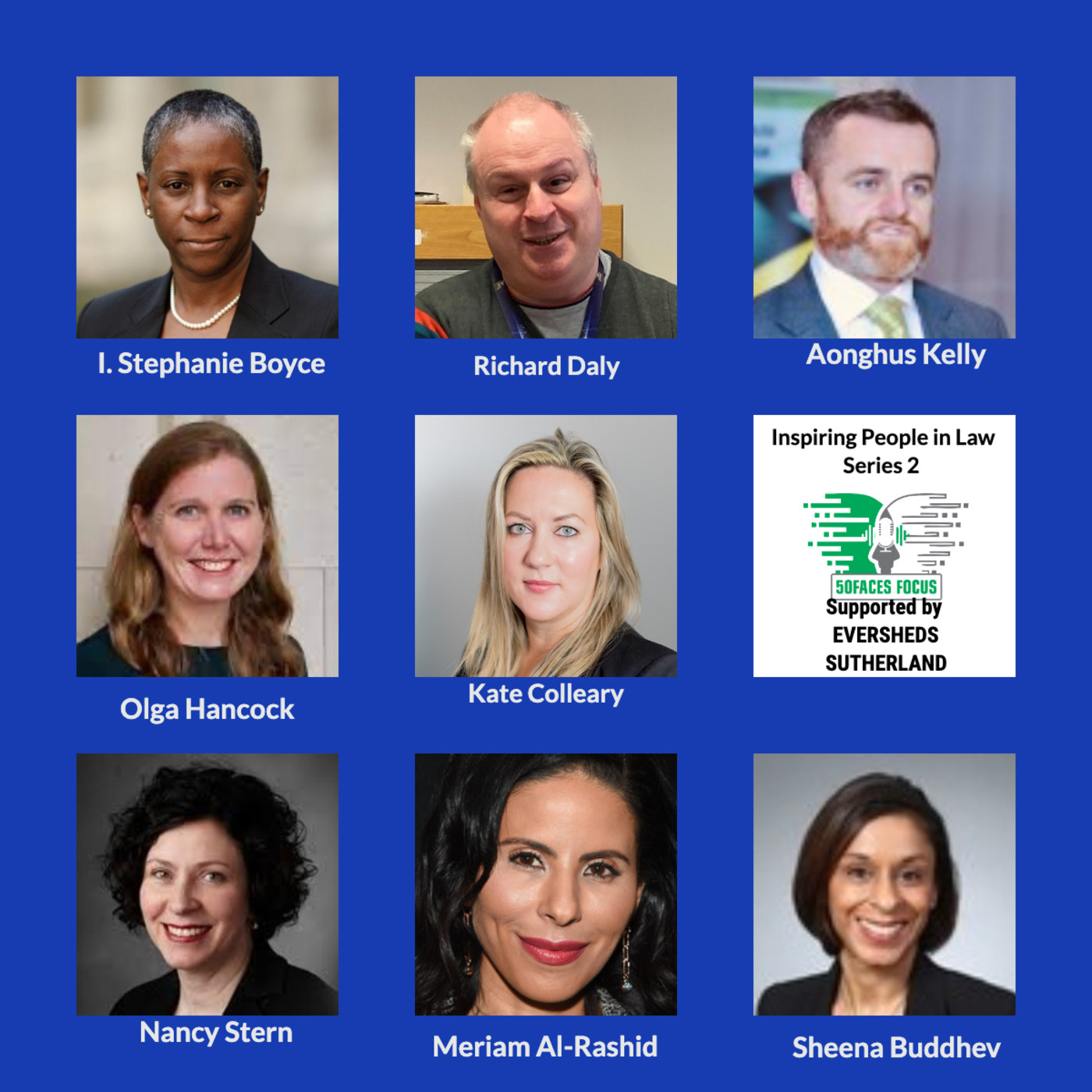
Speaker A: In our 2022 Inspiring People in Law series, we hear from 8 diverse lawyers across different practice areas and the globe. We hear from an international corporate lawyer about how she transferred her legal skills to a role in executive leadership.
Inspiring People in Law: A lot of the skills that lawyers have tend to be very transferable. One of the things that most lawyers have to guard against is not being too risk-averse, because I think that’s an occupational hazard.
Speaker A: We hear from the head of the Law Society of England and Wales about her passion to advance social justice.
Speaker C: So for me, legal rights mean absolutely nothing if you don’t know when those rights have been taken away, or indeed you don’t even know how to enforce those rights.
Speaker A: We hear from a data protection lawyer about what drives her in this fast-paced area.
Speaker D: I set up a data protection consulting practice. Our motto is to make the complex clear because we have a very complex regulatory framework that applies in business.
Speaker A: And about the cutting-edge advances in commercial litigation.
Speaker E: The exciting part about international arbitration is now there’s a convergence between international arbitration and international human rights. So business and human rights, the supply chain. Countries being more committed to the concept of human rights. The very fact that right to a healthy, clean environment and clean air is now considered a human right.
Speaker A: Many of our guests touch on areas of sustainability and how they bring their legal skills to bear.
Speaker F: A lot of the time in responsible investment, you’ve got to very quickly, critically analyze a very challenging event or issue, whether it be with a company or a broader geopolitical type issue. So the skill sets lawyers have to very quickly cut-through issues are incredibly helpful.
Speaker A: And we hear about the next frontier of the digital revolution, which could transform the profession: the concept of digital justice.
Speaker G: It was so radical, I couldn’t quite get my head around it. It would be a smart system that operates online or even on-chain, and what it seeks to do is identify and resolve disputes between parties all sort of through algorithms. So whilst judges, arbitrators, or experts would still ultimately be responsible for decision-making, sort of routine or interim processes could be resolved by algorithms, with always the parties retaining the right to appeal to a human judge.
Speaker A: We turn to an international criminal lawyer to hear what keeps him motivated through the sluggishness of some processes.
Speaker C: You need to believe in what I call the law of accumulated effect. You need to wean yourself off the necessity of instant gratification.
Speaker A: And the low points?
Speaker C: Because you see the hurt, you see the reality for people, you see how terrible war is. And I think about that a lot.
Speaker A: Many of our guests have overcome adversity, whether within or outside their firms.
Speaker E: I remember a recruiter saying to me, I don’t think you’re smart enough to be in this space.
Speaker G: Both my maternity leaves probably did impact on my progress. When I came back, I really felt as if I had lost time and I had to build relationships again and prove myself again.
Speaker A: They’ve also experienced biases around disability.
Speaker H: Instead of saying, how will a blind person do this job, why not ask a blind person how they’ll do the job?
Speaker A: We hear then what tactics have helped them.
Inspiring People in Law: My takeaway has really been centered on empathy, centering on what do other people need and want here, and how can I take that into account? Really trying to put yourself in the other person’s shoes helps with a lot of things.
Speaker A: As always, our series is brimming with life lessons and advice for us. Arbeitskleider.
Speaker F: Just find something you really enjoy. At the end of the day, that’s what really matters.
Speaker D: I don’t believe in failure. If you make a mistake, if something goes wrong, you learn from it and then you improve on it.
Speaker C: So PUSH stands for— because I absolutely believe that every door is open if you push, you persevere until something happens.
Speaker A: So from next week, join us in recognizing the career journeys of 8 extraordinary lawyers. You can find us on Apple Podcasts, Spotify, and wherever you get your podcasts. All of our podcasts are available on the 50 Faces hub together with resources and other aids to support your career. This series is brought to you with kind support of Eversheds Sutherland, a global law firm which believes that diversity, equity, and inclusion are fundamental to the delivery of high-quality legal services and innovative thinking. Providing advice around the globe from over 70 offices in more than 30 countries, The firm is committed to helping its clients, its people, and its communities to thrive.
Speaker A: In our 2022 Inspiring People in Law series, we hear from 8 diverse lawyers across different practice areas and the globe. We hear from an international corporate lawyer about how she transferred her legal skills to a role in executive leadership.
Inspiring People in Law: A lot of the skills that lawyers have tend to be very transferable. One of the things that most lawyers have to guard against is not being too risk-averse, because I think that’s an occupational hazard.
Speaker A: We hear from the head of the Law Society of England and Wales about her passion to advance social justice.
Speaker C: So for me, legal rights mean absolutely nothing if you don’t know when those rights have been taken away, or indeed you don’t even know how to enforce those rights.
Speaker A: We hear from a data protection lawyer about what drives her in this fast-paced area.
Speaker D: I set up a data protection consulting practice. Our motto is to make the complex clear because we have a very complex regulatory framework that applies in business.
Speaker A: And about the cutting-edge advances in commercial litigation.
Speaker E: The exciting part about international arbitration is now there’s a convergence between international arbitration and international human rights. So business and human rights, the supply chain. Countries being more committed to the concept of human rights. The very fact that right to a healthy, clean environment and clean air is now considered a human right.
Speaker A: Many of our guests touch on areas of sustainability and how they bring their legal skills to bear.
Speaker F: A lot of the time in responsible investment, you’ve got to very quickly, critically analyze a very challenging event or issue, whether it be with a company or a broader geopolitical type issue. So the skill sets lawyers have to very quickly cut-through issues are incredibly helpful.
Speaker A: And we hear about the next frontier of the digital revolution, which could transform the profession: the concept of digital justice.
Speaker G: It was so radical, I couldn’t quite get my head around it. It would be a smart system that operates online or even on-chain, and what it seeks to do is identify and resolve disputes between parties all sort of through algorithms. So whilst judges, arbitrators, or experts would still ultimately be responsible for decision-making, sort of routine or interim processes could be resolved by algorithms, with always the parties retaining the right to appeal to a human judge.
Speaker A: We turn to an international criminal lawyer to hear what keeps him motivated through the sluggishness of some processes.
Speaker C: You need to believe in what I call the law of accumulated effect. You need to wean yourself off the necessity of instant gratification.
Speaker A: And the low points?
Speaker C: Because you see the hurt, you see the reality for people, you see how terrible war is. And I think about that a lot.
Speaker A: Many of our guests have overcome adversity, whether within or outside their firms.
Speaker E: I remember a recruiter saying to me, I don’t think you’re smart enough to be in this space.
Speaker G: Both my maternity leaves probably did impact on my progress. When I came back, I really felt as if I had lost time and I had to build relationships again and prove myself again.
Speaker A: They’ve also experienced biases around disability.
Speaker H: Instead of saying, how will a blind person do this job, why not ask a blind person how they’ll do the job?
Speaker A: We hear then what tactics have helped them.
Inspiring People in Law: My takeaway has really been centered on empathy, centering on what do other people need and want here, and how can I take that into account? Really trying to put yourself in the other person’s shoes helps with a lot of things.
Speaker A: As always, our series is brimming with life lessons and advice for us. Arbeitskleider.
Speaker F: Just find something you really enjoy. At the end of the day, that’s what really matters.
Speaker D: I don’t believe in failure. If you make a mistake, if something goes wrong, you learn from it and then you improve on it.
Speaker C: So PUSH stands for— because I absolutely believe that every door is open if you push, you persevere until something happens.
Speaker A: So from next week, join us in recognizing the career journeys of 8 extraordinary lawyers. You can find us on Apple Podcasts, Spotify, and wherever you get your podcasts. All of our podcasts are available on the 50 Faces hub together with resources and other aids to support your career. This series is brought to you with kind support of Eversheds Sutherland, a global law firm which believes that diversity, equity, and inclusion are fundamental to the delivery of high-quality legal services and innovative thinking. Providing advice around the globe from over 70 offices in more than 30 countries, The firm is committed to helping its clients, its people, and its communities to thrive.