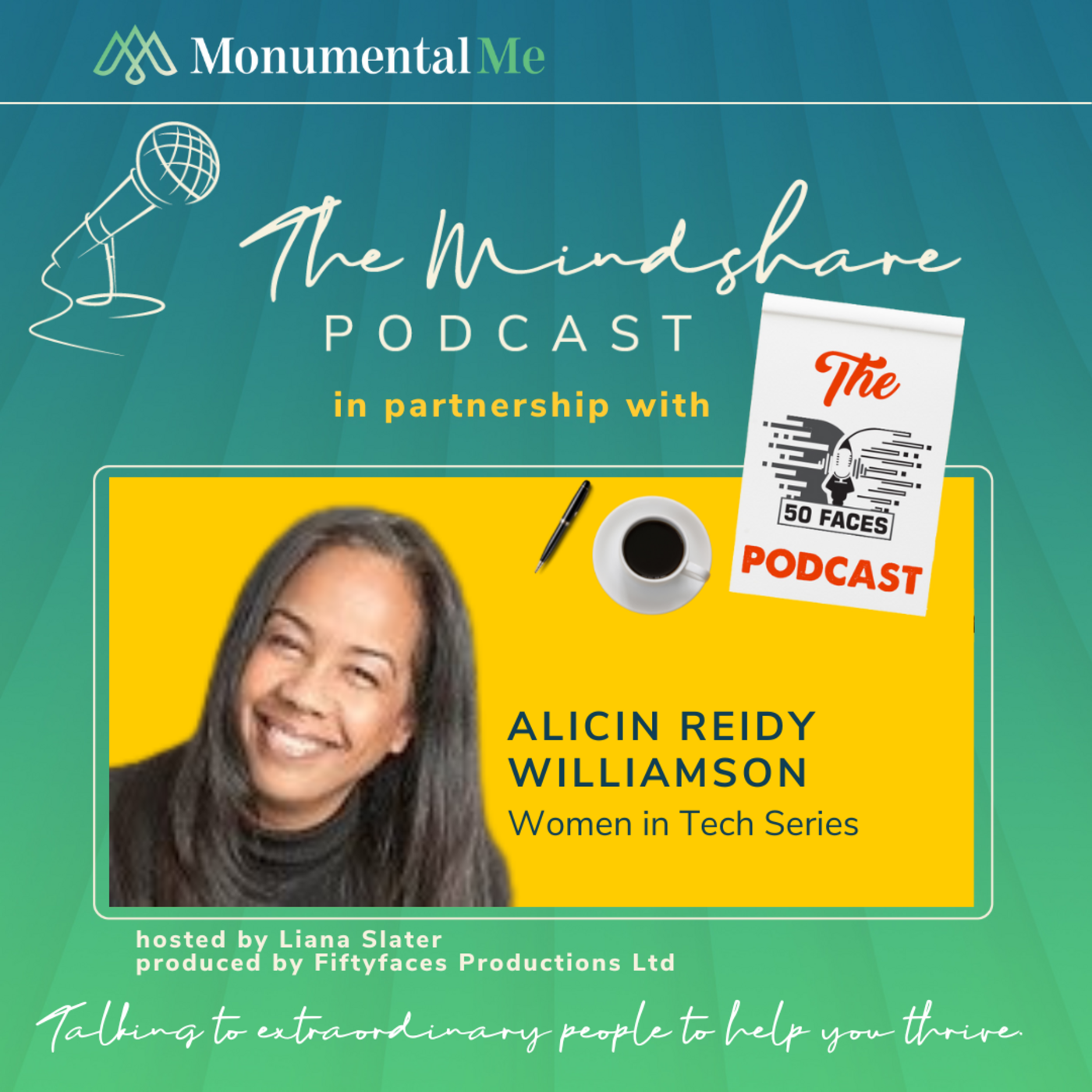
Aoifinn Devitt: This is Leanna Slater from Monumental Me and the Mindshare Podcast. I am thrilled to partner with Aoifinn Devitt and 50 Faces Productions for a new special series, Women in Tech. With women still making up about 33% of employees of major tech firms and 3% of tech startup founders, we are focused on making a difference to get more women into and to thrive in their careers in tech. And it may feel like women’s presence in business is improving, but women Women currently hold only 6% of CEO positions in the S&P 500. This is according to a new report, Women CEOs of the S&P 500 by Catalyst. This is a tiny improvement. In 2018, Harvard Business Review shared that the number of CEOs of US-based companies who were named John outnumbered the total number of women CEOs, which was 5%. So from that perspective, change is stagnant, but there’s so much we can do. Corporate leaders, investors, and education leaders, we need to ask what you’re doing to create more equity in the workplace. And note, we don’t all have to become CEOs. We’re focused on women all along their career trajectory, and there are so many ways to enjoy one’s career and to add to the diversity that makes companies more innovative, competitive, and profitable. And at Monumental Me, we work to help women develop professionally and personally. So we now join 50 Faces production to share stories and real tools for success with this special series, and We’ll be speaking with some remarkable people in and around the tech world. We can’t wait to share. Thanks for joining us. Today I’m speaking with Allison Reedy Williamson. Allison is Chief Diversity and Culture Officer at Yahoo Inc. For over 25 years, she’s led culture, purpose, and DEI for top companies, including Endeavor, The Raven Group, and Viacom and MTV Networks. Allison’s new to the tech industry, but just half a year into her role at Yahoo, she is having a real impact, and she’s making sure that everyone feels that they belong. How does she do it? Well, I can’t wait for you to hear. So thanks so much for joining us. Welcome, Allison. So Allison, you are the Chief Diversity and Culture Officer for Yahoo. Could you please just start us off by briefly introducing yourself and just touch on what led you to take on this role, and also just to help everybody really touch on what Yahoo is today?
Special Collaboration: Sure. Well, so I have been in the space of diversity, equity, inclusion, stakeholder engagement, communication strategy, community development for a couple decades now. It’s sort of bananas when I think about how long it’s been, and It’s constantly evolving and I grow with it all the time and I learn all the time. And one of the things that really attracted me to coming over to Yahoo was the vision of Jim Lanson, the CEO, who I was his first executive hire upon arrival. And he understands the importance of belonging and what leads to belonging is really understanding diversity, equity, and culture and inclusion. And so, that was the draw. It was, you know, reporting into him, having him understand and know the value proposition of what can happen with Yahoo when we have a thriving culture for everyone who’s here. And obviously, that leads to incredible opportunity for our consumers, our users, our clients. And, you know, I actually had to do a little bit of learning too when I was first talking about Yahoo. I have a Yahoo email address. I’ve had one for since the ’90s or late, maybe early 2000s actually. But I needed to do a little education myself, but it’s actually incredible the vastness of this brand that we have 900 million monthly global active users. This media and technology company is made up of just brands that we’ve known who, that are leaders or were pioneers actually in the tech space, including AOL and Obviously Yahoo itself, but, and then some entities and products that are used on a daily basis, Yahoo Finance and Yahoo Sports, TechCrunch. So it was actually really interesting to discover over the course of my entry into Yahoo, the reach and vastness of the enterprise.
Aoifinn Devitt: Yeah. And I think that’s really important to point out. It was a pioneer, is a pioneer. It’s been around for over, what, 25 years. And so that’s why I just want to check in and remind people that Yahoo is so relevant, number one in, I think, sports and finance. So, it’s a player. Okay, well, I love that you just pointed out that culture— and it’s part of your title— but that you pointed out culture and belonging. And that concept feels so inclusive and holistic to me. If you could just tell us a little bit more about what that really means. And are you focused on your internal culture for your employees as well as the company being more reflective and inclusive with its external users and customers? How do you really cultivate culture?
Special Collaboration: Sure. Well, you know, part of what’s actually an interesting— this is an interesting time as we are really deciding that we’re going to be a hybrid experience in the new way of showing up for anything, whether it’s for work, whether it’s for how we engage in a product. You know, there are just all sorts of relatively new influences that impact how we think about the employee experience as well as the customer experience. And so, The focus is on the employees right now, because if we get that right, we can certainly ensure that our clients and our customers and our users are feeling the same experience. If we’re thinking about inclusion, if we’re thinking about who’s not here, but should be, what are the barriers to entry? What are the opportunities that people see, but don’t necessarily understand that they could be part of? And so, the focus, yes, is, and that’s how we think about organize our culture. And it’s aspirational. I think we’re constantly evolving and that Yahoo actually has a really strong culture internally and building on that and having people understand again, who isn’t here in order to ensure that we are growing as a company, that we’re presenting opportunities for everyone and ensuring that there’s equity in the workplace, we are really looking at belonging as the outcome. It’s this journey towards it. And that’s how we’re focused on culture, how I’m, I’m building our work around culture.
Aoifinn Devitt: Okay. And belonging, how does one cultivate belonging? Are there just maybe some examples, an ERG group or regular meetings, communications? What is a main vehicle towards cultivating a sense of belonging for everybody?
Special Collaboration: Well, it’s of part it. Part of what— so belonging is sort of the outcome. And it’s actually interesting, the group that I came and took on used to have belonging in its title. And I sort of just dropped the B, not because it’s not the most important, because it is, but because that’s what we’re striving for. So it’s sort of like having corporate strategy be called profits. There is a revenue. It is this North Star and that we want everyone to have that sense of agency within the company. And so what that gets, what gets built towards that are these efforts around inclusion and how we are able to show up fully, right? And how we’re heard and who’s in the meeting. And my, does do I understand how my work has value, not only to my manager, but to the company as a whole? We just launched actually a self-ID pilot in the UK and Ireland. And it was really important to do this, not only because we want to know who’s here, but we also, we want to signal that we want people to show up fully. And so it’s an opportunity to both identify oneself by race and ethnicity if they so choose, as well as sexual orientation and gender identity. Those are the types of efforts that really let people know that we want them to be seen and feel seen. And that hopefully leads to belonging. So we have employee resource groups and we have racial equity task force, and there are a number of things happening across the company. And again, all of that hopefully ladders into how people feel that they can show up and how they feel like they can roll. I want everyone in here to think that, know that they own this place. And that’s the work.
Aoifinn Devitt: And a self-ID pilot, just to clarify that, is that on an internal directory? So, when somebody, when you meet somebody or looking somebody up, they can include anything about themselves that they want to identify?
Special Collaboration: Yeah, this actually is in their Workday profile. So, it’s all, it’s private. And so only a very few set of people have access to the information, but it’s a real indication of like, we wanna understand the full experience so we can organize efforts and policies to ensure that we’re supporting our employees.
Aoifinn Devitt: I don’t know if you’ve heard. Okay. Got it. All right. Well, I don’t know if this is true, but I was across the board, I was disheartened to hear over the past couple years with various C-level execs and DEI leaders that it’s almost easier to focus on growing ethnic diversity than it is gender diversity. And the needle just isn’t really moving for women. So a recent statistic just says that 33% of the workforce in major tech firms is women, female people identify as female. So what do you think about that? Are companies working to still focus on women specifically and women’s engagement and promoting women to senior levels, to the C-suite? Is that still a priority, or is it almost just easier with some companies just to really focus on the diversity, because that’s just easier keeping men, retaining men, and attracting men specifically in tech.
Special Collaboration: So interesting. So I spend a lot of time with my colleagues in this field, and I have not come across that statement. And I would say that tech is pretty much needing to do a lot around underrepresentation for both race and gender. There is a representation, significant representation of Asians, typically, in the United States, in many tech companies. However, even that, the attrition rate is generally quite high as well. And so, even though that people are able to, are showing up and that they’re represented in numbers, there’s also a departure rate that is something that everyone needs to pay attention to and understand why. The importance to focus on both race and ethnicity and gender is that there is no space for— no one’s doing this well yet. That’s, Like, I guess, the challenge. Actually, you know what, I will say, and for gender, I did do a look at some comparative companies, and there are a couple. Airbnb is actually over-indexing. It has 50% or more, slightly over, women at Airbnb. And I think that it does depend on the, the company. But I also think that women have been— were in tech. There were more women in tech before. And part of what we saw, especially during the pandemic, of droves of women leaving the workforce did not do the tech industry any favors. And so, I will say, I don’t think it’s easier for race and ethnicity, especially underrepresented race and ethnicity. For Blacks and Latinos in the United States, absolutely, we have to do better. Everyone in tech needs to focus if it’s— if they’re serious. For women, there’s the same thing. And, but what we have now is, and this is the challenge that everyone has when we start to introduce people who are underrepresented into these companies, is we now have the job of convincing women that things are different. The reason that they left the business, Liana, left the industry, we have to make sure that those reasons no longer exist, that things have changed and that there are opportunities for growth, that there are absolutely like a no, a zero tolerance policy around any behavior that might make it more challenging for women to be here. There are all the reasons that maybe women did not stay in this industry. We now have to do some convincing as opposed to others who have not actually been invited in ever. They will come in and then if that experience is not actually a good one, then our hill is steeper to climb on increasing the numbers around race and ethnicity. So maybe that’s part of why, where that narrative is generated from. But I would say that there’s no, I can’t, the work is so clear for all of the underrepresented in all the underrepresented spaces that I wouldn’t say that it’s easier to do. Well, first of all, it is relatively easy to get folks in, and it’s easier to get women in with that caveat that I just shared. The trick is to keep. And that’s the work that we’re, we’re really creating a space where, or working towards creating a space where this is a really, we want it to be a really hard place to decide to leave.
Aoifinn Devitt: Yeah. And it feels like just from what I know, Yahoo is doing that very well. And then that was also forced upon the industry in general, that being flexible work hours, working from home, working remotely. I think that has been an absolute game game changer for many women who might be caretakers, either children or parents, or for everybody, male and female, but specifically women. It just sounds like that has been a real game changer. Are you seeing that? I mean, I know that still we’re 2 years into this pandemic, but do you see that as something that people are really valuing? Is that helping some companies requiring women to come back into the office?
Special Collaboration: Absolutely. I mean, I think what is required is actually just understanding the lived experiences of people now. There are— just looking at our policies is what we’ve been doing to ensure that we are looking at childcare, emergency childcare, or childcare support, or elder care support. We’re looking at what kind of leave makes sense for the people in our company. We have actually— we’re remote first with the option of hybrid experience. And so what the needs are, are going to be different than if we were requiring people to come in 5 days a week. We get to be innovative in this. And one of the things that I always used to joke about, and I still do to some extent, is when it comes to technology and the opportunities, people’s like minds, the innovation gets like, and the creativity is beyond. When it comes to inclusion, getting gender equity, and people of color, all of a sudden we go into like this 1973 playbook. And so we actually have an opportunity, even in this chaos, that’s COVID, to reimagine how we ensure that everyone can thrive in this industry. It’s extremely awesome. There’s so much going on and there’s so much to come. And we want more women and people of color at this party. And the job is to make sure that we’ve looked at every reason that they don’t think they should be here, and then ensuring that when they are here, that they thrive.
Aoifinn Devitt: Yeah. The gift of remote-first for many people is also a challenge. So, creating culture and that sense of belonging, I would think that’s really difficult right now. You don’t have people in person or learning from other people by rubbing elbows, sitting side by side in that bullpen, like just things that I experienced. Yeah. How are you guys addressing that as part of finding solutions to cultivate and keep the culture that Yahoo has?
Special Collaboration: Well, it’s a great opportunity for people to become better managers and leaders because what we know is there are some things that people can do sitting in their slippers at their dining room table on their laptops without anyone sitting over next to them or over their shoulder. We also know that they’re— and having to figure out what that is, and trusting that that’s happening and managing to deliverables. And to your point, I’m a big fan of serendipity. I love being able to not actually look at green light on my computer. I like being able to walk around and see how people are experiencing work, just introducing myself and people who would not necessarily be scheduled into my day, but certainly are important parts of this company and are a part of this company. So, I think that there’s, as we continue down this road of figuring out the balance of it all, we’re really able to rethink how we engage on all levels, whether it’s in person and why we’re engaging in person and making these moments matter. And then also, like, how do we ensure that, especially the new people who don’t know how great the culture is at Yahoo! How do we— and thinking, how do we bring that to them if they’re fully remote? But then also, what are the opportunities to bring them together depending on their comfort level in the moments that matter? And so, not necessarily so that they can sit in front, in the middle of this pit, and do what they’d be doing at their table anyway.
Aoifinn Devitt: All right. So, tech is a broad industry in that tech touches everything, but the tech industry, we still think of big tech firms, giant companies, and learning organizations. So, you know, years ago it was GE, Google, Adobe. They were considered the ultimate learning organizations. And you mentioned Airbnb, but who else do you think is doing a really good job? If you’ve heard about that, kind of any industry events you’ve been to or something, who else do you think you could look towards as doing a really good job in this goal of supporting women and cultivating careers for women for the long-term in tech?
Special Collaboration: No, it’s actually— I am so— I’m new to this industry. I’ve been in media and entertainment for a long time, and before that, political strategy, and before that, media and entertainment. And so I think what I’m seeing in this industry is there’s a lot of work happening. And I suspect that if you spoke with women in any tech company, you would get a range of answers. Yeah, because everyone’s sort of entering into this conversation differently and the expectations are different. And that’s why I talk about, you know, at the beginning I talked about the just evolution and this like how we’re constantly growing and evolving this work as well as learning constantly because the expectations of some women are very different than the expectations of women of a particular generation. And that’s actually good because it keeps pushing us. I’m sure there are some that are doing it well. I actually have been— I’ve looked at some of the at least public-facing data, and data does not tell the whole story for sure. But no one’s knocking it out of the park. And I do know that there are efforts across the board. I also know that there’s not one that can say that they’ve figured it out. And I’ll never say that because I’m, again, like, I want to be pushed. I want us to be challenge to keep recognizing how we engage and include, ensure that we are including every voice in a way, and certainly through kindness and empathy, but making sure that when we say bring your full selves, we actually mean it.
Aoifinn Devitt: So Allison, do you think there is a difference in female leadership and do you see an advantage in that?
Special Collaboration: What I see a difference in is feminist leadership, that does make a huge difference when understanding women and how women are able to show up and what impacts them. It’s seismic. And the reality is there are men, and I actually think I happen to work for one who leads in that way. He is just high EQ. And I think sadly there have been women who have not. And so I would say that it does absolutely make a sense when we have feminist leadership.
Aoifinn Devitt: We need to get more EQ in all people in the workforce out there.
Special Collaboration: Yes, absolutely, absolutely. I mean, I’m big— I’m a big believer and fan of women in the C-suite and in the C— as CEOs, absolutely. And I also know that there are men who are sitting in the C-suite and as CEOs who can lean in more and ensure that we are again able to show up fully, that we are able to thrive, and that we as women are able to— there’s a lot that comes to us and that we can make sure that we are having our full potential. We are showing up fully.
Aoifinn Devitt: Great. Well, that’s so great that you point that out about your boss, the CEO, Jim Lazzone. And it sounds like to answer my earlier question, Yahoo seems to be a learning organization that we can look at as setting that example.
Special Collaboration: I’m going to let him know that I said that about him because I actually truly believe it, but I want to make sure he knows it.
Aoifinn Devitt: Yes, he’ll have to listen to this conversation.
Special Collaboration: Exactly.
Aoifinn Devitt: All right, let’s look at the other side of this. This might be a little controversial. So women have some agency, they really do, and obviously want to— you mentioned that earlier, that you want everybody to feel that sense of agency. But where do you think women might be falling short in this area? And I can give you some prompts. When I think about maybe confidence, wage negotiations, asking for money, asking for that promotion, how they present themselves when they interview, do you think that women could be taking a little bit more responsibility for getting into tech, sticking with it, or getting promoted?
Special Collaboration: I feel like we all should be thinking about how we can do better. I don’t know if it’s about how we do better navigating structures that were not necessarily meant to include us. I think one of the things that we’re working to also disrupt is even that negotiate salary negotiation component. Women often like fall prey to negotiating against themselves often, but the questions are unfair, right? There’s information and context and data that we aren’t privy to, but that’s like the case for everyone, but for whatever, because of the way compensation has been handled, women often are more vulnerable to that. I wouldn’t put that on them necessarily. And yeah, like we need to figure out like how to ask for what we want if we’re not able to do that. But I also know that there are tropes of women who ask for what they want and then they’re considered aggressive or too bossy. It’s depending on, because there are so many structures and narratives and just places where it’s often signaled that we need to conform to a certain behavior in order to be acceptable. I feel it would be unfair to put that on us. I think there are women who’ve been pioneers who did it ahead, like, did it, kicked open doors, broke through glass ceilings by doing that. And there’s not— I mean, and I’m always— I always will be grateful for that because I’m sure that’s one of the reasons that I’m sitting here. I think that the job of women is to make sure that we are not the only one. I’d say that’s the only thing that I would ask. If they’re already— if we’re already sitting at the table, we need to make sure there’s another seat at least, and more.
Aoifinn Devitt: I think that’s such an important message and, and so true. And I’ve had the privilege to talk to, oh gosh, over 40 women in business from finance, consumer, retail, tech, everything. And it’s just— it’s interesting. I feel like the older generation, like women 60s and above, I wasn’t feeling that sense of responsibility to include everybody at the table along with them. And that’s probably because there were so few of them at the table. But I have heard from many of my conversations for women mid-career that they are so eager to, to bring other people along with them. I hope that’s true for most women, but that’s what I’ve heard.
Special Collaboration: So, I mean, it’s a hard spot to be. I understand women who’ve sat at the table and have been the only one for generations, right? Do you risk not being there at all? I get it, but I do think you’re right. I think that there are a lot of women now who wouldn’t, uh, who don’t accept that, who will not accept it. And again, it’s because of those women who are sitting by themselves for so long and helped us like figure out how to make that happen. That’s the one thing that I would have women who have the ability and the agency to do that is ensure that there’s space for more women wherever they’re sitting.
Aoifinn Devitt: Great. Yeah. All right, Allison, let’s get a little bit personal. I want to ask you about you. Well, first, was there one piece of advice that you may have received kind of along the way in your career that really made an impact on you, maybe how you work or how you see the world?
Special Collaboration: Well, it’s so funny, my, my mom used to say, and this was not along the career path, but it certainly is something that I’ve applied to my work is that the first no is generally— is usually a maybe. So it’s not taking that first no as the end result. So that actually has been really helpful. You know, I’ve just been actually very fortunate with leaders and bosses in my career. You know, I worked for a woman at MTV Networks who made sure I was in the room all the time. And I think it wasn’t something that she said, which was, be present, be there so you get to be seen. But I think that is, it’s an important piece of information that I took and I’ve taken through my career as well, is that I’m not going to make myself smaller for the comfort of others. And in fact, what I found, I’ve found is that it’s been rewarding. It’s been mutually rewarding when I don’t, when I do not, when I do not make myself smaller.
Aoifinn Devitt: Good to hear. And yeah, mentors and sponsors. It sounds like you had some excellent mentors and sponsors, and that’s just so important. Is that something also that you feel that you want to cultivate, or is— I think you are doing some things at Yahoo to help set that up. So what are you doing there, and what can— what would you recommend for individuals to seek out?
Special Collaboration: I’m a big fan of the personal board of directors. I think having that roundtable of people that include mentors and sponsors and, and sometimes just peers who are going to— and friends. You need the people who are going to tell you that you were right no matter what. You’re right, that was bananas. And then you need the people who are going to help guide you and give you advice and feedback. And then you need the people like sponsors who are going to be— who are going to talk about you when you’re not in the room and really be your— a champion and cheerleader throughout. At Yahoo, we are doing a lot there. We have a really robust learning development program as well as our ERGs that lead both efforts around how to create those relationships, develop those relationships intentionally. We also have MAKERS, a convening and media brand that really encourages and brings women together to ensure that there is that network of support. And advocacy. And through that, we’re actually also looking at how do we make sure that we have mentoring and sponsorship opportunities for women at all levels. But it’s very important. It’s— no one can do this alone, and no one has. No man or woman has gotten to any echelon of success without some support, whether it was a formal mentor or formal sponsor or not.
Aoifinn Devitt: It’s important for everybody to hear this, and especially people earlier in their career who just think, I I can do this all, or I need to prove myself. One thing I always say is just ask, reach out to people. People love to share their gems and that’s a start, you know, just connect with others to step up. Yes.
Special Collaboration: Yeah.
Aoifinn Devitt: Great.
Special Collaboration: Yeah, absolutely.
Aoifinn Devitt: So, okay, I will ask you one last question. This is my signature question. What would you tell your 26-year-old self?
Special Collaboration: Oh, the quickie is don’t sweat the small stuff. And everything is small stuff, I think. But really, what I would— in the line of work that I, I’ve chosen, the small things actually really do matter. And so I guess what I would tell my 26-year-old self is— it sounds trite— but follow your passion. You kind of get worried about where you are, what your title is, what your status is. At 26, you’re trying to figure out what’s my situation supposed to be right now. And what you realize when you’re some odd years older, is that when you follow your passion, it unfolds in the way that it’s meant to be, whether it’s in life, in life, in partnership, in childbearing and child rearing, job choice. And it’s to not try to overprescribe and decide this is actually what I should be doing because I’m 26. It’s an interesting ride.
Aoifinn Devitt: Yes. Yes. Great. All right. Well, Allison, thank you so much. This has been a pleasure and so insightful.
Special Collaboration: Thank you. This is, it’s wonderful. It’s wonderful to have this conversation. And I, and I do think your podcast is so important. And I’m a listener. I was about to say a watcher. Geez. I’m a listener. Thank you. These are really important pieces of information. I wish I had these when I was beginning my career.
Aoifinn Devitt: Same. That’s exactly what keeps me going. That I wish I had had, could listen into these conversations and meet these people that we’re talking to, like you, when, yeah, when I was my 26-year-old self.
Special Collaboration: This podcast is for informational purposes only and should not be construed as investment advice, and all views are personal and should not be attributed to the organizations and affiliations of the host or any guest.
Aoifinn Devitt: This is Leanna Slater from Monumental Me and the Mindshare Podcast. I am thrilled to partner with Aoifinn Devitt and 50 Faces Productions for a new special series, Women in Tech. With women still making up about 33% of employees of major tech firms and 3% of tech startup founders, we are focused on making a difference to get more women into and to thrive in their careers in tech. And it may feel like women’s presence in business is improving, but women Women currently hold only 6% of CEO positions in the S&P 500. This is according to a new report, Women CEOs of the S&P 500 by Catalyst. This is a tiny improvement. In 2018, Harvard Business Review shared that the number of CEOs of US-based companies who were named John outnumbered the total number of women CEOs, which was 5%. So from that perspective, change is stagnant, but there’s so much we can do. Corporate leaders, investors, and education leaders, we need to ask what you’re doing to create more equity in the workplace. And note, we don’t all have to become CEOs. We’re focused on women all along their career trajectory, and there are so many ways to enjoy one’s career and to add to the diversity that makes companies more innovative, competitive, and profitable. And at Monumental Me, we work to help women develop professionally and personally. So we now join 50 Faces production to share stories and real tools for success with this special series, and We’ll be speaking with some remarkable people in and around the tech world. We can’t wait to share. Thanks for joining us. Today I’m speaking with Allison Reedy Williamson. Allison is Chief Diversity and Culture Officer at Yahoo Inc. For over 25 years, she’s led culture, purpose, and DEI for top companies, including Endeavor, The Raven Group, and Viacom and MTV Networks. Allison’s new to the tech industry, but just half a year into her role at Yahoo, she is having a real impact, and she’s making sure that everyone feels that they belong. How does she do it? Well, I can’t wait for you to hear. So thanks so much for joining us. Welcome, Allison. So Allison, you are the Chief Diversity and Culture Officer for Yahoo. Could you please just start us off by briefly introducing yourself and just touch on what led you to take on this role, and also just to help everybody really touch on what Yahoo is today?
Special Collaboration: Sure. Well, so I have been in the space of diversity, equity, inclusion, stakeholder engagement, communication strategy, community development for a couple decades now. It’s sort of bananas when I think about how long it’s been, and It’s constantly evolving and I grow with it all the time and I learn all the time. And one of the things that really attracted me to coming over to Yahoo was the vision of Jim Lanson, the CEO, who I was his first executive hire upon arrival. And he understands the importance of belonging and what leads to belonging is really understanding diversity, equity, and culture and inclusion. And so, that was the draw. It was, you know, reporting into him, having him understand and know the value proposition of what can happen with Yahoo when we have a thriving culture for everyone who’s here. And obviously, that leads to incredible opportunity for our consumers, our users, our clients. And, you know, I actually had to do a little bit of learning too when I was first talking about Yahoo. I have a Yahoo email address. I’ve had one for since the ’90s or late, maybe early 2000s actually. But I needed to do a little education myself, but it’s actually incredible the vastness of this brand that we have 900 million monthly global active users. This media and technology company is made up of just brands that we’ve known who, that are leaders or were pioneers actually in the tech space, including AOL and Obviously Yahoo itself, but, and then some entities and products that are used on a daily basis, Yahoo Finance and Yahoo Sports, TechCrunch. So it was actually really interesting to discover over the course of my entry into Yahoo, the reach and vastness of the enterprise.
Aoifinn Devitt: Yeah. And I think that’s really important to point out. It was a pioneer, is a pioneer. It’s been around for over, what, 25 years. And so that’s why I just want to check in and remind people that Yahoo is so relevant, number one in, I think, sports and finance. So, it’s a player. Okay, well, I love that you just pointed out that culture— and it’s part of your title— but that you pointed out culture and belonging. And that concept feels so inclusive and holistic to me. If you could just tell us a little bit more about what that really means. And are you focused on your internal culture for your employees as well as the company being more reflective and inclusive with its external users and customers? How do you really cultivate culture?
Special Collaboration: Sure. Well, you know, part of what’s actually an interesting— this is an interesting time as we are really deciding that we’re going to be a hybrid experience in the new way of showing up for anything, whether it’s for work, whether it’s for how we engage in a product. You know, there are just all sorts of relatively new influences that impact how we think about the employee experience as well as the customer experience. And so, The focus is on the employees right now, because if we get that right, we can certainly ensure that our clients and our customers and our users are feeling the same experience. If we’re thinking about inclusion, if we’re thinking about who’s not here, but should be, what are the barriers to entry? What are the opportunities that people see, but don’t necessarily understand that they could be part of? And so, the focus, yes, is, and that’s how we think about organize our culture. And it’s aspirational. I think we’re constantly evolving and that Yahoo actually has a really strong culture internally and building on that and having people understand again, who isn’t here in order to ensure that we are growing as a company, that we’re presenting opportunities for everyone and ensuring that there’s equity in the workplace, we are really looking at belonging as the outcome. It’s this journey towards it. And that’s how we’re focused on culture, how I’m, I’m building our work around culture.
Aoifinn Devitt: Okay. And belonging, how does one cultivate belonging? Are there just maybe some examples, an ERG group or regular meetings, communications? What is a main vehicle towards cultivating a sense of belonging for everybody?
Special Collaboration: Well, it’s of part it. Part of what— so belonging is sort of the outcome. And it’s actually interesting, the group that I came and took on used to have belonging in its title. And I sort of just dropped the B, not because it’s not the most important, because it is, but because that’s what we’re striving for. So it’s sort of like having corporate strategy be called profits. There is a revenue. It is this North Star and that we want everyone to have that sense of agency within the company. And so what that gets, what gets built towards that are these efforts around inclusion and how we are able to show up fully, right? And how we’re heard and who’s in the meeting. And my, does do I understand how my work has value, not only to my manager, but to the company as a whole? We just launched actually a self-ID pilot in the UK and Ireland. And it was really important to do this, not only because we want to know who’s here, but we also, we want to signal that we want people to show up fully. And so it’s an opportunity to both identify oneself by race and ethnicity if they so choose, as well as sexual orientation and gender identity. Those are the types of efforts that really let people know that we want them to be seen and feel seen. And that hopefully leads to belonging. So we have employee resource groups and we have racial equity task force, and there are a number of things happening across the company. And again, all of that hopefully ladders into how people feel that they can show up and how they feel like they can roll. I want everyone in here to think that, know that they own this place. And that’s the work.
Aoifinn Devitt: And a self-ID pilot, just to clarify that, is that on an internal directory? So, when somebody, when you meet somebody or looking somebody up, they can include anything about themselves that they want to identify?
Special Collaboration: Yeah, this actually is in their Workday profile. So, it’s all, it’s private. And so only a very few set of people have access to the information, but it’s a real indication of like, we wanna understand the full experience so we can organize efforts and policies to ensure that we’re supporting our employees.
Aoifinn Devitt: I don’t know if you’ve heard. Okay. Got it. All right. Well, I don’t know if this is true, but I was across the board, I was disheartened to hear over the past couple years with various C-level execs and DEI leaders that it’s almost easier to focus on growing ethnic diversity than it is gender diversity. And the needle just isn’t really moving for women. So a recent statistic just says that 33% of the workforce in major tech firms is women, female people identify as female. So what do you think about that? Are companies working to still focus on women specifically and women’s engagement and promoting women to senior levels, to the C-suite? Is that still a priority, or is it almost just easier with some companies just to really focus on the diversity, because that’s just easier keeping men, retaining men, and attracting men specifically in tech.
Special Collaboration: So interesting. So I spend a lot of time with my colleagues in this field, and I have not come across that statement. And I would say that tech is pretty much needing to do a lot around underrepresentation for both race and gender. There is a representation, significant representation of Asians, typically, in the United States, in many tech companies. However, even that, the attrition rate is generally quite high as well. And so, even though that people are able to, are showing up and that they’re represented in numbers, there’s also a departure rate that is something that everyone needs to pay attention to and understand why. The importance to focus on both race and ethnicity and gender is that there is no space for— no one’s doing this well yet. That’s, Like, I guess, the challenge. Actually, you know what, I will say, and for gender, I did do a look at some comparative companies, and there are a couple. Airbnb is actually over-indexing. It has 50% or more, slightly over, women at Airbnb. And I think that it does depend on the, the company. But I also think that women have been— were in tech. There were more women in tech before. And part of what we saw, especially during the pandemic, of droves of women leaving the workforce did not do the tech industry any favors. And so, I will say, I don’t think it’s easier for race and ethnicity, especially underrepresented race and ethnicity. For Blacks and Latinos in the United States, absolutely, we have to do better. Everyone in tech needs to focus if it’s— if they’re serious. For women, there’s the same thing. And, but what we have now is, and this is the challenge that everyone has when we start to introduce people who are underrepresented into these companies, is we now have the job of convincing women that things are different. The reason that they left the business, Liana, left the industry, we have to make sure that those reasons no longer exist, that things have changed and that there are opportunities for growth, that there are absolutely like a no, a zero tolerance policy around any behavior that might make it more challenging for women to be here. There are all the reasons that maybe women did not stay in this industry. We now have to do some convincing as opposed to others who have not actually been invited in ever. They will come in and then if that experience is not actually a good one, then our hill is steeper to climb on increasing the numbers around race and ethnicity. So maybe that’s part of why, where that narrative is generated from. But I would say that there’s no, I can’t, the work is so clear for all of the underrepresented in all the underrepresented spaces that I wouldn’t say that it’s easier to do. Well, first of all, it is relatively easy to get folks in, and it’s easier to get women in with that caveat that I just shared. The trick is to keep. And that’s the work that we’re, we’re really creating a space where, or working towards creating a space where this is a really, we want it to be a really hard place to decide to leave.
Aoifinn Devitt: Yeah. And it feels like just from what I know, Yahoo is doing that very well. And then that was also forced upon the industry in general, that being flexible work hours, working from home, working remotely. I think that has been an absolute game game changer for many women who might be caretakers, either children or parents, or for everybody, male and female, but specifically women. It just sounds like that has been a real game changer. Are you seeing that? I mean, I know that still we’re 2 years into this pandemic, but do you see that as something that people are really valuing? Is that helping some companies requiring women to come back into the office?
Special Collaboration: Absolutely. I mean, I think what is required is actually just understanding the lived experiences of people now. There are— just looking at our policies is what we’ve been doing to ensure that we are looking at childcare, emergency childcare, or childcare support, or elder care support. We’re looking at what kind of leave makes sense for the people in our company. We have actually— we’re remote first with the option of hybrid experience. And so what the needs are, are going to be different than if we were requiring people to come in 5 days a week. We get to be innovative in this. And one of the things that I always used to joke about, and I still do to some extent, is when it comes to technology and the opportunities, people’s like minds, the innovation gets like, and the creativity is beyond. When it comes to inclusion, getting gender equity, and people of color, all of a sudden we go into like this 1973 playbook. And so we actually have an opportunity, even in this chaos, that’s COVID, to reimagine how we ensure that everyone can thrive in this industry. It’s extremely awesome. There’s so much going on and there’s so much to come. And we want more women and people of color at this party. And the job is to make sure that we’ve looked at every reason that they don’t think they should be here, and then ensuring that when they are here, that they thrive.
Aoifinn Devitt: Yeah. The gift of remote-first for many people is also a challenge. So, creating culture and that sense of belonging, I would think that’s really difficult right now. You don’t have people in person or learning from other people by rubbing elbows, sitting side by side in that bullpen, like just things that I experienced. Yeah. How are you guys addressing that as part of finding solutions to cultivate and keep the culture that Yahoo has?
Special Collaboration: Well, it’s a great opportunity for people to become better managers and leaders because what we know is there are some things that people can do sitting in their slippers at their dining room table on their laptops without anyone sitting over next to them or over their shoulder. We also know that they’re— and having to figure out what that is, and trusting that that’s happening and managing to deliverables. And to your point, I’m a big fan of serendipity. I love being able to not actually look at green light on my computer. I like being able to walk around and see how people are experiencing work, just introducing myself and people who would not necessarily be scheduled into my day, but certainly are important parts of this company and are a part of this company. So, I think that there’s, as we continue down this road of figuring out the balance of it all, we’re really able to rethink how we engage on all levels, whether it’s in person and why we’re engaging in person and making these moments matter. And then also, like, how do we ensure that, especially the new people who don’t know how great the culture is at Yahoo! How do we— and thinking, how do we bring that to them if they’re fully remote? But then also, what are the opportunities to bring them together depending on their comfort level in the moments that matter? And so, not necessarily so that they can sit in front, in the middle of this pit, and do what they’d be doing at their table anyway.
Aoifinn Devitt: All right. So, tech is a broad industry in that tech touches everything, but the tech industry, we still think of big tech firms, giant companies, and learning organizations. So, you know, years ago it was GE, Google, Adobe. They were considered the ultimate learning organizations. And you mentioned Airbnb, but who else do you think is doing a really good job? If you’ve heard about that, kind of any industry events you’ve been to or something, who else do you think you could look towards as doing a really good job in this goal of supporting women and cultivating careers for women for the long-term in tech?
Special Collaboration: No, it’s actually— I am so— I’m new to this industry. I’ve been in media and entertainment for a long time, and before that, political strategy, and before that, media and entertainment. And so I think what I’m seeing in this industry is there’s a lot of work happening. And I suspect that if you spoke with women in any tech company, you would get a range of answers. Yeah, because everyone’s sort of entering into this conversation differently and the expectations are different. And that’s why I talk about, you know, at the beginning I talked about the just evolution and this like how we’re constantly growing and evolving this work as well as learning constantly because the expectations of some women are very different than the expectations of women of a particular generation. And that’s actually good because it keeps pushing us. I’m sure there are some that are doing it well. I actually have been— I’ve looked at some of the at least public-facing data, and data does not tell the whole story for sure. But no one’s knocking it out of the park. And I do know that there are efforts across the board. I also know that there’s not one that can say that they’ve figured it out. And I’ll never say that because I’m, again, like, I want to be pushed. I want us to be challenge to keep recognizing how we engage and include, ensure that we are including every voice in a way, and certainly through kindness and empathy, but making sure that when we say bring your full selves, we actually mean it.
Aoifinn Devitt: So Allison, do you think there is a difference in female leadership and do you see an advantage in that?
Special Collaboration: What I see a difference in is feminist leadership, that does make a huge difference when understanding women and how women are able to show up and what impacts them. It’s seismic. And the reality is there are men, and I actually think I happen to work for one who leads in that way. He is just high EQ. And I think sadly there have been women who have not. And so I would say that it does absolutely make a sense when we have feminist leadership.
Aoifinn Devitt: We need to get more EQ in all people in the workforce out there.
Special Collaboration: Yes, absolutely, absolutely. I mean, I’m big— I’m a big believer and fan of women in the C-suite and in the C— as CEOs, absolutely. And I also know that there are men who are sitting in the C-suite and as CEOs who can lean in more and ensure that we are again able to show up fully, that we are able to thrive, and that we as women are able to— there’s a lot that comes to us and that we can make sure that we are having our full potential. We are showing up fully.
Aoifinn Devitt: Great. Well, that’s so great that you point that out about your boss, the CEO, Jim Lazzone. And it sounds like to answer my earlier question, Yahoo seems to be a learning organization that we can look at as setting that example.
Special Collaboration: I’m going to let him know that I said that about him because I actually truly believe it, but I want to make sure he knows it.
Aoifinn Devitt: Yes, he’ll have to listen to this conversation.
Special Collaboration: Exactly.
Aoifinn Devitt: All right, let’s look at the other side of this. This might be a little controversial. So women have some agency, they really do, and obviously want to— you mentioned that earlier, that you want everybody to feel that sense of agency. But where do you think women might be falling short in this area? And I can give you some prompts. When I think about maybe confidence, wage negotiations, asking for money, asking for that promotion, how they present themselves when they interview, do you think that women could be taking a little bit more responsibility for getting into tech, sticking with it, or getting promoted?
Special Collaboration: I feel like we all should be thinking about how we can do better. I don’t know if it’s about how we do better navigating structures that were not necessarily meant to include us. I think one of the things that we’re working to also disrupt is even that negotiate salary negotiation component. Women often like fall prey to negotiating against themselves often, but the questions are unfair, right? There’s information and context and data that we aren’t privy to, but that’s like the case for everyone, but for whatever, because of the way compensation has been handled, women often are more vulnerable to that. I wouldn’t put that on them necessarily. And yeah, like we need to figure out like how to ask for what we want if we’re not able to do that. But I also know that there are tropes of women who ask for what they want and then they’re considered aggressive or too bossy. It’s depending on, because there are so many structures and narratives and just places where it’s often signaled that we need to conform to a certain behavior in order to be acceptable. I feel it would be unfair to put that on us. I think there are women who’ve been pioneers who did it ahead, like, did it, kicked open doors, broke through glass ceilings by doing that. And there’s not— I mean, and I’m always— I always will be grateful for that because I’m sure that’s one of the reasons that I’m sitting here. I think that the job of women is to make sure that we are not the only one. I’d say that’s the only thing that I would ask. If they’re already— if we’re already sitting at the table, we need to make sure there’s another seat at least, and more.
Aoifinn Devitt: I think that’s such an important message and, and so true. And I’ve had the privilege to talk to, oh gosh, over 40 women in business from finance, consumer, retail, tech, everything. And it’s just— it’s interesting. I feel like the older generation, like women 60s and above, I wasn’t feeling that sense of responsibility to include everybody at the table along with them. And that’s probably because there were so few of them at the table. But I have heard from many of my conversations for women mid-career that they are so eager to, to bring other people along with them. I hope that’s true for most women, but that’s what I’ve heard.
Special Collaboration: So, I mean, it’s a hard spot to be. I understand women who’ve sat at the table and have been the only one for generations, right? Do you risk not being there at all? I get it, but I do think you’re right. I think that there are a lot of women now who wouldn’t, uh, who don’t accept that, who will not accept it. And again, it’s because of those women who are sitting by themselves for so long and helped us like figure out how to make that happen. That’s the one thing that I would have women who have the ability and the agency to do that is ensure that there’s space for more women wherever they’re sitting.
Aoifinn Devitt: Great. Yeah. All right, Allison, let’s get a little bit personal. I want to ask you about you. Well, first, was there one piece of advice that you may have received kind of along the way in your career that really made an impact on you, maybe how you work or how you see the world?
Special Collaboration: Well, it’s so funny, my, my mom used to say, and this was not along the career path, but it certainly is something that I’ve applied to my work is that the first no is generally— is usually a maybe. So it’s not taking that first no as the end result. So that actually has been really helpful. You know, I’ve just been actually very fortunate with leaders and bosses in my career. You know, I worked for a woman at MTV Networks who made sure I was in the room all the time. And I think it wasn’t something that she said, which was, be present, be there so you get to be seen. But I think that is, it’s an important piece of information that I took and I’ve taken through my career as well, is that I’m not going to make myself smaller for the comfort of others. And in fact, what I found, I’ve found is that it’s been rewarding. It’s been mutually rewarding when I don’t, when I do not, when I do not make myself smaller.
Aoifinn Devitt: Good to hear. And yeah, mentors and sponsors. It sounds like you had some excellent mentors and sponsors, and that’s just so important. Is that something also that you feel that you want to cultivate, or is— I think you are doing some things at Yahoo to help set that up. So what are you doing there, and what can— what would you recommend for individuals to seek out?
Special Collaboration: I’m a big fan of the personal board of directors. I think having that roundtable of people that include mentors and sponsors and, and sometimes just peers who are going to— and friends. You need the people who are going to tell you that you were right no matter what. You’re right, that was bananas. And then you need the people who are going to help guide you and give you advice and feedback. And then you need the people like sponsors who are going to be— who are going to talk about you when you’re not in the room and really be your— a champion and cheerleader throughout. At Yahoo, we are doing a lot there. We have a really robust learning development program as well as our ERGs that lead both efforts around how to create those relationships, develop those relationships intentionally. We also have MAKERS, a convening and media brand that really encourages and brings women together to ensure that there is that network of support. And advocacy. And through that, we’re actually also looking at how do we make sure that we have mentoring and sponsorship opportunities for women at all levels. But it’s very important. It’s— no one can do this alone, and no one has. No man or woman has gotten to any echelon of success without some support, whether it was a formal mentor or formal sponsor or not.
Aoifinn Devitt: It’s important for everybody to hear this, and especially people earlier in their career who just think, I I can do this all, or I need to prove myself. One thing I always say is just ask, reach out to people. People love to share their gems and that’s a start, you know, just connect with others to step up. Yes.
Special Collaboration: Yeah.
Aoifinn Devitt: Great.
Special Collaboration: Yeah, absolutely.
Aoifinn Devitt: So, okay, I will ask you one last question. This is my signature question. What would you tell your 26-year-old self?
Special Collaboration: Oh, the quickie is don’t sweat the small stuff. And everything is small stuff, I think. But really, what I would— in the line of work that I, I’ve chosen, the small things actually really do matter. And so I guess what I would tell my 26-year-old self is— it sounds trite— but follow your passion. You kind of get worried about where you are, what your title is, what your status is. At 26, you’re trying to figure out what’s my situation supposed to be right now. And what you realize when you’re some odd years older, is that when you follow your passion, it unfolds in the way that it’s meant to be, whether it’s in life, in life, in partnership, in childbearing and child rearing, job choice. And it’s to not try to overprescribe and decide this is actually what I should be doing because I’m 26. It’s an interesting ride.
Aoifinn Devitt: Yes. Yes. Great. All right. Well, Allison, thank you so much. This has been a pleasure and so insightful.
Special Collaboration: Thank you. This is, it’s wonderful. It’s wonderful to have this conversation. And I, and I do think your podcast is so important. And I’m a listener. I was about to say a watcher. Geez. I’m a listener. Thank you. These are really important pieces of information. I wish I had these when I was beginning my career.
Aoifinn Devitt: Same. That’s exactly what keeps me going. That I wish I had had, could listen into these conversations and meet these people that we’re talking to, like you, when, yeah, when I was my 26-year-old self.
Special Collaboration: This podcast is for informational purposes only and should not be construed as investment advice, and all views are personal and should not be attributed to the organizations and affiliations of the host or any guest.