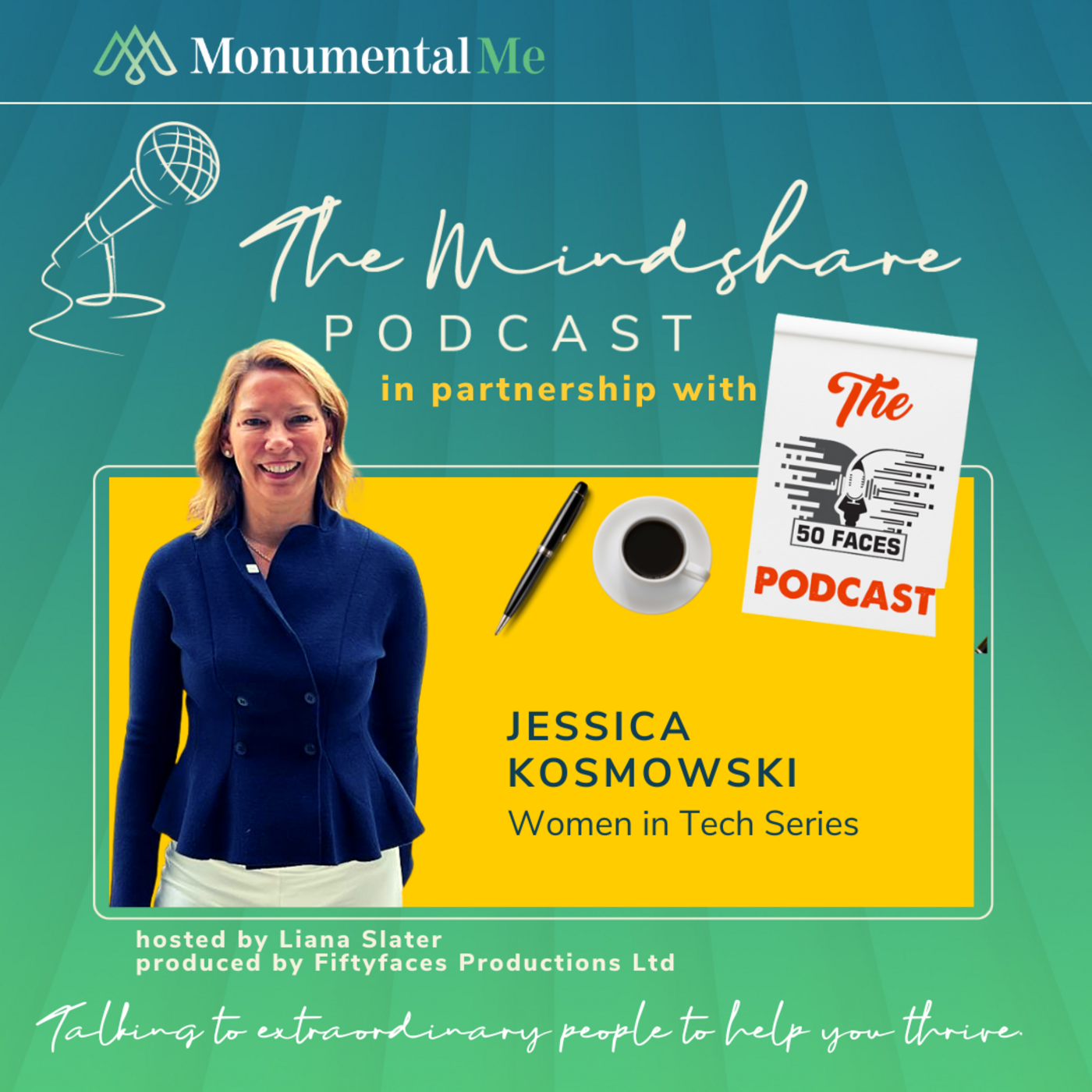
Aoifinn Devitt: This is Leanna Slater from Monumental Me and the Mindshare Podcast. I am thrilled to partner with Aoifinn Devitt and 50 Faces Productions for a new special series, Women in Tech. With women still making up about 33% of employees of major tech firms and 3% of tech startup founders, we are focused on making a difference to get more women into and to thrive in their careers in tech. And it may feel like women’s presence in business is improving, but women Women currently hold only 6% of CEO positions in the S&P 500. This is according to a new report, Women CEOs of the S&P 500 by Catalyst. This is a tiny improvement. In 2018, Harvard Business Review shared that the number of CEOs of US-based companies who were named John outnumbered the total number of women CEOs, which was 5%. So from that perspective, change is stagnant, but there’s so much we can do. Corporate leaders, investors, and education leaders, we need to ask what you’re doing to create more equity in the workplace. And note, we don’t all have to become CEOs. We’re focused on women all along their career trajectory, and there are so many ways to enjoy one’s career and to add to the diversity that makes companies more innovative, competitive, and profitable. And at Monumental Me, we work to help women develop professionally and personally. So we now join 50 Faces production to share stories and real tools for success with this special series, and we We will be speaking with some remarkable people in and around the tech world. We can’t wait to share. Thanks for joining us.
Jessica Kosmowski: This is Leeanna Slater of Monumental Me.
Aoifinn Devitt: Today I’m speaking with Jessica Kosmowski. Jessica is a principal in Deloitte Consulting LLP and lead for Consulting Ecosystems and Alliances practice with a constant focus on the next big thing, which she shares with us today. Previously, Jessica led the technology, media, and telecommunications group at Deloitte. Jessica is recognized as one of the top 25 consultants by Consulting Magazine and is one of the Bay Area’s most influential women in business by San Francisco Business Times. Jessica’s deep experience in relationship building and a passion for connecting people is key to her success, and she explains how her pioneering attitude and always being curious has been her strength in growing her career. Thanks for listening.
Jessica Kosmowski: So Jessica, you are National Managing Principal at Deloitte. You are a mom, a wife, and an excellent friend, and the life of the party. And you’re really a force of nature in your career. So that’s what we’re going to talk about today. And I want to start with you telling us briefly what your focus is at Deloitte, and then we’re going to discuss your insights from your seat at the table where you’re overseeing collaborations with companies and institutions that innovate and shape the future of business tech and global impact initiatives. So yeah, tell us what you’re up to today.
Speaker C: Will do. I love being called the force of nature, so thank you for that. I lead Deloitte’s ecosystem and alliances practice. So what that means is I get to oversee collaborations with some of the largest organizations that are driving change across the world. Companies like Amazon, Google, NVIDIA, SAP, to Workday, together with academic institutions and others. And what Deloitte does with them is we really shape big transformations for our clients and drive huge change together. So that’s what we call it, ecosystems, we put them together, and it’s how we go to market. I’ve been with Deloitte for over 25 years, which I know sounds shocking considering how young I look. Anyway, as you know, I started in San Francisco during the dot-com boom. That’s when you and I spent time here together. And I’ve run everything through to leading what we call our Technology, Media, and Telecom practice, TMT. But during that, I’ve also spent time in Slovenia bringing Silicon Valley-style transformation to another region. And I spent time in our nation’s capital where I led our Deloitte’s federal practice. I have an amazing husband, Eric, who you— that’s how we connected. You guys spent some time together at INSEAD years and years ago. And I’ve got two amazing children. So that’s a little bit about me. Great.
Jessica Kosmowski: All right, as I said, you have this breadth of experience. You are a woman in tech, perfect for this series just on so many levels. Let’s start with how do you define what the tech industry is today? What is the area of focus that excites you in tech today?
Speaker C: Right, well, you’re right, the tech industry is tough to define because tech is pretty much everywhere. So what I’ll talk about is not just the industry, but the trends around it. I always say in today’s times, if you’re not changing, you’re dying. And as a result, you can imagine the tech industry is one that is constantly evolving as technologies like AI and immersive experiences really come into the mainstream together with 5G and cloud and all the things that are enabling it. So we take a look at what’s going on in tech every year. We’ve done it for decades. And we publish what’s called a Tech Trends Report. And it’s usually pretty spot on for what’s happening. We’ll give you a little bit of an insight into what we think is happening in 2023 as we look at the tech industry and tech industries around it. Really, we see 3 trends that are in the here and now. The first is around immersive internet experiences. So think metaverse, VR, AR, and we see that as really coming into its own this year. And being adopted into enterprises like oil and gas, et cetera. The second is around greater trust for AI in business processes. And of course, we wrote this last year before everyone was talking about generative AI, et cetera, et cetera, every moment of the day. But you can imagine that’s an even more important topic as the generative AI trend continues to go viral, let’s call it. And the third is around the simplification of multi-cloud management through MetaCloud. Which of course does sound pretty meta. But basically, it’s about how a family of tools and techniques can come together to simplify a multi-cloud environment through AI, data, security, operations, governance, and beyond. So those 3 things are what we see as the trends for 2023, and what really define where the tech industry is headed.
Jessica Kosmowski: Thank you for that, that summary. That’s super helpful for me, and then also for our audience here who might understand tech, but there’s so much going on right now that that is just a great summary.
Speaker C: Summary.
Jessica Kosmowski: And I know that you recently attended Davos, so I would love to hear about your experience as a guest and a speaker, if you can share what you took home. But first, before you go into that, if you could just quickly define what Davos actually is.
Speaker C: Absolutely. So Davos is a little village in the middle of Switzerland in the Swiss mountains, and what it is is it’s where the World Economic Forum convenes world leaders on a yearly basis. Typically in January. So basically, the kinds of people who come together are business leaders, government leaders, and NGOs, and they come together to talk about the world’s topics. And the topics of the day for 2023 centered around 4 main themes. The first was around the economy and what that means. Of course, it’s not an even conversation based on what country you’re in, so the economy was one. The second was around geopolitical issues, and you can imagine Ukraine was front and center there. The third was around climate and winds that we’re seeing in the climate space and headwinds that we’re seeing. And then the fourth was really around technology innovations and what that means for organizations across the board. And really AI was the center of that. So pretty exciting time, really was a thrill to be able to be a part of the Deloitte delegation that spent time in Davos talking about those topics.
Jessica Kosmowski: All right, well, those are some pretty important and heavy topics, and I want to kind of hone in on speaking about women, specifically women in tech, and how technology affects everybody regardless of your gender. But just as you mentioned, you do focus on gender and inequality and just the future of employment. If you can just tell us some learnings that you took home specifically on that topic.
Speaker C: Well, I’ll start off with saying that I got to kick off the week with an incredible group of women, so Citigroup hosted a city women’s dinner which brought together about 30 people talking about the issues of the day. And I’m grateful for Bridget Fawcett and Ida Lou who invited me to be a part of that. One of the leaders, Emmy Humes, is a renowned documentary filmmaker who just published a book on the only women. It’s called The Only Woman, and it shares 100 pictures and stories of women that there was always a gaggle of men in the room but only one woman in the room. So you can imagine a photo of There’s cowboys with one woman from early in the century through to today with women inventing the vaccine for COVID-19. So it was amazing to get to spend time with her and really hear her talk about each of the photos and how much they touched her. Some brought her joy, some brought her pain, but it was really incredible. So she was there. And then another woman that really touched me was Sayan Bailakh. She’s the current president of Barnard and is soon to be president of Dartmouth. And she talked a lot about the importance of women’s education and really debunked the concept that imposter syndrome isn’t just something that women have, but that we all have. And she talked about her book Choke, and she really talked to all of us about how she’s imploring us as women leaders to think about bringing the 21-year-olds who are exiting college into the workforce and really helping them thrive. So it was a little bit about tech, but it was really about how these women at Davos could really change the world of lots and lots of people around them. So we started there, and it was really interesting to have that call to action to talk about those different things with those ladies. Pretty exciting. The other thing that we spent a lot of time with is the Female Quotient. I don’t know if you know the Female Quotient, but Shelley leads it and is really bringing women together and people to talk about women’s issues around the world. And the one that touched me the most was this panel that’s called Women Taking on the World’s Greatest Challenges panel. Liana, who doesn’t want to be in that room, right? Anyway, so I had that privilege to be in that room while that panel was talking, and it was incredible. It featured 4 incredible women leaders doing inspiring work for the advancement of women and human rights around the globe. So one of them was Irina Nikorek, who is an activist and deputy for the Kyiv City Council, and she shared her story about how she’s uniting the women in Kyiv by turning them into warriors. She talked about the beginning of the war and when the bombs dropped in the early mornings, how that was the very first time and the last time she felt afraid. She’s got young children. I don’t remember, let’s call them 5 or 6. And she was a mother at that time, but she had to pivot because she does lead as a big leader in their city council. She had to pivot to being a citizen and to being a warrior. And so what she did was she said, How am I going to ignite and unite the women of Ukraine to really help fight back? And what’s interesting is women in Ukraine are not traditionally trained as soldiers. And so there’s so many things that they needed to learn. But there is an acute problem that because the women are not soldiers, there’s no uniforms for women. You can imagine that being in uniform is important. Wearing a flak jacket is important. Wearing a bulletproof vest is important. So she founded what’s called Armed Women Now, which is a social initiative to basically bring women warriors of Ukraine army uniforms to really make them as effective as possible and not have to run around in men’s clothes. So they’ve sewed 70,000 sets of women’s uniforms. They’ve created these things and gotten them out there, and they’re really changing the face of that. Another woman who is on that panel is Nazanin Boniadi. You know, you might know her. She’s an Iranian-British actress. And she’s been on Scandal, Homeland, How I Met Your Mother, Lord of the Rings, etc. But she’s also a very powerful woman when it comes to women’s rights. She’s an Amnesty International ambassador, and she talked about standing up for women’s rights in Iran and how that turned into a broader human rights movement just well beyond women’s rights. And she talked about that from a powerful point of reference because, of course, she spent time here in the United States in Britain and in Iran working with the women and bringing it forward. So it was a very powerful session talking about women’s rights and all the things around it. Pretty exciting.
Jessica Kosmowski: That is such an amazing opportunity that you had to meet all of these women, and I just, I love that you’re putting a spotlight on some of them and these inspiring stories. What was one or two things that you could take back to kind of the work that you do and apply it? You’re involved with many different companies and initiatives, but were there one or two things that you really felt like you could come back and apply to the involvement of tech in TEI, and that’s the focus.
Speaker C: Well, so I was— I got to be on a panel with Zoom on hybrid work, and what’s interesting is we talked about how technology is continuing to drive hybrid across all walks of life. You can imagine Zoom, it was able to create a hybrid panel. We had somebody who was Zooming in from afar, and we had a couple of other people on the, on the panel, and what we talked about was the importance of technology and organizations in continuing to drive work that allows people to sort of work where they need to be, and hopefully through that, really bringing more people into the workforce. As we know, during the pandemic, many women were impacted by the pandemic and by the level of work that they had to do at home as well as in the office, and we saw lots of people leave the workforce. So this is a way for us to really think about how we bring women, continuing to bring women and others into the workforce and, and do it in a manner that works for them the best.
Jessica Kosmowski: Great. I love that positive view of it. Were there any kind of red flags too that people should be aware of, like what with AI or anything that you mentioned that might take away from some progress that women have made recently?
Speaker C: I think no one really talked about AI and that being something that’s going to take away from women, but people did talk quite a bit about how we continue to see attrition in the workforce for women and how we want to see what we can do to alleviate that. And so we’ve talked a lot about that as hybrid as being a way to drive that forward and make that into something that we can stop stop that, that flow.
Jessica Kosmowski: I like that. I like that because I’m just amazed today at the flexibility. That was a silver lining that came out of the pandemic. I think we did lose a lot of women from the workforce, but when I look back to my days when I left Google, I needed to just take some time and be at home with my family more. And now it’s like, that’s actually feasible, and women can really grow in their careers and have that flexibility. So I think that that’s a really exciting topic. Okay, in terms of diversity and inclusion, was there any more around not just specifically women, but tech and its involvement in diversity and inclusion?
Speaker C: Yeah, what’s interesting is from a diversity inclusion perspective, if you take a step back Throughout my career, I’ve worked in industries that feature a limited representation of women, and what I’ve done is I’ve always talked about my kids and my family because it humanized me and showed people around me that you can have a life while being a working professional. So that’s something that I’ve always done sort of personally on a day-to-day basis. As you can imagine, as a woman, diversity within the workforce is something that I’ve been wildly committed to, and I’ve always believed that I’ve had the power to create a culture shift. So even as a, a manager at Deloitte, I’ve always felt that I’ve had the power, and I know it’s my responsibility to use my voice and status to speak up for others. What’s interesting is we, like I mentioned, do a lot of work with the Female Quotient, and we believe that to advance gender equality in the tech industry, Deloitte’s really working together with them to drive things forward. This alliance that we’ve got has focused on leading the diversity and inclusion conversation in the tech industry where women and racially and ethnically diverse professionals really are underrepresented. As you well know, you spend time at Google, you spend time in and around tech, and you see it. So together we’ve hosted and created gender equality-focused pop-ups at global conferences like Dreamforce and WEF, etc., to really highlight and bring that topic together and make it shine. What’s interesting is that in terms of women being represented in the tech sector today, We’re seeing, like I said, steady though very slow progress, very slow, especially when it comes to leadership and technical roles. We see people in program management roles and back office roles, but we really aren’t seeing all the traction we’d love to see in the technical side. So from a data perspective, last year, Deloitte Global projected that large global tech companies on average would reach nearly 33% of overall female representation in their workforce But it also predicted that 25% of technical roles and 25.3% of leadership roles would be held by women, which is up a smidge, but not up as much as we would like. So we’re gaining some ground, but it’s happening at a pretty slow rate. We see well-known challenges that we all know about, like the educational pipeline, recruitment, hiring, pay, retention as being an issue. And of course, COVID-19 was another issue. What was interesting is In 2021, we did a women at work study. I led this for our TMT practice. Again, that’s technology, media, and telecom. And we polled 500 women around the world to hear what they were thinking. What we found was that compared to how they felt prior to the crisis, women in the TMT world have experienced dramatic drops in motivation and productivity at work and job satisfaction, which is obviously not fantastic. And we see it even more acute with racially and ethnically diverse people across the TMT space. Is things that we’re trying to work on and we’re trying to push. We’ve seen a little bit of progress, but we need to do a lot more.
Jessica Kosmowski: Yeah, I definitely agree with you on all of that. So it’s interesting, you’ve been to Davos, you have your hands right on the pulse of what’s happening in this industry, and that is as it stands still today. So really useful to hear that. So Jessica, we know the value of diversity in the workforce and, and women at all levels within industries, but do you think there’s a difference in female leadership per se? Do you see an advantage in the, in female leadership, or what are the strengths?
Speaker C: Absolutely. And what’s interesting is it’s not just me and what I feel. Research has proven it. So research has shown that having a gender-diverse board— so it’s interesting, I was talking with Shelley, who leads the Female Quotient. We talked about female-led boards. And so I actually stepped back when I came back to the US to dig into what the actual data shows. So the data shows that having gender-diverse boards and senior leadership is positively correlated with almost everything that you would love to have go up—better financial performance, better employee engagement, better outcomes in ESG. Basically, more women on boards turns your company into a better place. What’s interesting is—I don’t know if you’ve heard about this, but there’s a great example—the Women on Boards Directive, which the European Parliament just passed in November, is going to require require publicly traded companies to have at least 40% of non-executive director posts or a third of all director posts filled by women by 2026. And of course, some were able to adopt it straight away, some are on the journey, but it really is showing that as these companies get more women on their boards, they have better results. And it happens almost out of the gate. It’s pretty incredible. So very exciting. Very exciting stuff. The other thing we’ve learned is that companies that are run by women CEOs have a more balanced board. It’s like 33% than male CEOs, which is around 20%, and those companies are also seeing more acceleration of all things good from the top to the bottom line and employee engagement. So pretty exciting stuff.
Aoifinn Devitt: Excellent.
Jessica Kosmowski: Okay, I’d love to hear that. All right, so change needs to come from the top down, so we all know that, and we need to support and boost women where we can. On the flip side though, how do you think individuals and women can build themselves up in this environment?
Speaker C: To me, women are warriors, taking it from my friend from Kiev. And how we can boost ourselves up is by continuously learning, leaning into reading about what’s going on in today’s world and being curious and diving in, and then talking about it with our friends around us. I love to have conversations with Liana, you, and others to talk about what we’re seeing out there in the world and applications of it because it really helps. These salons help bring ideas together and help us continue to drive forward. So I think continuing to be curious, continue to talk with others about it, continue to find ways to bring it into real applications, I think is a way for women to continue to drive things forward.
Aoifinn Devitt: Excellent.
Speaker C: Love it.
Jessica Kosmowski: And back to focusing on companies and leaders, do you see any leader or specific company that are really kind of a learning organization kind of leading this change in addition to Deloitte?
Speaker C: I mean, so many companies are leading into this change. You see, Citi was a great example, as you know. Yeah, they’ve got a full female leadership stack over there. Pretty exciting. Jane is the CEO and there’s plenty of people around her and they’re driving lots of amazing change. I see it coming across in all walks of life. Of course, Dartmouth is going to be headed by a woman president. Very exciting, very exciting time for them as they look into that, lean into that change. And I do see my tech clients having many more women in leadership positions and driving forward, not just of course in the back office but in the front office as well. And I see that as humanizing them and making them really understand the world’s problems and how they can lean into them. So many organizations I think are seeing great traction and it’s exciting to watch and exciting to be a part of.
Jessica Kosmowski: Exciting to hear too. I love the very practical examples that are out there. It’s definitely inspiring. All right, Jessica, I’m gonna turn this personal. I’m gonna ask you just two questions about yourself. So first, can you just tell me what you think your two main strengths are? That have really driven kind of your success in your career and when you kind of identified those strengths?
Speaker C: Sure. So I would say the two are I’ve got a pioneering mindset and I’m a natural connector. On the pioneering mindset, I’ve always looked around the corner for new possibilities and thought about things that could be done differently and really thought outside of the box. And it’s been exciting because that trait has actually allowed me to really shift and change many organizations through the work that I’ve done at Deloitte. So pretty exciting. And the natural connector— I’ve had a very diverse set of experiences at Deloitte across the globe and across Deloitte, and I’ve found ways to connect people in natural and unnatural ways to ignite new relationships and ignite change. So pioneering mindset is something that has always been a part of me, and a natural connector is something that I’ve leaned into as I’ve been blessed to have many different roles and responsibilities over my time to bring people together. And I think that from a pioneering mindset, one could say that that’s something I’ve had since I was 2. My mother would say that that’s something I’ve always had. And in the connector, I leaned into that early in my career, knowing that I was blessed with many different opportunities and wanted to make sure that I was bringing those relationships to others and to drive those connections forward.
Aoifinn Devitt: Right, love it.
Jessica Kosmowski: And I’m going to surprise you with a question here, which is just kind of my signature question, which I get such Amazing answers from, and, and very simple and poignant answers. So I’m gonna ask you, if you could talk to your 26-year-old self from where you sit today, what would you tell your 26-year-old self?
Speaker C: Be confident, be fierce, and believe in myself. Right. All.
Jessica Kosmowski: Well, Jessica, thank you so much for your time today. This has been really insightful and great to talk to you as always.
Speaker C: Thank you so much for having me and absolute pleasure. This podcast is for informational purposes only and should not be construed as investment advice, and all views are personal and should not be attributed to the organizations and affiliations of the host or any guest.
Aoifinn Devitt: This is Leanna Slater from Monumental Me and the Mindshare Podcast. I am thrilled to partner with Aoifinn Devitt and 50 Faces Productions for a new special series, Women in Tech. With women still making up about 33% of employees of major tech firms and 3% of tech startup founders, we are focused on making a difference to get more women into and to thrive in their careers in tech. And it may feel like women’s presence in business is improving, but women Women currently hold only 6% of CEO positions in the S&P 500. This is according to a new report, Women CEOs of the S&P 500 by Catalyst. This is a tiny improvement. In 2018, Harvard Business Review shared that the number of CEOs of US-based companies who were named John outnumbered the total number of women CEOs, which was 5%. So from that perspective, change is stagnant, but there’s so much we can do. Corporate leaders, investors, and education leaders, we need to ask what you’re doing to create more equity in the workplace. And note, we don’t all have to become CEOs. We’re focused on women all along their career trajectory, and there are so many ways to enjoy one’s career and to add to the diversity that makes companies more innovative, competitive, and profitable. And at Monumental Me, we work to help women develop professionally and personally. So we now join 50 Faces production to share stories and real tools for success with this special series, and we We will be speaking with some remarkable people in and around the tech world. We can’t wait to share. Thanks for joining us.
Jessica Kosmowski: This is Leeanna Slater of Monumental Me.
Aoifinn Devitt: Today I’m speaking with Jessica Kosmowski. Jessica is a principal in Deloitte Consulting LLP and lead for Consulting Ecosystems and Alliances practice with a constant focus on the next big thing, which she shares with us today. Previously, Jessica led the technology, media, and telecommunications group at Deloitte. Jessica is recognized as one of the top 25 consultants by Consulting Magazine and is one of the Bay Area’s most influential women in business by San Francisco Business Times. Jessica’s deep experience in relationship building and a passion for connecting people is key to her success, and she explains how her pioneering attitude and always being curious has been her strength in growing her career. Thanks for listening.
Jessica Kosmowski: So Jessica, you are National Managing Principal at Deloitte. You are a mom, a wife, and an excellent friend, and the life of the party. And you’re really a force of nature in your career. So that’s what we’re going to talk about today. And I want to start with you telling us briefly what your focus is at Deloitte, and then we’re going to discuss your insights from your seat at the table where you’re overseeing collaborations with companies and institutions that innovate and shape the future of business tech and global impact initiatives. So yeah, tell us what you’re up to today.
Speaker C: Will do. I love being called the force of nature, so thank you for that. I lead Deloitte’s ecosystem and alliances practice. So what that means is I get to oversee collaborations with some of the largest organizations that are driving change across the world. Companies like Amazon, Google, NVIDIA, SAP, to Workday, together with academic institutions and others. And what Deloitte does with them is we really shape big transformations for our clients and drive huge change together. So that’s what we call it, ecosystems, we put them together, and it’s how we go to market. I’ve been with Deloitte for over 25 years, which I know sounds shocking considering how young I look. Anyway, as you know, I started in San Francisco during the dot-com boom. That’s when you and I spent time here together. And I’ve run everything through to leading what we call our Technology, Media, and Telecom practice, TMT. But during that, I’ve also spent time in Slovenia bringing Silicon Valley-style transformation to another region. And I spent time in our nation’s capital where I led our Deloitte’s federal practice. I have an amazing husband, Eric, who you— that’s how we connected. You guys spent some time together at INSEAD years and years ago. And I’ve got two amazing children. So that’s a little bit about me. Great.
Jessica Kosmowski: All right, as I said, you have this breadth of experience. You are a woman in tech, perfect for this series just on so many levels. Let’s start with how do you define what the tech industry is today? What is the area of focus that excites you in tech today?
Speaker C: Right, well, you’re right, the tech industry is tough to define because tech is pretty much everywhere. So what I’ll talk about is not just the industry, but the trends around it. I always say in today’s times, if you’re not changing, you’re dying. And as a result, you can imagine the tech industry is one that is constantly evolving as technologies like AI and immersive experiences really come into the mainstream together with 5G and cloud and all the things that are enabling it. So we take a look at what’s going on in tech every year. We’ve done it for decades. And we publish what’s called a Tech Trends Report. And it’s usually pretty spot on for what’s happening. We’ll give you a little bit of an insight into what we think is happening in 2023 as we look at the tech industry and tech industries around it. Really, we see 3 trends that are in the here and now. The first is around immersive internet experiences. So think metaverse, VR, AR, and we see that as really coming into its own this year. And being adopted into enterprises like oil and gas, et cetera. The second is around greater trust for AI in business processes. And of course, we wrote this last year before everyone was talking about generative AI, et cetera, et cetera, every moment of the day. But you can imagine that’s an even more important topic as the generative AI trend continues to go viral, let’s call it. And the third is around the simplification of multi-cloud management through MetaCloud. Which of course does sound pretty meta. But basically, it’s about how a family of tools and techniques can come together to simplify a multi-cloud environment through AI, data, security, operations, governance, and beyond. So those 3 things are what we see as the trends for 2023, and what really define where the tech industry is headed.
Jessica Kosmowski: Thank you for that, that summary. That’s super helpful for me, and then also for our audience here who might understand tech, but there’s so much going on right now that that is just a great summary.
Speaker C: Summary.
Jessica Kosmowski: And I know that you recently attended Davos, so I would love to hear about your experience as a guest and a speaker, if you can share what you took home. But first, before you go into that, if you could just quickly define what Davos actually is.
Speaker C: Absolutely. So Davos is a little village in the middle of Switzerland in the Swiss mountains, and what it is is it’s where the World Economic Forum convenes world leaders on a yearly basis. Typically in January. So basically, the kinds of people who come together are business leaders, government leaders, and NGOs, and they come together to talk about the world’s topics. And the topics of the day for 2023 centered around 4 main themes. The first was around the economy and what that means. Of course, it’s not an even conversation based on what country you’re in, so the economy was one. The second was around geopolitical issues, and you can imagine Ukraine was front and center there. The third was around climate and winds that we’re seeing in the climate space and headwinds that we’re seeing. And then the fourth was really around technology innovations and what that means for organizations across the board. And really AI was the center of that. So pretty exciting time, really was a thrill to be able to be a part of the Deloitte delegation that spent time in Davos talking about those topics.
Jessica Kosmowski: All right, well, those are some pretty important and heavy topics, and I want to kind of hone in on speaking about women, specifically women in tech, and how technology affects everybody regardless of your gender. But just as you mentioned, you do focus on gender and inequality and just the future of employment. If you can just tell us some learnings that you took home specifically on that topic.
Speaker C: Well, I’ll start off with saying that I got to kick off the week with an incredible group of women, so Citigroup hosted a city women’s dinner which brought together about 30 people talking about the issues of the day. And I’m grateful for Bridget Fawcett and Ida Lou who invited me to be a part of that. One of the leaders, Emmy Humes, is a renowned documentary filmmaker who just published a book on the only women. It’s called The Only Woman, and it shares 100 pictures and stories of women that there was always a gaggle of men in the room but only one woman in the room. So you can imagine a photo of There’s cowboys with one woman from early in the century through to today with women inventing the vaccine for COVID-19. So it was amazing to get to spend time with her and really hear her talk about each of the photos and how much they touched her. Some brought her joy, some brought her pain, but it was really incredible. So she was there. And then another woman that really touched me was Sayan Bailakh. She’s the current president of Barnard and is soon to be president of Dartmouth. And she talked a lot about the importance of women’s education and really debunked the concept that imposter syndrome isn’t just something that women have, but that we all have. And she talked about her book Choke, and she really talked to all of us about how she’s imploring us as women leaders to think about bringing the 21-year-olds who are exiting college into the workforce and really helping them thrive. So it was a little bit about tech, but it was really about how these women at Davos could really change the world of lots and lots of people around them. So we started there, and it was really interesting to have that call to action to talk about those different things with those ladies. Pretty exciting. The other thing that we spent a lot of time with is the Female Quotient. I don’t know if you know the Female Quotient, but Shelley leads it and is really bringing women together and people to talk about women’s issues around the world. And the one that touched me the most was this panel that’s called Women Taking on the World’s Greatest Challenges panel. Liana, who doesn’t want to be in that room, right? Anyway, so I had that privilege to be in that room while that panel was talking, and it was incredible. It featured 4 incredible women leaders doing inspiring work for the advancement of women and human rights around the globe. So one of them was Irina Nikorek, who is an activist and deputy for the Kyiv City Council, and she shared her story about how she’s uniting the women in Kyiv by turning them into warriors. She talked about the beginning of the war and when the bombs dropped in the early mornings, how that was the very first time and the last time she felt afraid. She’s got young children. I don’t remember, let’s call them 5 or 6. And she was a mother at that time, but she had to pivot because she does lead as a big leader in their city council. She had to pivot to being a citizen and to being a warrior. And so what she did was she said, How am I going to ignite and unite the women of Ukraine to really help fight back? And what’s interesting is women in Ukraine are not traditionally trained as soldiers. And so there’s so many things that they needed to learn. But there is an acute problem that because the women are not soldiers, there’s no uniforms for women. You can imagine that being in uniform is important. Wearing a flak jacket is important. Wearing a bulletproof vest is important. So she founded what’s called Armed Women Now, which is a social initiative to basically bring women warriors of Ukraine army uniforms to really make them as effective as possible and not have to run around in men’s clothes. So they’ve sewed 70,000 sets of women’s uniforms. They’ve created these things and gotten them out there, and they’re really changing the face of that. Another woman who is on that panel is Nazanin Boniadi. You know, you might know her. She’s an Iranian-British actress. And she’s been on Scandal, Homeland, How I Met Your Mother, Lord of the Rings, etc. But she’s also a very powerful woman when it comes to women’s rights. She’s an Amnesty International ambassador, and she talked about standing up for women’s rights in Iran and how that turned into a broader human rights movement just well beyond women’s rights. And she talked about that from a powerful point of reference because, of course, she spent time here in the United States in Britain and in Iran working with the women and bringing it forward. So it was a very powerful session talking about women’s rights and all the things around it. Pretty exciting.
Jessica Kosmowski: That is such an amazing opportunity that you had to meet all of these women, and I just, I love that you’re putting a spotlight on some of them and these inspiring stories. What was one or two things that you could take back to kind of the work that you do and apply it? You’re involved with many different companies and initiatives, but were there one or two things that you really felt like you could come back and apply to the involvement of tech in TEI, and that’s the focus.
Speaker C: Well, so I was— I got to be on a panel with Zoom on hybrid work, and what’s interesting is we talked about how technology is continuing to drive hybrid across all walks of life. You can imagine Zoom, it was able to create a hybrid panel. We had somebody who was Zooming in from afar, and we had a couple of other people on the, on the panel, and what we talked about was the importance of technology and organizations in continuing to drive work that allows people to sort of work where they need to be, and hopefully through that, really bringing more people into the workforce. As we know, during the pandemic, many women were impacted by the pandemic and by the level of work that they had to do at home as well as in the office, and we saw lots of people leave the workforce. So this is a way for us to really think about how we bring women, continuing to bring women and others into the workforce and, and do it in a manner that works for them the best.
Jessica Kosmowski: Great. I love that positive view of it. Were there any kind of red flags too that people should be aware of, like what with AI or anything that you mentioned that might take away from some progress that women have made recently?
Speaker C: I think no one really talked about AI and that being something that’s going to take away from women, but people did talk quite a bit about how we continue to see attrition in the workforce for women and how we want to see what we can do to alleviate that. And so we’ve talked a lot about that as hybrid as being a way to drive that forward and make that into something that we can stop stop that, that flow.
Jessica Kosmowski: I like that. I like that because I’m just amazed today at the flexibility. That was a silver lining that came out of the pandemic. I think we did lose a lot of women from the workforce, but when I look back to my days when I left Google, I needed to just take some time and be at home with my family more. And now it’s like, that’s actually feasible, and women can really grow in their careers and have that flexibility. So I think that that’s a really exciting topic. Okay, in terms of diversity and inclusion, was there any more around not just specifically women, but tech and its involvement in diversity and inclusion?
Speaker C: Yeah, what’s interesting is from a diversity inclusion perspective, if you take a step back Throughout my career, I’ve worked in industries that feature a limited representation of women, and what I’ve done is I’ve always talked about my kids and my family because it humanized me and showed people around me that you can have a life while being a working professional. So that’s something that I’ve always done sort of personally on a day-to-day basis. As you can imagine, as a woman, diversity within the workforce is something that I’ve been wildly committed to, and I’ve always believed that I’ve had the power to create a culture shift. So even as a, a manager at Deloitte, I’ve always felt that I’ve had the power, and I know it’s my responsibility to use my voice and status to speak up for others. What’s interesting is we, like I mentioned, do a lot of work with the Female Quotient, and we believe that to advance gender equality in the tech industry, Deloitte’s really working together with them to drive things forward. This alliance that we’ve got has focused on leading the diversity and inclusion conversation in the tech industry where women and racially and ethnically diverse professionals really are underrepresented. As you well know, you spend time at Google, you spend time in and around tech, and you see it. So together we’ve hosted and created gender equality-focused pop-ups at global conferences like Dreamforce and WEF, etc., to really highlight and bring that topic together and make it shine. What’s interesting is that in terms of women being represented in the tech sector today, We’re seeing, like I said, steady though very slow progress, very slow, especially when it comes to leadership and technical roles. We see people in program management roles and back office roles, but we really aren’t seeing all the traction we’d love to see in the technical side. So from a data perspective, last year, Deloitte Global projected that large global tech companies on average would reach nearly 33% of overall female representation in their workforce But it also predicted that 25% of technical roles and 25.3% of leadership roles would be held by women, which is up a smidge, but not up as much as we would like. So we’re gaining some ground, but it’s happening at a pretty slow rate. We see well-known challenges that we all know about, like the educational pipeline, recruitment, hiring, pay, retention as being an issue. And of course, COVID-19 was another issue. What was interesting is In 2021, we did a women at work study. I led this for our TMT practice. Again, that’s technology, media, and telecom. And we polled 500 women around the world to hear what they were thinking. What we found was that compared to how they felt prior to the crisis, women in the TMT world have experienced dramatic drops in motivation and productivity at work and job satisfaction, which is obviously not fantastic. And we see it even more acute with racially and ethnically diverse people across the TMT space. Is things that we’re trying to work on and we’re trying to push. We’ve seen a little bit of progress, but we need to do a lot more.
Jessica Kosmowski: Yeah, I definitely agree with you on all of that. So it’s interesting, you’ve been to Davos, you have your hands right on the pulse of what’s happening in this industry, and that is as it stands still today. So really useful to hear that. So Jessica, we know the value of diversity in the workforce and, and women at all levels within industries, but do you think there’s a difference in female leadership per se? Do you see an advantage in the, in female leadership, or what are the strengths?
Speaker C: Absolutely. And what’s interesting is it’s not just me and what I feel. Research has proven it. So research has shown that having a gender-diverse board— so it’s interesting, I was talking with Shelley, who leads the Female Quotient. We talked about female-led boards. And so I actually stepped back when I came back to the US to dig into what the actual data shows. So the data shows that having gender-diverse boards and senior leadership is positively correlated with almost everything that you would love to have go up—better financial performance, better employee engagement, better outcomes in ESG. Basically, more women on boards turns your company into a better place. What’s interesting is—I don’t know if you’ve heard about this, but there’s a great example—the Women on Boards Directive, which the European Parliament just passed in November, is going to require require publicly traded companies to have at least 40% of non-executive director posts or a third of all director posts filled by women by 2026. And of course, some were able to adopt it straight away, some are on the journey, but it really is showing that as these companies get more women on their boards, they have better results. And it happens almost out of the gate. It’s pretty incredible. So very exciting. Very exciting stuff. The other thing we’ve learned is that companies that are run by women CEOs have a more balanced board. It’s like 33% than male CEOs, which is around 20%, and those companies are also seeing more acceleration of all things good from the top to the bottom line and employee engagement. So pretty exciting stuff.
Aoifinn Devitt: Excellent.
Jessica Kosmowski: Okay, I’d love to hear that. All right, so change needs to come from the top down, so we all know that, and we need to support and boost women where we can. On the flip side though, how do you think individuals and women can build themselves up in this environment?
Speaker C: To me, women are warriors, taking it from my friend from Kiev. And how we can boost ourselves up is by continuously learning, leaning into reading about what’s going on in today’s world and being curious and diving in, and then talking about it with our friends around us. I love to have conversations with Liana, you, and others to talk about what we’re seeing out there in the world and applications of it because it really helps. These salons help bring ideas together and help us continue to drive forward. So I think continuing to be curious, continue to talk with others about it, continue to find ways to bring it into real applications, I think is a way for women to continue to drive things forward.
Aoifinn Devitt: Excellent.
Speaker C: Love it.
Jessica Kosmowski: And back to focusing on companies and leaders, do you see any leader or specific company that are really kind of a learning organization kind of leading this change in addition to Deloitte?
Speaker C: I mean, so many companies are leading into this change. You see, Citi was a great example, as you know. Yeah, they’ve got a full female leadership stack over there. Pretty exciting. Jane is the CEO and there’s plenty of people around her and they’re driving lots of amazing change. I see it coming across in all walks of life. Of course, Dartmouth is going to be headed by a woman president. Very exciting, very exciting time for them as they look into that, lean into that change. And I do see my tech clients having many more women in leadership positions and driving forward, not just of course in the back office but in the front office as well. And I see that as humanizing them and making them really understand the world’s problems and how they can lean into them. So many organizations I think are seeing great traction and it’s exciting to watch and exciting to be a part of.
Jessica Kosmowski: Exciting to hear too. I love the very practical examples that are out there. It’s definitely inspiring. All right, Jessica, I’m gonna turn this personal. I’m gonna ask you just two questions about yourself. So first, can you just tell me what you think your two main strengths are? That have really driven kind of your success in your career and when you kind of identified those strengths?
Speaker C: Sure. So I would say the two are I’ve got a pioneering mindset and I’m a natural connector. On the pioneering mindset, I’ve always looked around the corner for new possibilities and thought about things that could be done differently and really thought outside of the box. And it’s been exciting because that trait has actually allowed me to really shift and change many organizations through the work that I’ve done at Deloitte. So pretty exciting. And the natural connector— I’ve had a very diverse set of experiences at Deloitte across the globe and across Deloitte, and I’ve found ways to connect people in natural and unnatural ways to ignite new relationships and ignite change. So pioneering mindset is something that has always been a part of me, and a natural connector is something that I’ve leaned into as I’ve been blessed to have many different roles and responsibilities over my time to bring people together. And I think that from a pioneering mindset, one could say that that’s something I’ve had since I was 2. My mother would say that that’s something I’ve always had. And in the connector, I leaned into that early in my career, knowing that I was blessed with many different opportunities and wanted to make sure that I was bringing those relationships to others and to drive those connections forward.
Aoifinn Devitt: Right, love it.
Jessica Kosmowski: And I’m going to surprise you with a question here, which is just kind of my signature question, which I get such Amazing answers from, and, and very simple and poignant answers. So I’m gonna ask you, if you could talk to your 26-year-old self from where you sit today, what would you tell your 26-year-old self?
Speaker C: Be confident, be fierce, and believe in myself. Right. All.
Jessica Kosmowski: Well, Jessica, thank you so much for your time today. This has been really insightful and great to talk to you as always.
Speaker C: Thank you so much for having me and absolute pleasure. This podcast is for informational purposes only and should not be construed as investment advice, and all views are personal and should not be attributed to the organizations and affiliations of the host or any guest.