Aoifinn Devitt: For me to excel in life, I need to understand where I’m coming from. I need to understand where I am right now. I need to understand where I’m going to.
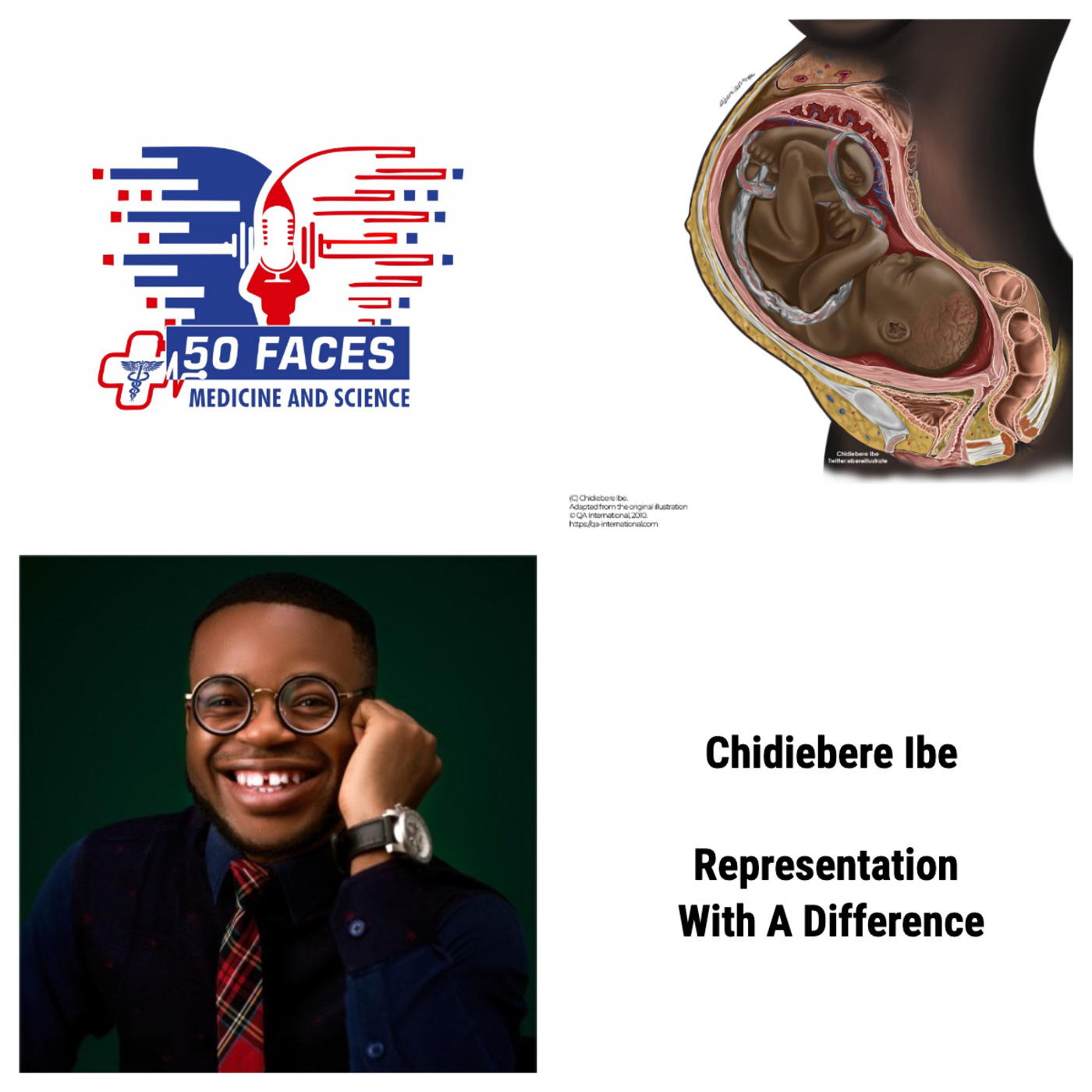
Fiftyfaces Focus Medicine and Science: Next guest grew up in rural Nigeria and became a self-taught medical illustrator while he applied to medical school. Find out how one of his drawings of a Black pregnant woman with a Black fetus in utero went viral, gaining the attention of Forbes and CNN. Find out also what this taught us about representation bias, and missing voices in the practice of medicine. I’m Aoifinn Devitt, and welcome to the 50 Faces Focus Podcast, in which we showcase inspiring voices in the fields of medicine, science, and beyond. I’m joined today by Titia Bera-Ibe, who is a medical student and Forbes-featured medical illustrator whose illustration of a Black fetus in utero went viral in December 2021. Many commentators said that this was the first time that they had seen a depiction of a dark-skinned fetus, a pregnant woman, and provoked a discussion about the lack of representation of such images in textbooks and journals. Titi Aberra has a bachelor’s degree in chemistry from the University of Uyo in Nigeria and is the chief medical illustrator at the Journal of Global Neurosurgery. He holds numerous roles on various committees relating to medical education. Welcome, Titi Aberra. Thank you for joining me today.
Aoifinn Devitt: Thank you so much, Efren, for having me. It’s a pleasure being here.
Fiftyfaces Focus Medicine and Science: Well, let’s talk about your background and career journey. Can you tell us about your background, where you were born, what you studied initially, and how your interest in medicine and medical illustration started?
Aoifinn Devitt: All right. Thank you. I was actually born and raised in Nigeria, in Akwa Ibom State to be precise. I’m from a family of 4, with 3 siblings, including me, making it 4. Born to the family, raised by my parents. My father, mother, and I. I mean, some years ago, at 11, I lost my mom to ovarian cancer. So I was actually raised by a single parent, by my father. Then while growing up, I mean, I’ve stayed all my life, I’ve been in Nigeria growing up as a young person trying to improve myself, trying to be a better version of myself, trying to learn skills. So it was pretty rough for us as people, as Nigerians, or as my family generally, we barely had money to eat food, barely had breakfast or dinner. And because of such situations like that, I had to learn a lot of skills. I had to become a baker, I had to become a car mechanic to learn and grow. In the process of becoming all of that, I realized that I was— I was creative. I realized I was artistic, so I had to learn how to work. I taught myself how to draw, how to use pencil and pen to draw. Until fast forward to 2020, I mean, before then I ventured into a couple of great work like photography, videography, animations, and a whole lot of creative processes. Then I became a medical illustrator in 2020 during the lockdown, and before then I was a medical student, so I had to teach myself the little anatomy that I knew then. And that’s how I evolved. I started learning illustration, teaching myself the software I used for illustration. And basic medical terms, basic medical codings. And that’s how I evolved from being a mere graphic designer or an artist to being a medical illustrator. So it’s been an amazing process going from that little background to where I’m right now.
Fiftyfaces Focus Medicine and Science: That’s amazing. So essentially you’re self-taught in the field of medical illustration. You didn’t take lessons there.
Aoifinn Devitt: No, I didn’t take any lessons anywhere.
Fiftyfaces Focus Medicine and Science: That’s extraordinary. So obviously to date there have been quite many highs and lows. You mentioned that having to have many different sources of training. Were there any particular lessons that those early challenging years taught you?
Aoifinn Devitt: Yes, actually, those years taught me a whole lot of things, a whole lot of lessons of life, I would say. Endurance, perseverance, not giving up, because for me, I applied to medical school For about 10 years, I kept applying to medical school, and I wasn’t admitted into medical school. And I had reasons to give up my dreams, but I just kept on pushing. Family actually said, I mean, that you’re all alone in the journey to become a medical student and become a doctor. So in the process of being alone, pursuing my dream, I learned resilience. I learned lessons about life, that life actually gives what you place a demand on and not what you deserve. So I had to place demand on life to give me the opportunities that I deserve. So I had to work hard, I had to put in the effort, I had to trust God, I had to learn skills, I had to be a better person every day. And I think this lesson that I learned in the process of struggling— because while I was an illustrator, I was every day while I was learning about 2020, I was making a 1-hour travel from my house to my church where I could get power supply because I lived in a very remote area. In Nigeria where there was no power supply. So I would make a 1-hour travel from my house to church every day to get power supply where I could charge my laptop and learn illustrations. So that’s just, just process taught me a lot of lessons about life, a lot of mental resilience, a lot of lessons to always strive for self-improvement. Because for me, one of the most important things I learned was that we cannot give the world what we don’t have. And that’s why I realized that for me to be a great person, for me to be an impact to my world, I need to build that virtue inside of me so that I’ll be able to give that virtue to the world. So those years of training, those years of difficulty were the moment that I built virtues and value that will make me a person of interest to the world. So those are the lessons I actually learned from the process of being an illustrator.
Fiftyfaces Focus Medicine and Science: And then to look at the impact you’ve had in the last few years is really extraordinary. Let’s move now to talk about that drawing, and we will put that drawing— I say that drawing, I know you’ve done many, because it was that drawing of the fetus in utero that went viral and attracted so much attention. Can you tell us about what motivated you to produce that first image that went viral? And had you seen any other representations of Black skin, Black fetus in that way?
Aoifinn Devitt: Actually, I created that drawing in November, shortly after I went to the embassy to apply for a visa to Ukraine, which I was— of course, I was denied a visa. So I was sad, but I realized I needed to draw. I needed to speak out with my illustrations. So I remember the day I created that artwork, I was in contemplation between what artwork to create because I was actually deciding, should I create a full anatomy illustration or I should create a particular Black features illustration? And the motive behind creating that was that I realized that most images in a medical textbook didn’t have Black people, right? Particularly, I didn’t create the image to become famous because of course I didn’t know people can get famous for creating illustrations. So the idea behind that was that it was a tool for advocacy, to advocate, because when I, when I posted the artwork on social media, all I said was, I am Black and I’m beautiful, and more of this should be included in medical literature. That was all I actually attributed to that post. And before then, I was actually crowdfunding. I was raising funds for medical school. So luckily, I just had to put my GoFundMe link there, and it’s amazing how the donation came in. But when I shared that online, people started sharing, people started saying they haven’t seen it before in their entire life. And then I understood that this artwork was not just about— was not just a medical illustration, was a tool of advocacy, was actually a piece of art that resonated among the Black community, where Black women were not given equal healthcare attention simply because they were Black. And that image was a powerful image, powerful tool to speak up for the Black community. But before now, I had seen a couple of images of Black women, illustration rather, of Black mothers carrying a fetus. But the unique thing about my work was that the fetus was actually Black. Most of the images I see could be a Black mother, but the fetus is in white, which could be pink, right? But I particularly said I was going to make my features Black. And for me, that actually raised a lot of and comments, just showed me that our features are actually Black, our features actually do have coloration in the womb. So for me, that was the unique thing about my work. And I think that’s the iconic thing about the work because I actually was deliberate about making sure that the fetus was Black inasmuch as the mother was Black to talk about proper representation. So that was actually the motive behind creating that illustration.
Fiftyfaces Focus Medicine and Science: Really fascinating. If you were to look at maybe the gap of representation when you were building your medical illustration career and looking at other illustrations and textbooks, or if you look at the standard textbooks today, what percentage would you say of those images are representing females or representing people of color more generally?
Aoifinn Devitt: Yes, so first of all, research was carried out at the University of Pennsylvania, and it stated that less than 5% of images show Black people, people of Black descent, Black people in medical textbooks. And I think it’s had a lesser percentage showing the showing other people of color like the Hispanic or the Asians. Statistically, it was a very sad number. And from this number, from the less than 5%, the images that were shown of Black people were images of Black people that were with infectious diseases like HIV, like marasmus, like kwashiorkor, which was representing Africa in a different perspective. Which of course, when you consider conditions like kwashiorkor, it actually has a greater number of Statistically, it actually affects a good number of population in Asia also. But yet the images we see in our textbooks just show Black people also. And also in terms of sex and gender, the research I read, I’m not particularly sure of the statistic right now, but statistics show that men were actually used as models in terms of illustration compared to women. And it was a problem because it didn’t talk about proper representation, because when we talk about representation, it’s not just about the race or ethnicity, it’s about the gender also. And that’s why most of my images are focused on diseases or infections that affect women, women also, and children also. So not much has been done in terms of creating a balance between how different sectors have been represented, and that’s why I think there’s lack of representation in that regard. So statistically, I’m not sure of the number, but I know that there is little representation of women in our medical literature.
Fiftyfaces Focus Medicine and Science: And it’s more than just the representation and the actual image too, right? It’s about the anchoring and the bias that occurs then, not only in terms of how medicine is practiced, that we don’t see perhaps how certain diseases manifest in women, say, or how maybe certain diseases manifest on Black skin. It’s also a broader issue, say, of people studying medicine seeing themselves reflected in the books, and also anyone studying medicine thinking of a broader kind of patient type. What kind of broader discussions have some of the reactions generated to your work?
Aoifinn Devitt: Well, one of the most important reactions is that people are now very confident to talk about their personal biases, right? Because before now, people were scared, I would say, of going public and talking about how they face bias from their physician. But after this image went viral, a lot of people of color actually felt more confident in speaking of their story. Because I think before now, people were not actually aware that there’s a factor called systemic racism. People were not actually conscious of the bias that was going on in the system. That’s because people were not talking about it. People didn’t have the courage to confront bias head-on. And that’s why it had roomed around for a long time. So one of the impacts this work actually created was that people would now understand, people were now seeing that, yes, there is a factor, there is an issue like systemic racism, there is an issue like bias in medicine, there’s an issue around healthcare disparities among the people of color. And this not just created awareness, it also created a workforce, also created an effort or a synergy where people came together and said, we have to deliberately address this injustice we see. We don’t have to be Black, we don’t have to be the people of color to address this, but we have to put in our efforts to see how we can advocate for the minority group. So it actually created a system where people came together, where people synergized. I mean, I had artists who literally changed their existing artwork that we wiped into Black, and the art community were not deliberate about Making images that represent people of color, I mean, that’s the change you always want to see, and it’s already happening already, and that’s the greatest impact that we wanted to see. And I can tell you with all amount of tenacity that in the nearest future, that there will be an increasing statistical, I would say, number in terms of images that we see in our medical literature, because now people are aware that in medical literature, these images were not very representative, and now there should be an effort to improve representation. So the workforce is increasing, people are coming together to educate people also, educate the the healthcare workforce, and also not just educating but also lending their voice to advocate for the minority groups. So I think it’s an amazing impact that is happening, and I can’t wait for what the future holds for we as advocates for this change.
Fiftyfaces Focus Medicine and Science: Now, it’s an extraordinary process that you’ve initiated some of this discussion, and the fact that it hasn’t been happening before is really what’s quite amazing. But the fact that your viral drawing kickstarted this at levels like Forbes CNN, that I think is just illustrative of how lacking that type of a contribution was. So of course, since this drawing went viral, you yourself have seen your own profile elevated and you’ve done a TEDx talk, I think at least one. I know you’ve done one. You may have done many. What was the topic of that and what kind of reaction did you get to that?
Aoifinn Devitt: Yeah, so I actually did a TEDx talk in Switzerland, Geneva in March. It was centered around how diversity in medical professions can improve our healthcare outcomes. And for me, people ask me, how can, I mean, creating diverse images improve our healthcare outcome? There are a lot of ways you can improve our healthcare outcome, and that was the center of my talk. So what I was discussing was my process to how I take those decisions and how the variation in skin tone and how the skin color, how our skin color, how our race and ethnicity, not how, but why, our skin color should affect how we receive healthcare attention. So those were the center points around my talk. So I actually talked about how we as Black people, we are devalued and disrespected simply because we are not represented enough. And how a lot of patients were misdiagnosed simply because the physician had no prior experience or had no formal training to diagnose some skin conditions. On Black people. So this was the crux of my conversation, of my TEDx talk, and it was an elaborate one. So what I would advise people to just go watch it on YouTube because there is so much we actually talked about there.
Fiftyfaces Focus Medicine and Science: Now let’s return to some personal reflections now. So you mentioned applying to medical school, unfortunately in Ukraine, where obviously events overtook you and perhaps starting that program. What is the next chapter for you now? What lies ahead the next few years?
Aoifinn Devitt: Well, for me, a lot of persons have asked me, now you’re a famous illustrator, do you want to go to medical school? I mean, because for me, medicine has been a passion, and I don’t think being famous would actually deter me from pursuing my dreams as a medical doctor. So currently I’m reapplying to other medical schools. Hopefully by next year I should be resuming medical school again. And for me, I want to be a community doctor. Where we go to communities, we educate, we take the healthcare service to the local community and see how we can better their life and improve their life. For me, I think this is how my life is going to be centered around because I feel that’s where I feel fulfilled, I have more impact. And I also want to see how we can— from my, from my perspective, near future, I’m going to open on a couple of projects and big projects and publications. I’m actually writing my own book, right? Hopefully very soon it should be out and of course made public. And for me, one of the things I want to do in the future is to impact young people, because for me the future lies in the hands of young people. And most young people are not actually aware of what they think they want to do, are not aware of the problems they could solve, they are not aware of themselves generally. So as a young person who have conquered my environment, who have conquered those obscurities, who have conquered difficult times and able to use limited resources to achieve greatness, I think I’m in a good position to mentor young people also. So I currently started an initiative, an NGO called Championing Change, where we gather young people. We have our first launch in October where we are gathering young people, over 300 Nigerians, and training them and educating them and mentoring them about being change agents. So for me, this is the current project I’m working on. In the near future, we’re looking towards training other medical illustrators, which we’ve already started, but it’s an internal process. We’ll make it public very soon and see how we can mobilize and train more makers, because I think that’s also a strategy to creating more diverse images. So those are the projects I’m working on, those are my plans for the near future, and they are massive, they are big, and they are also very scary.
Fiftyfaces Focus Medicine and Science: Well, we’ll definitely put some hyperlinks to that in the show notes because that sounds like an extraordinary initiative. When you look back at your career so far, your progress you’ve made, were there any key people or mentors to you along there, or anyone who influenced you along the way?
Aoifinn Devitt: Yes, first of all, I have a lot of influences. I mean, I’m a Christian, so I’m going to talk about my faith of how God have helped me through the journey. It’s been really, really difficult, but I keep faith, I kept pushing. So I would thank God first for that. Before then, I also, because my late mom has been an amazing impact in my life. She raised me up the right way, the right moral, right lessons of life. So she’s my mentor also. And I also want to give, I mean, I cannot say that I can’t— I mean, my mentor, Dr. Oric Sidney, he was the one that actually suggested, why not go into medical illustration? Because you’re artistic and you have passion for medicine, why not go into illustrations? So then I actually started illustration. So I have a lot of mentors, Dr. Oric Sidney, Dr. Ignatius Esseni. They’ve been amazing. They’ve always given me opportunities to grow. Professor Kipark has been an amazing mentor, always helping me through, always being a good referee to me. And I’ve had a lot of mentors who have helped me through my siblings and family. So it’s just been amazing to me.
Fiftyfaces Focus Medicine and Science: And when you look back at the advice these mentors have given you, or your Christian faith, there are other people who’ve influenced you. Was there any advice that you care to share here, or any creed or motto that guides you through life?
Aoifinn Devitt: Yes. So one of the lessons I’ve learned generally in— among— I mean, there’s been a unique lesson among was my mentor. It’s actually a three-phase process which actually says that for me to excel in life, I need to understand where I’m coming from, I need to understand where I am right now, I need to understand where I’m going to. So my mentors always, I mean, directly and indirectly, their advice always centered around this understanding where I came from, that I came from a more disadvantaged background where things wasn’t right. And I know that nobody owed me anything, but I owed myself my destiny, my future to achieve. So understanding that molded me to learning some things, and understanding where I am right now was actually a measure to checkmate that more can be done, that there’s room for improvement, that you don’t have to grow and become a better person. And also understanding where I’m going to was also a measure to check pride, to always stay humble, to always have the right connections, to always understand that wherever you’re going to, it also has a factor of good friendship, of good connection that we built. So with these 3 keys through mentorship, I understood that these are the things that guided me through my journey. These are the things that always keep guiding me through this journey of not just illustration, but generally journey of excellence. And I think it’s very applicable to every other person.
Fiftyfaces Focus Medicine and Science: Well, that is a beautiful place to bring our conversation to a close. The introspection and humility intrinsic in that statement is something that I will reflect on And Tidiabara, I have enjoyed the beauty of your illustrations from all the way across the Atlantic. And I think that anyone will do well to just study just how beautiful works of art they are in their own right. And they’re important works of art as well because they force us to think, they force us to see what we’re missing. And hopefully that conversation will force us to see the people we’re missing, not only practicing medicine, but also in the patient body, in who we think about when we develop the craft.. And I feel so privileged to have spoken with you today, and I think we are so lucky to have you as a force in the world of not just illustration, but medicine soon. Thank you for coming here, for the work you’re doing, and for sharing your insights with us.
Aoifinn Devitt: Thank you, Ifeoma. Thank you for having me. It’s been a great pleasure conversing with you today. I really hope that this message goes out to the world and people see the need to join the workforce. Thank you.
Fiftyfaces Focus Medicine and Science: I’m Ifeoma David. Thank you for listening to the 50 Faces Focus Podcast. If you liked what you heard and would like to tune in to hear more inspiring people and their personal journeys, please subscribe on Apple Podcasts or wherever you get your podcasts. This podcast is for informational purposes only and should not be construed as investment advice, and all views are personal and should not be attributed to the organizations and affiliations of the host or any guest.
Aoifinn Devitt: For me to excel in life, I need to understand where I’m coming from. I need to understand where I am right now. I need to understand where I’m going to.
Fiftyfaces Focus Medicine and Science: Next guest grew up in rural Nigeria and became a self-taught medical illustrator while he applied to medical school. Find out how one of his drawings of a Black pregnant woman with a Black fetus in utero went viral, gaining the attention of Forbes and CNN. Find out also what this taught us about representation bias, and missing voices in the practice of medicine. I’m Aoifinn Devitt, and welcome to the 50 Faces Focus Podcast, in which we showcase inspiring voices in the fields of medicine, science, and beyond. I’m joined today by Titia Bera-Ibe, who is a medical student and Forbes-featured medical illustrator whose illustration of a Black fetus in utero went viral in December 2021. Many commentators said that this was the first time that they had seen a depiction of a dark-skinned fetus, a pregnant woman, and provoked a discussion about the lack of representation of such images in textbooks and journals. Titi Aberra has a bachelor’s degree in chemistry from the University of Uyo in Nigeria and is the chief medical illustrator at the Journal of Global Neurosurgery. He holds numerous roles on various committees relating to medical education. Welcome, Titi Aberra. Thank you for joining me today.
Aoifinn Devitt: Thank you so much, Efren, for having me. It’s a pleasure being here.
Fiftyfaces Focus Medicine and Science: Well, let’s talk about your background and career journey. Can you tell us about your background, where you were born, what you studied initially, and how your interest in medicine and medical illustration started?
Aoifinn Devitt: All right. Thank you. I was actually born and raised in Nigeria, in Akwa Ibom State to be precise. I’m from a family of 4, with 3 siblings, including me, making it 4. Born to the family, raised by my parents. My father, mother, and I. I mean, some years ago, at 11, I lost my mom to ovarian cancer. So I was actually raised by a single parent, by my father. Then while growing up, I mean, I’ve stayed all my life, I’ve been in Nigeria growing up as a young person trying to improve myself, trying to be a better version of myself, trying to learn skills. So it was pretty rough for us as people, as Nigerians, or as my family generally, we barely had money to eat food, barely had breakfast or dinner. And because of such situations like that, I had to learn a lot of skills. I had to become a baker, I had to become a car mechanic to learn and grow. In the process of becoming all of that, I realized that I was— I was creative. I realized I was artistic, so I had to learn how to work. I taught myself how to draw, how to use pencil and pen to draw. Until fast forward to 2020, I mean, before then I ventured into a couple of great work like photography, videography, animations, and a whole lot of creative processes. Then I became a medical illustrator in 2020 during the lockdown, and before then I was a medical student, so I had to teach myself the little anatomy that I knew then. And that’s how I evolved. I started learning illustration, teaching myself the software I used for illustration. And basic medical terms, basic medical codings. And that’s how I evolved from being a mere graphic designer or an artist to being a medical illustrator. So it’s been an amazing process going from that little background to where I’m right now.
Fiftyfaces Focus Medicine and Science: That’s amazing. So essentially you’re self-taught in the field of medical illustration. You didn’t take lessons there.
Aoifinn Devitt: No, I didn’t take any lessons anywhere.
Fiftyfaces Focus Medicine and Science: That’s extraordinary. So obviously to date there have been quite many highs and lows. You mentioned that having to have many different sources of training. Were there any particular lessons that those early challenging years taught you?
Aoifinn Devitt: Yes, actually, those years taught me a whole lot of things, a whole lot of lessons of life, I would say. Endurance, perseverance, not giving up, because for me, I applied to medical school For about 10 years, I kept applying to medical school, and I wasn’t admitted into medical school. And I had reasons to give up my dreams, but I just kept on pushing. Family actually said, I mean, that you’re all alone in the journey to become a medical student and become a doctor. So in the process of being alone, pursuing my dream, I learned resilience. I learned lessons about life, that life actually gives what you place a demand on and not what you deserve. So I had to place demand on life to give me the opportunities that I deserve. So I had to work hard, I had to put in the effort, I had to trust God, I had to learn skills, I had to be a better person every day. And I think this lesson that I learned in the process of struggling— because while I was an illustrator, I was every day while I was learning about 2020, I was making a 1-hour travel from my house to my church where I could get power supply because I lived in a very remote area. In Nigeria where there was no power supply. So I would make a 1-hour travel from my house to church every day to get power supply where I could charge my laptop and learn illustrations. So that’s just, just process taught me a lot of lessons about life, a lot of mental resilience, a lot of lessons to always strive for self-improvement. Because for me, one of the most important things I learned was that we cannot give the world what we don’t have. And that’s why I realized that for me to be a great person, for me to be an impact to my world, I need to build that virtue inside of me so that I’ll be able to give that virtue to the world. So those years of training, those years of difficulty were the moment that I built virtues and value that will make me a person of interest to the world. So those are the lessons I actually learned from the process of being an illustrator.
Fiftyfaces Focus Medicine and Science: And then to look at the impact you’ve had in the last few years is really extraordinary. Let’s move now to talk about that drawing, and we will put that drawing— I say that drawing, I know you’ve done many, because it was that drawing of the fetus in utero that went viral and attracted so much attention. Can you tell us about what motivated you to produce that first image that went viral? And had you seen any other representations of Black skin, Black fetus in that way?
Aoifinn Devitt: Actually, I created that drawing in November, shortly after I went to the embassy to apply for a visa to Ukraine, which I was— of course, I was denied a visa. So I was sad, but I realized I needed to draw. I needed to speak out with my illustrations. So I remember the day I created that artwork, I was in contemplation between what artwork to create because I was actually deciding, should I create a full anatomy illustration or I should create a particular Black features illustration? And the motive behind creating that was that I realized that most images in a medical textbook didn’t have Black people, right? Particularly, I didn’t create the image to become famous because of course I didn’t know people can get famous for creating illustrations. So the idea behind that was that it was a tool for advocacy, to advocate, because when I, when I posted the artwork on social media, all I said was, I am Black and I’m beautiful, and more of this should be included in medical literature. That was all I actually attributed to that post. And before then, I was actually crowdfunding. I was raising funds for medical school. So luckily, I just had to put my GoFundMe link there, and it’s amazing how the donation came in. But when I shared that online, people started sharing, people started saying they haven’t seen it before in their entire life. And then I understood that this artwork was not just about— was not just a medical illustration, was a tool of advocacy, was actually a piece of art that resonated among the Black community, where Black women were not given equal healthcare attention simply because they were Black. And that image was a powerful image, powerful tool to speak up for the Black community. But before now, I had seen a couple of images of Black women, illustration rather, of Black mothers carrying a fetus. But the unique thing about my work was that the fetus was actually Black. Most of the images I see could be a Black mother, but the fetus is in white, which could be pink, right? But I particularly said I was going to make my features Black. And for me, that actually raised a lot of and comments, just showed me that our features are actually Black, our features actually do have coloration in the womb. So for me, that was the unique thing about my work. And I think that’s the iconic thing about the work because I actually was deliberate about making sure that the fetus was Black inasmuch as the mother was Black to talk about proper representation. So that was actually the motive behind creating that illustration.
Fiftyfaces Focus Medicine and Science: Really fascinating. If you were to look at maybe the gap of representation when you were building your medical illustration career and looking at other illustrations and textbooks, or if you look at the standard textbooks today, what percentage would you say of those images are representing females or representing people of color more generally?
Aoifinn Devitt: Yes, so first of all, research was carried out at the University of Pennsylvania, and it stated that less than 5% of images show Black people, people of Black descent, Black people in medical textbooks. And I think it’s had a lesser percentage showing the showing other people of color like the Hispanic or the Asians. Statistically, it was a very sad number. And from this number, from the less than 5%, the images that were shown of Black people were images of Black people that were with infectious diseases like HIV, like marasmus, like kwashiorkor, which was representing Africa in a different perspective. Which of course, when you consider conditions like kwashiorkor, it actually has a greater number of Statistically, it actually affects a good number of population in Asia also. But yet the images we see in our textbooks just show Black people also. And also in terms of sex and gender, the research I read, I’m not particularly sure of the statistic right now, but statistics show that men were actually used as models in terms of illustration compared to women. And it was a problem because it didn’t talk about proper representation, because when we talk about representation, it’s not just about the race or ethnicity, it’s about the gender also. And that’s why most of my images are focused on diseases or infections that affect women, women also, and children also. So not much has been done in terms of creating a balance between how different sectors have been represented, and that’s why I think there’s lack of representation in that regard. So statistically, I’m not sure of the number, but I know that there is little representation of women in our medical literature.
Fiftyfaces Focus Medicine and Science: And it’s more than just the representation and the actual image too, right? It’s about the anchoring and the bias that occurs then, not only in terms of how medicine is practiced, that we don’t see perhaps how certain diseases manifest in women, say, or how maybe certain diseases manifest on Black skin. It’s also a broader issue, say, of people studying medicine seeing themselves reflected in the books, and also anyone studying medicine thinking of a broader kind of patient type. What kind of broader discussions have some of the reactions generated to your work?
Aoifinn Devitt: Well, one of the most important reactions is that people are now very confident to talk about their personal biases, right? Because before now, people were scared, I would say, of going public and talking about how they face bias from their physician. But after this image went viral, a lot of people of color actually felt more confident in speaking of their story. Because I think before now, people were not actually aware that there’s a factor called systemic racism. People were not actually conscious of the bias that was going on in the system. That’s because people were not talking about it. People didn’t have the courage to confront bias head-on. And that’s why it had roomed around for a long time. So one of the impacts this work actually created was that people would now understand, people were now seeing that, yes, there is a factor, there is an issue like systemic racism, there is an issue like bias in medicine, there’s an issue around healthcare disparities among the people of color. And this not just created awareness, it also created a workforce, also created an effort or a synergy where people came together and said, we have to deliberately address this injustice we see. We don’t have to be Black, we don’t have to be the people of color to address this, but we have to put in our efforts to see how we can advocate for the minority group. So it actually created a system where people came together, where people synergized. I mean, I had artists who literally changed their existing artwork that we wiped into Black, and the art community were not deliberate about Making images that represent people of color, I mean, that’s the change you always want to see, and it’s already happening already, and that’s the greatest impact that we wanted to see. And I can tell you with all amount of tenacity that in the nearest future, that there will be an increasing statistical, I would say, number in terms of images that we see in our medical literature, because now people are aware that in medical literature, these images were not very representative, and now there should be an effort to improve representation. So the workforce is increasing, people are coming together to educate people also, educate the the healthcare workforce, and also not just educating but also lending their voice to advocate for the minority groups. So I think it’s an amazing impact that is happening, and I can’t wait for what the future holds for we as advocates for this change.
Fiftyfaces Focus Medicine and Science: Now, it’s an extraordinary process that you’ve initiated some of this discussion, and the fact that it hasn’t been happening before is really what’s quite amazing. But the fact that your viral drawing kickstarted this at levels like Forbes CNN, that I think is just illustrative of how lacking that type of a contribution was. So of course, since this drawing went viral, you yourself have seen your own profile elevated and you’ve done a TEDx talk, I think at least one. I know you’ve done one. You may have done many. What was the topic of that and what kind of reaction did you get to that?
Aoifinn Devitt: Yeah, so I actually did a TEDx talk in Switzerland, Geneva in March. It was centered around how diversity in medical professions can improve our healthcare outcomes. And for me, people ask me, how can, I mean, creating diverse images improve our healthcare outcome? There are a lot of ways you can improve our healthcare outcome, and that was the center of my talk. So what I was discussing was my process to how I take those decisions and how the variation in skin tone and how the skin color, how our skin color, how our race and ethnicity, not how, but why, our skin color should affect how we receive healthcare attention. So those were the center points around my talk. So I actually talked about how we as Black people, we are devalued and disrespected simply because we are not represented enough. And how a lot of patients were misdiagnosed simply because the physician had no prior experience or had no formal training to diagnose some skin conditions. On Black people. So this was the crux of my conversation, of my TEDx talk, and it was an elaborate one. So what I would advise people to just go watch it on YouTube because there is so much we actually talked about there.
Fiftyfaces Focus Medicine and Science: Now let’s return to some personal reflections now. So you mentioned applying to medical school, unfortunately in Ukraine, where obviously events overtook you and perhaps starting that program. What is the next chapter for you now? What lies ahead the next few years?
Aoifinn Devitt: Well, for me, a lot of persons have asked me, now you’re a famous illustrator, do you want to go to medical school? I mean, because for me, medicine has been a passion, and I don’t think being famous would actually deter me from pursuing my dreams as a medical doctor. So currently I’m reapplying to other medical schools. Hopefully by next year I should be resuming medical school again. And for me, I want to be a community doctor. Where we go to communities, we educate, we take the healthcare service to the local community and see how we can better their life and improve their life. For me, I think this is how my life is going to be centered around because I feel that’s where I feel fulfilled, I have more impact. And I also want to see how we can— from my, from my perspective, near future, I’m going to open on a couple of projects and big projects and publications. I’m actually writing my own book, right? Hopefully very soon it should be out and of course made public. And for me, one of the things I want to do in the future is to impact young people, because for me the future lies in the hands of young people. And most young people are not actually aware of what they think they want to do, are not aware of the problems they could solve, they are not aware of themselves generally. So as a young person who have conquered my environment, who have conquered those obscurities, who have conquered difficult times and able to use limited resources to achieve greatness, I think I’m in a good position to mentor young people also. So I currently started an initiative, an NGO called Championing Change, where we gather young people. We have our first launch in October where we are gathering young people, over 300 Nigerians, and training them and educating them and mentoring them about being change agents. So for me, this is the current project I’m working on. In the near future, we’re looking towards training other medical illustrators, which we’ve already started, but it’s an internal process. We’ll make it public very soon and see how we can mobilize and train more makers, because I think that’s also a strategy to creating more diverse images. So those are the projects I’m working on, those are my plans for the near future, and they are massive, they are big, and they are also very scary.
Fiftyfaces Focus Medicine and Science: Well, we’ll definitely put some hyperlinks to that in the show notes because that sounds like an extraordinary initiative. When you look back at your career so far, your progress you’ve made, were there any key people or mentors to you along there, or anyone who influenced you along the way?
Aoifinn Devitt: Yes, first of all, I have a lot of influences. I mean, I’m a Christian, so I’m going to talk about my faith of how God have helped me through the journey. It’s been really, really difficult, but I keep faith, I kept pushing. So I would thank God first for that. Before then, I also, because my late mom has been an amazing impact in my life. She raised me up the right way, the right moral, right lessons of life. So she’s my mentor also. And I also want to give, I mean, I cannot say that I can’t— I mean, my mentor, Dr. Oric Sidney, he was the one that actually suggested, why not go into medical illustration? Because you’re artistic and you have passion for medicine, why not go into illustrations? So then I actually started illustration. So I have a lot of mentors, Dr. Oric Sidney, Dr. Ignatius Esseni. They’ve been amazing. They’ve always given me opportunities to grow. Professor Kipark has been an amazing mentor, always helping me through, always being a good referee to me. And I’ve had a lot of mentors who have helped me through my siblings and family. So it’s just been amazing to me.
Fiftyfaces Focus Medicine and Science: And when you look back at the advice these mentors have given you, or your Christian faith, there are other people who’ve influenced you. Was there any advice that you care to share here, or any creed or motto that guides you through life?
Aoifinn Devitt: Yes. So one of the lessons I’ve learned generally in— among— I mean, there’s been a unique lesson among was my mentor. It’s actually a three-phase process which actually says that for me to excel in life, I need to understand where I’m coming from, I need to understand where I am right now, I need to understand where I’m going to. So my mentors always, I mean, directly and indirectly, their advice always centered around this understanding where I came from, that I came from a more disadvantaged background where things wasn’t right. And I know that nobody owed me anything, but I owed myself my destiny, my future to achieve. So understanding that molded me to learning some things, and understanding where I am right now was actually a measure to checkmate that more can be done, that there’s room for improvement, that you don’t have to grow and become a better person. And also understanding where I’m going to was also a measure to check pride, to always stay humble, to always have the right connections, to always understand that wherever you’re going to, it also has a factor of good friendship, of good connection that we built. So with these 3 keys through mentorship, I understood that these are the things that guided me through my journey. These are the things that always keep guiding me through this journey of not just illustration, but generally journey of excellence. And I think it’s very applicable to every other person.
Fiftyfaces Focus Medicine and Science: Well, that is a beautiful place to bring our conversation to a close. The introspection and humility intrinsic in that statement is something that I will reflect on And Tidiabara, I have enjoyed the beauty of your illustrations from all the way across the Atlantic. And I think that anyone will do well to just study just how beautiful works of art they are in their own right. And they’re important works of art as well because they force us to think, they force us to see what we’re missing. And hopefully that conversation will force us to see the people we’re missing, not only practicing medicine, but also in the patient body, in who we think about when we develop the craft.. And I feel so privileged to have spoken with you today, and I think we are so lucky to have you as a force in the world of not just illustration, but medicine soon. Thank you for coming here, for the work you’re doing, and for sharing your insights with us.
Aoifinn Devitt: Thank you, Ifeoma. Thank you for having me. It’s been a great pleasure conversing with you today. I really hope that this message goes out to the world and people see the need to join the workforce. Thank you.
Fiftyfaces Focus Medicine and Science: I’m Ifeoma David. Thank you for listening to the 50 Faces Focus Podcast. If you liked what you heard and would like to tune in to hear more inspiring people and their personal journeys, please subscribe on Apple Podcasts or wherever you get your podcasts. This podcast is for informational purposes only and should not be construed as investment advice, and all views are personal and should not be attributed to the organizations and affiliations of the host or any guest.