Uwe Schillhorn: The Chilean pension fund industry is internationally very well regarded and has roughly $200 billion assets under management. So it’s quite big. Another big player are the life insurance companies. There are over 20. Their combined AUM is between $60 and $70 billion, I guess. And the third important players are single and multifamily offices and high net worth individuals.
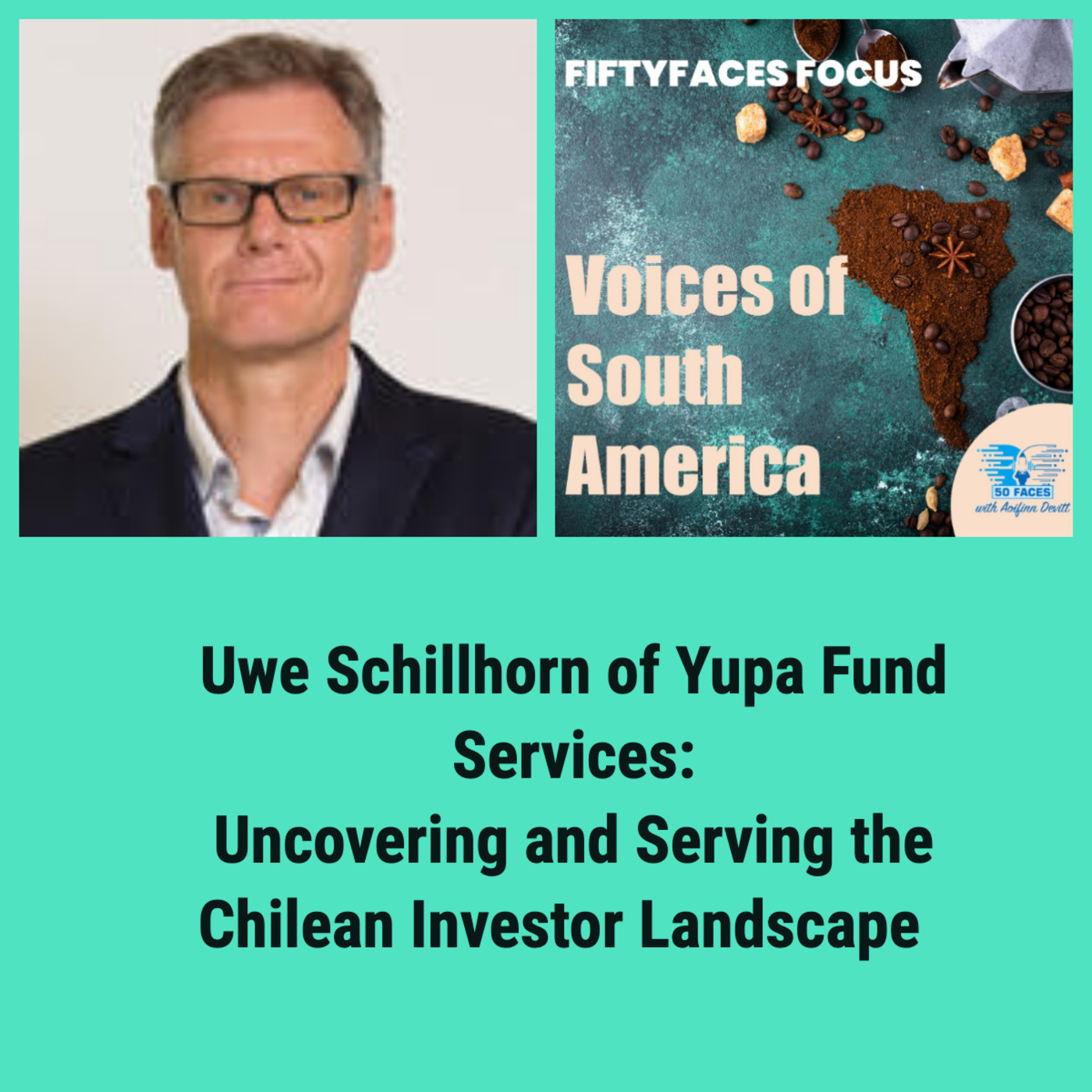
Aoifinn Devitt: I’m Aoifinn Devitt, and welcome to the 50 Faces podcast, a podcast committed to revealing the richness and diversity of the world of investment by focusing on its people and their stories. I’m joined today by Uwe Schilhorn, whom we interviewed last year on the main series. He had at that time just finished up a role as chief investment officer of a Chicago-based public fund. And was program director at Emerging Markets Investors Alliance, a role he still holds today. We spoke then about his 6 years living in Chile and key takeaways from the region. Now he has pivoted to form a placement agent, UPEF Fund Services, which specializes in bringing tax-efficient public and private US investment vehicles to the Chilean institutional and wealth management space. We are delighted to feature him here returning to the podcast as part of our Latin American Voices series. Welcome, Uwe. Thanks for joining me today.
Uwe Schillhorn: Thank you for having me again.
Aoifinn Devitt: Well, I’d love to talk about— just going back a little bit in time, it was great to have you on the podcast before— to talk about what led you to found Yuppa Fund Services. What was the opportunity in the market that you were seeking to address?
Uwe Schillhorn: I guess it started with something that for most people in investment, including myself, isn’t very exciting, and that’s taxes. So Chile and the US had a double taxation treaty on the books for many years, but it had never been signed into law by the respective Congresses. Therefore, many Chilean investors that have in the past invested in the US market did this via Luxembourg, Dublin, or other offshore vehicles. And these vehicles provided some tax relief, but the situation wasn’t optimal. And then last year, an ex-colleague of mine from Chile that I had served with on the board of a pension fund called me and told me that the Double Taxation Treaty had been signed into law by both countries. I couldn’t believe it at first, but it is true. So this opened up great new possibilities. So Chilean investors can now invest directly into US vehicles at more advantaged tax rates and in theory have access to all types of managers that were not active in Chile before. And it also kind of offers US managers that do not have Luxembourg or Dublin listed funds the possibilities to attract Chilean investors directly. And we decided to form a company that takes advantage of this change and bridge the gap between these US managers and Chilean investors. So we got in touch with another ex-colleague colleague, and we formed UPA Fund Services to bring, as you mentioned, kind of interesting tax-efficient US investment vehicles to the Chilean institutional and wealth management space that they were not exposed to before. And we also serve as a placement agent for these vehicles in Chile. And my colleagues are based in Chile and have been working there in the asset management space for many years on the investment side and on the legal and compliance side. And we’re very well connected and know the space as well. And I myself, I’ve been doing due diligence on and invested in public and private managers in the US for many years. So Yupa allows us all kind of to put our skills and passions to work.
Uwe Schillhorn: Really interesting. Well, sometimes it is exciting business ventures that come out of sometimes the most mundane reasoning. So nothing unusual there. But before we go into a little bit more detail about how this will work and the kind of strategies that might be most of interest, can we just pull the lens back and paint a picture of the Chilean institutional investor landscape? Who are we speaking about here? Pension funds, family offices. How does that landscape look today and how has it evolved?
Aoifinn Devitt: Yeah, so the biggest players in the industry are the pension funds indeed. And contributing to the pension funds is compulsory for all formal workers in Chile. So therefore they’re constantly growing and they are managed by private companies. And it’s a very competitive space. And the system is defined contribution and they have target risk funds that invest abroad and they’re now moving to target date funds. And the Chilean pension fund industry is internationally very well regarded. And has roughly $200 billion assets under management. So, it’s quite big. Another big player are the life insurance companies. There are over 20. Their combined AUM is between $60 and $70 billion, I guess. And the third important players are single and multifamily offices and high net worth individuals. They’re estimated to have roughly $25 to $30 billion AUM. And they’re generally very sophisticated and also very globally oriented. Basically, those are the three big groups.
Uwe Schillhorn: Really interesting. And just starting with the pension funds, you and I both have experience in the US public fund arena. The ones in particular that we worked with in Chicago were on the underfunded side of the spectrum. How well funded are the Chilean pension funds?
Aoifinn Devitt: Well, they are not. That isn’t an issue for them. So they’re capitalizing pension funds, right? So they’re not— it’s basically you create your own account and then you fund it. So there’s no funding gap or so. They’re defined contributions, they’re not defined benefits. But there is an issue, of course, because not everyone is covered by them. The unofficial economy is quite large in Chile. So that’s an issue. So they need a social pillar, plus the contributions have been too low. So the life expectancy has increased over the years. So there is a funding issue, but the funding issue doesn’t stem from bad returns. Returns have been very, very good. It’s just the institutional setup needs some additional pillars.
Uwe Schillhorn: Pretty interesting. So I just got back from the region, as we discussed, and the issue down there for some countries such as, say, Brazil was a high interest rate environment made anything that wasn’t essentially risk-free bonds look quite unattractive in comparison. It was a high bar to clear. What is the kind of landscape for these institutional investors in Chile? And you’d mentioned they’re looking overseas. Where would they normally be allocated and how long the spectrum are they with alternatives?
Aoifinn Devitt: Yeah, so Chile doesn’t really have that issue that Brazil has. I think Brazil is fairly unique, although right now, real rates in Brazil are very high. Real rates are high in Mexico too, and maybe Colombia, but that’s more cyclical. I think in Brazil, it’s more a structural issue that they tended to have very high real rates and therefore much more activity in fixed income than in equities. So Chile, being a relatively small and open emerging market economy, Chilean investors have always been interested in investing abroad. And this interest has accelerated after the social uprising in 2019. I remember actually receiving a phone call in 2022 from people in Chile waiting to invest in US real estate quickly to get the money out of the country. And although that panic has died down, that’s much more stable now, the interest in investments in the US has remained. And another trend in Chile is the interest in private market. There was a change in the pension fund regulation some years ago that expanded the possibilities of the pension funds to invest in private markets. And the pension funds often set the tone for the other market participants in Chile. And we also see growing interest from the insurance and family office space for private investments.
Uwe Schillhorn: Really interesting. And I presume the dollar has been a bonus return stream as it was stronger. Is there sensitivity to currency impact of some of these strategies as well?
Aoifinn Devitt: Well, yes, of course. But I think Chileans, they want that exposure. I mean, I think in developed markets, we invest in emerging markets generally to get the higher returns. And if you’re already in an emerging market, you want more stability. So yes, you know, the dollar has its cycles too, of course, and recently has weakened. But generally, Chilean investors are happy to have exposures to the dollar or the euro.
Uwe Schillhorn: I think it’s really interesting to kind of paint a picture of the DNA of a country in terms of their preferences when it comes to, say, alternatives. Just to give you an example, I know a lot of managers say with real asset or infrastructure products with a steady yield or private credit have been looking at, say, Germany or Japan, where the DNA of those investors has been more constrained on the risk side and focused on steady return. What would you say if you were to characterize the DNA of the Chile investors? Is there one, or is it quite varied, or what do you find is most attractive? In terms of strategies?
Aoifinn Devitt: Well, there are professional investors, and they certainly don’t shy away from risk. And there are many big funds and ETFs investing in public equity markets outside of Chile that are available for Chilean investors. So they are often in the form of those LUX or Dublin-listed vehicles that I mentioned before. So the investors there are quite well served here. But Chile, as many other countries in Latin America, does not really have a very deep high-yielding market. By high-yielding, I don’t necessarily mean only sub-investment-grade bonds, but also private strategies that generate predictably high cash flows. And we see interest in that segment. And this could be real estate or private credit or certain strategies in private equity like music rights, for example. And because here the underlying assets in these strategies are profitable already and they generate cash flows, and at the same time, they offer some price upside at exit. And that’s what many Chilean investors are looking for.
Uwe Schillhorn: It’s really interesting. And just in terms of the sustainability angle, I know that there is in Europe, say for example, there has been quite a lot of interest in the sustainable funds. But when they look, when Europe looks to say Latin America, there might be some interest in the forestry products or other products that have a sustainability angle. Do you find that the Chilean investor, when they’re looking outside Chile to invest, is there any sector that they perhaps are overweight? Maybe it’s energy. That they don’t want exposure to, or do they have a focus on, say, sustainability as a criteria?
Aoifinn Devitt: Well, so it’s a difficult question because they’re all different. So the pension fund regulator basically, they require each pension fund to integrate the subject of sustainability into its investment policy and to report on its effort in various occasions. And in general, in Chile, listed companies also need to show their effort in this regard. But both of these initiatives don’t require the companies to hit any specific targets or so, but just to publish what their position is so that the stakeholders have the relevant information. So it’s not something mandated by the government. It’s sometimes in Europe, you know, there are some laws that require to look at supply chains or so. This is not the case in Chile, but you have to publish what you’re doing and you have to make the information available. This has so far not really translated into specific effort in the rest of the industry to put specific emphasis on the subject. Now, there will always be certain investors, certain companies that do that, right? But in general, no. You know, it’s— you’ve got to show what you’re doing, but you’re not required to do certain things. And there’s no broad push to that either.
Uwe Schillhorn: Really interesting. And before we leave that area, do you see— Chile has always been seen as a leader in the Latin American arena in terms of its sophistication of its institutions, I suppose its robustness. And its economic discipline. Do you see that it is extraordinary among its peers and neighbors there in Latin America with this sophistication? Or do you see and look to any neighboring countries to see maybe who will be next in line for this level of sophistication and investment outside?
Aoifinn Devitt: Well, so the Mexican pension funds are actually not too different in terms of the way they function. I think they are similar Now, in general, the investment landscape in Mexico is not as sophisticated as in Chile, I think. And interestingly, a lot of the investment leaders in Mexico that I came in contact with were actually not from Mexico, but from Argentina sometimes. So we’re looking at these, and Brazil is more constrained. And certainly, it has a very, of course, very professional market inside of Brazil. But because real rates are so high there, the outside investments I think are smaller. So we at Yuppa We’re currently looking at Chile because we started in Chile because that’s where the opportunity set changed most. And that’s the market that we’re most familiar with. And as I mentioned, we have good connection to some of the other countries in the region, and we probably will go there later. But for right now, we really have our hands full with Chile.
Uwe Schillhorn: Pretty interesting. Well, before we go to some reflections from the last few years, just to bring us up to date, is there anything else you’d like to mention about the opportunity, about what excites you in the region? Or just something we haven’t covered here?
Aoifinn Devitt: Chile is interested in private cash-flowing strategies. That’s what excites me also, that have a shorter lifespan than the typical VC or PE fund, and where investors don’t have to wait like 10 to 12 years before they can cash in their returns. And that’s also what I find very interesting from an investment standpoint. Of course, you know, PE has done well, but when you look at some of these funds, even after 10 years, there’s still some money invested. So you look at these multiples and the IRRs, yeah, but 20% of those is still invested even after 10 years and they get an extension and another extension. So I think it’s very interesting to get exposure to private markets because of their illiquidity premium. And most investors really don’t need all that liquidity. So it’s a very good opportunity to get that extra premium. But you can find markets where you can get your money back a lot quicker and also some predictable cash flow. So you don’t need to put all your hope on that great exit, be it a strategic investor or an IPO. But you have some sounder businesses as underlying. So I like that. Appetite for cash flow, I see down there too.
Uwe Schillhorn: It’s a really interesting point. I think it’s good that we’re moving to reflections, because I think one of the reflections I had from my trip and speaking to professionals in Latin America is, first of all, how agile and versatile and resilient many investors in the region are, because they are used to a certain amount of volatility. But equally, trust has not always been rewarded there because of whether it’s changing governments or assets being appropriated or that there is not a very high level, I’d say, of trust. So I’d say long lockups maybe are not necessarily the most suitable for a region that has seen some volatility. But the bird in the hand of the cash-flowing characteristics that can often start within the first quarter of an investment, that has a very valuable component. I’m not sure if you think the psychology of the region has anything to do with these preferences.
Aoifinn Devitt: You’re probably right. So yes, and I think I can sympathize with that because it’s very unpredictable, even if you live there. As I mentioned, there was a social uprising when I lived there in 2019 that seemed to change the economic and institutional path of the country that the country had taken for 20 years. And I completely did not see this coming at all. But before working in Chile, I was head of emerging market debt at UBS Global Asset Management. And I had seen, therefore, my share of crises in different countries and knew how difficult it was to adequately forecast this from far away. And now, I lived in one and still was flabbergasted, and so all my Chilean colleagues that are there with me. So I think these social interconnected systems are inherently difficult to predict. And markets have humbled me and many people many times. And I think, yeah, that hunger for a little bit more safety and cash flows is certainly there. But then also what is interesting thing, after the country embarked on this disastrous constitutional process, and everyone in Chile was so negative, this is the end, it surprised me again. And the country put itself together and stepped away from the abyss. And kudos to the Chilean people that showed a great deal of political maturity. And during this time, I know that many people withdrew money from the pension funds because that was actually during COVID but it was right after the social uprising. It wasn’t directly related, but withdrew money from pension funds because of fear of what could happen there. And yeah, know, you I think the lesson here is that if you are investing in these markets, whether you live there or not, you have to deal with surprises or the known unknowns and then adjust quickly. I think it’s going to be interesting if AI can help us in the future being aware of weak spots in a timelier manner in the future. That’s not a prediction. I’m rather skeptical. It’s going to be interesting to see, I think.
Uwe Schillhorn: So interesting. Well, thanks for that reflection. And then my final question is whether you’ve been now doing this focused work down there, focusing on the investor, pairing the investor with suitable products. Any additional reflection to add to the original podcast we discussed, which I can link to in the show notes, but anything, lesson learned over the past few years or any advice that you’ve come up with?
Aoifinn Devitt: I mean, there’s something, but I don’t actually remember whether we talked about that in the last podcast. And it’s not necessarily a piece of advice that a wise person gave gave me, but more a reflection on myself. I think that most people are to a great deal shaped by their past experiences. And in this regard, I was quite lucky because I’ve generally worked and dealt with people that deserved my trust. So I usually give them the benefit of the doubt. I also did that in Chile, although I didn’t know the culture very well when I moved you there, know. And I have observed that that works fine for me, and that I become miserable when I stop doing that. And it generally doesn’t lead to anywhere good. So not sure if that works for everybody, but it certainly worked for me.
Aoifinn Devitt: Well, thank you. And I don’t think we mentioned that last time around. So thank you. I mean, I think we’re always learning. We’re all— every experience in life adds to that body of whether it’s lessons you learned, know, or just mistakes made. And I think the wisdom gained. So thank you very much for sharing some detailed insight into the landscape of the Chilean investor. I think it’s something that we know little enough about and is, I think, clearly under the radar screen of many funds and allocators in North America. So thank you for coming here and sharing those insights with us.
Uwe Schillhorn: Oh, thank you for having me again. And I hope that there’s something useful in here for your listeners.
Aoifinn Devitt: And good luck with the early years of Yupa indeed.
Uwe Schillhorn: Thank you.
Aoifinn Devitt: I’m Aoifinn Devitt. Thank you for listening to the 50 Faces Podcast. If you liked what you heard and would like to tune in to hear more inspiring investors and their personal journeys, please subscribe on Apple Podcasts or wherever you get your podcasts. This podcast is for informational purposes only and should not be construed as investment advice, and all views are personal and should not be attributed to the organizations and affiliations of the host or any guest.
Uwe Schillhorn: The Chilean pension fund industry is internationally very well regarded and has roughly $200 billion assets under management. So it’s quite big. Another big player are the life insurance companies. There are over 20. Their combined AUM is between $60 and $70 billion, I guess. And the third important players are single and multifamily offices and high net worth individuals.
Aoifinn Devitt: I’m Aoifinn Devitt, and welcome to the 50 Faces podcast, a podcast committed to revealing the richness and diversity of the world of investment by focusing on its people and their stories. I’m joined today by Uwe Schilhorn, whom we interviewed last year on the main series. He had at that time just finished up a role as chief investment officer of a Chicago-based public fund. And was program director at Emerging Markets Investors Alliance, a role he still holds today. We spoke then about his 6 years living in Chile and key takeaways from the region. Now he has pivoted to form a placement agent, UPEF Fund Services, which specializes in bringing tax-efficient public and private US investment vehicles to the Chilean institutional and wealth management space. We are delighted to feature him here returning to the podcast as part of our Latin American Voices series. Welcome, Uwe. Thanks for joining me today.
Uwe Schillhorn: Thank you for having me again.
Aoifinn Devitt: Well, I’d love to talk about— just going back a little bit in time, it was great to have you on the podcast before— to talk about what led you to found Yuppa Fund Services. What was the opportunity in the market that you were seeking to address?
Uwe Schillhorn: I guess it started with something that for most people in investment, including myself, isn’t very exciting, and that’s taxes. So Chile and the US had a double taxation treaty on the books for many years, but it had never been signed into law by the respective Congresses. Therefore, many Chilean investors that have in the past invested in the US market did this via Luxembourg, Dublin, or other offshore vehicles. And these vehicles provided some tax relief, but the situation wasn’t optimal. And then last year, an ex-colleague of mine from Chile that I had served with on the board of a pension fund called me and told me that the Double Taxation Treaty had been signed into law by both countries. I couldn’t believe it at first, but it is true. So this opened up great new possibilities. So Chilean investors can now invest directly into US vehicles at more advantaged tax rates and in theory have access to all types of managers that were not active in Chile before. And it also kind of offers US managers that do not have Luxembourg or Dublin listed funds the possibilities to attract Chilean investors directly. And we decided to form a company that takes advantage of this change and bridge the gap between these US managers and Chilean investors. So we got in touch with another ex-colleague colleague, and we formed UPA Fund Services to bring, as you mentioned, kind of interesting tax-efficient US investment vehicles to the Chilean institutional and wealth management space that they were not exposed to before. And we also serve as a placement agent for these vehicles in Chile. And my colleagues are based in Chile and have been working there in the asset management space for many years on the investment side and on the legal and compliance side. And we’re very well connected and know the space as well. And I myself, I’ve been doing due diligence on and invested in public and private managers in the US for many years. So Yupa allows us all kind of to put our skills and passions to work.
Uwe Schillhorn: Really interesting. Well, sometimes it is exciting business ventures that come out of sometimes the most mundane reasoning. So nothing unusual there. But before we go into a little bit more detail about how this will work and the kind of strategies that might be most of interest, can we just pull the lens back and paint a picture of the Chilean institutional investor landscape? Who are we speaking about here? Pension funds, family offices. How does that landscape look today and how has it evolved?
Aoifinn Devitt: Yeah, so the biggest players in the industry are the pension funds indeed. And contributing to the pension funds is compulsory for all formal workers in Chile. So therefore they’re constantly growing and they are managed by private companies. And it’s a very competitive space. And the system is defined contribution and they have target risk funds that invest abroad and they’re now moving to target date funds. And the Chilean pension fund industry is internationally very well regarded. And has roughly $200 billion assets under management. So, it’s quite big. Another big player are the life insurance companies. There are over 20. Their combined AUM is between $60 and $70 billion, I guess. And the third important players are single and multifamily offices and high net worth individuals. They’re estimated to have roughly $25 to $30 billion AUM. And they’re generally very sophisticated and also very globally oriented. Basically, those are the three big groups.
Uwe Schillhorn: Really interesting. And just starting with the pension funds, you and I both have experience in the US public fund arena. The ones in particular that we worked with in Chicago were on the underfunded side of the spectrum. How well funded are the Chilean pension funds?
Aoifinn Devitt: Well, they are not. That isn’t an issue for them. So they’re capitalizing pension funds, right? So they’re not— it’s basically you create your own account and then you fund it. So there’s no funding gap or so. They’re defined contributions, they’re not defined benefits. But there is an issue, of course, because not everyone is covered by them. The unofficial economy is quite large in Chile. So that’s an issue. So they need a social pillar, plus the contributions have been too low. So the life expectancy has increased over the years. So there is a funding issue, but the funding issue doesn’t stem from bad returns. Returns have been very, very good. It’s just the institutional setup needs some additional pillars.
Uwe Schillhorn: Pretty interesting. So I just got back from the region, as we discussed, and the issue down there for some countries such as, say, Brazil was a high interest rate environment made anything that wasn’t essentially risk-free bonds look quite unattractive in comparison. It was a high bar to clear. What is the kind of landscape for these institutional investors in Chile? And you’d mentioned they’re looking overseas. Where would they normally be allocated and how long the spectrum are they with alternatives?
Aoifinn Devitt: Yeah, so Chile doesn’t really have that issue that Brazil has. I think Brazil is fairly unique, although right now, real rates in Brazil are very high. Real rates are high in Mexico too, and maybe Colombia, but that’s more cyclical. I think in Brazil, it’s more a structural issue that they tended to have very high real rates and therefore much more activity in fixed income than in equities. So Chile, being a relatively small and open emerging market economy, Chilean investors have always been interested in investing abroad. And this interest has accelerated after the social uprising in 2019. I remember actually receiving a phone call in 2022 from people in Chile waiting to invest in US real estate quickly to get the money out of the country. And although that panic has died down, that’s much more stable now, the interest in investments in the US has remained. And another trend in Chile is the interest in private market. There was a change in the pension fund regulation some years ago that expanded the possibilities of the pension funds to invest in private markets. And the pension funds often set the tone for the other market participants in Chile. And we also see growing interest from the insurance and family office space for private investments.
Uwe Schillhorn: Really interesting. And I presume the dollar has been a bonus return stream as it was stronger. Is there sensitivity to currency impact of some of these strategies as well?
Aoifinn Devitt: Well, yes, of course. But I think Chileans, they want that exposure. I mean, I think in developed markets, we invest in emerging markets generally to get the higher returns. And if you’re already in an emerging market, you want more stability. So yes, you know, the dollar has its cycles too, of course, and recently has weakened. But generally, Chilean investors are happy to have exposures to the dollar or the euro.
Uwe Schillhorn: I think it’s really interesting to kind of paint a picture of the DNA of a country in terms of their preferences when it comes to, say, alternatives. Just to give you an example, I know a lot of managers say with real asset or infrastructure products with a steady yield or private credit have been looking at, say, Germany or Japan, where the DNA of those investors has been more constrained on the risk side and focused on steady return. What would you say if you were to characterize the DNA of the Chile investors? Is there one, or is it quite varied, or what do you find is most attractive? In terms of strategies?
Aoifinn Devitt: Well, there are professional investors, and they certainly don’t shy away from risk. And there are many big funds and ETFs investing in public equity markets outside of Chile that are available for Chilean investors. So they are often in the form of those LUX or Dublin-listed vehicles that I mentioned before. So the investors there are quite well served here. But Chile, as many other countries in Latin America, does not really have a very deep high-yielding market. By high-yielding, I don’t necessarily mean only sub-investment-grade bonds, but also private strategies that generate predictably high cash flows. And we see interest in that segment. And this could be real estate or private credit or certain strategies in private equity like music rights, for example. And because here the underlying assets in these strategies are profitable already and they generate cash flows, and at the same time, they offer some price upside at exit. And that’s what many Chilean investors are looking for.
Uwe Schillhorn: It’s really interesting. And just in terms of the sustainability angle, I know that there is in Europe, say for example, there has been quite a lot of interest in the sustainable funds. But when they look, when Europe looks to say Latin America, there might be some interest in the forestry products or other products that have a sustainability angle. Do you find that the Chilean investor, when they’re looking outside Chile to invest, is there any sector that they perhaps are overweight? Maybe it’s energy. That they don’t want exposure to, or do they have a focus on, say, sustainability as a criteria?
Aoifinn Devitt: Well, so it’s a difficult question because they’re all different. So the pension fund regulator basically, they require each pension fund to integrate the subject of sustainability into its investment policy and to report on its effort in various occasions. And in general, in Chile, listed companies also need to show their effort in this regard. But both of these initiatives don’t require the companies to hit any specific targets or so, but just to publish what their position is so that the stakeholders have the relevant information. So it’s not something mandated by the government. It’s sometimes in Europe, you know, there are some laws that require to look at supply chains or so. This is not the case in Chile, but you have to publish what you’re doing and you have to make the information available. This has so far not really translated into specific effort in the rest of the industry to put specific emphasis on the subject. Now, there will always be certain investors, certain companies that do that, right? But in general, no. You know, it’s— you’ve got to show what you’re doing, but you’re not required to do certain things. And there’s no broad push to that either.
Uwe Schillhorn: Really interesting. And before we leave that area, do you see— Chile has always been seen as a leader in the Latin American arena in terms of its sophistication of its institutions, I suppose its robustness. And its economic discipline. Do you see that it is extraordinary among its peers and neighbors there in Latin America with this sophistication? Or do you see and look to any neighboring countries to see maybe who will be next in line for this level of sophistication and investment outside?
Aoifinn Devitt: Well, so the Mexican pension funds are actually not too different in terms of the way they function. I think they are similar Now, in general, the investment landscape in Mexico is not as sophisticated as in Chile, I think. And interestingly, a lot of the investment leaders in Mexico that I came in contact with were actually not from Mexico, but from Argentina sometimes. So we’re looking at these, and Brazil is more constrained. And certainly, it has a very, of course, very professional market inside of Brazil. But because real rates are so high there, the outside investments I think are smaller. So we at Yuppa We’re currently looking at Chile because we started in Chile because that’s where the opportunity set changed most. And that’s the market that we’re most familiar with. And as I mentioned, we have good connection to some of the other countries in the region, and we probably will go there later. But for right now, we really have our hands full with Chile.
Uwe Schillhorn: Pretty interesting. Well, before we go to some reflections from the last few years, just to bring us up to date, is there anything else you’d like to mention about the opportunity, about what excites you in the region? Or just something we haven’t covered here?
Aoifinn Devitt: Chile is interested in private cash-flowing strategies. That’s what excites me also, that have a shorter lifespan than the typical VC or PE fund, and where investors don’t have to wait like 10 to 12 years before they can cash in their returns. And that’s also what I find very interesting from an investment standpoint. Of course, you know, PE has done well, but when you look at some of these funds, even after 10 years, there’s still some money invested. So you look at these multiples and the IRRs, yeah, but 20% of those is still invested even after 10 years and they get an extension and another extension. So I think it’s very interesting to get exposure to private markets because of their illiquidity premium. And most investors really don’t need all that liquidity. So it’s a very good opportunity to get that extra premium. But you can find markets where you can get your money back a lot quicker and also some predictable cash flow. So you don’t need to put all your hope on that great exit, be it a strategic investor or an IPO. But you have some sounder businesses as underlying. So I like that. Appetite for cash flow, I see down there too.
Uwe Schillhorn: It’s a really interesting point. I think it’s good that we’re moving to reflections, because I think one of the reflections I had from my trip and speaking to professionals in Latin America is, first of all, how agile and versatile and resilient many investors in the region are, because they are used to a certain amount of volatility. But equally, trust has not always been rewarded there because of whether it’s changing governments or assets being appropriated or that there is not a very high level, I’d say, of trust. So I’d say long lockups maybe are not necessarily the most suitable for a region that has seen some volatility. But the bird in the hand of the cash-flowing characteristics that can often start within the first quarter of an investment, that has a very valuable component. I’m not sure if you think the psychology of the region has anything to do with these preferences.
Aoifinn Devitt: You’re probably right. So yes, and I think I can sympathize with that because it’s very unpredictable, even if you live there. As I mentioned, there was a social uprising when I lived there in 2019 that seemed to change the economic and institutional path of the country that the country had taken for 20 years. And I completely did not see this coming at all. But before working in Chile, I was head of emerging market debt at UBS Global Asset Management. And I had seen, therefore, my share of crises in different countries and knew how difficult it was to adequately forecast this from far away. And now, I lived in one and still was flabbergasted, and so all my Chilean colleagues that are there with me. So I think these social interconnected systems are inherently difficult to predict. And markets have humbled me and many people many times. And I think, yeah, that hunger for a little bit more safety and cash flows is certainly there. But then also what is interesting thing, after the country embarked on this disastrous constitutional process, and everyone in Chile was so negative, this is the end, it surprised me again. And the country put itself together and stepped away from the abyss. And kudos to the Chilean people that showed a great deal of political maturity. And during this time, I know that many people withdrew money from the pension funds because that was actually during COVID but it was right after the social uprising. It wasn’t directly related, but withdrew money from pension funds because of fear of what could happen there. And yeah, know, you I think the lesson here is that if you are investing in these markets, whether you live there or not, you have to deal with surprises or the known unknowns and then adjust quickly. I think it’s going to be interesting if AI can help us in the future being aware of weak spots in a timelier manner in the future. That’s not a prediction. I’m rather skeptical. It’s going to be interesting to see, I think.
Uwe Schillhorn: So interesting. Well, thanks for that reflection. And then my final question is whether you’ve been now doing this focused work down there, focusing on the investor, pairing the investor with suitable products. Any additional reflection to add to the original podcast we discussed, which I can link to in the show notes, but anything, lesson learned over the past few years or any advice that you’ve come up with?
Aoifinn Devitt: I mean, there’s something, but I don’t actually remember whether we talked about that in the last podcast. And it’s not necessarily a piece of advice that a wise person gave gave me, but more a reflection on myself. I think that most people are to a great deal shaped by their past experiences. And in this regard, I was quite lucky because I’ve generally worked and dealt with people that deserved my trust. So I usually give them the benefit of the doubt. I also did that in Chile, although I didn’t know the culture very well when I moved you there, know. And I have observed that that works fine for me, and that I become miserable when I stop doing that. And it generally doesn’t lead to anywhere good. So not sure if that works for everybody, but it certainly worked for me.
Aoifinn Devitt: Well, thank you. And I don’t think we mentioned that last time around. So thank you. I mean, I think we’re always learning. We’re all— every experience in life adds to that body of whether it’s lessons you learned, know, or just mistakes made. And I think the wisdom gained. So thank you very much for sharing some detailed insight into the landscape of the Chilean investor. I think it’s something that we know little enough about and is, I think, clearly under the radar screen of many funds and allocators in North America. So thank you for coming here and sharing those insights with us.
Uwe Schillhorn: Oh, thank you for having me again. And I hope that there’s something useful in here for your listeners.
Aoifinn Devitt: And good luck with the early years of Yupa indeed.
Uwe Schillhorn: Thank you.
Aoifinn Devitt: I’m Aoifinn Devitt. Thank you for listening to the 50 Faces Podcast. If you liked what you heard and would like to tune in to hear more inspiring investors and their personal journeys, please subscribe on Apple Podcasts or wherever you get your podcasts. This podcast is for informational purposes only and should not be construed as investment advice, and all views are personal and should not be attributed to the organizations and affiliations of the host or any guest.