Aoifinn Devitt: I often use the word the soft bigotry of low expectations, that if you have a disability or a neurodiverse, you are not able to do a top-level executive job. Because of my deafness, I had to work harder than my normal abled colleagues. And so at school, I thought everyone was doing it, they were working over the weekends, 10 hours kind of leading up to exams every day. Um, I realized that wasn’t the case, but that was just what I had to do because I missed information in classes. So I had to kind of essentially play catch-up. And this resilience and this determination has steadily built up as I’ve grown up.
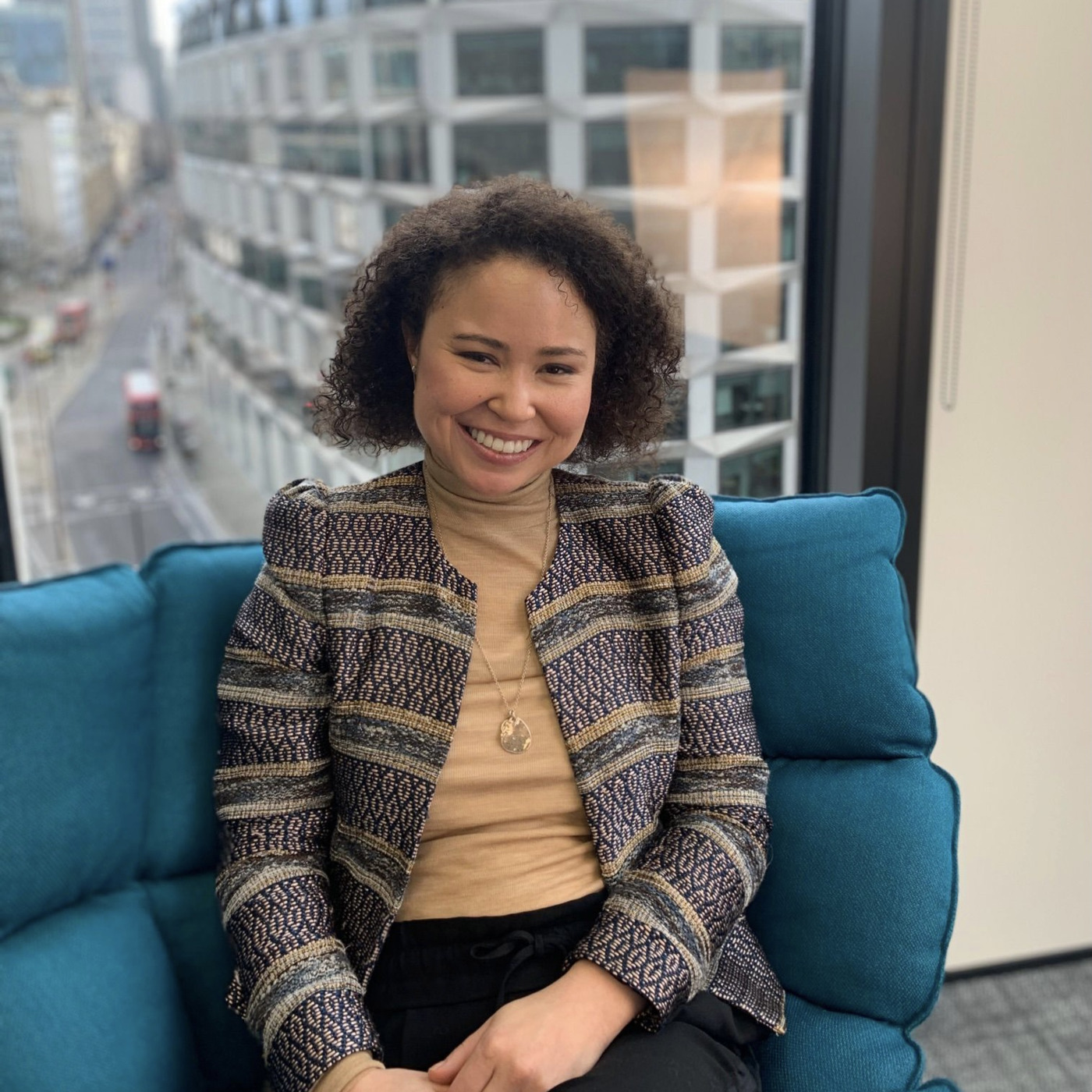
Claudia Buffini: I’m Aoifinn Devitt, and welcome to the 50 Faces podcast, a podcast committed to revealing the richness and diversity of the world of investment by focusing on its people and their stories. I’m joined today by Claudia Buffini, who is Corporate Responsibility Advisor at Schroders in London. Welcome, Claudia. Thanks for joining me today.
Aoifinn Devitt: It’s great to be here. I’m so excited.
Claudia Buffini: Let’s start by talking a little bit about your background. Where were you born? What did you study? And how did you end up in this role in corporate responsibility?
Aoifinn Devitt: So I was born in London. I’m 28 years old. I went to Durham University and I studied anthropology, which is looking at different cultures and societies and what that reveals about our own. And I really love the methods you use to study culture because it is so intangible—behaviours and values and attitudes. So really enjoyed kind of using ethnographic surveys, going out to different people that you wouldn’t necessarily meet and finding out what essentially their values are, what they enjoy and what they’re passionate about. And, and this made me really think in terms of that I wanted to do a job that evolved around people and working with people. And so I by chance ended up at my first job in a communications agency which specialized in purposeful leadership. And my role there was to really kind of build essentially the communications around employee engagement, um, for Iraqi oil field in Ramallah. That was one of our clients, was BP. I spent a lot of my time kind of honing my communication skills and putting my perspective in an Iraqi oil field worker’s shoes. What would make them get up and work in 50 degrees heat? It was really hard to kind of empathize, especially when you’re working in a very nice place in Covent Garden. But I really kind of learned a lot in a very small— it was a very small company, and so I had a lot of ownership and a lot of responsibility. And that really set me up in terms of the role I’m in now, which is Corporate Responsibility Advisor at Schroders. Because again, it’s to do with people. It’s how we look after our people internally and also how we support our community in our local area through our charity partnerships. And that again is through communication skills. So writing engaging articles about our partnerships. Why people should volunteer with them, and really putting myself in their perspective.
Claudia Buffini: Fascinating. And well, it’s going to speak a little bit about that when it comes to obviously diversity and inclusion within a firm, the importance of empathy and putting oneself in the shoes of others, and also recognizing that each of those shoes are individual shoes. So, so not having necessarily group-level solutions at that level. So what was the path then from the communication agency into Schroders, into investment management?
Aoifinn Devitt: I remember that day quite clearly. I was reading a magazine called the Harvard Business Review, which many know well, and it had an article— and this was in 2020, so just after the first lockdown— and it had an article in it saying how companies should make people with disabilities— what adjustments and accommodations they can make for them. And whilst the article was well-intentioned, it came from a place of kind of, this is a lot of effort, these people are in some ways a bit of a liability. And I was fuming. I was really quite angry. And this was before the wave of inclusion and diversity, before that was a key word. And I sat down and I wrote a LinkedIn blog post on why my hearing was an asset and not a liability in response to the Harvard Business Review. And I posted it, and what happened was that it got circulated around on the internet, and Schroders was a client of the communication agency, and my boss sent it to Schroders. They read it, and they asked me to get in touch with them, and I did, and they heard a bit more about my story and asked me to apply for an interview. And that was the first step that got me through the door, um, at So Schroders. I had absolutely no intention of joining a financial company, of working with a company like Schroders, but I do really care about inclusion and corporate sustainability, and that is also really high on.
Claudia Buffini: Schroders’ agenda And it’s really good advice in terms of how you can actually, no matter who you are, where you work, if you have a voice, use it. And sometimes using that voice and that advocacy can open doors. So I think a great recommendation for others who might have similar points of view.
Aoifinn Devitt: Yeah, LinkedIn is a fantastic platform. I encourage everyone to build their external profile, post blogs. Little posts about what you’re doing with work, what matters to you at work, what you’re doing outside of work. It can be big, it can be small, but if you build that external profile, you never know, it could be super useful in the future.
Claudia Buffini: So I’d say now, looking at the corporate responsibility role, this is something we speak about a lot on this podcast. What would you say is at the forefront of your mind today if you were to say maybe look at things as a hierarchy?
Aoifinn Devitt: I think the biggest thing on my mind is— I’m I’m sure, sure people are aware that there is a significant ESG backlash in America at the moment. And in terms of really what is ESG, we are approaching it the wrong way in terms of our governance and how we look after our environment and social society. So for me, it’s how we articulate in layman terms kind of our journey towards sustainability, what we are doing, especially with my role in terms of our people and our community partnership, the impact we’re having, and explaining it in basic terms. Essentially, what is the importance of sustainability for the business and for you as a person? Because essentially, I believe it’s the way that you can embed purpose within your work by volunteering either with our Schroders community partnerships or using that as a way to inspire you in thinking, okay, what charity in my local area can I support? So I think it’s— that is at the forefront of my mind at the moment.
Claudia Buffini: And you also volunteer a lot. How do you integrate that volunteering into the role you do today, and how do you encourage others to volunteer?
Aoifinn Devitt: Really good question. We link volunteering to talent and development and as a way to hone our professional skill sets. So I don’t really see volunteering as separate, but as a way that enhances my own self-development. And with that perspective, I share with others, and it’s a great way to see, okay, it’s not separate from my day-to-day role, but a way that enhances my learning and my career progression. So for example, I sit on an inclusion and diversity board for a charity, and I just make sure that I set aside 1 hour a month. And actually, that’s not a lot of time, and I really enjoy it. I use my disability perspective to provide them with advice on how they can bring inclusion within the firm, within their social enterprise infrastructure.
Claudia Buffini: And you also have some frequent LinkedIn posts. A recent one of those was around purpose and finding purpose. Can you speak a little bit about the point of that post and how you think that informs, I suppose, better corporate welfare.
Aoifinn Devitt: It’s really hard, I think, for people to find their purpose and to really know what that means. And the whole point of that post, kind of the path to happiness, was to start thinking small in terms of what do I enjoy doing, what gets me up in the day Answering those two questions, really kind of starting small, can help you to think, okay, I enjoy keeping fit, or I enjoy supporting my children’s fundraiser at their school. And by focusing on those small things, you can think about the bigger picture. Okay, what can I take— what elements of those can I take and implement them into work? Is it that I like working with people? Is it that I am really focused on mental health and well-being, therefore maybe I should join Schroeder’s mental health inclusion group Minds? I think it’s just kind of thinking about what it means really to be human, and answering those two questions can kind of hone in on that. I think that is all about starting small.
Claudia Buffini: And let’s talk a little bit about your own personal story and some of the purpose that you found in amplifying initiatives and awareness of, I suppose, career paths for people who are hearing impaired. Can you talk a little bit about your own perspective there?
Aoifinn Devitt: Definitely. I didn’t really know any other hearing impaired deaf people when I was growing up. So I was born premature, and what happened there was that the hearing cells in my ears didn’t grow, and so I wear two hearing aids at all times, and I essentially can’t hear the top notes of the piano or like the birds singing, and so that’s why I have my hearing aids. I feel what has happened is that I’ve always strived to be the same as everyone else, so I am actually quite competitive and quite resilient because of my deafness. I’ve had to work harder than my normal abled colleagues, so at school I thought it— everyone was doing it, that they were working over the weekends, 10 hours, kind of leading up to exams every day. I realized that wasn’t the case, but that was just what I had to do because I missed information in classes. So I had to kind of essentially play catch-up. And this resilience and this determination have steadily built up as I’ve grown up and At Schroders, I really value that the working place is as inclusive as possible. So no matter what background you’re from, no matter what difference you have, if we can create an environment where you can work in your own way at your best potential, then we should be able to create a place where everyone can thrive. And that’s kind of built from my perspective of growing up with my hearing difference.
Claudia Buffini: And maybe talk about, I suppose, the attitude around disability in the workplace, because we— I’ve had a number of other guests on this podcast discuss this, and it is perhaps, uh, maybe not the last frontier, but it’s a certainly further frontier because it doesn’t seem to get the same attention. There’s been some fantastic initiatives around London in particular around neurodiversity, and you’ve also posted about that at Schroders using, having interns on the autism spectrum and how well that’s worked in the workplace. How would you say expectations need to be guided, or maybe should I say pre-expectations or preconceived notions of what people with disabilities can do, how we can change that?
Aoifinn Devitt: Yes, so I often use the word the soft bigotry of low expectations, that if you have a disability or a neurodiverse, you are not able to do a top-level executive job, or you are able to not be kind of leading a team. And what I say to that is it’s setting expectations that you have to create an environment where you have to make certain adjustments, and these adjustments are quite small in certain areas, and they can benefit everyone. And if I give an example of that, a really simple one is that an autistic individual may need a quiet space to work. And so we have been thinking and working towards providing designated quiet spaces. But that can not just benefit an autistic individual, that can benefit everyone. There may be days when you probably do want to have a quiet space, whereas everyone kind of chatting around you. And so I kind of really use that narrative in terms of accessibility is about everyone, it’s about creating an environment for everyone to thrive in. And when you look at it like that, disability, supporting people with neurodiverse talent, should be much higher up on businesses’ agendas because we are providing a place called to promote and foster diversity of thought where different people’s perspectives really come into play and therefore creates innovation.
Claudia Buffini: I had some blind guests on the podcast, and for them, the advances of technology in the last 10 years in particular have made huge strides in terms of enabling accessibility for them. Whether it be their software talking to them instead of forcing them to read. How have technological advances made that integration piece easier for people who are hearing impaired or deaf?
Aoifinn Devitt: Well, for example, we have this fantastic phone app on our phones, um, that can allow our music and videos and team meetings to connect directly to our hearing aids. And I cannot tell you how much better it is because I’m not saying, what, or kind of asking people to repeat themselves. So that is one example, and then there’s another example of a Roger Pen, and that you can kind of have in a really noisy environment like a restaurant, and it amplifies the person you’re speaking to, so it captures their voice. Now, with all these kind of technological advancements, they’re fantastic, but what we’ve been trying to do at Schroders is to create a toolkit which shows essentially a catalog of all of the technology that you can request. Because when you first come into our company, you have no idea what’s available. And so I spent the past 6 months with our workability inclusion group, and that’s a community of people with disabilities and neurodiverse differences, to bring together a toolkit working with our technology team. Maps out essentially what we have, how you can request it, and that’s been a really huge step forward for us in terms of our accessibility journey.
Claudia Buffini: And Schroders has a global presence. Do you see that the integration path is similar around your offices around the world? Is that something you’re trying to do and keep uniform?
Aoifinn Devitt: Definitely. I think Schroders in London is steering the pathway in terms of our inclusion journey. The US, I went to the office in May, um, and they are also very focused on inclusion as well. And I think what we’re doing is we’re trying to set the boundaries and the kind of expectations of where we’re going so we can help our other offices as well. There is also an awareness piece around what inclusion is, and that especially with disability, um, around stigma and voicing whether you’re disabled or not. And that is something we’re looking at as a workability inclusion group, to make it easier for people to come forward and say, yes, I am disabled, um, I need this software, this equipment, and know that your manager or your colleagues aren’t going to look at you differently. That is our next piece of focus going forward, and that is what we will be sharing with our other offices.
Claudia Buffini: And just returning to your anthropology insights, how do you see in terms of some people not wanting perhaps to disclose their disability, that some, for some it is something they want to disclose and they gain from disclosing in terms of better access, better inclusion,, but others who prefer to keep that private.
Aoifinn Devitt: You make a really excellent point that it is very much down to the individual. There is no one approach or process in terms of the inclusion path. It is tailored for each individual, so we have to be really mindful of that and create a clear process, which we’re working on, especially with neurodiversity where people can come forward if they need to, or they’re just aware that’s the process and I will come to it in my own time. We’re very kind of at the start of our neurodiversity journey. We’re working with individuals who are neurodiverse themselves to better understand how we can support them, but it is being flexible and having a tailored approach for each individual.
Claudia Buffini: Really interesting. This is a question that I, I’m only asking now because I’ve realized it from my Pride series, which I’ve just finished recording. And it’s an unusual concept within some of the LGBTQ+ community. Some of them talk about having had an internalized transphobia perhaps that they had to overcome, or an internalized homophobia even for older individuals that they had to overcome. Have you found people in the disabled community sometimes have to overcome almost a frustration with themselves in terms of their own inability perhaps to do functions that other people can do so easily? Is that kind of counseling piece almost a part of the work you do?
Aoifinn Devitt: Yes, I wouldn’t call it frustration. I mean, there would be frustration, but I think it comes down to self-confidence. I’ve been fortunate enough to meet people like me on my career journey. And I realized how lucky I am to have had a really close family upbringing who made me feel comfortable that you can achieve this, you can do the same as everyone else. And that is such a stark contrast to perhaps someone else just like me who is deaf who hadn’t had that support, who didn’t have that voice cheering them behind, saying, “Yes, you can do this. Don’t worry, you weren’t able to hear that. You didn’t really embarrass yourself because they didn’t know that you were deaf.” I think it comes down to self-confidence, because once you do have this instilled confidence in you, any obstacles, you have that determination and drive to tackle them or find a solution. So I think that’s what it comes down to, this self-confidence. And a lot of people have not had that kind of upbringing that I’ve had in terms of the close family support. And that’s why it gets me up every day to be able to create a culture at Schroders to be that voice that I’ve always had, saying it’s okay, we really do care about you, please share what you need from us because we want to make this work so that you can do the best in your day-to-day job.
Claudia Buffini: It’s such a good point because I was just going to say that the self-confidence piece is never done in the sense that for anyone throughout their journey, they need those cheerleaders who can bolster the self-confidence along the way. Self-confidence is a, I suppose, a journey that’s volatile for anyone regardless of their abilities. So that, that, that is not just done at the childhood level, which is so great that you’re providing that network now. So that’s a good segue to the personal reflection section, and you already mentioned some of the, the key people in your own development. And were there anyone else maybe at the school level or, or past that into your early career who really had an impression on you or made a difference?
Aoifinn Devitt: My family have been key, and I’ve mentioned this a lot, role models that I’ve really looked up to at school was my learning support teacher, Mrs. Morton, and my headmistress, Mrs. Williams. I went to a particular school selected by my parents because it was small and it had a special education office. The headmistress, Mrs. Williams, was so warm and so lovely, and she saw something in me that I didn’t think I saw myself. Staying with my learning support teacher, Mrs. Morton, who I went to see every week when I started. And she helped with my speech language and kind of made sure I wrote everything down in my planner. I think they were right because I was made their first disabled mixed-race head girl at this school. And for me, them believing in me was key for what all I’ve done since leaving school, going to university, being driven, getting my first job as a communications consultant, getting to where I am now. Um, again, it comes down to that self-confidence and them seeing something that I didn’t see before.
Claudia Buffini: And when you look back at that journey, and you mentioned the resilience that you and many other people who’ve had to learn to work with disabilities have. Were there any particular turning points besides maybe the head girl incident or challenges that you learned lessons from?
Aoifinn Devitt: I played the trumpet, and the real big challenges of that— and I look back on that much older now with a kind of smile on my face because I think it’s very hard to play the trumpet in performances in front of the whole school. And being deaf as well, to hear the notes, to hear the tunes, to hear the pitch, make sure you’re in tune. And I think that experience— I was very fortunate to, to play the trumpet and have that, but I played to a really high level, to grade 8. And I do think that as well just helped me get a little bit outside my comfort zone, just to do something a bit different to everyone else. And that’s not necessarily a bad thing, that’s actually something that sets you apart. And again, that whole experience really taught me the value of kind of putting yourself out there, stretching yourself, seeing how far you can go. And that’s really helped me in good stead.
Claudia Buffini: And my last question is around any creed or motto that you live by, or any words of wisdom that you can leave us with?
Aoifinn Devitt: Yes, your successes are fantastic, but you learn the most from your failures. I think that for me is so significant. Every cloud has a silver lining. So I’m a really optimistic person. I really celebrate the big wins, but learning is so key. Like, what can you do better? What can I take away from that experience and make it even better next time? That for me is what’s really interesting. But yeah, those two key mottos are the ones I hold to my chest every day when I go to work and for life experiences as well.
Claudia Buffini: Well, thank you so much, Claudia. Your resilience has now been converted into a generous advocacy. Which will in turn lead to the resilience of a whole generation of able workers who are now hopefully can look forward to a career path that is as full and inclusive as it should be and, and for anyone. So thank you so much for coming here and sharing your insights with us.
Aoifinn Devitt: I’ve really enjoyed talking to you and yeah, I’m looking forward to seeing what happens next.
Claudia Buffini: I’m Aoifinn Devitt. Thank you for listening to the 50 Faces podcast. If you liked what you heard and would like to tune in to hear from more inspiring investment professionals and their personal journeys, please subscribe on Apple Podcasts or wherever you get your podcasts. You can find all of our content on the 50 Faces Hub, where you will find a library of role models, resources, and other solutions to enhance your career. This podcast is for informational purposes only and should not be construed as investment advice, and all views are personal and should not be attributed to the organization and affiliations of the host or any guest.
Aoifinn Devitt: I often use the word the soft bigotry of low expectations, that if you have a disability or a neurodiverse, you are not able to do a top-level executive job. Because of my deafness, I had to work harder than my normal abled colleagues. And so at school, I thought everyone was doing it, they were working over the weekends, 10 hours kind of leading up to exams every day. Um, I realized that wasn’t the case, but that was just what I had to do because I missed information in classes. So I had to kind of essentially play catch-up. And this resilience and this determination has steadily built up as I’ve grown up.
Claudia Buffini: I’m Aoifinn Devitt, and welcome to the 50 Faces podcast, a podcast committed to revealing the richness and diversity of the world of investment by focusing on its people and their stories. I’m joined today by Claudia Buffini, who is Corporate Responsibility Advisor at Schroders in London. Welcome, Claudia. Thanks for joining me today.
Aoifinn Devitt: It’s great to be here. I’m so excited.
Claudia Buffini: Let’s start by talking a little bit about your background. Where were you born? What did you study? And how did you end up in this role in corporate responsibility?
Aoifinn Devitt: So I was born in London. I’m 28 years old. I went to Durham University and I studied anthropology, which is looking at different cultures and societies and what that reveals about our own. And I really love the methods you use to study culture because it is so intangible—behaviours and values and attitudes. So really enjoyed kind of using ethnographic surveys, going out to different people that you wouldn’t necessarily meet and finding out what essentially their values are, what they enjoy and what they’re passionate about. And, and this made me really think in terms of that I wanted to do a job that evolved around people and working with people. And so I by chance ended up at my first job in a communications agency which specialized in purposeful leadership. And my role there was to really kind of build essentially the communications around employee engagement, um, for Iraqi oil field in Ramallah. That was one of our clients, was BP. I spent a lot of my time kind of honing my communication skills and putting my perspective in an Iraqi oil field worker’s shoes. What would make them get up and work in 50 degrees heat? It was really hard to kind of empathize, especially when you’re working in a very nice place in Covent Garden. But I really kind of learned a lot in a very small— it was a very small company, and so I had a lot of ownership and a lot of responsibility. And that really set me up in terms of the role I’m in now, which is Corporate Responsibility Advisor at Schroders. Because again, it’s to do with people. It’s how we look after our people internally and also how we support our community in our local area through our charity partnerships. And that again is through communication skills. So writing engaging articles about our partnerships. Why people should volunteer with them, and really putting myself in their perspective.
Claudia Buffini: Fascinating. And well, it’s going to speak a little bit about that when it comes to obviously diversity and inclusion within a firm, the importance of empathy and putting oneself in the shoes of others, and also recognizing that each of those shoes are individual shoes. So, so not having necessarily group-level solutions at that level. So what was the path then from the communication agency into Schroders, into investment management?
Aoifinn Devitt: I remember that day quite clearly. I was reading a magazine called the Harvard Business Review, which many know well, and it had an article— and this was in 2020, so just after the first lockdown— and it had an article in it saying how companies should make people with disabilities— what adjustments and accommodations they can make for them. And whilst the article was well-intentioned, it came from a place of kind of, this is a lot of effort, these people are in some ways a bit of a liability. And I was fuming. I was really quite angry. And this was before the wave of inclusion and diversity, before that was a key word. And I sat down and I wrote a LinkedIn blog post on why my hearing was an asset and not a liability in response to the Harvard Business Review. And I posted it, and what happened was that it got circulated around on the internet, and Schroders was a client of the communication agency, and my boss sent it to Schroders. They read it, and they asked me to get in touch with them, and I did, and they heard a bit more about my story and asked me to apply for an interview. And that was the first step that got me through the door, um, at So Schroders. I had absolutely no intention of joining a financial company, of working with a company like Schroders, but I do really care about inclusion and corporate sustainability, and that is also really high on.
Claudia Buffini: Schroders’ agenda And it’s really good advice in terms of how you can actually, no matter who you are, where you work, if you have a voice, use it. And sometimes using that voice and that advocacy can open doors. So I think a great recommendation for others who might have similar points of view.
Aoifinn Devitt: Yeah, LinkedIn is a fantastic platform. I encourage everyone to build their external profile, post blogs. Little posts about what you’re doing with work, what matters to you at work, what you’re doing outside of work. It can be big, it can be small, but if you build that external profile, you never know, it could be super useful in the future.
Claudia Buffini: So I’d say now, looking at the corporate responsibility role, this is something we speak about a lot on this podcast. What would you say is at the forefront of your mind today if you were to say maybe look at things as a hierarchy?
Aoifinn Devitt: I think the biggest thing on my mind is— I’m I’m sure, sure people are aware that there is a significant ESG backlash in America at the moment. And in terms of really what is ESG, we are approaching it the wrong way in terms of our governance and how we look after our environment and social society. So for me, it’s how we articulate in layman terms kind of our journey towards sustainability, what we are doing, especially with my role in terms of our people and our community partnership, the impact we’re having, and explaining it in basic terms. Essentially, what is the importance of sustainability for the business and for you as a person? Because essentially, I believe it’s the way that you can embed purpose within your work by volunteering either with our Schroders community partnerships or using that as a way to inspire you in thinking, okay, what charity in my local area can I support? So I think it’s— that is at the forefront of my mind at the moment.
Claudia Buffini: And you also volunteer a lot. How do you integrate that volunteering into the role you do today, and how do you encourage others to volunteer?
Aoifinn Devitt: Really good question. We link volunteering to talent and development and as a way to hone our professional skill sets. So I don’t really see volunteering as separate, but as a way that enhances my own self-development. And with that perspective, I share with others, and it’s a great way to see, okay, it’s not separate from my day-to-day role, but a way that enhances my learning and my career progression. So for example, I sit on an inclusion and diversity board for a charity, and I just make sure that I set aside 1 hour a month. And actually, that’s not a lot of time, and I really enjoy it. I use my disability perspective to provide them with advice on how they can bring inclusion within the firm, within their social enterprise infrastructure.
Claudia Buffini: And you also have some frequent LinkedIn posts. A recent one of those was around purpose and finding purpose. Can you speak a little bit about the point of that post and how you think that informs, I suppose, better corporate welfare.
Aoifinn Devitt: It’s really hard, I think, for people to find their purpose and to really know what that means. And the whole point of that post, kind of the path to happiness, was to start thinking small in terms of what do I enjoy doing, what gets me up in the day Answering those two questions, really kind of starting small, can help you to think, okay, I enjoy keeping fit, or I enjoy supporting my children’s fundraiser at their school. And by focusing on those small things, you can think about the bigger picture. Okay, what can I take— what elements of those can I take and implement them into work? Is it that I like working with people? Is it that I am really focused on mental health and well-being, therefore maybe I should join Schroeder’s mental health inclusion group Minds? I think it’s just kind of thinking about what it means really to be human, and answering those two questions can kind of hone in on that. I think that is all about starting small.
Claudia Buffini: And let’s talk a little bit about your own personal story and some of the purpose that you found in amplifying initiatives and awareness of, I suppose, career paths for people who are hearing impaired. Can you talk a little bit about your own perspective there?
Aoifinn Devitt: Definitely. I didn’t really know any other hearing impaired deaf people when I was growing up. So I was born premature, and what happened there was that the hearing cells in my ears didn’t grow, and so I wear two hearing aids at all times, and I essentially can’t hear the top notes of the piano or like the birds singing, and so that’s why I have my hearing aids. I feel what has happened is that I’ve always strived to be the same as everyone else, so I am actually quite competitive and quite resilient because of my deafness. I’ve had to work harder than my normal abled colleagues, so at school I thought it— everyone was doing it, that they were working over the weekends, 10 hours, kind of leading up to exams every day. I realized that wasn’t the case, but that was just what I had to do because I missed information in classes. So I had to kind of essentially play catch-up. And this resilience and this determination have steadily built up as I’ve grown up and At Schroders, I really value that the working place is as inclusive as possible. So no matter what background you’re from, no matter what difference you have, if we can create an environment where you can work in your own way at your best potential, then we should be able to create a place where everyone can thrive. And that’s kind of built from my perspective of growing up with my hearing difference.
Claudia Buffini: And maybe talk about, I suppose, the attitude around disability in the workplace, because we— I’ve had a number of other guests on this podcast discuss this, and it is perhaps, uh, maybe not the last frontier, but it’s a certainly further frontier because it doesn’t seem to get the same attention. There’s been some fantastic initiatives around London in particular around neurodiversity, and you’ve also posted about that at Schroders using, having interns on the autism spectrum and how well that’s worked in the workplace. How would you say expectations need to be guided, or maybe should I say pre-expectations or preconceived notions of what people with disabilities can do, how we can change that?
Aoifinn Devitt: Yes, so I often use the word the soft bigotry of low expectations, that if you have a disability or a neurodiverse, you are not able to do a top-level executive job, or you are able to not be kind of leading a team. And what I say to that is it’s setting expectations that you have to create an environment where you have to make certain adjustments, and these adjustments are quite small in certain areas, and they can benefit everyone. And if I give an example of that, a really simple one is that an autistic individual may need a quiet space to work. And so we have been thinking and working towards providing designated quiet spaces. But that can not just benefit an autistic individual, that can benefit everyone. There may be days when you probably do want to have a quiet space, whereas everyone kind of chatting around you. And so I kind of really use that narrative in terms of accessibility is about everyone, it’s about creating an environment for everyone to thrive in. And when you look at it like that, disability, supporting people with neurodiverse talent, should be much higher up on businesses’ agendas because we are providing a place called to promote and foster diversity of thought where different people’s perspectives really come into play and therefore creates innovation.
Claudia Buffini: I had some blind guests on the podcast, and for them, the advances of technology in the last 10 years in particular have made huge strides in terms of enabling accessibility for them. Whether it be their software talking to them instead of forcing them to read. How have technological advances made that integration piece easier for people who are hearing impaired or deaf?
Aoifinn Devitt: Well, for example, we have this fantastic phone app on our phones, um, that can allow our music and videos and team meetings to connect directly to our hearing aids. And I cannot tell you how much better it is because I’m not saying, what, or kind of asking people to repeat themselves. So that is one example, and then there’s another example of a Roger Pen, and that you can kind of have in a really noisy environment like a restaurant, and it amplifies the person you’re speaking to, so it captures their voice. Now, with all these kind of technological advancements, they’re fantastic, but what we’ve been trying to do at Schroders is to create a toolkit which shows essentially a catalog of all of the technology that you can request. Because when you first come into our company, you have no idea what’s available. And so I spent the past 6 months with our workability inclusion group, and that’s a community of people with disabilities and neurodiverse differences, to bring together a toolkit working with our technology team. Maps out essentially what we have, how you can request it, and that’s been a really huge step forward for us in terms of our accessibility journey.
Claudia Buffini: And Schroders has a global presence. Do you see that the integration path is similar around your offices around the world? Is that something you’re trying to do and keep uniform?
Aoifinn Devitt: Definitely. I think Schroders in London is steering the pathway in terms of our inclusion journey. The US, I went to the office in May, um, and they are also very focused on inclusion as well. And I think what we’re doing is we’re trying to set the boundaries and the kind of expectations of where we’re going so we can help our other offices as well. There is also an awareness piece around what inclusion is, and that especially with disability, um, around stigma and voicing whether you’re disabled or not. And that is something we’re looking at as a workability inclusion group, to make it easier for people to come forward and say, yes, I am disabled, um, I need this software, this equipment, and know that your manager or your colleagues aren’t going to look at you differently. That is our next piece of focus going forward, and that is what we will be sharing with our other offices.
Claudia Buffini: And just returning to your anthropology insights, how do you see in terms of some people not wanting perhaps to disclose their disability, that some, for some it is something they want to disclose and they gain from disclosing in terms of better access, better inclusion,, but others who prefer to keep that private.
Aoifinn Devitt: You make a really excellent point that it is very much down to the individual. There is no one approach or process in terms of the inclusion path. It is tailored for each individual, so we have to be really mindful of that and create a clear process, which we’re working on, especially with neurodiversity where people can come forward if they need to, or they’re just aware that’s the process and I will come to it in my own time. We’re very kind of at the start of our neurodiversity journey. We’re working with individuals who are neurodiverse themselves to better understand how we can support them, but it is being flexible and having a tailored approach for each individual.
Claudia Buffini: Really interesting. This is a question that I, I’m only asking now because I’ve realized it from my Pride series, which I’ve just finished recording. And it’s an unusual concept within some of the LGBTQ+ community. Some of them talk about having had an internalized transphobia perhaps that they had to overcome, or an internalized homophobia even for older individuals that they had to overcome. Have you found people in the disabled community sometimes have to overcome almost a frustration with themselves in terms of their own inability perhaps to do functions that other people can do so easily? Is that kind of counseling piece almost a part of the work you do?
Aoifinn Devitt: Yes, I wouldn’t call it frustration. I mean, there would be frustration, but I think it comes down to self-confidence. I’ve been fortunate enough to meet people like me on my career journey. And I realized how lucky I am to have had a really close family upbringing who made me feel comfortable that you can achieve this, you can do the same as everyone else. And that is such a stark contrast to perhaps someone else just like me who is deaf who hadn’t had that support, who didn’t have that voice cheering them behind, saying, “Yes, you can do this. Don’t worry, you weren’t able to hear that. You didn’t really embarrass yourself because they didn’t know that you were deaf.” I think it comes down to self-confidence, because once you do have this instilled confidence in you, any obstacles, you have that determination and drive to tackle them or find a solution. So I think that’s what it comes down to, this self-confidence. And a lot of people have not had that kind of upbringing that I’ve had in terms of the close family support. And that’s why it gets me up every day to be able to create a culture at Schroders to be that voice that I’ve always had, saying it’s okay, we really do care about you, please share what you need from us because we want to make this work so that you can do the best in your day-to-day job.
Claudia Buffini: It’s such a good point because I was just going to say that the self-confidence piece is never done in the sense that for anyone throughout their journey, they need those cheerleaders who can bolster the self-confidence along the way. Self-confidence is a, I suppose, a journey that’s volatile for anyone regardless of their abilities. So that, that, that is not just done at the childhood level, which is so great that you’re providing that network now. So that’s a good segue to the personal reflection section, and you already mentioned some of the, the key people in your own development. And were there anyone else maybe at the school level or, or past that into your early career who really had an impression on you or made a difference?
Aoifinn Devitt: My family have been key, and I’ve mentioned this a lot, role models that I’ve really looked up to at school was my learning support teacher, Mrs. Morton, and my headmistress, Mrs. Williams. I went to a particular school selected by my parents because it was small and it had a special education office. The headmistress, Mrs. Williams, was so warm and so lovely, and she saw something in me that I didn’t think I saw myself. Staying with my learning support teacher, Mrs. Morton, who I went to see every week when I started. And she helped with my speech language and kind of made sure I wrote everything down in my planner. I think they were right because I was made their first disabled mixed-race head girl at this school. And for me, them believing in me was key for what all I’ve done since leaving school, going to university, being driven, getting my first job as a communications consultant, getting to where I am now. Um, again, it comes down to that self-confidence and them seeing something that I didn’t see before.
Claudia Buffini: And when you look back at that journey, and you mentioned the resilience that you and many other people who’ve had to learn to work with disabilities have. Were there any particular turning points besides maybe the head girl incident or challenges that you learned lessons from?
Aoifinn Devitt: I played the trumpet, and the real big challenges of that— and I look back on that much older now with a kind of smile on my face because I think it’s very hard to play the trumpet in performances in front of the whole school. And being deaf as well, to hear the notes, to hear the tunes, to hear the pitch, make sure you’re in tune. And I think that experience— I was very fortunate to, to play the trumpet and have that, but I played to a really high level, to grade 8. And I do think that as well just helped me get a little bit outside my comfort zone, just to do something a bit different to everyone else. And that’s not necessarily a bad thing, that’s actually something that sets you apart. And again, that whole experience really taught me the value of kind of putting yourself out there, stretching yourself, seeing how far you can go. And that’s really helped me in good stead.
Claudia Buffini: And my last question is around any creed or motto that you live by, or any words of wisdom that you can leave us with?
Aoifinn Devitt: Yes, your successes are fantastic, but you learn the most from your failures. I think that for me is so significant. Every cloud has a silver lining. So I’m a really optimistic person. I really celebrate the big wins, but learning is so key. Like, what can you do better? What can I take away from that experience and make it even better next time? That for me is what’s really interesting. But yeah, those two key mottos are the ones I hold to my chest every day when I go to work and for life experiences as well.
Claudia Buffini: Well, thank you so much, Claudia. Your resilience has now been converted into a generous advocacy. Which will in turn lead to the resilience of a whole generation of able workers who are now hopefully can look forward to a career path that is as full and inclusive as it should be and, and for anyone. So thank you so much for coming here and sharing your insights with us.
Aoifinn Devitt: I’ve really enjoyed talking to you and yeah, I’m looking forward to seeing what happens next.
Claudia Buffini: I’m Aoifinn Devitt. Thank you for listening to the 50 Faces podcast. If you liked what you heard and would like to tune in to hear from more inspiring investment professionals and their personal journeys, please subscribe on Apple Podcasts or wherever you get your podcasts. You can find all of our content on the 50 Faces Hub, where you will find a library of role models, resources, and other solutions to enhance your career. This podcast is for informational purposes only and should not be construed as investment advice, and all views are personal and should not be attributed to the organization and affiliations of the host or any guest.