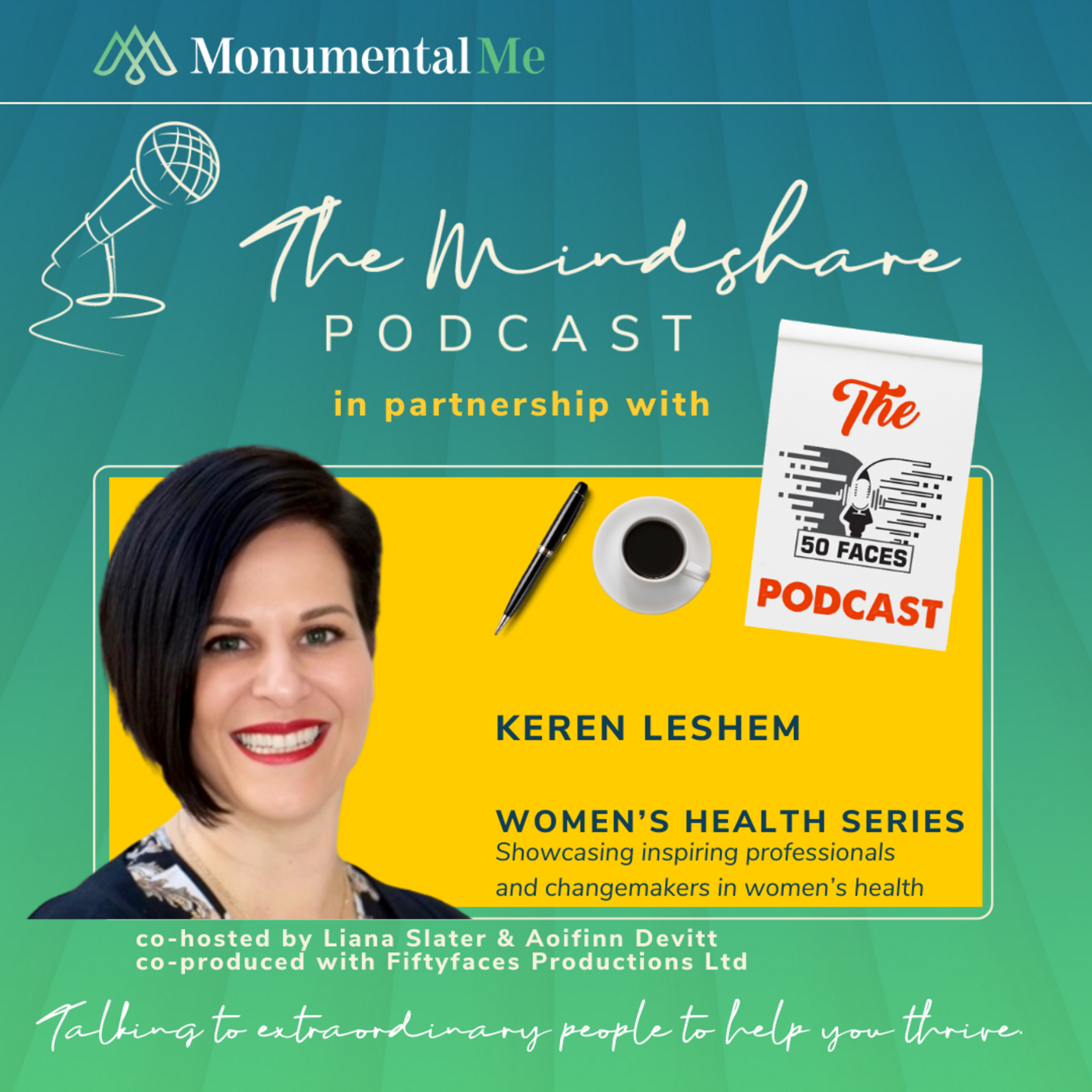
Aoifinn Devitt: Welcome to the second collaboration between Monumental Me and 50 Faces Productions. Monumental Me and the Mindshare Podcast help women access the tools needed to thrive in life and in work. 50 Faces Productions and the 50 Faces Podcast are dedicated to showcasing inspiring people and their career journeys. This series captures key insights and current trends from women dedicated to innovation and discovery in women’s health in particular, as well as in healthcare more broadly. Focusing on women in healthcare, wellness, and health tech, we hear about the funding gaps, technological advances, and awareness campaigns that are bringing this issue out of the shadows and into improving lives. I’m Aoifinn Devitt, and welcome to the 50 Faces Podcast, a podcast committed to revealing the richness and diversity of people in medicine and science by focusing on those people and their stories. I’m joined today by Karen Leshem, who is Chief Executive Officer at Ocon Therapeutics, which develops innovative and safe intrauterine medical solutions inspired by women’s bodies and anatomy. She’s also a board director at Astevix and was recently awarded Best Women’s Health Tech CEO 2023 in the Global CEO Excellence Awards. She holds a number of other board roles and in 2022 was a tech pioneer at the World Economic Forum and is a mentor within the 8400 Health Network, Welcome, Karen. Thanks for joining me today.
Keren Leshem: Thank you for having me.
Aoifinn Devitt: Let’s start by talking a bit about your background. Where did you grow up? What did you study? And how did you first become interested in healthcare and technology?
Keren Leshem: So I grew up in the US to parents from Israel, and I moved back at the age of 18. I was back and forth. I did my master’s finally in business, so I have an MBA from Clark University in the United States. I wasn’t really sure what I was going to do when I grow up. I’m still not sure. So that kind of led me to tech. I didn’t start off in health technology. It was more in high tech, but circumstances led me to do what I like to do, which is healthcare. And I did a lot of years in ophthalmology, and now I’m in women’s health, which is great.
Aoifinn Devitt: And I always think about certainly startups and, you know, we find our niche where there is a problem that needs to be solved, or perhaps an area that’s under-resourced or something not being met. What was the gap that you perceived that led you into women’s health?
Keren Leshem: Well, you know, I don’t have a romantic story about women’s health. A lot of founders and entrepreneurs and CEOs that are women want to solve their own issues. I stumbled across Oakcon. It was my first time to even understand that this could be an extremely interesting, important market. When I joined Ocon, I firstly joined as a vice president, business development and sales. I later turned CEO and we restarted the company and we did a whole what I call a restart-up, looking at women’s anatomy, the health of women. You know, as a mother to children, I’ve never had any issues with bringing them into the world. And so I saw that this is such an underdeserved, underfunded area. And I knew that, you know, we need to do better and help that. And so I became in love with it as I learned about the lack of research, the lack of clinical studies, the lack of options. And as I grow older and older, the lack of information and knowledge, it’s just a bit discouraging. But we’re building this community, which is great, and I get to be part of it. So I feel very privileged.
Aoifinn Devitt: You know, and we’re actually, we’re gonna discuss a little bit about that later, but I think what’s interesting, it is, I suppose it’s, it’s a good thing that you haven’t had a personal experience that has led you to that. That means you’re healthy and that we’re one of the lucky ones. And I consider myself also one of the lucky ones. And I think the surprising thing is how binary it can be. I mean, I’ve had 9 children with no problems and thank goodness for that. But I think when you see just how so many women can have no problems and some women can have problems from the very beginning, And these are clearly the high-risk women that the medical industry and the healthcare industry needs to be watching from day one because they are far more likely to have a bad outcome. That binary nature of it, I think, means that some of us can sort of exist in blissful ignorance about what some of our fellow women are going through because our experience is so different. So I, I think it is notable that there is that divide. It seems to be all or nothing in some cases. And I’d love to ask you, given your focus on some of the intrauterine delivery, what exactly excites you today about some of these innovative technologies that you’re working on?
Keren Leshem: So part of my growing and learning process in women’s health is the lack of options, all the way from contraception to diseases that are so prevalent. If you look at any women’s health condition pathology, there’s no one cancer that even comes closer to the amount of population that it kind of carries. So we’re talking 1 in 3 women that suffer from heavy menstrual bleeding. We’re talking about 1 in 10 that suffer from endometriosis, even though today it’s even believed to be 1 in 6. We’re talking about 7 out of 10 women that will have a fibroid, a uterine fibroid by the age of 50, 8 out of 10 women of color. These are insane numbers, population numbers, not just in women’s health, if you look at the entire population. And so looking at the options that that we have, we’re doomed to either take these oral pills that have these horrific systemic side effects. How can you avoid side effects when you have to swallow these medications? Or the other option we have is surgery. We have to literally go into the hospital and either get this invasive, aggressive surgery or get our uteruses removed. Why? There’s a reason they’re there. It’s there and we should try to hold on and keep it. It also has, you know, a lot to do with our mental health. And so having the ability to take medicines we know work, some better, some worse. But to do research specifically on women, to bring those medicines directly to where they need to be in the uterus is incredible, right? And we are able to do that on a device that fits our anatomy. Finally, something that was designed to be soft, to be round, to not have any edges, not to be made of plastic that can break or twist or turn. And so you have this incredible technology that is able to deliver drugs in a safe manner. It’s been validated. And so this is super exciting because now we have all these diseases that are so prevalent that we can fix by having the woman go in the community into the doctor’s office and to get treated once in a while and not a daily dose of oral treatment or a very aggressive hospital procedure. So that to you me, know, makes all the difference. And I’m a customer of our products. I’ve used our first product, which is a non-hormonal contraception, for over 3 years. I’m still at the age where that could happen to me. And the other products in the pipeline, as I age and as I you see, know, these conditions that evolve, such as heavy menstrual bleeding, etc., I’m a perfect customer for these products as well. So it’s really funny to see, you know, you work at it, but you’re also You’re looking forward to it.
Aoifinn Devitt: That’s a test market. But I’d love to say, on your backdrop there, you have 4 products: IUB, SEAD, Prima, Adira, and Stella. Just to get into the weeds a little, what do they treat, or what are they for? What does IUB stand for?
Keren Leshem: Yeah, the SEAD stands for spherical endometrial ablation drug or device, and it treats, or it’s supposed to be treating, 1 in 3 women that suffer from heavy bleeding for all kinds of reasons. For the reasons for the seed will be non-structural reasons, right? Something that’s not physically in the cavity. And these women are subject to hormones, hormones, hormones, hormones, or an invasive procedure in the hospital. This is really a revolutionary product because it’s a 30-minute quick in-out procedure where basically these beads, these orange beads, they melt into a paste and they remove the thick lining or endometrium that bleeds every month. And women come out of this quick procedure, there’s no need for sedation, there’s no need for a hospital setting, it’s just in the community. And we’ve seen in our clinical studies over 70% drop in bleeding. This is huge in terms of lifestyle, huge in terms of anemia, and it doesn’t require hormones, it doesn’t require follow-on, and it doesn’t require surgery. So that’s really revolutionary. The Prima is a hormonal version to treat abnormal bleeding. So this is when you have structural issues. The ADIRA would treat uterine fibroids, so it would shrink the fibroids in the uterus itself. And the STELLA is for endometriosis. We will take an active ingredient to make sure that the lining itself is so thin that it doesn’t continue to travel or grow in other parts of the body outside of the uterus.
Aoifinn Devitt: And IUB Seed, what does the IUB part stand for?
Keren Leshem: Intrauterine ball.
Aoifinn Devitt: Now we know. So just broadly, given you clearly now are focused on some of these innovations, innovative deliveries, addressing in a, I suppose, as a least obstructive way as possible some of these issues that are so common and not well talked about. I think many of these issues you mentioned, the hormones, the heavy bleeding that can all come with menopause or perimenopause. Now that you said you didn’t start out in women’s health, but now that’s where you reside professionally, what would you say is the current state of investment in it? Awareness in it, visibility, and just interest maybe by investors and the investor base generally of supporting these solutions.
Keren Leshem: People always ask me, how long have you been at Ocon? And I say 4 years and 10 kilos because it’s so hard. I’ve never had such a hard time fundraising. I’ve been fundraising, I think, most of my career for many different indications, not specifically in women’s health. It’s been a very, very difficult ride. I think that there are a lot of smaller funds and smaller checks that want to support women’s health, but there’s not, you know, big money and big advancements. And I think it’s now becoming a lot more discussed and a lot more talked about. There’s a lot more money being funneled towards women’s health, but it’s still very, very young in terms of a marketplace. There hasn’t been huge exits yet. There hasn’t been a lot of return on investment for investors in the space. So it’s growing. I’ve seen a huge change. You know, 4 years ago when I said women’s health, women’s what? Is that, is that a category? And today they don’t ask if it’s a category. Everybody knows it’s a category. So there’s been an advancement because we are a biotech. We deal with drugs and drug regulatory routes. This is not inexpensive. These are expensive hobbies. And so we require a lot of funding to do these clinical studies on women to make sure that they come to market. And so I see it shift. I see that there’s more willingness to discuss women’s health. I see a lot of women in VC that step forward and want to do these investments. Unfortunately, this area is very convoluted. There’s a lot of sex tech and femtech and women’s health, and it kind of all comes together. Some of it is very science-oriented, like Ocon. Some of it is less science-oriented. Some of it doesn’t require regulatory approvals like certain tampons. But on the other hand, others require rigorous. And so there’s a lot of mix and match. And I hope this will come to more of an order later on as we grow and progress this industry and we have some successes. With the things that we’re doing. At the end of the day, we wanna make sure that doctors have options to offer women, not just the traditional hormones and IUDs that are stick-shaped and surgeries. This also gives doctors the ability to be a lot more innovative and have more options for them also to make money. You know, we shouldn’t exclude that. And of course, the choice for women and for payers, these are a lot less expensive than a daily kind of compliant needed pill. I’m very optimistic about this market and future, but there’s still a ways to go.
Aoifinn Devitt: It’s interesting, we definitely have come a long way. I think it’s as, you know, celebrities, as other female advocates have come of age and hit perimenopause and menopause themselves, they’re now speaking about it more openly. It’s even at younger women who are maybe sports stars who are dealing with performing at a high level while they have their period, for example, and expressing openly, admitting that and the drain it can place on them physically. So I think we’ve definitely taken discussion of this out of the shadows. I’m sure it’s not something most people are 100% comfortable discussing. It still seems perhaps too intimate, but I think we’ve probably come a long way. We have a long way still to go. And I’d love to ask, given the board roles you have, given that the roles you’ve had, say, at areas like the World Economic Forum, what is the sort of the level of discussion at those levels and what do you bring to your board roles?
Keren Leshem: So I think there’s a lot of discussion in those areas such as the World Economic Forum more on policies. And really trying to map out where the opportunities are and where the biggest needs are, not just in third world countries where obviously access to healthcare is hard for anyone, especially for women, but you also, know, in Western countries. Where are the biggest opportunities? Where are the biggest pitfalls? Where do we need to put most of the investment, most of the push? We’re done just talking about mommies and babies. There’s a woman here that is a woman before she becomes a mother and is a woman after she becomes a mother or not. And so I think those organizations, they discuss more policy and discuss a little bit more what the opportunities are. On the specific board roles, I think that it’s important for people like me that own a very strong network to come and exploit that network in other ways. And that’s exactly what I do with the KOLs and the investors, you know, and the other board members. I’m able to bring that to those board roles to really help push more women’s health forward. And I always say that if we help each other, we all move forward. This will grow the market and we’ll all be successful. If we kind of build our own silo and stay in our own positions, it’s not going to help this industry grow and be more successful. And so I really believe we have to help each other. And I set that as a strategy that I’m now part of your network. Use me as you please. LinkedIn is a great way to start. Who am I connected to? Who would you like to be connected to? So I keep saying that to any entrepreneur, any investor, any woman trying to do anything in this space so that we can all come together and look at really good ideas and bring them forward, get them financed and get them going.
Aoifinn Devitt: Well, it’s great. It was the wonderful Maura Rosenfeld, I think, that was our connection in common. And yes, exactly that. I mean, this is exactly where unfortunately it is still marginal in terms of fundraising and awareness building, women’s health. And I think therefore advocates like yourself, powerful advocates like Maura as well, that’s exactly where we need to go. And LinkedIn is a perfect vehicle for this because this is a global problem. And I would just refer back also to the fact that in the SDGs, women and girls are highlighted there, gender equality, as well as much of the health-related goals there. But I do know that at least at a global level, these are aspirational goals. Let’s return to some personal reflections now. So you’re clearly in a very, I suppose, highly charged role right now as you raise capital and are at the forefront of some of this innovation. What are some of the ups and downs of your career to date and any lessons learned from any of those setbacks?
Keren Leshem: Do we have like 3, 4 hours? I’m very good at complaining, let me tell you. It’s everywhere. It’s just in every single path you take. If it’s regulatory, if it’s finance, if it’s R&D, if it’s clinical studies. I mean, every single rock you turn has its own fun, fun, fun. I can tell you that I’ve decided I’m going to do a TED Talk at some point after all this is done about the hurdles we had to go through, you know, with such great, you know, tech. So we have great validated technology. And even then, how much you have to go through, even from within your own team and your own board. It’s such a roller coaster. It’s such a roller coaster. And especially, you know, with the geopolitical situation that’s going on, COVID hit us a couple of years ago. It’s just been extremely difficult to get, you know, teams on the ground to do our clinical studies, to do our regulatory, to make sure we’re there where it’s needed, key opinion leaders really make sure that we have our commercial product out in the market. It’s just been an insane ride. So in every rock you turn, you find something that you gain another 7 kilos due to that.
Aoifinn Devitt: How do you stay on the train then, or on that roller coaster? What is it that drives you, I suppose, to stay the course? And where does that resilience come from?
Keren Leshem: A lot of carbs. Actually, it’s funny because they always say that the CEO position is such a lonely position, but for me, it’s my team. I have such an incredible team. We’re so passionate about what we do. We love the products that we kind of push forward. And my investors, I got to tell you, these are people that I admire, that regardless of the fact that this is not a known industry and regardless of the fact that this is hard and it will take time, they put their money, they put their money on me and on my team and on these products. And so that’s really what keeps me going. And of course, I have a daughter and I have a sister and I have friends and family. I want to make sure that we have better options. I don’t want to hear women just complaining about the fact that they don’t know what to do or they haven’t heard of anything new or that the doctors have nothing to offer. It’s a mix of things that give me my motivation to make sure that this comes to fruition. I want to see these products on the market. That’s the most important thing to me. And I want to make sure that they return the investment that was made and make sure that the team does this with passion together with me as we go through the motions.
Aoifinn Devitt: Well, remarkable as it is to see your resilience, and I’m so thankful for it, it is still kind of sad that it is such a set of hurdles because I’m sure there are many out there who would have products like yours or other products that are needed that don’t stay the course or that are dissuaded from the lack of fundraising or that never see the light of day. So that’s, I think, the real shame is that the ecosystem is not more welcoming around this type of massive risk that has to be taken to even make something like this. Speaking of the ecosystem, any role models or key people who were influential to you along this journey?
Keren Leshem: I thought about that and I have a few. Of course, I mentor and I always say that I have mentors. So yes, of course. And it’s been since I was much younger, but I think the one biggest role model for me was my grandfather, my mother’s father. He is a Polish Holocaust survivor, and he went all the way through concentration camps, came to Israel, had a beautiful family which had a beautiful family which had a beautiful family. And really his resilience and his love of life, I think, kind of stuck with me, with my kids. So he’s my biggest role model. He passed away at the age of almost 100 and just was a lovely man. And so I think he’s the one that I always look up to and say, wow, he went through, you know, his resilience is nothing compared to what we need to live through.
Aoifinn Devitt: So, oh, I’m sure he would be very proud. And now when you think about the words of wisdom or creed or motto that you have gathered over the years, anything you can leave us with there?
Keren Leshem: I think with everyone it’s different, and every day is different, and the situation today, especially on our side of the world, is very, very difficult. But I think that the most important thing is to really be thankful. Just be thankful. And, you know, if that can be accompanied with a smile that makes people around you feel welcome, feel safe, feel comfortable, I always recommend that over ego and over anything else. And so just thankful with a smile would, you know, go a long way.
Aoifinn Devitt: Well, Karen, anyone who’s listening to this can see how many times you smiled through this discussion, but it has been nonstop radiance across the screen that I’ve seen. And I’d say that as well as your deep commitment to this area of women’s health, the fact that these products are needed, are accessible, are easy, and I think are ultimately aimed to eliminate some of the friction for which in women’s lives there is much friction at all stages. So anything that is supposed to make that easier and is addressing head-on problems that sometimes get pushed into the shadows or that don’t get the right attention. So thank you so much for your commitment, for your amazing presence on LinkedIn, your enthusiasm, your drive, and all that resilience. If it did come from your grandfather, thank you for that. Thank you for coming here and sharing your insights with us.
Keren Leshem: Thank you.
Aoifinn Devitt: Thank you for listening to this podcast made in collaboration with Monumental Me and 50 Faces Productions. If you liked what you heard and would like to tune in to hear more inspiring professionals and their personal journeys, please subscribe on Apple Podcasts or wherever you get your podcast. This podcast is for informational purposes only and should not be construed as investment advice, and all views are personal and should not be attributed to the organizations and affiliations of the host or any guest.
Aoifinn Devitt: Welcome to the second collaboration between Monumental Me and 50 Faces Productions. Monumental Me and the Mindshare Podcast help women access the tools needed to thrive in life and in work. 50 Faces Productions and the 50 Faces Podcast are dedicated to showcasing inspiring people and their career journeys. This series captures key insights and current trends from women dedicated to innovation and discovery in women’s health in particular, as well as in healthcare more broadly. Focusing on women in healthcare, wellness, and health tech, we hear about the funding gaps, technological advances, and awareness campaigns that are bringing this issue out of the shadows and into improving lives. I’m Aoifinn Devitt, and welcome to the 50 Faces Podcast, a podcast committed to revealing the richness and diversity of people in medicine and science by focusing on those people and their stories. I’m joined today by Karen Leshem, who is Chief Executive Officer at Ocon Therapeutics, which develops innovative and safe intrauterine medical solutions inspired by women’s bodies and anatomy. She’s also a board director at Astevix and was recently awarded Best Women’s Health Tech CEO 2023 in the Global CEO Excellence Awards. She holds a number of other board roles and in 2022 was a tech pioneer at the World Economic Forum and is a mentor within the 8400 Health Network, Welcome, Karen. Thanks for joining me today.
Keren Leshem: Thank you for having me.
Aoifinn Devitt: Let’s start by talking a bit about your background. Where did you grow up? What did you study? And how did you first become interested in healthcare and technology?
Keren Leshem: So I grew up in the US to parents from Israel, and I moved back at the age of 18. I was back and forth. I did my master’s finally in business, so I have an MBA from Clark University in the United States. I wasn’t really sure what I was going to do when I grow up. I’m still not sure. So that kind of led me to tech. I didn’t start off in health technology. It was more in high tech, but circumstances led me to do what I like to do, which is healthcare. And I did a lot of years in ophthalmology, and now I’m in women’s health, which is great.
Aoifinn Devitt: And I always think about certainly startups and, you know, we find our niche where there is a problem that needs to be solved, or perhaps an area that’s under-resourced or something not being met. What was the gap that you perceived that led you into women’s health?
Keren Leshem: Well, you know, I don’t have a romantic story about women’s health. A lot of founders and entrepreneurs and CEOs that are women want to solve their own issues. I stumbled across Oakcon. It was my first time to even understand that this could be an extremely interesting, important market. When I joined Ocon, I firstly joined as a vice president, business development and sales. I later turned CEO and we restarted the company and we did a whole what I call a restart-up, looking at women’s anatomy, the health of women. You know, as a mother to children, I’ve never had any issues with bringing them into the world. And so I saw that this is such an underdeserved, underfunded area. And I knew that, you know, we need to do better and help that. And so I became in love with it as I learned about the lack of research, the lack of clinical studies, the lack of options. And as I grow older and older, the lack of information and knowledge, it’s just a bit discouraging. But we’re building this community, which is great, and I get to be part of it. So I feel very privileged.
Aoifinn Devitt: You know, and we’re actually, we’re gonna discuss a little bit about that later, but I think what’s interesting, it is, I suppose it’s, it’s a good thing that you haven’t had a personal experience that has led you to that. That means you’re healthy and that we’re one of the lucky ones. And I consider myself also one of the lucky ones. And I think the surprising thing is how binary it can be. I mean, I’ve had 9 children with no problems and thank goodness for that. But I think when you see just how so many women can have no problems and some women can have problems from the very beginning, And these are clearly the high-risk women that the medical industry and the healthcare industry needs to be watching from day one because they are far more likely to have a bad outcome. That binary nature of it, I think, means that some of us can sort of exist in blissful ignorance about what some of our fellow women are going through because our experience is so different. So I, I think it is notable that there is that divide. It seems to be all or nothing in some cases. And I’d love to ask you, given your focus on some of the intrauterine delivery, what exactly excites you today about some of these innovative technologies that you’re working on?
Keren Leshem: So part of my growing and learning process in women’s health is the lack of options, all the way from contraception to diseases that are so prevalent. If you look at any women’s health condition pathology, there’s no one cancer that even comes closer to the amount of population that it kind of carries. So we’re talking 1 in 3 women that suffer from heavy menstrual bleeding. We’re talking about 1 in 10 that suffer from endometriosis, even though today it’s even believed to be 1 in 6. We’re talking about 7 out of 10 women that will have a fibroid, a uterine fibroid by the age of 50, 8 out of 10 women of color. These are insane numbers, population numbers, not just in women’s health, if you look at the entire population. And so looking at the options that that we have, we’re doomed to either take these oral pills that have these horrific systemic side effects. How can you avoid side effects when you have to swallow these medications? Or the other option we have is surgery. We have to literally go into the hospital and either get this invasive, aggressive surgery or get our uteruses removed. Why? There’s a reason they’re there. It’s there and we should try to hold on and keep it. It also has, you know, a lot to do with our mental health. And so having the ability to take medicines we know work, some better, some worse. But to do research specifically on women, to bring those medicines directly to where they need to be in the uterus is incredible, right? And we are able to do that on a device that fits our anatomy. Finally, something that was designed to be soft, to be round, to not have any edges, not to be made of plastic that can break or twist or turn. And so you have this incredible technology that is able to deliver drugs in a safe manner. It’s been validated. And so this is super exciting because now we have all these diseases that are so prevalent that we can fix by having the woman go in the community into the doctor’s office and to get treated once in a while and not a daily dose of oral treatment or a very aggressive hospital procedure. So that to you me, know, makes all the difference. And I’m a customer of our products. I’ve used our first product, which is a non-hormonal contraception, for over 3 years. I’m still at the age where that could happen to me. And the other products in the pipeline, as I age and as I you see, know, these conditions that evolve, such as heavy menstrual bleeding, etc., I’m a perfect customer for these products as well. So it’s really funny to see, you know, you work at it, but you’re also You’re looking forward to it.
Aoifinn Devitt: That’s a test market. But I’d love to say, on your backdrop there, you have 4 products: IUB, SEAD, Prima, Adira, and Stella. Just to get into the weeds a little, what do they treat, or what are they for? What does IUB stand for?
Keren Leshem: Yeah, the SEAD stands for spherical endometrial ablation drug or device, and it treats, or it’s supposed to be treating, 1 in 3 women that suffer from heavy bleeding for all kinds of reasons. For the reasons for the seed will be non-structural reasons, right? Something that’s not physically in the cavity. And these women are subject to hormones, hormones, hormones, hormones, or an invasive procedure in the hospital. This is really a revolutionary product because it’s a 30-minute quick in-out procedure where basically these beads, these orange beads, they melt into a paste and they remove the thick lining or endometrium that bleeds every month. And women come out of this quick procedure, there’s no need for sedation, there’s no need for a hospital setting, it’s just in the community. And we’ve seen in our clinical studies over 70% drop in bleeding. This is huge in terms of lifestyle, huge in terms of anemia, and it doesn’t require hormones, it doesn’t require follow-on, and it doesn’t require surgery. So that’s really revolutionary. The Prima is a hormonal version to treat abnormal bleeding. So this is when you have structural issues. The ADIRA would treat uterine fibroids, so it would shrink the fibroids in the uterus itself. And the STELLA is for endometriosis. We will take an active ingredient to make sure that the lining itself is so thin that it doesn’t continue to travel or grow in other parts of the body outside of the uterus.
Aoifinn Devitt: And IUB Seed, what does the IUB part stand for?
Keren Leshem: Intrauterine ball.
Aoifinn Devitt: Now we know. So just broadly, given you clearly now are focused on some of these innovations, innovative deliveries, addressing in a, I suppose, as a least obstructive way as possible some of these issues that are so common and not well talked about. I think many of these issues you mentioned, the hormones, the heavy bleeding that can all come with menopause or perimenopause. Now that you said you didn’t start out in women’s health, but now that’s where you reside professionally, what would you say is the current state of investment in it? Awareness in it, visibility, and just interest maybe by investors and the investor base generally of supporting these solutions.
Keren Leshem: People always ask me, how long have you been at Ocon? And I say 4 years and 10 kilos because it’s so hard. I’ve never had such a hard time fundraising. I’ve been fundraising, I think, most of my career for many different indications, not specifically in women’s health. It’s been a very, very difficult ride. I think that there are a lot of smaller funds and smaller checks that want to support women’s health, but there’s not, you know, big money and big advancements. And I think it’s now becoming a lot more discussed and a lot more talked about. There’s a lot more money being funneled towards women’s health, but it’s still very, very young in terms of a marketplace. There hasn’t been huge exits yet. There hasn’t been a lot of return on investment for investors in the space. So it’s growing. I’ve seen a huge change. You know, 4 years ago when I said women’s health, women’s what? Is that, is that a category? And today they don’t ask if it’s a category. Everybody knows it’s a category. So there’s been an advancement because we are a biotech. We deal with drugs and drug regulatory routes. This is not inexpensive. These are expensive hobbies. And so we require a lot of funding to do these clinical studies on women to make sure that they come to market. And so I see it shift. I see that there’s more willingness to discuss women’s health. I see a lot of women in VC that step forward and want to do these investments. Unfortunately, this area is very convoluted. There’s a lot of sex tech and femtech and women’s health, and it kind of all comes together. Some of it is very science-oriented, like Ocon. Some of it is less science-oriented. Some of it doesn’t require regulatory approvals like certain tampons. But on the other hand, others require rigorous. And so there’s a lot of mix and match. And I hope this will come to more of an order later on as we grow and progress this industry and we have some successes. With the things that we’re doing. At the end of the day, we wanna make sure that doctors have options to offer women, not just the traditional hormones and IUDs that are stick-shaped and surgeries. This also gives doctors the ability to be a lot more innovative and have more options for them also to make money. You know, we shouldn’t exclude that. And of course, the choice for women and for payers, these are a lot less expensive than a daily kind of compliant needed pill. I’m very optimistic about this market and future, but there’s still a ways to go.
Aoifinn Devitt: It’s interesting, we definitely have come a long way. I think it’s as, you know, celebrities, as other female advocates have come of age and hit perimenopause and menopause themselves, they’re now speaking about it more openly. It’s even at younger women who are maybe sports stars who are dealing with performing at a high level while they have their period, for example, and expressing openly, admitting that and the drain it can place on them physically. So I think we’ve definitely taken discussion of this out of the shadows. I’m sure it’s not something most people are 100% comfortable discussing. It still seems perhaps too intimate, but I think we’ve probably come a long way. We have a long way still to go. And I’d love to ask, given the board roles you have, given that the roles you’ve had, say, at areas like the World Economic Forum, what is the sort of the level of discussion at those levels and what do you bring to your board roles?
Keren Leshem: So I think there’s a lot of discussion in those areas such as the World Economic Forum more on policies. And really trying to map out where the opportunities are and where the biggest needs are, not just in third world countries where obviously access to healthcare is hard for anyone, especially for women, but you also, know, in Western countries. Where are the biggest opportunities? Where are the biggest pitfalls? Where do we need to put most of the investment, most of the push? We’re done just talking about mommies and babies. There’s a woman here that is a woman before she becomes a mother and is a woman after she becomes a mother or not. And so I think those organizations, they discuss more policy and discuss a little bit more what the opportunities are. On the specific board roles, I think that it’s important for people like me that own a very strong network to come and exploit that network in other ways. And that’s exactly what I do with the KOLs and the investors, you know, and the other board members. I’m able to bring that to those board roles to really help push more women’s health forward. And I always say that if we help each other, we all move forward. This will grow the market and we’ll all be successful. If we kind of build our own silo and stay in our own positions, it’s not going to help this industry grow and be more successful. And so I really believe we have to help each other. And I set that as a strategy that I’m now part of your network. Use me as you please. LinkedIn is a great way to start. Who am I connected to? Who would you like to be connected to? So I keep saying that to any entrepreneur, any investor, any woman trying to do anything in this space so that we can all come together and look at really good ideas and bring them forward, get them financed and get them going.
Aoifinn Devitt: Well, it’s great. It was the wonderful Maura Rosenfeld, I think, that was our connection in common. And yes, exactly that. I mean, this is exactly where unfortunately it is still marginal in terms of fundraising and awareness building, women’s health. And I think therefore advocates like yourself, powerful advocates like Maura as well, that’s exactly where we need to go. And LinkedIn is a perfect vehicle for this because this is a global problem. And I would just refer back also to the fact that in the SDGs, women and girls are highlighted there, gender equality, as well as much of the health-related goals there. But I do know that at least at a global level, these are aspirational goals. Let’s return to some personal reflections now. So you’re clearly in a very, I suppose, highly charged role right now as you raise capital and are at the forefront of some of this innovation. What are some of the ups and downs of your career to date and any lessons learned from any of those setbacks?
Keren Leshem: Do we have like 3, 4 hours? I’m very good at complaining, let me tell you. It’s everywhere. It’s just in every single path you take. If it’s regulatory, if it’s finance, if it’s R&D, if it’s clinical studies. I mean, every single rock you turn has its own fun, fun, fun. I can tell you that I’ve decided I’m going to do a TED Talk at some point after all this is done about the hurdles we had to go through, you know, with such great, you know, tech. So we have great validated technology. And even then, how much you have to go through, even from within your own team and your own board. It’s such a roller coaster. It’s such a roller coaster. And especially, you know, with the geopolitical situation that’s going on, COVID hit us a couple of years ago. It’s just been extremely difficult to get, you know, teams on the ground to do our clinical studies, to do our regulatory, to make sure we’re there where it’s needed, key opinion leaders really make sure that we have our commercial product out in the market. It’s just been an insane ride. So in every rock you turn, you find something that you gain another 7 kilos due to that.
Aoifinn Devitt: How do you stay on the train then, or on that roller coaster? What is it that drives you, I suppose, to stay the course? And where does that resilience come from?
Keren Leshem: A lot of carbs. Actually, it’s funny because they always say that the CEO position is such a lonely position, but for me, it’s my team. I have such an incredible team. We’re so passionate about what we do. We love the products that we kind of push forward. And my investors, I got to tell you, these are people that I admire, that regardless of the fact that this is not a known industry and regardless of the fact that this is hard and it will take time, they put their money, they put their money on me and on my team and on these products. And so that’s really what keeps me going. And of course, I have a daughter and I have a sister and I have friends and family. I want to make sure that we have better options. I don’t want to hear women just complaining about the fact that they don’t know what to do or they haven’t heard of anything new or that the doctors have nothing to offer. It’s a mix of things that give me my motivation to make sure that this comes to fruition. I want to see these products on the market. That’s the most important thing to me. And I want to make sure that they return the investment that was made and make sure that the team does this with passion together with me as we go through the motions.
Aoifinn Devitt: Well, remarkable as it is to see your resilience, and I’m so thankful for it, it is still kind of sad that it is such a set of hurdles because I’m sure there are many out there who would have products like yours or other products that are needed that don’t stay the course or that are dissuaded from the lack of fundraising or that never see the light of day. So that’s, I think, the real shame is that the ecosystem is not more welcoming around this type of massive risk that has to be taken to even make something like this. Speaking of the ecosystem, any role models or key people who were influential to you along this journey?
Keren Leshem: I thought about that and I have a few. Of course, I mentor and I always say that I have mentors. So yes, of course. And it’s been since I was much younger, but I think the one biggest role model for me was my grandfather, my mother’s father. He is a Polish Holocaust survivor, and he went all the way through concentration camps, came to Israel, had a beautiful family which had a beautiful family which had a beautiful family. And really his resilience and his love of life, I think, kind of stuck with me, with my kids. So he’s my biggest role model. He passed away at the age of almost 100 and just was a lovely man. And so I think he’s the one that I always look up to and say, wow, he went through, you know, his resilience is nothing compared to what we need to live through.
Aoifinn Devitt: So, oh, I’m sure he would be very proud. And now when you think about the words of wisdom or creed or motto that you have gathered over the years, anything you can leave us with there?
Keren Leshem: I think with everyone it’s different, and every day is different, and the situation today, especially on our side of the world, is very, very difficult. But I think that the most important thing is to really be thankful. Just be thankful. And, you know, if that can be accompanied with a smile that makes people around you feel welcome, feel safe, feel comfortable, I always recommend that over ego and over anything else. And so just thankful with a smile would, you know, go a long way.
Aoifinn Devitt: Well, Karen, anyone who’s listening to this can see how many times you smiled through this discussion, but it has been nonstop radiance across the screen that I’ve seen. And I’d say that as well as your deep commitment to this area of women’s health, the fact that these products are needed, are accessible, are easy, and I think are ultimately aimed to eliminate some of the friction for which in women’s lives there is much friction at all stages. So anything that is supposed to make that easier and is addressing head-on problems that sometimes get pushed into the shadows or that don’t get the right attention. So thank you so much for your commitment, for your amazing presence on LinkedIn, your enthusiasm, your drive, and all that resilience. If it did come from your grandfather, thank you for that. Thank you for coming here and sharing your insights with us.
Keren Leshem: Thank you.
Aoifinn Devitt: Thank you for listening to this podcast made in collaboration with Monumental Me and 50 Faces Productions. If you liked what you heard and would like to tune in to hear more inspiring professionals and their personal journeys, please subscribe on Apple Podcasts or wherever you get your podcast. This podcast is for informational purposes only and should not be construed as investment advice, and all views are personal and should not be attributed to the organizations and affiliations of the host or any guest.