Speaker A: I just thought that if this failed, I could try something else. And I still have that mentality today, which is very much try something, do your best. If it fails, there are opportunities to learn from it and to start something new.
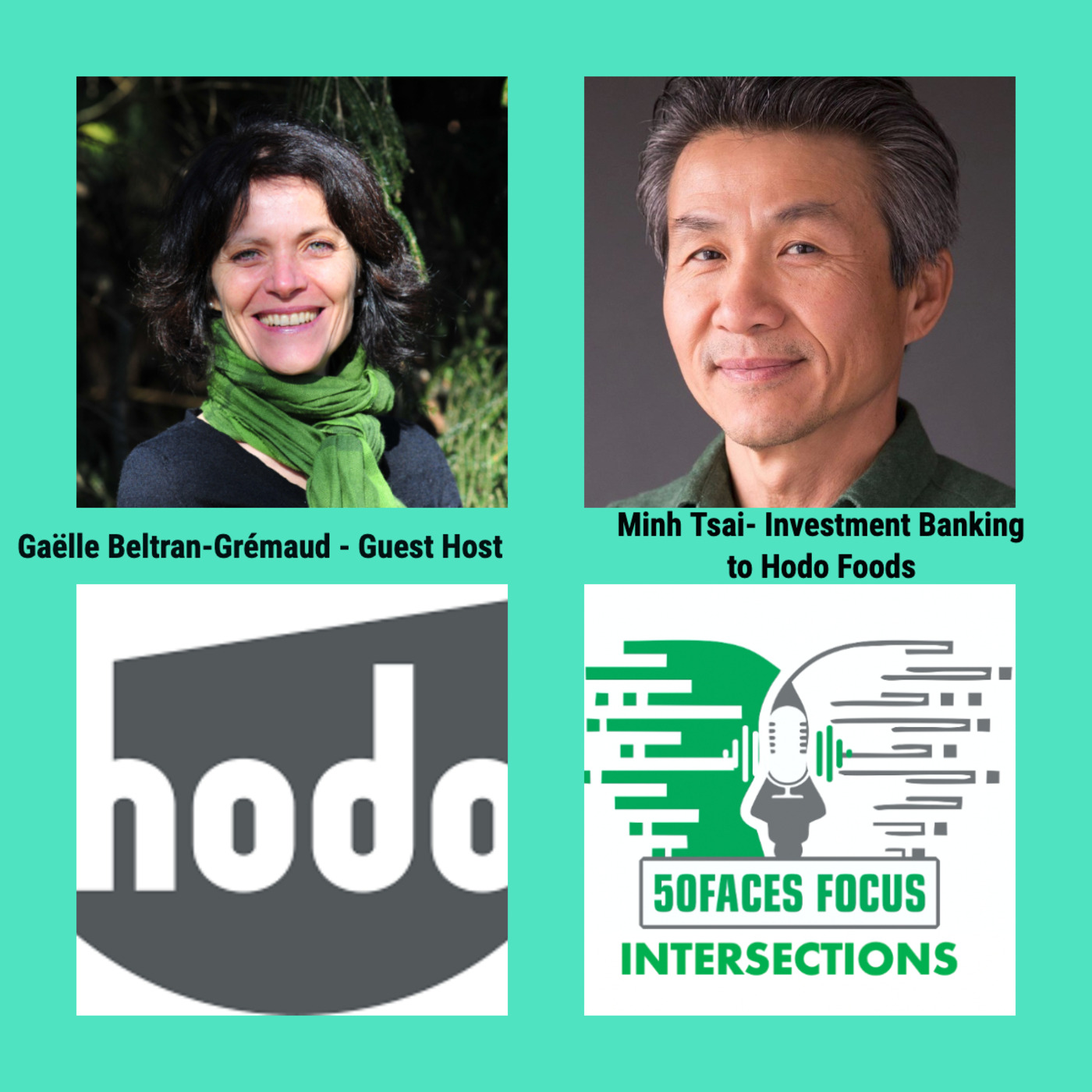
Minh Tsai: I’m Gaëlle Beltran-Gremot, a guest host of the 50 Faces Intersections podcast, founded by Aoifinn Devitt. Through this podcast, I’m hoping to share with you the stories of people who made deliberate or fortuitous career changes. I personally find it fascinating to hear about the reasons why people decide to change career, who helped them along the way, the challenges they faced and are still facing. I hope that you’ll enjoy these conversations as much as I do and get inspired. My first guest is Minh Tsai, the founder and CEO of HODO, one of the most original and sought-after plant-based brands in the US, well known for its tofu products. I have known Minh for many years when we were both working in management consulting in San Francisco. Already back then, Minh was clearly a food lover and excited to share his love for food, especially Vietnamese food, with his friends. As a former investment banker and a consultant, Minh never expected that he’d be starting and running a food company. Min simply decided to make the delicious organic artisan foods he grew up eating in Vietnam. He started with one farmer’s market stand in the San Francisco Bay Area 15 years ago. Please join me in listening to Min’s story. Good afternoon, Min. I’m so excited to have you with us today. As an introduction, maybe can we start with your background, where you grew up, how you came to the US, and how you went from finance to consulting to starting Hodo?
Speaker A: Thanks, Gael. This is really fun to talk to you. I grew up in Vietnam. I am living now in San Francisco Bay Area, and I grew up pretty much during the war in Vietnam, and I left Vietnam in 1981 as a teenager on a boat, escaping and becoming a refugee and coming here as an immigrant. So I came through that period of boat people leaving Vietnam in the late ’70s and in the ’80s. And then I got to San Francisco where I spent my formative years going to elementary, middle, and high school, and ended up going to a college in New York. And New York is where I’m exposed to big cities, to the financial world, and ended up staying in New York, working as an investment banker for JP Morgan. That was my very first job. I didn’t know what I was doing. I didn’t know what finance was, what M&A was, but fortunately I was able to learn with some great mentors and ended up doing finance for a few years. But then I got bored with finance relatively quickly. Simply because what I came to recognize is that finance is pretty much just one facet of business, and I was very curious about other parts of business, such as what else goes into a business besides the financing of it, besides taking it public, besides mergers and acquisitions. The other part that really turned me off about finance was I think there were a lot of really bright people in finance. There still are, but I think it’s really an industry driven so much by achievements and by money. And at that point in life, this is 20-odd years ago, I didn’t understand it. I came from a very modest background. Drawing a six-figure salary 20 years ago was already such an unbelievable thing. But seeing people making millions of dollars and still not satisfied with what they do, with their career, with their life, which was really something that I didn’t understand. So I left finance and ended up learning about management consulting, and that’s how you and I met, is what— through AD Little, where we worked together as a management consultant. And then that was fascinating in that It really gave me a second layer to what we know in the business world, which is more operational, more strategic, and it was really fun for me. And again, met some amazing people doing that. The long and short of all these career changes for me, from finance to management consulting to startups and all of that, after about nearly 30 years of working, I’ve come to realize that I’m probably the worst employee you can hire. In that I’m constantly in need of stimulation, in need of learning, and therefore, as an employee, I probably need a new job every couple of years, otherwise I’d be bored.
Minh Tsai: I you remember, know, when you made the move from consulting to starting Hodo. So how did you end up just choosing Hodo?
Speaker A: Yeah, it feels a long time ago, but I started Hodo, the food company, nearly 20 years ago. How I ended up there was because, having worked in finance and consulting, pretty much in the white-collar world, I realized that, at least in the U.S., we go through these economic cycles, you know, boom and bust. So I ended up starting a food business because I wanted to do something that was more recession-proof. Everyone has to eat and there are no layoffs in the food business unless of course there’s a pandemic, then it really has tremendous impact. So from a business standpoint, that’s how I ended up starting Hodo. But from a personal standpoint, I started Hodo because I’m just a lover of food and I spend all my money eating. I don’t have fancy cars or fancy clothes. So food was very much something I was curious about and interested in and experimented with I do a lot of cooking. I did a lot of cooking then. I’m still cooking a lot now. And I thought there is so many yummy foods that I can introduce to the US consumers. And I didn’t want to open a restaurant because restaurant is such hard work. So I ended up choosing Hodo, choosing tofu, plant-based foods, because there was just a gap here there was no high-quality tofu, the type of tofu that I grew up eating in Asia. So I ended up just experimenting like I do with and, everything, you know, the experiment became a viable business. And then the rest really has a lot to do with the marketplace and the demand of healthy eating and delicious eating and plant-based. So we’ve been around for almost 20 years riding this wave of consumer desire to eat better and to eat well and to eat delicious food, tapping into all my finance and consulting background and experience to really launch a business that required me to pretty much do everything from making tofu to learning about machineries, operating processes, quality assurance processes. So it’s the one job that can keep me going without having to quit or looking for a new job. Because there are so many things to do.
Minh Tsai: That’s a wonderful story. And I love the fact that you were able to take one of your passions and make it into a business. Could you maybe share with us some of the highs and lows of your experience in launching Hodo and running Hodo?
Speaker A: I think as with any business, there are lots of risks. This is something that I think about a lot. You know, I have teenage kids, but they’re very privileged. I have a lot of friends at our age who are going through sort of a midlife of sorts and trying to figure out what to do with their career, their lives. And some of them are really struggling trying to figure out what to do and answering the question of what do I want to do? I think my immigrant background really helped me take all those risks. Having left Vietnam on a boat, escaping, having seen my parents work so hard here just for minimum wage to put us through school, I think those experiences really made me think that I’m already successful even way back when I was in college, in that I’m so privileged already to have the opportunity for education. I’m so privileged to be able to learn about finance and consulting and software development. So for me, taking risks is something I’m very comfortable with. When the time came that I decided to start a food business, I knew that there were a lot of risks. My parents didn’t understand why I wanted to do it. They they were, were telling me, why, why up, give you know, such a good career path to start a startup food business? Selling at the farmers markets. And I think it all had to do with the fact that I just thought that if this failed, I could try something else. And I still have that mentality today, which is very much try something, do your best. If it fails, there are opportunities to learn from it and to start something new. I think the U.S., it’s really set up for a lot of people like that. And I think in some ways I wouldn’t call them successful people necessarily, but it really— in the US, there are many opportunities if you’re willing to take the risks. And as far as highs and lows, I think the highs for me will always be just interacting with customers, having the feedback of, wow, you know, what you make is delicious. I eat your food all the time. I’m so happy to hear that it’s in Target. It’s in Whole Foods. I can get it Chipotle. I think that feedback from individual consumers, it’s still what drives me, what makes me happy that I’ve created a food that people love. That will always be the highs for the rest of Hodo. And as far as lows, I think again, when we first started out, I had to work long hours, which I didn’t mind. But I guess among the lows is it’s the fear of losing the business, and we’ve gone through that a few times because I started the business right at one recession in 2004. And when I was ready to expand and raise money, my very first round of financing, and built a plant, a large plant to produce more products, we hit the housing market recession of ’08 and ’09 and ’10, and that was super scary because I couldn’t make payroll. I couldn’t pay my employees. That was very stressful for me. I ended up having to gather my employees to share with them that I have to let go of 50% of them, and fortunately my employees came up with a better plan, which is they were all willing to cut their hours by half so nobody needed to get laid off. And that was a testament to the culture that I didn’t know that I had built, which is one of really taking care of employees. And the business struggled for quite a few years. It was very challenging at the time. So, you know, where we are today, the success of where we are today, it’s really to be able to ride through those periods.
Minh Tsai: This is fascinating. And as you said, a great testimony to the culture that you’ve built within Hodo as a leader and of your team. Could you share with us what did you learn from some of the setbacks and challenges or even mistakes that you’ve made over your career and how that has helped you, you know, rebound in such difficult times?
Speaker A: I think life is full of setbacks and how we look at them It’s really very individual. I think for me, the idea of just getting up when you’re knocked down, it’s very much natural. You know, I grew up on the streets in Vietnam, and I get into fights for no particular reason, and you do get knocked down. Same here, you know, when I came here as an immigrant not speaking English, you get teased, you get bullied. And I would just fight back, and I get hurt, but I just don’t take it. So when it comes to business or personal life, it’s the same idea that you’re going to have setbacks. It’s what you do with the setbacks. For me, being honest about it, it’s a great way to start with setbacks, just acknowledging that that’s what they are— setbacks. It doesn’t define me as an individual. A lot of people work very, very hard and still have tons of setbacks, and it has nothing to do with whether you’re privileged or not. It’s really how you think about setbacks. When I started my business, and that moment in ’08 when we couldn’t make payroll, what I came to realize is being honest with my team and building a team that really cared about not just the business, but each other, was something that’s important. So one of the lessons coming out of that was to continue to care for people that come to work at Hodo. So we started with about a dozen people back then, and we have more than 200 plus, almost 250 people today. And that culture still exists, a culture where when I look at the workers I really look at them as friends and family. And at times that’s really hard because, you know, you don’t want to fire friends or family if things don’t work out. But I think having honest conversations and clear conversations with every single one of them during difficult times or, you know, during challenging of sort conversations really helps. And that sort of the approach I still take today with everyone, both at the professional level and at the personal level, is to face those difficult times through honest conversations. And some people can do it better than another. And I’m just, you know, I’ve gone through so much of it that I think it’s probably the best path to take for me personally, is having honest conversation with myself and with the people around me. And I think it’s the first step to get past the setbacks.
Minh Tsai: That’s a great segue with my next question, because obviously, as we heard, you have influenced and you are still influencing a lot of people around you. And so my question is, who were for you some of the key people who influenced you in your career, in life, and in what way?
Speaker A: I have a few people that I think I considered mentors and uncles or aunts or whatnot. One of the most important people that really set my path is this woman named Lois Lufborough, and this is pure serendipity. I met Lois when I was in my second year of being in the U.S. I was merely a student learning English in the ESL program in the public schools, And Lois is the founder of an organization called Summer Bridge. She happened by chance to meet me when she came to my school to recruit students for the summer program. And it was a funny story because Lois is this tall, nearly 6-foot blonde, intimidating woman. And the day that she came to my school to give the talk to recruit. I was a 6th grader, and she went to the gifted class, which is not my class. I was in the ESL class, but by chance, my teacher in the ESL class said, hey, Min, you might benefit from summer school. There’s this woman coming to give a talk about our summer school, so why don’t you just take time and go into the gifted class to see if you can pick up an application? And I went to the gifted class and there was no extra chair for me that day. So I ended up literally sitting on the floor very comfortably, right in front of Lois, looking up at her. She talked really fast about summer school, about homework. I barely understood what she was saying, but I walked out of that meeting with an application that I worked so hard to fill out. I had to look in the dictionary, get translation help. And submit it. And when I got accepted, I was thrilled because I had nothing to do during the summer. And through Summer Bridge, I was able to attend summer schools for a few summers and ended up teaching as a teacher in the program and starting a program, a Summer Bridge in Asia, in Hong Kong, that I launched and founded. And looking back, Lois and I are still great friends. We share this story because Lois has a very different story. She basically tells the world that, “Oh, you know, Minh is so brilliant,” and blah, blah, blah, blah. And I said to her, when we actually get together, I said, “Lois, you know, what did you see in me?” And she said, “You are this bright-eyed kid that pay attention to me the whole time, while the rest of the class, I wasn’t sure whether they were hearing me.” And I said, “Lois, I wasn’t paying attention to you. I was just trying hard to understand what you were saying. You were talking so fast.” And she said, “Well, I didn’t know that. I thought you really was paying attention. That’s why we took you in.” And it just goes to show that luck plays a huge role, and I was at the right place at the right time. And Lois continued to mentor me throughout my life, even to this day. And again, she was very honest. To me from day one. She said, hey, you know, you’re going to be behind because I thought you were in the gifted class and you were a gifted student in my program, but you weren’t. So you’re just going to have to work harder and I’m going to help you and I’m going to help you along the way, but you have to put in the work. And I think part of that, it’s really related to these honest conversations. And, and she was very clear. She said, You know, because all of us were public school kids and she wanted us to go to really good colleges. So she, she pretty much continued to mentor not just myself but thousands of other kids in a very similar fashion, which is she demands excellence and she will help you achieve it through a lot of So, mentorships. You know, I’ll stop there because certainly probably the greatest influence on me is probably Lois.
Minh Tsai: And I love the fact that you’re sharing that with us. And that’s, again, it’s all about, you know, having great conversation and trusting people and willing to, wanting to actually help some of them as we move along in our own career and personal journey. Was there any one piece of advice that you received that made an impact on how you work or how you see the world?
Speaker A: I work a lot with people of color, with immigrants, I’ve also had the privilege to work a lot with very successful people that, you know, went to great schools and you are, know, financially very privileged. And what I really recognize in sort of seeing this entire spectrum of class and race is that we really need to put in— besides putting in the work I think we need to bring people along. When I think about Lois, I think about the work that I do and the opportunities that I got. I always think about the advice of Lois that’s proven out many times, which is you have to expect excellence from people, anybody, regardless of their background or race. You just expect the best from them. And I think that’s the first step. When you look somebody in the eye and you acknowledge them and you respect them and you expect the best from them, that’s when they come through. You don’t judge them by their colors, by their class. That’s really an honest way of looking at an individual, sort of acknowledging their humanity. So for me, I you think, know, we see so much divide in the US. And I see people walking down the street, people coming through our doors, working for us of all class and race. The best conversations I’ve ever had are the ones that you acknowledge people and you give them their humanity. They will show their true selves, their vulnerable self to you. And that’s when you really can engage with people is it’s really allowing myself to be vulnerable. And acknowledging other people’s humanity and vulnerability, and that’s when the true self will come out.
Minh Tsai: That’s a a great, great piece of advice. Thank you very much, Min. Maybe keeping advice in mind, if you reflect on your life and career, what advice would you have for your younger self? Know, You going back to those years when you were either in high school or at the university, or just starting your new job in finance in New York, you know, what advice would you have to your younger self? Or maybe also, you know, what advice do you give to your children?
Speaker A: Wow. I think your last question about what advice I would give to my kids, I think about that a lot because I feel like my kids have a very privileged life. They deserve it. They deserve all the love they can get and all the support they can get, which I didn’t have growing up just by circumstance. When I think back, and the advice I would give to myself or to my kids would be not to wear masks of who you are. Like, I remembered when I started my work in finance and in consulting, and you may remember too, Gael, when, when we met, know, you I probably came across very confident, very together, almost cocky. And to me, while I am comfortable, that was not who I was. Behind that mask of confidence and cockiness, it’s really someone who’s real and vulnerable that didn’t want to show it. I think that would be the advice that I would have given myself, you know, many years ago. And I’m not sure if I heard it back then, I would have been able to understand it or take it. But I think we have to show our vulnerability, and in my 50s, I’m able to show that so much more than in my 20s or 30s. And I think I would have been a happier person if I had shown it early on in my life. I hid it. We are in a society where confidence and coming across polished is held in high regards, and vulnerability is considered a weakness. And I didn’t want to come across weak or vulnerable back then in these white-collar, high-flying career paths. But in retrospect, I wish I had, because I think I could learn more and grow more much earlier in my life and take even more risks than I did early on.
Minh Tsai: Well, thank you, Min. But, you know, in retrospect, I think that you’ve just shown us how you actually took great risk even early in your life and early in your career. So thank you very much for sharing that with us, and we wish you all the best with the rest of your professional and personal career.
Speaker A: Thank you so much. It’s fun talking to you, and I hope to continue talking to you.
Minh Tsai: Take care, take care. Bye-bye. Bye-bye. I’m Gaëlle Beltrán-Gremot. Thank you for listening to the 50 Faces podcast. If you like what you heard and would like to hear more stories, please subscribe on Apple Podcast or wherever you get your podcasts.
Speaker A: I just thought that if this failed, I could try something else. And I still have that mentality today, which is very much try something, do your best. If it fails, there are opportunities to learn from it and to start something new.
Minh Tsai: I’m Gaëlle Beltran-Gremot, a guest host of the 50 Faces Intersections podcast, founded by Aoifinn Devitt. Through this podcast, I’m hoping to share with you the stories of people who made deliberate or fortuitous career changes. I personally find it fascinating to hear about the reasons why people decide to change career, who helped them along the way, the challenges they faced and are still facing. I hope that you’ll enjoy these conversations as much as I do and get inspired. My first guest is Minh Tsai, the founder and CEO of HODO, one of the most original and sought-after plant-based brands in the US, well known for its tofu products. I have known Minh for many years when we were both working in management consulting in San Francisco. Already back then, Minh was clearly a food lover and excited to share his love for food, especially Vietnamese food, with his friends. As a former investment banker and a consultant, Minh never expected that he’d be starting and running a food company. Min simply decided to make the delicious organic artisan foods he grew up eating in Vietnam. He started with one farmer’s market stand in the San Francisco Bay Area 15 years ago. Please join me in listening to Min’s story. Good afternoon, Min. I’m so excited to have you with us today. As an introduction, maybe can we start with your background, where you grew up, how you came to the US, and how you went from finance to consulting to starting Hodo?
Speaker A: Thanks, Gael. This is really fun to talk to you. I grew up in Vietnam. I am living now in San Francisco Bay Area, and I grew up pretty much during the war in Vietnam, and I left Vietnam in 1981 as a teenager on a boat, escaping and becoming a refugee and coming here as an immigrant. So I came through that period of boat people leaving Vietnam in the late ’70s and in the ’80s. And then I got to San Francisco where I spent my formative years going to elementary, middle, and high school, and ended up going to a college in New York. And New York is where I’m exposed to big cities, to the financial world, and ended up staying in New York, working as an investment banker for JP Morgan. That was my very first job. I didn’t know what I was doing. I didn’t know what finance was, what M&A was, but fortunately I was able to learn with some great mentors and ended up doing finance for a few years. But then I got bored with finance relatively quickly. Simply because what I came to recognize is that finance is pretty much just one facet of business, and I was very curious about other parts of business, such as what else goes into a business besides the financing of it, besides taking it public, besides mergers and acquisitions. The other part that really turned me off about finance was I think there were a lot of really bright people in finance. There still are, but I think it’s really an industry driven so much by achievements and by money. And at that point in life, this is 20-odd years ago, I didn’t understand it. I came from a very modest background. Drawing a six-figure salary 20 years ago was already such an unbelievable thing. But seeing people making millions of dollars and still not satisfied with what they do, with their career, with their life, which was really something that I didn’t understand. So I left finance and ended up learning about management consulting, and that’s how you and I met, is what— through AD Little, where we worked together as a management consultant. And then that was fascinating in that It really gave me a second layer to what we know in the business world, which is more operational, more strategic, and it was really fun for me. And again, met some amazing people doing that. The long and short of all these career changes for me, from finance to management consulting to startups and all of that, after about nearly 30 years of working, I’ve come to realize that I’m probably the worst employee you can hire. In that I’m constantly in need of stimulation, in need of learning, and therefore, as an employee, I probably need a new job every couple of years, otherwise I’d be bored.
Minh Tsai: I you remember, know, when you made the move from consulting to starting Hodo. So how did you end up just choosing Hodo?
Speaker A: Yeah, it feels a long time ago, but I started Hodo, the food company, nearly 20 years ago. How I ended up there was because, having worked in finance and consulting, pretty much in the white-collar world, I realized that, at least in the U.S., we go through these economic cycles, you know, boom and bust. So I ended up starting a food business because I wanted to do something that was more recession-proof. Everyone has to eat and there are no layoffs in the food business unless of course there’s a pandemic, then it really has tremendous impact. So from a business standpoint, that’s how I ended up starting Hodo. But from a personal standpoint, I started Hodo because I’m just a lover of food and I spend all my money eating. I don’t have fancy cars or fancy clothes. So food was very much something I was curious about and interested in and experimented with I do a lot of cooking. I did a lot of cooking then. I’m still cooking a lot now. And I thought there is so many yummy foods that I can introduce to the US consumers. And I didn’t want to open a restaurant because restaurant is such hard work. So I ended up choosing Hodo, choosing tofu, plant-based foods, because there was just a gap here there was no high-quality tofu, the type of tofu that I grew up eating in Asia. So I ended up just experimenting like I do with and, everything, you know, the experiment became a viable business. And then the rest really has a lot to do with the marketplace and the demand of healthy eating and delicious eating and plant-based. So we’ve been around for almost 20 years riding this wave of consumer desire to eat better and to eat well and to eat delicious food, tapping into all my finance and consulting background and experience to really launch a business that required me to pretty much do everything from making tofu to learning about machineries, operating processes, quality assurance processes. So it’s the one job that can keep me going without having to quit or looking for a new job. Because there are so many things to do.
Minh Tsai: That’s a wonderful story. And I love the fact that you were able to take one of your passions and make it into a business. Could you maybe share with us some of the highs and lows of your experience in launching Hodo and running Hodo?
Speaker A: I think as with any business, there are lots of risks. This is something that I think about a lot. You know, I have teenage kids, but they’re very privileged. I have a lot of friends at our age who are going through sort of a midlife of sorts and trying to figure out what to do with their career, their lives. And some of them are really struggling trying to figure out what to do and answering the question of what do I want to do? I think my immigrant background really helped me take all those risks. Having left Vietnam on a boat, escaping, having seen my parents work so hard here just for minimum wage to put us through school, I think those experiences really made me think that I’m already successful even way back when I was in college, in that I’m so privileged already to have the opportunity for education. I’m so privileged to be able to learn about finance and consulting and software development. So for me, taking risks is something I’m very comfortable with. When the time came that I decided to start a food business, I knew that there were a lot of risks. My parents didn’t understand why I wanted to do it. They they were, were telling me, why, why up, give you know, such a good career path to start a startup food business? Selling at the farmers markets. And I think it all had to do with the fact that I just thought that if this failed, I could try something else. And I still have that mentality today, which is very much try something, do your best. If it fails, there are opportunities to learn from it and to start something new. I think the U.S., it’s really set up for a lot of people like that. And I think in some ways I wouldn’t call them successful people necessarily, but it really— in the US, there are many opportunities if you’re willing to take the risks. And as far as highs and lows, I think the highs for me will always be just interacting with customers, having the feedback of, wow, you know, what you make is delicious. I eat your food all the time. I’m so happy to hear that it’s in Target. It’s in Whole Foods. I can get it Chipotle. I think that feedback from individual consumers, it’s still what drives me, what makes me happy that I’ve created a food that people love. That will always be the highs for the rest of Hodo. And as far as lows, I think again, when we first started out, I had to work long hours, which I didn’t mind. But I guess among the lows is it’s the fear of losing the business, and we’ve gone through that a few times because I started the business right at one recession in 2004. And when I was ready to expand and raise money, my very first round of financing, and built a plant, a large plant to produce more products, we hit the housing market recession of ’08 and ’09 and ’10, and that was super scary because I couldn’t make payroll. I couldn’t pay my employees. That was very stressful for me. I ended up having to gather my employees to share with them that I have to let go of 50% of them, and fortunately my employees came up with a better plan, which is they were all willing to cut their hours by half so nobody needed to get laid off. And that was a testament to the culture that I didn’t know that I had built, which is one of really taking care of employees. And the business struggled for quite a few years. It was very challenging at the time. So, you know, where we are today, the success of where we are today, it’s really to be able to ride through those periods.
Minh Tsai: This is fascinating. And as you said, a great testimony to the culture that you’ve built within Hodo as a leader and of your team. Could you share with us what did you learn from some of the setbacks and challenges or even mistakes that you’ve made over your career and how that has helped you, you know, rebound in such difficult times?
Speaker A: I think life is full of setbacks and how we look at them It’s really very individual. I think for me, the idea of just getting up when you’re knocked down, it’s very much natural. You know, I grew up on the streets in Vietnam, and I get into fights for no particular reason, and you do get knocked down. Same here, you know, when I came here as an immigrant not speaking English, you get teased, you get bullied. And I would just fight back, and I get hurt, but I just don’t take it. So when it comes to business or personal life, it’s the same idea that you’re going to have setbacks. It’s what you do with the setbacks. For me, being honest about it, it’s a great way to start with setbacks, just acknowledging that that’s what they are— setbacks. It doesn’t define me as an individual. A lot of people work very, very hard and still have tons of setbacks, and it has nothing to do with whether you’re privileged or not. It’s really how you think about setbacks. When I started my business, and that moment in ’08 when we couldn’t make payroll, what I came to realize is being honest with my team and building a team that really cared about not just the business, but each other, was something that’s important. So one of the lessons coming out of that was to continue to care for people that come to work at Hodo. So we started with about a dozen people back then, and we have more than 200 plus, almost 250 people today. And that culture still exists, a culture where when I look at the workers I really look at them as friends and family. And at times that’s really hard because, you know, you don’t want to fire friends or family if things don’t work out. But I think having honest conversations and clear conversations with every single one of them during difficult times or, you know, during challenging of sort conversations really helps. And that sort of the approach I still take today with everyone, both at the professional level and at the personal level, is to face those difficult times through honest conversations. And some people can do it better than another. And I’m just, you know, I’ve gone through so much of it that I think it’s probably the best path to take for me personally, is having honest conversation with myself and with the people around me. And I think it’s the first step to get past the setbacks.
Minh Tsai: That’s a great segue with my next question, because obviously, as we heard, you have influenced and you are still influencing a lot of people around you. And so my question is, who were for you some of the key people who influenced you in your career, in life, and in what way?
Speaker A: I have a few people that I think I considered mentors and uncles or aunts or whatnot. One of the most important people that really set my path is this woman named Lois Lufborough, and this is pure serendipity. I met Lois when I was in my second year of being in the U.S. I was merely a student learning English in the ESL program in the public schools, And Lois is the founder of an organization called Summer Bridge. She happened by chance to meet me when she came to my school to recruit students for the summer program. And it was a funny story because Lois is this tall, nearly 6-foot blonde, intimidating woman. And the day that she came to my school to give the talk to recruit. I was a 6th grader, and she went to the gifted class, which is not my class. I was in the ESL class, but by chance, my teacher in the ESL class said, hey, Min, you might benefit from summer school. There’s this woman coming to give a talk about our summer school, so why don’t you just take time and go into the gifted class to see if you can pick up an application? And I went to the gifted class and there was no extra chair for me that day. So I ended up literally sitting on the floor very comfortably, right in front of Lois, looking up at her. She talked really fast about summer school, about homework. I barely understood what she was saying, but I walked out of that meeting with an application that I worked so hard to fill out. I had to look in the dictionary, get translation help. And submit it. And when I got accepted, I was thrilled because I had nothing to do during the summer. And through Summer Bridge, I was able to attend summer schools for a few summers and ended up teaching as a teacher in the program and starting a program, a Summer Bridge in Asia, in Hong Kong, that I launched and founded. And looking back, Lois and I are still great friends. We share this story because Lois has a very different story. She basically tells the world that, “Oh, you know, Minh is so brilliant,” and blah, blah, blah, blah. And I said to her, when we actually get together, I said, “Lois, you know, what did you see in me?” And she said, “You are this bright-eyed kid that pay attention to me the whole time, while the rest of the class, I wasn’t sure whether they were hearing me.” And I said, “Lois, I wasn’t paying attention to you. I was just trying hard to understand what you were saying. You were talking so fast.” And she said, “Well, I didn’t know that. I thought you really was paying attention. That’s why we took you in.” And it just goes to show that luck plays a huge role, and I was at the right place at the right time. And Lois continued to mentor me throughout my life, even to this day. And again, she was very honest. To me from day one. She said, hey, you know, you’re going to be behind because I thought you were in the gifted class and you were a gifted student in my program, but you weren’t. So you’re just going to have to work harder and I’m going to help you and I’m going to help you along the way, but you have to put in the work. And I think part of that, it’s really related to these honest conversations. And, and she was very clear. She said, You know, because all of us were public school kids and she wanted us to go to really good colleges. So she, she pretty much continued to mentor not just myself but thousands of other kids in a very similar fashion, which is she demands excellence and she will help you achieve it through a lot of So, mentorships. You know, I’ll stop there because certainly probably the greatest influence on me is probably Lois.
Minh Tsai: And I love the fact that you’re sharing that with us. And that’s, again, it’s all about, you know, having great conversation and trusting people and willing to, wanting to actually help some of them as we move along in our own career and personal journey. Was there any one piece of advice that you received that made an impact on how you work or how you see the world?
Speaker A: I work a lot with people of color, with immigrants, I’ve also had the privilege to work a lot with very successful people that, you know, went to great schools and you are, know, financially very privileged. And what I really recognize in sort of seeing this entire spectrum of class and race is that we really need to put in— besides putting in the work I think we need to bring people along. When I think about Lois, I think about the work that I do and the opportunities that I got. I always think about the advice of Lois that’s proven out many times, which is you have to expect excellence from people, anybody, regardless of their background or race. You just expect the best from them. And I think that’s the first step. When you look somebody in the eye and you acknowledge them and you respect them and you expect the best from them, that’s when they come through. You don’t judge them by their colors, by their class. That’s really an honest way of looking at an individual, sort of acknowledging their humanity. So for me, I you think, know, we see so much divide in the US. And I see people walking down the street, people coming through our doors, working for us of all class and race. The best conversations I’ve ever had are the ones that you acknowledge people and you give them their humanity. They will show their true selves, their vulnerable self to you. And that’s when you really can engage with people is it’s really allowing myself to be vulnerable. And acknowledging other people’s humanity and vulnerability, and that’s when the true self will come out.
Minh Tsai: That’s a a great, great piece of advice. Thank you very much, Min. Maybe keeping advice in mind, if you reflect on your life and career, what advice would you have for your younger self? Know, You going back to those years when you were either in high school or at the university, or just starting your new job in finance in New York, you know, what advice would you have to your younger self? Or maybe also, you know, what advice do you give to your children?
Speaker A: Wow. I think your last question about what advice I would give to my kids, I think about that a lot because I feel like my kids have a very privileged life. They deserve it. They deserve all the love they can get and all the support they can get, which I didn’t have growing up just by circumstance. When I think back, and the advice I would give to myself or to my kids would be not to wear masks of who you are. Like, I remembered when I started my work in finance and in consulting, and you may remember too, Gael, when, when we met, know, you I probably came across very confident, very together, almost cocky. And to me, while I am comfortable, that was not who I was. Behind that mask of confidence and cockiness, it’s really someone who’s real and vulnerable that didn’t want to show it. I think that would be the advice that I would have given myself, you know, many years ago. And I’m not sure if I heard it back then, I would have been able to understand it or take it. But I think we have to show our vulnerability, and in my 50s, I’m able to show that so much more than in my 20s or 30s. And I think I would have been a happier person if I had shown it early on in my life. I hid it. We are in a society where confidence and coming across polished is held in high regards, and vulnerability is considered a weakness. And I didn’t want to come across weak or vulnerable back then in these white-collar, high-flying career paths. But in retrospect, I wish I had, because I think I could learn more and grow more much earlier in my life and take even more risks than I did early on.
Minh Tsai: Well, thank you, Min. But, you know, in retrospect, I think that you’ve just shown us how you actually took great risk even early in your life and early in your career. So thank you very much for sharing that with us, and we wish you all the best with the rest of your professional and personal career.
Speaker A: Thank you so much. It’s fun talking to you, and I hope to continue talking to you.
Minh Tsai: Take care, take care. Bye-bye. Bye-bye. I’m Gaëlle Beltrán-Gremot. Thank you for listening to the 50 Faces podcast. If you like what you heard and would like to hear more stories, please subscribe on Apple Podcast or wherever you get your podcasts.