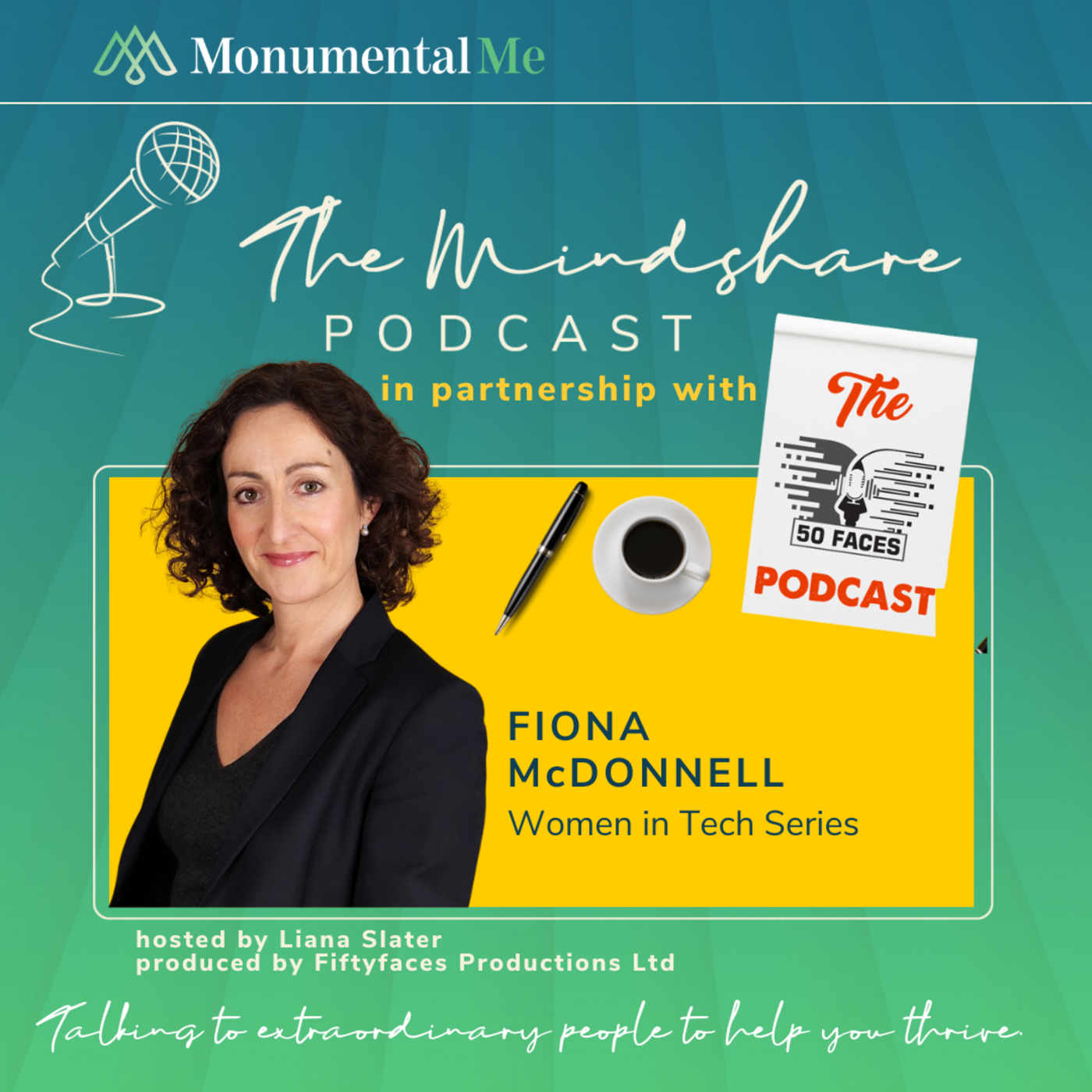
Aoifinn Devitt: This is Leanna Slater from Monumental Me and the Mindshare Podcast. I am thrilled to partner with Aoifinn Devitt and 50 Faces Productions for a new special series, Women in Tech. With women still making up about 33% of employees of major tech firms and 3% of tech startup founders, we are focused on making a difference to get more women into and to thrive in their careers in tech. And it may feel like women’s presence in business is improving, but women Women currently hold only 6% of CEO positions in the S&P 500. This is according to a new report, Women CEOs of the S&P 500 by Catalyst. This is a tiny improvement. In 2018, Harvard Business Review shared that the number of CEOs of US-based companies who were named John outnumbered the total number of women CEOs, which was 5%. So from that perspective, change is stagnant, but there’s so much we can do. Corporate leaders, investors, and education leaders, we need to ask what you’re doing to create more equity in the workplace. And note, we don’t all have to become CEOs. We’re focused on women all along their career trajectory, and there are so many ways to enjoy one’s career and to add to the diversity that makes companies more innovative, competitive, and profitable. And at Monumental Me, we work to help women develop professionally and personally. So we now join 50 Faces production to share stories and real tools for success with this special series, and We’ll be speaking with some remarkable people in and around the tech world. We can’t wait to share. Thanks for joining us. This is Leanna Slater from Monumental Me. Today I’m speaking with Fiona McDonnell. Fiona is a tech executive currently with Booking.com and formerly at Amazon and well-known consumer goods companies and more, having had an amazing business career spanning 30 years. In addition, Fiona is an author, mother, and so much more. Hear Fiona introduce her whole self and also share some nuggets with you from her book, Two Mirrors and a Cheetah. You’ll have to listen to understand what that title means and also to hear Fiona so eloquently articulate how she manages effectively and helps others to really understand who they are and what they’re capable of. So important in today’s tricky economic environment. And to assuage the fear enhanced by layoffs at some of the largest tech firms, and just important to thrive in life. Thanks for listening. Welcome, Fiona. Thank you for joining me today, and I’m so glad to have you here with us.
Fiona McDonnell: Thanks for inviting me, Leon.
Aoifinn Devitt: Fiona, I wanted to start by you telling us just a little bit about your background in technology and beyond, and really what you’re focused on today. Before we touch on a few questions that I have.
Fiona McDonnell: Yeah, so I’m, well, I’m somebody who’s been working for over 30 years, so you can just image, you know, where I’m coming from. I started my career as a freshly trained engineer. I did civil engineer very first, working in tunnels underground, but I had studied manufacturing, so I went straight into business in the world of making stuff. And so, it was sort of tech combined with air and actually doing something with that right from the beginning. And I’ve worked my way through basically large branded companies that you’d probably find in your cupboard or in the services that you use. And that’s been something that’s how I’ve chosen where I’ve worked over the years. So working with companies like Kraft and Kellogg’s and Nike, Amazon, and obviously I’m with Booking.com at the moment as VP of Commercial Operations, which we call Global Partner Services. And I say that’s me in the business world, but I’m so much more than that. And I encourage people to start with all the other things too. I’m a mom of two boys. Married to a Dutch person. I’m quite international, lived in a handful of different countries and always attempt those languages. Yeah, I like tennis and yoga and keeping fit, and I’m really passionate about trying to walk that line of being who you are but not looking like Superwoman, but nonetheless prioritizing the stuff that matters to you. And for me, that is my family, my health, the things I do, and of course the job, which I enjoy. So I suppose I call myself a right-brain engineer, left-brain marketeer, and I just put that all together.
Aoifinn Devitt: Great. I love hearing the whole picture. I think that’s so important that you’re sharing your family and your passions and staying healthy. So, thank you for sharing that. And then also, you are an author. You have written a book, Two Mirrors and a Cheetah. I want to hear about that and how that came about.
Fiona McDonnell: Yeah, so, the book in total is called Two Mirrors and a Cheetah: Think Differently, Own Your Career, and Succeed by Being Yourself. And it’s very much, I suppose, crosses the lines of looking at diversity and inclusion, but also career management. So, The idea that if you can succeed by being yourself, that’s sort of the path of least resistance, but it’s also the way to be able to understand and do a better job at being an inclusive leader. So that’s the take I’ve had on it. And it came about really as I’ve reached a slightly older age than average. I’m in a position where people want to hear about the many different jobs I’ve had in all the different companies and countries, as I’ve mentioned. And when I started putting that together in various career talks, I think it’s 2017 actually, rather than just tell people what I’d done, given there was such amount of chance in there. I wanted to make my career learnings usable or transferable for other people, because I sat in so many talks myself thinking, well, that’s lovely, but the chance of those things lining up in my life are close to zero. And I didn’t want to do that back to other people in the audience who’d come to hear me speak about what they could learn from my career. And it’s essentially put together in a way that’s super practical. It’s not a heavy-going textbook, because people are busy, and I wanted to do something different to what I had come across and stuff that’s out there to make it super easy to read and based around storytelling. And so, it’s a crazy title for a set of different views on tough topics, simply to make them palatable and easier to digest and have a go at than make them too scary and so people won’t go into the self-awareness or the looking at what’s holding us back in life. And I’d done these ideas not just for speeches, but for sort of development sessions in my years when I was at Amazon. And as the pandemic hit, I think many of us sat down and relooked at what we were doing and how we could do things differently or help. And I paused and took a year out to do a number of things, support a couple of charities I was working for, getting kids into STEM and young people into work. And I said, right, I’m going to write the book. So, I put down the job for a full year. I wasn’t actually working at the time and set about writing the book in the lockdown whilst doing those other things. And the rest is, yeah. I wouldn’t say history, but it’s out there now.
Aoifinn Devitt: It’s out there, yeah. This is super helpful. I think the topics you’ve touched on is developing your career. Self-awareness really jumps out at me. Can you just touch on self-awareness, why it could be scary, what drove you to focus on that, just your main message when you even try to help people get to talking about that topic?
Fiona McDonnell: So, when I was talking about my career, I was talking with pride about the walls which I’d run into. The school of hard knocks was definitely how I came through many of my earlier years. You know, bear in mind, I’ve got 30 years plus, there’s a lot of them to choose from. But those were moments that really shaped me. And rather than see them as poor moments where I made the mistake and learned something, I started to cherish those much more. But at the time when I was in those moments, it was often because of a lack of self-awareness that landed me in the frustration moment or the, you know, the brick wall that I talked about. And in particular, I remember a mentor of mine— I put this in the book actually— he was talking at a session I was at learning, and he said some of his hardest lessons were around learning more self-awareness. And I can literally remember sort physically squirming, going, “That’s really too touchy-feely for me, just give me the formula,” because I was impatient, I was ambitious, and I’m still ambitious, but hopefully a lot more patient over the years. And it made me realize that it’s far from being an overly self-reflective, indulgent, staring-at-the-stars thing. It is a way to actually unlock a better quality of life and feeling good for yourself and for the people that you lead. So, far from it being self-indulgent, it’s actually a necessary thing to lead in a better way and to actually start being a better manager, leader, and for other people.
Aoifinn Devitt: And this is relevant for everybody. So, I’m focused right now on women in technology, but this, obviously, you’ve had this career in consumer goods and other sectors, but do you see a difference in people that you worked with in the tech companies versus your other experiences that you’ve had?
Fiona McDonnell: Yeah, so, and I made the decision to actually move over into tech, what would be, would it be sort know, of, you be coming up to 10 years, 9 years or so. And I was missing the pace of stuff. People were talking about being digital and not going digital, and I wanted to be genuinely customer-centric rather than, again, giving lip service. Service to that. And so, that was what brought me to Amazon’s door when I approached them. But the pace in working and the sort of accepting scrappiness, if that’s the right way to describe it, of doing multiple things at the same time so that you’re guaranteed to have one thing that gets over the line, was very different to the controlled and calm sequential approach to innovation, etc., that I’d come across in FMCG, where it was much more— I suppose it’s slower, a bit more bureaucratic, and it was 1 in 10 things was a success, whereas it’s probably the same ratio since I’ve been in tech, but you’ve got hundreds of things going at any one time, and hence you move forward faster. So, enter the world of agile teams and all those sort of things. It made me have to lead in a different way. And of course, I was getting slightly older in my career, and tech was full of a lot more younger people, and it’s kept me on my toes of adapting how I lead. It’s me holding up the mirror of seeing how I can be different to what people need rather than what I want to do. Because I’m faced with completely different audiences in tech companies. And I’ve worked for two now, and they are very different. So, it’s not just all tech companies are the same, but the ability to work with data, keep things factual rather than opinions. And there’s still politics everywhere. I don’t think people say you can have a completely politic-free business, but it’s a little bit less about the politics because you can keep the conversation focused on the data, if you have that available. If that makes sense.
Aoifinn Devitt: Yes, definitely. These are all very good points that just speaking tech, non-tech like Amazon and Booking.com, very different, but they’re technology companies. But I think you’re going to get a different set of people that fast-paced, that constant uncertainty, other things that you mentioned, that just adds a whole other kind of level and pressure to people. So, that’s also why I want to hear a little bit more about these development sessions that you mentioned at Amazon. Maybe you’re even doing it now still at Booking.com or writing about it. So, in addition to self-awareness, what can people people really focus on to just keep pace with all these constant changes and uncertainty?
Fiona McDonnell: Yeah, I mean, there’s all sorts of things you learn. You start to unpack it, and the way each of us learns self-awareness is also different. I learn a huge amount by traveling, not just because I’m in a travel company, but when I look back over the years, you become resourceful, you’re forced to confront things when you are on a mountainside on your own, etc., etc. Or you could do thousands of surveys, you know, from your Myers-Briggs, your Discovery Colors, and all these personality inventories which you can do. Or you can trial and error, or you can take stretch assignments. And the availability of those different learning moments differ per company you’re in and what is a way of sort of exploring who you are, really. So, I think about all the different stuff going on, I found getting to grips and understanding these organizations hugely challenging, having been— I was a CEO in the last role prior to going in there. So, I’ve been in control of a lot of the staff, I was the expert in the field, I knew the data, metrics of the business, the financials, the industry, the relationships, and you have to really go back and be open to learning. And so, you’re no longer the expert, the industry is changing rapidly, so it’s not about being an expert, it’s about being adaptable and being able to move with the pace of learning as well as doing. And that was a real difference, and I think many of us, if I look at the industries I’m in now, they didn’t exist when I came out of university, so I could never have trained to be in them. So, that mentality of Being okay with being a constant learner is kind of humbling, but you can learn from many different areas. It’s not just upwards that you learn, you learn sideways, different teams, people under you from a hierarchical point of view. It’s a different concept of how you acquire knowledge, use knowledge, etc. And the speed is really, I suppose, a bit representative of the pace at which these industries took off. The expansion of people wanting to shop online in the last couple of years has been massive. Likewise, probably Amazon and Booking are probably a similar age, actually, but they’re completely different, and they’ve tackled their businesses in a different way. I mean to say, I don’t speak on behalf of my current employer, especially today. This is my own views. But there is no standard way for a tech company to have been structured. They’re so new that they differ so much more than maybe the P&Gs and the Unilevers, Coca-Colas, who have been there a lot longer together and may look more similar when you get inside. So, it’s being comfortable with that, it’s you being, know, aware that you can learn, and also the idea of learning from failure, seeing it as a good thing, because you test so many things, you test them to the point of failure. So, therefore, the learning comes when things fail, and you push systems to breaking. I learned that one certainly at Amazon. You wanna make a system fail so you can rapidly see what to fix to be able to scale it, as opposed to try and put your energies into things not failing, to avoid something to collapse. It was a complete reverse mentality of welcoming and learning from failure and not having blame attached to it versus maybe some of the other cultures where finding out who’d done something rather than why a thing had failed in some of the other companies I’d been in.
Aoifinn Devitt: So, these are all such important concepts, and I completely agree with you in the value of them. And I’m excited about your book because I do like how you’ve made this a very relatable topic for people because I think you can hear like, that, failure is good and that you have to bounce back and all that, But I think it takes people like you who have had experiences, who can share their experiences, storytelling aspect of it, so younger generation and cohorts can learn from that. So, yeah, have you gotten that feedback?
Fiona McDonnell: Yeah, yeah, yeah. I mean, people said literally this is a page-turner. I have some people have read this book in sort of two sessions over two days, which is just the ultimate compliment for me. I wanted it to make it a beach read, that sort of book that you don’t have to just do it once a year. Your career is an ongoing thing, and when you look at it, I normally read a novel and then a leadership book and balance them out. This is— I wanted to make it so easy to do, but also I lead with a sense of humor and I do like to take metaphors in life and see how they could be useful in a different scenario. And there’s a lot of that throughout the book. And I take inspiration from my kids who do inspire me every day, and I try not to parcel those out that are businesswoman here and mom on the other side, because some of my lightbulb moments are actually when those two things are sort of coming together. And kids tell you it as it is. So it’s not surprising that my kids can literally have a duh moment about self-belief, for example, with one of these mirrors. That makes for a great story because if a child can see it, why have we become unable to see it is where I come from. And in using stories and metaphors, I suppose it takes the pressure off people to sort of understand logic or structure. It’s just a normal person telling a normal story with things that hopefully everybody can relate to, like Snow White. And Seven Dwarfs or holding up a mirror or actually, you know, watching Top 10 Deadly Animals with your kids on the TV, which is where the cheat sheet came from originally. So it’s just trying to make it accessible because I struggled to even go near a book that talked about self-awareness because I thought that was not for me because that was— I won’t say for weak people, but when I look at how I took so many years to go near the topic well enough, I don’t think I gave it the credit that it deserves because I was busy fighting the world, and you come out of education doing exams, which are you versus the system, and then you come to a company and it’s you achieving in part of a team, and then you become a manager and it’s you achieving through people. And that sort of different reliance on other opinions, needing to be something for other people and not just for yourself, is what then forces you to look deeper to see how you can continue and improve. And if I’d done things over again, I probably would have been more honest with myself earlier in my career than just being stubborn that these things weren’t for me.
Aoifinn Devitt: But that’s the value of experience. So, and you mentioned a couple times you’re older, but that’s the value that you bring in. And we both went to the same business school. You’re an alum of INSEAD, as I am. And I came in as the poet. I love the human side of business and all of that good stuff. But I think you were absolutely not alone in feeling the way you did early in your career, like, I don’t have time for that stuff. And then you realize this is really important, especially for longevity and growth.
Fiona McDonnell: But I remember actually, I’ll say I come from a large family and I had, you know, parents who pushed me to do well in education. I don’t come from a business or, you know, very sort of gloriously high, well-off background. So I was putting in the work and education was the way through. But then I probably overrelied on that. And you get out in the business world and it’s so much more a practical world and your theory only takes you so far. It’s so much more about relationships and actually thinking in practical situations. And what led me to talk about the cheetah is that even when you do your own theory on yourself and your strengths and your weaknesses and all those other wonderful things, depending on your context and your situation, those all— those things can be next to useless. And the whole cheetah thing, we know it’s the fastest land animal, but if you put that cheetah in a concrete car park, how useful is that skill if the wildebeest is in a tin in the corner? You know, just that nuts Changing something completely on its head to sort of see the folly in the way we go about stuff is what I brought into some of these stories to give a smile to these things whilst they’re tough to learn that it’s not supposed to be all serious and life’s about enjoying things too.
Aoifinn Devitt: Absolutely. Yeah. And I love how you reference that your kids help you with that. So I have two boys as well and they definitely bring in a reality check and you have to laugh at a lot lot of, a of life. So that’s really good. Okay. So I want to bring in the element of women in technology. I still think this is an important topic, as I don’t think women have made as much progress as they should be making in reaching kind of the upper ranks of technology, getting into technology, all of that. What are your thoughts, if you have any, around that topic, women in technology?
Fiona McDonnell: I mean, I hasten to say I’m on the commercial side of tech. I can do some basic programming. I used to say I’m a woman who doesn’t code, but I’ve still since taught myself some, though, to do my own website and what have you. But I actually have never worked for a woman. I was looking back across my career and thinking, I never have. So, clearly, we can have more examples. So, I can’t give you firsthand experience of what it feels like to be directly reporting in and immediately learning from women. But I do see increasingly more of them around both of those businesses I’ve been in as peers who do things, I wouldn’t say necessarily differently, but there are some things that we share similarities, and we were naturally multitaskers. Dealing with 100 things on the go is something which, without being too stereotypical, I find I have. My mum was like that, you know, juggling the kids and the work. She was a working mum as well, and tech’s about juggling 1,000 things. So, there’s some sort of things which maybe help us naturally to do these things. But when it comes down to the content of a job, I normally think it’s about everybody is equal, you know, whether it’s a woman leadership or another sort of, you know, minority group leading. I don’t tend to look at them as separate things. I do see it as a leader, but I’ve only seen many male examples above me and around me, and it’s very easy to see the stereotypes that people talk about in terms of the assertive is completely fine when you’re a man and it’s not if you’re a woman. And I’ve had some of these feedbacks that say— one of them was, I wouldn’t like you if you were a man. Not very useful to me, but there’s something in there. It’s only means, but they’re unable to articulate it in a way that actually gives me something which I can work with. So I’m all for more varied types of leadership, whether that’s female, yes, and others. But I’m careful not to actually quantify what I think female leadership is because I lead as myself, not as a woman per se. I only know how to lead as me because I am just a woman. But 10, 15 years ago, I led as what I thought a successful businesswoman should be. And therefore I looked to lean in and copy what I thought it was in terms of the way I dressed, the way I showed up, as opposed to just chilling out and being myself about it. And I suppose within the tech orgs I’ve been in, there’s a little bit more of a relaxed environment in terms of whether it’s your dress code or your ping pong sort of culture, etc. But that doesn’t necessarily translate into being any more relaxed as a leader. So, it’s not necessarily different from the environment, the challenge, which I felt as a woman trying to lead in some of the other larger companies which I’ve worked at.
Aoifinn Devitt: Okay, so authenticity at work. So, this is related to that, and you definitely bring that up in your book, and being yourself. So, I think this is a gender-neutral topic, but you tell us a little bit about your take and how people can be more of themselves at work and the value behind that.
Fiona McDonnell: Yeah, and I think what stopped me from being myself was trying to live up to other people’s expectations. And the idea that success is what somebody else defines is where I draw a line. So, in terms of being honest with yourself, what does being yourself mean? Well, it’s living according to values whilst achieving your goals in life is my take on it, rather than living somebody else’s goals and adhering to other people’s values. But of course, doing it in a way that isn’t disrespectful of others and actually doesn’t look for toes to tread on, and with the recognizing that not all situations will work for you once you’ve discovered how you like to work and why, etc., and being flexible to change. So it’s about— if I was to sort of say, what is a formula to bring yourself to work, which is again when these two mirrors and a cheetah came in— understanding who you are through many in many different dimensions, whether that’s the skills you bring, the passions you have, the sort of styles and environments you work in, or indeed the impact you have on people and they have on you, importantly. Understanding that full thing and then understanding why it is that you’re not able to be that person, if that’s the case. And it comes down to things like lack of confidence or this fear of failure we talked about, or simply going along with habits you no longer or don’t even realize you’re carrying with you, things we grow up with without challenging. And I joke about ironing,. Because I used to iron for countless hours as a kid because that’s what my parents wanted. But I don’t bother with that now because I’m not fussed about my kids’ clothes being a bit crumpled. But some people— or my sheets, for that matter— some people still iron those things because it matters to them. And so breaking away and recognizing, being honest with yourself where you do these things, is a huge enabler to go, I don’t want to do these anymore. And then put that together with, as I said, recognizing that different situations work to your strengths or your desired way of working and others don’t, and not seeing that as a personal failure rather than a context challenge gives you an enormous power to go, well, I’m going to change that because it’s in my control to do so. And so that’s what I mean is the value of doing it. When you’re able to be yourself, you can pick and choose where it’s not working and you recognize the own frustrations in yourself of when something’s not being true to you, whether it’s a headache or a backache or just something that bugs you. When we’re really honest that it’s something we holding ourselves back to, we can then open the door and sort of go and change it. And that’s, to me, the real difference is doing it because it’s your choice, not because it’s somebody else’s choice. And seeing that quite often we are our own worst critics, that when you stand in front of a mirror, it should be your reflection and your voice that you hear and not other people’s.
Aoifinn Devitt: That is very valuable advice. So where, in your opinion— and I don’t speak on behalf of your company or your previous companies, but this is a very kind of individually driven concept. And what can companies do to boost this? And maybe what is happening now where you are currently to help boost these skills within individuals to help them move ahead?
Fiona McDonnell: Yeah, I mean, if you look at it in sort of two buckets, there’s helping individuals to perform well and be content in their workplace is one side, and then there’s equipping leaders to do that and lead in responsible ways and more inclusive ways. And on the former, there’s so much organizations to do to encourage people to understand more about themselves, whether that’s your 360-degree feedback, your annual process reviews, etc., but not just limit it to strengths and weaknesses because you can go through 10 years of your career thinking that’s all that matters, as opposed to your values, where you get your energy from, particularly with all this from working from home. I miss being in the office because I get energy from people. So, just helping people understand that there’s more dimensions to them, their personality, how and where they work, than simply just these what you’re good at and what you’re not so good at and matching that to a job description. And they can do that through training, through helping people rotate through different roles. So, it’s something I do see in tech, you know, the ability to take different components to a role rather than be sort of just in a certain career track forever. We can help lots of people explore who they are without feeling that that is something overly psychological that they need to be either worried of, like the Big Brother thing. Many people don’t even like doing surveys, I’ve found. There’s large companies, they maybe think there’s a an alternative agenda in there of wanting to measure sort of things. So, actually being able to play that in a good way that is about greater employee engagement. And actually, the more our employees understand and are able to succeed at stuff, the better it is for companies. And then, in terms of the leader thing, the reason I also include this in the book, that when you go on your journey, once you discover stuff for yourself and you’re able to see what you need in a manager to work well, you can then see how other people could look at you and therefore what they need of you, what they need from a situation, and what they need from a job., and all those sort of trimmings coming together, that helps you sort of attempt the conversations, the development, the appreciation, and sort of wider perspective management in a way that starts to be really inclusive by thinking about the whole other person, thinking about what individuals need from the teams you’re in, from the environments you have them in, that it makes you a much more compassionate manager, much more able to see different points of view, which is the right way to go. For diversity as well as leading with inclusion in mind. And self-awareness then is not just for top leaders to lead a business better, it’s for all managers to cultivate the environments which we know we need. And it helps you sort of take those steps forward. So training managers on stuff rather than, as happened to me and happens to many people, when you become a manager, there’s no manual to how to do it. You tend to get given one person to kind of trial on, and if you’re good at leading, then maybe you get a second one. That sort of pivotal moment when you go from an individual contributor to being a manager It’s a big moment for people, and some people don’t succeed in it because they haven’t thought about how to carry on being successful in what was working for them on the other side of that promotion. And so, if you think about it in a different way, many more people may succeed in doing that. We may create better managers out of individuals by putting that self first. At least, that’s my hope.
Aoifinn Devitt: Yeah. I hear of managers having access to executive coaching. Seeing that too in your current company or else your peers?
Fiona McDonnell: Yes. So, it does differ depending on the company. Depending on how people want to use stuff. It also depends on quite how well internally a business is equipped, because I see a lot more of scaled learning with a lot more WebExes and these sort of consume-on-demand works for training as well. And it’s about carefully using where you have that individual interaction. I’m certainly seeing it at the moment, it’s being encouraged. I didn’t have that all the way throughout my career, whereas I sought out mentors when I felt a mentor was the right thing. Sometimes I had a sponsor. At the moment, I, I do have, well, I’m looking at a different coach, seeing as I haven’t been with this company for very long. But yeah, I’ve had exec coaches for different stages in my leadership development, depending on the type of situation. So, taking over a company that was acquired, I went in to lead as a CEO in Poland, which was one of my most favorite moments where it was like a new country, new language, completely different situation. Yeah. And it was culturally, it was personally, I had my second child there, I had a move with like a, a tote bag on one arm and a maxi-cosi on the other, relocating with a 6-month-old baby. And so of course, being able to have somebody that helps you see the clarity, that you have your sort of plan to hit the ground running and not leave stones unturned or views that you can’t see, that it was important enough to have a coach. So I use coaches for moments as opposed to continually, but I do see it a lot. But not everybody likes to lean in and do that. In my case, some people see it as What’s wrong with me if I need a coach? And others are like, yeah, I’m going to have a coach, but what should I use them for? So, yeah, it depends.
Aoifinn Devitt: Yeah. I do want to ask you this question. There are learning organizations supporting their employees on areas that you’ve touched on. Do you see any today in your world that you kind of look to as, oh, they’re doing this right?
Fiona McDonnell: I think, well, I’ll say no at the moment in the sense I’m not looking out, sort of seeing them, because I think many people are going through that real tumultuous, okay, how do we— some companies are, how do we stay afloat? You know, the last 2 or 3 years, The challenge that has almost eaten up some companies alive, that’s now with others in terms of from a pandemic. The company I’m in now, obviously, was at the— the industry kind of fell over. We didn’t know if it was going to come back. Whereas the other company I was working at the time, online was thriving. So you have this very different circle where some businesses are simply trying to stay alive. Others are, how do you grow fast enough to these sort of changing demands? And so I think the businesses are being shaped at a different pace than we’ve seen before, certainly in the tech space. Look out necessarily at some of them and think, well, that’s because they’re, you know, doing certain things for people. I do, however, see a lot more talk and use of employee engagement data without promoting. I have been an angel investor myself and still am in an employee engagement and data behind happiness company, because I do think it feels like the right thing to do. And being able to listen properly and interact with your employees at scale makes a big difference right now. Because we’re going through such changing times. But there’s the focus on all the harassment stuff that hits the news, and there’s so much stuff out there. It’s probably a wave of stuff that needs to just be stripped out from people’s perceptions rather than what’s going on. And so without being inside any of these companies, I would hesitate at this point in time to choose one and say, yeah, I think these are being great. There’s lots of good intentions that needs to translate into mechanisms, as I I’ve been used to saying over recent years, to make sure that it’s not just a flash in the pan, and that when we have real stability back, that these things don’t go back to other ways of doing. You also have such a war for talent right now that I expect companies to be leaning in and sharing what they’re doing on development and inclusivity and getting more women into tech, because it’s needed to stay in the game right now, I think.
Aoifinn Devitt: Absolutely. That’s good to hear, because that’s what I’m about uncovering. Let’s see who’s, who’s doing this well, but I’ve definitely heard nobody’s got the answer. It’s all still very exploratory right now, but it sounds like the intentions are there. So, okay, I want to ask you just a couple of personal questions to wrap this up. I’m so impressed with your background and your openness to learning and the cultural input that you’ve had from working in various countries and all of that good stuff. But I would love to hear your take on what would you say are your two main strengths for the success in your career and in sharing your, your knowledge? What are your two main strengths?
Fiona McDonnell: Yeah, it’s funny, I was thinking, how would I narrow this down to two? Because I’ve become known for being a really good communicator and storyteller, so I won’t use that, seen as I’ve written a book telling stories. But in terms of what got me into this space, I’d have to give credit to that impatient young person that I was, in the sense that not being afraid of stuff. I think I charged into opportunities because they excited me, and I saw the adventure bigger than I saw the risks, whether that’s relocating, goodness knows, 8 or whatever, 10 times, or a new language, or not overly worrying about what people thought. I had enough confidence in myself and enough appetite to thrive on the adventure, and I think that gave me opportunities. It meant that they came my way, and likewise, that I was available and up for the challenge when they came. So, I would have that one. Looking at— I am the sort of creative marketer, and there’s the engineer in there. I think where these things come together, I think I have a knack, if that’s the right word, for seeing the structure in the chaos, whether that is how to sort out a people issue in a massive organization, or whether it’s joining the dots in the data thing, I can see patterns and get rid of the noise to focus in on the message or the issue. And I use that as problem-solving or synthesis, whichever you want to call those. And that’s how I describe it. It’s whether it’s a people problem or a customer problem or a data problem, it’s problem-solving and the ability to zoom in on what the issues are.
Aoifinn Devitt: That is very valuable. I think that’s really good. It sounds to me like an engineering mindset. That’s the perfect, perfect addition to a marketing focus. So no, that’s really good. Thank you. Well, and my final question: what would you tell your 26-year-old self from where you sit today?
Fiona McDonnell: I say chill out a bit. I mean, I was so impatient for things to happen, and if they had happened straight away, I would have missed most of the valuable lessons. So it’s, it’s almost saying, you know what, the school of hard knocks is not such a bad thing. But that’s not going to be palatable to many people, unnecessarily. But I think having the patience to see what it is that needs to happen, that things will happen, but having the patience to see that. It’s the, the lack of patience I had. I would tell my 26-year-old self to just believe a little bit stronger in yourself, but add patience to the mix.
Aoifinn Devitt: Wonderful. Yeah, and you mentioned that before, that ambition versus patience.
Fiona McDonnell: So still there, but I do, I do hope I’m slightly more patient. I am with myself, at least.
Aoifinn Devitt: Yeah, well, at least knowing that the need to be patient is there, that’s half the battle.
Fiona McDonnell: So, nothing wrong with a brick wall is what I also say, and my do kids that. Yeah, so there’s nothing wrong with a dead end like that. It’s win or learn. So, excellent.
Aoifinn Devitt: All right, well, thank you so much for your time. This has been really delightful talking to you.
Fiona McDonnell: You’re most welcome. Thanks, Liana. This podcast is for informational purposes only and should not be construed as investment advice, and all views are personal and should not be attributed to the organizations and affiliations of the host or any guest.
Aoifinn Devitt: This is Leanna Slater from Monumental Me and the Mindshare Podcast. I am thrilled to partner with Aoifinn Devitt and 50 Faces Productions for a new special series, Women in Tech. With women still making up about 33% of employees of major tech firms and 3% of tech startup founders, we are focused on making a difference to get more women into and to thrive in their careers in tech. And it may feel like women’s presence in business is improving, but women Women currently hold only 6% of CEO positions in the S&P 500. This is according to a new report, Women CEOs of the S&P 500 by Catalyst. This is a tiny improvement. In 2018, Harvard Business Review shared that the number of CEOs of US-based companies who were named John outnumbered the total number of women CEOs, which was 5%. So from that perspective, change is stagnant, but there’s so much we can do. Corporate leaders, investors, and education leaders, we need to ask what you’re doing to create more equity in the workplace. And note, we don’t all have to become CEOs. We’re focused on women all along their career trajectory, and there are so many ways to enjoy one’s career and to add to the diversity that makes companies more innovative, competitive, and profitable. And at Monumental Me, we work to help women develop professionally and personally. So we now join 50 Faces production to share stories and real tools for success with this special series, and We’ll be speaking with some remarkable people in and around the tech world. We can’t wait to share. Thanks for joining us. This is Leanna Slater from Monumental Me. Today I’m speaking with Fiona McDonnell. Fiona is a tech executive currently with Booking.com and formerly at Amazon and well-known consumer goods companies and more, having had an amazing business career spanning 30 years. In addition, Fiona is an author, mother, and so much more. Hear Fiona introduce her whole self and also share some nuggets with you from her book, Two Mirrors and a Cheetah. You’ll have to listen to understand what that title means and also to hear Fiona so eloquently articulate how she manages effectively and helps others to really understand who they are and what they’re capable of. So important in today’s tricky economic environment. And to assuage the fear enhanced by layoffs at some of the largest tech firms, and just important to thrive in life. Thanks for listening. Welcome, Fiona. Thank you for joining me today, and I’m so glad to have you here with us.
Fiona McDonnell: Thanks for inviting me, Leon.
Aoifinn Devitt: Fiona, I wanted to start by you telling us just a little bit about your background in technology and beyond, and really what you’re focused on today. Before we touch on a few questions that I have.
Fiona McDonnell: Yeah, so I’m, well, I’m somebody who’s been working for over 30 years, so you can just image, you know, where I’m coming from. I started my career as a freshly trained engineer. I did civil engineer very first, working in tunnels underground, but I had studied manufacturing, so I went straight into business in the world of making stuff. And so, it was sort of tech combined with air and actually doing something with that right from the beginning. And I’ve worked my way through basically large branded companies that you’d probably find in your cupboard or in the services that you use. And that’s been something that’s how I’ve chosen where I’ve worked over the years. So working with companies like Kraft and Kellogg’s and Nike, Amazon, and obviously I’m with Booking.com at the moment as VP of Commercial Operations, which we call Global Partner Services. And I say that’s me in the business world, but I’m so much more than that. And I encourage people to start with all the other things too. I’m a mom of two boys. Married to a Dutch person. I’m quite international, lived in a handful of different countries and always attempt those languages. Yeah, I like tennis and yoga and keeping fit, and I’m really passionate about trying to walk that line of being who you are but not looking like Superwoman, but nonetheless prioritizing the stuff that matters to you. And for me, that is my family, my health, the things I do, and of course the job, which I enjoy. So I suppose I call myself a right-brain engineer, left-brain marketeer, and I just put that all together.
Aoifinn Devitt: Great. I love hearing the whole picture. I think that’s so important that you’re sharing your family and your passions and staying healthy. So, thank you for sharing that. And then also, you are an author. You have written a book, Two Mirrors and a Cheetah. I want to hear about that and how that came about.
Fiona McDonnell: Yeah, so, the book in total is called Two Mirrors and a Cheetah: Think Differently, Own Your Career, and Succeed by Being Yourself. And it’s very much, I suppose, crosses the lines of looking at diversity and inclusion, but also career management. So, The idea that if you can succeed by being yourself, that’s sort of the path of least resistance, but it’s also the way to be able to understand and do a better job at being an inclusive leader. So that’s the take I’ve had on it. And it came about really as I’ve reached a slightly older age than average. I’m in a position where people want to hear about the many different jobs I’ve had in all the different companies and countries, as I’ve mentioned. And when I started putting that together in various career talks, I think it’s 2017 actually, rather than just tell people what I’d done, given there was such amount of chance in there. I wanted to make my career learnings usable or transferable for other people, because I sat in so many talks myself thinking, well, that’s lovely, but the chance of those things lining up in my life are close to zero. And I didn’t want to do that back to other people in the audience who’d come to hear me speak about what they could learn from my career. And it’s essentially put together in a way that’s super practical. It’s not a heavy-going textbook, because people are busy, and I wanted to do something different to what I had come across and stuff that’s out there to make it super easy to read and based around storytelling. And so, it’s a crazy title for a set of different views on tough topics, simply to make them palatable and easier to digest and have a go at than make them too scary and so people won’t go into the self-awareness or the looking at what’s holding us back in life. And I’d done these ideas not just for speeches, but for sort of development sessions in my years when I was at Amazon. And as the pandemic hit, I think many of us sat down and relooked at what we were doing and how we could do things differently or help. And I paused and took a year out to do a number of things, support a couple of charities I was working for, getting kids into STEM and young people into work. And I said, right, I’m going to write the book. So, I put down the job for a full year. I wasn’t actually working at the time and set about writing the book in the lockdown whilst doing those other things. And the rest is, yeah. I wouldn’t say history, but it’s out there now.
Aoifinn Devitt: It’s out there, yeah. This is super helpful. I think the topics you’ve touched on is developing your career. Self-awareness really jumps out at me. Can you just touch on self-awareness, why it could be scary, what drove you to focus on that, just your main message when you even try to help people get to talking about that topic?
Fiona McDonnell: So, when I was talking about my career, I was talking with pride about the walls which I’d run into. The school of hard knocks was definitely how I came through many of my earlier years. You know, bear in mind, I’ve got 30 years plus, there’s a lot of them to choose from. But those were moments that really shaped me. And rather than see them as poor moments where I made the mistake and learned something, I started to cherish those much more. But at the time when I was in those moments, it was often because of a lack of self-awareness that landed me in the frustration moment or the, you know, the brick wall that I talked about. And in particular, I remember a mentor of mine— I put this in the book actually— he was talking at a session I was at learning, and he said some of his hardest lessons were around learning more self-awareness. And I can literally remember sort physically squirming, going, “That’s really too touchy-feely for me, just give me the formula,” because I was impatient, I was ambitious, and I’m still ambitious, but hopefully a lot more patient over the years. And it made me realize that it’s far from being an overly self-reflective, indulgent, staring-at-the-stars thing. It is a way to actually unlock a better quality of life and feeling good for yourself and for the people that you lead. So, far from it being self-indulgent, it’s actually a necessary thing to lead in a better way and to actually start being a better manager, leader, and for other people.
Aoifinn Devitt: And this is relevant for everybody. So, I’m focused right now on women in technology, but this, obviously, you’ve had this career in consumer goods and other sectors, but do you see a difference in people that you worked with in the tech companies versus your other experiences that you’ve had?
Fiona McDonnell: Yeah, so, and I made the decision to actually move over into tech, what would be, would it be sort know, of, you be coming up to 10 years, 9 years or so. And I was missing the pace of stuff. People were talking about being digital and not going digital, and I wanted to be genuinely customer-centric rather than, again, giving lip service. Service to that. And so, that was what brought me to Amazon’s door when I approached them. But the pace in working and the sort of accepting scrappiness, if that’s the right way to describe it, of doing multiple things at the same time so that you’re guaranteed to have one thing that gets over the line, was very different to the controlled and calm sequential approach to innovation, etc., that I’d come across in FMCG, where it was much more— I suppose it’s slower, a bit more bureaucratic, and it was 1 in 10 things was a success, whereas it’s probably the same ratio since I’ve been in tech, but you’ve got hundreds of things going at any one time, and hence you move forward faster. So, enter the world of agile teams and all those sort of things. It made me have to lead in a different way. And of course, I was getting slightly older in my career, and tech was full of a lot more younger people, and it’s kept me on my toes of adapting how I lead. It’s me holding up the mirror of seeing how I can be different to what people need rather than what I want to do. Because I’m faced with completely different audiences in tech companies. And I’ve worked for two now, and they are very different. So, it’s not just all tech companies are the same, but the ability to work with data, keep things factual rather than opinions. And there’s still politics everywhere. I don’t think people say you can have a completely politic-free business, but it’s a little bit less about the politics because you can keep the conversation focused on the data, if you have that available. If that makes sense.
Aoifinn Devitt: Yes, definitely. These are all very good points that just speaking tech, non-tech like Amazon and Booking.com, very different, but they’re technology companies. But I think you’re going to get a different set of people that fast-paced, that constant uncertainty, other things that you mentioned, that just adds a whole other kind of level and pressure to people. So, that’s also why I want to hear a little bit more about these development sessions that you mentioned at Amazon. Maybe you’re even doing it now still at Booking.com or writing about it. So, in addition to self-awareness, what can people people really focus on to just keep pace with all these constant changes and uncertainty?
Fiona McDonnell: Yeah, I mean, there’s all sorts of things you learn. You start to unpack it, and the way each of us learns self-awareness is also different. I learn a huge amount by traveling, not just because I’m in a travel company, but when I look back over the years, you become resourceful, you’re forced to confront things when you are on a mountainside on your own, etc., etc. Or you could do thousands of surveys, you know, from your Myers-Briggs, your Discovery Colors, and all these personality inventories which you can do. Or you can trial and error, or you can take stretch assignments. And the availability of those different learning moments differ per company you’re in and what is a way of sort of exploring who you are, really. So, I think about all the different stuff going on, I found getting to grips and understanding these organizations hugely challenging, having been— I was a CEO in the last role prior to going in there. So, I’ve been in control of a lot of the staff, I was the expert in the field, I knew the data, metrics of the business, the financials, the industry, the relationships, and you have to really go back and be open to learning. And so, you’re no longer the expert, the industry is changing rapidly, so it’s not about being an expert, it’s about being adaptable and being able to move with the pace of learning as well as doing. And that was a real difference, and I think many of us, if I look at the industries I’m in now, they didn’t exist when I came out of university, so I could never have trained to be in them. So, that mentality of Being okay with being a constant learner is kind of humbling, but you can learn from many different areas. It’s not just upwards that you learn, you learn sideways, different teams, people under you from a hierarchical point of view. It’s a different concept of how you acquire knowledge, use knowledge, etc. And the speed is really, I suppose, a bit representative of the pace at which these industries took off. The expansion of people wanting to shop online in the last couple of years has been massive. Likewise, probably Amazon and Booking are probably a similar age, actually, but they’re completely different, and they’ve tackled their businesses in a different way. I mean to say, I don’t speak on behalf of my current employer, especially today. This is my own views. But there is no standard way for a tech company to have been structured. They’re so new that they differ so much more than maybe the P&Gs and the Unilevers, Coca-Colas, who have been there a lot longer together and may look more similar when you get inside. So, it’s being comfortable with that, it’s you being, know, aware that you can learn, and also the idea of learning from failure, seeing it as a good thing, because you test so many things, you test them to the point of failure. So, therefore, the learning comes when things fail, and you push systems to breaking. I learned that one certainly at Amazon. You wanna make a system fail so you can rapidly see what to fix to be able to scale it, as opposed to try and put your energies into things not failing, to avoid something to collapse. It was a complete reverse mentality of welcoming and learning from failure and not having blame attached to it versus maybe some of the other cultures where finding out who’d done something rather than why a thing had failed in some of the other companies I’d been in.
Aoifinn Devitt: So, these are all such important concepts, and I completely agree with you in the value of them. And I’m excited about your book because I do like how you’ve made this a very relatable topic for people because I think you can hear like, that, failure is good and that you have to bounce back and all that, But I think it takes people like you who have had experiences, who can share their experiences, storytelling aspect of it, so younger generation and cohorts can learn from that. So, yeah, have you gotten that feedback?
Fiona McDonnell: Yeah, yeah, yeah. I mean, people said literally this is a page-turner. I have some people have read this book in sort of two sessions over two days, which is just the ultimate compliment for me. I wanted it to make it a beach read, that sort of book that you don’t have to just do it once a year. Your career is an ongoing thing, and when you look at it, I normally read a novel and then a leadership book and balance them out. This is— I wanted to make it so easy to do, but also I lead with a sense of humor and I do like to take metaphors in life and see how they could be useful in a different scenario. And there’s a lot of that throughout the book. And I take inspiration from my kids who do inspire me every day, and I try not to parcel those out that are businesswoman here and mom on the other side, because some of my lightbulb moments are actually when those two things are sort of coming together. And kids tell you it as it is. So it’s not surprising that my kids can literally have a duh moment about self-belief, for example, with one of these mirrors. That makes for a great story because if a child can see it, why have we become unable to see it is where I come from. And in using stories and metaphors, I suppose it takes the pressure off people to sort of understand logic or structure. It’s just a normal person telling a normal story with things that hopefully everybody can relate to, like Snow White. And Seven Dwarfs or holding up a mirror or actually, you know, watching Top 10 Deadly Animals with your kids on the TV, which is where the cheat sheet came from originally. So it’s just trying to make it accessible because I struggled to even go near a book that talked about self-awareness because I thought that was not for me because that was— I won’t say for weak people, but when I look at how I took so many years to go near the topic well enough, I don’t think I gave it the credit that it deserves because I was busy fighting the world, and you come out of education doing exams, which are you versus the system, and then you come to a company and it’s you achieving in part of a team, and then you become a manager and it’s you achieving through people. And that sort of different reliance on other opinions, needing to be something for other people and not just for yourself, is what then forces you to look deeper to see how you can continue and improve. And if I’d done things over again, I probably would have been more honest with myself earlier in my career than just being stubborn that these things weren’t for me.
Aoifinn Devitt: But that’s the value of experience. So, and you mentioned a couple times you’re older, but that’s the value that you bring in. And we both went to the same business school. You’re an alum of INSEAD, as I am. And I came in as the poet. I love the human side of business and all of that good stuff. But I think you were absolutely not alone in feeling the way you did early in your career, like, I don’t have time for that stuff. And then you realize this is really important, especially for longevity and growth.
Fiona McDonnell: But I remember actually, I’ll say I come from a large family and I had, you know, parents who pushed me to do well in education. I don’t come from a business or, you know, very sort of gloriously high, well-off background. So I was putting in the work and education was the way through. But then I probably overrelied on that. And you get out in the business world and it’s so much more a practical world and your theory only takes you so far. It’s so much more about relationships and actually thinking in practical situations. And what led me to talk about the cheetah is that even when you do your own theory on yourself and your strengths and your weaknesses and all those other wonderful things, depending on your context and your situation, those all— those things can be next to useless. And the whole cheetah thing, we know it’s the fastest land animal, but if you put that cheetah in a concrete car park, how useful is that skill if the wildebeest is in a tin in the corner? You know, just that nuts Changing something completely on its head to sort of see the folly in the way we go about stuff is what I brought into some of these stories to give a smile to these things whilst they’re tough to learn that it’s not supposed to be all serious and life’s about enjoying things too.
Aoifinn Devitt: Absolutely. Yeah. And I love how you reference that your kids help you with that. So I have two boys as well and they definitely bring in a reality check and you have to laugh at a lot lot of, a of life. So that’s really good. Okay. So I want to bring in the element of women in technology. I still think this is an important topic, as I don’t think women have made as much progress as they should be making in reaching kind of the upper ranks of technology, getting into technology, all of that. What are your thoughts, if you have any, around that topic, women in technology?
Fiona McDonnell: I mean, I hasten to say I’m on the commercial side of tech. I can do some basic programming. I used to say I’m a woman who doesn’t code, but I’ve still since taught myself some, though, to do my own website and what have you. But I actually have never worked for a woman. I was looking back across my career and thinking, I never have. So, clearly, we can have more examples. So, I can’t give you firsthand experience of what it feels like to be directly reporting in and immediately learning from women. But I do see increasingly more of them around both of those businesses I’ve been in as peers who do things, I wouldn’t say necessarily differently, but there are some things that we share similarities, and we were naturally multitaskers. Dealing with 100 things on the go is something which, without being too stereotypical, I find I have. My mum was like that, you know, juggling the kids and the work. She was a working mum as well, and tech’s about juggling 1,000 things. So, there’s some sort of things which maybe help us naturally to do these things. But when it comes down to the content of a job, I normally think it’s about everybody is equal, you know, whether it’s a woman leadership or another sort of, you know, minority group leading. I don’t tend to look at them as separate things. I do see it as a leader, but I’ve only seen many male examples above me and around me, and it’s very easy to see the stereotypes that people talk about in terms of the assertive is completely fine when you’re a man and it’s not if you’re a woman. And I’ve had some of these feedbacks that say— one of them was, I wouldn’t like you if you were a man. Not very useful to me, but there’s something in there. It’s only means, but they’re unable to articulate it in a way that actually gives me something which I can work with. So I’m all for more varied types of leadership, whether that’s female, yes, and others. But I’m careful not to actually quantify what I think female leadership is because I lead as myself, not as a woman per se. I only know how to lead as me because I am just a woman. But 10, 15 years ago, I led as what I thought a successful businesswoman should be. And therefore I looked to lean in and copy what I thought it was in terms of the way I dressed, the way I showed up, as opposed to just chilling out and being myself about it. And I suppose within the tech orgs I’ve been in, there’s a little bit more of a relaxed environment in terms of whether it’s your dress code or your ping pong sort of culture, etc. But that doesn’t necessarily translate into being any more relaxed as a leader. So, it’s not necessarily different from the environment, the challenge, which I felt as a woman trying to lead in some of the other larger companies which I’ve worked at.
Aoifinn Devitt: Okay, so authenticity at work. So, this is related to that, and you definitely bring that up in your book, and being yourself. So, I think this is a gender-neutral topic, but you tell us a little bit about your take and how people can be more of themselves at work and the value behind that.
Fiona McDonnell: Yeah, and I think what stopped me from being myself was trying to live up to other people’s expectations. And the idea that success is what somebody else defines is where I draw a line. So, in terms of being honest with yourself, what does being yourself mean? Well, it’s living according to values whilst achieving your goals in life is my take on it, rather than living somebody else’s goals and adhering to other people’s values. But of course, doing it in a way that isn’t disrespectful of others and actually doesn’t look for toes to tread on, and with the recognizing that not all situations will work for you once you’ve discovered how you like to work and why, etc., and being flexible to change. So it’s about— if I was to sort of say, what is a formula to bring yourself to work, which is again when these two mirrors and a cheetah came in— understanding who you are through many in many different dimensions, whether that’s the skills you bring, the passions you have, the sort of styles and environments you work in, or indeed the impact you have on people and they have on you, importantly. Understanding that full thing and then understanding why it is that you’re not able to be that person, if that’s the case. And it comes down to things like lack of confidence or this fear of failure we talked about, or simply going along with habits you no longer or don’t even realize you’re carrying with you, things we grow up with without challenging. And I joke about ironing,. Because I used to iron for countless hours as a kid because that’s what my parents wanted. But I don’t bother with that now because I’m not fussed about my kids’ clothes being a bit crumpled. But some people— or my sheets, for that matter— some people still iron those things because it matters to them. And so breaking away and recognizing, being honest with yourself where you do these things, is a huge enabler to go, I don’t want to do these anymore. And then put that together with, as I said, recognizing that different situations work to your strengths or your desired way of working and others don’t, and not seeing that as a personal failure rather than a context challenge gives you an enormous power to go, well, I’m going to change that because it’s in my control to do so. And so that’s what I mean is the value of doing it. When you’re able to be yourself, you can pick and choose where it’s not working and you recognize the own frustrations in yourself of when something’s not being true to you, whether it’s a headache or a backache or just something that bugs you. When we’re really honest that it’s something we holding ourselves back to, we can then open the door and sort of go and change it. And that’s, to me, the real difference is doing it because it’s your choice, not because it’s somebody else’s choice. And seeing that quite often we are our own worst critics, that when you stand in front of a mirror, it should be your reflection and your voice that you hear and not other people’s.
Aoifinn Devitt: That is very valuable advice. So where, in your opinion— and I don’t speak on behalf of your company or your previous companies, but this is a very kind of individually driven concept. And what can companies do to boost this? And maybe what is happening now where you are currently to help boost these skills within individuals to help them move ahead?
Fiona McDonnell: Yeah, I mean, if you look at it in sort of two buckets, there’s helping individuals to perform well and be content in their workplace is one side, and then there’s equipping leaders to do that and lead in responsible ways and more inclusive ways. And on the former, there’s so much organizations to do to encourage people to understand more about themselves, whether that’s your 360-degree feedback, your annual process reviews, etc., but not just limit it to strengths and weaknesses because you can go through 10 years of your career thinking that’s all that matters, as opposed to your values, where you get your energy from, particularly with all this from working from home. I miss being in the office because I get energy from people. So, just helping people understand that there’s more dimensions to them, their personality, how and where they work, than simply just these what you’re good at and what you’re not so good at and matching that to a job description. And they can do that through training, through helping people rotate through different roles. So, it’s something I do see in tech, you know, the ability to take different components to a role rather than be sort of just in a certain career track forever. We can help lots of people explore who they are without feeling that that is something overly psychological that they need to be either worried of, like the Big Brother thing. Many people don’t even like doing surveys, I’ve found. There’s large companies, they maybe think there’s a an alternative agenda in there of wanting to measure sort of things. So, actually being able to play that in a good way that is about greater employee engagement. And actually, the more our employees understand and are able to succeed at stuff, the better it is for companies. And then, in terms of the leader thing, the reason I also include this in the book, that when you go on your journey, once you discover stuff for yourself and you’re able to see what you need in a manager to work well, you can then see how other people could look at you and therefore what they need of you, what they need from a situation, and what they need from a job., and all those sort of trimmings coming together, that helps you sort of attempt the conversations, the development, the appreciation, and sort of wider perspective management in a way that starts to be really inclusive by thinking about the whole other person, thinking about what individuals need from the teams you’re in, from the environments you have them in, that it makes you a much more compassionate manager, much more able to see different points of view, which is the right way to go. For diversity as well as leading with inclusion in mind. And self-awareness then is not just for top leaders to lead a business better, it’s for all managers to cultivate the environments which we know we need. And it helps you sort of take those steps forward. So training managers on stuff rather than, as happened to me and happens to many people, when you become a manager, there’s no manual to how to do it. You tend to get given one person to kind of trial on, and if you’re good at leading, then maybe you get a second one. That sort of pivotal moment when you go from an individual contributor to being a manager It’s a big moment for people, and some people don’t succeed in it because they haven’t thought about how to carry on being successful in what was working for them on the other side of that promotion. And so, if you think about it in a different way, many more people may succeed in doing that. We may create better managers out of individuals by putting that self first. At least, that’s my hope.
Aoifinn Devitt: Yeah. I hear of managers having access to executive coaching. Seeing that too in your current company or else your peers?
Fiona McDonnell: Yes. So, it does differ depending on the company. Depending on how people want to use stuff. It also depends on quite how well internally a business is equipped, because I see a lot more of scaled learning with a lot more WebExes and these sort of consume-on-demand works for training as well. And it’s about carefully using where you have that individual interaction. I’m certainly seeing it at the moment, it’s being encouraged. I didn’t have that all the way throughout my career, whereas I sought out mentors when I felt a mentor was the right thing. Sometimes I had a sponsor. At the moment, I, I do have, well, I’m looking at a different coach, seeing as I haven’t been with this company for very long. But yeah, I’ve had exec coaches for different stages in my leadership development, depending on the type of situation. So, taking over a company that was acquired, I went in to lead as a CEO in Poland, which was one of my most favorite moments where it was like a new country, new language, completely different situation. Yeah. And it was culturally, it was personally, I had my second child there, I had a move with like a, a tote bag on one arm and a maxi-cosi on the other, relocating with a 6-month-old baby. And so of course, being able to have somebody that helps you see the clarity, that you have your sort of plan to hit the ground running and not leave stones unturned or views that you can’t see, that it was important enough to have a coach. So I use coaches for moments as opposed to continually, but I do see it a lot. But not everybody likes to lean in and do that. In my case, some people see it as What’s wrong with me if I need a coach? And others are like, yeah, I’m going to have a coach, but what should I use them for? So, yeah, it depends.
Aoifinn Devitt: Yeah. I do want to ask you this question. There are learning organizations supporting their employees on areas that you’ve touched on. Do you see any today in your world that you kind of look to as, oh, they’re doing this right?
Fiona McDonnell: I think, well, I’ll say no at the moment in the sense I’m not looking out, sort of seeing them, because I think many people are going through that real tumultuous, okay, how do we— some companies are, how do we stay afloat? You know, the last 2 or 3 years, The challenge that has almost eaten up some companies alive, that’s now with others in terms of from a pandemic. The company I’m in now, obviously, was at the— the industry kind of fell over. We didn’t know if it was going to come back. Whereas the other company I was working at the time, online was thriving. So you have this very different circle where some businesses are simply trying to stay alive. Others are, how do you grow fast enough to these sort of changing demands? And so I think the businesses are being shaped at a different pace than we’ve seen before, certainly in the tech space. Look out necessarily at some of them and think, well, that’s because they’re, you know, doing certain things for people. I do, however, see a lot more talk and use of employee engagement data without promoting. I have been an angel investor myself and still am in an employee engagement and data behind happiness company, because I do think it feels like the right thing to do. And being able to listen properly and interact with your employees at scale makes a big difference right now. Because we’re going through such changing times. But there’s the focus on all the harassment stuff that hits the news, and there’s so much stuff out there. It’s probably a wave of stuff that needs to just be stripped out from people’s perceptions rather than what’s going on. And so without being inside any of these companies, I would hesitate at this point in time to choose one and say, yeah, I think these are being great. There’s lots of good intentions that needs to translate into mechanisms, as I I’ve been used to saying over recent years, to make sure that it’s not just a flash in the pan, and that when we have real stability back, that these things don’t go back to other ways of doing. You also have such a war for talent right now that I expect companies to be leaning in and sharing what they’re doing on development and inclusivity and getting more women into tech, because it’s needed to stay in the game right now, I think.
Aoifinn Devitt: Absolutely. That’s good to hear, because that’s what I’m about uncovering. Let’s see who’s, who’s doing this well, but I’ve definitely heard nobody’s got the answer. It’s all still very exploratory right now, but it sounds like the intentions are there. So, okay, I want to ask you just a couple of personal questions to wrap this up. I’m so impressed with your background and your openness to learning and the cultural input that you’ve had from working in various countries and all of that good stuff. But I would love to hear your take on what would you say are your two main strengths for the success in your career and in sharing your, your knowledge? What are your two main strengths?
Fiona McDonnell: Yeah, it’s funny, I was thinking, how would I narrow this down to two? Because I’ve become known for being a really good communicator and storyteller, so I won’t use that, seen as I’ve written a book telling stories. But in terms of what got me into this space, I’d have to give credit to that impatient young person that I was, in the sense that not being afraid of stuff. I think I charged into opportunities because they excited me, and I saw the adventure bigger than I saw the risks, whether that’s relocating, goodness knows, 8 or whatever, 10 times, or a new language, or not overly worrying about what people thought. I had enough confidence in myself and enough appetite to thrive on the adventure, and I think that gave me opportunities. It meant that they came my way, and likewise, that I was available and up for the challenge when they came. So, I would have that one. Looking at— I am the sort of creative marketer, and there’s the engineer in there. I think where these things come together, I think I have a knack, if that’s the right word, for seeing the structure in the chaos, whether that is how to sort out a people issue in a massive organization, or whether it’s joining the dots in the data thing, I can see patterns and get rid of the noise to focus in on the message or the issue. And I use that as problem-solving or synthesis, whichever you want to call those. And that’s how I describe it. It’s whether it’s a people problem or a customer problem or a data problem, it’s problem-solving and the ability to zoom in on what the issues are.
Aoifinn Devitt: That is very valuable. I think that’s really good. It sounds to me like an engineering mindset. That’s the perfect, perfect addition to a marketing focus. So no, that’s really good. Thank you. Well, and my final question: what would you tell your 26-year-old self from where you sit today?
Fiona McDonnell: I say chill out a bit. I mean, I was so impatient for things to happen, and if they had happened straight away, I would have missed most of the valuable lessons. So it’s, it’s almost saying, you know what, the school of hard knocks is not such a bad thing. But that’s not going to be palatable to many people, unnecessarily. But I think having the patience to see what it is that needs to happen, that things will happen, but having the patience to see that. It’s the, the lack of patience I had. I would tell my 26-year-old self to just believe a little bit stronger in yourself, but add patience to the mix.
Aoifinn Devitt: Wonderful. Yeah, and you mentioned that before, that ambition versus patience.
Fiona McDonnell: So still there, but I do, I do hope I’m slightly more patient. I am with myself, at least.
Aoifinn Devitt: Yeah, well, at least knowing that the need to be patient is there, that’s half the battle.
Fiona McDonnell: So, nothing wrong with a brick wall is what I also say, and my do kids that. Yeah, so there’s nothing wrong with a dead end like that. It’s win or learn. So, excellent.
Aoifinn Devitt: All right, well, thank you so much for your time. This has been really delightful talking to you.
Fiona McDonnell: You’re most welcome. Thanks, Liana. This podcast is for informational purposes only and should not be construed as investment advice, and all views are personal and should not be attributed to the organizations and affiliations of the host or any guest.