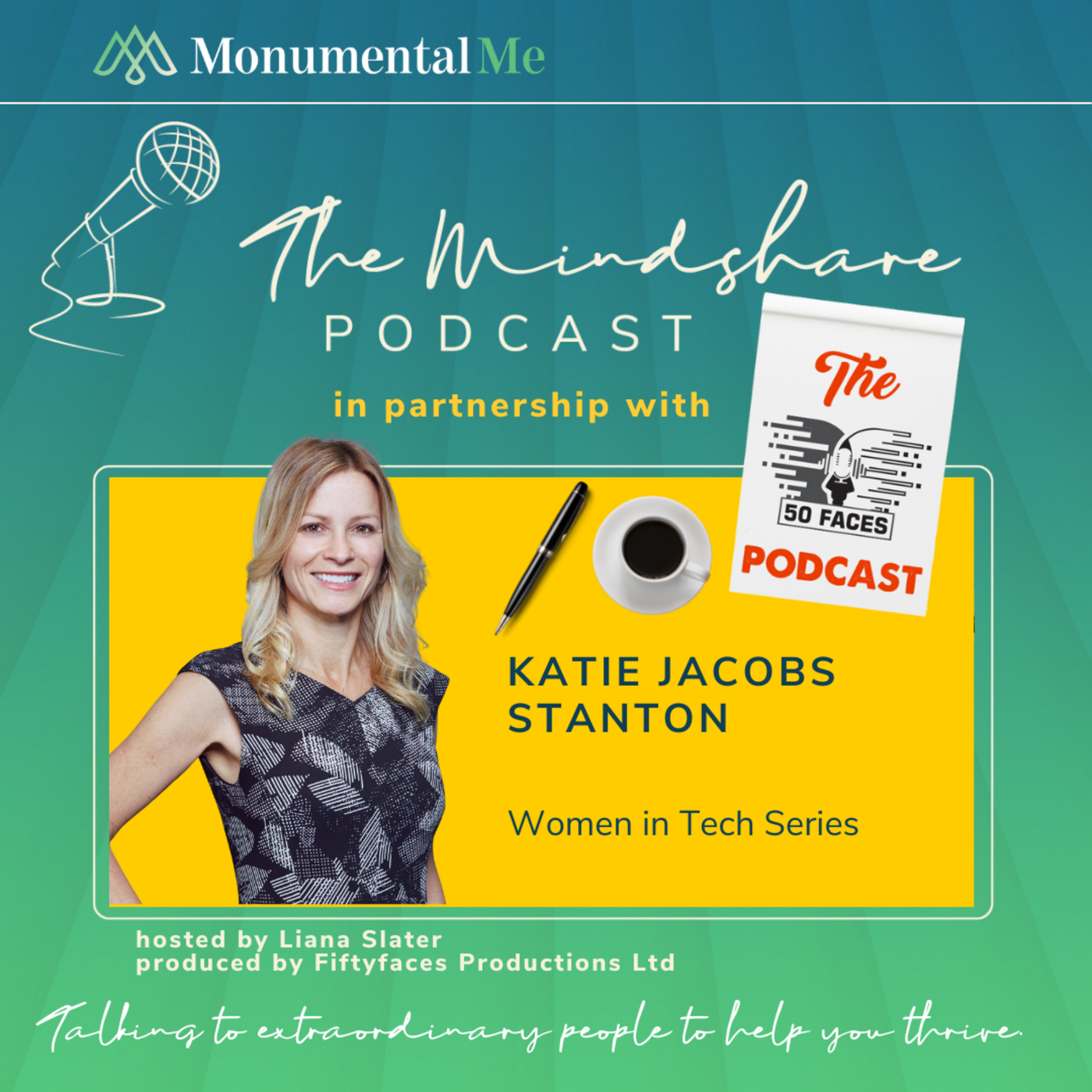
Aoifinn Devitt: This is Leanna Slater from Monumental Me and the Mindshare Podcast. I am thrilled to partner with Aoifinn Devitt and 50 Faces Productions for a new special series, Women in Tech. With women still making up about 33% of employees of major tech firms and 3% of tech startup founders, we are focused on making a difference to get more women into and to thrive in their careers in tech. And it may feel like women’s presence in business is improving, but women currently hold only 6% of CEO positions in the S&P 500.
Katie: This is according to a new report.
Aoifinn Devitt: Women CEOs of the S&P 500, by Catalyst. This is a tiny improvement. In 2018, Harvard Business Review shared that the number of CEOs of US-based companies who were named John outnumbered the total number of women CEOs, which was 5%. So from that perspective, change is stagnant, but there’s so much we can do. Corporate leaders, investors, and education leaders, we need to ask what you’re doing to create more equity in the workplace. And note, we don’t all have to become CEOs. We’re focused on women all along their career trajectory, and there are so many ways to enjoy one’s career and to add to the diversity that makes companies more innovative, competitive, and profitable. And at Monumental Me, we work to help women develop professionally and personally. So we now join 50 Faces Production.
Katie: To share stories and real tools for.
Aoifinn Devitt: Success with this special series. And we will be speaking with some remarkable people in and around the tech world. We can’t wait to share. Thanks for joining us. This is Leanna Slater of Monumental Me. Today I’m speaking with Katie Jacobs-Stanton. Katie’s the founder and general partner of Moxie Ventures, a venture capital firm. Prior to Moxie, Katie served in numerous executive operating roles at Twitter, Google, Yahoo, and Color. Katie and I met when we both worked at Google. Katie’s career trajectory has included leading teams in marketing, communications, recruiting, product, and media. And in addition to working in Silicon Valley, Katie served in the Obama White House and State Department, and she began her career as a banker at JPMorgan Chase. Katie also sits on the board of Vivendi, a French multinational media company headquartered in Paris, and on the board of Yahoo. And she previously served on the board of Time Inc. Katie shares some excellent advice for women in tech and beyond, and for the men and women who want to advocate for true gender equity and all the benefits that brings to the world. Thanks for listening.
Katie: Welcome, Katie. Thank you so much for being here with me today.
Speaker C: Thank you so much for having me, Katie.
Katie: I would prefer to just talk to you as a friend and a former colleague and talk about your amazing career trajectory and personal development as an individual who has thrived in their career. But today I am talking to you as a woman in tech. I just want to hear from you through this lens because it’s still so important to highlight that women represent only about a third of workers in large global tech firms. And I think about 5% of tech startup owners are owned by women. So, I strongly believe that we need to encourage more women to choose careers in tech and support and celebrate the women who are already there. So, if that sounds about right to you, why don’t we share what that looks like today?
Speaker C: Sure. Well, first of all, at a high level, everything is tech, right? Like, it’s not a specific vertical anymore, basically. I mean, with a lot of exceptions, I guess, but so many industries are powered by software. If you look at healthcare, if you look at real estate, if you look at construction even, there are so many different types of industries that are fueled by software and hardware. So, we are all living in an age where everything is powered by technology. And I think you and I met when we were both at Google pretty early. And I look back now and realize how fortunate we were at that time because it was just really the beginning of this explosion of so many great technology companies, starting with Yahoo, the first job I ever loved, and then Google, which took things to another level. And over the past 25 years or so, we’ve just seen this really amazing acceleration of innovation powered by technology. And in the very beginning, I remember being one of a small number of women. Now things have evened out a bit. But we still see so much disparity with women in leadership positions, in founding positions, in board positions, in equity ownership positions across technology. So, it’s a great space, great opportunity, but we have a ton of work to do to kind of level set and make things more equitable around the board.
Katie: Exactly. And I’m so glad you defined how you see technology and the tech industry because you’re so right. Technology touches everything these days. So, if you want to touch on what areas of technology do excite you today? I know you can touch on what you do with Moxie Ventures, but just to get an understanding of what you’re living and breathing today, what areas are you touching yourself?
Speaker C: Yeah, there are a number of industries where we are seeing like so many great categories of innovation. I think with us at Moxie, the two areas that we’re most excited about are in climate and in health. So in climate, we are all seeing the dire reports, reading these dire reports from scientists on our warming planet. And our overdue narrative and challenges with energy independence. And so, you know, we have a lot of work to do to address the biggest challenge and opportunity of our lifetime, which is addressing climate change. Any case, that was a long-winded way of saying climate technology, I think, is really early, really important. And so we are looking at a lot of different types of software tools. There are a bunch of hardware tools as well, but we’re software investors that we think will help us address some of these changes. Example, So for For we have invested in a company called Overstory, which is based in Amsterdam, led by a husband-wife team and a bunch of data scientists. And they’re looking at AI for vegetation management. So how can you take all these different inputs of weather patterns and topography and different types of assets that especially utilities may use to better understand which of these assets may be more prone to fire risk, to drought risk, and addressing these challenges before it’s too late. So technology and climate, we think, is going to be really important. And healthcare is huge. It’s the largest and fastest industry in the US and worldwide. And we’ve seen AI transform so many different industries. If it’s email, self-driving cars, images, I mean, the whole stuff with ChatGPT. But what’s really interesting is that healthcare has not yet been transformed by AI. And we think it’s on the verge of happening given the urgency, given how big the market is. Given the structural problems that we see in existing business models. So we’re really hopeful. We’ve made a bunch of investments in this space and are hopeful we’re right and hopeful that these types of companies will make access and outcomes in healthcare better for everyone.
Katie: This is great to hear what does excite you, and there’s so many amazing innovations. And looking at it from another direction, you and I grew up in these larger tech firms, or now they’re larger, Yahoo, Google. You worked for Twitter for a while. Several smaller companies. My question is, in these younger companies, in these startups that you are looking at right now, do you see more women? Do you see more of a balance in gender in terms of those companies?
Speaker C: So it’s weird. I would say a few years ago, yes. When I started Moxie in 2019, thesis and my goal was to become a great investor, but also to make sure that I was doing something more modern, more fair, more equitable, looking at more female founders, more female investors, more female early employees, and so forth. But I was investing in both genders, all genders. And in Moxie One, my first 7 founders were all women. And I was so excited, but then I got nervous, like, well, it’s not a women-only fund. I want to make sure people know to come to me and male founders come to me too. So it was just this weird thing. And then things evened out over time and that’s what happens. But it was a funny pattern. With Moxie Two, the reverse happened. My first 7 investments, our first 7 investments were male-led. And I was like, oh my gosh, like, what is happening? I’m actually going against my original goal and you having, know, more equitable representation across the portfolio. And I started to panic. I started to you ask, know, women, what’s going on? And mind you, a lot of things were happening externally. So notably COVID. And I think what we saw, a lot of female founders, they were caregivers maybe to their children, to their And, parents. You know, they just had a heavier load. Maybe they didn’t want to take the extra risk. I don’t know. It’s really hard to quantify, but anecdotally, I’d heard some of these things. Things have finally evened out. We just invested in our first female founder in Moxie2. So I’m like, okay, maybe we’re back in action. But our pipeline still remains heavily skewed male, and it remains heavily skewed male in the categories that we’re most excited about in climate and health. So that has me worried. I still think that we need more call to action, encouraging more women to jump into the arena, empowering more women, training more women, making sure that they have the healthcare and the childcare and the family care that they may need so they can pursue these lofty goals.
Katie: That’s so important to hear from you. It’s fascinating that you have that real-life case study during the pandemic where we all obviously lived and heard about women leaving in droves, and hopefully that is turning around again. So, just on a very high level, what is the first thing that you might suggest to get more women excited about tech? So, maybe just touching on the early career cohort here, what could get women more excited?
Speaker C: I think a few things. One is developing technical acumen, you know, either being, you know, entering software as an engineer, as a product manager, developing really strong technical skills. It’s one of the things that we have become somewhat religious about as investors that you really need that technical talent at ground zero to be able to build a world-changing product and company. It’s really hard to hire for that kind of talent. So, you know, encouraging more women to go into those fields and developing that kind of expertise. Second is probably the exact opposite, which is more psychological, which is get rid of imposter syndrome. We all have it and we just need to overcome it because it’s very funny. It’s almost like these A/B tests all day long where I’ll see male founders and female founders with very similar backgrounds and male founders are just more confident. I’m overgeneralizing here, but often they will have the same thing. And our female founders may say, well, like, I may not have this experience, but this is what I want to do and hire for. And it’s like, No, you have this experience, go for it, price your deals better. And so there’s just a little bit of, of a mindset shift maybe is a better way to say it. And then maybe the third is just your networks. One of the things that I have found to be really game-changing, especially in Silicon Valley, are these ecosystems and developing these high-quality, high-value networks of people that will challenge you that will support you, that will help you get to the next level, that may fund you. In Silicon Valley, you have this really interesting culture of entrepreneurs who end up investing in other entrepreneurs. Maybe they become scouts for different VCs, so their access to capital is easier, their access to mentorship is easier. And it’s two of the things that make, I think, Silicon Valley unique. So if you’re a woman out there, you’re a founder, you’re thinking about getting into technology, starting a company, to summarize, you know, develop that technical talent, change that mindset, and build those networks of people that are going to support you in the earliest of stages.
Aoifinn Devitt: I love that.
Katie: 3 super important things. I want to hone in on your third, so your network and the idea of mentors. And I believe, in my opinion, you’ve had some really wonderful mentors over your career across various companies and within Silicon Valley, but even maybe on the East Coast when you were involved in DC and politics, can you just share with us one or two examples of a situation where a mentor really, really moved the needle on your career and supporting you, or you taking advantage of it?
Speaker C: Yeah, I will share three examples. The first is Dan Rosenzweig, who you may know, the CEO of Chegg. He’s in New York. Dan and I knew each other from Yahoo in the earliest of days, and I can’t even recall the first that we met, but I recall it being electric. Who is this person who is so affable, so positive, so smart, so genuine? And he basically took me under his wing and was always there as a friend, but more so as a mentor in the very beginning, helping me navigate my career, staying, staying as an executive in different roles when I kept thinking like, oh, I don’t know if I can do it. What about my kids? Can I be a good mother and a good executive at the same time? It’s so hard. And He was always there to encourage me, to give me good real talk advice. He brought me into boards, so he helped bring me onto the Time board, which was so interesting and fascinating. He encouraged me to join the Yahoo board, which has been a really great learning experience. So finding someone like Dan in your life. The second person that was an incredible mentor to me, and this was just pure luck, is John Donahoe, who is the CEO of Nike. And at the time, he was the CEO of eBay. And we met in this unconventional way where his wife, Eileen Donahoe, had been a U.S. Ambassador when I was working in D.C. And we got to know each other on the Obama campaign and became friends. I had no idea what her husband did, and I just knew her as an ambassador. And she was really smart. And when we both moved back to Silicon Valley, I was over at their house for coffee and he approached me. He was like, do you have a mentor? And Dan was at this point more of a friend. I was like, well, you know, there’s Dan. He’s like, yeah, but you have someone who just meets with you on a quarterly basis and no expectations. You just come with agenda. And as a mentor, I was like, well, no, it’s like, I will be your mentor. And I just got extremely lucky there. And we would meet for coffee every quarter. I would come in with an agenda. Sometimes I was more polished than others and would just ask him for advice. And he was amazing. And then I kind of, he, got very, very busy and I hated to bother him. But I would suggest to all of your listeners, be proactive and think about who do you want to be your mentor and just ask. The worst that can happen is that somebody says no, but be really specific, be very organized, and don’t take too much time. Make it a quarterly thing and come with an agenda. And then the third thing is more of a peer group of mentorship, which are my sisters at #Angels. So about 7 years ago, I think that’s about right. 5 other girlfriends and I were at our friend Jess’s birthday party. We’re talking about angel investing and we’re like, how come every time a company goes public or there’s some kind of massive story about it and they talk about their early investors, it’s always the same cast of characters. And there are very few women, very few people of color, very few operators who are mentioned. And it’s such a big market. It’s such a big ecosystem. There’s plenty of room for lots of different types of people. Why not us? And so we banded together and created an investment collective called #Angels, which is really 6 friends who would get together every 2 weeks and share deal flow. We had a Slack channel, we had Twitter DMs, we had text messages, we have emails that continue to this day. We can’t pick a platform, so we’re on all of them for the most part, but we would start sharing deal flow and that really helped accelerate all of our interest in angel investing and became the bedrock for me ultimately deciding to pursue a role in venture and creating Moxie. So finding those networks, wherever they may be, with aligned interests, with great humans that you love spending time with, is a real joy and I think a great way to advance your career too.
Katie: Yeah, excellent advice. I’m a huge fan of working in community, and I have my own mastermind group. We call ourselves the Ascend Group, and it’s It sounds somewhat similar. It wasn’t just focused on investing, but it focused on each of our careers and is in a collective group of women.
Speaker C: But I think that’s so important.
Katie: So encouraging people to do that, to set that up for themselves. And you mentioned the luck that you had. And yes, so lucky when you cross paths with amazing people like Dan. I wish everybody had a Dan in their life. But also, I think it’s so important that you just encourage people to reach out and ask and be persistent and prepared, right? Like, that’s something else, especially for younger people. Do not be afraid to put yourself out there and ask. I just want to underscore that.
Speaker C: You do make your luck, right? You know, you get a little lucky, but you also have to make your luck too. So you need to set yourself up for success.
Katie: Exactly. It’s always a mix. Always a mix. And I love when you just pointed out you doubted raising your family. That touches on, you know, just kind of one of my pain points, which I am so happy in all of my career decisions and it’s evolved beautifully. But I did step out of the workforce because my husband was traveling and working. And it’s a very hard decision. I took a career break. So I want to ask you, actually, it’s not necessary for everybody to do that. How do you think career breaks are seen today? And what do you think about career breaks?
Speaker C: Well, the good news is that I think they are far more accepted than they were when we were younger mothers. I remember being so anxious about taking my foot off the pedal, right, taking that time off. And so what happened with me, that I had all these terrible jobs in my early 20s, and I finally get to Yahoo and I loved it. I was like, oh my God, I could love my job. And I had my first child, Ellie, and I loved being with Ellie, but I loved job too. And I thought, well, can I have both? And so I kind of scaled back my hours a little bit, went back to work, and it seemed to work out okay. I would work from home on Fridays, which was a very novel thing back in, you know, 2000. But I was fortunate that my managers were really supportive and I was able to do it. And then I had twins 18 months later, and oh my God, that was hard with 3 kids under 2 years. And we didn’t have family nearby. We hadn’t really, you know, couldn’t afford to have a full-time nanny or extra and so we just cobbled by ourselves. And finally I was like, I can’t do this. I can’t go back to work. I couldn’t afford to go back to work because the market had crashed. I didn’t know if my stock options would be worth anything. My salary wasn’t that high. My husband was at a startup. And so I was like, you know what, I’ll stay back and stay home with the kids. And after a year I realized, oh my God, it’s way harder to stay at home. Things do work out. You know, if I could tell myself 20 years ago any advice, it’d be like, it’ll all work out. Don’t worry about the short term. Just do what makes sense right now, and you can always catch up. And so there are going to be people that are going to out-hustle you, outrun you if you take extended leaves, and that’s okay. Who cares? Let them. Like, do what is best for you, do what is best for your family, and it will all work out the.
Katie: Way it’s supposed to be. Absolutely. Okay. I am going to shift this a little bit. I asked you about younger women earlier in their career. How do we get them into technology as an industry? And I just want to point out, both you and I, we don’t have computer science degrees. I don’t think we even thought about studying tech subjects in college, probably. Can you just touch on taking this from another perspective? Women in technology, do you think there’s a difference in female leadership and is there something a value that’s different that women bring into the tech industry?
Speaker C: One of the best leaders in technology is Susan Wojcicki. Google started in her garage. She is now the CEO of YouTube. She is on the board of Salesforce. She has 5 children and she is incredibly successful and an amazing human being. So, to me, Susan Wojcicki has it all and I adore her and I admire her. And she, I believe, was a biology major, but she was able to really rise and stay in the leadership positions across Google because she’s smart, she’s hardworking, she’s honest, she’s empathetic, and she’s curious. You know, she asks good questions. And sometimes being outside of a little echo chamber is really helpful. So, she could ask the hard questions to engineers. I don’t have a software engineering background, but I don’t understand how this is going to work. And, you know, especially as you look into a lot of these platforms like YouTube, it’s very human, right? People are, you know, what is the human experience? It’s a software platform, but humans are the ones enjoying it and sharing it and feeling good about it or feeling bad about it. So how do you optimize all of those things together harmoniously? And I think She has done just such an exceptional job. So women or anyone without a technical background can bring in tons of added value to the development of any product we do need. You know, that’s why we have cross-functional organizations over time, right? You need marketers to tell a story. You need lawyers to make sure you’re following the rules of the road. You need designers who really understand the user experience. At some point, you may need policy people to make sure that you have developed policies that protect your users and also abide by the rules of the road. So, having that cross-functional perspective and infrastructure is going to be important, and women can play roles in any of those things.
Katie: Great to hear, right, from your experience, because I obviously agree with all of that. And then thinking about women in mid-career or later in career, they can transition into tech, right? I mean, it’s not like, as you said, it’s not just one separate siloed industry. It touches everywhere now. So, what do you think about encouraging, and, you know, is there a path to encourage more women mid-career and later career to get into technology? Totally.
Speaker C: There’s no linear line in careers, right? We’re all zigzagging, and that’s okay. That’s what makes it fun. And as you learn best practices from one company or one industry, you’re able to bring that to the next chapter in your career. And you’re also able to take the things that you shouldn’t do and don’t want to do, and those terrible things that you may have witnessed at another company. So, these are all good experiences, but just know you only have a finite number of chapters, right? You know, life is short, but careers are even shorter. So, making those choices wisely and knowing that, you know, especially if you’re in mid-career, okay, at this point, you’re probably managing people. Maybe you’re in the C-suite, or maybe you aspire to be in the C-suite. Great. If at some point you feel like you might be capped, then it’s time to move on. And so, my personal example was when I was at Google, and you probably remember the rule that unless you were a computer science major, with the exception of Susan Wojcicki, you could not be a VP in product. And they were really particular about that degree. And Marissa Meyer gave me a little bit of a window. So, she kind of pulled me in and I was, whatever my title was, I wasn’t a VP. Senior something. I realized I was capped. There’s no way I was on the track to become a VP of anything at Google without that kind of pedigree. And it was too late for me to earn that pedigree. So, I knew it was time to move on. And so, as I thought about, “Okay, well, what’s next?” I had almost joined Twitter in 2008. I knew Ev Williams and really admired him. I was like, “Whatever you do next, can I come with you?” And I happened to have this wildcard opportunity to work for President Obama in his first administration. I was like, well, I have to do that. And so I chose that. So my point is that, you know, at some point, if you realize that your runway at a particular company is short and you’re on a path to nowhere, it’s time to think creatively. And what’s another way that you can kind of advance your career, advance your learning, find your own sort of career market fit? I guess it’s okay to move on and don’t stay places too long. ‘Cause then I think you stop learning and learning is the whole point.
Katie: That is such an important piece of advice also, ’cause my general perspective is women specifically might get just stuck staying in their lane or in a company ’cause they’re comfortable and they have to balance many other elements of their lives, caregiving for children, caregiving for elders. And I just think what you just said is so important. Don’t get stuck. Yeah.
Speaker C: And I mean, listen, like those companies, as great as many of them may be, You are just an employee and they can cut you at will. And you have to seek ownership. You need to seek ownership of your time, ownership of your equity, and ownership of your career. No one else is going to do that for you. You have to be your biggest advocate.
Katie: Absolutely. Thinking of Google and that Google is really a wonderful example of a learning organization, really kind of very pioneered in various initiatives for wellbeing at work, innovation, all of that. But when you just mentioned that example of some people being blocked from moving into product marketing or moving into technology kind of focus roles, do you think that was a mistake or do you think that they have learned from that? Has that shifted, number one? And then the second part of that, are there current companies that have kind of replaced a Google, even two or three companies you might think of now as learning organizations?
Speaker C: Yeah. Well, first, I don’t think any of these things are mistakes. You know, you do the best that you can with the information that you have at that particular time. So these are all learning experiences versus mistakes. And then second, yeah, it’s been so interesting because Google did such a great job of creating institutions of learning, right? Like the APM program, Jonathan Rosenberg and Marissa would take these young APMs out of Stanford and all these great schools and teaching them how to be world-class product managers and taking them around the world. And what a great opportunity that was. And you see the effects to this day of those product managers leading great organizations. So, Gokul Rajaman and Ilad Gil and Brett Taylor and, and Marissa, and she’s gone on to do interesting things too. So, you see that class, Dan Soroker, who created Optimizely and now in the Moxie portfolio, I should add. So, you see like these classes and these graduates of these programs do great things in the world. And we’ve seen that now replicated. For example, LinkedIn, I think, has really great marketers, people who have learned from Shannon Stubo, for example, and their classes of marketers are quite good. Facebook has also had its own APM classes. I know them less, but actually, actually, we do have one Facebook PM lead as a founder in Moxie. And Catherine is amazing. She started a company called ForSure, and I think her class and cohort of friends have done a great job. Um, let’s see, Twitter is probably a mix in terms of— when I was at Twitter, we did not do a great job building these APM types of classes, but I think over time they ended up doing that. So that’s been good. Stripe is probably the best example, actually. Stripe has done fantastic job building a company, building a business, doing it with clear focus, with humanity. I look at Patrick and John Carlson as some of the best entrepreneurs and CEOs of our time that have built a generational business and a great place to work.
Katie: Great. All right, I have 3 questions for you, a little bit more on the personal level. What do you wish— and you talk to a lot of people now, and I love that you’re sharing what you do and your amazing, valuable perspective— but what do you What do you wish is one question that more people would ask you right now?
Speaker C: I don’t want any more questions. I get too many questions. I don’t know. I don’t have a good answer to that. What are other people’s answers? What are good answers?
Katie: You’re the first one I’ve asked in this Women in Tech series because you’re the very first interviewee in the Women in Tech series, which I’m so excited about. The question, “What do you wish more people asked?” really came from a conversation that I had with a woman who, it’s for women. Getting promoted actually in Silicon Valley. And her answer to that was, I wish less people asked me about how I can balance everything and more people just asked me about my specific expertise. And that kind of pulls you away. Like, don’t ask me about, you know, kind of female-centric questions. Just ask me about what I’m really good at and why I’m an expert. So I don’t know if you think that way, and that’s great. Or I think you have so many interesting people in your lives, you probably get very great questions and not just like, what are you wearing? So you can have— you can say no as your answer. There is nothing else. That’s totally fine.
Speaker C: But I think the flip of it, like, I love when people solve things and then let me know afterwards. So for example, Greg, like when I wake up in the morning, he has an Americano with oat milk ready for me. Like he has just solved my first problem of the day. More solutions to more problems and making life easier is something that I aspire.
Katie: To see and do. Love it. Love it. Okay. And then I’m going to ask you, what are two of your main strengths that really helped you succeed in your career?
Speaker C: Just one is optimism. I am just by nature a very optimistic, happy person and look for the best in things, which can be a problem sometimes, especially in venture where you have to make really hard decisions and looking at what can go wrong, whereas my default is, okay, what can go right? And then I have to work from there. And the second is that I get my energy from people and networking and helping. So I genuinely love when I will talk to a founder and say, you know, what is one problem that I can unblock for you? Or what is one person I could connect you to that can make a big difference in your life? And when I’m able to achieve that and make that connection or solve that problem, I get a lot of energy and I love when that happens. Love it.
Katie: Yeah, I think I realized that about myself kind of after my Google days. I mean, I’ve always loved people. I love the energy. I’m a good networker. I have this great network of people, which is one reason why I started my podcast, is to leverage that. But also, I think I didn’t realize how valuable that was for my career and growing within various roles. So I love that you just pointed that out, getting energy from other people and then leveraging that. All right, and then my final question for you, and this is one that I do always ask. That’s why I I refer to it as my signature question, and you have absolutely answered this. But if there’s anything else you could share, what would you tell your 26-year-old self from where you sit right now?
Speaker C: I would tell my 26-year-old self that it’ll all work out, that you should have date nights every week with your partner, that you should outsource as much as you can And don’t think you have to do it all yourself and be a martyr about it, because I did that a lot. And, and to really be scrupulous about the people you spend time with because they matter. And it makes you a better person, a happier person if you’re surrounded by a lot of joy and love and trust. And I think I got that right. But I would just reinforce that to my 26-year-old self.
Katie: Excellent. All right. Well, thank you, Katie, so much for.
Speaker C: Talking with me today.
Katie: And this has been super, super insightful.
Speaker C: Thank you so much for having me. It’s so great to be reconnected. This podcast is for informational purposes only and should not be construed as investment advice, and all views are personal and should not be attributed to the organizations and affiliations of the host or any guest.
Aoifinn Devitt: This is Leanna Slater from Monumental Me and the Mindshare Podcast. I am thrilled to partner with Aoifinn Devitt and 50 Faces Productions for a new special series, Women in Tech. With women still making up about 33% of employees of major tech firms and 3% of tech startup founders, we are focused on making a difference to get more women into and to thrive in their careers in tech. And it may feel like women’s presence in business is improving, but women currently hold only 6% of CEO positions in the S&P 500.
Katie: This is according to a new report.
Aoifinn Devitt: Women CEOs of the S&P 500, by Catalyst. This is a tiny improvement. In 2018, Harvard Business Review shared that the number of CEOs of US-based companies who were named John outnumbered the total number of women CEOs, which was 5%. So from that perspective, change is stagnant, but there’s so much we can do. Corporate leaders, investors, and education leaders, we need to ask what you’re doing to create more equity in the workplace. And note, we don’t all have to become CEOs. We’re focused on women all along their career trajectory, and there are so many ways to enjoy one’s career and to add to the diversity that makes companies more innovative, competitive, and profitable. And at Monumental Me, we work to help women develop professionally and personally. So we now join 50 Faces Production.
Katie: To share stories and real tools for.
Aoifinn Devitt: Success with this special series. And we will be speaking with some remarkable people in and around the tech world. We can’t wait to share. Thanks for joining us. This is Leanna Slater of Monumental Me. Today I’m speaking with Katie Jacobs-Stanton. Katie’s the founder and general partner of Moxie Ventures, a venture capital firm. Prior to Moxie, Katie served in numerous executive operating roles at Twitter, Google, Yahoo, and Color. Katie and I met when we both worked at Google. Katie’s career trajectory has included leading teams in marketing, communications, recruiting, product, and media. And in addition to working in Silicon Valley, Katie served in the Obama White House and State Department, and she began her career as a banker at JPMorgan Chase. Katie also sits on the board of Vivendi, a French multinational media company headquartered in Paris, and on the board of Yahoo. And she previously served on the board of Time Inc. Katie shares some excellent advice for women in tech and beyond, and for the men and women who want to advocate for true gender equity and all the benefits that brings to the world. Thanks for listening.
Katie: Welcome, Katie. Thank you so much for being here with me today.
Speaker C: Thank you so much for having me, Katie.
Katie: I would prefer to just talk to you as a friend and a former colleague and talk about your amazing career trajectory and personal development as an individual who has thrived in their career. But today I am talking to you as a woman in tech. I just want to hear from you through this lens because it’s still so important to highlight that women represent only about a third of workers in large global tech firms. And I think about 5% of tech startup owners are owned by women. So, I strongly believe that we need to encourage more women to choose careers in tech and support and celebrate the women who are already there. So, if that sounds about right to you, why don’t we share what that looks like today?
Speaker C: Sure. Well, first of all, at a high level, everything is tech, right? Like, it’s not a specific vertical anymore, basically. I mean, with a lot of exceptions, I guess, but so many industries are powered by software. If you look at healthcare, if you look at real estate, if you look at construction even, there are so many different types of industries that are fueled by software and hardware. So, we are all living in an age where everything is powered by technology. And I think you and I met when we were both at Google pretty early. And I look back now and realize how fortunate we were at that time because it was just really the beginning of this explosion of so many great technology companies, starting with Yahoo, the first job I ever loved, and then Google, which took things to another level. And over the past 25 years or so, we’ve just seen this really amazing acceleration of innovation powered by technology. And in the very beginning, I remember being one of a small number of women. Now things have evened out a bit. But we still see so much disparity with women in leadership positions, in founding positions, in board positions, in equity ownership positions across technology. So, it’s a great space, great opportunity, but we have a ton of work to do to kind of level set and make things more equitable around the board.
Katie: Exactly. And I’m so glad you defined how you see technology and the tech industry because you’re so right. Technology touches everything these days. So, if you want to touch on what areas of technology do excite you today? I know you can touch on what you do with Moxie Ventures, but just to get an understanding of what you’re living and breathing today, what areas are you touching yourself?
Speaker C: Yeah, there are a number of industries where we are seeing like so many great categories of innovation. I think with us at Moxie, the two areas that we’re most excited about are in climate and in health. So in climate, we are all seeing the dire reports, reading these dire reports from scientists on our warming planet. And our overdue narrative and challenges with energy independence. And so, you know, we have a lot of work to do to address the biggest challenge and opportunity of our lifetime, which is addressing climate change. Any case, that was a long-winded way of saying climate technology, I think, is really early, really important. And so we are looking at a lot of different types of software tools. There are a bunch of hardware tools as well, but we’re software investors that we think will help us address some of these changes. Example, So for For we have invested in a company called Overstory, which is based in Amsterdam, led by a husband-wife team and a bunch of data scientists. And they’re looking at AI for vegetation management. So how can you take all these different inputs of weather patterns and topography and different types of assets that especially utilities may use to better understand which of these assets may be more prone to fire risk, to drought risk, and addressing these challenges before it’s too late. So technology and climate, we think, is going to be really important. And healthcare is huge. It’s the largest and fastest industry in the US and worldwide. And we’ve seen AI transform so many different industries. If it’s email, self-driving cars, images, I mean, the whole stuff with ChatGPT. But what’s really interesting is that healthcare has not yet been transformed by AI. And we think it’s on the verge of happening given the urgency, given how big the market is. Given the structural problems that we see in existing business models. So we’re really hopeful. We’ve made a bunch of investments in this space and are hopeful we’re right and hopeful that these types of companies will make access and outcomes in healthcare better for everyone.
Katie: This is great to hear what does excite you, and there’s so many amazing innovations. And looking at it from another direction, you and I grew up in these larger tech firms, or now they’re larger, Yahoo, Google. You worked for Twitter for a while. Several smaller companies. My question is, in these younger companies, in these startups that you are looking at right now, do you see more women? Do you see more of a balance in gender in terms of those companies?
Speaker C: So it’s weird. I would say a few years ago, yes. When I started Moxie in 2019, thesis and my goal was to become a great investor, but also to make sure that I was doing something more modern, more fair, more equitable, looking at more female founders, more female investors, more female early employees, and so forth. But I was investing in both genders, all genders. And in Moxie One, my first 7 founders were all women. And I was so excited, but then I got nervous, like, well, it’s not a women-only fund. I want to make sure people know to come to me and male founders come to me too. So it was just this weird thing. And then things evened out over time and that’s what happens. But it was a funny pattern. With Moxie Two, the reverse happened. My first 7 investments, our first 7 investments were male-led. And I was like, oh my gosh, like, what is happening? I’m actually going against my original goal and you having, know, more equitable representation across the portfolio. And I started to panic. I started to you ask, know, women, what’s going on? And mind you, a lot of things were happening externally. So notably COVID. And I think what we saw, a lot of female founders, they were caregivers maybe to their children, to their And, parents. You know, they just had a heavier load. Maybe they didn’t want to take the extra risk. I don’t know. It’s really hard to quantify, but anecdotally, I’d heard some of these things. Things have finally evened out. We just invested in our first female founder in Moxie2. So I’m like, okay, maybe we’re back in action. But our pipeline still remains heavily skewed male, and it remains heavily skewed male in the categories that we’re most excited about in climate and health. So that has me worried. I still think that we need more call to action, encouraging more women to jump into the arena, empowering more women, training more women, making sure that they have the healthcare and the childcare and the family care that they may need so they can pursue these lofty goals.
Katie: That’s so important to hear from you. It’s fascinating that you have that real-life case study during the pandemic where we all obviously lived and heard about women leaving in droves, and hopefully that is turning around again. So, just on a very high level, what is the first thing that you might suggest to get more women excited about tech? So, maybe just touching on the early career cohort here, what could get women more excited?
Speaker C: I think a few things. One is developing technical acumen, you know, either being, you know, entering software as an engineer, as a product manager, developing really strong technical skills. It’s one of the things that we have become somewhat religious about as investors that you really need that technical talent at ground zero to be able to build a world-changing product and company. It’s really hard to hire for that kind of talent. So, you know, encouraging more women to go into those fields and developing that kind of expertise. Second is probably the exact opposite, which is more psychological, which is get rid of imposter syndrome. We all have it and we just need to overcome it because it’s very funny. It’s almost like these A/B tests all day long where I’ll see male founders and female founders with very similar backgrounds and male founders are just more confident. I’m overgeneralizing here, but often they will have the same thing. And our female founders may say, well, like, I may not have this experience, but this is what I want to do and hire for. And it’s like, No, you have this experience, go for it, price your deals better. And so there’s just a little bit of, of a mindset shift maybe is a better way to say it. And then maybe the third is just your networks. One of the things that I have found to be really game-changing, especially in Silicon Valley, are these ecosystems and developing these high-quality, high-value networks of people that will challenge you that will support you, that will help you get to the next level, that may fund you. In Silicon Valley, you have this really interesting culture of entrepreneurs who end up investing in other entrepreneurs. Maybe they become scouts for different VCs, so their access to capital is easier, their access to mentorship is easier. And it’s two of the things that make, I think, Silicon Valley unique. So if you’re a woman out there, you’re a founder, you’re thinking about getting into technology, starting a company, to summarize, you know, develop that technical talent, change that mindset, and build those networks of people that are going to support you in the earliest of stages.
Aoifinn Devitt: I love that.
Katie: 3 super important things. I want to hone in on your third, so your network and the idea of mentors. And I believe, in my opinion, you’ve had some really wonderful mentors over your career across various companies and within Silicon Valley, but even maybe on the East Coast when you were involved in DC and politics, can you just share with us one or two examples of a situation where a mentor really, really moved the needle on your career and supporting you, or you taking advantage of it?
Speaker C: Yeah, I will share three examples. The first is Dan Rosenzweig, who you may know, the CEO of Chegg. He’s in New York. Dan and I knew each other from Yahoo in the earliest of days, and I can’t even recall the first that we met, but I recall it being electric. Who is this person who is so affable, so positive, so smart, so genuine? And he basically took me under his wing and was always there as a friend, but more so as a mentor in the very beginning, helping me navigate my career, staying, staying as an executive in different roles when I kept thinking like, oh, I don’t know if I can do it. What about my kids? Can I be a good mother and a good executive at the same time? It’s so hard. And He was always there to encourage me, to give me good real talk advice. He brought me into boards, so he helped bring me onto the Time board, which was so interesting and fascinating. He encouraged me to join the Yahoo board, which has been a really great learning experience. So finding someone like Dan in your life. The second person that was an incredible mentor to me, and this was just pure luck, is John Donahoe, who is the CEO of Nike. And at the time, he was the CEO of eBay. And we met in this unconventional way where his wife, Eileen Donahoe, had been a U.S. Ambassador when I was working in D.C. And we got to know each other on the Obama campaign and became friends. I had no idea what her husband did, and I just knew her as an ambassador. And she was really smart. And when we both moved back to Silicon Valley, I was over at their house for coffee and he approached me. He was like, do you have a mentor? And Dan was at this point more of a friend. I was like, well, you know, there’s Dan. He’s like, yeah, but you have someone who just meets with you on a quarterly basis and no expectations. You just come with agenda. And as a mentor, I was like, well, no, it’s like, I will be your mentor. And I just got extremely lucky there. And we would meet for coffee every quarter. I would come in with an agenda. Sometimes I was more polished than others and would just ask him for advice. And he was amazing. And then I kind of, he, got very, very busy and I hated to bother him. But I would suggest to all of your listeners, be proactive and think about who do you want to be your mentor and just ask. The worst that can happen is that somebody says no, but be really specific, be very organized, and don’t take too much time. Make it a quarterly thing and come with an agenda. And then the third thing is more of a peer group of mentorship, which are my sisters at #Angels. So about 7 years ago, I think that’s about right. 5 other girlfriends and I were at our friend Jess’s birthday party. We’re talking about angel investing and we’re like, how come every time a company goes public or there’s some kind of massive story about it and they talk about their early investors, it’s always the same cast of characters. And there are very few women, very few people of color, very few operators who are mentioned. And it’s such a big market. It’s such a big ecosystem. There’s plenty of room for lots of different types of people. Why not us? And so we banded together and created an investment collective called #Angels, which is really 6 friends who would get together every 2 weeks and share deal flow. We had a Slack channel, we had Twitter DMs, we had text messages, we have emails that continue to this day. We can’t pick a platform, so we’re on all of them for the most part, but we would start sharing deal flow and that really helped accelerate all of our interest in angel investing and became the bedrock for me ultimately deciding to pursue a role in venture and creating Moxie. So finding those networks, wherever they may be, with aligned interests, with great humans that you love spending time with, is a real joy and I think a great way to advance your career too.
Katie: Yeah, excellent advice. I’m a huge fan of working in community, and I have my own mastermind group. We call ourselves the Ascend Group, and it’s It sounds somewhat similar. It wasn’t just focused on investing, but it focused on each of our careers and is in a collective group of women.
Speaker C: But I think that’s so important.
Katie: So encouraging people to do that, to set that up for themselves. And you mentioned the luck that you had. And yes, so lucky when you cross paths with amazing people like Dan. I wish everybody had a Dan in their life. But also, I think it’s so important that you just encourage people to reach out and ask and be persistent and prepared, right? Like, that’s something else, especially for younger people. Do not be afraid to put yourself out there and ask. I just want to underscore that.
Speaker C: You do make your luck, right? You know, you get a little lucky, but you also have to make your luck too. So you need to set yourself up for success.
Katie: Exactly. It’s always a mix. Always a mix. And I love when you just pointed out you doubted raising your family. That touches on, you know, just kind of one of my pain points, which I am so happy in all of my career decisions and it’s evolved beautifully. But I did step out of the workforce because my husband was traveling and working. And it’s a very hard decision. I took a career break. So I want to ask you, actually, it’s not necessary for everybody to do that. How do you think career breaks are seen today? And what do you think about career breaks?
Speaker C: Well, the good news is that I think they are far more accepted than they were when we were younger mothers. I remember being so anxious about taking my foot off the pedal, right, taking that time off. And so what happened with me, that I had all these terrible jobs in my early 20s, and I finally get to Yahoo and I loved it. I was like, oh my God, I could love my job. And I had my first child, Ellie, and I loved being with Ellie, but I loved job too. And I thought, well, can I have both? And so I kind of scaled back my hours a little bit, went back to work, and it seemed to work out okay. I would work from home on Fridays, which was a very novel thing back in, you know, 2000. But I was fortunate that my managers were really supportive and I was able to do it. And then I had twins 18 months later, and oh my God, that was hard with 3 kids under 2 years. And we didn’t have family nearby. We hadn’t really, you know, couldn’t afford to have a full-time nanny or extra and so we just cobbled by ourselves. And finally I was like, I can’t do this. I can’t go back to work. I couldn’t afford to go back to work because the market had crashed. I didn’t know if my stock options would be worth anything. My salary wasn’t that high. My husband was at a startup. And so I was like, you know what, I’ll stay back and stay home with the kids. And after a year I realized, oh my God, it’s way harder to stay at home. Things do work out. You know, if I could tell myself 20 years ago any advice, it’d be like, it’ll all work out. Don’t worry about the short term. Just do what makes sense right now, and you can always catch up. And so there are going to be people that are going to out-hustle you, outrun you if you take extended leaves, and that’s okay. Who cares? Let them. Like, do what is best for you, do what is best for your family, and it will all work out the.
Katie: Way it’s supposed to be. Absolutely. Okay. I am going to shift this a little bit. I asked you about younger women earlier in their career. How do we get them into technology as an industry? And I just want to point out, both you and I, we don’t have computer science degrees. I don’t think we even thought about studying tech subjects in college, probably. Can you just touch on taking this from another perspective? Women in technology, do you think there’s a difference in female leadership and is there something a value that’s different that women bring into the tech industry?
Speaker C: One of the best leaders in technology is Susan Wojcicki. Google started in her garage. She is now the CEO of YouTube. She is on the board of Salesforce. She has 5 children and she is incredibly successful and an amazing human being. So, to me, Susan Wojcicki has it all and I adore her and I admire her. And she, I believe, was a biology major, but she was able to really rise and stay in the leadership positions across Google because she’s smart, she’s hardworking, she’s honest, she’s empathetic, and she’s curious. You know, she asks good questions. And sometimes being outside of a little echo chamber is really helpful. So, she could ask the hard questions to engineers. I don’t have a software engineering background, but I don’t understand how this is going to work. And, you know, especially as you look into a lot of these platforms like YouTube, it’s very human, right? People are, you know, what is the human experience? It’s a software platform, but humans are the ones enjoying it and sharing it and feeling good about it or feeling bad about it. So how do you optimize all of those things together harmoniously? And I think She has done just such an exceptional job. So women or anyone without a technical background can bring in tons of added value to the development of any product we do need. You know, that’s why we have cross-functional organizations over time, right? You need marketers to tell a story. You need lawyers to make sure you’re following the rules of the road. You need designers who really understand the user experience. At some point, you may need policy people to make sure that you have developed policies that protect your users and also abide by the rules of the road. So, having that cross-functional perspective and infrastructure is going to be important, and women can play roles in any of those things.
Katie: Great to hear, right, from your experience, because I obviously agree with all of that. And then thinking about women in mid-career or later in career, they can transition into tech, right? I mean, it’s not like, as you said, it’s not just one separate siloed industry. It touches everywhere now. So, what do you think about encouraging, and, you know, is there a path to encourage more women mid-career and later career to get into technology? Totally.
Speaker C: There’s no linear line in careers, right? We’re all zigzagging, and that’s okay. That’s what makes it fun. And as you learn best practices from one company or one industry, you’re able to bring that to the next chapter in your career. And you’re also able to take the things that you shouldn’t do and don’t want to do, and those terrible things that you may have witnessed at another company. So, these are all good experiences, but just know you only have a finite number of chapters, right? You know, life is short, but careers are even shorter. So, making those choices wisely and knowing that, you know, especially if you’re in mid-career, okay, at this point, you’re probably managing people. Maybe you’re in the C-suite, or maybe you aspire to be in the C-suite. Great. If at some point you feel like you might be capped, then it’s time to move on. And so, my personal example was when I was at Google, and you probably remember the rule that unless you were a computer science major, with the exception of Susan Wojcicki, you could not be a VP in product. And they were really particular about that degree. And Marissa Meyer gave me a little bit of a window. So, she kind of pulled me in and I was, whatever my title was, I wasn’t a VP. Senior something. I realized I was capped. There’s no way I was on the track to become a VP of anything at Google without that kind of pedigree. And it was too late for me to earn that pedigree. So, I knew it was time to move on. And so, as I thought about, “Okay, well, what’s next?” I had almost joined Twitter in 2008. I knew Ev Williams and really admired him. I was like, “Whatever you do next, can I come with you?” And I happened to have this wildcard opportunity to work for President Obama in his first administration. I was like, well, I have to do that. And so I chose that. So my point is that, you know, at some point, if you realize that your runway at a particular company is short and you’re on a path to nowhere, it’s time to think creatively. And what’s another way that you can kind of advance your career, advance your learning, find your own sort of career market fit? I guess it’s okay to move on and don’t stay places too long. ‘Cause then I think you stop learning and learning is the whole point.
Katie: That is such an important piece of advice also, ’cause my general perspective is women specifically might get just stuck staying in their lane or in a company ’cause they’re comfortable and they have to balance many other elements of their lives, caregiving for children, caregiving for elders. And I just think what you just said is so important. Don’t get stuck. Yeah.
Speaker C: And I mean, listen, like those companies, as great as many of them may be, You are just an employee and they can cut you at will. And you have to seek ownership. You need to seek ownership of your time, ownership of your equity, and ownership of your career. No one else is going to do that for you. You have to be your biggest advocate.
Katie: Absolutely. Thinking of Google and that Google is really a wonderful example of a learning organization, really kind of very pioneered in various initiatives for wellbeing at work, innovation, all of that. But when you just mentioned that example of some people being blocked from moving into product marketing or moving into technology kind of focus roles, do you think that was a mistake or do you think that they have learned from that? Has that shifted, number one? And then the second part of that, are there current companies that have kind of replaced a Google, even two or three companies you might think of now as learning organizations?
Speaker C: Yeah. Well, first, I don’t think any of these things are mistakes. You know, you do the best that you can with the information that you have at that particular time. So these are all learning experiences versus mistakes. And then second, yeah, it’s been so interesting because Google did such a great job of creating institutions of learning, right? Like the APM program, Jonathan Rosenberg and Marissa would take these young APMs out of Stanford and all these great schools and teaching them how to be world-class product managers and taking them around the world. And what a great opportunity that was. And you see the effects to this day of those product managers leading great organizations. So, Gokul Rajaman and Ilad Gil and Brett Taylor and, and Marissa, and she’s gone on to do interesting things too. So, you see that class, Dan Soroker, who created Optimizely and now in the Moxie portfolio, I should add. So, you see like these classes and these graduates of these programs do great things in the world. And we’ve seen that now replicated. For example, LinkedIn, I think, has really great marketers, people who have learned from Shannon Stubo, for example, and their classes of marketers are quite good. Facebook has also had its own APM classes. I know them less, but actually, actually, we do have one Facebook PM lead as a founder in Moxie. And Catherine is amazing. She started a company called ForSure, and I think her class and cohort of friends have done a great job. Um, let’s see, Twitter is probably a mix in terms of— when I was at Twitter, we did not do a great job building these APM types of classes, but I think over time they ended up doing that. So that’s been good. Stripe is probably the best example, actually. Stripe has done fantastic job building a company, building a business, doing it with clear focus, with humanity. I look at Patrick and John Carlson as some of the best entrepreneurs and CEOs of our time that have built a generational business and a great place to work.
Katie: Great. All right, I have 3 questions for you, a little bit more on the personal level. What do you wish— and you talk to a lot of people now, and I love that you’re sharing what you do and your amazing, valuable perspective— but what do you What do you wish is one question that more people would ask you right now?
Speaker C: I don’t want any more questions. I get too many questions. I don’t know. I don’t have a good answer to that. What are other people’s answers? What are good answers?
Katie: You’re the first one I’ve asked in this Women in Tech series because you’re the very first interviewee in the Women in Tech series, which I’m so excited about. The question, “What do you wish more people asked?” really came from a conversation that I had with a woman who, it’s for women. Getting promoted actually in Silicon Valley. And her answer to that was, I wish less people asked me about how I can balance everything and more people just asked me about my specific expertise. And that kind of pulls you away. Like, don’t ask me about, you know, kind of female-centric questions. Just ask me about what I’m really good at and why I’m an expert. So I don’t know if you think that way, and that’s great. Or I think you have so many interesting people in your lives, you probably get very great questions and not just like, what are you wearing? So you can have— you can say no as your answer. There is nothing else. That’s totally fine.
Speaker C: But I think the flip of it, like, I love when people solve things and then let me know afterwards. So for example, Greg, like when I wake up in the morning, he has an Americano with oat milk ready for me. Like he has just solved my first problem of the day. More solutions to more problems and making life easier is something that I aspire.
Katie: To see and do. Love it. Love it. Okay. And then I’m going to ask you, what are two of your main strengths that really helped you succeed in your career?
Speaker C: Just one is optimism. I am just by nature a very optimistic, happy person and look for the best in things, which can be a problem sometimes, especially in venture where you have to make really hard decisions and looking at what can go wrong, whereas my default is, okay, what can go right? And then I have to work from there. And the second is that I get my energy from people and networking and helping. So I genuinely love when I will talk to a founder and say, you know, what is one problem that I can unblock for you? Or what is one person I could connect you to that can make a big difference in your life? And when I’m able to achieve that and make that connection or solve that problem, I get a lot of energy and I love when that happens. Love it.
Katie: Yeah, I think I realized that about myself kind of after my Google days. I mean, I’ve always loved people. I love the energy. I’m a good networker. I have this great network of people, which is one reason why I started my podcast, is to leverage that. But also, I think I didn’t realize how valuable that was for my career and growing within various roles. So I love that you just pointed that out, getting energy from other people and then leveraging that. All right, and then my final question for you, and this is one that I do always ask. That’s why I I refer to it as my signature question, and you have absolutely answered this. But if there’s anything else you could share, what would you tell your 26-year-old self from where you sit right now?
Speaker C: I would tell my 26-year-old self that it’ll all work out, that you should have date nights every week with your partner, that you should outsource as much as you can And don’t think you have to do it all yourself and be a martyr about it, because I did that a lot. And, and to really be scrupulous about the people you spend time with because they matter. And it makes you a better person, a happier person if you’re surrounded by a lot of joy and love and trust. And I think I got that right. But I would just reinforce that to my 26-year-old self.
Katie: Excellent. All right. Well, thank you, Katie, so much for.
Speaker C: Talking with me today.
Katie: And this has been super, super insightful.
Speaker C: Thank you so much for having me. It’s so great to be reconnected. This podcast is for informational purposes only and should not be construed as investment advice, and all views are personal and should not be attributed to the organizations and affiliations of the host or any guest.