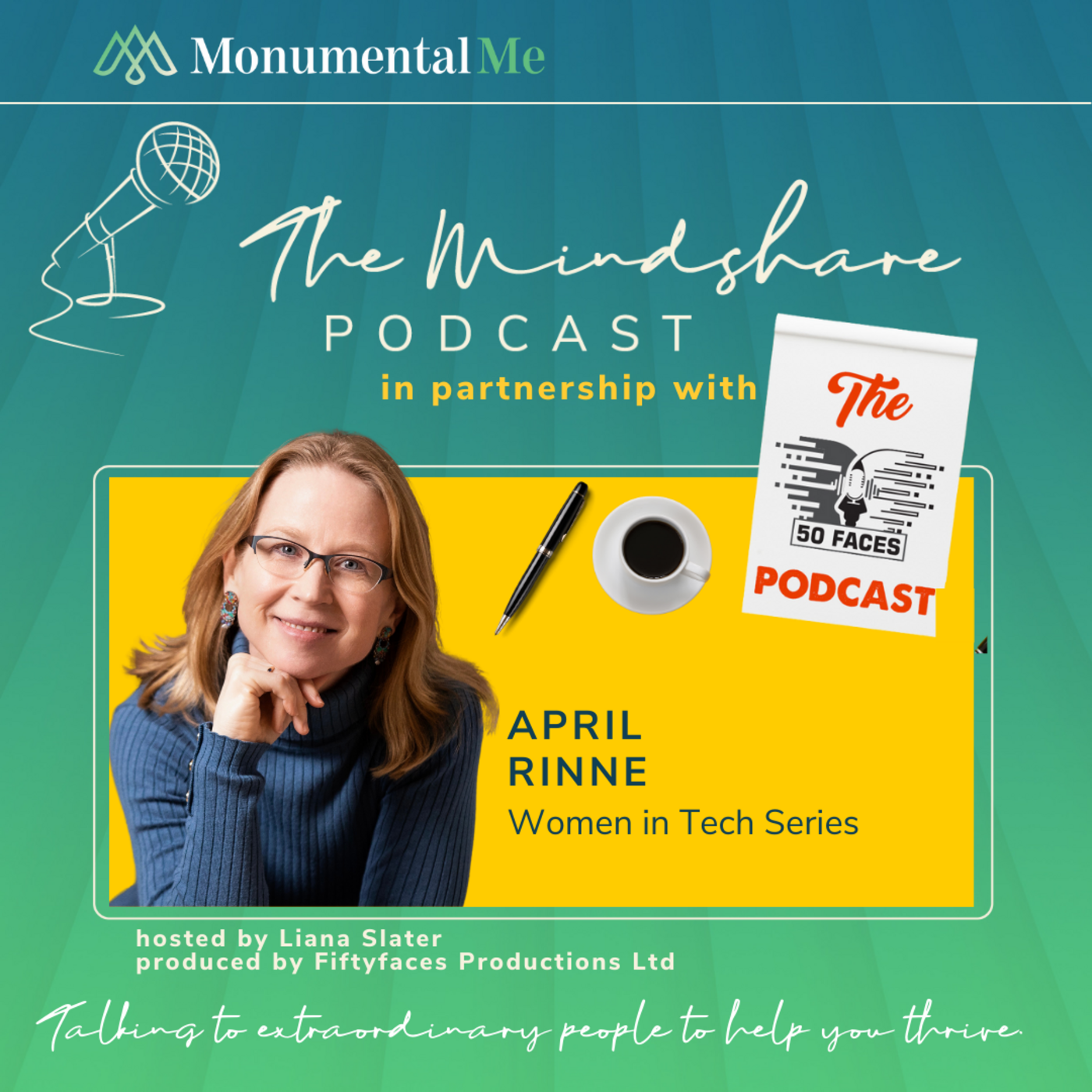
April Rini: Our Global Women in Tech series is an exciting collaboration between 50 Faces Productions and Monumental Me, an organization committed to wellness, including resilience, mental fitness, and strength, designed to help you thrive in life and your career. By listening to this series, not only are you gathering key insights into the tech world today, but you’re also gaining real tools to help you rise in your career while taking care of your wellbeing. Thanks for listening. And if you enjoy this series, spread the word. This is Leanna Slater of Monumental Me. Today I’m speaking with April Rini. April is a change navigator. She’s a speaker, investor, and adventurer whose work and travels in more than 100 countries have given her a front row seat to a world in flux. She’s ranked one of the 50 leading female futurists in the world by Forbes, and April was my guest on the Mindshare podcast in season Episode 1, and we talked about her book, Flux: 8 Superpowers for Thriving in Constant Change. I invited April to speak with me on this series after a year of advising organizations in tech and across sectors and of speaking on this topic and more. Today, April talks us through these superpowers and how we can apply them to our lives in order to manage constant change and flux. We reflect on a few of our guests on the Women in Tech series to dig into timely topics that affect each of us today. This is a real treat. Thanks for joining us. Welcome, April Rini.
April: Thank you very much. I’m delighted.
April Rini: So, April, you are a guest on this special series, Women in Tech. We’re sharing conversations about what drove our guests’ success, how the tech industry is changing, and sharing some invaluable advice that they wish they had learned earlier. And I invited you as our guest in this series because you focus on the topic of a flux mindset and you’re a futurist. And tech and working in really any industry today requires a flux mindset. In your words from your book, I just want to point out one thing that you say that always sticks with me. To thrive in this world in flux, we need to radically reshape our relationship to uncertainty and flip the script. So I’d love for you to introduce yourself, your book, and everything else that you do, but do tell us also just what a flux mindset is and what a futurist does and really why this concept is your topic of choice.
April: Absolutely. Let’s dive in. How long do we have? That’s a joke. So I want to get straight to a flux mindset, but really quickly, I’ll tee it up by just calling out the fact that the word change, it’s one word. We treat it often like it’s one thing. Ditto for uncertainty. But the reality is that change and uncertainty are really, really messy. We love some kinds of change, we hate other kinds of change. In particular, we love change we can opt into, we love change we can choose and control, things like a new relationship, a new sweater, a new house, a new haircut, right? We love those kinds of changes. We hate the changes we didn’t see coming, the ones that blindside us. And so I’ve been fascinated in these themes of change and uncertainty for a really long time. Now, the past few years have been like a crash course for this scope of work. But I’ve been pulling on this thread of flux and flux, meaning both continuous change as a noun, but flux is also a verb and to flux means to learn to become fluid. And so, this idea of, okay, the world is in flux, the future is in flux, pretty much everything is in flux these days, it seems. And we need to learn as humans individually and collectively how to flux, how to go with that flow more, if you will, and how to get comfortable with uncertainty. And so, the concept of a flux mindset is the state of mind, the ability to see all change, and by all I mean the quote unquote good stuff and the bad stuff, the expected changes and the unexpected changes, and especially those really hard changes, the things you didn’t want to have happen, the things you didn’t see coming. It’s the ability to see all of them as an opportunity to learn and to grow and to improve and really to show up more fully for yourself for one another and the future that we all face, which is full again of change and uncertainty. And so that’s, you know, in a nutshell what a flux mindset is. In terms of how I got into this space and what I bring to it, I often say that I have 3 different lenses that I bring to this world in flux. The first is that which you mentioned of a futurist. And so as a futurist, I’m helping organizations better understand what’s on the horizon and how they fit into it. And in particular, those macro forces that a lot of people aren’t really paying attention to because they may not relate to their industry or their domain or this quarter’s returns, but they are going to have a massive effect on business and society in the coming years. And so that’s super fun. We can kind of run down that rabbit hole. That’s the future of work, the future of learning, the future of the economy, cities, climate, all of those sorts of things. The second lens though is that of a global citizen. So really a global lens on change. And I’ve lived and worked and traveled in more than 100 countries, every continent except for Antarctica. And that has just given me this great breadth of not just experience, but exposure to different cultures and different wisdom traditions and different kinds of ways of seeing the world. And what that has shown me is that we are surrounded by so much human wisdom about how we see change, concepts and rituals and traditions and words about change. And the punchline is that there’s just a lot we can learn from one another if we can connect those dots. And so I see myself as a dot connector and a translator of these many different traditions and how we can all help each other see change and uncertainty and the future differently, better, I would say. And then last but not least, it’s just this very human interest as a humanist, as a human being in change and uncertainty. And I often say that if I really go back to when did I get interested in this, I will date myself. It was more than 25 years ago when I was in college and it was a profoundly human experience that rocked my world and flipped it upside down. And that is that when I was in college, when I was 20, both of my parents were killed in a car accident. And I know that’s a difficult topic to bring into the conversation, but I think it’s really important. And I should be clear also, I welcome conversations about the really hard, messy, emotional stuff, the grief and the loss and the what do we do when we just don’t know what to do. And hey, that wasn’t supposed to happen. But as someone relatively young, I had to go through that. And I realize now that there were a lot of things I wished I’d known about life. I joke, I often, I in some ways had a kind of midlife crisis when I was 20. I wasn’t in midlife and I didn’t ask for it, but I started asking the kinds of questions about change and uncertainty and why are we here and what is the purpose and meaning of any of this, all of this. And those insights and those learnings and lessons have stayed with me, and I now get really excited when I can share them with others. But when I also know that each and every one of us is going to go through some kind of very human flux, whether that’s a loss of a loved one, loss of a job, medical diagnosis, something that’s going to flip your world upside down. And so I’m excited to help people get prepared from that perspective as well.
April Rini: All right. This is great. Thank you for that summary. And I love that you mentioned a couple things about better managing change through loss, extreme loss, and that you touched on culture and the importance of international travel, and then just thinking about being human. So there’s so many things that you touch on, and I don’t know if this is a good place to mention your book, ’cause I know you do so much more than that, but you do have a book and I’d love for you to just touch on that and the superpower idea. If you don’t mind introducing that.
April: Sure, of course. Yes. So very apropos title of my book is Flux: 8 Superpowers for Thriving in Constant Change. And this idea of a flux mindset is at the core. It’s sort of a central concept of the book, but it also leads to— and how it all kind of connects is that people say, okay, I should open this mindset. I’ll work on that. I want to improve my relationship to change. But how do I do that, right? Just because you have a mindset doesn’t mean that somehow there are all of the answers right in front of you. And so what I like to say is that the superpowers are the practices and disciplines and quote unquote how to strengthen your flux mindset, open it further, and really put these ideas into action. And so each one is a chapter in the book. I joke that They’re a menu, not a syllabus. So you don’t have to read 1 before 2 or 2 before 3. You can read them in any order. I joke you could read the book backwards. But it really relates to the fact that if I have learned anything in the past 30+ years, it’s that we’ve all had different experiences of change and we can all use some help with change. I haven’t met anybody who’s not grappling, if not struggling, with some kind of change in their life that they just wish was a little bit different. And I say this because the book is designed to meet people where they are, and the superpowers are designed to meet you wherever you are, hopefully over across the 8, covering a vast range of approaches to different kinds of change. So depending on what you’re working on or worried about or struggling with, you may want to actually start with one or two of the superpowers that may or may not be, you know, chapter 1 and 2 and so forth. But I’m happy to run through all 8 if you’d like. I can do that quickly.
April Rini: Yeah, let’s introduce them and then I do want to ask you how to apply that with some specific questions. But yes, if you can summarize the 8, that’d be great.
April: Super. And I should also give the caveat. It’s more just like a framing that each of these superpowers is counterintuitive or contrarian in some way. And why that is, is because much of what we’ve been taught about change and uncertainty and how we’re supposed to relate to these things is really outdated and incomplete for today’s world. I think I can just, when I tell people what we were taught about how change is supposed to work, doesn’t often align with change as it actually works in the real world. And I think more and more, again, the last few years have been a really good example of that, of like, oh, you thought you could quote unquote manage change. And I often joke that change management is a useful tool in our toolbox, but it too is woefully incomplete. The fact that we think that we can somehow manage change, engineer it, put it back in a box, tick that box and move on, just fundamentally at odds with human reality today. So with that framing— Yes. And we can talk about change management. And I know also we can talk a lot about what this means for the world of technology and also for the world of women writ large. I mean, it’s a book that’s written for humans, all humans, but women have been among the most avid and enthusiastic readers. Because as you’ll hear in just a minute, when I go through the superpowers, there are a range of chords that I think I strike that people are like, yep, this is how I’ve been feeling. You’re giving voice and language around this. But again, it’s not typically what we’ve been taught. So with that as a mini kickoff, I’ll just take these in order in which they do appear in the book. So the first flux superpower is run slower. People are like, what? I’ve always been told I was supposed to run faster and just keep up. And I joke, no, in fact, running slower is all about anxiety and burnout and also making wiser decisions. The punchline is that when we’re always running ever faster, we actually miss much of life. We fail to see what really matters. We struggle to make wise decisions and we bypass a lot of our best opportunities for hope and well-being. And so I always like to say too, running slower isn’t about somehow compromising productivity or getting less done. It’s actually about getting really clear on what does productivity really mean. So that’s the first one. The second one is what I call see what’s invisible, which is about identifying our blind spots, what we’re not seeing, and also uncovering new insights, new opportunities, new sources of value. This is about both seeing within and seeing outside of ourselves, and there are so many hidden messages, hidden insights, hidden wisdom that we’ve buried for a long time, but that’s also been in us for a very long time that hasn’t necessarily seen the light of day. And this is about unlocking all of that invisibility and making it glaringly visible in order to serve the world. The third superpower is Get Lost. Now, this is about stretching beyond your comfort zone and your relationship to the unknown. I will often frame this as the question of how do you not just get comfortable not knowing where you are or how the future is going to land or how a particular situation will turn out? That’s our relationship to the unknown. How do you not just get comfortable with that, but actually learn to actively embrace that kind of disorientation? Because this may sound a little pithy, a little trite, but when we get lost is when we actually find ourselves. And I think we can take that in many different directions. Fourth superpower is Start with Trust, which is all about how to nurture human relationships and navigate change together. And I often call this one the flux super superpower because when it comes to navigating change well over time, as far as I can tell, and I would gladly debate this, but as far as I can tell, no single factor matters more than trust. Everything in some way comes back to trust at some point, whether that’s trust of other people, trust of yourself, trust that the sun will rise tomorrow, trust that things are going to get better, whatever the case may be. So that’s another really rich one to dive into. The fifth superpower is called know you’re enough. Now this is all about our obsession, I would say, with more, more, more, more, more, and also our quest for true happiness. And here it is framed as know you’re enough, Y-O-U-R, but it also includes knowing that you are enough and that you always have been ever since the day you were born, and that in fact society and messaging and a lot of social media tries to convince us otherwise and often does a very good job of it. But the fact is you are enough, and knowing you’re enough is actually where you begin to see abundance. As I like to say, enough is plenty. The 6th superpower— we’re almost there— is create your portfolio career. This one is unique in that it’s the one that’s squarely oriented towards the future of work and professional development, and this one is basically all about How to design and own your career in ways that are fit for a future of work in flux. And the punchline is that the successful meaningful career of the future, the shape of it is not a ladder to climb. It is a portfolio to curate as an artist or an investor or an executive would. And so we can get into this concept of a portfolio rather than a ladder or a path. The 7th superpower is be all the more human. This is about the— well, it’s about our relationship with technology, and it’s also about the tension we face in that we’re spending ever more time with our devices and yet ever less time with one another. And let me just say that when change and uncertainty hits, this tension, this over-indexing on devices and under-indexing on human relationships, causes a big problem. And so that might be good for this conversation as well. And last but not least, the 8th flux superpower is let go of the future. And if none of the other 7 have made you kind of go, wait a minute, what? That’s not what I was taught. This one probably does. This is all about our relationship to control. Now, letting go does not mean giving up. It does not mean failing. It does not mean shirking your responsibility. If I had more space, if my editor had given me more space, I would have called this letting go of our obsession with wanting to predict and control quote unquote the future. Because there is no one future, but rather there are many different possible futures that we are all bringing into being every single day. And so how do we groove that mindset? To rethink all of the futures that we may face and let go of this need to predict the one, and especially to have that one work one certain way. And if it doesn’t go that way, then, oh no, what’s going to happen, etc., etc. When you can let go, you actually find it’s very empowering, and it opens up space and gives oxygen to a lot of ideas that actually the world and the brighter tomorrow need. So again, a bit of a mouthful, but my additional answers from here I think will be shorter.
April Rini: No, this is great. This is great. I do encourage everybody to get your book because I think it is good to have it on hand because each superpower is so rich. And I think that doesn’t come naturally to everybody, the things that you mentioned here. So just coming back to this Women in Tech series that we’re doing, I wanted to focus different superpowers on different conversations we had. And then after that, I want to expand on a couple of them that you just mentioned. So just One example in the series, Jessica Kosmowski, we interview her and she’s a very senior executive at Deloitte Consulting. She mentions bringing her whole self to work and she does this by talking about her family and she wants to be seen as human. So I wanted to pose this to you. I kind of see this as particularly related to superpower number 2 you mentioned, but how do you think about this and how do you think that this is a helpful way for women to position themselves? Themselves in today’s world?
April: Yeah, so I would actually— I’m like, oh, this is superpower number 2 and number 5 and number 6 and number 7. Like, what I love is like you give me again, and I joke, far more things are in flux than not today. So there’s this never-ending fire hose of ways these superpowers can be helpful. But the idea of bringing your whole self to work, I have to give a caveat. I know that not everyone feels comfortable bringing their whole self to work or anywhere else. And it’s not a matter necessarily of seniority. It’s not necessarily a matter of sector, but not everyone is ready to be vulnerable. Not everyone feels proud or excited about all that they are. I think it’s much easier to do when you are an executive, when you have quote unquote made it. But I’m really trying to reach people at all points in their life, at all levels of seniority, and to help them see that every experience they have had in life, whether they were born on the right side of the tracks or the wrong side of the tracks, whether they had every opportunity or actually had to just fight, fight, fight the whole way, whether they’ve had different challenges, different disabilities, different parts of their personality, that all of these things can be celebrated. Because I think there is a lot that people want to hide. The place where I would actually start, so there’s definitely seeing what’s invisible. Those invisible talents and skills and parts of yourself that you’re quote unquote supposed to hide from the office. I don’t buy that for a minute. I also though will respect whatever parts someone does or does not feel ready to share. I hope that everyone ultimately feels like they can share all of themselves. I also know that’s a gradual process. And over the last nearly 3 decades of talking to people about how they can and cannot show up, and I didn’t mention this earlier, but related to the global piece of my puzzle, the first half of my career was exclusively focused on global development. So I have spent a lot of time working with the bottom billion, working on creating sustainable business models for people earning $5, $10 a day. I have lived in urban slums. I have tackled every single one of the 17 Sustainable Development Goals or SDGs in, at some point in my career. And I share this because I have deep, deep empathy. This is not a message for privilege. The irony is the privilege of privilege is not noticing the privilege. And I’m really trying to cast a very wide net for How do people feel confident to show up fully themselves and to celebrate those things that I think a lot of times a traditional narrative around success would deem to be liabilities and actually recast them as strengths. And so the place that this often shows up and for whatever reason where I’m naturally taken to move or to focus today in this conversation is actually this idea of your portfolio. Portfolio career and what’s in your portfolio. And I think it’s a nice dovetail with what Jessica’s talking about, because one of my favorite ways to frame how we see our careers and the shape of our careers is that your resume contains only a fraction, a tiny sliver, a narrow slice of who you are and what you can do. And as far as I can tell in my experience, it doesn’t even contain the most interesting parts often. And the number one example that I will pull out, I think it’s very relevant, not just for women, men too, but looking at women in particular, parenting skills, right? So Jessica talks about talking about her family. That’s great to be able to talk about your family. You want that. I look at this and I say, why is it that parenting skills not only— there’s not a place for your resume for them, you’re not supposed to put them on your resume, you might get dinged for putting them on your resume. And yet I look around and I go, as far as I can tell, parenting skills are super skills for everything from conflict negotiation, time management, multitasking, all of these things that help someone succeed in the office or in business or at work. Why do we hide these things? And coming back to this idea of a portfolio, your portfolio is your unique combination of everything you can do, whether or not it’s on your resume or not, whether or not you’ve been paid for it. And parenting skills would be actually at the center of a portfolio, along with all of the different technical skills and credentials, et cetera, that you have. And so that’s kind of where I like to take this. And so if you’re interested in this idea of a portfolio career, There’s a whole lot more that I’ve written, that a few others have written on this concept. And when you show up with your portfolio, you present a fuller self to work, to your colleagues and whatnot. What’s fascinating, and this might be going too far beyond our scope for today, this isn’t just about individuals. This is actually the future of talent and HR and career, quote unquote, management for companies as well. Because companies want to hire different kinds of talent. They want people to feel comfortable showing up fully, and yet they’re still hiring through this like old school ladder metric. And so portfolio, a portfolio approach has benefits for individuals, but also for companies as well.
April Rini: Excellent point. Yes. Thank you. Okay. So let me just guide us to the second interview that we have in this series with Katie Jacob Stanton. She is a founder of Moxie Ventures, a VC, so she works with investment as well as many entrepreneurs. And she encourages women to get rid of the imposter syndrome. And I see fear as something that feeds this for many women and men, but what is your advice? And I won’t point out my superpower that I relate to this because I think it’s better if you tell us what to focus on, on your advice on managing this fear or managing imposter syndrome.
April: Yeah. And I actually first met Katie, let me think, 12 years ago. She had just started at Twitter. Long, long, long ago. So I’m like, I saw her name and I was like, wow, that’s awesome. Yeah. And I was doing some work with, again, that was when I was in global development. And so this idea of how Twitter could help communications and again, different era in human history when most people still didn’t know what Twitter was and globally there was very little knowledge, particularly in emerging and developing markets. So anyway, it’s kind of a fun bridge here. So imposter syndrome and fascinating side note, the founders, the women, they were women who first established this concept of imposter syndrome. It was called imposter phenomenon. There’s a great piece out, I believe it’s in the New Yorker about imposter phenomenon and how even by their account, it became something much, much bigger and much more problematic than they originally imagined. Not to say it has incredible, incredible import. It’s just that like there’s this bigger picture and narrative and historical backdrop as to how this concept of impostering came about that I would highly recommend reading because I, again, I totally got into it and I learned a lot about my own imposter syndrome, how it has evolved, et cetera. Now today for this idea around fear, I’m going to take us not to one specific superpower, but rather back to this mindset. Because over the past, again, nearly 30 years of tracking these themes and how we relate to change and uncertainty, and what do you do when you just don’t know what to do? I call it like a little secret. When it comes to these questions of like, I just don’t know what to do. What one factor matters most? This is where it gets really interesting. Whether— how you see a given change, it’s not about whether a change is big or small. It’s not about whether a change was a surprise or, to be frank, you’d seen it coming for a long time. Maybe you tried to deny it, but it was there. You know, it’s none of those things that are kind of on the surface. The number one driver or factor of how we can approach a given change is whether we see it from a place of hope or fear. And I just kind of want to let that sink in because— just pause for anyone tuning in, think about a change that you’ve struggled with. I will bet that when you think about your feelings related to that change, some kind of fear, anxiety, worry— oh my God, what’s going to happen? Oh no— that will have crept in. And yet you could see— and I’ll come back to this in a minute— you do have the choice to see that very same change from a place of hope. Now, think about what happens when you see a change, the very same change from a place of hope. It’s interesting because I totally get that hope can be hard. I think for many people, and myself included, when change hits, we may be wracked by anxiety, paralyzed by fear, and when that happens, we develop a kind of tunnel vision. There’s a physiological component to all of this. When we fear, our area of focus narrows. It’s a literal physiological thing. Your scope of vision narrows, your short-term memory shrinks, and you lose perspective. You can no longer see the forest for the trees when you have fear. And in contrast, hope— yes, it can be hard. I’ll be the first to admit that. But hope is also a catalyst for uplift, and hope what expands your vision. Hope is what inspires action. Hope signals an openness to try new things. Hope is what gives us a reason to move forward. And I don’t want this to sound— well, I don’t mind if it sounds woo-woo at all, actually. I realize that there’s some places where you do and don’t want that to happen. But I just want to kind of ask people to pause for a moment and consider that no matter who you are, No matter what title you may or may not have, no matter how much money you may or may not have, no matter where in the world you are, all of that, no matter— and I hate to use this example, but imagine you’re in solitary confinement in a prison. You still, every single one of us, every single human, wherever they are, whoever they are on the planet, no matter what else happens, you still have the ability to choose and to control whether you see a given change, a given reality, a given thing from a place of hope or fear. And so I just want to start there because it goes beyond imposter syndrome or imposter phenomenon. How we relate to change absolutely completely conditions how we show up for the rest of of our lives and for the world. And so holding that tension, I think, is a hallmark of a flex mindset, but it’s really about choosing hope rather than fear. And not blind hope, not naive hope, but hope that is grounded in the wisdom that we have all around us and also inside of us. Love it. Yep.
April Rini: Thank you. Okay. Shifting a little bit here, I’m going to focus on our guest for episode 3 in the series. So Allison Reedy Williamson. She’s the Chief Diversity and Culture Officer at Yahoo. Yahoo’s gone through a lot of changes, so that was a great conversation to hear what’s happening there and how she’s managing that topic. But she discusses feminist leadership, and I want to hear from you, April, if you see a difference in leadership between women and men, and if so, what are the strengths or difference in women in leadership, and can any of the superpowers you mentioned be applied there?
April: Oh my goodness, where to start? This one is so fun. You can’t see me, but big smile. Smile on my face. And yes, there are lots of different, I think, leadership styles and arcs and differences between men and women. But again, I’m someone who I don’t necessarily want to call people out or put them on the spot and say, this is bad, this is good. I tend to come out, zoom out and say, where can we learn from human systems about the differences between what I will term more broadly male and female energy, male and female character traits, and recognizing that all humans have elements of both male and female in them. It’s not like women are 100% one way and men are 100% other ways. We know women who have character traits like men and men that have character traits like women, and here I’m talking about things like emotional intelligence or rigor, discipline, people who can focus or not, all sorts of things. And where this comes back to for me, for a lot of this, is the concept of yin and yang. Yin and yang, historically, they come from ancient Chinese philosophy. Yin and yang are complementary forces and energies and symbols of harmony. Now, in a healthy society, in any healthy society, Yin and yang should be in balance, and that means that they’re in this sort of like creative dynamic tension. So it’s not all yin, it’s not all yang, you’ve got balance. And the very best kinds of harmony flourish at the boundary between yin and yang. When yin and yang are out of balance, we lose this tension, we lose this integration. And yin and yang are everywhere. Right? They’re light and dark, joy and pain. Those things are all yin and yang. Now, yang energy is typically considered to be bright and linear, focused and male. It’s like that laser of light. In contrast, yin energy is soft and round. It’s keenly attuned to relationships and holistic thinking, and it’s female. Right now, yang energy to dominate, it’s that harsh, intense light. Yin prefers to collaborate. It likes to take everyone into consideration. Yang is fire, yin is water. And again, like I was saying, every person has elements of both yin and yang in them. But today, and we have these different elements, we just have them in different proportions, right? So men tend to have more yang, women tend to have more yin, but each of us has a little bit of both. But today, and this really gets to the heart of your question, I shouldn’t say just today, for the last 300, if not 3,000 years, I believe that we are suffering from a massive yang overdose. And that isn’t about men versus women, but rather that for the last several centuries, if not a couple millennia, it’s the yang energy has been running the show. But as a result, we are all out of balance and we’ve lost the creative tension and the edge that a thriving society needs. And so does this mean more women in leadership and more women everywhere? Yes, it does. But more broadly, what it means for me is more yin. And when you think about male leaders, who have a lot of yin, they tend to be the beloved leaders. They tend to have emotional intelligence off the charts. They are the men that are not afraid of being vulnerable and showing empathy and creating a culture of trust and all of that, right? And I say this very respectfully, but the women who often, you know, you have a small percentage of women who are leading Fortune 500 companies. Still quite small. But women, when women have had to fight their way to the top, they’ve often had to show a lot of yang characteristics. They’ve had to dress like men. They’ve had to be kind of bullheaded and harsh and don’t bring their emotions and all of that. That is the antithesis of what we need. And so I get really excited because a healthy thriving future that’s in balance has more yin. That tempers the yang. And so this is a huge opportunity, I think, for women across the board, but it is also an opportunity for men to understand and get in touch with that yin part of themselves. So let me pause right there. This is again a little bit woo-woo, but it’s so spot on when you really dig into these dynamics and forces at play.
April Rini: Absolutely. Yep. Thank you. That was great. All right, I’ll move along to the next guest that we had in episode 4 of the series. So Fiona MacDonald, she is author and a senior executive at Booking.com. And in a recent book that she wrote, she discusses the importance of self-awareness. So she brought that into our conversation. So April, what are your thoughts on that, on self-awareness to be able to thrive at work and better manage change and uncertainty? And you definitely touched on this when you were summarizing the Superpower.
April: Answer here will be quite brief. I mean, a flux mindset is all about self-awareness. It’s all about understanding, understanding and updating, upgrading your relationship to change and uncertainty can only happen from the inside out. And it can only happen from the inside out if you do the work and understand and become aware of all of the different parts of you. And so, self-awareness is very much at the heart of flux and a flux mindset. And each of the flux superpowers, when you get good at practicing them and strengthening them, also boost your self-awareness. But for me, there is no professional development that can happen without personal growth, for example. And the personal growth is all rooted in self-awareness. Includes, you know, the parts that you’re excited about, the parts that you struggle with, your best features as well as your warts and your, and your worries, but really starting to see and embrace and love yourself for all of those things because they’re what make you uniquely you. And, you know, at the risk of stating the obvious, so many people are striving to be something that other people think they should be. And you will never ever, you or anyone, will never be the best other person that you can be. And yet no one will ever be a better you than you. So self-awareness and becoming the best you that you can possibly be will allow you to bring those gifts into the world and to other people who really quite, I don’t want to say desperately, but desperately need them today, right? I mean, that’s the point in human history that we’re at. But it does all come back to self-awareness. And it also comes back, as I mentioned before, this tension between hope and fear. A lot of self-awareness revolves around that as well. Yes.
April Rini: And that will be surprising for some people. So, I love that you expanded on that earlier. So, okay. Getting towards the end of our time together, and I want to give you time to talk about the superpower number 7. That was something you mentioned earlier. So do you want to expand on that a bit now? The concept of spending less time with technology and how hard that is, but so important.
April: Oh yes, absolutely. Exactly. So that’s one that I was thinking about. So we can take this many different directions, but yeah, our relationship to is technology is the fact that we’re spending ever more time with our devices, yet ever less time with one another. And lots of evidence out there that shows this. And I, I don’t mean to discount that. It’s not that time on screens with other humans isn’t time at all with humans, but there’s something we lose when we’re not in human touch. And the point I wanted to bring up, and it’s a bit counterintuitive, but I find it fascinating, and it relates to change management, and it relates to engineering change, and it relates to how a lot of companies, tech companies and otherwise, it’s not unique to tech companies, but how they design their organizations and their cultures and their change management processes and whatnot, that we think about, oh, when change hits, I’m just going to pull out an app and that’s going to solve my change. And you can think about things like you get in a traffic jam and you pull out Waze or something to find a different way. Like that’s a change, right? But some kind of change happens. Technology is going to help me solve it. And hence, the more devices and more apps I have in my pocket, the better prepared I am for change, right? And that’s a totally legitimate perspective to take. Kind of makes sense, right? That if I don’t know what the future has, just give me more apps, give me more tools in my toolkit, and I will be ready for all change. It turns out, however, and I think I only need to point to the COVID pandemic to make this point that when change, like capital C change, really hits, an app is not going to fix it. An app is not going to help you. An app will help you maybe save a few minutes getting from point A to point B, again, in a traffic jam. But when change hits, this is all about who do you turn to when change hits and you don’t know what to do? Who do you turn to when you’re wracked by fear and anxiety about the unknown? You do not turn to an app. Your device is not going to give you the answer. You turn to your trusted human relationships. Humans are the only thing that are ultimately going to navigate change well, and we’re really only going to navigate it really well together. And so this is a little bit of the Superpower 7, it’s also a dose of Superpower 4, the starting with trust. And so I bring this up because I, and I know many other people have long said that technology, technology has no value on its own. Technology is simply a tool that gives humans value based on how we use it. Right. But technology existing in a vacuum is like, great. Okay. What? Right. So, recalibrating this tension, and we need to start over-indexing on investing time in meaningful human relationships based on trust. Technology can help make that happen. But the irony that the people who struggled most back in March 2020 when the world flipped upside down, but ever since then, are the people who put too much of their Oh, this is how I’m going to navigate change into the basket of technology. And those who have thrived the most are those who have overinvested, or I don’t think you can ever overinvest in human relationships, but those who have really focused on the human connection and the human touch. And so I bring that together because I think this is— I’m looking at everything through the lens of how we navigate change and uncertainty. I actually think this is fundamentally a principle example for how to live a good life, period.
April Rini: Definitely. That is very well said. And also, I’m just thinking back on each of these conversations that I had with the previous guests. That’s the common thread. I think that human thread, the relationships and how important they are, connected to so many different topics. So thank you so much for, for summarizing that. So April, we have to wrap it up. I’d love to ask you if there’s anything that you want to touch on that you haven’t gotten to. I know we could speak for days, but you also in our last conversation on the Mindshare podcast that when we spoke last year about your book, you mentioned you like when people ask you, is there a question that you didn’t get? So I don’t know if you want to touch on something there because that’s something also stuck with me when we spoke.
April: Yes. And I think, and I have received since we last spoke, oh my goodness, so many questions from so many different places. So many unexpected questions because what I really want to shine light on, and I mentioned it briefly before, but this book, this body of work, this flux mindset, these superpowers, they really are designed to meet people where they are. And the kinds of questions I’ve been receiving where people are like, I’m dealing with this kind of change and I took your book and used it in this way. And I was like, wow, that is awesome. And I never thought of that before. And so I love it because the other, The punchline that I often give at the end of this kind of conversation is that when everything is in flux, everything can benefit from a flex mindset. And so think of what we’re talking about today, not just in terms of how it applies to your work and your career and professional development, the world of technology, et cetera. Think about these as skills for life. And every day deals us change and uncertainty. And so every day we have an opportunity to improve. And I get really excited because literally every week I am being asked questions about some new kind of flux, including, as I was saying to you earlier, things I just, I never saw them coming. And it’s really exciting to realize the power and relevance and benefit that these superpowers can have for pretty much whatever is coming your way. And also not just you, it is your colleagues and people that you work with, but these are also superpowers for your friends, your kids, your spouse. I’ve actually had a lot of people pick up Flux and they finish reading and they’re like, oh, that was, that was really helpful. I really need my spouse to read this. Yeah, that’s— I’ve been thinking that as we’ve been speaking. Yeah. And I share this because even if it’s not there is likely at least 1 or 2 other people in your life who are really struggling with a given change at a given moment in time. This is a way you can help them as well. So that would be my wrapping up point. Awesome.
April Rini: All right. Well, we are going to leave it there. Thank you so much for joining us and being part of this special series. I love having you as our guest.
April: Thank you very much. It’s truly been a joy and a pleasure. And thanks to you and your community as well. This podcast is for informational purposes only and should not be construed as investment.
April Rini: Advice, and all views are personal and.
April: Should not be attributed to the organizations.
April Rini: And affiliations of the host or any guest.
April Rini: Our Global Women in Tech series is an exciting collaboration between 50 Faces Productions and Monumental Me, an organization committed to wellness, including resilience, mental fitness, and strength, designed to help you thrive in life and your career. By listening to this series, not only are you gathering key insights into the tech world today, but you’re also gaining real tools to help you rise in your career while taking care of your wellbeing. Thanks for listening. And if you enjoy this series, spread the word. This is Leanna Slater of Monumental Me. Today I’m speaking with April Rini. April is a change navigator. She’s a speaker, investor, and adventurer whose work and travels in more than 100 countries have given her a front row seat to a world in flux. She’s ranked one of the 50 leading female futurists in the world by Forbes, and April was my guest on the Mindshare podcast in season Episode 1, and we talked about her book, Flux: 8 Superpowers for Thriving in Constant Change. I invited April to speak with me on this series after a year of advising organizations in tech and across sectors and of speaking on this topic and more. Today, April talks us through these superpowers and how we can apply them to our lives in order to manage constant change and flux. We reflect on a few of our guests on the Women in Tech series to dig into timely topics that affect each of us today. This is a real treat. Thanks for joining us. Welcome, April Rini.
April: Thank you very much. I’m delighted.
April Rini: So, April, you are a guest on this special series, Women in Tech. We’re sharing conversations about what drove our guests’ success, how the tech industry is changing, and sharing some invaluable advice that they wish they had learned earlier. And I invited you as our guest in this series because you focus on the topic of a flux mindset and you’re a futurist. And tech and working in really any industry today requires a flux mindset. In your words from your book, I just want to point out one thing that you say that always sticks with me. To thrive in this world in flux, we need to radically reshape our relationship to uncertainty and flip the script. So I’d love for you to introduce yourself, your book, and everything else that you do, but do tell us also just what a flux mindset is and what a futurist does and really why this concept is your topic of choice.
April: Absolutely. Let’s dive in. How long do we have? That’s a joke. So I want to get straight to a flux mindset, but really quickly, I’ll tee it up by just calling out the fact that the word change, it’s one word. We treat it often like it’s one thing. Ditto for uncertainty. But the reality is that change and uncertainty are really, really messy. We love some kinds of change, we hate other kinds of change. In particular, we love change we can opt into, we love change we can choose and control, things like a new relationship, a new sweater, a new house, a new haircut, right? We love those kinds of changes. We hate the changes we didn’t see coming, the ones that blindside us. And so I’ve been fascinated in these themes of change and uncertainty for a really long time. Now, the past few years have been like a crash course for this scope of work. But I’ve been pulling on this thread of flux and flux, meaning both continuous change as a noun, but flux is also a verb and to flux means to learn to become fluid. And so, this idea of, okay, the world is in flux, the future is in flux, pretty much everything is in flux these days, it seems. And we need to learn as humans individually and collectively how to flux, how to go with that flow more, if you will, and how to get comfortable with uncertainty. And so, the concept of a flux mindset is the state of mind, the ability to see all change, and by all I mean the quote unquote good stuff and the bad stuff, the expected changes and the unexpected changes, and especially those really hard changes, the things you didn’t want to have happen, the things you didn’t see coming. It’s the ability to see all of them as an opportunity to learn and to grow and to improve and really to show up more fully for yourself for one another and the future that we all face, which is full again of change and uncertainty. And so that’s, you know, in a nutshell what a flux mindset is. In terms of how I got into this space and what I bring to it, I often say that I have 3 different lenses that I bring to this world in flux. The first is that which you mentioned of a futurist. And so as a futurist, I’m helping organizations better understand what’s on the horizon and how they fit into it. And in particular, those macro forces that a lot of people aren’t really paying attention to because they may not relate to their industry or their domain or this quarter’s returns, but they are going to have a massive effect on business and society in the coming years. And so that’s super fun. We can kind of run down that rabbit hole. That’s the future of work, the future of learning, the future of the economy, cities, climate, all of those sorts of things. The second lens though is that of a global citizen. So really a global lens on change. And I’ve lived and worked and traveled in more than 100 countries, every continent except for Antarctica. And that has just given me this great breadth of not just experience, but exposure to different cultures and different wisdom traditions and different kinds of ways of seeing the world. And what that has shown me is that we are surrounded by so much human wisdom about how we see change, concepts and rituals and traditions and words about change. And the punchline is that there’s just a lot we can learn from one another if we can connect those dots. And so I see myself as a dot connector and a translator of these many different traditions and how we can all help each other see change and uncertainty and the future differently, better, I would say. And then last but not least, it’s just this very human interest as a humanist, as a human being in change and uncertainty. And I often say that if I really go back to when did I get interested in this, I will date myself. It was more than 25 years ago when I was in college and it was a profoundly human experience that rocked my world and flipped it upside down. And that is that when I was in college, when I was 20, both of my parents were killed in a car accident. And I know that’s a difficult topic to bring into the conversation, but I think it’s really important. And I should be clear also, I welcome conversations about the really hard, messy, emotional stuff, the grief and the loss and the what do we do when we just don’t know what to do. And hey, that wasn’t supposed to happen. But as someone relatively young, I had to go through that. And I realize now that there were a lot of things I wished I’d known about life. I joke, I often, I in some ways had a kind of midlife crisis when I was 20. I wasn’t in midlife and I didn’t ask for it, but I started asking the kinds of questions about change and uncertainty and why are we here and what is the purpose and meaning of any of this, all of this. And those insights and those learnings and lessons have stayed with me, and I now get really excited when I can share them with others. But when I also know that each and every one of us is going to go through some kind of very human flux, whether that’s a loss of a loved one, loss of a job, medical diagnosis, something that’s going to flip your world upside down. And so I’m excited to help people get prepared from that perspective as well.
April Rini: All right. This is great. Thank you for that summary. And I love that you mentioned a couple things about better managing change through loss, extreme loss, and that you touched on culture and the importance of international travel, and then just thinking about being human. So there’s so many things that you touch on, and I don’t know if this is a good place to mention your book, ’cause I know you do so much more than that, but you do have a book and I’d love for you to just touch on that and the superpower idea. If you don’t mind introducing that.
April: Sure, of course. Yes. So very apropos title of my book is Flux: 8 Superpowers for Thriving in Constant Change. And this idea of a flux mindset is at the core. It’s sort of a central concept of the book, but it also leads to— and how it all kind of connects is that people say, okay, I should open this mindset. I’ll work on that. I want to improve my relationship to change. But how do I do that, right? Just because you have a mindset doesn’t mean that somehow there are all of the answers right in front of you. And so what I like to say is that the superpowers are the practices and disciplines and quote unquote how to strengthen your flux mindset, open it further, and really put these ideas into action. And so each one is a chapter in the book. I joke that They’re a menu, not a syllabus. So you don’t have to read 1 before 2 or 2 before 3. You can read them in any order. I joke you could read the book backwards. But it really relates to the fact that if I have learned anything in the past 30+ years, it’s that we’ve all had different experiences of change and we can all use some help with change. I haven’t met anybody who’s not grappling, if not struggling, with some kind of change in their life that they just wish was a little bit different. And I say this because the book is designed to meet people where they are, and the superpowers are designed to meet you wherever you are, hopefully over across the 8, covering a vast range of approaches to different kinds of change. So depending on what you’re working on or worried about or struggling with, you may want to actually start with one or two of the superpowers that may or may not be, you know, chapter 1 and 2 and so forth. But I’m happy to run through all 8 if you’d like. I can do that quickly.
April Rini: Yeah, let’s introduce them and then I do want to ask you how to apply that with some specific questions. But yes, if you can summarize the 8, that’d be great.
April: Super. And I should also give the caveat. It’s more just like a framing that each of these superpowers is counterintuitive or contrarian in some way. And why that is, is because much of what we’ve been taught about change and uncertainty and how we’re supposed to relate to these things is really outdated and incomplete for today’s world. I think I can just, when I tell people what we were taught about how change is supposed to work, doesn’t often align with change as it actually works in the real world. And I think more and more, again, the last few years have been a really good example of that, of like, oh, you thought you could quote unquote manage change. And I often joke that change management is a useful tool in our toolbox, but it too is woefully incomplete. The fact that we think that we can somehow manage change, engineer it, put it back in a box, tick that box and move on, just fundamentally at odds with human reality today. So with that framing— Yes. And we can talk about change management. And I know also we can talk a lot about what this means for the world of technology and also for the world of women writ large. I mean, it’s a book that’s written for humans, all humans, but women have been among the most avid and enthusiastic readers. Because as you’ll hear in just a minute, when I go through the superpowers, there are a range of chords that I think I strike that people are like, yep, this is how I’ve been feeling. You’re giving voice and language around this. But again, it’s not typically what we’ve been taught. So with that as a mini kickoff, I’ll just take these in order in which they do appear in the book. So the first flux superpower is run slower. People are like, what? I’ve always been told I was supposed to run faster and just keep up. And I joke, no, in fact, running slower is all about anxiety and burnout and also making wiser decisions. The punchline is that when we’re always running ever faster, we actually miss much of life. We fail to see what really matters. We struggle to make wise decisions and we bypass a lot of our best opportunities for hope and well-being. And so I always like to say too, running slower isn’t about somehow compromising productivity or getting less done. It’s actually about getting really clear on what does productivity really mean. So that’s the first one. The second one is what I call see what’s invisible, which is about identifying our blind spots, what we’re not seeing, and also uncovering new insights, new opportunities, new sources of value. This is about both seeing within and seeing outside of ourselves, and there are so many hidden messages, hidden insights, hidden wisdom that we’ve buried for a long time, but that’s also been in us for a very long time that hasn’t necessarily seen the light of day. And this is about unlocking all of that invisibility and making it glaringly visible in order to serve the world. The third superpower is Get Lost. Now, this is about stretching beyond your comfort zone and your relationship to the unknown. I will often frame this as the question of how do you not just get comfortable not knowing where you are or how the future is going to land or how a particular situation will turn out? That’s our relationship to the unknown. How do you not just get comfortable with that, but actually learn to actively embrace that kind of disorientation? Because this may sound a little pithy, a little trite, but when we get lost is when we actually find ourselves. And I think we can take that in many different directions. Fourth superpower is Start with Trust, which is all about how to nurture human relationships and navigate change together. And I often call this one the flux super superpower because when it comes to navigating change well over time, as far as I can tell, and I would gladly debate this, but as far as I can tell, no single factor matters more than trust. Everything in some way comes back to trust at some point, whether that’s trust of other people, trust of yourself, trust that the sun will rise tomorrow, trust that things are going to get better, whatever the case may be. So that’s another really rich one to dive into. The fifth superpower is called know you’re enough. Now this is all about our obsession, I would say, with more, more, more, more, more, and also our quest for true happiness. And here it is framed as know you’re enough, Y-O-U-R, but it also includes knowing that you are enough and that you always have been ever since the day you were born, and that in fact society and messaging and a lot of social media tries to convince us otherwise and often does a very good job of it. But the fact is you are enough, and knowing you’re enough is actually where you begin to see abundance. As I like to say, enough is plenty. The 6th superpower— we’re almost there— is create your portfolio career. This one is unique in that it’s the one that’s squarely oriented towards the future of work and professional development, and this one is basically all about How to design and own your career in ways that are fit for a future of work in flux. And the punchline is that the successful meaningful career of the future, the shape of it is not a ladder to climb. It is a portfolio to curate as an artist or an investor or an executive would. And so we can get into this concept of a portfolio rather than a ladder or a path. The 7th superpower is be all the more human. This is about the— well, it’s about our relationship with technology, and it’s also about the tension we face in that we’re spending ever more time with our devices and yet ever less time with one another. And let me just say that when change and uncertainty hits, this tension, this over-indexing on devices and under-indexing on human relationships, causes a big problem. And so that might be good for this conversation as well. And last but not least, the 8th flux superpower is let go of the future. And if none of the other 7 have made you kind of go, wait a minute, what? That’s not what I was taught. This one probably does. This is all about our relationship to control. Now, letting go does not mean giving up. It does not mean failing. It does not mean shirking your responsibility. If I had more space, if my editor had given me more space, I would have called this letting go of our obsession with wanting to predict and control quote unquote the future. Because there is no one future, but rather there are many different possible futures that we are all bringing into being every single day. And so how do we groove that mindset? To rethink all of the futures that we may face and let go of this need to predict the one, and especially to have that one work one certain way. And if it doesn’t go that way, then, oh no, what’s going to happen, etc., etc. When you can let go, you actually find it’s very empowering, and it opens up space and gives oxygen to a lot of ideas that actually the world and the brighter tomorrow need. So again, a bit of a mouthful, but my additional answers from here I think will be shorter.
April Rini: No, this is great. This is great. I do encourage everybody to get your book because I think it is good to have it on hand because each superpower is so rich. And I think that doesn’t come naturally to everybody, the things that you mentioned here. So just coming back to this Women in Tech series that we’re doing, I wanted to focus different superpowers on different conversations we had. And then after that, I want to expand on a couple of them that you just mentioned. So just One example in the series, Jessica Kosmowski, we interview her and she’s a very senior executive at Deloitte Consulting. She mentions bringing her whole self to work and she does this by talking about her family and she wants to be seen as human. So I wanted to pose this to you. I kind of see this as particularly related to superpower number 2 you mentioned, but how do you think about this and how do you think that this is a helpful way for women to position themselves? Themselves in today’s world?
April: Yeah, so I would actually— I’m like, oh, this is superpower number 2 and number 5 and number 6 and number 7. Like, what I love is like you give me again, and I joke, far more things are in flux than not today. So there’s this never-ending fire hose of ways these superpowers can be helpful. But the idea of bringing your whole self to work, I have to give a caveat. I know that not everyone feels comfortable bringing their whole self to work or anywhere else. And it’s not a matter necessarily of seniority. It’s not necessarily a matter of sector, but not everyone is ready to be vulnerable. Not everyone feels proud or excited about all that they are. I think it’s much easier to do when you are an executive, when you have quote unquote made it. But I’m really trying to reach people at all points in their life, at all levels of seniority, and to help them see that every experience they have had in life, whether they were born on the right side of the tracks or the wrong side of the tracks, whether they had every opportunity or actually had to just fight, fight, fight the whole way, whether they’ve had different challenges, different disabilities, different parts of their personality, that all of these things can be celebrated. Because I think there is a lot that people want to hide. The place where I would actually start, so there’s definitely seeing what’s invisible. Those invisible talents and skills and parts of yourself that you’re quote unquote supposed to hide from the office. I don’t buy that for a minute. I also though will respect whatever parts someone does or does not feel ready to share. I hope that everyone ultimately feels like they can share all of themselves. I also know that’s a gradual process. And over the last nearly 3 decades of talking to people about how they can and cannot show up, and I didn’t mention this earlier, but related to the global piece of my puzzle, the first half of my career was exclusively focused on global development. So I have spent a lot of time working with the bottom billion, working on creating sustainable business models for people earning $5, $10 a day. I have lived in urban slums. I have tackled every single one of the 17 Sustainable Development Goals or SDGs in, at some point in my career. And I share this because I have deep, deep empathy. This is not a message for privilege. The irony is the privilege of privilege is not noticing the privilege. And I’m really trying to cast a very wide net for How do people feel confident to show up fully themselves and to celebrate those things that I think a lot of times a traditional narrative around success would deem to be liabilities and actually recast them as strengths. And so the place that this often shows up and for whatever reason where I’m naturally taken to move or to focus today in this conversation is actually this idea of your portfolio. Portfolio career and what’s in your portfolio. And I think it’s a nice dovetail with what Jessica’s talking about, because one of my favorite ways to frame how we see our careers and the shape of our careers is that your resume contains only a fraction, a tiny sliver, a narrow slice of who you are and what you can do. And as far as I can tell in my experience, it doesn’t even contain the most interesting parts often. And the number one example that I will pull out, I think it’s very relevant, not just for women, men too, but looking at women in particular, parenting skills, right? So Jessica talks about talking about her family. That’s great to be able to talk about your family. You want that. I look at this and I say, why is it that parenting skills not only— there’s not a place for your resume for them, you’re not supposed to put them on your resume, you might get dinged for putting them on your resume. And yet I look around and I go, as far as I can tell, parenting skills are super skills for everything from conflict negotiation, time management, multitasking, all of these things that help someone succeed in the office or in business or at work. Why do we hide these things? And coming back to this idea of a portfolio, your portfolio is your unique combination of everything you can do, whether or not it’s on your resume or not, whether or not you’ve been paid for it. And parenting skills would be actually at the center of a portfolio, along with all of the different technical skills and credentials, et cetera, that you have. And so that’s kind of where I like to take this. And so if you’re interested in this idea of a portfolio career, There’s a whole lot more that I’ve written, that a few others have written on this concept. And when you show up with your portfolio, you present a fuller self to work, to your colleagues and whatnot. What’s fascinating, and this might be going too far beyond our scope for today, this isn’t just about individuals. This is actually the future of talent and HR and career, quote unquote, management for companies as well. Because companies want to hire different kinds of talent. They want people to feel comfortable showing up fully, and yet they’re still hiring through this like old school ladder metric. And so portfolio, a portfolio approach has benefits for individuals, but also for companies as well.
April Rini: Excellent point. Yes. Thank you. Okay. So let me just guide us to the second interview that we have in this series with Katie Jacob Stanton. She is a founder of Moxie Ventures, a VC, so she works with investment as well as many entrepreneurs. And she encourages women to get rid of the imposter syndrome. And I see fear as something that feeds this for many women and men, but what is your advice? And I won’t point out my superpower that I relate to this because I think it’s better if you tell us what to focus on, on your advice on managing this fear or managing imposter syndrome.
April: Yeah. And I actually first met Katie, let me think, 12 years ago. She had just started at Twitter. Long, long, long ago. So I’m like, I saw her name and I was like, wow, that’s awesome. Yeah. And I was doing some work with, again, that was when I was in global development. And so this idea of how Twitter could help communications and again, different era in human history when most people still didn’t know what Twitter was and globally there was very little knowledge, particularly in emerging and developing markets. So anyway, it’s kind of a fun bridge here. So imposter syndrome and fascinating side note, the founders, the women, they were women who first established this concept of imposter syndrome. It was called imposter phenomenon. There’s a great piece out, I believe it’s in the New Yorker about imposter phenomenon and how even by their account, it became something much, much bigger and much more problematic than they originally imagined. Not to say it has incredible, incredible import. It’s just that like there’s this bigger picture and narrative and historical backdrop as to how this concept of impostering came about that I would highly recommend reading because I, again, I totally got into it and I learned a lot about my own imposter syndrome, how it has evolved, et cetera. Now today for this idea around fear, I’m going to take us not to one specific superpower, but rather back to this mindset. Because over the past, again, nearly 30 years of tracking these themes and how we relate to change and uncertainty, and what do you do when you just don’t know what to do? I call it like a little secret. When it comes to these questions of like, I just don’t know what to do. What one factor matters most? This is where it gets really interesting. Whether— how you see a given change, it’s not about whether a change is big or small. It’s not about whether a change was a surprise or, to be frank, you’d seen it coming for a long time. Maybe you tried to deny it, but it was there. You know, it’s none of those things that are kind of on the surface. The number one driver or factor of how we can approach a given change is whether we see it from a place of hope or fear. And I just kind of want to let that sink in because— just pause for anyone tuning in, think about a change that you’ve struggled with. I will bet that when you think about your feelings related to that change, some kind of fear, anxiety, worry— oh my God, what’s going to happen? Oh no— that will have crept in. And yet you could see— and I’ll come back to this in a minute— you do have the choice to see that very same change from a place of hope. Now, think about what happens when you see a change, the very same change from a place of hope. It’s interesting because I totally get that hope can be hard. I think for many people, and myself included, when change hits, we may be wracked by anxiety, paralyzed by fear, and when that happens, we develop a kind of tunnel vision. There’s a physiological component to all of this. When we fear, our area of focus narrows. It’s a literal physiological thing. Your scope of vision narrows, your short-term memory shrinks, and you lose perspective. You can no longer see the forest for the trees when you have fear. And in contrast, hope— yes, it can be hard. I’ll be the first to admit that. But hope is also a catalyst for uplift, and hope what expands your vision. Hope is what inspires action. Hope signals an openness to try new things. Hope is what gives us a reason to move forward. And I don’t want this to sound— well, I don’t mind if it sounds woo-woo at all, actually. I realize that there’s some places where you do and don’t want that to happen. But I just want to kind of ask people to pause for a moment and consider that no matter who you are, No matter what title you may or may not have, no matter how much money you may or may not have, no matter where in the world you are, all of that, no matter— and I hate to use this example, but imagine you’re in solitary confinement in a prison. You still, every single one of us, every single human, wherever they are, whoever they are on the planet, no matter what else happens, you still have the ability to choose and to control whether you see a given change, a given reality, a given thing from a place of hope or fear. And so I just want to start there because it goes beyond imposter syndrome or imposter phenomenon. How we relate to change absolutely completely conditions how we show up for the rest of of our lives and for the world. And so holding that tension, I think, is a hallmark of a flex mindset, but it’s really about choosing hope rather than fear. And not blind hope, not naive hope, but hope that is grounded in the wisdom that we have all around us and also inside of us. Love it. Yep.
April Rini: Thank you. Okay. Shifting a little bit here, I’m going to focus on our guest for episode 3 in the series. So Allison Reedy Williamson. She’s the Chief Diversity and Culture Officer at Yahoo. Yahoo’s gone through a lot of changes, so that was a great conversation to hear what’s happening there and how she’s managing that topic. But she discusses feminist leadership, and I want to hear from you, April, if you see a difference in leadership between women and men, and if so, what are the strengths or difference in women in leadership, and can any of the superpowers you mentioned be applied there?
April: Oh my goodness, where to start? This one is so fun. You can’t see me, but big smile. Smile on my face. And yes, there are lots of different, I think, leadership styles and arcs and differences between men and women. But again, I’m someone who I don’t necessarily want to call people out or put them on the spot and say, this is bad, this is good. I tend to come out, zoom out and say, where can we learn from human systems about the differences between what I will term more broadly male and female energy, male and female character traits, and recognizing that all humans have elements of both male and female in them. It’s not like women are 100% one way and men are 100% other ways. We know women who have character traits like men and men that have character traits like women, and here I’m talking about things like emotional intelligence or rigor, discipline, people who can focus or not, all sorts of things. And where this comes back to for me, for a lot of this, is the concept of yin and yang. Yin and yang, historically, they come from ancient Chinese philosophy. Yin and yang are complementary forces and energies and symbols of harmony. Now, in a healthy society, in any healthy society, Yin and yang should be in balance, and that means that they’re in this sort of like creative dynamic tension. So it’s not all yin, it’s not all yang, you’ve got balance. And the very best kinds of harmony flourish at the boundary between yin and yang. When yin and yang are out of balance, we lose this tension, we lose this integration. And yin and yang are everywhere. Right? They’re light and dark, joy and pain. Those things are all yin and yang. Now, yang energy is typically considered to be bright and linear, focused and male. It’s like that laser of light. In contrast, yin energy is soft and round. It’s keenly attuned to relationships and holistic thinking, and it’s female. Right now, yang energy to dominate, it’s that harsh, intense light. Yin prefers to collaborate. It likes to take everyone into consideration. Yang is fire, yin is water. And again, like I was saying, every person has elements of both yin and yang in them. But today, and we have these different elements, we just have them in different proportions, right? So men tend to have more yang, women tend to have more yin, but each of us has a little bit of both. But today, and this really gets to the heart of your question, I shouldn’t say just today, for the last 300, if not 3,000 years, I believe that we are suffering from a massive yang overdose. And that isn’t about men versus women, but rather that for the last several centuries, if not a couple millennia, it’s the yang energy has been running the show. But as a result, we are all out of balance and we’ve lost the creative tension and the edge that a thriving society needs. And so does this mean more women in leadership and more women everywhere? Yes, it does. But more broadly, what it means for me is more yin. And when you think about male leaders, who have a lot of yin, they tend to be the beloved leaders. They tend to have emotional intelligence off the charts. They are the men that are not afraid of being vulnerable and showing empathy and creating a culture of trust and all of that, right? And I say this very respectfully, but the women who often, you know, you have a small percentage of women who are leading Fortune 500 companies. Still quite small. But women, when women have had to fight their way to the top, they’ve often had to show a lot of yang characteristics. They’ve had to dress like men. They’ve had to be kind of bullheaded and harsh and don’t bring their emotions and all of that. That is the antithesis of what we need. And so I get really excited because a healthy thriving future that’s in balance has more yin. That tempers the yang. And so this is a huge opportunity, I think, for women across the board, but it is also an opportunity for men to understand and get in touch with that yin part of themselves. So let me pause right there. This is again a little bit woo-woo, but it’s so spot on when you really dig into these dynamics and forces at play.
April Rini: Absolutely. Yep. Thank you. That was great. All right, I’ll move along to the next guest that we had in episode 4 of the series. So Fiona MacDonald, she is author and a senior executive at Booking.com. And in a recent book that she wrote, she discusses the importance of self-awareness. So she brought that into our conversation. So April, what are your thoughts on that, on self-awareness to be able to thrive at work and better manage change and uncertainty? And you definitely touched on this when you were summarizing the Superpower.
April: Answer here will be quite brief. I mean, a flux mindset is all about self-awareness. It’s all about understanding, understanding and updating, upgrading your relationship to change and uncertainty can only happen from the inside out. And it can only happen from the inside out if you do the work and understand and become aware of all of the different parts of you. And so, self-awareness is very much at the heart of flux and a flux mindset. And each of the flux superpowers, when you get good at practicing them and strengthening them, also boost your self-awareness. But for me, there is no professional development that can happen without personal growth, for example. And the personal growth is all rooted in self-awareness. Includes, you know, the parts that you’re excited about, the parts that you struggle with, your best features as well as your warts and your, and your worries, but really starting to see and embrace and love yourself for all of those things because they’re what make you uniquely you. And, you know, at the risk of stating the obvious, so many people are striving to be something that other people think they should be. And you will never ever, you or anyone, will never be the best other person that you can be. And yet no one will ever be a better you than you. So self-awareness and becoming the best you that you can possibly be will allow you to bring those gifts into the world and to other people who really quite, I don’t want to say desperately, but desperately need them today, right? I mean, that’s the point in human history that we’re at. But it does all come back to self-awareness. And it also comes back, as I mentioned before, this tension between hope and fear. A lot of self-awareness revolves around that as well. Yes.
April Rini: And that will be surprising for some people. So, I love that you expanded on that earlier. So, okay. Getting towards the end of our time together, and I want to give you time to talk about the superpower number 7. That was something you mentioned earlier. So do you want to expand on that a bit now? The concept of spending less time with technology and how hard that is, but so important.
April: Oh yes, absolutely. Exactly. So that’s one that I was thinking about. So we can take this many different directions, but yeah, our relationship to is technology is the fact that we’re spending ever more time with our devices, yet ever less time with one another. And lots of evidence out there that shows this. And I, I don’t mean to discount that. It’s not that time on screens with other humans isn’t time at all with humans, but there’s something we lose when we’re not in human touch. And the point I wanted to bring up, and it’s a bit counterintuitive, but I find it fascinating, and it relates to change management, and it relates to engineering change, and it relates to how a lot of companies, tech companies and otherwise, it’s not unique to tech companies, but how they design their organizations and their cultures and their change management processes and whatnot, that we think about, oh, when change hits, I’m just going to pull out an app and that’s going to solve my change. And you can think about things like you get in a traffic jam and you pull out Waze or something to find a different way. Like that’s a change, right? But some kind of change happens. Technology is going to help me solve it. And hence, the more devices and more apps I have in my pocket, the better prepared I am for change, right? And that’s a totally legitimate perspective to take. Kind of makes sense, right? That if I don’t know what the future has, just give me more apps, give me more tools in my toolkit, and I will be ready for all change. It turns out, however, and I think I only need to point to the COVID pandemic to make this point that when change, like capital C change, really hits, an app is not going to fix it. An app is not going to help you. An app will help you maybe save a few minutes getting from point A to point B, again, in a traffic jam. But when change hits, this is all about who do you turn to when change hits and you don’t know what to do? Who do you turn to when you’re wracked by fear and anxiety about the unknown? You do not turn to an app. Your device is not going to give you the answer. You turn to your trusted human relationships. Humans are the only thing that are ultimately going to navigate change well, and we’re really only going to navigate it really well together. And so this is a little bit of the Superpower 7, it’s also a dose of Superpower 4, the starting with trust. And so I bring this up because I, and I know many other people have long said that technology, technology has no value on its own. Technology is simply a tool that gives humans value based on how we use it. Right. But technology existing in a vacuum is like, great. Okay. What? Right. So, recalibrating this tension, and we need to start over-indexing on investing time in meaningful human relationships based on trust. Technology can help make that happen. But the irony that the people who struggled most back in March 2020 when the world flipped upside down, but ever since then, are the people who put too much of their Oh, this is how I’m going to navigate change into the basket of technology. And those who have thrived the most are those who have overinvested, or I don’t think you can ever overinvest in human relationships, but those who have really focused on the human connection and the human touch. And so I bring that together because I think this is— I’m looking at everything through the lens of how we navigate change and uncertainty. I actually think this is fundamentally a principle example for how to live a good life, period.
April Rini: Definitely. That is very well said. And also, I’m just thinking back on each of these conversations that I had with the previous guests. That’s the common thread. I think that human thread, the relationships and how important they are, connected to so many different topics. So thank you so much for, for summarizing that. So April, we have to wrap it up. I’d love to ask you if there’s anything that you want to touch on that you haven’t gotten to. I know we could speak for days, but you also in our last conversation on the Mindshare podcast that when we spoke last year about your book, you mentioned you like when people ask you, is there a question that you didn’t get? So I don’t know if you want to touch on something there because that’s something also stuck with me when we spoke.
April: Yes. And I think, and I have received since we last spoke, oh my goodness, so many questions from so many different places. So many unexpected questions because what I really want to shine light on, and I mentioned it briefly before, but this book, this body of work, this flux mindset, these superpowers, they really are designed to meet people where they are. And the kinds of questions I’ve been receiving where people are like, I’m dealing with this kind of change and I took your book and used it in this way. And I was like, wow, that is awesome. And I never thought of that before. And so I love it because the other, The punchline that I often give at the end of this kind of conversation is that when everything is in flux, everything can benefit from a flex mindset. And so think of what we’re talking about today, not just in terms of how it applies to your work and your career and professional development, the world of technology, et cetera. Think about these as skills for life. And every day deals us change and uncertainty. And so every day we have an opportunity to improve. And I get really excited because literally every week I am being asked questions about some new kind of flux, including, as I was saying to you earlier, things I just, I never saw them coming. And it’s really exciting to realize the power and relevance and benefit that these superpowers can have for pretty much whatever is coming your way. And also not just you, it is your colleagues and people that you work with, but these are also superpowers for your friends, your kids, your spouse. I’ve actually had a lot of people pick up Flux and they finish reading and they’re like, oh, that was, that was really helpful. I really need my spouse to read this. Yeah, that’s— I’ve been thinking that as we’ve been speaking. Yeah. And I share this because even if it’s not there is likely at least 1 or 2 other people in your life who are really struggling with a given change at a given moment in time. This is a way you can help them as well. So that would be my wrapping up point. Awesome.
April Rini: All right. Well, we are going to leave it there. Thank you so much for joining us and being part of this special series. I love having you as our guest.
April: Thank you very much. It’s truly been a joy and a pleasure. And thanks to you and your community as well. This podcast is for informational purposes only and should not be construed as investment.
April Rini: Advice, and all views are personal and.
April: Should not be attributed to the organizations.
April Rini: And affiliations of the host or any guest.