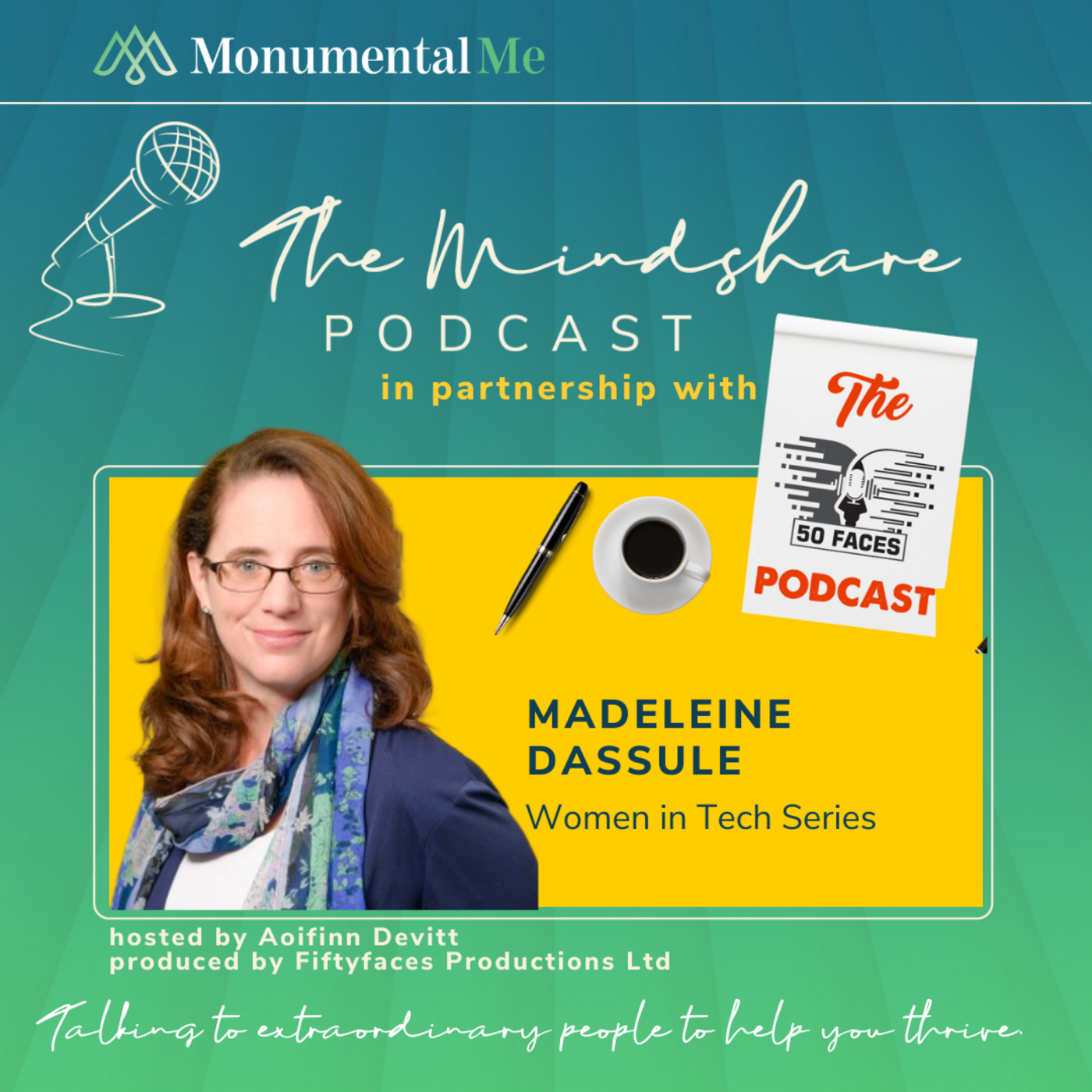
Aoifinn Devitt: Our Global Women in Tech series is an exciting collaboration between 50 Faces Productions.
Madeleine: And Monumental Me, an organization committed to.
Aoifinn Devitt: Wellness, including resilience, mental fitness, and strength, designed to help you thrive in life and your career.
Madeleine: By listening to this series, not only.
Aoifinn Devitt: Are you gathering key insights into the.
Madeleine: Tech world today, but you’re also gaining real tools to help you rise in your career while while taking care of your well-being.
Aoifinn Devitt: Thanks for listening, and if you enjoy this series, spread the word.
Madeleine: Scale through automation for both our clients and to meet the standards of regulators is an evergreen goal in technology. We want our humans to use their full capacities and not be doing redundant tasks as much as possible. So let’s use the machines to do the things that are repetitive, and let’s use our humans to their full potential and to use their hearts and souls in every way that can be helpful and bring the best outcomes to our clients.
Aoifinn Devitt: I’m Aoifinn Devitt, and welcome to the 50 Faces Focus Podcast, a podcast committed to revealing the richness and diversity of global tech by focusing on its people and their stories. I’m joined today by Madeline Dassault, who’s partner and co-head technology at Wellington Management. She previously was a vice president at Goldman Sachs in the area of equity trading technology. She holds a number of board roles, including being a member of the board of Phinos and Boston City Singers. Welcome, Madeline. Thanks for joining me today.
Madeleine: Thank you so much for having me today.
Aoifinn Devitt: Well, let’s start with your career journey. Can you talk us through that, going right back to where you grew up, what you studied, And did it take any surprising turns along the way?
Madeleine: I’m happy to. So I was born and raised in France. My father is from a French working-class family outside of Paris. My mom is American and from a conservative Jewish family in New York that we used to visit every summer. And I went to the Lycée International de Saint-Germain-en-Laye, which was one of the first international French public schools, and it was multilingual. And multicultural with 9 countries represented. So a real melting pot way before its time. And part of French school culture was a saying that everyone in my generation remembers fondly from all the report cards and all of the teachers is “Peux mieux faire,” which literally translated is “Can do better.” I’ve turned that mantra a little, a little bit on its side as I’ve gotten older too. I am and I want to always be a work in progress, but That premier fait of can do better is something that’s deeply ingrained in me, that there’s always more to be done and more to learn and more ways to grow and evolve as a person and a professional. So I followed my siblings to Columbia College in New York and became a math major. And that is definitely an unusual choice. And it was more a factor of the fact that I really found writing papers in English at a college level very difficult, having come from France, because it was a— a direct choice, and I was always attracted to math. It is the universal language, and it was something that I enjoyed and was good at. And so eventually I realized that leaning into my strengths was a better path than trying to fight through my weaknesses that came from my educational background. So I joined Accenture, which was then Andersen Consulting, in financial markets in New York out of college, and I was there for about 5 or 6 years. And then I went to Goldman Sachs in trading technology And that’s where I really fell in love with the markets. I had the great privilege of working on the floor of the New York Stock Exchange for a couple of years and really became fascinated with the mechanics and the feel of what was going on in the heart of of the, the world financial markets. You could stand on the floor of the New York Stock Exchange and literally feel the world financial market’s heart beating. It was pretty amazing. And the trading floors are very intense places. The NYSE was definitely a very intense place. And it was a very formative experience and a great match for me because I am a very intense person and I feel things very strongly, and I’m also very direct and blunt by nature. So those environments were a very good match for me in terms of my natural state, my personality. So the next big change in my career was walking away from Wall Street. I had two girls who were identical twins, Annette and Sophie, and We decided to move to Boston where my husband was from to get some support from a family point of view and really also just be able to spend more time as a family unit and less time commuting and at work. And so I joined the trading technology team at Wellington in 2006. We had a great privilege of assembling a team to build an equity trading order management system from scratch. Took about 5 years. It was a really bonding and unique experience, and I’m very grateful to Wellington for seeing it through. Very few firms will actually spend those years on that type of work and have the consistency and forward-looking view to keep going. And then after we did that, I started taking on more responsibility little by little for legal and tech and regulatory and operations and portfolio implementation and different aspects of data in the technology space. And then 2020, when our previous CIO retired, I was asked to co-head technology. And the path at Wellington has been very surprising because in my mind I was choosing family over career when I went to Wellington. It was part of the move to Boston and having the kids be near the grandparents and a good commute to the French school for my daughters. And I really didn’t expect to have such an incredibly rewarding career and feel so strongly that I’m part of something special at Wellington than the way it’s turned out. So very surprising turn, in fact.
Aoifinn Devitt: That’s great. Of course, that’s the ultimate holy grail, is finding that fulfillment in a way that allows you to offer your family what you wish. Lots to dig into a little bit there in terms of your background. Really fascinating. First of all, you said that your dad had come from a working-class background, but yet you went to the lycée. Was there any kind of a cultural adjustment in terms of either at Lycée, then Columbia, New York. Was that a normal path? You said your siblings had done it, but was there a kind of a culture shock for you at all?
Madeleine: The interesting thing about the Lycée International is that it was actually a French public school. It was originally the school for the kids of the SHAPE officers during World War II, and then it became the school for the kids of the NATO officers. And then when France left NATO, it became a French public school. So from that point of view, it was very, very much kind of social class agnostic. What you did have is a group of expats who were the children of CEOs and diplomats. You would see plates on the cars with diplomat plates, and they were interestingly often kind of bubbled on the side because most of the school was just regular public school people that happened to come from various countries around Europe. So if anything, I think they were kind of the on-the-side group, whereas everybody else mixed in, and it really was very much a melting pot. I would say when I got to Columbia, actually, what I found was it was— people used to say it’s a salad bowl, not a melting pot. And very surprisingly, you would have thought that coming to New York, that that’s where the melting pot would be. But my environment in high school in Europe was much more of a melting pot than Columbia was. At Columbia, you had very distinct groups and they mixed very, very little. So there was a huge amount of diversity, but, but the kids actually clumped together in subgroups and didn’t mix very much.
Aoifinn Devitt: Really interesting. And then you also mentioned the trading floor being intense. I’d love to just see exactly what you mean by that. And you said that you, you match that environment being intense yourself. Do you think that there are certain people for whom trading is just a match to trading floor? Can one learn and adapt to be that intense, do you think, or is it something you’re born with?
Madeleine: I think there’s a certain level of it that you’re born with. People who are very calm by nature and don’t like conflict it’s going to be hard to learn to really love. I mean, you can survive it, but I don’t know that you’re going to love that kind of environment. And for me, having that intensity matched sort of meant that it was easier to be myself. And it took me a long time to learn how to modulate that. And so in the early years, I didn’t have to modulate it because the trading floors, they’re aggressive, they’re loud, they’re direct, and things happen very, very quickly. And there’s a very high sense of urgency. And all of those things were things that came very naturally to me and that I’ve had to modulate out of over my life versus the opposite. So I think it kind of depends where you come from, but trading floors are not very happy places for a lot of people. It takes a certain type of personality to enjoy it, but those who enjoy it love it.
Aoifinn Devitt: It’s interesting you mentioned conflict because I think that’s one thing that governance often gets wrong in that there’s so rarely conflict, say, on boards elsewhere that when there is something really critical, like we’ve seen with these bank situations over the, over recent months, recording this in March ’23, it seems like that we’re actually uncomfortable with conflict. We don’t know how to handle it and things get brushed onto the surface. Did you find in the trading floor that when there was conflict, there was a fresh start the next day, that there was that ability to kind of move on from conflict, not take it personally, just focus on the issues?
Madeleine: Absolutely. And I think it’s one of the strengths of those types of environments. Is that things are said very directly and part of the job in the environment is that you take it and you process it, you react, you improve, and you move on to— and the next day is a fresh day with the learning coming with you. And I do think it’s extremely healthy to have the processes and the capacity to actually deal with disagreement and conflict and move through it rather than move around it.
Aoifinn Devitt: Really interesting. Just wanted to now move to your career progression because you have progressed through the ranks into a leadership role. How would you say you achieved that? Was there any plan, anything that worked and that didn’t?
Madeleine: So I never had a master plan, but I always wanted to excel at what I was doing, and I always strived to get whatever the recognition, the next recognition was that was happening in that particular job. So I definitely put the work in. I I’m arguably a workaholic. I like to work. I enjoy what I do. And part of the thing that I’ve done is always make sure that what I’m working on is something I have passion for. And so I don’t actually feel the fact that I work a lot of hours as that painful because I enjoy what I do. And I would say I never said no to anything I was asked to do, regardless of what type of work it was and whether it was really grunt work. And I always kept my head up and looked for opportunities to learn from everything and from people around me who role-modeled interesting skills that I could just observe and try to emulate and learn and kind of try on and try out. And that worked very well for me until I got to a consulting project when I was in my Accenture days that was at a bank that was just, for a variety of reasons, not a positive environment. It was pretty toxic. I wasn’t learning anything. And I don’t think we were actually doing anything particularly useful for the client in the end when you step back and look at it broadly. And so what I realized there is that that was a case where no amount of hard work and grit was going to actually improve the situation. And I eventually got myself out of it, but it took a couple of years. And so the learning from that experience is that sometimes you’re just in the wrong environment and the thing that you have to change isn’t yourself, it’s the environment.. And figuring out what those moments are, I think, is really important in a career because you can get pretty unmotivated and stagnant when you’re in an environment that’s just not good for you at that moment. And to our earlier point, what’s good for one person isn’t good for another. It depends on who you are and what an environment that makes you thrive is. So I think it’s really important for everyone to remember that we have the agency to decide where we work and with whom we work. And, and that’s a privilege to be in corporate We can, when we have those types of choices, not everyone in the world has them. So let’s use that agency to make sure that we thrive.
Aoifinn Devitt: Of course, the intensity you mentioned earlier, I’m sure that goes with a certain desire to thrive and progress and learn as well. I think the two probably, I rarely see one without the other. It’s interesting. Moving now to your role at the helm of a technology division at a large global asset manager, what would you say is at the forefront of your mind today?
Madeleine: At the forefront of my mind is thinking about what differentiates our firm in the market and how to best align technology work to support and amplify the firm’s mission. So on a day-to-day basis, that means working really tightly with our business leadership to make sure that what we’re doing is optimized for our business and our edge. I’m a big believer that generic technology gives you generic answers. But a technology that’s extremely well-matched to your edge and your business problem is incredibly differentiated. And when you work very closely together and collaborate between business leaders and technologists, and your business people understand enough about how technology can be useful to them, and the technologists understand enough about the business problem that they can come together, that’s when you really get magic and you get very, very powerful technology that can really change the game for a firm. So concretely in today’s world, what does it look like in terms of the different areas where we’re applying technology? Harnessing the power of virtual interactions is incredibly important right now. Obviously COVID took us to that place, but if you think about what it means in the future, how you interact with clients, whether or not you choose to travel or not, which obviously has a link to the environment and our sustainability goals, Being able to do research at scale without having to physically go to every single place that you’re interested in. And also just having access to the best talent in the world and being able to integrate people virtually rather than physically at all times. Harnessing the power of virtual interactions is a big focus. Data and being able to wrangle down the vast amounts of data that exists and that keep on multiplying and growing, getting our arms around that both for clients and for research and bringing it into the hands of our our GIAs and our portfolio managers in as practical and pragmatic and forward-looking way as possible is a huge goal for both the technology and the data groups at Wellington. Scale through automation for both our clients and to meet the standards of regulators is an evergreen goal in technology. We want our humans to use their full capacities and not be doing redundant tasks as much as possible. So let’s use the machines to do the things that are repetitive and let’s use our human their full potential and to use their hearts and souls in every way that can be helpful and bring the best outcomes to our clients.
Aoifinn Devitt: And in terms of the focus on cybersecurity spending on tech, do you see that it’s going to take an ever-increasing share of wallet? It seems that that’s really where the next kind of arms race is.
Madeleine: So there is an arms race in that space and there is a kind of a sub-industry, if you will, a cottage industry of InfoSec. That in some ways is self-perpetuating, right? So the, the more they exist and the more they’re building their businesses, the more an asset manager needs to— and any financial services firm needs to spend money on cyber. So I think in the short term it’s definitely a little bit of an arms race, but hopefully we will get to the point where there’s a little bit more sharing and outsourcing and common tools going on so that it flattens out a little bit and, and doesn’t become a drain on the core business of getting good outcomes for our clients.
Aoifinn Devitt: And I’d love to turn to the area of coaching now, because I know you spend a lot of time coaching members of your firm, maybe within, outside your team as well. What have you learned from this and what are some of the themes that come up and some of the issues that you’ve helped with?
Madeleine: So I would say the number one thing that comes up over and over and over again is feedback, how you give it, how you receive it. What to do with it. And it’s the thing I spend the most time with people, particularly women. So feedback, I would say, is seldom delivered very well. And it takes a lot of effort to actually figure out something concrete to do with feedback when you get it. And it’s very, very hard to not feel like the feedback is a personal attack. So I’ll give you a personal example that I think is a pretty powerful one. So a few years ago, I was given feedback that one of my peers had expressed that they perceived me as someone with schadenfreude, which I didn’t actually know what that meant at the time. But it turns out that it means that you take pleasure in someone else’s pain. And in a team context, if you look it up, it says the observer’s feelings of pleasure that the other’s failure represents an improvement or validation for their own group. So if your group fails, I feel good because my group is better. And you can imagine that it’s very hard not to take that feedback very, very personally. And I lost quite a few nights of sleep, both being angry that someone would say that about me, but also feeling terrible that someone would perceive that about me. And what happened eventually is that I decided to do the work and lean in and try to figure out if I’m a work in progress, how can I do something constructive with this? And I first started by inquiring with my closest trusted work friends, what could this have come from? What does it mean? Do they perceive that about me? And then I eventually expanded it a little bit after I got some insights from them to some other peers in the group. And what I learned is that during leadership team meetings, when other teams’ challenges were being discussed, I tended to do two things. I would get back on my laptop and visibly start working on something else. And I would apparently giggle slightly or possibly smile. So I still would like to think that the giggle was a nervous giggle and that it wasn’t me smiling in relief that I wasn’t in the line of fire. But there is a possibility that it was a little bit of both, and I can admit that now. This behavior of going back to my laptop and smiling or giggling when another team’s challenges was being discussed is what caused this feedback that somebody else in the room thought, oh well, she’s just happy that my team’s having a problem right now. And so that’s a pretty easy fix and very aligned to my values. It’s not hard to pay attention in a meeting and try to really be supportive and engage, even if the problem being discussed or the challenge being discussed isn’t directly your team. And so I think it’s a good example of a time where I was completely unaware of my behavior. I was completely unaware of the impact that it had, and I really learned a lot from the feedback. And the feedback was really poorly delivered and took an enormous amount of effort to pick apart and understand. So when you get feedback, I think the knee-jerk reaction tends to be very black and white. Either I reject it completely or, oh my God, they’re 100% right, I have to fix myself completely. I think what’s helpful is to take a mindset of mine for wisdom, go looking, take the pieces that are useful, put aside the pieces that aren’t. And really try to keep in mind that how we behave and how we impact others is in our own control. And we can go find out how we’re being perceived. We can go find out what impact we have. And then we can choose to modify our behaviors in the way that’s aligned to ourselves. And I think that’s a very empowering way to look at feedback rather than just feeling either soul-crushed or elated and nothing in the middle. The middle is we’re a work in progress. There’s always something to learn.
Aoifinn Devitt: I love that. First of all, I love the work in progress notion. I kind of, for me, it’s the kind of dig deeper exhortation that I would give my own children, that there’s always something you can do to dig deeper. But equally, feedback has been viewed as a gift too, is I think is another way to look at it is that it is something that obviously you can use to grow. But funnily enough, one of the problems I find is the more senior you get, the less feedback you get. So to have to actually actively mine for feedback, that feedback you got was extraordinarily specific and useful and concrete, as you mentioned, as a result. Definitely more of that would help us all. But equally being able to take that trading floor mentality, not take it personally, take it in the spirit in which it should be intended to focus on the issue, I suppose, more than as a personal affront. But really fascinating. Equally then, you’ve spoken when we had this pre-call about some of your skepticism around some of the wisdom that gets passed through generations, whether it’s necessarily always fit for purpose. In the generation in which it’s received. Can you just expand on that a little? Yes.
Madeleine: So the wisdom that I was given when I first started working, and I’m not sure I would really call it wisdom at this point, but it came in— I’m sure you heard a lot of it yourself over the years. It came in variations around things like keep your head down and do your work. Don’t stick out. Cream will rise to the top. Don’t wear any clothes that bring attention to being female. That was definitely Wall Street in the early ’90s. Don’t giggle, don’t cry, don’t show any emotions. Effectively blend in as much as possible. That was prevalent for a long time in my career, various versions. It softened a little bit over the years, and when I moved from New York to Boston, I would say the words were a little bit different, but fundamentally that was the wisdom that you got. And now the wisdom that you hear is bring your whole self to work, and that’s a pretty big change in 25 years from effectively try to disappear and blend in and do your work and hope someone notices it to bring your whole self to work. And my personal view is that it goes a little bit too far and can have some unintended consequences. So I’ll take myself as an example. My whole self includes feelings of anger and sadness and shame and guilt and fear and frustration and anxiety. I’m a human being. I go through all of those. And I do think when we all experienced each other through COVID, it became much more transparent that everyone goes through these experiences. And we had to all kind of manage and change how we deal with that inner world and the work world during COVID So I think we learned a lot during that period. So those feelings are real and they need to be processed, and people go through different moments in their lives that are really hard. COVID was a everyone-is-going-through-a-hard-time-at-the-same-time kind of moment. So I think there was a lot more sharing in some ways because it was a common struggle. But people in their lives go through different moments, right, where you’re having challenges in your family, with your health, with your kids. And I would say that I absolutely need the support and care that my work friends give me through those tough times. But I don’t think that I can be successful in my role if I bring all of that to work every day and let it dominate who I am as a leader, even when it’s dominating my inner world. And so what I want to convey to my team is that we can go to the moon and that we’re stronger together and that I’m a servant leader here to help them and that I have strength and emotional bandwidth to support them and help them grow and look to the future. And so there is a balancing act between those two things. So I would say a more measured piece of wisdom would be exercise self-care for yourself so that you can bring your best work self to work.
Aoifinn Devitt: I’ve heard a modification of that best self or whole self as a favorite self, which is, I think, kind of a nice kind of middle ground, is that we all know we, we have our extremes. And I suppose if we can kind of— and I’ve also heard a technique for that is to practice it in smaller circumstances, maybe lower stakes, maybe how you’re going to interact with that receptionist at a hotel or with some somebody in your daily interactions and try to think, well, what’s my favorite self that I would bring to this scenario? And that kind of role modeling and practicing can help you to think about that, be more flexible, I suppose, for that favorite self in the work setting, whatever we encounter. So I think it’s quite similar to your ideas there. I wanted to just talk about diversity because you’ve seen diversity from starting obviously on a trading floor, not a bastion necessarily of diversity. And I mean by diversity here, by gender, by ethnic background. And you’ve also been in financial services and tech. What grade would you say you’d give the industry? Any observations on how it’s evolved through your career?
Madeleine: I won’t give us a grade because my French self would come out, but I would say that “peux mieux faire,” “I can do better,” absolutely applies to this topic. And although there’s been a lot of progress and there’s deliberate work both in asset management and in technology, I think it’s slow going, but change is happening. From my day-to-day experience, there was a time when I was almost always the only woman in the room, and now that’s rarely the case. And I would say the experience of women of color in technology and asset management is definitely not what I wanted it to be, and much more similar to what I experienced from just a gender point of view 20, 25 years ago. So some stats that should give us all a little bit of pause: in 2020, 58% of U.S. Bachelor degrees were awarded to women. And yet 46% of employees in finance are women. 28% of employees in the tech industry are women. And only 15% in financial services of executives are women. And women still make 79 cents on the dollar. What can we do to change it? I’m a big believer in lift as you rise. If you look at women today, we control $10 trillion of total US household financial assets, and it’s forecasted to be $30 trillion by the end of the decade. So I think if women take their purchasing and decision-making power and continue to drive change and demand that the treatment of women and all underrepresented groups be fair as they grow their decision-making and power through financial decision-making, it’s going to continue to change. It’s going to make a difference.
Aoifinn Devitt: Really interesting. Thank you for bringing the stats to the discussion there, because that’s really what, what does bring it home. I’m just going to turn to some personal reflections. So you’ve had a career that’s taken you through different cities, different sort of backdrops. Would you say there are any ups and downs there and any perhaps lessons that you learned from?
Madeleine: So the ups in my career are times when I’m growing and I feel deeply connected to the people that I work with and the mission of the firm. For me, having values aligned with the mission of what I’m doing is incredibly important. And the lows have been times, as I mentioned earlier, where I’m just in a work environment that’s not a good fit for me, and I become very stagnant. So the lesson that I always come back to is I got to make sure that I’m growing and evolving and that I can honestly look at myself as a work in progress. And if I’m getting complacent or I’m getting less motivated, then I have to honestly be able to look at the environment that I’m in or how I’m behaving and figure out what to change and remember that I have the agency to change it and not stay in place.
Aoifinn Devitt: Yeah, that agency, absolute self-determination, absolutely key. And you had mentioned lift as you climb, and actually this is a theme that’s run through many of these podcasts here, from a young Ghanaian woman who wants to give back to her community to many other walks of life. Has anyone lifted you as you’ve climbed? Have there been any key people who have influenced you along the way?
Madeleine: Absolutely. So I’ve been very lucky to have a number of just my managers, both in IT and leaders of the trading floors that have really taken me under their wings over the years. And they’ve helped me interpret feedback, importantly channel my intensity in a productive way and temper how I bring the rest of myself to work on behalf of the firm. They’ve been incredibly helpful and formative. The leadership team that I work with on a day-to-day basis influences me a ton. We have a great team in IT at Wellington.. And they bring really complementary skills, and I learn from them every day. And they actually do give me feedback even as I get more senior because we’ve been together for a long time and there’s some very deep trust. I am constantly learning and evolving thanks to them. One of my managers, every catch-up that we have is feedback for me, feedback for him, and we always do that. I think that’s a great tool, and it can really— it makes a difference because you’re always learning and growing. And again, it’s not an attack on you, it’s just part of the process. Process and, and something that you’re using to get better. The person who has had the most influence on my life and career is my husband, Eric. We’ve been together for 30 years. We met in college and he taught me to program in C while I helped him with his French homework. He’s always believed without a shadow of a doubt that the right thing for our family was for me to work and that I would excel at work. And he really believes I’m good at this stuff and he doesn’t accept me wallowing in my insecurities or negativity. He’s challenging of my approach, and he’s also an IT professional, so he can challenge all the way down into the work, but he respects my perspective. And having— I would say having someone who believes in you really makes a difference when you’re pushing through the difficult times. And there are always going to be difficult times, whether it’s work-based or home-based. So fundamentally, he believes that I can grow and learn and that I’m a work in progress in the most positive way. And that’s definitely the most defining influence on my career, on my life.
Aoifinn Devitt: And how about any words of wisdom that you’ve learned over the years? Any creed or motto that you live by?
Madeleine: You know, clearly we’re all work in progress is a creed or motto, and it’s, it’s come up throughout this podcast. But some of that has also been influenced by Carla Harris, who wrote a book called Expect to Win. She came to Wellington in one of the women’s groups many years ago. I still occasionally go back and reread that book, and one of the things she said is You can change the way people think about you simply by changing the way you behave, the things you say, and the words you use when you are speaking to them. So again, that’s very empowering about you having the choice in terms of how you’re perceived and what impact you have on others. And the other one that I think about a lot is actually one Jean Hines has said, and she is our CEO at Wellington now and an incredible woman and investor and mother and human being.. And she said the biggest leadership lesson is to assume positive intent. Stop wasting time and energy mulling over why someone did something. And I do think that applies very heavily to those situations where you get feedback that’s hurtful, remembering that they have positive intent and they’re actually telling you this because they’re trying to help you. There’s no incentive for someone to get to bother giving you feedback and taking the time if they’re not actually trying to help you grow. So positive intent is another one, and, and Jean repeats that often.
Aoifinn Devitt: My mother is a politician, has a similar expression about umbrage being a heavy burden to bear, and I think that’s the only way you could survive in these kind of conflict-filled environments is to, to navigate through with believing people don’t intend to hurt you. But great advice. I’ll have to go read that from Carla. Final question is around any advice you might have for your younger self. Anything for that young student entering Columbia College from De Liceu?
Madeleine: Yes, I actually talked to some young students entering Columbia College recently. So I do try to spend time with the next generation as much as possible. So I would say to my younger self, and that’s very specific to me, and we’re all different, is for me, it’s okay to be different. In fact, it’s a strength. Lean into where your talents are and don’t take all the criticism so personally. If you hear that you’re too this and too that,— just remember that your passion and intensity are a core strength and who you are, and absolutely you need to learn how to challenge it, but you don’t need to squelch it. If you can do that and you learn how to channel it, you’ll be a work in progress and continue to grow and evolve, and that’s exactly what you want to be, and that’s what you need to be to have a successful career.
Aoifinn Devitt: Well, Madeleine, this has been a wonderfully reflective discussion, taking us right back back to the, the primary school classroom, elementary school in Paris, and some of the values laid down there. So thank you so much for walking us through your career in tech and asset management, the reflections along the way. And I think this has been a wonderful discussion. Thank you for sharing your insights with us.
Madeleine: Thank you so much for having me, and it’s been a lovely chat. I’ve really enjoyed it.
Aoifinn Devitt: I’m Aoifinn Devitt. Thank you for listening to the 50 Faces podcast. If you liked what you heard and would like to tune in to hear more inspiring people on their personal journeys, Please subscribe on Apple Podcasts or wherever you get your podcasts. This podcast is for informational purposes only and should not be construed as investment advice, and all views are personal and should not be attributed to the organizations and affiliations of the host or any guest.
Aoifinn Devitt: Our Global Women in Tech series is an exciting collaboration between 50 Faces Productions.
Madeleine: And Monumental Me, an organization committed to.
Aoifinn Devitt: Wellness, including resilience, mental fitness, and strength, designed to help you thrive in life and your career.
Madeleine: By listening to this series, not only.
Aoifinn Devitt: Are you gathering key insights into the.
Madeleine: Tech world today, but you’re also gaining real tools to help you rise in your career while while taking care of your well-being.
Aoifinn Devitt: Thanks for listening, and if you enjoy this series, spread the word.
Madeleine: Scale through automation for both our clients and to meet the standards of regulators is an evergreen goal in technology. We want our humans to use their full capacities and not be doing redundant tasks as much as possible. So let’s use the machines to do the things that are repetitive, and let’s use our humans to their full potential and to use their hearts and souls in every way that can be helpful and bring the best outcomes to our clients.
Aoifinn Devitt: I’m Aoifinn Devitt, and welcome to the 50 Faces Focus Podcast, a podcast committed to revealing the richness and diversity of global tech by focusing on its people and their stories. I’m joined today by Madeline Dassault, who’s partner and co-head technology at Wellington Management. She previously was a vice president at Goldman Sachs in the area of equity trading technology. She holds a number of board roles, including being a member of the board of Phinos and Boston City Singers. Welcome, Madeline. Thanks for joining me today.
Madeleine: Thank you so much for having me today.
Aoifinn Devitt: Well, let’s start with your career journey. Can you talk us through that, going right back to where you grew up, what you studied, And did it take any surprising turns along the way?
Madeleine: I’m happy to. So I was born and raised in France. My father is from a French working-class family outside of Paris. My mom is American and from a conservative Jewish family in New York that we used to visit every summer. And I went to the Lycée International de Saint-Germain-en-Laye, which was one of the first international French public schools, and it was multilingual. And multicultural with 9 countries represented. So a real melting pot way before its time. And part of French school culture was a saying that everyone in my generation remembers fondly from all the report cards and all of the teachers is “Peux mieux faire,” which literally translated is “Can do better.” I’ve turned that mantra a little, a little bit on its side as I’ve gotten older too. I am and I want to always be a work in progress, but That premier fait of can do better is something that’s deeply ingrained in me, that there’s always more to be done and more to learn and more ways to grow and evolve as a person and a professional. So I followed my siblings to Columbia College in New York and became a math major. And that is definitely an unusual choice. And it was more a factor of the fact that I really found writing papers in English at a college level very difficult, having come from France, because it was a— a direct choice, and I was always attracted to math. It is the universal language, and it was something that I enjoyed and was good at. And so eventually I realized that leaning into my strengths was a better path than trying to fight through my weaknesses that came from my educational background. So I joined Accenture, which was then Andersen Consulting, in financial markets in New York out of college, and I was there for about 5 or 6 years. And then I went to Goldman Sachs in trading technology And that’s where I really fell in love with the markets. I had the great privilege of working on the floor of the New York Stock Exchange for a couple of years and really became fascinated with the mechanics and the feel of what was going on in the heart of of the, the world financial markets. You could stand on the floor of the New York Stock Exchange and literally feel the world financial market’s heart beating. It was pretty amazing. And the trading floors are very intense places. The NYSE was definitely a very intense place. And it was a very formative experience and a great match for me because I am a very intense person and I feel things very strongly, and I’m also very direct and blunt by nature. So those environments were a very good match for me in terms of my natural state, my personality. So the next big change in my career was walking away from Wall Street. I had two girls who were identical twins, Annette and Sophie, and We decided to move to Boston where my husband was from to get some support from a family point of view and really also just be able to spend more time as a family unit and less time commuting and at work. And so I joined the trading technology team at Wellington in 2006. We had a great privilege of assembling a team to build an equity trading order management system from scratch. Took about 5 years. It was a really bonding and unique experience, and I’m very grateful to Wellington for seeing it through. Very few firms will actually spend those years on that type of work and have the consistency and forward-looking view to keep going. And then after we did that, I started taking on more responsibility little by little for legal and tech and regulatory and operations and portfolio implementation and different aspects of data in the technology space. And then 2020, when our previous CIO retired, I was asked to co-head technology. And the path at Wellington has been very surprising because in my mind I was choosing family over career when I went to Wellington. It was part of the move to Boston and having the kids be near the grandparents and a good commute to the French school for my daughters. And I really didn’t expect to have such an incredibly rewarding career and feel so strongly that I’m part of something special at Wellington than the way it’s turned out. So very surprising turn, in fact.
Aoifinn Devitt: That’s great. Of course, that’s the ultimate holy grail, is finding that fulfillment in a way that allows you to offer your family what you wish. Lots to dig into a little bit there in terms of your background. Really fascinating. First of all, you said that your dad had come from a working-class background, but yet you went to the lycée. Was there any kind of a cultural adjustment in terms of either at Lycée, then Columbia, New York. Was that a normal path? You said your siblings had done it, but was there a kind of a culture shock for you at all?
Madeleine: The interesting thing about the Lycée International is that it was actually a French public school. It was originally the school for the kids of the SHAPE officers during World War II, and then it became the school for the kids of the NATO officers. And then when France left NATO, it became a French public school. So from that point of view, it was very, very much kind of social class agnostic. What you did have is a group of expats who were the children of CEOs and diplomats. You would see plates on the cars with diplomat plates, and they were interestingly often kind of bubbled on the side because most of the school was just regular public school people that happened to come from various countries around Europe. So if anything, I think they were kind of the on-the-side group, whereas everybody else mixed in, and it really was very much a melting pot. I would say when I got to Columbia, actually, what I found was it was— people used to say it’s a salad bowl, not a melting pot. And very surprisingly, you would have thought that coming to New York, that that’s where the melting pot would be. But my environment in high school in Europe was much more of a melting pot than Columbia was. At Columbia, you had very distinct groups and they mixed very, very little. So there was a huge amount of diversity, but, but the kids actually clumped together in subgroups and didn’t mix very much.
Aoifinn Devitt: Really interesting. And then you also mentioned the trading floor being intense. I’d love to just see exactly what you mean by that. And you said that you, you match that environment being intense yourself. Do you think that there are certain people for whom trading is just a match to trading floor? Can one learn and adapt to be that intense, do you think, or is it something you’re born with?
Madeleine: I think there’s a certain level of it that you’re born with. People who are very calm by nature and don’t like conflict it’s going to be hard to learn to really love. I mean, you can survive it, but I don’t know that you’re going to love that kind of environment. And for me, having that intensity matched sort of meant that it was easier to be myself. And it took me a long time to learn how to modulate that. And so in the early years, I didn’t have to modulate it because the trading floors, they’re aggressive, they’re loud, they’re direct, and things happen very, very quickly. And there’s a very high sense of urgency. And all of those things were things that came very naturally to me and that I’ve had to modulate out of over my life versus the opposite. So I think it kind of depends where you come from, but trading floors are not very happy places for a lot of people. It takes a certain type of personality to enjoy it, but those who enjoy it love it.
Aoifinn Devitt: It’s interesting you mentioned conflict because I think that’s one thing that governance often gets wrong in that there’s so rarely conflict, say, on boards elsewhere that when there is something really critical, like we’ve seen with these bank situations over the, over recent months, recording this in March ’23, it seems like that we’re actually uncomfortable with conflict. We don’t know how to handle it and things get brushed onto the surface. Did you find in the trading floor that when there was conflict, there was a fresh start the next day, that there was that ability to kind of move on from conflict, not take it personally, just focus on the issues?
Madeleine: Absolutely. And I think it’s one of the strengths of those types of environments. Is that things are said very directly and part of the job in the environment is that you take it and you process it, you react, you improve, and you move on to— and the next day is a fresh day with the learning coming with you. And I do think it’s extremely healthy to have the processes and the capacity to actually deal with disagreement and conflict and move through it rather than move around it.
Aoifinn Devitt: Really interesting. Just wanted to now move to your career progression because you have progressed through the ranks into a leadership role. How would you say you achieved that? Was there any plan, anything that worked and that didn’t?
Madeleine: So I never had a master plan, but I always wanted to excel at what I was doing, and I always strived to get whatever the recognition, the next recognition was that was happening in that particular job. So I definitely put the work in. I I’m arguably a workaholic. I like to work. I enjoy what I do. And part of the thing that I’ve done is always make sure that what I’m working on is something I have passion for. And so I don’t actually feel the fact that I work a lot of hours as that painful because I enjoy what I do. And I would say I never said no to anything I was asked to do, regardless of what type of work it was and whether it was really grunt work. And I always kept my head up and looked for opportunities to learn from everything and from people around me who role-modeled interesting skills that I could just observe and try to emulate and learn and kind of try on and try out. And that worked very well for me until I got to a consulting project when I was in my Accenture days that was at a bank that was just, for a variety of reasons, not a positive environment. It was pretty toxic. I wasn’t learning anything. And I don’t think we were actually doing anything particularly useful for the client in the end when you step back and look at it broadly. And so what I realized there is that that was a case where no amount of hard work and grit was going to actually improve the situation. And I eventually got myself out of it, but it took a couple of years. And so the learning from that experience is that sometimes you’re just in the wrong environment and the thing that you have to change isn’t yourself, it’s the environment.. And figuring out what those moments are, I think, is really important in a career because you can get pretty unmotivated and stagnant when you’re in an environment that’s just not good for you at that moment. And to our earlier point, what’s good for one person isn’t good for another. It depends on who you are and what an environment that makes you thrive is. So I think it’s really important for everyone to remember that we have the agency to decide where we work and with whom we work. And, and that’s a privilege to be in corporate We can, when we have those types of choices, not everyone in the world has them. So let’s use that agency to make sure that we thrive.
Aoifinn Devitt: Of course, the intensity you mentioned earlier, I’m sure that goes with a certain desire to thrive and progress and learn as well. I think the two probably, I rarely see one without the other. It’s interesting. Moving now to your role at the helm of a technology division at a large global asset manager, what would you say is at the forefront of your mind today?
Madeleine: At the forefront of my mind is thinking about what differentiates our firm in the market and how to best align technology work to support and amplify the firm’s mission. So on a day-to-day basis, that means working really tightly with our business leadership to make sure that what we’re doing is optimized for our business and our edge. I’m a big believer that generic technology gives you generic answers. But a technology that’s extremely well-matched to your edge and your business problem is incredibly differentiated. And when you work very closely together and collaborate between business leaders and technologists, and your business people understand enough about how technology can be useful to them, and the technologists understand enough about the business problem that they can come together, that’s when you really get magic and you get very, very powerful technology that can really change the game for a firm. So concretely in today’s world, what does it look like in terms of the different areas where we’re applying technology? Harnessing the power of virtual interactions is incredibly important right now. Obviously COVID took us to that place, but if you think about what it means in the future, how you interact with clients, whether or not you choose to travel or not, which obviously has a link to the environment and our sustainability goals, Being able to do research at scale without having to physically go to every single place that you’re interested in. And also just having access to the best talent in the world and being able to integrate people virtually rather than physically at all times. Harnessing the power of virtual interactions is a big focus. Data and being able to wrangle down the vast amounts of data that exists and that keep on multiplying and growing, getting our arms around that both for clients and for research and bringing it into the hands of our our GIAs and our portfolio managers in as practical and pragmatic and forward-looking way as possible is a huge goal for both the technology and the data groups at Wellington. Scale through automation for both our clients and to meet the standards of regulators is an evergreen goal in technology. We want our humans to use their full capacities and not be doing redundant tasks as much as possible. So let’s use the machines to do the things that are repetitive and let’s use our human their full potential and to use their hearts and souls in every way that can be helpful and bring the best outcomes to our clients.
Aoifinn Devitt: And in terms of the focus on cybersecurity spending on tech, do you see that it’s going to take an ever-increasing share of wallet? It seems that that’s really where the next kind of arms race is.
Madeleine: So there is an arms race in that space and there is a kind of a sub-industry, if you will, a cottage industry of InfoSec. That in some ways is self-perpetuating, right? So the, the more they exist and the more they’re building their businesses, the more an asset manager needs to— and any financial services firm needs to spend money on cyber. So I think in the short term it’s definitely a little bit of an arms race, but hopefully we will get to the point where there’s a little bit more sharing and outsourcing and common tools going on so that it flattens out a little bit and, and doesn’t become a drain on the core business of getting good outcomes for our clients.
Aoifinn Devitt: And I’d love to turn to the area of coaching now, because I know you spend a lot of time coaching members of your firm, maybe within, outside your team as well. What have you learned from this and what are some of the themes that come up and some of the issues that you’ve helped with?
Madeleine: So I would say the number one thing that comes up over and over and over again is feedback, how you give it, how you receive it. What to do with it. And it’s the thing I spend the most time with people, particularly women. So feedback, I would say, is seldom delivered very well. And it takes a lot of effort to actually figure out something concrete to do with feedback when you get it. And it’s very, very hard to not feel like the feedback is a personal attack. So I’ll give you a personal example that I think is a pretty powerful one. So a few years ago, I was given feedback that one of my peers had expressed that they perceived me as someone with schadenfreude, which I didn’t actually know what that meant at the time. But it turns out that it means that you take pleasure in someone else’s pain. And in a team context, if you look it up, it says the observer’s feelings of pleasure that the other’s failure represents an improvement or validation for their own group. So if your group fails, I feel good because my group is better. And you can imagine that it’s very hard not to take that feedback very, very personally. And I lost quite a few nights of sleep, both being angry that someone would say that about me, but also feeling terrible that someone would perceive that about me. And what happened eventually is that I decided to do the work and lean in and try to figure out if I’m a work in progress, how can I do something constructive with this? And I first started by inquiring with my closest trusted work friends, what could this have come from? What does it mean? Do they perceive that about me? And then I eventually expanded it a little bit after I got some insights from them to some other peers in the group. And what I learned is that during leadership team meetings, when other teams’ challenges were being discussed, I tended to do two things. I would get back on my laptop and visibly start working on something else. And I would apparently giggle slightly or possibly smile. So I still would like to think that the giggle was a nervous giggle and that it wasn’t me smiling in relief that I wasn’t in the line of fire. But there is a possibility that it was a little bit of both, and I can admit that now. This behavior of going back to my laptop and smiling or giggling when another team’s challenges was being discussed is what caused this feedback that somebody else in the room thought, oh well, she’s just happy that my team’s having a problem right now. And so that’s a pretty easy fix and very aligned to my values. It’s not hard to pay attention in a meeting and try to really be supportive and engage, even if the problem being discussed or the challenge being discussed isn’t directly your team. And so I think it’s a good example of a time where I was completely unaware of my behavior. I was completely unaware of the impact that it had, and I really learned a lot from the feedback. And the feedback was really poorly delivered and took an enormous amount of effort to pick apart and understand. So when you get feedback, I think the knee-jerk reaction tends to be very black and white. Either I reject it completely or, oh my God, they’re 100% right, I have to fix myself completely. I think what’s helpful is to take a mindset of mine for wisdom, go looking, take the pieces that are useful, put aside the pieces that aren’t. And really try to keep in mind that how we behave and how we impact others is in our own control. And we can go find out how we’re being perceived. We can go find out what impact we have. And then we can choose to modify our behaviors in the way that’s aligned to ourselves. And I think that’s a very empowering way to look at feedback rather than just feeling either soul-crushed or elated and nothing in the middle. The middle is we’re a work in progress. There’s always something to learn.
Aoifinn Devitt: I love that. First of all, I love the work in progress notion. I kind of, for me, it’s the kind of dig deeper exhortation that I would give my own children, that there’s always something you can do to dig deeper. But equally, feedback has been viewed as a gift too, is I think is another way to look at it is that it is something that obviously you can use to grow. But funnily enough, one of the problems I find is the more senior you get, the less feedback you get. So to have to actually actively mine for feedback, that feedback you got was extraordinarily specific and useful and concrete, as you mentioned, as a result. Definitely more of that would help us all. But equally being able to take that trading floor mentality, not take it personally, take it in the spirit in which it should be intended to focus on the issue, I suppose, more than as a personal affront. But really fascinating. Equally then, you’ve spoken when we had this pre-call about some of your skepticism around some of the wisdom that gets passed through generations, whether it’s necessarily always fit for purpose. In the generation in which it’s received. Can you just expand on that a little? Yes.
Madeleine: So the wisdom that I was given when I first started working, and I’m not sure I would really call it wisdom at this point, but it came in— I’m sure you heard a lot of it yourself over the years. It came in variations around things like keep your head down and do your work. Don’t stick out. Cream will rise to the top. Don’t wear any clothes that bring attention to being female. That was definitely Wall Street in the early ’90s. Don’t giggle, don’t cry, don’t show any emotions. Effectively blend in as much as possible. That was prevalent for a long time in my career, various versions. It softened a little bit over the years, and when I moved from New York to Boston, I would say the words were a little bit different, but fundamentally that was the wisdom that you got. And now the wisdom that you hear is bring your whole self to work, and that’s a pretty big change in 25 years from effectively try to disappear and blend in and do your work and hope someone notices it to bring your whole self to work. And my personal view is that it goes a little bit too far and can have some unintended consequences. So I’ll take myself as an example. My whole self includes feelings of anger and sadness and shame and guilt and fear and frustration and anxiety. I’m a human being. I go through all of those. And I do think when we all experienced each other through COVID, it became much more transparent that everyone goes through these experiences. And we had to all kind of manage and change how we deal with that inner world and the work world during COVID So I think we learned a lot during that period. So those feelings are real and they need to be processed, and people go through different moments in their lives that are really hard. COVID was a everyone-is-going-through-a-hard-time-at-the-same-time kind of moment. So I think there was a lot more sharing in some ways because it was a common struggle. But people in their lives go through different moments, right, where you’re having challenges in your family, with your health, with your kids. And I would say that I absolutely need the support and care that my work friends give me through those tough times. But I don’t think that I can be successful in my role if I bring all of that to work every day and let it dominate who I am as a leader, even when it’s dominating my inner world. And so what I want to convey to my team is that we can go to the moon and that we’re stronger together and that I’m a servant leader here to help them and that I have strength and emotional bandwidth to support them and help them grow and look to the future. And so there is a balancing act between those two things. So I would say a more measured piece of wisdom would be exercise self-care for yourself so that you can bring your best work self to work.
Aoifinn Devitt: I’ve heard a modification of that best self or whole self as a favorite self, which is, I think, kind of a nice kind of middle ground, is that we all know we, we have our extremes. And I suppose if we can kind of— and I’ve also heard a technique for that is to practice it in smaller circumstances, maybe lower stakes, maybe how you’re going to interact with that receptionist at a hotel or with some somebody in your daily interactions and try to think, well, what’s my favorite self that I would bring to this scenario? And that kind of role modeling and practicing can help you to think about that, be more flexible, I suppose, for that favorite self in the work setting, whatever we encounter. So I think it’s quite similar to your ideas there. I wanted to just talk about diversity because you’ve seen diversity from starting obviously on a trading floor, not a bastion necessarily of diversity. And I mean by diversity here, by gender, by ethnic background. And you’ve also been in financial services and tech. What grade would you say you’d give the industry? Any observations on how it’s evolved through your career?
Madeleine: I won’t give us a grade because my French self would come out, but I would say that “peux mieux faire,” “I can do better,” absolutely applies to this topic. And although there’s been a lot of progress and there’s deliberate work both in asset management and in technology, I think it’s slow going, but change is happening. From my day-to-day experience, there was a time when I was almost always the only woman in the room, and now that’s rarely the case. And I would say the experience of women of color in technology and asset management is definitely not what I wanted it to be, and much more similar to what I experienced from just a gender point of view 20, 25 years ago. So some stats that should give us all a little bit of pause: in 2020, 58% of U.S. Bachelor degrees were awarded to women. And yet 46% of employees in finance are women. 28% of employees in the tech industry are women. And only 15% in financial services of executives are women. And women still make 79 cents on the dollar. What can we do to change it? I’m a big believer in lift as you rise. If you look at women today, we control $10 trillion of total US household financial assets, and it’s forecasted to be $30 trillion by the end of the decade. So I think if women take their purchasing and decision-making power and continue to drive change and demand that the treatment of women and all underrepresented groups be fair as they grow their decision-making and power through financial decision-making, it’s going to continue to change. It’s going to make a difference.
Aoifinn Devitt: Really interesting. Thank you for bringing the stats to the discussion there, because that’s really what, what does bring it home. I’m just going to turn to some personal reflections. So you’ve had a career that’s taken you through different cities, different sort of backdrops. Would you say there are any ups and downs there and any perhaps lessons that you learned from?
Madeleine: So the ups in my career are times when I’m growing and I feel deeply connected to the people that I work with and the mission of the firm. For me, having values aligned with the mission of what I’m doing is incredibly important. And the lows have been times, as I mentioned earlier, where I’m just in a work environment that’s not a good fit for me, and I become very stagnant. So the lesson that I always come back to is I got to make sure that I’m growing and evolving and that I can honestly look at myself as a work in progress. And if I’m getting complacent or I’m getting less motivated, then I have to honestly be able to look at the environment that I’m in or how I’m behaving and figure out what to change and remember that I have the agency to change it and not stay in place.
Aoifinn Devitt: Yeah, that agency, absolute self-determination, absolutely key. And you had mentioned lift as you climb, and actually this is a theme that’s run through many of these podcasts here, from a young Ghanaian woman who wants to give back to her community to many other walks of life. Has anyone lifted you as you’ve climbed? Have there been any key people who have influenced you along the way?
Madeleine: Absolutely. So I’ve been very lucky to have a number of just my managers, both in IT and leaders of the trading floors that have really taken me under their wings over the years. And they’ve helped me interpret feedback, importantly channel my intensity in a productive way and temper how I bring the rest of myself to work on behalf of the firm. They’ve been incredibly helpful and formative. The leadership team that I work with on a day-to-day basis influences me a ton. We have a great team in IT at Wellington.. And they bring really complementary skills, and I learn from them every day. And they actually do give me feedback even as I get more senior because we’ve been together for a long time and there’s some very deep trust. I am constantly learning and evolving thanks to them. One of my managers, every catch-up that we have is feedback for me, feedback for him, and we always do that. I think that’s a great tool, and it can really— it makes a difference because you’re always learning and growing. And again, it’s not an attack on you, it’s just part of the process. Process and, and something that you’re using to get better. The person who has had the most influence on my life and career is my husband, Eric. We’ve been together for 30 years. We met in college and he taught me to program in C while I helped him with his French homework. He’s always believed without a shadow of a doubt that the right thing for our family was for me to work and that I would excel at work. And he really believes I’m good at this stuff and he doesn’t accept me wallowing in my insecurities or negativity. He’s challenging of my approach, and he’s also an IT professional, so he can challenge all the way down into the work, but he respects my perspective. And having— I would say having someone who believes in you really makes a difference when you’re pushing through the difficult times. And there are always going to be difficult times, whether it’s work-based or home-based. So fundamentally, he believes that I can grow and learn and that I’m a work in progress in the most positive way. And that’s definitely the most defining influence on my career, on my life.
Aoifinn Devitt: And how about any words of wisdom that you’ve learned over the years? Any creed or motto that you live by?
Madeleine: You know, clearly we’re all work in progress is a creed or motto, and it’s, it’s come up throughout this podcast. But some of that has also been influenced by Carla Harris, who wrote a book called Expect to Win. She came to Wellington in one of the women’s groups many years ago. I still occasionally go back and reread that book, and one of the things she said is You can change the way people think about you simply by changing the way you behave, the things you say, and the words you use when you are speaking to them. So again, that’s very empowering about you having the choice in terms of how you’re perceived and what impact you have on others. And the other one that I think about a lot is actually one Jean Hines has said, and she is our CEO at Wellington now and an incredible woman and investor and mother and human being.. And she said the biggest leadership lesson is to assume positive intent. Stop wasting time and energy mulling over why someone did something. And I do think that applies very heavily to those situations where you get feedback that’s hurtful, remembering that they have positive intent and they’re actually telling you this because they’re trying to help you. There’s no incentive for someone to get to bother giving you feedback and taking the time if they’re not actually trying to help you grow. So positive intent is another one, and, and Jean repeats that often.
Aoifinn Devitt: My mother is a politician, has a similar expression about umbrage being a heavy burden to bear, and I think that’s the only way you could survive in these kind of conflict-filled environments is to, to navigate through with believing people don’t intend to hurt you. But great advice. I’ll have to go read that from Carla. Final question is around any advice you might have for your younger self. Anything for that young student entering Columbia College from De Liceu?
Madeleine: Yes, I actually talked to some young students entering Columbia College recently. So I do try to spend time with the next generation as much as possible. So I would say to my younger self, and that’s very specific to me, and we’re all different, is for me, it’s okay to be different. In fact, it’s a strength. Lean into where your talents are and don’t take all the criticism so personally. If you hear that you’re too this and too that,— just remember that your passion and intensity are a core strength and who you are, and absolutely you need to learn how to challenge it, but you don’t need to squelch it. If you can do that and you learn how to channel it, you’ll be a work in progress and continue to grow and evolve, and that’s exactly what you want to be, and that’s what you need to be to have a successful career.
Aoifinn Devitt: Well, Madeleine, this has been a wonderfully reflective discussion, taking us right back back to the, the primary school classroom, elementary school in Paris, and some of the values laid down there. So thank you so much for walking us through your career in tech and asset management, the reflections along the way. And I think this has been a wonderful discussion. Thank you for sharing your insights with us.
Madeleine: Thank you so much for having me, and it’s been a lovely chat. I’ve really enjoyed it.
Aoifinn Devitt: I’m Aoifinn Devitt. Thank you for listening to the 50 Faces podcast. If you liked what you heard and would like to tune in to hear more inspiring people on their personal journeys, Please subscribe on Apple Podcasts or wherever you get your podcasts. This podcast is for informational purposes only and should not be construed as investment advice, and all views are personal and should not be attributed to the organizations and affiliations of the host or any guest.