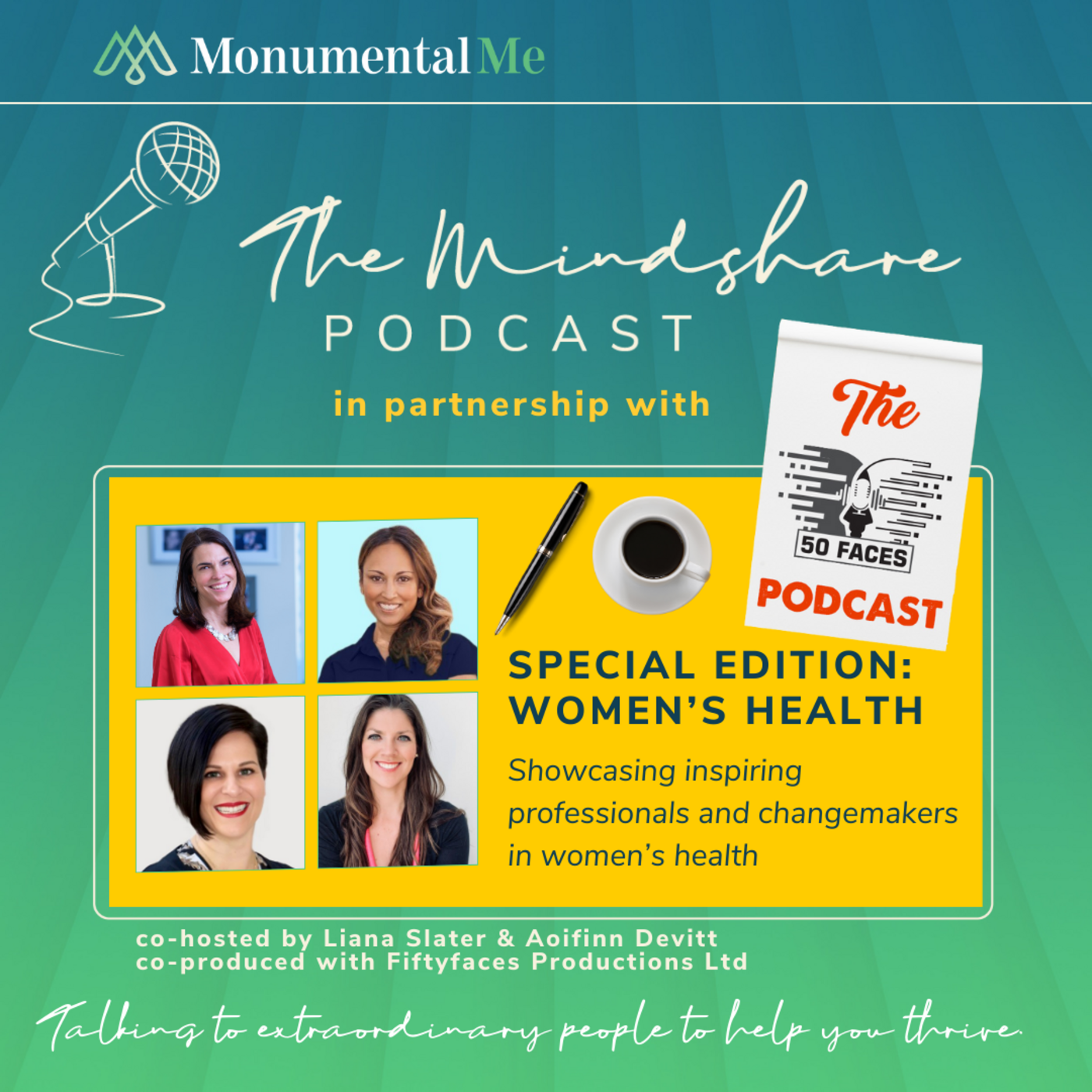
Speaker A: Welcome to the second collaboration between Monumental Me and 50 Faces Productions. Monumental Me and the Mindshare Podcast help women access the tools needed to thrive in life and then work. 50 Faces Productions and the 50 Faces Podcast are dedicated to showcasing inspiring people and their career journeys. This series captures key insights and current trends from women dedicated to innovation and discovery in women’s health in particular, as well as in healthcare more broadly. Focused on women, healthcare, wellness, and health tech, we hear about the funding gaps, technological advances, and awareness campaigns that are bringing this issue out of the shadows and into improving lives. In this first short capsule collection, we hear from startup owners and venture capitalists, as well as medical researchers about what drives them to address the imbalance around women’s health.
Special Collaboration: Our mission is improving lives of people who have been overlooked. A lot of places where women have been overlooked is intersectional with women of color as well. So a lot of the health disparities for women are worsened for BIPOC. And so we’re really looking to have a lot of ways in which we’re improving women’s lives.
Speaker C: As a mother to children, I’ve never had any issues with bringing them into the world. I saw that this is such an underfunded area, and I knew that, you know, we need to do better and help that.
Speaker A: We hear about the illnesses and conditions that disproportionately affect women.
Speaker D: There are things that are very specific to women that have to do with the fact that women have different organs, that women have different cycles in their lives and go through different conditions. So, for example, women can become pregnant. They go through menopause. They go through menarche, which is the start of having menstruation. On the same side, women also just have health issues and health needs and conditions that are also very prevalent in women in addition to men. And so when I think about women’s healthcare, I think about that holistic view of women’s healthcare.
Speaker C: So we’re talking 1 in 3 women that suffer from heavy menstrual bleeding. We’re talking about 1 in 10 that suffer from endometriosis, even though today it’s even believed to be 1 in 6. We’re talking about 7 out of 10 women that will have a fibroid, a uterine fibroid, by the age of 50. 8 out of 10 women of color. These are insane numbers, population numbers, not just in women’s health. We’re doomed to either take these oral pills that have these horrific systemic side effects How can you avoid side effects when you have to swallow these medications? Or the other option we have is surgery. We have to literally go into the hospital and either get this invasive, aggressive surgery or get our uteruses removed. Why? There’s a reason they’re there.
Speaker A: And lists the unexpected ways that women can have less positive outcomes.
Speaker D: Cognitive impairment is unfortunately more prevalent in women. We have to think about that as part of the women’s health ecosystem. Cardiovascular disease is the number one killer of women.
Special Collaboration: Their first use case is just diabetes.
Speaker D: Most of the data that we have as it relates to healthcare and the evidence that led us to treatments is actually being provided for women, but it comes from testing men. There are chronic conditions, something in particular called autoimmune diseases, that women are disproportionately affected by— rheumatology, inflammatory diseases— and really more research is needed into the causes and treatments.
Speaker A: We ask where the areas for investment are.
Special Collaboration: We’re heavily focused on digital health right now and have a big thesis around what makes a successful digital health company. And so when COVID hit, it really accelerated adoption of telehealth. But at this point, a lot of the companies that may have been overvalued in telehealth, telehealth for XYZ, haven’t fully moved the needle. And so what we’re seeing right now is telehealth may be a component, but there should be like an entire digital platform that’s defined the health outcomes that they’re improving.
Speaker A: And look to the opportunities of tomorrow.
Speaker D: We look for companies that are at the collision of healthcare and technology. We spend a lot of time looking at artificial intelligence and the role that it can play.
Speaker C: You have this incredible technology that is able to deliver drugs in a safe manner. It’s been validated.
Speaker A: While being cheered by the fact that there is finally some money on the horizon.
Speaker D: I think this announcement by the administration is actually going to just increase funding, both venture funding and public research funding, for women’s health in many, many ways. The proposal is, like you said, for $12 billion to fund research on women’s health.
Speaker A: As always, we conclude with words of wisdom and a call to action.
Speaker D: The quote that I often will share is, “We are not humans having a spiritual experience. We are spiritual beings having a human experience.”.
Speaker A: Thank you for listening to this collaboration between Monumental Me and the 50 Faces Podcast. We look forward to sharing our with stories you.
Speaker A: Welcome to the second collaboration between Monumental Me and 50 Faces Productions. Monumental Me and the Mindshare Podcast help women access the tools needed to thrive in life and then work. 50 Faces Productions and the 50 Faces Podcast are dedicated to showcasing inspiring people and their career journeys. This series captures key insights and current trends from women dedicated to innovation and discovery in women’s health in particular, as well as in healthcare more broadly. Focused on women, healthcare, wellness, and health tech, we hear about the funding gaps, technological advances, and awareness campaigns that are bringing this issue out of the shadows and into improving lives. In this first short capsule collection, we hear from startup owners and venture capitalists, as well as medical researchers about what drives them to address the imbalance around women’s health.
Special Collaboration: Our mission is improving lives of people who have been overlooked. A lot of places where women have been overlooked is intersectional with women of color as well. So a lot of the health disparities for women are worsened for BIPOC. And so we’re really looking to have a lot of ways in which we’re improving women’s lives.
Speaker C: As a mother to children, I’ve never had any issues with bringing them into the world. I saw that this is such an underfunded area, and I knew that, you know, we need to do better and help that.
Speaker A: We hear about the illnesses and conditions that disproportionately affect women.
Speaker D: There are things that are very specific to women that have to do with the fact that women have different organs, that women have different cycles in their lives and go through different conditions. So, for example, women can become pregnant. They go through menopause. They go through menarche, which is the start of having menstruation. On the same side, women also just have health issues and health needs and conditions that are also very prevalent in women in addition to men. And so when I think about women’s healthcare, I think about that holistic view of women’s healthcare.
Speaker C: So we’re talking 1 in 3 women that suffer from heavy menstrual bleeding. We’re talking about 1 in 10 that suffer from endometriosis, even though today it’s even believed to be 1 in 6. We’re talking about 7 out of 10 women that will have a fibroid, a uterine fibroid, by the age of 50. 8 out of 10 women of color. These are insane numbers, population numbers, not just in women’s health. We’re doomed to either take these oral pills that have these horrific systemic side effects How can you avoid side effects when you have to swallow these medications? Or the other option we have is surgery. We have to literally go into the hospital and either get this invasive, aggressive surgery or get our uteruses removed. Why? There’s a reason they’re there.
Speaker A: And lists the unexpected ways that women can have less positive outcomes.
Speaker D: Cognitive impairment is unfortunately more prevalent in women. We have to think about that as part of the women’s health ecosystem. Cardiovascular disease is the number one killer of women.
Special Collaboration: Their first use case is just diabetes.
Speaker D: Most of the data that we have as it relates to healthcare and the evidence that led us to treatments is actually being provided for women, but it comes from testing men. There are chronic conditions, something in particular called autoimmune diseases, that women are disproportionately affected by— rheumatology, inflammatory diseases— and really more research is needed into the causes and treatments.
Speaker A: We ask where the areas for investment are.
Special Collaboration: We’re heavily focused on digital health right now and have a big thesis around what makes a successful digital health company. And so when COVID hit, it really accelerated adoption of telehealth. But at this point, a lot of the companies that may have been overvalued in telehealth, telehealth for XYZ, haven’t fully moved the needle. And so what we’re seeing right now is telehealth may be a component, but there should be like an entire digital platform that’s defined the health outcomes that they’re improving.
Speaker A: And look to the opportunities of tomorrow.
Speaker D: We look for companies that are at the collision of healthcare and technology. We spend a lot of time looking at artificial intelligence and the role that it can play.
Speaker C: You have this incredible technology that is able to deliver drugs in a safe manner. It’s been validated.
Speaker A: While being cheered by the fact that there is finally some money on the horizon.
Speaker D: I think this announcement by the administration is actually going to just increase funding, both venture funding and public research funding, for women’s health in many, many ways. The proposal is, like you said, for $12 billion to fund research on women’s health.
Speaker A: As always, we conclude with words of wisdom and a call to action.
Speaker D: The quote that I often will share is, “We are not humans having a spiritual experience. We are spiritual beings having a human experience.”.
Speaker A: Thank you for listening to this collaboration between Monumental Me and the 50 Faces Podcast. We look forward to sharing our with stories you.