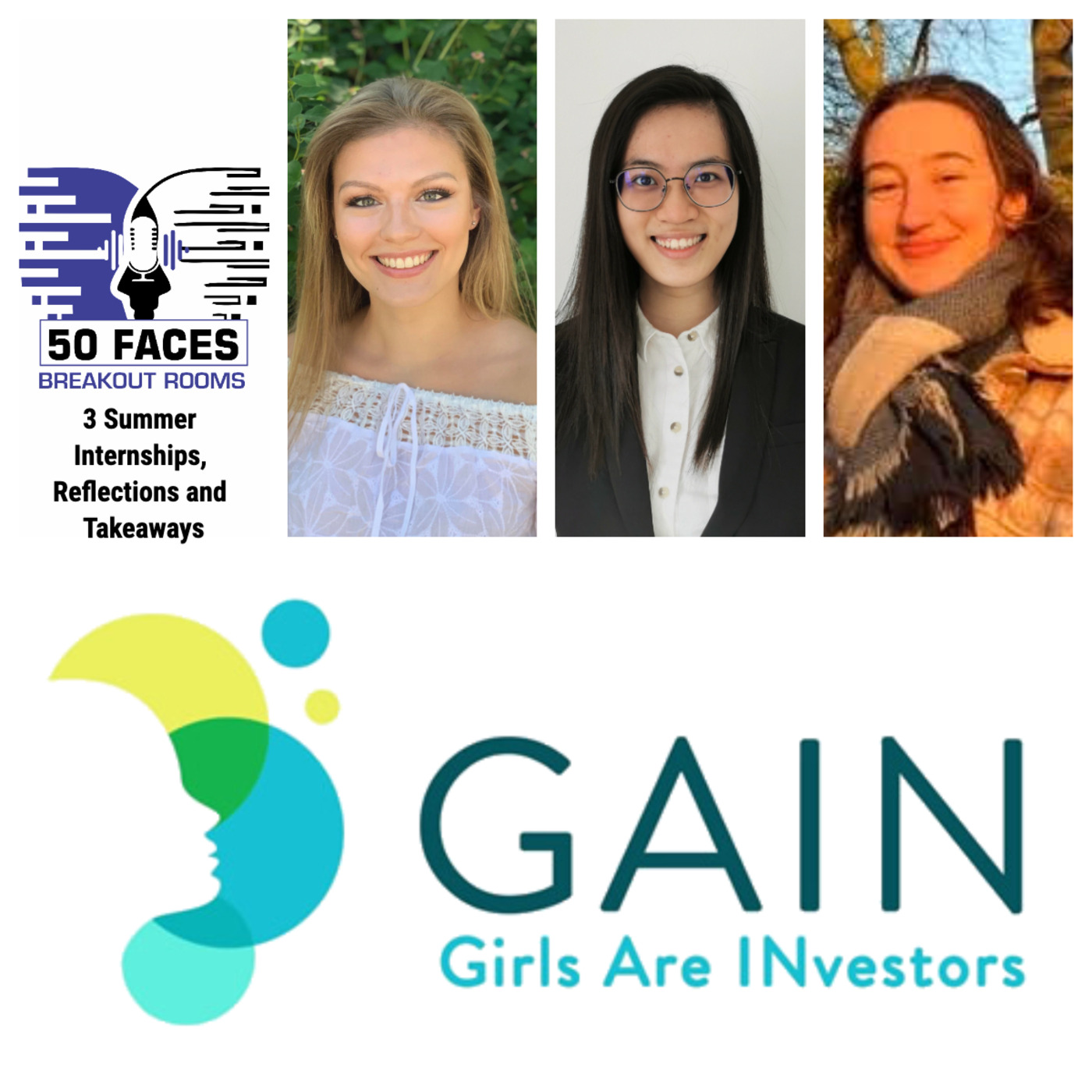
Aoifinn Devitt: This podcast is brought to you with the kind support of Plutus Capital, a female-run investment management firm based in Evanston, Illinois, which works with clients on a wide variety of mandates such as custom diversity solutions, manager due diligence, diversified hedge fund to fund allocations, and advisory services. I’m Aoifinn Devitt and welcome to this collaboration between 50 Faces Podcast and GAIN, where we are meeting 3 interns from their recent 8-week summer internship program, which was held across various financial institutions in the city. GAIN is a community of investors with charitable status set up to change the lack of gender diversity in investment management from the ground up. Its mission is to increase the number of female applicants for entry-level roles into the industry. They do this by informing young women with online resources, bringing helpful information on careers and investment to their fingertips, inspiring young women with a strong network of female role models who speak in high schools and universities around the UK and feature on their online channels, delivering compelling and high-impact messages on the many benefits of investing as a career, and also by providing opportunities for young women to get into the investment industry, such as via this internship program. I’ve gathered 3 interns here to discuss their impressions of the internship, their impressions of the industry, and their plans for the future. I’m delighted to be joined here by Ellen Welford, Heyu Lo, and Ava Boras. Welcome, thanks for joining me today. So let’s start with Ellen. Can you talk to me a little bit about where you’re studying now and where you did your internship?
The GAIN Summer Internship 2021: Yeah, so I’m currently studying at Oxford and I’m just about to go into my third year studying economics and management. I’ve also just completed an 8-week internship at a small family investment office based in London.
Aoifinn Devitt: Great, thank you. And how about you, Han Yu?
The GAIN Summer Internship 2021: Thank you, Aoifinn.
Speaker C: So I’ve just finished my second year doing chemical engineering at University of Cambridge. I’m entering my third year next academic year. So I’m currently interning at Metropolis Capital and MMM. It’s my week 5 now.
Aoifinn Devitt: And Eva, how about you?
Speaker D: Hi, I’m Eva and I just finished my second year in Biomedical Engineering at Imperial College London and will be going into third year. And I completed— two weeks ago I finished a 7-week internship at Capstone Advisors.
Aoifinn Devitt: So Ellen, you studied perhaps the most traditional path for preparation for a career in finance. How did you find that Economics and Management that you were learning at Oxford How did you find the skills there translated into something you might have needed?
The GAIN Summer Internship 2021: Yeah, so definitely economics is quite a traditional route into finance and the investment industry, and quite a lot of my peers have also gone on to do internships in banking and you consultancy, know, quite the traditional route. One of the things about my degree course is like the mix between the economics and the management side of things. So the economics is quite problem solving and we do quite a lot of mathematical work, whereas the management management side of the degree course is a lot more essay-based, and we do a lot more reading and a lot more referencing. And one of the things that surprised me about my work in the internship is how writing-heavy it was. So quite a lot of the tasks that analysts have to do is prepare for meetings and send everybody out a brief in advance of a meeting, and then also write up the meeting notes afterwards. And then throughout my internship, I also did 2 projects which were kind of accumulated in a report-style structure. And so my first project was on SPACs, and that was about a 30-page-long report. And I guess I didn’t really anticipate that I’d be needing my writing and essay writing skills that much, but I think that’s definitely something that really helped going into the internship.
Aoifinn Devitt: That’s fascinating. And I’d love to know then how our 2 scientists found that, whether they had a similar element of writing included. So Han Yu, chemical engineering. To the world of finance. How did you find that transition?
Speaker C: Well, it fits pretty well because I think from my internship I’ve realized that, as contrast to Alan’s work, I have less writing. It’s probably because my tasks and responsibilities are different, but what I do a lot is reading, reading, digesting, guessing the key takeaways from a lot of readings, and then present it. So I think this is what I’ve learned from chemical engineering, especially from writing reports, because when writing like lab reports, we have to do some extra researching as well and then present it into the report. So this is one of the skills that I’ve learned from chemical engineering that’s very useful in my internship. But the scientific knowledge-wise for chemical engineering, I do find more comfortable when looking into the chemical industry or maybe just like sciences industry. So chemical companies, pharmaceutical companies, that’s where I have the chance to use my scientific knowledge into my work now.
Aoifinn Devitt: Absolutely. And Eva, did you have a similar impression, biomedical engineering to investing? How did you find that transition and what skills did you bring to bear?
Speaker D: So as my peer just said, bioengineering in general is very lab-based and a very important skill to have is knowing how to write reports. That reflect all the experiments that you’ve done before. And I feel like that’s what is more overlapping with investment and asset management, which involves, at least in the group that I worked in during my internship, which was risk arbitrage, there was a lot of heavy research to be done into looking into different companies and their financial past and comparing and whether in the future some finance would be feasible or not. And I feel like not because it was biomedical, but just the engineering part of it was the most useful in terms of preparing for the internship, as well as being able to work under time pressure and having certain deadlines to complete projects, or if a report was expected from me from my supervisor, to know how to manage my time. So I feel like my degree also helped me develop that skill.
Aoifinn Devitt: It’s really interesting. So clearly a diverse set of skills needed, and even if you’d come maybe with a certain set of skills well developed through your degree, there seemed to have been the opportunity to learn new skills there in those positions. I’m curious, so in terms of what you knew about the asset management industry before entering, I’ll start with Ellen. Would you say that you knew a lot about the world of investing? Had the asset management industry done a good job of advertising itself to you, making you aware of it?
The GAIN Summer Internship 2021: Yeah, so I think I was in a relatively fortuitously lucky position in that my next-door neighbor works in the asset management industry, and that has been my only connection to the industry from a relatively young age. You know, I had no family members or no one in my school went into the industry, and so as I from, say, a super young age, I would be quizzing him on what he was doing in his work and what he enjoyed about his work. And one of the great things about him was that he was always so eager to explain things to me and was always really patient with all of my questions and also just made it sound like such a dynamic, interesting industry to work in. So that was kind of my first exposure to the industry. And then after that, I decided that I was going to study economics at my A-levels, and then with a view to if I really enjoyed that, then studying it at university. So it was a good job that I enjoyed it in the A-level stage and then continued pursuing the asset management side of things from then on. I did do a work experience with my neighbour when I was about 17, so I shadowed him in his asset management firm. And then I’ve done a couple of spring weeks as well, which is again quite a traditional economics and management undergraduate route. You know, you go from your degree to your spring week to your internship, then fingers crossed to the grad role. So I had a few bits and pieces of insight into the asset management industry kind of sprinkled in. Through my life, but I definitely think the internship has kind of surprised me with how much I’ve still got to learn about it, because all of these other insights gave a great overview. Yeah, I don’t think I ever realized how deep it went.
Aoifinn Devitt: Fantastic. And Han, you and Eva, how about you from a science perspective? Did you find that the asset management industry was knocking on those doors in the traditional kind of milk round, or did you have to seek it out yourselves?
Speaker C: I was exposed to finance sector, not just asset management, relatively late, so I’ve only realized this sector when I was in uni because I didn’t have any relatives or friends or family that’s in this industry. So I realized it, I joined society, and I’ve just realized there are so many more branches in finance sector. And yeah, and then digging around, researching around, and realized that asset management is probably the sector that I’m most, most interested in out of all this financial sector. And yeah, so what I thought about asset management before entering the internship is managing people’s assets, right? And there are like so many different ways to manage the assets. And then after I’ve joined, I’ve just realized there are so many branches from asset management yet, you know, like public fund and private equity fund and stuff like that, hedge funds. So, right, so I’m probably just understanding one part of it. But yes, definitely, I have still a lot more to learn.
Aoifinn Devitt: Fascinating. Eva, what was your experience?
Speaker D: So on the contrary to Ellen, I had no exposure to asset management or the finance industry as a whole. Me personally, I completed the business GCSE back when I was like 16. But then I decided to look into it when I came to university, and I realized how important the finance world is. At the core of the economics of how the world works, it all comes down to money. And so I felt like it would be very important, as well as very interesting, to look into this whole world that I hadn’t been exposed to before. So to answer your question, no, I hadn’t been exposed to it before.
Aoifinn Devitt: And had any of you been investing personally in stocks or had an interest in investing before embarking on this internship?
Speaker C: I did have a little interest in investing before joining, but since, like I’ve mentioned, I didn’t have a lot of exposure to this sector, so I wasn’t very comfortable of taking risks. So I’ve decided to learn a bit more before I do any decisions.
Aoifinn Devitt: How about business clubs or economic clubs or investing clubs at university? And some even go right back to high school. Did any of you join any of those kind of affinity groups?
The GAIN Summer Internship 2021: So I know that Oxford has a fair amount of investing clubs, but I think quite a lot of them are a lot more focused on the sell side, so quite a lot of people focus on like M&A and investment banking, and that was not the side of things that I wanted to go into. So I joined one of the societies called Oxford Women in Business, and that really appealed more to my interests, which were really in kind of the business fundamental side of investing. And that society is also really interesting because it introduced me to the world of not only investment but then also consultancy and law, because yeah, the society covered all of those different grounds. And then I say, after being able to view all of those different options, I decided that the investment management side was the most interesting to me. And then also another point to that is that I joined GAIN as an ambassador whilst doing my degree at Oxford, so I assume we might come on to talking about GAIN in a little while, but that was also an amazing introduction to the asset management industry.
Aoifinn Devitt: And just getting back to the idea of you can’t be what you can’t see, how important was it to you to see senior women succeeding in these roles? And on an ongoing basis, if you could put yourself forward 5 years and you’re a junior to mid-level, how important do you think it will be to see women in leadership roles?
Speaker C: You wouldn’t want a job that has no future or promotion, good job prospect. You don’t want yourself to working harder than anyone else and reach a glass ceiling. That’s very demotivating, I think. So looking if there’s like more opportunities or normalizing females in the senior roles and firms, that’s very encouraging. I’ll be very happy as long as it’s fair and square, as in they don’t discriminate women as someone who are not decisive. Things like that.
Aoifinn Devitt: Any other thoughts on that point around female role models perhaps being important?
The GAIN Summer Internship 2021: It’s quite difficult, I think, because I’ve really not had exposure to many female role models. Most of the women that I’ve spoken to in investment management are under 30, and I think that that’s a big issue in itself, and that a lot of women who go into the industry drop out of the industry when they decide that they want to start a family. And I think my firm at the moment are really strongly trying to encourage shared paternity and maternity leave. So that— I know that one of our head directors at the moment who’s a male has just taken 2 months of paternity leave, and I think that’s like a really important step to equalizing the playing field a little bit and making sure that women aren’t taking a disproportionate amount of time out of the job and out of the industry. But yeah, I think most of the women that I’ve spoken to are under 30, which makes it difficult because obviously they are great role models in themselves and have been able to provide so so much insight into the role and what the whole industry consists of. But when you go a bit higher than that, I’ve, yeah, struggled to find a vast amount of people that I can reach out to and discuss with. And so hopefully that will change going into the future, but I think at the moment we kind of need to create our own role models in a sense.
Aoifinn Devitt: Ava, do you have any thoughts on that point?
Speaker D: I feel like a big part of why there is not that many female role models in very senior positions is the fact that at some point in your career, you’re faced with a decision of whether you want to continue working or have a family or have a child. And that’s a very important aspect that should be taken into account. I know during my internship, I didn’t meet any portfolio managers that were women. But I did meet the head of legal and compliance. The whole compliance part of the firm that I was working in was mainly women. I did really feel very motivated, even though it was compliance instead of asset management or like a portfolio manager. I did feel very encouraged to keep working when I saw the woman that was the head of compliance. So I feel like it’s definitely very, very important to try and get a lot more women in charge, which there are women working in the industry, but not necessarily, as mentioned before, in a very high position. So I feel like for me, and I would say for like every girl that’s in primary school right now, if they had like a talk by a very important female CEO, they would certainly be inspired or maybe have it in the back of their minds., as you said, as an option of what they want to aspire to be. So definitely I think having more role models or people to look up to, it’s very important.
Aoifinn Devitt: Did any of you have specific mentors during your internship or in your university careers office perhaps? And how did you find that useful if so?
The GAIN Summer Internship 2021: Yeah, I have had a couple of amazing mentors actually. And again, I know I keep bringing it up, but it’s through the GAIN program. So when I first became an ambassador 2 years ago, they provided me with a mentor, an amazing woman a woman named Natasha who actually did become like a more senior position. So, you know, she is like my one reference point. And she worked on like the ESG side of investment. And that was something that I was really interested in at the time. So that’s environmental, social, and governance. And it was amazing to talk to her and get her insight into the industry. And then just before starting the internship program, GAIN also provided us with another mentor. And so again, I had an amazing, amazing woman named Hannah, and she was in her late 20s and had risen up the ranks like really, really quickly. So it was amazing for her age and provided me with so much insight into what it was like in kind of the early days starting out into the industry, because that wasn’t too long ago for her now. And yeah, those are my two like really great reference points that was also someone outside of the firm that I was interning with, so I was able to ask them all the stupid questions that you’d maybe not want to approach someone in your actual internship firm to ask, you know, like, what does business casual really mean? And like, can I wear this? And how do I approach and talk to someone this senior? You know, all of those sorts of questions that you wouldn’t want to ask someone who has, I guess, a decision on your final hiring job decision. Yeah, I think that the mentors were really important and amazing to have a sounding board to bounce ideas off and then also ask advice throughout the internship on certain projects or things that you’re working on. So I definitely recommend everybody to get a mentor, and then hopefully if/when I get into the industry, I’d love to be in that role and provide mentorship and guidance to other young women hoping to break into the industry as well.
Aoifinn Devitt: Thanks, Ellen, for giving us some insights into what GAIN does, because obviously that’s a huge part of this podcast is to, I think, to highlight this internship program and some of the supports that are in place throughout the year. Some fantastic events, some panels, career advice, and just really of sort showing the path into the world of investing. And the wonderful thing I think is that GAIN is just one piece of the global initiative on these fronts. Han Yu or Eva, do you have any thoughts on mentorship and its importance?
Speaker C: Yes, and it’s from GAIN. They’ve done a very fantastic job. So I wasn’t a GAIN ambassador, so I’ve— but they assigned me a mentor for my summer internship. I believe they do for all the interns that’s involved in this summer internship program. So she was the point of reference because again, I wasn’t very familiar with this whole sector before the internship. This might be a stereotype, but I’ve always find more comfortable, you know, to ask questions and approach someone who is a girl, who is a female, than counterparts. So she did give me a lot of advice in terms of maybe preparation into the industry and confidence in working in the industry. So she’s actually the one that’s talked to me about diversity in this industry that I mentioned just now. And yeah, what Alan said, you wouldn’t want to ask some of those questions that’s from your internship firm. So I do ask her a lot of specific questions as well, even during my internships, and how to first talk to people. Should I ring them up? Because it was a virtual remote working style. So stuff like how do I first approach the people, how do I organize a coffee chat with people, things like that. She has been very helpful.
Aoifinn Devitt: Great. Thanks for bringing this up, Ellen. And I think that’s where ESG is coming in with finance, in that it is definitely smoothing some of the rough edges of finance. Instilling across the board a commitment to change, to positive change, and as well as also integrating achieving a return with fulfilling a mission, doing good, and ensuring that that return is sustainable. Just, I would be curious if anyone had found that the ESG element was of particular interest, and maybe whether that might be an angle through which more women are attracted to the industry.
The GAIN Summer Internship 2021: I definitely think it is an angle that is attracting not only more women into the industry, I guess, but just more people of our generation. I think our generation is a lot more sustainability focused, you know, we all want to do our bit to help the environment. And I definitely think, I completely agree with what you said about it softening the edges of finance, and I think that, yeah, that softening of the edges will attract a lot more women. And one of the things about the firm that I’ve been interning with as well, and one of the things that I absolutely love about it, is that it’s a family office and it manages these assets, but the returns on the assets are donated to various charities. And the family whose assets we own are some of the biggest philanthropists in the UK. And it just has that feel-good factor, you know, that the money and the returns that we’re making are not just padding out someone’s back pocket, but are really funding really genuinely good causes and really doing good. And I think that that is definitely an angle that has attracted me into the industry. And the ESG side of things is something that I’ve been really interested in in the past, and I’m hoping to explore further going into the future. But I definitely think investing to do good is an amazing movement and one that I hope will continue into the future.
Aoifinn Devitt: So, Han, what are your impressions on the ESG question?
Speaker C: Yeah, so I was trying to say, because as chemical engineers, you know, engineers have a very different role to the society as compared to the finance sector. So entering to the university, I’ve always thought that I hope to be able to use my expertise to contribute to the society, and engineering can easily play that part. But then I’ve been thinking about how finance sector can actually help. So that’s something that’s very motivating and also completes my career goal in terms of contributing myself, using my expertise to contribute to the society. So ESG is something that’s not just for the girls, but for our generation.
Aoifinn Devitt: Well, that’s just so impressive. Well, as we’re getting close to the end of our time, I’d love to just go around the group now and have— I’ve got 2 questions because I’ll never ask just one. And the first one is around, was there any kind of key takeaway from your internship, either something that surprised you or maybe a mistake you made and a lesson learned, kind of a little bit of wisdom that you picked up? And then if you could also let me know whether you’re intending to stay in the industry and what your future hopes are. Ava.
Speaker D: So for me personally, because of the environment that we’re in because of COVID I didn’t really get to go into the office, like have in-person experience during the internship. I was only able to go into the office for the last 2 weeks. So I did go 3 times in person. So what I would say surprised me the most is how important it is to go in person into your office environment wherever you’re working. Because being an intern, like, this is what my boss told me. He told me being an intern is hard and being a remote intern is even harder. So for me, I found it quite difficult at first to really know how to balance my time as I was working from home. And I didn’t really know how often I should approach my portfolio manager or how often I should reach out or do my own thing. So for me, what surprised me is how important it is to go into the office, basically, and also talking to other teams. Because even though I was in the risk arbitrage, which was investing money when there’s a merger or acquisition, when I went into the office, I did speak, as I mentioned before, to the legal and compliance team, and some other convertible bonds and some other teams. And it was so helpful to just get to know different people, as well as when I spoke to the receptionist and the human resources team. And also another thing I wanted to mention, which I would say this is advice or something I would have wanted to know before starting my internship, which is don’t be afraid to reach out when you are lost or when you don’t know what’s going on. Because as an intern, there’s nothing expected from you in the sense that you are like a baby to them, to the industry, to the firm. So reaching out when you feel like you’re not understanding exactly what you have to do or how you should portray your work, then I feel like for me it’s the most important because the last 2 weeks of my internship I had the amazing opportunity of— I reached out to this other manager in the firm and I got a whole new insight on the industry, which was so useful to me. So that’s what I would say was what I learned the most and what surprised me the most.
Aoifinn Devitt: And will you stay in the industry, Ava? Is that your plan?
Speaker D: I’m definitely very interested in learning more about the industry. My manager recommended me a book which was specialized in risk arbitrage, and I’m reading that at the moment. And I’m definitely looking into, like, for instance, Engain, to go into some of the events during the year to try to maybe learn about other areas in the finance world. But I’m definitely very interested in it. So I would love to learn more about it. Yeah.
Aoifinn Devitt: Fantastic. Who’d like to go next? Han, can you?
Speaker C: Yeah, um, so I do agree with Eva’s advice, and you know what, I should have known before I joined I should heed her advice because talking about how you should ask people when you are stuck, because again, I was doing half remote, and actually my first 2 weeks was actually a remote working style because I had to do my quarantine at home when I just came, so I think first 2 weeks having it— doing it remotely is not the best plan because like what all the challenges that Eva mentioned, you just don’t know how much research you should do yourself until you should ring someone up to ask a question, or you should like just write a list of questions and ask it at the end of the day. But in terms of what surprised me the most, although it’s not about people but about the work, because I’m doing this investment analyzing, meaning finding stocks to invest in. And I’ve just realized that there are just so many industries in the world that we can invest in. So maybe some industry that you never thought of it, but it’s— it could be some industry that’s a good investment, might not be thrilling. So for example, doll manufacturer, it’s not the most thrilling industry ever, but it could be a good investment. Some of the companies might gain a lot of money from it. So yes, that’s one of the eye-opening things that I’ve learned from the internship.
Aoifinn Devitt: And do you think you will stay in the industry? Would you like to do that after graduation?
Speaker C: I’m very open to it, and I love the job I’ve done so far because I’ve been learning all these different industries every day. One day I’m looking at insurance company, the other day I’m looking at banks, the other day I’m looking at doll manufacturer. So it’s a very steep learning curve, and I find it very challenging but interesting at the same time. So I’d love to learn more about the industry, about the sectors. So maybe another internship next year, learn more about the sectors before going in as a graduate job.
Aoifinn Devitt: Fantastic. And Ellen, anything that you take away now and your plans?
The GAIN Summer Internship 2021: Yeah, I mean, just bouncing off the other two as well, I’ve been really lucky in that I’ve been able to go into my office for most of my internship. So I’ve been working Monday through Thursday in the office and just Fridays from home. And yeah, my kind of heart goes out to both of you guys because I found it so amazing to be in the office, and I think I’d have really struggled doing an internship virtually. And some of the really tiny questions that you have, like, I can just nip over to someone’s desk and say, oh, you know, how do I find this piece of information, rather than send them an email, which feels far too important for such a small question. So I’ve really, really loved that aspect of it. And again, I think that one of the things that surprised me is how much I’ve learned in 8 weeks. But then as a side effect of that, they always say that the more that you know, the more you realize you still don’t know. So I’m just here realizing that there’s this whole world out there that I still don’t fully understand, and there’s still so much more to learn. And I guess that’s one of the interesting things as well. Like, some of the directors that I speak to say that they still learn things every single day, and even having been in the industry for 15, 20 years, you know, they’re still learning, still expanding their horizons, and still loving the diversity of the job. And yeah, to that end, I’m still really interested in going into the industry after graduation. I hope to go into the industry, and I think that it’s, yeah, really appealed to kind of my curious side as well as my innate need to do something different all the time. I don’t like focusing on just one thing for too long, so I love that you’re in a meeting and then you’re researching one thing and then you’re looking into another thing and then you’ve got a whole different sector altogether. And yeah, so much diversity and so much that really is applicable to the world around you, and I find that all just so interesting. So yeah, hopefully in a year’s time I’ll be moving to London for a grad job, but that’s a fingers crossed at the moment.
Aoifinn Devitt: Well, I think the key takeaway for me as a senior person here is not only how important in-office working is and just being present for the younger generation and for incoming talent. And I hope that those not only in the senior level but in the mid-ranks take this to heart, how important it is for you that we are in the office training you and being visible for you. So I think that’s been a real eye-opener for me to hear that. So thank you. Well, I think what we’ve learned here is a lot about breadth, breadth in the industry itself, perhaps that doesn’t do a good enough job at revealing just how rich it is in terms of opportunity, and also breadth in terms of the skills that you need to function well in there in terms of writing skills, analytical skills, looking for evidence, analyzing it, critiquing it, and obviously dealing with people. A big part of that skill, you mentioned that the skill to ask questions, the skills to network. Clearly a wide range of skills needed, but that should open up many doors. Second, I’m learning also about the importance of mentorship and role models, as well as just pure visibility of women and diverse faces in the roles you might want to go into. So thank you for sharing that. And I think also thinking about the advent of more and more ESG-based investing and ESG initiatives across finance, hopefully that will do something to humanize the world of finance for the whole next generation So very much looking forward to that. Each of you has been an inspiration, and I will say that as a somewhat senior person in the industry, I am absolutely delighted to see such talent, such enthusiasm, and such generosity for you coming here and sharing your insights with us. So thank you very much to Ellen, Han Yu, and Eva, and to GAIN for collaborating on this podcast series. And we will have in the show notes all references to the internship programs and the wonderful activities that GAIN puts on. And thank you for sharing your insights here with us.
The GAIN Summer Internship 2021: Amazing. Thank you.
Speaker C: For Thanks your time.
Speaker D: Thank you for having us.
Aoifinn Devitt: I’m Aoifinn and David, and thank you for listening to this 50 Faces breakout room brought to you with the kind support of Plutius Capital.
Aoifinn Devitt: This podcast is brought to you with the kind support of Plutus Capital, a female-run investment management firm based in Evanston, Illinois, which works with clients on a wide variety of mandates such as custom diversity solutions, manager due diligence, diversified hedge fund to fund allocations, and advisory services. I’m Aoifinn Devitt and welcome to this collaboration between 50 Faces Podcast and GAIN, where we are meeting 3 interns from their recent 8-week summer internship program, which was held across various financial institutions in the city. GAIN is a community of investors with charitable status set up to change the lack of gender diversity in investment management from the ground up. Its mission is to increase the number of female applicants for entry-level roles into the industry. They do this by informing young women with online resources, bringing helpful information on careers and investment to their fingertips, inspiring young women with a strong network of female role models who speak in high schools and universities around the UK and feature on their online channels, delivering compelling and high-impact messages on the many benefits of investing as a career, and also by providing opportunities for young women to get into the investment industry, such as via this internship program. I’ve gathered 3 interns here to discuss their impressions of the internship, their impressions of the industry, and their plans for the future. I’m delighted to be joined here by Ellen Welford, Heyu Lo, and Ava Boras. Welcome, thanks for joining me today. So let’s start with Ellen. Can you talk to me a little bit about where you’re studying now and where you did your internship?
The GAIN Summer Internship 2021: Yeah, so I’m currently studying at Oxford and I’m just about to go into my third year studying economics and management. I’ve also just completed an 8-week internship at a small family investment office based in London.
Aoifinn Devitt: Great, thank you. And how about you, Han Yu?
The GAIN Summer Internship 2021: Thank you, Aoifinn.
Speaker C: So I’ve just finished my second year doing chemical engineering at University of Cambridge. I’m entering my third year next academic year. So I’m currently interning at Metropolis Capital and MMM. It’s my week 5 now.
Aoifinn Devitt: And Eva, how about you?
Speaker D: Hi, I’m Eva and I just finished my second year in Biomedical Engineering at Imperial College London and will be going into third year. And I completed— two weeks ago I finished a 7-week internship at Capstone Advisors.
Aoifinn Devitt: So Ellen, you studied perhaps the most traditional path for preparation for a career in finance. How did you find that Economics and Management that you were learning at Oxford How did you find the skills there translated into something you might have needed?
The GAIN Summer Internship 2021: Yeah, so definitely economics is quite a traditional route into finance and the investment industry, and quite a lot of my peers have also gone on to do internships in banking and you consultancy, know, quite the traditional route. One of the things about my degree course is like the mix between the economics and the management side of things. So the economics is quite problem solving and we do quite a lot of mathematical work, whereas the management management side of the degree course is a lot more essay-based, and we do a lot more reading and a lot more referencing. And one of the things that surprised me about my work in the internship is how writing-heavy it was. So quite a lot of the tasks that analysts have to do is prepare for meetings and send everybody out a brief in advance of a meeting, and then also write up the meeting notes afterwards. And then throughout my internship, I also did 2 projects which were kind of accumulated in a report-style structure. And so my first project was on SPACs, and that was about a 30-page-long report. And I guess I didn’t really anticipate that I’d be needing my writing and essay writing skills that much, but I think that’s definitely something that really helped going into the internship.
Aoifinn Devitt: That’s fascinating. And I’d love to know then how our 2 scientists found that, whether they had a similar element of writing included. So Han Yu, chemical engineering. To the world of finance. How did you find that transition?
Speaker C: Well, it fits pretty well because I think from my internship I’ve realized that, as contrast to Alan’s work, I have less writing. It’s probably because my tasks and responsibilities are different, but what I do a lot is reading, reading, digesting, guessing the key takeaways from a lot of readings, and then present it. So I think this is what I’ve learned from chemical engineering, especially from writing reports, because when writing like lab reports, we have to do some extra researching as well and then present it into the report. So this is one of the skills that I’ve learned from chemical engineering that’s very useful in my internship. But the scientific knowledge-wise for chemical engineering, I do find more comfortable when looking into the chemical industry or maybe just like sciences industry. So chemical companies, pharmaceutical companies, that’s where I have the chance to use my scientific knowledge into my work now.
Aoifinn Devitt: Absolutely. And Eva, did you have a similar impression, biomedical engineering to investing? How did you find that transition and what skills did you bring to bear?
Speaker D: So as my peer just said, bioengineering in general is very lab-based and a very important skill to have is knowing how to write reports. That reflect all the experiments that you’ve done before. And I feel like that’s what is more overlapping with investment and asset management, which involves, at least in the group that I worked in during my internship, which was risk arbitrage, there was a lot of heavy research to be done into looking into different companies and their financial past and comparing and whether in the future some finance would be feasible or not. And I feel like not because it was biomedical, but just the engineering part of it was the most useful in terms of preparing for the internship, as well as being able to work under time pressure and having certain deadlines to complete projects, or if a report was expected from me from my supervisor, to know how to manage my time. So I feel like my degree also helped me develop that skill.
Aoifinn Devitt: It’s really interesting. So clearly a diverse set of skills needed, and even if you’d come maybe with a certain set of skills well developed through your degree, there seemed to have been the opportunity to learn new skills there in those positions. I’m curious, so in terms of what you knew about the asset management industry before entering, I’ll start with Ellen. Would you say that you knew a lot about the world of investing? Had the asset management industry done a good job of advertising itself to you, making you aware of it?
The GAIN Summer Internship 2021: Yeah, so I think I was in a relatively fortuitously lucky position in that my next-door neighbor works in the asset management industry, and that has been my only connection to the industry from a relatively young age. You know, I had no family members or no one in my school went into the industry, and so as I from, say, a super young age, I would be quizzing him on what he was doing in his work and what he enjoyed about his work. And one of the great things about him was that he was always so eager to explain things to me and was always really patient with all of my questions and also just made it sound like such a dynamic, interesting industry to work in. So that was kind of my first exposure to the industry. And then after that, I decided that I was going to study economics at my A-levels, and then with a view to if I really enjoyed that, then studying it at university. So it was a good job that I enjoyed it in the A-level stage and then continued pursuing the asset management side of things from then on. I did do a work experience with my neighbour when I was about 17, so I shadowed him in his asset management firm. And then I’ve done a couple of spring weeks as well, which is again quite a traditional economics and management undergraduate route. You know, you go from your degree to your spring week to your internship, then fingers crossed to the grad role. So I had a few bits and pieces of insight into the asset management industry kind of sprinkled in. Through my life, but I definitely think the internship has kind of surprised me with how much I’ve still got to learn about it, because all of these other insights gave a great overview. Yeah, I don’t think I ever realized how deep it went.
Aoifinn Devitt: Fantastic. And Han, you and Eva, how about you from a science perspective? Did you find that the asset management industry was knocking on those doors in the traditional kind of milk round, or did you have to seek it out yourselves?
Speaker C: I was exposed to finance sector, not just asset management, relatively late, so I’ve only realized this sector when I was in uni because I didn’t have any relatives or friends or family that’s in this industry. So I realized it, I joined society, and I’ve just realized there are so many more branches in finance sector. And yeah, and then digging around, researching around, and realized that asset management is probably the sector that I’m most, most interested in out of all this financial sector. And yeah, so what I thought about asset management before entering the internship is managing people’s assets, right? And there are like so many different ways to manage the assets. And then after I’ve joined, I’ve just realized there are so many branches from asset management yet, you know, like public fund and private equity fund and stuff like that, hedge funds. So, right, so I’m probably just understanding one part of it. But yes, definitely, I have still a lot more to learn.
Aoifinn Devitt: Fascinating. Eva, what was your experience?
Speaker D: So on the contrary to Ellen, I had no exposure to asset management or the finance industry as a whole. Me personally, I completed the business GCSE back when I was like 16. But then I decided to look into it when I came to university, and I realized how important the finance world is. At the core of the economics of how the world works, it all comes down to money. And so I felt like it would be very important, as well as very interesting, to look into this whole world that I hadn’t been exposed to before. So to answer your question, no, I hadn’t been exposed to it before.
Aoifinn Devitt: And had any of you been investing personally in stocks or had an interest in investing before embarking on this internship?
Speaker C: I did have a little interest in investing before joining, but since, like I’ve mentioned, I didn’t have a lot of exposure to this sector, so I wasn’t very comfortable of taking risks. So I’ve decided to learn a bit more before I do any decisions.
Aoifinn Devitt: How about business clubs or economic clubs or investing clubs at university? And some even go right back to high school. Did any of you join any of those kind of affinity groups?
The GAIN Summer Internship 2021: So I know that Oxford has a fair amount of investing clubs, but I think quite a lot of them are a lot more focused on the sell side, so quite a lot of people focus on like M&A and investment banking, and that was not the side of things that I wanted to go into. So I joined one of the societies called Oxford Women in Business, and that really appealed more to my interests, which were really in kind of the business fundamental side of investing. And that society is also really interesting because it introduced me to the world of not only investment but then also consultancy and law, because yeah, the society covered all of those different grounds. And then I say, after being able to view all of those different options, I decided that the investment management side was the most interesting to me. And then also another point to that is that I joined GAIN as an ambassador whilst doing my degree at Oxford, so I assume we might come on to talking about GAIN in a little while, but that was also an amazing introduction to the asset management industry.
Aoifinn Devitt: And just getting back to the idea of you can’t be what you can’t see, how important was it to you to see senior women succeeding in these roles? And on an ongoing basis, if you could put yourself forward 5 years and you’re a junior to mid-level, how important do you think it will be to see women in leadership roles?
Speaker C: You wouldn’t want a job that has no future or promotion, good job prospect. You don’t want yourself to working harder than anyone else and reach a glass ceiling. That’s very demotivating, I think. So looking if there’s like more opportunities or normalizing females in the senior roles and firms, that’s very encouraging. I’ll be very happy as long as it’s fair and square, as in they don’t discriminate women as someone who are not decisive. Things like that.
Aoifinn Devitt: Any other thoughts on that point around female role models perhaps being important?
The GAIN Summer Internship 2021: It’s quite difficult, I think, because I’ve really not had exposure to many female role models. Most of the women that I’ve spoken to in investment management are under 30, and I think that that’s a big issue in itself, and that a lot of women who go into the industry drop out of the industry when they decide that they want to start a family. And I think my firm at the moment are really strongly trying to encourage shared paternity and maternity leave. So that— I know that one of our head directors at the moment who’s a male has just taken 2 months of paternity leave, and I think that’s like a really important step to equalizing the playing field a little bit and making sure that women aren’t taking a disproportionate amount of time out of the job and out of the industry. But yeah, I think most of the women that I’ve spoken to are under 30, which makes it difficult because obviously they are great role models in themselves and have been able to provide so so much insight into the role and what the whole industry consists of. But when you go a bit higher than that, I’ve, yeah, struggled to find a vast amount of people that I can reach out to and discuss with. And so hopefully that will change going into the future, but I think at the moment we kind of need to create our own role models in a sense.
Aoifinn Devitt: Ava, do you have any thoughts on that point?
Speaker D: I feel like a big part of why there is not that many female role models in very senior positions is the fact that at some point in your career, you’re faced with a decision of whether you want to continue working or have a family or have a child. And that’s a very important aspect that should be taken into account. I know during my internship, I didn’t meet any portfolio managers that were women. But I did meet the head of legal and compliance. The whole compliance part of the firm that I was working in was mainly women. I did really feel very motivated, even though it was compliance instead of asset management or like a portfolio manager. I did feel very encouraged to keep working when I saw the woman that was the head of compliance. So I feel like it’s definitely very, very important to try and get a lot more women in charge, which there are women working in the industry, but not necessarily, as mentioned before, in a very high position. So I feel like for me, and I would say for like every girl that’s in primary school right now, if they had like a talk by a very important female CEO, they would certainly be inspired or maybe have it in the back of their minds., as you said, as an option of what they want to aspire to be. So definitely I think having more role models or people to look up to, it’s very important.
Aoifinn Devitt: Did any of you have specific mentors during your internship or in your university careers office perhaps? And how did you find that useful if so?
The GAIN Summer Internship 2021: Yeah, I have had a couple of amazing mentors actually. And again, I know I keep bringing it up, but it’s through the GAIN program. So when I first became an ambassador 2 years ago, they provided me with a mentor, an amazing woman a woman named Natasha who actually did become like a more senior position. So, you know, she is like my one reference point. And she worked on like the ESG side of investment. And that was something that I was really interested in at the time. So that’s environmental, social, and governance. And it was amazing to talk to her and get her insight into the industry. And then just before starting the internship program, GAIN also provided us with another mentor. And so again, I had an amazing, amazing woman named Hannah, and she was in her late 20s and had risen up the ranks like really, really quickly. So it was amazing for her age and provided me with so much insight into what it was like in kind of the early days starting out into the industry, because that wasn’t too long ago for her now. And yeah, those are my two like really great reference points that was also someone outside of the firm that I was interning with, so I was able to ask them all the stupid questions that you’d maybe not want to approach someone in your actual internship firm to ask, you know, like, what does business casual really mean? And like, can I wear this? And how do I approach and talk to someone this senior? You know, all of those sorts of questions that you wouldn’t want to ask someone who has, I guess, a decision on your final hiring job decision. Yeah, I think that the mentors were really important and amazing to have a sounding board to bounce ideas off and then also ask advice throughout the internship on certain projects or things that you’re working on. So I definitely recommend everybody to get a mentor, and then hopefully if/when I get into the industry, I’d love to be in that role and provide mentorship and guidance to other young women hoping to break into the industry as well.
Aoifinn Devitt: Thanks, Ellen, for giving us some insights into what GAIN does, because obviously that’s a huge part of this podcast is to, I think, to highlight this internship program and some of the supports that are in place throughout the year. Some fantastic events, some panels, career advice, and just really of sort showing the path into the world of investing. And the wonderful thing I think is that GAIN is just one piece of the global initiative on these fronts. Han Yu or Eva, do you have any thoughts on mentorship and its importance?
Speaker C: Yes, and it’s from GAIN. They’ve done a very fantastic job. So I wasn’t a GAIN ambassador, so I’ve— but they assigned me a mentor for my summer internship. I believe they do for all the interns that’s involved in this summer internship program. So she was the point of reference because again, I wasn’t very familiar with this whole sector before the internship. This might be a stereotype, but I’ve always find more comfortable, you know, to ask questions and approach someone who is a girl, who is a female, than counterparts. So she did give me a lot of advice in terms of maybe preparation into the industry and confidence in working in the industry. So she’s actually the one that’s talked to me about diversity in this industry that I mentioned just now. And yeah, what Alan said, you wouldn’t want to ask some of those questions that’s from your internship firm. So I do ask her a lot of specific questions as well, even during my internships, and how to first talk to people. Should I ring them up? Because it was a virtual remote working style. So stuff like how do I first approach the people, how do I organize a coffee chat with people, things like that. She has been very helpful.
Aoifinn Devitt: Great. Thanks for bringing this up, Ellen. And I think that’s where ESG is coming in with finance, in that it is definitely smoothing some of the rough edges of finance. Instilling across the board a commitment to change, to positive change, and as well as also integrating achieving a return with fulfilling a mission, doing good, and ensuring that that return is sustainable. Just, I would be curious if anyone had found that the ESG element was of particular interest, and maybe whether that might be an angle through which more women are attracted to the industry.
The GAIN Summer Internship 2021: I definitely think it is an angle that is attracting not only more women into the industry, I guess, but just more people of our generation. I think our generation is a lot more sustainability focused, you know, we all want to do our bit to help the environment. And I definitely think, I completely agree with what you said about it softening the edges of finance, and I think that, yeah, that softening of the edges will attract a lot more women. And one of the things about the firm that I’ve been interning with as well, and one of the things that I absolutely love about it, is that it’s a family office and it manages these assets, but the returns on the assets are donated to various charities. And the family whose assets we own are some of the biggest philanthropists in the UK. And it just has that feel-good factor, you know, that the money and the returns that we’re making are not just padding out someone’s back pocket, but are really funding really genuinely good causes and really doing good. And I think that that is definitely an angle that has attracted me into the industry. And the ESG side of things is something that I’ve been really interested in in the past, and I’m hoping to explore further going into the future. But I definitely think investing to do good is an amazing movement and one that I hope will continue into the future.
Aoifinn Devitt: So, Han, what are your impressions on the ESG question?
Speaker C: Yeah, so I was trying to say, because as chemical engineers, you know, engineers have a very different role to the society as compared to the finance sector. So entering to the university, I’ve always thought that I hope to be able to use my expertise to contribute to the society, and engineering can easily play that part. But then I’ve been thinking about how finance sector can actually help. So that’s something that’s very motivating and also completes my career goal in terms of contributing myself, using my expertise to contribute to the society. So ESG is something that’s not just for the girls, but for our generation.
Aoifinn Devitt: Well, that’s just so impressive. Well, as we’re getting close to the end of our time, I’d love to just go around the group now and have— I’ve got 2 questions because I’ll never ask just one. And the first one is around, was there any kind of key takeaway from your internship, either something that surprised you or maybe a mistake you made and a lesson learned, kind of a little bit of wisdom that you picked up? And then if you could also let me know whether you’re intending to stay in the industry and what your future hopes are. Ava.
Speaker D: So for me personally, because of the environment that we’re in because of COVID I didn’t really get to go into the office, like have in-person experience during the internship. I was only able to go into the office for the last 2 weeks. So I did go 3 times in person. So what I would say surprised me the most is how important it is to go in person into your office environment wherever you’re working. Because being an intern, like, this is what my boss told me. He told me being an intern is hard and being a remote intern is even harder. So for me, I found it quite difficult at first to really know how to balance my time as I was working from home. And I didn’t really know how often I should approach my portfolio manager or how often I should reach out or do my own thing. So for me, what surprised me is how important it is to go into the office, basically, and also talking to other teams. Because even though I was in the risk arbitrage, which was investing money when there’s a merger or acquisition, when I went into the office, I did speak, as I mentioned before, to the legal and compliance team, and some other convertible bonds and some other teams. And it was so helpful to just get to know different people, as well as when I spoke to the receptionist and the human resources team. And also another thing I wanted to mention, which I would say this is advice or something I would have wanted to know before starting my internship, which is don’t be afraid to reach out when you are lost or when you don’t know what’s going on. Because as an intern, there’s nothing expected from you in the sense that you are like a baby to them, to the industry, to the firm. So reaching out when you feel like you’re not understanding exactly what you have to do or how you should portray your work, then I feel like for me it’s the most important because the last 2 weeks of my internship I had the amazing opportunity of— I reached out to this other manager in the firm and I got a whole new insight on the industry, which was so useful to me. So that’s what I would say was what I learned the most and what surprised me the most.
Aoifinn Devitt: And will you stay in the industry, Ava? Is that your plan?
Speaker D: I’m definitely very interested in learning more about the industry. My manager recommended me a book which was specialized in risk arbitrage, and I’m reading that at the moment. And I’m definitely looking into, like, for instance, Engain, to go into some of the events during the year to try to maybe learn about other areas in the finance world. But I’m definitely very interested in it. So I would love to learn more about it. Yeah.
Aoifinn Devitt: Fantastic. Who’d like to go next? Han, can you?
Speaker C: Yeah, um, so I do agree with Eva’s advice, and you know what, I should have known before I joined I should heed her advice because talking about how you should ask people when you are stuck, because again, I was doing half remote, and actually my first 2 weeks was actually a remote working style because I had to do my quarantine at home when I just came, so I think first 2 weeks having it— doing it remotely is not the best plan because like what all the challenges that Eva mentioned, you just don’t know how much research you should do yourself until you should ring someone up to ask a question, or you should like just write a list of questions and ask it at the end of the day. But in terms of what surprised me the most, although it’s not about people but about the work, because I’m doing this investment analyzing, meaning finding stocks to invest in. And I’ve just realized that there are just so many industries in the world that we can invest in. So maybe some industry that you never thought of it, but it’s— it could be some industry that’s a good investment, might not be thrilling. So for example, doll manufacturer, it’s not the most thrilling industry ever, but it could be a good investment. Some of the companies might gain a lot of money from it. So yes, that’s one of the eye-opening things that I’ve learned from the internship.
Aoifinn Devitt: And do you think you will stay in the industry? Would you like to do that after graduation?
Speaker C: I’m very open to it, and I love the job I’ve done so far because I’ve been learning all these different industries every day. One day I’m looking at insurance company, the other day I’m looking at banks, the other day I’m looking at doll manufacturer. So it’s a very steep learning curve, and I find it very challenging but interesting at the same time. So I’d love to learn more about the industry, about the sectors. So maybe another internship next year, learn more about the sectors before going in as a graduate job.
Aoifinn Devitt: Fantastic. And Ellen, anything that you take away now and your plans?
The GAIN Summer Internship 2021: Yeah, I mean, just bouncing off the other two as well, I’ve been really lucky in that I’ve been able to go into my office for most of my internship. So I’ve been working Monday through Thursday in the office and just Fridays from home. And yeah, my kind of heart goes out to both of you guys because I found it so amazing to be in the office, and I think I’d have really struggled doing an internship virtually. And some of the really tiny questions that you have, like, I can just nip over to someone’s desk and say, oh, you know, how do I find this piece of information, rather than send them an email, which feels far too important for such a small question. So I’ve really, really loved that aspect of it. And again, I think that one of the things that surprised me is how much I’ve learned in 8 weeks. But then as a side effect of that, they always say that the more that you know, the more you realize you still don’t know. So I’m just here realizing that there’s this whole world out there that I still don’t fully understand, and there’s still so much more to learn. And I guess that’s one of the interesting things as well. Like, some of the directors that I speak to say that they still learn things every single day, and even having been in the industry for 15, 20 years, you know, they’re still learning, still expanding their horizons, and still loving the diversity of the job. And yeah, to that end, I’m still really interested in going into the industry after graduation. I hope to go into the industry, and I think that it’s, yeah, really appealed to kind of my curious side as well as my innate need to do something different all the time. I don’t like focusing on just one thing for too long, so I love that you’re in a meeting and then you’re researching one thing and then you’re looking into another thing and then you’ve got a whole different sector altogether. And yeah, so much diversity and so much that really is applicable to the world around you, and I find that all just so interesting. So yeah, hopefully in a year’s time I’ll be moving to London for a grad job, but that’s a fingers crossed at the moment.
Aoifinn Devitt: Well, I think the key takeaway for me as a senior person here is not only how important in-office working is and just being present for the younger generation and for incoming talent. And I hope that those not only in the senior level but in the mid-ranks take this to heart, how important it is for you that we are in the office training you and being visible for you. So I think that’s been a real eye-opener for me to hear that. So thank you. Well, I think what we’ve learned here is a lot about breadth, breadth in the industry itself, perhaps that doesn’t do a good enough job at revealing just how rich it is in terms of opportunity, and also breadth in terms of the skills that you need to function well in there in terms of writing skills, analytical skills, looking for evidence, analyzing it, critiquing it, and obviously dealing with people. A big part of that skill, you mentioned that the skill to ask questions, the skills to network. Clearly a wide range of skills needed, but that should open up many doors. Second, I’m learning also about the importance of mentorship and role models, as well as just pure visibility of women and diverse faces in the roles you might want to go into. So thank you for sharing that. And I think also thinking about the advent of more and more ESG-based investing and ESG initiatives across finance, hopefully that will do something to humanize the world of finance for the whole next generation So very much looking forward to that. Each of you has been an inspiration, and I will say that as a somewhat senior person in the industry, I am absolutely delighted to see such talent, such enthusiasm, and such generosity for you coming here and sharing your insights with us. So thank you very much to Ellen, Han Yu, and Eva, and to GAIN for collaborating on this podcast series. And we will have in the show notes all references to the internship programs and the wonderful activities that GAIN puts on. And thank you for sharing your insights here with us.
The GAIN Summer Internship 2021: Amazing. Thank you.
Speaker C: For Thanks your time.
Speaker D: Thank you for having us.
Aoifinn Devitt: I’m Aoifinn and David, and thank you for listening to this 50 Faces breakout room brought to you with the kind support of Plutius Capital.