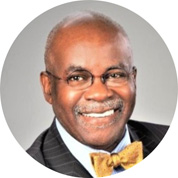
Yele Aluko: And this is what we call missing persons in healthcare. There is a large void of African American healthcare providers at every, in every discipline, doctors, nurses, and otherwise. It is not increasing. It’s at risk of going down. So diverse representation in the workforce is one thing. What are the consequences of lack of a more representative workforce? Is another thing. The absence of industry alignment about the importance of a diverse physician workforce is, I believe, part of the problem.
Aoifinn Devitt: Our next guest has had an extraordinary career in medicine and is now seeking to influence policy at the highest levels. Let’s hear his journey. Next. I’m Aoifinn Devitt, and welcome to the 50 Faces podcast. I’m joined today by Yele Aluko, who is Chief Medical Officer at EY, a role he has held for close to 4 years. He is co-chair health equity advisory at the International Well Building Institute, an advisory board member at the Children’s National Hospital, and a board member of the Wake Forest University School of Business. He has worked as a cardiologist in hospital settings for over 30 years. Welcome, Jelle. Thank you for joining me today.
Yele Aluko: Good afternoon, Aoife. It’s a pleasure to be with you today. Thank you for the invitation.
Aoifinn Devitt: Well, you’ve had a long and varied career, which has seen you move from a medical career to into now healthcare management consulting in a global position. Can you talk us through your career journey, maybe going right back to where you grew up, and did it take any surprising turns along the way?
Yele Aluko: Going back to where I grew up, I was born in Lagos, Nigeria in West Africa. I went to boarding school, school called King’s College Lagos. I got in there when I was 11 years of age and left there when I was 17. And boarding school formed my closest relationships over a 7-year period. It was in boarding school that I developed interests in physics, chemistry, biology. I was fairly good in those subjects, but I hadn’t made any career decisions until I turned 15 years of age when I happened to accompany my mother to visit a family member in a hospital in Lagos. And the experience I had there is what indelibly informed my decision to go into medicine. And I’ll very quickly tell you what happened. So we’re walking through the emergency room. And a taxi comes screeching to a halt in front of the emergency room, and a man runs out shouting, “Please help my wife. My wife is dying. I need a stretcher.” There were no stretchers available, so he runs back to the taxi. Doors are flung open, and he and the taxi driver are bringing out this large woman with her hands flailing. And they bring her in, half dragging, half carrying her into the emergency room floor. There are no stretchers. And he is running around, eyes wide open, sweating, pleading for help. And she dies on the floor in front of me. That was a very traumatic experience. First time as a 15-year-old kid that I came that close to the reality of mortality. And at that time, in that day, I decided I was going to go into medicine with the naive rationale that I didn’t want that experience to happen to any family member of mine. So I went to medical school and I went to medical school in Nigeria at the University College Hospital in Nigeria, which was birthed several years ago as a college of the University of London and then became an autonomous medical school in the University of Ibadan. And I came to the United States to do a residency in internal medicine. When I came to the United States, my plan was to do 3 years of an internal medicine residency and then go back to Nigeria to be on faculty at my medical school. One thing led to another, 30-plus years after, I’m still here. And having finished my internal medicine residency, I did a number of fellowships in general cardiology fellowship, invasive cardiology fellowship and then an interventional cardiology fellowship. All of these were done in the Northeast USA, New York and Massachusetts. And having finished those fellowships, I came to Charlotte, North Carolina to start a solo practice. Starting a solo practice was not by design. I essentially, despite my extensive qualifications, could not get a job with any of the existing large cardiovascular medicine practices, considering that in the Southeast USA at the time, you don’t just drop out of the sky to come to practice. You essentially get recruited by alumni organizations. If you went to Davidson, went to Chapel Hill, you went to Emory, then you have those networks. I had none of those networks having not gone to those schools in the United States. So I turned up, so I turned up African-American with a funny name. I didn’t get hired, so I started my own business as a solo practitioner, grew that to a 4-physician practice of African-American cardiologists, and eventually merged that practice into, with an 8-physician Caucasian cardiology practice. There were 12 of us initially. I became the president of that practice. We grew the practice to about 50 adult cardiologists, the second largest in North Carolina. That practice eventually got acquired by a health system. I was asked to be the medical director of the Heart and Vascular Institute in that 14-hospital health system across 4 states in the Southeast USA. I became a physician executive, a physician leader. I was on the board of trustees of the organization. I ended up in business school, did an MBA. Having done that MBA, I developed non-clinical interests, which were focused more on the macroeconomic perspectives of the industry. And I decided to leave the bedside and I joined Ernst Young as a healthcare management consultant, where I am now as chief medical officer.
Aoifinn Devitt: Well, that’s a very moving story of how you entered medicine. And thank you for sharing that with us. Was it a difficult decision to leave the bedside or was the time right in your view? Did you think you could have more influence perhaps in a policy role?
Yele Aluko: It was a very difficult decision and it’s not surprising to understand why. Physicians generally birthed within a very narrow ecosystem of colleagues. You go to medical school and because of the all-encompassing and depth of intellectual commitment that’s required. You are, for the most part, buried within the environment of medicine. You then get into a residency program and it’s the same thing, 18-hour days surrounded by physician colleagues, co-residents and co-interns and nurses. And then you get into clinical practice, the same thing. So the exposure that one gets is very valuable and the work we do is very valuable, but it’s very linear. And leaving medicine is a difficult decision for most physicians because our entire DNA revolves around the doctor designation and the role the doctor has in society. So it’s very conflicting, at least it was for me, to even begin to consider that I’d step away from the bedside from dispensing care to patients that I had done for decades. But the truth of the matter is that having done the MBA, I had developed just broader interests, and I had this conflicting desires to be equally impactful but in a broader manner over a larger geography and utilizing a louder megaphone. And I felt that leaving the bedside, even though so doing brought value to patients every single day, was something that I could do. But it took me 2 years to really come to terms with the fact that if I was gonna do it, I had to put the wheels in motion. And I put the wheels in motion with a fair amount of trepidation because understanding that I was coming from an organization where I had spent my entire professional career, developed a brand, a reputation and a comfort zone. And stepping outside that comfort zone was scary. However, I’ve taken risks before and I take calculated risks. And I felt that I was well positioned to be successful by reinventing myself within another career.
Aoifinn Devitt: That’s very powerful. And I’m sure that having had that long career in medicine at the bedside, that gives you so much more credibility and ethos when it comes to the policy role. I always ask my guests who’ve had a long career like you have about some of the highs and low points. What would be some of the highs and low points of your career so far?
Yele Aluko: I would say the, one of the lowest points of my career was having come to the United States without having any social support. I didn’t have any family here. Coming here as a foreign-trained physician, I had to do the standardized examinations that enable foreign-trained doctors to apply for residency positions in the United States. You apply for a position and you also apply for a visa to work. So having passed those examinations and having gotten into a residency program, my first pro— residency program, I wasn’t paid for 6 months. Because they didn’t have a budget to pay me. That was the rationale at the time. But I was doing the full portfolio of work that other residents were doing on call every third night. And it took me a while to understand that there was probably something very wrong with that scenario. But even more importantly, the loneliness, the social isolation, the enormity of the work. Led me after 6 months when winter came, had never seen winter before. I essentially felt that I had made the wrong decision coming to the United States. And I called my dad back home and I said, you know what? He didn’t want me to come in the first place because I had a position to go to England where we had more common relations being a former English colony and my medical school being a former college of University of London. We had more natural connections in the UK. So he wasn’t really supportive of my coming to the United States, but essentially called him up and I said, you know what, I made the wrong decision. I think I’m going to come back and rethink this thing. And he said, no, you’re not. You, you lay in the bed you make. So that was a very low point for me trying to navigate the work-life balance. Which at best is not good in the absence of any social family support. Regarding high moments, I will say that coming to Charlotte, North Carolina and starting a practice— I’ll just mention a couple of high moments because there are a number— starting a practice as a solo African American cardiologist, the only African American cardiologist in the city that was trained to do very specific interventional procedures. I was the first cardiologist in my hospital to perform a procedure which we call a balloon aortic valvuloplasty. And this was a novel procedure at the time that I had been trained to do in my fellowship program that wasn’t being done at that hospital. And lo and behold, it turns out that I’m referred a patient that was too sick to get their aortic valve replaced surgically and would ordinarily have been left to die. But the word got around from a referring physician that I had a new procedure under my belt and they asked me to do the procedure, to consider doing the procedure. I saw the patient and set them up for the procedure. I will say that with much resistance from the physician leadership in town, if you consider that a Black doctor who dropped out of the sky all of a sudden is bringing innovation into the practice in a hospital that had 99.9% Caucasian leadership at the time. There was a fair amount of resistance put in front of me, but I was able to navigate the leadership obstacles and do the procedure successfully. And having done that, I actually began to develop an individual personal professional brand of clinical excellence in cardiovascular care.
Aoifinn Devitt: That’s a wonderful story, a very empowering story to hear. And also, thank you for sharing the low point about the sense of isolation and lack of social capital, because I think that is probably an experience that’s being replicated 100-fold across some of the new immigrants to the US in your profession too. So sharing that is very helpful. Moving now to some of the policy issues that might be at the forefront of your mind, what is at the forefront of your mind in terms of the most pressing matters in healthcare policy today? And I know we can’t dedicate the whole podcast to this, Maybe, maybe in kind of very high level.
Yele Aluko: Well, that question really speaks to what led me to consider leaving the bedside and to eventually deciding to do that. Having worked within clinical care delivery for many years, working within successful healthcare systems, very, very highly branded healthcare systems with very committed colleagues, very skilled colleagues who wake up every single day to go to work to make people feel better, live longer. If the inevitability of death occurs, ensuring that people transition with empathy and dignity. That’s the work we do day in, day out. However, having gone to business school, I became keenly aware of the gross level of inefficiency within the industry. The healthcare industry, understanding that there are intersecting stakeholder groups that create the ecosystem that forms the healthcare industry. I, as a doctor, worked within healthcare systems, and both physicians and healthcare provider systems are called provider groups. You have the insurance companies as another stakeholder group. You have drug companies as another stakeholder group. And then of course you have the patient that should be the most important stakeholder within that ecosystem. But it occurred to me time and time again that even though we delivered good care, the value that the consumer, the patient as the most important stakeholder, the value they got was poorly defined, poorly understood. Poorly measured, and the industry wasn’t being held accountable for driving value. And by value, I speak to being able to provide a clinical product, irrespective of whatever specialty it is, that has excellent outcomes driven at the best cost. The cost of care delivery in the United States is inordinately expensive. It’s the most expensive in the world. And if we look at the societal metrics of performance, across the healthcare industry in the United States fails woefully across societal metrics such as infant mortality, maternal mortality, life expectancy, access to healthcare. So those issues of healthcare value began to gnaw at my sensibilities, and I felt that I could provide insight to thought leaders about the imperative for industry transformation, even though this industry transformation imperative is spoken about on a daily basis for several years. But you talked about policy. Part of the issue is the fact that holding healthcare systems and physicians accountable for delivery of value in a consistent manner. Why should it cost $30,000 for open heart surgery to be done on the West Coast and cost $90,000 for it to be done on the East Coast for the same procedure? So there are pockets of significant variation when it comes to cost and when it comes to outcomes. And we know this, we’re aware of this. And we are unable to eliminate unnecessary variation and create some degree, some semblance of necessary standardization. So that’s one issue about around policies. How do we develop accountability processes that move the needle towards standardization? And of course, on the other end of the spectrum is a policy around access to healthcare. It is clear that The health of any community, any society, any country, any human ecosystem is driven by the availability of the individuals to get good quality care. And by good quality care, talking about basic healthcare, preventive care, doesn’t necessarily have to be à la carte care, tertiary level, but basic healthcare. At a preventive level and at a diagnostic level and a treatment level. Healthcare policies in the United States do not enable ubiquitous healthcare coverage. There’s a large number of people, currently around 30 million of US citizens that don’t have healthcare coverage. During the Obama administration, the Affordable Care Act was passed with much resistance which persisted throughout the last presidency. The inability for the most sophisticated, the richest country in the world, the richest country within the portfolio of the OECD, to embrace the moral obligation of a country with such resources to provide health coverage to the disabled, the poor, and all vulnerable populations. It’s an obligation that in the United States we continue to struggle with and policy around healthcare access in reasonable manners because this is expensive to do but can be done. We are one of the few countries in the industrialized world that does not provide universal healthcare access. And by universal healthcare access, I’m not talking about a single-payer system like a Medicare for All. I’m talking about having some model that covers everybody who can’t afford to purchase health insurance.
Aoifinn Devitt: Those are very powerful points. I think another kind of a related problem, perhaps related to access, but certainly related to how a profession is perceived and maybe levels of trust, is how well that profession represents the communities that it serves. And the theme of my whole podcast series is around representation within professions. How do you assess the level of diverse representation in medicine today? And is it improving? Has it improved over the course of your career?
Yele Aluko: So if we look at the African American community, I’ll focus on that just for sake of time. The African American population in the United States is about 13%. About 4 to 5% of the physician workforce in the United States is African American. And you see similar gaps if you look at the Latinx community. The enrollment into medical school for African Americans is actually going down. And this is what we call missing persons in healthcare. There is a large void of African American healthcare providers in every discipline, doctors, nurses, and otherwise. It is not increasing, it’s at risk of going down. So diverse representation in the workforce is one thing. What are the consequences of lack of a more representative workforce is another thing. And as you are well aware, With COVID-19, there has been a recent overwhelming insight about healthcare disparities, the lack of health equity in the United States. Some think this is a new observation with COVID-19, but indeed this is a deep-seated historical observation that is not new to those of us that have practiced medicine for decades. This is a conversation that has been going on for at least 50 years and the needle hasn’t moved. One of the factors that have been put forth and have been validated is that the more minority doctors you have, the more likely you’re going to get engagement with minority patients about health literacy, other things that impact personal decision-making. But the truth of the matter is that As of now, there are not enough doctors that are Black to take care of Black patients. And the message should not be that you want to match one ethnicity with a patient and a doctor. Yes, patients should have choice, but the strategy shouldn’t be, “We want to increase the pipeline of minority doctors so that Black doctors should treat Black patients.” No. It’s important to increase the pipeline, but it’s also important that we understand The strategy should be to teach cultural sensitivity to all doctors so that non-African American physicians understand through training the importance of cultural sensitivity that enable them to be better doctors to all segments of society. And by so doing, we begin to move the needle away from subliminal bias that exists in healthcare and stereotyping towards humility in service and elimination of health disparities over time.
Aoifinn Devitt: So it seems like there are really two aspects to the problem, the shortage of doctors entering the profession today, as well as an overall still inadequate number, as well as that training. Is that training something that you’re overseeing now going into, well, are you seeing it happening more in medical settings? The type of inclusion training, and also what do you think is the reason for the decline in Black doctors entering the profession?
Yele Aluko: Well, first of all, the, in the healthcare industry though, is that the DEI activities oftentimes are penetrating the administrative workforce and less so the clinician physician workforce. Because having conversations around diversity and inclusion within the physician workforce leads to circumstances where physician leaderships say, “We don’t know where to find minority doctors from. We just can’t find them.” And when it comes to talking about subliminal bias and stereotypical treatment, it becomes a difficult conversation. So hopefully, the work that consulting firms— and we are involved in this type of work— the work that we are doing seeks to provide insights into the business case for diversity and the importance of eliminating subliminal bias and stereotypical behavior in the clinical workforce that allows for standardization of care for all people.
Aoifinn Devitt: Do you believe that the reason for the slow rise in these numbers is to do with the cost of medical school? Is that, is that a barrier? Are there not enough scholarships, for example? I have heard there have been some scholarships to encourage more diversity in the profession.
Yele Aluko: So the cost of medical school is clearly a barrier for a lot of people, Black and otherwise. And the pipeline of medical students has been borne largely by the historically Black college and university medical schools, of which there are 4. The absence of industry alignment about the importance of a diverse physician workforce is, I believe, part of the problem. There are several mainstream medical schools in, the United States that don’t have an alignment around the need to diversify the workforce. So, absent of that alignment, it’s impossible to develop pipeline strategies for recruitment. If there is a strategy for recruitment, then there will be access to scholarships to do so. And there are significant philanthropic donors that will be aligned with, you know, different types of educational agendas, one of which would be increased diversity in the workforce. So yes, the cost of medical education is significant. And for that reason, there had been a uniform decline in medical school applications up until about 2 years ago. And honestly speaking, with COVID-19, there has been an uptick of medical school applications in general, but not of minority applications.
Aoifinn Devitt: So clearly a long road ahead and a lot of work to be done, but thank you for your contribution to shining a light on this. I just wanna move back to your personal story now. Earlier in the conversation, you spoke about social capital. You didn’t have a lot of it when you first moved to the US due to circumstance. Can you speak about any key people in your life, whether before or since your time in the US, who had an influence on your career and in what way?
Yele Aluko: Well, there’s no question that my parents and my nuclear family had a significant influence in my career. My father was a civil engineer, at a point in time was a minister of finance in the western region in Nigeria, and then became a university professor. Of engineering and an author. He wrote about 10 books. My mother initially was a homemaker. She had 6 children. And she went back to school and got a degree in French at the age of 50 and became the principal of a high school and a French teacher. But, you know, beyond and more importantly beyond the academic achievements, there was just the personal growth, character, humility, education, awareness that they instill. Boarding school was very important. I had 5 siblings. My elder sister, she was the first, I’m the third. My elder sister is a pediatric cardiologist and I followed in her footsteps. So she was a role model. I had 2 uncles that were doctors. One was a general surgeon and an ENT surgeon, another one. So when I came to this country, I came with that database, sense of self, and a purpose that had been instilled by those experiences. So I had a lot of social capital when I got here from whence I came, but that social capital is not automatically transportable. I had to build that social capital here to support me. It’s interesting that I will say I didn’t have a lot of mentors in my professional career here. I stumbled around a lot and eventually got back onto the road towards the North Star. And I think that’s the story of life in general. You seek to go to the North Star, the true north, and every now and again you go backwards or you go sideways, but as long as you can get back on the right path, all is okay. I had a mentor, a couple of mentors in Charlotte, North Carolina when I got here. None of them, neither of them are in healthcare. One is a gentleman called Harvey Gantt. He’s an African-American architect who was the first Black mayor of Charlotte, was the first Black Black student to go to Clemson University. I got to know him and he was an inspiration to me. He mentioned to me that as the first Black cardiologist that did the procedures that I did in Charlotte, I would have large opportunities but significant obstacles. I also met a gentleman called James Ferguson who was a civil rights attorney. Who helped me navigate some political obstacles that I was exposed to as an African American physician new in town. There was an occasion where I was almost arrested in a hospital for being accused of impersonating a doctor, which was very traumatic for me, as you can imagine. So the lack of structured mentorship for me has led me to prioritize being a mentor at any point in time that I can. And I probably have mentored over 100 students at different levels of their educational pedigree that have an interest in healthcare, in any discipline of healthcare, starting from when they are in high school all the way through to their medical school and residency and fellowship programs. So I’m very committed to mentorship And I think that the reason that I’m committed to it is that I’ve learned a lot. And having not had that direction in a structured manner myself, I do know the importance of networks and especially the importance of enabling minority students to have orthodox mentorship to help them stay on the north path.
Aoifinn Devitt: Well, that’s a wonderful creed or motto, I think, that North Star analogy. Are there any other creeds or mottos you live by now that you can share?
Yele Aluko: My father used to say this all the time, “Thank God for little mercies. It could always be worse.” And I am a glass half full kind of person. I do not fret or obsess about things that are not within my control. I essentially realize that things could be worse. And I think about that almost every single day. And I remember my dad used to say that a lot. Thank God for little mercies, it could be much worse. And that’s one of the credos that I live by, that to whom much is given, much is expected. And one should not minimize the importance of the blessings that one has had the benefit of being exposed to or have been given.
Aoifinn Devitt: And my last question, after such a long career with many changes, is there anything that you know now that you wish you could tell your your younger self?
Yele Aluko: I would have been less militant in my earlier years. It took me a while to develop the emotional intelligence to be more embracing of diverse thoughts and less quick to judge, even if I had made judgments about business decisions or interpersonal relationships that were rationally— appeared to be rationally right. I would advise a younger person and the younger me to spend a little more time developing emotional intelligence to allow one to navigate through complexities quicker, even if one was right. I’d have gone to business school earlier. I’d have probably, you know, I practiced medicine for about 22 years before I went to business school. I’d have probably practiced for 10 years before I went to business school, and I might have stayed as a clinician, but Then again, I might have left clinical medicine after 10, 12 years and entered the industry and might have been positioned to have more time to be significantly impactful in transformation. All that being said, I’m very fortunate and happy with the blessings that I’ve received and the progress that I’ve made and the value that I have brought to human society and intends to do so going forward.
Aoifinn Devitt: Well, Yele, it has been such a pleasure to chat with you here. You’ve given us so much food for thought. First of all, I’m inspired by your mother. I think I can now pursue that French or English literature degree that I’ve always wanted to. It’s never too late, clearly. I also agree with you on business school. I went to business school after about, I suppose, 5 years in my profession, which was law, and it really does open your mind, I think. And not so much how much you take in terms of books, book knowledge, but it really forces you to think differently. So I definitely see that point. And it’s really been such a privilege to speak with you. You’ve spoken about a North Star. To me, you embody that for so many, for your profession. You are a role model and you really are the definition of what it is to give back, but you’ve also given us some profound things to think about. And thank you very much for that and for sharing your insights with us.
Yele Aluko: I thank you for the opportunity. It’s been my privilege.
Aoifinn Devitt: I’m Aoifinn Devitt. Thank you for listening to the 50 Faces Podcast. If you liked what you heard and would like to tune in to hear more inspiring people and their personal journeys, please subscribe on Apple Podcasts or wherever you get your podcasts. This podcast is for informational purposes only and should not be construed as investment advice, and all views Opinions are personal and should not be attributed to the organizations and affiliations of the host or any guest.
Yele Aluko: And this is what we call missing persons in healthcare. There is a large void of African American healthcare providers at every, in every discipline, doctors, nurses, and otherwise. It is not increasing. It’s at risk of going down. So diverse representation in the workforce is one thing. What are the consequences of lack of a more representative workforce? Is another thing. The absence of industry alignment about the importance of a diverse physician workforce is, I believe, part of the problem.
Aoifinn Devitt: Our next guest has had an extraordinary career in medicine and is now seeking to influence policy at the highest levels. Let’s hear his journey. Next. I’m Aoifinn Devitt, and welcome to the 50 Faces podcast. I’m joined today by Yele Aluko, who is Chief Medical Officer at EY, a role he has held for close to 4 years. He is co-chair health equity advisory at the International Well Building Institute, an advisory board member at the Children’s National Hospital, and a board member of the Wake Forest University School of Business. He has worked as a cardiologist in hospital settings for over 30 years. Welcome, Jelle. Thank you for joining me today.
Yele Aluko: Good afternoon, Aoife. It’s a pleasure to be with you today. Thank you for the invitation.
Aoifinn Devitt: Well, you’ve had a long and varied career, which has seen you move from a medical career to into now healthcare management consulting in a global position. Can you talk us through your career journey, maybe going right back to where you grew up, and did it take any surprising turns along the way?
Yele Aluko: Going back to where I grew up, I was born in Lagos, Nigeria in West Africa. I went to boarding school, school called King’s College Lagos. I got in there when I was 11 years of age and left there when I was 17. And boarding school formed my closest relationships over a 7-year period. It was in boarding school that I developed interests in physics, chemistry, biology. I was fairly good in those subjects, but I hadn’t made any career decisions until I turned 15 years of age when I happened to accompany my mother to visit a family member in a hospital in Lagos. And the experience I had there is what indelibly informed my decision to go into medicine. And I’ll very quickly tell you what happened. So we’re walking through the emergency room. And a taxi comes screeching to a halt in front of the emergency room, and a man runs out shouting, “Please help my wife. My wife is dying. I need a stretcher.” There were no stretchers available, so he runs back to the taxi. Doors are flung open, and he and the taxi driver are bringing out this large woman with her hands flailing. And they bring her in, half dragging, half carrying her into the emergency room floor. There are no stretchers. And he is running around, eyes wide open, sweating, pleading for help. And she dies on the floor in front of me. That was a very traumatic experience. First time as a 15-year-old kid that I came that close to the reality of mortality. And at that time, in that day, I decided I was going to go into medicine with the naive rationale that I didn’t want that experience to happen to any family member of mine. So I went to medical school and I went to medical school in Nigeria at the University College Hospital in Nigeria, which was birthed several years ago as a college of the University of London and then became an autonomous medical school in the University of Ibadan. And I came to the United States to do a residency in internal medicine. When I came to the United States, my plan was to do 3 years of an internal medicine residency and then go back to Nigeria to be on faculty at my medical school. One thing led to another, 30-plus years after, I’m still here. And having finished my internal medicine residency, I did a number of fellowships in general cardiology fellowship, invasive cardiology fellowship and then an interventional cardiology fellowship. All of these were done in the Northeast USA, New York and Massachusetts. And having finished those fellowships, I came to Charlotte, North Carolina to start a solo practice. Starting a solo practice was not by design. I essentially, despite my extensive qualifications, could not get a job with any of the existing large cardiovascular medicine practices, considering that in the Southeast USA at the time, you don’t just drop out of the sky to come to practice. You essentially get recruited by alumni organizations. If you went to Davidson, went to Chapel Hill, you went to Emory, then you have those networks. I had none of those networks having not gone to those schools in the United States. So I turned up, so I turned up African-American with a funny name. I didn’t get hired, so I started my own business as a solo practitioner, grew that to a 4-physician practice of African-American cardiologists, and eventually merged that practice into, with an 8-physician Caucasian cardiology practice. There were 12 of us initially. I became the president of that practice. We grew the practice to about 50 adult cardiologists, the second largest in North Carolina. That practice eventually got acquired by a health system. I was asked to be the medical director of the Heart and Vascular Institute in that 14-hospital health system across 4 states in the Southeast USA. I became a physician executive, a physician leader. I was on the board of trustees of the organization. I ended up in business school, did an MBA. Having done that MBA, I developed non-clinical interests, which were focused more on the macroeconomic perspectives of the industry. And I decided to leave the bedside and I joined Ernst Young as a healthcare management consultant, where I am now as chief medical officer.
Aoifinn Devitt: Well, that’s a very moving story of how you entered medicine. And thank you for sharing that with us. Was it a difficult decision to leave the bedside or was the time right in your view? Did you think you could have more influence perhaps in a policy role?
Yele Aluko: It was a very difficult decision and it’s not surprising to understand why. Physicians generally birthed within a very narrow ecosystem of colleagues. You go to medical school and because of the all-encompassing and depth of intellectual commitment that’s required. You are, for the most part, buried within the environment of medicine. You then get into a residency program and it’s the same thing, 18-hour days surrounded by physician colleagues, co-residents and co-interns and nurses. And then you get into clinical practice, the same thing. So the exposure that one gets is very valuable and the work we do is very valuable, but it’s very linear. And leaving medicine is a difficult decision for most physicians because our entire DNA revolves around the doctor designation and the role the doctor has in society. So it’s very conflicting, at least it was for me, to even begin to consider that I’d step away from the bedside from dispensing care to patients that I had done for decades. But the truth of the matter is that having done the MBA, I had developed just broader interests, and I had this conflicting desires to be equally impactful but in a broader manner over a larger geography and utilizing a louder megaphone. And I felt that leaving the bedside, even though so doing brought value to patients every single day, was something that I could do. But it took me 2 years to really come to terms with the fact that if I was gonna do it, I had to put the wheels in motion. And I put the wheels in motion with a fair amount of trepidation because understanding that I was coming from an organization where I had spent my entire professional career, developed a brand, a reputation and a comfort zone. And stepping outside that comfort zone was scary. However, I’ve taken risks before and I take calculated risks. And I felt that I was well positioned to be successful by reinventing myself within another career.
Aoifinn Devitt: That’s very powerful. And I’m sure that having had that long career in medicine at the bedside, that gives you so much more credibility and ethos when it comes to the policy role. I always ask my guests who’ve had a long career like you have about some of the highs and low points. What would be some of the highs and low points of your career so far?
Yele Aluko: I would say the, one of the lowest points of my career was having come to the United States without having any social support. I didn’t have any family here. Coming here as a foreign-trained physician, I had to do the standardized examinations that enable foreign-trained doctors to apply for residency positions in the United States. You apply for a position and you also apply for a visa to work. So having passed those examinations and having gotten into a residency program, my first pro— residency program, I wasn’t paid for 6 months. Because they didn’t have a budget to pay me. That was the rationale at the time. But I was doing the full portfolio of work that other residents were doing on call every third night. And it took me a while to understand that there was probably something very wrong with that scenario. But even more importantly, the loneliness, the social isolation, the enormity of the work. Led me after 6 months when winter came, had never seen winter before. I essentially felt that I had made the wrong decision coming to the United States. And I called my dad back home and I said, you know what? He didn’t want me to come in the first place because I had a position to go to England where we had more common relations being a former English colony and my medical school being a former college of University of London. We had more natural connections in the UK. So he wasn’t really supportive of my coming to the United States, but essentially called him up and I said, you know what, I made the wrong decision. I think I’m going to come back and rethink this thing. And he said, no, you’re not. You, you lay in the bed you make. So that was a very low point for me trying to navigate the work-life balance. Which at best is not good in the absence of any social family support. Regarding high moments, I will say that coming to Charlotte, North Carolina and starting a practice— I’ll just mention a couple of high moments because there are a number— starting a practice as a solo African American cardiologist, the only African American cardiologist in the city that was trained to do very specific interventional procedures. I was the first cardiologist in my hospital to perform a procedure which we call a balloon aortic valvuloplasty. And this was a novel procedure at the time that I had been trained to do in my fellowship program that wasn’t being done at that hospital. And lo and behold, it turns out that I’m referred a patient that was too sick to get their aortic valve replaced surgically and would ordinarily have been left to die. But the word got around from a referring physician that I had a new procedure under my belt and they asked me to do the procedure, to consider doing the procedure. I saw the patient and set them up for the procedure. I will say that with much resistance from the physician leadership in town, if you consider that a Black doctor who dropped out of the sky all of a sudden is bringing innovation into the practice in a hospital that had 99.9% Caucasian leadership at the time. There was a fair amount of resistance put in front of me, but I was able to navigate the leadership obstacles and do the procedure successfully. And having done that, I actually began to develop an individual personal professional brand of clinical excellence in cardiovascular care.
Aoifinn Devitt: That’s a wonderful story, a very empowering story to hear. And also, thank you for sharing the low point about the sense of isolation and lack of social capital, because I think that is probably an experience that’s being replicated 100-fold across some of the new immigrants to the US in your profession too. So sharing that is very helpful. Moving now to some of the policy issues that might be at the forefront of your mind, what is at the forefront of your mind in terms of the most pressing matters in healthcare policy today? And I know we can’t dedicate the whole podcast to this, Maybe, maybe in kind of very high level.
Yele Aluko: Well, that question really speaks to what led me to consider leaving the bedside and to eventually deciding to do that. Having worked within clinical care delivery for many years, working within successful healthcare systems, very, very highly branded healthcare systems with very committed colleagues, very skilled colleagues who wake up every single day to go to work to make people feel better, live longer. If the inevitability of death occurs, ensuring that people transition with empathy and dignity. That’s the work we do day in, day out. However, having gone to business school, I became keenly aware of the gross level of inefficiency within the industry. The healthcare industry, understanding that there are intersecting stakeholder groups that create the ecosystem that forms the healthcare industry. I, as a doctor, worked within healthcare systems, and both physicians and healthcare provider systems are called provider groups. You have the insurance companies as another stakeholder group. You have drug companies as another stakeholder group. And then of course you have the patient that should be the most important stakeholder within that ecosystem. But it occurred to me time and time again that even though we delivered good care, the value that the consumer, the patient as the most important stakeholder, the value they got was poorly defined, poorly understood. Poorly measured, and the industry wasn’t being held accountable for driving value. And by value, I speak to being able to provide a clinical product, irrespective of whatever specialty it is, that has excellent outcomes driven at the best cost. The cost of care delivery in the United States is inordinately expensive. It’s the most expensive in the world. And if we look at the societal metrics of performance, across the healthcare industry in the United States fails woefully across societal metrics such as infant mortality, maternal mortality, life expectancy, access to healthcare. So those issues of healthcare value began to gnaw at my sensibilities, and I felt that I could provide insight to thought leaders about the imperative for industry transformation, even though this industry transformation imperative is spoken about on a daily basis for several years. But you talked about policy. Part of the issue is the fact that holding healthcare systems and physicians accountable for delivery of value in a consistent manner. Why should it cost $30,000 for open heart surgery to be done on the West Coast and cost $90,000 for it to be done on the East Coast for the same procedure? So there are pockets of significant variation when it comes to cost and when it comes to outcomes. And we know this, we’re aware of this. And we are unable to eliminate unnecessary variation and create some degree, some semblance of necessary standardization. So that’s one issue about around policies. How do we develop accountability processes that move the needle towards standardization? And of course, on the other end of the spectrum is a policy around access to healthcare. It is clear that The health of any community, any society, any country, any human ecosystem is driven by the availability of the individuals to get good quality care. And by good quality care, talking about basic healthcare, preventive care, doesn’t necessarily have to be à la carte care, tertiary level, but basic healthcare. At a preventive level and at a diagnostic level and a treatment level. Healthcare policies in the United States do not enable ubiquitous healthcare coverage. There’s a large number of people, currently around 30 million of US citizens that don’t have healthcare coverage. During the Obama administration, the Affordable Care Act was passed with much resistance which persisted throughout the last presidency. The inability for the most sophisticated, the richest country in the world, the richest country within the portfolio of the OECD, to embrace the moral obligation of a country with such resources to provide health coverage to the disabled, the poor, and all vulnerable populations. It’s an obligation that in the United States we continue to struggle with and policy around healthcare access in reasonable manners because this is expensive to do but can be done. We are one of the few countries in the industrialized world that does not provide universal healthcare access. And by universal healthcare access, I’m not talking about a single-payer system like a Medicare for All. I’m talking about having some model that covers everybody who can’t afford to purchase health insurance.
Aoifinn Devitt: Those are very powerful points. I think another kind of a related problem, perhaps related to access, but certainly related to how a profession is perceived and maybe levels of trust, is how well that profession represents the communities that it serves. And the theme of my whole podcast series is around representation within professions. How do you assess the level of diverse representation in medicine today? And is it improving? Has it improved over the course of your career?
Yele Aluko: So if we look at the African American community, I’ll focus on that just for sake of time. The African American population in the United States is about 13%. About 4 to 5% of the physician workforce in the United States is African American. And you see similar gaps if you look at the Latinx community. The enrollment into medical school for African Americans is actually going down. And this is what we call missing persons in healthcare. There is a large void of African American healthcare providers in every discipline, doctors, nurses, and otherwise. It is not increasing, it’s at risk of going down. So diverse representation in the workforce is one thing. What are the consequences of lack of a more representative workforce is another thing. And as you are well aware, With COVID-19, there has been a recent overwhelming insight about healthcare disparities, the lack of health equity in the United States. Some think this is a new observation with COVID-19, but indeed this is a deep-seated historical observation that is not new to those of us that have practiced medicine for decades. This is a conversation that has been going on for at least 50 years and the needle hasn’t moved. One of the factors that have been put forth and have been validated is that the more minority doctors you have, the more likely you’re going to get engagement with minority patients about health literacy, other things that impact personal decision-making. But the truth of the matter is that As of now, there are not enough doctors that are Black to take care of Black patients. And the message should not be that you want to match one ethnicity with a patient and a doctor. Yes, patients should have choice, but the strategy shouldn’t be, “We want to increase the pipeline of minority doctors so that Black doctors should treat Black patients.” No. It’s important to increase the pipeline, but it’s also important that we understand The strategy should be to teach cultural sensitivity to all doctors so that non-African American physicians understand through training the importance of cultural sensitivity that enable them to be better doctors to all segments of society. And by so doing, we begin to move the needle away from subliminal bias that exists in healthcare and stereotyping towards humility in service and elimination of health disparities over time.
Aoifinn Devitt: So it seems like there are really two aspects to the problem, the shortage of doctors entering the profession today, as well as an overall still inadequate number, as well as that training. Is that training something that you’re overseeing now going into, well, are you seeing it happening more in medical settings? The type of inclusion training, and also what do you think is the reason for the decline in Black doctors entering the profession?
Yele Aluko: Well, first of all, the, in the healthcare industry though, is that the DEI activities oftentimes are penetrating the administrative workforce and less so the clinician physician workforce. Because having conversations around diversity and inclusion within the physician workforce leads to circumstances where physician leaderships say, “We don’t know where to find minority doctors from. We just can’t find them.” And when it comes to talking about subliminal bias and stereotypical treatment, it becomes a difficult conversation. So hopefully, the work that consulting firms— and we are involved in this type of work— the work that we are doing seeks to provide insights into the business case for diversity and the importance of eliminating subliminal bias and stereotypical behavior in the clinical workforce that allows for standardization of care for all people.
Aoifinn Devitt: Do you believe that the reason for the slow rise in these numbers is to do with the cost of medical school? Is that, is that a barrier? Are there not enough scholarships, for example? I have heard there have been some scholarships to encourage more diversity in the profession.
Yele Aluko: So the cost of medical school is clearly a barrier for a lot of people, Black and otherwise. And the pipeline of medical students has been borne largely by the historically Black college and university medical schools, of which there are 4. The absence of industry alignment about the importance of a diverse physician workforce is, I believe, part of the problem. There are several mainstream medical schools in, the United States that don’t have an alignment around the need to diversify the workforce. So, absent of that alignment, it’s impossible to develop pipeline strategies for recruitment. If there is a strategy for recruitment, then there will be access to scholarships to do so. And there are significant philanthropic donors that will be aligned with, you know, different types of educational agendas, one of which would be increased diversity in the workforce. So yes, the cost of medical education is significant. And for that reason, there had been a uniform decline in medical school applications up until about 2 years ago. And honestly speaking, with COVID-19, there has been an uptick of medical school applications in general, but not of minority applications.
Aoifinn Devitt: So clearly a long road ahead and a lot of work to be done, but thank you for your contribution to shining a light on this. I just wanna move back to your personal story now. Earlier in the conversation, you spoke about social capital. You didn’t have a lot of it when you first moved to the US due to circumstance. Can you speak about any key people in your life, whether before or since your time in the US, who had an influence on your career and in what way?
Yele Aluko: Well, there’s no question that my parents and my nuclear family had a significant influence in my career. My father was a civil engineer, at a point in time was a minister of finance in the western region in Nigeria, and then became a university professor. Of engineering and an author. He wrote about 10 books. My mother initially was a homemaker. She had 6 children. And she went back to school and got a degree in French at the age of 50 and became the principal of a high school and a French teacher. But, you know, beyond and more importantly beyond the academic achievements, there was just the personal growth, character, humility, education, awareness that they instill. Boarding school was very important. I had 5 siblings. My elder sister, she was the first, I’m the third. My elder sister is a pediatric cardiologist and I followed in her footsteps. So she was a role model. I had 2 uncles that were doctors. One was a general surgeon and an ENT surgeon, another one. So when I came to this country, I came with that database, sense of self, and a purpose that had been instilled by those experiences. So I had a lot of social capital when I got here from whence I came, but that social capital is not automatically transportable. I had to build that social capital here to support me. It’s interesting that I will say I didn’t have a lot of mentors in my professional career here. I stumbled around a lot and eventually got back onto the road towards the North Star. And I think that’s the story of life in general. You seek to go to the North Star, the true north, and every now and again you go backwards or you go sideways, but as long as you can get back on the right path, all is okay. I had a mentor, a couple of mentors in Charlotte, North Carolina when I got here. None of them, neither of them are in healthcare. One is a gentleman called Harvey Gantt. He’s an African-American architect who was the first Black mayor of Charlotte, was the first Black Black student to go to Clemson University. I got to know him and he was an inspiration to me. He mentioned to me that as the first Black cardiologist that did the procedures that I did in Charlotte, I would have large opportunities but significant obstacles. I also met a gentleman called James Ferguson who was a civil rights attorney. Who helped me navigate some political obstacles that I was exposed to as an African American physician new in town. There was an occasion where I was almost arrested in a hospital for being accused of impersonating a doctor, which was very traumatic for me, as you can imagine. So the lack of structured mentorship for me has led me to prioritize being a mentor at any point in time that I can. And I probably have mentored over 100 students at different levels of their educational pedigree that have an interest in healthcare, in any discipline of healthcare, starting from when they are in high school all the way through to their medical school and residency and fellowship programs. So I’m very committed to mentorship And I think that the reason that I’m committed to it is that I’ve learned a lot. And having not had that direction in a structured manner myself, I do know the importance of networks and especially the importance of enabling minority students to have orthodox mentorship to help them stay on the north path.
Aoifinn Devitt: Well, that’s a wonderful creed or motto, I think, that North Star analogy. Are there any other creeds or mottos you live by now that you can share?
Yele Aluko: My father used to say this all the time, “Thank God for little mercies. It could always be worse.” And I am a glass half full kind of person. I do not fret or obsess about things that are not within my control. I essentially realize that things could be worse. And I think about that almost every single day. And I remember my dad used to say that a lot. Thank God for little mercies, it could be much worse. And that’s one of the credos that I live by, that to whom much is given, much is expected. And one should not minimize the importance of the blessings that one has had the benefit of being exposed to or have been given.
Aoifinn Devitt: And my last question, after such a long career with many changes, is there anything that you know now that you wish you could tell your your younger self?
Yele Aluko: I would have been less militant in my earlier years. It took me a while to develop the emotional intelligence to be more embracing of diverse thoughts and less quick to judge, even if I had made judgments about business decisions or interpersonal relationships that were rationally— appeared to be rationally right. I would advise a younger person and the younger me to spend a little more time developing emotional intelligence to allow one to navigate through complexities quicker, even if one was right. I’d have gone to business school earlier. I’d have probably, you know, I practiced medicine for about 22 years before I went to business school. I’d have probably practiced for 10 years before I went to business school, and I might have stayed as a clinician, but Then again, I might have left clinical medicine after 10, 12 years and entered the industry and might have been positioned to have more time to be significantly impactful in transformation. All that being said, I’m very fortunate and happy with the blessings that I’ve received and the progress that I’ve made and the value that I have brought to human society and intends to do so going forward.
Aoifinn Devitt: Well, Yele, it has been such a pleasure to chat with you here. You’ve given us so much food for thought. First of all, I’m inspired by your mother. I think I can now pursue that French or English literature degree that I’ve always wanted to. It’s never too late, clearly. I also agree with you on business school. I went to business school after about, I suppose, 5 years in my profession, which was law, and it really does open your mind, I think. And not so much how much you take in terms of books, book knowledge, but it really forces you to think differently. So I definitely see that point. And it’s really been such a privilege to speak with you. You’ve spoken about a North Star. To me, you embody that for so many, for your profession. You are a role model and you really are the definition of what it is to give back, but you’ve also given us some profound things to think about. And thank you very much for that and for sharing your insights with us.
Yele Aluko: I thank you for the opportunity. It’s been my privilege.
Aoifinn Devitt: I’m Aoifinn Devitt. Thank you for listening to the 50 Faces Podcast. If you liked what you heard and would like to tune in to hear more inspiring people and their personal journeys, please subscribe on Apple Podcasts or wherever you get your podcasts. This podcast is for informational purposes only and should not be construed as investment advice, and all views Opinions are personal and should not be attributed to the organizations and affiliations of the host or any guest.