

Aoifinn Devitt: This podcast is brought to you with the kind support of Plutus Capital, a female-run investment management firm based in Evanston, Illinois, which works with clients on a wide variety of mandates such as custom diversity solutions, manager due diligence, diversified hedge fund to fund allocations, and advisory services. I’m Aoifinn Devitt and welcome to this collaboration between 50 Faces Podcast and GAIN, where we are meeting 3 interns from their recent 8-week summer internship program, which was held across various financial institutions in the city. GAIN is a community of investors with charitable status set up to change the lack of gender diversity in investment management from the ground up. Its mission is to increase the number of female applicants for entry-level roles into the industry. They do this by informing young women with online resources, bringing helpful information on careers and investment to their fingertips, inspiring young women with a strong network of female role models who speak in high schools and universities around the UK and feature on their online channels, delivering compelling and high-impact messages on the many benefits of investing as a career, and also by providing opportunities for young women to get into the investment industry, such as via this internship program. I’ve gathered 3 interns here to discuss their impressions of the internship, their impressions of the industry, and their plans for the future. I’m delighted to be joined here by Ellen Welford, Heyu Lo, and Ava Boras. Welcome, thanks for joining me today. So let’s start with Ellen. Can you talk to me a little bit about where you’re studying now and where you did your internship?
The GAIN Summer Internship 2021: Yeah, so I’m currently studying at Oxford and I’m just about to go into my third year studying economics and management. I’ve also just completed an 8-week internship at a small family investment office based in London.
Aoifinn Devitt: Great, thank you. And how about you, Han Yu?
The GAIN Summer Internship 2021: Thank you, Aoifinn.
Speaker C: So I’ve just finished my second year doing chemical engineering at University of Cambridge. I’m entering my third year next academic year. So I’m currently interning at Metropolis Capital and MMM. It’s my week 5 now.
Aoifinn Devitt: And Eva, how about you?
Speaker D: Hi, I’m Eva and I just finished my second year in Biomedical Engineering at Imperial College London and will be going into third year. And I completed— two weeks ago I finished a 7-week internship at Capstone Advisors.
Aoifinn Devitt: So Ellen, you studied perhaps the most traditional path for preparation for a career in finance. How did you find that Economics and Management that you were learning at Oxford How did you find the skills there translated into something you might have needed?
The GAIN Summer Internship 2021: Yeah, so definitely economics is quite a traditional route into finance and the investment industry, and quite a lot of my peers have also gone on to do internships in banking and you consultancy, know, quite the traditional route. One of the things about my degree course is like the mix between the economics and the management side of things. So the economics is quite problem solving and we do quite a lot of mathematical work, whereas the management management side of the degree course is a lot more essay-based, and we do a lot more reading and a lot more referencing. And one of the things that surprised me about my work in the internship is how writing-heavy it was. So quite a lot of the tasks that analysts have to do is prepare for meetings and send everybody out a brief in advance of a meeting, and then also write up the meeting notes afterwards. And then throughout my internship, I also did 2 projects which were kind of accumulated in a report-style structure. And so my first project was on SPACs, and that was about a 30-page-long report. And I guess I didn’t really anticipate that I’d be needing my writing and essay writing skills that much, but I think that’s definitely something that really helped going into the internship.
Aoifinn Devitt: That’s fascinating. And I’d love to know then how our 2 scientists found that, whether they had a similar element of writing included. So Han Yu, chemical engineering. To the world of finance. How did you find that transition?
Speaker C: Well, it fits pretty well because I think from my internship I’ve realized that, as contrast to Alan’s work, I have less writing. It’s probably because my tasks and responsibilities are different, but what I do a lot is reading, reading, digesting, guessing the key takeaways from a lot of readings, and then present it. So I think this is what I’ve learned from chemical engineering, especially from writing reports, because when writing like lab reports, we have to do some extra researching as well and then present it into the report. So this is one of the skills that I’ve learned from chemical engineering that’s very useful in my internship. But the scientific knowledge-wise for chemical engineering, I do find more comfortable when looking into the chemical industry or maybe just like sciences industry. So chemical companies, pharmaceutical companies, that’s where I have the chance to use my scientific knowledge into my work now.
Aoifinn Devitt: Absolutely. And Eva, did you have a similar impression, biomedical engineering to investing? How did you find that transition and what skills did you bring to bear?
Speaker D: So as my peer just said, bioengineering in general is very lab-based and a very important skill to have is knowing how to write reports. That reflect all the experiments that you’ve done before. And I feel like that’s what is more overlapping with investment and asset management, which involves, at least in the group that I worked in during my internship, which was risk arbitrage, there was a lot of heavy research to be done into looking into different companies and their financial past and comparing and whether in the future some finance would be feasible or not. And I feel like not because it was biomedical, but just the engineering part of it was the most useful in terms of preparing for the internship, as well as being able to work under time pressure and having certain deadlines to complete projects, or if a report was expected from me from my supervisor, to know how to manage my time. So I feel like my degree also helped me develop that skill.
Aoifinn Devitt: It’s really interesting. So clearly a diverse set of skills needed, and even if you’d come maybe with a certain set of skills well developed through your degree, there seemed to have been the opportunity to learn new skills there in those positions. I’m curious, so in terms of what you knew about the asset management industry before entering, I’ll start with Ellen. Would you say that you knew a lot about the world of investing? Had the asset management industry done a good job of advertising itself to you, making you aware of it?
The GAIN Summer Internship 2021: Yeah, so I think I was in a relatively fortuitously lucky position in that my next-door neighbor works in the asset management industry, and that has been my only connection to the industry from a relatively young age. You know, I had no family members or no one in my school went into the industry, and so as I from, say, a super young age, I would be quizzing him on what he was doing in his work and what he enjoyed about his work. And one of the great things about him was that he was always so eager to explain things to me and was always really patient with all of my questions and also just made it sound like such a dynamic, interesting industry to work in. So that was kind of my first exposure to the industry. And then after that, I decided that I was going to study economics at my A-levels, and then with a view to if I really enjoyed that, then studying it at university. So it was a good job that I enjoyed it in the A-level stage and then continued pursuing the asset management side of things from then on. I did do a work experience with my neighbour when I was about 17, so I shadowed him in his asset management firm. And then I’ve done a couple of spring weeks as well, which is again quite a traditional economics and management undergraduate route. You know, you go from your degree to your spring week to your internship, then fingers crossed to the grad role. So I had a few bits and pieces of insight into the asset management industry kind of sprinkled in. Through my life, but I definitely think the internship has kind of surprised me with how much I’ve still got to learn about it, because all of these other insights gave a great overview. Yeah, I don’t think I ever realized how deep it went.
Aoifinn Devitt: Fantastic. And Han, you and Eva, how about you from a science perspective? Did you find that the asset management industry was knocking on those doors in the traditional kind of milk round, or did you have to seek it out yourselves?
Speaker C: I was exposed to finance sector, not just asset management, relatively late, so I’ve only realized this sector when I was in uni because I didn’t have any relatives or friends or family that’s in this industry. So I realized it, I joined society, and I’ve just realized there are so many more branches in finance sector. And yeah, and then digging around, researching around, and realized that asset management is probably the sector that I’m most, most interested in out of all this financial sector. And yeah, so what I thought about asset management before entering the internship is managing people’s assets, right? And there are like so many different ways to manage the assets. And then after I’ve joined, I’ve just realized there are so many branches from asset management yet, you know, like public fund and private equity fund and stuff like that, hedge funds. So, right, so I’m probably just understanding one part of it. But yes, definitely, I have still a lot more to learn.
Aoifinn Devitt: Fascinating. Eva, what was your experience?
Speaker D: So on the contrary to Ellen, I had no exposure to asset management or the finance industry as a whole. Me personally, I completed the business GCSE back when I was like 16. But then I decided to look into it when I came to university, and I realized how important the finance world is. At the core of the economics of how the world works, it all comes down to money. And so I felt like it would be very important, as well as very interesting, to look into this whole world that I hadn’t been exposed to before. So to answer your question, no, I hadn’t been exposed to it before.
Aoifinn Devitt: And had any of you been investing personally in stocks or had an interest in investing before embarking on this internship?
Speaker C: I did have a little interest in investing before joining, but since, like I’ve mentioned, I didn’t have a lot of exposure to this sector, so I wasn’t very comfortable of taking risks. So I’ve decided to learn a bit more before I do any decisions.
Aoifinn Devitt: How about business clubs or economic clubs or investing clubs at university? And some even go right back to high school. Did any of you join any of those kind of affinity groups?
The GAIN Summer Internship 2021: So I know that Oxford has a fair amount of investing clubs, but I think quite a lot of them are a lot more focused on the sell side, so quite a lot of people focus on like M&A and investment banking, and that was not the side of things that I wanted to go into. So I joined one of the societies called Oxford Women in Business, and that really appealed more to my interests, which were really in kind of the business fundamental side of investing. And that society is also really interesting because it introduced me to the world of not only investment but then also consultancy and law, because yeah, the society covered all of those different grounds. And then I say, after being able to view all of those different options, I decided that the investment management side was the most interesting to me. And then also another point to that is that I joined GAIN as an ambassador whilst doing my degree at Oxford, so I assume we might come on to talking about GAIN in a little while, but that was also an amazing introduction to the asset management industry.
Aoifinn Devitt: And just getting back to the idea of you can’t be what you can’t see, how important was it to you to see senior women succeeding in these roles? And on an ongoing basis, if you could put yourself forward 5 years and you’re a junior to mid-level, how important do you think it will be to see women in leadership roles?
Speaker C: You wouldn’t want a job that has no future or promotion, good job prospect. You don’t want yourself to working harder than anyone else and reach a glass ceiling. That’s very demotivating, I think. So looking if there’s like more opportunities or normalizing females in the senior roles and firms, that’s very encouraging. I’ll be very happy as long as it’s fair and square, as in they don’t discriminate women as someone who are not decisive. Things like that.
Aoifinn Devitt: Any other thoughts on that point around female role models perhaps being important?
The GAIN Summer Internship 2021: It’s quite difficult, I think, because I’ve really not had exposure to many female role models. Most of the women that I’ve spoken to in investment management are under 30, and I think that that’s a big issue in itself, and that a lot of women who go into the industry drop out of the industry when they decide that they want to start a family. And I think my firm at the moment are really strongly trying to encourage shared paternity and maternity leave. So that— I know that one of our head directors at the moment who’s a male has just taken 2 months of paternity leave, and I think that’s like a really important step to equalizing the playing field a little bit and making sure that women aren’t taking a disproportionate amount of time out of the job and out of the industry. But yeah, I think most of the women that I’ve spoken to are under 30, which makes it difficult because obviously they are great role models in themselves and have been able to provide so so much insight into the role and what the whole industry consists of. But when you go a bit higher than that, I’ve, yeah, struggled to find a vast amount of people that I can reach out to and discuss with. And so hopefully that will change going into the future, but I think at the moment we kind of need to create our own role models in a sense.
Aoifinn Devitt: Ava, do you have any thoughts on that point?
Speaker D: I feel like a big part of why there is not that many female role models in very senior positions is the fact that at some point in your career, you’re faced with a decision of whether you want to continue working or have a family or have a child. And that’s a very important aspect that should be taken into account. I know during my internship, I didn’t meet any portfolio managers that were women. But I did meet the head of legal and compliance. The whole compliance part of the firm that I was working in was mainly women. I did really feel very motivated, even though it was compliance instead of asset management or like a portfolio manager. I did feel very encouraged to keep working when I saw the woman that was the head of compliance. So I feel like it’s definitely very, very important to try and get a lot more women in charge, which there are women working in the industry, but not necessarily, as mentioned before, in a very high position. So I feel like for me, and I would say for like every girl that’s in primary school right now, if they had like a talk by a very important female CEO, they would certainly be inspired or maybe have it in the back of their minds., as you said, as an option of what they want to aspire to be. So definitely I think having more role models or people to look up to, it’s very important.
Aoifinn Devitt: Did any of you have specific mentors during your internship or in your university careers office perhaps? And how did you find that useful if so?
The GAIN Summer Internship 2021: Yeah, I have had a couple of amazing mentors actually. And again, I know I keep bringing it up, but it’s through the GAIN program. So when I first became an ambassador 2 years ago, they provided me with a mentor, an amazing woman a woman named Natasha who actually did become like a more senior position. So, you know, she is like my one reference point. And she worked on like the ESG side of investment. And that was something that I was really interested in at the time. So that’s environmental, social, and governance. And it was amazing to talk to her and get her insight into the industry. And then just before starting the internship program, GAIN also provided us with another mentor. And so again, I had an amazing, amazing woman named Hannah, and she was in her late 20s and had risen up the ranks like really, really quickly. So it was amazing for her age and provided me with so much insight into what it was like in kind of the early days starting out into the industry, because that wasn’t too long ago for her now. And yeah, those are my two like really great reference points that was also someone outside of the firm that I was interning with, so I was able to ask them all the stupid questions that you’d maybe not want to approach someone in your actual internship firm to ask, you know, like, what does business casual really mean? And like, can I wear this? And how do I approach and talk to someone this senior? You know, all of those sorts of questions that you wouldn’t want to ask someone who has, I guess, a decision on your final hiring job decision. Yeah, I think that the mentors were really important and amazing to have a sounding board to bounce ideas off and then also ask advice throughout the internship on certain projects or things that you’re working on. So I definitely recommend everybody to get a mentor, and then hopefully if/when I get into the industry, I’d love to be in that role and provide mentorship and guidance to other young women hoping to break into the industry as well.
Aoifinn Devitt: Thanks, Ellen, for giving us some insights into what GAIN does, because obviously that’s a huge part of this podcast is to, I think, to highlight this internship program and some of the supports that are in place throughout the year. Some fantastic events, some panels, career advice, and just really of sort showing the path into the world of investing. And the wonderful thing I think is that GAIN is just one piece of the global initiative on these fronts. Han Yu or Eva, do you have any thoughts on mentorship and its importance?
Speaker C: Yes, and it’s from GAIN. They’ve done a very fantastic job. So I wasn’t a GAIN ambassador, so I’ve— but they assigned me a mentor for my summer internship. I believe they do for all the interns that’s involved in this summer internship program. So she was the point of reference because again, I wasn’t very familiar with this whole sector before the internship. This might be a stereotype, but I’ve always find more comfortable, you know, to ask questions and approach someone who is a girl, who is a female, than counterparts. So she did give me a lot of advice in terms of maybe preparation into the industry and confidence in working in the industry. So she’s actually the one that’s talked to me about diversity in this industry that I mentioned just now. And yeah, what Alan said, you wouldn’t want to ask some of those questions that’s from your internship firm. So I do ask her a lot of specific questions as well, even during my internships, and how to first talk to people. Should I ring them up? Because it was a virtual remote working style. So stuff like how do I first approach the people, how do I organize a coffee chat with people, things like that. She has been very helpful.
Aoifinn Devitt: Great. Thanks for bringing this up, Ellen. And I think that’s where ESG is coming in with finance, in that it is definitely smoothing some of the rough edges of finance. Instilling across the board a commitment to change, to positive change, and as well as also integrating achieving a return with fulfilling a mission, doing good, and ensuring that that return is sustainable. Just, I would be curious if anyone had found that the ESG element was of particular interest, and maybe whether that might be an angle through which more women are attracted to the industry.
The GAIN Summer Internship 2021: I definitely think it is an angle that is attracting not only more women into the industry, I guess, but just more people of our generation. I think our generation is a lot more sustainability focused, you know, we all want to do our bit to help the environment. And I definitely think, I completely agree with what you said about it softening the edges of finance, and I think that, yeah, that softening of the edges will attract a lot more women. And one of the things about the firm that I’ve been interning with as well, and one of the things that I absolutely love about it, is that it’s a family office and it manages these assets, but the returns on the assets are donated to various charities. And the family whose assets we own are some of the biggest philanthropists in the UK. And it just has that feel-good factor, you know, that the money and the returns that we’re making are not just padding out someone’s back pocket, but are really funding really genuinely good causes and really doing good. And I think that that is definitely an angle that has attracted me into the industry. And the ESG side of things is something that I’ve been really interested in in the past, and I’m hoping to explore further going into the future. But I definitely think investing to do good is an amazing movement and one that I hope will continue into the future.
Aoifinn Devitt: So, Han, what are your impressions on the ESG question?
Speaker C: Yeah, so I was trying to say, because as chemical engineers, you know, engineers have a very different role to the society as compared to the finance sector. So entering to the university, I’ve always thought that I hope to be able to use my expertise to contribute to the society, and engineering can easily play that part. But then I’ve been thinking about how finance sector can actually help. So that’s something that’s very motivating and also completes my career goal in terms of contributing myself, using my expertise to contribute to the society. So ESG is something that’s not just for the girls, but for our generation.
Aoifinn Devitt: Well, that’s just so impressive. Well, as we’re getting close to the end of our time, I’d love to just go around the group now and have— I’ve got 2 questions because I’ll never ask just one. And the first one is around, was there any kind of key takeaway from your internship, either something that surprised you or maybe a mistake you made and a lesson learned, kind of a little bit of wisdom that you picked up? And then if you could also let me know whether you’re intending to stay in the industry and what your future hopes are. Ava.
Speaker D: So for me personally, because of the environment that we’re in because of COVID I didn’t really get to go into the office, like have in-person experience during the internship. I was only able to go into the office for the last 2 weeks. So I did go 3 times in person. So what I would say surprised me the most is how important it is to go in person into your office environment wherever you’re working. Because being an intern, like, this is what my boss told me. He told me being an intern is hard and being a remote intern is even harder. So for me, I found it quite difficult at first to really know how to balance my time as I was working from home. And I didn’t really know how often I should approach my portfolio manager or how often I should reach out or do my own thing. So for me, what surprised me is how important it is to go into the office, basically, and also talking to other teams. Because even though I was in the risk arbitrage, which was investing money when there’s a merger or acquisition, when I went into the office, I did speak, as I mentioned before, to the legal and compliance team, and some other convertible bonds and some other teams. And it was so helpful to just get to know different people, as well as when I spoke to the receptionist and the human resources team. And also another thing I wanted to mention, which I would say this is advice or something I would have wanted to know before starting my internship, which is don’t be afraid to reach out when you are lost or when you don’t know what’s going on. Because as an intern, there’s nothing expected from you in the sense that you are like a baby to them, to the industry, to the firm. So reaching out when you feel like you’re not understanding exactly what you have to do or how you should portray your work, then I feel like for me it’s the most important because the last 2 weeks of my internship I had the amazing opportunity of— I reached out to this other manager in the firm and I got a whole new insight on the industry, which was so useful to me. So that’s what I would say was what I learned the most and what surprised me the most.
Aoifinn Devitt: And will you stay in the industry, Ava? Is that your plan?
Speaker D: I’m definitely very interested in learning more about the industry. My manager recommended me a book which was specialized in risk arbitrage, and I’m reading that at the moment. And I’m definitely looking into, like, for instance, Engain, to go into some of the events during the year to try to maybe learn about other areas in the finance world. But I’m definitely very interested in it. So I would love to learn more about it. Yeah.
Aoifinn Devitt: Fantastic. Who’d like to go next? Han, can you?
Speaker C: Yeah, um, so I do agree with Eva’s advice, and you know what, I should have known before I joined I should heed her advice because talking about how you should ask people when you are stuck, because again, I was doing half remote, and actually my first 2 weeks was actually a remote working style because I had to do my quarantine at home when I just came, so I think first 2 weeks having it— doing it remotely is not the best plan because like what all the challenges that Eva mentioned, you just don’t know how much research you should do yourself until you should ring someone up to ask a question, or you should like just write a list of questions and ask it at the end of the day. But in terms of what surprised me the most, although it’s not about people but about the work, because I’m doing this investment analyzing, meaning finding stocks to invest in. And I’ve just realized that there are just so many industries in the world that we can invest in. So maybe some industry that you never thought of it, but it’s— it could be some industry that’s a good investment, might not be thrilling. So for example, doll manufacturer, it’s not the most thrilling industry ever, but it could be a good investment. Some of the companies might gain a lot of money from it. So yes, that’s one of the eye-opening things that I’ve learned from the internship.
Aoifinn Devitt: And do you think you will stay in the industry? Would you like to do that after graduation?
Speaker C: I’m very open to it, and I love the job I’ve done so far because I’ve been learning all these different industries every day. One day I’m looking at insurance company, the other day I’m looking at banks, the other day I’m looking at doll manufacturer. So it’s a very steep learning curve, and I find it very challenging but interesting at the same time. So I’d love to learn more about the industry, about the sectors. So maybe another internship next year, learn more about the sectors before going in as a graduate job.
Aoifinn Devitt: Fantastic. And Ellen, anything that you take away now and your plans?
The GAIN Summer Internship 2021: Yeah, I mean, just bouncing off the other two as well, I’ve been really lucky in that I’ve been able to go into my office for most of my internship. So I’ve been working Monday through Thursday in the office and just Fridays from home. And yeah, my kind of heart goes out to both of you guys because I found it so amazing to be in the office, and I think I’d have really struggled doing an internship virtually. And some of the really tiny questions that you have, like, I can just nip over to someone’s desk and say, oh, you know, how do I find this piece of information, rather than send them an email, which feels far too important for such a small question. So I’ve really, really loved that aspect of it. And again, I think that one of the things that surprised me is how much I’ve learned in 8 weeks. But then as a side effect of that, they always say that the more that you know, the more you realize you still don’t know. So I’m just here realizing that there’s this whole world out there that I still don’t fully understand, and there’s still so much more to learn. And I guess that’s one of the interesting things as well. Like, some of the directors that I speak to say that they still learn things every single day, and even having been in the industry for 15, 20 years, you know, they’re still learning, still expanding their horizons, and still loving the diversity of the job. And yeah, to that end, I’m still really interested in going into the industry after graduation. I hope to go into the industry, and I think that it’s, yeah, really appealed to kind of my curious side as well as my innate need to do something different all the time. I don’t like focusing on just one thing for too long, so I love that you’re in a meeting and then you’re researching one thing and then you’re looking into another thing and then you’ve got a whole different sector altogether. And yeah, so much diversity and so much that really is applicable to the world around you, and I find that all just so interesting. So yeah, hopefully in a year’s time I’ll be moving to London for a grad job, but that’s a fingers crossed at the moment.
Aoifinn Devitt: Well, I think the key takeaway for me as a senior person here is not only how important in-office working is and just being present for the younger generation and for incoming talent. And I hope that those not only in the senior level but in the mid-ranks take this to heart, how important it is for you that we are in the office training you and being visible for you. So I think that’s been a real eye-opener for me to hear that. So thank you. Well, I think what we’ve learned here is a lot about breadth, breadth in the industry itself, perhaps that doesn’t do a good enough job at revealing just how rich it is in terms of opportunity, and also breadth in terms of the skills that you need to function well in there in terms of writing skills, analytical skills, looking for evidence, analyzing it, critiquing it, and obviously dealing with people. A big part of that skill, you mentioned that the skill to ask questions, the skills to network. Clearly a wide range of skills needed, but that should open up many doors. Second, I’m learning also about the importance of mentorship and role models, as well as just pure visibility of women and diverse faces in the roles you might want to go into. So thank you for sharing that. And I think also thinking about the advent of more and more ESG-based investing and ESG initiatives across finance, hopefully that will do something to humanize the world of finance for the whole next generation So very much looking forward to that. Each of you has been an inspiration, and I will say that as a somewhat senior person in the industry, I am absolutely delighted to see such talent, such enthusiasm, and such generosity for you coming here and sharing your insights with us. So thank you very much to Ellen, Han Yu, and Eva, and to GAIN for collaborating on this podcast series. And we will have in the show notes all references to the internship programs and the wonderful activities that GAIN puts on. And thank you for sharing your insights here with us.
The GAIN Summer Internship 2021: Amazing. Thank you.
Speaker C: For Thanks your time.
Speaker D: Thank you for having us.
Aoifinn Devitt: I’m Aoifinn and David, and thank you for listening to this 50 Faces breakout room brought to you with the kind support of Plutius Capital.


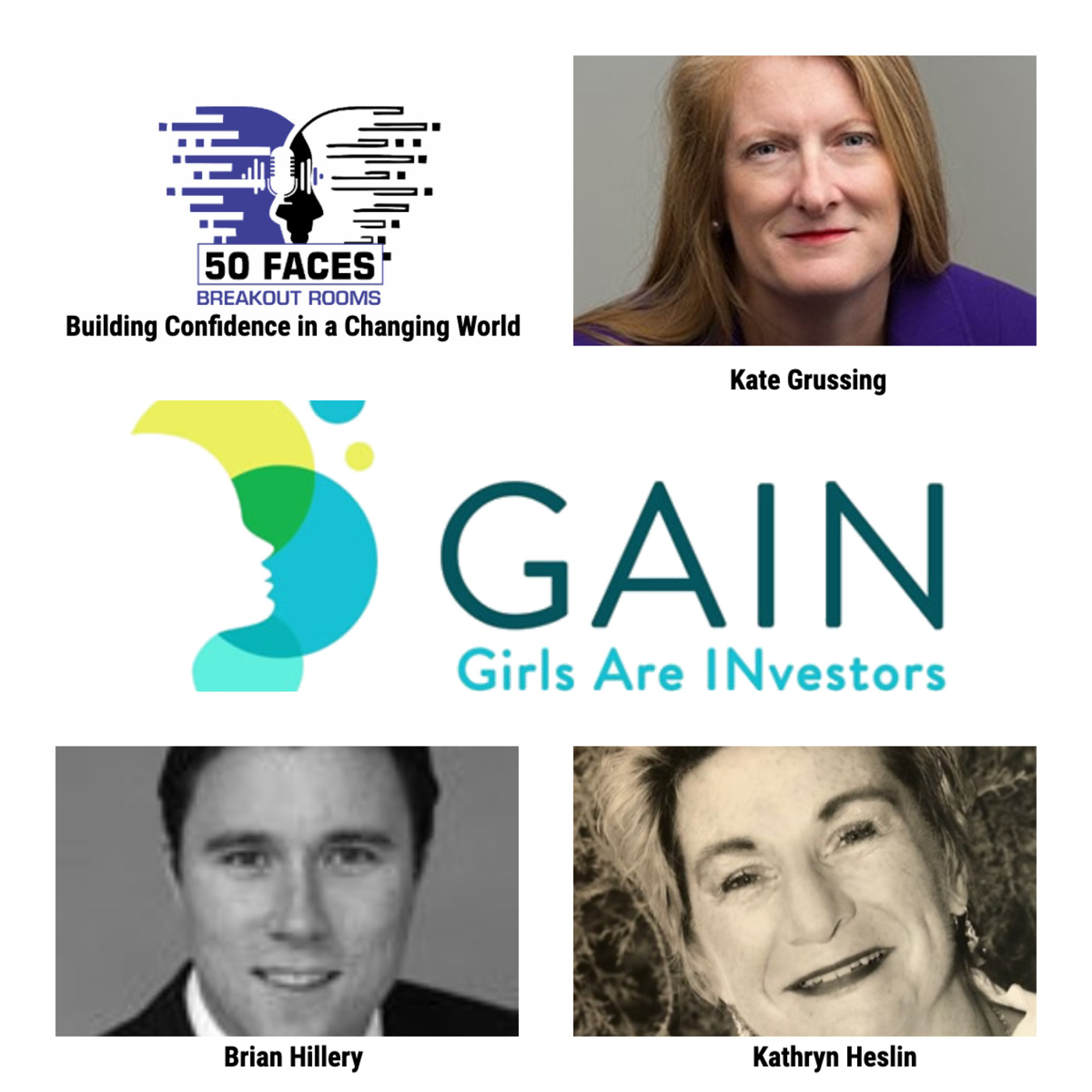
Aoifinn Devitt: There’s a popular narrative that women are less confident than men, but is this borne out in the data? Find out from our panel of experts from areas of coaching and executive search why lack of self-confidence can be an issue for far more people than we might think, and how the stories we tell ourselves, visualization, and building a personal board of directors can be keys to confident personal growth. I’m Aoifinn Devitt, and welcome to this 50 Faces Breakout Rooms podcast. This podcast is a joint initiative between 50 Faces Productions and Girls Are Investors, or GAIN. GAIN is a community of investors with charitable status set up to change the lack of gender diversity in investment management from the ground up. In the UK, women represent just 8% of decision makers in investment management. At entry level, it’s not much better. It’s understood that only 20% of applicants to the industry are women. I work in the investment industry and we frequently come up against the concept that women have a deficit in confidence when compared to men. Recently, I presented to a group of university students who are members of a women in asset management club, and it seemed to me in a somewhat troubling way that the popular narrative that women are less confident than men had become accepted as a truth and had even become internalized by young women at a young age. I set out to gather a group of professionals who have firsthand experience with these kinds of issues in the workplace: 2 executive coaches and 1 executive search expert. We are gathered here today in this breakout room to discuss the issue of confidence more generally, whether there is a deficit, and what we can do about it. I’m delighted to introduce our panel today. Kate Grussing works in executive search at Sapphire Partners. Katherine Hesselin is an executive coach and management consultant. She’s managing partner of Change Associates based in Dublin, and I’ve been lucky enough to have been working with Katherine myself. Brian Hillary was introduced to me by Katherine and is also based in Dublin. He’s a partner and head of coaching at EisnerAmptner, a specialist accountancy firm. Let’s kick off with the fundamental question: what does it mean to be confident? How would you define that, Kate?
A: Thank you so much for the opportunity to be here today. I think it’s such an important topic. The question is a fascinating one. I’d say to be confident means to know that you’re likely to succeed at something. Could be that you’re confident in preparation for a job interview. It could be you’re confident in the context of a promotion. But, you know, there— it also could be you’re maybe making a big public speech or presentation. I think for most people, confidence ebbs and flows. It’s not static.
Aoifinn Devitt: Thanks for that, Kate. Catherine, how about for you? How do you define confidence?
Speaker C: Well, again, thank you for having me on. And like Kate said, it is interesting. It does ebb and flow. I think for everybody, even in the hours of the day, it can ebb and flow. I define it as self-confidence is about how you feel about yourself and then your ability to take action about it. I do think that self-confidence and self-worth are different, but I’m not sure that most people make that themselves. Differentiation Themselves. And I think when you ask them the question, they kind of roll everything into one: self-worth, self-esteem, self-confidence. And I don’t really think the definitions matter. If they feel it, it is it, whatever that it might be for them.
Aoifinn Devitt: Thanks, Brian. How about you?
Speaker D: Yeah, similarly, I think Catherine mentioned self-worth there as well. I think self-confidence and self-worth are very closely linked. What I think is self-confidence, the way to think about it is it’s trusting maybe believing in our own abilities, our ability to execute a task. So if we have a healthy sense of self-confidence, it might be we’re more willing to take on a new challenge or an opportunity. We mightn’t be afraid to express our opinion or to be wrong, or we might be more inclined to ask others for help when it’s needed. I think self-worth is something that’s a little bit deeper, and I think it’s about how we feel about ourselves and the value we place in ourselves.. And I think if we have a healthy sense of self-worth, we might feel more centered, balanced, safe, and secure. And I think maybe if we have a lower sense of self-worth, it might be manifest as not— we’re we just feel we’re just not good enough for this job or this interview, or maybe we’re not worthy of a relationship. And I think if we have a lower sense of self-worth, it might manifest itself as issues with self-confidence in other parts of our lives.
Aoifinn Devitt: So Brian, just getting back to that point about self-worth, I’m just going to ask you this first. Is it possible then to have a sense of self-worth but not be confident? Or do you think that they always go together?
Speaker D: I think none of us will be confident in everything. We can’t be good at everything. And I think even acknowledging that is a step forward. I think if we have a low sense of self-worth and maybe connected to a low sense of self-esteem, I do think that then that can manifest itself across different parts of our lives, almost to a point where we might withdraw from opportunities, that we can be kind of closed in ourselves.
Aoifinn Devitt: And I’m just going to stay with you and then we’ll go back around the popular narrative that women are less confident than men. Is that something that you’ve seen in your practice? And do you think that it’s justified to to say, say that, that it’s general as a general rule?
Speaker D: So another really interesting question. I think everyone will struggle with issues of self-confidence throughout our lives. So almost everyone anyway. And I think in my own experience, it’s something that I’ve had to work on. And in my experience as a coach, it’s something that I often work on, or it’s an area of focus with both male and female clients. And maybe to get a little bit more of an objective view, I did speak to a number of my colleagues and clients before today. And what came out of those discussions was that it isn’t the case that women are less confident than men.
Aoifinn Devitt: Absolutely fascinating, because right from the beginning here, we’re starting to debunk that popular narrative, which is great. How about you, Catherine? What have you seen in your practice? Does the narrative bear out?
Speaker C: Well, it’s funny. So when you put the question to me, I kind of had to think about it. The metadata doesn’t support the narrative. So what’s out there in terms of Harvard studies, etc., doesn’t support the narrative that there is a difference between gender on confidence. And I have found the same thing like Brian in my practice. Both male and female present with having lack of confidence in certain things. So I haven’t found it to be gender specific. And everybody feels it at certain points in time. I would have felt, had a sense of, oh my God, the confidence level to even come on. Am I the right person to come on this podcast? I think we all feel it at certain points in time.
Aoifinn Devitt: Very interesting. That’s certainly what I’m learning on imposter syndrome. It is by no means confined to women and/or confined to status or age throughout an organization. It can happen at any point. Kate, how about from your perspective, and especially as you’re in the executive search arena, So you see perhaps that we have this classic other narrative that is, for example, that women tend to ensure that they are fully qualified for all the points of a job description, whereas a man may be happier with only meeting a few of those criteria. Maybe what are you seeing from your perspective in search?
A: No, well, there is lots of research that shows that men will apply for a role if they have approximately 60% of the qualifications, and women will only apply for a role if they have 100% of the qualifications. There have been many studies looking at that. I do see it in my search work. And when I pick up the phone to a candidate, I’ll typically know something about them. They will have been recommended. I will have looked them up on LinkedIn perhaps. And a man and a woman with identical profiles, the woman is less likely to say, “Oh, absolutely. What took you so long to find me?” She’ll say, “Well, I’m not ready. It may not be the right time.” Whereas her male peer is much more likely. And, you know, won’t— he the male peer is less likely to say, oh, well, I don’t have these two aspects of the candidate description. I think some of that, from my perspective, is healthy in women, where women candidates can perhaps be less arrogant or can be less overconfident. But it can be a double-edged sword in terms of if my female candidates are self-doubting, that can come across in their interviews. So, part of my and my colleagues’ and fellow recruiters’ job is to make sure that our female candidates blow their own trumpet and understand why they are as qualified as their male peers.
Aoifinn Devitt: Let’s get into a little bit more detail there. So, just say you have this highly qualified woman who you’ve approached, perhaps. You think she’d be excellent for the role, but she’s hesitant and she has self-doubt in certain aspects. How do you encourage her to address that situation?
A: Well, I will typically go through quite forensically the items in the role description and ask her questions against each of them. I will hopefully have her CV or enough background in front of me so that I can try and unpick her answers. Now, you know what? My job as a search consultant is to find great candidates. It’s not to boost her confidence. But I know through my decades of work in this field that I am more likely to have to nudge or prod or encourage female candidates over male candidates. I will typically ask a candidate for, can you give me an example of some time when you have done this? And so, ask for quite practical things. And then a woman is quite likely to say, oh yeah, well, I did do that. Or, oh, I have another example. So, it’s getting them to go back through their CV or their education where you help them find the evidence so that it’s not a matter of their bravura or what they think. It’s let’s look at what have you done that would help you be qualified in this domain.
Aoifinn Devitt: Really interesting. I think not only a database of that, but also really focusing on case studies and granular examples, which obviously everybody is always going to be more readily able to identify with an actual case study than a theoretical ability. That’s very interesting. Just going back to the coaching side now, because Kate, obviously you said that your role is not to bolster someone’s confidence. On the coaching side, it may not be your role, but it may be how some clients see your role. Katherine, how does that manifest itself when a client might come to you with a confidence issue? How often do other issues that maybe people seek coaching about come down to confidence?
Speaker C: Before I answer that question, I might just go back to Kate’s point. The data is really clear on, men tend to overbelieve in their competence levels, which has fed out for Kate in her experience in the search world. And women tend to underplay it. And unless you kind of do that granular, go after the granular, give me the data or give me some examples, there’s loads there, but they just don’t put them on the table. To go back then to your question around on the coaching front, how do issues relate to confidence? Oftentimes clients don’t come with the confidence. They don’t come and say, I have a lack of confidence issue. They might come with something else. But quickly, it kind of comes out, well, I want to go for a new role, or I want to try something different, or I want to speak up more. And ultimately, when we kind of— when you peel back the layers from it, they ultimately say, you know what? It is about lack of— I’m not confident enough to speak up or to put myself forward or to go for it. So they don’t often call it out. But then eventually, as we feed things through, it comes out that, yeah, it is about lack of confidence. And then we talk about that and how that manifests itself for them. And there’s physical manifestations of that lack of confidence. You know, they’ll say, I have sweaty palms, my heart is racing. There’s a whole load of manifestations. So we talk about it and we kind of figure out, okay, well, let’s talk about what it is today, what you’d like it to be, etc. And we go from there. And it’s all bespoke. So it’s all related to the— there’s no kind of grand plan. Everybody’s definition of confidence is different. So you go with their definition because the coaching belief that I have is they have all the answers. My job is just to help pull those out of there.
Aoifinn Devitt: I think it might be interesting just before moving to Brian about maybe looking at how— because some of the perception is that not everybody suffers from these issues. How many people say who come for coaching do you think have issues about confidence? Maybe not in every domain, but in certain domains. I suppose I’m trying to get at how pervasive is lack of confidence as a problem?
Speaker C: I think nearly every client that I have, male or female, at some point we touch on the topic of lack of confidence. I don’t think I’ve ever had a client where it doesn’t arise.
Aoifinn Devitt: Now, Brian, how about you? I would imagine it’s a similar observation.
Speaker D: Yeah, and actually just I’d echo what Catherine was saying there, that I think it would be an exception where it didn’t relate in some shape or form to self-confidence. And I think coaching is something that is kind of a tool mechanism that can just be a great way to help someone with their self-confidence. And while some people, as Catherine said, some people I work with may explicitly state, I’d like to work on my self-confidence, very often they have a goal or an area of focus that if that’s achieved or worked towards, it actually has a positive impact on their self-confidence. So whether it’s explicit or not, it’s almost always a theme. And I think in terms of how self-confidence or issues with self-confidence can manifest itself. I think sometimes issues around self-confidence stem from deep-seated beliefs that we hold about ourselves and the stories that we tell ourselves on repeat. And if the stories that we’re telling ourselves is that I’m just not good enough, I’m not worthy, I’m winging it, I’m going to be found out, I think those beliefs about ourselves can impact the decisions that we make. So then we don’t go for a job interview or a promotion. We don’t express our view or opinion in a meeting, or maybe we don’t say no enough. So we always say yes, and we work really long hours at the expense of other parts of our lives. And something else I was thinking about, I think sometimes if there’s a recurring theme of self-confidence or issues with self-confidence, is it so sometimes that we can take ourselves out of the race before the starter gun even goes.
Aoifinn Devitt: I know that when we had our talk at the beginning, we’re going to go around and ask about, well, how do we, I suppose, break away from this? What are the kind of action plans that we can put in place to instill confidence? And I think you mentioned the stories we tell ourselves. How much of this is kind of a growth mindset versus a fixed mindset problem? That they say, well, I’m just not confident. Or is there, I think, an increased recognition that people can develop confidence and build it, that is not something that’s fixed? About their personality? I’ll maybe start with Brian and we can go around.
Speaker D: Yeah, so I would think it’s not fixed, but it can take time to shift our sense of self-confidence and self-worth. And maybe just on action plans, kind of in my experience, what works well is to have a plan that’s focused and very achievable too. So take for example, if I was working with a client and self-confidence which manifests maybe with a fear of public speaking, we might have 3 steps to it. And the first step might be just understanding and demystifying the underlying fear or anxiety. So what is You it? Know, talking about what is fear, talking about the sympathetic nervous system being activated, adrenaline flowing through our system. Where does it manifest? As Catherine said, is it shallow breathing? Is it racing thoughts, sweaty palms? And then maybe talking about why we experience it. So is it a fear of judgment, a fear of failure, fear of rejection? And I think talking about it in this way helps to in some ways demystify it. And it helps the client to realize that they’re actually okay. And in some ways, it loses its grip. So the first step is just understanding, you know, demystifying the fear, anxiety. The second step would be developing an awareness or helping the client to develop an awareness of how unique and special they are. So their own values, their strengths, their capabilities. And some of the exercises there are around developing and clarifying core values. I think when we know our core values, it helps us to make better decisions in our lives based on what we value most. I would encourage clients to actually write them down and keep them visible. Something else when I’m working with clients, sometimes with their permission, I speak to some of their colleagues. Sometimes I notice some of the feedback is very positive, but a client can be very slow to— they can downplay or minimize that feedback. Again, I encourage them to take bits of that feedback and actually write it down and make it visible. Someone might be a great communicator, a valued colleague, And I think these exercises help the client develop their sense of self-worth. And the third step would be taking specific tangible action to be, say, in this example, to become more comfortable with public speaking. So it’s to pick an event that they’d actually speak at, reframe the event as not a dreaded challenge, but an exciting opportunity. And some of the things we might look at is internal dialogue. So as opposed to saying, this is scary, this could be terrible, this could be a disaster, to reframing that, that this could be exciting, fun, an opportunity to learn and grow. And we try to focus on the process as opposed to the outcome and to enjoy the process as much as possible. So they’re just some of the things we might work on. But I think approaching, say, a public speaking event in this way, the client can approach it with a sense of excitement and enthusiasm as opposed to fear and worry.
Aoifinn Devitt: Really interesting. And I love that reframing concept. I’ve heard people should even reframe the sense of butterflies in your stomach or anxiety as not perhaps worry there’s something about a negative outcome, but actually that’s a sign of how important an event is to you, is that that’s how your body is reacting. So it’s a sign that you’re taking it seriously, it’s important, not necessarily something that should lead you down a spiral of lack of confidence and poor performance. Catherine, over to you. And when you speak about maybe action plans, I’d love you to touch on a point you made earlier, which is around the answers being inside yourself, because some people might attribute lack of confidence to others, maybe how they’ve been treated in the past, but maybe even their family background What action plans do you think of and where does the answer lie? Always within or sometimes externally?
Speaker C: I believe that the answers always lie within you. I mean, obviously how you frame things come from your family of origin, your experiences. All of those things do have an impact on what you think about yourself. But then I would use techniques like Brian talks about, like reframing it. So that’s how it was that time. It doesn’t have to be like that. What possibilities are out there for the next time? And that was, you know, that was the feedback that you got from Boss A. Do you think that the 4 other people in the room had the same feedback to give you, for instance? In terms of plans, action plans, I’m very much again of that belief that you decide, you are the person who calls out, like, do you want to work on confidence? And then if you do, then we kind of talk about it. So I often use metaphors. So I say to somebody, when you’re having a bad confidence moment, what would you call it? And I try and get them to put something on it. And often I’ve got, well, I feel like a mouse, and it could be a cornered mouse. So we talk about, okay, so how does that feel? What are you doing as a cornered mouse? All of those things. And really getting into how they feel. I feel terrified. I feel like I’m looking from A to B. I might be so frozen in the moment I can do nothing. And then I say, well, do you want to stay in that place? Because it is important to validate that is a place that they feel. And most people will say, no, I don’t want to stay there. And I physically get them to move. Right, where do you want to go? Well, I want to go to a place where I’m totally confident. Okay, well, let’s move to that place. And what’s the metaphor you put on it now? And what I’ve often heard is, I feel like a lion, the pride of a lioness. And they put the character on it, I don’t. And then, what does that feel like? Well, I’m very proud. You can see it in their body language, their whole shoulders go back, their voice might go up. What are you doing? How are you feeling? All of those things. And then we talk about, okay, so if you want to move from the mouse to the lion, what are 2 things that you can do between now and the next time you meet to facilitate that movement? So they have— there’s their action plan set, and then we reinforce, like Brian had talked about. We talk about, okay, what did you try? What worked? How did it feel? Will you try— and really kind of emphasize and acknowledge the fact that they’ve done something with us, and that acknowledgement will reinforce, hopefully, them going to do it again. It’s a process. This will take time. I mean, if they suffer from lack of confidence, it didn’t just happen overnight. So it can’t be rectified overnight.
Aoifinn Devitt: Very interesting. And I’d say as a client of Catherine’s, she does actually make you move. So you be prepared to start moving around the room. It’s always been very helpful in terms of mindset. And just before I come to Kate in terms of the effect she’s seen of that kind of coaching on some of the clients she works with, let’s get back to Brian to ask you about The point about confidence coming from within or being influenced by external forces and what can we do about that?
Speaker D: I think ultimately it does come from within. And I think that’s where, you know, it comes back to the deep-seated beliefs that we hold about ourselves if we struggle with self-confidence and it’s connected to that sense of self-worth. And I think it’s creating a shift in those kind of deep-seated beliefs. And as Catherine said, I just think that’s something that actually takes time to shift those beliefs. Catherine made an interesting point there. It’s, say, I took, for example, a public speaking event, but it’s only when you do the— you repeat the event that you go again and you build up momentum as well. I think that’s where self-confidence is generated. I think certainly you can find support via a coach or maybe a mentor to help you develop self-confidence and just talking to people about it. But ultimately, I do think it’s probably something that ultimately the shift has to come from within.
Aoifinn Devitt: Very interesting. I think the other point, getting back to Katherine’s point about a mouse and how does it make you feel, I think that’s the difference between feeling that the situation doesn’t feel right, perhaps, or an introvert who genuinely doesn’t like perhaps big events that involve a lot of public speaking. I think it’s possible to be very comfortable in your own skin and not like that, but equally, the lack of confidence is a negative effect that we don’t like that situation and want to move. I’m just going to go back to Kate on the executive search front. So you’ve worked with clients, and I certainly— do you see clients who’ve benefited from this kind of coaching? And how do you ensure that women can really have the most, I suppose, productive career trajectory that they deserve?
A: I think it’s really important that women do own their own achievements, and having a coach or a mentor is a fabulous way to have an external perspective because sometimes we can have these little demons or parrots on our shoulder. And we do need an external catalyst reminding us of our strengths or what I like to call our superpowers. And as Brian said earlier, no one’s good at everything. And you certainly, know, not all at the same time. I think women are so talented. There are more fabulous women than ever in the pipeline coming out of universities at all levels of companies. And certainly, as we’re recruiting for roles, we see more women than ever. Who get recommended to us, who we think really merit being on longlists and shortlists. In addition to coaching, I think it’s important that you think about who are advocates you can enlist, who are your champions. It could be a group of girlfriends, it could be former colleagues, it could be a sister or a sister-in-law, but it is important that you have those people in your corner who you can turn to when maybe you’re trying to negotiate a pay rise or thinking about a stretch assignment or considering a change in role and having that group of your own directors. And obviously, it can be men and women. It’s whoever really understands what makes you tick and what you’re good at.
Aoifinn Devitt: It’s an interesting point. And also, I think sometimes there may be a bit of a misnomer in the term executive coaching because there’s a sense that it’s only reserved for executives and that if you know, kind I’m, of making my way up the ladder, I don’t I can’t ask for any. I know, Brian, that you’ve worked with people right across their career at every level. It seems to me that coaching is something that should really be available and certainly accessed at almost every stage. Would you say that?
Speaker D: Yeah, I totally agree. And I think just on that, while maybe a company or an organization has a finite amount of resources, one of the things we did in the last number of years was we kind of set up a coaching function within our business. And as part of that, our management team have access to coach, and I head up that service. But what we’ve done over the past kind of 18 months is we do coaching skill sessions for everybody in the firm. So during the pandemic, we actually bring the whole firm together, and people go into breakout rooms, and they take it in turns to be the coach, the coachee, and the observer. And they have 10 minutes each, and then they give feedback to each other, and then they go and they rotate the roles. And we find that that’s really helpful, that it’s a way of kind of embedding a coaching culture, and it kind of has a ripple effect as well. And then just to say, I think people who have the opportunity to be coached, I think the positives of that is when you’re coached yourself, and I’ve been coached, that actually enables me— the people that I’m a better manager because I’m coached, and the people I’d like to think the people that I work with, actually it helps their management skills too. And that way it kind of, it can permeate through the firm.
Aoifinn Devitt: Really interesting, especially the point about the observer. And I think I’ll bring this point up later, but I think we need a lot more observers in our meetings, especially now when most of them are being held by Zoom. Observers to ensure that people are getting their voice heard and getting a chance to speak when they can.
Speaker D: Sometimes people find it very hard to be the observer, to give the feedback, and that’s something where we encourage— because this is right across our firm, from trainees to partners— it’s encouraging the trainees to give candid feedback too.
Aoifinn Devitt: Catherine, do you see coaching as a career-long I think it’s a career-long pursuit.
Speaker C: And I think it should be provided to everybody all the way through. Brian and myself were talking about this at one point. Even though I work as a coach, I still engage a coach to work with me and have done for a long, long time. I think you always need, as Kate said, you need a lot of people in your corner who will be advocates for you, be that a coach, a mentor, pal, a sister-in-law, but anything that will help you bring out the best in yourself is worth investing in. I often hear women say, but it’s very expensive and the firm won’t pay for it. And my retort is always, well, would you buy a handbag that costs you a lot of money? And the answer is, of course. Well, then it’s worth investing that amount of money in yourself because it’ll last a lot longer than the handbag.
Aoifinn Devitt: Absolutely. Well, I’d like to just do a sort of final roundup of maybe— here we are still, unfortunately, at this time, not all together in one room. We’re all doing this. We’ve got very good at Zoom, but we’re all working from home. Still on Zoom. Is there any kind of one thing that we could have our listeners take away that they can work on in the near term to just maybe boost their confidence, even in a certain area or more generally? What would you say would be kind of a tangible takeaway action plan? Maybe I’ll start with you, Brian, since I know you have done a lot of this quite recently in your firm.
Speaker D: So I think everyone’s had a really tough year, and that’s, you know, no matter who we are, what we do, everyone’s had a really tough year at the the pandemic. And I’d say if people could just be— I’d encourage people to just be a little bit kinder to themselves. And that might sound a bit vague. So in terms of how you might do that is encouraging people to just take a little bit of time out of their day to do something that brings them a bit of joy, peace, happiness, and fun, whatever that is. And for me, that might be 10 minutes of meditation first thing in the morning. And that helps me to be more present, a little less reactive. And that can have a ripple effect in the rest of my day. But for others, it could be getting out into nature for a run or a walk or a swim in the sea. It could be meeting a friend for a walk or a coffee. And I think the benefits of that aren’t just that we’re getting exercise. It’s actually more about putting value on ourselves and our well-being. And I think if we do that, that can have a ripple effect, and I think we could feel better about ourselves. So I’d say try to be kind to yourself, and maybe how to do that— carve a little bit of time out of your day to do something that brings you a bit of fun and joy.
Aoifinn Devitt: How about you, Catherine? Is there any one thing that our listeners could take away to boost their confidence or start working on that in their daily lives?
Speaker C: I have a tagline which says, ‘Be kind, be brave, be safe.’ So I don’t give advice as I believe that it’s all within you, but a thought: if you are feeling uncomfortable about saying or doing something, do it or say it.
Aoifinn Devitt: Absolutely. Kate, any takeaway or piece of advice you’d give our listeners?
A: I love what both Brian and Katherine said. I might add to it in terms of saying, ask yourself at the end of each day, or maybe it’s at the end of each week, what went well? What am I proud of? What did I accomplish? You know, maybe it was something big, maybe it was something small, but I’m also of the camp, I believe a lot in, you hear people talk about gratitude journals. And so thinking about how much we have to be thankful for. Often helps really put things in perspective. Often, at the end of a day or a week, you’ll realize, “Wow, I really tackled that well.” I think that act builds upon itself.
Aoifinn Devitt: Well, great. I’m going to add one of my own. While I’m speaking, if any of you has anything else you’d like to contribute to this, I think, very important discussion on confidence, please come in at the end. For me, it’s about listening and visibility. I’ve been doing these podcasts for a year. I’ve really developed a listening muscle, I think, and it’s kind of sad to think I had to wait this long in my career to develop it. But actually, that has been profoundly life-changing for me to be able to now empathize more readily. It is certainly— one identifies with everybody’s insecurities and we see that we’re not alone. Listening is a great skill. Tied to that, the point I made about meetings, having maybe a second— Brian mentioned the notion of an observer. I do think that all chairmen or chairwomen need to have a second chair of a meeting, which is an observer. Is everybody speaking in this meeting? Is everyone being heard? We’ve had the concept of the ancient tribes passing a stick from one to the other so that people speak when they get the stick. There doesn’t seem to be that function on Zoom yet, but I do think that having that and the ability to speak when you’re given the stick and then pass it on, just to ensure that there is that visibility and that we’re all listening to each other, I think that will be very important, I think, in shoring up our own confidence because we will see that we’re really more alike with our peers than we are different. So that’s my contribution as a non-expert to this discussion. Just before we finish up, does anyone have anything that we haven’t said so far on the topic of confidence that they’d like to share?
A: I might just add that I think it’s a good thing to talk about. So if you’re having a day or a week where you’re not feeling particularly confident, don’t hide that. Ask for help. Enlist your supporters. Maybe no one else saw it in you that particular day or week. But as Catherine said early on, everyone feels this at some stage of their career— men, women, junior, senior. And I think you’ll find that people will really want to help you.
Speaker D: I think that’s a great point, Kate, because even in the lead-up to today, I had lots of great conversations over the past 10 days or so with my colleagues, male and female, on the issue of self-confidence. And it was just some really healthy and honest conversations between us as well. So I think opening that dialogue is a big step forward.
Speaker C: I would agree. And I think the best thing you can get out of all this is you can gain from us. Excuse the pun.
Aoifinn Devitt: Well, that’s a wonderful place on which to end. Yes, we all need to gain. Well, thank you so much to all the panel, to Kate Grissom, for listening, Kathryn Heslin and Brian Hillary. It’s been a real pleasure to discuss this with you today. Clearly, this is a discussion that we need to keep having, but I think we’ve certainly set us off on the right path now. Thank you for sharing your insights with us.
Speaker C: Thanks, Aoifinn.
Speaker D: Thanks, Aoifinn. Thanks, Kathryn.
Aoifinn Devitt: I’m Aoifinn and David. Thank you for listening to the 50 Faces breakout room made in collaboration with Girls Are Investors. If you liked what you heard and would like to tune in to hear more inspiring investors on their personal journeys, please subscribe on Apple Podcasts or wherever you get your podcasts. This podcast is for informational purposes only and should not be construed as investment advice, and all views are personal and should not be attributed to the organizations and affiliations of the host or any guest.
Aoifinn Devitt: If you look at the way that it seems social mobility works, is once you’ve established a beachhead from an underprivileged community, generally speaking, that beachhead becomes one in which other members of that community land and then can spread around into the areas they’re trying to break into.
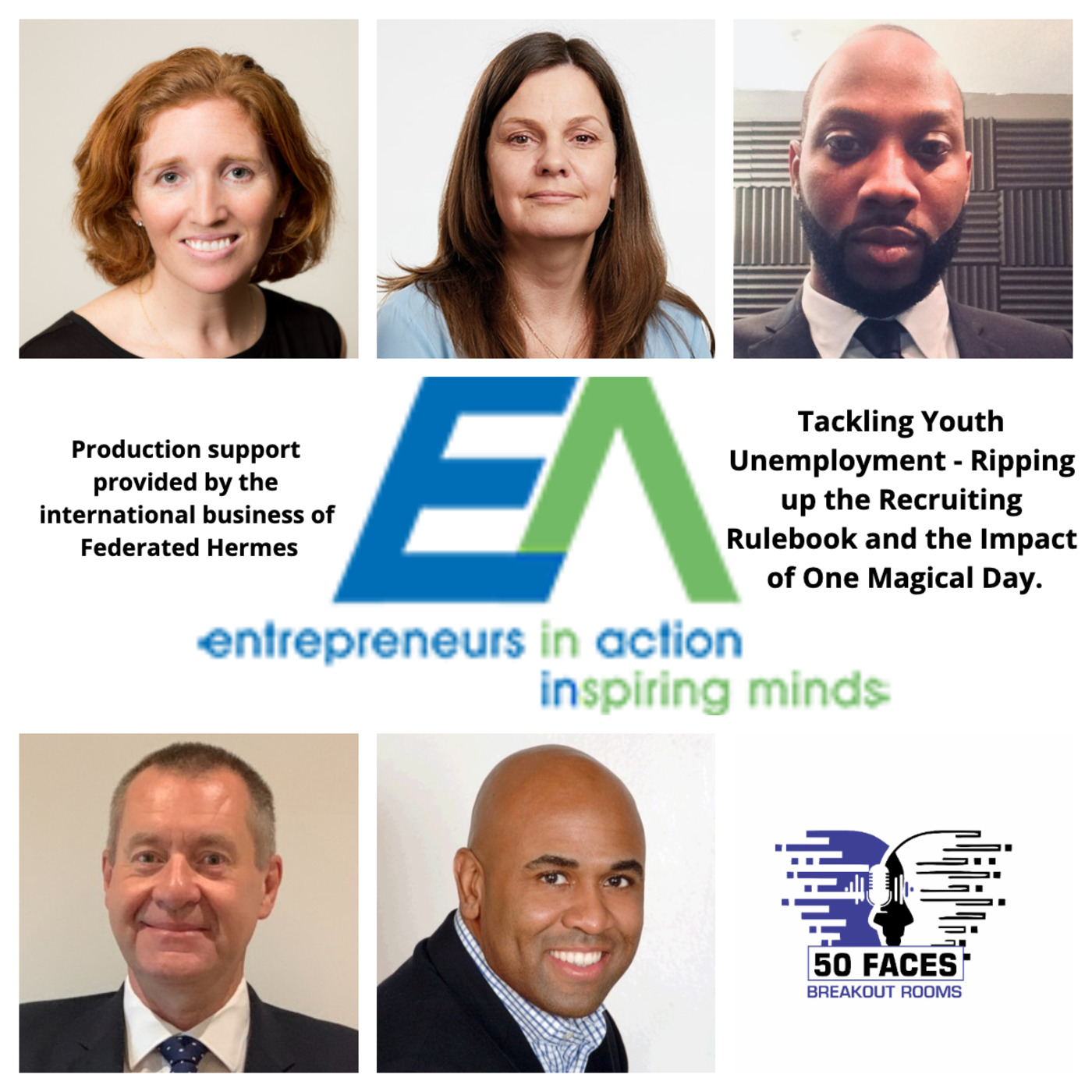
Breakout Room 5: That was Sakir Nashebi, Chief Executive Officer of the International Business of Federated Hermes, whom we thank for supporting the production costs of this episode. Welcome to our breakout room, a spinoff of the 50 Faces podcast, a podcast committed to revealing the richness and diversity of the world of investment by focusing on its people and their stories. I’m Aoifinn Devitt. The UK unemployment rate has risen to 4.9% in the 3 months to October 2020. With 370,000 people made redundant. Official data recently published shows that the annual fall in employment is the highest in a decade, with the number of people in paid work 280,000 lower than a year earlier, taking the employment rate to only 75%. The government has said after the figures released that protecting lives and livelihoods is our number one priority, and they particularly underscored the Kickstart scheme for unemployed young people as they meant to ensure that nobody is left without hope or opportunity. Employment is also an important source of dignity, and as we all know, the focus on the UN Sustainable Development Goals, SDG 8, looks to decent work and to promote sustained, inclusive, and sustainable economic growth, full and productive employment, and decent work for all. With this focus on youth unemployment, this, we have here in this breakout room, a rare opportunity to see the impact of a program which targeted unemployed youth 7 years ago. Many of the programmes and initiatives that we see are focused on now, but it’s very rare to be able to look back and look at the impact of a programme that had already happened, to look at the impact it’s had on participants, but also on those who sponsored and delivered it. Youth employment has always been a large focus for the UK government, particularly in 2011 after the financial crash. At that time, the government launched a Futures Job Fund in a bid to provide opportunities for a growing number of unemployed youth. That was also the year that summer riots took place across the UK. In Croydon, we saw the image of a burning Reeves furniture store featuring on news stories across the world. It was at that time a groundbreaking programme was put together by our panellists here in order to focus on the problem of youth unemployment. I’m joined here by Stuart Heatley, Managing Director of Capita Pensions, Suzanne Taylor, Senior Consultant at LCP, Salomon Beyoud, who was a participant in that youth unemployment programme, and Derek Brown, Chief Executive of Entrepreneurs in Action, whose brainchild the programme was and put together the programme with Stuart. I’d like to first start with Stuart to speak about why at that time, 7 years ago, he was interested in the area of youth unemployment and what it was about it that triggered an interest in him. Stuart, welcome. Can you tell us about why you decided to invest in a programme targeting unemployed young people from Croydon?
Speaker C: Hi, thanks very much. I just start by saying this is one of the most interesting and rewarding things that I think I’ve done in my career, and certainly as a senior leader within business. It was a time of significant growth, and we needed to look at a different way of recruiting and bringing people into our business. And I met with Derek, and I was really interested in what he talked about around CVs and getting past CVs. I’ve always been a great believer in bringing people on, and when you talk to people, that actually, really, if you’re relying only on their CV, then you’re not really getting to understand about the person that you’re bringing on. And Derek talked to me about the program that he had, the potential that he was seeing on a day-to-day basis amongst some of the the people that he was working with, and it really captured my imagination. It really made me think, you know, we need to approach this in a different way. And with the support from Suzanne, who had taken on the, the new office as part of her overall leadership, we embarked on the program. And really, the program was about tapping into a pool of potential that I think conventionally employers wouldn’t look at. And like I say, one of the most interesting and rewarding things that I’ve done.
Breakout Room 5: And just in terms of your own personal experience, I think that you have always been focused on recruiting based on potential and talent and not necessarily on a narrow definition of academic success. Can you just talk a little bit about that experience?
Speaker C: Yeah, and it starts with myself. I didn’t I left school, and I didn’t go to university. I started splitting print. That was my job with a ruler. And I was given an opportunity, and I joined what at the time was a very entrepreneurial business. And I got great opportunities to work my way through the business and learn a lot of different things that ultimately meant that at the time, I was the managing director of the Aon pensions and benefits business. I think as I’ve approached recruitment with both senior leaders and also bringing people into the businesses that I’ve worked for, I’ve tried to look for that potential and look beyond necessarily people who have been to university and specialized in, in a particular subject. It doesn’t mean that we don’t recruit graduates, of course we do, and that is definitely something that will continue for good reason, but But what we’ve also got to do is we’ve got to be mindful of either through circumstance or will. Mine was more through will. I decided I didn’t want to go to university. I wanted to do a whole lot of other things. But through circumstance or through will, people won’t go on to secondary education. But it doesn’t mean that we shouldn’t be channeling that talent and channeling the potential into our business, because that’s going to be great for business.
Breakout Room 5: And just moving to you now, Derek. Thanks, Stewart. What was your pitch? You heard, you were obviously witnessing the situation in Croydon. You’ve been focused on youth unemployment for some time. What’s your view on how corporations currently recruit versus how they should recruit? And what was your pitch to Stewart?
Speaker D: Thank you, Aoifinn, and Stewart’s sort of given you, set the scene really. Yeah, so I was introduced to Stewart, and we had a conversation around recruitment. He was talking very much about the Croydon office, and I pitched him and said, look, you’ve got the office here, Stuart, would you not be interested in recruiting some local talent? The old adage of a big global insurance company looking to and engage with local talent. And Stuart said, you know, he liked the idea. And then I pushed and said, wouldn’t it be really interesting if we recruited in that old traditional way by talent and not by numbers? And what I mean by not by numbers, I think we’ve become obsessed then and today in recruiting young people into jobs by numbers. Numbers of the A*s that you get at GCSE, number of A-levels, what grades you get, have you got a first-class degree, did you go to one of the big Russell Group universities. And I, you know, I said to Stuart that there are lots of talented people who would get, who’d really value the opportunity being recruited on their talent and giving the business leaders the opportunity to have a hunch and recruit. And Stuart’s already talked about somebody giving him an opportunity, and I think the present recruitment, the existing and today’s recruitment process, processes focus predominantly on academic resource, academic results. And I’ve often asked leaders Many of them wouldn’t get a job today if they were going to be screened on the academic qualifications that their HR departments are looking at for entry-level jobs. So huge number of people who have got into business and proved themselves, and Stuart and many others are like that who will be listening to this podcast. So I pitched Stuart that we would design the UK’s first CV-less recruitment process, and he liked the idea, he liked the idea, but he did give me a warning that if it didn’t work, he did give me that look, and unfortunately we can’t see Stuart, but he is over 6 foot and a big rugby player, and I knew that I had to get this job right. So he set the scene in a really polite way that, you know, I’m going to back you, but go ahead and do it. And The opportunity to work in Croydon was a fabulous opportunity. As you mentioned, huge amounts of negativity about the Croydon brand. We, you know, the Croydon was at the height of every news report, the burning Reeves building, but there was a lot of talent in Croydon. And I think that it’s just about giving young people a chance, an opportunity, and getting their confidence up so they can apply for a big global brand such as Aon. So from our perspective, we put together the program, we partnered with Jobcentre Plus and the Croydon Council, and I’ll talk about that a bit later. But essentially the pitch was to Stuart, give these young people a chance, move away from CVs, move away from recruiting and numbers, and let’s create a level playing field where people, young people, could be recruited based on their talent and accept the opportunity.
Breakout Room 5: Thank you, Derek. And let’s move to Suzanne to talk about translating this ideal into reality, because I understand that you managed the program and oversaw the entire recruitment process from day one to the final presentation. Can you walk us through, first of all, your initial thoughts as you went into that? What the selection process was like and how you managed it.
Speaker E: Hi, yes, so I can remember the first conversation that I had with Stuart, actually. We were sitting down having a chat and he raised with me the idea, and I think very early on I became quite excited because I live locally in South West London and really understand some of the challenges that was faced by the young people. But at the same time, I was living in this corporate world going through the process as Derek described, where you have this CV approach to interviewing. So, instantly, the whole approach of the programme really became quite exciting because it felt that you could do something locally for local people. And as Stuart touched on, we were setting up a new office, so it was a great opportunity. So, the first point really around what we started to do was I started to talk to my wider management team And really early on, I realised that I wasn’t the only one that was quite excited about this. It was being received really positive with the existing staff that were working in the office with me. So, I think from very, very early on, it was a really new opportunity, quite exciting, and to make a difference in the local community, and that really stood out. In terms of what we did with working on the programme, I think what was really great for us when I look back on it was having that opportunity to see individual candidates for more than an hour. So to get to actually build a programme with EIA on how you could come together with a group of young people and really understand what they had to give. And I think it would be fair to say that on the first day where we worked in the college, we were really overwhelmed with the enthusiasm and the motivation and the commitment from young people. It was pretty amazing.
Breakout Room 5: That’s great. And in terms of the number of candidates, I understand that you started with 10, but you did ultimately increase to 15. Can you just talk us through that?
Speaker E: Yeah, I can actually remember when we were sitting at the end of the boardroom session with the leadership team, we were trying to decide who the final 10 would be. And it would be fair to say that that wasn’t an easy conversation. There was lots of conflict in discussions. And in fairness, I think Stuart instantly agreed that we would increase that number to 15. But, but I think even at that point, we were quite disappointed that there was so much talent in that room. We would have liked to have increased that number further, because what you really saw from the young people was all of the strengths that they would bring into an organisation that you wouldn’t necessarily see through an interview process, even if you went through one or two different stages. Because what you were actually seeing was these young people working in that environment as if they were placed in that business with you. So it was absolutely It was quite overwhelming, actually. I think it would be fair to say I found it very emotional to see what young people had to give.
Breakout Room 5: Well, thank you. And moving now to Solomon, I’d love to hear your personal story in terms of, are you a son of Croydon, for example, and how you came to hear about this program and what you felt during this process?
Speaker F: Thank you. So for me, actually, I have quite a different experience in terms of I was in a bad place, really. I had, um, just finished uni, couldn’t get a job. I studied accounting and finance and was just struggling to get an interview. Like, I’d applied for so many jobs, but one thing I didn’t do, which my mom insisted I did, was sign up for the job center because I had some savings prior, because I had worked at the London Olympics the year before. So I had some savings, and I really didn’t want to going to the job center. In my opinion, it’s just not the place you go if you want to get a job. That was my perspective. And, um, so I avoided job center. But what was interesting was just I woke up one day and I decided to take my mom’s advice and actually just go into the job center. And I remember going in the first day and thinking, oh, what am I doing here? Don’t like this place at all. And I remember signing up with an advisor who looked at my CV and was like, what are you doing here? Like, you’ve got a degree, you seem to, you know, like this place isn’t for you, essentially. And it was even more depressing. So I remember that first week not going great, and then came back the next week and my advisor was ill. It was someone else. And she looked at my CV again and she was like, do you know what, I’m going to give you the advice that I gave my kids. Stop looking for a job, look for an employer that has room for you to grow and for you to eventually get to what you want to do. And then she um, mentioned, the, the program with EIA backed by Aon Hewitt. And she— I’d never heard of Aon Hewitt at the time. And she said, trust me, just apply for it. It’s a completely different process. All you need is your GCSEs and they’re going to take you through the process and just, just go along to it. I was like, okay, sure, why not? Got nothing to lose. And that was pretty much how I ended up on the program. I almost didn’t go to that, um, meeting that day, which was— now thinking about it, it’s, it’s, it’s almost crazy. And I would say it was a great decision, Derek, to partner with the job center because I almost imagine it could have been anything else. It could have been with an agency and so on and so forth. I think doing it with the job center was actually the perfect way to go about this in order to meet what the actual— what you were trying to do with this program. So that’s pretty much how I ended up on the program. And I must say, one thing that the program did for me was motivate me. I remember, um, I say, I think it was like just a couple days into, um, the process. I remember thinking, wow, I’m actually excited to get up now. I’m excited to go and do this. So every day I went, I was more— I was motivated. So that was the one thing it definitely gave me, which I didn’t realize, that I was demotivated. So, it motivated me.
Breakout Room 5: So, our other panelists have spoken about feeling overwhelmed in that room by the sheer talent, the energy, the enthusiasm. How did you feel when you were dealing with this potential employer? Did you feel overwhelmed? Did you feel that your confidence was growing in that setting?
Speaker F: Yes, I’d say, actually, I remember the first stage, there was actually quite a lot of people. I don’t remember what the number was, but I’m tempted to say it was hundreds. And I remember walking in thinking, seriously, 10 jobs? There was quite a lot of people in the room, and I remember feeling overwhelmed thinking, wow, that really, really have to be you a, know, special 10 to get the job because it’s quite a lot of people in there. And I remember feeling overwhelmed at that stage even before we got to the final 25. I think when we did the group activities in the breakout rooms that I remember feeling overwhelmed and almost couldn’t speak because there’s just so many people and so much going on.
Breakout Room 5: No, it’s definitely, it sounds like quite a unique experience. And what I think is also very interesting is that you had a university degree, but even still, you weren’t aware of programs like this. And this is something that has come up in other breakout rooms, that perhaps the industry doesn’t do enough of a good job in getting itself out there to potential talent. And it’s only through programs like this, maybe, that we can plug gap. So how did you feel when you were offered the position, when you were one of the lucky 15, I suppose, if there was 15 positions?
Speaker F: Yes, I’m actually— I’ll go further and say I was one of the even luckier 5 because I didn’t get one of the jobs that was originally advertised. I got an even better job, which has pretty much set me up for what I’ve achieved right now. So it was an analyst, analyst job, and it was something that even till today I get friends and family questioning me, like, how did you get that job? And when I told them the story, they’re like, oh wow, because I didn’t study anything to get that job. It was pretty much, um, um, I’d say it was Ian, um, Ian Bloxham, who’s not here today, but he wanted me in his team He, he was involved in the process and he saw my presentation and he wanted me in his team. So I ended up getting a different job to what was advertised, which was amazing. And that’s been the perfect job because I guess that talent that he saw in me, I didn’t see myself. And since then it’s just grown. Like, I can’t explain to you or express how much it’s changed my life completely. It was something I never considered doing. And just from this program and this process, I’ve been able to develop a skill and develop a talent that had always been there, I guess, but I wasn’t aware of.
Breakout Room 5: Great. I’d like to just go back to some of the other panel members in terms of their— maybe the impressions it made on them personally, whether it be the initial day or the program as it evolved. Back to you, Stewart. Can you maybe speak about some of the presentations you saw that day? And how the program evolved in your eyes.
Speaker C: Yeah, sure. So I wasn’t involved in the initial selection day, and as Suzanne said, that she, she really was the sponsor of this and really, I think, made this successful for us and also for the people that were involved alongside Derek. But, you know, we had a session where we, at the end of this, where we got the presentations and where this was where we were going to select our 10 people. And I’m not sure I was overwhelmed, I was just, I was absolutely, I found it incredible that we had managed to get such a wonderful group of people that wanted to be part of our organization, that wanted the opportunity, and had not just done the day with Derek and then come along to have a conversation with us, but actually they’d done a lot of preparation. And they’d been separated into groups, and they’d been given particular topics that were close to our heart in terms of how we served our clients or how we could see the market moving. And they’d come in, and they presented as groups, and they’d done the work together. They put a lot of effort into it. And I was just amazed. And it felt like such an affirmation of the direction that we had taken. But the affirmation was nothing to do with us, the affirmation was to do with the talent that had come into the room, the enthusiasm that was there. I think Suzanne mentioned enthusiasm, the enthusiasm, the desire to learn, the desire to be part of our organization. Give me that any day over a group of people who are kind of just looking at a whole number of jobs to see and throwing their CV out. And give me enthusiasm, give me a desire to learn and a desire to be part of an organisation. And we did expand the group, know, you and I think Suzanne is giving me the credit for that. I think it was Suzanne’s idea, but we all agreed immediately because, and do you know what, if we’d had 25 jobs, we would have taken probably the group of people who were in the room if we could have, but we expanded to 15, and it’s great to hear Solomon with the impact that the role that Ian had picked out around the analyst job around Salesforce and the work that he was doing. But it’s great to hear that. But yeah, I would have— if we could have, we would have taken more. And I think to a certain extent, we felt great for the roles that we were going to offer, and we felt a little bit sorry that we didn’t have more potential vacancies to bring people in on. But, you know, just absolutely fantastic. And as I say, down to the people that came into that room, they were such a great bunch of people.
Breakout Room 5: I want to move to Suzanne in a minute to speak about the program and the training involved in it once those offers had been made. But I want to circle back to Derek because some words I’m hearing here, I’m hearing about people being amazed, overwhelmed, stunned, maybe even surprised at the talent they saw coming into that room. Derek, I got the impression you perhaps would not have been surprised and that you knew about this great well of talent out there. Were you surprised or did you know it was there all along?
Speaker D: Hi, Aoifinn. Great, great question. And if I’d be really honest, one of the most magical days in the 17 years, I think now, of running Entrepreneurs in Action was the first day that Solomon mentioned when we had 125 young people arrive for a 9 o’clock start in the pouring rain. I remember it was pouring with rain and somebody said to me, can you go downstairs? Just look outside of the doors of the college and see what— just look and see what’s going on. And I remember coming downstairs and I was like, ‘Why are you calling me to watch, to see what’s happening?’ And I looked out in the pouring rain, and there was 125 young people queuing patiently whilst we started the registration process at 8:15 in the morning. And for me, you know, sometimes we get caught up with this narrative about what’s wrong with young people, I just looked at it and said, this is what is right about young people. They wanted to work, they had their— they were suited, they were booted, they came there, they just— they were just so well mannered. They filed through, nobody complained that it was raining. I remember doing the opening speech to the group and I scripted something and I just tore it up because I was so overwhelmed by all the young people in the room that I just said that today is the start of a journey, it’s not about your CV, it’s about your talent, you know, give it your best shot, this program could change your life. And lots of people say that, and I think the beauty of it, and listening to Solomon today is that you never really get an opportunity to see the impact of the work that you do and, and hear it firsthand from somebody. You, you kind of think you are making a difference, but I honestly believe that the work we do changes lives. And essentially, this program is underpinned but and what Solomon’s demonstrated or shared in his journey is that if you’re given an opportunity, it can truly change your life. Work changes lives because he’s— and we must find out, you know, what he’s— I’m really keen to find out what he’s gone on to do. But, you know, just Ian having that opportunity to spot talent, not by CV, you know, just through this process of seeing somebody coming in and actually performing at a task. And Ian had a hunch, which I said at the very beginning, that this process gives employers a chance to have a hunch, to look at somebody and say, we want to take that person. So I couldn’t have written the script better for Solomon to say that he hadn’t actually thought about the job. This was somebody’s hunch to give him the opportunity to do it. So to answer your question, Aoifinn, I wasn’t surprised, but I was pleasantly really happy by the journey and that everybody’s been on and especially what Solomon’s shared.
Breakout Room 5: Thanks, Derek. And I want to move now to Suzanne and Stewart to talk about the actual program. Once those hires have been made, that people are now in the firm being trained. Was it all plain sailing? Were there areas perhaps that, perhaps because there wasn’t maybe the awareness of these schemes before, that extra training was required? What was your experience in implementing the programme?
Speaker E: We were fortunate in that I think from day one what you saw with the group coming through the door was two things really. Firstly, the proudness to be chosen, and I think what that gave each of those candidates as they started their training program was the confidence to know that they deserved their place, they had earned their place. And I think the second thing that you really saw was the hunger, I’m going to describe it as, and the motivation to get on and do a good job. And in a lot of respects, I think the induction was probably smoother than it traditionally would have been because they had worked with the management team. So the management team had been part of the selection process down to the final 25, so they all were already familiar with a large group of the people that they would be working with. And in addition to that, I think that the pensions administration environment worked quite nicely with a programme of this times, such as lots of admin, I believe, would do the same, in that it’s quite structured as to how you would induct a candidate into the role, and you would move through the various stages of training. But I think my overall view of how did this work and did it give us extra challenges, I think I’d have to say no. I think it gave an advantage, and the advantage was that you really knew that each of those candidates they wanted to be there, so they wanted to be part of the organization, because part of that program had enabled them to learn more about the company they would be working with, so understand a bit more about Aon. So, I actually feel that it gave everybody an advantage rather than a disadvantage, because that knowing each other was already in place.
Breakout Room 5: And is this something that Aon has continued to do over the years, and will you continue to do it? How has it changed, if at all?
Speaker E: So, I’m not sure what Aon are currently doing working for LCP, but what I can say is that we have recently done a classroom-to-boardroom programme, and following on from that, we’re exploring other opportunities with Derek, so hopefully there’ll be some exciting stuff from the future. But from a personal perspective, I most certainly would get involved in running a similar programme again, because I think what it actually gives you as an employer is a real insight to the strengths and the talents that the individuals have. And Solomon’s story on how Ian chose him to be within his area, I think that really demonstrates that in those sessions, you get to see what someone can bring to your business. Which you wouldn’t necessarily see through the traditional interview process where you might have nerves or a limited amount of time. So I think, yeah, most certainly I would definitely get involved again. Some key points from the programme and the whole process that might be worth adding, and that’s really, for me, it was about watching the journey through from day one right through to those, the talent embedded in the workplace, and looking at that day-to-day interaction and the value they were really bringing to the business. And that wasn’t just because we were fortunate enough to have a great talent pool that we brought in, but I think it was two-way learning. I think there was a lot of learning for the current teams within the organization on what they could learn from that group of young people that came in with that enthusiasm and that commitment, knowing that they’d been successful. And I think what that really did was across the whole, whole office within Croydon, it uplifted the motivation of the whole team. So the wider team, which at that point was about 100. So I think they really added quite a lot of motivation to the location. So it wasn’t just us being fortunate getting that talent pool, it was what they brought into the wider office. And I think that’s something that people wouldn’t expect to achieve for a programme such as this, but it actually had that real positive results for the whole location, and I think that was quite an important piece for me.
Breakout Room 5: So Stuart, would you agree with what Suzanne said? Would you have had a similar impression?
Speaker C: The only thing I was going to add was pretty much along what Suzanne was saying. I think the impact that this group, that that process, and I think the impact that the group had on the business, not even in just Croydon, I think across the board, I think was just so positive. And I think it brought a real drive to our Croydon office, which was a new office that was being built out. As I said, we were putting new clients in there, so it was a growth, it was part of our growth. And it just, I think it contributed to what was a really, really positive time and a really positive period, I think, within the business and certainly within my own career experience. I think it was good that you should never underestimate the impact of compact enthusiasm and just a great group of talent and what those people have on the people that are around them and the business that they’re in.
Breakout Room 5: So, Suzanne, you have a lot of experience in recruitment. Is it your experience that certain people perhaps are less well suited to the traditional CV and interview recruitment process, and perhaps are well suited to this kind of more of a session that Solomon has just described.
Speaker E: So, when we were sitting down making the decision after the presentations, there was a particular individual who— what became very clear throughout the whole programme was that they probably would not be successful through recruitment via this traditional CV approach. They were quite an introverted character. And I truly believe that there are people out there that this works for far better than, you know, going into a room, a buildup of nerves, because actually that period of time working with an organization allows all of that fear to be removed. So, you can actually see what they really have to bring. And this particular individual, who I won’t name, it became quite clear that they would be quite successful in an environment working with techie and systems-type work, and was actually successful as part of the programme. And I truly believe without a programme such as this, they would have struggled to find a place. And in fact, following up, having conversations with the individual after they were successful, that became clear that that was part of their journey. They had been trying to get through that interview process, and for whatever reason, with their personality and confidence, it just wasn’t possible. But this programme gave them that kickstart they needed with their career, and I think that’s quite an important message too.
Breakout Room 5: And just to clarify, in those sessions, how much time was spent perhaps between Salman and Ian? Maybe, Salman, you can answer this yourself. Was it a kind of a case study, an example of what you would do for him? How did you know that that was an area that you were suited for?
Speaker F: I’d say it was just, we had to do a final presentation as a group, and I remember my part was around technology and how we could use technology to, I guess, get people interested in pensions. And I think that was it. I don’t remember seeing him at any other session. It was just that one session, and I think I spoke for about 5, 6 minutes, and that was it.
Breakout Room 5: It was actually seeing perhaps, you, in a— you could maybe visualize you in the role that way, as opposed to a straight kind of an interview technique. It’s very interesting. You, Stuart, so you were involved in this program 7 years ago. Would you do something like this again, and do you think it has potential for broader application?
Speaker C: So would I do it again? I absolutely would do it again. I think it’s, you know, when we did this and the circumstances under which we did it, I think were just perfect. I think there was a symbiotic relationship. We had a group of talent that were looking for an opportunity and we were looking for a group of people who were looking for an opportunity. I’d love to do it again. I think now, and particularly as we go into a post-COVID environment, I think that locations have become also less specific to business, and I think that opens up the UK to recruitment really across the whole of the UK, and let’s be honest, could be the whole of Europe and the whole of the world. But I think if we focus that on the UK, absolutely. I think if we’ve got pockets of talent as we had in Croydon. I think we’ve demonstrated we’ve got pockets of talent that if we can unlock that talent, we can create, I think, a great outcome from a business perspective and an even better outcome, I think, from an individual perspective, giving people confidence and giving them the ability to deliver something back to business, but also, I think, to build themselves. So I would definitely do this again. Derek and I keep in regular touch. I’d love to work with Suzanne and also Solomon again more locally, but I would love to do it again, definitely. And I think what we need to do is we need to think about how we adjust what we did from a Croydon perspective to a UK-wide, and I think if anything, the opportunities are greater in our post-COVID environment.
Breakout Room 5: Thanks, Stuart. So, Solomon, I think we’re all interested to hear what you’re doing now and what you have gone on to do after this experience. Can you tell us about that?
Speaker G: Yes. So from that job as a client analyst, I gained very important skills. Say the most important skill I gained was problem solving, and that’s pretty much what I do today. So I ended up actually building databases. That was one of my first experiences with Aon. I built databases in Microsoft Access and SharePoint just to gather information from colleagues, from client service managers at different parts of the country, just basically to reduce the amount of time spent doing admin and create some sort of reporting tool, essentially. And that’s literally set me up for every single job that I’ve been into since. And it’s just that problem-solving, reporting, making data easier to gather and analyze, and automating that whole process. That’s pretty much what I do. So I currently work for a consultancy called Kainos, and we do digital transformation. So what’s interesting about my tool and I— about my job right now, and I link it back to my first day, is I remember on that first day I didn’t have a clue what I was going to be doing or how I was going to be doing it. And what was great was I had a manager who pretty much gave me creative freedom in terms of how I solved every single problem. So the job that I do currently requires me to pick up new tools, tools I’ve never learned before. So we could go into a client’s environment and clients’ offices, and they might be using a database or tool or reporting tool that I’ve never seen before. And one of the primary reasons why I got this job, as I was told, was my, I guess, my interest and ability to pick up new tools without any prior knowledge on the fly. So I’ve recently just finished a 6-week project, burn project, that I had to learn every single technology that we used on the fly. And it was successful. So I would say what the job has set me up for is that ability to go into the unknown with an open mind, very optimistic, very positive, and succeed, essentially.
Breakout Room 5: That’s great. Thank you. So Derek, looking to the future yourself, one of the areas I want to ask you about is, did this program— we haven’t touched on diversity in this discussion yet. And did the program and the group you employed, did it reflect the local diversity in the Croydon population? And was that one of the objectives? And would programs like this perhaps be one of the keys to unlocking some of the underrepresentation we have in investment jobs or in financial jobs in general, in terms of diversity?
Speaker D: Aoifinn, that’s a really good question. So we didn’t open it up as a diversity-led program. We focused on talent and we said that we would recruit based on CVs, based on what we saw in terms of young people’s performance in front of the executives over the two phases of the program. What was very, very interesting is that although it wasn’t a diversity program, we delivered diversity. So one of the interesting stories about Croydon is that there’s South Croydon and there’s North Croydon, and North Croydon has a higher level of social people within that social deprivation bracket than South Croydon. We delivered, I would say, 90% of the young people who came through the job centre and made it through the assessment phases were from North Croydon. In addition to that, the ethnic mix was really balanced. I think it was about 50% Black and Asian who got through, and, and the gender mix was brilliant as well. It was 50/50. And what I really enjoyed is that we had a talent-based or talent-led recruitment process, and it delivered everything that we try and engineer in terms of recruitment without trying to engineer it. So we just focused on not on the CVs and just that conversation with Ian, having 6 minutes to observe and speak. Well, he had a bit longer. He would have spoken to Solomon after the presentation, but it was about seeing how people fitted within the organisation. And the other observation I’d love to share is that when I spoke to— we did a follow-up session 3 months into the roles, and we went back and we filmed everybody. And what I found fascinating— what fascinated me about that was that every young person who we spoke to was working to for Aon said that they would never have applied for Aon as a role because one, they hadn’t heard of Aon for some, but two, many of them didn’t have the confidence, saw it as too big an organization to recruit them. And I think that’s also one of the challenges for young people is that they kind of switch off and a little bit around that comment which Solomon said, ‘You know, there’s 125 people there. Am I going to be the one who gets a job?’ And it’s, you know, it’s really important, especially in these times that we’re in with, um, the huge unemployment figures, that young people keep that hope, have that self-belief, have that confidence in themselves that anything’s obtainable and it’s up to them to obtain it. And if they have that self-belief, they will achieve.
Speaker E: Great.
Breakout Room 5: Well, thank you, Derek. The last thing I want to ask you about is the partnerships. You mentioned before that this was done in partnership with Croydon Council. What exactly did that partnership entail?
Speaker D: Yeah, so we worked with the CEO of Croydon Council to promote the job opportunities. So around the table, the stakeholders were Croydon Council, Jobcentre Plus, which we had very senior level buy-in, and Jobcentre Plus helped in the screening. I think 1,000 young people wanted to get a role, and we got it down to 125. We also worked with Croydon College, who supplied the venue, and they were a brilliant partner to work with. And through the council, we’re able to also give the program some high-profile support at the GLA, and we had the local MPs also getting involved in the program. So I thought it was a very positive experience for Aon in that one, they got the employees that they were able to recruit, but also they got some very positive profile which they were able to reference in business pitches, etc. In terms of lots of people talk about doing socially based activities, they were able now to reference something which they’d done in Croydon and the impact that it had. So partnerships were critical, and the most important partner was AON and the flexibility of Stuart and Suzanne in terms of working together. And you collectively, know, we were able to make a real difference.
Breakout Room 5: Well, that’s certainly something I’m hearing, that it really— whereas everybody may want to create hope and opportunity for young people, it really does take a village and everyone showing up and making an effort and making it happen. And thank you to all of you, to Stuart, Suzanne, and Derek, for showing up and making it happen. And thanks in particular to Solomon for coming that day and for being a great example to a whole new generation of youth as to what exactly is possible. Thank you very much for listening to the 50 Faces breakout room. I’m Aoifinn Devitt. Since recording this breakout room, Derek Brown has participated in a further CV-less recruitment pilot, this time for Fidelity International. The program was conducted during lockdown in January 2021 and resulted in the employment of 13 apprentices who were recruited without reference to their CV. The participants described the program as life-changing and said that it had a positive impact on their mental health. The Fidelity executives found it to be an innovative and effective way to recruit entry-level talent into their business. And now let’s hear again from Sakir Nusseibi to talk about an apprenticeship program that the International Business of Federated Hermes is putting into place this year. Once more, we thank the International Business of Federated Hermes for production support for this episode.
Aoifinn Devitt: When Mr. Floyd’s death brought to everybody’s attention, including ours at Federated Hermes International, that despite thinking that we’ve done as much as we could for particularly ethnic integration, we fell far below the mark when it came to integrating Black communities. We had a very close look at why that is. If you looked at our BAME representation, it was pretty much where we’d want it to be, which is higher than the national average and higher than the London average. But when you looked at the Black participation in our company, it was very, very low. And all the efforts that came afterwards in trying to create opportunities to allow fellow citizens from Black communities a step up the ladder into the corporate world kind of approached it in a traditional way. And by that, I mean, there was many excellent projects, but all of them aimed at graduate trainees. Now, that presupposes that you have somebody who has decided, in fact, to go to university. That presupposes two things. One is that they’ve had the opportunity both at home and at school to get the grades to go to university. And secondly, that you’re presuming that they, in fact, believe that submitting themselves to the debt that university entails will pay back over time, even though we know that in fact many times opportunity does not do so. And so we were trying to get to the heart of the problem, in fact, and get around this traditional way of approaching it. And like everything else in investment management, our approach was simply to go back in history to the way that asset management used to do it many, many years ago for the privileged, funnily enough. So if you go back to the ’70s and the ’80s, quite often people from privileged backgrounds would come straight to the city from schools, sometimes from the army. And the idea was that as they joined, they would be trained on the job. Nowadays, of course, most people who come to the city have done finance at universities, are really interested in finance, mathematics, and so on. So what we decided to do was, look, let’s use the same system that was used all these years ago to entrench privilege and actually turn it on its head and use it to break down privilege and promote diversity. And so our program is to go to high schools in the United Kingdom and in London and to try to see who’s really interested with no prerequisites and bring them on board and train them as an apprentice. And if they like the job and they find that they have an aptitude, to then sponsor them. Through a CFA program. And so that becomes an equivalent of a degree. And that way you break the barrier because you open up the opportunity for people who had not looked at finance as a way of a career to actually really come into it. We’re excited by it. It’s new, and I hope it works. But I think at the very least, it will help some people break the glass ceiling and come into the city from more deprived communities in and around London and the UK. So we’d like to go for 10 apprentices per annum, and then you have to assume that they would leave you after a while, but actually one of the best things that you can do is if they then leave you to go to other firms, so you start feeding them into the system.
Breakout Room 5: This podcast is for informational purposes only and should not be construed as investment advice, and all views are personal and should not be attributed to the organizations and affiliations of the host or any guest.
Aoifinn Devitt: We would like to thank the International Business of Federated Hermes for providing production support for this episode. Welcome to the second of our 50 Faces breakout rooms focused on the Classroom to Boardroom program, a program that was the brainchild of Derek Brown of Entrepreneurs in Action and Mitesh Seth of Reddington. And was designed as a way to tackle underrepresentation of Black talent in the investment management industry. The program held online during the summer of 2020, brought a cross-section of Black youth across high school and college programs in the UK together with asset management executives and aimed to provide a thorough introduction to the asset management industry, as well as to hear directly from Black youth about some of the challenges that they face. In the first breakout room, we heard from the asset managers. Now we want to hear from the students about their experience. I’m joined here by Jonathan, Amarachi, and Sarah, all of whom participated in the Summer Programme. I’m also joined by Derek Brown. Over to you, Jonathan.
Classroom to Boardroom Part 2: So I’m studying economics at Lancaster University. I’m currently, I’m doing a year-long placement, and I’ll be going back next year in September to do my final year of university.
Speaker C: Amarachi, Hi, my name’s Amarachi and I am currently in sixth form studying A-level Chemistry, Biology, and Maths, and one day I hope to go to Cambridge University to study Veterinary Medicine.
Aoifinn Devitt: And Sarah.
Speaker D: Good afternoon everyone, my name is Sarah. I’m currently in my second year of sixth form studying Economics, Psychology, and Media. I’ll be going to uni next year, hopefully to study Economics and Management.
Aoifinn Devitt: Great. So 3 of you are clearly at a critical stage in terms of your education. Can you just tell us what the lockdown experience was like for you and how it disrupted your education starting in March of last year? I’ll just start with Amarachi, that question.
Speaker C: Yeah, the, the whole lockdown announcement, at first it was a big shock and it it was, was hard to know that there were some friends that I was probably never going to see for a very long time because they might have been moving schools and we didn’t really have a proper chance to say goodbye. And then with education, I was fortunate that I was in Year 11 at the time, and so I had my GCSE exams coming up. So there was a lot of anxiety to start off with that we didn’t know what our grades were going to be. We knew that the exams weren’t happening, so we weren’t sure how our hard work was going to be reflected in our grades. There was a good few months of anxiety and worrying. And a lot of last-minute assessments from our teachers, and a lot of lockdown tasks that we had to do that our teachers could use to try and assess us. And when we heard about what had happened on A-level results day, it made that anxiety worse because we knew some people were getting downgraded just because of their school, or because of various, various factors. So, in terms of actual education, there wasn’t much more we had to learn, so that was fortunate, but I think the worry about our results, our GCSE results, was probably the worst part of the whole lockdown experience.
Aoifinn Devitt: Jonathan?
Classroom to Boardroom Part 2: The summer was quite hectic, not knowing about having my end-of-year exams at university, with some exams being cancelled, some being moved online. And that made my revision schedule quite difficult and quite hard. And then obviously then joining a team on my placement and trying to interact with that team but virtually was quite difficult. Doing my learnings of the industry and of my role was also quite difficult virtually, but yeah.
Aoifinn Devitt: Sarah.
Speaker D: The lockdown was quite a shock, but as I was in my first year of A-levels we kind of had to stop. We had to stop, but we started doing online learning literally the next week after the lockdown had happened, so we didn’t miss out on much. But I would say that learning at home is very different from learning in school. It requires a lot more effort and internal motivation. Um, we did miss some exams we had, um, because at A-level you have to do AS exams so we weren’t able to do our AS exams. Our teachers had to base our predicted grades off of classwork, and when we recently came back to Year 2, um, A-level Year 2, we had to do some assessments late, really late, which gave us our predicted grades. And I’ll say that it kind of halted the process of applying for universities. Like, I only just recently finished my UCAS application and I feel like it should have been finished quite a while ago. Other than that, the lockdown hasn’t— I wouldn’t say it’s affected me too, too much because it’s kind of helped me. I’ve learned how to type faster. I know how to use a computer better. So there’s some positives to it.
Aoifinn Devitt: That’s fantastic. And then Derek, then maybe just remind us of the origins of the Classroom to Boardroom programme.
Speaker E: Classroom to Boardroom, we started Classroom to Boardroom programme about 17 years ago, 16, 17 years ago. Ago, Years and it was as an opportunity for students to get that chance to work on real business challenges and also for schools to connect with business in a different way. And it also acted as a bridge for employers and businesses to connect with students in a way they hadn’t done previously. So the program really revolves around students working on real business challenges that businesses are facing and then giving the students that opportunity to get that real-life business experience, which culminates with a presentation to senior leaders in the boardroom. So hence the start in the classroom, end up in the boardroom equals classroom to boardroom.
Aoifinn Devitt: And I’d love to now move to the students to hear how they heard about that program, and maybe we can start with Jonathan. Jonathan, how did you hear about the Classroom to Boardroom program, and were you already interested in the investment management industry?
Classroom to Boardroom Part 2: So I’d always had quite a keen an industry— interest, rather, in the banking industry in its many forms, both asset management and retail banking and commercial banking, and I heard about Classroom to Boardroom through one of my best friends from school, Jordan, and he then sent me the link and got me involved in the program. And once I really heard about the program and heard about the details, I was very keen to get involved so I could start to have an impact and start to bridge that gap between myself and getting the opportunities at these firms.
Aoifinn Devitt: And Amarachi, how about yourself? How did you hear about the program? And were you one of the younger members of the program too, given you had just done your GCSEs?
Speaker C: Yeah, I think I was one of the younger members, but that wasn’t really felt because everyone was very professional and everyone treated people very equally. As for how I heard about it, my dad is well acquainted with Derek, and so he had heard about this opportunity from him. And when he brought it up to me, at first I didn’t really have much interest because unlike a few— a lot of the other people, I didn’t really know much about finance. I didn’t think it was anything that I had any right getting involved in, but when I did hear about some of the details, I thought that it would be a good opportunity and it would be a good way to enhance enhance my— some of my skills such as teamwork and problem solving. So I thought it would be a good idea to give it a shot.
Aoifinn Devitt: Great. And Sarah, were you already interested in investment management when you heard about the program, or was this a new area for you?
Speaker D: Before I heard about the programme, I didn’t know anything about investment management, nothing at all. I heard about it through my headteacher. He pitched it to a few of the students in the sixth form, and we signed up for it during the holidays.
Aoifinn Devitt: And one of the impressions that I had when I spoke with the asset management leaders was that they said at the initial part of the programme, there was a sense of almost challenge from some of the students, that there was a sense of, well, Why were they there? In a sense, like, what was their goal? What were your first impressions when you sat in that room with the asset management leaders? Why did you think you were all there? Jonathan?
Classroom to Boardroom Part 2: My first impressions was actually, it was a lot more serious than I initially thought. And there was a lot more commitment from these leaders than I initially imagined there would be. Whether that’s been because I’ve been scored in the past, where we’ve been told that leaders from these firms will be coming to speak to us, and it will be the lowest level of these firms that then— will we’d have their time to discuss with, but seeing the actual CEOs and directors there talking to us, maybe that’s just as important, how committed they are to making a difference.
Aoifinn Devitt: And Emorechi, I know that you are focused on sciences and maybe hadn’t known a lot about the investment management industry before. Do you think the industry was doing a good job in making itself accessible to students, maybe making itself seem attractive? And did your impressions change as you went through the program?
Speaker C: I think my impressions certainly did change because at the start of the program, I didn’t really— I didn’t think that anyone had really spoken to us about it at all. Like when we go to when people come into school, people weren’t really talking about that field. And at the end of at the, the end of the program, I had learnt that even though there was still a lot of work to be done, which is obviously why we were there, I thought that they had at least, in my research, they had done a few schemes and they had tried to get people more involved and it just didn’t seem to be working, which is of course where we came in. But yeah, at the beginning, I had no clue that they even had any sort of school schemes set up, any sort of internships, anything to do with universities. I was completely in the dark.
Aoifinn Devitt: And Sarah, could you walk us through maybe the kind of work you did in the program and how that differed from a traditional classroom setting?
Speaker D: The program consisted of us doing a lot of research. Putting together a slideshow— um, sorry, a presentation. I was part of the marketing team, so we did a lot of research. We had mostly how to, how to entice people into the investment management industry. So it was even insightful for me to learn how, you know, they can use social media and other platforms to engage people like myself. And I would say I definitely learned a lot more about the industry, more than I knew before. And it interested me.
Aoifinn Devitt: And in terms of the kind of collaborative work that you did, speaking with Amarachi, speaking with Jonathan, it’s clear that this program spanned quite a lot of age groups and some university students and some school students. How did you enjoy collaborating with a range of different students?
Speaker D: I would say it was difficult at first because it was virtually. So a lot more effort went into it. And there was a lot of confusion at the beginning, but once we all understood and realized the importance of the program, we came together really quickly and the communication improved. And I don’t think the age difference had much to do— it didn’t really affect anything. We all got along and we all did what we needed to do.
Aoifinn Devitt: That’s great. And Jonathan, what were your impressions of the collaborative process? Did you find that enriching?
Classroom to Boardroom Part 2: It was definitely a learning curve. Not being in the classroom and being able to see and speak to everyone physically, but I think we adapted really well and it was definitely a rich experience to just hear a multitude of perspectives on the same issue and something that we’re all dealing with and all trying to overcome. But having to obviously engage on Teams with each other and the use of emails, which are very useful professional skills that I’ve now taken with me into my internship in the banking industry, were really put to the test in that environment by having it online. So that was my experience, but it’s definitely enriching, definitely increased my workplace skills.
Aoifinn Devitt: And Amarachi, you said you’re passionate about science. Coming into this with your science skills, what did you learn and what did you enjoy most about the collaborative process?
Speaker C: I think like Jonathan said, it was definitely getting people’s perspectives, getting— because of course it spans so many age groups, it was nice hearing from so many different viewpoints and really putting everything, everyone’s work into this one project, not just one person’s idea. And I feel like at the end we really figured out a good way to find that balance. And also it was just a big team, and I felt really— I feel like it was really a comfortable working place, and the communication skills that I think we all gained from that experience are invaluable. I mean, with the— with trying to gouge people’s opinions over Zoom, it was difficult at first, but I feel like we all really adapted quickly and efficiently and managed to make something that I think made a really big difference.
Aoifinn Devitt: And Derek, just turning to you, what were some of the things you saw during that week that really most impressed you from the group, some of whom are here?
Speaker E: So thanks. So firstly, it was the first online classroom to boardroom program that we’ve run in the UK, and it was the first time that we’ve run the program with 3 different schools across GCSE, first year A-level, second year A-level, undergraduate first, second, and third year, and one graduate. So it was a very different type of programme really for us to run. And typically in education, there are so many hard stops at those respective levels that the students don’t get a chance to work together. So what really impressed me is that, was that one, they really as a group took on board the importance of the challenge. And I kind of felt that there was a sense of responsibility, which they can maybe elaborate on, to make a difference and to help these investment management firms to actually connect with young Black talent more effectively. So that really came across really well. And really— what the other part that really surprised me was that considering the students were in lockdown and many of them, and I don’t know how many will admit, were maybe getting up later than 9 o’clock in the morning, they all got in really early. Normally we start at 9 and then I was seeing calls at 8:15 and they worked really late and I know that the calls were going on in their teams into the late evening and seeing emails exchanging, being exchanged at 10:15, 10:30. So I thought that was really amazing just to see how well they did. And then the other area that I thought was very, very interesting was that they were tasked with a lot of responsibility in terms of managing confidential information. And so for a really truly authentic experience and just demonstrating the real-life nature of this, of what they’re working on, many of the firms shared confidential information in relation to their recruitment strategy plans and in some cases budgets which had to be respected by the students both in their, in terms of their research but also in their final presentation to the senior leaders on the Friday and I found it just really, the maturity of the students, I was incredibly proud by the way in which they put that together, the way they presented and you know I I can’t say that we have many surprises on the final presentation, but what I must say is that considering the time that this programme took place, the geographic mix of the students and the mixture of institutions from secondary school to university, and the difficulty of the challenge, they were exceptional at their presentation when they made that to the execs. And I’ve been really surprised about how seriously the business took the presentation and in terms of wanting to continue to work with the students. So overall, these students were exceptional and we’re very proud of what they did.
Aoifinn Devitt: And I’d like to get back to that point you made about surprise, because one of the reasons I got into finance was I was a lawyer working in corporate finance, corporate law, but wanted to demystify investment and finance for myself because it was a bit of a foreign language, a bit of a mystery. And I’ve spoken with a number of people on the 50 Faces podcast who actually started out studying medicine and only kind of fell into investment later, possibly because they never knew about it during their college days. So I’d love to ask the students, I mean, starting with Jonathan, did anything surprise you about what you learned about the world of investment and something that you weren’t expecting that you came away with as a real takeaway for that week?
Classroom to Boardroom Part 2: I’ve previously done a lot of research into the world of finance because it’s something I’ve always been interested in. I wouldn’t say I was surprised by what I heard, more the extent and the commitment to what I was hearing. So what’s the working hours and pay and all those sort of things are things you come across when you research finance and they’re all a part of the glamour of the industry. But hearing about the work with the community and the charity work, which often are just small parts of when people discuss the finance industry, but actually hearing how involved these firms are and how committed they are and how central the role of of their, their wider community engagement is to these, to the firm and industry on a wide scale surprised me. And it was also, I found it quite enticing to learn how committed they are and how they recognize that they have a responsibility and a duty and also an opportunity. And I think that’s the most important thing, and that they’re trying to make the most of that opportunity of the resources at their disposal. So that’s one thing that really surprised me that I learned and that I was really happy to hear, to be honest, and made it seem like a more rewarding career path and more rewarding than I previously thought.
Aoifinn Devitt: Absolutely. What impresses me about that program is how it’s focused on listening, listening to students and their point of view instead of executives landing in the classroom and giving their point of view. I think there’s a real focus on hearing from you, which is really quite unique. Amorachi, was there anything that surprised you positively about the industry after sitting through the program?
Speaker C: Yeah, one thing that I think really surprised me was the— in these firms, the vast amount of roles there were, because there’s— I think there there is, is a bit of a misconception that all the roles are to do with maths and money and And finance. Well, while that’s of course very important, There’s also so many different things that have nothing to do with things like maths. There’s things involving sciences, there’s things involving— like, there’s so much that you can get involved in in one of these firms, which I think— which is why I think it was even more important that we made our point, that we got our points across, and we gave these firms ideas on how to branch out, because I think knowing the vast number of roles that are available in these firms, it just makes it more accessible to everyone as opposed to just a select group of people. So, yeah, I think the amount of different things you can do in this world is what really impressed me.
Aoifinn Devitt: And Sarah, what was surprising to you after sitting through the week with the investment management executives.
Speaker D: What was surprising to me is the amount of firms that actually do investment management. Never hearing of it before, I was shocked to find that there are so many large firms as well that we see every day, but I never had a clue what they did.
Aoifinn Devitt: There were also some critical takeaways as students made the transition from academic work to producing work in the professional world in a collaborative process. Let’s hear from Jonathan.
Classroom to Boardroom Part 2: So what I mean by the value of imperfection is I think something that we’re so tailored towards at school is not really to send something out until it’s complete and done to the best of your ability. It’s something we’re geared towards, especially when you have deadlines, you have to make sure everything’s perfect before you send it out at the deadline, and that’s essentially your one shot, and then it’s marked and it’s graded. What I really learned, I actually struggled at first on during this programme to get out of, and that was actually in a collaborative, in a group effort, is sometimes more useful to send your incomplete work but with an explanation of where the work is at, what’s been completed, what’s yet to be completed, and so they can understand with your issues and the problems you’re facing to get your work completed and where it’s meant to go. And in the presentation, what that can do is really help the people putting together the presentation to understand where we are as a group and to also provide their own ideas and input as to how you can complete the work more efficiently. And I think it was hard not to be— it was definitely difficult at first to send out incomplete work and work I knew was imperfect and still needed more time because there was a judgmental aspect to it of this isn’t obviously the best I can do. ‘And people are going to see this and judge me on it.’ But I feel like we were all very open and honest with each other, and the feedback I was given wasn’t negative and wasn’t an insult, but instead it was constructive in order to really uplift the whole— the team as a whole. And so just getting used to that and getting to the motions of sending that incomplete work so people have an understanding of where the presentation’s at was something I found really useful, something again, I’m going to take forward with me.
Aoifinn Devitt: Derek also felt that the programme filled a vital gap for the students who were no longer able to complete exams in some cases due to the lockdowns. It provided therefore some kind of a replacement for that loss.
Speaker E: So I just think that one of the things that I really think was important about the programme is that many of the young people have spoken about not having the opportunity to take an exam And I felt that what was really good about this program is that rather than taking an exam based on coursework and what you’ve studied, they went through this experiential journey where they learned about an industry, they worked with people they didn’t know on a real business challenge, and then they had the highest form of assessment possible, not by an examination board, but by the CEOs of some of the leading global businesses in the investment management industry. And all I can say, and judging by the feedback from the CEOs, is that each and every one of them, and collectively as a group, passed with a distinction. And I’m super proud of what they’ve done. And also the biggest thing they can do now and this is the industry, is implementing the ideas and which we’re seeing. So, you know, these young people are paying it forward and I look forward to seeing them leading some of these investment management firms and other types of firms over the coming years.
Aoifinn Devitt: And one of the points I wanted to ask about, and maybe Derek can weigh in here, is part of the appeal of this program was it’s appealing directly to Black youth. And clearly there is a strong momentum within investment management now to diversify the representation from all ethnicities, but particularly Black youth. And we’ve seen programs such as 100 Black Interns now grow to 10,000 Black interns over the course of just a few short months. What do you think the financial industry will have to do to make its drive for diversity successful? Do you think it’s on the right track?
Speaker E: So if I— so essentially, I left the city 17 years ago, and there were very few Black representatives within the City of London across investment banking and private banking, which is where I was. And I found it when I had the initial conversation, I was very surprised that having left the industry 17 years ago, not much progress had been made despite having a whole industry around diversity and putting a lot of money into it. So I think the way forward has been this program in terms of one of the ways that post the murder of George Floyd the industry is opening up its eyes to actually look at how we can address the imbalance and the lack of Black talent. And as you said, there are, you know, 100 Black interns now, 10,000 Black interns, and there are other organizations which are targeting and working in this area. But what I think is really the difference now is that, one, the industry are looking to work with a wider range of partners to change it. And also some of the ideas that the students have given to the firms, and considering the size of some of the firms, that some of those ideas are going to be implemented, and I think they’re going to also make a difference. So I’m really, I’m positive that this program and others this year, we’re going to see a sea change in terms of the number of of young Black people who come into the industry, but that really boils down to the action that the CEOs and the commitment that the CEOs are going to take to make a difference. And I think that by having 9 CEOs and a global lead of HR on that final presentation, and in light of what they’ve gone on to do post the summer program, there is a real commitment by the industry to, to widen and become more diverse.
Aoifinn Devitt: And just speaking, going over to the students, and Jonathan, so you’ve covered this industry, you’ve been aware of it for some time. Are you encouraged by the changes you see, and how important is it to you that this industry continue to diversify?
Classroom to Boardroom Part 2: So not only have I studied and been aware of this industry, I’m now actively involved in this industry. I’m on a year-long placement at a bank in the City, So one thing I’ve noticed in the culture, one thing that’s been apparent, is the training that’s going on in terms of unconscious biases and also just diversity on such a wide scale. It’s not necessarily just aimed at supporting Black people but other minorities that have been overlooked historically in the industry, such as women and other ethnic minorities. So What I’m noticing, one thing I’m finding really encouraging, is the actions that’s been taken, the training that’s been done, and essentially the millions have been spent to try and rectify this issue. Although it’s not something that you can throw— just throw money at and hope to solve, it does seem to be a real commitment and real action that’s been taken to try and rectify the issue.
Speaker C: And Amarachi, Yeah, yeah, I think there’s a few things that have made me feel a lot more positively about this industry, like the changes in things such as the communities of minorities that they started to establish. I can’t remember exactly which firm, but there are some firms that would have sessions with their minority employees where they would talk about their issues. And I feel like that’s a really enriching and a good thing to do. And there was just a plethora of things really. There was the 100 Black Interns scheme that another firm did, which I think was really good, and I just, I think the fact that they’re trying to take these steps in the right direction is just a very promising thing to see.
Aoifinn Devitt: And also programs like mentorship, I suppose, and more outreach to a wider range of universities, perhaps as well. And equally, a number of internship programs I’ve seen that are now recruiting directly from high school, not simply from universities in sort of an apprenticeship program, which I think is another way of increasing the diversity and richness of a talent pool. Sarah, do you have any thoughts on what the industry is doing now and maybe how it’s improving? And how it could do better?
Speaker D: Yes, I’ve seen a lot of actual firsthand improvements. For example, the firm that I did my work experience with, they, they held like, a, an internal meeting program with a lot of partners in their firm, and I was a panelist. So we spoke about how they could improve diversity and make Black people more comfortable in the workplace. And just to see firsthand the effects of everything that we’ve done, it made me really happy to see that, you know, they’re taking an initiative and actually trying. And I know that other firms have also put things in place, for example, the 100 Black Interns, and it shows growth. And hopefully other firms will take the same initiative and try to improve diversity, include more Black people in their workforce.
Aoifinn Devitt: Great, and we’re now, we’re at the end of a very tumultuous 2020. Many of us looking to the new year with some hope, hopefully some optimism. What does the future hold for each of you? Maybe starting with Jonathan, you said you’re already in a placement. Can you speak about where you hope your career will go from here?
Classroom to Boardroom Part 2: So in terms of the immediate future, it’ll be completing this placement and then going back to university. For my final year. I’ve been doing my utmost to make the most of that and try and get the best mark possible. And then I think it’s going to be for me diving headfirst into the industry, so almost a scattershot of applications to numerous firms in both asset management and other banks, other financial institutions.
Aoifinn Devitt: And Amarachi, what are you currently focusing on?
Speaker C: Well, currently my biggest focus is on my schoolwork and on my grades because I feel like they have the power to get me where I really want to be. And hopefully I can study what I want to at university. But I’m also, because of this program, I’ve also developed a newfound passion for these kinds of schemes in all sorts of industries. What I want to do is veterinary medicine, and there’s a big issue with diversity in that as well. And so if I was ever to break into that kind of course, I would probably dedicate a lot of my time to talks, maybe at primary schools and secondary schools in more diverse areas, to try and encourage more Black children to to maybe take the chance and go for a more scientific, maybe vet-related course, because I feel like it’s, it’s something that can be improved on there as well.
Aoifinn Devitt: It’s so true. I’ve always been a big believer in the phrase that you can’t be what you can’t see. And it’s so important to actually represent and to show students and aspiring professionals just what the professions look like. And can look like so that they can see themselves in these roles. Sarah, what about you?
Speaker D: The near future, I am looking forward to my A-level exams. I’m hoping that they’re not cancelled like they were last year because I really do want to see all of my hard work being put to use. I want to see the outcome of it. Next year, I will be going to university, hopefully to study economics and management. Right now I’m just waiting to see any offers. I haven’t sent off my UCAS, but I’m about to. Um, I have a lot of ideas and industries that I’m interested in, so I feel like what I need to do in the near future is to continue my research and expand my knowledge and to find what I’m most interested in and what’s best suited to me. So that’s what I’ll be spending most of my time doing as of now. And revising and doing stuff for my A-level exams.
Aoifinn Devitt: Well, I certainly hope for your sake that they are held as well. Um, I know that you were also, um, quite lucky in getting work experience after the Classroom to Boardroom program. Can you just tell us briefly about that?
Speaker D: Yeah, so after the program, because in the call where we presented all of the CEOs and executives, their names were there, so I added them on LinkedIn LinkedIn, found their emails. So I just emailed everyone because, you know, you have to ask to get what you want. So, um, the CEO of Mercer did get back to me. So I did a virtual work experience with Mercer, and I felt, I felt proud because I needed a work experience, and obviously lockdown made that unable to happen. Some people had work experience that they could do virtually, but during the time where I was meant to find work experience, I didn’t. So I felt kind of lucky, gifted, that I was able to be able to do the work experience with Mercer, considering they’re such a huge firm as well.
Aoifinn Devitt: That’s fantastic. Well, it’s been really wonderful to speak with each of you. I do believe the future is very bright indeed. And what I’m very encouraged by is how each of you has been motivated from this experience to take pass it on, essentially, to take this now to the next generation and ensure that you can pass on some of the good skills that you learned. Well, thank you so much to Jonathan Amarachi, Sarah, and Derek for providing your insights here. As I said, I do believe the future is very bright indeed, and thank you for all of the positivity and encouragement that you’re giving here to the next generation. I’m Aoifinn Devitt. Thank you for listening to the 50 Faces breakout room. This podcast is for informational purposes only and should not be construed as investment advice, and all views are personal and should not be attributed to the organizations and affiliations of the host or any guest.
Aoifinn Devitt: As we near the end of 2020, we are well aware of the far-reaching effects of the coronavirus-related disruptions. As certain segments of the economy have been intermittently switched on and switched off, such as indoor dining, non-essential retail, cultural institutions, and transport capacity, Others, namely schools, have tended to be more stable. After the initial seismic disruption to schools and universities in March-April 2020, campuses have been in constant focus.
Speaker B: In the Boston area alone, Northeastern, Boston University, and the entire UMass system have now joined Harvard, MIT, Suffolk, and Emerson.
Speaker C: On the list of colleges preparing to.
Speaker B: Teach the rest of the spring semester online.
Aoifinn Devitt: As Ivy League campuses shut down in quick succession in the spring, The growing return to campus towns were hotly monitored in the autumn. College students were told not to return home for holidays, and in some cases they were even barricaded into their dorms. Student life does, however, go on, but not as many would have imagined it, and not as we ourselves would remember it. In this breakout room, I speak to 4 students, all close to the beginning of their university experiences. We speak about their experience of learning, of socialising, and of adjusting in in an age of COVID disruptions. We first hear from Zuriel.
Speaker D: I’m based in South London, I’m from South London, but I’m actually at university in Nottingham at the University of Nottingham and I’m studying politics at the minute, politics and international relations. But I do want to go into investment management when I do finish university.
Aoifinn Devitt: Staying in London, we speak with Alex.
Speaker B: My name is Alex McLaughlin and I’m currently studying English at Goldsmiths in South London.
Aoifinn Devitt: Then crossing the ocean to the Midwest, we speak with Simon.
Speaker E: My name is Simon Donoghue-Nosek. I’m an undergraduate student at Oberlin College in Ohio, which is a very small rural university. I study political science, language, and religion.
Aoifinn Devitt: And going up to Canada, we speak with Serka.
Speaker C: Hello, my name is Serka Chow, and I’m a second-year student studying at the University of Toronto in Scarborough.
Aoifinn Devitt: I wanted to hear from them what the initial lockdown and summer experience felt like.
Speaker D: Yeah, I remember being at university when it all began, and it was almost— everyone had that sense of disbelief. And then people started going home. And I remember being like one of the last people actually at university. So I live in a student area, which is Lenton in Nottingham. And I remember pretty much all my housemates went before me. I remember going out to the shop and actually going onto the street, and there were no cars. And this is a street where there are usually cars everywhere. A lot of noise, and it it was, was dead silent. It was actually a bit of a scary, a bit of a surreal experience because I remember it was almost like, is this an apocalypse? People were just scared and it was really weird. And obviously from there I went home and I guess we moved to online learning. There was a lot of work to still be done, so.
Aoifinn Devitt: Alex meanwhile lost out on part of his foundation course.
Speaker B: Last year I was doing a foundation course in drama at Central Saint Martins but it was only one year, so I only kind of lost, I think it was about half a term because of COVID but it still got cut short and it kind of screwed up kind of what I was planning to do over the summer because obviously like I’d taken a year because I just left school, so I kind of had plans to go traveling after the course had ended, and I think a lot of people had done that. I had a lot of friends that had kind of booked quite extensive traveling, you know, adventures. But they, like, my friend got stuck in India because they closed the borders.
Aoifinn Devitt: And he felt like the summer was like no other.
Speaker B: It didn’t really feel like a summer. It kind of stretched into some sort of weird period where, like, time didn’t really mean anything.
Aoifinn Devitt: Simon was in his final year of high school and lost his high school graduation.
Speaker E: Those first lockdowns hit in like, my, my final semester of high school, so Our last about third of the school year was moved online. This meant that I left my extracurriculars, athletics, work, a lot of the social activities that are traditionally organized through the school got shut down. So we closed out our year mostly with Zoom classes and tests and a lot of writing assignments. But for the most part, I found that students, including myself, were unengaged because we didn’t know when this was going to end or what form it was going to take at the start of the new year. As for the summer, you know, we did what we could. I normally work with a theater program, children’s camp, and that whole process was moved online. So that meant I was mostly doing tech support or just keeping Zoom calls running for dozens of students. I know a lot of other summer jobs were harder hit. And students couldn’t travel or visit university or friends. I know for students deciding on different schools, that was troublesome too because they couldn’t tour where they wanted. I was involved with many clubs and extracurriculars through the school, and we always had a sort of senior night or send-off for the older students who had run the club for the past year or two, and that was certainly something that we tried to find some version of with our— I run our, or ran our high school’s LGBT club, which obviously is a group of students who may not have as many interactions or as wide a social net as they would like in the rest of their life. So we tried to still host weekly online meetings, face calls with everyone, and we did have a little send-off ceremony towards the end of the year as students were getting ready for finals. I know, you know, there there weren’t— wasn’t a prom or the large sports games that are typical at the end of the year, so a lot of students did feel that they were missing something even as our graduation ceremony was live-streamed to our living rooms. For my university courses over the summer, It looked a lot like what we’d seen in high school, so Zoom classes and readings and writings and less face-to-face discussions. We had students all over the world calling in for these classes, which also made time zones quite difficult because people normally would all be on campus and together and in one zone, but I have friends who are 5, 8, or 13 hours separate. I have friends in in Guangzhou who are 13 hours away calling into class. So once we got things on campus, it was much more workable. Like, my school is quite small. It’s in a rural county. So community transmission was less of a risk. So with face masks, and we were lucky to have frequent testing and no big group activities, we were lucky enough to have in-person classes every day. For the first semester, at least.
Aoifinn Devitt: While Serka had experienced a dispersed campus already.
Speaker C: I just want to say, I think at least for my school, I think they’re doing the best they can given the situation. So I know some schools, especially in the US, I know they’ve all been going back and they’ve been going to class. I know for elementary, middle, and high school, at least they’re going to class and, you know, seeing their friends. But for me, it’s all online. So because like I said, it was mostly international. Most students are not even in Canada, they’re in their home countries. And it’s just basically Zoom or BB Collaborate, all my classes. Usually you don’t even see people’s faces, you just see like their profile picture or a black screen. And honestly, it wasn’t as bad as I thought it would be. Like, I think I’m still learning a lot and I’m still working and studying. And it’s almost kind of nice because you don’t really have to worry about getting up and going to class anymore, like socializing a ton. But then again, like, that’s also what I found out that I was missing out on. But anyway, it’s just weird because there’s there’s just, just something so odd about knowing people and like seeing people but not actually seeing them. So I feel like I’ve gotten to know my professors and my classmates, but I’ve never actually seen them in real life. So that’s a different experience as well as just I think people are less— I think they’re just not as focused as they were. At least that’s for my case, because I know I used to commit 100%, and now because everything’s on my computer, it’s kind of hard to get into the classroom environment. I do miss like going to class, like dressing up, like kind of just putting on a face and then like going to class and interacting with people, like raising your hand, like being in a huge lecture hall, because that’s kind of like the college experience, just being acting like an adult and having this new life. And just for that to be all taken away in an instant is like—.
Aoifinn Devitt: It’s quite clear that now for these students, the learning experience is differing.
Speaker B: I’ve only been into the actual university once to get my ID card, and that’s the only time I’ve gone into the campus. But there’s no real communal feeling at the moment. It’s kind of— I’ve met a lot of people in my halls. We kind of, you know, when the pubs are open, we could go to the pubs. But that’s kind of— essentially it. You kind of have to go out your way to socialize because you only meet the kind of same people. I feel like, you know, quite a large part of going to university is to meet lots of different people, to kind of, you know, go there and broaden your horizons and kind of experience new things. And yeah, there’s no real kind of communal ethos, if that makes sense. You can’t join any I don’t know, sports teams or anything. It’s, it’s kind of all done online, and you spend a lot of time just kind of in the same setting.
Aoifinn Devitt: Simon was one of the lucky ones. He is very aware of how lucky he is to be in a campus situation.
Speaker E: I’m certainly quite lucky to be able to be on campus and to be able to attend in-person classes. I know that now that we’re back home for the holiday season and all of our classes have moved online again, there certainly has been a drop in engagement and a drop in face-to-face time with classmates and with professors. So when we are in class discussing, doing readings, having debates, it feels like any other year normally would, save that we’re 6 feet apart and wearing masks and often outside. But for students who are restricted on travel, who can’t come to the States, who can’t be be on campus because of restrictions on how many students they’re allowing, it certainly has cut down on accessibility and the ability of students to have, again, those face-to-face interactions. I’m surrounded by such a wonderful group of educators, but it certainly has been a cutback on those late nights writing papers together or grabbing food after class. There are certainly some, some big drops in sort of the social side of education.
Aoifinn Devitt: I asked each of the students how these disruptions were affecting their mental health.
Speaker D: I think even myself, it’s been quite difficult. So I had to isolate for 2 weeks, for example, and obviously you’re just guessing up, you’re in your room and doing your work in your room, constantly in that space. And not to sound spoiled or anything, because obviously those who are going through hardships, this is a difficult time. It is obviously a difficult period, but I don’t think enough attention has been been paid to it. And I know people who have actually done 4 weeks of isolation, for example, because some— one of their housemates had it, they had to isolate, then they didn’t get it initially, and it was only after those 2 weeks that they then came back positive, and then they had to isolate again for an extra 2 weeks. And then you add that on to obviously the lockdown, people spent quite a lot of time just locked away in their rooms, and it does get repetitive, it does get difficult. You’re literally rolling out of your bed, go to your desk, do some work, and then you go back to bed. It’s very repetitive. It’s almost a prison lifestyle. I think to do that for much of the year is difficult on anyone, but as students, obviously your time at uni is quite short. It’s only 3 years, and obviously you want to live your life to the fullest. You want to enjoy university before you go out into the world and you have to start working a 9 to 5, and obviously not being able to do that is quite difficult. I know the people in the year above, they they were quite sad about not having their graduation ball, not having graduation, not being able to do those things that you’d normally be able to do, and I’m sure that’s quite difficult for them, and a lot of them look back now and it still eats away at them that they didn’t really get that final send-off and that real uni experience.
Speaker B: Quite a few people that I know have had issues, and like kind of as a result of this, as opposed to kind of an isolated incident, I think it kind of comes from what moving out of home is a stressful situation anyway, and because the support network— I think the university, well, at least Goldsmiths, I think is doing kind of all that it can, but it’s a thing of you don’t feel like there’s a support network there, and because it’s kind of all online, like you can ring up a number and you have, but like as opposed to kind of going into the universities, kind of going into lectures and then being aware of all this stuff that’s there for you so that, you know, if you feel homesick or you feel lonely, there’s lots of people there that can help you. They are still there, but it’s not as apparent to you. And also one thing I kind of struggled with at the beginning of kind of this, the term when you first start doing all these online lectures, because I’ve never done online lessons before, like my brothers who go to secondary school, they’re very accustomed to online lessons by now, but I’d never done them before. And it is very easy if you start kind of ignoring it. It’s very easy to just ignore the entire universe and just kind of go about your business. And I think that’s— yeah, basically it is very easy to feel isolated, I think is the point I’m trying to make. But yeah, the experience I’ve had is that I’m going from kind of a child that lives in his parents’ home to kind of a young adult trying, learning how to make it on their own, which means you’re kind of vulnerable anyway. And what’s great about that is you can go out and you can explore and do all these things. And the fact that we’re not allowed to do that is because, you know, all those people that are at risk from corona are now saying, you know, students are being very selfish going out and mingling. They got to do all of that, if that makes sense. They got to have that time in their lives. There was a thing in Manchester where they barricaded the people in their halls. They put fences up around the accommodation and they didn’t tell the students that they were doing that. And I just think it’s a very kind of great— I get what they’re trying to do, I get it’s in the, you know, in the sense of the greater good, but I feel like there should be more cooperation with students as opposed to kind of enforcing things on them. It’s not attacking, but it’s kind of we’re kind of a weak link that needs to be managed, managed. Yeah, then there’s not really kind of a safety net for, you know, the fallout in mental health and kind of people’s reactions to the situation. I had a friend who lives in Wales, and obviously the border shut kind of, I think it was October, which meant that she couldn’t see her parents for about 3 months. And she had already struggled with kind of issues because of, you know, the isolating effects of the restrictions and the fact that you can’t go out and meet people. You’re kind of stuck in this small room that you’ve never lived in before, but she was cut off from her family. And her home, which is— yeah, which would be very scary, I think.
Speaker E: Certainly, I think for a lot of students, this might be their first time really dealing with a large-scale tragedy and the confusion that comes along with it, the uncertainty, and that can certainly be off-putting to a lot of students who are away from home for the first time or traveling internationally or even across state lines. So I would like to see resources made much more available. Our university does have a small counseling center and free services available to students, which is wonderful, but I would like to see those advertised more with an email perhaps about where you can go to find those, or students within the student body, residential advisors and such, who make an effort to communicate that to any students they notice might be struggling.
Speaker C: From personal experience, I know mentally I wasn’t thriving at all, especially given the situation where I’m completely adrift. Like, right now I’m in Canada and none of my friends, none of my family live there. But yeah, especially because my cousin recently started at the same university and she had to completely miss out on prom and graduation. That was all virtual. And she’s basically just like staying in her room. Oh yeah, and also for students that live on campus or like in student dorms, they’re not allowed to have roommates because of COVID So now it’s just, they’re basically, basically like a prison cell, like, like for lack of a better term, just because you’re basically like in solitary confinement on a computer studying a ton. Like, how do they expect people to socialize and actually have a traditional college experience? If like that’s the new normal. They expect us to be like doing well with like, like we’re totally thriving, like we’re doing well in class, like we’re staying in shape, we’re like having a good social life. But that’s just not realistic to think about because given the circumstances, there’s there’s no, like, no way people can be like actually in a good space mentally with when they’re treated like prisoners and just like numbers.
Aoifinn Devitt: Zuriel used similar imagery.
Speaker D: Obviously, if you’re not able to leave your room for 2 weeks, it’s quite difficult, especially because you’re confined into what is effectively a box. It’s very similar to prison in that sense.
Aoifinn Devitt: For some, social media has been a refuge. It has also been problematic.
Speaker B: It can be quite depressing because you see kind of all these people voicing their— if that’s your only connection to people that you care about and then it can be quite draining and you can get quite absorbed by it and you find that, yeah, I don’t know, I feel like it’s been quite a negative impact on me while using it over lockdown.
Speaker C: Well, before, social media was known for just being a front people put up. So they’d be highlighting all their good moments, like, oh, I graduated, oh, like, I did this, like, I look great in this outfit. And that was always like bad on people’s mental health because they’re comparing their worst times to someone’s best times. But at least we have like the real world to remind us that this isn’t true. Like social media is like just that, that just showcases one thing, but the real world showcases everything. But like take away like the world as we know it and like we’re all in quarantine and lockdown. All we have is our social media. So for better or for worse, we do rely on it. Because yes, we’re seeing like all— yeah, we see how these influencers, they’re still partying and they’re still not social distancing and they’re having a great time. And like, we feel— and that doesn’t make us feel great at all because first of all, we’re not doing all that. And then it’s also just a slap in the face because they obviously don’t care and they’re supposed to be role models. And then I think also, especially with things just like body image, that Like, I don’t think— yeah, I think there’s a whole phenomenon that people have been like gaining weight since quarantine. Like they say it’s okay if your routine, if your body changes because like your routine’s changed. Like with everything going on in the world, like you survived a pandemic, it’s okay if you put on a few pounds. But of course, like still with people like going through the motions with like physical health, like mental health, and then you just see this perfect facade. That’s not like— that’s obviously not good. Be a good thing. But then again, social media also is the only way to connect with people, because there’s no other way to connect. It’s literally like the last resort. Like, we can’t go out and meet people anymore. We can just see what they did on their road trip or what they did in like quarantine. And so I think it’s kind of just, you have to take like the good and the bad. You can’t throw out the baby with the bathwater. Like, you need to have all the bad parts of social media, but then you also have to be reminded that you can stay in touch with people and like it’s at least like an outlet, so you’re not just like going stir crazy in your room.
Aoifinn Devitt: There are new norms for making friends and even dating.
Speaker E: For in-person, you know, you, you make your bubble and you stick to it. So at university, uh, I had a few friends and classmates who I would work together, or if you were dating someone, they would be in your bubble. Um, but there certainly was a cutback on how many new people you could meet. Going to parties, going to sporting events, going out on— our school’s near Cleveland, and there’s a shuttle service that runs there, so students would go to a museum downtown or to see a sports game, and that certainly has not been as accessible.
Aoifinn Devitt: For many, what surprised me though is that this has been an intense time of reflection and creativity.
Speaker D: I actually found that the COVID disruptions were quite useful I think most people would say that they obviously didn’t enjoy it, they didn’t like it, but for me personally, I think it gave me a bit of time to reflect on things, how I’d got to where I was. I think the word that I’d use to describe it is introspection, because it gave me some time to look at myself, reflect on how I’d got to where I was. Life moves so quickly, so fast, and obviously I’ve actually found that the COVID disruption was time to slow down, time to reflect. And actually look at where I wanted to go with my life, where I wanted to go, the next steps I wanted to take. So I actually enjoyed it. I think spending time with the family as well was really, really enjoyable actually. A time to just connect with the family. Obviously, when your parents are going to work 9 to 5, your sisters are going to school, you’re going to university, everyone’s just going in their own direction, and it was just time to come back together, I think, and really connect. I found it quite useful. In terms of work, it gave me time to really focus on my work and actually get some really good grades and do really well. Obviously at university, when you’ve got all the distractions, the clubbing, the partying, and I play a lot of sports, I play rugby at university, there’s just a lot going on. It can be quite difficult to really focus and stay focused. Obviously you live in a house with other people, they may want to go out, they may want to party, so it’s easy to get distracted, easy to get quite lost. So I think it just brought some focus, some structure back to my life as well.
Speaker B: Kind of the time to myself and kind of reflection and kind of it’s made me more aware of kind of flaws that I have because I’ve always been someone that’s quite eager to socialize and go out and the fact that I have to restrain myself and kind of stay inside has been like, it was a challenge but I’ve also found some peace in it and I feel, yeah, I feel like kind of accepting everyone’s had to do it, but accepting this massive thing that no one can change affects your life in such a major way and kind of acceptance of that and kind of, you know, not trying to break the rules around it. It’s— yeah, it’s— I found it quite maturing. I’m not sure my parents would agree. I made videos. I kind of— yeah, kind of towards the beginning of lockdown, I went a bit mad and I started making these like I’d come up with an idea and I’d kind of like a skit and I’d film it all by myself and like I’d play different characters and I’d send them to my friends. So that was something. And I’ve actually, because I want to go into that kind of industry, you know, film and acting, that was quite a— yeah, that was quite a nice medium to discover. You know, just the fact that I can do that on my own. I don’t need like a group of people to help me. What else have I been doing? I wrote about— oh, I’ve been getting very into like walking. Riding a bike. I kind of rediscovered the guitar. You kind of have to because there’s only so much Netflix you can watch.
Speaker C: So I used to always think like there’s always like a silver lining to everything. And I think with like the pandemic, that’s the hardest thing to wrap my head around because it’s so hard to find something positive. And yeah, I don’t think there’s any winners in this case. Like, I think I read somewhere that the only winners there are are like people’s pets because now their owners are home all the time. It is just a challenging situation we need to get through. And the only thing that’s keeping me optimistic was I recently read an article, like, saying about all the good things that are going to come out of the pandemic, which is like, there’s no more stigma around working from home because people have proven that actually works. And now people— now we can hope that people are getting more considerate of other people’s health. Like, they’ll be more, like, cautious of, like, washing their hands, like, not sneezing on other people. And they’ll be keeping their distance. So I think at least the only winner there is here is that people will be more caring and cautious in the future. I think if anything, COVID’s just taught me that people just need to start caring about other people other than themselves. They can’t be ignorant. They can’t be selfish. They can’t be just thinking about what applies to them. They have to be thinking about everything as a whole. Not even with COVID just with 2020 in general, like with the whole Black Lives Matter movement, with, yeah, just with like everything going on in the world. Like people, he’s like, yeah, well, COVID mostly. And then also like taking into things like Black Lives Matter. Like I think there’s just a whole message that what if 2020 is the year that’s just so uncomfortable, like so terrible that it pushes us to get us moving. Because the thing is we were never normal. We were never perfect. We were never like living like, well, we were all, we were just ignorant to all that. So, 2020 could really just like make sure that we never go back to that, you know, quote unquote normal, that we go into like a better place, like a newer, more improved normal.
Aoifinn Devitt: And finally, this podcast would not be complete without asking each of the students which they were most looking forward to doing and what they would do first when things start to normalize.
Speaker D: I think the first thing I’d probably want to do is go clubbing. But yeah, I’m looking forward to getting that social life back is something I’d really love to do. I’m a big rugby player, so I’d love to get back to playing sports, probably going back to a stadium as well, going back to watch some live sports, some football. Those are all things that, you know, I really miss. But obviously everyone’s in the same boat, I guess.
Speaker B: I live in London and this isn’t really a noble aspiration, but basically everyone that’s come to Goldsmiths didn’t live in London and they don’t know kind of nightlife, so I’m very looking forward to kind of showing the people clubs that I know and different bars and stuff. And also just traveling because, yeah, I don’t know, just kind of free. I definitely— yeah, also work. I need to get a job. So those— yeah, those are my three priorities: going out, traveling, and getting a job.
Speaker E: I certainly would hope to travel more to visit some of my friends, even just across state lines, maybe make up for some of those traditional youthful shenanigans that got missed in the transition from high school to university. So take a road trip up into northern Michigan or something like that. And, and yeah, hopefully by next summer we’ll be able to gather safely and do all of that fun outdoor traditional and sort of exciting events that we’ve missed. I certainly will be excited to see sporting events come back and to maybe attend some of those from my university or my city.
Speaker C: Like, one thing to keep in mind, it’s definitely not going to go all the way back to normal just like that because there’s going to be— they’re going to slowly open up everything. Like, things are slowly going to get back into like how it used to be. But yeah, like, there’s always going to be like restrictions. Like, you might have to get tested, you might have to like wear a mask, you might not be able to go with who you wanted to go. But yeah, I think definitely come the end of my school year, which is around like April, hopefully there’ll be vaccines will be more into in the picture because I think there’s like 3 vaccines out right now. Yeah, I definitely think I’d want to go back to the States and just see if I can like, I don’t know what places will be open right now because again, like workplace, like in jobs, they’re very limited. But yeah, just maybe even like travel to a few places as well. Again, which is pretty limited. But I know Europe had like— has like a green list and everything, so the travel ban isn’t as strict as it is in like North America.
Aoifinn Devitt: So travel, maybe some music festivals?
Speaker C: Well, I don’t know if music festivals will be a thing until for another couple years, but yeah, definitely. Yeah, music festivals, film festivals, concerts, clubs, like whenever. It’s just hard to imagine because it’s just so hard to imagine life before COVID It’s just really hard to picture life after. Like, I keep having to remind myself this is just something that’s gonna pass, like there’s gonna be an end to it all. But yeah, it’s just, yeah, hopefully that, but then again, I don’t know when that’s ever gonna happen.
Aoifinn Devitt: So thank you for listening to our breakout room. I hope you now have a little bit of insight into how students who are going through a formative time during this disruptive time are coping. Thank you for listening to the 50 Faces breakout room, and thank you to Zuriel, Alex, Simon, and and Circa for sharing their views with us. I’m Aoifinn Devitt. This podcast is for informational purposes only and should not be construed as investment advice, and all views are personal and should not be attributed to the organizations and affiliations of the host or any guest.
Essential Oils: 2.6 billion pounds was spent last year in 2019 on music and live events, and this year it’s been zero.
to our: To feel that, especially during a time right now when we all feel so isolated, to have that community of people behind you, I just honestly, I get choked up like every time I think about it. Like, I just, I really, I feel so fortunate, and to really see the best in humanity through this entire process at a time when— we are all feeling isolated and stressed out. I’m so thankful.
Speaker C: Welcome to our 50 Faces breakout room, where we focus on the impact of the COVID-19 pandemic on a small group of small business owners. The COVID-19 pandemic and government responses have upended society. And have wreaked havoc on small businesses in particular. According to data from Homebase, as we now enter the holiday season and year-end, metrics in terms of hours worked, the number of businesses open, and the number of employees working have sunk to pre-summer levels. The number of small business owners who don’t know if their business will survive has fallen to 34% from 24% in July, while 6% believe it won’t from 3% in July. Shuttered shops and restaurants dot the landscape as return to the office sputters. While city centers feel hollowed out, some suburban communities have thrived as their newly stay-at-home populations seek diversion and somewhere to spend their money. And small businesses are often scrappy. They are used to pivoting, to having to adapt to survive. In this breakout room, we talked to a diverse group of business owners based in the UK and the US. What we learned from our conversations sometimes surprised us. Sometimes it was sadly predictable, however. The shocks and setbacks of forced closures and the suddenness with which they descended forced everyone to pivot and to adapt. What was surprising, however, was the rally of a community and the support of a business community. Some of our business owners face a landscape that has changed utterly. For others, it is the same business, however not business as usual. First, we hear from Karen Morris, who is the founder of Reg Co. A sponsorship and partnership specialist that works across the sport, arts, and entertainment charity and public sectors. She works with clients such as Transport.
Essential Oils: For London— mind the gap between the train and the platform, mind the gap—.
Speaker C: Which has seen a 95% fall in advertising revenues and a precipitous fall in foot traffic since the pandemic.
Essential Oils: We are in London, and I set up in 2003, and we are a fundraising and sponsorship and brand partnership consultancy. So we work with clients and organisations across very many sectors to find partners and sponsors and sometimes grant funding to fund their projects. It was pretty devastating actually in April because we lost all our summer events. We lost events in May, Photo London for example, which then moved to October with the premise that it would be an art fair, photography fair, and that didn’t happen. It became digital because I think there was an idea that people would postpone. Obviously in April we didn’t realize that we would still be in lockdown on the 1st of December, and people were very nervous about traveling, so any kind of event this year that has relied on groups of people, relied on any kind of overseas travel, have all disappeared from the calendar. We were left with probably about 30% of our sort of estimated revenue in April and May of what we kind of went into the financial year on, so it was pretty devastating.
Speaker C: I asked Karen how she pivoted from early April.
Essential Oils: I think the thing that saved us at that point was the furlough, because we put 2 of the team on furlough initially because we just didn’t have the work to service while we sort of thought through what we might do, and then it was a case of reaching out to different clients. We won a couple of new that clients have made June, one’s a national retailer and we look after now their loyalty and membership and competitions and prizes. So using our existing kind of network to find people that would do online competitions, we sat and helped people with their digital events I mean, that’s been a real challenge because as much as you might go to a conference, a lot of the, the revenue is sponsorship of sessions, it’s networking, and obviously it’s delegate income. So everybody was squeezed if they were trying to run their conferences online. There was a lot of optimism sort of April, May, June about the autumn having kind of maybe events with a digital element, and in fact Photo London’s fair in October, we brought in the headline partner Nikon, so that was a great piece of business for us and for them, and we ran a partnership around talks online that actually sold out and went really well, so that was really encouraging. Obviously nowhere near the revenue that you would make if it was the real fair with 40,000 people going across the weekend.
Speaker C: The furloughs she refers to were only a piece of the assistance, however, and Karen described how they used the Business Loan Scheme were enabled to use the Part-Time Programme to creatively find the staff she needed to dial up and dial down their employee needs.
Essential Oils: When we got a business loan that actually we haven’t to date used, but it’s there, and obviously we would use it if we thought there was something worth investing in. So that, and that came through within 48 hours, which is fantastic because it just gave you that kind of sense of security. Things were really tough, that there was some cash there, and obviously the first year you pay no interest. And the furlough scheme, particularly when they made it part-time, meant that we could bring the team back. You know, in fact, they’re working sort of 60%, and it meant that we could kind of skill swap. So there were people that you needed in the business some of the time for some of the projects, so that’s worked really well. So I do feel supported by both the furlough scheme and the business loan.
Speaker C: I asked her how the transition from physical to online events was felt by customers, whether it had the same impact, and whether sponsors felt like they were still getting the same value for money. I also asked her how they are bridging the gap between the two.
Essential Oils: So I think there’s nowhere near the engagement online that there is if you’re physically at an event or a conference. I think there’s a lot missing. So we work with the International Wine and Spirits Competition, which has been around since 1969. And it’s normally in the an amazing event at Guildhall, and it’s all of the gins and spirits and wines from around the world that are judged, and then there’s a tasting followed by dinner, and it’s a really well-attended event that sells out sort of 500 seats every year. That became a 40-minute video presentation, so for all of the sponsors that we’ve worked with over the last 3 or 4 years, there was a sense of, “I’ve got a sponsor credit on a video. I’ve got some nice content I can share on my platform.” And although, you know, I think there’s nearly 3,000 views last time I looked, a lot more people have watched it than would attend the physical event. There’s none of that business networking, and there’s none of that interaction in terms of getting to know people within the industry, which is why you would become a sponsor. So what we’ve done for all of our sponsors there is that ’21, and we don’t know the format for ’21 because it’s in November, so it’s hopefully quite a long way off, it will be an event of some description, we’ve rolled their sponsorship, so they’ve paid this year and they’ll have ’21, you know, at a very much reduced rate. And I think that’s the fear for me for ’21, is that if we’re doing kind of virtual and live events and the sponsors from this year are carrying their fees over, I mean, our business works a lot on taking a percentage of the revenue we the, you generate, know, the revenue will be less and therefore the percentages will be less, and yet the work is equal if not more of convincing people that, you know, to come on the journey to pivot to a digital event rather than a real-life event.
Speaker C: And what does it look like when an events business looks to the future, to a still uncertain 2021? What do they see?
Essential Oils: It was a great time of reflection to have a look at you business, know, what are we doing well, what do you know, do we, what we find more challenging, and we’ve just recently won this week another piece of business doing this sort of loyalty and competitions and sort of customer engagement, which we’ve not done before, sort of more brand partnerships and sponsorship. So that’s exciting for us as a business because we’re good at it. I mean, we’ve done 48 partnerships for our retail client this year since April. So we’ve got a really good network now that we didn’t have before, and new businesses online, lots and lots of new online businesses that we’re helping. That we probably wouldn’t have approached before because the entry cost to be a partner of, you know, the Racing League or go to London or skate at Somerset House, for example, is quite high and well, well that, you know, with not in the reach of a sort of startup online business. But because we’ve got sort of more tactical promotional campaigns, we’ve been able to build that side of the business. So hopefully we’ll remain in that kind of sphere, new area for us, and keep winning business, which will support the other side of the business, which has seen a kind of real blow to to the, the revenue and the projects that haven’t happened.
Speaker C: Let’s cross the ocean now to hear from Mary Ratchford, who is a co-owner at Physikal, a physical therapy and balance center in Naperville, Illinois. She talks to us about the stresses of not only being a business owner, but also one in the medical field.
Speaker D: I am a physical therapist in Naperville, Illinois, which is about 30 miles west of the city of Chicago. And I opened the clinic in 1994 with my partner at the time because we knew there was a definite need for rehabilitation needs in the western suburbs. So I bought him out a few years later, and then with my husband Gary, for the next 20 years, we thrived as a little mom-and-pop shop. Shop until about 5 or 6 years ago when the healthcare scene really started to change and we found it very difficult to find referrals and basically be profitable. So at that time we joined a franchise called Fyzical, which was relatively new at the time, and it’s spelled F-Y-Z-I-C-A-L. And I like to say it’s spelled differently because we are different. And at the time we just felt like that franchise really was in line with our values, our philosophies, and our treatment needs. So we joined, and since then we’ve really grown and have been expanding our services. We now have a staff of 15, which include PTs, PT assistants, OTs, aides, office staff.
Speaker C: So it’s clear that over the last 20 years, Mary and her business have been used to pivoting as the business changes. They have always known that they were resilient and could pivot. However, the COVID-19 shutdown was like nothing they had ever seen.
Speaker D: So that was quite sudden and quite dramatic, and I believe it was about the second week in March when patients started calling and canceling, and we started discharging patients earlier than we normally would have, giving them home programs, and we literally went from a staff of 15 to a staff of 2. 2 in 1 week. It was very crazy. And we did have a few patients at the time who really needed to continue their rehab because they just had replacements or they had very severe injuries and they needed to have the physical therapy. So we were able to stay open because we are considered an essential business. But we didn’t find there were many patients that really wanted to come in because everybody was in lockdown. We also at that time were able to transition many of the patients to telehealth services, which at the time we had just dabbled in a bit but became very proficient at it because we were forced to. And since then, many of the patients have either stayed on to telehealth or have used it just like suddenly we were in another position where cases are rising and they feel more comfortable doing telehealth versus coming into the clinic. I transitioned to working from home completely because I had many other things I could do from home. So I dove right into all the social media that I could possibly learn about. I, again, dabbled in Facebook, Instagram, and Twitter, but I tried to learn as much as I could about blogging and emailing to patients, getting the word out so the community knew that we were still open, we could still provide services. We transitioned our exercise classes to online streaming, which we still do today. We have two senior exercise classes that run Tuesday and Thursday at 1 o’clock and actually have people from Ireland, from Greece, from Denmark that tune in with Dina, the occupational therapist, for her 45 minutes of exercise. And we also have a yoga class that we’ve, we’ve been doing now in person, but only about 4 to 6 people attend it. And then we have been streaming those online as well. So it was quite a change for our system, but we’ve, we’ve adjusted and really thrived thrived in it now.
Speaker C: This pivot to telemedicine, in her case, but also onto social media, was a steep learning curve for Mary, but one that was forced by necessity. And that learning curve is one that we see again and again, as well as adapting and learning to service customers in the new normal. Again, the business community was a powerful resource, and as a result, the future looks bright for the physical therapy business, with growth and expansion plans in their future.
Speaker D: Our franchise leaders have done an excellent job in educating us through webinars, Zoom meetings, on all of the regulations that we had to become familiar with, government websites, forms to fill out for loans, Medicare guidelines, a number of issues. And then in Illinois, here actually in Naperville, the Illinois Physical Therapy Association is located, and they did the same thing coming out with numerous webinars, emails, giving us the knowledge we would need to navigate this uncertain territory that none of us had been through before. And I can’t thank those people enough, and especially other owners, even in different healthcare fields. If I had any kind of questions, I would text out a group and have an answer in a number of minutes. So it’s been really wonderful to see the healthcare community come together to try to support each other. I don’t think we will go back to business as usual for quite a while, but I do think that the future is very bright for us. We are looking forward to 2021 and in fact even thinking about expanding because we are at max capacity for our location right now, and we would like to grow our footprint in the Chicagoland area. So we really look forward to touching more lives, and I think now that we have access to telehealth, and we, we can go globally, right?
Speaker C: Staying in Illinois, one of the most inspiring stories of the past 9 months was the long-awaited opening of a suburban bagel shop, The Daily Bagel, which brought traditional East Coast-style bagels to the Midwest, which has always been a bit of a wasteland for bagel connoisseurs. Amanda Daly started her business from her home, perfecting and painstakingly testing her recipes before sharing her treats with neighbors and a quickly growing loyal body of followers. From there, she graduated to occasional pop-ups, which saw viral levels of excitement in the Chicago suburbs. On Saturday mornings, it saw lines winding down the streets and empty shelves within a few short hours. Her journey to set up her own bagel shop was supported by a Kickstarter campaign and was a true labor of love with massive community support. When she finally opened her store in April 2020, after a series of delays and in the middle of a pandemic, It was a beacon of joy and hope for the community. Amanda talked to me from her shop in Oak Park. We talked to her about what it was that motivated her to start her business.
to our: I’m originally from the East Coast, from New Jersey, and after we moved here to Oak Park, Illinois, just outside Chicago, I really missed, you know, bagels from home. And I have a son who’s a very picky eater and When we were really kind of unable to find the proper bagels, it sort of launched this whole bagel business. We started out of my house, like out of my home kitchen, at this point probably about 2.5 years ago. And then the business kind of proceeded, we moved into a shared commercial kitchen and did pop-ups and farmers markets and things like that until we finally opened our storefront here in Oak Park in— we opened on April 27th of this year, so right in the middle of the pandemic. But yeah, we have bagels, you know, by the dozens, all different flavors. We do sandwiches, coffee, espresso drinks, and we really wanted to be kind of a community gathering place for where we are located in the village, which I think we still are despite the fact that we can only have a couple people in the store at a time. But Yeah, that was sort of the whole vision was an East Coast style bagel boutique with a little bit of a spin, you know, a little bit of our own kind of personal take on it.
Speaker C: So as we heard, Amanda opened right in the middle of the pandemic. I asked her what was going through her mind in those tense months.
to our: Well, I mean, I guess a great deal of panic, like just about everyone. You know, we had really thought— our opening day got pushed back multiple times because of delays and build out and everything else. Originally, we thought we were going to open the summer of 2019, and we unfortunately didn’t. Then we thought, okay, we’re going to be open by Thanksgiving of 2019, and of course we didn’t. But we actually really thought we were— that was— we were very, very close. I had actually hired people that were going to— supposed to start in November of last year, really this time last year. We were all completely set to go, and then there was one issue with some of the venting in the space that pushed everything back by quite a bit. When we were sort of wading through the winter trying to get everything squared away and looking at planning on opening in the spring. It was really as COVID was ramping up and we were realizing how serious it was and how much it was starting to impact life. And then of course the lockdown in March, which was really only a month out from when we were opening, we realized pretty quickly that, you know, everything that we kind of thought we were going to do was sort of out the window and we were going to have to really rethink a lot of things for how we were going to proceed. So we had always really wanted to have— to preserve that, you know, community engagement piece of— that had really been such an integral part of the business during our pop-ups and, you know, while I was at my house and everything else. And we really saw this as a community gathering place. And with gatherings not happening or being allowed, you know, we had to really think about, okay, how do we still preserve that piece while making this as efficient and safe as possible for everyone coming in the store. So we had to do a couple things, which was, you know, offer curbside right away and really limit the amount of people that were coming in here and just trying to be as efficient as possible. And I did not come out of a food service background, so a lot of this was a learning curve anyway. But it— we really had to like rethink about how we were progressing. So we started with just bagels and cream cheese. We put the cream cheese on the side. We didn’t want to handle things as much as possible. And we just kept the menu really, really limited when we first opened. Drip coffee and bagels and that was it. And then, you know, as we progressed through the stages, as we got more sophisticated in our own operations here, we were able to add in, you know, different products on our menu slowly but surely until we were making sure that we were keeping people kind of coming through the store in a way that, you know, didn’t make people wait super long. I hate making people wait, but also, you know, was manageable from our side. So I would say definitely curbside. We started with delivery too right at the beginning, which we had to roll back because it was a little bit more than we could handle, but we’re hoping to add delivery back in in the next couple weeks, actually hopefully right after Thanksgiving. And yeah, there really are so many balls in the air and so many things that we’re kind of constantly thinking about, not just, you know, when we opened, but from day to day. You know, there’s— we’re trying to read the situation, which, you know, can be somewhat fluid, and try to make decisions based on, you know, what are we hearing today, what’s the best course of action, how can we handle this, you know, things like that. So I think that’s probably like the one big overarching theme in all of this.
Speaker C: So clearly her business has been stress tested at an early stage and certain changes have been accelerated. I did, however, feel I had to ask her whether there was any time when she considered not going ahead with the opening.
to our: We were always going to do it and just figure out a way. I I think, think because of the pandemic, we were, we basically had to rethink how we did it, um, for sure. But, um, I think we had the thought that, okay, even if we open and we only have 2 or 3 people doing this and we can only make so many bagels at a time, like, let’s do this however we can, however safe, you know, to keep our staff safe and keep everyone that’s coming in our door safe. And if that’s just really, really limited, then it’s really, really limited. But, you know, we’ll do this however we can as long as we can. Yeah, I really honestly don’t feel like I feel like every ounce of success we’ve had, every challenge that we’ve overcome has been because of the community involved with this. I just, I really do feel like this is, yes, it’s a labor of love, but it’s so many people’s love that has contributed to the success and to the growth of the business. And to feel that, especially during a time right now when we all feel so isolated, to have that community of people behind you, I just, Honestly, I get choked up like every time I think about it. Like, I just, I really, I feel so fortunate and to really see the best in humanity through this entire process at a time when we are all feeling isolated and stressed out. I’m so thankful.
Speaker C: And staying local, I wanted to share the story of Kina Bonds, who is the brainchild behind Spread the Love Body Butters and Scrubs with Essential Oils. Kina is a single mother who developed this business from her home a few years ago in addition to her day job. She sells her products at craft fairs and through social media, but her following is mostly through word of mouth. Her experience during COVID-19 reveals the power of community support and the overwhelming desire to support local businesses, and particularly Black-owned businesses, in the aftermath of the killing of George Floyd and the social upheaval that followed. Let’s hear from Keena.
Speaker E: I go by the name of Keena Renee, and the name of my business is Spread the Love Body Butters and Scrubs with Essential Oils. I create body butters, which is nothing but a lotion, and I do body scrubs, which is an exfoliant. My business started about 3 years ago. It started out of a place of need. I’m a single mom and I needed to bring some extra money in my household just to maintain the everyday bills and put food on the table. So that’s how my business came about, and I’ve been doing it basically for 3 years. It really took off last year, and the reason is I had an opportunity to do a lot of vending events, which is great for crafters like myself. I started off as a crafter before it became an official business, and that’s how I found out if it was a product that people really liked or not. And, uh, I’ve been doing it for 3 years now, and it’s been great. Um, since COVID hit.
Essential Oils: I kind.
Speaker E: Can’T— kind.
Essential Oils: Of—.
Speaker E: I I of hit a little rough spot, but I was blessed by two women in our community. One lady, her name is Rachel Boltinghouse, and Demma Ali. Rachel Boltinghouse were making masks for people for free, and people wanted to purchase her mask. And instead of her telling them to buy the mask, she directed them to me. She said, instead of paying for it, can you go and support my friend? Who has a small business who’s struggling right now, and she sent all her customers to me. And I think that kind of really got me out there because a lot of— I don’t know everybody in Oak Park, you know, I just know a handful of people, and I’ve been doing my business by word of mouth. So with her doing that, I think that helped push my business out there to people who I never would have even gotten my product to if it wasn’t for her. And Deema Ali, she started doing stuff in the community for women of color, especially with the COVID and when the Black Lives Matter, all that started happening. It just became stressful for people. So she wanted to do something for the women of color as well. So she made care packets and she asked people to support the different businesses, businesses in Oak Park that were ran by people of color. And one of my businesses, one of the businesses that people from everywhere just started hitting me up. It was kind of a blessing for me and my business.
Speaker C: Keena has also been forced to adapt to COVID protocols in her business.
Speaker E: I do curbside pickup, so if they want to order, they can pick it up at my place. They don’t have to get out their car. I go out, mask up, hand it to them, or they’ll tell me to just put it in the back seat and I’ll pass it to them. Or I can ship it to people. Like, if people don’t live in a community, I do shipping anywhere in the United States.
Speaker C: But she’s still clearly having a nice chance to innovate and pursue her creative side.
Speaker E: I’m trying to market to more men now to get my product out there. So I actually did an event at a barbershop, and that was successful. That was my first barbershop event, and it went well. So I’m happy about that. And I’m a creative person anyway, so I’m always trying to come up with ideas. I just recently got a shirt made and it’s like 16 businesses that I call them my family and I put their business name on the back of my shirt. So that’ll be walking advertisement and I just share their stuff on Facebook. So even though, you know, I want my business to prosper, but again, I want all of us to prosper.
Speaker C: So we can see from these stories that grit, resilience, the power of community, The need to adapt and survive. These are the traits that have kept small businesses afloat during this unprecedented year. This podcast is a tribute to them and their strength. I’m Aoifinn O’Devitt. Thank you to Karen, Mary, Amanda, and Kena for sharing their experiences, and thank you for listening to the 50 Faces Breakout Rooms. This podcast is for informational purposes only and should not be construed as investment advice, and all views are personal and should not be attributed to the organizations and affiliations of the host or any guest.
Aoifinn Devitt: In the aftermath of the killing of George Floyd this past summer, the eruption of global social protests, and the summer lockdown, Derek Brown and some industry colleagues heard a call to action to seek to solve the underrepresentation of Black talent in the investment management industry. Let’s hear how they answered that call, about the classroom-to-boardroom session that they organized, and about how it forced them out of their echo chambers to hear from Black youth, and the difference that listening closely can actually make to help us to reboot the investment management industry. Welcome to our breakout room, which is the first spinoff of the 50 Faces podcast, a podcast committed to revealing the richness and diversity of the world of investment by focusing on its people. And their stories. I’m Aoifinn Devitt. Today we’re speaking with an esteemed panel of leaders in the asset management arena. What unites them is that they all participated in an ambitious Classroom to Boardroom event this past summer. Classroom to Boardroom is the brainchild of Derek Brown and Mitesh Shep and was devised as a way to tackle underrepresentation of Black talent in the investment industry. It was designed as a way for executives to get out of their echo chamber, and hear directly from Black youth about their perspectives, challenges they might face, and maybe even identify talent. We’re joined today by a panel consisting of Derek Brown, Chief Executive of Entrepreneurs in Action, Ritesh Sheth, Chief Executive of Reddington, Sally Nelson, Chief People Officer, Fidelity International, Rob Gardner, Director of Investments at St James’s Place, and Alex Hutton-Mills, Managing Director at Lincoln Pensions. Let’s start by hearing from Derek and Mitesh about the origins of this project. Derek, can you tell us a little bit about your own story and why you decided the time was now for this initiative?
Breakout Room 1: Thank you, thank you very much. So my story has always been one of being a minority in the city. I joined Barings in 1989 as a trainee and became the first Black trainees since 1762, uh, on at Barings. And, um, by the time I’d left 7 years later, I was still sort of one of 440, uh, traders and salespeople on the trading floor. And then I left there and joined Merrill Lynch on the private banking side, working with high net worth and ultra high net worth clients, and became a partner in the biggest team in Europe. What was interesting still was I was only one Black banker and partner in the UK and in Europe. After leaving Merrill Lynch, I set up Entrepreneurs in Action, and that’s 17 years ago, and we act as a bridge between businesses to connect with young people and to give them insights around Generation Z, primarily through our classroom-to-boardroom program. And it’s really through the Classrooms Boarding Programme that I’ve met sort of Mitesh and Rob at Reddington. And really the now bit around why now and how we started this conversation, which has led to this event today really, is that after the horrible murder of George Floyd, I had a call from Mitesh and we had a conversation around the lack of Black diversity in the investment management industry and this sort of conversation around BAME, but really the lack of the B in the BAME in representation. And we agreed that, you know, collectively we would do something together about that, and Mitish was very interested in how we could do that with the Classroom to Boardroom program, and we did that by really focusing on giving the industry a chance to not really guess at how to connect and engage with young Black talent, but to hear from themselves, from the young Black talent, and to get those insights directly from them. So I think that really sort of brings us to date as to how Mitesh and I got to work together.
Aoifinn Devitt: Mitesh, why did this project excite you, and what did it have that maybe other projects that have happened in the past were missing?
Speaker C: Thanks for that question, Aoifinn. The reason for this project is actually Rob Gardner had introduced me to Derek maybe 5 years ago, where he had run the Classroom to Boardroom for us, bringing kind of young talent in to help us think about how we engage future generations in saving for their future. And, you know, when we went through the summer and, you know, I participated in the kind of I Am campaign run by the Talk About Black team. Derek was one of the first people I thought of, and I thought, wouldn’t it be great if we could get out of our echo chamber and actually hear from some of the Black students themselves, work with them to engage with their teams, with their colleagues, with their kind of fellow students, as well as their wider community? And have them represent to us what it is they think of our industry, why they’re not applying, and if they are applying, why they aren’t getting through. So it’s really wanting to make sure that we didn’t just tick a box or pretend to ourselves that this time was going to be different, but to really make sure that we stop, recognize that what got us here won’t get us to where we need to get to, and that we really needed to hear from those who were simply not engaging and/or bringing into our firms. So I was delighted to kind of reconnect with Derek and set him the challenge to say, could we have a Classroom to Boardroom with a bit of a difference? Would you be able to accommodate multiple firms? Because it was clear from speaking to my peers and colleagues that this clearly isn’t a Reddington-only issue. It’s something we’ve got to try and tackle together as an industry. And secondly, could we in this occasion just focus on Black students, and would you be able to you get, know, a number of Black students maybe across a couple of schools together to go on to this? And finally, would we be able to do this remotely? So there were kind of three tiers of challenges that definitely, I think, sent Derek’s head spinning initially, and I was delighted to hear his call back over the weekend to say Yep, it’s difficult, but this is important and let’s make it happen.
Aoifinn Devitt: Well, we’re going to hear a little bit later how he made that happen in, I think, what, 3.5 short weeks. But so thanks for that, Mitesh. And just moving to Rob, because I know, Rob, financial literacy is something that you are passionate about and that you spend your time trying to get even very young children to, I think, grasp basic concepts of saving and finance and investment. Why was this project of interest to you?
Speaker D: Yeah, great question. I think the thing that struck me at the end when we were having a conversation was the lack of awareness about our industry, and I use the industry in the broader sense. I mean, representatives were mostly from sort of wealth management and asset management, but I think it’s a real sense that I didn’t know these jobs existed. I wasn’t aware of it. We don’t get taught about this at school, even if we do business studies, it’s not really aware. So I think for me, there’s a kind of— it’s interesting that Derek used the word bridge because I think that’s exactly the issue. On the one side, as an industry, I think we, and I include the firm SJP I work for and the industry I work with, kind of unaware about the challenges young Black men and women face trying to get into our industry. And then the flip side, just how our industry doesn’t make ourselves aware as a career opportunity to young people looking to come and join us. And I think there are very strong parallels with the fact that people feel totally inequipped around financial literacy and making good financial decisions.
Aoifinn Devitt: That’s an excellent, excellent point. And Sally, you’re Chief People Officer at Fidelity, clearly a huge global firm. Have you seen initiatives like this elsewhere, and why did it interest you in particular?
Speaker E: Yeah, Fidelity International is in 27 different operating locations, and I guess the reason why the program Classroom to Boardroom was of considerable interest to a company of our size is that our rich cultural diversity is a huge strength and critical to our business success. And maybe just to give you a bit of context around the diversity of our workforce, we have just over 70% of our employee base outside of the UK. And of that, more than a third of the employees are in India and 10% in China. So we really believe that our business should reflect the full diversity of the communities in which we work so that we can continue to innovate and meet the needs of our really diverse client base. And so this, this summer, as the world considered all the challenging questions raised by Black Lives Matter campaign, we looked more deeply at how we ensure our business is one where everyone has an equal opportunity to thrive regardless of race, ethnicity, or cultural background. And today it’s true that Black people are underrepresented not only within Fidelity International, but within the asset management sector as a whole. So we’re determined to change that, and early careers is a key area of focus. I really jumped at the chance of taking part in Classroom to Boardroom. And what a fantastic, unique opportunity to hear directly from a truly diverse and really talented group of young people as we were ourselves shaping our thinking on how to open up access and inspire young Black people to consider a career in asset management. And I’m personally a trustee on the boards of a couple of education charities, And equal access to opportunities and social mobility are at the heart of what those charities stand for. And I value enormously the voices and contributions of young people, and they really had a lot to tell us about. What I wanted to do was to really be able to help other CEOs and business leaders to understand the benefits of Classroom to Boardroom as a program and how that can help us engage with Black students while still at school. And actually, the whole initiative exceeded our expectations in terms of the quality and the output from the students, because what we found was the programme was all about how we could engage, recruit, and retain Black talent, and it truly showed some really impressive talent that Black students can bring to our sector. In just a week, they, they absorbed and analysed huge amounts of information about our sector, They conducted research into best practice, they came up with recommendations, they investigated their feasibility and turned them into flowing, highly organised presentations. It was just mind-blowing. What I was particularly impressed with was the depth of their thinking, the creativity of the ideas, and the confidence in delivering an engaging presentation. None of them had any hesitation in offering up their views, and they were so confident, it was incredible. So for anyone thinking about taking part in the Classroom to Boardroom programme, it’s just such a great way to hear totally different ideas and make sure that your plans are going to work well for your target audience and that you’re going to, along the way, meet some incredibly talented young people. So I guess the aspiration really is that some of the students who participated might also even have been a little bit inspired to consider a career in asset management as well.
Aoifinn Devitt: That’s certainly a win-win from a talent identification perspective. Alex, what were some of your thoughts? Had you come across a program like this before, and what were you hoping to gain from it?
Speaker F: Yeah, I mean, I have known Dawid and Rob because we started our respective businesses, you know, in what we hoped to be a disruptive way about 12 or 13 years ago, within about 6 months of each other. And I’m Ghanaian, as is Dawid, and I think the I like Mitesh’s concept of the echo chamber because I think as we go about our day jobs, we’re constantly thinking about how we can come up with the right sort of products, the right sort of advisory services for customers and clients. And I think it’s really easy to lose sight of the fact that actually, unless you keep finding the right sort of talent and you recruit and sort of raise and then try and retain that talent, there isn’t really a sustainable business going forwards and a sustainable future for what we’re all participating in at the moment. So for me, a lot of this is about trying to make sure that we get outside the echo chamber, listen to why is it— and I think this was the starkest finding, the fact that why is it that people don’t really understand what goes on in investment management, which then makes it harder for them to think about that as a credible career option going forwards. So it was really interesting hearing from the students to actually recognize the journey they’d been on in the 4 or 5 days when they’d interviewed us, because they were recognizing that it’s not just maths, numbers, you know, dry stuff as they described it, but actually there’s a real kind of richness in marketing, in business development, in other functions within investment management that mean that actually it’s something that they should be thinking about. I think the other thing I personally look at, just because of, you know, my fortunate opportunities to start with a number of internships through my school and through university is that just giving people the opportunity to undertake an internship doesn’t mean they have to stay in investment management. It just means that you’re better equipped to make a decision about the right career for you. So I think it’s as important for us to make sure that people are making good decisions in the early careers to make sure that they’re in the right spot when they are, you know, at the bottom of that foothill starting their careers in earnest. So I think, as I said, that the The biggest learning for me was just, we’ve got to do a lot more to try and help young Black students understand that there’s a lot that they can gain, and it’s a really interesting and attractive industry to work in. And I feel fortunate having done this for 20-odd years, and hopefully many that, more, you know, I can hopefully see that this is an inflection point in where we go in terms of recruiting and retaining Black talent.
Aoifinn Devitt: That’s a really interesting point, because often we talk about the pipeline, as a problem that it’s almost that there aren’t enough people applying. But I think it’s interesting how you frame that as a problem of asset management or investment management, that it’s not getting out you there, know, touting the joys of working there or touting the benefits of this as a career. It seems that that’s entirely on us, those of us who work in here, that we perhaps should be a little more active about selling its attractive features. I’d like to go back to Derek to paint a picture for what this week actually looked like. I think Sally’s already given us a sense of some of the presentations involved, But I know you put it together in about 3.5 short weeks. What exactly did you have in mind? And also with the additional pressure, I suppose, that it all had to be done more or less remotely.
Breakout Room 1: Yeah, so it was really, I think, a massive call to action for me and the team. And if I reflect, it was that sort of lockdown spirit of innovation where you kind of just believe anything’s possible. But typically we have a 6-month leading time for a Classrooms to Boardrooms challenge, that’s with one company and one school, but recognizing that the scale of the task, particularly after an evening call at 6:30 on a Friday with Alex and his business partner, we realized that this was a really serious program for industry. So from our perspective, we had to put together 3 schools, which the headteachers were amazing in taking this up. Because we’ve got young people with different economic backgrounds and access to technology, we agreed that all students would come into school and socially distance, and so they could use the school’s technology. But we had no idea, and the schools had no idea, that they’d be using something called Webex, and that we had lots of technical issues in, in sort of connecting with the businesses. But again, can-do spirit, they got through it. And then from the business leaders, we had this sort of 3.5-week period of speaking rapidly to a number of business leaders to explain what the program was about, what they needed. And I think again, the authentic goal that we set, that we wanted to make it meaningful, we asked businesses to share confidential information regarding HR plans and diversity in early careers, which they did in the spirit of really trying to get to the bottom of this and allowing the students to have the best tools and research to help them. And also, I think that from a student perspective, if you can imagine, many of them were sleeping late into the to the morning, if not lunchtime, because they were about exams, they were in the middle of lockdown, and all of a sudden this opportunity sprung on them. And what was amazing from my perspective is that they just jumped at it. They started at 8:30 in the morning, some starting at 8 o’clock. During the week they were working some nights 10, 11 o’clock in their teams because they saw it as an opportunity to really make a difference, and they got excited by the industry, they got excited by the conversations they had with the HR teams and the directors on the Tuesday. And I think the other side of it, which was very unique for us, as it was such a complex challenge, we actually had 3 schools, so we had students at 16, 17, and 18, GCSE, first-year A-level, and A-level students doing it, as well as first-year and second-year undergraduates from 4 universities, and also one graduate. So we had an amazing group of young people working in a way that we’ve never worked before, and there was amazing learning, which you hopefully, know, we’ll hear another time from the students. So I think They had an amazing time. They really did well. They worked really hard, and the challenge was set to them by Mitesh on the Monday. And literally, the students only have 3 days to put themselves into teams, to analyze all the information that has been shared by the businesses, have the conversations with the businesses, do their own independent research, come up with new ideas. And my team, we’ve been doing it for For our 17th year, we’ve sort of 16,000 young people through the program, so we’ve got a model that we know that’s worked, that works. But again, we were stretched. It was all remotely done, but they bonded as a team. They were excellent. They came up with loads of ideas. And then, as was commented by all the speakers, our job is to prepare them for that moment. We call it the Wembley effect, where they walk in to the big pitch and and they pitched to CEOs. So it was amazing to have 10 senior leaders, a mixture of CEOs and global heads, giving up 2 hours of their time on the Friday to listen to the presentation. And to be honest with you, I heard the pep talk on the Friday morning. They went in to really nail this and they were really confident. They felt they owned the industry. And by the quality and energy of the presentation, I sort of saw it as one of the best presentations we’ve ever seen. So, but that’s me and I kind of stop and I say what the industry can say what they thought about it, but that’s what I thought was brilliant.
Aoifinn Devitt: Well, I think at this point I’ll refer people back to your video on your LinkedIn profile, which does have excerpts from that presentation, The Wembley Effect, and it really is a phenomenally impressive video. I’d love to ask the panel members what their impressions of the week were, in particular if there was anything that resonated with them personally. And one question I’d also like to ask about is, we talked a lot about how impressive everybody is. Was there any clear area maybe for development that there was, it was clear that maybe we can assist at this stage to plug some gaps? Maybe Mitesh.
Speaker C: Yeah, so let me try and answer both of those. If I go with the first one, I mean, the real sucker punch for me in recognizing how little we knew and how much we needed to move forward was right in my first engagement with them. And I think this was when we set the challenge to them at the beginning of the week. And they, I think Sally said earlier, they were just so confident and frank with us. They very boldly said to me, why are you doing this? Is this just to tick, you know, some kind of box, or do you genuinely believe Do you think that Black talent has some value to offer to your industry? It was such an open, honest, and important question. And I reflect on it because I still think about that today. And I answered them at the time to really say to them that, you know, you’re all different and I don’t want to make a generalization. But I absolutely have seen through the different talent and specifically even Black talent that have joined our business, the various different kind of skills, capabilities, and mindset that they’ve brought to our business. And I think being able to really clearly show these young people that we’re not just ticking a box,. And whether it be their perseverance or their grit or their problem solving or their confidence or otherwise, there were so many different things that we think are critical to our success and growth that we need to be able to bring in. And not just kind of maths, maths grades, even though many of them kind of came to us and have since applied to us with fantastic kind of maths and finance grades. But there was this real perception that they had that we had a particular type of profile of candidate that we were looking for. And I think the moment we could shatter that, I think they— we absolutely engaged and got their interest and engagement. And again, to your second question around development from here, I think when we are interviewing these young people, whether they’re the ones from the Classroom to Boardroom for internships or other young kind of Black talent through entry-level programs, I think it’s really important that we can demonstrate to them through our processes that we’re not just ticking boxes, but also that we’re not just using standard processes and that we’re really looking to dig deeper around their motivation and skill sets and the breadth of potential capabilities that they bring to our organizations and ones that’ll be critical to our success.
Aoifinn Devitt: And just building on that with Rob, how do you demonstrate that you’re not just ticking boxes and that you have a genuine commitment to this? And what were your impressions of the week?
Speaker D: Let me start with the presence of the week. I mean, I only got to sort of enjoy the last 2 hours, but as has been said by everyone really, just blown away by the passion, the hard work, and I think the image of shattering the mirror or the glass, I remember one of them playing back to us what it looked like, what the industry looked like, and it was all charts and screens and I was like, oh my God, that is what we do and that is how we look, and I can see how that just doesn’t create it doesn’t create an industry that says, I could work here too. So that was my takeaway. For me, I’m the kind of executive sponsor for race and ethnicity at St. James’s Place, as well as being the director of investments where I’m personally extremely passionate about responsible investing and embedding what’s called environmental, social, and governance factors into the way we invest our money. And there are two sides of that coin because at the end of the day, we need to ensure that as a business, we are diverse and inclusive. And Alex talked about raising the bar to be sustainable for the long term. And actually, that’s exactly what I see our job is. We need to retain, we need to attract, we need to inspire, we need to skill up. We need to empower. And so for me, firstly, it’s demonstrating steps that we are giving opportunities to young Black men and women. And so we’ve taken on an intern and a summer intern through Classrooms to the Boardroom. We’re involved with another initiative called 100 Black Interns, which has now become 10,000 Black Interns, as well as other sort of projects to give either internships or graduate opportunities. The second thing though is ensuring that the retain piece and the development piece and creating those role models within our business to ensure that this is for the long run, and I think that the danger is, as an industry, it’s easy to say we’re on a journey and we’re making progress, but I think it’s important to if you you have a— are on a journey and maybe the destination’s unclear, but I think it’s important to have some clear designated stop-off points and commitments, uh, to sign up to. So I, I think if, if you are not doing this as box ticking and you’re genuinely taking action to, A, understand the problem and the issue— what, why are young Black men and women not and why aren’t— applying, and, and why aren’t we keeping Why aren’t they progressing as well in our industry? So how do we tackle that? And then two, what steps can we put in place to address that?
Aoifinn Devitt: That’s great. And Sally, you’ve already spoken about some of your positive impressions of the program. Is there anything that your fellow panelists have said here that resonates with you? And you’re a chief people officer, so you’re looking at attracting all kinds of people. What were your impressions of the week and anything to take away with you?
Speaker E: Well, I think I’ve already mentioned just how blown away I was with the incredible energy and clarity of thinking and recommendations that the students were able to offer up. For example, you know, some of the insights that they gave us to have a think about was to have a much more targeted strategy and approach around, you know, how we think about attracting Black candidates and improving representation. So, you know, we’re now going to launch a sponsorship scheme, and then the other aspect really which we really have embraced is looking at changing the mix of universities and schools that we target, which was another recommendation that that we had, and the early careers team have been looking at the ethnic diversity of our target universities, and as a result of the conversations we had, have identified a new set of target universities with student bodies that reflect a much greater diversity of ethnicity and social background. And then just to make it really real within the organisation, we’ve now set some specific key performance indicators, not just for recruitment of young Black talent, but also around the number of Black employees in senior management. So, you know, we’ve set ourselves a target to increase the number of Black directors and above within a couple of years. And, you know, we will be actively promoting that and measuring it. So it’s really got us thinking quite deep. And it’s, it’s been an incredible experience.
Aoifinn Devitt: That’s great. And Sally, when you say you’ve set a target, do you actually put a figure on that target or is it at this point?
Speaker E: Yes. Yes. So we put a figure of we would like 5 additional Black directors and above in senior management positions by December of 2023.
Aoifinn Devitt: Alex, just moving to you, did anything of what you heard during that week resonate with you personally or as an entrepreneur, as a finance executive?
Speaker F: Yeah, I mean, like Rob, I— we were trying to make sure that the students had enough access to enough different people, so we had other seniors participate in the interview process, and then I participated in the presentation at the back end. But I mean, I think there’s probably a couple of things that really resonated from the feedback that we chatted about internally before the presentation, and one was Just some really, um, blindingly obvious low-hanging fruit, like make sure you’re sort of with the times. So for example, you know, how do we set up our early careers page not just to be interesting to the sorts of people that we as a business— because we tend to take on not just graduates but graduates with professional qualifications, so they’re typically accountants or someone with a CFA Level 3 And that sort of raises a portcullis immediately. So, you know, we’re having to think about making sure we have some sort of apprenticeship or internship program, which then allows people to start bridging towards that. And if you don’t, you know, it’s just much more difficult because the numbers of people who were interested in getting into that side of the industry, they drop quite dramatically anyway. So we’re trying to, you know, open up the top of the funnel to give ourselves a chance to to find and recruit that talent early enough. And I, so I mean, that was really important. And then again, the other thing is, I you think, know, I feel like a dinosaur sometimes, because it’s fear of social media, given the topic. But actually, it’s so important to engage. And engaging in a meaningful way as part of a retention and a recruitment strategy is really important. So, you know, whilst we’re very client-focused and making sure we’re giving good messages about our kind of specific idiosyncrasies and products and services, actually, we need to make sure, again, back to the early point about sustainability, we’re hiring, finding, hiring, and keeping the right people. Otherwise, you know, we will become extinct to that extent, just to keep the analogy going. So I mean, I think those were the two key things. And actually, I think on the presentation itself, the one thing I try to share with the students as a piece of advice or shared experience back was for them to recognize that actually this cohort was the first of a— if not the first, an early network that they’ve created because they’ve bonded with a group of people. And actually, the thing they should do is just make sure they nurture that network and keep that, because that’s the sort of thing that will sustain and will endure in 20, 30 years’ time as their careers develop. And to try and help that to some extent, what what we’ve, we’ve done is um, we, we had the industry presentation that Friday, but we’ve also then given the students a chance to do a single company version in, in the Cardano and Lincoln Group to us internally, which was to about 120-odd people, which I think gave the students another chance to just reinforce the, the network and the friendships that they developed, but also it’s just another chance to keep developing and sharpening presentation skills and some of the soft skills know, that, you that Derek and others were trying to develop in that week. So hopefully, that was a constructive thing that we were doing. And as I say, it just says there’s a lot to do where we’ve got to think about things like engaging through social media and trying to think harder about how to make sure that we’re seen as an attractive spot to start your career.
Aoifinn Devitt: Absolutely. I mean, what I’m hearing here is our industry has a bit of an image problem, certainly as in terms of making itself attractive to students at this level. And you’re all senior executives, and I think any senior executive I speak with, and I’ve spoken with many over the course of the summer, is everybody underrates, I think, when they’re young, the importance of networking skills and people skills, and perhaps overrate the importance of the hard quantitative skills. And as they move through their career, they actually begin to realize it was the soft skills, the relationship skills that actually mattered all along. So I think it’s interesting that maybe we need to start to convey this to students at an early age. And they also, the students, I think are very good at networking usually, certainly my daughters are. So maybe we should be encouraging them to do that and that it can actually be very fertile for their career. I want to move to the future now and look beyond this initial momentum. And I’m actually going to come to Derek last because I think, Derek, since we started with you, we have to end with you. But I’d like to hear maybe first from Atesh. How do we build on this momentum? Are you optimistic about the future for our industry being diverse in the future? And where do we go from here?
Speaker C: I am optimistic and not just because I am a natural optimist, but really because of the huge engagement I’ve seen Firstly, from the, you know, the other 9 organizations that jumped at the chance to run Classroom to Boardroom alongside us and that really made it possible. But also, I’m really heartened to see the ongoing engagement from them with Derek and the students, but also with the many other excellent programs out there, whether people are working through Bright Networks or Investment 2020, or indeed with the Talk About Black team, and as Rob mentioned earlier, the 100 or now 10,000 Black interns. So I feel like we have turned a corner and there’s a real recognition of the issue. I think, you know, committing to data and reporting is really important. We’ve got to recognize that where we are today as companies and as an industry just isn’t good enough. And that we can’t bury Black within a BAME target, and that we’ve got to be able to specifically recognize the different issues here in an intersectional way, even within the Black community, and work out who are the people who are finding it hardest to, to get through to us. So I am optimistic in having seen that shift. I think some of the things that are a little bit more challenging is that the rebranding of the industry. And what became really clear, and I’d love for Derek to touch on some of the stats later, but I know very few of them aged 17, 18 had ever considered a career in the city or in the savings and investment industry. And yet by the end of the, just the week-long engagement with all of us, a significant number would have seriously considered a career in our industry. And I’d love Derek to share the stats later. But if that’s really possible, then the big message is we’ve got a branding issue and an engagement issue, but really we’ve got to be getting to speak to students when they’re 13 or 14 or 15 or 16 before they’ve made up their mind and dismissed us. So I think that is one of the challenges that I’m still trying to figure out, and I know we can’t do that alone, and so my ask with the others on the panel and the others listening is how can we together respond to the students’ challenge of partnering with schools, of getting into schools earlier, not just for the occasional speech, but specifically helping them with their aspiration and understanding of the industry and the opportunities it offers.
Aoifinn Devitt: Alex, how about you? Are you optimistic about the future? What do you have in mind for your firm for the next say 5 to 10 years?
Speaker F: Yeah, I mean, again, I’m a naturally optimistic person and I think, you know, once you’ve identified something that’s an issue, it’s much easier to start focusing on how you can deal with the issue. So the fact that, and I think I mentioned this a bit earlier, it really does feel through an alignment of different factors that we’ve reached an inflection point and there’s a real momentum to try and make a change and deal with the perception and the image. I think that’ll take longer to change because perception becomes reality, I think, as everyone knows, but we have to persist and, you know, if the whole notion of savings and investment is sustainability, so, you know, if we’re serious about this, then we need to try and create programs that will allow us to kind of sustainably hire and retain and raise and nurture this Black talent going forwards, because I think it’s important, not just for gender purposes, but for, you know, race, ethnicity, that we you are, know, able to tap into different mindsets, different motivations, and different understandings to try and get better outcomes. So I am optimistic that we can make a change as an industry if we persist with it. As I said, I think there’s been enough of a groundswell to have moved things on quite naturally anyway, and we just need to make sure that we kind of keep that momentum up. What are we doing? So we’ve got the single company or the presentation that the students did, which we’re trying to use as further motivation for us as a business to focus on the B of BAME within our diversity and inclusiveness steering group at the top, and then it’s trying to make sure we we can, have slightly different programs for the different arms of the group, which have defined contribution, fiduciary management, and then the credit advisory and transaction advisory. We’ll need different people with different skills there, so that hopefully there are opportunities going forwards to try and be attractive to, you know, to different Black students with different aspirations in their industry.
Aoifinn Devitt: Thank you. And Rob, you are the ultimate long-term investor. You exhort young children to save their acorns. So in the long term, even the short term, what are your thoughts for the industry? Are you optimistic?
Speaker D: Yeah, look, I am optimistic. I think maybe when I pick up how do we get there, and I’ve got a kind of 5-point framework to do that. I think first we need to acknowledge and accept there’s a problem. I used to work at Merrill Lynch with Dawid, who’s been referred to, and actually when I reflect on it 15 and 20 years later, the industry hasn’t got much better. So Derek talked about when he started his career at Barings and Merrill Lynch. So to accept that there is a problem, and it’s not ah, you like, know, the problem is no one applies. The second thing is awareness, and I think the awareness around BAME, I think the conversation about inclusion and diversity has moved from gender, although there’s still a long way to go on that. This concept called BAME emerged, but then even within that, recognizing that different groups face different challenges in their careers and progressions. The third thing is small action, and so for me, the small actions are taking on interns and summer interns and graduate opportunities on the back of this Classroom to Boardroom, participating in 10,000 Black Interns. The fourth stage is adjust, and I think 3 and 4 become an iterative process. We’ll learn stuff, you know, we all learn some stuff through this Classroom to Boardroom initiative. Once we get that right, and I think if we all share, if we’re sharing together, then we can accelerate. So I just want to finish by thanking Derek and Mitesh, make this happen over the summer. It was a brilliant initiative, and I think it was great to get, you know, 10 firms together to collaborate and see to really understand what the issue is and to take some ideas so that we can start to take small actions. And we all know the key to big change is a series of small actions.
Aoifinn Devitt: That’s a great plan there. Thank you very much for that. Sally, you have spoken a lot about the global nature of your firm. This momentum has been a global momentum, I think it’s fair to say. How do we keep on with this momentum?
Speaker E: We have to keep having the right conversations. I mean, one of the things that’s been incredibly powerful over the summer is the tone and focus from the very top of the organization. Internally, we’ve been going through a very similar process of classroom to boardroom by really listening to the voices of our people in focus groups across the firm to inform our plans. So, and these focus groups have been run by members of the executive committee, committee and senior management. And really the conversations have been all about trying to understand and address how race and culture impacts on people’s experiences of working in our firm. I mean, as we probably already acknowledged, as an industry we really need to move the dial on engaging, recruiting, and retaining Black talent because progress up until today has been really too slow. I think it’s right in saying that only 1% of people in asset management identify as Black compared with 13%, I believe it is, of the population in London where many asset managers, including my own, are based. So I think we need to keep the momentum, we need to keep the conversations going, we need to keep listening and we need to be open. I mean, there’s no doubt there’s an acknowledgement that rich cultural diversity, having diverse voices around the table is the way great business and great service to our clients will be done, and it’s critical really for future business success. So, you know, we need to encourage everybody to tell us like it is, and certainly that was my experience of Classroom to Boardroom. I mean, we really got told exactly how it comes across and some of the things we really need to think about. And if we can keep this candid debate that’s already been started going, especially when it’s not easy and when it’s not necessarily comfortable, I you think, know, the most courageous conversations often lead to the most important outcomes. And I really think we’re at that point you where, know, great change and progress is going to happen. So I’m very optimistic about where this is going, but I don’t underestimate the journey that we’re on, and it will need commitment and it will need us all to you really, know, move to action, to measurable action.
Aoifinn Devitt: That’s a really good point, and maybe I’ll bring to Derecka as we close, because I didn’t mention before, but I think that is what I’m hearing here, is that we do need to feel uncomfortable as an industry about some of these conversations. We will feel uncomfortable, and we have to be become comfortable about feeling uncomfortable. But I think that’s why it’s so important to share experiences like this, because the natural instinct when one is uncomfortable is to shut down the conversation and move on or change the subject. And if we can at least have some solidarity in the industry in terms of that we’re all having these same conversations, I think we can definitely move the needle. Back to you, Derek. You have pulled off a Herculean task here with this very ambitious project put together in a short space of time. I think, however, it’s clear that for none of us is our work done at the moment. The work goes on. What are your thoughts for the future? And maybe you can also share what even one week of this project did actually achieve, as I think that Mitesh had mentioned you had some stats maybe for us.
Breakout Room 1: Yeah, I know. Thank you very much. And just to your reference on the uncomfortable peace and what Sally said. I think what’s important about the program, it creates a safe space for young people to talk to leaders and give that level of honesty. But it also creates a safe space for the leaders to listen and learn from the young people and have a debate and the interaction. I think we’re all benefiting from that. Just to share some observations on the stats as well. I think first and foremost what came across from the young people, which isn’t recorded in any of the reports or video, is that they felt a human connection with the industry through the people that they met, and it really dispelled a lot of myths for them around what the sort of investment-type person was. And that’s really borne out in the figures that we’ve got. So before we started, we did a a poll and said, how many of you would be interested in working in the industry? And yes, we had 22%, and no, 78%. And at the end of the program, we turned that round, or the guests and the panel and all of the participants have moved from— they moved from 22% to 70%. 8%. So, so we had a massive— so 72% said that they’ll be interested rather than a no of 28%. So a massive turnaround by the experience, the knowledge they got, the insights and the interactions which they had. And I’ve got just a couple of stories really, and the benefit of that for the industry is that if you get bright talent connecting with your industry, you know, and that’s in this case with the Diversity Games, bright Black talent, the industry wins because we had a number of those students who were exceptionally gifted academic students at top universities and they have a choice in terms of their careers that they can actually take up and I know two particular students who are leading universities who had no interest whatsoever in investment management or the financial services industry, just based on what their friends have said, what they’ve seen in the press. But as a result of the program, as a result of the, the real human connection, the humility of the leaders on this call and the staff that was involved and the experience of the industry through their research. They have decided to join the industry. They want— applying for internships, one’s working with Rob at St James’s Place. These are young people who’ve been turned around by what’s happened. And the final story on that is one of the students has always wanted to be a vet from the age of 4. And after she finished the program, I got a call from her parents saying that she sat down at the dinner table and said, ‘Mum, Dad, I don’t think I want to be a vet anymore. I think I want to join the investment management industry.’ And I don’t want to repeat what happened on that call, but it was a really great call to have. And so that’s that on that point. And just on the how I feel about the industry, I’m optimistic. As was Robin Marks, I left 17 years ago, and speaking to Mitesh.
Speaker F: And.
Breakout Room 1: Coming back into industry, because I haven’t really done anything in industry in that time, I was really surprised how little the industry had progressed in terms of representation despite the huge amount of investment that’s been made in diversity. And for me, my reflections really is it’s— I almost see it as a Ctrl+Alt+Delete moment for the industry, for me, in that we’ve brought these young people in, they’ve brought challenge, and the industry’s finally— the industry’s listening, the industry’s acting, and there are a number of players which have been mentioned that now the industry is creating space for new people, for new ideas and new approaches to work. And it’s with that commitment of the likes of Sally, Mitesh, and Rob, who are making those commitments, and all of the 10 firms. We’ve seen great commitments from Alex as well. And that’s what we need. And what I would say is that yes, it’s important for the industry to think about Black diversity, and we should look at that in terms of pipeline. And I love Sally’s reference to making a commitment, I think it’s to 2023, to having more Black, you know, a specific number of Black executives on the team at director level. But also, I think this is a conversation for businesses to look at supplier diversity. We’ve been able to work with the industry, share our knowledge in a way that we haven’t been able to do before. And as a result of doing this program, we’re having a number of conversations, but the diversity of thought and new ways of thinking has brought great value, which has stimulated the conversations which we’re hearing today. So I also think that businesses should look and challenge themselves at who are their suppliers and think about how they can work with other suppliers who are not within the standard racial mix that they would typically go for. So I’m really excited. I think you’ve made a real difference. I really appreciate everybody in making the time to be on the call, and yeah, the future’s bright. So thank you very much.
Aoifinn Devitt: Thank you, Derek. And Lukesh, did you want to come in there?
Speaker C: Yeah, I was just going to say that I’m so grateful, I think on all of our behalf, to Derek for taking the challenge on, for bringing together what was the impossible, but really opening our eyes. And I think as Derek and the kind of fairly strong team of young people said to us, they’ve handed the baton to us., and we need to make sure we don’t let them down in making sure we pick this up and run with it. And I think all I would say is that we’ve talked a lot about building bridges, and a big part of that is opening our eyes, opening our minds, and opening our hearts. It’s about real empathy. Quite often we find that line managers can become the biggest blockers to change, but not if we can help them open their eyes. Minds and hearts for empathy, and I think they can become the biggest multipliers for this kind of change. And I think for doing that, connecting our line managers to these young Black people as mentors, or even more importantly, to get reverse mentoring so that they can hear from them and use them as a sounding board for making change, I think could be a really powerful way of accelerating this and amplifying that change. But I think let’s make sure this isn’t the one and let’s all make sure that we continue to keep our eyes open and keep the momentum going. But thank you, Derek, and thank you, everybody.
Aoifinn Devitt: Well, thank you, Natasha. And yes, I’d like to extend my own thanks. It’s been a very inspiring conversation. The students clearly, we can hear from you and also based on the video on Derek Brand’s LinkedIn page, are a very inspiring bunch. I would have a lot of hope for the future. But thank you also to all of you, Sally, Derek, Mitesh, Rob, and Alex. You are also an inspiration because you believe not just in talk but in action. And I firmly believe we need both. We don’t just need the action, we also need the talk, because if we don’t talk like we’re doing now, we can’t spread the word. So thank you again. Thank you for listening to the 50 Faces breakout rooms. I’m Aoifinn Devitt. This podcast is for informational purposes only and should not be construed as investment advice, and all views are personal and should not be attributed to the organizations and affiliations of the host or any guest.
GAIN interns discuss the benefits of a summer internship program in the investment arena
Two executive coaches and one executive search expert discuss how common it is to feel a lack of confidence and techniques to help to build it.
Our two podcasts in our Covid Series discuss how small businesses and students have coped with the new environment thrust upon them by Covid restrictions.
Go to our Meditations Hub for a series of free inspiring meditations. Whether you want to start the day with a positive mindset, reset during the day, calm your mind or draw upon the power to forgive, these reflections will encourage you to give yourself this time.
Go to our Coaching Hub for videos from some of our inspiring guests and coaches to help with your career and personal development.
Hear from Oli Shakir-Khalil about his mental health advocacy here: Listen from 6.30 to 12.5 on Apple or Spotify.
If you would like to recommend a guest, send us any resources to share with our listeners, make any suggestions, or contribute to the discussion, please write to us via the form below: