



Ian Mc: Hello and welcome to The Long and Short of It, an occasional podcast where we bring you economic market and investment commentary with a bit of real life and good humor thrown in. I’m Ian McKnight, a senior advisor at Cartwrights, Giant Shoulders, Hinani, and CIO of Tontine Trust Fintech. And I’m joined by Aoifinn Devitt, absolute legend of the industry, senior investment advisor at Moneta and several pension schemes to boot, the host you’ll know of the 40 Faces and Markets Happy Hour podcast. Welcome, Aoifinn, and happy New Year.
Aoifinn Devitt: Happy New Year to you too, Ian. Great to chat with you here.
Ian Mc: It’s very exciting indeed. So there’s— I mean, where do we start, right? We, we want want to, we to give listeners to this podcast a bit bit of, a of our thoughts on the whole craziness that’s just been going on. And with so much material, we’ll have to be parsimonious in what we say, won’t we?
Aoifinn Devitt: Exactly. Well, it’s been a crazy Christmas period. I hope you had a good time. I was relaxing in France, but with an inundation of news flow, it seemed, uh, there was a lot to get through in terms of rethinking the new order of the world and politics, finances, economics. And there was barely time to make many New Year’s resolutions?
Ian Mc: Well, how about we have a little chew over some of the Christmas festive news flow, which frankly was just nonstop, and then have a little look forward to the next year or two and see what we think about that. So maybe if we start, I guess, with something we brought up in a chat we had on one of your podcasts before Christmas about the Venezuela situation and the impact on the oil markets. But also the knock-on of two precious metals, both of which have been big stories financially over the peak last week too. And.
Aoifinn Devitt: You have— you actually called this, I think, in our last discussion. Well, I was finishing out the year 2026, looking back, looking at this phenomenal resilience from the US economy. And I’d seen the term that 2025 was a defining year for metals. And that was something I was running with on Christmas Eve as I was preparing my kind of Christmas podcast. Didn’t do Christmas Day, but Christmas, the day after Christmas, Boxing Day. And then no sooner was I then looking at the notes to prepare my New Year’s Eve podcast, the defining year for metals had taken another turn because we’d seen some pretty sharp volatility in the silver market and an alteration of some of the margin requirements by the CME and very sharp falls in silver and some rumors circulating which have completely gone to bed at the moment. That one large financial institution had been caught with these rising margin requirements. So it was a specter of another kind of whale trade or something capturing a large too-big-to-fail bank in its wake. And again, the perils of leverage. So it was a real kind of blast from the past that particular week, I think, in terms of just what we were seeing in terms of silver. That was one theme. And then in terms of what else, the AI, geopolitics, I think we now know from Venezuelan news, geopolitics still does not really move markets. I think Venezuela as an oil producer, what is it, number 18, seriously dilapidated and under-capacity infrastructure, and as well as its impact on world GDP, no better than minuscule. So certainly it’s clouding our social media feeds and the headlines, but in terms of its impact on the economy, I at this point am guided towards thinking it’ll be very minimal in terms of its impact on markets.
Ian Mc: I think that’s a very good point. So we’ve seen this for the past few invasions, wars, and crises. The markets tend to just take them in their stride. And it’s a very modern phenomenon to not have a massive panic when things like this happen. What are your thoughts on why that might be?
Aoifinn Devitt: I do think that it’s really history has taught us that these geopolitical events tend to be flash in the pan as far as markets are concerned. There could also be the inability maybe to potentially extrapolate from a very large, almost abstract event into tangible kitchen table issues that drive stocks. That could be just a disconnect where we can’t process it. So we therefore don’t process it and we just focus on what we can process, which are backward-looking earnings statements. That could be one reason for that particular disconnect. It could be that markets are just so resilient today that they run on their own steam and they don’t need to take into account geopolitical events. But it is a great question as to why this is occurring. And it does seem you that, know, looking back over the last 18 months or even longer, That has seemed to be the mood that geopolitical events can dictate headlines. They can certainly hint at a shifting world order, but that shifting world order, even tariffs as they relate to the world order, do not tend to impact markets that much day to day.
Ian Mc: So you’ve touched on tariffs there, which is relevant to the US. What are your thoughts around that? I’ve got some thoughts on what might happen there.
Aoifinn Devitt: Well, it’s interesting, the— you mentioned what maybe some of the heuristics that maybe come into place as to why geopolitics aren’t affecting markets. And one of the other, I think, trends and behavioral biases I’m seeing is a tendency to believe that causation is instant, maybe unilateral in terms of that, for example, interest rates being dropped will instantly lead to a flood of new credit and drive up inflation. Or the opposite, in effect, this more stringent monetary policy, more restrictive policy would lead to lower inflation. Equally, there was the expectation that tariffs would immediately lead to higher inflation, not taking into effect many of the intervening factors that can get in the way of a very strict causation. And I think we are also assuming perhaps as markets open today, we’re recording this on January 5th, Monday, that there will be an immediate effect on the oil price. From the Venezuelan affairs as well as perhaps a short trade around Canada. And these effects are not immediate. So I’m not sure whether this is again a cognitive bias that investors assume that causation is straight line, single cause, and also immediate. So I don’t think these things are immediate. I think that that’s one of the things that we do need to factor in.
Ian Mc: Because it always strikes me, so in the bond markets, for example, even when things are well heralded, they often wait until it’s actually happened before moving. Whereas I think what, what seems to happen now in other areas is lots of— there’s so much news constantly that, as you say, identifying genuine cause-effect, this is a nightmare for economics professors, right, when they’re teaching their classes what should happen and what does happen. And in the past, as we’ve seen, sometimes it’s the complete opposite. But it’s a muddied somewhere in the middle of theory versus actuality. And this cause and effect thing in, for example, the stock market, we’re looking at massive multiples, which we’ll come back to in a minute, I think, because that’s particularly interesting. And you’ve got a delay in realization of what’s actually going on. But fundamentally to me, and back to this commodities complex, Isn’t it all fundamentally cost of energy and raw materials that should be the inflationary factor? Because you’ve got the rate situation has just got a mind of its own now, and the central banks have different remits than they used to. And they’re also arguably pretty politicized. They’re not as independent as they might want to pretend.
Aoifinn Devitt: It’s a great point. And I think, yes, our assumption that an easy monetary environment would drive inflation is usually based on these demand factors. And in effect, much of the inflation around COVID was supply-driven, supply-side driven. And certainly on the energy side, with oil being suppressed as it has been, or at least the price coming down and it’s still down about 20% on the year, on the full year trading in the 50s, that would be a conducive environment to having lower at least energy prices at the pump, at least as far as that kind of big sticker price of a gallon of gas that President Trump seems to focus on. Whereas we do know, though, that electricity is rising in price, particularly in the UK. We know that it’s taking an increasingly large share of that inflation budget, and that is something that’s causing a lot of sensitivity to communities in the US that are concerned about data centers essentially devouring their energy allocation and driving prices higher. As well as just the affordability point more generally. So I think that why— and I found a very interesting stat at the end of the year that the clean energy index was up over 40% over the course of 2025. And this is against a backdrop of, I think, incontrovertible headwinds from the Trump administration.
Ian Mc: Yeah, but isn’t this just a global phenomenon where governments are just hose piping money? This is basically a subsidized industry to a degree, and you are being political, so it’s all linked. This confluence of politics and economics. Because standalone, I can’t see that they’d have ever got off the ground, these offshore wind farms and so on.
Aoifinn Devitt: But I think it does illustrate this 40% rise, and there was an interesting article on Bloomberg that was shorting regular oil and long the clean energy index, and that would have generated 80% according to John Authers’ Hindsight Capital, which is of course a backward-looking artificial construct. But at the same time, I think this does illustrate that the demand for energy, and this gets back to your AI point, that is only heading in one direction. So if we can— Yeah, so this.
Ian Mc: Is great for it. Sorry to interrupt you, but it’s like the oil majors are probably quite interesting at the minute. And this whole Venezuela thing, which fundamentally, whether it’s caused by or it’s just a nice corollary of what they’ve done, is to keep the oil flowing in, this heavy oil they’ve got that’s nicely refined on the south coast of the US. Of course it is.
Aoifinn Devitt: It’s— well, this is a very interesting time for oil majors. On the one hand, they seem to be getting the promise, a very vague promise, I’d say. It’s been difficult to— there is always this guardrail against whether we should take President Trump literally or seriously or both. And I think taking him literally with some of the statements around Venezuela would be a little misleading because some of them simply have been contradicted the next day or simply will be difficult to imagine. For example, running the country from the US. But what has been quite clear in the rhetoric has been this statement around reclaiming stolen oil or regaining rights to oil. I think that has been a narrative that has been front and center of the recent developments and a suggestion that the US and maybe even multinational oil majors would be involved in essentially reclaiming some of that oil and certainly getting a right to develop it. That, that is another point of cause and effect, though, And certainly in terms of timescale, because it’s by all accounts, this could be something that would be 10 years in the developing, this under-invested in oil infrastructure within Venezuela. And it would certainly not be a plain sailing situation given the fractious economic situation.
Ian Mc: But it’s a decent strategic shift, and not least with the Russia and China influence over there. And I heard there’s like Hezbollah presence and Cuba’s interference and you know, potentially Cuba. They’ve got their eye on them now as well. So, but Donald Trump to me always comes— he’s like a bloke in a pub, isn’t he, who’s had somebody tell him in probably reasonable detail what they’re doing, why, how he should present it, but what it really means. And he just blurts out things he shouldn’t blurt out. So, and it’s quite amusing. The first time I noticed this was when he talked about you know, injecting yourself with bleach or something people were accusing. But what somebody obviously briefed you saying, look, we’ve got like 50 different trials going on. One of them is effectively screening your blood, passing it through a sort of cleaner and putting it back. And it’s effectively like you’re sort of bleaching it out. But they’ll throw a throwaway card and he’s like said this. And then of course everybody, somebody died. I can’t remember doing silly things. But he almost just tells you some of his briefings without meaning to. And clearly I doubt very much whether they’d have wanted apart from the obvious oil rights that were being withheld, they had a legitimate grievance about that. They would have wanted front and center, as you say, the, oh, we’re just doing this for oil and money. And because actually, there’s about 5 different reasons that they would reasonably have wanted to do this: to stop the flow of cocaine into North America, to moot the influence of other large global players in their backyard. And any one of them is a more legitimate reason than we just want them, because it’s a nice corollary, nice to have, isn’t it, for America? They’ve loads of oil in America, right? You could frack, baby, frack. There’s a ton of it. They’re not wanting for it. It’s just a strategic play on the oil for them.
Aoifinn Devitt: There was an excellent ex-post over the weekend by a trader who posts a lot on commodities, and her theory was that oil was a narrative. Essentially that was convenient and easy to understand, but it was actually— that was basically a show. And that behind the scenes, it was that trifecta of, as you mentioned, the bad actors as far as the US geopolitical scene were concerned, trifecta of China, Iran, and Russia, all of whom had operational interests in Venezuela. This was again the Monroe Doctrine in full force and effect in terms of the the desire to strategically mute these actors in various ways or neutralize them by taking this presence and removing the kind of common factor of Venezuela from the equation. Certainly those actors did not step up in defense of Venezuela during the recent actions. And it’s been, I think, very little has been said. But I’d love to take up that theory of how you did the drunk in the pub. So shooting from the hip with the latest.
Ian Mc: Well, Donald Trump doesn’t drink, of course, so he’s just in a pub. But sure. No.
Aoifinn Devitt: But how do you treat that drunk in the pub? How does one— I no longer drink, so I’m often maybe the sober, you know, person at the table. But how do you tend to treat the drunk at the pub? You kind of go, you nod your head, you go, okay, okay, great. Yeah, sure. Right. And I think that maybe that is the attitude we need to take. I mean, it’s not just shooting from the hip about running Venezuela, there was another X post, as you said, I probably spent far too much time this weekend or this past week on X with the map of Greenland with an American flag interposed on top of that. And that was posted by Katie Miller, the wife of Stephen Miller, who is by some accounts very close to the president. And this had then not only sparked some outrage online, but certainly well over 20 million views. The time I last looked, but it has now sparked responses from the administrative head of Greenland as well as the Danish Prime Minister.
Ian Mc: So it’s outrageous. I mean, they basically want to buy Greenland. That’s what’s going on here. It’s not for sale last time I checked, but I don’t doubt he’ll bid them at some point.
Aoifinn Devitt: It’s— but I think what my point is really that these gestures, which maybe are— are they to be taken seriously? Are they provocative? Are they jokes? Are actually sparking quite serious responses. And I think this is— are we being trolled with some of this, this flooding of the zone? And but I think they’re all sparking interesting conversations. The winners, I believe, in 2026 of this increased rhetoric will be most likely defense stocks.
Ian Mc: Right. And the consultancy universe that goes around in Booz Allen, I forget who it is. Yeah. Mm, that’s fascinating. So back to the US and what’s driving that, because, you know, it’s been all the talk, and I know you’ve done a lot of work on AI, the Magnificent Seven, or MAG Seven. He’s even got abbreviated. It’s so cool to talk about. But I mean, I’m almost yearned off about it, but there’s still loads to go. And Tesla in particular, I think, is worth exploring, because what I want to get to on on the equity markets is, first of all, the jobs, which I go on about relentlessly, and there was updates yesterday we can talk about if you want or not. But the multiples that have been applied to different levels of growth, and are those multiples due for a correction? So notwithstanding the growth may or may not be coming, and it may or may not be supporting some of those stocks, are some of these, because of AI, going to even be there by your payback period? And this concept of terming out an investment, Would anybody rationally pay £100 for something giving them £3 a year if they didn’t think it was gonna make it to the end? It’s like a bad bond.
Aoifinn Devitt: Exactly. Well, great, great question. And I suppose we’ve been kind of wrestling with this valuation point all year. I think just getting back to the Magnificent Seven, even though they have led the conversation, not only because of their dominance and representing 40% of the S&P, as well as they’re dominating headlines, certainly capital expenditure and just the whole AI story. Their actual performance over the year was somewhat lackluster in some cases. And probably you mentioned Tesla and Tesla had a particularly volatile start to the year. It was of course tied to Elon Musk’s role in government and Doge and his, he was, that was perhaps most accentuated around the aftermath of Liberation Day. They’re just looking at a stock chart of Tesla, of Tesla here, and it didn’t really start to recover until September, October, and is just back to where it started the year, essentially. So not a particularly illustrious run, I’d say, for Tesla. What the stocks that really did stand out were Alphabet, and we know that they are stealing a march on Nvidia when it comes to their AI models, and Nvidia itself. But if you take out, um, Alphabet and Nvidia from the Mag 7 chart, we’ve had a fairly lackluster plodding along recovering of what they lost, but not a particularly strong, strong year in absolute terms. And then just getting back to valuations, I suppose the key problem for extrapolating around now is that we do have solid earnings just ongoing, exceeding expectations coming out of the US. We know they have fat margins that have been defended, and that’s really what differentiates the US from other countries around the world is just that sheer robustness. Earnings picture.
Ian Mc: It’s the world in a continent.
Aoifinn Devitt: Exactly. Yeah.
Ian Mc: And I think the jobs is fundamental to it all. If you start seeing those come off, you’re soft— not even a landing, is it? But you sort of soft playthrough of that, uh, doesn’t, doesn’t work. But whilst they hold up, that earnings robustness that you mentioned carries on. And so it’s quite curious to see what it will be. It’s not— we’ve assessed that it’s not a esoteric political war-based shock. What is it that would cause some correction in that? And how long does it take the market to realize they’re paying chronically over long-term rates for income?
Aoifinn Devitt: Yeah, well, we’ve got back to, we were talking about cognitive biases and how we’re extrapolating causation and short-term and long-term effects. And I think the other problem is this kind of average. I had a guest on my podcast who described the average as a lie. And we do tend to focus on averages. And when we look at the average, say, earnings growth, the S&P, that the average earnings growth is supposed to be at 15% and double digit for the third straight year in 2026. And the estimated earnings growth rate to be 15%, which is above the trading growth rate, 10-year average of 8%.
Ian Mc: Is that mean or median?
Aoifinn Devitt: Well, that’s the mean. And then if you break it down, the real estate companies are languishing with a 5% earnings growth. Whereas technology is, you know, closer to 30% earnings growth. So this average of 15% is quite distorted and not representing necessarily the, the entire picture.
Ian Mc: Very high growth coming from the big.
Aoifinn Devitt: Large-Cap growth, and particularly technology. And why? I mean, this is of course backward-looking. What we’re seeing, staggering growth numbers which probably cannot be extrapolated in a straight-line way into the future. And then the, similarly, um, the The CapEx requirements will be significant. That will certainly start to eat at away that.
Ian Mc: Well, that takes us back to a topic we’ve discussed before, which is barriers to entry issues and why it’s different this time kind of chats. So looking back to 2000 and you had myriad startups and non-revenue-producing internet companies, many of which disappeared entirely, many of which went on to be those big names today. However, in AI, the CapEx is so vast to keep up and enhance their offering. And you’ve also got this sea change of people, perhaps I think going from using Google to looking at their Grok or to whichever else they seem to have, ChatGPT and so on, and others are available. So, and this sort of war for being the new search engine, such that when you Google stuff now, the AI is the first answer, its own meta one. Comes up at you. And so there’s a sort of a behavioral adoption piece for those, for those big ones that are already spending. And because it’s concentrated in those 7, you don’t sort of have this, oh God, what if they’re overvalued, in the way things were overvalued back in ’00 that were just never gonna fly. What do you think about that? Yeah, is it different this time?
Aoifinn Devitt: Those classic words about the 400 Most dangerous words in the English language. I’d say a few things are different. Yes, these companies have solid balance sheets. They have, in case of Alphabet, but not the case of OpenAI actually, a very solid existing business that can subsidize the spending on CapEx needed for their AI buildout and can also, that it gives them, that they have the ability to issue debt. There’s always, they’re oversubscribed, these offerings. And there is, I’d say, a very solid capital formation picture there for, say, for Alphabet. But what’s different— what’s not different is the tendency for market participants to buy the dream, buy to drink the Kool-Aid, and to kind of overestimate the impact of certain— of the growth will continue on the same trajectory and underestimate the ability for customer behavior to reach saturation point. And you mentioned the switching between models. I do think that this switching is indicative of the exploratory and experimental stage, that there will be a choosing of a model that works for your needs. And your needs may not be the needs of a kind of a vibe coder that needs the fastest, most powerful model available to, say, somebody doing biotechnology research. You may need something very basic that has already been satisfied by the current model. So there will be, I believe, a discrimination by consumers in terms of what they need and what they don’t need. And this will be a reckoning for many of the, the AI companies because they will not, I believe, see the same growth that they’ve seen up to now.
Ian Mc: Well, I think that that’s almost inevitable because growth has to taper to something eventually once you saturate. But is it— I saw some narrative yesterday or this morning on a news feed about potentially the commoditization of that Mag-7 universe. What do you think about that?
Aoifinn Devitt: That would accord exactly with what I’ve been thinking in terms of, you know, have we reached saturation point? I’ve spoken about 2026 being the year of enough. A good friend of mine called Brian Portnoy, you would enjoy him. He’s not afraid to speak his mind. He has a company called Shaping Wealth and he speaks about the— or his book called Shaping Wealth and his company speaks a lot about the idea of what are we seeking to achieve in our retirement or is funded contentment. And that there’s that concept of enough, that we’re not always striving for more, that if you can actually be content with what we have, that is the goal. And being able to fund that, that that is enough of a goal.
Ian Mc: As a human being, I would agree with that. But as a society and a planet, we never ever have enough. Well, that’s Ferris Bueller’s wisdom. You can never go too far.
Aoifinn Devitt: That’s an interesting topic. I mean, I think you were getting into the philosophical now, but I do believe on this enough point, we can at times say, call timeout perhaps on our future development. We’ve already, I’ve mentioned before, the pushback around data center buildouts and the price of energy. There will be timeout, I believe, on the consumers’ ready adoption of AI because they will have reached either saturation point. They won’t be, we’ve already seen this point with some of the AI videos and AI content and even the discussion that influencer roles when it comes to marketing, maybe reaching some saturation point. So these are fascinating pointers to, I think, to note is that how quickly do we change how we consume, who we listen to, creator economies getting a lot of attention today. Are big brands losing their way because they haven’t got that? So all of these enough, I think affordability mentioned at the very beginning, mentioned that the oil price, the price of gas at the pump for US drivers, has there been appointed— they’ve just elected a socialist, Democratic Socialist mayor in New York City on the platform of affordability.
Ian Mc: Who’S just put the tube fares, their subway fares, up to $3, I believe, having promised to accent to zero.
Aoifinn Devitt: There, there you go. Do as I do, not as I say, or listen to— watch what I do, not what I say. And this will be a fascinating thing to watch in terms of also just whether these There were some pictures of Mamdani, recently the mayor, going to rent-controlled buildings and looking at the state of them. Arguably, the reason they’re in this state is because with rent control, the owners have not been able to actually make the upgrades that would be required in any old building. You can’t have it both ways. You can’t have rent control and perhaps state-of-the-art maintenance.
Ian Mc: The failure of socialism, a bit of a theme with Venezuela’s collapse and rent controls not working.
Aoifinn Devitt: It’s, it’s been popular. It’s been— I mean, that’s one that certainly in the US I did not perhaps take fully into account, just the, the cultural backdrop to that push. And I first started to see it during the presidential election in when, you 2024, know, where we had Donald Trump and Kamala Harris running, and this Kamala or the assessment of the socialist, the communist undertones. And it came up during the Bernie Sanders candidacy 4 years previously. But certainly I did not appreciate that cultural backdrop against socialism.
Ian Mc: It’s a massive polarized society. It’s not just in the US to a degree here. You have, you have, and basically the angst is from, it is about the wealth gap. And it’s not really an earnings Gini coefficient wealth gap. It’s a wealth gap. And the problem is, to my eyes, I’ve discussed with you before, is governments just spending too much money, depreciating their currency, and making people hide out in assets that inflate. So the haves have more, and the have-nots literally can’t get there because they’re precluded. And as the need for more spending results in higher taxation, the likelihood of them escalating of that social scale diminishes further, amplifying the wealth effect, the wealth Gini coefficient. Until that’s fixed, you’ll just keep getting more and more angry people realizing that they’re the victim of this. Frankly, the governments just need to stop spending too much money telling you you just need more and more people to prop up what is effectively a Ponzi scheme. It is. And at some point as a planet, and this is very philosophical but actually real, there will be a maximum population on Earth. And at that point, you will not be able to grow any further, right? So working back from then, there has to be a reckoning before that point or at that point certainly. So why not get it out of the way and stop making everybody’s lives harder? You know, just stop spending too much. That would be my answer to this.
Aoifinn Devitt: Well, this is why I love conversations with you because you never— there are so many rich layers to what you just said. And I think a couple of things. One is we’ve spoken before about the lack of influence of geopolitics on markets. Does the K-shaped economy and the wealth gap and the rise of inequality, does that have an impact on markets? I showed a slide recently in the Markets Happy Hour podcast, which showed that the top 10% of earners in the US are responsible for 50% of spending. So clearly the bottom 10% are not moving the needle when it comes to those earnings numbers that we mentioned before. Maybe they’re downsizing into the Dollar Store, Dollar General, and they’re not spending money at Chipotle because they can’t afford a $15 salad bowl or burrito bowl. And I’ve never been able to justify that personally. So, you know, I’ve always been surprised at the rise of that, that class of spending. But so if they’re not really moving spending, what is this going to mean? I think you and I both know that it drives populist politics. It can drive socialist politics. We’ve spoke about that. So that can then drive wealth flight, which we can see. There’s a lot of wealth, whether it’s exiting the UK or exiting New York and going to Miami. So there will be that. But does that really move the needle at the end of the day? It’s hard to tell. But I think what does, the incontrovertible common factor that is associated with positive outcomes for every member of society is economic growth. And I had this conversation down in Argentina in the summer. I was there in August before the— it was the affirmation of Javier Milei’s policies in September. So there was quite a bit of concern at that point that he would not get that congressional affirmation and that it could be sidetracked or waylaid. Whereas some of these cuts, as you mentioned, were critical in Venezuela, what he also successfully did was kind of a little mini Doge down there in terms of cutting out middlemen, stripping away some layers of bureaucracy. He was, of course, the original chainsaw man. It was to see that the adoption of that, despite the fact that there had been some austerity resulting from it, it was seen as the essential must-have before growth could take place.
Ian Mc: Yes. I mean, it’s a template, that’s the template, right? And until it gets followed by major Western countries, we’re just going to keep languishing like this, to my eye.
Aoifinn Devitt: Well, growth is the answer, and that’s why I’m so committed to the UK growth, living here now.
Ian Mc: Because ours has been stagnant, stagnant for 20 years, really.
Aoifinn Devitt: Right. And I think some of that’s due to the, perhaps the ecosystem is not conducive to encouraging venture capital. Certainly there have been more listings happening elsewhere. We’ve had the many pension funds forced into fixed income instruments. Some of that has been a regulatory requirement in order to shore up funding ratios. Pension funds have exited, foreign investors have exited the market, stock markets, the British stock market, the FTSE has shrunk as a component of global markets. So all of these factors, but I don’t think it’s too late. I tend to be, I think fundamentally at heart, an optimist and believe that it’s not too late to kickstart growth in the UK. I think we’re on the right path with government policy and with some of the recognition of what needs to be done. And this goes back to one of your points about some of the green energy lobby. You mentioned getting a peak, reaching a point where we go ex-growth, we can’t, the population can’t grow anymore, it just reaches saturation point. If growth is sustainable, to use one of those buzzwords that were popular a few years ago along with DEI and ESG, Sustainable growth, that is part of it. And I do think that local investing in the UK is a form of sustainable growth because it’s— it may— you may be sacrificing some return at the margin, but you are creating communities, building places, investing in agriculture. You’re seeing biodiversity enhanced. You’re building new carbon-neutral buildings. So this is sustainable growth. I’m very optimistic about that.
Ian Mc: You have a conflation on the wealth thing because of the population aging. So it’s not just the growing population, the sort of sanguine growth generally, but you are— I think David Willets mentioned it years ago in his The Pinch book. Remember the Tory MP, Two Brains Willets, he was called. And he wrote on this and it was how the baby boomers, he said, have stolen our, you know, future and how they should give it back and all this. But effectively, we’re kind of at that point where baby boomers, bless them, are about to, you know, reach the end of their, their time here. And it’s going to pass whether it drops a generation or drops two generations. And you’ve seen all the talk about inheritance planning and, and the second— the government’s recognizing this, trying to lick their lips. How can we get that? How can we get it? That’s the wrong answer because that’s needed lower down the young people without jobs and without prospects and without the chance of buying a house, frankly. To take that away as well would be the final insult, as it were, of that generation that has enriched itself beyond any reasonable measure and leaves everybody else to pay for it because they’ve geared it all up, of course.. And I think that story is fundamental to understanding the spend and wealth inequalities, not just— and it’s all linked, of course— not just the fact you that, know, if you do a day’s labour, it doesn’t seem to move the needle on getting you wealthy, as it were, because it’s all stashed in these older demographics.
Aoifinn Devitt: Well, you touched there on two topics that again, the last two that I just brought up, and maybe it’s a good place to just do kind of end my thoughts on the year. But two points you made is one, the baby boomers and how they had it so nobody ever had it so good as the baby boomers. They earned more than their parents. They had a nice trajectory, stable jobs, built nice retirements, and are now sitting around these wonderful houses that they own, and they’re doing better than their kids could ever hope to do. And but yet on the other hand, they are downsizing, baby boomers. They’re living longer perhaps than they thought they would, and they’re downsizing, and that’s actually opening up the real estate market for first-time home buyers who are, it’s granted, older than they would have been in the past. They’ve waited longer to own a home, but because they’re waiting, that, that, that perfect point will synchronize that as baby boomers are selling, they’ll be entering the market. And maybe if the new Fed chairman has his way, and we’ll be seeing lower rates in the in the US at that point. So the housing market isn’t quite the basket case or disaster as you might have thought. And in fact, the baby boomers do have to go somewhere and there is that kind of, that is there. But the second point, I think this is something I talked about again at the beginning of the year, is this new nihilism. And one of the other, as I said, far too many times on X rabbit holes over the Christmas period was this idea of, you know, that it was in the Wall Street Journal that we’ve ascended, that current generation has essentially given up on traditional wealth creation. They have seen it’s not possible. They’re out of the housing ladder and they are instead focusing on speculation and perhaps, you know, gambling, throwing it all on black and hoping that they’ll be the next unicorn founder. But that they— Well, you see this.
Ian Mc: Don’T you, with the Insta-ready generation that made fortunes from a few, you know, videos, whatever it is they do. And, um, but you might also see— I’ve mentioned this to you before— that with the dawn of AI, you could see people without much experience or savvy being able to use the AI to do something that actually sells. You know, ask the AI, what is it that will sell? How do I do it? Can you do it for me? And they sit there just talking. And ask the right question, you would have to be pretty bright, but you know, the barrier to entry might actually for many be quite lower in that new world. And there’s an interesting corollary point there on the meaning of brand in the next decade. Does that carry the same weight it does? Which takes us nicely back to Tesla, actually, because the cult following that it does have of investors who are Elon fans will will hang on his every word and read everything there is to say about it. But that story would be, okay, robotaxis, everyone’s going to want a robotaxi, they’re going to take over the world. Well, of course, yeah, Tesla robotaxi or the competition that will inevitably follow, which one wins and does it actually work and are they the winner? They’re big questions and that’s possibly why it’s lagged some of the others. But all the other things it has, like the robot thing, everyone’s going to have a robot. Well, will they? And if they do, are you going to be the one providing it? And I think that those two— and if they’re right, they’re going to make a fortune. If they’re not, you know, they’re going to have a bloody nose. So it’s a really interesting one to chat about because it ties all of this together. It’s sort of a little microcosm of the economy.
Aoifinn Devitt: Well, I think where our conversation started is where we, you know, I come back to that. You said I— the mistake that when you look at your social media feed, you have it on all, read all. You don’t look for tailored news because tailored news sends down rabbit you a hole of the echo chamber, the confirmation biases that we already know. And that is exactly what I think this nihilism article revealed, is it was profoundly depressing to think that all young people might think that way, to think that the rise of Polly Market and Kelshee and other betting vehicles and sports we betting, know, has increased dramatically. It’s a sign that people just have given enough. And usually, as you know, lottery ticket sales are higher in poorer neighborhoods because it’s that when you have nothing to lose, you know, that little bit of a gamble and so much to gain, and you think about those odds quite differently. And they essentially were saying that the current generation has nothing to lose. They are at this place of such degradation in terms of their financial outlook that they’re just, you know, gambling it all.
Ian Mc: So what we need, Aoife, is hope. We need hope for the generation and for us. So what, what, what’s getting you all excited and optimistic for the next year?
Aoifinn Devitt: Let’s start with that article. The backlash to that article was well, like, you know, my kids aren’t like that, or I don’t see that the only answer is betting on these you know, casinos, buying it, getting into the gambling platforms, that I actually see that things are a little different is perspective. The answer is hope, but the answer is also perspective. What am I hopeful? I think, as you mentioned, with AI, it can be empowering. I think these pushbacks around the ethical case for AI, the moral case, the social media ban in Australia, as well as the desire for AI to just slow down, the rise of awareness of the anxious generation, the effect of social media on our kids. We are not amoral as a society. And I think that is reassuring. There’s no necessary formula for the moral code that dictates how quickly we accept change to our existence. But there is a code. And if we were to hope that we bend towards it over time, that gives me hope. And again, just back to that growth phenomenon, I think when we— things have to get sometimes to rock bottom in terms of perspective and outlook before something gets done. And I do think with the UK in particular, you know, such— and probably the last budget was probably, I think, a rock bottom point. That was when we last spoke.
Ian Mc: It certainly was.
Aoifinn Devitt: I think since then it was seen as an anti-growth budget, and I think the, the calls, the catcalls were far and wide in terms of this has gone too far.
Ian Mc: Yeah, well, thank you for your thoughts, and, uh, and I guess we should wish everybody listening a very, very happy, fruitful, and successful 2026, and health most important commodity of all. And a bit like you, I’m off to get some snow while there still is some, and hopefully we’ll reconvene to chat over again and see how that January is playing out.
Aoifinn Devitt: Thank you, Ian, fantastic conversation. I really enjoyed it.
Ian Mc: Lovely to speak to you, and God bless. Thank you all. Bye.



Aoifinn Devitt: Find out how our next guest drew on her insights from financial services to develop a corporate-level wellness solution to deliver mindfulness and avert burnout. I’m Aoifinn Devitt, and welcome to the 50 Faces Focus Podcast, a podcast committed to revealing the richness and diversity of founders and entrepreneurs by focusing on people and their stories. I’m joined today by Laura Sage, who is CEO at Chill Anywhere and co-founder of the Lynn Sage Breast Cancer Foundation. She has previously held a series of advisory and business development roles at different financial institutions, including hedge funds. Welcome, Laura. Thanks for joining me today.
Laura Sage: Oh, it’s such a pleasure to be here. Thank you for having me.
Aoifinn Devitt: Well, let’s start first by talking about your background and career trajectory, first into the finance area, because you were ultimately global head of investment relations and business development for a hedge fund. Can you talk to us about how you ended up in that role?
Laura Sage: Sure. So I went to business school in Chicago at Kellogg, actually went to business school at night, and I always wanted to be financially independent and always enjoyed the markets. So I decided to focus on becoming an investment advisor and originally worked in a high net worth capacity. And when I got my degree, I was recruited and ended up going to work for JP Morgan. I worked for several different investment banks in either high net worth advisory roles or ultimately in middle market roles, which was really helping smaller hedge funds, and then decided to pivot and looked for a role where I could use my skills in more of a sales capacity on the institutional side. And that’s how I ended up working for a hedge fund that was based in Chicago and London.
Aoifinn Devitt: And of course, the role of business development is always a very challenging one, particularly in the hedge fund arena where you have to almost take on an education role in terms of working with investors. What did you enjoy most about that role, and what would you say were the keys to success in it?
Laura Sage: So you hit on exactly one of the things that I liked the most, which was it wasn’t just a sales role. I had an opportunity to be in the role of an educator. And I found that to be really interesting. Whether I was in the investment advisory role or working for the hedge fund, it was really enjoyable to me to teach our investors about the different types of markets that we were participating in and to share the stories of the companies that we were investing in. So I thought that that was very rewarding. I also really enjoyed the people that I worked with, in particular on the hedge fund side. Hedge funds in general are meritocracies. And the people that I worked with were very smart, so that was rewarding. And I also was able to travel a lot, and I had always enjoyed travel, and in particular international travel. So working at a hedge fund when you’re the spokesperson oftentimes, or going to visit investors that are in places like Asia or Europe, I enjoyed that as well.
Aoifinn Devitt: Did you find it a physically demanding role, all that travel?
Laura Sage: Yes, I was traveling just about 100,000 miles a year for close to a decade. And while I really did enjoy the travel, it is physically demanding. Traveling to, for instance, Japan for a day of work meetings and then returning to the US is physically exhausting. But I did find it rewarding, and it’s been 6 years, so I was younger then.
Aoifinn Devitt: And then on paper, the pivot to Chill Anywhere looks like a complete pivot, but I’m expecting that you’re going to tell me you gained a lot of the insights into the need for that, the gap in the market, perhaps from that high-paced investment career you were leading. So can you tell us about the gap in the market perhaps that led to your desire to launch Chill?
Laura Sage: Well, I will say that probably the stresses of traveling 100,000 miles a year, working at a hedge fund while I was also leading a nonprofit organization certainly made me realize there was a need for mental well-being that I did not think the marketplace currently had. And in particular, the idea of preventative healthcare or prophylactic healthcare for mental well-being, I didn’t see in the space. Certainly people were familiar and I was familiar with the concept of meditation, But most of the stigma that I had around meditation was that it was a little bit hippie-dippie and not necessarily focused on productivity. And so to me, the idea of mindfulness had a little bit of a branding problem as well as a bit of a distribution problem. And as I learned more about mindfulness and meditation and mental well-being exercises and they helped me, I thought that there were other people that were in similar roles to mine that would really benefit from learning more about these exercises.
Aoifinn Devitt: And of course, we will have links to a lot of the CHILL material in our show notes for this. But can you talk about how it evolved? So initially, I think you thought it was going to be in studio and online, and then with the pandemic, a pivot was necessary.
Laura Sage: Yes, definitely. So we opened CHILL in 2017 as a physical studio. The analogy I often use is people are often familiar with SoulCycle or CorePower Yoga. Those are studios that you would go to, to exercise your body. So CHILL was created as a physical studio and a place where people could go to exercise their mind. Our mission in 2017, and still today, is to help people live less stressed and more mindful lives. And that would manifest in a physical studio with 7-day-a-week classes. The classes would be either 30-minute mindfulness classes or hour-long classes that were part yoga and part meditation. It would also manifest in a massage section. We called it No Need to Get Naked Massage. That would look similar to what you might see at an airport but more elevated. And we also had a highly curated selection of retail products, always aligned with our mission to help people live less stressed, more mindful lives. And we did have to pivot when the pandemic hit Chicago, which is where our studio is located. We had to close our doors, and we ultimately did not open our doors. We do still have second-floor office space, and that’s where we create all of the content for our app, which is called Chill Anywhere. But now we’re completely focused on the business community and not as much on the direct consumer. So it’s been a pretty big change for us, but rewarding one. And we continue to make great content and continue to build relationships. You know, if we’re able to build a relationship with a business, the customers that we work with have thousands of employees. So we’re still able to speak to the consumer, but more from a B2B2C perspective.
Aoifinn Devitt: And what have you seen in terms of the evolution of awareness around employee wellness? From an employer’s standpoint. The pandemic really shone a light on that. How have you seen employers become more responsive?
Laura Sage: So it’s a great question, and the answer is we have seen an evolution. In 2017, when we opened our doors, employers were maybe somewhat aware that mental well-being and physical well-being were aligned, but it was definitely not a focus. If there is a silver lining in terms of the pandemic, I would say it’s that it has helped to raise the awareness and importance of mental well-being and to help people better understand that if they’re not mentally well, it’s going to translate into a lot of different things along with physical health being challenged. It’s also going to jeopardize productivity and culture. So I do see that businesses notice that. Also, stigma continues to be chipped away at. And in particular, you can see that with the younger generation. Younger, newer employees are demanding mental well-being services in a way that my generation had never seen. So companies are at a minimum getting smarter on the space. And we do see more employers dedicating budget to mental well-being services. And that can be something that that’s lower acuity solutions such as Chill, right? Employees can use Chill independently. They don’t need to let their employer know they’re doing it. It can be a very preventative approach, or some businesses are also committing money to much higher acuity solutions such as therapy. So it’s definitely happening. What I’m a little bit concerned about is employers are starting to get worried about an imminent recession.. And I do see companies that we’ve been in dialogue with perhaps be a little bit more reluctant to commit as much budget as they have been speaking about. So time will tell how that works out.
Aoifinn Devitt: It’s so ironic because of course it’s just at those crunch times that perhaps these services are needed more than ever to ensure stability and well-being. So very interesting in terms of timing. Let’s hope for the best that they will see the long view on that. And what about some testimonials that you’ve heard in terms of how this affects productivity, engagement, desire to perhaps stay in a role. Have you heard back from your clients about that?
Laura Sage: Yes, so we always ask for feedback. It’s really important to us, not in terms of just justifying our existence, but also in terms of we take feedback and then we create custom contents for our clients. So based on feedback, we might change the duration of the content that we deliver or the subject matters. In terms of testimonials. We know that what we’re delivering works, and there’s plenty of scientific evidence and tons of testimonials to suggest that. The issue is getting employees to do it. There’s a saying that we use, which is that it works if you work it. And this is not just about CHILLZ content, by the way. I would argue this is any type of mindfulness, meditation, mental well-being exercises. It’s scientifically shown to help employees with their mental well-being, which helps with their productivity, which helps with their physical well-being, which lowers insurance claims and leads to more loyal employees. So what we’re always working on and always working with our business partners on is how to continue to get employees and humans in general to go back to the practice. But we know that people love it. And we take a lot of pride in getting feedback and getting net promoter scores, and they’re very positive.
Aoifinn Devitt: Oh, it is wonderful. And the way it’s delivered is also just so enriching as well. So congratulations on all the content you’ve created. I want to go back a little bit in your career to talk about the nonprofit focused on breast cancer research, because of course the Lynn Sage Foundation has a facility at Northwestern, which is a wonderful addition to that institution there. Can you talk about your involvement in that and how it has grown?
Laura Sage: Absolutely. So I am one of the co-founders of the Lynn Sage Breast Cancer Foundation. And as you noted, the breast center is named after my mom, Lynn Sage. But in fact, we don’t even support that anymore. What we fund now is exclusively breast cancer researchers and their education. And we fund doctors at Northwestern, but we also fund doctors at the University of Chicago as well as Rush University.. And a lot of our focus has been on funding doctors earlier in their careers when it’s really difficult to get larger grants from places like the Defense Department and the National Institutes of Health. And this is a very special project to me, but funding doctors earlier, giving them funding for 2 years, we give $100,000 a year for 2 years, which is enough for them to hopefully have some success and collect some data and leverage that data to get these larger grants. And we’ve seen quite a bit of success. So it’s very rewarding. Another project that we do is we fund what we call Lynn Sage Fellows. These are doctors that are at Northwestern and they will likely go out to either rural communities or smaller communities where there might not be people that specialize in breast health, and they will now have this knowledge to help their community. And that’s also very rewarding. Boarding project that we work on.
Aoifinn Devitt: That seems like it would go a long way, that, that $100,000 grant over 2 years. How do you decide who gets it?
Laura Sage: We have a committee of PhDs and MDs that help us make those decisions. We are very lucky we have 2 MDs that are on our board that chair what’s called our grant committee. In fact, what usually ends up happening is we reach out to the medical institutions We give them a sense of projects that we might have an interest in funding and different parameters, and then they present us with the best candidates that they have within their own communities.
Aoifinn Devitt: And what excites you about some of the advances that have happened in breast cancer research? It certainly seems to get a lot of high-profile coverage among— of all women’s health issues, I’d say it was one of the ones that dominates. What advances excite you in terms of treatment and maybe more personalized treatment that’s available now?
Laura Sage: Well, you’ve got— exactly hit on it. In the cancer space, first of all, 1 in 8 women will get diagnosed with breast cancer. And there is a big misconception that if you don’t have breast cancer in your family history, that your likelihood of getting breast cancer is diminished. But in fact, most of the people that get diagnosed with breast cancer have no family history. Of course, if you do have a family history, then your likelihood is much higher. Going back to preventative medicine, there are some higher screening mechanisms or even prophylactic treatments that are available. But in terms of what gets me most excited, it is this idea of specialization. 20, 30 years ago, somebody got diagnosed with breast cancer and you would think that one breast cancer was the exact same as any other. And in fact, that’s not the case. It’s not the case with cancers in general. The more precisely you can be diagnosed, there are myriad of different treatments that can work for one type of breast cancer that won’t work for another. That’s really important because right now what we’re trying to do is change the trajectory of a breast cancer diagnosis from it being a death sentence to it being something that people can live and thrive with. I really do believe that to be the case. In many instances today, whereas when my mother was diagnosed, her prognosis wasn’t good. She ended up passing away at 39, but a lot of other women and some men also didn’t have an element of optimism that is out there right now.
Aoifinn Devitt: Well, thank you so much for the work you’re doing in that respect. Extremely important. And as I said, having had personal experience of visiting that breast cancer center, it was wonderful to look at that name and know about you, know that I know you, and that this work is ongoing. So just wanted to move to the question of diversity because that is a strong focus of our podcast, and clearly showcasing and highlighting women’s health is an important piece of diversity and inclusion. I want to talk about your experience of diversity in the investment industry, given that was where you spent a lot of your earlier career. What would you say you saw in terms of the state of diversity and inclusion then, and how did it improve at the time you, you left the industry?
Laura Sage: That’s a great question. And I had been thinking about something quite similar. We at CHILL work with a group of women in technology at one of the largest insurance providers. And I was speaking to that group last week and reflecting on basically exactly this question. Regrettably, when I was working at investment banks, it was still fairly unusual for there to be women in the space, or we were a major minority. And frankly, when I left the banks, we still were a minority. You could see more women starting to enter the space, but there was no JPMorgan Women in Finance when I was at JPMorgan, for instance. Now, I’m still friends with a woman who was part of my training program. She was based in Hong Kong and now lives in Singapore, and she sent me a screen grab of who we had as mentors. This was a couple decades ago at this point. And interestingly, they did match me up with two women. I looked them up on LinkedIn. None of us are in finance today. So I don’t know if that’s a testament to our experiences collectively, but the long-winded way to answer your question is, at the time, I’d say it was difficult to be a woman. I would not say that we were encouraged to align and share stories and mentor. And I hope, but I can’t speak from experience, that things have improved. But it was a pretty tough neighborhood when I worked for investment banks as a woman.
Aoifinn Devitt: It’s exactly, I think, what others have experienced too. But as just to touch on a theme you mentioned earlier, I do hope that some of these initiatives, networking, support groups, mentor groups, don’t go by the wayside if business takes a downturn. Because unfortunately, just like wellness programs, they do tend to be considered dispensable. And unfortunately, I think they’re anything but.
Laura Sage: I completely agree with you, and I would do whatever I could in any community that I’m a part of to mentor other women, be supportive of them, and share my experiences in the hopes that they can learn from them.
Aoifinn Devitt: And let’s talk now about, you your experience as a founder and maybe go back to some personal reflections. What would you say were some of the high and low points either of your founder’s career or prior to that?
Laura Sage: Well, I am very candid about being a founder and an entrepreneur being a bit overrated. I think it’s a lot of responsibility, which I relish, but a friend of mine called it volatile the other day. This was a man who I know who’s also in the entrepreneurial space. There are really high highs and there are really low lows, and it doesn’t pay as well unless you have a home run as working in finance does. So I will tell you, this is completely wholeheartedly, I have had an opportunity to work with some of the most incredible, creative, smart, and generous humans because of starting Chill. And these are people that have skill sets vastly different than my own, which is a huge lesson that I’ve learned as being an entrepreneur, is to not hire people identical to yourself, but actually to find people that have diversity in terms of thoughts, in terms of profiles, and in terms of skill sets. So highs have been remarkable, but it’s been very emotionally challenging.
Aoifinn Devitt: Well, thank you for your candor there. I think let’s not sugarcoat it. And I’m sure there are exhilarating moments, but it definitely comes with like a bit of a grind. Some of those setbacks and challenges you’re alluding to there, were there any lessons learned in terms of saying, well, I’ll never do that again, or I’ll have to make sure the next founder that I mentor is given a heads up about this?
Laura Sage: Well, one piece of experience which I’ve already alluded to is hire people with different skill sets than your own. It’s been remarkably helpful for us And people really like to shine. I will always recommend trying to hire people for roles that they enjoy doing. Clearly, when you’re in an entrepreneurial space, we do a lot of different things, and every single thing that each of my team members does, maybe they don’t relish. But I really do try to have the guts and the belly of what they’re doing being things that they enjoy. It’s led to having really sticky, good, collaborative community, which is great. Another thing that— I don’t know if this is quite a life lesson, but what I’ve learned in the entrepreneurial space, which is quite contrary to the hedge fund world, is that perfection is the enemy of progress. And if we need to do everything meticulously perfect, we would be paralyzed. So we do try to advance projects, in particular tech projects, that maybe everything isn’t ideal, but it will get us to the next stage. I was just on a conference call with our tech team right before you and I spoke, and we’re talking about a new form of our app being released, and it won’t look perfect in landscape mode for every single shot, and we’re going to release it anyway, and then we’re going to work on fixing it in landscape mode once that’s been done.
Aoifinn Devitt: Really interesting advice there, and I completely agree, especially when you’re There’s an element of when you’re an entrepreneur that one has to live hand to mouth to a degree because that’s the way business works. And if things don’t work, you have to pivot. You don’t have the luxury of waiting for years for them to work out. So I like that advice. You spoke about mentors, sponsors, sometimes maybe their absence in a financial career at critical times. Did you have any mentors or sponsors, whether through your financial career, your nonprofit work, or now as an entrepreneur that you learned particular from?
Laura Sage: I did have one mentor in the financial space, and it was really nice to have him as an advocate, and we are still in touch. So I would say that’s been helpful. I didn’t have as many mentors as I would have liked, but in the entrepreneurial space, I have a remarkable collection of advisors, and people have been exceptionally generous to me. In terms of their time and their resources and their advice. So not quite mentor roles, but let’s say pro bono advisor roles, in my experience in CHILL has been very abundant and very constructive for me personally, as well as for the business. And I don’t know if that’s common in the entrepreneurial space. I think it probably is more common than in the world of finance. But I also think that people get really engaged because they care so much about our mission and they like to be aligned with a mission-based business.
Aoifinn Devitt: And when you think about any words of advice or creed or motto that you live by, is there anything you can share there?
Laura Sage: Well, we alluded to the idea of perfection being the enemy of progress. Another motto that we’ve really stuck to since the beginning of opening CHILL, and this has permeated everything from the design aspect of our studio to the types of offerings that we currently have is the concept of less is more. We just can’t be everything to everybody. So we do try to stay very focused and aligned to our mission at all times. And I think that is a really good life motto as well.
Aoifinn Devitt: And my final question is around any advice you might have for your younger self, given you’ve, you’ve had so many different phases of your career. Is there anything you know now that you maybe wish that young students entering finance knew then?
Laura Sage: That’s an interesting question. I have to remind my older self and wish I had learned this lesson younger. But I think that, as I’ll say, this tends to be the case for a lot of women. We’re really hard on ourselves. And so I always advise people, including myself, to treat yourself the way that you treat somebody that you love very much. That might be a daughter. That might be, in my case, my sisters. It could be a best friend. But don’t beat yourself up. Don’t speak to yourself in a way that you wouldn’t talk to somebody that you care about. That’s my advice to my younger self.
Aoifinn Devitt: Well, thank you so much, Laura. It’s very appropriate that we ended on a note of self-care because what CHILL has done in terms of reminding us of the importance of self-care and just the whole look and feel of the brand is so soothing. And you mentioned that less is more. Well, even a small amount, a short video, which we will feature on our website and link to in these notes, it does a little part to get us feeling a little bit better in ourselves and a little bit ready to face the world and some of its volatility, as you mentioned. So thank you for the tremendous contribution you’re making there, as well as in the important area of breast cancer research. It’s been a pleasure to chat here and hear your insights.
Laura Sage: Thank you so much. It’s really been a pleasure to get to know you better. I appreciate the opportunity. And thank you.
Aoifinn Devitt: I’m Aoifinn Devitt. Thank you for listening to the 50 Faces podcast. If you liked what you heard and would like to tune in to hear more inspiring investors on their personal journeys, please subscribe on Apple Podcasts or wherever you get your podcasts. This podcast is for informational purposes only and should not be construed as investment advice, and all views are personal and should not be attributed to the organizations and affiliations of the host or any guest.



Blair Smith: But the way that we at the Milken Institute define inclusive capitalism is, first, that it creates long-term value that benefits all stakeholders. So not just businesses and investors, but also employees, customers, governments, and communities. The second aspect of inclusive capitalism is that it produces equitable, measurable, and sustainable growth that empowers others while addressing many of society’s needs. And then finally, that inclusive capitalism enables stakeholders to participate in the capital markets structure to support both the end beneficiary as well as keeping an eye on the bottom line.
Aoifinn Devitt: I’m Aoifinn Devitt, and welcome to the 50 Faces Podcast. A podcast committed to revealing the richness and diversity of the world of investment by focusing on its people and their stories. I’m joined today by Blair Smith, who is Senior Director of the Center for Financial Markets at the Milken Institute, where he leads the center’s access to capital and strategic innovative financing initiatives to enhance economic and social impact. Prior to joining Milken, he was an adjunct professor at the Columbia Business School. He’s the former Chief Investment Officer for the Upper Manhattan Empowerment Zone Development Corporation, a CDFI, and was a founder and CEO of Promethean AB Strategies LLC, a strategic consultancy focused on helping diverse-led asset management firms achieve their goals. He’s a member of the Real Estate Executive Council and is a 2019 Council of Urban Professionals Finance Catalyst recipient. Welcome, Blair. Thanks for joining me today.
Blair Smith: Thank you for having me. It’s a pleasure.
Aoifinn Devitt: Well, let’s start where we always start, which is with your background. What did you study? Where did you grow up? And how did you come to enter the world of investing and finance?
Blair Smith: Well, I grew up in the Maryland, D.C. Area. My parents split up before I was born, so I had a very interesting childhood. My dad was a business executive who lived in Baltimore, and my mom was the secretary for the mayor of Annapolis, a man named Roger Pitt Moyer, throughout most of my early childhood. So I would spend my weekdays in Annapolis, sort of a sleepy seaside town back in the early ’70s, and then would be spending my weekends in the big city with my dad in Baltimore. So I could say that I didn’t realize it until very recently that I’d received the best of both worlds from that experience.
Aoifinn Devitt: Absolutely. And then moving from there, clearly an early taste of policy and business. How did you decide what to study and where to move to career-wise?
Blair Smith: Well, I took what some of my friends in private equity called the weavy path. It wasn’t just a linear straight line to one career point to the next. I had grown up in a family of journalists. My great-great-grandfather founded one of the first Black newspapers in this country. And I’d always been attracted to journalists. There was a journalist named Brian Gumbel, and I fancied myself— that was sort of my role model for journalism. I wanted to be like Brian Gumbel and grew up watching him on the Today Show and doing interviews. So when I got to my undergraduate choice, which was an HBCU, Morgan State in Baltimore, I decided to study journalism.
Aoifinn Devitt: I’d love to ask also what your time in journalism taught you in terms of maybe translating it into finance later? Because often we learn to write, we learn to communicate, maybe you learn to keep your sources private. Any insights from that?
Blair Smith: Oh, absolutely. I take a lot of the experience that I had working at my family’s newspaper. I did internships at some of the local TV stations, but my biggest takeaway from that experience and how that translated into being an investor is that a journalist should never be afraid of the truth. And so I think that being an investor, going through the allocation and governance process and the diligence process, a good investor is never afraid of the truth.
Aoifinn Devitt: Equally, given you started in journalism and you’ve seen it through the ages, maybe through your family, what’s your thought on how the profession has evolved now in terms of, I suppose, its existential crisis they may have gone through with print journalism changing dramatically and the advent of digital journalism?
Blair Smith: Well, I saw two crises over the last couple of decades. The first, obviously, is the business model changing with the introduction of technology and information being far more accessible more rapidly than the traditional model. People used to digest information on a fairly infrequent basis compared to now. You can open up and read the Wall Street Journal anytime you like versus having to wait for the paperboy to drop the paper on, on your front steps and, and then carving out time during the day to sit and read the newspaper, or waiting a full day until 6 o’clock or 6:30 to watch Walter Cronkite and find out what happened during the day and then waiting another 24 hours to see Walter Cronkite and hear what happened during the day. I’m 55, so I saw the introduction of the 24-hour news channel. And so the first crisis in journalism was the adjustment to technology for the business model. And then the second crisis, I feel, was the bifurcation of journalism versus punditry. And you have journalists who their main objective is to find a story, present the story as it is, here are the facts, and that’s it. And then punditry, sort of the evolution from just what was once just a one-pager in a newspaper, the op-ed, to what we have today. You have individuals, their entire show or the whole channel is devoted to being an op-ed, to punditry. And so there are elements of facts in that. There’s more often than not a higher concentration on opinion. So it’s as if the op-ed part of the newspaper has taken over the newspaper completely. Now, some people would say, well, do you think that that’s a good thing or a bad thing? I think it’s just the evolution of journalism in this country, because that’s the current state of play.
Aoifinn Devitt: It’s so interesting that inability sometimes to distinguish from fact and opinion. We might return to this when we start talking about impact investment, because sometimes impact can be an objective or a subjective thing, and it can be open to interpretation at times as well. So a really interesting conclusion there. So let’s move from journalism then, entering into finance. Impact investing had an early role in your career. Can you talk us through that?
Blair Smith: Well, sure. I came to New York under the arrogant presumption that I’d get into the business school of my choice. And I was very, very lucky in the early 2000s to have the opportunity to do that. So after spending about 15 years in various roles on Wall Street, I moved into the asset management space. Like a lot of people who were in banking, the Volcker Rule and the way that a lot of people who were managing directors on Wall Street were doing business, the environment changed. So many of them migrated to places like Greenwich and they hung up their own shingle and they got into private equity and launching their own hedge funds. So like a lot of bankers, I sort of followed the crowd away from financial services in a more traditional format to the alternative side. And I was fortunate to land a role with the New York State Common Retirement Fund as a senior investment officer overseeing a $5 billion portfolio that was both composed of a long-only bucket, as well as private equity and real estate and hedge and opportunistic strategies bucket. And many of those managers fell into the category of being women-led or diverse-led general partnerships. So I was very lucky to see the early success of some of the bigger names like José Feliciano, Frank Baker, Robert Smith, Damian Dwyane, having a ringside seat in those investment committees of moving on from their second fund to their third fund, or in some cases, their first fund to their second fund. So it gave me a very unique perspective on the ecosystem that exists and the relationship between the asset management industry as a whole and those managers that are still challenged by the allocation and governance process and the bottlenecks that exist that prevent more women and more BIPOC-led funds from getting into the industry successfully. And I know we’ll discuss this later, but one of the challenges that we’re targeting, the Milken Institute within the Center for Financial Markets, is that the asset management industry is an $87 trillion industry domestically, and only 1.4% of that is represented by people that look and sound like you and me. So the challenge is putting a pin in that percentage and how do we increase that number holistically, not with just one-offs of one firm is doing this or one trade association is doing that, but how do we aggregate the efforts so that essentially we’re trying to help all boats rise at the same time?
Aoifinn Devitt: So let’s just jump now to your work at the Milken Institute, because I do want to talk about how you define impact. And you’re doing a tremendous amount of work there in different domains, both in terms of encouraging diversity as well as focusing on impact. Can you talk us through the work you’re doing and what these different initiatives entail?
Blair Smith: After I had the opportunity to lecture in impact investing at my alma mater, Columbia Business School, I received a call from the Milken Institute to have the opportunity to join the Center for Financial Markets, which if you think about the Milken Institute, we are a nonprofit bipartisan think tank, or as our founder Michael Milken likes to say, a think and do tank. So anything that we come up with, any sort of policy or programs or reporting that we do, there needs to be a specific outcome. And I think that that’s what differentiates us from a lot of efforts that are out there. We absolutely believe in the power of convening and bringing the right people to the room, but those convenings generally result in some sort of specific outcome or at least an action step to move forward and then advance the issue forward versus just kind of sitting around in a circle and just kind of talking about the same problems over and over again. But with my role within the Center for Financial Markets, if you think of the Milken Institute as a university, The Center for Financial Markets is like our school of business. So we broadly focus on how to create a more efficient and equitable global capital and financial market structure. So when I joined the Milken Institute, we had a number of different programs that focused on the challenges for MDIs, minority deposit institutions, and CDFIs, and very successfully executed by my predecessor, a gentleman named Aaron Betru, who now is a chief strategy officer for a diverse-led firm called Trident. But Aaron had put together a research paper titled The 14 Strategies for Advancing the Success of CDFIs and Mission-Driven Organization. The Milken Institute The Center for Financial Markets weighed in on the PPP crisis a few years ago, some of the challenges small business to businesses to receive those funds, working very closely with the Treasury Department and other institutions, Vista Equity Strategies and JP Morgan. And so really able to see a specific outcome as a result of those convenings and strategy sessions. And Aaron was able to testify on Capitol Hill, and as a result, capital was allocated so that those minority deposit institutions could not just survive the combination of pandemic, PPP crisis, and the horrific tragedies around George Floyd’s murder, Breonna Taylor, and and others, this group was able to convene and you can point to specific outcomes that were the result of that convening. So fast forward to my joining the Institute, I decided to bundle the challenges of greater diversity, equity, inclusion in the asset management space with the work that we’ve been doing with mission-driven organizations. And I created the Inclusive Capitalism program. And the Inclusive Capitalism program essentially is not based on the goal of taking something away from a group of people and giving it to another group. It’s how do you help a specific group become more successful and more competitive? How do you prepare candidates, for example, that come from an HBCU experience and tee them up so that they can be competitive in top-tier institutions like Ares or Apollo or BlackRock or Carlyle. Because that would be the starting point, that would be the addressing the first pillar that the Inclusive Capitalism program is built on, which is the sourcing of more diverse talent into the industry. And then the second pillar that the Inclusive Capitalism program is built on is the allocation and governance to diverse-led and women-led partnerships. So we have specific goals and objectives, and we’re moving towards what are some innovative outcomes that we can conceive of and then use our power of convening to galvanize the industry and get those action steps executed. And we’re relying on the track record that we have from our work with mission-driven organizations to hopefully effect change in the diversity, equity, and inclusion space in asset management.
Aoifinn Devitt: That’s so interesting. I love, first of all, the idea of the think and do tank. I think I wish a lot more think tanks should be so set up. And also the fact that you integrate, because I’ve done some work with diverse founders and it’s true that there are so many integrated issues, whether it comes to the opportunity to raise capital, say from friends and family, or to get capital. And a lot of that comes from where they’ve been, the network they’ve built, the pipeline that they’ve been part of. So it’s such an interesting area. And then because these are all quite different initiatives, even though they’re all integrated, which ones have you seen to have the most early impact? And I suppose, how do you measure impact in that respect?
Blair Smith: Well, we measure impact through the feedback that we get from our stakeholders as a first step. So we have convened an executive council of 20 of the most influential organizations in the asset management space, but we wanted to be very strategic about it. We didn’t want to create a hall of mirrors. Very often when you have a convening of well-meaning groups, it’s all the same folks. They either all CEOs or they’re all human capital people, or they’re all of the same segment or group. And that’s not going to holistically affect that 1.4% number. So our executive council started with generous support from Carlyle, and then Apollo, Ares, BlackRock joined as well. But we also have nonprofit organizations like Girls Who Invest to provide us guidance around how we can be more intentional in bringing more women into the asset management space. And then we have organizations that are smaller general partnerships like EJF Capital and Brightstar. So they give us perspective from their vantage point on the change that needs to occur in the industry. And we have the president of Howard University on our executive council, uh, Dr. Wayne Frederick, to advise us and answer that annoying question. Well, I can’t seem to find more diverse talent. I’m having trouble locating it. Well, the president of one of the most successful historical Black colleges can certainly advise on where to find the best talent in that space. So again, going back to measuring impact, we have this group of thought leaders to tell us in real time, where they’re seeing specific impacts based on the work that we’re doing.
Aoifinn Devitt: Well, that’s great. And that is the most annoying response of all time. We simply can’t find the talent. I don’t know when we can finally eradicate that. Let’s go now from the Milken Institute to the industry as a whole. You’ve had a ringside seat to the development of the emerging manager universe, diverse owners, diverse fund managers from your time at the New York State Common Retirement Fund. How have you seen the industry landscape evolve in that respect? Is it where you thought it would be? And overall, in terms of diversity, despite the work you’re doing, what do you see as maybe the score you would give our industry in terms of diversity today?
Blair Smith: If I were going to give it a score, I would give it a healthy C overall because— and I like to start with the good news. So the good news, as I said earlier, is that there is a new generation of better trained, better educated, more focused, more intentional group of both women-led and BIPOC-led talent teams. You have GPs, you have a lot of examples of GPs that are women-led and diverse-led that are highly successful. You have a broad range of individuals who are women and BIPOC who have achieved outsized success. So you have all of these examples of them in a small, reasonably sized cohort, and yet on the other side of it, you have this sort of ingrained mindset that, well, it’s still going to be a challenge because of scale. It’s always going to be a challenge because you’ll never be able to get the fee structure right. Our institution, well, we’ve tried this before. We’ve tried to bring in more diverse talent. They all seem to leave in 18 months, and people are scratching their heads, and they can’t figure out why did that happen. Well, because we need to adjust our thinking and our goals and objectives. What are we doing? What exactly are we trying to accomplish? You can’t have the mindset that this is a project that I have to get off my desk. And I think that that is one of the greater challenges for leadership in our industry is like, I just want to get this off my desk. I want it to go away. But it’s not going to go away because the concept of diversity, equity, inclusion has seeped into the asset management industry. It’s stuck, it’s here to stay, it’s not going anywhere. You’re not going to get this off your desk so you can focus on other things. You have to figure out a way to blend this into your thinking, and you have to adjust your thinking so that you’re thinking about diversity, equity, inclusion less as an altruistic endeavor and more as either a potential source of alpha generation or as a way to hedge or mitigate against risk. Because when you start to think about DE&I in the language of asset management, you’re either doing one of the two things. You’re hiring a stronger cohort of talent that’s going to help you with your bottom line because they come from backgrounds where there’s diversity of thought, there’s diversity of, of idea, there’s diversity of concepts, the ability to be competitive because, hey, guess what, your peer organizations are doing this. If you’re not, it may not just be a symptom of the institution that you have being unable to accommodate diversity, but what else are you unable to accommodate? Then you’re starting to look at, well, they have difficulty accommodating technology, they have difficulty being more innovative or more nimble. You have some of the best and brightest on Wall Street saying, hey, you know what, for the last 10 years investors have had a pretty smooth ride. I don’t think I’m speaking out of pocket by saying that. Now we’re really going to find out who’s a good investor because now there’s more volatility in the market and you’ve got all of these headwinds like inflation and supply chain disruption and unpredictability around the war in Ukraine. There are a lot of variables that are being introduced that are really going to test investors in the asset management space over the next couple of years. And if you’re not prepared for that, if you’re not nimble, and by prepared, having a 21st century workforce that sees the tea leaves and can kind of read things based on their experiences so that everybody doesn’t go off a 2008 cliff, then congratulations, guess what? You’ve actually embraced diversity without even thinking about it. Now it’s just a part of your DNA.
Aoifinn Devitt: That’s such an interesting perspective.
Blair Smith: Does that all make sense?
Aoifinn Devitt: Absolutely. It’s an interesting perspective. And I think the other challenge for management, as you mentioned, in terms of wanting to get something off their desk, is this isn’t a KPI that you can sort of tick a box and say, okay, that’s done. It’s always gonna be room for improvement. It’ll always be an issue. And it needs, because people change, there’s a turnover problem, as we know, in our industry. People move on and we have to continue to retain staff and attract. So very interesting perspective. Let’s get back to your personal story now. What would you say have been some of the highs and lows of your career so far?
Blair Smith: The most recent high for me was the opportunity to be on a panel with my friend and mentor from my Citi days, Ray McGuire. He is former Vice Chair, Citi He’s recently joined KKR in an advisory capacity. And sitting next to Ray, like literally sitting next to him on stage, to me, like I could barely envision that as a young first VP many, many years ago. I won’t call this out how many years ago, but just coming from there to someone believing that I could sit on the same stage with Ray, to me, that was a milestone experience for me. I’m not even sure what it means. Just the fact that someone would put a panel together and say, we’re going to put Blair and Ray on the same stage. Like that, to me, it felt good, but it was mind-blowing in the same sense.
Aoifinn Devitt: And given you push against some sometimes lofty goals, have there been disappointments or low points in this journey?
Blair Smith: Oh, absolutely. There are managers that I’d hope to have the opportunity to allocate to during my tenure at New York Common. I’ll say that there just wasn’t enough time, my tenure there, to have the opportunity to do that. There are others. We’ve lost some firms over time, and I think that if those firms were given the same type of runway to adjust and pivot to market cycles cycles and, and other challenges that some mainstream firms get, then perhaps those firms would still be in business today. And I guess the other disappointment is that I haven’t seen enough of a change in the model. There’s still a lot of more of the same as far as the default to what we’re going to do around diversity. And I’ve been discussing in a lot of my conversations, public speaking, panels, whatever, I’ve been discussing what I call the diversity frontier. And the diversity frontier are those areas of diversity that we haven’t even touched yet. Not the same stuff, not let’s have a holiday or a celebration or let’s focus on culture. I mean, like, real change, like capital allocation. Like, how do we get more capital to the people that deserve it? How do we take people who are supremely talented and double down on those folks to ensure their success? To me, that’s the diversity frontier. That’s the part of diversity that we haven’t even scratched the surface on that we need to pursue.
Aoifinn Devitt: And when you look at your own journey, have there been any key people in there? You mentioned appearing on the stage with some of these role models. But have there been anyone maybe who have influenced you in particular ways, set you on a certain path?
Blair Smith: It’s a long list. I think that if I could say one thing, I have been really, really blessed, particularly at certain stages of my career that have been more challenged than just like, okay, almost like waking up in a philosophy seminar. Like, why am I here? What am I doing? But I was fortunate to have folks like Dale Favors, who runs Adapt and Growth Strategies. I was fortunate to have folks like Robert Smith to be able to reach out to, Ray McGuire. I know I’m going to leave somebody out. Michael Milken. And I think just the accessibility to those individuals, my predecessor, Aaron Betru, And if I were going to coach anyone who wants to do coaching, we all have a lot of finite time. And I try to remember this when I’m being a coach or a mentor is being generous with that time can be transformative to someone’s career. If those individuals that I named and others— I apologize if I’ve left you out— but if those individuals were not as generous with their time and did not offer me the type of mentorship or sponsorship or coaching that I needed at a key point in my career, I don’t know if we’d be having this conversation.
Aoifinn Devitt: Well, I always like to add the caveat at the beginning of that question, which I forgot to do this time, that this is not an exhaustive list. So thank you for noting that. Let’s get to words of wisdom or any creed or motto that you live by. Having this kind of mission driving you through your life, I’m sure you need to refer to some touchstone. Or core belief?
Blair Smith: Yeah, you know what, I think that the 2 or 3 things that I think through is not to judge. I was coaching a young person who was entering the asset management space, and he had some highly judgmental rhetoric about some of the folks who were in the space already. And I said, listen, you don’t know the whole story of walking in their shoes and what it takes to get into that space. You don’t have the complete picture as to what they may have done to help folks who are in underserved communities, and you don’t have the complete picture. So when you don’t have the complete picture— and that goes for anyone— try not to judge, because you may find that once you get the complete picture— and I’ve had this experience a number of times— it’s like, oh, well, I didn’t know that he or she were doing that, or I didn’t know this organization’s— and it’s like, yeah, you’re kind of judging without having the total picture.
Aoifinn Devitt: And my last question is, what advice would you have for your younger self, for that young boy shuttling between Annapolis and the big city? Is there anything you know now that you would like that young boy to have known?
Blair Smith: Yeah, I probably would have bought Bitcoin at $5 a share. No, I’m kidding. The advice to my younger self would be to make the best use of time. I think we get into spaces or points in our career where we’re not making the best use of our time or taking advantage of time. Time is a human construct, so you do have the ability to control it and manage it. Make the best use of your time, whatever it is, even in recreation. And then also focus on good judgment. Make sure that in the things that you do, examine the task that’s being presented to you and add judgment to a part of your thinking process when getting things done.
Aoifinn Devitt: Well, that’s a wonderful place to end this. Thank you, Blair, for the work you’re doing and for what you’re doing to help us define the concept of inclusive capital, because you are bringing the heavy hitters that you have brought to the table. I know this will be much more than thinking, it will be thinking and doing, and our industry needs that at this level. And thank you for sharing your insights here with us.
Blair Smith: Well, I just wanted to say thank you, Ethan, for the opportunity to participate on this podcast today and being able to share my journey. There’s a lot of work that needs to be done in the asset management industry, and it will take more than conversation and convening. It’s going to take specific action, but we’ll do everything that we can to make that happen. But it’s been a privilege to speak with you today.
Aoifinn Devitt: Well, it’s our privilege too. I’m Aoifinn Devitt. Thank you for listening to the 50 Faces Podcast. If you liked what you heard and would like to tune in to hear more inspiring investors on their personal journeys, please subscribe on Apple Podcasts or wherever you get your podcasts. This podcast is for informational purposes only and should not be construed as investment advice. And all views are personal and should not be attributed to the organizations and affiliations of the host or any guest.

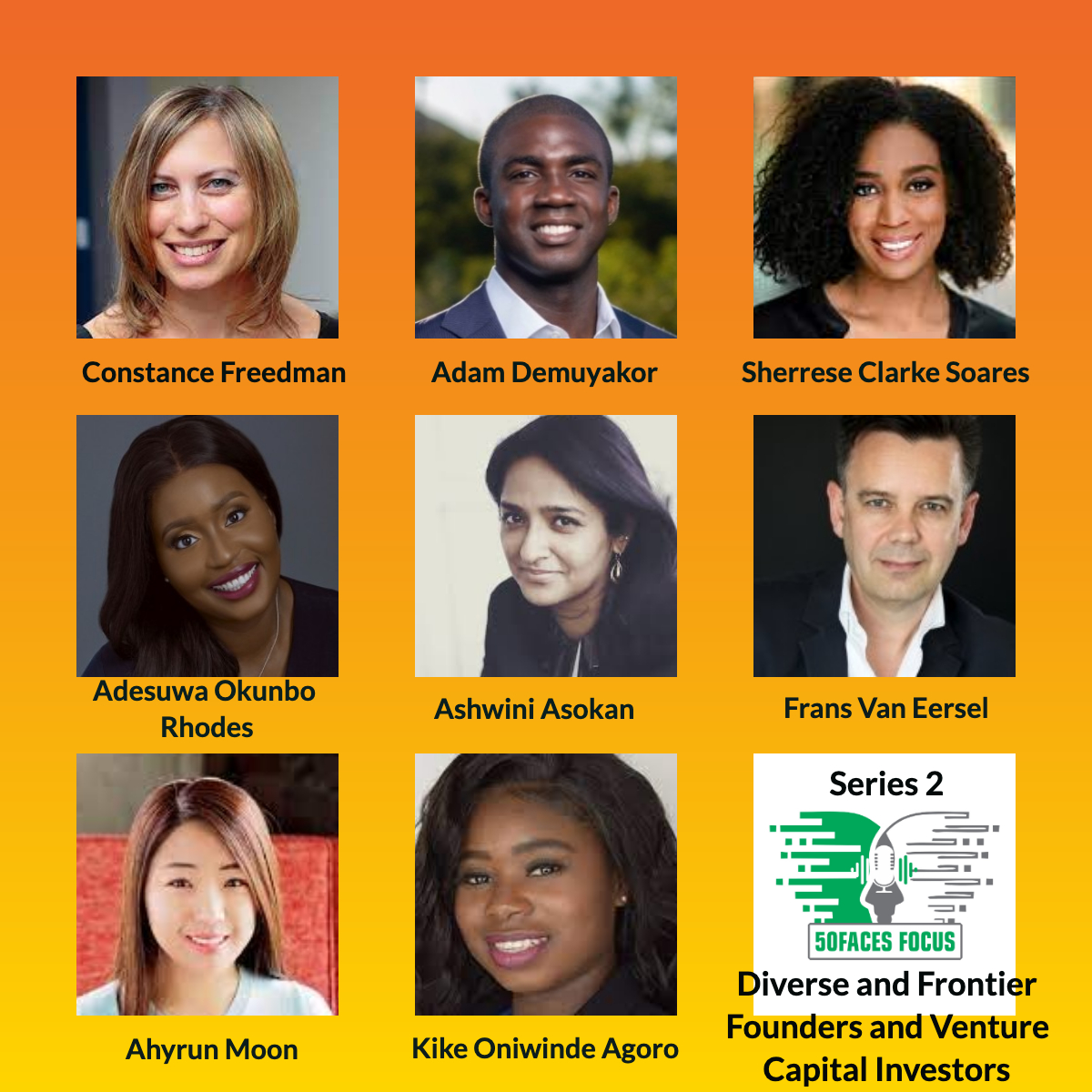



Aoifinn Devitt: This series was made possible by the kind support of Wellington Management, one of the world’s largest independent asset managers focused on delivering long-term investment excellence for clients and their beneficiaries, as well as Nile Capital Group, a sector-focused, operationally oriented private equity firm based in the Los Angeles area.
McKeever (Mac) Conwel: You know, there are a lot of organizations and VCs who say our doors are open for diversity, we’ll talk to anybody. Well, it doesn’t help if your doors are open and nobody knows that your doors exist. You’re better served to actually go out those doors and go find those entrepreneurs, go find those opportunities. And that’s a lot more work and it’s harder, but you’re going to need to do that if you want to do this work.
Aoifinn Devitt: Our next guest doesn’t just go out into the community to find entrepreneurs. He creates his own community to allow the next generation of founders to develop their social capital and thrive. I’m Aoifinn Devitt, and welcome to the 50 Faces Podcast, a podcast committed to revealing the richness and diversity of the world of investment by focusing on its people and their stories. I’m joined today by McKeever, or Mac, Conwell II, who is managing partner at Rare Breed Ventures, a venture capital firm based in the Baltimore area. He’s held various roles, including as a software engineer, an entrepreneur in residence at the NewMe Accelerator, a fund manager at Maryland Technology Development Corporation, where he was a member of the seed investment team, and various advisory and consulting roles in the tech space. Rare Breed Ventures is a pre-seed fund that aims to invest in exceptional founders outside the large tech ecosystems earlier than everyone else. Welcome, Mac. Thanks for joining me today.
McKeever (Mac) Conwel: Thank you for the invite. I’m glad to be here.
Aoifinn Devitt: Well, let’s start by talking about your background and your entry into the tech world. Where did it start?
McKeever (Mac) Conwel: So for me, my start into the tech world probably starts with as a kid, you know, when as a young one, I spent a lot of time doing a lot of engineering after-school programs and things like that. That’s where my like love for engineering comes from. And then when I went to college, I studied computer science.
Aoifinn Devitt: And then when you look back at the various training that you did, what do you draw on most today as an early stage investor?
McKeever (Mac) Conwel: I think what I lean on today is more so from my experience, not so much from the early days, but more so my experience as an entrepreneur myself, right? Like a lot of how I approach being an investor comes from the way I wish people had approached being an investor when I was an entrepreneur, right? Like I aspire to be, you the investor I always wanted.
Aoifinn Devitt: Well, we’re certainly going to dig into some of those perhaps missing parts, I think, of your own experience when we look at that experience as an investor now. When we spoke earlier, you mentioned that your time at the NewMe Accelerator in 2013 really was a turning point for you. Can you talk about this?
McKeever (Mac) Conwel: Yeah, the thing about the NewMe Accelerator was it was the first accelerator for underrepresented founders. It started in 2011, and Their first class got featured in a CNN special, Blacks in Silicon Valley, which was amazing. And so I ended up being in the third class and that was a turning point because one, I ended up spending several months in San Francisco and got to see what Silicon Valley was all about and what made Silicon Valley what it was, right? The other thing that that accelerator did was it connected us to the who’s who of Silicon Valley. I mean, during my time going through that accelerator, I met Eric Eric Ries, the, the writer of The Lean Startup, Ben Horowitz, Mitch Kapoor, Ken Coleman, like titans of industry. And then I also got to meet a lot of individuals who would later go on to be very influential in my life, like Charles Hudson, Richard Kirby, Marlon Nichols. These were all Black men who were VCs who were working at various funds back then who all have their own funds today. And are people I can reach out to and I look towards for guidance to help in my journey. And like all of that started in my time in NewMe through 2012 and 2013. The other thing that was really instructive was beyond the investment network and getting to meet the folks in Silicon Valley, but also the network within the accelerator itself, right? If you look at the first 4 classes of the NewMe accelerator, there’s 9 investors who came out of that who are all people I know and I’m cool with and who are my friends. And so, that was a really instructive time. And that time has carried me through to where I am today.
Aoifinn Devitt: And you talked earlier about your own experience of raising capital as a founder. Can you talk a little bit about that? What was missing in that experience that you’re trying to correct now as you’re an investor yourself?
McKeever (Mac) Conwel: I think the biggest thing for me when I first got started was I didn’t know anything, right? Like, I just, I didn’t know the basics around raising capital or even what venture capital was. I joke with people, but it’s true. When I started my first company in 2010, I didn’t know what a startup was. I didn’t know what a VC was. I didn’t know what networking was. Which is probably a crazy idea considering I was already 6 years into a very successful career as a software engineer, right? Making the transition over to management at the time. And so like starting my first company, I didn’t know anything. And it was so hard for me to meet and find people who were willing to share that information. And it wasn’t that there weren’t people who weren’t willing to share the information or that the information didn’t already exist somewhere online, but like, I didn’t know where to go for it. Anybody to talk to, right? No, there was nobody who looked like me who was sharing this information. And so I had to go into settings and go into rooms and go into organizations where I didn’t feel comfortable because I was the only person who looked like me. And then having to get comfortable with being in those settings and recognize like, oh, we all have a commonality of we all love business. We all love companies. We all love our companies. We all love learning. Right. And so then you get acclimated to it, but it took me 2 and a half years to get to that point. And so now I spend a lot of my time just educating folks on like just the basics of venture capital, fundraising, and just entrepreneurship in general and like how all of this stuff works. And so that’s probably the biggest thing for me.
Aoifinn Devitt: Just going back a little, maybe before your career as a software engineer, when you were at college and maybe learning the ropes, and, you know, sometimes networking is something that’s instilled at that stage. Did you have the benefit of any I suppose, mentors back at your college days or your early career who maybe instilled those kinds of skills in you?
McKeever (Mac) Conwel: I didn’t. And really the biggest thing I had going into college was my father, right? I had my father who was my guiding light in life and who was helping me stay on the right path of being a good man. But like, you know, my father was a postal worker and before that he was in the military. Right. He didn’t know these things. He didn’t do these things. And, you know, as a computer science major, like, they’re not talking about networking. And you got to remember, so like, I’m in school in ’05, ’04, you know, ’06. During that time, like, startups weren’t the big exciting thing they are today. The iPhone hadn’t even come out yet. Being a computer scientist wasn’t a cool thing. The only reason I chose that as my major was I really I really thought I was going to build robots. And so when I got to school, I didn’t know anything about majors. I should have went into electrical engineering. That’s more aligned with what I wanted to do. But they told me that computer scientists did that work. And so I listened. I got there, figured out that that’s not really what they did. But when I looked up how much computer scientists made coming out of college, I decided, well, this is going to be my major. So I literally chose this major because of how much money you can make. But I didn’t have any mentors in college pushed me or pointed me in the right directions of all that. What really changed in college, I guess you could call this a mentor, was when I, my sophomore year of school, I got an internship with the Department of Defense. And as part of the student program, there’s 300 of us. And of the 300 students, about 30 of us were Black. So of that, those young people, that became my core group of friends in my early 20s. Well, out of that group, there was a gentleman by the name of Patrick Jackson. He is now the CTO of a company in Silicon Valley called Disconnectus. It’s a VPN company. And Patrick was the first person I met who was obsessed with startups, but we didn’t call it startups. It’s really, he wanted to be the Black Mark Zuckerberg, right? This is a gentleman who, he was the first person I saw make an iPhone app. I think he made his first app in like ’08. I think iPhone comes out in ’07. He’s making iPhone apps in ’08, right? You know, he’s making websites, you know, and generating revenue. And then In ’09, he quit his job with the government and moved to San Francisco because him and some friends had started a business and some people who used to work at Google gave them money. And at the time, that was like mind-blowing to me and the rest of my friends. And we didn’t even understand what was happening. We didn’t understand that these people were investors. We didn’t understand that our friend was starting a startup and chasing the Silicon Valley dream. Like, we didn’t have the words to put to it. We just knew that as software engineers ourselves, we had the skill set to do something similar. And so, that was kind of like the beginning of moving in that direction. So, I always credit Pat for the reason why me and some other of my friends started moving in that direction.
Aoifinn Devitt: And it’s interesting because you mentioned not having the words to put to it, but I also think there probably wasn’t the role model, that number of role models out there, or there wasn’t the visibility around perhaps that many Black founders or entrepreneurs or venture capitalists Would you say that that lack of representation was an issue as well?
McKeever (Mac) Conwel: 100%. I mean, the lack of representation leads to the lack of knowledge, right? Like, like Arlen Hamilton is a thing today. So if you’ve heard of Arlen Hamilton, you’ve heard of her story, you at least heard venture capital or the phrase investor or angel investor. Like, you’ve heard these points because you’ve gotten to see it through her story. When I started in 2010, That story wasn’t there, right? Like there were stories that existed, but they weren’t in my purview. Like even when I was talking to students at historically Black colleges in 2015, 2016, there were still many students in those departments that had never heard of TechCrunch, right? They didn’t know what any of these tech blogs were or had ever heard of individuals like Michael Arrington, right, or barely have ever heard of who Ben Horowitz was, right? And so like the lack of people in our community who had gone on to do things in the space, meaning there was lack of opportunity for us to learn about it. And so for me, it was just, I didn’t have that, you know. I didn’t know where to go to find it. I didn’t know where you could hear about this stuff. Like it literally took me 2 and a half, almost 3 years of doing this work, getting in, figuring out that you have to be in these events and go to these spaces and then realize, okay, once you get in these spaces, you got to build relationships with these folks that you don’t know. There was this whole journey and process to it. Well, now, you know, if you follow me on Twitter, you’ll get access to like this whole world without having to go through all the struggles I had to. But then again, I’m talking about you have to be able to find me, right? Which is why I spend so much time doing podcasts and doing blogs and tweeting a lot, because I want people to find me so they can get that education, so they can learn these things. But there’s far more role models and people you can look to today than when I got started. Right.
Aoifinn Devitt: Well, let’s start with what your Twitter handle is. Can you share that so people can follow you on Twitter?
McKeever (Mac) Conwel: Absolutely. So it’s @MacConwell, M-A-C-C-O-N-W-E-L-L. W-E-L-L. It’s just my name. The name that shows up is Mac the VC. So, if you go on Twitter and search Mac the VC, you’ll find me as well.
Aoifinn Devitt: Well, that’s a great first step, but let’s get back to some other interventions that you’ve seen to work, because certainly more role models like you, more ways of shortcutting perhaps the years that you put in before you realize what it took. What have you seen that works in terms of, you know, maybe assisting diverse founders today? And is it just about having more diversity in the venture space?
McKeever (Mac) Conwel: Some of it’s about having more diversity in the venture space. That makes a difference. The greatest thing I can point to, to that working is after having two startups and coming back to Baltimore, I ended up working for the Maryland Technology Development Corporation, or TEDCO, which is essentially the investment arm for early-stage companies in the state of Maryland. And I started a pre-seed fund specifically for underrepresented— for initially for Black founders. In the first year of me running it, I generated all this interest from all these Black founders, and everybody was like, how did you do this? We’ve never seen this kind of, you know, outpouring of interest from these entrepreneurs before. And I said, well, I just— I went to where they are, you know, I went to go be where they were. And they were like, fine, can you recreate this for the Latin community locally? And I was like, I could try, but I’m never going to do that as well because I’m not a member of that community. It was really easy for me to do that Black entrepreneurs, because I was one. I knew where they were. I knew where they hung out. I knew the language and the language barriers there. I don’t know that for the Latin community. So I could try that. And I can probably do okay at that. But if I partner with somebody who’s a member of that community, I will probably get a lot more done and get a lot further. And so having more diversity is definitely a piece, but you’re not always going to have that luxury. And if not, the other piece is one, getting out. You know, there are a lot of organizations and VCs who say our doors are open for diversity, we’ll talk to anybody. Well, it doesn’t help if your doors are open and nobody knows that your doors exist, right? You’re better served to actually get— go out those doors and go find those entrepreneurs, go find those opportunities. And that’s a lot more work and it’s harder, but you’re going to need to do that if you want to do this work. The other thing is being willing to give these founders grace, right? A lot of investors are always looking for the quickest way to get to a no so they can move on to the next opportunity. Right. And so it can make you jaded and make you less gracious towards founders where if a founder is making a mistake or doing some things wrong, you take that as a red flag and you want to move on. Well, when you’re talking to underrepresented founders who may not know the lingo, who may not have gotten all the experiences or the training or read all the blogs or listened to all the podcasts, then there existed a space for VCs to give those founders some grace, right? To give those founders education. If a founder says, hey, Mac, will you sign an NDA? I don’t just say no and like turn them away. I use it as a teachable moment. So many VCs will just turn that entrepreneur away because they feel like you haven’t been doing this long enough. You haven’t learned the ropes. I don’t have time for you. Well, no, you should have time for them, right? Or if an entrepreneur doesn’t know all the right lingo or all the right words, that’s okay. I will still listen to the pitch all the way through because if I listen to your pitch all the way through, I’m just trying to listen for the business. I don’t need to hear the right buzzwords. I don’t need to hear all the flashy sentences. I need to hear that you got a good and strong business. You don’t need to be able to talk properly to have all the right words to figure that out, right? And so giving entrepreneurs the ability to go through their pitch and listen to them, hear them out, and even if they’re not the most polished or they don’t know all the right words, listen for the business case. Because I could teach you all the other stuff. I could teach you how to pitch. I could teach you what VR, AR, AL, like I could teach you all those things. I can’t teach you how to be a good entrepreneur and build a good business. Right. Cause there’s so much more that goes into that. I can help you build a good business, but I can’t teach you some of the intangibles it takes to be an amazing entrepreneur, to create an awesome business. Right. And so I think more VCs need to do that.
Aoifinn Devitt: Well, that’s great. And you’ve really given us a bit of a sense of your vision for what a VC really should be. Can you talk about that in the context of Rare Breed? And I’m particularly interested in what you’re doing at the pre-seed stage and what the pipeline is as well.
McKeever (Mac) Conwel: For Rare Breed, well, one, the pipeline is amazing, right? Deal flow is incredible. There’s so many amazing entrepreneurs all across this country of all races, sexes, creeds. Like, there’s so many amazing entrepreneurs out there that, like, there ain’t no— there’s no such thing as a pipeline issue. We could talk about a funnel issue with a lot of these underrepresented founders being at the top of the funnel and having harder ways to move through. But that’s a longer discussion, right? At Rare Breed, what we aspire to be is the firm that never misses out on the next Spanx. And for those who don’t know, you know, Spanx went on to become a billion-dollar business. But as the founder was starting the business, nobody wanted to fund her because most traditional VCs don’t understand women’s undergarments. Or how that can be such a powerful company. But for me, I tell my team that what we care about is customer acquisition, experience, and retention. If you can show me, you know, how to find your customers, that your customers like your product, and they like it so much that they keep coming back, you probably have a chance to be a good business. That has nothing to do with your market or any of the other stuff that we as VCs talk about, right? But it gets down to the fundamentals of the business of can you find your customers? Do your customers want to buy it? And will they keep coming back? If you can do those three things and do those three things well, you might have a shot at being a good business. And that’s how we try to strip our biases out or away from when we make decisions in the companies that we talk to.
Aoifinn Devitt: It’s very interesting. I think I heard about that Spanx, that actually the ideas didn’t get off the ground because most of the VCs were male until I think the products were sent to some of the VCs’ spouses or their secretaries. So, basically, that was the only female sort of test market they could do. Do you have to have a very diverse team, or are you sort of literally trying to get into the shoes of your founders and their customers and see it through that lens? Or is it just this customer focus? And I suppose if you’re at the pre-seed stage, do all of the founders have a chance to maybe prove they have repeat customers if they haven’t even had seeding yet?
McKeever (Mac) Conwel: That’s the hard chicken and the egg piece, right? So most of the companies we invest in will have already had some traction, will have some customers. Every now and then we will invest in a company that is pre-product, that is pre-launch. It’s not often, right? Just because, again, back to the deal flow, I’m going to see in a given quarter, on the low end, I’m going to see 500 companies, right? On the low end. And if we add my team in, we’re going to see 750. And of that, I mean, We’ll invest in somewhere between 0 and 6 companies, right? That’s a lot of companies to see in very few investments. And so the thing that tends to separate the companies out is going to be their traction or how many customers they have or how big of a waiting list they have. But, you know, every now and then you’ll find really amazing opportunities going after industries that are so antiquated. That you could take a bit more of a chance on, right? It’s not going to happen every day. As far as the team, I’m the only full-time person on my team. I do have a venture partner, 2 investors, and then 3 fellows, but I use my broader network as well, right? Like, I don’t have a team large enough and diverse enough to really, you know, speak to all these communities, but I definitely do have investors in my network that span the gamut, as well as friends. And I use them very often because I’m not going to know everything, right? If I see a company that’s, you know, in the women’s undergarment space, well, if they got a strong business case, I’m already going to be interested. I’ll probably send it to a few women investors and even entrepreneurs that I know just to get their feedback, right? And to the point where, you know, my fellows and the other investors on my team, they’re all Gen Zers, right? Well, we’re invested in a Gen Z dating app called Monet. The reason why I saw the value in what Monet was doing was because of them. Because, you know, they’re over here telling me about this amazing app, it’s so exciting. I’m like, I don’t get it. But the more and more Gen Z folks I had in my orbit telling me about how great this app was, I was like, okay, I got to meet the team. And then the team blew me away and their traction and growth was exceptional. I probably don’t take a look at that investment without having those individuals on my team. Right. And so I’ve learned over time to listen to all the voices around me to get a full view of what a market is or could be and not try to be stuck with my own thoughts and being stuck in my own mind. Because I know just like anybody else, I have my own biases too.
Aoifinn Devitt: And it all clearly comes back to network as well, since you can draw on that network now and their expertise. The venture arena is known to have a high failure rate, as is probably the founder arena. What have you learned from some of the setbacks and challenges and even investment mistakes that you’ve experienced over the course of your career so far?
McKeever (Mac) Conwel: Being hypersensitive to things that could be legitimate red flags, right? Like paying attention to the way a founder treats other people, the way a founder treats their team, the way a founder treats their co-founders. Speaks volumes for the way they’re going to run their business. Making sure that the lines of communication are always open between me and my founders and making my— and helping my founders understand that the best time for them to reach out to me is when things aren’t going good. Like, when things are going good and going well, we can all say happy things and cheer each other up and boost each other’s egos, but it’s when things are going bad that I hope you reach out to me as soon as possible, right? I can do far more for you when things are going bad than when things are going good. And I’ve had companies in my previous portfolios fail because the founders were scared to reach out to me and tell me they were having some issues. It ultimately led to the company, you know, closing down, when if they had reached out to me right away, probably could have saved the company and kept things going. And so being critical around The red flags are things that feel like little things. It’s almost like dating, right? You know, when you go on the first date, every now and then, you know, while you’re talking, somebody may say something that is interesting or something that may be a red flag, but you know, it’s the first date and they laugh and joke it off and you probably think nothing of it, right? Well, in actuality, that was a real flag they just shared with you, and so you should pay attention to it. It’s the same thing. So being— trying to have that discerning ear and discerning eye for things that could be real red flags and making sure to pay attention to the red flags and make sure that those lines of communication are really well open for my founders, for them to know, like, hey, when things are going bad, contact me. Like, I am here to support you and help you in everything, not just when it’s going good.
Aoifinn Devitt: And how much emphasis do you put on personal contact, you know, actually meeting the person and picking up on the unspoken words, perhaps some of the body language, the cues? I would imagine that’s extremely important and perhaps not— hasn’t been easy over the past year.
McKeever (Mac) Conwel: Yeah. I mean, we launched this fund during the pandemic, so investing while not being able to be in person has become a thing. But, you know, when you’re investing in a company as a team, we always have a meeting with the team and that gives us a chance to ask them questions as a team and see how they interact, to see if they’re talking over each other. If they’re arguing with each other, if they are on the same page with things. You know, when you have a team where the co-founders disagree, that’s a red flag. When you got founders who are talking over each other or being demonstrative and correcting each other, that’s a bit of a red flag. You know, one of the, the number one reasons for companies failing are co-founder issues. Right. So, try to pay attention to that. So, you can see those things in Zoom, you know, just like you can see them in an office room or at a lunch, right? Like, if you sit with somebody for long enough, it’ll come out.
Aoifinn Devitt: Absolutely. So, you’ve already talked about a number of the key people who influenced you along your career so far. You mentioned your father, you mentioned some of the mentors you met at the accelerator, as well as even earlier than that. Were there any key pieces of advice that you received that have stayed with you? And maybe guided you through your career, or any creed or motto that you live by?
McKeever (Mac) Conwel: Some of the best advice I’ve gotten, well, one is always be growing your network, right? Like, network is so important and it’s such a thing that people talk about, but they— I don’t think they put it in the best of context. So like, your network is your net worth. What that means is The ability to pick up the phone and call somebody to get a problem solved, it’s so amazing. Like the same way to have the ability to go to your phone, pick it up and call a plumber that you know, who you know is going to do good work and give you a good price, is as value, if not more, to being able to pick up your phone and talk to somebody you know to get a deal done for a customer or to get a partnership going. Like, the ability to do that comes from your ability to grow your network and create these relationships over time. And so being pushed to do that more has been life-changing. The other thing was, as an entrepreneur, to focus on customer acquisition at the earliest stages, because A lot of founders think that if you have a good idea or a good product, you should be able to get funding from investors. And what I had to learn and what I talk a lot about is, as an entrepreneur, when you see other companies raising money pre-product or pre-revenue, 9 times out of 10, it has nothing to do with the business and everything to do with their network. And if you do not have the same network or the same kind of network as them, then you’re not comparing apples to apples. And so if you’re just starting out and you don’t have that network and you’re trying to grow your business, the focus on getting customers or your customer acquisition is showing demand. Because if you can show large enough demand, money will come. And now, is it going to be hard to show them the demand? Do you have to jump through some hoops? Are you going to struggle, especially if you don’t have the funding up front? Yep, you sure are. But it doesn’t mean it’s impossible. It doesn’t mean you can’t do it. Is it going to be harder than others? Yeah. If you don’t have that kind of friends and family capital, it’s going to be harder, but it’s doable. Right. And so that was one thing I had to learn and absorb as an entrepreneur.
Aoifinn Devitt: And it’s interesting because I think an aspect of networking, in my view anyway, is giving and taking. It’s not just about taking. And I think sometimes people can underestimate the giving part, but you clearly are both a giver. I say primarily a giver, actually, given what we’ve been discussing about here. But how do you encourage the young people to give? I’ve come across people who I won’t hear from for 10 years, and then they’ll come to me asking me for something. And I might be less inclined to help them if I haven’t heard from them in 10 years.
McKeever (Mac) Conwel: So, I tell people, you know, try, like, you know, build a personal CRM, right? You want to keep or put a spreadsheet together of all the people you’ve met. And, you know, every quarter or every 6 months, just send them a note, try to stay in touch. And no, you’re not going to be able to stay in touch with everybody. You’re not going to have the strongest relationships with everybody. And there are going to be some people that you, you might not reach out to for 5 to 10 years. Right. But when you do reach out to them, be very genuine, be sincere. And if you are looking to be transactional or get something from them, make sure you offer something too.
Aoifinn Devitt: My last question is around any advice you might have for your younger self. I mean, looking back at that young computer science student, is there anything that you know now that you wish you had known at that stage besides the networking point, maybe in addition to that?
McKeever (Mac) Conwel: I would have told myself to start listening to audiobooks or reading more sooner. It was only maybe 3 or 4 years ago where I really started listening to audiobooks. I had a good friend of mine who was listening to a bunch of books and gaining all this knowledge. He kept telling me how I needed to do it, how I needed to get on it. And one of the greatest things you can do is become a voracious reader and reading a lot of nonfiction, especially if you want to be an entrepreneur or be in the space, reading these business books, because there are so many people who have already gone through a bunch of the stuff you’re going through, who have made the mistakes, who have had the heartaches, who have had a hard time going through it, who can, who you can learn from their stories. Is a true cheat code in this business. Being able to take in that information will be truly helpful for you. So, I wish I had started doing that sooner.
Aoifinn Devitt: Well, I look forward to putting in the show notes a list of books that you recommend in that respect because— and we are looking forward to whenever you decide to put your own thoughts into one. I think that would be wonderful. So, thank you so much, Mack. You mentioned giving grace to entrepreneurs, and I think that grace that you give and the generosity with which you give it and try to lift up this next generation is really palpable through this podcast. So thank you so much for coming here and sharing your insights with us.
McKeever (Mac) Conwel: Thank you for allowing me to come and spend this time with you, and hopefully your audience is able to gain something from this.
Aoifinn Devitt: I’m Aoifinn Devitt. Thank you for listening to the 50 Faces Podcast. If you liked what you heard and would like to tune in to hear more inspiring investors and their journeys, please subscribe on Apple Podcasts or wherever you get your podcasts. This podcast is for informational purposes only and should not be construed as investment advice, and all views are personal and should not be attributed to the organizations and affiliations of the host or any guest.
Aoifinn Devitt: We approached literally hundreds and hundreds of venture capital firms. You know, I think it was about 300, and of those, we probably started talking to about 70, went into second discussions with about 10, and ended up talking to the final 3, of which 2 were inbound. So my success rate was a failure rate of something like 99.7%. I think that gives you the sort of scale of how hard it is to actually raise.
Ezechi Britton: Founder life. If we were to put together a wall of inspiring quotes for founders and venture capitalists, we might put something like this quote from Michael Dell: Ideas are a commodity. Execution of them is not. We might use the wise words of former British Prime Minister Winston Churchill: ‘Never, never, never give up.’ Or we might look to the co-founder of Dropbox, Drew Houston, who said, ‘Don’t worry about failure. You only have to be right once.’ But no matter the pep talk, we know that life as a founder is hard, riddled with setbacks, hundreds of thousands of requests for funding, and assiduous networking. In this special 50 Faces focus series focused on underrepresented founders and VCs, we meet with a cross-section of both founders and VCs from the US, the UK, and Africa to talk about specific challenges that they face. We provide access to resources, role models, and tips for the next generation. First, we asked why the distance travelled to get to the starting line are so different for many.
Speaker C: How easy is it for you to get to the starting line? Now, some people get driven in their parents’ Mercedes, other people have to walk around the corner, and then there’s a demographic of individuals who have to walk 20 miles barefoot in the cold, jumping over hurdles just to get to the start line. And that piece there is the adversity that most of these founders have to go through just to be in the room.
Ezechi Britton: There can sometimes be cultural barriers too.
Speaker D: Now, when it comes to Black women, 28%, I think, of the Black entrepreneurs, and they’re 50% of the Black working population. When you look at the cultural demands on me as a Black woman, balancing running the business and cultural expectation, etc., there is a pull and a block. There’s a pull at home, which is sometimes cultural, raising the family, caring roles, et cetera. There is a block or boundary or perceived block or boundary that being accepted as a Black woman in business, in the business world.
Ezechi Britton: And once those founders get to the room, is the opportunity self-evident or does the pace of change remain slow?
Speaker E: I was certain that everybody would wake up to this huge gap and this huge opportunity within the next year or two. I was just so confident that my window was so small to break into the industry and sort of make some noise with that as an idea, as a novel concept. Fast forward, you know, nearly a decade, it’s still a novel concept to back diverse founders and the industry just hasn’t woken up to it.
Ezechi Britton: We speak about why the lack of representation is a problem and can lead to diminished social capital.
Speaker F: The lack of representation leads to the lack of knowledge.
Ezechi Britton: We also learn that VCs need to do more to foster success among founders.
Speaker F: So many VCs will just turn that entrepreneur away because they feel like, you haven’t been doing this long enough, you haven’t learned the ropes, I don’t have time for you. Well, no, you should have time for them.
Ezechi Britton: Why is it that the same setbacks, though, can foster a resilience that offers both diversity in business models and style, and why this is cause for hope?
Speaker G: So I see the next few years in the venture industry to be really good. Now, what I do think that LPs need to do is catch on to that and find these amazing women, and just generally people of color to go back because that resilience that they have is going to make them win and not the traditional other folks that are in the market out there that they’re used to backing.
Ezechi Britton: As always, we return to some cardinal rules of founder life and words of wisdom. Seeing entrepreneurs fail, rise up from those failures, and going on to do great things, it’s just showed me that failure is not the end. We’re not to be defined by our failures.
Speaker E: Who— anybody who’s not learning from failing isn’t really doing anything.
Ezechi Britton: So from next week, join us on this fascinating journey, which we will be releasing all during the summer. This series was made possible by the kind support of Wellington Management, one of the world’s largest independent asset managers focused on delivering long-term investment excellence for clients and their beneficiaries, as well as Nile Capital Group, a sector-focused, operationally oriented private equity firm based in the Los Angeles area.

Aoifinn Devitt: This series was made possible by the kind support of Wellington Management, one of the world’s largest independent asset managers focused on delivering long-term investment excellence for clients and their beneficiaries, as well as Nile Capital Group, a sector-focused, operationally oriented private equity firm based in the Los Angeles area.
Mark Mwangi: We approached literally hundreds and hundreds of venture capital firms. You know, I think it was about 300, and of those, we probably started talking to about 70, went into second discussions with about 10 and ended up talking to the final 3, of which 2 were inbound. So my success rate was a failure rate of something like 99.7%. I think that gives you the sort of scale of how hard it is to actually raise.
Aoifinn Devitt: I’m Aoifinn Devitt, and welcome to this 50 Faces Focus Series in which we showcase diverse founders and venture capital investors. I’m joined today by Mark Mwangi, who is the founder of Amitruck, a Kenya-based company which connects transporters, whether a motorbike, pickup truck, van, or even a large articulated truck, directly to clients, and aims to ensure convenient pricing and cut out a large part of the cost of goods. He’s also the co-founder of Dalwin, a natural gas exchange based in London. He was previously a senior investment manager at Pictet Asset Management in London, and prior to that worked in equity research at Bluecrest. One fun fact shared in another podcast is that he’s also a licensed pilot. Welcome, Marc. Thanks for joining me today.
Mark Mwangi: Thanks for having me.
Aoifinn Devitt: So there’s already a very interesting podcast which chronicles your journey and your business model at Amitruck on the Developing Founders podcast, and we have a link to that in the show notes here. So we won’t cover the same ground as that, but it is such a fascinating journey, I’d like to just include a little bit of it. So can you just maybe briefly talk us through your background, where you grew up and how you came to enter finance, first of all?
Mark Mwangi: Yeah, so I actually was born and raised in Kenya. I went to study maths at City University in London when I was still quite young. And due to unfortunate family circumstances, I had to put myself through school by driving a truck in and around Heathrow Airport at night. And that’s how I managed to fund my maths degree. Luckily for me, the silver lining in the cloud was that having done well in my degree as well as worked full-time, I managed to get into a graduate program in investment management. And basically that’s how I broke into investment banking.
Aoifinn Devitt: And then you made quite a big change by moving from investment banking, where I presume you could have continued and had a very successful career, to move to the world of startup land and start your own venture. Can you talk us through your thinking there?
Mark Mwangi: Yeah, so I think everyone thought I’d gone crazy, but I just became aware of the fact that there was more to life than just your bank balance, and the amount of time you’re spending in this world should be to do something more impactful. I wanted to do something that helped my home country and left a bit of a legacy and brought a bit more meaning to my life than just money.
Aoifinn Devitt: You had some experience of trucking, driving around Heathrow Airport. Why trucking? What was the thought process there?
Mark Mwangi: Well, at the time, being younger, it paid quite well, which helped because international fees, I think at City University were about £14,000 a year, plus you had your upkeep. Secondly, you could do it at night, which meant that I was free to study my maths degree during the day. And it wasn’t a job that most people wanted to do. It’s not a very social job. So I had the advantage of being flexible enough to do that.
Aoifinn Devitt: And then when we talked before this, you talked a little bit about the vision for Ametruck. Can you talk about that and how maybe transport costs factor into the cost of goods and what is the problem that Ametruck is designed to solve essentially?
Mark Mwangi: Yeah. So When we first identified the problem, it looked like you had 2 or 3 middlemen between a cargo owner and his vehicle, and they generally were taking, you know, up to 60% of the cost of delivery. And on top of that, if something happened to the load, it’s very hard for the cargo owner to work out exactly who’s liable. So you weren’t sure if your goods will get there safe from theft or damage. I mean, we’ve since now begun to understand the ramifications of this. It means that, you know, something like 60% of the cost of Colgate, you know, a big percentage of cost of medicines and other essential goods are basically transport. And the reason for that is because there isn’t a nice single place, or there wasn’t a nice single place where a transporter and a cargo owner could meet and compare the services that they’re offering. And that’s the space that Ametrak sits in, connecting that cargo owner to competitively priced, secure transport using technology.
Aoifinn Devitt: And when you look at the skill set that you’ve gained throughout your life so far through that discipline, I suppose that resilience you had to build and putting yourself through college, driving the actual trucks, and then a career in finance, which of the skills are you drawing upon now in your role as an entrepreneur?
Mark Mwangi: I think I spent some time on a private equity desk and running actual operational businesses, and that really helps understand the intricacies of business. So not just limiting me to the financial analysis statements and so on, but actually understanding things like culture, teams, boardrooms, customers’ interaction with the business, aligning incentives. And many of those are lessons that I bring with me today. And I think having driven the truck meant that I know what a really nice automated trucking system looks like with forklifts and coded pallets and, you know, lovely belts that pull the pallets in and off the truck. And then, you know, you sort of compare that with what we have here and you can see how much room there is to improve on the efficiency and the way we do things here in Africa.
Aoifinn Devitt: One of the focuses of this podcast is around capital raising for entrepreneurs and founders. Can you talk us through your experience of raising capital as a founder, maybe particularly in your case, and then we can talk a little bit about founders, the landscape more generally?
Mark Mwangi: I think Amitrak is one of the luckier ones. But the process can be very, very difficult. We approached literally hundreds and hundreds of venture capital firms. You know, I think it was about 300, and of those, we probably started talking to about 70, went into second discussions with about 10, and ended up talking to the final 3, of which 2 were inbound. So my success rate was a failure rate of something like 99.7%. I think that gives you the sort of scale of how hard it is to actually raise.
Aoifinn Devitt: And would you say that was a feature of being based in Kenya, maybe the number of VCs that were interested in investing there? Like, did you look to Africa-based VCs? Did you look globally?
Mark Mwangi: Yeah, so we looked globally. I think it’s difficult to raise anyway. I think the fact that you’re in Africa means that many of the global VC firms may not include Africa as an area of interest for them. So it definitely cuts out quite a lot of venture capitalists from looking at your business because you’re just not in an area they’re currently looking to invest in. And then once you get the set of investors who are looking at Africa, you then have the second step, which is to look at investors who would invest in Africa and look at logistics. And then the ones that would, you then have to find the ones that haven’t already got a competing startup. So you really bring down the numbers very quickly.
Aoifinn Devitt: And I just want to ask you a little bit about your mindset over what timeframe was this and how did you kind of keep getting back out there? Did you look for feedback from some of the nos or did you just put them aside and move on to the next challenge?
Mark Mwangi: I already knew that this was not going to be easy. So we actually started fundraising as soon as we set Amitrak up. And in the first 6 months, the trick was to go looking at investors who we knew would never put money in the business, and that was just to get our initial presentation corrected, to get and understand the kind of questions to expect from investors and hone those answers in, and basically also get some practice in how you pitch your startup to a venture capitalist and the kind of questions and interactions we can expect, and also just to get used to it so that you can now start the real serious process of the ones that you think will really invest.
Aoifinn Devitt: And have you ever given thought to just the state, I suppose, of diversity in the, whether the startup space or the venture capital space in particular? Do you have any observations on what you see from your perspective?
Mark Mwangi: So this one has been a touchy subject, especially over the last 2 years. And obviously the data is showing that not many Black-founded startups have received funding and those that have get a lot less. And it’s even worse for Black female founders. I’ve sort of been in this bit from two sides. When I was in investment banking, I was probably one of very few African investment managers, analysts, whatever position I was at the time. And I think there’s a bit of misunderstanding on both sides. On the VC side, I think it’s just the fact that there is such a high amount of trust and a high amount of uncertainty when funding a startup that it would only be natural for a venture capitalist to feel a relationship closer with a founder that looks and sounds and answers questions in the way that they expect them answered. And yes, you might argue that’s wrong and it leads to a racial bias, but, you know, I don’t think that they’re out there with hooded pillows over their heads. I think it’s just the fact that as they are looking through the startup community, the sort of founders they relate to have been to sort of their schools and worked in some of the businesses that they’ve worked in, and they’re just easier to form a rapport during the investment pitching process and the due diligence. And I think on the other side, we have not always had the sort of educational systems and cultural systems that lead us to present very early, learn to negotiate very early, and we don’t necessarily have the same circles. So for example, one of the things you learn as a startup founder, the way to be introduced to a VC, it’s much better to get an introduction from somebody they know and trust than it is for you to try and cold call or cold email them. Obviously, if you’re a startup in Africa, your circle might not include a lot of the American European VCs that are active in the space, and it takes a while before you get the intro. And I think this is just some of the things that will be sorted out by the ecosystem as more success stories come out of Africa and as we get bigger IPOs that will show the success. And I think it’ll sort through that.
Aoifinn Devitt: It’s interesting you said, I suppose optimistically, that it will be sorted out, but I would imagine there’s a lot of space right now for progress to happen, maybe whether it be mentors pushing into that area. Maybe it could be affinity groups or other groups that provide incubation or other support, or even governmental organizations. I know there are sovereign wealth funds in Africa perhaps that, that have a sleeve that could be dedicated to local innovators. Have you seen any of these that look promising?
Mark Mwangi: I haven’t seen anything tangible, but I’ve definitely been seeing a lot of news in and around focusing more on the minority founders. I’ve seen a lot of work happening around the female founders in Africa, but you’re right, the biggest hurdle to a startup in Africa today is probably the availability of capital.
Aoifinn Devitt: A story we’re seeing reflected around the world, actually. So it’s very interesting to have your own unique perspective. So just going back to your personal journey now, moving from investment banking in London to this startup in Kenya, I’m sure it does not come without a significant amount of highs and lows, perhaps. Can you talk us through any of those and maybe any lessons learned that you’ve taken from this experience so far?
Mark Mwangi: Yeah, so I think there’s just interesting little bits. Like, I remember being in banking, you were constantly at risk of having your job taken away because of underperforming. And actually, you’re constantly worried about, would I have a job this time next year? How will the markets treat me this year? And I think the same thing happens in the entrepreneurial world where you begin to realize that you are as worried as you are losing your job of losing your employees. And they are difficult to find when you’re looking for good ones and very difficult to keep and keep motivated. So that’s been an interesting sort of change in mindset with regards to how I view employment and employees. I think the other thing that maybe I could bring up was just the switch in mindset, you know, working at, say, Pictet Asset Management. I tried to follow quite closely the teachings of the likes of Warren Buffett and Charlie Munger and some of these value investors, and they believe in looking at very successful businesses with a very strong track record, with very good management and very good competitive moats. And now I’m sitting in the exact opposite side of that in a small business that has no history, where we’re still trying to work out how it’s going to keep growing. And you’re not necessarily assured it will survive. So it’s a very different, but a much more interesting and fulfilling way to spend your time because you are actually making a difference.
Aoifinn Devitt: And you had quite a graphic description of what some of the kind of day-to-day struggles, I suppose, in terms of the fires you’re putting out on a regular basis. And maybe with the pandemic disruption too, it’s been particularly volatile. Can you share how you describe the founder’s experience?
Mark Mwangi: I think you’re referring to crawling through glass naked.
Aoifinn Devitt: A fairly unforgettable image, yes.
Mark Mwangi: Yeah, yeah, it is. I’ve since heard someone else say it’s like trying to build my wings on the way down and the wood’s on fire and the hammer’s hot. But it’s also fun, right? That’s what makes it exciting. There are moments when you really question what you’re doing and you really, there’s a lot of soul searching. There are many times when you think that your business might not make it and then you walk it out and you get through the other side and there’s a sense of relief. But before you even get a chance to breathe in, something else comes up. So it’s quite a journey.
Aoifinn Devitt: But I would also think the mindset in finance, which is fairly highly charged, it actually can lend itself though to the mindset you need because you constantly need to be flexible and to pivot. And it’s certainly not dull, I would think, the life of a founder. So I suppose it did train you in some way.
Mark Mwangi: So I think from very early on when I was trying to put myself through my maths degree, I realized that you can make a sob story and you can always explain things away. And one of the things I remember thinking quite young was it’s almost like an athlete and someone with a disability trying to cross the road. You know, the truck will hit you both the same way. So you kind of have to try 10 times harder and ensure you get across before the truck does. And it doesn’t help anybody pointing at the athletes with any sort of jealousy or want or anything like that. And it’s that single focus mindset to get to a solution that maybe has helped me in my startup life where we don’t stop to explain what went wrong. Constantly sort of spinning our wheels trying to make sure we’re getting somewhere close to a solution.
Aoifinn Devitt: Absolutely. Getting back to the reflections, maybe were there any key people who influenced you throughout your life or that have really had an impression on you?
Mark Mwangi: I have to say, and this should actually go to the diversity discussion, so if you look at all the key people that have helped me through my career, They’ve all been white European middle-aged men, from my mentors when I went through Bluecrest Capital, my boss and mentor at Pictet Asset Management, when I was in private equity, my manager and boss then. All the people that actually have had a significant impact in terms of my career have all been European. So that just came to mind. The thing that maybe influenced me the most was just understanding that you can fail and survive. And that maybe was the single thing that helped me cross over from employment into entrepreneurship.
Aoifinn Devitt: And my last question is around any advice you would have for your younger self, knowing what you know now as a founder, kind of in the throes of startup phase, anything that you maybe back when you were 16, 17, that you wish you had known then?
Mark Mwangi: Yes, I wish I had come back home earlier. I think having success financially makes it more difficult for founders to take risks. Once you’ve tasted employment, salary, nice flat, nice car, it’s very hard to then think, I’m gonna give it all up and go set up shop in Africa where I have no track record, nobody knows who I am, and that’s a journey that I think would probably work much easier and better if you started immediately after finishing school. So I’d actually say that I would have told myself to come home, start early. And I always look back and wonder where I’d be had I done this 20, 25 years ago.
Aoifinn Devitt: And did it take you long to build that sort of social capital once you did move back to Kenya?
Mark Mwangi: I think I’m on the very beginning of still building that up. You know, I’ve been back for 2 and a half years now, and You’re not a name yet. Nobody knows who you are. So I’m as big as my startup Army Truck is and as big as my team enable it to be. So we are, we’re still working hard on helping clients and hopefully that delight works out as reputation at some point.
Aoifinn Devitt: Just want to follow up on one point you made, because I think it’s very interesting. You mentioned, you know, that the more you’ve worked, perhaps the more you’ve earned, the more you have to lose. More is at risk when you move to a startup. But I’ve also heard Adam Grant, who’s written a book about Think Again, that sometimes the most effective founders are the ones who mitigate their risks. They don’t risk it all. They don’t kind of just jump off a cliff, that they actually have backup plans. And what camp would you say you’ve fallen into? Would it be the— have you mitigated risk in terms of this career change, or was there a lot of risk involved?
Mark Mwangi: There’s a lot of risk involved. I mean, I definitely risked my income. It felt at the time like you were coming into a less organized society where some of the legal healthcare infrastructure maybe wasn’t as strong as it was in the UK. I suppose you can say that about most places, but I think what Adam’s probably referring to was more the that that’s not necessarily a limiting factor. I think if you’ve had a job already, then of course you’ll bring a lot of lessons that you’ve learned from your experience in those jobs back to your startup, and that’s great. But I actually think the thing that stops people from starting a, a business is the fact that they’re already in a comfortable lifestyle, and the idea of startup, which is literally asking questions about, is this a value-added service that customers will pay for the entire time? It then appears to be more risky than staying in employment. And maybe that psychology stops a lot of great minds from switching from careers in investment management, for example, like I did, and coming to solve real-world problems where they have much more of an impact on society and potentially could enrich them even more.
Aoifinn Devitt: Would you say that venture capitalists are looking for all-in type of risk, or are they looking for risk mitigation? Is there any one kind of message you’ve received in your discussions?
Mark Mwangi: Oh, I’ve definitely seen all-in. And, you know, you very quickly figure out that if you have— you’re spending your time doing anything else, if you’re not invested in the business, if you don’t have a significant holding and In fact, most of them will make you vest over 4 or 5 years so that you get a bit of your business back as you work after funding. And all those things would lead me to think that, you know, they really want sole focus, full-on risk to get things done.
Aoifinn Devitt: Well, this has been a fascinating discussion, Mark. Thank you so much for coming here and sharing your journey and your insights into the, I suppose, the somewhat volatile and thankless at times role of a founder. But I think you’ve really brought it to life for us. So Thank you for sharing your insights with us.
Mark Mwangi: No, thank you very much for, for having me.
Aoifinn Devitt: I’m Aoifinn Devitt. Thank you for listening to the 50 Faces Podcast. If you liked what you heard and would like to tune in to hear more inspiring investors and their personal journeys, please subscribe on Apple Podcasts or wherever you get your podcasts. This podcast is for informational purposes only and should not be construed as investment advice, and all views are personal and should not be attributed to the organizations and affiliations of the host or any guest.

Aoifinn Devitt: This series was made possible by the kind support of Wellington Management, one of the world’s largest independent asset managers focused on delivering long-term investment excellence for clients and their beneficiaries, as well as Nile Capital Group, a sector-focused, operationally oriented private equity firm based in the Los Angeles area.
Austin Clements: I said I was going to graduate with either a role in venture capital or no job at all. I ended up graduating with no job at all, but eventually through found my way into the industry with a firm called 1010. So we want to get behind people, as we always phrase it, that are delusional with their vision but pragmatic with their execution.
Aoifinn Devitt: I’m Aoifinn Devitt, and welcome to the 50 Faces Podcast, the podcast committed to revealing the richness and diversity of the world of investment by focusing on its people. And their stories. I’m joined today by Austin Clemens, who is a partner at Slauson Co., a Los Angeles-based venture capital firm that provides pre-seed and seed funding to a range of founders. He’s a Kauffman Fellow and has a strong interest in economic empowerment. He was previously chair of Pledge LA, an alliance between LA’s venture capital community, the Annenberg Foundation, and the office of Mayor Eric Garcetti. He also holds a number of board roles. Welcome, Austin. Thanks for joining me today.
Austin Clements: So excited to be here amongst all the great guests that you have. It’s an honor.
Aoifinn Devitt: Well, thank you so much. And well, let’s start by talking about your background and your entry into the tech world.
Austin Clements: Absolutely. It’s a very simple story, actually. Born and raised in LA, in South LA to be exact, primarily Black and brown neighborhood. Went to Morehouse College for undergrad and came back to LA, started working in finance. In wealth management. I did that for a couple years, enjoyed it, didn’t know anything about the venture capital industry. I was mostly focused on public equities and fixed income portfolios. So then I left that role to start a company. I was doing web and mobile development for a lot of small businesses, and it was there that I really fell in love with working with entrepreneurs. And, you know, they’re the most passionate people on the planet about their work. I enjoyed working with small businesses as well, and I enjoyed applying technology. To their businesses. So coupled that with learning about investing, and it just became extremely interesting to me that you could combine investing and working with entrepreneurs and technology all into one role. I started to learn about the venture capital industry and just became obsessed with it, uh, really wanted to find a way in. Everybody told me at the time— this is like 2009, 2010— everybody told me at the time, like, it’s nearly impossible to break in and find a role. But, you know, nearly impossible. I like those odds. I’ll go for it. And went back to business school. I went to NYU and got my MBA, but really the entire focus of going to business school was to try to find a role in venture. I said I was going to graduate with either a role in venture capital or no job at all. I ended up graduating with no job at all, but eventually found my way into the industry with a firm called 1010.
Aoifinn Devitt: Great. Well, I’d love to talk about maybe what training I suppose you had in the early days and how that kind of, you draw upon it as an early stage investor today. What do you think, I think, equipped you with the tools to be, uh, have the right skills as a venture capital investor?
Austin Clements: Sure, certainly my— I’m oriented as an investor first. I think that, you know, some people look at the industry and say like it’s, it, it certainly makes sense to start as an operator and then come into the industry with that experience, and, and you’ll be empathetic to founders and whatnot. And I’ve seen that firsthand. I think that that does provide a lot of insight if you come at it from the operating angle before going into venture. But you could also be empathetic without being an operator, and that was kind of my approach. And so my orientation to begin with was an investor, but then beyond that, I also did work with a lot of small businesses. These weren’t like venture-backed businesses, these are like local businesses, everything from interior design shops to law firms and things like that, and helping them build technology. So I became very familiar with emerging technology and all of the things that are associated with that, all the good and the bad and things to look out for. So I really started to learn about tech quite a bit in that role, even though it wasn’t necessarily venture-backed tech, it was other kinds of tech. And so I learned from there that I think that that sort of served as the basis for really understanding what’s out there and sort of how to, I guess, how to be a good investor in those particular categories. A lot of it has to do with the people part of the business and then understanding what the vision and the mission of the entrepreneur is. And that’s what I was always able to be excited by and really able to get behind too. That’s what made a huge difference. And that’s, you know, still the part of the business that I love the most now.
Aoifinn Devitt: And do you think business school and other kind of college programs can really prepare you for the skills you need in venture capital, or is it more academic?
Austin Clements: I think that they can prepare you with decent frameworks that serve as a beginning of thinking about how to do it. But, you know, there’s nothing like real-world experience. Business school, I wouldn’t say taught me to be a good investor. I would say it taught me to be a better investor. I wouldn’t say the business school taught me how to work with entrepreneurs. I think it helped refine some of the aspects that I had already in place, and ultimately it was useful. Probably one of the most useful things was for me for business school was to step out of the day-to-day and sort of create a plan for what I wanted to be in this industry and how I wanted to get into the industry. And I think more than anything else, building a good network and taking the time to have a better constructed plan helped me to think about things on a long term, with a long-term view, which in my opinion is probably the best way to have it, is to take a long view on most things that you do, and then you can figure out how to navigate it to achieve the desired outcome. So I wouldn’t necessarily say that there was anything tactical that made me feel like— in fact, there were probably a few things that I had to unlearn coming out of business school in terms of how to work with companies, because startups are fundamentally different. I think business schools have gotten a lot better about that over the years, though. It taught me a few things, but also had to rethink a few things as well.
Aoifinn Devitt: So just moving now to your work at Slauson Co. So what kind of incubation services do you provide beyond capital, and what kind of pipeline are you seeing at the moment at the pre-seed stage?
Austin Clements: Sure. So yeah, pre-seed and seed stage is where we’re primarily focused. So in most cases, we’re leading the deals that we do, and we’re the first institutional check into the company. And often we’re taking between 50% and 75% of the round and, you know, usually investing somewhere between $250,000 up to a couple of million as an initial check in. But we also recognize that the founders that we’re backing in most cases can benefit from more than just the capital in terms of our relationships and guidance and perspective and help and support. That’s just a huge element. Slauson and Company, we very intentionally named it and Company versus like ventures or capital or anything like that because really it’s about the company that we keep. That’s the biggest asset that we have. We’ve been very fortunate enough to have just an excellent list of advisors and corporations that have gotten behind what we’ve done, that are supporting what we do, and want to provide resources to the founders that we back. So when I think about what we do, we usually make an investment, and then in the early days, we’re talking to the founders on a pretty regular basis, understanding what they need. This isn’t a matter of them reporting in to us about like, hey, tell me what you did this past week or whatnot. That’s not really what it is at all. It’s more we want to say, hey, what do you need? What are you working on? What’s top of mind? Give people a chance to step out of their business for a little while and ask questions, big picture questions. And our job is to help advance their vision as much as we possibly can. And fortunately, we have a lot of resources and a pretty solid network that we’re really proud of that we can lend to that founder.
Aoifinn Devitt: You’re strongly motivated by the need for economic empowerment. How would you assess the current levels of access to capital for underrepresented founders?
Austin Clements: Abysmal, and it’s been that way. You know, one of the things that interested me most about coming into the industry with an investor orientation was the fact that I realized it was very, very obvious to me from, you know, a decade and some change ago that if I could act as a means to provide capital to the types of brilliant people that I grew up around, the people that came from communities like mine, where there’s just so much genius there and so much cultural relevance and so many things that are birthed out of neighborhoods like that, but just don’t have access to capital or resources or guidance from mentorship and things like that, where people that have achieved success. All of that stuff seemed like very, very far away when I was growing up. And so when I got into the industry, what I realized with my investor orientation is if I can make that connection, then I could create a firm that could do really well from a performance standpoint. When I think about where that was in 2009, going into business school and, and trying to break into the industry, I was certain that like everybody would wake up to this huge gap and this huge opportunity within the next year or two. I was just so confident that like my window was so small to break into the industry and sort of make some noise with that as an idea, as a novel concept. Fast forward, you know, nearly a decade, it’s still a novel concept to back diverse founders, and the industry just hasn’t woken up to it. I think that obviously the activity around last year and all the social justice conversations put a spotlight on it, which actually attracted a lot of capital to the category, which is a great thing in my opinion. But I still don’t know that most folks realize how massive of an opportunity there is to back diverse founders. And if you do it, and if you’re authentically connected to those communities and you’re authentically connected to the traditional venture community, then there’s a whole lot of success to be had.
Aoifinn Devitt: And it’d be great if you could paint a picture of that opportunity and maybe just compare it to maybe the typical venture capital opportunity, because I mean, the typical venture capital opportunity I think of, there is a fairly high failure rate sort of baked into that. But what is it about the diverse founder opportunity that you think is so compelling?
Austin Clements: Sure, I think that there’s still a failure rate that is going to be fairly high. I mean, like, I worked for— I worked with small businesses before, and the failure rate isn’t too much different than venture-backed companies. So when I think about failure rate, I think it’s still about getting behind opportunities that are swinging for the fences. I think that there are plenty of models and actually some opportunities out there for models that accommodate various types of businesses that aren’t trying to be, you know, massive scale or things like that. And down the line, I’d love if that’s something that like Slauson would explore. Right now, our focus is primarily on very, very large-scale opportunities. So we want to get behind people, as we always phrase it, that are delusional with their vision but pragmatic with their execution. We want people that have a vision that’s almost like unsettling about how, how big it is and what they want to grow their company to be. But then they’re very pragmatic in the sense of they know what the first few steps look like and they’re actively doing it and they’re focused on doing it. So that’s what we look for in founders, and we’ll continue to do that from Sloss Co.’s perspective.
Aoifinn Devitt: And do you think some of the barriers to capital raising are due to lack of diversity in the venture space? So the actual, the investors themselves are not diverse enough and therefore they’re not recognizing this opportunity.
Austin Clements: I mean, I think so. I think that that is a key component of it. I’m always really reluctant to paint venture as like a bunch of evil people that are, you know, very intentionally trying to leave people out. I don’t necessarily think that’s the case, or at least that hasn’t been my experience with most of the people that I’ve interacted with. With that being said, most of the people do come from a fairly homogenous group where in that they went to the same schools, they worked at the same companies, and now they’re backing each other and helping each other’s companies grow and scale. I think that what happens is when you take people that are VCs from diverse backgrounds, their life experience is different and their networks are different. And so they can take the knowledge of how venture works and apply that to different networks naturally. One thing I think about is, you know, I went to Morehouse for undergrad, right? If I meet a founder that went to Morehouse or went to Spelman or Howard or most HBCUs, like, I think of that in the same way that somebody who went to Stanford thinks about when they see somebody that went to Stanford. I think that this is a very high-achieving person with a very strong network. And a defined perspective and an opinion about something. Those are sort of the qualities that I get. If you didn’t go to Morehouse, if you didn’t go to Spelman or Howard, you probably would have no reason to believe that about these schools or these institutions. But because my life experience is fundamentally different than that, I can bring that perspective to the industry and help founders that come from that background to succeed.
Aoifinn Devitt: Absolutely. It’s sort of having the insider view. Being from Ireland myself, people would always send me the resumes of Irish people because I would know, oh, that university is good or a degree from that university actually is slightly different. It means something different. So I think that’s a very good point. You really do need to have the inside view to be able to, I suppose, interpret the credentials that have come from a similar background. What particular interventions have you seen? Maybe the word isn’t to be interventions, but I suppose methods or ways of— is it affinity groups? Is it better networking? Is it more outreach to founders? More of this kind of incubator work or more groups like you had at Pledge LA, the alliances? What have you seen to really help to get the funding into the hands of where it’s needed?
Austin Clements: So one thing we recognize and appreciate is that there’s a limited number of companies that Slauson can back from each fund. If we talk to 100 companies, we’re probably going to back one. That doesn’t mean that the other 99% of the companies that we talk to are not worth existing. It’s just a matter of fit and where we could help out most and all those other things. Usually those top 10% of companies that we talk to are actually quite phenomenal companies all in and of themselves, and we just, again, end up picking one. But we started to think about how do we advance the mission of economic inclusion by supporting more companies? And one of the ways that we wanted to do that was through a program that we created called Calling on Capital. It’s a program that we’re doing in conjunction with Grid110, which is an accelerator that’s based in LA, a nonprofit accelerator that takes no fee, no equity, but just helps out emerging businesses. Grid110 has a phenomenal track record of diversity in the sense of they have 70% of the founding teams have a woman, 70% of the founding teams have a person of color. The accelerator is just really, really strong. And so we partnered with Grid 110 to create Calling On Capital, which is a program that’s designed to help more companies be able to raise capital and get matched with the right investors. So even though we may not be the best fit, we want to be able to touch more companies and help them prepare to raise capital from other investors as well, even if it’s not us. So again, I talk a bit about my As a, as a Black man in America, I feel like I have a social obligation that I have to hold to advance society in the interest of inclusion. I think that this is one of those ways that it could manifest, where even though there may not be a direct benefit in terms of our portfolio, we certainly see a benefit in terms of the mission of what we’re trying to accomplish. I don’t think that there’s anything that you could do that will move the needle like getting people from these backgrounds. Into the conversations and everything else. I mean, that’s what I would do. I’ll give one example that maybe might hit home for a broader audience. When I was at the firm 10 One 10, I was very, very active in a lot of different diversity groups, very active with women entrepreneur organizations. I spoke on panels and everything like that and thought that I had a pretty decent in with women entrepreneurs. But as soon as there was a woman VC that was added to the firm that I was working with, the number of female founders that came through the door skyrocketed, right? And so it’s just something that I as a man cannot replicate, even, you know, with the very directed intention behind trying to get more women founders to be evaluated from our firm. Like, the point is, when you bring in a woman VC, it just changes the entire dynamic. And so, you know, we think about that as we’re growing our team as well, who the types of people that we want to bring to the table and the networks that they have. So it’s not just— this isn’t just a critique of white men in Silicon Valley. This is more of a reality of how all firms should be thought of. If you’re trying to attract more people from different networks and different demographics, you’ve got to hire people that come from those networks and those different demographics. It’s as simple as that.
Aoifinn Devitt: Of course. And then after the hiring, there has to be the inclusive environment so they, they thrive. And that’s my segue to an article you wrote recently called The Delusion Around Inclusion. Can you talk a little bit about the points you were making there and what that delusion is?
Austin Clements: That article came on the early side of our fundraise for Slauson Co. We were putting together, this is pre- George Floyd murder. This was pre-Black Lives Matter events, things like that. So we were fundraising during that environment. This article came after that, but we were fundraising during that environment and we kept hearing the same ideas that were felt so wrong or so incorrect about the assumptions of what we were doing around the different types of founders that we were targeting and who we were serving and how we were positioning ourselves. It seemed so wrong from that and so common. We had the same common mistakes that people were making about what we were doing that I was like, we should write an article about this rather than having the same conversation over and over. So there were a few things that popped up, like a couple that I’ll touch on. One was this idea that it was a niche audience that we were going after, that going after minority founders or underrepresented founders is a niche approach to the business of venture capital. And thus, as a result of that, we’re basically limiting our opportunity or our ability to find what would be the next breakout company. If you look at the changing demographics of the country, you’ll see very quickly that if we’re talking about women and minorities, we’re actually talking about the majority of the country, right? What’s niche is actually targeting a few schools in two or three cities in the country and assuming that all of the talent, all of the ambition, all of the great ideas of what could shape the future are located there. Like, I’d argue that that’s a fairly niche audience that they’re going after. Obviously it’s worked relatively successfully, but when it comes time to thinking about building a firm and differentiating, and you see literally 1,000 new firms popping up, that are all targeting this niche audience over there, to me, the major opportunity seems to be in the lake where we’re fishing, which is pretty much the rest of the country. With that said, I think that the other thing that people associate most closely when you’re talking about diverse fund managers is that it’s some sort of philanthropic or charity work. And implied in that is that there’ll be some concessionary returns like we’re doing it for the good of society rather than being able to produce above average returns. I actually don’t think that’s the case. I think that as a Black man in America, I do have a moral obligation to look at society and see where I could change and see where I could impact things in a positive way. But as far as this firm goes, I actually think that the approach that we’re taking leads to outperformance rather than underperformance. And that’s mainly because, again, we’re not targeting the niche community, and thus it’s not as competitive to find really, really good opportunities and really good founders. I actually believe that where they’re fishing is a lot more competitive, and they are actually just paying really high prices, often inflated prices, because so many people and so many firms are going after just those communities. Whereas with us, we can find more fair valuations and find companies that aren’t thriving on hype, but in fact are really building very solid businesses that are in a position to scale.
Aoifinn Devitt: That was exactly the nuance I was driving at when I asked about the difference perhaps in profile and returns and risk management, because this came up in my conversation with James Norman as well. We spoke about just the fundamentally different backdrop to some of these businesses. They perhaps have, first of all, that the founders themselves may be fairly resilient having got to that stage without perhaps the advantage of friends and family capital. And they may have already had to prove their concept because, as you said, they can’t thrive on hype because they’ve had to perhaps build a customer base and demonstrate it before they even get to the boardroom stage of presenting. So I think there is quite a different kind of backdrop and it’s really interesting to, to sort of parse that and see how, how makes the returns arguably, well, certainly divergent returns. They may be good diversifiers.
Austin Clements: You’re absolutely correct. I like the idea that we hear about from, particularly from a lot of diverse fund managers when you’re talking about diverse founders, the concept of distance traveled. Like basically how far did you have to get to, or what, what did you have to overcome to get here? And what we find is that people from the backgrounds that we typically back They travel pretty far in terms of like their personal lives and development and things that they overcame. And they didn’t have, in many cases, the friends and family round that would give, you know, the $100,000, $200,000 to start and work on a concept. That just doesn’t exist for the majority of the population in the communities that we’re serving. And so as a result of that, you know, even if you’re, if you’re a VC that’s trying to look at things objectively and just say like, I don’t care if you don’t have a high school degree or, or what race or gender or sexual orientation you are, but like, if you’re hitting these metrics, then I’ll back you. And as a result, there should be an even distribution of the founders that I should back. I, I think that when you look at those metrics, a lot of time you have to put those in the context of what resources did that person have. At the very earliest stage to get those metrics. And if you ignore that component of it, then you’re almost certainly overlooking a whole lot of talent that should they be given a small amount of capital, they could just do a whole lot with a little because that’s what they’ve been used to. So there’s just massive opportunity.
Aoifinn Devitt: Really interesting what kind of creativity can be born out of constraints. So just now going— obviously you’re in the venture capital world. We talked before about the high failure rate that just permeates the entire venture capital arena, um, needing to have a stomach for that. What have you learned from some setbacks or challenges or even investment mistakes that you’ve experienced in your career?
Austin Clements: I’ll talk about mistakes that I made early in my career in venture. Early in my career, I think that I was a lot more ego-driven in the sense of when I’d hear a pitch I’d try to poke holes in the opportunity and find out, think about things maybe the founder hadn’t thought about, or challenge and find out ways of basically saying like, this is potentially how the company could fail because of this, that, and the other thing. And I think, you know, after you look at a thousand or a couple of thousand companies, you realize at the seed stage, that’s every company. Every company has holes, every company has gaps, every company has major things that could lead to a failure. And so the real courage, the real skill in this business comes with being sort of brave enough to get behind somebody when you are fully aware of the challenges that it’s facing and the gaps that it’s facing and still believe that there might be a chance that this founder can navigate those obstacles and figure out a way. And so I think that my view went from to being much more optimistic. I think generally I have always been an optimist, but in, but just in terms of my interactions with founders, I, I go into every meeting hoping that this is the meeting that will lead to the company that will make my career as an investor. You know, this is not— I don’t take it lightly at all. I try to take everything seriously and come in prepared and respectful of the founder because this might be the person that can make my career as a VC. So I want to come into meetings with that kind of intention versus the arms crossed, eyebrow raised skepticism of like, oh, well, have you thought about this? Of course they have. And of course they’re fully aware of it because they think about their business every day and every night. So I’d say that’s probably one thing, one challenge, or one way that I’ve evolved over the years.
Aoifinn Devitt: And one of the things you mentioned earlier is around networks perhaps and how you weren’t initially aware of the networks. Maybe you didn’t have mentors initially but gained them later. Were there any key people over the course of your career or life so far that have really had an influence and really some that you could mention?
Austin Clements: Sure, there are a few key people along the way that have just made a massive difference in the venture ecosystem. So let’s see, there’s Brad Feld, Mark Soester, Fred Wilson that were bloggers, and that was really how I started to understand the industry was through their blogs. That’s when I, you know, a lot of the advice that I was giving to some of the entrepreneurs that I was working with when I was just running a dev shop mirrored some of the things that they were saying on their blog. And I was like, these are guys that are at the top of their game and I’m learning a lot, but also I understand this because I’m kind of doing it but in a different way. So that’s what made me really interested and feel like venture could be the career for me. Then beyond that, David Waxman, who I did actually know in person because he gave me my first full-time gig in venture at 1010 Ventures. David is just a phenomenal human being who really, I learned so much from him. The two things that I’ll call out here, one is that what it’s like to watch someone who comes from an operator’s background work with founders. His experience across the three companies that he founded that all had varying outcomes was so useful when he’d sit across the table from a founder, and it was so impressive. And, you know, some of those conversations are things that I’ll never be able to say because I was never, you know, the founder of a venture-backed company. But it also did— it helped me understand where my strengths were as well and where my perspectives were— would add a lot of value. And so I was able to lean more into who I am and also appreciate the skills of people who I am not. Another person— I’ll give two more people really quickly— another person is Kareem Webb. Who is a founder of Fourth Movement. He was a serial entrepreneur that came from our neighborhood. And Kareem is really, really dedicated to creating opportunities, economic opportunities for people of color. And he taught me essentially that as we build the firm, it’s not about selling people in the firm, it’s about enrolling people in our vision. It’s not for everybody, but for the people who are on board, they really, really are on board. And I think it’s shaped a lot of how we built the firm. And then the last person I’ll say is Ron Conway, who, you know, even before all the social justice stuff of last summer, was very interested in working with fund managers of color to find all the opportunities into all these untapped founders. And Ron came across us, me and my partner AJ, and he sat down with us and kind of talked to us and heard about our vision and what we were doing. And and in many ways took us under his wing. And Ron at SV Angel has just been phenomenal with helping guide us and mentor us and support us and open his relationship network, which is second to none, and certainly accelerated a lot of what we were building. So those are the people that immediately come to mind as being transformative to what we were doing.
Aoifinn Devitt: A long, illustrious list there. Are there any rules that you live by, any creed or motto, maybe based on some advice you received or just something that you discovered for yourself?
Austin Clements: Sure. The one motto that I live by is actually from Kahlil Gibran. He said, “Progress lies not in enhancing what is, but in advancing toward what will be.” And I really liked that because I think that a lot of times when you think about progress or You know, people think about, all right, here are the things in front of me. How do I make this better? And I think the idea of advancing toward what will be takes a different approach where you’re like, well, what is the future state of all this? And how do I get there? And that’s just a different orientation that has informed so many aspects of my life from what career I decided to go to. Obviously, you could imagine how that fits very directly into venture capital. To marriage, to how I think about parenting my son, to friendships and everything like that. That motto is basically at this point ingrained into my DNA.
Aoifinn Devitt: Well, that’s a very nice and optimistic way to bring our conversation to an end. But I do have one last question, which is around any advice you might have for your younger self. Is there anything you know now after a decade-some year in about career and venture that you would like to tell perhaps that young college student at Morehouse College?
Austin Clements: I would say it all comes in handy. What I mean by that is another thing we say at Slauson is your life experience is your competitive advantage. When I was in my 20s coming out of college, I couldn’t even tell you at this point how many jobs I had between college and me finding my way to the venture capital industry. And it was always like really trying to find my way and trying to decide what was for me, and should I be following my passion, or should I just try to get paid as much as humanly possible and then do my passion on the sides, or anything like that. So I ended up doing a bunch of different things and then learned from all of them. As I work now, all of the life experience comes in handy with, with building my firm, with dealing with people, with all things like that. So I don’t feel like there were too many missteps. I don’t really regret much at all because I look back and I just say to myself, it all came in handy.
Aoifinn Devitt: It’s funny how stories converge from totally different backgrounds. I just published a podcast this week from a young Israeli woman, and she had a similar experience hustling through the grueling world of media. And her said was not a minute was wasted in terms of those kind of the slavish internships, et cetera. Everything, it comes home to roost in terms of having a use Well, thank you so much, Austen. It has really been a pleasure speaking with you and listening to your focus. Your relentless focus on economic empowerment is really quite inspiring. You’ve talked about vision a lot here, and obviously visions have to be bold, and you certainly have not only engendered— have you had your own vision, but also encouraged that of others. And I look forward to seeing where some of those visions land. So thank you very much for sharing your insights with us.
Austin Clements: Absolutely. This is great. I really enjoyed this. Thanks for having me.
Aoifinn Devitt: I’m Aoifinn Devitt. Thank you for listening to the 50 Faces Podcast. If you liked what you heard and would like to tune in to hear more inspiring investors and their personal journeys, please subscribe on Apple Podcasts or wherever you get your podcasts. This podcast is for informational purposes only. And should not be construed as investment advice, and all views are personal and should not be attributed to the organizations and affiliations of the host or any guest.

James Norman: The only thing that actually will change social equity here in the US and the greater broad world is economic inclusion. Having proper economic standing for the work that you put in and ideas that you put in the world.
Aoifinn Devitt: Our next guest has been an entrepreneur since he was a young boy. Let’s hear why he believes the pandemic has shifted the playing field to allocate more points for those years of hustle. I’m Aoifinn Devitt, and welcome to the 50 Faces podcast. The Investor’s Podcast, a podcast committed to revealing the richness and diversity of the world of investment by focusing on its people and their stories. I’m joined today by James Norman, who is CEO at Pilotly, a market research platform for creative content. He’s a partner at Transparent Collective, a group of founders dedicated to increasing exposure and access to Silicon Valley for African American and Latino Hispanic men and women. He’s a serial entrepreneur who built his first company at the age of 16. Welcome, James. Thanks for joining me today.
Speaker C: Thanks for having me.
Aoifinn Devitt: Can we start by talking about your background and your early entrepreneurial instincts? Did you always want to explore new ideas and monetize them?
Speaker C: Yeah, certainly. I don’t think I knew what the word monetization was at my earliest stages of life, but yeah, I mean, I was just kind of— I’ve always been doing my own businesses, and I think like the first thing I ever started was me and my friend, we were super into video games and So we would, you know, we were close enough that like, you know, I could throw a video game across the fence to him. So we just buy different games and share them. But we had amassed enough of a collection to start renting them out. And then we said, well, we’re the best at this, so we should start selling tips. And so we had a video game tip selling service. We might get on the phone with the kid and walk them through something or things like that, write up instructions. So that was like my earliest business. I was probably like 9. I’ve been doing this stuff for a long time. I’ve always seen things and wanted to be in certain places and know it costs money to do so. And so my earliest phases, I was just trying to find ways to make money to do the things that I thought were most important or the coolest thing or something I wanted. So it’s kind of like where everything started. But my first real company— when I say real company, like making enough money to do the things that I wanted— was MJH Sound. I started in ’95, so that was an e-commerce— e-commerce wasn’t the word then, there was no PayPal, any of that. So it was a website where I was selling car audio around the world, and so I did that for a number of years up until I ended up going to university.
Aoifinn Devitt: And can you tell us about your current role at Pilotly? What exactly are you doing there, and what’s the history behind that company?
Speaker C: Well, the history of Pilotly is deep just because You know, when I started my first company online in ’95, it’s not like I knew what the dot-com boom was or if I knew what a venture capitalist was or any of that. I was just making money. So I didn’t even know what a tech company was per se until, say, 2008. You know, I met a friend of mine, Drew, who started Dropbox. He made it very apparent to me that you could raise money for something that didn’t make any money and there was a whole ecosystem around it. And so that kind of exposed me to the idea that I was going to go build a tech startup. I was in LA at the time. So because I was in LA, I was like, well, I was around Hollywood. I was building cars for Fast and Furious. I think by the sheer nature, I came up with a TV-esque tech company, which was Youbee. And that was my first foray into the video space. So I was building this online channel guide that would aggregate all video online into one place. To make it personalized and easy access on any device, with the idea that no one will have cable by 2020. So people know that to be true now. 12 years ago, people thought I was crazy. So that was my foray in the video. And so through the cycles of that company, getting someone who wants to acquire the IP of it, and moving on to build yet another company called Groupflix, which is going to be à la carte TV service around 2013— during the process of that, that second real tech company, that’s when Pilotly started kind come to life because no one was going to fund the à la carte TV service. We had the product built, we had thousands of people sign up with credit cards, we had contracts on the table from Warner Brothers, Starz, and Sony. No one was going to give us the money to move forward. So I was like, I’m not putting my net worth on the line to do this. I’m, you know, it’s not fair, right? So I was like, what can I do to make this into something that actually is a business? And so when I talked to the customers, well, they weren’t my customers yet. When I talked to people who were gonna sign the contracts with, I asked them about data because Netflix and Google, etc., weren’t delivering any data to the people that they distribute content for. And they told me about focus groups in Vegas and Orlando and Burbank and how they were doing focus groups just with people off the street. And there was a little bit of science to it, but not so much. It wasn’t so effective in my time. It was completely ineffective when you look at how much content is made every day now. You can’t even run enough focus groups in a year to account for all the research that you need to do around the content that’s created now. So Pilotly became the solution. Like, let’s put an interactive layer on top of this à la carte TV service, kind of consumer-facing, you know, user experience. Let’s collect this information around this content. And over time, we built all these tools and built a suite and a platform that allows, you know, you do like this rapid research that’s cost-effective but still get like these bespoke outputs from it. So it’s very different than running like a SurveyMonkey. Most people aren’t researchers, so you really don’t have any business writing a survey Monkey to do research on any kind of content. But if you did do that, all you’re going to get out is a bunch of numbers. What you need to get out is, you know, the character is not resonating with this core of the audience, this scene didn’t work, people have this high of an intent to continue watching the next episode, and this is why, this is what you might want to lean into as you continue developing this piece of content, or this advertisement is offensive to this cohort of women, or whatever it might be, you know. You need to have that type of direction And so usually it only comes from a consultancy and not from a tech company. So at Pilotly, I’m the CEO. Our mission is to create cultural relevance, to, uh, allow people to understand where their content fits in the world and with whom.
Aoifinn Devitt: That sounds absolutely fascinating. It also seems to be resonating quite a lot with big creators nowadays. And we’ve seen commitments to dedicate it or earmark a certain amount of capital to diverse content created by diverse creators. So it seems that there is a need now to reach out and really to, to a wider range of consumers.
James Norman: Yeah, that’s kind of the way we see it as well. You know, when the business started, it was just for pilot TV shows, but the first thing we did was test a shift in brand perception for a piece of branded content for Home Depot. And that kind of made me very aware that this was a much bigger solution than I originally anticipated, no one had really built a platform specifically to test creative content because there’s so many layers to how one experiences something that is visual because there’s the audible part, right? So even the audio part has some complexities to it. Like if we’re testing a podcast, we’re going to look at the intonation of people’s voice, how much overlap there is in the conversation, who dominates the conversation, who doesn’t, who’s the most preferred speaker, did someone learn something from them? Like that’s just audio. When you bring the visual to the table, it changes the whole dynamic. What you see can very much dictate how you hear what you hear and how you lean into the story at hand.
Aoifinn Devitt: And do you find your clients respond and adapt according to what your rocket research is telling them? Are they able to respond in real time?
James Norman: Certainly. Sometimes people are looking for data points that they’re looking for to tell the story they already want to tell. And that’s fine, that’s totally up to them. But, you know, more often than not, we’re not just here for, I guess, wall art. They want to make changes to what they’re doing, and the speed of what we do becomes imperative to that. Because I remember one time it took us like 4 days longer than we thought to get feedback on a piece of content, and they were like, hey, we can’t do that again because people were waiting on the set for the feedback. And like, that costs money, like keeping people on the set for a show, right? It was cool that we saw people were using the information, but it was also like, okay, wow, we got to keep on improving and improving so we can make sure we’re always on the dot. Now, not everybody does it in that way where they’re actually iterating live, but they are using that information to inform future marketing decisions, inform different conversations about other content they might produce. They might actually go back and recut something in post-production depending. So it’s used in a bunch of different ways.
Aoifinn Devitt: Really interesting. There’s a phrase that we’ve heard before in the podcast, which is around the suggestion that access to capital is the last frontier of the civil rights movement. What are your thoughts on the current levels of access to capital for diverse founders?
James Norman: So I can’t speak on it as intelligently across all diverse founders, as my expertise is just now on Black founders, even though I work with all kinds of people. My expertise on the subject is around Black founders, but it’s definitely the last frontier in the sense that as a kid here in the US, you’re always— there’s Martin Luther King Day, right? And you’re taught about this speech, and I have a dream, and you got these civil rights, and yada, yada, yada. But what no one told you is like, you got the rights to be a part of a system that wasn’t built for you. And so hooray for you. Like, let’s see what you can do within the confines of that system. And some people break out of it. Of course, there’s always going to be the token exceptions, but ultimately, like, is really built against a certain population of people, specifically Black people, and then that trickles out to other people who get closer to our, like, skin tone color, essentially. You know, here in the US, like, skin color is very associated with worldview, and it is that way because of the way the country was set up, the way housing opportunities were set up, the way education was set up, etc. Just by grouping people together by how they look led us to a world in the US where skin color is highly associated with worldview and access. So access to capital is the most important thing, and that’s something that someone like Martin Luther King realized just before he was killed. That was going to be the last portion of his life, but it kind of got dropped on the ground there. It was the same thing Malcolm X had been talking about, but people thought being money-driven and being militant was also not good, which, who’s to say it’s not good when you’re actually in a war for your access to live? So there’s a balance of these two things. And in the end, what it comes down to today is I think people have seen the NAACP and the this and that, the different nonprofits that are Band-Aids in a broken system, not perform. Like, they help certain things along the way, but it’s not actually changing anything. And so the only thing that actually will change social equity here in the US, in the greater broad world, is economic inclusion, having proper economic standing for the work that you put in and ideas that you put in the world. And right now, even for those Black people who are getting funded, it’s still not an even shake. On average, we have a 15% to 20% less valuation when you compare it to our counterparts in the common market. We don’t get our full rounds of funding, which further limits our ability to matriculate up to larger rounds of funding to get to the, say, unicorn scale of company. You know, we’re just now seeing billion-dollar value companies led by Black founders in the past year, basically, in the pandemic. While has been a tragedy globally, has been probably one of the most important things that ever happened to Black people. We are most likely to get sick and things of that nature because we’re more in lines of work where you need to go to work. You are an essential worker, essentially, in a lot of cases, or your family is, and so you’re in and around people who are more in touch with COVID more. But when I say that, I’m speaking with respect to the Black entrepreneur because we never get any brownie points for the durability and sustainability of what we bring to the game in entrepreneurship. I’ve been doing this, like I said, since ’95. I ain’t never received a million-dollar check in funding from anybody. And I’ve been making a living like this since I was a kid. I should get points for that. It doesn’t matter, it doesn’t matter how big my IP acquisition was, it doesn’t matter what school I went to. There’s very few people you can meet on this earth who’s been doing this as long as I have, and I don’t get points for that. But in the pandemic, You get points for that. Everybody’s getting points. These people came into the pandemic with damn near no funding and kept building businesses and found new opportunities in the dark place to make further money while people were stuck at home. When you see that and you’re a VC and you’re stuck with a bunch of other people talking about ideas that don’t make money and won’t make money forever, your brain starts to shift towards where the money’s at. I’m doing some research right now, so it’s anecdotal, so I’m saying it. Kind of with a distance, I’ll have the data in a couple more weeks finalized, but I do believe that there was more capital deployed to Black founders in the past year than there ever has been. Not by number of checks written. I don’t think there was more checks written to Black founders in 2020 versus 2019, but there was more money deployed. So there was a series, there were Series As happening, there were Series Bs happening, there was large seed rounds happening that never happened before. And that’s because people are starting to take the demographic a little bit more seriously. And the death of George Floyd further fueled people to open their ears.
Aoifinn Devitt: Such an interesting observation. I was just thinking, as you mentioned that, whether there has been a bit of a leveling of the playing field, perhaps because some of the networking has been cut away or impossible, less in-person networking, more online. Maybe it’s more about proving the concept and not just sketching it and dreaming it, that there is a bit more of show me the money. Maybe that has actually benefited Black founders more.
James Norman: Well, it depends. It gets a little dicey. Depends on where you’re at because you actually find that, you know, because Black founders actually need to make a living in most cases, they do start trying to make money earlier than most other companies. And what can happen is when you go to pitch the company, you’re so tied into the product and the money you’ve been making and you’re proud of that progress and you believe it’s a further validation that she should give you money by articulating the size of your current business and how long it took you to get there, what you have, you actually end up boxing yourself in unless you’ve done something absolutely amazing. Like if you build something that makes $100K, it took you a year to get to $100K, it doesn’t seem completely replicable from that point. They’re like, okay, well show me more traction. And you’re sitting there as a founder like, I did this by rubbing twigs together, what are you talking about? But that person doesn’t see that journey, it doesn’t process for them. And so a lot of times telling a grandiose idea that has no structure around it allows them to dream and find their way into the conversation. For Black founders, oftentimes we have to become the foremost expert in what we’re doing to get to making that money. So we get in the conversation, we’re pitching it, not only is it maybe not actually explaining something that could generate over $1 billion in the next 5 to 7 years or be about $1 billion valued per se, it doesn’t leave room for the VC in the conversation. The VC is there to have ego as well. I am great. I can help you. How can I help you? This is how I can help you. Let’s have a conversation about solving this problem. They want to have those conversations because that’s what makes them feel good. There’s very few people out there just writing checks because they’re like, that’s the one, here’s the check, I’ll see you later. Like, there’s very few people doing that. And so when you come in as the foremost expert in your space, it’d be hard to manage the energy in the room. You know, when you’re having a conversation, there can also be, like I said, they don’t know how they can help. So then, you know, I mean, maybe if you should find another lead investor because I’m not gonna be the best one to help you. Versus if you don’t know anything, they’re gonna be able to help you because they’re not dumb people. Right? You have this fine balance of being knowledgeable, but not knowing so much that you box yourself in and box other people out.
Aoifinn Devitt: So it doesn’t seem like it’s simply a factor of there not being enough diversity among the VCs themselves.
James Norman: Not at all, because there’s been Black VCs well before now. It doesn’t mean there’s been more capital deployed into Black people. Most people who are venture capitalists up until the past couple of years learned from the same school of hard knocks, the same track that everybody went through. They all went to HBS, they went to Stanford, they went to Wharton. If they were Black, they were the one Black person in their class, and some of them proud of being the only Black person there and not bringing more Black people into the space. And so in those cases, they suffer from the same challenges that white founders do. The only thing they don’t suffer from in terms of other white venture capitalists is some of them will still hold true to their worldviews and where they came from, and so they’ll be able to meet some Black founders in spaces where other people can’t by the sheer nature of where they came from. But if you came from the upper middle class, you went to HBS, and you’re a VC, and you did this before the year 2020, it’s very unlikely that you move any different than a white venture capitalist. And I kind of wrote about that in the Harvard Business Review when I discussed the 4 challenges that the current VC establishment has to investing in Black founders. Because right now, you are seeing a pickup in the number of people who will have the meeting. People are opening networks and making more introductions. But ultimately, the meeting has to lead to a check. But the meeting can’t lead to a check because there’s intrinsic reasons as to why that people is not becoming convinced to actually write the check. And those are things that take real personal work to shift.
Aoifinn Devitt: And we can put a link to that article in the show notes. But was there anything— any other barriers that you can name in that?
James Norman: It’s easy. It’ll take me 30 seconds. There’s 4. There’s different markets and different solutions. So that means I came from a different worldview, and I see a market opportunity that’s not apparent to you who doesn’t come from the same place. I have a different solution to a common market. I’m approaching this in a way that is not commonly being approached. The average VC has a pattern that— which that does not fit. And so out the gate, you’re discounting the value of my market, which is super important when I’m having an initial conversation at the early stages. Then there’s different surroundings and different resources, meaning that we don’t have friends and family rounds, and we’re not around other people who might join an early-stage team. So 94% of Black founders specifically are solo founders. Then you have different communication. Because we actually have, literally every Black person has a professional version of them and a personal version of them. And they use two different language and they interact with the world in different ways. And it’s just how we were brought up here in the US. And so because you bring only your professional self to that table, they’re missing the personal side of you. And some of the words you’re using aren’t landing on them because you speak differently than other people they’ve met. And so in combination, they don’t feel a connection towards you in a lot of cases. And that personal connection and the value of the market are the two biggest things that are actually driving people writing checks at the pre-seed and seed. And all that is underlied by unconscious bias because they don’t know why they’re not connecting. They’re not making an effort to connect with someone who’s not exactly like them. So it actually takes mental cycles and effort. And that is something that some people are now putting in, so it’s helping alleviate some of the bias.
Aoifinn Devitt: Really interesting. I would have to think that some of the part— the last problem, the lack of personal connection, Some of that will change as the venture community becomes more diverse, perhaps the new generation that hasn’t invested prior to 2020. Hopefully that, uh, those alliances can build. Just moving from there to talk about your work at the Transparent Collective, which I know is, is dedicated to increasing exposure and access to Silicon Valley. Can you talk about that work?
James Norman: Yeah, Transparent Collective started in 2015, basically me and another friend of mine who I grew up with since I was zero. We went to different high schools and did different things. He was more of an athlete. Like I told you, I’ve been selling stuff for a long time. So we had two different things we were doing as kids, but like similar parents, both social workers, like similar values that, you know, we came up through life together, the entire life. Like went to University of Michigan together, both did engineering, both worked in the automotive industry. I came out here before him. I put him on. He moved out here to Silicon Valley. Both went to the same program, got introduced to the same networks Combined, we had the most robust network in Silicon Valley. We couldn’t raise money for our companies. We were like, this is impossible. And so we were like, we need to do something to create a program where we can at least extend our network, extend our knowledge, and get more people in the space so people have to start writing checks. So that’s how Transparent Collective came together. And that program now runs a week long for each batch, usually 8 to 10 companies. And it involves storytelling strategy, pitch deck development, fundraising strategy, product strategy, legal and human resource development, legal strategy. And then it culminates in a demo day where we curate a set of investors. The real numbers of how much we’ve gotten for funding for these founders is a little bit vague to me because on Monday I heard the number $80 million, and that is a lot more than where we were at last year. But the numbers I do know to be true is we’ve helped 52 companies raise over $42 million in early-stage funding. And we basically, specifically for Black founders, have alleviated the issue of getting pre-seed funding. If you have a company that is going to be big, we can get you pre-seed funding. Like, that is almost guaranteed at this point.
Aoifinn Devitt: Fantastic resource in the ecosystem there. Looking back at your own career, whether it’s— and you, as a serial entrepreneur, I’m sure you’ve had many setbacks, many challenges, and many mistakes, perhaps either with trusting people or with investment ideas. Can you talk about any lessons you learned from them?
James Norman: I got a million lessons. Anybody who’s not learning from failing isn’t really doing anything. I think the co-founder thing is important. You know, understanding if you’re going to have a co-founder, what that relationship’s going to be like, and understanding that if you’re going to be the CEO, it’s not just about product vision and being good at selling said vision and building a product. It’s also about building a team. A team’s not just about hiring people, it’s about understanding people’s competencies, where they’re strongest at, how to deal with them when they’re not performing well, how to help them connect with other people on the team, how to build a community within your company. I don’t think that’s taught a lot, but, you know, I don’t think a lot of our counterparts have to learn that because they have so much money that they can just hire and fire people like it’s nothing. You know, that’s why you end up with these companies that have terrible corporate cultures, a bunch of people who don’t really stay in the company, have to constantly stay on top of hiring and find the best talent. ’cause they didn’t really build something that was sticky in the beginning ’cause they had the resources and they didn’t have to worry about it. For underrepresented founders, it’s super important to build a robust team that can see through the ups and downs because we might not have the same amount of funding for quite some time. That’s one thing I learned. I also learned that I’m very confident in my personal skillset. Everybody will tell you that, but I have that level of confidence ’cause the amount of time I put into it. I initially had this belief that anybody who put in the time could do exactly what I could do. And that’s not true. And it leads to, like, miscommunication and poorly set expectations on people. And again, it goes back to, like, being a proper CEO. Like, if everybody could put in the time and do what you do, they’d be the CEO. Like, that’s just the facts. And I didn’t realize that, right? So that was, like, a come-to-Jesus moment for me as well, like, where I had to start seeing people for what they were and not what they could be because I have no idea what their aptitude is to achieve, and I can’t compare it to mine because I’m a different type of person. When you go to investors, I’m gonna say underrepresented people, specifically Latinx and Black, aren’t used to asking people for money. And so before, I remember, I think my friend Arjun, who I still talk to all the time, he was my mentor at 500 Startups. Someone like him told me, you gotta ask for the money. I was like, oh wait, what do you mean? So I go pitch them thinking like, we’re here to get, like, that’s the whole point of this interaction, right? And so like, I’ll never forget when I went to pitch my first VC after having these conversations and strategizing, I’m getting ready to go raise a little bit of money for Pilotly. I pitched this guy who I’d been talking to, getting UX feedback. We sit down and he’s like, “All right, that’s interesting.” I was like, “Cool, man, is it interesting enough? Is it something you think you could get behind?” Like, that was my way of saying, “Are you gonna give me money?” Instead of like, “Are you, would you wanna invest?” Like, that’s like too forward. And I’m like, “Is this something you and your team could get behind?” He’s like, “I think so. You know, I think I will get a personal check in. I think I can get the team to put in some money. I’ll come back to you.” And I was like, oh, wow. I asked and he gave me money, right? Everybody else, white people are asking for money, ’cause it’s okay. It’s normal. It’s part of their life. That’s something you have to come to terms with, like making the ask and being comfortable with it and coming into a room knowing that you have value. So, like, a lot of times, you come as an underrepresented person, you come into a room with a certain chip on your shoulder to prove that you belong there. And that’s kind of what’s going on in a pitch in a sense, right? You’re trying to show them that your company is worth investing in. But it’s a different type of energy when you’re actually trying to prove yourself, right? You’re not trying to prove the company, you’re trying to prove yourself. It comes across. And so it can come across as, I don’t know, I don’t know if this guy really needs the money. The people who other people are pitching, people have no need for money. They could get no funding and be like, ah, whatever, I’ll sleep on the couch. I’ll get a job at Google in a month. I’ll come back and do it again. Like, there’s a different energy that comes across in the room when you do something from a standpoint of necessity versus a standpoint of luxury. And most of us are doing it from a standpoint of necessity. You have to find your in-between, you know, and know your safety nets. That’s just what it is. Like, you have to bring yourself to a room, not arrogantly confident, but enough confidence that you believe what you’re doing is gonna work and I’m going to do it, like, no matter what. You know, I just think you’d be good to partner with on this. If I had this capital, I could do this. I’m going to do this anyways, but I could really do this if we got together on this, you know, and someone could say no to that and I’m going to keep existing. It might not even be true. You might not even still exist if they don’t give you the money, but you have to come in with the attitude.
Aoifinn Devitt: So interesting, because as you’re depicting that scene and that kind of mindset, it’s not dissimilar from what I think a lot of women feel, Black and white, when they go into situations where they’re underrepresented. There’s that concept of feeling grateful, feeling grateful for being in the room at all, for being in the interview at all, not asking, not making the ask, certainly not asking for appropriate pay package. And I think, and then as you mentioned, then these differences persist and they compound and it becomes an even, there’s even more of a gap. So I think it’s very, very interesting.
James Norman: We have a number of women on the Transparent Collective team because there’s an aspect to that that I as a man could never even conceive, right? Because I never experienced it. But one thing I do know that I try and put in the minds of female entrepreneurs is have conviction. You know, because women will be like, well, I think this, you know, we’re really hoping for that. You know, like, like, no, no, no, I’m going to do this. And that is what’s going to happen. And that’s the end of the story.
Aoifinn Devitt: I was going to ask you about how you train people to change their mindset. And it seems that it is possible in your experience to get that mindset to change, is it?
James Norman: Yeah, but it’s important to have someone who looks like you to do it.
Aoifinn Devitt: Right.
James Norman: Like, because otherwise they’re not going to be able to say the right things. In addition to that, the person will have a little bit of dissonance to actually connecting with what you’re saying. It will take them longer to pick it up. And then on top of that, it’s unlikely that you’ll have all the right information because you haven’t had the same experience.
Aoifinn Devitt: Very interesting. And looking back at your own journey, were there any key people there who really influenced you and maybe put you on a different path or just left their mark in some way?
James Norman: A million. Like, I mean, I could just list them off. I mean, my friend Martin, who I grew up with, I wouldn’t probably be doing this if it wasn’t for him because any crazy idea I had, he’d be like, I’m with it, let’s go do it. Like anything, like building websites, selling this stuff, going to sell bootleg CDs at school, like whatever we were gonna do, he’s with it. He’s there as my like co-founder. That person initially is my co-founder. I honestly didn’t even realize that till now. That’s what a co-founder can do with you when you’re early on in this process of understanding how to run a company is be there for you no matter what. So, like, that just has some level of importance. Drew had an impact on me ’cause that’s how I decided to go start doing tech startups. My buddy Joe with MIT kind of fits the typical mold of what a, you know, person in tech would be like, but has been, like, my best friend for over decades, I guess, now. He introduced me to what white privilege looks like. The way he would articulate how he felt and the way he would push things across the finish line, the way he’d see what I’d say and be like, No, man, like, you’re better, you’re bigger than that. Like, let’s do this. You know, like, he always saw, he always saw, like, things that were beyond what I even thought I could do. So that guy is important. Then you have, like, you know, Wayne Sutton, Angela Benton made the NewMe program, which brought most of the Black people who are doing things out here in tech. There’s some high percentage of them that came from NewMe, high percentage. And so that program was super important, and that program led me to meet people like Mike Seibel, who told me my deck was garbage. That was the first time I realized I don’t know what I’m doing in terms of building a deck for Silicon Valley. You had Ben Horowitz, who was early on starting Andreessen Horowitz and brought us over to his house and just broke down things to me and helped me when I was trying to get IP acquisition offer early on for Ubi. Then, yeah, I think the last piece of that puzzle is the team over at 500 Startups because the landscape has shifted over the past 5 years. When I first started doing this, there was less than 100 Black people that ever received venture capital. Then when I started doing, like, started my next thing that pivoted to Pilotly, there was less than 200 who had ever been funded. So this is still an ultra-rare thing. You had to have a 500 Startups or Y Combinator write you a check for you to have a chance of getting any money. Like, that’s just kind of where the landscape was at. And so 500 Startups was super important to me having an opportunity to even get measly funding to bootstrap my company basically now to where it is. You know, all those things are super important kind of in my trajectory.
Aoifinn Devitt: And out of all those very inspiring people you’ve listed, was there any key piece of advice that you really held on to, or any creed or motto that you live by?
James Norman: I think it all— all the words come together, but I would say that I, one, learned not to take the investment conversation personal. Underrepresented founders are putting so much of their personal life on the line and doing this for such a point— it is so meaningful to how we live. Again, we’re not living off of some random family funding or anything. That when you take something— you’ve seen your counterparts do this. You’ve seen your counterparts pitch. You’ve brought MIT people in the room with you to see what’s going on. They’ve been in the other rooms. And they still don’t give you the money, it can hit you personally. And that energy comes off in the room. And it can be combative. And it can be negative. And it’s not going to get you the funding. And so, like, I think coming to terms with the fact that it’s not personal, they just can’t see the opportunity that I have, is a big mind shift. And working to help them see the opportunity, as opposed to being mad at them that they can’t see it. And then for me personally, more on a spiritual level, looking back at my life and what I’ve done and all the failures I’ve had and what it’s led me to, it has made me this expert that can sit here and talk with you. So there’s a reason why there’s not too many other people you could talk with and have this conversation, ’cause you would have gone through it. You had to have gone through it to have this kind of perspective on the landscape and on what it is to be an entrepreneur and being underrepresented. And so all of that was important for me to be in a position to help other people like me. And so I think that was always my end goal, but I knew the end goal required money, but I had my energy very focused on the money. And I refocused my energy probably 5 years ago on the people, and that’s where Transparent Collective started. And the money comes in between, because when you’re helping people raise millions of dollars and you’re helping VCs get rich, you’re helping other people who’ve been blocked out from backing or representing founders understand what they’re missing out on, how they get there, then you become an important person. And with importance comes access to the power and access to the resources that you need to make the change that you think is most important, right? People know you know how to make the change and they’re going to put the money in your hands to make the change. You can talk about making change all day, you can get the money and then you can’t make the change because you’re not really plugged in. You never really helped the people, you don’t have a track record, you don’t know what the framework looks like. Now you got to figure it out. But if you figure out how to help the people and you put your energy there, then the resources will come.
Aoifinn Devitt: That’s, that’s some really inspiring words there. And my last question is around any advice you would have for your younger self. You don’t have to go back to the video games over the fence stage, but maybe your University of Michigan self.
James Norman: Know what you’re best at and learn to build teams of people that are better at other things than you. Because I always got ideas. Ideas can only go so far with like one person at the helm.
Aoifinn Devitt: Well, thank you so much, James. This was a really powerful conversation, and I think you’re really embodying the epithet I’ve heard on this podcast before, which is to lift as you climb. I think your commitment to doing that is just so inspiring. Thank you for coming here, for sharing your insights. I reached out to you because of something you’d written, which I came across when I was researching the series. I’m going to put everything you’ve written, links in the show notes, and hopefully, that’ll be helpful to a whole new generation of founders. Thank you so much for sharing your insights with us.
James Norman: Thanks so much for having me.
Aoifinn Devitt: I’m Aoifinn Devitt. Thank you for listening to the 50 Faces Podcast. If you liked what you heard and would like to tune in to hear more inspiring investors and their personal journeys, Please subscribe on Apple Podcasts or wherever you get your podcast. This podcast is for informational purposes only and should not be construed as investment advice, and all views are personal and should not be attributed to the organizations and affiliations of the host or any guest.

Aoifinn Devitt: This podcast was made possible by the kind support of Speaking with Images, a firm focused on motivational speaking, increasing resilience, improving communication, and building better workplace cultures.
Shruti Van Dyke Gandhi: But the good thing about women is we’ve struggled for centuries. Things have just never been handed to women, and we just know we have to fight for things. And so the thing that women are really good at is being resilient and just going for it. And so actually, I know so many women now that are so good at Just saying, I know you rejected me, but that’s okay. I’m gonna go keep marching on and I’m gonna make it work.
Aoifinn Devitt: I’m Aoifinn Devitt and welcome to the 50 Faces Podcast. A podcast committed to revealing the richness and diversity of the world of investment by focusing on its people and their stories. I’m joined today by Shruti Van Dyke Gandhi, who is general partner and founding engineer at Array Ventures, which invests in enterprise deep tech early-stage companies. Shruti is also a professor in the computer science department at Columbia University. She spent her early career as a developer on mainframe security, collaboration tools, and data analytics. After engineering, she was investing in early-stage companies at True Ventures and Samsung’s Venture Fund. She’s also the recipient of the Chicago Booth 2021 Distinguished Alumni Award at Chicago. Welcome, Shruti. Thanks for joining me today.
Shruti Van Dyke Gandhi: Thank you so much for having me. I’m really excited to be here and answer all the questions in the venture world as a GP.
Aoifinn Devitt: Great. Well, let’s kick off by asking you about your current role. Can you tell us a little bit about what you do at Array Ventures?
Shruti Van Dyke Gandhi: I describe my role as a kingmaker in many ways. I raise capital and then I find amazing founders and founding team whose ideas I believe in, and I believe are ideas that are needed in the market in the B2B world. And then hopefully we work towards building a company that’s going to go public in a few years. So that’s my role. I’m the first investor in B2B enterprise companies. And I started a fund, Array Ventures, to focus exactly on that, to invest in first check in B2B enterprise companies.
Aoifinn Devitt: And can we talk a little bit about your journey into that role? Um, maybe going right back to what you studied and how you ended up in venture.
Shruti Van Dyke Gandhi: I studied computer science and my journey was, I was an engineer for a decade and always wanted to start a company. But when I went to start a company, I realized that Starting a company that is venture-backed, high growth, is different than just starting a company. So, I wanted to learn all about how you build a high growth company, and I decided to kind of spend a few years in venture to reverse engineer that learning. When I decided to get into venture, I realized that there are not many operators who also have venture experience and are also deep tech, which is my background, which is data analytics. AI machine learning. And so I actually decided to stay in venture and start a company, which is a venture fund where I invest in amazing founders solving big problems in different industries using data, AI, machine learning. But that’s been the journey, which is, I would say it’s like 3 different career paths, engineering, founder, and then venture capital. But I would say that the common thread between all of them is it’s all in the tech world.
Aoifinn Devitt: And when you say you’re focused on building high-growth companies, what have you seen to be some of the maybe unifying characteristics of the companies that can successfully enter high-growth phases?
Shruti Van Dyke Gandhi: I would say high growth is oftentimes a mindset and an understanding of the market. Sometimes people come and say, I grew 2x every year, and that’s still impressive. It’s just not as impressive as another company. That is growing 10x a year, which is important. So I think our big focus and learning there was that markets are creating this opportunity for companies to grow very fast. And in order for a company to grow that fast, you have to have a good team. You have to have different experts. You have to hire for those over time. You have to still stay scrappy. And do all that. So, it’s a mindset to be able to make all that happen and to just go drive towards that goal. And so, it’s not something you can just sit and learn in a case study, but it’s something you actually kind of do and just strive for better. And in some ways, compare yourself to the other folks that are winning in the industry to say that this is possible.
Aoifinn Devitt: And in a venture role, you’re obviously choosing groups to back. Have you found that there are any kind of characteristics of those founders that you look for, or equally any characteristics that would raise a flag for you that you would wish to avoid backing?
Shruti Van Dyke Gandhi: Yeah, in my world, there’s like a very straightforward way of how I look for founding teams. One is technical background. Two is them having worked in that area that they want to solve a problem in. And three is a sales mindset. I believe a founder needs to sell to three entities, which is investors, customers, and new hires. And without the sales mindset, you’re not able to convince anyone to close. So, we look for these high-level things. And then on the softer side, we look for, I would say, like general hustler, people who have just a curiosity and hunger to go solve different big problems, but also know how to define problems and take them one step at a time. I think that’s generally the kind of personality of teams we look for as we go back these companies.
Aoifinn Devitt: And how about the kind of personality traits that you think make a good venture investor? And maybe we can go back to your paths and education. Was any particular skills that you have found have been particularly useful?
Shruti Van Dyke Gandhi: Now, it’s funny, I had a professor reach out to me to talk to his class from my business school days at UChicago. And the one skill, and I wrote to him that this morning as well, like the one skill I do use even to this day, 10 years out, is decision-making. I think many people don’t know how to make decisions fast, which is what a venture industry is all about. I think knowing how to make decisions fast based on the data you have and how do you synthesize all this information to kind of come to a quick decision is a real art. And an art that you can learn. And I spent a big portion of my business school time taking a lot of organizational behavior classes, especially from this one professor, George Wu, at UChicago. So I would say that decision-making is very, very important in this business. And then the other traits are negotiation skills that most people understand. I think that decision-making is, I think a lot of people can say, I need more information. It’s hard to make decisions at this stage because I need more data. And I think that’s a set of group of people that are well suited to work at an environment where the jobs are well defined, but not in an environment where you have to create your problem statement and then figure out what you’re trying to decide.
Aoifinn Devitt: It’s interesting because the topics, the subjects you’ve mentioned there are ones that will be studied in a traditional MBA course. And I think we’re still in a bit of an era where there is a bit of a a rebellion against traditional courses, you know, whether it’s certain scholarships from Peter Thiel for people who drop out of undergraduate courses. There’s certainly a track record of that in Silicon Valley. But it seems that some of these things really do need to be learned in a classroom.
Shruti Van Dyke Gandhi: You could say that, or you could read a good book on it. I don’t know. I think it’s the kind of founders who recognize that they need to do this. And I think the ones that I love working with are the ones that have real good clarity on what their strengths are and what their weaknesses are and what they’re going to focus on. I don’t think everyone needs to be good at everything, but I just think good people surround themselves with people that fill the gaps that they’re not good at. So I think fundamentally say that I actually wrote a big Twitter thread on this, as you know, that I recently won the Young Distinguished Alumni Award at UChicago. So I was reflecting on that, like, was this valuable for me or not? And I honestly think it depends on your background, understanding what you need to grow and not grow and figuring out exactly how you grow. And some people like me decided that I wanted to grow at an institution. And some people say that you don’t have to be at an institution. So I think it depends, but you can just read books or learn from champions or mentors or surround yourself in a high-growth environment and then learn on the job, which I think I support all of those.
Aoifinn Devitt: And now just looking at your role as a female venture investor, there is a perception that females are not well represented, whether in the tech community or in the venture capital arena. What would you say about the level of representation that you’re seeing in those sectors?
Shruti Van Dyke Gandhi: You are an LP and you know that the numbers are bad in the GP representation for women. At one point there were like less than 1% women in venture, especially in the GP roles. And even then they were counting all the non, you know, investing partners at firms. Things are looking a little bit better. Many women are saying, no, you don’t need to give me a job. I can just go start my fund. But unfortunately, LPs are not able to recognize that yet as a trend they should be backing, because they’re still looking for that track record and they’re still looking for that spin-out firms that are coming from top-tier firms. And unfortunately, because the top-tier firms have done such horrible job at cultivating people that are not typical folks like white male, there is not many spin-out funds. And so women are still struggling and trying to raise money. But the good thing about women is we’ve struggled for centuries. Things have just never been handed to women and we just know we have to fight for things. And so the thing that women are really good at is being resilient and just going for it. And so actually, I know so many women now that are so good at just saying, I know you rejected me, but that’s okay. I’m going to go keep marching on and I’m going to make it work. So I see the next few years in the venture industry to be really good. Now, what I do think that LPs need to do is catch onto that and find these amazing women and just generally people of color to go back because that resilience that they have is gonna make them win and not the traditional other folks that are in the market out there that they’re used to backing.
Aoifinn Devitt: It’s a very interesting point because I also agree that there is not only a resilience in the women who are at this level, but also a hunger for for success and for stretch goals and everything, because they’ve essentially had to pursue a certain goal with a lot of discipline and ambition before. So, I think there is a need perhaps at established firms to manage the careers of women who are already in the mid-level there, as well as to recognize that when they do strike out, I suppose that they’re worthy of support. So, you say you’re hopeful at this juncture that the industry is becoming more representative, or do you think that other deliberate schemes such as perhaps diverse manager programs are needed in order to really move the needle?
Shruti Van Dyke Gandhi: Oh, I think you need diverse manager programs. I mean, after a while you get tired. There is not enough pools of capital out there still that are backing one emerging managers, two people of color, three women, and organized capital needs to be available. I mean, this is probably not fully relevant, but I learned this years ago. From a very successful billionaire. Their mindset was, I don’t want to give a dollar to someone asking for a dollar. I want to give them $100. And why? Because $100 can take you far. $1 can buy you a drink or something like that. I think that similar mindset has always stuck for me. I think women are going out there and saying, hey, invest $50K, $100K, and look what I can do. But what I actually think is important in the industry that’s needed is Set up organized capital that is going to give women a fair chance at creating a great portfolio and demonstrating that they can succeed. Take that bet. And that bet, because we are in the industry where we’re supposed to take risks, but I think LPs often don’t get paid for taking those risks. But I would say if there was that appetite for risk and their ability to say, I’m going to organize capital around this alpha that this group of people are creating. Let’s take that bet and see what happens and be in there for a little bit longer. ‘Cause right, like you have to be around for 3 or so funds to see if this really works. So it’s really effort some LPs have to put together. And I think that most people are not doing that yet. There are some minor programs that are being created, but it’s not enough capital out there to really see if these women are gonna succeed or not.
Aoifinn Devitt: And what do you think of the notion that women approach risk differently? And the reason I bring it up is my own thinking has actually evolved quite a bit on that over the last year because now I’m increasingly seeing far more nuanced ways of taking risk. And in fact, saying women have as much of diversity in how they take risk as how men take risk. But there is a perception that women take risk differently. What are your thoughts on that?
Shruti Van Dyke Gandhi: I think women take more calculated risks. I think, again, back to history, we’re never just handed opportunities, and it’s proven we have to do 10x more things before someone can believe us. And I think end of the day, that requires you to dot your i’s and cross your t’s, be more structured and methodical. Because there, I always say there is no room to fail for me. The minute I fail, I’m written off. Like, oh, of course it’s not going to work out. Look how, you know, this is not a traditional background. She doesn’t have this. And there’s enough things to point at to say this was not going to be a success to begin with. So I have to do my job 10x better.. And because of that, we’re more thorough. So I think when women take risks, we are more calculated. And I actually think, which is why the most— if you go back to recent IPOs that have happened with Stitch Fix and Bumble and other IPOs, that’s going to happen more. I think women have figured out and they’re beginning to crack that success and that playbook is being written right now. So if you want to be part of that playbook today, you want to fund these founders and these GPs. We just have more examples to follow and more people are saying that you don’t need to believe in me, I’m just gonna make it happen right now. So I think back to the risk question, we do take risks, but we take it in a much more calculated way.
Aoifinn Devitt: Very interesting. The other aspect of venture capital is, I suppose, the hit ratio that we focus on and that there can be many losses, but one or two big wins that can really dominate the portfolio and make up for the losses. What have you learned from some maybe investment mistakes or setbacks or challenges throughout your career or just your time being a venture investor?
Shruti Van Dyke Gandhi: I think the power law mindset has literally, I would say like is a very much of a just take it as it is information because this has worked for previous investors. I’m going to just use that playbook. And I actually believe that what I’m seeing is there is room for outsized returns, but most of the companies are going to fail mindset is actually false. And data is proving that today, that that doesn’t necessarily have to be true. You can still do a 3 to 5x by having a lot of companies do 3 to 5x instead of going after 100, 200x kind of, you know, win. And I think that’s where women are going to win. They’re going to return more consistently funds that are going to be 3, 5, 10x consistently through all their portfolio companies because they’re doing the calculated work and taking appropriate risks over funds that are a gamble, I would say, because they’re just going out and believing in power law and just going after that one win. So it’s either you want to back that consistent calculated risk fund, which is what I think LPs look for. Or you wanna back the gamble. And I think the appealing answer right now is a gamble because it looks glamorous when one thing succeeds and then you wanna back their next fund and there’s no formula around it. Or you just say, this is a manager that is methodical, has a process, and they’re gonna be consistent for the next 3, 5, how many ever funds. So it’s a good question.
Aoifinn Devitt: Very interesting. Was there any one piece of advice that you’ve received over the years and maybe from a mentor or a family member or, or anybody you’ve encountered? That made an impression on how you see the world that you can share?
Shruti Van Dyke Gandhi: Yeah, I actually try to get a lot of advice in my life from a lot of folks, either by asking or by observing. And then every year I try to incorporate one thing. But honestly, the biggest life-changing one was for me, believing in yourself versus getting permission from someone to believe in yourself. And I think most of us, including me, still to this day, wait for some permission from someone. Either because they’re more successful or you respect them more, or you give that person the power that is higher than the power you’ve given yourself. So I think the advice is to believe in yourself and not look for that validation from others. And that has really, really been helpful for me, which has made me the independent thinker I am today. In venture, that is really important to have that kind of a mindset of people say it’s a contrarian thinker or whatever it is, but it’s what I call the non-momentum thinker. Just because everyone’s piling money into this particular deal doesn’t mean you have to as well, even if it’s like a top fund investing in it. And so I would say that believing in yourself and your fundamentals is important to me, and it is why I’ve been able to succeed so far today.
Aoifinn Devitt: And just because a part of being a venture investor is having to raise money for your fund, and I suppose getting a lot of nos, or maybe more nos than you would get yeses at the fundraising stage, How do you retain that belief? How do you develop that thick skin when you are at the fundraising stage?
Shruti Van Dyke Gandhi: Not to take it personally. It’s still hard. Every fundraise I have to gear up and get a mindset of, so what to really do, what the process is going to look like, how you’re going to enter a raise with what the outcome you’re going to go look for and what kind of people you’re going to go for. But I think one advice on the fundraising side is to not take no personally and then just go open more doors and not waste time on the nos. By trying to convert them to yeses. You know, I think nos converting to yes is lower probability than just going and finding more people and trying to get them more excited about your business. I think that as a piece that kind of is a reminder every time. It’s not about thick skin or whatever. It’s just not the right opportunity. And I think that is very important for me to remember every day. And that makes me want to put more work into trying to find new intros versus going and calling the same investor I’ve been trying to call 3 years, 4 years, and them never wanting to come into my fund, which is very demoralizing. And again, it’s validation seeking, right? Because it’s like saying, no, no, believe in me now. I’m better now, right? If you believe it, that’s when you’re going to come in versus saying, oh, I believe in myself and I’m not— this person doesn’t believe it. That’s fine. That’s their problem. I’m going to go show them otherwise by trying to find someone else. And then they’ll maybe come in anyway because most people are followers and not leaders. So that’s the mindset that actually makes you kind of want to succeed more and in a different path than the path that we’re used to, which is just go fight and knock on doors and convert someone.
Aoifinn Devitt: That’s very, very good advice. My last question is around what advice you might have for your younger self. Knowing what you do now, after many years in the industry, is there anything you perhaps wish you had known earlier?
Shruti Van Dyke Gandhi: Lots of advice, but I think the confidence was the one that really changed the game for me. The other thing was I was, I think, always looking for a next step of let’s get this before we do that kind of a mindset. And even though I look young in my venture age, I would say like starting a fund at my age is pretty unheard of, especially when I started. I would still say that I could have gotten there sooner by just believing in myself sooner and taking that leap. Of faith sooner. So I would have shrunk down some of my engineering days or something like that, which again, they were all valuable and every journey is super valuable into what I’ve done and what I’m doing today. But I just think that there is an opportunity for maybe taking a little bit more risks early on, maybe doing more engineering-focused role in like Silicon Valley instead of the East Coast. I think those kinds of risks would have been valuable early on in my life. So that’s what I would tell myself to not stop. Go, just go do it. ‘Cause the thoughts did cross my mind. I just never acted on them.
Aoifinn Devitt: Well, thank you so much, Shruti. It’s been a real pleasure speaking with you today. Your energy is really palpable and your persistence, and I really think it’s fantastic to see. It has been very interesting and inspiring to speak with you here. So thanks for sharing your insights with us.
Shruti Van Dyke Gandhi: Yeah, thank you so much. Thank you for having me.
Aoifinn Devitt: I’m Aoifinn Devitt. Thank you for listening to the 50 Faces Podcast. If you liked what you heard and would like to tune in to hear more inspiring investors on their personal journeys, Please subscribe on Apple Podcasts or wherever you get your podcasts. This podcast is for informational purposes only and should not be construed as investment advice, and all views are personal and should not be attributed to the organizations and affiliations of the host or any guest.

Constance Freedman discusses the representation of women in venture capital and tech: 12.35 to 14.57
Adam Demuyakor discusses his venture capital firm focused on Proptech and the kind of innovations that he is seeing: 3.58 to 6.31
Shruti Van Dyke Gandhi discusses how she spots high growth potential and the traits she looks for in a founder 3.48 to 7.28
Austin Clements discusses the current levels of access to underrepresented founders: 8.08 to 10.18
Ezechi Britton, MBE of Impact X speaks about what he looks for in a founder 5.51 to 10.28
James Norman discusses his work at Transparent Collective: 19.09 to 20.53
Mark Mwangi presents the unvarnished truth about the strain of a start-up here: 14.28 to 15.23
Shalom Lloyd on the steps she went through to get funding to start her own business, Naturally Tribal, and the journey she experienced here: 12 to 13.05
Yvonne Bajela (from the Diverse Founders series) seeks out innovators throughout the African continent and Europe for her Impax Venture Capital fund. She shares what she looks for in a founder: 8.47 to 11.45
James Norman discusses his Harvard Business Review article and how VCs should approach funding black founders: 15.43 to 18.44
Austin Clements talks about his article “The Delusion Around Inclusion”: 18.00 to 21.31
Adam Demuyakor discusses some of the barriers he sees diverse founders facing: 12.33 to 15.09
Mac Conwell discusses how the lack of representation leads to lack of knowledge and the work he does in order to address this 10.14 to 12.31
Ezechi Britton, MBE talks about the challenges faced by diverse founders: 10.52 to 15.28
and his work at Code Untapped to provide coding and technology education to youth that would not normally have access to it: 23.26 to 27.05
Go to our Meditations Hub for a series of free inspiring meditations. Whether you want to start the day with a positive mindset, reset during the day, calm your mind or draw upon the power to forgive, these reflections will encourage you to give yourself this time.
Go to our Coaching Hub for videos from some of our inspiring guests and coaches to help with your career and personal development.
Hear from Oli Shakir-Khalil about his mental health advocacy here: Listen from 6.30 to 12.5 on Apple or Spotify.
If you would like to recommend a guest, send us any resources to share with our listeners, make any suggestions, or contribute to the discussion, please write to us via the form below: