

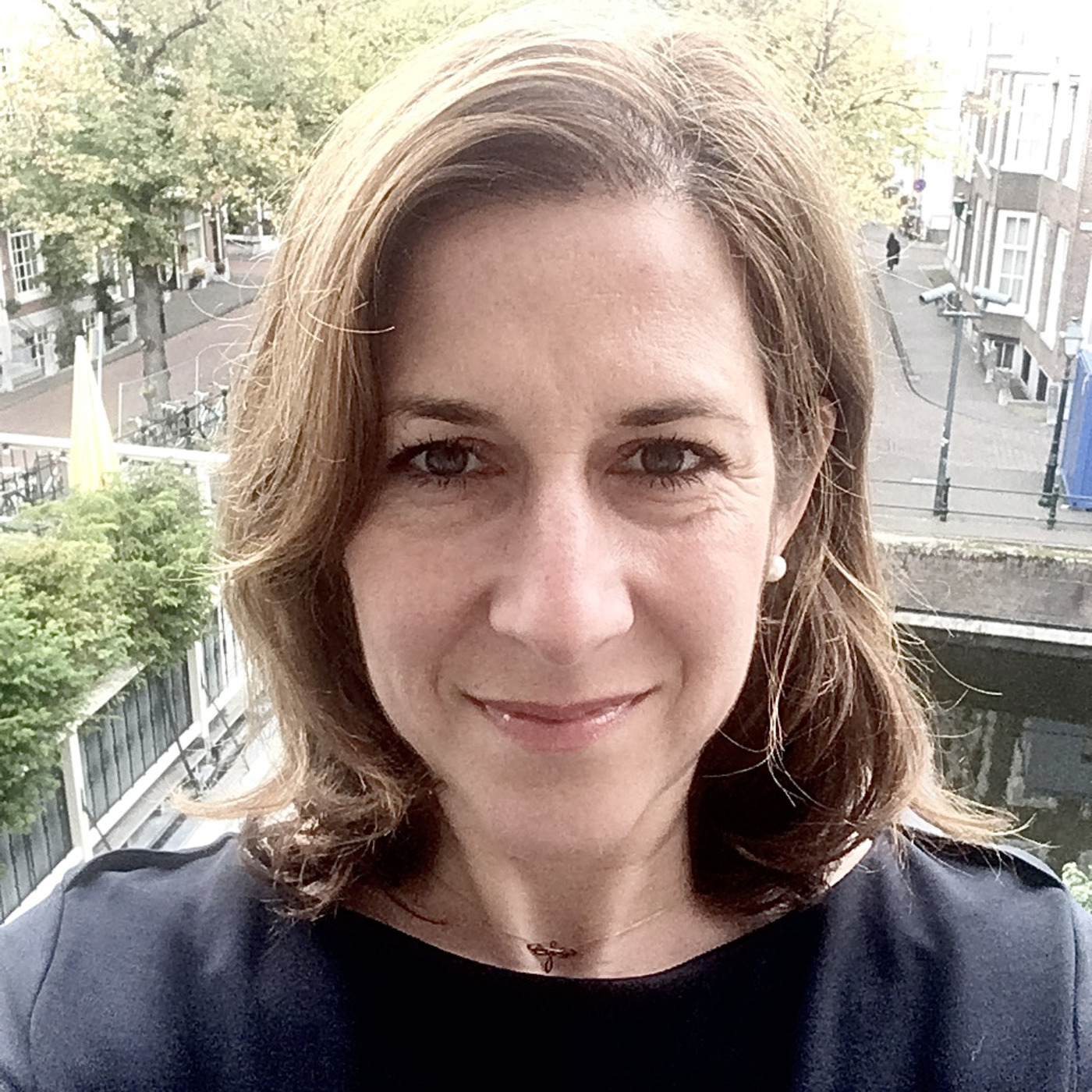
Aoifinn Devitt: Our next guest has pivoted from working in private practice to going in-house and then back again, where she is now a partner at Evershed Sutherland. Hear from her about her evolving practice from privacy into everything AI, how it is so important to understand the technology, and some of the words of wisdom she has gathered along the way. I’m Aoifinn Devitt, and welcome to this 50 Faces focus series. Which showcases the richness and diversity of inspiring people in the law. I’m joined today by Rachel Reed, who’s a partner and head of US Artificial Intelligence at Evershed Sutherland. She’s based in the Atlanta area. She started her career in law at the firm, then spent 18 years in a series of in-house roles before returning to the firm as a partner in May 2023. She’s a board director of Hop on a Cure, a nonprofit dedicated to finding a cure for ALS. Welcome, Rachel. Thanks for joining me today.
Rachel: Thank you for having me. It’s great to be here.
Aoifinn Devitt: Well, you’ve certainly had an interesting background, but can you, before we get to joining Evershed Sutherland initially, can we talk about your background before that, such as where you were born, what you studied, and what your path to law was?
Rachel: Absolutely. So I was born in Gainesville, Florida, which makes me a diehard Florida Gator fan. Hope that doesn’t alienate the listeners right off the bat. I ended up staying home for college and attending the University of Florida for undergrad. I had a couple of majors. First, I was a journalism major and switched out of that when I realized I couldn’t spell without spellcheck, and then ended up doing poli sci, getting quite interested in the law, finished up at Florida and went to Harvard Law School, which was a dream come true. Beautiful campus, great professors, learned a ton there, but I also learned that I do not like cold weather, having come from Florida. So after finishing up at Harvard, my choices, I was looking at either coming back to South Florida or to the Atlanta area, really just an area that had a big corporate law practice that was warm and relatively close to home. My family is still all in Gainesville, Florida. So I interned at a couple of firms and applied and ended up at Sutherland, Asbill Brennan, which was one of the firms that had been founded in Atlanta and had kind of a nice Southern feel, but also a very exciting corporate practice, which is what attracted me to that firm.
Aoifinn Devitt: And how did you make your way to this particular field of law, or did that come after your time in in-house roles?
Rachel: It really evolved throughout law school. So one thing I realized I did not like was sort of the debating, the public arguing, the mock court type exercises that we did in law school. I also, you know, as a first year, you have to take a standard set of courses, and I just found myself drawn towards the more transactional ones. So civil procedure and sort of being held to these, candidly, sometimes archaic rules of the court and artificial deadlines and things of that nature just didn’t really interest me as much. And so this is going to sound weird, but things like antitrust and intellectual property law, and I took as a second-year mergers and acquisitions class, it was really just what interested me, what got me excited. And then as I went through law school, I definitely picked pictured myself more as a commercial or transactional lawyer, not getting dressed and going to court every day. And since this is sort of a diversity-based podcast, I will say this was back in, you know, I graduated law school in 2001, and this was back in the day where women had to wear pantyhose and had to wear skirts, especially in courts in the South. And so a lot of that just really didn’t suit my personality very well. I wanted to dress how I wanted to dress and speak how I wanted to speak. And it was just a little bit more permissive. There were still rules back then for women, but it was a little— gave me a little bit more freedom to be myself, to be in a transactional practice.
Aoifinn Devitt: It’s interesting when corporate transactional practice is the relatively more liberal place to dress and behave, so that’s saying something. And then the transition you made from being in private practice to going in-house is a transition that many lawyers make. Can you talk us through what drove that in your case?
Rachel: Yes, and this was again, I mean, sitting where we are now in 2024 and looking back, it doesn’t feel like it was that long ago, but it really was. And it was a decision that a lot of mid-level women associates made at the time they were either getting married or thinking about having children, and it was really just the demands both of the job but of being in the office, which is also very interesting how that has evolved not just over time but post-COVID. But the demands were such that you really couldn’t even envision yourself being able to do that while at the same time raising a family or building a family. So I actually got a cold call from a headhunter about an open position. I was not looking for jobs. It sounded interesting, so I decided to explore it and go for the interview, and it seemed like a great opportunity. I had just gotten engaged, so I was at that phase. I was going to get married, and you could make a good living in-house, presumably with a much better work-life balance. I can tell you I learned a lot about that over the 17, 18 years, and it’s not always a great work-life balance in-house either, but at the time it felt like the right decision. I’ve made a few career moves, not career moves, but job changes over time, and I’ve always just sort of trusted my gut. And so that, that one was telling me it was the right job and I should take it, so I did. It worked out great. It also led me to my you next, know, role after that, and then eventually back to the firm.
Aoifinn Devitt: So pretty interesting. Anything that you didn’t anticipate in terms of the cultural change, maybe a change of pace? Having one client instead of many, not having access maybe to a huge layer of senior legal talent, which you would have in a law firm and maybe you don’t have in an in-house. And what were some of the things you missed maybe and observed maybe that were less expected for you?
Rachel: Yes, well, the support is definitely the hardest part of the transition, I think, from law firm to in-house. And not legal support, right? Secretarial support, IT support. You sort of get pampered in a law firm because you’re the profit center. Right? And once you go in-house, suddenly you’re a cost, an expense, and everything that comes with what you do is an expense to the company who is focused, right, on its profit centers, which are in the business. So that’s definitely an adjustment. What I liked a lot was having more responsibility and more autonomy, as well as a broader breadth of responsibilities. I think especially as a younger associate in a law firm. We do, and I think this is true a lot in the transactional practices as opposed to litigation, we sort of put people by level into pretty narrow predefined roles. So if you’re on an M&A deal, you’re in charge of due diligence or disclosure schedules, right? We don’t give them sort of the breadth of experiences and types of work that you get when you’re part of a small in-house team and you only have 8 people, right, to support a multi-billion dollar company, and you have to take on additional roles. So my first in-house job was with a healthcare IT company. I was hired primarily to support a particular sales organization in a region of the country. So we sold healthcare software and technology products, but before long there’d be another need, right? Like, oh, the business is building a new outsourcing business and they need counsel. So you would take on those other things. And then there are just sort of the side projects, you know, legal has to be involved, but it doesn’t fit neatly in anyone’s space. So there are a lot of opportunities to learn different things, to do different things, and to take on more responsibility. And candidly, as a young associate, that’s not always within your control.
Aoifinn Devitt: What drove the journey back then into private practice after 18 years? That perhaps is less typical of a move.
Rachel: Yes. Although as I go through this journey, I am finding more and more people who are what we call boomerangs, have left the law firm and then came back. So to the earlier, I sort of alluded to in-house is not always a great work-life balance. I had progressed with the company I was at over the course of almost 15 years. I had taken on a huge scope of responsibility. I felt like I had sort of done everything I was capable of accomplishing at that company. And I will say there’s a little bit of a sense of burnout because other people change, right? So one of my roles, for example, was supporting the IT organization. And if there’s a change in one of the IT leadership roles, you sort of feel like you’re going back and doing the same thing again to build those relationships and partnerships. The other thing that I always caution, I don’t know if caution is the right word, but advise lawyers who are thinking of going in-house is that inevitably at most companies, the more senior you become, the more your day-to-day shifts from doing quote unquote real legal work to administration, management, managing up as much as managing down, right? Managing outside counsel, budgets and things of that nature. So I was missing on some level doing more of the pure legal work, but it’s also, you know, that’s what keeps me stimulated is the learning and growing in new things. And when you feel like you’ve sort of hit the ceiling in a role, for someone like me, that means it’s time to move on and find the next opportunity.
Aoifinn Devitt: And speaking about the meat of the legal role, which clearly the areas you’ve been in could not probably be more top of mind, privacy and AI, and privacy was primarily some of the, in the in-house work that you did. Can you talk us through, let’s start with privacy. I’d love to talk about some of the issues and aspects that you think as an expert in this field, we’ll be hearing more about as laypeople perhaps in years to come. What are the hot button items and some of what’s on your mind?
Rachel: So thank you. That’s a great question. And I get accused sometimes of bringing every question back to AI. But I do feel like we are at sort of this pivotal point in this technology evolution, and AI is going to impact everything we do. But taking a step back, right, the world we live in has been shifting more and more over the years to an online, digital, data-driven world. And I think partially COVID accelerated that. But also it’s the rise of social media. It’s the fact that teenagers now, right, that’s how they interact. And that’s been the case for years. And that’s now who’s entering the workforce. So, so many of our interactions socially as a consumer and as a professional are now happening in the digital world. And that creates data, right? So everything now is data-driven. And I imagine a lot of companies are having regular discussions like, how do we become a data-driven company? We’re going to lose a competitive edge, right, if we can’t be a data-driven company. So the drive to collect data, to use it in different ways, and just the proliferation of data in cyberspace, right, that’s happened over the past few years is going to emphasize privacy, I think, above everything else. We’ve seen that that’s how the laws and regulations are evolving. So if you look even just in the US, but certainly in Europe and other places as well, what has happened over the last few years is not just that we’ve had additional states, for example, adopt privacy laws. There have been amendments and states have taken steps to, for example, broaden what they consider personal information, right? So if you go back to the early 2000s when I started practicing, personal information was like your Social Security number. That was basically all anybody cared about protecting. And now we have Internet activity, IP address, geolocation data, sort of all these ways we’re interacting with digital technology that are tracking our devices, right? Not just what we would think of as information associated with our person. So we’re broadening those definitions. We broaden significantly, starting with the California Consumer Privacy Act, the rights of individuals to exert some sort of control over their personal data. And then now we’re layering on top of that artificial intelligence technology, specifically generative AI, which is going to process just these vast quantities and volumes of data unlike anything we’ve seen before. And the privacy implications of that are quite significant. So I think not only are we already seeing this proliferation of laws specific to AI technology, folks are going to find that existing privacy laws are also going to be implicated by that technology. And I think if regulators see a gap or a disconnect between existing privacy legal landscape and AI technology, I think we will see them move very quickly to close those gaps with amendments or additional laws and regulations around privacy and protection of personal data.
Aoifinn Devitt: And how do you see it from a corporate standpoint in terms of a policy around privacy? Clearly there’s that trade-off as a corporation between the amount of data you can use and commercialize versus observing privacy norms. Privacy policy can become virtue signaling of sorts from corporations. And equally from the consumer side, don’t consumers maybe underweight it sometimes, their own privacy, until it really matters because they’re keen to get a free app or something of that nature? How do those kind of human issues factor into the advice you give?
Rachel: I think it’s for most corporations, it’s all about trust, and that can be managed in a number of different ways. And I think it depends a lot on the industry and the type of company. But for privacy laws and ethics generally, I say, always say kind of the good thing is that they’re very principles-based. So you don’t have to understand all, you know, 50 states’ privacy regimes if you follow a set of pretty basic principles that include notice, transparency, consent, accountability. So people want to know what personal information you’re collecting as a business, who you’re sharing it with, what you’re doing with it, how you’re processing it. I think that for all companies, right, if you want your customers, your consumers, even if you’re business to business and you’re doing data to preserve that trust, you have to be candid, transparent, and truthful about your privacy practices. And then I think consent is the other big one. And a lot of times, yes, the consent might be buried in terms and conditions or teeny tiny script when you’re agreeing to download an app or things of that nature. And there my advice is sort of take the reasonable consumer standard and the nature of your business and make sensible risk-based decisions. So if you are a financial services company and you want to kind of share data with retailers for marketing, like that is not something I’m going to expect when I go open a new savings account, right? That then my data is suddenly going to be used for marketing. If I’m downloading a gaming app, right, then I’m going to say, yeah, probably whatever I enter into this app is going to get sold to someone or shared with someone, right? Because that’s the nature of that world and that industry. So I think understanding what reasonable consumers anticipate and then meeting those expectations. So it’s not to say that the financial services company can’t sell my data,. But I would probably make that in a big bold disclosure or something that requires an affirmative click or a checkbox, right? When the person is agreeing to those terms, not buried further down in the terms because it’s not consistent with expectations. So if you think about, you know, what does the consumer expect and what do I need to do to sort of preserve their trust in me as a responsible business? I think that will get you a long way towards privacy compliance.
Aoifinn Devitt: That certainly seems like a very fundamental way of determining what regulation should be in place or what approach should be taken. When it comes to AI, we’re probably all dealing with such a novelty and the deluge of information and expectations and a sense of not knowing the direction of travel really of different areas. How do we make sense of that? And what’s really focusing your mind from a legal standpoint right now when you speak with companies and your clients?
Rachel: So number one, and where I always start, is understanding the technology itself. And a lot of lawyers in particular look at me like I’m a bit crazy when I say that, but I started as a baby lawyer doing technology contracts and trying to understand life insurance systems and things of that nature. But if you don’t understand what the technology is, how it’s developed, how it’s trained, and how it’s implemented, it will be virtually impossible to advise from a legal perspective or even from a business or a risk perspective on how to appropriately manage that technology. And it’s not intuitive. So every— I’ve been doing a lot of speaking on AI for companies, for clients, for lawyers across the board. And the slide I always spend a lot of time on is actually a diagram of the tech stack, right? So how, when you implement generative AI solution, what it actually looks like, and there are 5 layers. Layers, you know, including your infrastructure layer, which is basically either the cloud environment or the data center. There’s layers of software, there’s where the actual large language model sits. And then there are layers on top of that. And that has been eye-opening for a lot of the folks I’ve spoken with. But it helps explain where you can control what a generative AI model does and where you can’t, and helps you understand what questions you should be asking the vendor if it’s a vendor solution or your own IT if it’s an internally developed solution. And it also helps again, as lawyers, a lot of time our job is to apply law to facts. And I think these are critical facts, right? So you need to collect the relevant facts about the model. How was it trained? What data does it use as inputs, right? What guardrails have been put to restrict or contain the outputs? Things like abuse monitoring, or you can sometimes customize systems so they’re less likely to put defamatory language or offensive language, right, as outputs, things of that nature. But again, if you don’t understand the technology and the building blocks that went into it, it’s going to be very difficult both to really understand why generative AI comes with the inherent risks it does come with, things like bias, right, things like hallucinations, it’s because of the way those models were built and trained. So it’s to help you understand that. And then as, and I like to assess AI in terms of use cases, right? So the technology has such broad functionality and applicability, you could apply it to almost anything. So when a business is trying to make responsible and ethical decisions, I say you need to look at it as a specific use case. And first you need to understand the technology And then you need to understand who’s going to use the technology and how. And then you have what you need to do a proper legal assessment, right? Looking at the current laws and applying it to that particular use case.
Aoifinn Devitt: And with both of these areas, privacy and AI, what I think of when I think of these is, are we running to standstill to a degree because it is advancing so quickly? Can the legal side keep up? And it seems a little bit like the cybersecurity dilemma that, you know, we are furiously trying to keep up with the hackers who are ahead of us in that respect. How would you say the legal capabilities around these fast-moving areas are developing?
Rachel: So the law will always lag behind the technology. That’s something we’ve been seeing for decades. The EU is acting much faster than the US, as we’ve seen, and they’re trying to keep up. And that will likely sort of set the benchmark. But what we have done in the United States with these sort of broad federal regulatory regimes is cast a wide net. So, for example, the FTC Act generally prohibits unfair and deceptive trade practices in interstate commerce. And that law has been used historically in the absence of federal privacy legislation to enforce privacy violations along the lines of my privacy notices X, but I’m doing Y with the personal data I collect. That has already been applied to cases of what the FTC has deemed to be misuse of AI technology. So back to those principles, the same ones often apply to AI: notice, transparency, consent. If you’re interacting with an AI system, if it’s making a decision that could impact an individual, certain rights, inherent rights are inferred in those instances. And so we see the federal agencies using existing laws. If they find anything that they think is unfair or deceptive to consumers generally, they will act on it. We’ve seen similar enforcement by other agencies such as the Fair Housing Administration. If you use an AI algorithm to distribute rental housing ads to web browsers, right, and that algorithm is triggered by assigning a certain zip code based on the IP address, and that zip code determines whether the rental you know, ad is displayed. In the United States, zip code is a proxy for race, so that violates the Fair Housing Act. So what I would encourage folks is two things. We are not going to be able to stem, I don’t believe, the proliferation of AI systems and everything we do. I think that horse is out of the barn and it’s not coming back, and it’s going to rapidly proliferate because in the tech world right? It’s a race to not be left behind. So every SaaS vendor, right, every infrastructure as a service vendor, every real big tech vendor is enhancing their products and services with AI right now. And they’re just going to push it out to their customers, right? And customers are not really going to have a choice. The choice is going to be use the old technology or use what the vendor is now offering. And the idea is to use it responsibly, as best we can in the absence of prescriptive laws and regulations, right? So we’re going to have to use sort of responsibility and ethics as a guide. We have things out there like the NIST, National Institute of Standards and Technology, Standards and Technology has an AI risk management framework that is also principles-based that companies should be applying. So I think it’s finding that medium, making sure you have governance in place and that folks are thinking about the implications of the AI you’re using and deploying, remembering that we do have an existing set of laws and regulations that can be applied, and then really staying attuned and staying nimble for the developments that will inevitably come at some point.
Aoifinn Devitt: And you touched on this. It’s clear that AI is going mainstream. It’s being integrated into everything. Do you think this as a practice area will stand alone going forward? Will it be folded into, maybe sit alongside intellectual property or privacy or where if somebody, a lawyer entering the profession now, wants to specialize in this area, where will this practice area sit?
Rachel: So what we have decided as a firm at Evershed Sutherland is that it’s going to sit in the data privacy, cybersecurity, and technology function. I think it goes hand in hand with data privacy, and I think the two are inseparable. The same way though, I think data privacy goes hand in hand with cybersecurity, and I know some companies separate those functions and treat them differently. What I believe is going to happen and why I think clients and law firms will be best served by combining those functions is that eventually, at least in the US, the legal and regulatory landscape is going to become so complex and there’s going to be so much overlap between the privacy laws, the security laws, and the AI laws and regulations that you will inevitably have to become well-versed in all of those bodies of law to be effective in your role as a lawyer. And so they’ll naturally become combined and become part of the same function. I think the part that’s going to be hard for some sort of pure privacy lawyers to get up to speed is that you really do have to understand technology. So there’s sort of an intellectual property rights component of that. There’s a, do I know generally how hardware and software is run in a business? Those are things that can be learned, right? They’re not inherent. You don’t have to go back to law school to learn these things. But I think having an open mind and really starting to understand the tech world, how technology is built, and then how it’s licensed regularly to customers, and how does a software as a service differ from an on-premise platform, just those types of things folks will have to get up to speed need. But as far as sort of a legal practice area, I think with that underlying foundation in the tech, privacy, cyber, and AI fit very nicely together. And if you’re not combining them, you’ll need to have, you know, make a friend in the other practice group and have close partnerships with others who work in those areas.
Aoifinn Devitt: Clearly a highly dynamic and fast-growing area. I’d love to change gears now a little bit just to what you said was tantalizing in terms of the work-life balance. And how that can ebb and flow regardless of being in private practice or in-house. And this podcast, as you noted, has a particular focus on minority voices, less heard voices, and around diversity. I’d love to hear from you, I suppose, how you rate the legal profession today. How do you think it’s doing today, maybe compared to when you started your career, and any impressions on what it can do better?
Rachel: That is a very deep question. It’s near and dear to my heart. And I want to answer honestly, but also be kind of respectful of the organizations that have given me you opportunities, know, over my career. There have definitely been improvements, but not nearly enough in my opinion. And I think that’s true for both in-house counsel as well as law firm counsel. So one of the organizations I was fortunate to be sort of nominated to participate in when I was in-house with something called the 30% Club. And they endeavor, right, their mission is to get at least 30% women at senior management and board-level positions. And so when I first went to the first meeting and you get matched up with a mentor, my first question was, why 30% when women are 50%+ of the population, right? And so if that tells you anything, right, it’s like, Yes, people care more now. They’re doing more, but it’s, it’s still not enough. In the law firm, I mean, again, some of the old-fashioned ways have gone by the side, but I still hear stories about certain judges in the Deep South, right, that female lawyers are like, if I showed up in pants, I would be kicked out of the courtroom. I think that is ridiculous, right, in this day and age. The other thing that I’m still seeing as a challenge is is the pressure on hours and time for younger and mid-level associates. And I see it in ways that appear to affect the women more so than the men. And I will say I have a stay-at-home husband. That was a decision we made right after I finished my maternity leave. And I— we have one child. She’s now 13. She’s amazing. But he is the parent that drives her to school, that picks her up, right? That takes her to bass lessons in the afternoon. And when we get the call that she’s not feeling well at school, goes to pick her up, right? There are just a lot of responsibilities of parenting. And so sometimes I even think, am I the right person to be telling people how to find this work-life balance when I have a full-time adult basically helping manage my family and other people don’t? What I am trying to do back at the firm is be a resource, a sounding board for all of the female associates. I want them to see someone who hopefully has made it work, but also am willing to share with them that it’s really hard sometimes, right? And this is a demanding job and there are times when you just have to make decisions and sort of hope for the best. And I think as a young woman in this field, I think we feel, especially feel the pressure to not say no to more work, to not admit that it’s gotten to be too much or I need a break or I need someone else to help with this because I think we worry it’ll be seen as weakness or lack of commitment or things of that nature. So I am trying to help with coaching to say like, no, that’s just life, right? Everybody needs a break sometimes. There is absolutely absolutely no reason you can’t be both a successful law firm lawyer and a parent and a spouse. And, you know, whether you’re a pet parent or whatever you are, it’s okay to have interests and commitments outside of the office. And I try my best to both demonstrate that with what I do, as well as both talk the talk and walk the walk, and hope that I can help at least our firm retain female talent. And make it just a really safe and comfortable place for them to work and grow.
Aoifinn Devitt: That is wonderful. And sometimes I think it’s about life hacks as well, sharing life hacks that maybe have made it easy for you because clearly you have a massive amount to stay abreast of in terms of technology, privacy changes, AI. And those are things that, you know, take time and the job is hard. So I think combining that with a family, a foot cannot be taken off the pedal much in this profession. And I suppose it’s a way of how to keep it on while not compromising other sides. So I do think sharing practical things can often matter quite a bit. And just a final point on that, have you seen any particular things like affinity groups, women’s circles, special kinds of leave, maybe emergency childcare, or any particular hacks at a professional level that you found particularly impactful?
Rachel: What I found most helpful is just building a support network. And for me, that’s both with, among my clients. So I have an Atlanta Women Attorneys group where we meet really just to socialize, to vent, to form and deepen friendships. There’s really not a pure business aspect to it, but I find that the more you make the time to connect with similarly situated, right, high-powered, hardworking moms in other positions and just being able, like you said, to share tips, best practices. I think at our last event, we were exchanging Amazon shopping carts because someone had found the perfect under-desk treadmill that you could walk on. So things of that nature, really just building a network and a community. And then I think it’s just not being afraid to ask for help. There are a lot of amazing women out there who want to champion other women, myself included, and I’ve been the beneficiary of many of them along my career. So really just understanding that you are not alone in what you’re doing and reaching out if you need help, but looking for these opportunities to sort of form these networks and groups because you can all rely on each other and you’ll all be the better for it.
Aoifinn Devitt: That’s a good segue actually to the question on reflections around mentors and key people, given you have clearly a set of peers there. Was there anyone in particular that mentored you? And sometimes the answer to this is no. But I’d love to know, through your career, was anybody particularly impactful?
Rachel: I have had several along the way, and interestingly, the two that come to mind are both men. So I do want to say it doesn’t take, you know, you don’t need a working mom as a mentor if that’s what you are. I think you can pick up really great advice from others. But one was when I first started at the firm, and it was a partner who who took me under his wing and really taught me the basics of software and technology law, which started me down this path. And it’s really, I think, when someone just makes a commitment of their time to your learning and betterment, from someone like me, it really makes a big impact. And so I think look for that, look for cues. If someone’s willing to take your meeting request and sit down with you for an hour and explain something to you, like, that’s a good person to kind of stay close to and think about as a mentor. And the other was in one of my in-house roles, one of the general counsels. I think learned a lot from him in the non-legal aspects of in-house work in particular, but even a law firm, right? We’re a business as well. We have accountability to our other partners, to the COO, and, you know, so it’s still the aspects of business and how much of it is really relationship-focused. So sort of about building trust, maintaining trust, figuring out the best way to work and collaborate with either your peers or whoever’s higher up in the organization. So I think it was two different things. You know, the first mentor was more substantively, and then the second was more of the soft skills. But I think both of it, it’s taking the time I think everyone is so busy. If someone’s taking the time, it shows that they care and they’re willing to invest in you, and people really appreciate that, myself included.
Aoifinn Devitt: I think it’s interesting, people often say, how will I know who my mentors should be? I think they make themselves known because of this behavior. Often it is a natural thing. And staying on the personal reflections, when you look back at your career so far, private practice, in-house, and then back to private practice, were there any particular highs or lows that you can recall and maybe any lessons learned from the low points?
Rachel: There are definitely points, and it’s usually early on in each move when you second-guess yourself, right? And it’s like, oh my God, did I just make a terrible mistake in switching to this job or that? And I think I’ve had them. So I 1-2-3 every time I switched. And so my advice is be patient with yourself. And I remember some of the best career advice I ever got was from a woman who hired me for one of my in-house roles. And she said— and I was pregnant with my first child, first and only— and she said, don’t make any career decisions until at least a year after you come back from maternity leave. And that was huge, right? Because things obviously seem very overwhelming. So I made the same commitment with my job changes, right? And said, OK, I’m panicking a little bit, but I’m not going to make any decisions. I’m going to give it a year. And inevitably it worked out. And so I think, again, trusting your gut is really good. It was hard to leave a role after almost 15 years, but everything was telling me that now, you know, that it was the time. And then same with coming back to the firm. That was not necessarily my first or only option, but you after, know, thinking through the choices, discussing it with my family, and my gut kept saying like, I think I do want to give this a try, I think this work. So being trustful of that, and yes, it was super hard. I mean, the first 6 months, I think, I don’t— I think I blocked it out. It was a bit traumatic, but now I’m getting in a groove and I am really enjoying what I’m doing. So I think there are no wrong choices if you trust your gut. Don’t ever feel like you’re stuck in a role or a position. If you feel that way, reach out, ask for help, find a mentor, especially I think for lawyers and for women lawyers. There’s so many opportunities out there. And just keep an open mind for them.
Aoifinn Devitt: Well, thank you for normalizing that feeling, that knot in the stomach in the first few months, ’cause I think many, many people will identify with that. And just a couple of closing questions. So can you talk about any, the cause in particular that’s close to your heart and the work you do with Hopin’ a Cure and ALS?
Rachel: Absolutely. So Hopin’ a Cure was founded actually by a friend and neighbor of mine, John Hopkins, who was a founding member of the Zac Brown Band. He was diagnosed with ALS unexpectedly a few years ago. And really part of this is the sense of the neighborhood I live in. We’re all very close and dedicated to each other. But the more we learned about it, ALS is one of the least researched and most prominent diseases out there globally. And it’s one of those that we firmly believe can be cured if we can get the right money and dedication to research and researching cures. So a bunch of us have banded together to do this. We’ve raised a lot of money and made grants to researchers, experts in this area. And it hits home, I think, seeing someone you know and you’re close to going through the progression of this illness. And I know people have similar experiences, you know, almost everyone has a close friend or a family member who’s dealing with some sort of illness. And I think just giving giving back is what is most important. It doesn’t matter to what, but finding something you care about and finding a way to support it. It doesn’t have to be financially, but by volunteering or again, for the attorneys out there, joining a nonprofit board, I think is a great way to give back.
Aoifinn Devitt: And you’ve already littered this conversation with a lot of great words of wisdom, particularly on the career front. My last question is whether you have any creed or motto that you live by or any words of wisdom that you can leave us with?
Rachel: Yeah, so this might sound a little bit ordinary, but it’s really be authentic, be true to yourself. And I realize that’s easier said than done. And I also realize it’s easier the older you get. I think both because you sort of have more leverage, you’re more established, more experienced, but also you’re just more confident being yourself and doing what you want to do. But I think it’s really never too early to start. At least being as true to yourself as you can. Yeah, I do have to dress professionally sometimes, even though I’d rather be you wearing, know, yoga pants and flip-flops. Little things like that. But bring as much of your true authentic self to work as you can every single day, and don’t be afraid of that. It’s exhausting otherwise, is what I found. And we want, right, we want to live these sort of fulfilling, whole lives. And for me, that’s the best way to do it. So if I’m starting to feel like either I can’t be myself or I’m not doing it, to me that means something needs to change and I need to do some reflection.
Aoifinn Devitt: That’s a wonderful conclusion. Certainly there is little room for exhaustion caused by inauthenticity. Plenty of other things legitimately giving us exhaustion in the lives we lead. So I think your authenticity has shone through this podcast. Rachel, thank you so much for coming here. You have made some pivots in your career that are not easy look effortless and graceful. Remarkable. And similarly, the ease with which you seem to have mounted these learning curves that are seismic in terms of the changes in the profession is quite remarkable. So thank you so much for sharing your journey.
Rachel: Thank you very much. It was my pleasure.
Aoifinn Devitt: I’m Aoifinn Devitt. Thank you for listening to our 50 Faces Focus Series. If you liked what you heard and would like to tune in to hear more inspiring lawyers and their stories, please subscribe on Apple Podcasts or wherever you get your podcasts. This podcast The podcast is for information only and should not be construed as investment or legal advice. All views are personal and should not be attributed to the organizations of the host or any guest.


Aoifinn Devitt: Brought to you with the kind support of DLA Piper Ireland.
Maud Sarliev: And in French, it’s: Impose ta chance, sers ton bonheur, et va ton vers risque. À te regarder, ils s’habitueront. So basically means stick to your guts, believe in yourself. It won’t be easy, but you’ll get there, and people will look at you and follow your path if they find it inspiring.
Aoifinn Devitt: I’m Aoifinn Devitt, and welcome to this 50 Faces Focus series which showcases the richness and diversity of inspiring people in the law. I’m joined today by Maud Sarliev, who is an expert in international criminal law, international humanitarian law, human rights, and a leading authority in the development of creative legal thinking to address the environmental and climate crisis. Her professional commitments and casework have taken her to conflict and post-conflict environments in Southeast Asia, the Middle East, Central and Eastern Africa, Latin America, the Balkans, and Eastern Europe. She is currently judge assessor with the French National Court of Asylum, a founder of Control Z focused on climate and environmental justice, in addition to numerous other roles. Maud grew up near the Massif Central in France and moved abroad to the Côte d’Ivoire as a young child. This experience of living abroad and being enmeshed in different cultures inspired her to choose law and commercial law in particular in order to enable her to have an international legal career. Welcome, Maud. Thanks for joining me today.
Maud Sarliev: Thank you. It’s a pleasure to be here.
Aoifinn Devitt: Let’s start by talking about your career journey and what first interested you in going into law and international law in particular.
Maud Sarliev: Initially, I read international and EU law because I wanted to learn and, and live abroad again, and I saw business law as the best way to achieve that, which I was wrong about, basically. I went from being a first-class honours student to being a failed commercial lawyer. Which was very hard to accept at the time, but probably the best thing that’s happened to me. So after that, I decided to start from scratch as an intern with the Khmer Rouge Tribunal in Cambodia, and the rest is history.
Aoifinn Devitt: It’s interesting, my next question is usually around surprising turns, but I guess that was the surprising turn there, finding your passion in a different area. I’d love to now talk about some of those areas, because international war crimes, human rights evaluations, huge issues, highly complex and systemic. And sometimes I would say it seems to the outsider that progress in making change is slow and can sometimes be protracted. How do you cope with maybe the lack of measurable success and lack of feedback in dealing with some of these big issues?
Maud Sarliev: When it comes to how to cope with it, I try to focus on the objective that the values that I stand for and the general interest rather than my own, which sounds very corny and perhaps self-indulgent, but it’s far, far from easy.
Aoifinn Devitt: I remember when we spoke earlier, you used the story by the Amerindian philosopher and environmentalist Pierre Rabhi to illustrate this point. So if you don’t mind, I’d like to just read this story now in full so that our listeners have a full appreciation of its beauty. The Hummingbird’s Tale by Pierre Rabhi. One day, a long time ago, and in a faraway place, or so the legend goes, there was a huge forest fire that was raging in the countryside. All the animals were terrified, running around in circles, screaming, crying, and helplessly watching the impending disaster. But there, in the middle of the flames and above the cowering animals, was a tiny hummingbird, busy flying from a small pond to the fire, each time fetching a few drops with its beak to throw on the flames. And then again, and then again. After a while, an old grouchy armadillo, annoyed by this ridiculous, useless agitation on the part of the hummingbird, cried out, “Tiny bird, don’t be a fool! It is not with those minuscule drops of water, one after the other, that you are going to put out the fire and save us all!” To which the hummingbird replied, “Could be, but I’m going to do my bit.” So a really beautiful story there that captures the idea of everyone doing their part. And you’re a leading authority in the development of creative legal thinking to address the environmental and climate crisis. Can you give us an example as to how this works exactly, this creativity?
Maud Sarliev: One good example is something that I remember from when I was reading family law and we were going back into history and the professor was telling us, yeah, and up until ’94 in France, adultery was a crime. And you’re like, what? I’m sorry. It took a long time to accept something that was already accepted in society and had been accepted in society for years. Maybe not as much as accepted as we would’ve wished for. So that’s what I see with the climate and environmental crisis is that the law is lingering behind, but there is so much will and determination from the scientific community, from parts of the legal community that I think the next step is to get the lawyers and the scientists together and have them take the bridges between their respective jargon and bubbles down and make each other understand where they’re coming from and where they want to go, and then bring that to policymakers so that the law is changed and adapted to the challenges of our time.
Aoifinn Devitt: No, it’s really interesting. I suppose around human rights and your right to, say, a clean environment And that seems an area that definitely lends itself to hybrid, or at least hybrid thinking. And then also there’s an increased awareness as well of ecocide, especially in the current situation in Ukraine, and a lot more media attention to that.
Maud Sarliev: We all depend on clean, like breathable air and clean water and edible food. And without a sustainable, healthy environment, there’s no access to that. And similarly with ecocide, ecocide is even more blurry in my view, because It all comes down to the fact that the environment is, as a notion, as a concept itself, is very dynamic and very fluid, so hard to define. But what’s incredibly interesting and also incredibly depressing when it comes to Ukraine and the conflict that’s been raging since even before February 2022, because it started in 2014 with the invasion of Donbas and Crimea and the annexation of Crimea, but it’s really like where everything seems to be shifting. And also there’s an alignment and presented alignment between the political will of a government and its president on the one hand, with a 10-point peace plan of President Zelensky that lists ecocide and clean water and nuclear and energy safety as each of the 10 points on the one hand. And on the other hand, a real strong and solid determination of the Prosecutor General’s Office to hold accountable those most responsible with the environmental impact of the conflict. And here, because the law is not there, they are pushing Instead of reinventing the wheel, the idea is to push for the interpretation of the existing provisions and see how far they can go and explore the limits of these provisions. And as you, I think you said, just to be clear, in Ukraine they have a provision in the Ukrainian Criminal Code that defines ecocide. And it’s going to be very interesting to see how the Ukrainian judiciary is going to approach that and explore indeed the limits of that particular provision. Similarly, they have another provision that allows for the transposition to some extent of international humanitarian law into the Ukrainian internal legal order. So what does that mean? Which provisions that already exist are going to be applied? To which extent? How can we demonstrate the existence of their elements? For example, you have a particular additional Protocol I to the Geneva Conventions, which is quite interesting because it defines in its Articles 35 and 55 as a war crime, like any attack that’s caused long-term widespread and severe damages to the environment. So how is that going to be interpreted? Then at the ICC level, before the International Criminal Court, if the prosecution’s office considers that there are reasonable grounds to believe that crimes under the jurisdiction of the ICC defined by the Rome Statute and impacting the environment have been committed.
Aoifinn Devitt: It’s interesting that you are, for the most part, trying to find the answers within existing law, existing legal frameworks, and not reinventing the wheel. Is that because that would just take too long?
Maud Sarliev: Unless you want to do it the French way and have a revolution in 1789 and end in 1873, trying to recreate everything has, in my view, never been the easiest and fastest and most constructive and effective approach. And when it comes to environment and climate, Most of the time, the legal frameworks are there, or the beginning of an interesting legal framework is there. So test it, see how it works, how it doesn’t work. And if it doesn’t, then you have a practical case, a study that you can use and work out from. I think everyone’s efforts is important in, in that particular field. And again, that goes back to building bridges, building bridges between the practitioners, between academics, between the scientists and the policymakers, to have everyone’s perspective on board and then take it there and see which solutions are the most acceptable for everyone. And that’s why the right to healthy environment, concepts like the right to healthy environment or ecocide, all the campaigners behind it, behind these two concepts and others, are so important. Similarly, in the Aboriginal culture or the Māori culture, brings along people whose interests are usually completely sidelined, such as the interests of indigenous people and communities who have a completely different approach to environment. They see it from a philosophical standpoint that’s not comparable to the way we look at it in, in the West. They give them rights and considers nature as an entity that should be protected for itself.
Aoifinn Devitt: I love that systems thinking approach and drawing inspiration from how other societies view the environment and I suppose the role it plays in their lives. So I think that that’s really interesting. When it comes to recognition of some of these crimes against the environment, do you think that society, despite the fact that they get a lot of media attention when they happen,, but then it blows over perhaps. Do you think that society is taking them sufficiently seriously?
Maud Sarliev: A lot of people do not necessarily realize that the environmental impact of a conflict is not about birds, bees, butterflies, or hummingbirds, but it’s about the future of, of mankind. Because when you have farm fields turned into minefields, when, when you have water contaminated by industrial pollution or oil spills, when you have the air turning and bore because of chemical plants exploding or any sort of industrial accident. It’s not only one person, one geographical location that’s impacted, it’s that person and their family and friends, and it’s for the generations to come and beyond. And one example that I usually use, which may come across as a bit shocking to people, is to me, when someone is a victim of rape, men or women, it’s not only them that’s being impacted, and it’s not only now, it’s also in the generations to come and beyond. If you look at the impact and damages caused by the Kakhovka Dam catastrophe disaster that happened a few days ago, a few weeks ago, Or if you look at the impact of what has happened in Nagasaki and Hiroshima with the nuclear weapons being used, isn’t it comparable? So it’s not only, again, birds, bees, butterflies, and hummingbirds dropping water to, um, raging fire. It’s really about us as humanity. We are shooting ourselves in the foot unless we adapt. Our legal framework and our policies to the stakes.
Aoifinn Devitt: Well, some very profound ideas, I think, to ponder there. So thank you for raising those and I think making them real for us because I think it has to be done. I’d like to just move from there to some reflections on your career so far. First question is around diversity. This is a podcast series that focuses on diversity quite a lot. We look at the evolution of diversity and inclusion throughout professions. From your experience in law, how has your experience of diversity been? Have you seen— is it improving throughout your career so far?
Maud Sarliev: Well, I’ve been really lucky. So in Cambodia, there was a lot of diversity because it was a hybrid tribunal with Cambodian colleagues, and within the national side of the tribunal, we had a lot of Westerners. It was more North represented South. And then in Kosovo, again, working with Kosovars and then the international sides, you wouldn’t have a lot of diversity in terms of color, to say the least. And in the Special Tribunal for Lebanon, again, you know, the Lebanese, there was a lot of Lebanese and Middle Eastern representation, which is completely normal. But on the international side, I saw a little bit of evolution towards important, but not as much as one would wish. And now what strikes me, now that I work a lot with my international colleagues in Ukraine and other conflict zones, is that I don’t see many women, I’ve got to say. So the not so positive developments that I notice, or have noticed lately, and that’s specific to my experience as a sure it’s going to change and evolve. And that being said, so from I started where I was convinced that women representation was no longer an issue and we’d already won that battle, I’ve noticed that you have fantastic networks such as the Atlas Network, which is a network of women in human rights, international criminal law, with a Facebook group and I think 6,000-7,000 members now, with little groups in different cities on all the continents, which is developing, and where we provide support to younger women— and women, sorry. And so that’s a really interesting and positive development. And another network that I find incredible in that same sort of vein, not only for women but for students around the world is the network that’s being built around the PiCTA competition, which is a competition on international humanitarian law and international public law. It’s taking place at least once a year in a different city of the world where there have been conflicts, and that summons and convenes teams of 3 students from all over the continents. You know, you have loads of African teams represented, loads of South American teams, loads of Asian teams, and that’s incredibly positive in terms of diversity. I was actually speaking in a lecture where I was invited by former Pictaist, as we call ourselves, last week to talk about environment, climate, and international criminal law and international humanitarian law and how bridges can be built in that respect. And I think it’s incredibly important to have the voices of our African young researchers, lawyers, and practitioners heard when it comes to these debates.
Aoifinn Devitt: Absolutely. Well, we’ll put links to all of those organizations in the show notes, so look forward to that. But just wanted to quickly now move to you advising young law student who wants to enter your field. As I, I said to a friend of ours, Angus, who also works in the same field, it does seem for some like the dream job. What advice would you give in terms of entering the field of international law? Any steps you recommend?
Maud Sarliev: If you think that’s your call, then just try and persist and be determined. I have many, many examples around me of people like Kip Hale is another one, and Angus and others who have been extremely persistent in their approach to the international world. And you have many ways to get in. You can go The UN or international tribunals, NGOs are not the only answers. You can work your way in through reaching out to your connections and, or just emailing someone that you find interesting, asking if that person you’re very impressed by doesn’t respond to your message. Well, you know, it’s not the end of the world. And you do that once and twice and three times, and, and you have a meeting and you share a coffee Or you have a phone call and, and you get advice from that particular person, and that’s one further on your career path. I’ve done that with many people I didn’t know and had never met before who had no problem to email me out of the blue, and I’m always very happy if I have the time, which is getting rarer and rarer. I’m always very happy to help out as much as I can with time I have.
Aoifinn Devitt: Well, you’ve mentioned two great people there. I brought up Angus Kelly, and of course Kip Hale appeared on the first series of this podcast. So thank you for that shout out. And my last question is really around wisdom. So when you look at, of course, your career, the people you’ve worked with, any wisdom that you have gathered that maybe you live by now that you can share?
Maud Sarliev: I think there’s a quote, another French poet, it’s a bit cliché, but It’s something that I read when I was about 19 or 20, and I didn’t understand it, and I sort of it made my motto without realizing. And I’ll say it in English, it’s: impose your chance, hold tight to your happiness, and go towards your risk. Looking your way, they will follow, or looking at you, they’ll get used to it. And in French, it’s: impose ta chance, serre ton bonheur, et va vers ton risque. À te regarder, ils s’habitueront. So basically means stick to your guts, believe in yourself. It won’t be easy, but you’ll get there and people will look at you and follow your path if they find it inspiring. So that’s sort of been like, it’s, it’s easy of course to come up with that. You’re not a young student and have realized that you’ve got nothing to prove, but things that you have to prove to yourself. So there’s that. And also the other thing is that don’t let anybody, including and perhaps most importantly yourself, tell you that you’re not worth it or too ambitious. That’s another thing that I’ve learned along the way.
Aoifinn Devitt: Well, those are beautiful words to leave us with, and I’m so glad you said them in French because I was going to ask that anyway, because that really made my evening. And thank you, Maud. Your creativity that really laces through all of your work is such a gift to the profession. And I think forcing us to think differently about established areas is what pushes us out of our comfort zone and into creating the solutions that we need in the future. So thank you so much for coming here and sharing your insights with us.
Maud Sarliev: Thank you. Thank you for inviting me.
Aoifinn Devitt: I’m Aoifinn Devitt. Thank you for listening to the 50 Faces of Focus podcast. If you liked what you heard and would like to tune in to hear from more inspiring lawyers and their stories, please follow us on Apple Podcasts or wherever you get your podcasts. This podcast is are information only and should not be construed as investment or legal advice. All views are personal and should not be attributed to the organizations of the host or any guest.

Aoifinn Devitt: But with the professionalization of sport, with the increasing TV rights and payments, with private equity coming into sport, you see that, for example, in Formula 1, in soccer, and more recently in rugby, that drove change and an increasing demand for sports law expertise. So today, sports law is a genuine career choice for students coming out of university. They have the brilliant opportunity to study it at undergrad level and to do masters in it. There are now sports law departments within bigger law firms, and you even have boutique sports law firms, as well as in-house opportunities with sports federations, marketing companies, and agencies. So the landscape has really changed quite dramatically.
Susan Ahern: I’m Aoifinn Devitt, and welcome to this 50 Faces focus series, which showcases the richness and diversity of inspiring people in the law. I’m joined today by Susan Ahern, who is a barrister, international arbitrator, and accredited mediator with a specialisation in sports law and regulation. She is past chair of the Sports Law Bar Association of Ireland and formerly was general counsel for World Rugby Rugby World Cup Limited. Susan is the first independent judicial chair of World Wheelchair Rugby Independent Vice Chair of the Irish Horse Racing Regulatory Board Appeals Panel, and an arbitrator of the Court of Arbitration for Sport. She has over 25 years’ experience as an INED, including on the board of RTE, UCI 2023 Cycling World Championships, and multiple national sports federations and the Olympic Federation of Ireland. Welcome, Susan. Thanks for joining me today.
Aoifinn Devitt: Thank you.
Susan Ahern: Well, let’s start by talking about your background. Of course, having overlapped at Trinity, I know a little bit of this. But it’d be great if you could just fill us in on where you were born and what your path to law was.
Aoifinn Devitt: Well, I was born in County Tipperary in a large town called Clonmel, and I was taught by nuns and lay teachers in the Presentation Convent for 14 years. That actually was a quite a nice combination, and I really did get a good education in that school. And was given the freedom to try things out. So for example, myself and my pal Sarah set up the school cafe, which didn’t exist previously, and I think was a legacy that was left when we went on to university. And it was a school where there was plenty of sport, you know, an all-girls school but plenty of sport. And so really, I actually wanted to be a PE teacher. That’s what I thought I was going to be from a career perspective, and that really did persist until quite late in the day. But in my final year in school, we did debating through a, you know, an inter-schools competition, and to be honest with you, that really opened my eyes to the wider vista, and that included law. So for me, I hadn’t thought about law previously. There were no lawyers in my family, but I began to make that mental adjustment and eventually aimed for law. And of course, you and I, Aoifinn, we did cross over in Trinity College in Dublin, where I was for 4 years, and then I went on and did a year again, a master’s in law in Queen’s University in Belfast. So that’s really, I suppose, the background to how I started in the path to law.
Susan Ahern: So would you say there were any surprising turns along your trajectory so far?
Aoifinn Devitt: Yes, I would. There have certainly been a couple. I think the first surprising turn was that having, having done those 5 years of law study, I then went and became a banker. And so I became a graduate recruit into corporate banking, into an Irish bank where I had an absolutely fantastic training. And I also managed to meet my husband there. And then after that, I veered into capital markets with a small Belgian bank. And began to do a lot actually of the legal documentation there. And then I moved on in my next role to the National Treasury Management Agency, which was the entity that managed the national debt and pension reserve fund for Ireland. But by that time, I was actually working as a legal counsel because I had completed my barrister training in King’s Inns at night, actually, by that stage. So I had finally, after about 5 years, figured out that I did like the legal side of the house and that I did like the legal side of banking, and that’s where I went to. And that persisted, obviously, for 5 or 6 years. And then surprising turn number 2 was that I applied for a job as legal counsel to the then International Rugby Board, which is now World Rugby, and I was hired. That started my pathway as a sports lawyer, and at the time, both the general counsel, who actually had only been in the job 6 months himself when he hired me, he and I were the only 2 full-time sports lawyers in Ireland at that stage.
Susan Ahern: And that is interesting, actually. Not many lawyers made that move into banking, so well done on even knowing that was a career path, because I don’t think I would have known coming out of Trinity. And then just taking up that sports theme, so you played sports from an early age, you continued it through Trinity. I knew you for your volleyball fame there, and clearly now in your profession. First of all, what role would you say sport has played in your life? How do you think it has changed you as a person? And is it the ultimate confluence of those interests now that take that into law?
Aoifinn Devitt: Yeah, I think even you’ve put your finger on it there. If I look back at any one thing that is attributable to the career I’ve had to date, it stems back to volleyball really. But before volleyball, I was an athlete. I started an athletics club at the age of 7. I did shot put. I was quite a good shot putter at the age of 12, but then I stopped growing and soon became quite bad at that and dabbled in hurdles and then really became quite embedded in volleyball, which was introduced in my school when a new teacher came there. And through that process, the school became quite good, our teams were quite good, and I was eventually selected to be a member of the Irish junior volleyball team. And so thereafter followed 11 years playing both junior and senior national team. I played in a club as well as, you know, playing a little bit in Trinity, but mostly I played with a club And through that, I traveled a lot, I coached abroad, I was coached by coaches from abroad, and that was a really a wonderful time and a wonderful learning experience and creating a, I suppose, a family and a network in that environment. And that really led later on, and not very much later on, to getting a tap on the shoulder from the President of Volleyball Ireland because he knew I was studying to be a barrister, and they had a constitutional review that they were doing, and I got the tap on the shoulder to say ‘You’re a lawyer, can you help us out?’ And so really, that was the first step on my sports administration career. And not long after, at the age of 26, I found myself actually running a national sports federation. That was Volleyball Ireland. And I did that as a volunteer and in tandem with my working life for 4 years. So I suppose everything— there was a kind of a step-by-step process through volleyball that led me ultimately into that World Rugby role, because I’m firmly of the view that if I hadn’t had that mix of the athlete experience, the sports administration, as well as the law, that’s not a role that I would have achieved. So yes, I think volleyball really is the singular element that has tied my career to date.
Susan Ahern: And a lot of people credit time in sport, especially as youths, for really forming their personality, maybe their sense of teamwork, discipline, rigor. Not easy sometimes to go out to those early morning trainings. What would you say— would you say for you it made you approach your professional life differently, having been trained to such a high level?
Aoifinn Devitt: Most definitely. I think the most important thing for me was the teamwork element. I really did thrive in that environment. I liked being part of a group of people who had a singular and collective objective, and everybody played their own part and role in doing that. And so when I ultimately did become the head of legal in World Rugby, I approached the management of my team in the same way, kind of like a team captain, that we’re in this together. There’s a collective purpose, there’s mutual support and engagement, because nobody teaches lawyers how to be managers or how to run legal teams. So you have to come up with your own way of doing it. And for me, the easiest analogy and the way that was absolutely deeply embedded in me was running the department like a team.
Susan Ahern: After your time as general counsel at World Rugby, Rugby World Cup Limited, you then decided to go back to the bar. Can you talk us through that decision?
Aoifinn Devitt: Certainly I can. I spent a wonderful 15 years in World Rugby. I had a great innings there and I really grew up and matured as a lawyer. But I also did an enormous amount of travel, and my children were teenagers by that stage, and I really did want to be around them a lot more. And I was also cognizant that we were now entering into a 5th Rugby World Cup cycle, so that was going to be my 5th 4-year cycle, as it were, and I didn’t want to hit repeat. And I was also very cognizant of my age and that I was at about the right age in my early 40s where I could do something different and yet harness the 20 years experience that I had. Because I had trained as a barrister, the bar was always niggling at me in the background, and so I just took the leap with a view to not solely being a barrister but rather having a portfolio approach, because I wanted to combine my love of counsel work in disciplinary tribunals, which was a a big part of the work that I did. But also I had a growing desire to sit on the other side of the table as a decision maker in tribunals and in arbitrations. And then finally, I really wanted to leverage my corporate governance experience and my INET experience as a board director. So that portfolio approach was something that I thought would, I suppose, be the next stage in my career and give me career longevity.
Susan Ahern: Well, we’re going to come and speak about that portfolio approach a little bit later, but first I’d like to dig into the world of sports law because it does sound like for many law students perhaps, or practitioners out there, this could be the ultimate dream job, the fusion of the work and play. Can you speak a little bit about the area of sports law, like how it evolved maybe over the time you were there and what scope you would have had as a general counsel in a role like at World Rugby?
Aoifinn Devitt: Certainly, and I do appreciate what a great and attractive what a great job that was. I’d like to be able to say that I deliberately went down that pathway, but of course it was by dint of just making a series of decisions. I would start by saying that sports lawyers are specialist generalists. You need to know a little bit about a lot and a lot about certain key areas. And back in the early ’90s, when I joined World Rugby, the scope really did encompass both the commercial practice and also the regulatory practice. And so just delving into the commercial side, really you’re looking there at hosting and participation arrangements for all of our tournaments, sponsorship and licensing agreements, and broadcasting. And that’s dealing with whether it’s agencies or direct sales, and ultimately World Rugby set up its own production vehicle for Rugby World Cups. And if I was to give you an example of— I was thinking about this— one of my favorite contracts of the many, many hundreds that I did was actually the arrangement to put a replica of the rugby ball under the Eiffel Tower for the 2007 Rugby World Cup. So there were lovely features like that along the way. But then moving to the other side of the work, then on the regulatory side of the house, that really was dealing with off-field matters. So not necessarily the sport the sports rules themselves, but really everything that went around to support those. And you’re looking at writing those rules, those regulations, interpreting them, educating the membership, and also implementing them before independent tribunals. So that was an area which really, I suppose, if I had a preference, it was probably in that space. I really enjoyed getting my teeth into crafting those regulations. And then a lot of the time was spent in enforcing them. And we did all of that in-house. So our little team, which did expand over the years, but it was one of the features, I think, of that team that we did it ourselves. And we only really went to external counsel in very discrete areas or where we had an official law firm for a Rugby World Cup. So that gave a great sense of ownership, which I certainly took with me throughout my career. That’s the early phase. Those are the two sides of the function, I suppose, of a sports lawyer. But with the professionalization of sport, with the increasing TV rights and payments, with private equity coming into sport, you see that, for example, in Formula One, in soccer, and more recently in rugby, that drove change and an increasing demand for sports law expertise. So today, sports law is a genuine career choice for students coming out of university. They have the brilliant opportunity to study it at undergrad level and to do masters in it. There are now sports law departments within bigger law firms, and you even have boutique sports law firms, as well as in-house opportunities with sports federations, marketing companies and agencies. So the landscape has really changed quite dramatically, but the only downside I would say is that now it’s very difficult to be the generalist traversing both the commercial and regulatory side of sports law in the way that I had that opportunity, because it’s so broad and deep now that students and law graduates and so on tend to now have to choose either the commercial path or the regulatory path, unless of course they start in a small sporting organization.
Susan Ahern: So interesting just how that has become such— and I was just thinking of celebrities buying into Premiership football franchises, that the Ted Lasso effect is alive and well. Really interesting. So besides that, the regulation side and the commercialization side, any other issues that are at the fore or coming to the fore now for sports organizations?
Aoifinn Devitt: Yeah, there are a few that spring to mind, and I think the one that is at the foremost of my mind particularly is safeguarding issues around child protection and also athlete protection. They’re very much in the news, and they are very much at the forefront of the work that sports bodies are doing. I think we’ve certainly seen issues in a number of countries, not least in the United Kingdom, Canada, where these issues are very much alive, and certainly that’s an area where sport needs to focus a significant amount of attention. We’re also seeing an increase in athlete activism. So previously, team sports are reasonably well represented, they’ve got collective bargaining and so on, but for the individual athlete, it is far more difficult. And so now they are starting to work together, really, both within sport and increasingly in external organizations. So you have bodies like Global Athlete who are starting to represent the voice of the individual athlete. And the other area where I think we’re starting to see a recognition that is in the area of diversity and diversity in decision-making, because traditionally sports federations have been predominantly managed by men, and the boards have been reasonably homogeneous. So you are now starting to see diversity coming through, both on a gender and on a minority basis. And I think, just to give you one example, the Irish government has mandated that 40% of the boards of Irish sports governing bodies must be female by 2024. So I think that’s a very solid requirement and a recognition that diversity is essential. And of course, that has come after many years of the organic growth not, not working. So I think those are probably the top 3 issues that I think are on the minds of sports federations at the moment.
Susan Ahern: And recently, a leisure centre near us has a new esports whole division department, as well as we’re hiring for an esports manager. And we’ve heard a little bit about the world of NFTs kind of encroaching on sports area. Is that something that you think is going to start exploding in terms of the esports franchising and digital?
Aoifinn Devitt: Definitely. It already has. I mean, I think if you were looking back and having a conversation 7 or 8 years ago, you might say, well, oh, where is this going to go? But most sports now, certainly the professional sports, will have an esports complement to what they do. You’re seeing it at the Olympic level where you have esports. You’re seeing it coming into, for example, in cycling, the cycling world championships. They now have esports available. It’s a reflection of the generation that are there today. They want to have that optionality. And I think sports who are able to work it into their existing frameworks, that’s great. But also that it sits alone as well. And I have to say, I haven’t had any involvement in where there are professional esports teams, but I am fascinated by them.
Susan Ahern: Yes, I’m watching from afar. I won’t be signing up for that leisure center, I think, anytime soon, but just very interesting to see how much that’s taken share, I suppose. I’d love to ask about some of the arbitration and mediation work that you do. Is this something that grew out of your sports law work? And What skills do you think are needed in the arbitration and mediation area?
Aoifinn Devitt: Well, I can say that definitely the arbitration piece is a direct next step, in my view, out of the work that I did in World Rugby in terms of being effectively a prosecutor in the role of disciplinary officer for that organization and enforcing regulations before independent tribunals over many years and across many different subject areas. So I came to know and understand that both that disciplinary and arbitral process, it effectively was ingrained in me. And so when I left, part of my idea was to become an arbitrator, to become specifically to start with being a sports arbitrator. And I was very lucky that within a year or so of moving out into my independent practice that I was appointed as an arbitrator of the Court of Arbitration for Sport, which is effectively the Supreme Court of Sport, as it were. I suppose in terms of— I’ve learned a lot in these years. I think that developing a new area of practice into arbitration, into mediation requires quite a degree of patience and a commitment to the long haul because arbitration in particular is built upon networks and reputation and building on your credibility. And so for both arbitration and mediation, you really do need to have a solid foundation of knowledge. You need to have the credentials from the requisite recognized bodies. You do have to engage in speaking on the speaking circuit. You have to network, and you ultimately have to get a lucky break. But of course, having done all that foundation work, you can see how you you would build that lucky break yourself. And so really what that has shown me is, in terms of my skills, I’ve had to really work on communication, on efficiencies, on building rapport with the appointing institutions and with my colleagues at the Bar, which are both sources of work essentially. And I think if I look at mediation, and I’ve actually just come from a mediation conference this afternoon, One of the key things there, and a differential from arbitration or from tribunal work, is the mediator is not making a decision, and their job is to actively listen. And so I’ve had to learn how to switch my mindset from that sort of confrontational environment to one where it is a consensus-building environment. And that really is— that’s a challenge, and it’s a great challenge. I really relish that particular environment.
Susan Ahern: It sounds so interesting just taking into account, I suppose, the listing aspect and also the complexity. And I suppose the reduction of issues to multi-issue as opposed to single issue where there can often be that conflict. I only learned that for the first time in business school around negotiations. So I think maybe that is actually ultimately more intellectually stimulating as well when we start to look at things as complex, nuanced, and multi-issue.
Aoifinn Devitt: Exactly. And sometimes the dispute that you come into the room to deal with isn’t actually the real dispute. And I think spending a day or however long it takes in trying to peel away the layers and get to the essence of the issues. There’s always a turning point in a mediation where you can see a pathway to, I won’t say solution, but a pathway to compromise. That’s always a lovely moment in in a, a mediation from the mediator’s perspective, at least.
Susan Ahern: Interesting. So we’ve gone from the question behind the question to the dispute behind the dispute. It certainly sounds like we’re into multi-layered analysis there, but, but I can see the intellectual challenge and perhaps the satisfaction. And governance is like that. So you now have a lot of experience in different governance roles, directorships, as well as many board roles, INED roles. What would you say you bring to those roles? And what do you think makes a good director or chair in your view?
Aoifinn Devitt: Well, as an INED, I mean, the first thing I bring is independence. If you don’t bring that, then you’re not much of an INED. So I would say independence is key. But personally, I also bring pragmatism and decisiveness. I very much like— in the INED world, I like the practicality of dealing with business issues, whatever the business happens to be, and trying to look and see where the business is going strategically and that the right people are there to deliver on those strategic objectives. I suppose the sum of my various— because of the sum of my various experiences, I’m frequently selected to be on the audit and risk committees of these bodies or the broadcasting committees or inputting into crisis management policies. So you bring a general independence, but then also the specific skills that are coming from having that banking and legal background are generally, I suppose, plucked out by the Chair to be used in a functionally appropriate way. In terms of what goes into being a good director, really, you absolutely have to know what your duties are and you have to fulfill them, and exercising that independence of judgment. So that’s at the very high level. I think from my practical experience, I think it’s really important that independent directors contribute across all areas, not just their own areas of expertise, and that they’re clear on where conflicts of interest arise, because sometimes having the insight to understand that as well is important. And simple things as well, Aoifinn, like just being prepared for meetings, reading your papers, being supportive of the executive, but not being shy about asking the hard questions. And I am increasingly looking at things like culture of the organization and ESG, so that environmental, social, and governance responsibilities, and where they sit within organizations and how they’re being reported against. So I think that that space is evolving and evolving quite quickly. And you asked me as well about what goes into being a good chair, and I have really had the benefit of sitting on boards with good chairs, and I think The key thing for me is that they are the communication link between the CEO and the board, and of course also between the board and the CEO. And if that individual is balanced and is able to bring all of the board members into the various discussions so that they all contribute in a balanced way, that’s hugely important. And obviously that they’re able to chair a meeting within an agenda and stick to timeframes, these are actually quite important aspects of that role.
Susan Ahern: The reason I ask that question is it’s so rare that you actually get the manual or you get the course in what it takes. It really does come, as you mentioned, a bit about the personalities and knowing them, but also watching a good chair in action is so important. It’s the ultimate apprenticeship role, I think, and the same for a director. I’d love to go back to that diversity point you brought up earlier. You mentioned how we’re kind of getting it right in terms of maybe arranging some of the review panels, et cetera, now. But sport is not known to be a particularly, I suppose, equitable area when it comes to the amount of airtime, money male and female athletes get. We don’t see as much perhaps in sports being— in the US now it is, but in every country there may not be the same amount invested in female sport. But then to take that also to your profession and your experience around diversity, How has your experience of diversity been, I suppose, both from a professional standpoint and in watching the industry in which you work?
Aoifinn Devitt: Well, if I look at the legal side of things first, I think the legal profession has gone through considerable change in the past decade in particular, even though I still believe it has further to go. And even though there are more women now, certainly in Ireland and the UK, who are entering the legal profession, after about the first 5 years, you start to see a divergence in terms of how women are doing and their numbers being maintained. So I’ve been pleased to see the focus of the law societies in Ireland, the UK, and also the Bar of Ireland on initiatives like Women in Law Pledge or gender equality and inclusion charters, or more recently for my own professional body, the equitable briefing policy that they have introduced in order to try and ensure that women in the law are getting the same opportunities. And that’s not just to get work, but also to get the high-earning work, the commercial work, and so on. So that’s been an interesting thing for me to see and be involved with. And similar activities are happening in the arbitration world as well. You do have bodies like Arbitral Women who launched an equitable representation and arbitration pledge. And you see the institutional bodies like the ICC and the LCIA really trying to promote women and appointing them as arbitrators. So all of those things have really happened pretty much in the last decade or so. So that takes me back, I suppose, to when I started, which was well beyond that. And when I started, really, it was a bit of a base zero in all environments. There were no female heads of departments or directors. And this is not just within the legal environments, also in banking. There really were no role models at that C-suite level. And that began to change as I entered the C-suite, as it were. So for me, in many ways— and I was thinking about it lately— in many ways, I just took the environment I was in and worked with it. And it’s really more in retrospect that I understand and see how that was not necessarily a straightforward pathway. And so I’m really pleased to see that society in general is really working on trying to have more women involved in decision-making. And I’m very supportive of initiatives like the 30% Club for women on boards. I think that the trend is really going in the right direction. I think the conversations that are being had in business, in law, in arbitration are the right ones and they’re entirely appropriate. But I still think it’s very slow, and I think there still remains the danger that female talent will be lost because, quite frankly, I think there are easier jobs in this world to do than law. And so therefore, it was really incumbent on law firms and law societies and bar councils to keep working towards equity for their female members.
Susan Ahern: And then just the backdrop in sport itself. I know this wasn’t a scripted question, but how do you think we’re making strides there?
Aoifinn Devitt: Well, I think in sport there’s been an exponential change. If you start maybe at the top of the pyramid with the International Olympic Committee, there is now equal representation of men and women at the Olympic Games. That was a policy they pursued over a long period of time that has now been achieved. And so that then has— because they are at the pinnacle, that has a way of filtering down. And so you are seeing across sports, you are seeing those efforts to try and create that equitable balance.. Now, I haven’t done an analysis across sports of recent times, but you really are starting to— if I take rugby as an example, previously you had a Women’s Rugby World Cup and you had the Rugby World Cup, female Rugby World Cup, and then the Rugby World Cup was the men. A number of years ago, they changed that nomenclature and they are all Rugby World Cups, and the differentiating feature is now the year. And so that was an effort to try and say, well, actually they’re all Rugby World Cups. They just happen to be men or they happen to be women. And you’re also seeing female representation being deliberately increased in sports like that where you have that 40% representation. But if I look back maybe to more locally in Ireland, there was an extremely successful program that was run by a number of organizations called ‘If She Can See It, She Can Be It,’ and it has won numerous awards because what it did is it showcased girls and women playing sport. It showcased those women that can be role models for younger girls so that they could see women playing sport and they could actually think, you know what, that’s something I would like to do, and if she can do it, I can do it. And that has been enormously successful and has resulted in the transformation, certainly in television in Ireland, on the amount of female sports that is now being shown on television. Has it a ways to go? Of course it does. But having started from effectively ground zero, there has been massive change. And I think that is going to continue because we are never going to go back. Once women are given an opportunity and once girls are given an opportunity to get into a space and make it their own, they’re not going to give that up easily. So I’m really hopeful for the future.
Susan Ahern: Well, really great to hear that, I have to say. So thank you for the insights from the inside, I suppose. And you’re an athlete, you’re used to winning and losing. If you look back at your career, just on the moving to the reflection section here, would you say there are any highs or lows or any particular setbacks that you learned lessons from?
Aoifinn Devitt: Yes, and I think it’s always hard to be honest with yourself and talk about your setbacks, but I think it’s fair to say that everybody has them. And the one that I think is probably the most recent for me was at the time when I transitioned from being a general counsel and head of a legal department doing really stimulating legal work with a great team, which was mostly female, I have to say, and I moved to try and establish myself as a barrister and build my arbitration career. That was not an easy transition, and when I had a bad day in court or worse, no solicitor instructions, I wondered if I had made the right decision. But I am resilient, and I do— you won’t be surprised to hear— have that competitive streak. And so I just had to set myself the challenge of doing something every day that incrementally moved me forward. At least in my own mind. And so I went on lots of boards and bar committees and did lots of CPD and generally got stuck in. And actually, that incremental work is paying dividends now. So looking, I suppose, at the highs, if I think about my past career in rugby, I would have to say that running the legal and disciplinary teams at two Rugby World Cups one in New Zealand in 2011 and then in England in 2015. They are 7-week marathons in the midst of the media eye, which are wildly exhausting, full of ups and downs and issues and very little sleep, but they were exhilarating. So that was a real high for me in my past career in-house. But now today, I would say that my greatest high was being appointed as an arbitrator to the Court of Arbitration for Sport, actually at the Tokyo Olympic Games. It was a high point, but it was also a privilege because those games, due to COVID, obviously had no spectators. So it was just the athletes, it was just their coaches and entourage. And the referees and officials, of which we were one, who were permitted entry. So that really was a special time. Wow.
Susan Ahern: As you’re describing disciplinary committees, and I’m thinking of all the disciplinary infractions in sport and the amount of tabloid headlines that even one will get, I think we’ll have to dedicate a whole podcast series to ethics and sports. But we’ll leave that for another day. Another thing I want to just get back to is when I speak with people who’ve had a lot of sports in their background, coaching and coaches come up time and time again. And I’ve heard about people seeking to have bosses who are like coaches because of that deep personal interest a coach has in your success. And I’d love to ask if there have been people in your life, whether they’re coaches or otherwise, that have had a pivotal role for you.
Aoifinn Devitt: Yes, clearly coaches do. When you’re on the field of play, you follow their pathway and you, you pretty much have to because if you don’t, you’re not going to make the team. But then you have the choices to be a member of that team or not. But in my working life, I would say I haven’t had a specific mentor or coach in my career path, but there have been a couple of people who I would call out as maybe changing the trajectory of my life. And I did mention before the president of Volleyball Ireland, a man called Aidan Curran, who, who was the man who tapped me on the shoulder way back when I was but a young lawyer, and started my sports administration career. So I look back on that, I suppose it’s more of a turning point than anything else. But the other individual that had a big influence on me was the Judicial Panel Chair of World Rugby, a man named Tim Gressom, who I did work with very closely for 15 years. And he was a former Crown Prosecutor in his home country and also a rugby referee, and for me, he was a great sounding board. Board, and I really did learn everything about rugby discipline from him, as well as getting insights from a criminal law perspective that I might not otherwise have had, and they have served me well in my tribunal and arbitration careers. And I think it would be remiss of me if I didn’t mention my husband, who has been a huge supporter in my career and in life, and we’ve been equal partners in that journey. And I think my career would not have been possible without his support.
Susan Ahern: Well, that’s lovely to say, and I’m sure he’s got some prime seats at some prime sporting events as well as part of the journey.
Aoifinn Devitt: So I guess there’s always a trade-off.
Susan Ahern: Indeed, always a trade-off. Well, my last question is around any creed or motto that you live by or any words of advice that you have maybe found to be important for you and your trajectory, or that you would have given your younger self perhaps. So a bunch of questions thrown in there, but really just getting around words of wisdom.
Aoifinn Devitt: I’m not great with words of wisdom, and I was thinking about this, and actually what I came back to was I had an uncle who lived in the, in the United States, and who on a visit home when I was about 12 or 13, he brought me a poster of an athlete jumping a hurdle. Obviously I was a hurdler at that time, and that poster had a quote, and it was ‘Dream your dream, awake in action.’ And that poster resided on the inside of my wardrobe until I left home to go to college. And so when I meet a hurdle in my career, I think of that and it spurs me on. And I also think about it when I actually achieve something. So I think about it both positively, in a positive frame of mind, and also in a negative frame of mind. And I suppose I would say that I, I do see the world as a place of opportunity, and I do see life as a journey. It’s made up of many, many parts, and I consider that I have been really fortunate to have had 3 phases to my career so far, and I don’t believe I’m done yet.
Susan Ahern: Just thinking of those words of wisdom, sports really is the ultimate petri dish of life, so it’s no surprise that we get so many inspiring quotes from sports and from some of the players. So thank you so much, Susan. You’ve always been a wonderful teammate. I think we were on a moot court team at one point, as well as a team player. And I think you’re doing this now for the industry as a whole, being a wonderful team player, pushing forward the equity that we spoke about before, and being a wonderful role model for the generations coming behind. So thank you so much for coming here and sharing your insights with us.
Aoifinn Devitt: Thank you, Aoifinn. It’s been my pleasure.
Susan Ahern: I’m Aoifinn Devitt. Thank you for listening to the 50 Faces Focus Series. If you liked what you heard and would like to tune in to hear from more inspiring lawyers and their stories, please subscribe on Apple Podcasts or wherever you get your podcasts. This podcast is for informational purposes only and should not be construed as investment advice, and all views are personal and should not be attributed to the organizations and affiliations of the host or any guest.
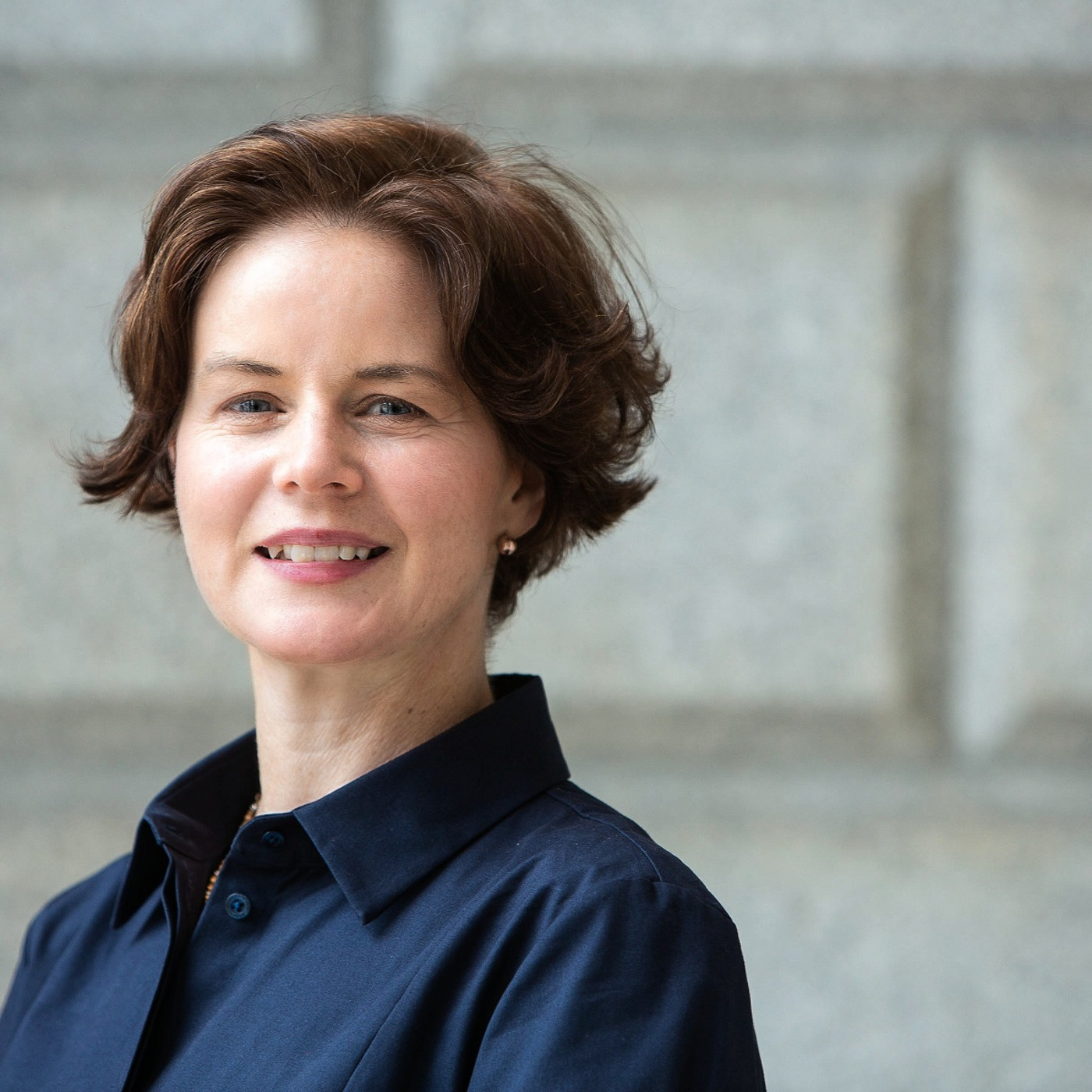
Aoifinn Devitt: This podcast is brought to you with the kind support of The Maples Group. The Maples Group, through its leading international law firm Maples Calder, advises global financial, institutional, business, and private clients on the laws of the British Virgin Islands, the Cayman Islands, Ireland, Jersey, and Luxembourg. Maples Group firmly believes that embracing diversity and inclusion fosters a better culture of sound decision-making, leading to enhanced results and better all-around performance. Among other targeted strategies to promote diversity and inclusion, The Maples Group offers scholarship programs, employee training seminars, formal mentoring programs, extensive leadership development retreats, and ongoing professional coaching to attract, retain, and advance a diverse workforce, to promote equitable and inclusive workplace practices, and to foster both employee engagement and a positive working culture. Our next guest parlayed her diverse international experience, sometimes a white-knuckle ride, into a fascinating career in employment law. Find out from her about the transformation of this area into a staging ground for some of the most complex issues of our time. Around dignity, equity, and opportunity in the workplace. I’m Aoifinn Devitt, and welcome to this 50 Faces focus series, which showcases the richness and diversity of inspiring people in the law. I’m joined today by Karen Killilay, who is a partner and head of employment at the Maples Group law firm in Ireland. Karen chairs the Diversity, Equity, and Inclusion Steering Group in Maples and Calder, and is part of the law firm’s management committee in Ireland. She has over 20 years of experience in advising international and domestic employers on Irish employment law, including in relation to labour law disputes, strikes, workplace investigations, whistleblowing, discrimination claims, pay claims, but also risk management practices, preparing employers for agile and flexible workplace demands, as well as the people aspects of transactions and change management. It’s not all about law and law firms and litigation though. Karen loves to be outdoors when not at the desk, and that could be trail running in the Dublin hills or further afield, playing tennis or sea swimming, and when weather and time permits, skiing or hiking in the Alps. Welcome, Karen. Thanks for joining me today.
Karen: Thanks, Aoifinn. I’m delighted to be here.
Aoifinn Devitt: Well, all of that description of your outdoor activities makes me just want to be doing some of that myself. So thanks for that imagery. But let’s start by talking about your background and career journey. Where were you born and what was your path to law? Sure.
Karen: So yeah, I was born in Dublin in Ireland, Aoifinn, as you know. And yeah, I had a fairly conventional upbringing, I guess. My parents were very, very focused on, on education and above everything else. That was sort of key as we were growing up. There was no question of not doing homework and not doing as well as you could do in exams and so forth. So they were very encouraging and it was, it was very positive. I went to high school or secondary school in Dublin also, and I was very fortunate. I went to a really good school, which is very strict. So we had a good bit of fun sort of pushing against that, or me maybe witnessing my friends pushing against it. I was always quite compliant and obedient, maybe too much so. I think maybe if I was to change one thing, I might change that— be a bit more of a rebel when I was younger. But apart from that, I mean, we had lots of sports, we had lots of extracurricular activity. When I think back on it now, I mean, this is kind of back in the ’80s, I’m revealing my age here, but we did certain things like media studies, and we did studied psychology and we had a transition year. So for non-Irish listeners or those who are not familiar with the Irish education system, that’s sort of an extra year of secondary school where you get to explore different activities and kind of understand better what you like and what you don’t like. So that was great and we had good teachers. I definitely remember a number of standout teachers from my high school, secondary school time that were just super encouraging and really interesting people and just good people who were generous and giving of their time. So Yeah, I mean, I think all in all a positive experience. I appreciate I’m extremely fortunate to be able to say that. And I guess from my own perspective, yeah, there are some standout adults in my early life that really had a huge impact on me and still have an impact on me to this day. So I guess my takeaway from all of that is you just got to be so careful with, with young people and be careful how you, you speak to them and encourage them. And what you say can potentially last a lifetime. So yeah, no, it was good, a.
Aoifinn Devitt: Straightforward background, but it Really interesting insights there, just in terms of remembering what is said to us. And I think we probably all remember exact phrases that were said to us in our teenage years and how much of an impact that can have. So that takes you through secondary school. Did you always think about choosing law? What was your pathway into law?
Karen: Yeah, I mean, it’s kind of funny to say it, but I actually did always have an interest in, in a career in law. I mean, I remember having a discussion with my mother about it, and really I was probably only about 10 or 11, which is kind of shocking. I wonder, does that show profound lack of imagination, but in some ways it made it like an easy choice for me. I think I was always interested in a career in law, and maybe that was to a certain extent driven by the fact that I sort of leaned into those subjects, the humanities subjects. I like debating, I like doing moot courts and all of that, but to be honest, I’m not sure that I had a really good understanding of what a career in law actually meant. But look, I kind of took it step by step, and it was, you know, it was tricky enough to actually study for a law degree back in the late ’80s, early ’90s. There were only a handful of universities that actually offered it, and, and the pathways weren’t necessarily as diverse as they are now. And it’s a good thing now that you can go and study something else and then maybe convert and take up law later. Like, that’s very positive. But back in the day, it was a little bit more linear, so it was difficult to get into a law degree. So that kind of focused me. I think that gave me good focus for the latter years of my secondary school. So I sort of put my head down because I very much wanted to do that. So I wound up then in Trinity College studying law, and that was really a terrific experience, a very new experience straight out from a very strict secondary school into just meeting people from very different backgrounds, different walks of life, and so forth. So, so it was, it was really great. But even before, I guess, even I thought long and hard about what sort of pathway within law that I would go. I think I knew within myself that I wanted to sort of experience a lot of different aspects of that. So I mean, even as an undergraduate, I think I definitely had an interest in taking a more international outlook on my career. I certainly didn’t consider for a moment staying in Ireland and qualifying immediately and working, and that was just a personal choice. Potentially also driven by the context at that time. Ireland was quite a different place at that time, economically probably a lot more depressed than it is now. It was a lot maybe less global in its outlook, and the opportunities didn’t seem to be as abundant as, as they subsequently were in the following decades after that. I mean, one of the highlights, and I’d say one of the pieces that really got me on a more international path, was doing Erasmus in third year from Trinity. So I went to France. That was definitely a game changer. But just reflecting on this and preparing to, to speak to you today, I was just trying to cast my mind back to being sort of 20 years of age and being determined to go and study in a European university. And the reality was actually my language skills weren’t amazing. And I remember speaking to the dean at the time of the law school and saying, I’ll go anywhere. He was saying, we can go to Germany, or you can go to Italy, or you can go to France. Do you speak any of languages. And my response was, never mind about that, that will sort itself out, which I think is kind of interesting. I’m not sure that I would be quite so bold and so resilient these days. But in any event, I did go off and I really enjoyed it, and it certainly widened my social circle and got to live in France for a year. And after a baptism of fire where I had absolutely hopeless French, I had to pretty quickly fix that. And then, I mean, as you will recall from university days as well, in those days we did a lot of traveling during the summer because we had to get jobs and it was not that easy to get jobs in Ireland. So had some great summer jobs in Canada, went to Japan, we had some time in Russia, we spent some time in Greece and all of that. So it does sort of make me think, I mean, I see fantastic graduates coming to interview for internships and traineeships and I’ve seen it across all my career. I mean, the caliber of graduates who come out now They’re just quite simply amazing. But it’s also good to do other stuff. I understand there’s pressure to do internships and so forth, and that’s great. It’s really good to do that, and it educates you as to your choices and whether or not a career in a particular firm or in a particular specialization might be interesting. But we have to do other stuff as well. And I feel that it’s good to have to live off your wits a little bit. And try different things and meet different people and go to different countries and struggle with the language and struggle with the bank accounts and struggle with the cultural differences. I, I don’t regret any of that. I don’t think any of that was time wasted. And your original question was, well, what was the pathway then into law? So in a nutshell, after I left college, I tried working for a U.S. Law firm for a while in Boston, which I really enjoyed. I went and did a master’s in Edinburgh, and that sort of had a focus on international doing the law, which I also really enjoyed. I moved to London and worked for a big city law firm for a while. So I definitely moved around, and I would say it probably took 5 or 6 or 7 years before— including my qualification in Ireland— before I sort of settled on what it was that I wanted to do. So I think in terms of what I would reflect on now as being valuable from all those experiences, I think you do have to go with your gut ultimately, whatever your instincts are. Do follow them. They are persuasive. They’re meaningful. Definitely get experience. Get variety. Do listen to others, but don’t listen to them too much. You do need to— as I say, you need to be able to live off your wits. You need to have a little bit of resilience. You need to try things. You definitely need to fail in things. So maybe don’t get sucked into endless internships and clerkships. For sure, you need to try them and you need to give it your best shot, but there’s lots of other stuff that you can do as well that will help you grow and help you to understand better what it is you want to do. So yeah, I think my pathway to law was definitely winding, and I got lost a few times, but I certainly don’t regret any of those experiences.
Aoifinn Devitt: Well, that’s a brilliant picture you painted there of the backdrop to our education, because we met, I think, shortly after you returned from Poitiers, and I remember just how much it featured in our conversations. It was clearly a formative year, and I do think that that’s a healthy reminder of just the importance of a diverse set of experiences in different fields. And you very much, I think, brought that to light here. So the international wanderlust didn’t stop there. You took it also into your practice of law and practiced law in Italy for a period. You mentioned already the US and the UK. I’m particularly interested in what it was like to work in Italy as a newly qualified lawyer. Can you tell us a little bit about that?
Karen: Yeah, absolutely. And not surprisingly, it was absolutely terrific, and I would highly recommend it if you have the opportunity. Opportunity, or if any of the listeners have the opportunity to do it. So I had the great privilege to live in Rome, which is just the most fabulous city in the world. It’s a personal favorite of mine. But you would think that I would have learned after my Erasmus experience that it’s really not a good idea to throw yourself into a critical aspect of your degree or your career in circumstances where you don’t speak the language. And again, I had some Italian, but I, I think I had an exaggerated sense of my ability to actually work using Italian. So Again, I had a just white-knuckle ride maybe for the first 6 months. I worked for Linklaters in their capital markets, one of their capital markets team, worked with a great bunch of people doing really interesting work. And without wanting to mislead anybody, I just, I simply thought my Italian was better than it was, but it wasn’t. But it did become much, much better after about 6 months. So again, I sort of found myself in meetings trying to negotiate documents and not so much draft, but definitely negotiate and follow meetings through Italian, which was— looking back again, it was great. It it was, was another, I suppose, example of trying to live on your wits and to get by and not cave. So look, it was great. And I think, yeah, I mean, it is completely different to what I am doing now. As you know, I practice as an employment lawyer now. And there in Rome in the early 2000s, in the midst of the dot-com boom, I was working on an equity capital markets team. So we were preparing really interesting, successful Italian, mostly family businesses for IPO. And that was just really amazing. We got to go and meet with and speak to successful, innovative, well-established entrepreneurs in a lot of different industries, but particularly luxury goods and also tech. So I mean, for example, I had no idea how to read a set of financial statements before I joined the capital markets team, but by the end of it I certainly wasn’t going to carve a career out of that, and I had decided I’m probably not going to be a capital markets lawyer for the rest of my life. But I just absolutely enjoyed and relished that experience to get just a little bit more financial literacy, to understand how are businesses funded, how are they capitalized, what’s a successful strategy, what makes businesses successful, what are the failures. So look, it was just a brilliant experience, and I wasn’t practicing as an Italian lawyer, and I didn’t really seriously contemplate qualifying as an Italian lawyer, because I think at that stage I felt I had done enough exams, quite frankly. So I wasn’t thinking about doing that. And I also sort of felt, well, look, I’ve been on the road for nearly 10 years now, apart from my period in Dublin where I was qualifying. And we finally pulled the shutters down on the Italy experience and decided to move home after a few years there. But it was terrific. And as I say, another baptism of fire that helped me to self-guide back to probably what I really wanted to do, which was to go back to Dublin and to pick up where I’d left off doing a mixture of litigation and employment law. So back domestically doing what maybe I had set out to do several years before.
Aoifinn Devitt: Let’s move into the world of employment law now. What do you like most about it and how has it evolved over the course of your practicing it and any area that’s become more challenging perhaps or more on point in terms of what you’re getting asked to advise on?
Karen: Yeah, no, absolutely. It’s a really, really interesting area, and it is— it’s pretty much unrecognizable compared to how it was 20 years ago, more than 20 years ago when I qualified. And again, it’s like these kind of slightly serendipitous elements. I can’t really say why I, I really was taken by employment law, but I do recall that the partner that I first worked for was just a terrific boss. He was really down to earth. He was good buddy. He used to get a bit stressed but he was a decent human being and he was a good teacher and he gave me an awful lot of agency even as a newly qualified lawyer. And I really loved that. I loved being handed litigation or transactions and pretty much being told, off you go and do it. And of course there were mistakes, but when there were mistakes, what I really liked about that first boss that I worked for was he didn’t blame me, you know, he was in there to sort of support me and help me sort it out. And so, so I So that was actually quite important. I just, I liked the team. I liked the partner who was running that team. And as I say, above all, he was, he was a decent human being. So that’s how I started off there. But back then, even, I think it was just very different. It was very different to a lot of what I had done before. It was less transactional. There was a real human element to it. And so that was obviously appealing. I liked the fact that it wasn’t purely transactional and you were dealing with sort of real-life people problems, if you like. There was also a good opportunity to be an advocate and to do your own advocacy working as an employment lawyer back in the day. I mean, that is still the case, but the stakes sometimes can be a little bit higher now, and it may make sense to have a, a very experienced and expert advocate run your cases. But back then, again, I keep referring back to this surviving and thriving and living by your wits to try to get on. And being up before what was then known as the Employment Appeals Tribunal as a relatively newly qualified solicitor and sometimes up against barristers. Like, that was a good experience, it was a good learning experience, and there were knockbacks. And each case that you do, you would learn from it and you wouldn’t make a mistake again. So I just loved that, and I, I love the variety of the sort of advisory and the transactional and the advocacy and the litigation and so forth. But yeah, it’s definitely— just, just to pick up on part of your question there, look, it’s become much more challenging, it’s become much more complex, and I think there’s probably a few things that feed into that. So I think back 20+ years ago, it wasn’t really a discipline of law that you would describe as regulatory or sort of compliance-driven. It was largely about, I think, litigation and then documenting the employment relationship. But if you fast forward now a couple of decades, I think there is just so much legislation, there’s so much case law, there is a huge regulatory character to an employment law practice these days. And so there’s a constant learning, there’s a complexity, and all of that is great. I definitely, definitely relish that, and my team relishes that. We love to have the variety of complex advisory and transactional employment work. But there are definitely challenges, and it has become more challenging. I mean, first of all, I think the pandemic has had a really material influence on how workplaces operate and even on how workers now perform their work. And in some cases that’s positive, in some cases it’s negative. I definitely think during the pandemic, certainly most of the employers that we work with, they were good corporate citizens and a lot of flexibility was extended to employees. And equally, as far as we could see, certainly in our practice, employees really put their shoulder to the wheel and it worked well in the face of adversity. It really did. But I do think that I can see a pattern since the pandemic finished and since people have now moved into this sort of hybrid pattern of working, where perhaps the strains of that working structure over a period of 2 years or more, the uncertainty and so forth, has certainly created issues. So we are seeing a lot of employers who would have employees who are quite distressed, who are coping very well. There are performance issues, quite a lot of disputes, whistleblowing. That all sounds like it’s quite negative, and I’m not expressing a judgment on it, but I’m definitely seeing an enhanced volume of that type of work. I also think it’s very complex to be a manager these days. I think it’s really difficult to manage people. I think there’s been a recalibration and a resetting of the norms of appropriate behaviors in the workplace. Again, I’m not sort of expressing a judgment on that, but people can have very polarized views on what is acceptable and what is not acceptable. And I do think it’s going to take some years for that to actually settle. I mean, by way of example, we have a number of codes of practice, for example, in Ireland, that help to guide employers and employees on how to have a dignified workplace, how to make sure that everybody enjoys dignity in the workplace. And yet we have an enormous amount of litigation in this exact area of law. And one of our key authorities in this area that is supposed to sort of guide practitioners and guide employers and guide employees about appropriate norms of behavior in workplaces— the case involved probably over the High Court, the Court of Appeal, the Supreme Court, probably 7 or 8 different judges, and many of whom didn’t agree on what constituted bullying or what was a dignified workplace or what undermined your dignity in the workplace. So you have very learned and experienced and capable judges taking a set of facts and three different courts coming to three different conclusions on it. So what I mean by that is I think the workplace has become very complex. I think the practice of employment law by definition as a result has become quite complex. And I think the third piece that I would say, so in addition to the post-pandemic complexities, in addition to complexities of being a manager. I think as an employment lawyer as well, we are increasingly called upon to support clients in workplace investigations. And workplace investigations can be, again, tricky and sensitive, and you’ve got people’s livelihoods and their reputations on the line, and you’ve got businesses and sometimes the very viability of businesses on the line. So that’s a white-knuckle ride as well, I would describe that as. If you are appointed as an investigator, or if you are advising on an investigation, you to be super mindful of the human beings who are involved. And as I say, not only the sort of corporate entity, but the individuals and their livelihoods and their families and their reputations and so forth. Just over the weekend, I was taking a look at some of the reports coming out of the UK in relation to investigations, and I was kind of struck in relation to Dominic Raab. I think has had a lot to say over the weekend just in relation to to a report that was prepared in relation to sort of allegations of inappropriate conduct by him. And I was struck by his description of some of the complainants, so people who had complained about his conduct, as being activists. And I thought, that’s an interesting word. And I think it sort of underlines and helped me to define what I feel about workplaces these days, which is that they can become very polarized. So I’m sure from the employee’s perspective, they don’t regard themselves as activists. But the alleged perpetrator who’s on the receiving end of these type of complaints, which are very personal— and again, not expressing a judgment, I haven’t read the report, but I just thought it was an interesting example of how polarized these issues can be and how complex it is to try to adjudicate as between different types of human behavior. And then equally, you do see employment lawyers and law firms and senior counsel, King’s Counsel in the UK, being called in to investigate cases where there are very serious allegations that have been made. So again, the CBI in the UK has obviously been in the media quite a lot because of allegations of sexual harassment and allegations of sexual assault among some of its employees, involving employees. So that is a really, really difficult situation, and we have had those types of cases. We’ve had those types of cases where you have very serious allegations of criminal behaviour. And as an employment lawyer, you can be tasked with navigating that. That is such a sea change compared to 2 and a half decades ago, where I think some of these concepts were simply— they just simply didn’t fall within the bailiwick of an employer or within the context of the workplace relationship. So yeah, it’s definitely become a little bit more more challenging and complex, but all the more reason for us then to make sure that we’re constantly skilling in other areas as well. You need a good deal of, I think, empathy and emotional intelligence to deal with some of these issues. None of us is perfect, but at least we know what we don’t know, and we should certainly be making sure that we are getting guidance and training and that we are appropriately skilled to tackle these mandates on behalf of clients.
Aoifinn Devitt: So that’s absolutely fascinating as a description of really employment law as a staging ground for so many of the issues facing society today, whether it be in the bullying realm or around the MeToo movement. And equally, I think it creates the other interesting— I suppose the collateral damage to this is that some people’s career development won’t be the same as it has been in the past because some of their relationships won’t be as close perhaps or there may be a tendency for some of the more senior people to simply not engage. So I think it is a very vexed area, but you’ll have your door being beaten down with young graduates wanting to study it from your description here.
Karen: No, it’s a very good point that you make. It absolutely is a staging ground, and you’re absolutely bang on message with your second point about that sort of necessary distance now between perhaps senior and more junior members of teams, and everybody just being very careful not to overstep them are. Of course, we have to have appropriate levels of distance, and there has to be appropriate levels of behavior. But you’re right, there is that sort of intangible connection and bond that undoubtedly forms between colleagues, and that’s just become a hugely complex area. How friendly can you be? Are romantic relationships allowed anymore in, in the workplace? It’s— yeah, it’s a vexed area for Exactly.
Aoifinn Devitt: And we operate in high-stakes industries which are highly pressured and where performance is key. And I think there will always be an element of a thick skin that is necessary in certain fields. And how does one develop that thick skin is another key criteria we look at as we look at career development over the course of these podcasts. Well, one of the areas that I know comes up for you a lot and is getting a lot of headline attention right now too, it gets back to the diversity topic and the issue of, say, something like the gender pay gap. Gap, which again can be quite controversial because of the way it gets measured, or maybe what it says about an entity when they release it. There was recently an announcement of HSBC’s gender pay gap. What work do you do in that domain? And maybe we can segue this into a discussion of diversity in the law from your vantage point.
Karen: Yeah, sure. It’s a really interesting development, and we’ve certainly helped a number of clients more so in relation to preparing, I suppose, the narrative once they have the raw data and they’ve sliced and diced the raw data. And just to recap for anyone who isn’t familiar with the gender pay gap or the gender pay gap as it functions currently in Ireland. It’s in early stage in Ireland, and our legislation came into force like a couple of years ago. So it’s really next year that we’ll see most medium to large size employers having an obligation to report on their gender pay gap. And as many listeners may already know, gender pay gap is— it’s really, yeah, it’s about structural imbalances, I think, in, in the hierarchy of a business. It’s about trying to tackle that and shine a light on why there is a gender imbalance at particular categories of employees, and in particular at senior level. So it’s very helpful in terms of businesses understanding where they have emergency work to do on their pipeline, on their talent pipeline. So it’s not about equal pay for equal work— that’s been established for several decades at this stage— but it’s a really positive step My experience, I think, of it would be that there was a lot of apprehension about this, that it was going to be very burdensome and that it was going to be in effect almost like another sort of regulatory tax on businesses. That has not, in our experience, turned out to be the case. Yes, employers have worked hard. They’ve made sure that their data sets are accurate. They’ve taken the opportunity to sort of polish up their data sets in relation to fixed and variable remuneration.. And I think largely the gender pay gap reports that recently were published, so December of this year, I think this has been treated seriously by employers here. And while the gender pay gap itself in Ireland appears to be hovering around 14% and then shoots up to sort of 60% or more in, in some sectors, including in, in the legal sector, I think it has started a conversation. And in particular, it has started a conversation about pipeline. How do we get females into the pipeline? What do we need to do to change the norms that we have relied on to advance and promote people so that we are meeting women halfway or maybe more than halfway? And we’re not demanding, for example, in the legal profession where many of us sell units of time, how do how do you, you make that business appealing and viable for parents, not just for women but for parents. But typically that will normally impact women more than men. And so how do you do that? And gender pay gap has been really great in moving the dial on that conversation. But even to bring it a little bit further, I think there’s a pay transparency directive that’s coming down the tracks as well. It’s a European directive, and as we understand it, it’s likely to be come law probably in about 3 years’ time. And I think that is going to be even more helpful because that is going to start a conversation about the pay that everybody in the same category of worker actually earns. So it will move the dial, as I say, in terms of individual conversations and people talking and comparing and being able to have visibility on the basic pay, the fixed pay, and the variable pay that their colleagues are receiving. There will be a right to easily accessible information on the criteria for promotion and advancement. And in the recruitment process, there is going to be a requirement to publish the fixed and variable remuneration associated with the role. So as you can see very quickly, what that means is there’s going to be no further secrecy about bonus. And someone sitting next to me doing the exact same job as I did, contributing the same value, do they get a 40% bonus and I got So I think in addition to gender pay gap, pay transparency is going to be really interesting and is going to help that whole conversation about equity and inclusion and supporting, in particular supporting women and supporting those with caring responsibilities of any description to really compete on a level playing field. I think we’re trailing behind some of the states in the US in this regard. I think it’s already law in a number of states, so, but it’s, it’s certainly not in Ireland. So I think that’s going to be very interesting.
Aoifinn Devitt: Absolutely critical, I would think, to overcome some of the taboo as well around discussing salary, which still seems to be very much present, not just in Ireland but elsewhere. So if the transparency is there, I think that’s going to be a huge advantage, especially for women who traditionally have not negotiated as well at that offer stage as men, and certainly not progressed. And it’s a starting point that can really be so pivotal, not just the stages along the way.
Karen: Exactly.
Aoifinn Devitt: Let’s move to some personal reflections now, because with the description of the sense of adventure and outdoor activities, I know we’ve got lots to talk about here. And but first, before we get into that, so throughout the course of your career, have there been any high and low points that you can talk about?
Karen: Yeah, I mean, briefly enough, I think in terms of high points, I have to say I was promoted to partner just over a decade ago, and that was a really high point. It was a cause for celebration, and I, I felt it was a great achievement, and I had to thank, of course, all the people who supported me. So the partners in the firm I was in at the time, and family, and so forth. So that was a very happy moment for sure. Other high points, I think, done a couple of cases over the years, pro bono cases for NGOs, household names here in Ireland, who just had to navigate difficult times, difficult times on their corporate boards, issues with their donors, just existential threats. To their viability. So they were really great cases. I always find in NGOs and charitable bodies you get a lot of people who are very passionate about what they want to do, and sometimes that can be sort of a tinderbox, and you can just have difficulties, either interpersonal difficulties or existential issues. So I really enjoyed those cases. I think we managed in most of those cases to sort settle matters. And those organizations that we helped all those years ago have gone from strength to strength. So I do— I mean, I was part of a wider team. It wasn’t a personal achievement, but I was very happy to be involved in that, and I really enjoyed that. I think also people. I’ve had a lot of fun, a lot of laughter over the years. I still catch up with my original trainee group. We all joined our old firm a long time ago, like 25, 30 years ago. So we have fun, and we do— there’s a lot of laughter when we meet up. So I really enjoy that. People have been such an important part of my career and my work experience so far, and it’s just so important to maintain those networks and stay in touch and carve time out of the impossibly busy, busy day to stay in touch with friends and family and all of that. Other high points, I think— I mean, here at Maples, we’ve had some really interesting people under the DE&I banner, just really interesting and impressed people to come in and share their stories with us. A lot of people who’ve had personal challenges. We’ve been educated. I think we’ve been taught to be a little bit more sensitive, to engage and not to other colleagues. So that has been a high point for me personally. I’ve really enjoyed that and I feel that I’ve learned a lot and I’m still learning. And as chair of the DE&I steering group, like, I never consider myself to be an expert. I need to rely on people and colleagues within the constituencies that we’re trying to represent to teach us and to tell us and, and to vocalize what they want and to tell us how we can be the best allies we can be. So genuinely, I, I enjoy all of that, and it’s so different to the day job. I love it. So yeah, I guess they’re the high points. Not too many low points, even, thankfully. I mean, it hasn’t been a totally euphoric existence, but I genuinely struggle to think of any really low points. It’s tough coming back from maternity leave. That’s definitely a tough and kind of a confusing time. But I mean, what I tend to say— and I’ve been through it a few times and come back and survived it— and so what I always say to any of the associates, maybe on my team or other associates, I kind of say something that helped me was to just work through the first 6 months. And in 6 months in a law firm, you pretty much see everything. You see the good times, you see the bad times, you see the busy times, you see the slower times. There are periods of holiday, people leave, people join. And so I used to just say, look, give it 6 months and see how you feel. Don’t make any snap decisions. And a lot of people that I would have worked with, they really enjoyed their jobs, and there can be a very strong instinct to step off the carousel for a few years, particularly maybe after a first maternity leave. So you can’t obviously make decisions for others, but I hope I somewhat helpful in being able to share some of my experience. And yeah, they were tough times, but they were good times too. So yeah, I think that’s it really in terms of low points. Maybe I just have a magical ability to shut them out.
Aoifinn Devitt: Your very positive approach to life, I think, is probably what leads one to reduce those low points and see them as opportunities, or to live by one’s wits, or as a way to build resilience. So I think that’s no surprise at all that you would characterize them that way. You spoke earlier about key people in your childhood and early education, perhaps, and equally about some of your first bosses that were very motivational in terms of putting you on the right path. With any key people or mentor per se other than that— and this is not an exhaustive list, I always like.
Karen: To mention that— yeah, probably not a specific assigned mentor as such or sponsor, but there have been lots good people that I’ve worked with. So like I mentioned, my first boss, he was, he was great. I also worked for a partner who was, yeah, very supportive when I had a young family. And so in a firm that I worked in previously, I think I was the first partner to be appointed when I was still working part-time. And I suppose in some ways that’s great and what an achievement, but actually when I think about it, it was very much business as usual and there wasn’t much fanfare about it. And I certainly had to have the understanding and the trust of the people I worked with in order to do that. So I think there’s been an array of people who sort of let me get on with it, and that’s really important. I think, again, I keep beating this drum about living by your wits. I think we do have to trust the next generation. We have to support them, and we have to be there to step in immediately if there’s any issue and they need us to. But I do think we have to just hand over the reins and let people have those bruising experiences and survive them, but also let people from an early stage, particularly in law firms, you know, develop those client relationships and become the point person. And just trust your team. Trust your team. I trust my team. I was trusted when I was on a team, and that’s got to be a good thing. And then you have to have people’s backs. There’s no doubt about that. You can’t desert them then when it— if it all goes pear-shaped, which hopefully it wouldn’t. Apart from that, I mean, yeah, it’s— as I say, I don’t necessarily feel there’s nothing negative about not having a mentor or a sponsor. I think it’s important to understand that people support you. And if you get a sense that a person in an organization doesn’t support you, that you probably need to have a word with them and just try to find out what the issue is. But I think, yeah, a community of people even, I’m going to say, were supportive over the years, and that was.
Aoifinn Devitt: Hugely And before we move on to some words of wisdom, of which you’ve already given us many, getting back to those outdoor activities, because I know for me, for example, it’s a great source of anxiety reduction as well as just general well-being. So how do you see the role of the trail running, the skiing, all of this outdoor work? I know you live by the coast in Dublin. What role does that play in your holistic self?
Karen: Oh, it’s like indispensable. Yeah, it’s indispensable. I mean, and you— as am I allowed to give you a shout out for your fabulous Boston Marathon performance? I’m gonna just go ahead and give that shout out anyway. Aoifinn, you’re a force of nature, and well done. So there you go, live on air. You’re not allowed to edit that out. Um, so yeah, I mean, running is just brilliant for clearing the mind and just thinking about other things. Yeah, I mean, I can’t extol the virtues of it enough, and it kind of goes back to one of the things I mentioned earlier, which is just carving time out. Sometimes working in a law firm can potentially be presented as a type of endurance sport in itself. And yes, we work hard and we have to. Our clients rely on us to guide them and to get them out of sticky situations and to be correct and to be responsive. And I get all of that and I love that work. But we still, in order to be able to do that over the course of a very long career, it has to be sustainable. For me personally, in order to make that sustainable, I have to be able to get outside and do exercise. And I’m very, very fortunate that I don’t have injuries, I don’t have an impairment, so I can do that and I just need to do it. And if I’m not able to cycle or run or ski or whatever it is that I’m fortunate enough to be able to do, I don’t think I perform as well at work. So yeah, I’m in furious agreement with you. It’s— there’s no dispute or debate between us, it is critical. And then other people have other interests. People— I have a friend who’s a very, very talented musician, and that is her space. That’s where she goes and she recharges. She powers up by getting back into her choir and playing with her band and so forth. So everybody has their own gig, and they absolutely need to be given time to go off and do that, because that’s how you recharge, and that’s how you come back in refreshed and ready to face the day.
Aoifinn Devitt: Well, my last question then is around any words of advice that you’ve received that have made an impression on you, or any creed or motto that you live by. Is there anything you can share there?
Karen: Yeah, I mean, very briefly, I think the best piece of advice that I ever, ever received was from a senior counsel. So we were down in the Four Courts, which anybody who’s outside of Ireland, I’ll explain that. That’s sort of the big court in the center of Dublin. Very stressful case, and and a client said to our senior barrister, you know, just— I how do you cope with this day in, day out? This is just so stressful. How do you cope with it? And the senior counsel just said, I just— I never worry. I never get stressed. I just prepare. That’s all. And I thought, wow, that’s absolutely correct, because we do spend a lot of time squandering emotional energy thinking, am I going to look like an idiot when I say this? Is this correct? Am I going to get into trouble? But actually, it all just comes down to preparation. If you spend less time worrying and more time actually being prepared, the scope for things going wrong is very significantly narrowed. So I think I would say, don’t worry, just prepare, is probably the best piece of advice I’ve ever heard.
Aoifinn Devitt: That’s great advice. It ties to a piece of advice I always have, because then in my field I’m often asked to make predictions, and instead of making predictions, I usually demur from that. I’ll say, well, we prepare. We don’t predict, we prepare. So I think that is always a safe route. Well, thank you so much, Karen. This has been so enjoyable. I think I now need to go around all the alums of law of that time frame and have a similarly deep conversation, and I can only hope they would be as, as rich as this one. Thank you for taking us on a tour of the white-knuckle rides of your life, professionally and personally, and the empathy and warmth that you exude. Even your answer around extracurricular activities was inclusive in focusing on everyone having their own gig. So thank you for reminding us of that, for making the field of employment law so colorful and rich for us, and for sharing all your other abundant insights us.
Karen: Thank you, Aoifinn. It was a pleasure.
Aoifinn Devitt: I’m Aoifinn Devitt. Thank you for listening to the 50 Faces podcast. If you liked what you heard and would like to tune in to hear from more inspiring lawyers and their stories, please subscribe on Apple Podcasts or wherever you get your podcasts. This podcast is for informational purposes only and should not be construed as investment advice, and all views are personal and should not be attributed to the organizations and affiliations of the host or any guest.

Aoifinn Devitt: I’m very conscious that, you know, you don’t come up with these ideas all on your own, and you don’t build things on your own. You never do. And actually, it’s way more satisfying to be able to do things with people and to be able to do things for people than the individual achievements and individual triumphs that you may have. None of them are ever much fun if you can’t share them with people. And being able to do things for people and be able to facilitate their growth and their success and them achieving.
David Carthy: Their potential Hear how our next guest used a values-driven approach focused on innovation, collaboration, and a global perspective to build a law firm branch from scratch, and how he ensured that diversity was part of the design. I’m Aoifinn Devitt, and welcome to this 50 Faces focus series, which showcases the richness and diversity of inspiring people in the law. I’m joined today by David Carthy, who is Managing Partner Ireland of DLA Piper. He was previously a partner at William Fry in Dublin, as well as President of the Irish Exporters Association. He previously spent over 7 years with the Ireland India Business Association, where he spent 5 years as Chairman. Welcome, David. Thanks for joining me today.
Aoifinn Devitt: It’s a pleasure.
David Carthy: Let’s start with your background. And of course, we know each other from Trinity College, so I have a little bit of that already. But would you start with where you were born, what your path to law was, and whether there were any surprising turns along the way?
Aoifinn Devitt: I was born in Dublin, so I went to school in Dublin, and I went to college in Dublin with Trinity. Background, none of my family had been in law. They had— my father’s an accountant, my mother ran a women’s dress store, so business, I suppose, was in the background. And I was the youngest in my family, and yeah, so that’s how I got to law. I did it as a general degree, and here I am 30 years later still doing it. So surprises happen.
David Carthy: I just want to ask a bit about the business history in your family there, because sometimes a lot of people on this podcast have either grown up with restaurants being run by the family or with stores being run. Did that form an important part of your childhood, spending time in that store, helping out in that store?
Aoifinn Devitt: No, absolutely. I think it always had an appreciation of where the money came from to give us the education and privileges that we had, and many of which my parents would not have had themselves when they were young. So it was an appreciation of that, probably an appreciation of hard work and seeing your parents work hard for it and seeing the ups and downs that go along with any sort of business enterprise. So yeah, definitely was there and, and definitely affected my view of the law as not being distinct from business but very much being part of and in service to.
David Carthy: Now I’ll segue, because we studied law together with some overlap in Trinity, a basic law degree I suppose, not particularly commercial in its practical orientation. But following that, what was your path into becoming a solicitor?
Aoifinn Devitt: The usual confusing decisions made by people in their 20s. So I did a master’s in a basic law degree in Trinity. I did a master’s in the University of Chicago, which was great, opened my mind, met a lot of people from around the world. Then I went back and I trained in London. So I joined a cohort training in Freshfields in London, which is like joining another sort of class for a few years, and I learned a lot of the basics there. So I did that, and then after a few years, about 4 or 5 years of that, I came back to Dublin and worked for William Fry. So, you know, a number of different decisions. I suppose I was always going to work in commercial law, as I said, Being close to having a basic skill like legal skill and being working in business generally, I suppose, was the goal to the extent I had a plan.
David Carthy: And was it always your plan to come back to Dublin having spent time in the US and London?
Aoifinn Devitt: Not necessarily. So I’m the youngest in my family. And so when I left home, all of us in terms of myself and my three other siblings were all working abroad in different places and moving around. And it wasn’t necessarily apparent at this stage. Three of us came back and my elder brother’s been in Boston for 40 years. So a typical Irish story to a sense of people traveling. So no, it wasn’t written in the stars. It just happened like that. And I suppose I’m very fortunate in my career that during my lifetime, Dublin and Ireland became much more globalized and much more part of the global economy. So that sort of international career, which I would have always been interested in, became possible in Dublin in a way that possibly it wasn’t in other European cities at the time.
David Carthy: And just before we move into your current role and the business building you’re doing there, you’ve always been quite unique in having a strong involvement in trade organizations throughout your legal career. When did this start and how do you think that enhanced your insights as a lawyer?
Aoifinn Devitt: I mean, look, I was always interested in travel, always interested in different cultures, different ways of doing things, very conscious of being involved in globally trading. It comes from being from a small island that is very globally connected. So yeah, being part of a local establishment had less interest for me than being part of something that was looking outward. I always felt like I had a lot in common with people who were getting on planes and trading and taking whatever goods or services they had and trying to trade globally. So, you know, working alongside them, whether it be India or the US or wherever, was something of interest. So I suppose with those interests in mind, I kind of fell into it, but it definitely did enhance my understanding of the clients I work with, enhanced the mindset, and you learn more people you’re dealing with or you’re exposed to, you learn more. So I suppose it outward looking perspective. Yeah, I suppose it was always there. There’s a tendency for all of us to draw the threads back in some sort of neat narrative about our careers. I’m not sure that’s necessarily true, but definitely that global perspective was probably always there.
David Carthy: Well, certainly, I think, contributes to the commercial sense and also probably a good networking opportunity for others to think about. And I think often these trade organizations are looking for involvement and people who are going to take a leadership role and take on some of those thankless tasks at times of running them. So, great insight.
Aoifinn Devitt: I mean, I would recommend it for others. I think it gives a different perspective. And if you stay just in your discipline, whether it’s law or something else, and just deal with people who do the same things every day, it will have a narrowing effect on your perspective, whereas the opposite could be true if you try something new and get involved.
David Carthy: Well, David, the reason I asked you on this podcast was I have watched in awe as you have built DLA Piper in Ireland from very, I’d say, modest beginnings into, I think, a powerhouse of the Irish legal commercial field there. So can you tell us a little bit about that? Was it your first time building a business from scratch, and how did you approach that? How does one approach building a branch office of a law firm?
Aoifinn Devitt: Absolutely. It was my first time doing it and is my first time doing it, and it takes so much energy I can’t imagine doing it again. The Irish legal market is relatively unique in the sense that it was dominated by local firms, local brands, people who largely went to school or college together and formed local organizations. And go back 20 or 30 years, and cities like Boston, Amsterdam, and Paris, and lots of other cities were dominated in the same way, in that way. But over the last 30 years, the increasing globalization and larger size professional services organizations has meant that if you want to get the same service, you go to the same brand no matter where you are. Big 4 accountancy firms is a leading example of that, but the law firms have been on that journey as well. So there was a sort of a timing where I felt that that was right, that was coming. I’d already seen what happened in other cities around the world. When it was coming to Ireland, I kind of always said to myself that I’d like to be part of that. And the opportunity came up. I worked with DLA Piper before. I was aware and I knew some people very well in the organization. So when they started looking at Ireland, I reached out to them to get involved. Now, in terms of building from scratch, yeah, it is, it’s an interesting thing as to how we go about it. DLA Piper had obviously done this before, most recently before my time, places like Luxembourg and South Africa. And I just spent a bit of time talking to them, particularly Johannes Haus in South Africa, about how to do it. And really what we decided to do is very much build a values-led organization. So you’re looking for as much diversity as you possibly can, but you want people to have the same sort of perspective, particularly around— I say 3 things I talk about in the you interview, know, having a global perspective, not just being happy to accept clients and money from all over the world, but actually really understanding how people in different parts of the world might approach the problem, what they have in common, what they don’t. Having people who are relatively bold in the sense of yes towards the entrepreneurial end, but also comfortable with change. We all have to change. There’s surprises in store for us every day of our life, and How we embrace them, how we pivot and react to them is really important as opposed to freezing with them. And the last was sort of being collaborative. And I think in all areas of life, no professionals ever self-identify as not being collaborative. But the truth is some people are an awful lot better than others. And some people are competitive by nature and never get around to the collaboration bit. Some people are insecure and never get around to the collaborative bit. So we really want people who have those things in common. And building on that from that perspective so that we were always building with the right sort of people who people would look at and say, not only do I think they’re good at what they do, but they also are people that I’d like to work with, meant that if you get the right decisions right, it starts to go in a domino effect. Now you can see how if you get some of the hires wrong, it goes the other way. So, so that meant a lot of pressure on the hires that done. And fortunately it’s worked well. And one of the things I learned is, you know, being able to talk about that values-led approach from the start. And also we use a degree of psychometrics because when I was interviewing at the start, it was just me and you second-guess yourself a bit. And so having a sort of a psychometric perspective as well, it sort of enhanced for everybody the fact that we were focusing on that sort of cultural fit bit. So that’s kind of how we built and we built person by person. So we now have just short of 110 people. It started with myself, just one. So that’s quite a degree of progress. But we have done ours one by one. It would have been tempting to take group, but then you’re taking a risk of culture changing, existing culture having already been established with a group of people, you inheriting that, that being different in different areas. And there are lots of organizations who, once you start that way, you never get it back. So I think we have a degree of cultural cohesion now. We have a younger collegiate group. We’re collegiate together, but we’re also collegiate with our international colleagues. And we didn’t inherit any business from anyone else from the group business, but we also didn’t inherit any cultural practices that were inconsistent. We didn’t inherit any flaws. We didn’t inherit any liabilities. So it’s worked well. That’s probably the best way I can draw it to understand it. So it’s still a challenge. I’m still learning. And we’re still making decisions where the effectiveness of it can’t be seen for several years afterwards. But that’s probably the best way to say that we were values-driven and there is a, I think a sporting phrase where somebody says having a no dickhead policy, it’s incredibly important. It doesn’t matter how wonderfully clever or how, what a fantastic set of commercial contacts or business people have. The most important thing is that we don’t hire something culturally inconsistent or just a person who isn’t admirable. Or you do your best to achieve this. I’m not saying we’re perfect in any way, but that enables you to keep building and starts to build up speed with building. Whereas if you go for a short-term fix, of somebody with a name or too much of a profile with some negatives attached, it not only may go wrong in itself, but it hinders a whole range of other people from joining you. You never get to judge the conversations that you don’t have. You just don’t get to have them. Hopefully that helps.
David Carthy: Really interesting. And that values-led approach, was that something that DLA Piper would have espoused elsewhere, or did you devise that?
Aoifinn Devitt: No, that was, that was the DLA would have, would have had that values-led approach. So about a year before I joined, they would have gone through a very extensive exercise consulting consulting with their teams and establishing a set of values that they would drive the business for and would be the touchstone for how we make decisions. And while none of us are perfect, it really has helped in terms of that collegiate approach. So as you build your team and if you’re consistently trying to build that along those lines and others are trying to do the same despite cultural differences in other countries and despite all sorts of personal differences that may arise, there is a degree of cohesion with that. Of course, there’s other ways to build teams, having everybody from the same country and having everybody from the same background. That builds a bit of cultural cohesion, but it doesn’t build the diversity that was going to help us build a global business. And that approach was never to interesting me. That approach is more prevalent in some work managers.
David Carthy: And would you say there were any missteps or any kind of, I suppose, rookie errors that may have occurred that you say, that’s a lesson learned, I’d advise the next person I advise on setting up a law firm not to do that?
Aoifinn Devitt: Nothing jumps out as huge, but you do learn a huge amount as you go along. Being able to communicate clearly a vision for the future and having people to buy into is something I’ve learned and got better at. Being able to alleviate people’s fears of something different, something new, is also something that I’ve got better at. I would say that some of my colleagues who joined early would probably say, yes, you’re right, David, you have got better at it. We saw earlier versions of you giving this pitch and it wasn’t quite as smooth, not quite as good. So I think you constantly learn. I mean, you know, I’ve done lots of interviews. I’ve worked with plenty of fine colleagues. I’ve learned from many of my international colleagues and anything I’ve done through my career. So you bear the influence of all sorts of things and you get better at telling where you’re, you know, so setting a confident vision that the people can buy into, but at the same time, understanding the fears that people may have in the short term of stepping that way and having them buy into the change in our competitive landscape that I believe in, that it has come to fruition. I got better at that, and I think undoubtedly have been missteps along the way.
David Carthy: And just building on that into maybe your leadership style today, obviously there are many books written about leadership styles and values driven, I think probably is going to be a huge part of that. Would you say there are other aspects? I mean, clearly with 110 people, you, you have to delegate. You can’t be in every area. Certainly there has to be a taking yourself out of the weeds aspect of this constant evolution. Feedback. How would you say your leadership style is expressed now?
Aoifinn Devitt: Well, I’m learning to take myself out of the weeds. I mean, taking yourself out of the right weeds and staying yourself involved in the right ones is a trial and error sort of thing. So now that we’ve grown to a business of, as I said, 110 people, it’s not possible. And so different structures arise, different delegation bits get delegated that didn’t get done before. So that’s a process that is ongoing. In terms of leadership style, I suppose one of the things is I didn’t start this current job until I was in my late 40s. So I had made many mistakes before. And one of the mistakes I would make is sort of having a view of the future and then working the quickest way to get there and realizing that others maybe didn’t see the future in quite the same way and maybe weren’t as prepared to work as quickly. So I have learned patience. I have learned how to collaborate more, and I have learned to set maybe, out, you know, a very US Californian approach, set out clearly what you think you’re going to do and then listen to what people say in return. And then by the time you’ve listened to a number of people, what you’re actually saying has changed to adapt and flow with their views as well. So I have no difficulty in doing that or realizing that you’ve got it wrong and changing. So I think I’ve got better at collaborating. So I would say a collaborative style in this business. Very early realized that just having it be a successful solo practitioner does not build a great business, and that you putting in a lot of hours and working to the highest standards and doing everything you can does not bring a good business. You have to actually have a consistent approach from a lot of people and that collaborative approach. So I would say collaborative, I’d hope, and I’d say sufficiently humble to change my views based on the evidence.
David Carthy: And just getting back to a point you made about not inheriting books of business, but inheriting values, that maybe goes against other models of building firms in branch offices. Clearly then you have a large team, all capable, all collegiate. All fired up and ready to go, but setting upon that business building stage, any kind of insights from that? And also, it’s interesting, I’m sure that also contributes to a more collegiate relationship perhaps with competitor law firms if there hasn’t been that business inheriting going on.
Aoifinn Devitt: Yeah, I mean, one of the things I realized, and you know, DLA has grown by merger from 2005 onwards, including greenfield. So they’ve probably tried every particular model of growing your business and collecting people together. And building teams. And one of the things I could see from that and other new entrants into the Irish market is that when people inherited a group from another firm, they’re forever known as the ex-group from such and such. And you’d hear where firms were, whole different floors in a firm would be, they came from there and they came from there. So even when people were trying their best to actually collaborate in the best way, the market and previous reflections and incarnations were how people came to know. In many ways, in pubs in Dublin, a pub can change its name 20 times and people of a certain generation still call it the first name because that’s what they remember it for. That was true of lawyers and that’s true of legal brands as well. So it was very important to me that we were from the start going to be DLA Piper and not anything else. And that greenfield setup, as I described, helped us do that because I could see that if people felt that you were— and the other thing is I was explaining to the Irish market that we were a global law firm. We weren’t an inherited group of local lawyers, and that’s been successfully done, which if you’ve taken a different approach by merger otherwise is much more challenging.
David Carthy: And another really notable part of how you’ve built DLA Piper Ireland is your focus on diversity from the very beginning. And I know that you have a very impressive female representation there. What has been your focus on diversity? How have you been intentional about it? And then maybe we can step back and look at the legal profession as a whole, but let’s focus on your approach first.
Aoifinn Devitt: Well, the first thing to say is that there’s plenty to be humble about. Our representation is not what we’d like it to be, and you can do an awful lot better. So that’s the first thing to say. But I suppose in looking at it, I would’ve always had a perspective that the best decisions as advisors are made by people from diverse backgrounds who don’t just instinctively think of the same cultural reference points as they try and understand or help with a problem. So there’s your professional ability, but there’s also your inherited experiences that go into it. And if your inherited experiences are as wide as possible, and you had different voices, then it was possible to have. So you wanted to have an open culture and you wanted to have diversity of thought. So the important thing is diversity of thought. So I had been, you know, in Ireland, if you look through its history, many of our work decisions, whether they’re made by the political class or the business or banking class, generally go back to a small number of people who, when you really look at it, all came from the same background, very often the same gender, the race, etc. And that leads to a sort of groupthink, and people are doing their best, but they still end up making the wrong decision because nobody came at it from another angle. And the ability to say no, wasn’t strong enough. So I had that perspective. So leave aside the sort of social justice perspective. The other obvious thing is that the clients you would be acting for were global in nature. And therefore, and Ireland was traditionally a very homogenous society, which is getting more ethnically and societally diverse now over the last 20 years, but traditionally hasn’t been. So you basically want to advise clients, you want to be like them. People need to see a mirror in the advisory thing. To the clients themselves. So all of those things, the business driver, the social justice driver, and the good decision-making driver where you have diversity of thought in your decision-making process, all led me to that view where diversity, I strongly believe diversity of thought drives better decision-making. Now, having said that, the first obvious thing that anybody notices about an organization, particularly the legal industry, is that at times, although at the bottom end of the pyramid in terms of people going into law, there’s a huge balance from a gender perspective. There isn’t at the top of the industry, and there’s many different reasons for that. But one of the reasons is that you would look at it and say, oh my God, this is so big, I can’t possibly do anything about it. So when you’re starting a law firm from scratch, it provides you the opportunity. I was not inheriting a different balance. So therefore I was going to be intentional about it from the start. Turns out it’s pretty hard and we’ll keep at it. But the goal here is for us to have a multinational background group of people clearly multi-gender, which sounds, you know, it should be the easiest, but because of the legal industry itself, there are some aspects that make it hard. And, you know, as much diversity of thought as possible. So we’re on that journey. And just like anything, it’s as much of a challenge and nobody’s ever cracked it and it is never achieved and ticked. That’s a long answer to a short question.
David Carthy: No, no, I notice it because I think when you look at the new announcements of partners being made and look at the stats, it does stand out. Have you attracted any industry attention because of the fact that it stands apart at this point with the diversity, particularly in your senior ranks?
Aoifinn Devitt: Yeah, it’s very welcome from a— when you’re pitching to multinational, even national decision makers, it’s very notable that the general counsel community is predominantly female. And it’s very notable that generally among the law firms is predominantly male. So there’s a mismatch there that needs to be affected. So we’ve got a little bit of attention, but as I said, this is a journey. We have a long way to go. I’m more interested in achieving commercial success, doing the right thing, and having others follow that example than trying to take out a stick and sort of wave it at other people, if you know what I mean. Hopefully the example of what we do and the example of the success we have acts as an example which in a small way filters through to the wider industry.
David Carthy: And when you and I graduated from Trinity, there weren’t really many global law firms with a footprint in Ireland. You had to go to London for that. Now that there are, there are a few. Do you offer incoming graduates an opportunity to do rotations through your other offices for them if they have these global values that you look for to actually realize them?
Aoifinn Devitt: I mean, look, it’s the most obvious thing people know of us. If they know one word about DLA Piper in Ireland, the word they’ll know is global. And therefore, yes, from a junior perspective or graduate perspective, they’re hugely interested in that. So the delivery of those Luckily, we have 99 offices around the world. We have, you know, we’re in 46 countries. So our ability to deliver on that promise is strong. So yeah, we are delivering on that and we have our first trainee crew coming through to qualification over the next 6 to 9 months and they’ll be offered jobs in Dublin and all over the world and they’re offered secondments and rotations in Dublin and all over the world. And at present we have somebody from Leeds and we have somebody from Hong Kong in the office, trainees from other offices. We’ve had people from Australia. We’ve had people from other countries, we’ve got 2 Germans, 2 Italians in the office. It’s that free flow which is really normal in other industries and in the legal industry it wasn’t. So one of the things you want to do is offer a global career in law from Dublin. That was not possible when you and I came out of college. You had to go to New York or London and typically you’d go, maybe you’d come back, but if you did come back, you’d have to fit back into a national structure that wasn’t global in nature and leave some of maybe the thoughts and new ideas behind, which is a frustration for people.
David Carthy: Yeah, it’s a completely different setup now. Finally, before you go on to some personal reflections, just would like to get your— I know you said you’re trying to pull yourself out of the weeds in certain areas, but where do you see the opportunity for the legal profession in Ireland for growth? I know that you’ve added almost a practice area by practice area, and you didn’t have a fund formation practice originally. Now you do. How would you say the legal landscape is evolving and what excites you?
Aoifinn Devitt: Well, it excites me about how much global business is being done through Dublin and how Ireland is in that succeeding thing. So that excites me. It excites me, as I said, to offer a global career wherever it is I’m working on from Dublin. That excites me. So I think there’s clear growth. We’ll build on our practice areas. We’ll also hire very much from a sector-driven approach. And that’s the other thing you get from a global perspective. If you want to, your problem is in its nature relatively unique and challenging, which tends to be the problems we get. You’re very interested in working with people who’ve seen this problem before. Those things typically aren’t all done in the same country, particularly if you’re a relatively small country like Ireland. So you’re doing the first, I don’t know, integrated ticketing plan for Metro or lottery, you can draw on the Australian or the UK or the US experience. That’s only going to help your decision-making process. So sector-driven approach, really important. And then the other thing is, you know, being a trusted advisor. The lawyer originally You know, back 100 years ago, there were no investment bankers, there was no Big Four, but there were lawyers. And over time, the lawyer moved out of the decision-making room and became the scribe or the advanced sort of documenter of decisions that other people made. It’s bringing the lawyer back to the center. So having government affairs advisors working alongside data analysts, working alongside expertise of all sorts of nature and being a trusted advisor and getting to the point for a client when they have a problem. Who’s your first call? Who’s your second call? And how broad an ability do people have to think to solve your problem? Or do you have to take narrow expertise and synthesize it all yourself because your advisors can’t do that for you?
David Carthy: Just moving to some personal reflections now. So we’ve looked back at the business building, at a career throughout different jurisdictions. Would you say, looking back either on your career or otherwise, there were any setbacks or challenges that you learned lessons from?
Aoifinn Devitt: Yeah, there was, and there have been. I mean, all of us in the legal industry struggle with a balance. It’s a very interesting and challenging job, but it doesn’t always come in the right proportion or at the right times. So you can end up working long hours or end up having a lot of something and then maybe less the next week. So that balance between all areas of your life is an important thing, and you learn to get better at that over time, but it’s always a challenge. And definitely at times I have a vision of the future and I have not been able to get that across enough to overcome people’s fears of whatever change may be involved in dealing with that. So I’d look at my time, my previous firm, William Fry, and say, yeah, the vision I have was an earlier vision of what I have now, but the ability to get that across, I was less able. And you learn, you learn from your setbacks.
David Carthy: It’s interesting because those are singularly, I think, skill sets that are not taught in law school, communication skills, but, you know, just people management, organizational skills. And we look at this continuing legal education concept. But it’s also completely absent in that respect. It’s, it’s legal, it’s not the other kind of management skills. And it’s interesting because finance can have that MBA kind of trajectory, which can ideally introduce some of those skills. But it’s interesting that in law they have to kind of be built either just from osmosis or the law.
Aoifinn Devitt: Yeah, learn you on the job.
David Carthy: Yeah, it seems that way. And you know, sometimes they remain absent. Speaking of taking care of mentors or key people, have there been any throughout your life professionally or personally that have left an impression on you and maybe changed your outlook?
Aoifinn Devitt: Yeah, I mean, I definitely from my time in William Fry, I’d cite Brendan Cahill. From my time in DLA Piper, Sandra Wallace, John Hayes, and my colleagues in Dublin who gave me the ultimate trust of agreeing to come aboard in a joint enterprise to drive this firm. Yeah, no, I’ve been very fortunate. I mean, one of the things is to be able to learn from all your experiences, but being open to learn. From them. I mean, if you’re too close to mindset, wonderful things and wonderful mentors can surround you, but you don’t notice and you don’t pick it up. So, so there are a couple of people on the legal side and certainly from a personal side, my wife is an academic PhD, Suzanne, my family, my parents, my brothers, my siblings. I was the youngest. So I got to see from the decisions they made and how they went about things. They all had an influence. So all of it is, all of it mixes together. So I’m very conscious that, you know, you know, come up with these ideas all on your own, and you don’t build things on your own. You never do. And actually, it’s way more satisfying to be able to do things with people and to be able to do things for people than the individual achievements and individual triumphs that you may have. None of them are ever much fun if you can’t share them with people. And being able to do things for people and be able to facilitate their growth and their success and them achieving their potential is hugely satisfying. So that’s the other thing you kind of learned. Once you’ve proved to yourself that you can do something, really the next challenge and far more satisfying is helping others to do it.
David Carthy: Well, thank you so much, David. One really remarkable aspect of how you’ve built DLA Piper Ireland is how you’ve made it look easy. And more important than that, you’ve made it look like a very enjoyable ride so far. And I know it’s been anything but easy. I’m sure it still has been enjoyable, but I think that’s because of your commercialism, your warmth, and just that humility that has come up time and time again. As we’ve discussed your techniques throughout this podcast. So thank you so much for coming here, for sharing your insights with us.
Aoifinn Devitt: Appreciate it. Thank you very much. Been very enjoyable.
David Carthy: I’m Aoifinn Devitt. Thank you for listening to our 50 Faces Focus Series. If you liked what you heard and would like to tune in to hear more inspiring lawyers and their stories, please subscribe on Apple Podcasts or wherever you get your podcasts. This podcast is for informational purposes only and should not be construed as investment advice, and all views are personal and should not be attributed to the organizations and affiliations of the host or any guest.

Speaker A: In our first legal series of 2023, we are delighted to bring together 3 voices from the Irish legal scene and one from the UK Bar. We discuss the challenge of employment law and its evolution, how to build a branch office of a law firm from scratch through focusing on values, the benefits of professional sport and legal practice, and the burgeoning and fast-paced development of the field of sports law. We look first at a model for building a firm from scratch by scrupulously focusing on values and being intentional about diversity. This is what David Carthy, Managing Partner of DLA Piper Ireland, had to say about how he built that firm to over 110 lawyers in only 5 years.
Inspiring People in Law: What we decided to do is very much build a values-led organisation, so you’re looking for as much diversity as you possibly can, but you want people to have the same sort of perspective, particularly around— I say 3 things I talk about in the interview, you know, having a global perspective, really understanding how people in different parts of the world might approach the problem, what they have in common, what they don’t. Having people who are relatively bold in the sense of yes towards the entrepreneurial end, but also comfortable with change. And the last was sort of being collaborative. And I think in all areas of life, no professional’s ever self-identified as not being collaborative. But the truth is some people are an awful lot better than others, and some people are competitive by nature and never get around to the collaboration bit. Some people are insecure and never get around to the collaborative bit. So we really want people who have those things in common.
Speaker A: We move from building businesses to the intricate business of navigating employment law, where we meet Karen Killilay, partner of Maples Ireland, who infuses this area with enthusiasm and also sets it out as a staging ground for so many of the issues of our time around human capital.
Speaker C: I think the workplace has become very complex. I think the practice of employment law by definition as a result has become quite complex. We are seeing a lot of employers who would have employees who are quite distressed, who are not coping very well. There are performance issues, quite a lot of disputes. In addition to the post-pandemic complexities, we are increasingly called upon to support clients in workplace investigations. And workplace investigations can be, again, tricky and sensitive, and you’ve got people’s livelihoods and their reputations on the line, and you’ve got businesses and sometimes the very viability of businesses on the line. So that’s a white-knuckle ride as well.
Speaker A: In our discussion of sport, we hear from Susan Ahern, an arbitrator and sports law specialist, about the explosive growth in this area. But with the professionalisation of sport, With the increasing TV rights and payments, with private equity coming into sport—you see that, for example, in Formula 1, in soccer, and more recently in rugby—that drove change and an increasing demand for sports law expertise. So today, sports law is a genuine career choice for students coming out of university. Susan also shares her best practice in arbitration and directorships. Finally, we move from sports law into the practical world of sport and hear from a barrister in training and one-time multi-sport professional, Christian Scotland-Williamson, about the passion he has for teamwork, showing up, and delivering his all, thanks to his time spent playing in the NFL and other professional leagues.
Speaker D: Regardless of circumstance, regardless of any adversity that you may be facing, it’s— there is a standard that needs to be met if you expect to succeed and ultimately to win, whether that’s at life or in a game. On the pitch.
Speaker A: As always, we hear words of wisdom to live by, whether for coping with stress.
Speaker C: Client said to our senior barrister, you know, just— I how do you cope with this day in, day out? This is just so stressful.
Speaker A: How do you cope with it?
Speaker C: And the senior counsel just said, I just— I never worry. I never get stressed. I just prepare.
Speaker A: That’s all. Or for knowing what we are capable of.
Speaker D: I think The thing that has underpinned my whole adventure, whether it’s in sport or beyond, has been that you can know something in your spirit without understanding it in your head. So sometimes there’s an energy speaking to you that you know is the right way to go or the right thing to do, but rationally it doesn’t make sense. And so for me, I’ve always tried to listen to that voice.
Speaker A: Or the importance of living our dream. Dream your dream awake in action. So tune in over the next few Wednesdays where we will release a new episode of the series each week. You can find us on Apple Podcasts, Spotify, or wherever you get your podcasts. All of our content is available on 50 Faces Hub. Remember, if you like what you heard and would like to support our content and our mission to amplify diverse voices across multiple professions, You can support us on Patreon. Just search for 50 Faces Podcast or click on the link in our show notes.
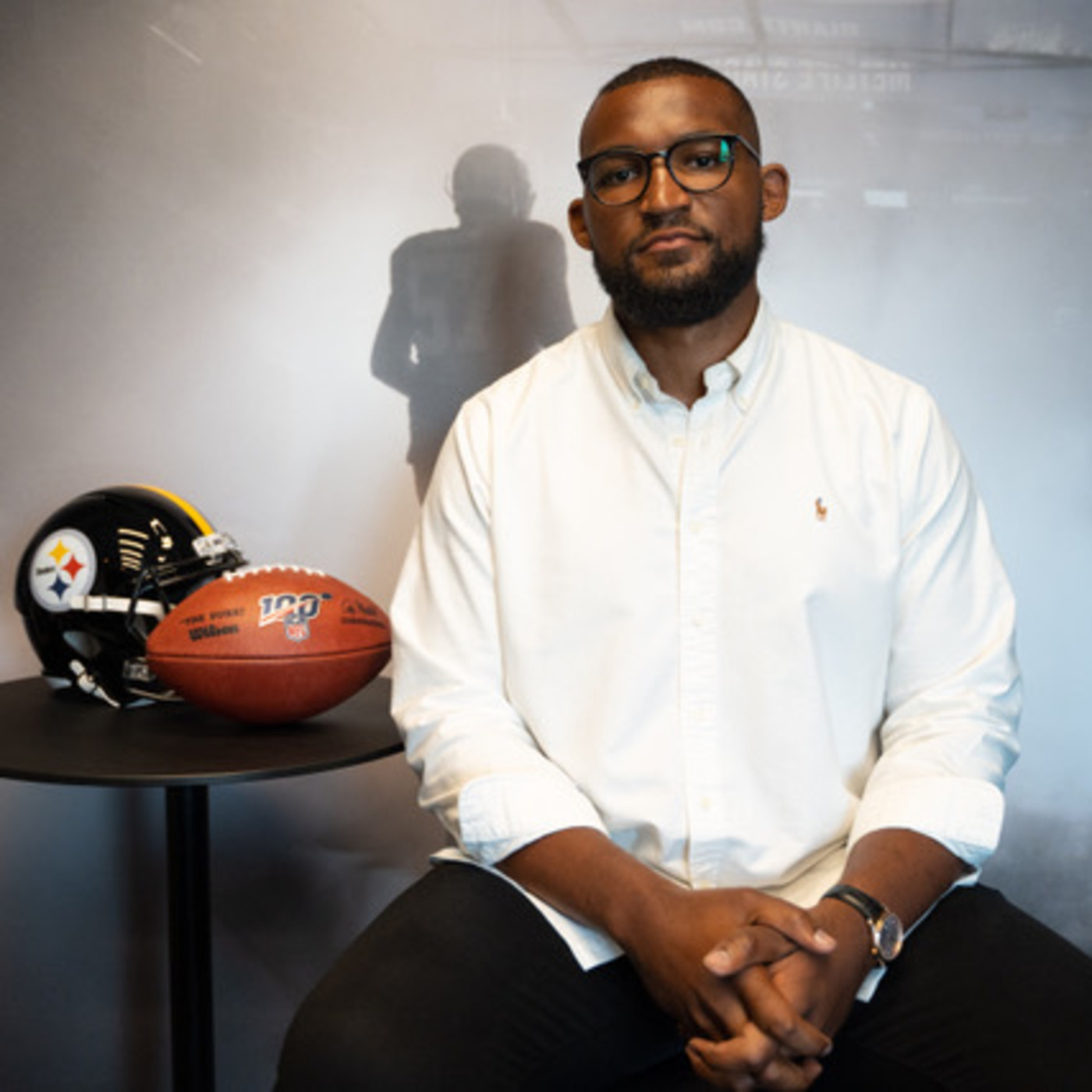
Aoifinn Devitt: What I’ve taken away from that is regardless of circumstance, regardless of any adversity that you may be facing, it’s— there is a standard that needs to be met if you expect to succeed and ultimately to win, whether that’s at life or in a game on the pitch. As an athlete, you’re almost institutionalized in a way where the only thing that matters is on-field performance. Everything in your life is geared towards that element. So you’re told where to be, what to wear, what to eat, how far to run, and how much weight to lift. And then you get thrown out of the whole system and put in the real world where ultimately your success or failure is down to you. And so being able to find those key mentors is crucial, and a lot of that comes from being a willing participant in your own success and rescue and, and seeking those out actively.
Christian Scotland-Williamson: I’m Aoifinn Devitt, and welcome to this 50 Faces Focus series, which which showcases the richness and diversity of inspiring people in the law. I’m joined today by Christian Scotland-Williamson. Christian is a two-sport athlete who played Premiership Rugby at a professional level in the UK and then moved to the US where he played NFL football with the Pittsburgh Steelers. While playing sport, he completed an MSc in International Business, and he is currently pursuing a course to become a barrister while being a broadcaster for TalkSport. Welcome, Christian. Thanks for joining me today.
Aoifinn Devitt: Thank you so much for having me on.
Christian Scotland-Williamson: Well, you have a very interesting background and not the most normal, I’d say, career trajectory. So can we talk about that, where you grew up and your career journey so far?
Aoifinn Devitt: Of course, it’s very unconventional. I was born in northeast London and I was educated at the Royal Grammar School, High Wycombe, where I was able to pursue rugby at a high schoolboy level and then ended up going to Loughborough University to continue my studies, not having any professional ambitions in mind., and it was only in my final year of studies that a fortunate event happened where Worcester Warriors needed a stand-in player for a fixture, and they liked me when I went down, and I signed a contract in the changing room 6 weeks later while making my professional debut.
Christian Scotland-Williamson: So can you go through your thought process? Like, was there any big decision involved in deciding to make that professional debut? Was it always something that you dreamed about? What were you thinking about then?
Aoifinn Devitt: It happened so suddenly. I come from a sporting family. My father was an ABA boxing champion and my brother played college basketball in America, so we’ve always been relatively naturally gifted. But I’d never had an opportunity to even consider playing professional sport. I was never in an academy and had never even played county rugby. So when the opportunity came about, it was very much just fulfilling an ambition of playing one singular game for a professional club. It wasn’t with view the view of actually having a career. I was actually studying to take up some grad schemes and was in the interview process at the time, and it was actually a huge fortune that I was able to cancel those interviews and say, I’ve actually got a job.
Christian Scotland-Williamson: So interesting. Well, I’m definitely going to talk a little bit about professional sport today and how it compares to the UK and the US, but at first I’d like to ask a little bit about what it’s like growing up in a household like that. What’s it like when sport is played at such a high level What are the emotional roller coasters, say, of watching your dad boxing? And equally for yourself, you said you’re all naturally gifted. Did you all just— whatever you picked up, you just naturally fell into or came first in every race in primary school?
Aoifinn Devitt: I think it actually stems from, well, actually both my parents, but in terms of the sporting context, my father instilled real discipline from an early age in terms of that boxing pursuit of always showing up. He used to tell stories of going for runs on Christmas Day because he knew that’s when his opposition wouldn’t be working. And I think I first set foot in a boxing gym when I was 3 or 4 years old. So I’ve always grown up with that culture of work and effort underpinning anything you want to do, and that’s permeated through every aspect of my life. So both my brother and I had a very broad spectrum of sporting endeavors where we swam, we did karate, football, and then he found his way in basketball and I found mine in rugby because It was something that I just took naturally to when I was 9 years old. And there was never any pressure on either of us to do anything at a high level with sport. It was always just, if you’ve made a commitment at the start of the season, you have to see the season through. And that was what underpinned our whole career. And then as we climbed through each level and started having more and more success, we were just ready for the opportunity when it came.
Christian Scotland-Williamson: And looking to the next generation, if you were to give advice to parents raising children now in terms of playing sport, would you say, have them play a lot of sports, not necessarily specialize too early. Is there any advice you, having played at this level, would give parents with respect to kids today?
Aoifinn Devitt: I’m a huge advocate for the broad base of an experience in childhood. So I played two sports professionally at the highest level, where people would think that they’re very similar, but they’re actually completely different, in rugby and American football. And I think that it was the ability to adapt, the ability to become accustomed to new environments and new rules of the game that allowed me to have success at both levels. Because my journey into elite sport, whether it was professional rugby or American football, was very sudden. And the ability to draw on that long history of being able to adapt under different circumstances and different pressure environments is really what came to the fore as an adult and as a professional.
Christian Scotland-Williamson: And let’s talk now about that journey into the NFL, because that’s clearly— you said different sport, different rules, different backdrop. I would imagine also just completely different ecosystem that it gets played in. How did you find that experience in the US and how would you compare the professional sports arena in the UK and the US?
Aoifinn Devitt: It was an eye-opening experience. It was something that I couldn’t have been prepared for without trying and experiencing it firsthand because it is so different to my experience in rugby. For example, we would get 12,000 to 15,000 people at a Premiership rugby game. And then I was put into an environment where we have 15,000 people watching practice at training camp. And then my second game in the NFL was at Lambeau Field in front of 85,000 people. So it’s a completely different scale. The commercial realities of the sport then filter and trickle down onto the field where decisions based on performance and effectively job security and the way contracts are structured mean that because there’s so much on the line with each game each Sunday, whether it’s from a coach’s perspective or a player’s perspective, there’s no margin for error. And that pressure and that need for elite performance really was astounding and eye-opening because yes, rugby is an elite sport and yes, soccer in England is an elite sport, but the way that America commercializes and put sport on a pedestal is just completely different.
Christian Scotland-Williamson: Interesting. And would you say that anyone is preferable? Do you think there are flaws in both systems? I think we mentioned in our pre-call just some of the struggles that sometimes some professional leagues have in the UK.
Aoifinn Devitt: Yes, definitely. I think I’ve seen it firsthand with returning to rugby and most recently playing for Harlequins, and then seeing my former club Worcester Warriors go into liquidation. Because of insolvency and not being able to make the business of the sport add up financially. I think that that also affects players in terms of you have to dedicate so much to being a professional your whole life, effectively, where you’re not actively encouraged to pursue other elements of your personality or potentially career progressions beyond the sport. And so when a club gets into financial difficulty and then suddenly you find yourself unemployed with a very narrow skill set in that you are a rugby player, for example, then suddenly if another team isn’t looking for your services, you have the harsh reality of completely having to reskill yourself, and it’s an unexpected stage of your life.
Christian Scotland-Williamson: And looking back at both experiences now, before we move on to your current focuses, would you say there are any highs and lows, any really memorable either times that you excelled and were recognized for it, or times when your hopes were crushed? Because it have some pretty stark volatility, I would imagine, both of those fields.
Aoifinn Devitt: Most definitely. I experienced the volatility in my first full-time season. I had back surgery, I had two fractured vertebrae, and was out for a week shy of two years. And that’s actually the reason why I went back to university and got my master’s. So I’d actually say that the biggest win that I was able to, to have and the biggest victory was off the field, where I walked across the stage and collected my master’s certificate, which brought an end to what was a very tumultuous period in my life where I wasn’t sure if I was going to have to retire as a 21-year-old because I had a broken back. And so I chose to use that time as well as rehabbing and go back to school, get my degree. And then after I’d walked the stage on my graduation, 4 weeks later I was on my way to the NFL. So I guess in a quite a circular fashion, being able to channel my focus and turn that frustration into something positive, which actually was nothing to do with sport and something that could never be taken away from me in that degree, was probably my greatest victory, which was actually born out of some frustrations in my career where I wasn’t able to have the success on the field that I would have hoped for.
Christian Scotland-Williamson: And let’s fast forward now to that degree you pursued and then now pursuing the bar. Can you tell us about your thought process there, particularly into law, as that’s not— again, it’s a bit circuitous, but obviously there’s clearly an opportunity there.
Aoifinn Devitt: I’ve always wanted to be a barrister, actually, from my— I had a look through my old yearbook, and in 2004, as a 10-year-old, that was my career ambition. It wasn’t playing sports. So I’ve come full circle back to what I guess was my main endeavor and pursuit and goal. So Now, having had the experiences that I’ve had in professional sport, playing across two different sports in rugby and American football, it’s actually given me a huge understanding of both the commercial realities of the sport and also the harsh realities that there are some things that happen within professional sporting environments and that I’ve experienced firsthand, where you aren’t aware of what your rights are, you aren’t aware of how things should be done properly. And I suppose that that’s what’s fueled my pursuit now as an adult, where effectively I want to have and equip myself with the ability to have the knowledge that I didn’t have earlier in my career, and then hopefully ensure that similar things that happen to me don’t happen to other people.
Christian Scotland-Williamson: Really interesting. And I’m sort of visualizing, but I’m looking— think about your dad in the boxing ring and being in the arena, and then you as a barrister being in an arena. I would imagine there are very similar traits from your sport that you’re bringing into your new professional career.
Aoifinn Devitt: Relentless discipline, focus, perseverance. I think those are the ones that jump out and are front of mind. But it’s actually also the ability to be honest and accept sometimes harsh feedback and criticism, because as a professional, you are sometimes critiqued by thousands, if not millions of people, whether it’s online or in the stadium. And so the ability to be honest with yourself and have a genuine appraisal of your abilities, whether they were good enough, was your performance where it should have been, is what most athletes, I believe, can carry into their next career, whatever endeavors they choose to do after they’ve finished playing. Because ultimately, it’s that process of preparation, performance, and review that will underpin any success in any industry and any improvement and allow people to get closer to their goals.
Christian Scotland-Williamson: And what particular area interests you and excites you now at the bar? I know you’re studying, but you bring a degree in international business with you, and you mentioned some of these potential for maybe being in the area of sports law or rights. Any particular area that is exciting you these days?
Aoifinn Devitt: I think a really burgeoning area is the intersection of commercial IP, sport, and media. Having played, and I think it really came to the fore when I was in America and was able to do a few internships at venture capital firms and with licensing companies, that the reality is sport is a global industry. I feel like the UK is slightly behind America in commercializing it and commercializing the full spectrum of what that sporting package entails. And so for me now, coming back, I do feel that there’s a gap in the market in terms of that knowledge and understanding and being able to bridge that between the playing side and then also to having the technical knowledge is, is what’s exciting.
Christian Scotland-Williamson: And a lot of this podcast series focuses on diversity because we found that some of the underrepresentation that we see in the world of finance, where I spend most of my time, is replicated in law. Maybe less so in the law firms. They seem to have addressed some of their imbalance, but at the bar, my sense is there is still a challenge. What has your experience been? And maybe we can even go right back to other strands of your career in terms of diversity and what’s being done about it?
Aoifinn Devitt: I think I would speak firstly to my experience as a rugby player, where I was only ever one of 3, perhaps 4 Black players on my team, and I never had someone that looked like me in a leadership position, be that at a junior level or professionally. I was then thrust into an environment in the Pittsburgh Steelers where the head coach was a renowned Black leader, and I was able to experience that firsthand. And now coming back, having had those diametrically, I suppose, opposed cultural experiences and now pursuing a career in the commercial bar, the visibility piece is something that really jumps out at me in terms of there’s no one that I’m seeing but a handful of people who I can, I suppose, look to for guidance or that is a possibility. And I think that’s something that needs to be addressed. And I think There are schemes and there are efforts to address the imbalances, but it can only happen through people of my generation, of my age group, trying to change what is an established culture and established practice where opportunities sometimes are few and far between.
Christian Scotland-Williamson: And have you found any initiatives, say affinity groups? For example, we interviewed Stephanie Boyce, who was the head of the Law Society, a very prominent figure who has done a great deal to really push the cause of underrepresented minorities, and someone like her is really making a massive difference just by being a great role model. Have you seen any, anything that’s worked in your view to encourage maybe more people of color into the bar, or to make the passage more positive when they’re there?
Aoifinn Devitt: In my own personal experience, I could only speak to the mentorships that I have been able to cultivate, and I’m extremely privileged to have. Harry Matovu, Margaret Casely-Hayford, and some others who I won’t mention. But it’s been much more of an individual and personal level that I’ve been able to lean on them for their experiences, their ability to transition and work their way through a system which wasn’t as favorable for them as it is now. And I know that there are visible efforts to improve the diversity at the Bar and within law.. And we are just waiting to see the fruits of that labor.
Christian Scotland-Williamson: And of course, Margaret Casely-Hayford was a previous guest on this podcast, recorded in the middle of COVID and an absolutely inspiring story there. So no surprise that she will be a wonderful mentor. Let’s just go to that question of mentorship, because already you’ve spoken a lot about your family background and how that motivated you. Were there any, besides Margaret and your other mentors you’ve mentioned, any key people across the course of your career, maybe at key decision points who helped you, influenced you, and really influenced the course you’re on?
Aoifinn Devitt: I would definitely say the coach I’ve already spoken about, Coach Mike Tomlin, who’s the head coach of the Pittsburgh Steelers. And his motto, and one that’s emblazoned on the wall in the facility as you walk in, is, ‘The standard is the standard.’ And that relates to on-field performance but also in life. And that’s something that I’ve carried with me since my time with the team because Effectively, what it speaks to is a standard of performance, a standard of accountability that each individual should hold themselves to, whether that’s in a team setting or as an individual trying to pursue their goals, say, in a self-employed pursuit like the bar, for example. And what I’ve taken away from that is, regardless of circumstance, regardless of any adversity that you may be facing, it’s— there is a standard that needs to be met if you expect to succeed and ultimately to win, whether that’s at life or in a game. On the pitch.
Christian Scotland-Williamson: And it’s really interesting because obviously in sport, one is privileged to have an inspiring coach like that. We don’t always have that coach throughout our lives, throughout our college lives, maybe throughout our work lives. How have you found that anchor? Because I think we often need times reminding, well, what is that standard? Or just evidence of how it is in practice outside sport. Have you found coaches or mentors outside sport too?
Aoifinn Devitt: That’s what this new chapter has been the most exciting about. It’s trying to find those same coaches, but with the mentor Monica, who can help guide me through this transition, guide me through the next phase of my life, which as an athlete you almost institutionalized in a way where the only thing that matters is on-field performance. Everything in your life is geared towards that element. So you’re told where to be, what to wear, what to eat, how far to run, and how much weight to lift. And then you get thrown out of the whole system and put in the real world where Ultimately, your success or failure is down to you. And so being able to find those key mentors is crucial. And a lot of that comes from being a willing participant in your own success and rescue and, and seeking those out actively. So the mentors I’ve already spoken about are able to guide me in a manner where I’m used to receiving coaching, I’m used to receiving critique and information about how I can improve as an individual or an athlete. And so now it’s about channeling those messages and really trying to be productive and put them to good use.
Christian Scotland-Williamson: And you mentioned something interesting there about feedback, because I think that’s a particularly tricky one for high performers, because even though we all benefit from it, and I presume we all crave it, actually getting it can be a challenge, and that sometimes we don’t find enough people willing to give it. But then when we do get it, we personalize it, maybe don’t see it in the spirit in which it was intended. I presume this also happens in sports when you have, I’m sure, ego that’s come from great success. Coming into that arena. How have you learned, and how have you seen people learn, to take feedback in the right way?
Aoifinn Devitt: A great quote that one of my coaches at Loughborough actually gave me was, feedback is feedback, you’re the one that puts the emotion to it. And I thought that was brilliant, and that’s followed me throughout my career, because objectively, in a high-performance environment that is sport, if I miss a tackle, that is not because I’m a bad person,. It’s not because other things surrounding my life have contributed to that. It’s the fact that I genuinely have not executed my task. And so the emotion that gets attached to it, whether it’s in a corporate setting or a business setting, is the fact that is it right or wrong? Ultimately, it becomes down to the raw facts of the matter rather than the emotion that is easily attached to each feedback, each review., where you may go into it thinking, does this make me a bad person? Does this make me any less of an individual because I’ve made a mistake or I’ve got something right? It might be the fact that you let praise go to your head. And so understanding that, understanding that ultimately you can be more objective and detailed about critiquing an exercise or a result is really at the forefront of it, where the emotion gets attached by the individual sometimes. Obviously the delivery of feedback. Is important. But I’ve had many moments in my career where I’ve had to hear the message and not the tone.
Christian Scotland-Williamson: That’s really interesting. And also, there’s also a sense sometimes, maybe because in business things are not as objective, say, as missing a tackle— it could be one person’s point of view versus another, which is a little more subjective— but also that you have to coach things with a positive feedback, this kind of compliment sandwich. I would hope in professional sport we haven’t got to that level, that that’s not necessary. Have you found that egos are sufficiently robust that feedback can be given without the need for the, the positive feedback surrounding it?
Aoifinn Devitt: I hate to say it, but sometimes there isn’t much choice. It’s very different where the normal rules of the normal working environment sometimes actually don’t apply. And what I’ve noticed as well is that it takes a huge amount of skill to understand what each individual needs at any given moment. And I think the best leaders that I’ve been around have been extremely skilled and adept at understanding that, understanding which buttons to push at the right moment in time and which athletes or individuals can cope with receiving certain messages in certain ways. For example, sometimes certain athletes need to be told in front of a group what they’ve done wrong, whereas others you would end up getting the worst performance out of them the following week. So it’s just understanding that individual detail, that individual needs to be sometimes have an arm put around them as opposed to being reprimanded in front of a group. And I think that really applies to everything. It’s no two people are the same and no two people will receive feedback in the same fashion.
Christian Scotland-Williamson: Very interesting. And you’ve given us lots of words of wisdom already out of the mouths of your coaches as well as being on the wall. I’ve learned a huge amount. If you were to just look now at any creed or motto that you live by, like what would you put on your wall? That Pittsburgh Steelers wall, anything that you can share there?
Aoifinn Devitt: I think the thing that has underpinned my whole adventure, whether it’s in sport or beyond, has been that you can know something in your spirit without understanding it in your head. So sometimes there’s an energy speaking to you that you know is the right way to go or the right thing to do, but rationally it doesn’t make sense. And so for me, I’ve always tried to listen to that voice.
Christian Scotland-Williamson: Really interesting. So a lot of intuition and gut feel there still mattering. And if you were to give advice to your younger self, to that young man considering whether to go to the NFL or maybe even going back earlier, is there anything that you know now having had this career and embarking on a new one that you wish you had known earlier?
Aoifinn Devitt: I think it definitely comes down to the fact that the biggest successes are often off of the back of what seems to be the moments of the greatest despair. So for example, breaking my back— I now look at it as the best thing that ever happened to me, but at the time I couldn’t see beyond my circumstance and effectively wallow in it.
Christian Scotland-Williamson: Well, that’s very profound, certainly, to be able to see things in that light. Well, thank you so much, Christian. It’s been a real pleasure to speak with you. You’ve managed to, in a short space of time, demystify the echelons of professional sports in two countries for us here and distill the wisdom of some I suppose many, many famous people who have been put on pedestals for good reason. And I think it’s great to hear their wisdom and try to apply it in our everyday lives. So thank you for sharing those with us and for sharing your insights on the podcast.
Aoifinn Devitt: Thank you so much for having me on.
Christian Scotland-Williamson: I’m Aoifinn Devitt. Thank you for listening to our 50 Faces Focus Series. If you liked what you heard and would like to tune in to hear more inspiring lawyers and their stories, please subscribe on Apple Podcasts or wherever you get your podcasts. This podcast is for informational purposes only and should not be construed as investment advice, and all views are personal and should not be attributed to the organizations and affiliations of the host or any guest.

Aoifinn Devitt: This series is brought to you with the kind support of Eversheds Sutherland. As a global top 10 law firm, Eversheds Sutherland provides legal services to a global client base. With more than 3,000 lawyers, the firm operates in over 70 offices in more than 30 countries across Africa, Asia, Europe, the Middle East, and the United States. The firm recognizes that having diverse talent across its business brings many benefits. It is committed to accessing a wide range of views, perspectives, and thinking in all of its teams, and in this way is building a culture of inclusion where each person feels able to be their true self at work and reach their full potential. Diversity and inclusion is fundamental to the firm’s purpose of helping their clients, their people, and their communities to thrive, and inclusive is one of its 5 values.
Nancy Stern: The top-down approach doesn’t work with everyone. You can have a really clear policy, a really clear structure, but I think the thing that really makes the difference sometimes is personal interactions. And we’ve heard this in the case with vaccine reluctance, for example, that people are looking to people they know and people they have daily contact with more than necessarily higher-level policy. So in my own experience, things that have really advanced my career and have colored the way that I think about helping others It’s been largely personal conversations.
Aoifinn Devitt: Why is it relationships and the personal touch that are key to career success in the end? Find out more next. I’m Aoifinn Devitt, and welcome to this 50 Faces focus series, which showcases the richness and diversity of inspiring people in the law. I’m joined today by Nancy Stern, who is CEO and board member at Alston Holdings LLC. She’s had a 27-year career starting as a lawyer and transitioning to a financial and business oversight role. In her latest role, which saw her assume the CEO position in 2020, she led a successful sale of that company that closed in 2021. Nancy holds a number of board roles, including as a non-executive director of eXp Global, an engineering and architectural services firm, as well as at Alston Holdings. She was the recipient of the Woman of Achievement Award granted by the Anti-Defamation League in 2019. Welcome, Nancy. Thanks for joining me today.
Nancy Stern: Thanks, it’s a pleasure to be here.
Aoifinn Devitt: Can we start with your background and what first interested you in going into law and this particular field?
Nancy Stern: Sure. I grew up in a small town in Michigan, and I worked at our family business, which was a John Deere dealership, from a young age. I did everything from cleaning the bathrooms and helping in accounting to sandblasting equipment. We did not have any lawyers in the family, but my father served on the board of directors of a local bank and knew a few lawyers. And for some reason, he thought that I would make a good lawyer. So he encouraged me in that direction. He helped me get a job at a small law firm when I was 15. I worked there in the summers in high school. I typed from dictation, answered the phones, helped with accounting.. And I was able to do that because I had gone to this rural high school that was somewhat vocationally focused. And so I learned shorthand and accounting and typing in high school. The lawyers at this law firm were father and son, and I did the job that the wife and mother normally did when she golfed in the summers. So after high school, I went to University of Michigan. I majored in economics. And then I went on to the law school there at Michigan, and I was able to work as a teaching assistant for a professor who had a joint appointment in the economics department and in the law school. And the intersection of law and economics at that time was a very popular topic. So that was very fun and engaging for me, as much as law school can be fun. After law school, I clerked for a federal judge and then started in the litigation department of a large law firm in Chicago. After 2 years, I transferred to the corporate department of the same law firm. One of the partners that I had done litigation for told me that he wanted me on his team and helped me get integrated into the corporate department. I really had at that first firm some really fantastic teachers who took the time to bring me up to speed on corporate law issues, which was very meaningful to me. I had enjoyed the litigation work, especially writing briefs, but the corporate work was more forward-looking and so more appealing from that perspective. And I liked the idea of helping companies achieve their strategic goals, either growing through acquisition, raising money through securities offerings, or getting liquidity from the sale of the company. So I stayed at that firm for 10 years. I learned a lot. I made partner. I became vice chair of the corporate department. And then I was recruited to another large law firm, which was Catton. I’d been on the other side of a deal from a partner who, unbeknownst to me, was the head of lateral partner recruiting at Catton. He remembered me, and when they were looking to add a new partner a few years later, he reached out and asked me to join him at Catton. So I stayed at Catton for 7 years and developed my own clients there.
Aoifinn Devitt: In terms of corporate law, I also started in corporate law and I had had no training or no even concept of what corporate law looked like. And it didn’t seem that the law school I went to, at least, was in a position to prepare for that. Did you find that you’d had any preparation for corporate law or was most of it learned in the apprenticeship mode that law firms can create?
Nancy Stern: I mean, certainly I had taken the basic corporate governance classes and contracts classes, which had some relevance. But a lot of the practice of law, particularly in the M&A area, is really something you have to learn on the job, I think. And that’s why it was so important that I was working in a firm where the partners were very skilled and were willing to take the time to show me what to do. Because even if you go to a great law school, there’s so much of that important practice That just has to be learned on the job, I think. So in 2013, through a client relationship, I was approached with the opportunity to join Alston, which is the company I’m still at, as general counsel. And the CEO was looking for someone to help him make big decisions, and that’s what made it an appealing role to me. So I guess one of the themes of my career has been that people I’ve worked with have reached out to me and asked me to help them in another role. I wasn’t really looking for a job either when I moved from my first firm to Catton or when I left Catton and moved to Alston, but those are opportunities that came from people that I had worked with.
Aoifinn Devitt: What was different about a GC role? What did you learn there?
Nancy Stern: One of the things I learned is that the scope of a GC role can really vary, especially at a smaller privately held company. But the one that I got at Alston was really meaty. Because it was in an industry where there was a lot of regulatory uncertainty and the stakes for the business were pretty high. I was also the company’s first GC and people were glad to have help. So we didn’t have a culture of resistance to the legal function, which was very helpful. I think people were looking for a thought partner. And so even though I didn’t know a lot about trading when I joined, I was able to develop that industry knowledge fairly quickly and was able to contribute a different perspective based on my experience up until that point and my business judgment. So I think that that was a great opportunity. And then when the CEO that had hired me left Alston, I had an opportunity to take on some more responsibility. So first I had legal and compliance and communications and investor relations, and then I got HR and trade operations and risk. And then I had the opportunity when the CEO left and the former president became CEO, they didn’t replace the president. And so after a period of time of taking on increasing responsibility, I was promoted to chief operating officer and then with the CFO reporting to me. And then a year later I was promoted to CEO.
Aoifinn Devitt: And in terms of the leap then, in terms of skills needed, was there a big gap in terms of skills you needed to develop as CEO? Had you kind of been developing them over the years that you transitioned into a COO, well, first into an in-house role and then COO and then CEO? Do you find that there was a natural transition there?
Nancy Stern: I think a lot of the skills that lawyers tend to have tend to be very transferable. One of the things that I think most lawyers have to guard against is not being too risk-averse, because I think that’s an occupational hazard that a lot of lawyers share. But sometimes just asking thoughtful questions and being able to analyze the pros and cons of various decisions, those are very lawyerly skills. Learning the core of the business is really important, but I think some of the interpersonal skills, communication, general leadership skills are really very transferable.
Aoifinn Devitt: That’s a really interesting point, actually. I think the point you made about culture too earlier around the resistance to the legal function, because obviously there probably is that culture in some organizations, but equally when the legal function is one that’s very commercially oriented maybe and can address some of that risk aversion you mentioned, maybe that’s the key to getting a kind of a joined-up culture.
Nancy Stern: Yeah, I think so. I had the benefit of being able to start with a clean slate, which not everyone gets when they go in-house. But I think my colleagues at Alston saw me as a person who helped them do what they wanted to do and protected them, which they appreciated, rather than having the legal department be the place that tells you you can’t do what you want to do. So tapping into some of the creativity was important.
Aoifinn Devitt: And having come to the peak of that particular journey, at Allston most recently. What would you say were some of the highs and lows of your legal career looking back?
Nancy Stern: Well, one of the things that happened that I certainly did not predict or couldn’t have seen coming is that one of my former M&A clients from Catton reached out to me in 2015 and asked for my help. I had represented him in the sale of his company to a PE-backed strategic buyer. And 5 years later, he was looking to buy out the PE firm’s stake in the acquirer. The company had not done very well after the sale, and it was now ripe for a turnaround. So I told him, listen, I’m no longer in private practice. I can’t do a deal for you. But he convinced me to help him, and my boss at Alston didn’t object. So I did that legal work on nights and weekends, and we were able to close that deal in December 2015. And then he asked me to join the board of the company, which I’ve done for the past more than 6 years. And seeing that company, which is now thriving, seeing that turnaround process has been really gratifying. And it’s also given me a chance to attend board meetings, both from the perspective of a board member and also from an executive presenting to the board. I think having the ability to look at both sides has been really valuable to me. The other thing I would say is that I can’t always tell in the moment whether something is a high point or low point. Sometimes it requires a little bit of time and perspective to look back and say that a particular event was pivotal because Although most of my career opportunities have come from people that I work with, sometimes there was a gap of years between when I did the work and when that opportunity came up. So what I try to focus on is really not so much is this a high point or a low point, but just focusing on the things that I can control because I’ve learned that things can just unfold in unpredictable ways.
Aoifinn Devitt: That’s really interesting. I also like a lot of these podcasts were recorded in the peak of the pandemic, so 2 years ago, and that was obviously a low point for many, certainly in terms of uncertainty. And I love the expression, which was, if your life and your career was a book, what would this chapter say? It often kind of lets you kind of step out and take the lens back and take the bigger picture perhaps, as opposed to focusing on the moment. So let’s move to the industry now. It’s been an industry where you have flourished, but it may not necessarily be that way for everyone. Can you speak about what you think of the diversity in the industry today, how it’s improved over the course of your career?
Nancy Stern: Yeah, I think diversity in, in financial services is not great, and particularly in trading, there aren’t very many female traders. That particular industry has become more and more technology focused, and there aren’t a lot of female technologists working in that area. So I can’t say that I’ve been happy with the progress in the financial services area. I think that law firms are doing a little bit better than financial services firms, but my own experience was really more colored by individual interactions. The CEO who hired me was a person of color and his successor was a Black man. And having the opportunity to have candid conversations with him about topics that people don’t always discuss at work, about race, about gender, I think was extremely meaningful to me. And I think is going to have an effect on my career going forward. But it’s tough to make really big progress when I think so much has to be done at the individual level. And I’m hopeful that we’re making progress, but it’s not really showing up in the numbers in a way that I would like to see it so far.
Aoifinn Devitt: And what do you mean when you say so much has to be done at the individual level? Do you mean in terms of attracting the right candidate and then mentoring and nurturing that candidate so that they do succeed?
Nancy Stern: Well, I think one of the things that we’ve seen during the pandemic is that the top-down approach doesn’t work with everyone. You can have a really clear policy, a really clear structure, but I think the thing that really makes the difference sometimes is personal interactions. And we’ve heard this in the case with vaccine reluctance, for example, that people are looking to people they know and people they have daily contact with more than necessarily a higher-level policy. So in my own experience, things that have really advanced my career and have colored the way that I think about helping others, it’s been largely personal conversations. And I think some of us have had a little bit broader perspective over the past couple of years. But the fact that we’re not together as much anymore, I’m concerned that that could have an adverse effect. On how people relate to people who are different than they are and are able to reach out and help more junior people who could use help.
Aoifinn Devitt: It’s a really interesting insight. And just in terms of what’s already in the industry in terms of infrastructure right now to try to make a difference, whether that be networks or affinity groups or like-minded individuals getting together in Chicago over lunch, Do you think there’s anything that’s particularly effective that you’ve seen?
Nancy Stern: Yeah, I think affinity groups are helpful, especially ones that are not just within a particular firm, but that cross the industry. I think those can give rise to opportunities to help each other, which I think can be very helpful. And also just sharing our personal stories and seeing role models and sometimes even being a role model. I think those can be really helpful and sometimes giving people a source of support and information that’s outside their firm. So I would certainly encourage people to join that sort of affinity group if they can. There are several good women-focused ones in Chicago and I’m sure other locations as well. I think that’s really valuable. I think it’s worth the time to make those connections.
Aoifinn Devitt: And just in terms of optimizing for success, what are the kind of skills that you think are best suited to a career like you’ve had? We mentioned before some of the people skills, the ability to reduce complex concepts into more understandable, digestible soundbites, perhaps. Are there any particular skills or strengths that you think are most useful in an area that is highly charged and can be high pressure?
Nancy Stern: Yeah, I think It certainly changes over the course of your career. Earlier in my career, I was really focused on being conscientious and being helpful and solving problems and being available to help people and solve their problems and thinking about things from their perspective. So I think empathy is a big one. It can be a tricky balance between drawing boundaries that allow you to have a healthy personal life and being accommodating to the needs of others. Self-care is so important, I think, both personally and professionally, but nobody’s going to hire you directly to do self-care. So I think being intentional about our boundaries between our needs and our colleagues’ and clients’ needs is something that’s really important. And as I get more senior in my career, the interpersonal aspect has become more and more important. Being willing to be vulnerable and connecting with people on a personal level, I think it’s more important later in your career. Vulnerability isn’t necessarily something people lead with when they’re really junior, at least I didn’t. So there’s a shift, and I think that’s a skill in itself. Is continuing to question what you’re doing and think about sharpening skills that may be becoming more important than they were earlier in your career.
Aoifinn Devitt: It’s very interesting because most of the skills we need in our senior ranks of our career, we will have been developing over the years. But it seems that maybe we’re less likely to develop those interpersonal relationships or skills maybe early on, but they become more important later. So one wonders, is it more difficult if we haven’t kind of gained practice in that, if we haven’t got comfortable being uncomfortable?
Nancy Stern: Yeah, I really like that phrase, being comfortable being uncomfortable. I think that’s a skill that is going to be helpful throughout life. I think embracing the awkward is something that can help a person both at a younger age and at a more senior level. That’s definitely a part of it, I think, is a level of humility and vulnerability and just realizing that everyone, regardless of the stage in their career, is going to have to adapt and think about shifting their skills as the world changes and as their role changes.
Aoifinn Devitt: And you mentioned empathy before because I think another critical piece of that when someone’s experiencing that discomfort with having a vulnerable conversation is that the other side of that has to be giving grace to that person who may say, have some malapropism or put their foot in their mouth or say something that’s clumsy at the time because they’re uncomfortable, is allowing them essentially the safe space to make those mistakes in order to grow and not having it— Yeah, no, it’s a delicate balance, but I think we all have to be kind of invested in that. I want to just move now to some of your board roles because you do have a number of board roles. We mentioned some already. And I like to provide in these podcasts as much sort of some guidance as to what it means to be a good chair or a good board member because I think there’s actually no instruction manual in that respect. In your view, what does it take to be a good board member and what do you try to bring to your board roles?
Nancy Stern: Well, one little motto that I’ve heard that I think is good advice is nose in, fingers out. I think it’s important to be supportive of management and not overstepping your role in terms of trying to get into the role of management, but to ask thoughtful questions and to not be afraid to go beyond the scope of what’s presented and think, is there something that might be missing from this presentation? I think there’s more and more responsibility being placed on boards for things like product safety and cyber incidents that might not necessarily be a part of management’s presentation. So thinking about what might be missing here and asking thoughtful questions, but at the same time, really being supportive of management and not micromanaging. I think that’s the tricky part.
Aoifinn Devitt: It echoes what somebody else said, which was eyes on, hands off, a very, very similar concept. And also one of the sense I have is that certainly with ESG taking more and more prominence, that boards need to be— you mentioned cybersecurity— have an element of confidence in even navigating these areas or even knowing what questions to ask. But equally, because these are highly complex areas, that confidence may not be there. There may be a sense it’s better just to look the other way or not ask the question. Do you find that a good board will have a culture of embracing a board member that speaks up, for example, as opposed to simply ticks boxes?
Nancy Stern: Yes, yes, I think so. And that’s the part where I think the humility and the vulnerability come in and saying, I’m not an expert on cybersecurity. Could you bring someone in to present to the board that will help us understand what the company is doing and where the vulnerabilities might be. I think that’s the board’s duty to raise the topic, but not to do it in an accusatory or inflammatory way. And I think the best boards are helpful to management, certainly in an oversight role, but in a helpful way.
Aoifinn Devitt: And you’re also involved in a number of other industry and civic groups. Some of those were mentioned in the introduction as well. Can you speak about any of those that are particularly close to your heart?
Nancy Stern: Yes, you know, I really enjoy connecting with other people and trying to find ways to connect people to each other. So getting involved in various different civic groups and professional groups has been a part of that. And then there’s also the element of trying to contribute to causes that I care about. I’m very interested in education as one, and then I got involved with the Anti-Defamation League as their Woman of Achievement honoree in 2018, and I’ve since helped with the planning of that event each year, and that raises money to provide education and support services to prevent hatred. Hate crimes and hate speech that affect people in minority groups, which is something that I believe strongly in. I think it can be difficult, especially for women who are raising a family and have demanding careers, to spend a lot of time in not-for-profit activities. So I try to find ways that I can contribute that have as big of an impact as I can. Given the time that I have available.
Aoifinn Devitt: And just getting back to your personal story now for a few reflections, were there any key people throughout your career whose influence really had a notable effect on either your career trajectory or how you saw the world?
Nancy Stern: Definitely, definitely. And I referred to some of them as I’ve told my story here. I think about my dad helping me get a job at age 15 in a law firm. Knowing that I didn’t really have exposure to lawyers and helping me get that exposure was super helpful. I think about the professor who hired me in law school to be his teaching assistant, which was super meaningful. The partner at my first law firm who helped me transition from being a litigator to being a corporate lawyer, and, and many partners throughout my career, and even more recently at Austin, just Having individual conversations that have opened my eyes to other people’s perspectives, those have all been, I think, really essential to the development of my career.
Aoifinn Devitt: Was there any one piece of advice or word of wisdom that you’ve carried with you from some of these interactions?
Nancy Stern: You know, I can’t think of a particular catchphrase, but my takeaway has really been centered on empathy, centering on what do other people need and want here, and how can I take that into account. I think it’s easy to get off the track by focusing a lot internally and focusing on maybe your idea of expectations, but really trying to put yourself in the other person’s shoes. I think helps with a lot of things. So that’s one thing I focus on.
Aoifinn Devitt: Well, I think that’s a very appropriate place to bring our conversation to a close because it is that empathy and that desire to help people, to give back some of the talents that you’ve received and to share what you’ve learned that I really take away from this podcast, which has been a very nuanced and thoughtful discussion of areas that I thought I knew fairly well, having trod it in some of them myself. And you’ve had an extraordinary career, but I think now that your ability to reduce it to some of these very poignant takeaways has been very powerful. So thank you for coming here and for sharing your insights with us.
Nancy Stern: Well, thank you so much for the opportunity. I’ve really enjoyed it.
Aoifinn Devitt: I’m Aoifinn Devitt. Thank you for listening to our 50 Faces Focus Series. If you liked what you heard and would like to tune in to hear more inspiring lawyers and their stories, please subscribe on Apple Podcasts or wherever you get your podcasts. This podcast is for informational purposes only and should not be construed as investment advice, and all views are personal and should not be attributed to the organizations and affiliations of the host or any guest.

Aoifinn Devitt: This series is brought to you with the kind support of Evershed Sutherland. As a global top 10 law firm, Evershed Sutherland provides legal services to a global client base. With more than 3,000 lawyers, the firm operates in over 70 offices in more than 30 countries across Africa, Asia, Europe, the Middle East, and the United States. The firm recognizes that having diverse talent across its business brings many benefits. It is committed to accessing a wide range of views, perspectives, and thinking in all of its teams, and in this way is building a culture of inclusion where each person feels able to be their true self at work and reach their full potential. Diversity and inclusion is fundamental to the firm’s purpose of helping their clients, their people, and their communities to thrive, and inclusive is one of its 5 values. Our next guest specializes in privacy law and data protection. Find out why trust is the new gold when it comes to consumers’ relationships with brands and how changes in this fast-paced area can be compatible with the rapid innovation in the tech space. I’m Aoifinn Devitt, and welcome to this 50 Faces focus series, which showcases the richness and diversity of inspiring people in the law. I’m joined today by Kate Colleary, who is Chairperson of Strand Advisory, a consulting firm focused on privacy and data protection, and the Director at Pembroke Privacy, a data protection consulting practice, a firm she established in 2019 to assist organisations and their data protection officers achieve compliance with privacy laws. She’s the country leader of the International Association of Privacy Professionals as well as a practicing solicitor. Welcome, Kate. Thanks for joining me today.
Kate Colleary: Thanks, Aoifinn, and I’m absolutely delighted to be here.
Aoifinn Devitt: Well, let’s start by talking about your background, your career journey. Of course, that did overlap a little for us, at least the college background. And how did you first get interested in law and this particular field?
Kate Colleary: Yeah, I grew up in Dublin, and as you know, yes, we went to Trinity College where I studied law from ’91 to ’95, you and I both. And I guess I got into law as a career choice, or even pre-career as a college choice, because I was very interested in debating in school. And my Irish debating teacher at the time said, you must do law. So I thought, well, then I will. And I did. So I studied law. And then once I finished up in Trinity, I trained in a law firm called Iver Fitzpatrick and Company. It was a very political media firm. So very exciting for me as a young trainee working with politicians, media professionals. And then I really enjoyed litigation. So then I moved— once I qualified, I moved to Matheson, which is a large firm here in Dublin specializing in IP and media litigation. I loved court work, and then I was there for 6 years. I then moved to another firm called Evershed Sutherland, which is a global law firm, and I ultimately headed up the intellectual property and data protection practice there. And I was there for 9 years, and then I set up my own firm in 2015, and very quickly within my own firm then specialized in data protection, as I had done for many years. But it suddenly really, I guess it just took over. So we really started only doing data protection work very, very quickly in that firm.
Aoifinn Devitt: How about the decision to set up your own firm? Can you talk us through that and how it’s gone so far?
Kate Colleary: Yeah, I guess my background was always litigation, whether it was IP or media or an element of insurance litigation as well. So There was a bit of a surprising turn, I guess, which ended up having a huge impact on my career. I was developing the data protection practice. It wasn’t a focus of mine, so I took over the team, the data protection team, without really having had that as a goal or anything. And once I had worked in that area for a number of years, I realized that I was really passionate about not just providing legal advice on data protection law, but also really becoming embedded with clients and trying to work with them in a very practical way, not just to advise them, but to actually do some of the work for them in-house. And there is this specter at the time of this pan-European regulation that was going to apply to personal data. We already had a directive, but that wasn’t very harmonized, a piecemeal approach throughout Europe. So there’s this idea of this big regulation that was going to come in and change everything. It was clear then that clients needed practical help, not just being told, yes, here’s a 10-page memo on what this regulation, the GDPR, General Data Protection Regulation, is going to do, but actually say, okay, this is what it says, this is what it means for your organization in practice, and let us help you. Let us help you draft your policies. Let us help you train your staff. Let us help you look at what needs to be put in place to comply with it in a really practical way. And that’s what really encouraged me to leave corporate law, which was such a surprise for me because I was always in my mind, I had always seen myself working in large corporate practices as I had done all my career. But that really, it sparked something in me that I really thought, this is an opportunity and something I would like to do to value my independence as well. And that’s what I did. Yeah, I set up a data protection consulting practice. Our motto is to make the complex clear because we have a very complex regulatory framework that applies in So how do we take what is complex and make it clear for each organization that we work with? And we’ve been very lucky that practice has grown year on year. So yeah, we just do data protection nowadays. That’s all we’re doing.
Aoifinn Devitt: Well, that’s a very noble aspiration that I would certainly commend, making the complex clear. It’s certainly in this area there seems to be an ever-increasing burden perhaps. Can you talk us through, I know that we could do a whole podcast series dedicated to the field of data protection, but maybe in terms of what excites you most about this area today and the advances that you’re seeing on the horizon?
Kate Colleary: Yeah, I was reflecting on this recently, and when we were in college, I loved family law. And I was looking back, and I never practiced in family law as a solicitor, as a lawyer, but I realized that I think what I loved about family law was that at the time in Ireland when we were studying, it was rapidly changing. There was political changes, there was legislative changes, and practitioners had to get up to speed with these new laws. And it was really an area of intense media speculation, media interest, and change in the law. And I think that’s what really ignited a passion in me at the time for family law. But as I said, I’d never worked in family law in practice. But I think it’s the same sort of thing with data protection. I think it’s maybe that is what excites me, what gets me interested in an area of law. It’s that idea that it is a rapidly changing area of law. It’s almost a new frontier. And What I love doing with it is working with clients to create better products and services, to create better privacy outcomes for data subjects or human beings who are the subjects of the data. And one thing that I really love doing, which is a real indicator of my nerdish mentality, is I love these things called data protection impact assessments. And what they are, they’re a mandatory requirement under GDPR for high-risk processing activity. But the idea is that they’re a risk assessment. So if you want to do something new and innovative, or if you just want to use a new technology, this is a way— it’s like a project management tool that enables you to assess the risks to that processing into the future through the lens of a data subject, through the lens of a human being, and work out how do we make this better. So we want to use maybe, I don’t know, an outsourced payroll service provider. Well, let’s have a look at the technology and what could we put in place? What controls or technical or organizational measures could we put in place to make sure that whatever it is that we want to do, that it’s going to be, A, compliant with the law, which of course is essential, but B, is going to ensure that our customers have trust in us, or in the example I’ve given, our employees have trust in what we’re doing with their data. And I love the DPiA example because it’s looking at a very technical piece of law and it’s working through the requirements in practice. You’re matching your processing activity to the legal requirements. And that to me is really exciting. I love doing that. And it’s— I suppose it also gives us access to these new technologies, innovative ideas, innovative products and services. And we work with clients then to try and not be a blocker to innovation, but actually to say, how do we use this and make it work better and make it to ensure that there are better outcomes for people, for data subjects at the end of the day? And again, to make it clear practical and really useful to people.
Aoifinn Devitt: And that’s a fascinating area because I was just about to ask about the tension between this regulation and innovation, in that I read a recent statistic that was 20-25% of apps have been taken down as a result of GDPR because they simply weren’t compatible with the requirements there, that it can stifle innovation in some ways. And you could argue that’s a trade-off that’s necessary. How do you see what this means for the large tech companies and for innovation going forward, in particular social media?
Kate Colleary: I don’t think it necessarily has to be a blocker to innovation at all. I think it’s about a balance, and I think the GDPR is a risk-based framework, so we’re always looking at risks and we’re balancing rights of data subjects and how do we make this work, but work in a way that protects data subjects’ privacy rights. And I would argue that if apps have been removed from app stores, I would ask what were they doing with data that was meant that they weren’t able to comply because in fact, the GDPR really is a baseline. It isn’t overly prescriptive in any way, really, because it is risk-based. So that would beg the question why so many apps perhaps were doing stuff with data that either they weren’t being transparent about or it was problematic in some way. So again, I think it’s a risk-based approach. It can be quite subjective as well. I don’t necessarily think it’s an innovation blocker. I think it’s more of an innovation balancer. It’s about working out how do we do what it is that we want to do with this innovative product or service and also take into account people’s privacy rights. But that isn’t just about a compliance thing. That’s also about feeding into trust. And I was at a conference last week where the regulator from Croatia was speaking and he was saying trust is the new gold for customers. So if you are able to build trust with your customers in your brand, and by that I mean not just by having good products and services, but also having good data management practices that are compliant with the law wherever you’re based, that’s going to build up that customer trust and customer loyalty. I don’t think it’s necessarily an innovation blocker. I think it’s not necessarily an enabler either, but it’s just something that has to be built into products and services and balanced so that it results in a better service, that results in better outcomes for the human beings whose data it is that we want to process.
Aoifinn Devitt: Well, that’s fascinating. Trust is the new gold. I’ve also heard that data is new oil. So I think we’re certainly awash in one and perhaps not so much awash in the other, in the trust. When you look across the world at, say, advances in the EU versus the US, how would you rank both of those regions? And maybe we can also look at other regions too in terms of advancement in this area.
Kate Colleary: Yes, a part of what we do is we offer outsourced DPO services, and as a DPO, it’s a data protection officer. It’s a mandatory requirement in some cases in Europe, but it’s a global role as well. So we’re looking at maybe taking the GDPR as a baseline and then matching it with other local jurisdictional requirements. In the US, we’re seeing an increase in interest in developing a federal privacy law that’s been on the cards for many decades at this point. It’s being discussed, it’s gathering momentum. I probably wouldn’t lay a bet that it will happen in the next 3 years, maybe 5. What we’re now seeing is an increasing number of US states develop their own privacy laws. You’re probably aware of the CCPA in California. We’re seeing privacy acts in Colorado, Virginia, and Utah. And then there are other privacy bills coming through in other states in the US. So what I think will happen in the US is that in, if few years’ time, once you have even more of these states with their own local laws that apply, they will experience the same problems that we did in Europe under our 1995 Data Protection Directive, which was a lack of a harmonized approach, which is a blocker in terms of the transfers of data locally, in terms of business, that you’ll have one set of rules that apply in Virginia, a different set of rules that apply in Louisiana, a different set of rules that apply in Alaska. That is going to be an inhibitor from a business perspective. And that will, I would imagine, ultimately result in a call for a more harmonized approach, as it did in Europe a number of years ago, which ultimately resulted in the GDPR.
Aoifinn Devitt: And just in terms of the cost burden, you mentioned the complexity and clearly looks like the burden is not likely to end. You mentioned the outsourced service you provide. How is this evolving for companies and how do you think it will continue? To evolve the cost?
Kate Colleary: Yeah, I mean, there are baseline requirements across all organizations, but how they are applied will depend on the size of the company. It depends on the type of the data, the sensitivity of it, the number of people whose data is being processed. And again, I was speaking at this conference last week. It was a joint conference between the Irish Data Protection Commission and the Croatian Data Protection Commission, and it was focused on SMEs because there was you know, there’s an understanding of this burden that is perhaps unfair on smaller enterprises and perhaps an inhibitor of competition as well, and new entrants into marketplaces. So there are resources being given today to SMEs, to small and medium enterprises, to help them build compliance programs and trying to train them, trying to give them template documents to help because, you know, there is a recognition, as you say, there is this cost burden that has to be borne. But it is, I suppose, a way of doing a way of building trust with your customers. Nowadays, if you’re a small business and you’re trying to gain customers who are perhaps large tech companies themselves or financial institutions, etc., you’re not going to get a contract with those organizations if you’re not able to give some assurances around security, data protection, and privacy obligations. So it is now just a cost of doing business.
Aoifinn Devitt: And in terms of the attractiveness of this area, because it’s so fast-paced, as you mentioned, and certainly privacy seems to be attracting a lot more attention in the legal field, what advice would you give to a young student looking to work in that field? What would you say they should study? Where should they gain experience?
Kate Colleary: I would certainly suggest grabbing every opportunity you can in terms of internships, because there’s nothing quite like having hands-on experience, and lots of organizations offer really interesting internships. So how do you identify those? Well, get in involved in those representative organizations. And I’m the country leader for Ireland of the IAPP, the International Association of Privacy Professionals. And that’s one organization that really supports young people coming through in the profession because we’ve gone from a membership of, say, 7,000 to 10,000 globally to 75,000 in under 5 years. One of the reasons for that, I suppose, is the mandatory requirement to appoint a DPO in the EU. So there is— it’s a burgeoning area. It’s an emerging area. A new profession, if you will. So for young people coming through, my gosh, there’s so many opportunities for them. We are crying out for people with an interest in this area. And what we see is we see people from legal backgrounds, from tech backgrounds, from compliance backgrounds, and then they maybe specialize in data protection through a master’s program or indeed through doing professional certifications like the IAPPs. CIPPE or CIPM. So they do these professional credentials that demonstrate they have a very basic sort of fundamental understanding of data protection law. But if you’re interested in a rapidly changing area of law involving innovation, involving new technologies, that’s good fun, well then it’s definitely for you. So I would suggest looking into it, looking at the IPP, looking at maybe the Future of Privacy Forum as well, Meet people, engage with people, be curious, and be positive as well. Have a, you know, a can-do attitude. If you do get a chance to have an internship, be that person that puts your hand up and says, ‘Yes, I’d love to do that. I’d love to get more experience in that area.’.
Aoifinn Devitt: Well, that’s some great advice, and I’ll put some links to those organizations in the show notes here. So now, just looking at diversity in the profession, even when we went to law school, our law class was at least 50% women. So it was well represented. How would you assess the practice of law now and its diversity, not only by gender but also by ethnicity?
Kate Colleary: I think it still has a long way to go. I think the legal profession is much further behind than other professions. I know that the published metrics would appear to show some progress, but I think if we start looking behind the titles of, say, partner, etc., I would like to know how many equity partners are from diverse backgrounds. I’m not even looking at this from a gender perspective across the board. How many equity partners are there from different backgrounds? What we have in Ireland, you see again and again, is a group of people who all went to the same single gender school as equity partners and very few others. So it really is not representative of the population. It’s unfortunate, but I think we do need to not just grant people titles, but actually look at who’s making decisions in the organization. So how diverse is the makeup of the executive board? How many equity partners are women? How many are from diverse backgrounds? So I think it still has a long way to go. Data protection is interesting, though, because that’s an outlier. So we see perhaps a majority of women leaders in the data protection sphere. So that is a bit of an outlier when it comes to both within the legal sector and also data protection consulting. Yeah, there’s quite a few very high-profile women leaders in that area, which is great to see.
Aoifinn Devitt: And it’s interesting, it’s probably no coincidence that it’s a very new and fast-paced area. So therefore, it’s not so much about what legacy learning you bring to the table, but your ability to learn on the fly and to evolve with the profession is probably, probably no coincidence in terms of being an entrepreneur and a business owner. Because that also can have challenges for women, especially when it comes to, to breaking into the field. Did you have any particular challenges around that?
Kate Colleary: I mean, I’ve been in practice as a lawyer since I qualified in 1999, so we’ve come such a huge way. And my personal experience, I’ve seen where I first trained, women weren’t allowed to wear trousers. That’s definitely putting me in an age bracket. And there was one firm I worked in at one point where women weren’t made partners, they consultants at a certain stage when they became relatively senior. So things have definitely moved on from there. I think there’s probably less overt problematic behavior, discriminatory conduct, etc. I don’t think it’s gone away, though. I think perhaps, you know, there are still issues there that need to be dealt with. As a business owner, it’s interesting. You’ll click with some people, you don’t with others. And I think We have a rule in our team that we won’t work with people or organizations that are abusive, that aren’t nice to work with. And that’s the benefit, I guess, of running my own business, that the team know that they can talk to me and we can work out, well, is this person’s behavior causing difficulties? And we won’t work with organizations sometimes on that basis. In terms of our own team, we are female-led and female-heavy, and that’s something I’m aware of. Constantly looking to balance that because I think it is important to have different viewpoints and different people from different backgrounds result in different experience which they bring to the table, which I think, and has been proven in the metrics, to result in better outcomes. So organizations with more diverse boards perform better. So that’s something that we’re very keen on, on making sure that we always have a diverse background. We’re not just— and we are a global organization, so we have members in, you know, from a Strand perspective, it’s a consulting practice that we’re made up of Pembroke Privacy in Ireland, but then we also work with teams in Israel, California, Italy, Germany, etc. So it’s something that is a positive. I think that if we can have a real melting pot of opinions, we’re going to come up with better ideas.
Aoifinn Devitt: And that is, of course, the beauty of running your own business. You can set your rules, set your own rules and your parameters. So that’s great to see. So let’s go back to some personal reflections now. So we’ve spoken about your career and the various different places you’ve spent it. Were there any high or low points there that you can share in particular?
Kate Colleary: Yeah, certainly as a high point of my career, a few years after I set up practice, I was approached by the IAPP. And as a young privacy lawyer, the IAPP is the go-to place. It’s the representative body for privacy professionals. And they approached me and asked me to be their country leader for Ireland. And frankly, I mean, I just couldn’t believe it. I really couldn’t. For me, you know, it really was the pinnacle of my career where my peers, as I had seen them, and people I really looked up to, they asked whether I would take on that role. And they appointed us at a conference. There was myself, there was a French country leader, UK, Netherlands, Germany, and at the time— and we have more country leaders now— but those of us who were appointed at that moment, it was this huge conference and big kind of music and lights, and it was this gigantic 4,000 privacy professionals in this place in Washington, D.C. That’ll always stick with me as being a very special moment in my career, and perhaps all the sweeter for having occurred where I had set up my own practice. And a big surprise, I have to say. As I said, I actually didn’t even believe it when they phoned me and were asking whether I would do it. To balance that with some lows, I guess when I left, you know, big corporate law firms, that’s always going to be a stressor, leaving what you know. And I had always worked in large corporate organizations all my life, and that environment, I really liked that environment. I liked the working with other people. I liked the support that you have in that environment. And I really I worried. Worried, you know, whether would clients come to a boutique, a specialist place? How are we going to deliver the same excellence of service without those supports, without the marketing team, without the accounting team or the IT team? And I think you psychologically, know, closing one chapter is always difficult, but I’m a resilient person. So, you know, I worked my butt off and I’m very fortunate to have had the training I’ve had in my career from Trinity all all the way through the Law Society and, and the various certifications and diplomas I’ve done since then. And that really stood to me and it helped me develop the practice. And I’ve been hugely lucky, I really have. So while that was a low at the time, now looking back, it was the best thing that ever happened.
Aoifinn Devitt: It’s certainly daunting to get outside the comfort zone and certainly to cast off the safety nets of a large firm, but you seem to have thrived. And you mentioned training— were there any key people throughout your career or in life in general? Who made an impression on you, maybe a mentor or just somebody whose knowledge you have really benefited from?
Kate Colleary: Yeah, I mean, there’s been so many people. I really have been so fortunate career-wise. I’ve worked with— there’s a, you know, financial controller who took me under his wing and sort of explained the business of law, which isn’t something that you’re really taught in law school. You’re taught how to balance account books and things, but you’re not really taught about the business of law and how to make it successful. And I, you know, I really appreciated that. And the same There was a marketing team as well. People in there really taught me how to go out there and look for clients and, you know, all of that sort of stuff. But I guess from a personal perspective, my mum and my grandmother both were very strong women. Both were teachers. My mum also wrote home economics textbooks. And at the time, you know, in the 1980s in Ireland, they were revolutionary in how they communicated information in a sort of an entertaining, practical, understandable way. So I was lucky. I had a strong history of strong women behind me. And both mum and granny were feminists, absolutely, who believed in equality. They were very politically interested, so there was always discussions about politics at the dinner table. And I guess one of the defining moments then was both my parents died, actually, where they were very young, they were in their 50s, I was maybe 24, and I was still living at home. So the outcome of that, I think, for me, on a personality perspective, is I’ve always seized the day, you know, I’ve always had this insatiable need to live life as fully as possible. And particularly around travel. I love travel, and I think it was my mum, she was afraid of flying all of her life, and it was only where she got diagnosed with cancer that she found it within herself to get on some planes and to go and to travel. But unfortunately, you know, that was curtailed by treatment, so she wasn’t able to experience some of the amazing places that I’ve been very lucky to travel to. And I think that’s perhaps another reason why I really appreciate the work that I do and the role that I have with IAPP. I’m able to travel almost anywhere in the world and be welcomed by a network of privacy professionals. You know, it’s like a large family, and it’s one that I’m terribly proud and grateful to be a member of.
Aoifinn Devitt: Well, that’s wonderful, and particularly that you mentioned your mother, because Deirdre Madden’s All About Home Economics, I think, is the tome that all of us— not just my generation, our generation— but many generations have referred to and continue to refer back to for the scrambled egg recipe, among others. So I’ll definitely put a link to that in the notes as well. And thank you for those reflections. My final question is around any advice, a key piece of advice or a creed or motto that you live by that you can share.
Kate Colleary: I don’t think there’s anything necessarily formal, but I really firmly believe that in order to succeed, whatever it is we want to do, if it’s in a relationship, career, finance, health, we can achieve our goals if we identify why we want to do whatever it is, and that why is strong enough and we have a plan, and then we take massive action to action that plan and to take steps towards it. And I love that phrase or that saying from Samuel Beckett, a very well-known Irish writer: ever tried, ever failed, no matter, try again, fail again, fail better. And I love that idea that I don’t believe in failure. You know, if you make a mistake, if something goes wrong, you learn from it and then you improve on it. I think that’s maybe a way of looking at life that makes it, you know, back to innovation, that assists innovation, that idea that you’re constantly evolving, constantly improving. But I guess, yeah, I think I mentioned my curiosity and my love of travel. So I think probably my abiding motto is, you know, don’t die wondering. I think go experience everything, you know, everything that life has to offer because life is short. So, so that would be, I think, my driver.
Aoifinn Devitt: Well, that’s a wonderful place to end this. I have so enjoyed, Kate, watching your career and your star rise through LinkedIn mostly, as we now live in different countries. But I can’t think of a better person to be at the helm of this fast-paced area of technology and privacy that is affecting all of our lives, perhaps in ways that we don’t even know yet. So thank you for staying on the cutting edge of that and for blending it with the commercialism that I think is key to getting it through and to getting it accepted more generally. So thank you for sharing your insights with us.
Kate Colleary: Thank you so much, Aoifinn, and I’ve really enjoyed talking.
Aoifinn Devitt: I’m Aoifinn Devitt. Thank you for listening to our 50 Faces Focus Series. If you liked what you heard and would like to tune in to hear more inspiring lawyers and their stories, please subscribe on Apple Podcasts, wherever you get your podcasts. This podcast is for information only and should not be considered construed as investment or legal advice. All views are personal and should not be attributed to the organizations of the host or any guest.

Eefan David: This series is brought to you with the kind support of Evershed Sutherland. As a global top 10 law firm, Evershed Sutherland provides legal services to a global client base. With more than 3,000 lawyers, the firm operates in over 70 offices in more than 30 countries across Africa, Asia, Europe, the Middle East, and the United States. The firm recognizes that having diverse talent across its business brings many benefits. It is committed to accessing a wide range of views, perspectives, and thinking in all of its teams, and in this way is building a culture of inclusion where each person feels able to be their true self at work and reach their full potential. Diversity and inclusion is fundamental to the firm’s purpose of helping their clients, their people, and their communities to thrive, and inclusive is one of its 5 values.
Meriam Nazih Al: Never let external anything define how you are going to forge your path. Decide it for yourself. I had to. You will be lucky if you have a sponsor or someone who speaks and is the vocal cords for you and lifts you up and pushes you forward and I did not have that. That to me was a blessing. To some it’s not, but for me, it taught me the following: define your career, define what you want. And the most important thing in doing that, when you decide what it is you want and go after it without any voices, just wash out those voices, all the naysayers, is choose the purpose. Define your purpose. And then it will define how you wish to proceed in your career. And let all the excess noise drown out, especially the negatives.
Eefan David: I’m Eefan David, and welcome to this 50 Faces focus series, which showcases the richness and diversity of inspiring people in the law. I’m joined today by Maryam Nazeem Al-Rashid, who is Global Co-Chair of International Arbitration and co-head of the Latin American Arbitration Practice at Evershed Sutherland. She’s based in the New York City area. She is also an adjunct professor of law at Fordham University Law School, a peer review board member of the American Review of International Arbitration, a committee member at the Cyrus R. Vance Center for International Justice, and the holder of numerous other arbitrator roles. Her areas of focus are international dispute resolution, international trade and commercial arbitration, as well as human rights and international law. She’s also the president and co-founder of Illusionist Pictures, a film production company. Welcome, Miriam. Thanks for joining me today.
Meriam Nazih Al: Thank you, Aoifinn. It’s so nice to be here. I really appreciate it.
Eefan David: Well, you have a fascinating background, and I’d love if you could start with that, where you were born and what you studied initially.
Meriam Nazih Al: Absolutely. So I was born in Logan, Utah, of all places, from parents that came from Basra, Iraq, and Alexandria, Egypt, and met there. And that’s how I managed to be born in a random spot, being half Iraqi, half Egyptian, and being raised between Logan, Utah, and Iraq through my childhood. From there, I kind of grew into— from all the travel that I did throughout my life to the Middle East with my parents and my diverse background, really, of course, it was diverse, especially in Utah. We were all of, I think, 5 Arab families, 1 of 5 Arab families throughout all of Logan, Utah. Because of that initial upbringing and my parents really pushing the culture and travel and growth globally and thinking about the world, not just our little bubble, I think that’s where I developed the urge and the calling to work in international law. So that is how I moved myself into that space. I started out in Los Angeles working as a litigator for just 2 years out of law school and very quickly realized that it wasn’t for me because of the reasons I just stated and thought, what is the fastest way to get myself where I need to be in international law? And I thought of international law, not necessarily in international arbitration, but I thought of it very much in a broad scope. So that’s how I’ve managed to grow my practice is very broadly with human rights, business and human rights, international dispute resolution, investment arbitration. Commercial arbitration, all internationally based. And the fastest route was to go get a master’s in international and comparative law from George Washington University. And there is where I got my teaching experience at GW, teaching two courses for a master’s program while I worked full-time for a law firm, not in international law, but just to pay the bills. And while I also finished my master’s and my thesis at GW. So it was quite a ride until I finally got my foot in the door. At Crowe Mooring and their international arbitration team. And it all started from there, from— for the international law work as I grew my specialty.
Eefan David: Well, we are going to dig into a lot of aspects of that because that is just so rich and so fascinating a background. Can we go back first of all to your childhood, spending time between Logan, Utah and Iraq? That must have been an extraordinary juxtaposition of different backgrounds, different cultures. How did you adjust between them and what do you think you learned from that period that you bring to yourself as a professional now?
Meriam Nazih Al: Well, I’ll tell you, let me start with the last part of your question is without a doubt, you either learn one of two things or maybe both. You learn one of two things or both if you’re placed in that position. You learn resilience and adaptation very quickly, or you learn how to retract in unknown and uncharted territories, or you’re unadaptable to change. I was the former. I adapt very quickly to change. I am very actually excited by change. I don’t like complacency, and I believe very much, as we’ll talk through, I’m sure, more of our discussion, I consider myself rather resilient. Some days I want to fall and crumble to the ground, but I always pick myself up, and I think that’s what resilience is. So that’s sort of the back end of your question. The beginning of your question, how was it? I was born in Logan, Utah, as I said, my sister and I. My sister is living in California now with my family, my immediate family, and she’s a physician. And we were both born in Logan, Utah. My mother and my father finished their post-doctorate and their PhD— father, my PhD, my mother, post-doctorate in aerospace physics, and my father in industrial sociology. And when he finished, he said, well, time to go back to Iraq. My country’s paid for my education. I must go back and give back to my country. And my mother did not expect that. So it was sort of an existential crisis and also very practical crisis for my parents, my mother being Egyptian, my father being Iraqi, and no idea that during the Iran-Iraq War in the ’80s that my dad wanted to move his entire family back to a country where there was a very aggressive war happening at the time. I spoke English and I understood Arabic, but I was young and I would speak a few words in Arabic, but I understood all of it. But my communication at the age of 5, when we left Logan, Utah, back to Baghdad, Iraq, we moved to the capital, not to Basra. My primary language is English. So going to Iraq, I very quickly, quickly adapted back to Iraqi Arabic, right? The dialect, Iraqi dialect. And went to school there. And it was during, as I say, the Iran-Iraq War. My sister, I can’t recall if she adapted, but we both sort of pushed each other along. And what that did was expose me to, as I said, the changes, but exposed me to what I thought was my culture living in Logan, Utah within my very small little household, but to a broader culture I didn’t actually quite understand until I was there living day in, day out with all the geopolitics that were involved at the time with the war. You learned what a bomb meant. You went into bomb shelters. You heard what the bomb alarms would be when you were in school. And so you had to run to the house as quickly as you could with your family, or you’d go to the closest bomb shelter and then wait till you were let out and get back on with life. You just got on with it. So I think that that has contributed a great deal to the way that I approach work is there’s a lot of stumbling in the area of international law, a lot of unknowns, and I have to oftentimes myself And my team, we stumble across things, we fall to the ground, we get back up, brush ourselves off, and figure out how to just move on forward. Moving back was probably the hardest part. When we left Iraq, we actually escaped. Although I was an American citizen, my mother had a green card, my sister was an American citizen, my father was not. And moving back to the States from Iraq at the time would have been had the United States sent my father back because he did not have an appropriate visa. He did not have all the relevant legal material for it. At the time, of course, the U.S. Was very open to immigrants coming in and seeking asylum of any kind or saying, I can’t go back to my country because this is what will happen to me. Today, that’s not the case, as we know. It was very interesting because that was the traumatizing part for, I think, me and my sister coming back, watching our parents struggle. We came with nothing in our pockets. We had to come as though we were coming for a 2-week vacation, not moving, because we could not let anyone in Iraq, including my father’s family, know that we were leaving for good. So we left like we were going on a 2-week vacation, left all our things— home, pictures, things I can’t ever replace, of course— in Iraq, and came with my father, all of us very worried. Of course, my sister and I less so, we were children. Too young to understand really, but with my father and my mother thinking if he goes back, he’s either going to be prosecuted, put in jail, or, or potentially executed for being a dissenter. So we didn’t seek asylum, but when we came in, we came in with nothing back to the US. And that formed a new picture for me, which was again, quickly adapt. Now I had to go back to school. I was about 9 at the time. I had to quickly get my English back on. I remember it took a month. I was pretty much silent throughout school. And what I did realize is by the age of 10 or 11, as a child where there was a lot of bullying, a lot of bullying, you could not break me. I just felt like I had owed it to my parents at that point. In that age, I was very cognizant. I could not let them down. I was not going to go home and cry about being bullied or anything. I just fought right back. So it just taught me a great deal of resilience, but there was definitely some trauma involved in it that I think plays part in work and personal life.
Eefan David: Well, thank you for sharing those very personal reflections. A lot of it resonates. I’ve spent time in emerging markets, not like you, not at that age, not in a war zone, but I think it does force you to realize that life goes on on the ground, even in the most so-called catastrophic circumstances as the media might depict them. There’s often people have a basic need to live their lives, and that is often overlooked sometimes. Also, what you said very much resonated with me in terms of how much lives hang in the balance with immigration issues. We were green card holders and we had to go through immigration uncertainty. And there is nothing quite like that feeling of helplessness when you are at the subject of the mercy of an immigration officer, you may say. So I understand that. And thank you for your reflections on some of the first world problems perhaps that were no longer an issue for you given what you’d seen. I want to just move to another part of your hinterland, which is fascinating to me, which is your time as a professional dancer, because I’d love to know a little bit about that. And again, what skills you brought from that. Into the work you do today?
Meriam Nazih Al: Yeah, when we were in Utah at the age of about 4 for me, my sister was 5, my mom insisted that we take some either music classes or, or dance classes. She really wanted us to sort of feel like we were making friends at that age. And again, we hadn’t moved yet from the US. So we started dance classes. I had about 2 years of that, and then we moved. When we came back from Iraq, it became even more, I guess you could say, critical to my mother, specifically my mother. And there was a cultural difference between my mom and my dad saying dance a certain way, but my mother felt very, very strongly that we needed to get back in and integrate. And to explain this, to make it resonate a bit further on the dancing side of things, my mother’s an aerospace physicist, one of brightest women I know. Only female professor in Alexandria University, only female in her physics department, and then a professor, of course, at the time in the ’60s and early ’70s. When I went to school back from Iraq, we walked in— this is probably why she moved us into dance and what it’s done for me today for work— the auditoriums you go in when you start the first year of school. And I recall walking in and looking to my right and my left and now everywhere around the room, feeling a little bit uncomfortable. I remember my mom sort of holding my neck and moving it forward, shifting it. She was behind me, shifting it forward. I looked back and I thought, why’d you do that? And I felt really embarrassed, right? Other people could have been— no one was paying attention to us, but I felt embarrassed. She said, never walk into a room and look around like you don’t deserve to be there. So she wanted me to just walk in with my head straight. That immediately informed my confidence levels, my mom teaching me that component. My father was very much that way. Dance, that moved her into the idea of I need to get her back in dance, I need to get my sister back in dance. Now with dance, I excelled. I went straight into competition. I was touring. I choreographed. I mean, I could have made a career out of dance, but it would have been a very short career because you just don’t go beyond 38, 40 years old. But I was very talented at choreography. I can say that now because I no longer do it, so I don’t feel like I’m being arrogant about it. However, when you compete, you’re on stage. You are on stage and you don’t see a lot of the people in the audience because you have the lights glaring into your eyes. You have to know the spot that you’re standing in, know the next formation. You have to memorize the dance moves, which use a certain part of muscle of your, of your brain. And you have to continue to practice it and then perform it to perfection, or as close to perfection or excellence as you can. I don’t believe there’s such a thing as perfection, but excellence, in order to compete and get the highest scoring. And you’re on a stage, you’re performing, you don’t get to reverse time. It’s live. It’s— that’s it. So I had that, I did that pretty much through all my formidable years from the age of 9 up till the age of 23 into law school. I was even teaching. And if you have to be on a stage and remember every single dance move, every intricate detail, all the technique, all the choreography, all the formations, when you are a litigator and you’re before a jury or before a judge and you have to remember your entire case, all the intricacies, all of the details, if you see what I’m saying, I’m making the parallels. That certainly aided my ability to be a litigator. So performance, which is very much part of what we do as disputes lawyers, was something I grew up with in dance. And so the two correlated.
Eefan David: Absolutely fascinating. I was thinking also adaptation probably is a key part of choreography too. If something goes wrong, you may have to adapt.
Meriam Nazih Al: Quickly.
Eefan David: Yeah. No, fascinating. Well, one more stop on your creative journey before we go back into discussing the legal profession. Your work as a creative on the film side, can you speak a little bit about that and the film company that you founded and about the company and your vision for that?
Meriam Nazih Al: Yes, thank you for asking that question. Dance was my creative outlet. At the age of 23, moving into 24, I stopped teaching. It became less creative for me and felt more like a job because I was teaching. And I think being in law school and then going straight into a law firm, it didn’t give me that creative outlet anymore for whatever reason, which is sad, but I continue to take classes now and then. So there was a pause between 2004 to 2009, 10 where I would take dance classes but didn’t feel that I was really exerting that creativity that I like, that artistic side of myself that feeds my soul. So I’ve always loved film, but the parts I’ve loved about film is I can watch a film 12 times over And the reason for that, the same film I can watch over and over again, is because I like the detail in watching whether from one scene to another the individual in a production of a film who’s supposed to have the continuity— so the person who handles continuity from scene to scene— if they’ve picked up on whether someone’s hand was used, they were using their right hand or their left hand, or something. Was the mug filled with something that we can see or wasn’t it? Those tiny intricate details I constantly paid attention to in films. And then I’d watch it over and over again because the dialogue always meant something different to me each time I’d watch a movie. So I became very interested in the production of filmmaking. And the acting, of course, of just the creative side of it was very interesting to me. But I liked the whole concept of how does this all get put together? Because dance, again, you move from one 8-count to another 8-count to another 8-count to another formation. Again, it’s all about this whole thing about moving things together and creating a formation, and all of it comes out into this beautiful product. That’s the whole thing. So film interested me in that way. In 2010, I went to the Cannes Film Festival. I was living in London at the time. My friend had a film that was going and premiering there, beautiful film, the title I now forget, and went to the Cannes Film Festival and something just reignited the love of film. And I thought, well, why can’t I do this? I’m a lawyer. Okay, lots of lawyers go into film production. Fine. I don’t want to be just a tell-all like any other lawyer that goes into production. I want to really make something of it. But something was always stopping me. When I went to the Cannes Film Festival and saw this, just sort of, I don’t know, it just invigorated my senses, my creative senses in particular. And so I kid you not, Aoifinn, I traveled back from France, went to London, called my business partner who’s in Los Angeles, whom I grew up with and who is an actor. And I said, listen, you’ve been talking to me about doing film production for some time. Let’s do it. He had always been doing it, and I tried to write a film script probably 3 or 4 years prior to that, and it was the worst piece of written product I’ve ever written in my life. I mean, the worst. So I knew I couldn’t write scripts, so I knew that was something I couldn’t do in film, but I didn’t know whether I could or could not produce films, which is different from writing a script. So when I went to him and back from the Cannes Film Festival, his response was sort of shocked. He said, but we don’t have any money, we don’t have any projects, we don’t have anything to start us off. I said, no one starts with everything. If they do, they’re lucky, but doesn’t everyone start from nothing? So what’s to stop us from starting from nothing? We did just that. And today we have a series of films for Illusionist Pictures, one of which we started with a short called Skin with Jamie Bell, and it’s based on a true story on discrimination in America between the Ku Klux Klan and Black Americans. And it’s based again on a true story. So The short was made out of it. It won an Oscar in 2019, the short, but we had already started production in 2018 on the actual feature full-length film. And of course, it came out in 2019, the feature full-length film as well. But that’s not the only film, of course. We have many. And it feeds my creative side. It’s a lot of work, but it keeps me sane. That’s where I go for my creative outlet.
Eefan David: Well, I completely identify with that as well, creativity keeping one sane. Let’s move back to your career in law. So you’ve taken the road less traveled and have forged your own path. Why do you think that law firms tend to prefer more traditional roadmaps? And how would you recommend tackling a career in law with a less traditional path as you have?
Meriam Nazih Al: It’s such an interesting question, because recently I have been receiving a lot of questions from young lawyers finishing their LLMs mainly, coming from a different country to New York to do their LLM so that they could start practicing in the international law space in the United States or in the United Kingdom. And they’re always perceived by law firms, including my own, as the less normal path into law firm and private practice. And oftentimes I hear from not just my firm, other firms and other lawyers, well, this is just a very unique road they’ve traveled here. It’s just not very typical. I think we should look more at the summer associate programs that we do and those associates coming out of there that we can hire for full-time first-year positions. I have a visceral response to people who tell me, this is how we do it or have done it, so this is how we will continue to do it. I do not hold back. My firm has heard this from me a million times because my bio, as you said, demonstrates that I have not taken a road most traveled. I have taken the road less and least traveled, a very unique one. I don’t think that it is logical to say, when you look at the world just in general, the world in geopolitics, in history, that it is logical in any way, shape, or fashion to say the phrase, well, this is how we do it, or this is how we’ve always done it, so we’re going to continue to do it that way. Well, if that were the case, I don’t know where we’d be today. We’re not in a great place in the world, that’s for sure, but we would be in a much worse place. And I won’t go into details of all all the very unfortunate historical facts that we have throughout the globe, but we would be in a far worse place if that was the logic that we all used. So, I always went to that in my mind. But see, again, I always went back to my parents. Neither of my parents went through their careers and their life, our personal life as a family, their personal life as a married couple in their day and age at being Arab, my mother being older than my father, he didn’t know her age until even the day they were married. He never asked the question. And she was married at a late age, at age 37, had me when she was 40. At that time, she was considered old, drab, and not to be thought of. So her personal life was unique. My father’s personal life was unique where he came from. He worked for years before he decided to do his master’s and PhD. So I had an example around me, as did my sister, of an entire world where you could create success and a happy life that is meaningful and a career that’s meaningful that does not have to follow parameters or rules set by external forces, people or otherwise. So that is how I always constructed my life and I continue to do it that way. I continue to renew myself. I continue to grow different practices and niches because I see a vision for it. And when people tell me that’s not going to go anywhere, I tell them, yes, it will. So, I don’t like that approach. Now, why do firms do that? Because lawyers are lawyers. We are risk-averse, and being part of risk-averse is looking at our business approach to a law firm and our business plans. And part of that is to continue to do what— if you look at COVID, if you look at what’s happening with the salaries of associates, firms follow other people. It’s a sheep sort of mentality. We’re going to go follow the construct, what everybody else is doing, because that’s the safest approach. It’s the risk-averse approach. The problem with that is you do not capture the best talent. The best talent are those who have had to struggle and find creative ways to get to a place of success. I certainly know, and I had many adversities. I don’t know if we’ll get to this question. I think you might want to— want, you know, the low and the high points of my career. I had many adversities. No one would ever have thought I’d make partner at the age that I did if you looked at the adversity I had and the road less traveled that I took to get here. So, no one would ever have guessed that, but I am an example and I say this to everyone who asks me who’s doing LMs and struggling the exact same way that I did. No one believed that I could get in this space. I tell them, never believe that. There’s 20 different ways to get to the same place. You just have to decide the one that’s the best for you and that is authentic to yourself and your personality. And firms unfortunately just need to get out of the headspace of, we’ve always done it this way, we’re risk averse, other firms do it do it this way, so we’re going to stay within the safe space. Safe space does not always lead to the greatest success.
Eefan David: Well, that’s so insightful. And I also— that’s the importance of role models too, because it’s one— all very well to hear maybe that it can be done, particularly in the area of diversity, where I’d say there the lip service is being paid to trying to do things differently, but you still need to see those role models of examples of how they’ve succeeded and the path they’ve drawn. And I just want to take the conversation now to that aspect because maybe as a contrary to an area where people want to do things as they’ve always done them, with diversity, there is a concerted effort to change the face of the legal profession, make it more diverse, both ethnically and by gender. How would you score it in terms of what you’re seeing, and has it improved throughout your career, the diversity and inclusion within the profession?
Meriam Nazih Al: It’s improved by performative standards, and when I say improved, let me be very frank, I say improved in a relative term, right? So, I’m not saying improved as in, oh, we’ve done better in that we’re doing well. We’ve improved just merely by the relative statistics. So, unfortunately, I think if I had to score the legal profession on diversity, equity, inclusion, and where we are today, I would say we are a D. Not a B as in baby, a D as in David. We are a D as a legal profession as a whole. And here’s one example, I’ll tell you why. If any legal institution, whether it be an arbitral institution, a court, a law firm, you name it, an NGO that is based around law, the Mansfield Rule really troubles me, right? So, the idea of that we have to meet the lowest common denominator percentage troubles me. Why? Go on merit. Merit alone will get you well above the lowest common percentage or lowest common denominator. And an example of what I can give you directly that I took a pretty hard line on an arbitral institution and said I only wanted arbitrators, gender diverse arbitrators, racially diverse arbitrators tend to happen in our, in our field, in my space, but ethnically and racially diverse arbitrators, but the gender component was not, it was always 3 females and 7 male, typically white, older men, and the 3 mainly sort of commonly named female arbitrators. And a list of 10. And I continued to reject that list and said, until you give me a 50/50 gender, 50/50 list, we will not be picking an arbitrator and doing the selection process. And this was an arbitral institution, and there are several of them that continue to boast and say, we have gotten to the 30% or the 33% in female diversity. That is our goal. That is a very meager, sad number. It should be 50%, and there’s absolutely no reason in the world. There are plenty of very qualified women in the space of law, not just in international. I’m speaking broadly of legal profession, very talented, very capable, simply not given a platform and 5 steps behind. And so there needs to be a push forward, there needs to be a fast forward, and there needs to be a requirement of 50/50, a requirement of 50/50 equal opportunity to be seen and heard such that we can see the gender gap, the pay gap, the inequities, all the issues surrounding DEI actually come to fruition. Until then, we will remain at a D and not move forward.
Eefan David: Very interesting. I think you’re absolutely right. Force the issue. And we can find the candidates. There’s usually not an issue. It’s that kind of relaxing and settling for less in terms of standards I want to just quickly go back to, before we return to personal reflections, go back to your area of practice, international arbitration. I’d love to hear what excites you most about this area now. I’m sure many of the listeners, it’s certainly one of the highly desirable areas to focus on, I would imagine, for new entrants.
Meriam Nazih Al: Yes, absolutely. It’s the go-to, everyone wants to get into it. And I remember those days where I was writing for 2 years, endless emails and letters asking for just a chance, just a foot in the door. What excites me most about the space of international law, and within international law you have international arbitration, which is sort of private practice, and within international arbitration you can break that down. Well, you could, and now it’s growing. That’s the exciting part, which I’ll get to. You break down this private practice into public international law investment arbitration. So investor-state disputes, matters that are involving sovereign states or sovereign-owned and controlled state entities and them being sued. And you’re either representing the claimant investor who has sued the country, the sovereign state, or the state agency, or you’re defending the sovereign state against the investor’s claims for violations of international law, customary international law, and treaty law. So within treaty law, it could be bilateral investment treaties, multilateral investment treaties, and it’s growing. And then under this umbrella of international arbitration, as I said, that’s the private element. You have this investment arbitration. Also under the private international law space, under international arbitration, you have the commercial arbitration work, which is contractual. So business to business, a contractual breach. But even then you can have a state sovereign in the contract. So you’ll still have a sovereign state involved in a commercial dispute, commercial arbitration, rather than in what they call the investor-state arbitration, which I just defined here, which has more of the public international law public policy components to it and customary international law. The exciting part about this space is that international arbitration is now, I don’t want to say it’s merging, but rather let’s say there’s a convergence between international arbitration and international human rights. So business and human rights, the supply chain, countries being more committed to the concept of human rights. The very fact that right to a healthy, clean environment and clean air is now considered a human right. Just goes to show you how close we’re getting into the human rights space, the real public international law, the stuff that matters about the right to self-determination. An example of that is even choices of your citizenship, for instance, that play part in investor-state disputes that I described. That’s a human rights issue. That’s the right to self-determination. There’s other treaties entirely separate from investor-state treaties that are now converging together. So you’re seeing all these very interesting public international law, environmental law issues, the right to a healthy, clean environment, the right to self-determination, the right to statehood, all these things coming in, maritime boundary disputes, border disputes, all converging with this private international law space of international arbitration.. And the two are coming together and forming this business and human rights umbrella underneath it as well. So you have international law and then business and human rights is coming into effect. So we are not sitting in a world where we’re just trying to make money anymore, as much as everyone wants to believe, and that’s what we are doing. There is a component of, you really do have to step back and say, do I want to represent this party, whether it be a state sovereign or company? Or two companies in what they’re doing in X country or in this X business that’s causing some particular damage to people, to a society, to a community, to the globe, to climate change? We’re all being forced in this world of international law to ask those questions of ourselves. We don’t always come up with the right answer, or an answer for that matter, but that’s what’s exciting to me. Now we have to become people, not just the lawyer. We have to be people, not just robots as lawyers and just defending. Or representing.
Eefan David: It’s absolutely fascinating because I see a real parallel between what you’re saying and the world of investing, where ESG integration has now almost become the norm. It’s a hygiene factor. The focus on sustainability is seen as commensurate with a focus on something that will make a good investment return. And equally, if we look at, say, the focus on emerging markets and ask whether they are investible, often it becomes down to a moral judgment. As to whether an area is investible or not. It’s not simply about the money. So really interesting how that’s happening in parallel in the legal profession. I want to move now to some personal reflections because I think you, I’m sure you have many. And the first one, just to touch on something you raised earlier about setbacks and challenges, you mentioned that you had them over the course of your career. You persisted nonetheless. Were there any in particular that you learned lessons from or that you can share?
Meriam Nazih Al: Getting into the space of international law was a really big struggle for me personally and professionally. Obviously, as I said, I was doing my master’s degree, finishing my thesis while I was working at a law firm in antitrust litigation, which was not the space I wanted to work in. Great space, but it was not my passion. But while I was networking to try to find a job in international arbitration, international law, and I was teaching two master’s courses. Preparing a curriculum is not an easy thing for a master’s program and two courses a week. During that time, while I was networking to get into international law, Wow, did I get told how I was not equipped for this. I remember a recruiter saying to me, “I don’t think you’re smart enough to be in this space, if I’m being very honest, Maryam.” Those were the words that were used. And I couldn’t believe that a recruiter would ever say that to me. And they went off of my grades in law school because I wasn’t in the top 10 percentile. And in the top 10 percentile, what international arbitration practitioners back in the early 2000s, one of the phrases that was used with me, I shall not name the person who stated this. Said, we are the neurosurgeons of law. And that was to say, you have to be at the top of your game, as though neurosurgeons are the only, you know, the smartest and the brightest doctors. I mean, that’s not the only, right? There are other very high-level thinkers in the medical space. But that was the comment that was made to me. And somehow that kind of trickled down to, you’re not smart enough because you weren’t in the 10th percentile. So if you weren’t in the top 10 percentile, you couldn’t possibly be as smart as the top neurosurgeons of law in international law. So that was setback. Again, resilience. It goes right back to resilience. I can’t tell you how many times I wanted to quit, move back to California. I was in Washington, DC at the time and go straight back to the law firm that had the open door for me. My prior firm where I first worked, loved them. They still today, I still speak to my old boss, my very first boss. And he always said, you have an open door here any day. But I just kept saying, no, who is this person or that person or these people to tell me who I am and what I’m capable of? So that was one very large setback. Another was when I actually entered and finally got my foot in the door at Crowe Mooring, I had some really rough experiences. There were people, again, no need to be naming people, but there were people who used the word, “You’re not cut out for this.” And it was always testing. There was always a mental game in the process, a mental test in the process. “Oh, maybe you’re not cut out for this.” No matter how hard I worked, I remember one time a book was thrown at my head. Because the person didn’t like the way that something was written. It was it actually— was me and another associate in the room, actually. It’s not just me. So we both ducked in opposite directions. I picked the book back up, threw it back at the person, and said, next time I won’t miss. And of course, my legs were shaking. I thought, oh man, I’m gonna get fired. But of course, that was a setback, and it was all based on, you’re just too stupid to figure this out. Now, the brief was filed as it was drafted with minor edits. It was just merely the personalities in this space. So I’ve learned a lot of difficult personalities in the space of international law because it comes with a lot of ego. And I started at a time— a lot has changed from the early 2000s or mid-2000s to date. I came into it at a time where it’s changed so drastically. At that time, you could get away with way too much as a partner at the top of your game, especially if you were a privileged white male. You could get away with so much. And so I had those setbacks and I had to cry it out. I had to fall to the ground, but I never crumbled. I got myself up and I just pushed on. And I remember one phrase, if there was something I could give to someone to say from a personal reflection. My father said to me, when I said every week, I said, I’m quitting, I’m quitting, I’m quitting, I’m quitting. And I, and I was there for a good 7 years, loved it. I would, and I loved the firm. It had nothing to do with the firm. It was just the industry. It felt like I was constantly being battled against or, or punched or pummeled. And my father said to me, you seem to think that they, whomever they were, they being the difficulties, the strife that I was facing, they and that will outlast you. What makes you think you can’t outlast them? And when I just stopped and reflected on that, it was hilarious to me. I thought, wait, wait, yeah, I’m thinking like this is going to go on forever. I said, well, what do you mean? He says, nothing ever stays the same. So just sit down, wait, have patience. You will outlast what is wrong. And the moment he said you’ll outlast what was wrong, I knew I was in the right, that was the wrong, and I just hung in there. I mean, I could go on and on about that, but those were the main two events and my father’s words to me that really stood out and made a difference for my resilience and how I overcame a lot of the setbacks.
Eefan David: It’s really interesting because we talk a lot about imposter syndrome, and that’s the sense of that comes from within of not being good enough. I can’t imagine the stress of having that even coming from the external force that one wasn’t good enough. And I’ve also heard that sometimes a focus on perfectionism within the legal profession, particularly, can be a source of great psychological stress and physical stress. So, it’s good that you share your experiences there and how how how you, you, you were resilient throughout. My last question is around any key piece of advice that you received throughout your career or any creed or motto that you live by. Is there anything you can share there?
Meriam Nazih Al: Yes. Never let external anything define how you are going to forge your path. Decide it for yourself. I had to. You will be lucky if you have a sponsor or someone who speaks and is the vocal cords for you and lifts you up and pushes you forward. And I did not have that. That to me was a blessing. To some it’s not, but for me it taught me the following: define your career, define what you want, and the most important thing in doing that, when you decide what it is you want and go after it without any voices just wash out those voices, all the naysayers, is choose the purpose. Define your purpose, and then it will define how you wish to proceed in your career. And let all the excess noise drown out, especially the negatives.
Eefan David: Well, thank you so much, Maryam. This has been a wonderfully rich discussion. I think the term Renaissance woman doesn’t even come close to doing you justice. The way you fuse your creativity your passion for law within law, the way you blend different disciplines and your advocacy and overall message of resilience and mission is just such a great collection of takeaways. Thank you for coming here and sharing your insights with us.
Meriam Nazih Al: Thank you so much for having me. I’ve enjoyed it so much. I really appreciate your time and it’s been an honour. Thank you, Aoifinnan.
Eefan David: I’m Aoifinnan Devitt. Thank you for listening to our 50 Faces Focus Series. If you liked what you heard and would like to tune in to hear more inspiring lawyers and their stories, please subscribe on Apple Podcasts, wherever you get your podcasts. This podcast is for information only and should not be construed as investment or legal advice. All views are personal and should not be attributed to the organizations of the host or any guest.
Aoifinn Devitt: This series is brought to you with the kind support of Eversheds Sutherland. As a global top 10 law firm, Eversheds Sutherland provides legal services to a global client base. With more than 3,000 lawyers, the firm operates in over 70 offices in more than 30 countries across Africa, Asia, Europe, the Middle East, and the United States. The firm recognizes that having diverse talent across its business brings many benefits. It is committed to accessing a wide range of views, perspectives, and thinking in all of its teams, and in this way is building a culture of inclusion where each person feels able to be their true self at work and reach their full potential. Diversity and inclusion is fundamental to the firm’s purpose of helping their clients, their people, and their communities to thrive, and inclusive is one of its 5 values.
Stephanie Boyce: So for me, legal rights mean absolutely nothing if you don’t know when those rights have been taken away, or indeed you don’t even know how to enforce those rights. So it is right that there is a focus on public legal education. That we ensure the public understand their rights and they know how to recognise from an earlier start a legal issue, a legal dispute, and where to go to. And of course, solicitors are qualified, regulated, and insured, so that is the primary reason to use a solicitor if you have a legal dispute.
Aoifinn Devitt: Find out why Margaret Thatcher was an early role model for this guest and why the PUSH principle can be the key to unlocking our career potential. I’m Aoifinn Devitt and welcome to this 50 Faces focus series which showcases the richness and diversity of inspiring people in the law. I’m joined today by I. Stephanie Boyce, who’s President of the Law Society of England and Wales. She’s the 177th President, the 6th female and first person of colour to hold the role. She’s had an extensive career in law including periods with the pensions regulator, in her own consulting firm and as a former clerk at the disciplinary and regulatory committees at the Association of Chartered Certified Accountants. She also holds a number of board and trustee roles, including Commissioner of the National Preparedness Commission. She’s a member of the Socioeconomic Task Force, Transforming Women’s Leadership in the Law Advisory Board, among other roles. Welcome, Stephanie. Thanks for joining me today.
Stephanie Boyce: Thank you for having me.
Aoifinn Devitt: Can we start with your background and your career journey? And maybe how you first even thought of entering law and this field in particular.
Stephanie Boyce: Yes, I think for me it started round about the age of 7, as I could remember it. And at that time I used to do a really good impression of Margaret Thatcher, which I can no longer do, I might just add. But for me, Margaret Thatcher was at that time a role model. And of course, I don’t agree, didn’t agree with anything that she went on thereafter to do. But for me, she was the education minister. She was a barrister. She was our first prime minister, a strong female role model for a young Black girl growing up in rural Buckinghamshire. So I— and equally growing up with the sounds of injustices ringing in my ears that I could see domestically and globally unfolding. And later on as a family, as we would emigrate to the United States of America, and I think it’s fair to say that America would have a lasting impression upon me. I’d be overwhelmed by the poverty at times. I’d be overwhelmed by the inability of people to access their rights because of their low socioeconomic status, because of the color of their skin, and how I longed to make a difference, to enable the voiceless to speak. And so that’s what absolutely drove me to the law, to the legal profession. And solicitors, as I am, we are at the heartbeat of society, keeping the wheels of justice turning.
Aoifinn Devitt: Well, that’s very profound, certainly. And can you just, because I’m based in the US, I’d love to know where you moved to and how long that stint was.
Stephanie Boyce: 6 years. So initially we, cuz my stepfather was in the American Air Force, we went to upstate New York, Plattsburgh. Then I went down to North Carolina, Rocky Mount, and then finally settled and graduated from high school in Norristown, Pennsylvania.
Aoifinn Devitt: Well, certainly some high and low points of American society, I’m sure. Especially given sometimes some of the poverty that’s is around Air Force bases and other sort of areas that may be now in decline. So moving now back to your career, so you became a solicitor. Were there any surprising turns along the way?
Stephanie Boyce: Surprising in a good way or just surprising?
Aoifinn Devitt: I mean, did you have a trajectory, a career plan, or did you let sort of opportunities arise and take them?
Stephanie Boyce: I don’t think I had a plan. I mean, I, later on I had a plan. I didn’t know what the plan was, but I had a plan. And that was around my volunteering. But in terms of all I knew was that I wanted to become, qualify as a solicitor and to try and navigate your way through that minefield as it was, because we didn’t have the use of the internet as we do now, you know, drop someone an email, you know, can you ask a question or do an online search to come up with the answer? It was those networks, those human networks that one had to rely on. And of course, because of my background, my low socioeconomic status, I didn’t have those connections, those individuals that I could ask. So I was determined to become a solicitor. I came across, went to university, or actually coming back to England, my high school diploma wasn’t recognized here at that time. So I had to get the UK equivalent to enable me to go on to high school, to university. And I did that part-time. For the Access to High Qualification route. I did it part-time for 2 years, and then when I finished with that, I went on to work. And then eventually I was working part-time and signed up for a part-time course at London Guildhall. And so I would work part-time with British Rail during the after— the mornings, early mornings, afternoons, rush back home to get changed, to travel into London because I’ve got subsidized rail fare because I worked for British Rail as it was, and later a different network. And then I would do all of that until evening classes until about 9 o’clock at night to get home about 11 o’clock at night to get up and be at work for 5-something in the morning. And I did that for about 7 months. And then I decided I wanted to go full-time to university. And I entered London Guildhall as a full-time student in September 1996 and subsequently graduated in 1999. With an LLB Honours with Politics. So my plan was that I knew I wanted to qualify, but I took every obstacle, every hurdle if you like, as it came and just navigated my way around them as they appeared in front of me, rather than thinking ahead because I wasn’t quite sure. And subsequently, that’s how my— to a certain extent, my career has been. So when I started volunteering for lots of bodies and boards and whatever, a good friend of mine said, “What are you doing volunteering, doing all this work for free?” And I said, “Wait and see, I’ve got a plan. I’ve got a plan.” I didn’t know what that plan was, but I had a plan of sorts. And that plan was that whilst lots of these organizations didn’t want to employ me or pay me to be an employee, they were quite happy to have me volunteer. And what that enabled me to do was to work with some of the best legal minds that this country has to offer. I got to be right in the heart of things at the table. They got to hear from me, they got to see me. And so volunteering through, and that’s how I built my networks.
Aoifinn Devitt: That is a fascinating, I was just thinking about it, that volunteering in exchange for that networking value, that’s the currency really that you got paid for it. So looking now, going to the Law Society role, because you’ve written on LinkedIn about how you pursued that role more than once. Can you talk about how you set your sights on that? And maybe some of the setbacks in the initial applications, but how you finally persevered and succeeded.
Stephanie Boyce: Well, absolutely. So I joined Council of the Law Society of England and Wales in 2013, representing the Women Lawyers Division, and it’s still a constituency that I represent today. And by 2015, having seen a number of individuals put themselves forward to become— so you put yourself forward to become Deputy Vice President. And once you’re successfully elected as Deputy Vice President, as I was in July 2019, you then go on— it’s an automatic trajectory to become President, as I did in March 2021. So by 2015, I put myself forward for the first time. And in 2019, I was, after 4 attempts, successfully elected as Deputy Vice President. And can I say, being President is a remarkable honour, a remarkable platform to be on. And one, a platform that’s important, and one where you can really highlight the change that you want to affect, that you want to see, the difference you want to make. So those three previous attempts were an opportunity, if you like, for me to keep trying, to perfect my offering, to develop, and I didn’t see them as failures. I don’t like the word failure because it has a negative connotation to it. I saw those as an opportunity, those other 3 occasions, as an opportunity to try and try. And I tell you, if I didn’t succeed on the 4th occasion, I would have kept going a 5th, a 6th, a 7th time. That’s how much I believed in me becoming Deputy Vice President.
Aoifinn Devitt: And now that you’re in this position, what is at the forefront of your mind as President of the Law Society today?
Stephanie Boyce: Well, as the leading representative of the solicitor profession, It is my job to be the voice of solicitors and speak for their interests and indeed their needs. Those interests are very varied. We are a diverse profession, some 215,000 solicitors in the jurisdiction of England and Wales that I head up. And so being a varied profession in terms of where we practice, what we practice, and with an eye on international practice as well and some of the situations that are unfolding internationally, such as that in Ukraine, domestically and globally, how we can improve access to justice for vulnerable people in cities, towns, and villages across England and Wales. We spend a lot of our time working with member firms, representatives of the profession, jurisdictions at events, podcasts like this, highlighting our work, trying to extend our reach, inform others of what we do. As I say, I use this remarkable platform to provide speaking opportunities to draw attention to the issues of concerns to our profession and put forward ideas to resolve those.
Aoifinn Devitt: So there are two issues there. There’s access to justice, and then you also think there’s probably access to the law for students who might potentially wish to enter that area, but maybe like you mentioned, come from lower socioeconomic status, don’t have role models, don’t have a roadmap in their heads as to how that might happen for them. So just on those two issues, how are you addressing that? First of all, maybe the access to justice. Are you looking at getting more firms to do pro bono? What does that involve?
Stephanie Boyce: So, I mean, the legal profession does a remarkable amount of pro bono work already, and we celebrate, we have a whole week dedicated to pro bono. And so many members do, as I say, so much pro bono work. And a number of us are associated with other bodies outside of our firms, outside of our organizations, charitable institutions where again we contribute to the pro bono work and offer it. But access to justice remains a problem in this jurisdiction of England and Wales. We still see people, some two-thirds of the UK population, do not know where to go to to get legal advice. So there is an issue around recognizing when one has a legal issue dispute, and from the research that the London Legal Walk Trust has done, some two-thirds of those adults in the United Kingdom, even if they knew where to go to, some 15 million of those who are below the poverty line couldn’t afford that advice in any event. So I believe public legal education is key. The law touches every part of your life. You cannot get away from it. So for me, legal rights mean absolutely nothing if you don’t know when those rights have been taken away, or indeed you don’t even know how to enforce those rights. So it is right that there is a focus on public legal education, that we ensure the public understand their rights and they know how to recognize from an earlier start a legal issue, a legal dispute, and where to go to. And of course, solicitors are qualified, regulated, and insured So that is the primary reason to use a solicitor if you have a legal dispute. But also from a social mobility aspect, from a social mobility aspect, for me, teaching law in schools goes some way to addressing the social mobility issue. Some 23% of the solicitor profession have been privately educated in England and Wales. That is against the 7% of the wider UK population. So there’s a disparity there. But if we start to teach law in schools, we start to break down some of those myths, the myths associated with the solicitor doesn’t look like me, doesn’t sound like me, it’s not a profession I belong. But as our young people start to navigate their way through the educational system, they start to think about that roadmap, that plan that we spoke about earlier, that they have to lay in order to think about what qualifications they’ll go on to take, what university they may go on to, because we know that the legal profession here, it draws lots of its recruits from certain universities, whereas we know talent is found everywhere, diverse talent is everywhere and brings so much richness to the business, to the table. But also the most important thing is those networks. How many people have said We don’t know how to network. What is a network? But if we start to get people to focus their thoughts and minds on these opportunities where we know that sponsorship, mentorship, and work experience are drawn from, they’re not at a disadvantage when they go to university. I was second year at university before I found out about these networks, these work experience mentors, sponsors, later on in my life. It’s that currency that we spoke about earlier.
Aoifinn Devitt: It’s so interesting. We speak a lot in the world of investment about financial literacy and the importance of introducing that, like, even to very young children. But your concept of legal literacy, I think, is also intriguing. And I do think that law, because it’s often couched maybe as a cryptic, almost inaccessible thing for people that have not been schooled in it, a massive imposter syndrome will develop, that we will think that it’s not accessible to me, I don’t understand it, I can’t understand it. I won’t approach that. So I think all these barriers being broken down are so important. There’s a number of affinity groups that you’ve already mentioned, but also that you volunteer with and are committed to: LawCare, Access to Justice Foundation, Sutton Trust. Can you talk a little bit about what those groups do and how they resonate with you personally?
Stephanie Boyce: One of the things I did was to, when I became president, was to establish 3 presidential charities to support my presidential priorities. And that was the 3 charities that you have mentioned. LawCare does lots of work around mental health and wellbeing in respect of the profession, the legal profession. We have to get to a point in our lives that we talk about mental health as we do our physical health. Nobody ever thinks twice about saying, oh, I’m going to the gym or I’m going for a bike ride, whatever. But when it comes to some of our wellbeing challenges, we don’t. And we know that the legal profession is a very high-pressured environment, and so we must create a culture and environment where one can speak comfortably about any of the challenges that they may have. So Access to Justice Foundation again is exactly what it says— enabling access to justice. And again, that’s around my point around teaching law in schools, highlighting the value of public legal education and ensuring that our public are informed, better informed about our justice system. Most people do not know about our justice system until they come to us. And dare I say it, that that may be too late. If your liberty is at risk because you’ve been arrested, you’re traumatized potentially. That’s not the right time to start thinking about or learning about how the justice system works or your rights. Or indeed, if you’re stopped and searched, or indeed, you know, going through a divorce, childcare issues. So access to justice enables some of the pro bono work we spoke about, enables exactly access to justice and what it speaks about. And Sutton Trust, one of my priorities is around diversity and inclusion and social mobility, and the Sutton Trust does lots of work with individuals from low socioeconomic position and trying to enable them to to develop their careers and to have opportunities to access professions where they might not otherwise have those opportunities.
Aoifinn Devitt: That’s a perfect segue to my question about diversity and inclusion. There is a sense that the legal profession is doing somewhat better than say the finance and investing profession in terms of diversifying its ranks, in terms of an atmosphere of inclusion. What kind of scorecard would you give it now in terms of diversity, right through from entry level, right through to partner level?
Stephanie Boyce: I mean, first of all, what I would say is that I have made it my mission to leave the legal profession, and I say legal profession with purpose rather than the solicitor profession, but to leave the legal profession more diverse and inclusive than the one I entered. And I’m clear that it must be a shared ambition. That’s my call to action with each and every one of us doing our part. It’s not just my responsibility, it’s our responsibility. Everybody has a role to play here. Despite what some will tell me, I believe that most of us want the same thing, and that is equality of opportunity. We want equity to be recognized for the individuals that we are, the skills, the ability, aptitude that we have, and to be able to put our best version of ourselves forward. So at entry level in the solicitor profession, females make up just over 63%. So very diverse at entry. 52% of practicing solicitors are female. We are in the majority since the last few years, but of that 52% practicing females, only 31% in private practice are partners. So there is a disparity there. 17.5% of our colleagues are from a Black, Asian, Minority Ethnic background, and again, that’s on par with the wider UK population. 5% of our colleagues identify as LGBT+, and just under 17% of our colleagues have identified a mental health issue or disability. But, and of course I spoke about before the 23% privately educated as opposed to 7%, and just one more figure for you as if I hadn’t dazzled you enough with statistics, 8% of partners in the largest 50+ firms are from a Black, Asian, Minority Ethnic background, and that figure has only changed by 1% since 2014. So I’ve given you all those figures. What we see, what we know, is that if you happen to be female, if you happen to be from a Black, Asian, Minority Ethnic background, you are more likely to go and work in-house and in a business, in an organisation. So with all those figures, We are not seeing individuals move through— females, those from a Black, Asian, Minority Ethnic background, those who are disabled, those who identify as LGBT+— we’re not seeing them reach the senior parts of our profession, and that’s across the legal profession. We’re not seeing our diverse members reach the heights to have the opportunity to develop to their full potential. There is a drop-off. And the Law Society published a report around the experiences of Black, Asian, minority ethnic solicitors called our Race for Inclusion report that gave a number of factors as to why. Some of that is around discrimination, some of that is around bullying and harassment, a feeling of, or a sense of feeling that they don’t belong. And so, and also in 2018, the Law Society published its Gender Equality report advocating for change. And some 91% of respondents who responded to that suggested that if we had flexible working, it would be great to have flexible working. We now have flexible working for the most part, hybrid working, we’re not necessarily required to be in the office 5 days a week. But what we do know is, and what we do hear, is that more people are saying that they are working longer hours. Somebody said to me this morning, I don’t come into the office because the time that would take me to commute, I can get on and work and clear some of the work. The difficulty with that, of course, is the question I have is what might be the impact of that in time? So I know, for instance, that— and yes, my diary has never been so busy— but it means that if I have to physically go to catch a train to commute to work, my senses, I’m out in the fresh air, I’m walking, I’m moving, I’m exercising. And if we’re sat in front of a screen all the time, I wonder what the long-term effect might be on us with that.
Aoifinn Devitt: And I think there’s another effect of that too, which is visibility and the networking that you mentioned earlier. I do think that we can get the work done. In this way, but given that the legal profession is definitely— there used to be the term solicitor apprentice, it was called that for a reason. It is an apprenticeship. It is meant to be done closely with a senior person who would be essentially transferring their skills to you and, you know, you would be learning from them. Is that as possible in a virtual or hybrid existence? Is it as possible to gain access to mentoring and to be visible and perhaps to develop those networks that need to be developed? I think these are all, as you said, issues we will continue to see Have you seen anything that has worked well? Obviously, some of the improvements have not been dramatic. As you mentioned, the percentage of, say, Black and Asian ethnic groups partners has not improved a great deal. I might also be interested in that 52% of solicitors being women, but the average earning, what the gender pay gap was there. I would imagine that there’s still the average earning, because they’re not in partner roles, is probably quite a bit lower than the average earning of the male solicitors. I don’t know whether that has been done.
Stephanie Boyce: So the legislation in this country suggests that for those, I think, of 200 or more employees, they have to publish their gender pay gap, and that was suspended. Reporting on that was suspended during the pandemic, but subsequently that has— this year that has been published again. I don’t have the figures in front of me, but I know that there is still a gap. Women are still not on parity of pay with their male colleagues. And there are calls not only for gender pay gap reporting, but also for ethnicity pay gap reporting and so forth. There are real issues at play in terms of how we’re seeing culture play out. Different organisations approach things differently, will have a number of set targets as to what they achieve. Some have achieved parity in terms of their pay gap reporting, others still have a long way to go.. And there is a recognition. So we have seen, for instance, that great work has been done. Great work has been done. We have done lots in terms of trying to narrow the gap, trying to bring about equality, but for so many of our diverse colleagues, the gap still remains huge and there is still much more for us to do.
Aoifinn Devitt: Absolutely. I just want to now return to a few personal reflections. So we’ve talked a lot about role models and mentors, and you obviously are an excellent role model now in your position of leadership. For you though, in your career, were there any key people who influenced you along your way?
Stephanie Boyce: I mean, absolutely. From the man who had a dream to the one who took a long walk to freedom to the woman who wanted to help everyone and then feed the world. Absolutely. I have been touched and influenced by lots of people in my home, in my communities, in my life, everybody I meet has something to contribute, has left, you know, an indelible mark. And I spoke about Margaret Thatcher as well. And I’m still impressed by lots of people who put themselves out there and are absolutely committed to making a difference. And I’ve often long said many voices make loud noise. And that’s why it’s absolutely important that we continue to advocate, to discuss, about the changes that we want to see and that we become the change that we want to see. Because as I say, it’s not just the responsibility of some of us, it is the responsibility of all of us.
Aoifinn Devitt: And that sounds very much like a creed or a motto, but I know you have another one which I want you to talk about here, the PUSH motto. Can you tell us what that means and how you live it every day?
Stephanie Boyce: Absolutely, absolutely. So PUSH stands for because I absolutely believe that every door is open if you push. You persevere until something happens. Now, for me, some people will say, and I’ve heard people say, that the door is not open to certain groups, to certain people, and so they’ve given up. They may have only attempted to push the door once and they have given up rather than continuing to push. And as I did, 4 attempts to become president, as I did to become a solicitor, when I didn’t have the resources, the finance, the backing, the networks, all of those things I kept. And when I got knocked down, I picked myself up, I dusted myself off. And don’t get me wrong, there were tears. There were times where I thought, is this it? Can it get any worse? But Once I got over that, I absolutely picked myself up and kept pushing. So I absolutely believe that every door is open if you push, you persevere until something happens. You owe it to yourself to never give up, to keep going. Our cemeteries are filled with people whose dreams died with them. And if you don’t birth your dream, if you don’t give your dream life, somebody else will do it and you’ll be watching them do it.
Aoifinn Devitt: I love that. Another guest said recently, what we see is the end result. We don’t see all the work that went into that end result. We don’t see, so to speak, what’s left on the cutting room floor. So I think we have to remember equally that not everybody necessarily had a straight-line trajectory. There is a lot of pushing going on behind the scenes. My last question is around any advice you’d have for your younger self, maybe that young girl returning to England and having to go through the hideous experience of doing school all over again. Is there anything that you know now that you wish you had known then?
Stephanie Boyce: Well, there’s lots I know now that I wish I had known then. I was recently interviewed and asked the question about what’s it like being president when I found out, and it remains this: it was like somebody gave me a key to a door, to a club, a pass to a club, and said, ‘Come on in, you are most welcome.’ And just, you know, the networks that I’ve had access to, the people who are drawn to me, want to speak to me and so forth. And of course the people I’ve had the opportunity to meet. So an amazing opportunity and I’m grateful to my council who has given me this opportunity. But the advice to my younger self is, I didn’t apply to certain universities because I didn’t think I was good enough. I didn’t apply to certain firms because I didn’t think I was good enough, that I wouldn’t get in. And my advice to my younger self is, you are good enough, apply.
Aoifinn Devitt: Well, I think those are great words to end by. And Stephanie, I am just so privileged to have had the time to speak with you here. Not only are you a role model by your very image, being the 6th female, the first person of colour to hold the role of President of the Law Society of England and Wales, but you are a living, breathing role model through your activism your passion, your humility, and your outreach. And thank you on behalf of the entire profession and the solicitors to come, the lawyers to come, for the work you are doing and for being the role model that you are.
Stephanie Boyce: Thank you.
Aoifinn Devitt: I’m Aoifinn Devitt. Thank you for listening to our 50 Faces focus series. If you liked what you heard and would like to tune in to hear more inspiring lawyers and their stories, please subscribe on Apple Podcasts, wherever you get your podcasts. This podcast is for information only and should not be construed as investment or legal advice. All views are personal and should not be attributed to the organizations of the host or any guest.

Aoifinn Devitt: This series is brought to you with the kind support of Evershed Sutherland. As a global top 10 law firm, Evershed Sutherland provides legal services to a global client base. With more than 3,000 lawyers, the firm operates in over 70 offices in more than 30 countries across Africa, Asia, Europe, the Middle East, and the United States. The firm recognizes that having diverse talent across its business brings many benefits. It is committed to accessing a wide range of views, perspectives, and thinking in all of its teams, and in this way is building a culture of inclusion where each person feels able to be their true self at work and reach their full potential. Diversity and inclusion is fundamental to the firm’s purpose of helping their clients, their people, and their communities to thrive. And inclusive is one of its 5 values.
Aonghus Kelly: And we need to be patient. And we live in an era of instant gratification, the internet era, the mobile phone era. And we think everything can change in an instant. It doesn’t. It takes time. So we need to be cognizant of that. And when you work in NGOs, you work on policy, I think you need to believe in what I call the law of accumulated effect. You need to wean yourself off the necessity of instant gratification. The problem for us, I think, is that the climate emergency is so grave that we really need to, to push ahead, and those bricks of the wall of that law of accumulated effect need to be put in place very quickly.
Aoifinn Devitt: I’m Aoifinn Devitt, and welcome to this 50 Faces focus series, which showcases the richness and diversity of inspiring people in the law. I’m joined today by Angus Kelly, who’s a lawyer who has a focus on international criminal law, human rights, and is presently Executive Director at Irish Rule of Law International, IRLI, which is the legal NGO working overseas founded by and representing the bars and law societies from both jurisdictions across the island of Ireland. He’s also a member of the Legal Action Committee at the Global Legal Action Network, GLAN, which uses innovative legal strategies to challenge global injustice. He previously spent time at the European Union Border Assistance Mission to Libya, as a defense lawyer at the Extraordinary Chambers in the Court of Cambodia, often known as the Khmer Rouge Tribunal, at the Special Prosecution Office of the Republic of Kosovo, the War Crimes Prosecutor’s Office in Bosnia and Herzegovina, and prior to that as a solicitor in England working on cases involving the aftermath of the war in Iraq in 2004 and in general practice in Ireland. Welcome, Angus. Thanks for joining me today.
Aonghus Kelly: Thanks a lot, Aoifinn. Nice to meet you. Nice to speak to you today. I was going to say nice to meet you, but that wouldn’t be correct.
Aoifinn Devitt: No, great to have you. And well, that’s a long list of, I would say, hotspots in the sense of international criminal law that I’ve mentioned there. Can you talk about your background and what kind of got you ultimately into this field?
Aonghus Kelly: I can indeed, although I speak far too much, as lots of my friends and family would tell you. So you’re probably going to walk yourself into a long-running soliloquy potentially, but I’ll try and be brief. I remember the first place I qualified as a lawyer was actually in New Zealand, and the High Court judge who admitted us to the bar that day said, ladies and gentlemen, two words you need to keep as keystones in your legal careers are brevity and clarity. And I hope I’m clear, but I’m not so sure I’m brief. But I’ll try and be brief. So I’m from Galway on the west coast of Ireland. And after my schooling, I suppose I went to university in University College Cork. And following on from that, I worked as a kind of a legal assistant, a gofer, in a law firm for a year while I started to study for bar exams. In Ireland. And I kind of decided through that process that I wanted to go traveling before I started working as a lawyer. And I went to New Zealand for 4 months and stayed 4 years. And as I mentioned, I qualified as a lawyer there. And I suppose that’s where my journey starts to a degree. And that I was very lucky in that, you know, sliding doors moment. I was working in an Irish bar at the time, and I had a row with my father, God rest his soul, and He was telling me that I need to come home and either do the bar and become a barrister or do what we call the FE1s in Ireland, the solicitors exams. And I told him I wasn’t going to do that, I was going to stay abroad longer. And we had a lot of toing and froing over that. And eventually he said, well, if you’re not going to come back and do the exams, you should do them over there. And I hadn’t a clue what was the situation in New Zealand. I knew it was a common law jurisdiction like most jurisdictions in the US and like Ireland, et cetera, et cetera. That was about it. But I said in my peak of anger, I said, “Yeah, so I will then.” So I think there was an expletive thrown in there potentially as well. But then that night, after coming home from the bar, I looked up on the internet, the very slow internet as it was then, in an internet cafe as it worked then, and I found out there was a cross-qualification agreement between Ireland and New Zealand. And the next day, a lady walked into the bar and handed over a credit card to pay for drinks and had the Law Society of Ireland on her credit card. And I said to that lady, “You’re a long way from Blackhall Place,” which is where solicitors, where the headquarters of the Law Society of Ireland is and where solicitors study and qualify to become lawyers. And she laughed at me and we had a discussion. And I said to her that I’d had a row with my father the previous night and I was thinking of cross-qualifying. And she smiled at me and said, I was the first person to do that cross-qualification after they signed the agreement. And she said, if you’re serious about doing that, here’s my card, give me a ring. And seemingly I was serious because I did give her a ring and she became my mentor. And I actually just met her the other day, Therese Singleton is her name. And she’s an amazing lady. She still lives in New Zealand, but she’s over and back to Ireland on occasion, obviously with family and friends here. So that’s how I started into my route into the law to a degree. But branching out into the human rights, international criminal law side of things was when I came back to Ireland after that. I left New Zealand after that 4 years, not because I particularly wanted to leave there, but because I knew if I stayed any longer, I’d never leave there. And I still can say that it’s one of my favorite places in the world. It’s an amazing place. I went back in 2019 for the first time in 13 years, and I realized during it and as I left that I still love the place as much as I did when I was there. So I came back to Ireland, and I did the— then the qualified lawyers transfer test because I was sitting as a foreign lawyer, if you will, in Ireland. But that agreement allowed me to cross-qualify, and it meant I didn’t have to do as many exams and qualification requirements as I might have if I hadn’t qualified in New Zealand. But in that period, I went to see a guy who’d be very familiar to potentially a lot of your American listeners, a guy called Bryan Stevenson. He’s a very famous African-American lawyer. He’s done a lot of work in death row cases and a lot of work on the historical roots of prejudice and the situation of African-American people in the US, lynchings, et cetera, et cetera. And I went to see him. He was speaking at the Irish Centre for Human Rights, which again, a sliding doors moment, is based in the National University of Ireland in Galway, which is soon to be relabeled as University Galway. But that, sin scéal éile, as they’d say in Irish, that’s another story. But I went to see him and I sat there for an hour and was transfixed as he spoke about working on death row cases and human rights and human rights abuses and the criminal law. And I said, this is why I became a lawyer, not doing lots of other stuff. And then I had the good fortune to get a phone call a few days later from a friend of mine, asked me if I’d like to go to visit Palestine, where a friend of his was working. And I went to Palestine with him and met a very good friend of his who’s now a good friend of mine, a guy called John Reynolds, who lectures at Maynooth University, and his then-girlfriend Vanina Trojan, who is now his wife, and she was actually my predecessor in my present job. And I became very good friends with them, and I was kind of really exposed to something that I knew a fair amount about, which was the Israeli-Palestinian conflict and the situation there. You know, it’s a very prescient part of our lives in Ireland, I suppose, more so than many Western countries. And the curtains were revealed. The veil was drawn back, if you want to use a corporate law term, and revealed to me that this is what I wanted to do. So off I went. And I suppose I started my master’s. And then while I was working as a solicitor in Galway, and then progressed to those various career spots you mentioned. I wasn’t very brief, was I?
Aoifinn Devitt: That actually was the highlights. And I think it really sort of took us through the journey here. I didn’t have to ask the question about surprising turns because it does seem to be the essence of that journey that there were many surprising turns. Serendipitous meetings. But let’s get into those areas there a little bit. So international war crimes and human rights violations, you’ve spent time working in multiple international organizations. Is the progress slow? And given that some of these issues take years to resolve, and do you find that there’s a lack of measurable success and sometimes a lack of feedback?
Aonghus Kelly: Is the progress slow? Yeah, I think it is, but it depends on what you define as progress to an extent and what you’re talking about.— and I don’t mean to be a pedant or someone who’s seeking bolt-holes, which lawyers often do, and that’s part of our job, which we get criticized for, but that’s in the job description, if you will. But if you want, let’s look at a few different things. I suppose let’s look at the example of the international courts in The Hague, and people are hugely critical of them, and not without reason on occasions. But I do think if you look at the courts, there’s a number of issues there that are prescient and important to discuss. One is the fact that you’re bringing together legal cultures and legal systems from all around the planet.. And like, we have arguments amongst ourselves, amongst the common law jurisdictions, but you’re not just bringing common law jurisdictions, which there are over 60 of, but you’re bringing all the civil law jurisdictions and a variety of traditions into that room. And that’s really, really difficult. This is something that’s just started, in essence. I suppose Nuremberg was the start to it, but the real start to it was the genocidal events in, in the Balkans and in Rwanda in the ’90s. And there was fresh impetus put into that area of international criminal law. So that fact, the fact of bringing all those lawyers and all those egos, and lawyers are generally people with big egos, let’s be frank and honest about it, and verbose people. So bringing all those egos and verbose people into a room and trying to come up with a structure that will work quickly is probably a little bit naive at best or stupid at worst. But that’s what we are, where we are, and it’s something— it’s a worthy project and a worthy process. The other thing I would say is that when we’re talking about those kind of instances, the expectations of the international courts are far too high. They are courts of law. You don’t expect courts of law in the US or in France— well, maybe France potentially different, but in the US or Ireland— to be purveyors of fact. They look at the criminal liability of an accused person, and they look at the prosecutor in general, the prosecuting authority is looking at gaining conviction for an alleged criminal event which the person at trial is alleged to have committed. But we, our expectations of the international criminal courts are that they’re going to make peace, they’re going to resolve historical issues, they are going to set down truth. I think our expectations are way too high. That being said, I think that they do move far too slowly. I think there needs to be massive restructuring of the international courts. I’ve been of that belief for a long time. And to be very frank, I suppose it’s part of the reason I’ve never practiced at The Hague, because I’m not sold by the situation there. I’ve always been of the view that we’re better off working and setting up hybrid courts in the countries we’re working in, or if that’s not possible, some kind of regional element. I think they’re more plausible, possible, and workable solutions than the International Criminal Court in The Hague. That being said, I do see a place for those very, very high-level courts in The Hague. I’m not one of these people that wants to destroy the whole thing and start again, burn it down. We’ve seen that in many facets of our lives at the moment, that destroying without having a reasonable plan for what follows is a complete disaster. You see that in revolutions and invasions in various jurisdictions, and also in things like Brexit, et cetera, et cetera, and populist cries to burn the house down. That sounds nice and it’s attractive, but it never works in general. And therefore, we have to have a solution. And the solution is reform, not revolution, when it comes to international courts. So I suppose that’s a summation of the courts. And as I said, I’m a great believer in the courts in-country or regional courts, because I think they have much more effect., and they’re much more fast-moving and dynamic and also have a spillover effect of assisting and practice and procedure in those domestic jurisdictions, which are often very damaged and need assistance. But I suppose moving on from the courts, if you look at the NGO sector and the policy side of things, Rome wasn’t built in a day. It’s a truism, it wasn’t. And we need to be patient. And we live in an era of instant gratification, the internet era, the mobile phone era, and we think everything can change in an instant. It doesn’t, it takes time. So we need to be cognizant of that. And when you work in NGOs, you work on policy, I think think I you need to believe in what I call the law of accumulated effect. And I talked to my colleagues in IRLI about that, and I talked to friends of mine. We discuss matters in the international sphere a lot. You need to believe in the law of accumulated effect. You need to wean yourself off the necessity of instant gratification. I love the instant gratification as well as the next man or woman, but you need to believe in that law of accumulated effect and changing things step by step and building that wall. So, you know, the work that IRLI does at the moment We’re working on cases in Malawi and on bail applications where people have been detained for months, years, if not some of them decades. But we’re also working on trying to help our Malawian colleagues with their work on changing the structure. And that’s slow work and that’s slow progress, but it has to be done because if we don’t do it, the alternative is very, very, very grim. And I suppose the last thing is that with this type of work, I think the coming area in many ways is the environmental side of, you know, very common acronym you hear in the corporate world of ESG. That side of things is the coming work point. It’s coming side for lawyers, I think, and for their interaction with other professionals, whether that be in economics or academia. I think that ESG side of things, we’re seeing that very fully now when it comes to how the West is dealing with the situation in Ukraine and the sanctions they’re putting on. But that leeches over into other areas. So that’s really, really important. And again, we have to believe in the law of accumulated effect. The problem for us, I think, is that the climate emergency is so grave that we really need to push ahead, and those bricks of the wall of that law of cumulative effect need to be put in place very quickly.
Aoifinn Devitt: That’s fascinating. One of the other guests in this series, Maryam Al-Rashed, who is an international arbitrator but also does some human rights work, made exactly the same point around the kind of fusion now of so many of these disciplines, even into the international litigation sphere. Then, in terms of some of these areas, I would imagine that many of these experiences were formative for you in terms of some of the issues you dealt with, perhaps the extremes of human behavior that you encountered, or at least were dealing with the legal aftermath of. Were there any particular moments throughout this career so far that have been formative, that have been meaningful? And we’ll maybe just, given the need for brevity, we’ll maybe focus on one or two.
Aonghus Kelly: The first thing I would say is the amazing people I’ve had the great pleasure and honor of meeting. There’s a famous quote in this which I’ve unfortunately forgotten. In essence, it’s about how the price one pays for traveling and for experiencing different cultures and different ways and different things is that sense of loneliness that you miss certain people in your lives. And all these countries that I’ve had the great pleasure of working in, in the Balkans, in North Africa, in Southeast Asia, in the Middle East, I have met such amazing people. And that’s the thing I take with me, the amazing friends I’ve made, the amazing people I’ve met. The amazing work those people do. Because I’m, in general, with the exception of, I suppose, to a degree now when I’m back in Ireland, but in general, I’m an outsider in their country. And I’m always very cognizant of that fact because I’m trying to do my best to help them as best I can. But it’s their country, not my country. And I will leave at some stage in all likelihood, and they’ll have to stay and they have to progress the country. I can’t. Only they can progress the country, not me. I can try and help them. But the real backbreaking work of changing a place has to be done by the people from that place because imposed solutions very, very, very rarely work. So that’s my first one. I’d say that I’m so honored and lucky to have met such amazing people. Formative experiences, so many of them. So, so many of them. In addition to those amazing people I’ve met, I suppose being at exhumations in Bosnia and Kosovo when we were searching for loved ones of people that had gone missing, that had been disappeared, that had been murdered. Seeing the results of ethnic cleansing in the Balkans and seeing how it affects people’s mentality and how those difficulties, those memories, those scars pass from generation to generation, not completely unusual to me coming from Ireland. And I suppose particularly when I go up to the north to go to Belfast, which I go to very regularly as Irish Rule of Law International is a cross-border organization, those scars are very visible to me when I walk around the streets of Belfast or driving through towns and villages across Northern around. But those moments, you know, meeting victims, meeting survivors, meeting the families of people who’ve been killed, those are telling moments. You know, so many of those stories, I suppose, in the Balkans, but also in Southeast Asia, also North Africa.
Aoifinn Devitt: Let’s move now to talk about the future and what excites you most about this area you work in, in terms of progress we’re going to see in the next 5 years.
Aonghus Kelly: Well, you know, hard to say. I don’t know what’s going to happen. What needs to happen is something I’ve just mentioned, that, that issue of dealing with the climate emergency. And I think lawyers need to become really active You know, I gave a lecture to a group of American students who were visiting Ireland a few days ago. We were discussing future job prospects, and when I tell to young lawyers now, when they talk about international criminal law, etc., etc., and international human rights law, I say to me the big show is the kind of work that GLAN do, that strategic litigation side of things. It’s also not, you know, that’s from a legal perspective, but from a cross-disciplinary perspective, I think that people involved in finance, people involved in corporate law, people involved in economics, people involved in academia, that interaction of those various fields to deal with the enormous challenge we have facing us. You know, I’m sitting here at my desk in Dublin and I can see I’m surrounded by several articles on the, in essence, impending doom we are faced with by the climate emergency. And that affects everything. And that affects migration, it affects security, it affects resources. It affects the way we live and the way we will live. And it is very in-your-face if you get down and are willing to open your eyes and look there in front of you. Because if you’re seeing mass migration already, movements, it’s driven in poorer parts of the world by the actions of richer parts of the world. And you have this rise of populism, often right-wing pseudo-fascist or fascist movements across the Western world that are acting because of— they feel this movement of people But in fact, it’s our actions in those rich countries that are driving a lot of those movements of people. The loss of fisheries, the loss of grazing land, the loss of water is driving this instability, driving conflict, and therefore driving people into the arms of bandits, jihadis, etc., etc. And that’s also true in the Western world where this income division— Piketty has done a lot of work, another economist— and this movement away from allowing people to have a decent standard of living It is unequal and therefore is driving further inequality and therefore is driving people to the extremes. And that worries me greatly when we have a climate emergency which we need to face as a global community. So that’s the area that I think needs to be dealt with in the next 5 years, in the next 10 years. And we need to get busy and get moving as quickly as possible because if not, we’re done for, I fear.
Aoifinn Devitt: Interesting. It ties with, I think, some forecasts I saw recently that environmental science, sustainability will be the new computer science in terms of the generations to come. But tied to that, and you mentioned speaking with students, is there any particular advice you give these students in terms of entry points, skills, and personality traits that you found useful in this area? Because I’m sure it’s an area that is highly desired.
Aonghus Kelly: It is an area that’s highly desired, although I suppose not as lucrative as many other careers, although I would try to work it, as I mentioned, in that those more lucrative professions in the corporate and financial side of things, that they too can play their part in this. Shouldn’t remove yourself, not just because you go into the corporate world or the business world, that you can still play a part in making the world a better place. And that sounds a little bit utopian and potentially fairy-like, for want of a better term, but it’s true. And I really do believe that. And this conversation I regularly have with corporate lawyer friends and financial types, but I think that’s important, first of all. Secondly, if it is— if this, the purer side of things, for want of a better term, is the direction you want to go in, then I think that there’s a number of things that are important. I would say languages are really important, and if you don’t have languages, so be it, you can only deal with what you have. But if you have the ability to hone a language or languages, then I would do that and improve them. I also think when you go and work in a country, it’s both good manners and good sense to learn some of the language of that place you’re working in, because to show your respect for the people of that place, but also to show your willingness to engage and learn and improve and there’s nothing more representative of that than the ability to say a few words in the language of that place, because it shows how you respect those people. I would say that networking, no more than every career, is really, really important, and talking to people and learning from people and staying in contact with people, I think that’s really, really important. I suppose also something that I’m not so great at myself, but I think is important, is taking time away from the internet and reading Articles, reading books, and learning. Personally, I’m a great fan of the Stoic philosophers. I think they have a lot to teach us going back over centuries and millennia. So yeah, and then if I was saying the areas of law, as I said, those intersections, particularly on the environmental side of things, but on governance, we’re seeing this a lot in work on sanctions at the moment, et cetera, et cetera. Those intersections are very, very interesting. So that’s a short abridged version of advice I might give, although I’m far from a perfect sense. They’re far from that completely.
Aoifinn Devitt: That’s an excellent piece of advice there. Let’s move to diversity within the profession, because that is a huge focus now, not only for the legal profession but across other professions such as finance and investing. So from your vantage point, do you see that diversity has improved over the course of your career? How would you assess it today?
Aonghus Kelly: That’s a difficult question for me to answer because I suppose I’ve been working in many places where I would have been in the minority. I would have been working with local colleagues and partners from those countries, so So when I step back into my home jurisdiction, Ireland, now, is the situation different in my home jurisdiction now than what it was? 100% it is. But that’s because the country that I grew up in when I was a child, and there was, you know, it was Irish people, and the only foreigners in inverted commas were people, the sons and daughters of immigrants who had left and come back and had funny accents, to a situation now where 20% of the population of Ireland is foreign-born. And I’m a big fan of that because I think we’ve gained enormously from that and will gain and are gaining. But I wouldn’t claim to be an expert in the area of diversity. What I would say is that if we’re looking at— I can’t, as I said, I can only speak to this in my own jurisdiction, Ireland, at present. But one thing that I’ve spoken to several lawyers about and is very obvious to me is the fact that if we look at the legal professions in Ireland, whatever about diversity of skin color or ethnic origin, we certainly have diversity when it comes to the male-female side of things. In fact, the vast majority of law schools students, to the best of my knowledge, even in my day, back in the late ’90s, early 2000s, were female, and that continues to be the case. And we’re seeing that moving through the professions, although we probably don’t have as high a number of female senior-level partners in the big firms and senior members of the bar and the judiciary as one would like, because we need to reach 50/50 at least, because that’s the population we’re serving. But we’re getting there, and it’s great to see some of the really, really able lawyers at those firms, at the Bar, and in the judiciary, and the political side of things also. But I still think another area that we’re not talking about as much is the area of diversity of what they might call postcodes in the UK, air codes, which we call them in Ireland, diversity of experiences from people. And a large amount of the people we’re dealing with in those places, in the judiciary, at senior members of the Bar, and in big firms, tend to be from a certain small number of areas in Dublin and other parts of the country, which are reflective of the socioeconomic situation of those areas. And I think that’s something we need to work on. And why is that important? Because look, that’s society around the world. You’re always trying to improve things, but we never reach perfection. And that’s, you know, Ireland’s not unusual in that regard. But why we need to improve the diversity in that, in my view, is because of the faith in democracy. And the faith in democracy is really important because lawyers representing people and then judges ruling on their lives, it’s important that those people reflect the society they represent., and if they all come from a certain coterie of society, in the world we live in today, which has been tribalized and made more angry to a degree by social media and by the internet, I think that that’s even more important than it was previously. So we need to work hard on that. Then Ireland, as I mentioned, is going to become much more ethnically, linguistically diverse. I think that’s an interesting issue. I think that my experience— and I wouldn’t pretend to be an expert in this area— but my experience is that we’re seeing more more people from ethnic and religious and linguistic minorities coming into the legal professions, but we have a long way to go. There’s been a lot of work done on that academically and also in some of the state bodies in this. I do wonder about how that’s going to progress. I think it’s easier for law firms, big law firms. I think it’s more difficult for the Bar because of the sole trader model. The barristers are all working as independent counsel, and I know there’s arguments for that. But we’re one of the few countries left with that now. It’s ourselves, Northern Ireland left with that, Scotland arguably, but they have chambers in England and Wales. They’ve merged the professions in New Zealand and Canada and the US many years ago. And I’m not sold on what’s the best way forward because each country is different, but I do think that’s something we need to look at, how we’re going to best serve ethnic, religious, linguistic minorities, to make sure women and men have equal opportunities, and to serve the diverse communities we represent across our island right now. I think that’s really, really important. So I wouldn’t claim to be an expert, but I have been observing this and watching this with a keen eye and with an eye of someone who spends a long time working in many different jurisdictions. So that would just be my tuppence worth, for what it’s worth.
Aoifinn Devitt: No, thank you very much for that. And let’s go back to some personal reflections now. So we’ve talked a lot about career highs, about the people you’ve met and some of the formative experiences you’ve had, and they may have been challenging experiences, but they were formative. Were there any particular setbacks or challenges or so-called low points in there that you learned lessons from or can share?
Aonghus Kelly: Lots of low points. Remember, I had a case— it’ll always stay with me. We had a case in Bosnia, it was a war crimes case with two guys who, you know, their own story was quite sad. They had gone AWOL, they had left Bosnia and gone to Serbia because they didn’t want to be enlisted because it was compulsory conscription. Into the army, the Bosnian Serb army, the BRS, the Vranje Republika Srpska. And they had fled to Serbia and they’d been caught and brought back, and they’d been put in a military police unit. And we alleged that they had been involved after a mass killing at a, a site outside of Srebrenica. They had been involved in execution-style confirmation killings going around and shooting people in the head. And we had very good evidence that they had been involved in that. But some of our witnesses were being threatened, and they recanted, or they refused to testify, or their statements became problematic. And we believe that was because our witnesses were being threatened, and we had reasonable evidence that had taken place. And we put that before the judge, and the presiding judge with a 3-judge panel, she refused to deal with our requests and refused to deal with the situation, we believed. And the case progressed, and the 2 men were acquitted. And the whole situation is terrible, but I believed then and I believe now that they were guilty and they should have been convicted, but they walked free. And in my view, the court didn’t deal with the really important issue which had arisen and we had brought before the court. So that bothers me. There’s another instance that bothers me, as we used to do in Bosnia Under the Law, in our belief, in the team we worked in, the prosecutorial team, 6th North we worked in, we believed that we were under a legal right to inform the victims of their right to claim compensation under the civil law. In private proceedings. Now, our own view was that the courts could have done that. There was no need for them to go into private proceedings, but the court had time and time again refused to take up that duty, in our view. And we, we did posit that opinion in filings before the court, but we knew that it was highly likely to be thrown out, and it was. And they said they need to go to the civil courts. So then our duty was to, to inform the victims, and we informed the victims. And two old ladies turned up at the front door of the building at the prosecutor’s office in Sligo, and I was sent out with one of my colleagues who was interpreting for me because sadly my Bosnian wasn’t good enough. It was okay at times, but never good enough to be dealing with that kind of level of things. And the ladies were really upset and they tore up the documents we had sent informing them of their rights and told us never to contact them again. They lost all their family, they lost their husbands and their sons and their cousins and uncles. And you’d done the right thing according to law, but you had re-traumatized these people. And I suppose that made you think a lot. There are two instances just in Bosnia, you know, there’s so many others I could think of in Kosovo. So those things are low points because you see the hurt, you see the reality for people, you see how terrible war is. And I think about that a lot when I see what’s going on in Ukraine right now, because it reminds me an awful lot of the things I’ve seen in Bosnia and Kosovo, in Libya, in Iraq. And that makes me very sad. But that’s life, you know, that can be depressing or you can use it to drive you forward. I try and use it to drive me forward. But it’s sad, there’s no doubt about it. So there are low points. And I know you mentioned professional low points, but no matter how challenging or terrible things are in one’s life, those are the kind of things for me personally that come to my mind that make me realize how lucky I am compared to so many people in the world. And I see that again, you know, going to— I was in Zambia last week for a few weeks for work for Air Alliance, and I visited the prisons there. People are convicted of illegal immigration and then serve time, and then because the authorities don’t have the money to send them back to the country they’re from, they keep them detained. So we were talking one guy from Cameroon who was in prison. He’d been convicted of illegal immigration, sentenced to 6 months, and he was there over 4 years. That’s pretty telling. In a really difficult, tough prison in Lusaka, that’s not great conditions at all.
Aoifinn Devitt: I have heard that prisoner rights are some of the lowest in the totem pole sometimes in terms of enforcement and advocacy because they can’t really advocate for themselves. So it’s often overlooked, and very important that you’re shining a light on that issue. And thank you for your reflections on those low points. I’m sure that we talked before about Northern Ireland and the scars, and I think that’s true. This history does sit like a scar. It’s always there. It may fade, but it is always there ultimately. So I also sense the same when I travel through that area. So I usually ask about key people who influenced you, and you’ve already mentioned a number. Is there anyone else, recognizing that this is not an exhaustive list, because I, I know that you probably have hundreds of people to mention. Anyone in particular who influenced you in your career and life that you can talk about here?
Aonghus Kelly: Yeah, Aoifinn, I’ve got a list of about 400 people that I’m going to read out for you in chronological order. No, and I literally could do that. Look, so many people that have been generous with their time with me. And, you know, one thing I would say to when people ask me to speak to young lawyers or speak to young people, the one thing I say to them, I try to say to them always, is, look, I’m happy to do this, but will you in 10, 15, 20 years’ time when you’re in my position, can you do do the same thing for other people coming up, because passing on the good vibes, passing on the karma, I think that’s really, really important. My boss when I first started working as a lawyer in law firm called Blake Kenyon was a guy called Michael Malloy, and he’s still a guy I have utmost respect for because he put himself out for me so much and was so kind. And like, you know, I went back to do my master’s and I was working basically a day less because of the hours I had to go to lectures. And I, I told him and he said no problem. And I said, oh, I you should— should dock my pay for a day less, and he refused. I was trying to get a job in the international world, and he knew that. And I told him that I’d been shortlisted for a job and I didn’t get it. And there was no bad blood. And he said, “Well, look, you’ll get another one that’ll be better and suit you better.” And he’s a guy I often reflect on because Michael and I would have very different political views. You know, I would be more on the greeny left side of things, and he would be more on the liberal right of center side of things. But he’s a man I have tremendous respect for. And the team he had in the law firm was one of the happiest places, if not the happiest place I’ve ever worked in. And that was because of his leadership and the way he helped and dealt with his staff. And that’s something I always admire. And, you know, my boss in Bosnia, Eric Larson, was a great guy. Again, he did a great job of leading our team there. My, you know, my boss in Cambodia, Wayne Jordache, is a great guy. I’m very, very lucky. And all those people, Therese Singleton I mentioned, you know, there’s loads of other people I could Vinod mention. Jai Chandu was my master’s— my dissertation supervisor, my master’s program, someone I just met him again yesterday for coffee. Really challenged me and still does challenge me and pushes me. And I think that’s something we as lawyers shouldn’t be afraid of, is being pushed. And I’m not saying working 17 hours a day. I’m saying having your thoughts and your views challenged. I think it’s really, really important. That’s something I think that worries me in the world, that we’ve become echo chambers that listen only to ourselves. We have to be challenged. Some of my best friends are people that are much more right of center, much more business orientated than I would be. But that’s good for me to be challenged and to be pulled up. And I hope it’s good for them to have the alternative. I was just at a good friend of mine’s wedding in the US. He’s in the US military. Some of my friends, European, particularly European friends on the left, would be quite stunned that I would be friends with someone who’s in the military. But he’s a great person and he challenges me and he does great work. And people like him are needed in the militaries of this world because they enforce international humanitarian law and respect it. And without them, then again, we’re done for. As we see in the conflict in Ukraine where there’s complete lack of adherence to international humanitarian law. So a variety of experiences and a variety of friends and being challenged, I think they’re really, really important things for us. But also being nice. It’s nice to be nice.
Aoifinn Devitt: I love that reference to challenge and the focus, because we’re all— that gives us all intellectual flexibility, right, if we are forced out of our comfort zone. So I’m very happy for you that you found people to do that. I probably need to keep searching searching for people to do that, because challenging someone takes time and effort and some intentionality too. Unfortunately, with our busy lives, we don’t always have those kind of partners or intellectual partners to do that with. So my last question is around pieces of advice. And one thing, when you spoke about some of your low points and some of these very difficult, intractable situations, I wondered whether you get some— you resort to the Stoics at times to help you get through that, or if there are any other words of wisdom whether from the Stoics or elsewhere, that you live by, that you can tell us now?
Aonghus Kelly: I don’t know if I live by them. If I did, I’d be more successful and better at the many things I need to be better at. But a phrase that was said to my then headmaster, who was a wise old Jesuit, was age quod agis, do what you’re doing. It’s an old Latin phrase, and it’s the essence of Stoicism in many ways, and certainly the essence of mindfulness, I think, which is very popular. And I think we’re very bad at that as human beings, particularly given the internet and the mobile phone. And I think that’s something I strive for every day and fail every day and try and fail better, to quote Beckett, I think it was. So I think that’s something important. I think being happy and enjoying yourself is important. Socializing, meeting people, playing sport, exercising. Exercising, in my view, is so important. And exercising can be different things. Like me, I’m a bit of an old codger now, but I still like playing a game of rugby, even though I’m battered and bruised more than I would’ve been 10, 20 years ago. I love playing squash. I love going for a jog. I love going for a walk. I love going bird watching, getting outside. And, you know, people can do different things, and that can be a walk or whatever you like, or tennis or soccer or whatever suits it— hurling, baseball, Gaelic football, whatever. But getting out there and playing some sport and talking to people and socializing, I think that’s really, really important, particularly I think for those of us in the legal side of things who sit in front of computers and a desk a lot. And having fun, you know, realizing that life is to be lived as well. And don’t get too down because we could all wallow in the madness if we got too beset by it. So I think they’re important things. And as I said, helping people out, being kind, doing your best for people, and that will come back to you. I’m a great believer in that, and that can take different forms and etc. But I do think that’s really, really important.
Aoifinn Devitt: Well, I will refer the listeners to your YouTube video for some more anecdotes about your rugby career, which I really enjoyed. I’ll put those in the show notes. Well, thank you so much, Angus. I, for one, am very glad that you do what you are doing. Your eloquence and your passion, when combined, are extremely powerful, and it has enabled you to make transformative change and to be a carrier, a flag carrier for the profession. And I, I’m very, very grateful for you for coming here and sharing your insights with us.
Aonghus Kelly: I’m trying in all those facets. I’m not sure I’m succeeding, but I’m trying, I’m trying. But thanks very much for having me, much appreciated, and I’d ask your listeners, if they’re interested in the work of Irish Youth of Launch National, to follow us on social media. You can find us on LinkedIn and Facebook, Instagram, Twitter. So thanks very much. And you also can find myself on Twitter if you want to hear my musings. I’ve just joined it last month.
Aoifinn Devitt: Oh, I’ll have to check that out. We’ll get your Twitter handle in the notes. Thank you for listening to our 50 Faces Focus series. If you liked what you heard and would like to tune in to hear more inspiring lawyers and their stories, please subscribe on Apple Podcasts wherever you get your podcasts. This podcast is for information only and should not be construed as investment or legal advice. All views are personal and should not be attributed to the organizations of the host or any guest.

Aoifinn Devitt: This series is brought to you with the kind support of Eversheds Sutherland. As a global top 10 law firm, Eversheds Sutherland provides legal services to a global client base. With more than 3,000 lawyers, the firm operates in over 70 offices in more than 30 countries across Africa, Asia, Europe, the Middle East, and the United States. The firm recognizes that having diverse talent across its business brings many benefits. It is committed to accessing a wide range of views, perspectives, and thinking in all of its teams, and in this way is building a culture of inclusion where each person feels able to be their true self at work and reach their full potential. Diversity and inclusion is fundamental to the firm’s purpose of helping their clients, their people, and their communities to thrive, and inclusive is one of its 5 values. Our next guest followed her interests and passions throughout her study of law and expanded to incorporate field trips and periods of study abroad. Hear how she has taken those skills to enable her to find true enjoyment in a responsible investing role at an institutional investor. I’m Aoifinn Devitt, and welcome to this 50 Faces focus series, which showcases the richness and diversity of inspiring people in the law. I’m joined today by Olga Hancock, who’s Deputy Head of Responsible Investment at Church Commissioners for England. She also holds a position of Chair of the Policy Committee at the UK Sustainable Investment and Finance Association and is Co-Chair of the Indonesia workstream of the Investors Policy Dialogue on Deforestation. She previously worked as a solicitor and started her career in Australia. Welcome, Olga. Thanks for joining me today.
Olga Hancock: Thank you very much for having me.
Aoifinn Devitt: Well, let’s talk about your background, career journey, and what first interested you in going into law in the first place.
Olga Hancock: Sure. So I grew up about 20 miles north of Sydney on the Northern Beaches in a suburb called Newport, and I decided to go into law because law seemed to be a wonderful key or gateway to the big wide world out there, and it just an opportunity to access the world and the broader world. So I enrolled after a year off after finishing secondary school. I enrolled in a law degree at the University of Sydney, which required a double degree, a little bit similar to the US system. And I’d wanted to study languages in secondary school. I’d focused on languages, but I ended up in a geography lecture because of a timetabling clash. And I was just going to take Geography 101, but that particular year and course awakened me to the climate that an ecological crisis happening around the world that wasn’t really part of common parlance at the time. It was only people who studied, say, environmental science who became exposed to that. It wasn’t in the mainstream media. And I kind of thought, how is this going on and nobody knows about it? So I stayed in geography and majored in that. And in second year, we had a several-month field school in Southeast Asia. And I remember at that field school being quite overwhelmed by the fact that this huge group of people in Asia who were about to enter the, the middle class and the impact that would have on the planet and how that could be done sustainably. So that interest has kind of stayed with me ever since. And then I had to finish law school after that and found a lot of it very dry. So I thought I’d just focus on the subjects which interested me, and I very much focused then on environmental law, international human rights law, criminology, jurisprudence, and I think some of my fellow law students were a little bit puzzled by this. And I was told, you’ll never get a place, you know, a graduate position in one of the big law firms. But I did get a position eventually at Mallesons, now Kingwood and Mallesons, as a graduate role and took that on and worked there for several years. And actually a lot of those subjects lent themselves quite well to the work there. I worked in the resource section where the work I’d done on Indigenous people in the law at university was very helpful. And I also worked in the environment team where I was obviously the environmental law was helpful and had some fantastic opportunities to work in the New South Wales Land and Environment Court. So I had a few roles in environmental law after that, mainly in litigation. And then after my first son was born, I was living in the UK and took on the role leading the global pro bono practice at Simmons Simmons, which I always call my Erin Brockovich job because in that role I felt like every single day I got to fight the good fight. So I spent a lot of time setting up an international land rights practice based on human rights and the UN Guiding Principles on Business and Human Rights, working with land rights and human rights defenders around the world. And oftentimes they were defending their land against land grabs from large multinational corporations. So that was a fantastic piece of work that lent itself very much to what I’m doing now. And also I worked a lot with an organization called Legal Response International, which Simmons had helped set up, advising least developed and climate vulnerable countries throughout the climate change negotiations from Copenhagen to Paris, and then I was quite involved for a couple of years in the Paris rulebook discussion. So that was my, my legal journey.
Aoifinn Devitt: There’s so much to unpack there, and it’s really fascinating. It’s interesting that those, those roots were laid down so early, and even that the interest in Southeast Asia and the work you do in Indonesia now. And I love also your comment about following those subjects where you were passionate in law school, because I often think that legal analysis is something that’s very open to transferring that skill elsewhere. And I think you probably learned the same skills of research, analysis, reasoning by analogy in environmental law or human rights as you would in commercial law. So it’s very interesting that you were able to apply those skills so easily.
Olga Hancock: Absolutely.
Aoifinn Devitt: And going forward now to your current role, the skills you bring— can you talk about what you do in your current role and maybe the skills you bring from legal training into that?
Olga Hancock: Yeah, sure. So my current role is at the Church Commissioners for England. So I moved into that role almost 3 years ago. So that was an interesting transition because I’d been at Simmons Simmons for about 8 years and was kind of looking at next steps. And it seemed a natural move to go into responsible investment because a lot of the substantive issues which I’ve been dealing with at Simmons had kind of entered the finance industry and becoming very much integrated in the finance industry. So in terms of the skill sets I was able to bring across, I think a lot of the things you just mentioned actually, which carry over from law school. So the first one would be applying critical analysis to issues. So a lot of the time in responsible investment, you’ve got to very quickly critically analyze a very challenging event or issue, whether it be with a company or a broader geopolitical type issue. So the skill sets lawyers have to very quickly cut through issues are incredibly helpful. And that wasn’t something that came naturally to me. I really struggled with that at law school and in the first couple of years of litigation and had to develop that skill set. So now having that skill set, I find that very useful. The second one I’d say is once you’ve worked out what the issues are, to be able to develop a story and a compelling case or narrative around that. Whether you need to convince your trustees or whether you need to convince a company or a policymaker, you need to be able to build a very compelling case and make that evidence-based. So again, the background in law really helps. And then I think the third one would be, as a junior lawyer, I mentioned having to get up in the New South Wales Land and Environment Court and be responsive there and think on my feet. So I think that one, that public speaking on the spot, is also an incredibly helpful skill which I was able to bring across into responsible investment.
Aoifinn Devitt: And now that you’re in this role, it’s clearly at the forefront of everyone’s mind, the issue of sustainability, responsible investment. It’s dominating investment agendas. What issues are you focusing on? What’s forefront of your mind?
Olga Hancock: I think there’s 3 things at the moment which are really critical. One is obviously broader geopolitical issues. And interestingly, again, when I was in the Simmons role, often lawyers would ask me, why should we do this pro bono work in an emerging market? Why does this matter? Why should we be doing this work in these other jurisdictions, whether it be human rights work or anti-corruption? And it wasn’t actually a difficult case to sell with lawyers because I’d just say, well, if the countries you’re working in don’t have don’t have you a rigorous system of rule of law and which allows markets to operate, if you don’t have anti-corruption, if you don’t have enforcement of contract, if the wealth isn’t fairly distributed, the whole system can come crumbling down. So by doing that kind of work in those countries, you’re enabling— you’re facilitating the entire system. And I think we’re seeing that now immediately with investors in terms of the broader geopolitical issues. There’s a realization that if those underlying systems aren’t in place, there’s a house of cards which can come falling down very quickly. So that would be the first one. The second one, which is really interesting, is traditionally there’s been the E, the S, and the G, which have been thought of separately. But I think now that there’s a realization that they’re very much joined up, so they need to be synthesized and then synthesized with the investment analysis as well. So I mean, the prime example is climate. Climate can’t be solved without a just transition for workers. But critical to the climate puzzle is also the issue around carbon sinks and deforestation and biodiversity protection, and also just issues around social inequality, which have risen to the fore now, and the backlash in many Western countries, at least, or the populism occurring, which is really as a result of social inequality. So again, without addressing these kinds of issues, investors are investing in a much less stable world, and we need a stable environment in which to operate. And then I’d say the third one, which we’re looking at at the Commission is very much at the moment are issues around the digital economy and AI and, and seeing that as being the next big transformational change in society and big tech companies, obviously, but AI will be affecting every single company in the digital economy, will affect every single company in the way in which we operate. So that will be the third big one, I think, at the moment.
Aoifinn Devitt: And if you were to look at these areas that you’re working on, are there areas where you’re seeing rapid change and maybe also areas where you think change is not happening quickly enough?
Olga Hancock: I’d kind of take a very high-level approach to that. I think in actual fact what concerns me the most is that the change is happening, happening so rapidly and financial institutions are taking on board ESG so rapidly that what I really see is the issue is not the speed of the change, but ensuring that it’s done properly and that there’s no greenwashing and that foundations are put in place properly because some of these systems will be in place now for decades to come. So we want to ensure there’s blueprints there that are sophisticated that are rigorous, that, you know, the foundations are actually built underneath, or again, we’ll have these house of cards falling down in the ESG space. So I think some of these things are coming about now, you know, this establishment last year of the ISSB, obviously the TCFD is getting mainstreamed around the world or replicated around the world, and now we’re having the TNFD. So that will come about and there’ll be more veracity around the data coming about. But I think it’s really critical sometimes just to take a deep breath ensure things are done thoroughly and properly. So we’re building things up one step at a time. And really, as we mainstream and integrate environmental and social issues into financial processes, we do that thoroughly and properly.
Aoifinn Devitt: And that’s a really interesting point, isn’t it? How we convert dialogue into action, how we actually execute on some of this policy. Maybe in the context of that, if you can talk about your work on the Policy Committee and also the deforestation dialogue committee that you are co-chair?
Olga Hancock: Yeah, absolutely. So UKCIF is doing a fantastic piece of work at the moment, which the team there who are brilliant are overseeing, which has been a large-scale inquiry into net zero in the UK financial sector. And so they’ve been running a series of roundtables with investors in the UK around promoting net zero investment opportunities in the economy, the role of investor stewardship, building a world-leading sustainability disclosures regime, bringing in client savers and communities and ensuring the whole sector’s effective contribution to net zero. So the team is currently synthesizing all the different viewpoints which were brought together as part of that, and we’ll shortly be releasing the findings as a policy package. So that’s been a really exciting piece of work to oversee. And then the IPDD is also another exciting piece of work. So that stands for the Investor Policy Dialogue on Deforestation, and I co-chair the Indonesia work stream, and that was a large group of investors over 50 signed up now who came together in the summer of 2020 when there was very rapid deforestation in the Amazon in Brazil. And a letter, a joint letter was sent to the Brazilian government, which they responded to and opened up a direct dialogue, which has been very much ongoing for over two or almost two years now. And later in 2020, a workstream was opened up around Indonesia. Again, there was a piece of legislation legislation coming in called the Omnibus Regulation, which was to encourage investment. And there was a concern that some of the fantastic gains that have been made in Indonesia around decreasing deforestation might be watered down through that legislation. So we, we sought to engage with the Indonesian government on that. And again, a dialogue has been opened up now for 18 months with the Indonesian government around deforestation and broader sustainability issues. Issues.
Aoifinn Devitt: And in connection with something like, say, deforestation, which is clearly a massive issue and where progress may be frustratingly slow just due to some of the counterparties we’re dealing with, what kind of personality traits do you need, or what kind of attitude or approach do you find you need to, I suppose, stay the course in an area where progress can be slow?
Olga Hancock: Yeah, that’s a really good question, because often with these things, particularly around climate— and when I worked in the, the UN climate negotiations, it was always two steps forward, one step back, two forward, one step back over not just weeks or months but usually years. So, um, you do need perseverance. I think I’d go back to something my, my father said when I first joined the workforce, which is just to focus on the work and not the politics. And I think the first couple of years I wasn’t sure that that was the best advice he’d given me, because oftentimes I thought, well, if I were playing the politics here, I could probably do a lot better. But in the longer term, that advice really paid off, because I think in the long term people really appreciate the quality of your work if you’re focusing on that and doing it well, but you also establish much longer-term collaborations and networks. So a lot of the networks and collaborations I’ve established over many years I’ve been able to carry forward into this role. And I think again that advice applies to the work in itself, because if you very much just focus on the work and focus on the quality of your work, in the long term, that does pay off. And be it two steps forward, one step back, over time you see there is progress. So just focusing on what’s immediately in front of you and doing a good job of that and ensuring a good work product means that over the long term there will be results.
Aoifinn Devitt: It’s very similar to a question I asked some of the international criminal law practitioners on this series, because they would have similar issues— tribunals that go on for that can be kind of scuppered by international policy or politics. But the difference with your area is that you also mentioned the areas where there’s very quick progress ostensibly being made, say around trying to put in place policy almost too quickly. So it’s an interesting kind of juxtaposition of speed on one hand, too much speed perhaps, and then not enough speed on the other. So an interesting challenge. And then one last aspect, you mentioned how integrated all the ESG points are. And one of the major issues that comes out of maybe the S and the G is around diversity. Diversity. And you’ve worked in both the legal profession, now the investment profession. Any thoughts from you in terms of how you’ve seen the diversity in the various professional settings that you’ve worked in?
Olga Hancock: Yeah, that’s a good question. I think when you’re when at— I was at school and university in Australia, at least, I was less aware of diversity and gender issues. And it’s once you hit the workplace that these issues kind of become real and you see them play out and affecting people’s lives in real time. So I think things have changed over time, but, but again, that’s one where it’s quite slow and hasn’t changed probably as quickly as they should have. I think something more recently which I think has been fantastic is I don’t actually think over the time I’ve been in the workplace women have changed that much. And sorry, I’m looking from a gender lens because that’s the one I can relate to. I think the things women would like in the workplace have remained the same, and, and demands about being able to work and also raise a family, and that there should be no questions around being able to carry out a professional role and to do that. That’s all stayed the same. What I think I am optimistic about though is that men seem to be changing. The new generation of men seem to be changing their behaviors, and I’m seeing a lot more men go on longer-term parental leave now, and they’re juggling childcare responsibilities with their partners. And so I think that’s where the change will come from. It’s men changing. So I think that finally is starting to happen. That’s, that’s what I’d say is very positive.
Aoifinn Devitt: Just getting back to some personal reflections now, have you had a mentor or key people in your career or even outside your career who’ve influenced you that you would like to mention?
Olga Hancock: Not so much within my career, but I did want to speak about my aunt who influenced me greatly. And this goes back to the gender issue, actually. So my Auntie Lorna, who was my father’s sister, who sadly passed away when I was 10, was quite a pioneer in her field. So she’d gone to a girls’ school in Sydney in the late 1950s, and she always loved animals. So my father had grown up with animals all around the house, and all she wanted to do was become a vet. But the headmistress at the school she went to wouldn’t give her a reference, and she got very good grades nonetheless and applied to get into vet school but wasn’t awarded a scholarship, even though her grades should have been given one, because they were only going to men. But then one of the men who were awarded the scholarship dropped out, and so she was given the scholarship and was allowed to go to vet school. And was one of only 2 women in the year. So she had to deal with a very male-dominated environment. And then at the end of her time in vet school, she wasn’t able to take up the scholarship with the district veterinary officers that had been part of the scholarship system. So she was put in a regional tick station for 6 months, which was obviously not what she’d wanted to do. And then in the end had to move all the way to Perth to get a job at an animal hospital, which she absolutely loved, and then went into vet practice after that. But I mentioned her for two reasons. First of all, it’s only one generation behind that had to deal with this kind of belief that women weren’t even allowed to have basic doors open just to simply do something they enjoyed doing, which seems quite straightforward now. But also, she was a role model to me because she just basically said, well, you just throw yourself into these male-dominated fields and don’t be afraid and just get in there and do it. And, you know, I found over the years you do end up in rooms full of men. So I just remember that, that you’ve just you’ve got got to throw yourself in there and not worry about that and get on with it.
Aoifinn Devitt: It’s so true, isn’t it? The previous generations, there weren’t even the words, the structures around these issues. They just got on with it. Well, it certainly seems like she was a true inspiration and not the only strong woman in your family, cuz I know that there was a LinkedIn comment, which our listeners can go uh, and, and search a LinkedIn post around your grandmother as well. So it seems like you come from a long series of strong women.
Olga Hancock: That’s right. My grandmother written war diaries actually throughout World War II. So she was a nurse working in Sydney during that time, and my grandfather had gone off first to fight in the Middle East and then in the Pacific. And so she kept a very detailed diary, but my aunts and uncles discovered that when she passed away and had the diary next to her desk. So it was typed up and put in the— I think it was the People’s Archive, like a war archive in Australia. So I had a hard copy of that sitting on my bookshelf. So with the challenge events in Europe in recent weeks. I’ve been reading through that diary and finding a lot of parallels, but also finding it quite haunting but reassuring as well.
Aoifinn Devitt: I have a similar diary from my great-grandfather who actually died in World War I, but in that case it was a very patchy sort of almost notes diary, but still it’s wonderful to have those type of things to remember, just to think that the struggles that have gone before for us. My final question is around any piece of advice that you’ve received that you can pass on, or any creed or motto that you live by.
Olga Hancock: So the one I think goes to work and enjoying the workforce and finding something you’re passionate about, and a lot of the questions you’ve asked earlier. So I mentioned I took a year off between secondary school and starting university and went on a Rotary exchange to Norway, and I was spending a a lot of time thinking about what I would do in life, and a lot of the Norwegians said to me, well, you just have to find this thing called arbeitsglæde. And that just is a very Scandinavian concept. It just translates basically to getting enjoyment out of work. And my understanding is that in Scandinavia, people just look for roles or jobs that they get enjoyment out of or get pleasure out of. So I think that kind of was a little bit of a North Star in terms of my career, in, in terms of just find something you really enjoy, that at the end of the day that’s what really matters. And I know that can be a little bit challenging in these days with high student debts, et cetera. But I think ultimately, if you’re heading in that direction and just trying to find something you enjoy and getting enjoyment out of your day every day, then everything else builds itself around that.
Aoifinn Devitt: Well, that is a wonderful motto for us to take with us. And certainly it’s something that I’ve taken away from our conversation. Thank you so much, Olga. Your passion is quite evident. And I think it has— we can trace it now going right back and the work you’re doing now at the Church Commissioners as well. As on UKCIF and on the Deforestation Policy Dialogue Committee. I will put links to that in the show notes, and I’ve really enjoyed our discussion. I think you’ve really brought to life how legal skills can be used in many different ways.
Olga Hancock: Thank you very much for having me.
Aoifinn Devitt: I’m Aoifinn Devitt. Thank you for listening to our 50 Faces Focus Series. If you liked what you heard and would like to tune in to hear more inspiring lawyers and their personal stories, please subscribe on Apple Podcasts or wherever you get your podcasts. This podcast is for information only and should not be construed as investment or legal advice. All views are personal and should not be attributed to the organizations of the host or any guest.

Aoifinn Devitt: This series is brought to you with the kind support of Evershed Sutherland. As a global top 10 law firm, Evershed Sutherland provides legal services to a global client base. With more than 3,000 lawyers, the firm operates in over 70 offices in more than 30 countries across Africa, Asia, Europe, the Middle East, and the United States. The firm recognizes that having diverse talent across its business brings many benefits. It is committed to accessing a wide range of views, perspectives, and thinking in all of its teams, and in this way is building a culture of inclusion where each person feels able to be their true self at work and reach their full potential. Diversity and inclusion is fundamental to the firm’s purpose of helping their clients, their people, and their communities to thrive, and inclusive is one of its 5 values.
Sheena: Take control of your career. Speak to people if you feel you’re not getting the opportunities. Talk to those individuals who can provide you with opportunities. Always be open, Have some transparency, be inquisitive, take a leap of faith. What’s the worst that can happen?
Aoifinn Devitt: I’m Aoifinn Devitt, and welcome to this 50 Faces focus series, which showcases the richness and diversity of inspiring people in the law. I’m joined today by Sheena Bhattiv, who is a partner at Eversheds Sutherland in their London office, with a practice area focused on complex commercial, business, and insolvency and restructuring disputes. Both litigation and arbitration, often with a cross-border element. Welcome, Sheena. Thanks for joining me today.
Sheena: Oh, thanks very much.
Aoifinn Devitt: Well, let’s start by talking about your background. Where were you born and what was your path into law?
Sheena: I grew up in an Indian family in North London. My parents came to this country, I think, in the mid-’60s. They both grew up in Nairobi, Kenya, where there was and remains a large Indian community. Both came from very modest backgrounds, large families whose fathers weren’t professional. But I think when my dad came to this country, he came to study initially. He came here because he really wanted to better himself and provide a future for his family. And I’m afraid I did grow up in a very stereotypical Indian family where there was very much an expectation that I would go into a profession. But what’s amazing is I have a brother, and given the sort of generation, my father’s generation and my mother’s generation and their cultural background, they never saw a difference between my brother and I. It was very much gender parity. You know, you would do well, they would provide the foundation, and you would join a profession. So when I was studying for what we call A-levels in this country, I did lots of research as to what I may wish to do. I had a cousin who was a lawyer. I spoke to her, I spoke to people that were lawyers, and I thought that I would study law at university and then just see how things would go. I sort of fell into that track quite easily. But what was quite interesting, I, I went to law school, I then joined Freshfields as a trainee lawyer. I stayed there for 5 years after I qualified, but in my sort of late 20s, early 30s, I started questioning whether law was what I really wanted to do. And something else that I had always been interested in was medicine. And I did consider at that point whether I ought to requalify as a doctor. For various reasons, I didn’t. And knowing how happy I have been in my career, I’m very glad I didn’t. It’s interesting, you sort of stop in your tracks at some points in your career and think, am I doing the right thing? But I know I am.
Aoifinn Devitt: Well, that’s so interesting. I was going to ask you about surprising turns, but clearly you averted a surprising turn. But I’d really love to dig into that because that time period you mentioned, the ’20s and ’30s, really are the critical points when many women leave the workforce. It’s often coinciding with, with family obligations. And what do you think it was for you that made you stay? And I know that you’ve taken maternity leave through your career. Can you talk a little bit about how it was coming back from that and why you decided ultimately to stay in the workforce?
Sheena: I set out to be a partner. I think in those days— I say those days, it wasn’t that long ago, but I think people’s outlooks have changed now— but in those days, I set out to be a partner, and I spent some time thinking when I should have my children, but just decided to have them at the right time. I took my first maternity leave in 2009, and I have to say both my maternity leaves probably did impact on my progress. And I can explain, you know, I made partner many, many years later and didn’t follow the usual trajectory. So when I went on maternity leave, I’d been working at the firm I was at for a number of years, not my current firm. I was regarded very highly. I had developed great relationships. I really liked the people I worked with and they liked me. I was very much in the running for partnership, but I have to say, albeit it was only now 13 years ago or so, I think mindsets were really different. Notwithstanding these great relationships, they knew me, I knew them. I think when I went on maternity leave and I did take 10 months off, and I think that’s commonplace in the UK, it was very much sort of out of sight, out of mind. And this was not deliberate. There was no malice intended, nothing like that. I think it was mindsets at the time and just human nature. So when I came back, I really felt as if I had lost time. And I had to build those relationships again and prove myself again. And then I had my second maternity leave and I felt the same again. And also when you’re not there, structures within your team change, people come in, people leave. So I did feel I came back having sort of lost those years and having to prove myself again. And when I came back, I guess after my second maternity leave, My husband then was in the army, he was traveling a lot. I was therefore working in a demanding industry, a demanding role with two young children. My firm then merged with another firm and there was a period of adjustment for the firm, bringing two firms together, two teams together. And with all of that in mind, I didn’t feel I sort of had what I’d say the sort of mental bandwidth to go for partnership. And I think at that stage, given where my firm was at, partnership probably wasn’t possible at that stage. So I took an Of Counsel role and decided to take a temporary step back from what I really wanted to do, wanted to achieve, which was partnership. You know, it wasn’t easy, and I often felt that I was selling myself short, but equally it was the right thing to do at the right time. And then, that is not to say I worked any differently. I worked extremely hard But it was a few years later, I felt that the circumstances were right, that the timings in my personal life were right, and I decided to take a leap of faith and seek that promotion. And so I didn’t follow the usual trajectory. I know people think that’s what you should still be doing, but I continued to work at the same pace, doing the same hours, but I took that sort of partnerships step back. I joined Evershed Sutherland in September last year as a partner, and I look at other partners who may be a lot younger than me, but I’ve had a different journey. I’ve learned a lot, I’ve experienced a lot. So I come into this role with a lot of experience behind me.
Aoifinn Devitt: So interesting what you mentioned about what you felt on returning from maternity leave and the need to rebuild those networks. Now that paternity leave is becoming more and more accepted, more the norm, perhaps not to the same degree as maternity leave is, is it common But do you think that men experience the same adjustments when they return? Or is it that women are the kind of other other because they already have the issue of being perhaps underrepresented? Does maternity leave set them back in a different way?
Sheena: It’s really interesting you ask that question. I was talking to somebody in my team only yesterday, a male associate with children, and I think women have their own very distinct issues. For a lot of women still, I think they’re the primary child carer. They will be the ones getting home and looking after the children, relieving their childcare individuals. But I think for many men, the issues are the same. I think it is a difficult profession to be in as a parent. It’s hugely demanding. The hours are long. That work-life balance is so difficult to achieve. And therefore, I do think that both women and men are facing some of the same issues. And I was talking to this associate yesterday about the possibility of partnership. He is fantastic. His career progression— I mean, he should be a partner. And his response was, I’m not certain if that’s what I want. I don’t know, will it give me work-life balance? How am I going to achieve all of that? Know, You I find the hours and the competing demands hard as it is. So I don’t think it’s necessarily just a gender issue, although it is, I still maintain, harder for women. And I think the statistics show that.
Aoifinn Devitt: And just in terms of the work-life balance, which is so key now that we have more flexibility built in as a norm, more of a hybrid working existence. And I think you described how you approach your team, you nurture your team. How do you think we can try to get this right? Maybe. In the next 5 to 10 years as a profession?
Sheena: I think flexibility is going to be hugely important. I maintain that the pandemic has propelled the legal profession, in particular in the UK, forward by 5 or 10 years. But for the pandemic, this flexibility, achieving more work-life balance, I just don’t think we would have been there. But flexibility is so key, and what is fantastic about Evershed Sutherland, and quite unique I think, is that it really is trailblazing when it comes to flexibility. So there are partners who work 4 days a week or take a Friday afternoon off to pick up their children, or stop at 3, pick up their children, and then log on again. There are partners who do that, there are associates who do that, there are associates who are up for promotion that do that. For me, that is really unique, and it’s giving people the opportunity to still work at the levels that they do, provide client excellence, continue their careers in this industry, but give them the opportunity to have their family life. And what I’m also finding is that, and in particular after the pandemic, that clients are so amenable to this. And I see more transparency. So again, I was, and I, this conversation comes at a time when I’ve been having these sorts of conversations internally But we were discussing as a team being very open with your clients. If they set a deadline to get them something, we’re not talking about court deadlines, these are internal deadlines, and you know that that’s going to be your non-working day, for instance, the ability to be open with clients, say, look, is it possible if this isn’t a fixed deadline, I get it to you the next day because tomorrow is my non-working day. I have to say, this is really unusual. I have not come from a background where people have done this, but I’m in admiration for those that do it. At my firm, and I think this is the way forward. It’s a way of retaining talent. We have a lot of senior female associates who can really see partnership as the next step in circumstances where they have more of a work-life balance.
Aoifinn Devitt: So this podcast focuses on minority voices, and from your vantage point, you said you grew up in an Indian family. How well do you think the legal profession is doing in terms of diversifying its base by ethnicity as well as by gender?
Sheena: I think it has a long way to go. I can only speak for, I guess, solicitors rather than barristers because that is the area I work in, but there is a long way to go. The statistics show that only 20% of all lawyers are Black, Asian, or from a minority ethnic group. There are, for instance, my firm, there are many initiatives to improve ethnic diversity, including right at the start. I think sometimes it is sort of interlinked with social mobility and it’s ensuring that we are there even before students go to university, really within the communities, encouraging ethnic minorities to go down the legal route. I think there is an education piece there even before, as I said, people get to university. And even now, we have many systems in place to ensure that the graduates that we recruit are diverse, that the lateral hires we recruit are diverse. But I think there is still a long way to go. Law firms have to work very hard to ensure we’re attracting a diverse set of lawyers.
Aoifinn Devitt: It’s interesting, isn’t it? Because I’ve heard from people in asset management that sometimes even the very factor of these glittering skyscrapers in the city, people all dressed well, nice handbags, nice shoes, that that can be an intimidating factor in itself. You mentioned social mobility, and I was wondering whether the new flexible working helps or hinders that. But then I think that even the backdrop to the flexible working is going to be under scrutiny as well. So it is important, I think, to make sure that we are as inclusive as possible to ensure that nobody feels intimidated, perhaps by not coming from wealth.
Sheena: I agree entirely. In the past, I have worked on initiatives where we as lawyers visit inner-city schools, talk to students at a very young age, and try and, as you say, change that perception and make it something that’s achievable for everyone. And it is a matter of starting at the school level, really, and also at university level.
Aoifinn Devitt: I want to just have a minute or two to discuss your practice area because I studied law myself. I’m a bit of a legal junkie. I love the subject matter of what is worked on day to day. Can you talk a little bit about your area of commercial litigation and arbitration, and what are you seeing that excites you in that area today?
Sheena: It’s interesting that you asked that question. I attended one of my first in-person legal conferences this week, and there was one particular session that really piqued my interest, and that’s very much relevant to being a disputes lawyer in London. And the question was, is London still the leading dispute resolution centre, both arbitration and litigation? And I am quite biased, but historically London has always been seen as one of the premier dispute resolution centres. In particular when it comes to cross-border disputes. In terms of litigation, we used to have one of the very few commercial courts in the world with very experienced, high-calibre judges who are independent and incorruptible. We have procedural rules that are very navigable and an English law system that’s hugely transparent. You’ve got your precedent system which allows for very predictable outcome. And on the arbitration side, a huge pool of hugely experienced arbitrators, what was referred to at the conference as a much-admired Arbitration Act, and again, the sort of invaluable ancillary role of the English courts. But with Brexit, there’s been the growth of English-language commercial courts in various parts of Europe. There’s in France, Germany, and given the increasing costs of litigation arbitration, I think there’s been a big question mark as to whether London can maintain that top spot. And so as a disputes lawyer, it’s going to be hugely interesting over the next sort of 5, 10 years to see whether London can maintain that top spot. As matters currently stand, I was reading a report about the commercial court a month or two ago. I think it seems that it is, but I do think the landscape is changing, and perhaps in 5 years things will be different. But what was really interesting is at the conference there was a keynote address by Sir Geoffrey Vos, who is the Master of the Rolls with responsibility for the civil court justice system here, and he was talking about the use of technology to transform the way in which civil disputes are dealt with here. And he termed it digital justice. And he wasn’t just referring to what we’re all doing now, which is moving to a digital system, digital document disclosure programs, or e-bundles or trial bundles, where, you know, paperless trials. But he was talking about something quite radical, and this is with a view to London retaining its status as a key dispute resolution center. He referred to it as an entirely smart system, and I have to say, it was so radical I couldn’t quite get my head around it, but so super interesting and quite exciting. And he said it would be a smart system that operates online or even on-chain, and what it seeks to do is identify and resolve disputes between parties, all sort of through algorithms. So whilst judges, arbitrators, or experts would still ultimately be responsible for decision-making, sort of routine or interim processes could be resolved by algorithms, with always the parties retaining the right to appeal to a human judge. I think this is, as I said before, quite radical. I can’t quite get my head around it, I have to say, but it’s really exciting. So I think this is sort of two of a number of issues or topics that make the next 5 to 10 years as a disputes lawyer a very exciting time. But the thought of AI being so prevalent in our dispute resolution is quite mind-blowing, frankly, and I’m not quite sure how we will get there. But when you have individuals who lead your justice system who are thinking this way, you can only assume that there will be quite radical change.
Aoifinn Devitt: That is fascinating. And it just, it triggered me to think of, we’ve seen cases of bias in human decision-making. You know, when a decision is made, for example, before lunch in a criminal case, that the sentences can be more severe. And so I’m sure the late afternoon doesn’t get the best attention. So this kind of AI could be a way to circumvent some of that, or at least alleviate some of it. And I think all of what you said is a reminder of the importance of not becoming complacent, whether it’s around London as a center of dispute resolution, around not embracing technology, and then regarding our earlier discussion around not embracing diversity and cognitive diversity. And in that, there’s no room for complacency, clearly. So thank you for sharing those very exciting developments. We could dedicate a whole podcast, I think, to the technology point alone. So let’s just move back for a few closing questions to some personal reflections. Were there any high and low points of your career that you can share so far, and anything you learned from them?
Sheena: Sure. The highs, what would I say? I have to say, I think it’s meeting some of the most amazing people, both clients and lawyers alike. Hugely interesting, fun, dynamic, and so many of whom are now my close friends. I think externally there’s a bit of a perception that it’s a bit of a dry industry, but when you’re there, I think it’s fantastic with some very colorful people, amazing people from whom I have learned a lot. So I would say that is certainly one high, and the other is also the successes in terms of case successes. In particular, a few years ago, a really difficult civil fraud claim, we had a huge team We worked side by side with a couple of other law firms. We were representing co-defendants and an amazing team internally, an amazing counsel team, great client, and all of it just came together. And also I was managing the case and we had a huge victory. And I think it’s successes like that that always remain with you and really when I look back over the last few years, a real high in my career. You become so invested as a lawyer in your clients’ cases, and so it becomes very personal, I think. So I would say some of the successful cases and the people really are the highs over the last 20 years. The lows, do you know what I I think? Think it’s the long hours, the sacrifices, And as a parent with young children, my children are a little bit older now, they’re 12 and 10 and so much easier. But when they’re young, the juggling is really very difficult. The guilt when you’re at work, the guilt when you leave. Again, going back to what I was saying before, 13 years ago, you would hope nobody was looking when you snuck out the door because you wanted to get home for bath and bedtime. Now I’m very open about it. Oh, I’m going to my kids’ sports day. I’m going to go and see my children for dinner. I think we can be bold and open and people embrace it and they want you to say that because you’ve set a precedent and people feel it’s okay when they’re in that situation to do it. But I think then it wasn’t quite the same and I was one of the first few to have had children and wrongly, I know. I felt that I should be working and approaching everything in the same way. I worked incredibly hard, I delivered in the same way, but what I really wanted to do, it was do it my way. And so go home, see my children, and find that little bit of balance. But I, I found that hard. And the guilt, I think for any working parent, those are probably the most challenging times when your children are young and you’re You’re still trying to establish yourself in your career and you feel like you’re being pulled in multiple directions. So I think lows possibly, but you learn a lot from those hard times and they shouldn’t define you. Whilst difficult, what I did learn was to be resilient and that has helped me massively to sort of a real ability to pick yourself up when the chips are down and to keep going. And I think that’s something I’ve relied on throughout my career.
Aoifinn Devitt: Well, thank you for sharing that. It’s so important that I think you, somebody like you in your position shares that because that’s something that everybody feels, but often there isn’t enough a sense that it’s felt elsewhere too, of sort of solidarity. And I think it’s only through listening to, to others who’ve felt this, who, who’ve come through, worked through it, who’ve learned how to frame it perhaps that we can have a mental model for ourselves. So I’m hugely appreciative for you for raising that. And you mentioned people being among the highs of your career. Do you think a mentor or a sponsor is a key component? Did you have one, for example? Do you try to be one, or do you think it’s possible to have a successful career notwithstanding not having a formal mentor?
Sheena: Do you know, if I’m entirely honest, I haven’t had a mentor in my career. I have worked with amazing people from whom I’ve learned a lot and to whom I’m hugely grateful, but I would not put them into the category of a mentor, I would say. So I lent on a lot of people. That is not to say I’ve not lent on a lot of people. I’ve been guided by people, but I don’t think I had a mentor. But do I think people should have mentors and sponsors? Yeah, absolutely. It makes it so much easier. It really does. I did used to look around and see those individuals with mentors and sponsors and did wish that I had a mentor or sponsor. So I think it’s really important if you can to find yourself a mentor or a sponsor. And I feel very fortunate to be in the position I am in now as a partner and as a leader, and I can provide that mentorship and sponsorship, and I feel very passionate about it. And that is what I wish to achieve at my firm at Eversheds is is to help those who wish to progress and to be there as a champion, as a mentor, as an advisor in any capacity. But I feel very strongly that people should have others that they can rely on. You know, it is a tough industry. It really is. And you need people you can really lean on and trust.
Aoifinn Devitt: And it’s interesting just to get back to some legal terminology. I say my conclusion there is it’s neither a a necessary nor sufficient condition to have a mentor. It is certainly a nice to have, but I think that’s key is that even if you don’t have any, you can still succeed. But it’s wonderful that you’re trying to make that up to the next generation. My last question is regarding any piece of advice you received, any words of wisdom or any creed or motto that you live by?
Sheena: Huh, very good question. I would say take control of your career really early on. And this is something that I didn’t do. I’ve always been confident, but not in sort of shaping and controlling my career in the early days. And I have said this to junior associates who’ve sort of come to me saying, you know, I’m sort of 2 years qualified, feel as if I’m not achieving what I should be achieving. And so, and I’ve always been quite honest, do what I didn’t do. Take control of your career. Speak to people if you feel you’re not getting the opportunities Talk to those individuals who can provide you with opportunities. Always be open, have some transparency, be inquisitive. I think again, at times in my career, I’ve just, I guess, been so busy and on that treadmill that I’ve not really given myself the opportunity to see what other opportunities could be available. Also, take a leap of faith, and it’s something I’ve learned quite recently. So as I— we discussed earlier, I only came to partnership very recently, and I think it took me a bit of time mentally and in believing that I can achieve that. So I’d say take a leap of faith. What’s the worst that can happen?
Aoifinn Devitt: Wonderful. Well, that is a wonderful place to end this. This has been a very well-rounded discussion. I think we often think that for senior people in this profession, it’s either you’re either more of a people person looking your team or subject matter experts, and I think you’ve proven that it’s possible to be both. Your deep concern for your team and desire to nurture them is extremely clear here, as was your passion for the subject matter that you focus on, which is fantastic too. So thank you for coming here and for sharing your insights with us.
Sheena: My pleasure. It’s been a great opportunity. Thank you.
Aoifinn Devitt: I’m Aoifinn Devitt. Thank you for listening to our 50 Faces Focus Series. If you liked what you heard and would like to tune in to hear more inspiring lawyers and their stories, Please subscribe on Apple Podcasts or wherever you get your podcasts. This podcast is for information only and should not be construed as investment or legal advice. All views are personal and should not be attributed to the organizations of the host or any guest.
Speaker A: In our 2022 Inspiring People in Law series, we hear from 8 diverse lawyers across different practice areas and the globe. We hear from an international corporate lawyer about how she transferred her legal skills to a role in executive leadership.
Inspiring People in Law: A lot of the skills that lawyers have tend to be very transferable. One of the things that most lawyers have to guard against is not being too risk-averse, because I think that’s an occupational hazard.
Speaker A: We hear from the head of the Law Society of England and Wales about her passion to advance social justice.
Speaker C: So for me, legal rights mean absolutely nothing if you don’t know when those rights have been taken away, or indeed you don’t even know how to enforce those rights.
Speaker A: We hear from a data protection lawyer about what drives her in this fast-paced area.
Speaker D: I set up a data protection consulting practice. Our motto is to make the complex clear because we have a very complex regulatory framework that applies in business.
Speaker A: And about the cutting-edge advances in commercial litigation.
Speaker E: The exciting part about international arbitration is now there’s a convergence between international arbitration and international human rights. So business and human rights, the supply chain. Countries being more committed to the concept of human rights. The very fact that right to a healthy, clean environment and clean air is now considered a human right.
Speaker A: Many of our guests touch on areas of sustainability and how they bring their legal skills to bear.
Speaker F: A lot of the time in responsible investment, you’ve got to very quickly, critically analyze a very challenging event or issue, whether it be with a company or a broader geopolitical type issue. So the skill sets lawyers have to very quickly cut-through issues are incredibly helpful.
Speaker A: And we hear about the next frontier of the digital revolution, which could transform the profession: the concept of digital justice.
Speaker G: It was so radical, I couldn’t quite get my head around it. It would be a smart system that operates online or even on-chain, and what it seeks to do is identify and resolve disputes between parties all sort of through algorithms. So whilst judges, arbitrators, or experts would still ultimately be responsible for decision-making, sort of routine or interim processes could be resolved by algorithms, with always the parties retaining the right to appeal to a human judge.
Speaker A: We turn to an international criminal lawyer to hear what keeps him motivated through the sluggishness of some processes.
Speaker C: You need to believe in what I call the law of accumulated effect. You need to wean yourself off the necessity of instant gratification.
Speaker A: And the low points?
Speaker C: Because you see the hurt, you see the reality for people, you see how terrible war is. And I think about that a lot.
Speaker A: Many of our guests have overcome adversity, whether within or outside their firms.
Speaker E: I remember a recruiter saying to me, I don’t think you’re smart enough to be in this space.
Speaker G: Both my maternity leaves probably did impact on my progress. When I came back, I really felt as if I had lost time and I had to build relationships again and prove myself again.
Speaker A: They’ve also experienced biases around disability.
Speaker H: Instead of saying, how will a blind person do this job, why not ask a blind person how they’ll do the job?
Speaker A: We hear then what tactics have helped them.
Inspiring People in Law: My takeaway has really been centered on empathy, centering on what do other people need and want here, and how can I take that into account? Really trying to put yourself in the other person’s shoes helps with a lot of things.
Speaker A: As always, our series is brimming with life lessons and advice for us. Arbeitskleider.
Speaker F: Just find something you really enjoy. At the end of the day, that’s what really matters.
Speaker D: I don’t believe in failure. If you make a mistake, if something goes wrong, you learn from it and then you improve on it.
Speaker C: So PUSH stands for— because I absolutely believe that every door is open if you push, you persevere until something happens.
Speaker A: So from next week, join us in recognizing the career journeys of 8 extraordinary lawyers. You can find us on Apple Podcasts, Spotify, and wherever you get your podcasts. All of our podcasts are available on the 50 Faces hub together with resources and other aids to support your career. This series is brought to you with kind support of Eversheds Sutherland, a global law firm which believes that diversity, equity, and inclusion are fundamental to the delivery of high-quality legal services and innovative thinking. Providing advice around the globe from over 70 offices in more than 30 countries, The firm is committed to helping its clients, its people, and its communities to thrive.
Aoifinn Devitt: If somebody has an interest in an area, whether it’s the law, whether it’s some other area that they’re particularly interested in, give it a try, examine it. Don’t let people say blind people can’t do something. You only know you can’t do something when you’ve tried and you actually can’t do something. Try and influence other people.
Richard Daly: I’m Aoifinn Devitt, and welcome to the 50 Faces Focus Podcast., a podcast committed to revealing inspiring people in the law. I’m joined today by Richard Daly. Richard was a classmate of mine at Trinity College Dublin who graduated in 1995 with an LLB. He is now an executive officer in the Irish Department of Defence where he works in the Legislative Instrument Department. Welcome, Richard. Thanks for joining me today.
Aoifinn Devitt: Thank you, Aoifinn, and thank you for having me.
Richard Daly: Well, Richard, let’s just start with you describing your current role. We’ve been law school classmates, obviously, so we go back a long way.
Aoifinn Devitt: Yes, indeed we do. We started in Trinity in 1991 together and graduated in ’95, and my current role, Aoifinn, is I’m an EO, an executive officer it’s called, in the public service here in Ireland in the Department of Defence, and I’m working in the legislation area.
Richard Daly: And let’s go back into your journey into this role, and maybe we can go right back to the very beginning because you are completely blind. Can you tell us a little bit about your education in the early years and how you came to Trinity?
Aoifinn Devitt: Yeah, okay. So I was born blind. I was born in 1967. I have no shame in saying that. I went to school in St. Joseph’s School for Boys in Drumcondra in Dublin, which is on the north side of Dublin. And I was there until I was 19 years of age. And after that, I didn’t have enough points for Trinity in the Leaving Cert, but I was always interested in the law. And I was inspired in that regard by a civics teacher called Mr. Woods, who instilled a great interest of the law in us, and it stuck with me. So I went to the Regional College in Waterford and did a legal studies certificate. And then I did a business diploma.
Richard Daly: And can you talk through just the education process for you at that time? I know when we met in Trinity, we had a process of converting a lot of the legal documents into Braille. There was a lot of scanning going on, used to record our lectures. How did the technology, I suppose, evolve during your early education?
Aoifinn Devitt: Okay, yes, so early education, Aoifinn, it was completely Braille. There was no recording, there was no scanning. It was everything— if something wasn’t in Braille, either had to get some kind soul to read it out for me, or I had to write it out in Braille if you could get somebody even to sit there and dictate it to me. But as time went on, as you said, I used to record the lectures in Trinity. I still put the notes into Braille, but I then got a machine which was called an M-Print. So for example, when the exams came around, it wasn’t a computer, but it was a printer that was attached to a Braille machine, and it used to convert the Braille that I was writing into text so that the lecturers could grade the exams or the essays.
Richard Daly: When it came to then thinking beyond Trinity and applying to the workplace, what kind of options did you have at that time and what did you pursue?
Aoifinn Devitt: Okay, when I left Trinity, I mean, I was thinking would it be Blackhall Place for solicitor or barrister, but I guess I sort of underestimated the problems that existed, and what I mean by that, Aoifinn, is that a lot of the legal procedural work, if you like, was paper-based, and to a person who’s totally blind like I am, If stuff can’t be scanned or made legible in some way, then obviously you’re going to run into difficulties. So I tried obtaining work in solicitor’s firms, and I basically spoke to several people, went for several interviews, but just was proving difficult to find some niche where I could sort of fit into. Then I was involved in local politics for a while here in my local area, and then I applied for the public service here in Ireland, and I was taken into the Department of Agriculture. I started to work there then, and I worked in what was then called Personnel, now called HR, and then I worked in the legal services area in agriculture doing secondary legislation. So I will say that since about 2008 to now, I’ve been using my legal qualifications that I obtained.
Richard Daly: And how has technology enabled that? Because obviously we’ve been out of college now for over 25 years. How has that changed now in terms of how accessible the profession is.
Aoifinn Devitt: Okay, well, technology has changed in leaps and bounds. In 1995, I mean, I’d never used a PC, and about 3 or 4 years later, I was using a DOS PC for a while and then went on to the dizzy heights of Windows 95 and have come up through the Windows version since. So technology now has made a huge difference. I mean, even everyday things, for example, years ago, even reading a newspaper for a blind person wasn’t something that you could do. You had to get somebody to do it for you. Now you can do all this sort of stuff online yourself.
Richard Daly: And obviously you’ve been fortunate in your workplace that accommodations have been made and the work is entirely accessible to you. Do you think that all workplaces are as accessible currently? And thinking about maybe the public sector and the private sector.
Aoifinn Devitt: I’d like to say I do, Aoifinn, and I don’t wish to sound negative, and a lot of workplaces are, and a lot of people make a lot of efforts to make workplaces accessible, but a lot of blind people— I can only speak on behalf of people who are blind because it’s something that I have experience of— A lot of blind people in all countries still find it very difficult to obtain work. Now, obviously, they’re not all interested in the legal area, but it’s still very difficult. There’s still a lot of attitudes there that, well, how will a blind person do this job? And instead of saying, how will a blind person do this job, why not ask a blind person how they’ll do the job? And maybe you’ll get further then by discussing things and saying, okay, well, X works, Y didn’t work, but you’ll always have trial and error. And unfortunately, sometimes there’s a bit more error than trial, but you will get there if you persevere with it.
Richard Daly: And this whole podcast series focuses on diversity and inclusion, and inclusion being a very important part of that. And it would seem that with some of these leaps that you mentioned in technology, that, that inclusion piece should be a lot easier, and that perhaps it’s the mindsets that need to change and some of the preconceptions. Are there groups that you’re aware of that are pushing to change some of these preconceptions and to advocate on behalf of blind people, deaf people, etc., in the workplace?
Aoifinn Devitt: Yeah, I mean, there are organizations here in Ireland. I know of the National Council for the Blind of Ireland, and they lobby on behalf of blind people, and they sort of, if somebody comes to them and asks them about issues, they will educate people, for want of a better phrase, even on how a blind person could do a certain job and be upfront about what blind people can’t do. I mean, there’s no good handing a blind person a 100-page handwritten file because even modern scanners can’t read handwriting yet, for example. So, you know, whereas it’s important to stress positives and what blind people can do, it’s also important to be realistic and say that there are certain things still that can’t be done.
Richard Daly: And one of the issues often when it comes to making a more diverse profession is the pipeline. To your knowledge, what would the average experience be now of going through third-level education the way you did, but with the technology that’s on offer? Do you feel that the students perhaps coming out of St. Joseph’s today have a greater set of opportunities perhaps now?
Aoifinn Devitt: I do, Aoifinn. Now, I don’t know any of them directly now. I’m a bit too old for them to be listening to, but a lot of the younger boys and the girls who come from schools for the blind, for the girls too, opportunities certainly would be there. They certainly would be there because the technology is there now, computer technology of all sorts. IPhones, for example, they have the voiceover on them now, so the technology is there. So like the opportunities are there, but it’s still Requires a lot of hard work though to get people to understand, even though attitudes are beginning to change. You know yourself that any worthwhile change, it takes time to achieve.
Richard Daly: Exactly, and also mentors and advocates and allies willing to work, I think, and push for that change by your side because obviously there will never be enough perhaps people in your situation to create a lobby. And just on that note, throughout your career, did you have mentors or guides that worked with you that influenced the way you approached your path?
Aoifinn Devitt: Yeah, funny you ask me that. When I was in Watford College, as I said to you earlier, I did a legal studies certificate and a business law diploma. One of the lecturers there was a man named Tony Scott, and Tony was the one really who said to me, you really should go on to a university and do the full law degree, he said to me, because you have a great aptitude for the law. Like, I was in a class of about 90 people and finished in the top 10 on the certificate and diploma side of the— so he was the one who really said to me, you can do it, because Let’s be honest about it, even back then, I was nervous. I think, how would I manage to do a full law degree? Go to somewhere like Trinity College Dublin, where the best of the best go? And I thought, would I be able to? And he said, well, you won’t know until you try. And that would be my sort of motto now as well to people. Try something. There’s no shame in failing at something. There’s absolutely no shame in saying, well, you know what? I did my absolute best. And unfortunately, my best wasn’t good enough. Or there’s no shame in saying, well, I can’t do it now, but maybe in 6 months or a year, I can have another go.
Richard Daly: And have there been any highs and lows throughout your career that you can mention? Obviously getting into Trinity, I’m sure, was a high. You graduated there, we had a great experience. Anything that you’re looking back that really stands out?
Aoifinn Devitt: Yeah, I mean, I suppose a low would be that it was very difficult to obtain employment, having worked so hard to get a law degree and having worked hard along with everybody else who got a law degree. Nobody ever got a law degree from doing nothing. So having worked so hard to get a law degree, finding it difficult to obtain employment was a low, even. I won’t lie, times were tough for a while, but you just had to keep battling away and keep going. And eventually another path opened for me, you know, that I kind of pushed the door open, if you like, and now have gone down this path. So we’re kind of back on a high again now. Like, I have a good job, there are career prospects, there are opportunities for promotion, and the work I’m doing is directly related to my law degree, and it’s valued within the section that I work in.
Richard Daly: And when you think about any creed or motto that you live by, or any words of advice perhaps, besides what Tony Scott said, that you have come back to throughout your life? Is there anything that you can share there?
Aoifinn Devitt: Yeah, I mean, I was born and raised Catholic, but I haven’t practiced for a number of years, so I’m not a religious person. But one sort of phrase, I suppose, from that time that stuck with me is, “Do unto others as you’d have done unto you.” So I try to treat people in the same way that I’d like to be respected, and I like to give people respect. Look, I’m not saying it always works out, Aoifinn, but sometimes you’ve said or done things that maybe you wish you hadn’t done, but just sort of do unto others as you’d have done unto you, I guess.
Richard Daly: And it seems that some of the challenges you spoke about perhaps are still being faced today. Just for our listeners, are there any groups or affinity groups perhaps that our listeners who want to change the balance of their organization, want to make them more accessible, are there groups that they can reach out to to learn how to do that? Because I think it is a learning curve, but it’s one that’s certainly worthwhile.
Aoifinn Devitt: I don’t know of any specific groups here in Ireland, I’ll be honest, even because I’m the only blind person who works. So I’ve started doing this as an I sort of make this up as I go along, for want of a better phrase, and we kind of adapt things and whatever. But I know, for example, the National Council for the Blind, like I mentioned earlier, I know in the US, for example, the American Council for the Blind and the Federation for the Blind, they do good work, I think, in the area of awareness and trying to change attitudes. But to me, the only way attitudes really change is when you work alongside your sighted peers or whatever, and people will say, yeah, okay, so Richard is blind. But after a while, people have said to me, and I don’t think it’s been said patronizing or in any way to be soft-soaping or anything, people say they actually forget that. They just see me as a fellow colleague who knows the work.
Richard Daly: Absolutely. That’s certainly something I’ve experienced. And it seems that— I’ve talked before about how neurodiversity in the workplace is an area that is most often overlooked. Where we speak a lot about gender equity as well as perhaps racial diversity, we don’t speak enough about different approaches to work. And certainly the inclusion piece, I think, can often get overlooked, perhaps because the numbers aren’t as large. In your case, blind people or deaf people, they aren’t as visible in terms of the numbers within that mix. So thank you very much for the— helping us to raise awareness of that. And when you look back, maybe at any advice you would want to give your younger self, anything you know now that perhaps you wish you had known when we met, when you were in your 20s?
Aoifinn Devitt: Just something that occurred to me, Aoifinn, was that when we were growing up, blind people weren’t taught, for example, to face the person as if you’re looking at the person. And in an age where body language and contact is so important, that was something that certainly should be borne in mind by people. It’s something that we weren’t taught, and it is something that’s taught now, as far as I’m aware. But blind people should be aware of their surroundings, facing the person that they’re speaking to, engaging with them and the person who is actually listening to them, then they’ll feel more engaged as well. And I’ve been told this at several interviews that I went to, that people commented on how I actually turned to face them and that they were actually engaged by what I was saying.
Richard Daly: And that wasn’t something that you were taught back during your school years? It just wasn’t something that was considered important?
Aoifinn Devitt: No, this was something that sort of only came up after. In fact, it would have been after I left school that people would have said, Rich, if you don’t mind me suggesting, sort of thing. People meaning well and, oh, I hope I’m not offending you. But no, any advice or— it’s not criticism, it’s constructive advice, we’ll say, even. So certainly it’s something that I would emphasize to younger blind people. If it’s something that they’re not being taught now in whatever part of the world they’re listening to this podcast from, it’s very important that you turn towards the person that you’re speaking to. If you’re being interviewed, for example, and there are 3 people, you can hear where the voices are, so you can turn to the left or right or stay centered as appropriate.
Richard Daly: Very interesting. Do you happen to have any statistics on the number of blind people there are in the world?
Aoifinn Devitt: I don’t even— the only statistic that I have, and it’s a very loose one, and it may even be slightly out of date now, I know that of the adult blind population, people over the age of 18, I understand that 70% of them are still not in work. And I’m told that it’s the same way in the US. It’s definitely that way here. It could even be slightly higher, but I don’t know the number of blind people around the world. I only know that it’s increasing because of things like diabetes and issues like that, but blind people being able to access employment, to me, I can’t stress enough, I think that’s the most— the day I got my first week’s pay when I joined the public service, the week I got my first— I got paid by check back then before it used to go into the bank. First couple of weeks I was on a paycheck, and when the lady was handing out the checks and I got my first— that I earned my first salary week, I actually sort of nearly swelled up with pride. It was a great feeling. And this is a feeling that I’m sure everybody feels that when you earn your first week’s, you think, wow, I earned my first week’s wages.
Richard Daly: I can certainly identify with that feeling. And is there anything else that you’d like to share of your reflections?
Aoifinn Devitt: Yeah, I guess I wish I’d known that technology might, if not hold me back, certainly would impede me in the early days of my career. Because like I said, it was difficult. But like I said, things have improved so much now technology-wise that Most things that I don’t really have many regrets in life. Maybe I should have stayed out of a few more bars when I was younger even, but never mind. But no, I have to say I’m not one for regrets really. So most of the things I wouldn’t particularly say, like I said, the technology side, I didn’t realize at the time how big an issue that was going to be when I left Trinity University. But like I said, things have improved now. So rather than looking back at what I might do different, I like to sort of look forward and what can I do different to make my job better or easier or make other people’s jobs easier in future.
Richard Daly: Well, thank you so much, Richard. It’s been a pleasure to reconnect here. From my perspective, you seem to have an extremely full college experience, and it was your kindness and your generosity that really struck me. And I think you’ve been extremely kind and forthright here about sharing your experience, because as I mentioned, we don’t have enough examples of these trajectories in the legal career in order that can actually enable us to make it better for the next generation. And I’m hoping that some of the wisdom you shared here will be actually something that can be acted upon in the future.
Aoifinn Devitt: Well, certainly, if— and like I said, at the risk of repeating myself, and I don’t wish to bore people, but really, if somebody has an interest in an area, whether it’s the law, whether it’s some other area that they’re particularly interested in, give it a try, examine it. Don’t let people say blind people can’t do something. You only know you can’t do something when you’ve tried and you actually can’t do something. Try and influence other people because like by you, I don’t like to use the word ambassador for blind people, but unfortunately if I do a good job, people will think that, oh, blind people are great at this. Now that isn’t fair because every person is different, as you know, but certainly because there are so few people with disabilities in the workplace, I think certainly for our generation, being a kind of ambassador, if you like, or trying to put the best foot forward and say to people, look, look what I can do. Okay, there are things I can’t do. There are lots of things I’ll never be able to. I’ll never be able to drive a car. But there are lots of things I can do, so let’s concentrate on what can be done rather than what can’t be done.
Richard Daly: I’m Aoifinn Devitt. Thank you for listening to the 50 Faces podcast. If you liked what you heard and would like to tune in to hear from more inspiring people in law and their life journeys, please subscribe on Apple Podcasts or wherever you get your podcasts. This podcast is for informational informational purposes only and should not be construed as investment advice, and all views are personal and should not be attributed to the organizations and affiliations of the host or any guest.





Ifran Devitt: This podcast was made possible by the kind support of Guylaine Charles and Charles Law PLLC, a law firm representing clients in the negotiation of a wide range of financial trading agreements based in New York City.
Dennis Archer: I pull myself up the ladder or whatever with my left hand. That’s my weakest hand. I use my right hand or right arm to reach behind me and to pull and slingshot ahead of me everybody that I can to cause them to have a better life than me.
Ifran Devitt: I’m Ifran Devitt, and welcome to this 50 Faces focus series, which showcases the richness and diversity of inspiring people in the law. Dennis Archer has had a legendary career, first as a lawyer, then as a judge on the Michigan Supreme Court, and as mayor of Detroit from 1994 to 2001. And he was the first Black head of the ABA. He is currently chairman emeritus at Dickinson Wright, a Detroit law firm, in addition to multiple committee and board roles. I sat down with him to discuss his early upbringing, his journey into law, his time on the Michigan Supreme Court, and why he ran for mayor of Detroit. Here are some excerpts from that discussion of an extraordinary career and purpose. We started with his early days.
Dennis Archer: We were not a family of wealth. That did not take away from the focus on education and having other wonderful things in my life. I was conceived in a small town in Michigan called Cassopolis. I was born in 1942, January 1st. There was still a lot of racial tensions in Michigan. In any event, after I was born, I lived in Detroit for 5 years, and then we moved— my mother and I moved back to Cassopolis, or for her, back to Cassopolis, for me going there for the first time to join my father. My father worked for a gentleman who owned a tool and die shop in South Bend, Indiana. My dad made $75 every 2 weeks for 6 months of the year and $37.50 every 2 weeks the other 6 months. My dad, before I was born, was involved in an accident wherein he had his arm, as he was driving, leaning out the driver’s side of the window. And I would remind you that back in 1942, cars did not have air conditioning. And as a result, when the car sideswiped my dad’s car, he wound up having lost his arm just above his left elbow as it was amputated. And as you heard me describe his income, it meant that we were living out of low poverty. But my dad, who had a third-grade education, mother had a high school diploma, worked every day, took care of his home. I started working at the age of 8. My first job was a caddie on a golf course.
Ifran Devitt: Dennis’s journey into law then took a few interesting twists and turns. After high school, he went to Wayne State University, then transferred to University of Western Michigan at Kalamazoo. He found his first passion as a special ed teacher, where his careful attention to students both during and after school hours was noted. He was encouraged to study for a master’s in education with a view to becoming a principal, but when he found himself reading the same books as he had during his undergrad, he took the good advice to consider law school. His civil rights awakening had come a little earlier though, thanks to a secondhand black and white TV.
Dennis Archer: And would see how police would use dogs or fire hoses or billy clubs and beat Blacks who wanted to register to vote or wanted an equal opportunity. And I read about them being beaten, saw it on television. Heard reports about people being lynched. And I heard in church, because my mother used to take me to church a lot, and I heard in church how this lawyer by the name of Thurgood Marshall, working with others, had won this case called Brown v. The Board of Education. And how in church they said that was going to make a difference. In the lives of those of us who wanted to go to college. That was when I heard about the law, never knew anything about it, never met a lawyer. The only two Black professionals I ever met while I was living in Kansas City was Mr. Charles Smith, who owned and built Smith Hoyster Manufacturing Company, and Clarence Lusby, who taught math. And it wasn’t until I went to the Detroit College of Law in Detroit, Michigan, downtown Detroit, Michigan, that I found out what lawyers could really do and the power of the law and fell in love with the law and learned about what lawyers could do. So I did the smartest thing I ever did before, and I did that before I graduated law school. I married the teacher who suggested that I go to law school. In June of this year, we’ll have been married for 54 years.
Ifran Devitt: Dennis and I talked about the high and low points of such a long career in law.
Dennis Archer: The high points was representing people who were charged with criminal offenses, who said that they were innocent, Representing people who were told, if you come back and complain at this Board of Education meeting, we’re going to arrest you. I went with them to that board, the next board meeting that they had at the Detroit Public Schools. They knew I was a lawyer. They didn’t arrest them and didn’t bother. Representing people who could not afford to hire a lawyer and represent them and be able to let them know that they had rights and to see if we could not cause them to win their concern, the complaints that they had. And even if they didn’t, they felt good and felt proud that someone, in this case a lawyer, in this case me, cared enough about them that despite the outcome, and I won most of them for them, that they were very happy that someone listened to them because they generally did not have a job, were not able to afford a lawyer. And it was that during the time, even in Detroit, Michigan, and other places in Michigan, where people— where they didn’t see a Black judge or a Black lawyer. I didn’t see anybody who worked in the courtroom who was Black. After I graduated law school and passed the bar, before I graduated, I worked for Judge— worked for a lawyer by the name of Damon J. Keith who headed up a law firm of outstanding Black lawyers. I think they’re about 5 or 6. And I worked for him the summer that the Detroit— city of Detroit experienced— a rebellion, some say riot. It was not a race riot, although one did take place in 1943. I’d just been born, I didn’t know anything about it. But they had a riot at that point, 43 people killed. And it was a race riot because it started that rumors that were wrong spread that an African American had either raped or assaulted a white woman. In the city of Detroit. And that rumor spread, and they were yanking people off of streetcars and buses and beating them. 43 people died in that race riot. In the rebellion, it was a manner in which Blacks were not being treated with respect. We had very few Black police officers, and they were disrespected. Many of them, most, by the white officers who did not want them to be on the police department, did not want them to ride in the police car together. And how people were— if you— we learned about George Floyd, Breonna Taylor, and others last year and the like, and it’s been happening for a long time before that, but it was people being mistreated, how they were stopped, sometimes beaten, etc., and how they were treated in some of the stores they went into. In some of the department stores, they had elevator operators that operated the elevators taking people up and down, but they didn’t have anybody waiting on them in any of the departments who happened to, who happened to be Black. Didn’t matter the department. Just weren’t hired. That gave rise to the ’67 rebellion, which caused, again, about 43, 44 people being killed during that time. The mayor was outstanding, Jerome Cavanaugh. He had, unlike his predecessors, he had hired African Americans to be part of his administration. It was certainly a surprise to him what occurred. The anger was there. He was not completely aware of how Blacks were being just mistreated. That summer, when I worked for Damon Teas Law Firm, it gave me an opportunity to see how valuable lawyers really were. Now, this is before I graduated from law school. I worked for him that summer. The next summer, I worked for Ford Motor Company, the Office of General Counsel. Let it be known. And they contacted law schools, and one of the law professors at the Detroit College of Law suggested I ought to go work for Ford Motor Company that summer. Now, what I didn’t— forgot to share with you is that I taught school during the day, and I went to law school at night. So as opposed to going to law school, graduating in 3 years, I worked as a teacher, and I graduated in 4 years. When I got ready to graduate, I sent a letter out to a large law firm, and they invited me in for an interview. When I came in for the interview, I asked them— or they asked me where I went to school. They knew. Well, they said, I see you went to Detroit College of Law. Yes. Well, we don’t hire people from law grads from Detroit College of Law. We hire people from University of Michigan, Harvard, Yale, Stanford, et cetera. So I thanked him and I left the office after that interview. And I smiled because I had read up about the person that was gonna give me my interview and found that he had graduated from the Detroit College of Law. And it just dawned on me, and I don’t know why I didn’t think about it, was that large law firms at that time, nowhere in Michigan, had hired any Black lawyer as an associate or had any Black lawyer as a partner. And so it dawned on me, one of the reasons why I didn’t really have an interview or they didn’t look at me is because I was Black. And so I worked for this When I graduated from law school, I went to work for a law firm, Gregg Gardner, Black law firm, 2 partners, 3 associates. I made it 4th associate. I love practicing law. I won my first criminal case as a felony trial, and I won my— before a jury, and I won my first civil case before a jury. That’s what started me off. I loved the profession, and when I became a member of the Michigan Supreme Court, one of the responsibilities that you have— there’s 7 of us who served on the Michigan Supreme Court— is that if the majority, or there would be somebody who would be assigned after oral arguments to write the majority opinion, we’d take a preliminary vote. You’d vote to affirm or deny. And so when we took a vote after the 3 days of listening to arguments, you would write an opinion if you signed, or you wait to see what someone else wrote preliminarily about that case. And if you disagreed with it, you were obligated to share with the public and with the lawyers who read the case why you disagree, and you’d write a dissent. I enjoyed that opportunity. I loved being on the Michigan Supreme Court, but I kept being drawn by people who thought because what I was doing and how I carried myself that I ought to become a judge. I said I went to see Damon Keith. By that time, Damon Keith, that that very summer that I worked for his firm, was nominated by United States Senator Philip Hart. He nominated him to become a judge on the Eastern District of Michigan, that trial court bench. And so I went to see him, and by that time I had also been involved helping people running for office in politics, love politics. I’ve helped people to become judges, mayors, but judges and the like. They kept asking, “Will you run?” Damon said, “No, keep practicing law, give back your time to the community, and earn a living so that you can be able to take care of your family. There will come a time when you can run.” or should not. I had become president of the first African American, the first person of color to be president of the State Bar of Michigan. Before that occurred, I’d been president of the National Bar Association, which is the largest African American bar association in the world. It was created and formed in 1924 and incorporated in 1925 in Rhode Island because The American Bar Association would not allow Black lawyers to join the American Bar. You couldn’t even be a member, let alone be an officer or a committee chair. I just got involved in the Bar Association, and it turns out that one of my best friends suggested— and he happened to be white and a partner in a large law firm— he said, Dennis, why don’t you join the Detroit Bar Association? Young lawyers, why don’t you join the Michigan State Bar in the Young Lawyers Section and why don’t you get active in the American Bar Association? Because the new chairman of the American Bar Association Young Lawyers Section wanted to make very clear that the Young Lawyers Section was open to all to participate. So I followed his suggestion and joined all the local bars, State Bar of Michigan, and went to my first American Bar Association meeting in 1972. Along the way, became president.
Ifran Devitt: I asked him then about his move to the Supreme Court and ultimately what led him to resign from there and run for mayor of Detroit.
Dennis Archer: I got appointed to the Michigan Supreme Court by Governor James Blanchard. He was a Democrat. He appointed me to the Michigan Supreme Court. I ran for statewide election and there were two vacancies, myself and the former United States Senator who had retired from the Senate, Robert Griffin. He and I won the two statewide seats. I kept my seat on the Michigan Supreme Court and he got elected I enjoyed representing or being on the Michigan Supreme Court and being able to help set the policy for our state in the legal profession. And our Chief Justice of the Supreme Court at the time I joined was G. Menon Williams, who was the former governor of the state of Michigan. And before I joined, he had convinced the court to start taking a look at issues that were of concern to people who use the court system. On one hand, there was a concern by business people and the like, why does it take so long between the time that a case is filed and you get a result, and why does it cost so much money? And on the other hand, there was concern because there was a lack of seeing people of color who worked for the courts or were in fact judges. I got in at the right time to be involved in all of that. But there was another calling. For some of us, the practice of law is a calling. For me, the first calling was to join the Michigan Supreme Court because it had been 20 years since the last person of color. The first person of color who was a member of the Michigan Supreme Court was Otis Smith, and he lost an election for reelection, and 20 years later, I got appointed. And so it was important, and I enjoyed serving, but there were things happening in the city of Detroit that caused people to want to see a change. The mayor at the time was Coleman Alexander Young. He was the first person of color, an African American, that was mayor of the city of Detroit. He was elected in 1973. I ran somebody else’s campaign in 1973. He lost the primary, and State Senator Coleman Young ran against his opponent, the two of them that survived the primary, who was the chief of police at the time. And Mayor Coleman Young won. And so 4 years later, when he got to run, got ready to run for reelection, that was in 1977, his campaign director called and asked if I would be Coleman Young’s campaign manager. And I said yes because had I admired and respected Coleman Young. I just got more involved in politics. And then finally, while I was on the Supreme Court, people kept saying, we’ve got some serious problems in the of city Detroit. We think you could be a fine mayor if you would run and win the office of mayor. So I ultimately went to Governor James Blanchard and said, I’m thinking about running for mayor, but in order for me to run, I’ve gotta satisfy myself I can find solutions to the problems that our city is facing. In order to run, I’d have to resign from the Michigan Supreme Court because there was a state statute that said if you served on the court, you could run anytime for any court office you want to, but if you ran for any office outside the judiciary, you had to resign 1 year before the primary. And I said to Governor Blanchard, it took 20 years before we had somebody to replace the first person of color, Black, to serve on our Michigan Supreme Court. I’d like to be able to resign so I can look to see if I can run for mayor, but I’m only going to do it if you will tell me that you will appoint another African American to take my place if I resign. He said, I understand what you’re saying. ‘You’ve done a fine job. I happen to think if you ran, you’d win as mayor, and we need you to run. So I’m going to make sure that the person I appoint to take your place will be a person of color.’ And he did. And I ran for mayor, and I won.
Ifran Devitt: His achievements as mayor were many, and I asked him which were those of which he was most proud.
Dennis Archer: I was the first mayor in a long time that had a balanced budget, and that balanced budget also had a modest, very modest surplus and a very modest rainy day fund. So we had a balanced budget. We were viewed as a comeback city. When I announced my retirement, I did not support any candidate who ran to take my place. I figured that the people of the city of Detroit deserve the right to pick their own person without me trying to suggest who ought to be the next mayor. There was a senior vice president of Comerica Bank, her name was Brenda Snyder, who kept track of every investment that was announced, every investment that was announced and completed, and every new investment. And I announced that I was not going to run towards the end of my second term. And she documented in June of 2001, that’s 7.5 years after I took office, that we had attracted $20.2 billion in investments. It listed every business that invested in the city of Detroit. We attracted over half a billion dollars in grants from foundations, both inside the state of Michigan, inside the city of Detroit, and nationally, because they were impressed with what we were trying to do. We had 15 other cities in the 2000 census that had a higher poverty rate than did the city of Detroit. All the newspapers Baltimore Sun, Wall Street Journal, Washington Post, LA Times, New York Times, Chicago Tribune, the big cities were writing about the comeback of the city of Detroit and how people were working again, how the city was safe, and how people were investing. We attracted 3 casinos that was approved by the state of Michigan. Well, they improved the concept of having 3 casinos. We had made an announcement of what they were doing, and they were in the process of building that out, the temporaries. We had 2 new stadiums. One housed the Detroit Tigers, which was called Comerica Park. Then we had the new football stadium, which was the Ford family, Bill Ford Sr., who was the owner. That team was playing in Pontiac, Michigan. They called and said, “How’d you like to have us come back to the city of Detroit?” I just simply said, “Yes!”.
Ifran Devitt: And.
Dennis Archer: We got them back. And there was new housing, new businesses coming to the city of Detroit. And then because I had a desire to open up more doors for people of color, because there was a lot of businesses who were now doing businesses in the city of Detroit, I created a race-neutral plan of action that caused Black businesses to do a lot of business for the city of Detroit. And I work with our business community to encourage our business community to do business with our businesses of color and women firms in the city of Detroit. And they did. They did that when they built out the two stadiums. They did it when they built out the temporary and the permanent casinos and other businesses.
Ifran Devitt: Now that decades have passed, including the recession of 2008,, which did take a toll on numbers in the profession from diverse backgrounds, I asked him what his thoughts were on the progress the legal profession had made to increase its diversity. Dennis first looked back to his own time practicing law.
Dennis Archer: The only time you would see a judicial law clerk of color would be if that judicial law clerk of color was working for a federal judge of color or a judge, say, on a state Supreme Court like I was, of color, because that’s where you would see judicial law clerks of color. And of course, there were very few judges of color back in 1982, ’83, and very few when I was— when I became a lawyer in 1970. I went to my first ABA meeting, that the only time you would see, as a general rule, a tenure-track law professor of color is if you went to a historically Black college. There was a survey that was requested by the Commission 360 that was done, and that survey confirmed that our legal profession today is overwhelmingly white and overwhelmingly male. And so that’s what we see today. And despite the fact that you see in many law schools, if women are not the majority, they’re close to being the majority of those who are in law school. And what makes me optimistic about the future is what I have observed as I watched the Business Roundtable. The Business Roundtable is today led by Doug McMillon, who is the CEO of Walmart, who had a natural interest in becoming more pro-diversity, inclusion, and equality. And the Business Roundtable led by him met and shared with the public in a press conference and press release that going forward, that the Business Roundtable, of which there are, as I understand, about 250 corporations, were going to look very closely as to how they can, in their corporations and with the law firms and lawyers that they use, enhance diversity and inclusion and equality.
Ifran Devitt: Finally, we talked about his legacy and his personal creed of passing on his gifts to the next generation.
Dennis Archer: Yes, I’ve spent my professional life trying to open up doors for people around me. I am ambitious, otherwise I would not have been a successful lawyer, would not have been been elected to positions of presidents of bar associations, of chairman of a major and outstanding chamber of commerce, elected to board of directors, publicly traded companies in Hawaii, unless I had something to offer. But I didn’t want me to be the only one because what we are seeing those of us who have been privileged to serve on corporate boards, is that it’s like one and done. And for women, maybe one and done, but let me just put it this way. When you take a look at women on corporate boards, there have been a number of studies that have confirmed that women who had— that corporate boards who had women as a board member, those corporate boards return better shareholder value than those corporate boards with no women at all, which means that when you have women and when you have people of color on corporate boards, the corporate boards gets the benefit of the thinking and the knowledge base and things that make a difference in the lives that makes it better for a corporation to compete with other corporations around the world or in the United States. And so I think that there’s a recognition that that is occurring, and that you lose when you don’t have the contributions and the ability that women have demonstrated In leadership, I am looking for a brighter future for our United States. And my thing is, personally, remember I said I’m sort of ambitious? I pull myself up the ladder or whatever with my left hand. That’s my weakest hand. I use my right hand or right arm to reach behind me and to pull and slingshot ahead of me everybody that I can to cause them to have a better life than me, et cetera. When I was getting ready to leave the office of mayor, I did what Mayor Coleman Young did. Mayor Coleman Young started a foundation to help provide money to students who are going to go to college. I did the same thing. I I started— created a foundation in 2001. I left Detroit. Since that time, my foundation has given out about $1.6, $1.7 million in scholarship grants for kids who have graduated from Detroit high schools and are going to Western Michigan or to Wayne State. Wayne State, where I started, Wayne State, Western, where I graduated from in Cassopolis, Michigan. Where I graduated from high school, and to see if I can be of help to them. And I have other foundations that I use to provide money to help, whether it’s a pocket park or some other— something that will be of help in the city of Detroit. I give back because it’s important to do so. And I try to encourage people that I’ve helped If you appreciate what I’ve done that allowed you to graduate, and most all of my students have that received grants, I ask them to consider giving back as they grow older and as they are able to do so.
Ifran Devitt: Well, I think that is the most remarkable legacy, and as a woman, I am just so cheered by some of the, the comments you’ve made here about being such an ally for women in business and for people of color across the board. There’s so much more we could talk about, but just to draw the conversation to an end, I think it’s— I feel it’s only the beginning, but it really has been a pleasure speaking with you, Dennis. Thank you for sharing your insights with us. Thank you for your ongoing tireless work and for being such an inspiration on some of the topics we discussed here.
Dennis Archer: Well, I thank you. I thank you for thinking that I was worthy to be interviewed, and I thank you for your questions, and I thank you for what you’re doing.
Ifran Devitt: I’m Aoifinn Devitt. Thank you for listening to the 50 Faces Focus Series. If you liked what you heard and would like to tune in to hear more inspiring lawyers and their stories, please subscribe on Apple Podcasts or wherever you get your podcasts. This podcast is for informational purposes only and should not be construed is investment advice, and all views are personal and should not be attributed to the organizations and affiliations of the host or any guest.

Aoifinn Devitt: Our next guest combines a successful legal career with a passion for the arts and for London, her hometown. Let’s hear how theatre that breaks the mould can also open minds and how open minds can lead to open opportunities. I’m Aoifinn Devitt, and welcome to this 50 Faces focus series, which showcases the richness and diversity of inspiring people in the law. I’m joined today by Carolyn Saunders, who is a partner and head of pensions at Pinsent Masons, one of the largest specialist pensions law teams in the UK. She focuses not just on traditional areas of pensions law, but on issues at the cutting edge of current discourse, particularly around areas such as sustainable investing, climate risk governance, and trustee fiduciary duties in this respect. She’s an active participant in affinity groups such as the Fawcett Society, and has a passionate interest in theatre and the arts. Welcome, Carolyn, thank you for joining me today.
Carolyn Saunders: Thank you, Aoifinn.
Aoifinn Devitt: Let’s start with talking about your background, your career journey, and what first interested you in going into law.
Carolyn Saunders: Okay, well, in terms of my background, born and bred Londoner, so have always lived in and around London. I went to a single-sex school, which I think was quite influential in terms of where I ended up in my career. In terms of my career, quite boring really in some ways because it’s always been private practice lawyer, always been in London, and actually ever since I qualified, I’ve always been a pensions lawyer. I became a partner I think around 1997 and since then, in addition to doing pensions work, I’ve done quite a lot of management roles which I found I’ve really enjoyed, so ranging from at the start heading up graduate recruitment through to sitting on the management board of the remuneration committee, and currently I’m the head of the pensions team and head of the London office. My interest in law— nobody in the family was a lawyer. In fact, nobody in the family had been to university. So my interest came purely from watching TV dramas. So it was those courtroom dramas where obviously I imagined myself being in the courtroom. And also it was a program when I was a teenager, there was a program on called The Paper Chase. And I think there was a film called The Paper Chase, but this was a TV series. Why it inspired me, I don’t know, because actually it was quite scary. It was about an American law school and this really fierce British professor there who used to put them all on the spot. But that was my total experience of law. As I say, there was nobody in the family who did law. And so when I went to university, I suppose I had imagined I would leave university and I would be, you know, one of those courtroom lawyers, and that that was the glamorous thing to do. And I was quickly disabused of that, that no, that’s not what you do, you do commercial law. But, uh, yeah, so it’s the TV that inspired me.
Aoifinn Devitt: And why was that commercial law? Was that because you decided to go the solicitor route and not to become a barrister? Was that how you figured that was a good route for you?
Carolyn Saunders: Yeah, I think that’s right, and all the focus when you’re studying is really on commercial law as very much being where the more interesting careers are, although I’m not sure that’s necessarily the case. Also, at the time, I just felt being a barrister wasn’t for me, that actually I’d be happier being, as I thought, slightly lower profile as a solicitor and not doing all that sort of standing up in court. But it’s funny how your views on things change and how I’ve become so much more used to sort of doing public speaking and that sort of thing, which I didn’t think I would like.
Aoifinn Devitt: And in terms of the juggling of the management responsibilities, is that something you take on full-time or you let take a percentage of your time but still stay with your clients on the legal side?
Carolyn Saunders: No, management isn’t full-time, so I would still very much be involved with the clients, which is really what you have to do in a technical area like pensions. Clients expect quite senior-level support, and to be honest, you can’t lead a team either unless you’re also at the cutting edge doing the client work. So you have to maintain that. You can’t manage effectively and with any credibility. You can’t manage a team, I think, unless you’re also doing the work. So I juggle all of it, but actually I enjoy that. I think one thing I’ve realised about myself is that I get bored quite quickly. I’m not sure if that’s a good thing, but it doesn’t sound very good, does it? I obviously have a short attention span and I just like to have lots of different things to do and that’s what energises me.
Aoifinn Devitt: Well, there’s certainly lots new coming across your transom, I’m sure, on the pension fund governance side, given the renewed and I think vigorous interest in climate change climate change governance, how this intersects with fiduciary duty. What’s at the forefront of your minds today as you work with pension fund trustees?
Carolyn Saunders: Yeah, do you know, I think just how hard it is to be a trustee, and it’s getting harder and harder. And it’s interesting to see how there is more of a market for professional trustees developing, which doesn’t surprise me because I think it’s becoming more of a full-time role. So from the trustees’ point of view, I think it is all about being very clear about their governance to manage their risk as best they can. It’s difficult. In the last month, for example, we’ve got the new Pension Schemes Act. That covers some chunky subjects. You’ve got climate change in there, which you’ve mentioned. You’ve got a new funding regime for defined benefit schemes. You’ve got the regulator increasing its powers and criminal sanctions. So there’s lots of stuff for trustees to get their heads around. As an adviser, more than ever it’s incumbent on us to hold trustees’ hands and try and guide them through all of this.
Aoifinn Devitt: And how about the area of fiduciary duty and, I suppose, climate goals, or some maybe addressing pressure that may be coming from other stakeholders in the case of a pension fund? What is the balance there and how do trustees get the balance right between their fiduciary duty and seeing that climate change risks are mitigated?
Carolyn Saunders: In terms of fiduciary duty, there’s quite a lot of interesting thinking in the industry at the moment and thought leadership around whether there is a case for expanding the duty, and that may or may not come to something. But leaving that aside, trustees have long wrestled with issues such as ESG and climate change, and for a long time I think they have felt that that’s almost like an optional extra that is inconsistent with doing what you need to do for your beneficiaries, which is getting a financial return. I think think I the thinking is now, and certainly in the last year or so, has shifted quite quickly, and trustees are getting better at understanding that long-term and thinking long-term, and therefore factoring in issues such as climate change, can very definitely be in beneficiaries’ interests and therefore consistent with their fiduciary duties. But I think it was a slow burn for that shift to start to happen. I’m seeing it happen that much more quickly, but there certainly is a long history there of trustees feeling that those kind of considerations, not for them. And it’s taken a while to sort of shift that mindset.
Aoifinn Devitt: There’s certainly been a dramatic uptick in, I think, the level of discourse around those topics. I’m just moving to another issue, a little bit related to ESG, the topic of diversity. We actually met at an event for women— I’m not sure if it was in the law, but certainly for women and advancement in their careers. And I know that this has been a passionate area of interest for you for some time, and through some of your involvement in outside societies. What are your thoughts on how the legal profession is doing in terms of encouraging both entry-level diversity and sustaining it through the ranks?
Carolyn Saunders: I think in terms of gender diversity, the profession is doing reasonably well. I mean, there’s always, always room for improvement, and there’s still much to be done, but I would say the early years of my career, nothing really happened. But probably in the last 10 years, gender diversity in the legal profession has got much better. But in terms of other forms of diversity, so ethnic diversity, social mobility, I don’t think we’re really even off the starting blocks, and partly that’s because those issues are less— there’s less control there for the law firms. In most law firms, I think it’s fair to say that at least 50% of the intake at graduate level would be female, and so they’re at least getting people coming in at that junior end. But in other respects, the graduate intake is not so diverse. So in terms of getting greater diversity in other respects, it’s not just for the law firms to do. There’s a job to be done at a much earlier stage, you know, in terms of raising aspirations and people thinking that it’s a career and a place for them. And that’s really hard, I think.
Aoifinn Devitt: Yeah, I think it comes down to role models and just more visibility of people succeeding and progressing through the ranks, not simply entering that level. And it’s funny because I started my podcast series focused on the investment profession, and yeah, that’s an area where we are definitely lagging on both of those metrics with gender and ethnic diversity and other diversity. And I think we like to look to the law sometimes as maybe being about a decade ahead of us, given that there is that parity at entry level, at least from a gender standpoint. What do you think works well in terms of encouraging retention of talent, you nurturing, know, just a culture of success? Do you find it’s mentorship circles, just mentoring in general, some kind of women’s networks?
Carolyn Saunders: Mentoring and networks are all very valuable and have a really important part to play. In terms of actually improving statistics and sort of where we are on the diversity scale, what I have seen work really well is leadership from the top, which certainly in my own firm has been tremendous, I’d say, in that respect. Just making it very clear right from the outset that this was a strategic priority to have a better gender balance in the firm and in senior positions, and then to make sure that everything is consistent with that, that it’s a topic that is discussed very openly, that the business case for it being a need is, is made very clear, and that all the processes that flow through the firm support that. So for example, recruitment processes, so the agencies with which we work are told that that is what the firm is trying to achieve. That various stages of promotion, there’s a comply or explain you approach, know, so for example you have X percent of females who are potential promotion candidates, why are you not putting forward that percentage at this stage? So I think all those things are really, really important actually, so it’s not just about the words, it’s embedding it in the processes that the firm uses.
Aoifinn Devitt: And does that comply and explain procedure or policy, is that going to be on a firm-by-firm basis or is it across the industry that you see that?
Carolyn Saunders: No, I mean, that’s very much firm-by-firm, but I think there are quite a lot of firms that will be doing that now.
Aoifinn Devitt: That’s great. I just want to move to some of the other areas I know that are passionate interests for you, and one is London itself. You said you’re born and bred in London, you’re a member of CBI’s London Council, you’re a Freeman of the City of London. What is it that you love about London?
Carolyn Saunders: It just energizes me. It’s been interesting actually during lockdown, because I live in central London, and so the area in which I walk is around London. And I love walking, I’ve always loved walking, and I love walking in the countryside as well, but I am just as happy having a walk around London, and it really energizes me. And I remember actually going on a holiday some years ago, I think it was either to New Zealand or Australia, which was beautiful, absolutely loved it, and coming back to London, and we were there for about 3 or 4 weeks, as you need to be, and coming back to London and driving through to central London from the airport, and going past the Houses of Parliament and thinking, wow, I hadn’t realized how much I’d missed this architecture. I’d loved the great outdoors and the countryside, but just seeing the architecture, I just get something from that. Yeah, it just gives me a real energy, and I get as much energy and as much of a buzz walking around London as I do, you know, walking on a beautiful coastal walk somewhere.
Aoifinn Devitt: I completely agree. I get a lot of energy, funnily enough, from architecture, and that’s why I’ve been quite troubled by, you know, people working from home and the idea that we will We will work at our homes and we will no longer work in these trophy office buildings. Because I started my career in New York City. I went to Midtown Manhattan. I went into one of those trophy office buildings every day. And that gave me a great sense of pride, a great sense of my own sort of self-respect and belonging and just real prestige that I belonged to this institution. And I don’t think that should be underrated, actually. I think London itself, as you said, it just throws off energy, but just by virtue of its people, its buildings. The last few months when the city has been emptied of much of its activity must have been challenging for you to witness.
Carolyn Saunders: Yeah, very challenging. Although also, as I say, I’ve been walking around the city and whilst it’s— and its emptiness has a real beauty to it as well, if you forget the reason for it. Yes, but very challenging and very hard to think what the city might become now. I don’t know. I mean, I’m very much a glass half full person, so I’m very optimistic that the city will reinvent itself. And will be just as brilliant, because certainly there is definitely a need. I think people are feeling the need to get back together, even those who at the very beginning said, “Oh, I’m never going to work, never going to come into the office again, I’m always going to work from home.” I think we’re just collaborative beings and we need to be with people, so there will always be a place for the office. And the cities will also be important, but it’s no doubt that it will be different going forward. And I think actually that’s quite exciting. It will reinvent itself, and it’d be interesting to see how the city does reinvent itself.
Aoifinn Devitt: Well, certainly one of the areas we’ve enjoyed together that I know is a big part of your life would be the arts, and of course that is particularly blighted at the moment. But you are a singer in the London Philharmonic Choir— I take it probably remotely in some form at the moment— a trustee of a theatre company, and have probably the most packed theatre card that I’ve ever seen during normal times. Can you talk about how that passion started?
Carolyn Saunders: I remember the very first thing I went to, the very first theatre thing I went to, was a pantomime when I was at about 6, so that’s not real theatre, but it was in the West End. It was at the Palladium in central London, and then I guess it was just by, you know, going to Shakespeare plays, as we would all do when they were on the syllabus at school. And again, I suppose I just found out how much I loved it, and it’s about getting energy from it again and about having experiences that you can’t recreate in any other way. And it has been interesting during lockdown. I haven’t really engaged with the theatre productions that have been on television because it just doesn’t give me what I get from the live theatre. There are still some that I will never forget because of the way they made me feel. Just amazing. I mean, I remember, I think it’s a Warren Mitchell Death of a Salesman at the National Theatre, which is the first time I had ever seen that play as well, and that would have been in my early 20s. Just being completely blown away by it, by his performance and by the play, and those experiences just stay with you. So yeah, I find the theatre is just amazing and I just love it.
Aoifinn Devitt: Well, you have been a fantastic source of recommendations, so if anybody needs to know where to go in London, come to me, I’ll ask Carolyn, I’ll pass it on. Um, let’s just come back to your personal story. You mentioned the effect that theatre’s had on your life. Are there any other key people whose maybe advice, wisdom, guidance has helped you throughout your career or life in general?
Carolyn Saunders: My parents. I think my parents are very influential. I think particularly, and they never said this, but it’s just You observe things, don’t you? And just the way they always treated everybody decently and always treated everybody in the same way, and I think that’s just such a great, great life lesson to be respectful of everybody. And then my first boss actually at Baker McKenzie, who was Robert West, so he was my first boss when I qualified as a pensions lawyer, very influential. I didn’t quite realise it at the time, but what was so great about Robert, in addition to being obviously a very good lawyer, was the way in which he made what are very technical legal concepts in pensions very easy and very translatable for clients. I think that was a really valuable lesson early on because with a topic like law, you’ve just come out of university and law school and you’re very excited by all the technicalities. Actually, it’s not about the technicalities. Law is just a tool, it’s just a maze you work your way through. Ultimately, it’s all about where you get to at the end of that, and that’s what the client’s interested in. To understand that at an early stage, I think, was really valuable and I think helped me develop into a better lawyer. It made me appreciate that so much of what we do is just about communication, written communication and spoken communication. That’s a really, really important skill. Yeah, you can work your way through the technicalities of the law, but that’s just part of the story. So, yes, he had a very, very important influence on me.
Aoifinn Devitt: It’s so true. I was a corporate lawyer for 4 years, and when I look back at my time there, it’s not the deals I remember, it’s the people. It’s the time I spent, you know, on-site in Indonesia with the telecoms company that, you know, whose hopes had been dashed, or it’s with the private equity firm that’s building their fund from the ground up. These are the people that stay with you. It’s not so much the technical legalese that you’ve crafted for them. That’s some very good advice. When you look maybe at some of these people, did they give you any key pieces of advice that you use maybe as a creed or a motto to live by now?
Carolyn Saunders: Again, going back to my parents, seeing the example of just being respectful to everybody. In terms of something that I think I live by, which is very important to me, and I don’t know whether this came from anybody else. It’s about being open-minded, being very open to experiences, not prejudging things. And I know that’s, that’s difficult because we all prejudge, but not, for example, allowing your prejudgment about whether you can do something, whether you will enjoy doing something, not allowing that to prevent you from doing something. Because I just think it’s really important just to do all these things and experience all these things It’s only through that that you really develop and you can surprise yourself. You can find that you can do things you never thought you could do. Yeah, I just think it’s so, so important to be open-minded. When I think of the things I’ve done in my career, a lot of them are things that I would, maybe some months before I did them, never have imagined myself doing. You do them, you think, “Yeah, I can do that,” and that was great and I enjoyed it.
Aoifinn Devitt: That’s wonderful. I also think theatre and the arts also forces a certain open-mindedness because if you think about it, you’re going to see new interpretations of the same play. Or into Shakespeare play, you’ve probably seen multiple versions of each one. And I think new interpretations, new ways of looking at new perspectives, a new lens through which to see something, I think forces you to get outside your comfort zone. And I know that some of the, some theater in London can definitely be quite experimental. So there can be really, I’ve certainly been quite forced outside my comfort zone at that time. So that’s another way to really bring that to bear. Have you had a mentor throughout your career?
Carolyn Saunders: I haven’t had a formal mentor throughout my career, no. I mean, I would certainly say that my first boss, who I mentioned, was an unofficial mentor, and even after I’d left the firm where I originally worked with him, yeah, continued as a mentor. But I have certainly done mentoring myself, yes, both to men and women, and really enjoy that and find it very rewarding.
Aoifinn Devitt: The reason I ask is because I think, actually, interestingly, when I started my career, I’m not even sure that the words mentor were actually formally used. We didn’t really even have the language around that. I think that’s definitely changed now in the last in the last decade, for sure. It can be slightly artificial, therefore, to think— because people think, “Well, I need a mentor. If I don’t have a mentor, I won’t be on a path for success.” Whereas, actually, in the past, we never thought about having a mentor or needing to find a mentor. There was a natural gravitation towards people who inspired, but it wasn’t as structured, perhaps, as some of the mentor relationships today. But we still managed to get something out of it. So I think it’s interesting. I just was curious as to what your experience had been. Looking back now to your younger self, if you could give that young student some advice, is there anything that you, you know now that you wish you had known then?
Carolyn Saunders: Well, certainly what I’d say to my younger self is about believing in yourself. This is a bit of a cliché, but I think women are particularly bad at self-belief. They’re always, and I know I did this, always beating themselves up for not being good enough. And I still do that, you know, it’s that sort of imposter syndrome. It’s still thinking, hmm, after I did something, actually ‘Did I do that well enough? Should I have been there?’ And you can waste so much energy on that. So yeah, I think that’s something I would try to change if I could. I’m not sure whether I could.
Aoifinn Devitt: Or whether you would have listened anyway. Exactly. I think, certainly with my own teenage daughters, I don’t think there’s any listening going on. Well, thank you so much, Carolyn. It’s been a real pleasure speaking with you today. Thank you for the energy that you bring to the industry, how you have opened my mind with some of your wonderful theatre recommendations, and also for reminding us of what joys there are in the city of London. Thank you for sharing your insights with us.
Carolyn Saunders: Thank you, Aoifinn, it’s a pleasure.
Aoifinn Devitt: I’m Aoifinn Devitt. Thank you for listening to the 50 Faces Focus Series. If you liked what you heard and would like to tune in to hear more inspiring lawyers and their stories, please subscribe on Apple Podcasts or wherever you get your podcasts. This podcast is for information only and should not be construed as investment or legal advice. All views are personal and should not be attributed to the organizations of the host or any guest.

Aoifinn Devitt: This podcast was made possible by the kind support of Guylaine Charles and Charles Law PLLC, a law firm representing clients in the negotiation of a wide range of financial trading agreements based in New York City. A career in international criminal law is for some the ultimate dream. It is also neither for the faint-hearted nor the impatient. Let’s hear how our next guest plotted and pursued his journey. I’m Aoifinn Devitt, and welcome to Welcome to this 50 Faces focus series, which showcases the richness and diversity of inspiring people in the law. I’m joined today by Christopher Hale, better known as Kip, who’s an attorney specializing in accountability for atrocity crimes, a term that encapsulates the crimes of genocide, crimes against humanity, and war crimes. Over 15 years in this field of law, Kip has served as senior counsel at the American Bar Association Center for Human Rights in Washington, D.C., and founding director of its International Criminal Court project. Previously, he was a prosecuting attorney at the United Nations-backed Khmer Rouge Tribunal in Phnom Penh, called the Extraordinary Chambers in the Courts of Cambodia, and did defense work and advised judges at the UN International Criminal Tribunal for the Former Yugoslavia in The Hague, the Netherlands. He is a term member of the Council on Foreign Relations and writes widely on international criminal justice issues. Welcome, Kip. Thank you for joining me today.
Kip: Thank you, Aoifinn. It’s great to be here.
Aoifinn Devitt: Let’s start with talking a little bit about your background and your journey into law.
Kip: Yeah, great. Everyone always thinks that I was destined to be a lawyer. My great-great-grandfather, I believe, I don’t know if I got it, the many greats it was, but he started Hale and Dorr, which is today now called WilmerHale. And that’s the oldest law firm in the United States. So I came from a background of lawyers, but my father wasn’t a lawyer and his father wasn’t a lawyer. So as my grandmother used to kid, I restored the family tradition. I was always very much fascinated with what being a lawyer enabled you to do, to see people not just practicing law, but other things that a law degree, again, enabled.
Aoifinn Devitt: And what interested you in particular in going into this field of international law?
Kip: As I always say, I’ve been incredibly fortunate in so many different ways. My father, as I mentioned, he was a politician, a local politician in Colorado. And so he very much dedicated his life to public service. And my grandfather, who I unfortunately didn’t get to meet, but he had a very distinguished career as a historian. And he was actually the very first archivist of the Commonwealth of Massachusetts. And so public interest was always around me, and I was very much inspired by that. And then I also just very much enjoyed traveling, obviously, and being abroad, but more importantly, what traveling enabled, the perspective that you get. So when I went into law school back home in Colorado, I really just knew I wanted to do public service and I wanted to do international work. That was just it. One thing I always tell to law students who ask me is you have to be really open-minded because these opportunities come your way. And I think if you have too narrow of a focus, like I need to do this or I can’t do that, you miss opportunities. And so in law school, I was very much inspired by the eminent Professor Ved Nanda. And so from there, I knew, okay, international law. And public international law is something that’s perfectly right down what I was thinking, but I didn’t really know within it what I wanted to do. And it was in my second year of law school that I attended a speech who is now a friend. His name is David Akerson. And David at the time was a prosecuting attorney at the ICTY, which is the International Criminal Tribunal for the Former Yugoslavia. And I heard him give a speech about his work both at that tribunal and one in Tanzania for the Rwanda genocide. And I just immediately, I remember just right afterwards going up to him and says, how do I get involved in this field? And he told me, go home, apply to be an intern at the ICTY. And as they say, the rest is history. And so I just became very— it just really spoke to me, this field of what we call international criminal justice. In so many ways. What I love about it is that it’s both obviously this burgeoning field of law. Of course, there was the background of the Nuremberg Tribunal after Tokyo Tribunals after World War II, but it had really been hibernated as a field due to the Cold War up until the So, ’90s. And with the IC2I and the Rwanda courts that I previously mentioned, and so it was really burgeoning field of law But it’s also, as I’m sure we could talk about it, it’s also in the cross-section of geopolitics. And so, which was obviously for me something very engaging, why I like being abroad and just really spoke to me in different ways. And so, yeah, so I was just really fortunate along the way to really string opportunity to opportunity and ended up, as you read in my bio, the different posts that I’ve had. I was quite fortunate meeting these people, and that’s what I always tell students. You have to be really open-minded because had I not gone to that speech and really been open to what’s out there, who knows what would happen.
Aoifinn Devitt: And besides being open-minded and perhaps having an interest in politics and travel, are there other traits that lend themselves to being successful in this field? Maybe working individually or working as a team, what kind of do you think personalities thrive in your sector?
Kip: Your question makes me think about something I also tell when people say, how did you get here? Because again, in this field, there’s no, you know, script, let’s say, or no traditional routes. Virtually everyone who works in this field has very interesting backgrounds, have done criminal work in their home jurisdiction or kind of human rights work out in the field in various places around the world. So there’s no traditional routes. And so I, I often tell people who ask me how to get involved, I say you have to be persistent. And I say borderline annoyance. Again, because there’s no traditional route. For instance, if you want to go work at a law firm, you don’t just go intern at the law firm and then, you know, hopefully you get a job and go on, you know, that type of traditional route, let’s call that, is not really available in this field. So you have to be persistent and you also have to be able to get out of your own perspective. Being in an international field such as this, you’re working with people from vastly different backgrounds, different legal traditions. And if you’re too, let’s say, dogmatic or focused on, ‘Oh, this is how we do it in the United States,’ or ‘This is how we do it in Australia,’ or so on and so forth, it’s harder to get ahead in this particular field. So I feel you have to be open-minded, be able to check your perspective at the door, There’s a range of different traits that you need, but those are the ones that stick out to me right now.
Aoifinn Devitt: Anything that’s in the crosshairs of any kind of politics, I would imagine, is subject to being perhaps either slowed down or sped up or really at the behest of those are, who whose interests are behind the politics. I’m wondering, is this area sometimes beset with slow progress or maybe protracted processes? And how do you cope with that when it might not be easy to measure success in real time or to get feedback on some of the work that you’re doing?
Kip: In terms of progress and being able to judge how far we’ve made in this field, I think there’s a lot with the 24/7 news and the such that makes international criminal justice seem that it is either flagging or It’s having existential crisis all the time. However, we really do need to take a step back and think about how you for, know, most of human history, impunity was the norm and getting away with war crimes and crimes against humanity and genocide was, was almost the default position. But now we see that there’s a real expectation of justice. Both from world leaders and the international community writ large to affected communities and civil society. And I think one you important, know, example to flesh that out is how the Nuremberg Trials, the post-World War II trials in Europe, played out. And those trials were, at the time, not very well received by the German community or lots of affected communities in that area and of the world. And it wasn’t, you know, it actually took many decades for the Nuremberg legacy really to achieve the kind of the vaulted pedestal that it is on now. And now Germany very much embraces that Nuremberg legacy and now was a real true leader in international criminal justice. And so unfortunately, I think justice does not— and accountability does not play nice, so to speak, with 24/7 news cycle or kind of our sometimes our sense of immediate gratification or immediate impact that we want to see. But it does build societies that are more democratic, or help, I should say, help build societies that are more democratic, more respective of human rights in freer, more stable places. And a lot of empirical data is showing that impact over time. And so I say all that to bring back that, yes, progress is difficult sometimes to see, particularly when you’re in the thick of it. But we do see progress over time, and it’s in that vein that very much myself and others keep working in this field and keep pushing on the proverbial ball.
Aoifinn Devitt: And a career that involves some of these atrocity crime tribunals that you mentioned has got to be fairly highly charged at times. What would you say were some of the high and low points of what you’ve been working on so far?
Kip: Certainly, you know, high points have been the trial against a prison warden. His nickname was Doy Keng Gek. Iev was his full name. And he was charged with overseeing a prison called Tuol Sleng. S-21 was the code name that the Khmer Rouge used for it. And we charged him with overseeing the torture and murder of over 12,000 people. It was actually a bigger number, we believe, but We had solid evidence on over 12,000. And to see that go to conviction was undoubtedly a high point in the sense of more for the— to see the reaction of victims. In Cambodia, and probably very similar in lots of countries around the world, myth sometimes is more powerful than the truth, or is more pervasive, I should say.. And to see that we developed a record of, of the truth of what happened at S21 and were able to ventilate that in a court of law, and to particularly hear the powerful testimonies of survivors, the very few survivors. I should have mentioned that we believe over 16,000 people walked into S21 and only 6 or so came out alive. And so to see the very few survivors that were still alive discuss their experience and to see the families of victims from S-21. It’s odd to call that a high point, but to see that the truth was again ventilated, was aired, to see so many people come to that tribunal to witness even just a day of the trial. It was over radio and television. It was broadcast all over Cambodia. As it relates to a low point, one that definitely sticks out to my mind is back in mid-2020 when the Trump administration exacted financial and other types of sanctions on the International Criminal Court and staff members, and also as well their families. By way of background, US sanctions of this kind or were only ever used for human rights abusers, nuclear proliferators, human traffickers, drug smugglers, things of this ilk. And so to see U.S. Administration, a government that for since Nuremberg has been seen and has has promoted— been seen by others and promoted it by itself as the true champion of international criminal justice, and to see such a flagrant disregard for the rule of law and democratic values by my own government was truly a low point. To draw a parallel, it would be like, you know, a mayor of a city sanctioning a local judge working on a controversial case or a local lawyer and having political consequences for doing their rule of law work, to be doing as independent, impartial judicial practitioners. And then further, not only with the sanctions, but to see some of the words that were coming out of U.S. Government One, officials. You know, U.S. Ambassador at the Merce time, Tann, talking about the potential dismantling of the ICC in response to, again, these sanctions I just said earlier were in response to the ICC’s investigation being activated in Afghanistan, and then potentially now has been since those sanctions were in Palestine as well. And thankfully, the Biden administration, albeit a little, a lot later than a lot of people in the field would have liked to have seen, has eliminated those sanctions. But certainly, undoubtedly, that was a low point for me and I think for a lot of my fellow Americans and even non-Americans who work in the field to see such a kind of depraved behavior from a US administration.
Aoifinn Devitt: It’s very interesting. I think also it probably indicates maybe there’s selective memory that the high points maybe outweigh the low points. And I suppose in this field, you certainly do have to have maybe a glass half full approach or you wouldn’t enter it in the first place. There’s a podcast I listened to recently that featured Juan Manuel Santos, who is credited with ending the civil war in Colombia. And one point he mentioned there was the trade-off between peace and justice, that sometimes in order to achieve peace, you may have to not achieve justice according to, in the eyes of everyone. You may just have to let some things like that in your frame of reference.
Kip: There’s one quote that really sums up the way that I feel about this field, and it’s something that I constantly remind myself and say to others, but it’s a quote by Martin Luther King Jr. In 1958 where he said, “True peace is not merely the absence of tension. It is the presence of justice.” And so yes, there has been compromises made. You can see many different conflicts where justice was sidelined. And I would argue and others would argue in the field that However, more often than not, where you’ve seen that justice has been compromised or has been sidelined, you see that conflict comes back. And so you’d still always see an expectation of justice, what we were talking about earlier. Now you see affected communities talking about the need for senior leaders to be held accountable, seeing from all sides. Not just one side as well. I think it’s incredibly important that we emphasize that justice and accountability is not just for the weak against the people who are maybe not powerful anymore, but needs to be applied against those who are— still remain in power.
Aoifinn Devitt: And another area where we’re seeing progress, I think, across law would be perhaps in having more diversity in the ranks. And my original podcast series was specifically about the world of investment, and we were really digging into how diversity was improving there and what more needed to be done. What’s your perspective on how the legal profession is doing in terms of diversity and maybe your field in particular?
Kip: Not good enough. That would be my simple answer. Now, with that being said, obviously working in international criminal justice is something that you would see, say, let’s say facially more diversity, seeing people from various continents and backgrounds who are involved. So in, in some respect, I would say on the surface there is a good deal of representation had. But if you look at these institutions top to bottom, there needs to be more women in senior roles, not just to titular at the head, but throughout. There needs to be people from different particularly the Global South, in positions of power, top to bottom. Certainly the current prosecutor of the International Criminal Court, Fatou Bensouda, who’s from The Gambia. And I can only imagine the impact that she’s had on women and girls around the world to be that visible optic example of diversity being realized.
Aoifinn Devitt: And going back now to your personal story, were there any key people who influenced you along the course of your career so far that you can mention here?
Kip: There’s only almost too many people to mention. I feel when I keep saying I’m very fortunate, it’s because I owe so much to so many people who’ve helped nurture me and guide me and give me different perspectives along the way. As I mentioned, Professor Ved Nanda, where I went to law school at University of Denver, always to this day I talk to him. I mentioned David Akerson and his sage advice that he’s given me along the way. There’s been so many people that come to mind, but I could be talking for hours about that. And I really genuinely mean it when I say that, you know, you do have to pay it forward.
Aoifinn Devitt: And you’ve had a global career working around the world, and I’ve had a little bit of that myself, probably not in as frontier destinations as you. But sometimes some of the advice that I’ve received in those global places or the creeds or the mottos of those places has stuck with me. Have there been any pieces of advice or creed or a motto that you live by?
Kip: Well, certainly there’s lots of different creeds and motto that I’ve lived by or pieces of advice that have been given to me. Two things that do step to the forefront in my mind. One was my late father, Thomas Hale, who often said to me that 80% of life was showing up. You know, at the time when I was younger and him saying that, I I think that was encouragement for me to get out of bed and go do things. But as I’ve gotten older and, you know, he continued to say that even as I was in law school and after law school, it really took on new meaning that it’s so easy to cut corners or maybe miss, skip certain meetings or not engage with a potential partner or any, depending on the field, how how it may manifest itself. But his underlying point was that you need to be there, you need to be present, you need to engage and potentially seek out new opportunities, but also learn from others and show the respect that showing up has. When you come to a meeting or you come to a situation, it’s very disrespectful if you just ditch out. How many things in my life was because I was in the— I showed up. Virtually everything was because I showed up and an opportunity presented itself, or I learned something that was incredibly important, or I met somebody that had such an impact on my life. And I can almost trace back with a lot of them how easy it would have been not to have shown up, and I would have gotten away with it, or there would have been no consequences, maybe a better way of saying it. And I think that has really proven its worth over time for me. And so that was one that really resonated with me. And it has parallels with another piece of advice I received from someone I mentioned earlier in this interview, David Akerson, who said to me that always make yourself indispensable. And that’s certainly how I received that is to really go to the nth degree, the cliché 110%. That is something that you have to apply not just in the big projects or the flashy things that one may do in one’s industry, but to do that in every single thing from making copies to taking down notes from a meeting to whatever it may be that you need to show your worth. You need to demonstrate that you do things to a very high standard. And what he said to me when he first gave me that advice was an example where, when he was working at the Yugoslav Tribunal, how graduates from very prestigious law schools around the world really felt that they were entitled to come in and start working on you know, the, the big motion of the day or whatever everyone’s talking about around the proverbial water cooler. And he said that he very rarely relied upon those people. He relied upon the people that were willing to do anything for the benefit of the team, benefit of the mandate, people who really pushed themselves to do a very excellent job on even very routine memos or routine work. And he said, you know, the point was that how could I trust someone who just wants to come in and feels entitled versus someone who’s really demonstrated their worth and demonstrated their capacity. So those are the ones that stick out to my mind.
Aoifinn Devitt: And is there any of such advice maybe that you would like to give your younger self? Anything that you wish you had known perhaps coming out of law school or in your 20s that you know now?
Kip: There’s so many things I would love to talk to my younger self about. Again, I’ve been, I keep mentioning it, but I’ve been incredibly fortunate and I don’t necessarily, of course, with hindsight, things can be done better and done differently. But I don’t necessarily have too many, let’s say, deep regrets in that respect. But if I were to go back to my younger self, I would definitely preach patience and the importance of not just again, paying lip service to being patient, but actually practice patience, certainly with other people, and most importantly, with yourself.
Aoifinn Devitt: Well, those are lovely words to leave us on. And I think it’s fair to say, at least from my perspective, you are living what I think for many law students would be the dream, the dream job. I think, you know, that the world of international law has a certain high mystique, but it is certainly, I think, one to which many law students would aspire. And thank you for breaking it down for us here and demystifying some of that, reminding us of how it’s accessible and of some of the high stakes involved. And I think it’s been a very interesting discussion, and thank you for sharing your insights with us.
Kip: Well, thank you, and thank you for doing this podcast. Appreciate it.
Aoifinn Devitt: I’m Eefan Devitt. Thank you for listening to our 50 Faces Focus Series. If you liked what you heard and would like to tune in to hear more inspiring lawyers and their stories, Please subscribe on Apple Podcasts or wherever you get your podcasts. This podcast is for information only and should not be construed as investment or legal advice. All views are personal and should not be attributed to the organizations of the host or any guest.

Aoifinn Devitt: This podcast was made possible by the kind support of Guylaine Charles and Charles Law PLLC, a law firm representing clients in the negotiation of a wide range of financial trading agreements based in New York City.
Margaret Casely-Hayford: Redress the imbalance and all else will follow. What I mean by that is try and give improved access to education opportunity to everybody, and you’ll bring the best out in them. And you know, what more can we do in the world than try to bring the best out in other people.
Aoifinn Devitt: I’m Aoifinn Devitt, and welcome to the 50 Faces podcast, a podcast committed to revealing the richness and diversity of the world of investing and beyond by focusing on its people and their stories. I’m joined today by Dr. Margaret Casely-Hayford CBE, who is Chancellor of Coventry University, a role she has held for close to 4 years. She’s had an extensive career in law, having been a partner at Dentons for close to 20 years, and has held roles as NED of the NHS, as well as, as a special trustee at Great Ormond Street Hospital Children’s Charity, chair at Shakespeare’s Globe, and as a board member of Co-op, to name just a few. Welcome, Margaret. Thank you for joining me today.
Margaret Casely-Hayford: Thank you very much, Aoifinn. It’s really a pleasure to be here. Thank you for asking me.
Aoifinn Devitt: So let’s start with your career journey. You’ve had a fascinating career journey that started with studying law at Oxford Can you talk us through your early career moves, and were there any surprising turns in there?
Margaret Casely-Hayford: It starts off with something probably quite bizarre considering I ended up being a lawyer, in that I really wanted to be a ballet dancer. And so albeit that I was studying law, I had in my heart that I wanted to dance. So what I did was to work in local government legal offices whilst doing dance classes for quite a time, and What that did was gave me an insight to the administration and systems, and probably set me on the pathway for.
Speaker C: Being planning and development lawyer, because that.
Margaret Casely-Hayford: Was probably the best example of where the, the system really organises our lives, if you like.
Speaker C: You Because, know, if there are going to be houses, where do you put them? How does that impact on impact on where the people work, and if there are going to be retail developments, where do you put them, and how does that impact on, you know, the people’s.
Margaret Casely-Hayford: Ability to access, and so on, and.
Speaker C: Consulting the individual, and so on. And so the interaction of the state with the individual became really stark and really apparent to me, and I just suddenly realized how much I actually enjoyed that. So working in local government actually gave me such an insight, not just into what was possible, but also how individuals ought really to engage more with the system to be able to determine the relevance of our own future. So that’s how I sort of embarked on that, and I went into the planning and development set of chambers and basically realized that I wasn’t very well suited to that, and so went into a city firm of solicitors as a planning and development lawyer, and that’s how I, I got in. To Dentons and we specialized in a lot of retail development. And so, you know, we did a lot of work for Sainsbury, Marks Spencer, Co-op, and Virgin and so on. And so I developed huge insight into how these businesses ran because you obviously, if you’re going to be a decent lawyer, you make it your business to understand the client’s business. And really understanding the client’s business then I think was what gave me the ability to transition into an in-house lawyer in a retail enterprise. And so that’s how, after 20 years Dentons, when I was asked whether I would go into John Lewis Partnership as Director of Legal, it didn’t seem like too mad a transition because I’d been so steeped in, you know, what it is that makes retail development work, what it is that makes a retail enterprise work. And then also because of understanding systems. I understood governance and so on, so all of it, everything seemed to sort of inspire to make that next step not too daunting and somehow logical. So yes, and then I went there for 9 years as Director of Legal Services, which was wonderful because it’s a fantastic organisation.
Aoifinn Devitt: Then you went into a plural or portfolio career role with many board roles and committee roles. When did you make the decision to do that?
Margaret Casely-Hayford: Well, in fact, I had been on boards during my time as a solicitor, so it wasn’t just when I retired after being a lawyer, after 30-odd years as a lawyer, that I went on.
Speaker C: To boards, because I’d been on trustee boards.
Margaret Casely-Hayford: You mentioned Great Ormond Street Children’s Hospital Charity, and I was also on the Jeffrey Museum whilst I was an associate solicitor. Those were really— gosh, it was such.
Speaker C: A steep learning curve, because at that stage I didn’t know I didn’t know very much about how boards operated, but being a trustee on charity boards is a really great insight into the relationship between the executive and the— I would say those in supervisory, but it’s not so much supervisory support and challenge roles on the board.
Margaret Casely-Hayford: And then when I went to John.
Speaker C: Lewis Partnership, of course, because I was also company secretary, I was obviously involved at board level all that time as well. So all of that gave me a lot of insight, and it was then really not too artificial then to go plural, as they say, once I did retire. And it was fantastic to be given the opportunity to chair ActionAid UK, and not least because it just has such a fantastic ambition to eradicate world poverty global poverty through focusing on the rights of women and girls and helping women and girls out of poverty. So it was just a brilliant time in my life to transition into some great boards and going onto the board of The Co-op after being at John Lewis. Again, there was a logic to it and it was another organization with a fantastic ethic and wonderful values. So I feel I’ve been blessed as well in the transitions that I’ve been enabled to make because I’ve been able to work with organizations that reflect my values.
Aoifinn Devitt: That’s an interesting point. I was going to ask you then what you seek to bring to these board and chair roles. What do you think makes an effective chair?
Margaret Casely-Hayford: I suppose starting with an effective chair, one’s got to be able to listen, and becoming chair of ActionAid UK helped.
Speaker C: Me to realize the importance of listening.
Margaret Casely-Hayford: ActionAid challenged itself, saying, if we are promoting the rights of women and girls, are we ourselves a feminist organisation? In other words, do we allow opportunity to those whose interests and opportunities are normally marginalised? And so we realised that there was a really fundamental shift that we had to take in making sure that we checked the way we ran our enterprise so that we opened up opportunity for people to be heard appropriately, for people to be appointed fairly, recognising that even the way in which you set your criteria can at times exclude certain people. So I suppose being a good chair is understanding the ethic of the organisation, working with the ethic of the organisation, really listening to people, giving people the opportunity to bring their whole selves into that boardroom. I’ve been in some boardrooms that have been quite hostile and heard the executive on leaving saying, “Did you survive?” And I think that if people feel like that, then you’re not running the Board appropriately. People should feel supported so that they can come in and really explain what’s happening within the organisation so that the Board can add value in terms of giving the right direction. You can’t give the right direction if you’re not hearing the whole story. And people can feel if they’re frightened or worried and don’t trust. So you— a good chair needs to build trust and a feeling of openness, needs to make sure the organisation recognises who are the key stakeholders. And the key stakeholders, of course, need to include the people working within the organisation all the way through, the employees, as well as those within the supply chain and those who are our neighbours and those who are meant to benefit from the way in which the organisation runs itself. Making sure that there are, I suppose, metrics set so that everybody is aware of how best to protect and promote the interests of the different stakeholders is critical, and in particular making sure that there’s a proper balance between those who are investing their money and want a commercial outturn, and those who are investing their time because they work within the organisation, or those who are impacted by the way in which the organisation operates.
Aoifinn Devitt: That is a very interesting point. Speaking of bringing one’s whole self to the board, what are your thoughts on some of the recent initiatives such as the 30% Club to get more diversity onto boards? Have you seen progress in this respect and do you welcome it?
Margaret Casely-Hayford: There has been progress. It’s very slow. I mean, it’s really interesting that you started off by talking about the 30% Club because, of course, that’s focused on women. And those who champion diversity have done.
Speaker C: Really well in making boards understand the need to bring women onto boards.
Margaret Casely-Hayford: We’ve done less well in widening diversity to ensure that there are ethnic minorities within the pipeline and on the board itself, and even less well to champion the interests of disabled people who can also obviously be sensibly accommodated within enterprises and on boards. And I’m actually quite pleased that now there is a much louder voice on the part of some groups, and there are charters emulating the charter that was set up for women, particularly trying to get women onto boards of the FTSE. The charter that was set up in that regard has been something that’s been copied by, I think, Mary Mativu, who’s a barrister, has done this for ethnic minorities, for Black and minority ethnic people, to try to get them into some of the big corporates in the city and into the bar at higher levels. And I know that Lord Billimoria, Karen Billimoria, has also established a charter for the CBI. And what we need next is to see the charters move into implementation so that it’s not just a statement of, well, we recognize we need to do something, It’s actually articulating what we’re doing is and putting a timeline against it so that everybody else can check the progress that’s being made. Because it’s not systemic at the moment, it isn’t properly monitored. So as a consequence of that, the progress isn’t linear. You’ll get a blip when something goes wrong and everybody gets terribly excited about it, and then it all sort of subsides and disappears. And it can’t be down to one champion CEO or a good-hearted chair, because of course if either of them leaves, resigns, retires, gets run over by a bus, all the good intention disappears with them. It’s got to be systemized and within the enterprise in order for it to take hold and be properly embedded. So Yes, progress, but not fast enough, and in particular moving into making people understand that if you do nothing, you’re actually condoning a negative. And the shift that we’ve seen recently into organisations having to look and think about whether they were actually anti-racist by doing something positive has been a really, really helpful one because it’s made people really think differently. So there’s a lot to do, but we are moving forward.
Aoifinn Devitt: And I want to go back to talk about your current role, but just since we’re on the topic of diversity, you spent over 20 years practicing law and have probably seen quite dramatic shifts in the diversity of that profession during the course of your career. How was it for you in the early days? Were you in an obvious minority in the practice of law, and what kind of progress have you seen there? And where do you think, if you were to give it a scorecard, the legal profession now, how would you think it would rank?
Margaret Casely-Hayford: Well, when I was made a partner at Dentons, the Law Society told me that I was the first Black female partner of a City law firm, and I hoped that things would change quite quickly. I think it was 2 years ago I was asked to speak by the Black Solicitors Network to a group of young people who were partners in city law firms, and there must have been about 30 people around the table. And I asked them at the beginning of the meeting how many of them were the only Black partner within their law firm, and apart from one person, every single person put their hand up. And I I just, just couldn’t believe it you that, know, 20 years later the situation was so you feeble, know, in terms of its progress. So there is progress, there is movement, but it’s just glacial, and it’s worrying because one of the things that’s very clear is that until we properly acknowledge the talents of young people, as soon as we give them a chance to recognize that they can become something that gives them confidence in themselves and their peers, they will remain outside of public service because you’ll feel there’s no point in participating because nobody’s going to take me seriously, nobody trusts me, and The interesting thing about that is it does have wider repercussions. We’ve seen it with the pandemic. We’ve seen that Black and minority ethnic people are far less likely even to want to have an injection, a vaccination, because of the lack of trust in the societal structure. And so that’s not only jeopardising the health of the individual, it’s jeopardising the health of the whole community. So, you know, it is really interesting that unless you make people feel part of the community, feel recognized, respected, they won’t trust. And if they don’t trust, the system breaks down. So it has a really, really wide benefit to bring people into the equation, quite apart from the fact that you’re obviously fishing in a wider pool of talent. And there is a, there’s a concept that a number in science and tech world have been discussing, and that’s the invisible Einsteins. And, you know, just on the basis that X percent of any population will be incredibly bright people, if you’re excluding those people from getting into the pipeline, you’re actually limiting your own ability to fish in that pool of talent, which seems ludicrous. And it’s been proved that this is absolutely true. And Tommy Loubey, who started a school in Ghana for girls, because of course girls are least likely to be supported in education if there isn’t money. And it was for really talented girls. And he has found that these young women can take an A-level in one year and get an A*. They, I mean, it’s really just the most remarkable success story, just by virtue of the fact that he’s demonstrating that you can pull people out of the ordinary system and give them support and they will shine. So, you know, we are actually doing ourselves a disservice by not allowing these.
Speaker C: Young people to come through and to participate appropriately.
Margaret Casely-Hayford: And I’m ashamed of the legal profession.
Speaker C: In this country for not actually having.
Margaret Casely-Hayford: Moved forward more quickly, but I do.
Speaker C: Recognize that there are some really great people and there is a diversity index and there are law firms like Hogan Lovells and so on that have a really, really good Everest had some good presence on the diversity index, and the work that they’ve been doing has been highly regarded.
Margaret Casely-Hayford: So, you know, it’s happening, it’s, it’s changing.
Speaker C: We just have to keep on asking for metrics and monitoring the metrics so that we can see that the progress is actually moving forward with the right level of impetus behind it and energy.
Aoifinn Devitt: Those are very powerful observations there, and I think you mentioned that the trust and maybe the lack of a take-up of, say, vaccinations, and I think I think that does come down to perhaps lack of role models and lack of examples, say, Black people as doctors on the front lines, you know, actually on television, you know, validating the safety of these vaccines. It really takes— I think there has to be an element of role modelling as well, and even more reason for the professions to become more visibly diverse. So thank you very much for those thoughts.
Speaker C: There are huge numbers of Black and minority ethnic doctors, of course, In fact, it’s almost criminal how many there are here by comparison to the countries from which their forebears.
Margaret Casely-Hayford: But your point about there not being high profile is a really good one, and there is a tendency to use.
Speaker C: The Black and minority ethnic people almost as cannon fodder, and you, you never get them to go into the high-profile roles, you never get them them to be the spokespeople. And it’s that, it’s the lack of visibility that makes people not trust the system, because they know perfectly well that their brothers and sisters are going into the profession. But if they’re not being treated well, it makes one not have trust in the system. So that is actually a really important point.
Aoifinn Devitt: Just going back to, to the role of charities, I’d love to ask you currently Clearly many of these charities are going to be suffering some severe stress at the time of COVID and what have the charities you’ve been working with, how have they been coping with the current strain?
Margaret Casely-Hayford: The theatre world has been probably quite well publicised. As you know, I’m chair of Shakespeare’s Globe, and we have— the Globe runs two types of enterprise really, in that we’ve got an education education an side as well as a performance side, and the education side runs workshops for schools, it runs performances as well as the research and graduate and postgraduate level through relationships with King’s College London and Guildhall. And we transitioned quite dramatically online, and for the education side we ran almost industrial-scale workshops, which I think were really well received by parents and teachers. But obviously we haven’t been able to open, and what a number of people didn’t realize until that first lockdown was that we don’t get any government subsidy as a charity. So we’re wholly 100% reliant on either donations or our own revenue-generating capability through people coming through the doors. And once the doors were closed, that was really worrying, and we had significant reserves just through the prudent organisation of the Chief Executive and finance team. We lived on the reserves for as long as we could, and then it got really difficult. We had to rely on government furlough, and then we made a pitch for government support, and we were We were so fortunate in being given £3 million, almost £2.9 million, towards the end of last year, which helped enormously. But by then we’d had to cease our operations so considerably that we just had a few socially distanced performances on the indoor stage of the Wanamaker Playhouse, which we live-streamed and hoped that people would give us some donations, and we— the public have been fantastic in supporting us. But obviously, as I think people’s budgets got tighter, less and less money came in. So that was really nerve-wracking. But we’re looking forward to being able to open up in this summer. We’ll start rehearsing very shortly, and hopefully with the government loan that we’ve managed to secure, we’ll be able to limp on until we can open the doors throw them open, and we hope that then people can come in in significant numbers. I mean, we still obviously can’t get people in maximum capacity because of social distancing, so even when we open, it’ll be some time before we can generate the sort of income that we need to keep the full contingent of people that we would like to have and to bring back all our freelancers. The The university I’m chancellor of, Coventry University, has an incredibly visionary chief executive.
Speaker C: And he had already moved the organization 2 or 3 years ago towards blended education. In other words, some of it on campus live, so to speak, and some of it online. And so because we already had that online capability, For us, transitioning online wasn’t nearly as dramatic as it’s been for some of our sister organisations, and I know that students have found online tuition really easy to access. And then we— I think probably because we had this sort of advantage of being ahead of people, ahead of the game, we were able to think about things like how do you create that, the community ’cause that’s what being at university is all about. It’s not just the education side of it, it’s also being part of the community. So for example, we have a brilliant.
Margaret Casely-Hayford: Scheme of sort of peer-to-peer discussions about the quality of tuition, and it’s run.
Speaker C: By a specific piece of software, and it’s almost like TripAdvisor for tutors.
Margaret Casely-Hayford: This must be pretty nerve-wracking for the.
Speaker C: Tutors, but apparently they get some really great feedback from the young people. And if they get— if there’s part of something that they’re doing that gets really brilliant feedback, they know that they.
Margaret Casely-Hayford: Should do more of that.
Speaker C: And that helps the community because they all discuss it amongst themselves. And so even though it’s obviously not the sort of on-campus, let’s all go for a drink sort of discussion, it still creates a degree of vibrancy that’s not just, oh, let’s just get our heads down and get stuck into this work. And we partnered a particular enterprise that’s enabled this community to work. So we’re quite ahead, but it doesn’t mean that we haven’t suffered financially. I mean, Brexit is utterly terrifying for universities because so much of our income.
Margaret Casely-Hayford: Came from students from Europe feeling that.
Speaker C: They can come over here and work easily and study quite readily and move backwards and forwards across the the borders. So that’s going to create a big hole.
Margaret Casely-Hayford: Then another big hole will be just.
Speaker C: Post-Pandemic, because of you course, know, we’re not going to get the free flow of people traveling for quite some time. So again, even if we come to useful arrangements such as substitution for the Erasmus scheme of student exchange to Turin, even if that works really well, and I don’t know how well that is going to work, it will be time before there’s confidence and people are back traveling with ease again. So all of that is going to put quite a lot of pressure on us, and so, you know, we have to tighten our belt quite dramatically, and.
Margaret Casely-Hayford: It’S quite difficult explaining to parents and students the tuition is the tuition, and so even though it’s not on campus, we’ve still got to pay the tutors and professors, you know, in the same way to prepare it and to give the courses. And so there’s quite a lot of dialogue within the university sector going on about, you know, should people be able to claw back And that is quite a nerve-wracking thing because not knowing where that will land is something that we have to prepare ourselves for. So yes, that’s another sector. I’ve supported a charity called the London Russian Ballet School, and they were so wonderful in last year taking some of their fabulous performances up to Manchester with Manchester Academy Schools and supported by the Co-op. And so I just thought it’d be great to get them to perform for some of the Academy Schools. And there’s a really, really heartening video of people coming out of one of the performances and just saying it’s so great to see this sort of thing up here in Manchester because, you know, it always tends to, to be down in London and the Southeast. And sadly, that ballet school has folded. They couldn’t survive the last year because the pressure was just too much financially. And so quite a wide range of impact on the different enterprises. Really, really sad. But Chineke Orchestra, which as you know is the only Black and minority ethnic orchestra in the country, of which I’m supportive as going well and has just launched a new scheme, a new foundation for supporting people going into auditions, and that was announced just last week. So we’re very excited about that, and numbers of orchestras have got behind that and tried to help us to move forward so that we could see more blind auditions, greater support for people when they’re trying to prepare for auditions. And travel and so on. And so yeah, that’s a really exciting scheme and it’s great to see that launched even despite the downturn. People have got behind it and we will try and boost its presence so that people have a greater awareness of it. So yeah, it’s just such an incredibly wide range of different impacts on the charities.
Aoifinn Devitt: When you’re talking there, it reminds me of a podcast I held with some small business owners. I was really acutely focused on the impact of the pandemic on their businesses. Some of them just got up and running, literally just opened right before the pandemic hit. What actually surprised me, but probably shouldn’t have, was how ultimately how scrappy some of these businesses were anyway. Because they were used— some of them had been going for 10 years. They’d been through multiple recessions or setbacks. They were forced to survive and they were fairly lean. This was just yet another setback. So they were actually more resilient than I had thought, probably because their expectations were set fairly low and they were used to volatility. It could be that some of the charities you mentioned— some, obviously not all, but some— maybe also have a similar track record in that they’ve been used to a fairly amount of struggle. So obviously the pandemic— I think that’s.
Margaret Casely-Hayford: A really good point, it’s a really, really good point. And before the pandemic, a lot of discussion in some of the economic papers about zombie companies and zombie enterprises that, because interest rates are so low, have sort of limped on in spite of the fact that they hadn’t done enough to trim the fat and to make sure that they were sufficiently resilient. And I think that the pandemic will have put paid to a number of organizations that were in that sort of, in those sorts of circumstances. And I I think you’re right that those who have been agile because they faced so much in the past are probably well placed to be able to move forward because they’re really, really lean. And the globe, I think, being totally self-sufficient in the past has just thought to itself, we’re just going to have to try and rebuild our reserves. Shrink down and rebuild and be that, you know, just go back to who we were and move forward from there. And yes, I think you’re absolutely right. It’s a real object lesson in going back to basics and just thinking about, you know, what the essence of your organisation is and staying true to that so that you are lean enough to be able to deliver the absolute essence of it.
Aoifinn Devitt: That’s really interesting. And just having a few closing questions which I always ask my guests, and I’d love to ask you. And one would be, what have you learned from some of the setbacks or challenges that you faced in your career?
Margaret Casely-Hayford: There was a point when I was made redundant from Dentons, and I— that was in the 1990s, when the early ’90s, there was quite a bad property recession, and I went home and just thought, okay, well, I’ll go and do something else. I won’t stay in the law. And then the phone started to ring and lots of clients were saying, well, where are you? And, you know, I was sort of in my kitchen and then they said, well, look, you know, we want you to do our work. So the interesting thing there was I realized that, albeit the firm thought I was redundant. The clients didn’t. And what I hadn’t realized was that I’d actually built a relationship that they saw as important. I didn’t realize that I had my own brand, and I was able actually then to just say to them, well, I don’t— I’m afraid I don’t have any insurance, but if I went to another law firm, would you want to ‘Want to come with me?’ And they were basically saying, ‘Yes, I mean, that’s why we’re calling you at home.’ And, you know, I didn’t court them because I genuinely didn’t know that they thought that I was important, because I wasn’t a partner, I was an associate. So I went and worked another firm, and, you know, the clients came, and that was really amazing because it did tell me that I needed to recognize my own self-worth.. And it gave me better resilience, it gave me a recognition of the importance of having a network, which I didn’t even understand really in those days. And then Dentons asked me after a year to come back and help them rebuild a department. Because I’d already you invested, know, sort of over a decade of my life there, I did go back, although I did say to them, I’m not wooing.
Speaker C: The clients back because I think it.
Margaret Casely-Hayford: Would be unfair to the firm that had given me a home. So I went, know, you I said, you know me, you’d have to trust me. And I went back and built a practice and was made a partner and did tell me at that stage, because I was then joint head of department, that one needs to sort of future-proof the team as best you can. So I also then created a greater agility by saying we we won’t have all our eggs in one basket. And so we did a wider spectrum of work. We did government procurement work as well, so that we created a resilience within ourselves. So it taught me an awful lot, that particular episode in my life. But probably the most astonishing lesson was the importance of Recognizing your own self-worth and building your own brand.
Aoifinn Devitt: Absolutely. And when you look at any key people that you may remember as influencing you, or maybe, um, putting you on a different direction throughout your life, is there anyone that you can mention?
Margaret Casely-Hayford: Yes, absolutely. The people who have been sort of inspirations to me— I mean, obviously my parents, both of whom worked really hard, both of whom understood the importance of public service, and both of whom were very encouraging of the different talents within.
Speaker C: My brothers and myself. And so that taught me something about recognizing what people bring to a team. And my mother always said that people are like the fingers on your hand. They all bring different things. Each finger is a different size, different.
Margaret Casely-Hayford: Shape from the other, and yet they.
Speaker C: All contribute to make the hand work. And the smallest, stumpiest is the thumb.
Margaret Casely-Hayford: Which is probably probably actually the most.
Speaker C: Useful, which is really interesting. And, and you just allow people to bring their whole selves into the enterprise. So definitely my parents.
Margaret Casely-Hayford: My brother Joe, who sadly died a couple of years ago, was amazingly strong.
Speaker C: He was a fashion designer, and even.
Margaret Casely-Hayford: Though the arts are meant to be liberal, fashion was incredibly racist. And Joe was so strong and so uncomplaining. But, um, what I saw him do to try and widen diversity, try and.
Speaker C: Help other young people— just amazing.
Margaret Casely-Hayford: And he’s been my spur for the.
Speaker C: Way I work and try and do the same thing and try and pass the baton on.
Aoifinn Devitt: In terms of any advice or a creed or motto that you live by, is there anything that you can share?
Margaret Casely-Hayford: Yes, I would say redress the imbalance and all else will follow. So what I mean by that is try and give improved access to education opportunity to everybody, and you’ll bring the best out in them. And you know, what more can we do in the world than try to bring the best out in other people?
Aoifinn Devitt: That’s so interesting. It reminds me of a podcast I listened to this morning, which was with Daniel Kahneman, and he spoke about the prevailing focus on happiness. And restoring happiness. And he said, I actually take the opposite approach. I focus on misery and trying to eliminate that. And I think that’s— if you eliminate misery, or try, I think you can go very well away to solving many of society’s problems. And I think that what you’re saying is something quite similar.
Margaret Casely-Hayford: Absolutely, absolutely. Yes, yes.
Aoifinn Devitt: My last question I ask all my guests is whether they would have any advice for for their younger self. Is there anything that you might advise that young law graduate from Oxford?
Margaret Casely-Hayford: Yes, believe better in yourself. Yeah, and I would probably say that to most women as well. I think that we so underestimate our potential.
Aoifinn Devitt: That’s wonderful. Well, thank you so much, Margaret. This has been such a rich discussion, and I can’t thank you enough for your ongoing service to not only the sector, the charity sector, but to culture, to third-level education, and to the conversation we’re having today. I think your contributions are so unique, so nuanced, and so very useful. So thank you for sharing your insights here with us.
Margaret Casely-Hayford: Oh, it’s my pleasure, Aoifinn. Thank you very, very much for asking me. It’s been an enormous pleasure speaking with you. Thank you.
Aoifinn Devitt: I’m Aoifinn Devitt. Thank you for listening to the 50 Faces podcast. If you liked what you heard and would like to tune in to hear more inspiring inspiring investors and their personal journeys, please subscribe on Apple Podcasts or wherever you get your podcasts. This podcast is for information only and should not be construed as investment or legal advice. All views are personal and should not be attributed to the organizations of the host or any guest.
Aoifinn Devitt: This podcast was made possible by the kind support of Guylaine Charle and Charle Law PLLC, a law firm representing clients in the negotiation of a wide range of financial trading agreements based in New York City. Our next guest has been curious for his whole life. Curious as to the history of his small upstate New York birthplace. Curious as to how liberal-leaning history professors in Georgetown would challenge his beliefs. And curious as to what a stint in the Peace Corps would bring. Let’s hear how this curiosity took him from New York City to Paris to now 18 years in Bucharest, Romania, and the leadership of his law firm. I’m Aoifinn Devitt, and welcome to this 50 Faces focus series, which showcases the richness and diversity of inspiring people in the law. I’m joined today by Peri Zizi, who is a managing partner at Dentons based in Bucharest, Romania. And he has worked in corporate law since the mid-1990s when we met as officemates in a Midtown Manhattan law firm, Debevoise Plimpton. He is the president, founder, and board member of the Romanian Diversity Chamber of Commerce. Welcome, Perry. Thanks for joining me today.
Perry: Thank you for having me.
Aoifinn Devitt: Let’s start talking about your background, where you grew up, and your early interests, and ultimately what drove you to go into law.
Perry: Yes, well, I grew up in a small town in upstate New York called Oriskany, 2,000 residents, very, very small town sandwiched between the larger cities of Rome and Utica. Larger meaning 40,000 and 60,000 people. So it was a very, uh, bucolic part of the state, quite beautiful in fact. I was interested early on in community. Everything about my town fascinated me, and I’m not sure why. I remember for one of my Boy Scouts, my Cub Scout projects, I drew a map of the town with all the road names, and I rode my bicycle all over town to find out the names of these streets. This was of course well before the internet, and we had no map that I found of the town, so I mapped it out myself. I was a member of the Oriskany Historical Society, which largely focused on the famous Battle of Oriskany, which is characterized as the turning point of the American Revolution. The Americans lost but slowed down the British advance long enough to make a critical difference in the war effort.
Aoifinn Devitt: So those early interests in community and in history, what did you then move on to what did you study when you went to undergrad?
Perry: Well, I did go away for undergrad to Georgetown University, which was quite a long way from Morristown in many ways. And I studied government as my major, which is known as political science in a lot of other schools, and largely because my interest in politics, which, if I can rewind a moment, I worked in Republican politics and in the Utica area, Oneida County, since I was 16, I guess, after attending a Washington Workshops Congressional Seminar in Washington, D.C., which really hooked me on the city and hooked me on politics. And I was definitely a Reagan Republican. I would say Libertarian Republican, but still very much a Reagan supporter and worked in Republican politics, Georgetown, until I left Washington. I was actually named a committeeman for the District of Columbia, which is the equivalent of a state committeeman. So, you know, more on that later and how the Republican Party left me, as Reagan said about the Democratic Party. But I studied, as I was saying, government, but my minor was history. And I found it an interesting combination because at least at Georgetown, the government professors tended to be more conservative, history professors tend to be more liberal. And I always tried to go out of my way to take the most liberal professors I could find on topics like Central America that would have inflamed conservative passions, just to understand what the arguments and what the positions meant. I didn’t like to dismiss arguments out of hand. I think it It really in many ways changed my own perspective, which is good, but it got me to understand my own positions that I held more thoroughly.
Aoifinn Devitt: That’s so interesting. Clearly at an early stage, you were pushing yourself out of your comfort zone in terms of your opinions. And we had many chats during our times as officemates in New York, and one of the themes that came up over and over again was your time in the Peace Corps and the impression that made on you. Can you tell us about that? Why you decided to pursue that, what you did, and the impression it had on you.
Perry: Yeah, a lot of reasons why I went to the Peace Corps. Primarily, I wanted to devote a large block of time to community service, and this was a great way to do it. I was really burned out on school and did not want to go to law school right away, which was ultimately the plan. Plus, I wanted to do something just completely different, and this was absolutely different. I was— ultimately, when I applied to Peace Corps, I had the opportunity to rank my choices of geographical region, and I think I chose Latin America as my first choice, Southeast Asia second choice, Sub-Saharan Africa as the third choice, and Asia Pacific— the Pacific, rather— as the fourth choice. At the time, which I didn’t know when I applied, Peace Corps was usually offering last choice to applicants to test their commitment. So I got offered Palau, where I had zero interest in going to, but I went because, in fact, I was committed, and I’m glad I went. In many ways, Being in Palau was like being in Ariskede, a very, very small community, a country of 16,000 people, the whole country. And the community where I was assigned to work in youth development and to teach English as a second language was only 1,000 people. So it was comfortable in a lot of ways I never expected, yet of course so different that it challenged my perspective. And yes, we did speak a lot about Palau. It was just a few years after I’d gotten back, and in particular being in a pressure cooker like in Manhattan, so many times when there were demands on time and demands on your intellect and coming up with solutions quickly, I often stepped back and asked myself, what would I do if I were in Palau? And it was something my former fellow Peace Corps volunteers, I think, did almost universally. It was a question we asked ourselves when we found ourselves in difficult situations. And being in Palau, I would say, and what that meant was really putting things in perspective, stepping back, not getting upset, shouting at people for no reason, keeping a sense of composure and calm and perspective.
Aoifinn Devitt: Clearly, that drove taste a for adventure, I would imagine. Let’s talk about what took you from ultimately law school into a law firm in New York, then on to Paris, and now Romania.
Perry: Well, yeah, interesting question, which was not on your list precisely, but we’ll tackle it anyway because it does tie into my original plans. I had wanted to go to law school. Not to practice law. I never planned to practice law. I wanted a law degree because, at least in the U.S., it’s sort of the key to many different professions. And for me, I wanted to go into politics. That is, until I went to Peace Corps. And while in Peace Corps, I really just— I just developed a different perspective and realized I wanted to be more, I would say, true to myself. And a perception of politicians is always projecting an image they believe other people wanted to see. No longer appealed to me. I still follow politics, obviously, and you know I’m passionate about it. I think we’ve had many interesting discussions, but actually to be in politics, especially these days, I think would be absolutely not what I would be interested in. So Peace Corps led me to question what I was going to do. I still had been admitted to Columbia Law School, went to Columbia, got my degree. I really didn’t know what I was going to do. I ended up having a mountain of debt, as many U.S. Law school graduates get, and had to pay that debt off. So I took a job in a big law firm. As the years went by, I realized that I actually liked practicing law, and the more and more autonomy I got, the more I liked it. The worst thing as a first-year associate was being called on a Friday at 5 o’clock and told you needed to stay over the weekend suddenly, and there go your weekend plans, which was quite often. When you get more senior, of course, you have more control over your time, you have more control over the pace of the transaction. And I’d actually liked it. I had to admit at one point I enjoyed it. So there was my decision to remain in the law. And ultimately I decided to leave New York because I just was kind of burned out on living in Manhattan after 8 years, law school plus Debevoise, and decided to move to Paris. Well, Debevoise sent me to London for a period of time, as you may remember. And that’s where I met my future husband. And it turns out he was French. So everything sort of worked out. And the greater good of the universe, I guess.
Aoifinn Devitt: And then Paris to Romania, that’s not usually on the circuit. Where did that come in?
Perry: Well, you know, they call Bucharest a little Paris, or is it they call Paris big Bucharest? I can’t remember. I think it’s little Paris. So it was not too far out of reach. I had been working on some transactions in Moldova, in Montenegro, while I was in Paris. And got a taste for the region. When an offer came along to be based in Bucharest at the time when Romania was starting to look more interesting to foreign investors, and I was also expected to be covering the region, I thought it was a great opportunity, so I took it in 2003. I’ve been here 18 years now.
Aoifinn Devitt: And what’s your main practice area now?
Perry: Right now I’m head of corporate, so I’m mostly doing corporate M&A and real estate M&A. I have moved away from banking, but you know, as a resident expat in an office in a country like Romania, you tend to have to do whatever comes across your desk. So I have a US client that asks me, who asks me to help on a dispute with a local joint venture partner. I’m usually stepping into that as well. So we’re not as specialized as New York, Paris, London. On the other hand, we are moving toward more specialization. So, you know, I would, I think the days of every lawyer doing everything are ending. And, you know, within 5, 6 years, I think we’ll see more lawyers who are only doing real estate or only doing finance or only doing corporate, which is definitely not the case now here in Romania.
Aoifinn Devitt: And as you know, I work— spent some time working in Hong Kong, and when you move from New York City to Hong Kong or the emerging market arena, there is definitely a much greater necessity of innovating, not operating with precedent, maybe being a bit more commercial in one’s approach, because it’s not really— there’s not cookie-cutter anything. And do you find that in Romania? And did you find that when you first arrived that you were dealing with some uncharted territory in some respects?
Perry: Oh, for sure, you hit the nail on the head. And it’s interesting because I had the same discussion with someone just a few days ago. We’re working on a large acquisition now, and we face issues with some of the counterparties, uh, taking what I would call a not commercial view on a transaction that’s a bit complicated given the target.
Aoifinn Devitt: And just moving back to your personal story, so this podcast series has a large focus on minority voices. And we started out by examining diversity in the investment profession. How well do you think the legal profession is doing in encouraging diversity within its ranks? And maybe you can give your own impressions of perhaps change in that respect as a member of the LGBT community.
Perry: Yes, well, I think the easiest to look at first is women’s advancement. Because there’s been a bit more focus on that for quite some time, as you know. And I think you probably remember at Debevoise, there were folks like Debbie Stiles were seen as role models, and there weren’t that many women partners. Unfortunately, I don’t think we’ve done much better. If you look at some of the recent surveys, in fact, there was one that came out, looking for it now, showing leading firms in the 25 to 30% range. You know, after, honestly, after 25 years when we started, 26 years. Is that acceptable? I can’t imagine, because even then we were not where we needed to be in terms of women partners. Other categories, I mean, obviously I’m not in the States now, so I’m not really at the end of— I don’t have a front row seat in the Black Lives Matter movement, and I don’t have a sense for how law firms in the States are reacting to it. But, you know, in Europe, because of GDPR, we have some issues with actually collecting data about LGBT, and I would even say Roma. So to measure where you are and where you need to get, it becomes a bit harder. And I don’t know you know, that, any law firms I can think of, at least on the continent, have particular goals for a number of LGBT or other minority partners. Certainly women, but that’s where it stops.
Aoifinn Devitt: And have you seen any particular methods or interventions work better than others? And I’m thinking affinity groups, whether in the legal community, maybe locally, or even within a firm, such as a network. Maybe a greater kind of celebration of certain days, like say Pride Month within a firm, or, you know, just seminars, anti-bias training? Has anything like that worked in your view?
Perry: I think those are all tools that work to some degree, and it really also depends on the buy-in of management, doesn’t it? Because if it’s a half-hearted attempt to tick the box, it’s not going to be much different, is it? But clearly, and you pointed out, I think outreach to students, that’s important. I actually met a very young trainee just last week who has completely, completely different worldview on diversity than some of the older folks you deal with in the profession. And I think that’s coming, and students that we hire want to know what we’re doing, and not just, you know, in Germany or France, but in a lot of our jurisdictions. And they’re going to be attracted— the best talent will be attracted to law firms that are more open to diversity.
Aoifinn Devitt: And I know you’ve commented on the impact of the pandemic and how you actually believe this will enhance diversity because it will enhance the ability of employees to work remotely, maybe integrate that with their family lives. What are your thoughts on that?
Perry: Well, indeed, we actually just hired a very talented lawyer who was out on maternity leave for a couple of years. She found it difficult to identify a law firm that would actually support the schedule she needs with her child. With the use of technology, particularly Zoom and other medium, We have no issue having male or female attorneys work at home to take care of kids. It’s worked pretty well. And so we told her, no issue on our side. We can have flexible schedules as long as you get your work done and you can arrange with the folks with whom you work to be available at various times. We’re flexible. I don’t think that was really the case a couple of years ago. We’ve moved to a point where people like that and persons with disabilities who may physically find it difficult to get into the office are able to work at a distance. I think that’s great.
Aoifinn Devitt: You know, it’s interesting also speaking about the different groups and progress made throughout, say, the legal profession over the last 20, 25 years, in our case getting closer to 30, um, since we’ve been in it. But one of the areas I would say that there has been the most obvious change of opinion or just change of level of discussion has been in the LGBT area. I think women’s rights and issues were kind of quite clear back in 1995. We knew we had to do more to improve ethnic diversity back in ’95, but I’m not sure there was as much discussion around LGBT issues then. Would you say you’ve seen a change over the course of that time?
Perry: Oh, for sure. I mean, in some ways it’s not even a question anymore. The global head of our TMT practice is LGBT. We have LGBT leaders at various levels of the firm, and honestly, it never comes up as controversial or an issue, I would say, in most of our offices. I mean, probably some offices I don’t really deal with much that where this is still problematic because we’re the largest law firm in the world and we’re in so many countries that, you know, where there’s still some cultural resistance, you know, this is, you know, at least for the moment, this is how it is. But yeah, I don’t think these days, I think the progress has been tremendous. You were, you know, I remember back in 1995, kind of, it was a lot of mostly whispers in the hallway of who was and who wasn’t. There was, you know, sort of an informal group, but it was not very visible. And these days, as you said, you have law firms sponsoring Pride. We sponsored Pride the last time it took place in Bucharest in 2019. Our law firm sponsors it in Amsterdam and Warsaw and other places with no compunction, no hesitation.
Aoifinn Devitt: And just tied to that, what are you focusing on in your role with the Romania Diversity Chamber of Commerce? I know you were a founder there.
Perry: Yes, well, the Diversity Chamber of Commerce was formed autumn of last year. After some discussion with stakeholders over a couple of years. If I can back up and explain how we formed— when I took over managing— as managing partner of Bucharest office, we signed the Diversity Charter, which as you know is a European Union effort to roll out a set of principles in each country that will be adhered to by companies, governmental agencies, NGOs. We signed, very happy to sign, but we thought, okay, what’s next? We had a nice press release, we had some publicity, but that was just for us, the starting point. It wasn’t the end point. And this— a lot of other companies with whom we spoke felt the same way. So we thought, a lot of NGOs out there that are helping Roma children or persons with disabilities get access to transportation, we thought, why don’t we, you know, as business people, do something that we know best, which is to set up a chamber of commerce? And ultimately, like as with any chamber of commerce, one of the main goals is to help members do more business, make more money. Economic empowerment is a very important part of why a lot of minority-owned or led businesses don’t have a seat at the table and are not able to do business with large multinationals. So our initial 4 pillars are Roma, LGBT, women, and persons with disabilities. We have plans to trainings, mixers, certification program for supply chains so that multinationals that have requirement to buy, procure a certain percentage of goods or services from companies owned by women or LGBT or other groups, will know that the companies they’re dealing with are actually meeting the requirements of their program. In Romania, companies presently don’t implement the diversity supply chain because there’s nobody certified, and we like to fulfill that goal working with some of our members to create the certification program.
Aoifinn Devitt: That’s fantastic work there. Congratulations on that. Going back to your personal career again, can we speak about any key people who have influenced you along your journey and how?
Perry: Well, my parents certainly put up with me for 54 years, many travels, and my plans that they never would have foreseen, even starting with going away to a university and then going into Peace Corps. So they have you been, know, largely understanding and ultimately come around to support me on everything. So they’ve definitely been You know, without them, I certainly wouldn’t be where I am now. A couple of other personalities I guess I would mention. One is a man named Bob Healy, who was a very good friend, and he was a pharmacist in a town near where we lived, but lived in Oriskany, the same town I lived. He and his wife Rose were lovely people, good friends, and it was Bob who got me really involved in philately, which is stamp collecting. And through stamp collecting, it also opened my— opened the door to travel in an exotic world outside of Oriskany. Bob and his wife used to go to Switzerland occasionally. I love looking at their photos and hearing about their trip. Yet coupled with that, Bob was also involved in the Oriskany Historical Society and loved local history. So it was this love of what was around him in the local, but this curiosity of the greater world outside as well, that definitely influenced me. Another person I would say who was was still— actually still living is my high school English teacher, Fran Conway, who taught me in the 11th and 12th grade. And she just had a love of education, which has never died in me, and I’ve tried to instill in my own children. Yet she also always had this resistance to the sometimes suffocating bureaucracy of the public school system in New York. She didn’t just kind of tick the box and do what she was told. You always sensed that she was a little edgy and resisted, uh, being told to do something. I remember, in fact, know, you I don’t necessarily agree, but I remember when we would say the Pledge of Allegiance each morning in school, sometimes at the end when we would say, “And liberty and justice for all,” she would say, which, “Almost,” you know, was her way of sort of tweaking those in authority, but, you know, made her political point.
Aoifinn Devitt: That’s wonderful. A rebel, clearly, and probably still. In terms of any advice that maybe you received from any of these people, or any creed or motto that you live by and how you see the Is world? There anything you can say?
Perry: You know, there are a lot of mottos, a lot of creeds that I would say have influenced me. To choose one and only one, I would have to go back to a book that Mrs. Conway had us read, which was To Kill a Mockingbird. And there was a quote from there, it was something like, “You never understand another person until you see things from their viewpoint, until you walk it, get into their skin and walk around in And, it.” you know, I think you probably see now from what we’ve discussed how I’ve always tried to challenge my perspectives and explore the wide world and understand it, that influenced me a lot and still does. And it influences me in negotiations too, even something as mundane as negotiating a contract, because if you don’t really understand what the other side is trying to get at, trying to achieve on a particular clause, you can end up going— and you know well— you can end up going round and round on discussions that are ultimately meaningless. So I always try to tease out what the business concern is to try to find a reasonable solution that’s workable to both sides.
Aoifinn Devitt: I love that, Farran, and also just how it can be used in your business setting as well as just in life. And in order— I’m sure it promotes empathy. My last question is around any advice you might have for your younger self, for that young student perhaps either entering or exiting Georgetown. Is there anything you know now that you wish you had known then?
Perry: My younger self? Wait, I thought I was young. What are you saying?
Aoifinn Devitt: Age is a state of mind.
Perry: Yeah, one of my teachers in high school used to say this, uh, Charlene Purnett, who’s still a dear friend. She was head of the gifted and talented program. She said, you know, I just don’t feel like an adult still. She said, and I’m 50 years old. And sometimes I feel that way too. I suspect you do too, which is good. I think being young at heart is ultimately the key to longevity. It’s knock on wood, right? You know, I guess what would I say to my younger self? I think of that scene, you know, from Back to the Future when Biff goes back and smacks the younger Biff on the head. It was one of the Back to the Future movies. I don’t think I would smack myself in the head with a newspaper like that, but I would say, look, life does not turn out the way you think it will, and that’s fine.
Aoifinn Devitt: Wonderful words to end by. Well, thank you, Perry. It’s been, as I expected, a great pleasure speaking with you today. Your irrepressible curiosity for life has been contagious and has been since we met in that office in 1995, as well as just your love of life and your, your very fun approach to it. So thank you very much for sharing your story and your insights with us.
Perry: You’re quite welcome. It was a pleasure, and I hope this is inspirational in some way.
Aoifinn Devitt: I’m Aoifinn Devitt. Thank you for listening to our 50 Faces Focus Series. If you liked what you heard and would like to tune in to hear more inspiring lawyers and their stories, Please subscribe on Apple Podcasts or wherever you get your podcasts. This podcast is for information only and should not be construed as investment or legal advice. All views are personal and should not be attributed to the organizations of the host or any guest.

Patrick Davitt: This podcast was made possible by the kind support of Guillen Charle and Charle Law PLLC, a law firm representing clients in the negotiation of a wide range of financial trading agreements based in New York City.
Victoria Kolakowski: Being honest about who you are, I find to be a lot less emotionally draining than trying to hide it. People treated me better if they did not come into interacting with me thinking this person is trans.
Patrick Davitt: That was the Honourable Judge Victoria Kolakowski, a judge of the Superior Court of Alameda County in the Bay Area of California. In November 2010, she was the first transgender person to be elected a trial judge. Let’s hear her story as co-hosted by a new co-host, Patrick Devitt, in this very special edition of a 50 Faces Focus Podcast. To commemorate which in the UK is LGBT History Month.
Speaker C: I’m Patrick Davitt, and this is 50 Faces: Focused. In this series, we showcase the richness and diversity of inspiring people in the law. I’m joined today by the Honourable Judge Victoria Kolakowski, who is a judge of the Superior Court of Alameda County in the Bay Area of California. In November 2010, she was the first transgender person to be elected a trial judge. Judge Kolakowski is a committed advocate for transgender people. She makes herself available throughout the United States and internationally for conferences, seminars, and interviews, acting as a role model and providing support. Although her transgender journey is a significant element of her life story, There’s also much, much more, which hopefully we will also be able to explore in this podcast. Welcome, Vicky. Thank you for joining us today.
Speaker D: Well, thank you.
Victoria Kolakowski: I’m really happy to be doing this.
Speaker C: Would it be all right with you if we dive right in and ask you the most basic question of all? What does transgender mean?
Speaker D: That’s actually— can be a complicated question because it can mean different things for different people. And actually, it’s a term that When I first transitioned from being— I was.
Victoria Kolakowski: Assigned— I was what we call now.
Speaker D: Assigned male at birth.
Victoria Kolakowski: And back when I first transitioned to living my life all the time as a woman, I would have been called a transsexual. And so the terminology has changed over time as well. And so transgender usually means in some way that one’s self-identity is different than what one’s perceived biological sex is, usually at birth. And so But that can mean different things for different people. And also there are some people who are non-binary who identify neither as male nor as female. In my case, I was born pretty much physically male and I would say genetically so. And I now present myself in public as female. And I know you probably want to know a little bit more about my background on this. I mean, I’ve known since I was a little kid, but I didn’t have— we didn’t have terminology for it.
Speaker C: What age were you when you first realized, would you say?
Speaker D: You know, I would say I was a child. Some of my oldest memories are me.
Victoria Kolakowski: What I would have said at the.
Speaker D: Time, wishing I were a girl. And so elementary school and earlier, I would say. Actually, I think pre-elementary school, maybe somewhere between 3 and 5 years old, is the first time I remember thinking these thoughts.
Victoria Kolakowski: But I was— I didn’t want to.
Speaker D: Talk to anybody about it because I thought there was something wrong with me.
Victoria Kolakowski: Because it seemed crazy. And this was back— I was born almost 60 years ago. So, I mean, I was growing up, this is in the mid-’60s, and there was nothing that a little kid would have known or had access to that would have given me any idea of how to describe this.
Speaker D: Yeah.
Victoria Kolakowski: And so I just did a really good job of hiding it and suppressing it until I was older.
Speaker C: Did you have brothers and sisters growing up?
Victoria Kolakowski: Yeah, well, I have a younger brother.
Speaker D: Who’S a year and a half younger.
Victoria Kolakowski: Than me, and I had an older.
Speaker D: Sister who died before I was born, who was born a year and a.
Victoria Kolakowski: Half ahead of me. I cannot tell you how many hours.
Speaker D: I talked to therapists who are like, oh, you’re just trying to replace your sister. It’s like, no, I’m not trying to replace my sister. That was something that as soon as people hear about my— that I had a sister, then they’re like, oh, that’s what this is all about.
Speaker C: I say, okay, that’s too easy.
Speaker D: No, and actually what’s in one of the things that’s interesting about that is my brother was born 3 years to the day after my sister was born. And so if anybody should have felt like they should have been my sister.
Victoria Kolakowski: Yeah, it would have been him. Yeah.
Speaker D: And so, which he never did. And so I didn’t talk to anybody about this. I used to wish that my sister was still around because for some reason or other I fantasized that she would get it somehow, or that that I have somebody that I can connect to. If nothing else, somebody whose clothes I could borrow. And it was really hard because I.
Victoria Kolakowski: Didn’T want, I wanted to be normal. I mean, I wanted to be, I didn’t want to do anything that would seem all that weird. I am a remarkably good girl and I try to do what I’m supposed to. And this was very confusing because I was growing up going, this is wrong. And what really became a problem was when I started hitting puberty and it’s like my body started changing and it’s like, no, no, no, no.
Speaker D: No, no, no, no, no.
Victoria Kolakowski: This is not a good thing. You know, I used to pray every day that I would wake up and be a girl in a girl’s body. And I had this one prayer card that said that if I prayed this prayer to the saint every day for a year, my prayer would go answered. I did that and I kept going after the year was up thinking maybe I missed a day. And so, I mean, I really, really, really— this was an important thing to me growing up. And it’s like, and I kept getting taller and I started developing these other features, and it was really, really frustrating. And what’s even worse is, is that I hid behind those things. Everybody around me was so excited to see me becoming a young man or growing up to become a man, and it was like, and so I kept trying to pretend to be this guy that they— everybody thought that I was growing into. And until eventually it was too much, and I eventually found out there was no information, as I said, back then. So it’s— I mean, even if you went— I went to the library, and all the information that was considered sexology, it was not— minors weren’t allowed to look at it. They were kept in, you know, in a locked area in the back in the reference sections. And So it was very hard for me to get any information until I started college when I was 17. And I just turned 17 a week before I started as an undergraduate. And then I got to college and I wound up finding a library. We had a library and the library had books about this stuff and I didn’t need to check them out. And so I spent days in the library reading about all of these things, reading every book of psychology in any way related to gender issues that was available in the late ’70s, every autobiography by anybody who was trans at that point, just trying to find out. And so I came I came back home for the summer right before I turned 18, and I told my parents, and they immediately rushed me to a therapist.
Speaker C: They were horrified, were they?
Victoria Kolakowski: They were confused.
Speaker C: Yes. Yeah.
Victoria Kolakowski: And they were worried. They were worried that I would do harm to myself.
Speaker C: Yeah.
Victoria Kolakowski: They were worried about how the world would treat me, and they also wanted to know, quite honestly, if they did something wrong.
Speaker D: Right, right.
Victoria Kolakowski: I mean, which is, I mean, I understand that. It’s a very hard thing sometimes, especially then, because nobody knew anything. It’s like people didn’t know then what we know now. And so, or at least we think we know.
Speaker C: And were.
Victoria Kolakowski: Now.
Speaker C: You dating other people at that time at college? Do you remember at high school, at college?
Victoria Kolakowski: Okay, so in high school I had one short-term girlfriend and then I had another girlfriend. You see, this is one of the things that was confusing was that I was with women. And so it’s like, well, you know, if I’m interested in women, that must mean I’m a man, right?
Speaker C: Yeah, yeah.
Victoria Kolakowski: And so again, this was, you know, at this point, this 1970s, and I had never actually met somebody who was out as a lesbian or as bi. God, nobody would identify as bisexual. And so, and then I wound up dating another young lady who I was sort of still technically dating long distance, and she was one of the first people I came out to. And we’re still friends. And it’s really very strange. I’m friends with most of the people I’ve ever dated and their significant others, which is even stranger. And so she was very understanding. But, you know, I came out to some close friends, but I didn’t tell people about this until I had the words for it. It wasn’t until I went off to college that I told anybody about what was going on. And yes, when I was in college, I dated a guy. And that did not work out, although we’re still friends. And I’m friends with his wife, of course, because as I said, I’m friends with all these people. Facebook is a fascinating thing. But that was one of the— see, I struggled in the beginning. One of the things that was hard.
Speaker D: For me was trying to figure out.
Victoria Kolakowski: How— I was a person of faith. I was a Christian, am a Christian still. I’m a retired ordained minister in the Metropolitan Community Churches. I went to seminary. And so I am a person that has, and I’ve actually written a number of pieces. I was the first person to write an essay in a mainstream academic religious journal about, that was positive to trans people. And I have, you know, I’m holding up a couple of books here. I’ve written a number of essays that are in these books about trans experience and trying to identify biblical things about of being transgender. So anyway, so that was an area that I was trying to reconcile was my spirituality and my strong belief that there was something greater, there was a God, and what I was going through. And the fact that I was attracted to both guys and women was confusing. And the fact that I thought that I should be a girl. And when obviously, if you looked at a picture of me, you’d say, oh, that’s a guy. And so it’s very hard, by the way, to explain to somebody before you transition why you look you know, look like something, to say, oh, I’m really something that looks completely different than what, you know, the way I’m presenting. And so, I mean, if you were to tell people, oh, I feel like I’m a woman inside, people would look at you and go, you look kind of like a guy to me. And so, you know, the way there.
Speaker C: Are some men who are very effeminate looking and vice versa, you weren’t an effeminate type of man physically, anatomically?
Speaker D: Not particularly not, but not particularly. See, I mean, it was back— it was the ’70s, so I had long hair. But at first, like I said, I used to hide behind things, so I grew a little facial hair because everybody was so proud that I could— was growing facial hair.
Speaker C: Yeah.
Speaker D: Eventually, until I came out, and then I shaved it off. And that’s one of the things that freaked my parents out, was that I took my little couple of whiskers here, got rid of them, and all of a sudden, oh my God, what’s she gonna— you know, what is my child gonna do It’s next? Yeah. Yeah. Like.
Speaker C: Concerned. They were worried that they’d done something wrong, and they packed you off to a therapist.
Victoria Kolakowski: Yeah, well, actually, we all went the first time. And one of the things that’s very difficult— it used to be very, very difficult. It’s become less so now. But one of the things that’s difficult is that certainly at that time was that the therapists were gatekeepers who were necessary in order to get access to medical care. And so rather than being relationships that were really therapeutic, myself and most of the people that I had eventually met online and things like that back when the internet started coming around. And before that, on computer bulletin boards, we used to have dial-up on 300 baud modems. This is how old I am. But the therapist wasn’t there as some— they were almost an enemy. They were the gatekeeper that you had to somehow convince. And so which creates a really bad relationship. It’s very dysfunctional because you have to be able to convince this person that you really are something that’s not what you look like. And people didn’t know very very much back then. And it was far more controversial then. And there was, when I was going through this, a little bit of a backlash, and where there had been sort of a move in parts of the psychiatric community away from believing that this should be treated medically. And so, and finding somebody competent to talk to, not an easy thing. And so I spent years in therapy, years and years and years in therapy, but basically trying to get past the gatekeeping. And boy, I dealt with all sorts of stuff. I mean, it was good for lots of other reasons. And I became more and more convinced that I was doing the right thing as I was talking to people. But it was, I mean, I was seeing a therapist all through the last 3 years and as an undergraduate, then went to graduate school and I started seeing a specialist. When I moved to New Orleans to go to graduate school, I found somebody who actually treated lots of trans people. And so he was a bit helpful with that. And then I was getting ready to transition and then I fell in love with a woman and this very much confused me because I thought, well, and so didn’t quite fit in. And I told this woman and she was like distressed, but I decided to try to be a straight guy.
Speaker D: Yeah.
Victoria Kolakowski: And things with her didn’t work out, but I did wind up than in a relationship with a person who, I’m going to use gender-neutral pronouns because they now identify as non-binary. I wound up with a person who had been dealing with their, well, with their attraction to men and women and all sorts of other things. But anyway, I got married to a person who now identifies as non-binary. And it was while we were together and they came to grips with their own— the fact that they felt as part of the LGBT community that I sort of— it was really weird. I was living this double life of where, you know, at home I was, you know, Vicki, and at school I was him.
Speaker C: Were you dressing in male clothing at school?
Speaker D: Yes.
Speaker C: And female clothing at home? Was that it? Yes. Yeah, yeah, yeah.
Speaker D: It was very strange.
Victoria Kolakowski: I mean, and then what happened eventually.
Speaker D: Was my final year in law school I went off for a week, you know, it was the spring holiday and we were— I was off from school for a week. And that week I got my ears pierced and my hair had been growing longer.
Victoria Kolakowski: And I went back to school and I’m like, I can’t do this anymore.
Speaker C: Yeah.
Victoria Kolakowski: And so I came back that Friday evening and I told my ex, I can’t do this anymore. I can’t go back as him.
Speaker D: Right.
Victoria Kolakowski: And so that was his last day on earth. And I’ve been Vicki ever since. I picked a name that was completely different. Okay.
Speaker C: Yeah.
Speaker D: Yeah.
Victoria Kolakowski: You see, and I picked that very young. Actually, I even had it be on the Wikipedia page. I was named Michael when I was a child. Normally some people call that deadnaming and they don’t want to use the old name, but I’m a very public figure. And so I don’t mind talking about it. And I specifically chose a name that was nothing like my old name. I thought it was kind of cheesy. And certainly by that point, Victor Victoria had already been out. I’m like, I don’t want to go anywhere to that. I mean, the only thing I feel bad about about with that now, looking back, is that all these people think that it would have been Victor. And one of the reasons I let people know that it wasn’t is just so they know.
Speaker C: Yeah.
Victoria Kolakowski: I’ve actually asked a lot of trans people whether they chose a name completely different than their old name or something very similar, and it seems like among my friends it’s kind of split 50/50 or so. Yeah. There’s a number of people who chose something completely different, and there are a number of people who chose something that was just a feminized version of their old name.
Speaker C: So in your final year of law school, you were Michael, and then one day you came in as Victoria. Is that correct?
Victoria Kolakowski: Yes.
Speaker D: Yeah.
Speaker C: Yeah. And how did that go over?
Victoria Kolakowski: Poorly.
Speaker D: Very, very poorly. Now, okay, I went to law school at Louisiana State University in Baton Rouge, which is not one of the historically progressive educational institutions. And so It was a bit of a shock now. And when I say shock, I mean I walked in in a dress.
Victoria Kolakowski: And by the end of the first.
Speaker D: Class period, somehow every— this is before cell phones or or internet anything.
Victoria Kolakowski: Somehow by the time that I finished.
Speaker D: That first class, it seemed like everybody in the building knew.
Speaker C: Yeah.
Speaker D: I mean, I don’t think information ever passed faster in that building than over this.
Speaker C: And were you scared?
Victoria Kolakowski: I was terrified. But, you know, I had my ex with me.
Speaker D: But, you know, I was It was. Well, the worst part was, is that I was at that point living in New Orleans and commuting Baton Rouge, which is about an hour and a half drive.
Patrick Davitt: Yeah.
Speaker D: And so I had to sit in the car while my ex was driving.
Victoria Kolakowski: And they said, you know, when we’re.
Speaker D: Getting there, you’re not going to spend the whole day sitting in the car.
Victoria Kolakowski: You’re going in.
Speaker D: Yeah. I’m like, you know, you’ve decided to go this far, you’re gonna go.
Victoria Kolakowski: And so I did, and I went.
Speaker D: In, and what I expected would happen was one of three things.
Victoria Kolakowski: Some people would be supportive, some people would be opposed, and other people be indifferent.
Speaker C: Yeah.
Victoria Kolakowski: What did happen really shocked me, which was that nobody spoke to me again.
Speaker C: Oh really? Even your friends?
Victoria Kolakowski: Nobody talked to me except for about like maybe a day or two later, a group of like 5 guys all came over together while I was going to my locker where I had the books and came over and said my ex had come out as a lesbian before I transitioned. And they said, oh, you’re not just doing this so you can stay with your ex, right? And I’m like, no, I’m doing this, I’ve been seeing a therapist for years. And they’re like, oh, okay. And that was it. I got a letter from the president of the Christian Legal Society telling me that I was gonna go to hell and suggesting I go to a Christian therapist who would help me. But other than that, nobody spoke to me. They spoke to my ex all the time. And so I would hear about what was going on.
Speaker C: And how many more did you got to go before you graduated?
Victoria Kolakowski: So my first day living as me full-time was April 1st, 1989. Yeah, no kidding, April Fool’s Day. So the first day of class was April 3rd, and so I had another 2 months of classes. Yeah, and honestly, I got my best grades in law school that semester.
Speaker C: Oh really? Well, nobody nobody was— yeah, was distracting you anyway but with conversation.
Victoria Kolakowski: Well, part of it was also that.
Speaker D: I was no longer emotionally invested in trying to keep a secret. And so, and the amount of turmoil.
Victoria Kolakowski: That that can cause for somebody is being honest about who you are, I find to be a lot less emotionally draining than trying to hide it. And so it was very liberating. And so I took the patent bar exam, which had a very low pass rate. And I passed that. And then I graduated. That’s a whole nother story I don’t want to go into because we only have a certain amount of time here. Then I applied to take the bar exam and was denied because they said I wasn’t of sound mind because I was trans.
Speaker C: Oh really?
Victoria Kolakowski: Oh yeah. And I appealed that to the state Supreme Court and they very quickly ruled that I could, which is very weird because my first success post-law school was for myself. And I didn’t feel like I could use my brief as a writing sample because it’s all about my personal history. One of the things I felt was that people— and it was my experience then— that people had a different— people treated me better if they did not come into interacting with me thinking this person is trans.
Speaker C: Oh yeah, yeah.
Victoria Kolakowski: If they just encountered me. And then they said they’re trans. I’m like, oh, okay. As opposed to coming into a situation where they’re looking for it. Because then what happens is everybody’s sitting there, they’re looking for every little sign, every little thing that seems, you know, masculine or something. And so, and people will see what they want to see.
Speaker C: Can I just ask you about bathrooms at the school?
Victoria Kolakowski: Yes, absolutely. What happened was apparently I was prohibited from using the women’s bathrooms because some of the women complained. I was prohibited from using the men’s bathrooms because some of the men complained. And so I was given a key to the chancellor’s private bathroom, which was, you know, nobody else was using. The biggest problem with that was that I had to carefully plot my day to make sure that I could get to the chancellor’s restroom if I ever needed to. No matter where I was on campus, I was supposed to use this one restroom. So, I mean, Restrooms have always been an issue. And one of the things that is amusing is that eventually when I was elected judge, and at that point, new LGBT legal law student group at my law school invited me to come and speak. And so I did. And when I came down there to speak, I went into one of the ladies’ rooms, and because I needed to use the facilities. And there in the stall was a little flyer for me coming to speak. And the idea that I was using the ladies’ room at this place where I had previously been banned, and that there were announcements for that in the ladies’ room, I thought was kind of interesting. And so, you know, come see our you know, see the first, first trans judge. She’s from here. But the bathroom thing was real hard. Getting employed was really hard. Getting a job initially was very difficult because people felt an obligation to disclose this about me when they talked to anybody I had ever worked with, or if they contacted the school. Yeah, they felt they had some sort of a moral duty to tell people. Yeah. And to warn them about me.
Speaker C: And legally then, was your birth certificate changed, or is that possible, or how?
Victoria Kolakowski: Okay, so I had a legal name change when I was in Louisiana. The birth certificate situation is where I was born, New York, which is Funny thing, and truthfully, it’s now possible to do so, but I need to actually pay attention to it. There were administrative problems with it. But what was weird was, is that I got my name changed and I went down to the DMV in Louisiana, which is part of the red states. And I showed them my name change thing and they changed my driver’s license to female. I didn’t even say to do that. Oh, she’s a girl. You see, people sometimes do these things without even thinking about it. And so, and then I had one, a document that said female on it, and then from there everything sort of went.
Speaker C: Yeah, can I just ask about treatment? Did you start treatment at some point?
Victoria Kolakowski: Um, okay, so what I did was, first of all, back then I wasn’t able to get hormones until after I was living full-time. That was the rules back then. It was the most brutal thing because you basically transitioned looking fully very masculine, which was horrible. And I’ve been on hormones now ever since. And so I eventually had what they now call gender confirmation surgery back in ’92, January ’92. And the rest of me is pretty much homegrown. And so, although I did have a couple of tweaks on the face, but in general, the way I am now is the way that I grew out of this whole experience.
Speaker D: Yeah.
Speaker C: Can I ask you about your employment then? You had difficulty getting a job at first. How did you eventually get employed?
Speaker D: What happened was I went to work someplace and they hired me on the spot. They didn’t do a background check. They were sufficiently impressed that they’re like, okay, you know, I did the interview, like, can you start Monday? And I’m like, yes. And so I had moved to the Bay Area, San Francisco Bay Area, partly because my ex was here going to school, and part of it was because of the fact that I knew that it would be a much more welcoming environment for me. And it was still hard The firm I was at, they never quite figured out what to do with me being this way. And when I basically was downsized out of my position a couple of years.
Victoria Kolakowski: Later, I went to work for myself for a while. And I went also— that’s when I went to seminary. And I worked for myself for a while. I kept looking for jobs. I had a lot of people who would send me work on a contract basis. They would not hire me to work for them full-time, but they liked my work. And so I had a steady stream of work coming in. They just weren’t willing to hire me on a permanent basis because they didn’t want to be associated with me that way. And so it was a bit frustrating. And then I wound up going— I found a job in a corporation, and that was unsuccessful because the corporation was having problems. The difficulty was, is that at that point, the only positions I could get were the ones that were harder for them to fill, more marginal positions. And as a result, those situations were very unstable and often didn’t work out. And there are some people who’ve looked at my history and said, well, you have a success— you have this history of being at places that were unsuccessful. And it’s like, actually, I have a history of surviving, notwithstanding the fact that I’ve had all these other problems. And so, you know, it’s like I’ve made it this far.
Speaker D: Yeah.
Victoria Kolakowski: And where, you know, pretty much nobody else has. And so I feel pretty good about that.
Speaker C: And one of your specialties was intellectual property with your science background, is that— Yes.
Victoria Kolakowski: And so I started as a patent attorney and I did that for quite a long time. I decided though eventually to go into public service, partly because of the fact that I knew that the civil service was more merit-based. And they were also less worried about pleasing customers or about whether or not external forces would feel negatively. So there are some places where, for example, law firms were not comfortable hiring me because they didn’t want me to meet their clients because they’re afraid their top clients would leave, things like that, which is why they would give me the work work that clients gave them. I would basically ghostwrite things for them.
Speaker C: Service then would be more likely to adhere to equality legislation or find it easier to adhere to it, I suppose.
Speaker D: One of the things I found, especially among attorneys who worked in government services, a lot of them are perhaps a little bit different. They’re not people who fit the normal standard profile of what a successful attorney in private practice would be.
Victoria Kolakowski: But many of them are outstanding attorneys.
Speaker D: As a matter of fact, some of.
Victoria Kolakowski: The best attorneys I’ve ever met worked for the government. But some of them did it because they wanted to be able to go to work with their guys with long ponytails or something, and they knew they couldn’t do that in a law firm at the time. So I went to work for the State of California, and I did regulatory work, telecommunications, and eventually energy regulatory, utilities regulatory work. I, because of my technical background, may be well suited for doing that. And eventually, I was able to develop successfully as a government utilities attorney, and then eventually became an administrative law judge.
Speaker C: For that industry, was it?
Speaker D: For a year, I was in a temporary position for the Department of Insurance here in California, but then I spent the following 4 years as an administrative law judge at the California Public Utilities Commission, where I previously worked. I was there doing that type of work when I decided to seek a position on the bench as a superior court judge.
Speaker C: You had to put yourself in front of the public then and go for election.
Victoria Kolakowski: Yes.
Speaker D: But you see, I had been involved.
Victoria Kolakowski: In— another thing I’ve been involved in.
Speaker D: Over the years had been in politics. I had a lot of experience with the electoral process. I had been since I was a teenager, actually. I had always had some interest in government and politics. And so, it was one of the things that actually originally attracted me to law. And so, public service was actually something I— elected service is what I wanted rather than civil service. But I had been interested in that type of work for many years. And so, I did run and I ran in 2008 and I lost. I turned around and ran in 2010 and won.
Speaker C: Did you run on a party ticket, or do you have a party to attached you?
Speaker D: Here in California, judicial elections are nonpartisan, although many of us get endorsed by political groups. In my case, in my race, I live in an area that is overwhelmingly Democratic Party registration. My opponent was, in the runoff, was.
Victoria Kolakowski: Also, had a lot of support within the Democratic Party. He managed to block my endorsement by the party for the county, although I got individual Democratic clubs and organizations all endorse me, as well as environmental groups, women’s groups, young politically active people all got supportive of my campaign. And it was— I mean, Alameda County, where I serve, has over 1.5 million people. We had in that election 3/4 of a million voters, although now it’s even much more. And so running a campaign in an area this big, this is the size of a state or a population of a very small country. And so It was challenging, but I’ll never want to have to go through something like that again.
Speaker C: You have to be reelected?
Victoria Kolakowski: Okay, yes, I do have to get reelected, but what people here— California’s judicial system is interesting when it comes to our trial court level, our superior court. That court, all of our judges are elected, and nobody knows it because if no one challenges an incumbent, the name doesn’t even go on the ballot. You’re automatically reelected. And so it leads to this weird thing where people don’t realize that they’re electing the judges, because when a vacancy appears, the governor can fill the vacancy. And if nobody runs against the appointed incumbent, their name doesn’t even go on the ballot. And so when I ran for reelection, I did not have an opponent, so my name didn’t even show up on the ballot. And so I am very much hopeful that that’s going to continue to be the case.
Speaker C: We’re approaching the end. The time has just flown. Sorry that I didn’t corral you better, but I take full responsibility.
Patrick Davitt: No, you’ve got it.
Speaker C: I’ll ask you a few quick questions towards the end.
Victoria Kolakowski: You got where you wanted to go, I What else think. Do you want to know?
Speaker C: So a couple of things. What do you think of adolescent transgender treatments?
Victoria Kolakowski: You know, that’s a really tricky question. I mean, I understand— first of all, I understand. I’m very, very sympathetic to the position of people who have real concerns about this. I know that, for example, in my case, as I said, I knew from the time I was very young. And then as I said, I really, really wanted to not have to go through puberty this way. And I’ve spent much of my adult life having— trying to undo the results of just a couple of years’ worth of male hormones. And so I think that it— I certainly wish that I had that available to me and that we could have done that with me and that everybody would have known enough and I could have done that. And I think that my life would have been much better. I think I would have passed better. I think that it would have been so much better for me now. And so I kind of envy people who are coming up now who have access to information, access to medical care, access to the things that I didn’t have when I was growing up. On the other hand, I do understand that there are people’s concern about the fact that we’re talking about minors. And the research I’ve seen does not suggest that there’s a real problem with people later deciding that they were— that they transitioned inappropriately. But I also don’t know what’s going to happen with time as we gain more acceptance, whether or not this becomes— part of what kept people from doing this if they really weren’t into it was the stigma and the difficulty involved. Okay, the gatekeeping was too high, but now there’s like no gatekeeping at all. And so the question is, is there some intermediate level that would be appropriate? And I think that’s probably the case. I do think that just because somebody comes in and says, I think that it requires a little bit more than just somebody coming in and saying, who’s a minor saying, I want hormones. But on the other hand, I also don’t think that it should be precluded from people. And so I think it’s something that should be available. And I know that that’s an issue, particularly I know for folks in the UK, this has been a big issue. I know it’s been very controversial in Canada as well. There’s been some discussions about this. It’s a very complicated issue. And I understand people’s concerns. I also understand the concerns of people who are concerned about, for example, about sport and people competing with people who have a different, I would say, hormonal history. And I understand that. And I personally am somewhat empathetic to that. But the problem becomes, it’s so hard. What we need to do is, it seems like part of the problem that’s happened is that for many years, in order for women to be recognized, it’s required creation of institutions that are supportive of women, like for example, women’s sport, and to give women opportunities in these areas. And now with transgender people coming along, that looks like it’s tearing down that or getting in the way of that because— and that’s part of what I think has been causing some of the feminist backlash against trans inclusion. And the truth of the matter is, What mattered to me is that I can go to the bathroom, that I can get access to medical care, that I can have a job and housing and be treated with respect. And you don’t have to really believe I’m a woman. I just think it’d be very, very polite to not treat me as though you think that I’m a guy. I mean, I don’t go up to people and go, you’re fat, or, you know, you’re the basic principles. You know, and so it’s just a question of, I think, civility. And of just being, you know, part of a society that we can be accepting of other people’s differences. I get invited to talk a lot about diversity issues, and it seems to me that too often we focus on those things as though these are meant to separate us. The truth of the matter is, is that all of us, no matter what our category are, we’re alike in many ways. And we’re different from each other in many ways. And part of, I think, the goal of being inclusive is to celebrate the ways in which we’re similar and to celebrate our individual uniqueness, not seeing that as being a weakness, but as a strength. But there’s nothing wrong with you if you’re not part of that group. I don’t see it being bad that people who aren’t trans— see, there’s a term that’s used now, cisgender, for people who are not transgender. And some people find that insulting. Well, because I guess they don’t want to be labeled. But, you know, I’m labeled and it’s just a label. And it’s a label that sort of means the exact opposite, you know, in terms of its etymology, cis and trans. And I like cis people. I like I mean, I’m married to a woman. I like men. I like people of all races, colors, differences. And this is— so often we have created this tribalism where we just focus on people who are like ourselves and othering others and blaming everything on who these other people are. And the truth is, nothing in life is that simple.
Speaker C: A couple of quickfire questions. Your greatest achievement?
Victoria Kolakowski: I think in a lot of ways, being where I am and having made it to this point. I would say also, I’m proud of myself for not just what I’ve achieved, but I’ve managed to do it in a way that I’ve come out as the person that I am now. I like being in a position where I can say the things that I’ve been saying and that I now have this audience that there are people— I get invited to speak all sorts of places all around the world. Actually, I’ve spoken in Ireland. I’ve spoken to audiences. I’ve been brought to France by the State Department, bit by video to India. I speak to audiences around the world. And it’s not so much an accomplishment as it is a privilege almost. And so I feel like What I’ve accomplished is that I’ve made it to this point of the journey, and that I’m continuing on the journey, and that I never do give up. And because I ultimately believe that although we are flawed as people, that there still is good in all of us, and that we can all— and we can reach that, we can make the world better.
Speaker C: Now, what would your creed or motto be for life? Your slogan, what you would put up on your bedroom wall?
Victoria Kolakowski: From the movie Galaxy Quest, never give up, never surrender. I don’t give up. Sometimes I wish I did because it would be a lot easier. Sometimes I think maybe people say I’m a trailblazer, and sometimes I think it’s just I’m stubborn, but, and I don’t know better than to not go the places that I’m going. But it’s not giving up. And one thing I do want to say before I because I haven’t brought this up and I do want to make this clear, is that I have not gotten to where I am alone. And one of the things that has been most important to me about my being success, every success I’ve ever had is a joint project. Everything I’ve ever achieved is done because there are other people around me who have loved me, supported me, or have opened doors for me who come before, who’ve done things, or they’re doing things now to I try to make the world a better place for people like me. And what I always encourage people to do in addition to not giving up is to surround themselves with people who will affirm them. And, you know, if they’re people who aren’t, it’s going to hurt, but leave them alone. And sometimes it’ll feel like you’re all alone and nobody loves you and cares about you because I felt that way at times. And those times I just I didn’t give up and I just kept going out there. And I have found that being myself has been— maybe that’s my greatest accomplishment.
Speaker C: Being yourself or finding yourself. Yes, yes. I was going to ask you about your hobbies and interests.
Victoria Kolakowski: I’m a genealogist. Family history is very big to me. I am a past president of the California Genealogical Society. I— whenever I am on holiday, I really just spend it, you know, doing my classes on genealogy.
Speaker C: Oh, really? Yes.
Victoria Kolakowski: And I am 1/4 Irish, but I find that connection important. And it also helps me to remind myself what I think a lot of people have forgotten, which is, first of all, the sacrifices people made to get us to where we are. And even though I suspect that if I were to meet my ancestors, probably they would all find me weird because they live in a different world than I do, and they wouldn’t understand who I am. I couldn’t be here without them. And when my people came to this country from Poland and from Ireland, they had next to nothing, and they worked hard, and they built lives for themselves and their families, and they were immigrants. One of the things that being a genealogist makes me aware of also is how connected we all are. In terms of we’re all part of a bigger family. You look back far enough, as you look back in time, generation by generation, the number of ancestors you have doubles each time. And you go back not that far, and suddenly, you’ve reached a point where the number of people you have there are greater than the number of people in the world. So, you know that some of these people in your tree are the same people on different branches because they married in different places and things like that. And we’re all in some ways, within certain communities, connected. And as time’s gone on, even more so as we broaden our global family tree. And that connection, that familial connection that we all have, I think, is something that reminds me of our common humanity and of our connections to one another.
Speaker C: And should bind us together. Yes.
Victoria Kolakowski: And so the truth is, you know, I think we’re all cousins if you go back far enough. And so why is it that we act like we’re all strangers when the truth is, is that we’re all connected in this wonderful human race?
Speaker C: I think on that very positive note, we should finish up our conversation. Thank you very much, Vicki.
Speaker D: Absolutely.
Speaker C: With you today, and thank you for sharing your story and your beautiful insights. I really enjoyed talking to you. Thank you very much.
Victoria Kolakowski: Thank you.
Speaker C: I’m Patrick Devitt. Thank you for listening to our 50 Faces Focus series. If you liked what you heard and would like to tune in to hear more inspiring lawyers and their stories, please subscribe on Apple Podcasts or wherever you get your podcasts.
Patrick Davitt: This podcast is for information only and should not be construed as investment or legal advice. All views are personal and should not be attributed to the organizations of the host or any guest.

Patrick De: This podcast was made possible by the kind support of Guillen Charle and Charle Law, PLLC, a law firm representing clients in the negotiation of a wide range of financial trading agreements based in New York City.
Walter: In most cases, the issue is not the talent or the skill set. It is the opportunity. I once had one of my senior partners told me when I first started my practice that 80% of the lawyers can do the work, but only 10% of lawyers can attract the work.
Patrick De: That was Walter White, who as a young boy growing up in Wisconsin was pulled up on the knee of none other than Martin Luther King during a press conference. So began a passion for human rights that he maintained throughout an illustrious legal career that took him to Moscow, London, and into the paths of world leaders. Let’s hear his story and his ideas for how the legal profession can change.
Speaker C: Hello, I’m Patrick DeWitt, and this is 50 Faces Focus. In this series, we showcase the richness and diversity of inspiring people in the law. I’m joined today by Walter White, who’s had a fascinating legal career spanning over 35 years. Walter is an African-American international business and finance lawyer, most recently with the London office of McGuire Woods now retired and working on a number of projects. He is also a committed human rights advocate, an active participant in the American Bar Association’s section on individual rights and responsibilities, in recognition of which he received an award for distinguished service for providing leadership to the legal profession in protecting and advancing human rights, civil liberties, and social justice. Walter is from Wisconsin and from a family steeped in the fight for human rights and equality. As a 6-year-old child, he sat on the knee of Dr. Martin Luther King and was introduced to Thurgood Marshall and other civil rights leaders of the day. Unusually, in high school and later in college, he studied and became proficient in Russian. This was to play an important part in his life. His global career, both in his practice and as a government appointee, has spanned the United States, Russia, Central Asia, and now the UK. We hope in this discussion to cover as many facets as possible of his interesting and well-lived life. Welcome, Walter. Thank you for joining me today.
Walter: Thank you very much. It’s a pleasure.
Speaker C: First of all, I’d like to talk a little bit about your family background and your upbringing. You were brought up in an African-American family in Milwaukee, Wisconsin, a very illustrious family by all accounts. Can you give us some idea of your childhood and what it was like growing up?
Walter: Well, my father was a dentist and my mother was a biologist. After a few years, well, after her third child, she stopped working. We lived in Milwaukee, Wisconsin. We lived in quite a middle-class Black integrated community until, until my sister was going to high school. And she had been advanced in grade 7 to grade 8, and then they were going to advance her again. And my father said, there’s no sense in my daughter thinking that she’s the brightest person in the world. And they looked for another school system, and we moved out to an interesting suburb known as Mequon, Wisconsin. And that’s where we completed high school before we went off to college. And it was a beautiful area. We lived on several acres in the woods with few neighbors, we could ice skate from the stream that ran across our front yard down to the Milwaukee River, which is about a 3/4 of a mile ice skating route. And then we could skate or snowmobile up and down the river as long as as long as we, we could until we ran into dams and things like that. In grade school, I was one of 3 Black children in my class, and that remained that way mostly through high school as well. When we were in high school, a high school of 1,200 people had at one point, I think, 7 Blacks, 3 of whom I was related to. Yeah, so it um, it was, was a difficult environment for us. That being said, we, we moved into the community fairly well. We were active, we were mostly academically successful. The neighbors that we did have didn’t necessarily take to our move into Mequon particularly well. We had— we were not permitted to use the telephone because of the number of vicious calls that the house would get.
Speaker C: Really?
Walter: That wasn’t a serious problem for me because I was probably 9 at the time. It was a much more serious problem for my older sister who, of course, spent, like a teenager does, her life on the telephone with her friends. But ultimately we got a private additional line which was largely used by, I would say, the children, but really it was by my sister and then later my younger sister.
Speaker C: That’s great. Your family were activists in equality and human rights issues.
Walter: Oh yes, we had a long tradition going back to my, my mother’s parents primarily. My grandfather was an avid civil rights activist, particularly focusing on education, but not exclusively. My mother was active with the League of Women Voters and the NAACP. And of course, there were rules in many parts, including the area that we were in, that forbade Blacks, often Jews, and others to purchase housing. And we circumvented that because the woman from whom we bought our home was a friend. And so she— when my parents called her to say we’re looking for places with good schools. She said, well, as it happens, I’m about to sell my house and move to England.
Speaker C: Oh really?
Walter: Yes. And so we were able to buy her house directly without, without much noise or activity.
Speaker C: Yes.
Walter: It was only after we moved that certain neighbors became concerned. That being said, in general, we had tremendous support from the community in Macon, and we were very active and in the high school activities.
Speaker C: And did you experience any direct discrimination yourself on account of your color?
Walter: Well, regularly. If I had— when I was older, if I had friends driving out to visit us, they would routinely be stopped by the police.
Speaker C: Yes.
Walter: It wasn’t so much a factor that affected me because, of course, I was recognized and my family was known. And there were, know, there you was what I would call a constant series of microaggressions. But having said that, were— we I was active in debate and forensics and was quite successful in those environments. And I was elected president of my high school class. Yes. So there were things that, that counterbalanced this. My sister was a tremendously successful perhaps the most successful actress and singer of the time. Yes. In the high school. And she went off to do drama at Harvard and various other places and ended up as a television producer in Hollywood. So my younger sister survived all of that. My brother had more difficulty. And so he was sent away to a prep school in the East. And then partially because he loved to ski, went out to Colorado, Colorado Rocky Mountain School before going to college.
Speaker C: So you’ve all been very successful. Can you tell us about how you met Martin Luther King? What was the— what were the circumstances?
Walter: I would say that we’ve all had a few good moments. Well, my parents were active with the NAACP and with the Urban League.. And during the late— I think it was the late ’50s, it may have been the early ’60s— it was customary for people like Martin Luther King and Thurgood Marshall and others who were active to come to the annual gala dinners and things that were hosted by those organizations. And they were largely fundraising activities for the civil rights movement. And Yes, because I um, I was, because was with my mother when Martin Luther King came to town. I met him behind the stage, and I don’t know, I was probably 5 or 6, and he literally picked me up and sat me on his lap as he did his press conference.
Speaker C: Do you have pictures of it?
Walter: I do not have pictures. Unfortunately, yes, there may have been pictures somewhere But the many, many years later, when my mother was elderly, we had a flood at the house and a lot of the original family documentation got destroyed, particularly a lot of my grandfather’s letters and things.
Speaker C: Oh, what a pity.
Walter: Yeah, they they were, were in the basement in boxes and they were just destroyed by the flood.
Speaker C: And did you always want to do law? With the debating at high school?
Walter: When I was young, my family fed me— I was an avid reader, and my family fed me books about the trials and tribulations of Thurgood Marshall and others. And so I grew up with a strong sense of justice and the battle for civil rights. When I got to high school, I was studying the Russian language. And I got immersed in Russian literature and loved the world of Pushkin and Dostoevsky and Tolstoy. And so when I went to college, I continued to study Russian. And I was just stubborn. I didn’t feel I’d learned it adequately in high school, and I wanted to learn it.
Patrick De: Yeah.
Walter: And in high school, they encouraged me to go to Russia because because they said I understood the fundamentals of the language, but I needed a lot of practice. And so I went to Russia in my freshman year for a while, and then I went back to study Russian later. And along the way, I was really a political science major, but I realized in my junior year that I had virtually satisfied the Russian, or the Russian studies major as well, and so I finished with both. When I graduated, it was during the post-Nixon era, and the only people who were really interested in Russian students of the quality that I was were the intelligence services. I didn’t— I wasn’t under any illusions that I would have a strong enough Russian language ability to say do graduate work in Russia. Yes, in Russian. And so in thinking about what to do next, I, like so many people, applied to law schools, right? That was not inconsistent with my interests. And so I went to law school. When I finished law school, nobody was interested in a Russian-speaking lawyer in the United States, so I went into corporate law.
Speaker C: You had had to, you to shelve the Russian temporarily. What made you interested in Russian in the first place?
Walter: My mother encouraged me. My sister studied Russian.
Speaker C: Oh, really?
Walter: I I think, think that my older sister Winifred studied Russian. I think, in fact, I took a look at the language options, which were pretty good at my high school, a choice of Spanish, French, Latin, Russian. I don’t remember, German might have been an option. But to me, Russian sounded most interesting. I was just studying the language because largely the literature hooked me.
Speaker C: Yes, yes. So it came into your life later on, but let’s go back then. So you graduated from the School of Law in Berkeley.
Walter: Yes.
Speaker C: And then you went into private practice?
Walter: I joined a firm called Michael Bussin Friedrich in Milwaukee, Wisconsin. I kind of looked nationally and was trying to head to New York because I was interested in international practice.
Speaker C: Yes.
Walter: But none of the international firms in New York were really doing law with Russia either.
Speaker C: Yes.
Walter: And so the Milwaukee firms were competitive, and they of course showed a greater interest. And so I, I I joined, joined a firm in Milwaukee.
Speaker C: And were there many people of your own background in that firm?
Walter: Well, if you mean, were there many people of color in the firm? You know, in fact, there were not many people of color in what I would call the big law corporate community. Yes, I think I was the third or the fourth. Yes, in the state as an associate in a major firm. There were some extraordinary lawyers who became friends of mine over time. Yes, reporter at Foley Lardner and John Daniels at Quarles Brady. John actually ended up being the managing partner of the Quarles firm. Yes. And Richard was a classmate of Hillary and Bill Clinton from Yale, and he was, I believe, the first Black partner in a major firm in Wisconsin.
Speaker C: Oh, really? Yes.
Walter: Yeah.
Speaker C: And you got support then from some of the other Black lawyers in the area? Were they supportive?
Walter: They were tremendously supportive.
Speaker C: Yes.
Walter: They gave me extraordinary guidance, and, and they had good wisdom.
Speaker C: And did you experience any particular obstacles then due to your color in your work?
Walter: Not within the firm, no. The firm had to talk its way through, um, hiring a Black lawyer, but they did that with relatively low noise. Um, I— we became I became an associate.
Speaker C: I in it.
Walter: I.
Speaker C: Was.
Walter: Had a significant profile in the firm and in the state. And I have no serious, serious regrets about that. In fact, I thank them tremendously for the opportunity. Yeah. We— I did have clients who said and did weird things. I had a client who I was having lunch with who said, I can remember when we didn’t have racial problems in this country.
Speaker C: Oh, really?
Walter: To which my, um, my partner who was with us said, well, I’m not sure exactly when that was. But for the most part, the firm gave me a nice platform to do the sorts of things that I wanted to do.
Speaker C: Yes. And what type of law was that that you were doing?
Walter: Well, my background at the time, for the first 7 years of my practice, was largely corporate officing, corporate offering, mergers and acquisitions, with a fair amount of litigation, commercial and corporate litigation, usually related to financial regulation or corporate activity.
Speaker C: And you’ve stayed throughout your career in the corporate area in general, would that be correct?
Walter: Yes, absolutely. When I was there, I did some work, some international work, international arbitration work as well. But then, then the Soviet Union began to change in 1985.
Speaker C: Yes.
Walter: I had been practicing for 5 years at that point. I had also been active with bar associations both locally and nationally, and I was very active with the American Bar Association, and I was very active with the international activities of the American Bar Association. Yes. So when perestroika and glasnost began to come about during 1985. The American Bar Association reached out to the Russian legal community and to the Soviet Union and began to talk about creating an independent judiciary and an independent bar and talk about human rights issues.
Speaker C: Yes.
Walter: As one of my friends who was in the association, when, when this began, I basically said I would like to be involved, and she said, get off your knees, we’re happy to have you.
Speaker C: So that was a perfect storm then for you, really, wasn’t it? With your Russian and with being involved in the ABA and with the perestroika, it all came together.
Walter: It did. At that time, it was all voluntary, but that was fine with me. We had a foresighted governor, his name was Tommy Thompson, and he gave me the opportunity to become Commissioner of Securities for the state of Wisconsin.
Speaker C: Yeah.
Walter: And that was consistent with my interests. But one of my— my only criteria for doing that was that he would permit me to continue to do the work that I was doing with the Bar Association and with Russia. Yes. And he agreed to that wholeheartedly. So while I was trying to help regulate the financial industry just after the crash in 1987, October of 1987. I also was running back and forth to the Soviet Union, then Soviet Union, on judicial exchanges and lawyers exchanges and lecturing on human rights and lecturing on the development of the securities market and corporate activities. In the Soviet Union.
Speaker C: And you were working two full-time jobs essentially at that point.
Walter: Well, I am one of these people who always considered the bar-related work to be a part of your job.
Speaker C: Yes.
Walter: And it is significant that, that as Commissioner of Securities, I did not have to keep billable hours, so the, the productivity level was less of a burden for me. And of course, I had a very good staff And so I could focus on the things that they needed me for, as opposed to all aspects of the day-to-day operations of the agency.
Speaker C: And how did you find Russia during that period?
Walter: Well, Russia was moving rapidly from the time when I first went, which was 1973, and it was dynamic, I think, is the way to describe it.
Speaker C: Yes.
Walter: You know, I met brilliant Russian lawyers. We had a program called the Soviet Lawyer Internship Program where we would bring lawyers to the United States. The American Bar Association would bring lawyers to the United States and they would work as interns and they would work in a variety of different places around the country. By having the opportunity to interview almost 200 Russian lawyers a year from all sectors of Russian society, yes, we got a very good understanding of what was going on in the country. Yes, it was exciting, which I got.
Speaker C: To what the public reports were.
Walter: Yes, I mean, we, we got a lawyer’s perspective, and as lawyers are involved in just about everything, you know, we spoke with defense lawyers and prosecutors, we spoke to lawyers who represented unions, lawyers who represented large state corporations, we spoke with lawyers who represented international corporations. We spoke with lawyers who were counsel to city and state organizations. So we had a very good insight into the activities of— that were going on in the country and the transition. We spoke with young lawyers who were politicians who were trying to drive change in the country. And of course, we also had the opportunity to travel to places like Armenia and discuss the situations in Armenia and go to Karabakh and the Kichivan.
Speaker C: Yes.
Walter: And hear from people who were frightened of the transitions.
Speaker C: Yes.
Walter: It was was a, it a dynamic time and very educational for me.
Speaker C: Yes. And what was it fragile at that time, the perestroika, early on?
Walter: The only way to answer that is to say yes.
Speaker C: Yes.
Walter: So it’s not necessarily apparent And of course, they’re at different times. We had pre-notice that people were going to try to— well, literally, a mayor, a deputy mayor named Stakhanovich, Sergei Stakhanovich, told us that they were going to take away the power from the Communist Party, which of course to us was unbelievable. And, um, you know, ultimately they closed the Soviet Union. Yes. And I was fortunate enough to be in the Kremlin on the day that they lowered the flag of the Soviet Union and raised the flag of the Russian Federation. That was a historic moment. Yes, tremendously historic and quite extraordinary. I never actually dreamed that I would be able to be a participant/witness of yes, changes of this magnitude.
Speaker C: Do you still get a tingle in your spine when you think of it?
Walter: I do, yes, but that’s also long past. Yes, um, the— in addition to the impact of the transition, there was an age of hope. Yes, expectation. And we anticipated that the Russian Federation and the neighboring republics would grow into an environment of a new dynamism and freedom and open private economic activity.
Speaker C: Yes.
Walter: And I moved to the Russian Federation in 1994 with some of those expectations and worked with lawyers who were doing some of that activity, and we, we helped build major public corporations and We did the first offering of Lukoil, for example, and many others. Of course, all of the enthusiasm that we carried into the country and the enthusiasm that was shared by many of the people with whom we worked was gradually shattered as Yeltsin evolved into Putin and the country became, well, what is an oligopoly.
Speaker C: And do you think that the Western expectations around that time were somewhat naive now in retrospect?
Walter: I think it’s fair to say that my expectations were naive.
Speaker C: Really? Yes.
Walter: There are always people who, who never thought that the transition was going to take place.
Speaker C: Yes.
Walter: Even I was aware of the challenges that the transition faced. What I was not aware of was how quickly and effectively corruption would manifest itself. Yes.. But I look back at the last few years that we’ve had in the United States, and I see a parallel as to how quickly it can happen.
Speaker C: Yes, indeed. Yes. And you met Gorbachev?
Walter: I did. And working with the American Bar Association, he was involved.
Speaker C: And did you like living in Russia?
Walter: I did. In many ways, it was among the high point of my years of practice. My family did not. It was very difficult for them. They had moved from a comfortable U.S. Environment, community, to a place where they lacked the friends, they lacked the language access. My wife, whose family— she was Jewish, was from Lithuania and Ukraine— was always skeptical of the idea of moving back to the Russian Federation.
Speaker C: Yes.
Walter: Yeah. She had a bit of a— Her view was, my family left this country for a reason, and I’m not sure that it’s wise to go back.
Speaker C: Yes.
Walter: And there were very difficult aspects of it.
Speaker C: Yes.
Walter: It was in many ways a crude and even cruel country. The first night that I left to go visit our office in Kazakhstan, a bomb went off in the building. That we had our apartment.
Speaker C: Yeah.
Walter: Now the building was a full block long and— or a full block square. And so the bomb was a block away from where we lived. But the newspapers reported that the bomb was set by the Armenian fruit mafia to blow up a building that licensed fruit kiosks on the street, or blow up an office that licensed fruit kiosks on the street.
Speaker C: Yes.
Walter: I have no idea whether or not that’s true, But what I do know was the first time that I left my family alone in Moscow, a bomb went off in the building that we were in. And my wife, who said, “I didn’t know who to call.”.
Speaker C: Yes.
Walter: “I didn’t have the numbers of the right people. I couldn’t speak to the police or the authorities. I knew that it was a bomb, but I just convinced myself that it was a snowplow.” So there is no minimizing the impact that it had on them. There were tremendous challenges. The reason that we moved from Russia was that my son was sledding one day and hit a major hill near Moscow University, and he fractured his skull. He hit a post. I took him to the American medical clinic, and they basically told him— told me that there was nothing that they could do for him. That I considered to be an unacceptable answer, so I called my brother-in-law, who’s the head of emergency medicine, or with the emergency medical faculty of Northwestern University Hospital in Chicago, and he told me I needed a neurosurgeon and a pediatric neurosurgeon, and I needed them right right away.
Speaker C: Yes.
Walter: So I called our security people and they identified Moscow’s leading neurosurgeon and pediatric neurosurgeon, literally sent cars to pick them up and opened a clinic in Moscow, the leading neurological neurosurgery clinic. And they worked on my son for many hours and It was horrific, the sort of worst experience that an expatriate in a difficult country could— I can imagine, I think. Yes. The— I got tremendous support from my people, and they came down prepared to purchase the clinic. Yeah. But my son was fine. They did a tremendous job, and shortly thereafter we flew him to the Great Ormond Street Hospital, which is the leading pediatric neuro facility in the UK.
Speaker C: Yes.
Walter: The Russians referred us to specific physicians. They checked him out and said that my son had been very well cared for, perhaps better cared for than they could have done in the UK.
Speaker C: Yes.
Walter: And he, of course, is doing fine. He is now a professor or assistant professor at Johns Hopkins University. And it was traumatic, and I was not seriously able to ask my family to move back to Moscow. Yes, yes. Even though it worked out, yeah, finish his semester and then we moved to the UK.
Speaker C: So even though it worked out, um, all right in the end, the process was too scary and too and too unpredictable. Was that your thinking?
Walter: Accidents can happen anywhere.
Speaker C: Yes.
Walter: But the access to facilities is taken for granted in the West. And, um, we have high expectations. And the— it was the view of my now ex-wife that I was gambling with the family’s health.
Speaker C: Okay, yes, yes.
Walter: And I was not prepared to continue that or do that again to the same extent.
Speaker C: Yes. And did that close the Russian chapter in your life then?
Walter: Well, it was a transition.
Speaker C: Can I ask you about another part of your life’s work, human rights? That’s been a major, really important aspect of your devotion, dedication over the years. Um, can you tell me a bit about your human rights involvement?
Walter: Given my family history and the nature of activities in the United States, it is inconceivable for me to be a lawyer and not include as an element of my life the fight for justice. And because my firms were less interested in that, some of the firms that I’ve worked with have been extremely conservative. For example, my first firm did not permit me to represent the NAACP in school desegregation cases, which I had the opportunity to do. I, I found that the Bar Association was a way to, to permit me to continue my advocacy, and in that capacity, I worked with the Milwaukee, Wisconsin Young Lawyers Association I worked with the State Bar and I worked with the American Bar Association. And I was privileged to have some leadership positions, several leadership positions in the American Bar Association. And bar associations set policy and they advocate positions. We were very effective in areas relating to reproductive rights. We were effective at the time in areas relating to voting. We were effective in deconstructing discriminatory activities in many corporate environments, and we were active in the areas of breaking down discrimination within within the, the practice of the law, including setting judicial ethics standards and legal standards in relationship to discrimination. And we also advocated policies nationally and internationally in relationship to human rights. And I was fortunate to chair the section on civil rights and social justice, and I was fortunate to chair the Center on Human Rights, which focuses extensively on protecting lawyers who are being shut down by governments while advocating on behalf of human rights defendants, usually.
Speaker C: Yes.
Walter: We also worked years ago when I was involved with the, the African Rule of Law Initiative on anti-trafficking initiatives in Eastern Africa. There were many tremendous opportunities to provide leadership and contributions to the development of human rights, including working with the United Nations.
Speaker C: And what do you think of the state of human rights in the world today?
Walter: It is a complex question and it’s probably related to a particular country or a particular region. During the Obama administration, we made tremendous progress, in my opinion, in relationship to commitments of, for example, the G20 to elimination of poverty. To protection of the rights of women. CEDAW, the Convention on the Elimination of Discrimination Against Women and Violence Against Women, is one of the things that the American Bar Association led the United States to adopt, um, in the United Nations. There’s a UN convention. So we had many successes. We’ve also had many failures. The Trump administration has largely backed away from the leadership of the United States and the development and protection of human rights. The Biden administration has signaled significant return to American traditions. And we also have had a substantial breakdown of the democratic structures in the United And that hopefully we are turning around with the Biden administration as well. So it’s difficult. The life and participation in democratic activities is way too difficult in today’s world. And there’s a tremendous amount of work to do.
Speaker C: And you say that there’s been a big setback throughout the Trump administration with respect to voting rights and equality, and will that take long to undo?
Walter: It’s taken 300-plus years, um, so far. I expect that in the event that the Congress is able to pass the John Lewis bill, even something stronger than the, the Voting Rights Act, then that will make substantial changes in the United States. However, what is very clear right now is that Republican legislatures around the country are imposing substantial restrictions to voting in the United States, and voter suppression is probably at an all-time high. At least the effort is probably at an all-time high. And that’s saying an awful lot because when you look back to the Jim Crow eras, And I suppose back to the time when the Constitution was passed and people of color were considered 3/5 persons, I suppose it’s inappropriate for me to say it is at an all-time high, but there is certainly an effort to maintain that tradition in the United States, and that needs to change.
Speaker C: And your own grandfather’s vote was suppressed. Is that right?
Walter: Oh, everybody in my family’s generations before have been suppressed. My grandfather told us tales about about the, the tests. He was a brilliant man, as I mentioned, an early Amherst graduate, attended Harvard and did further work at the University of Indiana. He had a minor in Latin when he graduated from Amherst. So that when he went to vote, they would offer him something in French and say, can you read this? And of course, with the Latin background, he could understand what the French said quite easily. And then they’d offer something— offer him something in another language, and he you would, know, do the same. And they would start by offering him something in English, say, can you read this? Of course he could read this. Then in French, and then finally they would offer him something in Chinese, and he would say, “Well, I guess it says that I don’t get to vote.” But he was a tremendously proud man. He was a large man, and he had a very dry wit, and he did not accept discrimination lightly.
Speaker C: Can I ask you then about the current state of gender and racial representation within the legal profession?
Walter: Well, it remains terrible. It is better than it was perhaps when I began my practice. There are a lot of initiatives by major corporations to require diverse legal teams on the, on the groups that service their work. And this is helpful, but it hasn’t been as effective as we would have liked. The numbers are still very low in relationship to, um, number of women partners, the number of partners of color, even though the numbers in the schools, the law schools, graduating from law schools, and have improved significantly, though I have to confess they’ve gone up and down as there have been challenges against affirmative action. I don’t know how to make that change in the United States. One of the ways to make a change is, of course, the new Biden administration has the most diverse cabinet in the history of the United States. That, in addition to many other things, and in fact one of the least significant reflections of that activity, is that it develops talent. And that talent will go out and develop other talent. I am pleased to say over the many years of my practice, I have had the privilege of developing many women and women of color and young lawyers of color. When you have a position in leadership in the profession, you attract others.. And many of them have gone on to develop very successful careers. In the UK, you have a bifurcated system. You have solicitors and you have barristers. And the solicitors essentially hire the barristers. The barrister ranks are relatively low in terms of diversity outside of certain particular areas of practice, like the criminal practice representing the impoverished communities. But if you look to the leading commercial chambers, the numbers are quite low. And over the years, I spent scores of millions of pounds on barristers, and I realized that if I had insisted that we develop key barristers, particularly juniors, I could have developed I could have grown, um, several QCs. Yes, over the last 20, 25 years of my practice in the UK. Now, if my firm made a commitment to that, because of course the scores of millions of pounds that I spent was only a portion of that spent on litigation by my firm, yes, then we could have doubled or tripled that number. And if the leading partners of color in London made those commitments in the leading firms, then the number is probably tenfold. And if 5 leading firms, um, say the Magic Circle firms, made a similar commitment, then the bar would be diversified in 10 or 15 years. There would be scores of QCs of color, because in most cases the issue is not the talent or the skill set, it is the opportunity. I once had one of my senior partners told me when I first started my practice that 80% of the lawyers can do the work, but only 10% of lawyers can attract the work.
Speaker C: Yes.
Walter: And if you take, you know, young people admitted to the bar and you train them, you have— and you train them with first-rate organizations like the Global 100 law firms who all have offices in the UK, then you give them extraordinary training and they will become the next era or class of potential QCs.
Speaker C: Is there a practical way then to develop that idea that you have?
Walter: Well, I suppose to call the firms together and say this is a priority. And can you do that? Some of them will buy into it.
Speaker C: Yes. Are you in a position to do that now? You’re retired from active practice now, is that correct?
Walter: Not with the same level of influence that I had when I was in but, practice, um, but I may know a few people.
Speaker C: And, and you’re hopeful to develop that idea then in a practical way?
Walter: Let’s see, I’ll, I’ll I’ll raise, raise the issue with a few people who are better positioned to do it than I am.
Speaker C: Well, that’s great. And just by the way, why do you think that is the case, that the barristers have less representation from from minorities and women rather than the solicitor?
Walter: Well, I don’t think the barristers have less representation than solicitors. I think they both have a paucity of diversity.
Speaker C: Yes.
Walter: I think the barristers are more under the control of the solicitor community. And it does not take the entire solicitor community to make that impact or make that difference. It takes a core, and it seems to me that can and should be done. All of the major firms have suggested that they have a commitment to diversity, and so let’s put them to the challenge.
Speaker C: Yes. So we’re approaching the end of the interview now. I might ask you one or two quickfire questions. Do you have any overriding sort of motto or creed that you live by?
Walter: A couple of things come to mind. The first that I have advised to young lawyers is at all costs protect your integrity.
Speaker C: Yes.
Walter: And this is a challenge, particularly relationship to the second issue, which is young people going into the profession often think that they have succeeded by getting access to the profession. And in my experience, it’s not so much that you achieve the point where you are— the point where you are a success as much as your successes prepare you to take on greater challenges.
Speaker C: Yes.
Walter: And the, the way you handle the greater challenges determines whether you reach another level of success.
Speaker C: It’s it’s a— an incremental thing.
Walter: Yes. It’s not an easy profession. And I, in my experience, took on a few extraordinary challenges: trying to change the nature of the financial hierarchy of South Africa at the end of the apartheid days, immediately after the end of the apartheid days, and changing the nature of the Russian Federation battling battles in the 5 countries of Central Asia. Those were unusual stretches.
Speaker C: Yes, indeed.
Walter: And, and I’ve had some great successes, and I’ve had some extraordinary failures. But along the way, I’ve had many great moments. When 9/11 happened, it was a tremendous shock to those of us in the legal community. I was here in London at the time. But we lost people, um, people who were working in the towers and people who were affected by the collapse of the towers. New York basically shut down, and it shut down for a week. The markets closed. And in the firm that I was in, there was a tremendous amount of email traffic about how it was affecting everybody and how much of a tragedy the incident was. And as we were all grieving, if that’s the proper term, we got a message from our managing partner who appreciated and acknowledged all of the pain that the lawyers in the firm were going through, but he recognized that the pain the clients were going through was greater. And the clients needed advice and they needed it now. And it was a reminder that as a lawyer, your client needs you when your client needs you and you need to be available for them to respond. And that was a lesson to me. It was fundamentally understood, but I never understood it with quite the sheer profundity as in that circumstance. That even though it was a difficult time for all of us, that you had to rise above the pain and serve the needs of the clients who were in desperate situations.
Speaker C: And that was the lesson you learned about that time, and that’s the advice you would give to your younger self?
Walter: It’s certainly one of the key pieces of advice. And it’s the nature of the legal profession. Historically, the lawyers don’t solicit work. Clients come to the lawyers when they are needed.
Speaker C: How are you spending your time at the moment?
Walter: Oh, I’m trying to be an investor. In some things on the continent of Africa and trying to put together a portfolio, a private portfolio with a few other individuals.
Speaker C: Very interesting. What are your hobbies and interests?
Walter: Well, I enjoy golf and I enjoy bicycling. I play a lot of chess when I get the opportunity. And of course, I’m at a point in life where my goal is to and experience family as much as they’ll permit me the opportunity to do so.
Speaker C: I want to thank you very much, Walter. It’s been a pleasure speaking with you today. And thank you for sharing your history and your insights with us. You’ve had a wonderful life. You’ll have a lot more years of wonderful life, I’m sure. You’ll be a total success in the investment world. And you might shake up some other countries in the world that need shaking up before you call it a day.
Walter: Thank you very much, and thank you for the opportunity.
Speaker C: Thanks again.
Walter: Take care.
Speaker C: I’m Patrick Devlin. Thank you for listening to our 50 Faces Focus series. If you liked what you heard and would like to tune in to hear more inspiring lawyers and their stories, please subscribe on Apple Podcasts or wherever you get your podcasts.
Patrick De: This podcast is for information only. Only and should not be construed as investment or legal advice. All views are personal and should not be attributed to the organizations of the host or any guest.

Aoifinn Devitt: I’m Aoifinn Devitt, and I’m Patrick Devitt.
Fiftyfaces Focus: In case you were wondering, he’s my dad, and he’s the co-host on this series. We are both trained as lawyers, and law was one of my first loves. The 50 Faces podcast, my original series, focused on showcasing diverse faces in the investment world. And given that the legal world contains equally diverse and fascinating figures, but has some of the same challenges as the investment industry. It seemed a natural place to develop a spin-off.
Aoifinn Devitt: In this collection, we speak with 7 fascinating lawyers, including a former Michigan Supreme Court judge, a lawyer focused on accountability for atrocity crimes, and the first transgender person elected to be a trial judge in the United States.
Fiftyfaces Focus: We speak with a pensions lawyer with a lifelong passion for the arts, international finance lawyers who spend time in Russia and Romania, and a former lawyer who is now a university chancellor.
Aoifinn Devitt: We speak to them about what it is they love about the law.
Speaker C: For some of us, the practice of law is a calling. For me, the first calling was to join the Michigan Supreme Court because it had been 20 years since the last person of color got appointed.
Aoifinn Devitt: And about the pace of change in terms of diversity.
Speaker D: There is progress, there is movement, but.
Speaker C: It’S just.
Speaker D: You. —place.
Fiftyfaces Focus: We speak about the high points of their careers.
Speaker E: Now you see affected communities talking about the need for senior leaders to be held accountable.
Fiftyfaces Focus: About their life journeys.
Speaker F: Being honest about who you are, I find to be a lot less emotionally draining than trying to hide it. People treated me better if they did not come into interacting with me thinking this person is trans.
Fiftyfaces Focus: And about the ways of thinking that have shaped them.
Speaker G: I would have to go back to a book, To Kill a Mockingbird, and there was a quote from there. It was something like, you never understand another person until you see things from their viewpoint, until you walk it, get into their skin and walk around in it. And it influences me in negotiations, even something as mundane as negotiating a contract.
Aoifinn Devitt: We examine what it takes to be successful in building a legal practice.
Speaker E: In most cases, the issue is not the talent or the skill set. It is the opportunity. I once had one of my senior partners told me when I first started my practice that 80% of the lawyers can do the work, but only 10% of lawyers can attract the work.
Aoifinn Devitt: I look at wisdom they wish they had known sooner.
Speaker D: Well, certainly what I’d say to my younger self is about believing in yourself. This is a bit of a cliché, but I think women are particularly bad at self-belief. They’re always— and I know I did this— always beating themselves up for not being good enough.
Fiftyfaces Focus: And we’d speak to them about what they are doing now in order to give back.
Speaker C: I pull myself up the ladder or whatever with my left hand. That’s my weakest hand. I use my right hand or right arm to reach behind me and to pull and slingshot ahead of me everybody that I can to cause them to have a better life than me, etc.
Fiftyfaces Focus: So from next week, we will be releasing one podcast from the series every Friday. Follow us on Apple Podcasts, Spotify, or wherever you get your podcasts. Please subscribe, leave us a comment, and spread the word. We are also on Twitter @50FacesPod. Thank you to Charles Law PLLC for supporting production costs of this series.

Victoria Kolokowski discusses her first legal role, which she moved into after law school, following her transition to become a woman 24.18 to 28.33
Dennis Archer discusses his impressions of diversity in the law: 25.41 to 28.17
Perry Zizzi discusses the change in inclusion in the legal profession since he entered in 1995, and shares his thoughts as to changes that remote working as it came about during the pandemic will cause: 11.02 to 15.51
Margaret Casely-Hayford comments on how diversity in law has been slow to change: 9.34 to 12.37 and 13.07 to 17.48
Kip Hale shares some of the high and low points so far of his career in international law: 10.43 to 14.57
Walter White on how it is inconceivable for him to be a lawyer and not to fight for justice and civil rights and his views on the state of human rights in the world today 29.34 to 33.50
Dennis Archer discusses his impressions of diversity in the law: 25.41 to 28.17
Go to our Meditations Hub for a series of free inspiring meditations. Whether you want to start the day with a positive mindset, reset during the day, calm your mind or draw upon the power to forgive, these reflections will encourage you to give yourself this time.
Go to our Coaching Hub for videos from some of our inspiring guests and coaches to help with your career and personal development.
Hear from Oli Shakir-Khalil about his mental health advocacy here: Listen from 6.30 to 12.5 on Apple or Spotify.
If you would like to recommend a guest, send us any resources to share with our listeners, make any suggestions, or contribute to the discussion, please write to us via the form below: