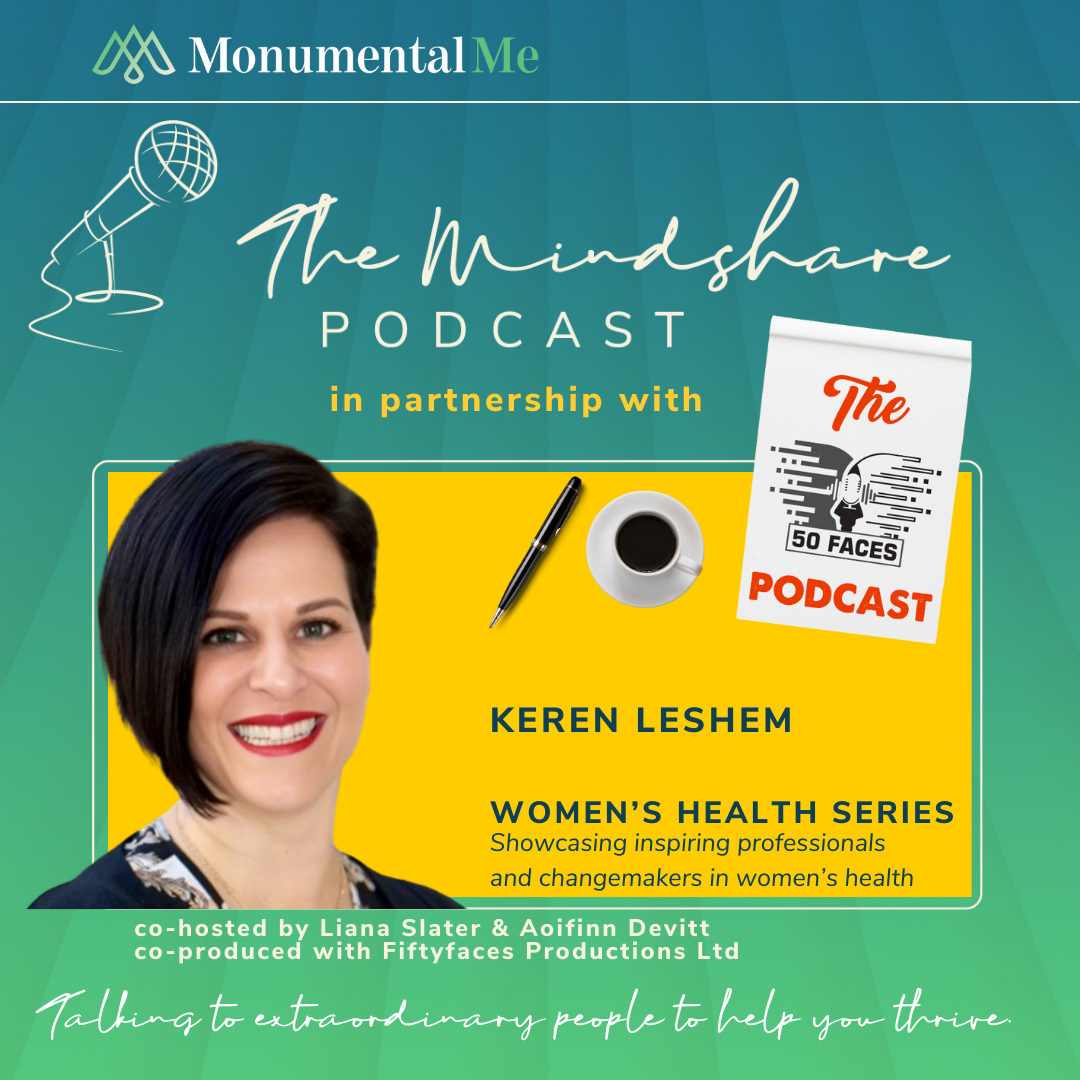


Aoifinn Devitt: Welcome to the second collaboration between Monumental Me and 50 Faces Productions. Monumental Me and the Mindshare Podcast help women access the tools needed to thrive in life and in work. 50 Faces Productions and the 50 Faces Podcast are dedicated to showcasing inspiring people and their career journeys. This series captures key insights and current trends from women dedicated to innovation and discovery in women’s health in particular, as well as in healthcare more broadly. Focusing on women in healthcare, wellness, and health tech, we hear about the funding gaps, technological advances, and awareness campaigns that are bringing this issue out of the shadows and into improving lives. I’m Aoifinn Devitt, and welcome to the 50 Faces Podcast, a podcast committed to revealing the richness and diversity of people in medicine and science by focusing on those people and their stories. I’m joined today by Karen Leshem, who is Chief Executive Officer at Ocon Therapeutics, which develops innovative and safe intrauterine medical solutions inspired by women’s bodies and anatomy. She’s also a board director at Astevix and was recently awarded Best Women’s Health Tech CEO 2023 in the Global CEO Excellence Awards. She holds a number of other board roles and in 2022 was a tech pioneer at the World Economic Forum and is a mentor within the 8400 Health Network, Welcome, Karen. Thanks for joining me today.
Keren Leshem: Thank you for having me.
Aoifinn Devitt: Let’s start by talking a bit about your background. Where did you grow up? What did you study? And how did you first become interested in healthcare and technology?
Keren Leshem: So I grew up in the US to parents from Israel, and I moved back at the age of 18. I was back and forth. I did my master’s finally in business, so I have an MBA from Clark University in the United States. I wasn’t really sure what I was going to do when I grow up. I’m still not sure. So that kind of led me to tech. I didn’t start off in health technology. It was more in high tech, but circumstances led me to do what I like to do, which is healthcare. And I did a lot of years in ophthalmology, and now I’m in women’s health, which is great.
Aoifinn Devitt: And I always think about certainly startups and, you know, we find our niche where there is a problem that needs to be solved, or perhaps an area that’s under-resourced or something not being met. What was the gap that you perceived that led you into women’s health?
Keren Leshem: Well, you know, I don’t have a romantic story about women’s health. A lot of founders and entrepreneurs and CEOs that are women want to solve their own issues. I stumbled across Oakcon. It was my first time to even understand that this could be an extremely interesting, important market. When I joined Ocon, I firstly joined as a vice president, business development and sales. I later turned CEO and we restarted the company and we did a whole what I call a restart-up, looking at women’s anatomy, the health of women. You know, as a mother to children, I’ve never had any issues with bringing them into the world. And so I saw that this is such an underdeserved, underfunded area. And I knew that, you know, we need to do better and help that. And so I became in love with it as I learned about the lack of research, the lack of clinical studies, the lack of options. And as I grow older and older, the lack of information and knowledge, it’s just a bit discouraging. But we’re building this community, which is great, and I get to be part of it. So I feel very privileged.
Aoifinn Devitt: You know, and we’re actually, we’re gonna discuss a little bit about that later, but I think what’s interesting, it is, I suppose it’s, it’s a good thing that you haven’t had a personal experience that has led you to that. That means you’re healthy and that we’re one of the lucky ones. And I consider myself also one of the lucky ones. And I think the surprising thing is how binary it can be. I mean, I’ve had 9 children with no problems and thank goodness for that. But I think when you see just how so many women can have no problems and some women can have problems from the very beginning, And these are clearly the high-risk women that the medical industry and the healthcare industry needs to be watching from day one because they are far more likely to have a bad outcome. That binary nature of it, I think, means that some of us can sort of exist in blissful ignorance about what some of our fellow women are going through because our experience is so different. So I, I think it is notable that there is that divide. It seems to be all or nothing in some cases. And I’d love to ask you, given your focus on some of the intrauterine delivery, what exactly excites you today about some of these innovative technologies that you’re working on?
Keren Leshem: So part of my growing and learning process in women’s health is the lack of options, all the way from contraception to diseases that are so prevalent. If you look at any women’s health condition pathology, there’s no one cancer that even comes closer to the amount of population that it kind of carries. So we’re talking 1 in 3 women that suffer from heavy menstrual bleeding. We’re talking about 1 in 10 that suffer from endometriosis, even though today it’s even believed to be 1 in 6. We’re talking about 7 out of 10 women that will have a fibroid, a uterine fibroid by the age of 50, 8 out of 10 women of color. These are insane numbers, population numbers, not just in women’s health, if you look at the entire population. And so looking at the options that that we have, we’re doomed to either take these oral pills that have these horrific systemic side effects. How can you avoid side effects when you have to swallow these medications? Or the other option we have is surgery. We have to literally go into the hospital and either get this invasive, aggressive surgery or get our uteruses removed. Why? There’s a reason they’re there. It’s there and we should try to hold on and keep it. It also has, you know, a lot to do with our mental health. And so having the ability to take medicines we know work, some better, some worse. But to do research specifically on women, to bring those medicines directly to where they need to be in the uterus is incredible, right? And we are able to do that on a device that fits our anatomy. Finally, something that was designed to be soft, to be round, to not have any edges, not to be made of plastic that can break or twist or turn. And so you have this incredible technology that is able to deliver drugs in a safe manner. It’s been validated. And so this is super exciting because now we have all these diseases that are so prevalent that we can fix by having the woman go in the community into the doctor’s office and to get treated once in a while and not a daily dose of oral treatment or a very aggressive hospital procedure. So that to you me, know, makes all the difference. And I’m a customer of our products. I’ve used our first product, which is a non-hormonal contraception, for over 3 years. I’m still at the age where that could happen to me. And the other products in the pipeline, as I age and as I you see, know, these conditions that evolve, such as heavy menstrual bleeding, etc., I’m a perfect customer for these products as well. So it’s really funny to see, you know, you work at it, but you’re also You’re looking forward to it.
Aoifinn Devitt: That’s a test market. But I’d love to say, on your backdrop there, you have 4 products: IUB, SEAD, Prima, Adira, and Stella. Just to get into the weeds a little, what do they treat, or what are they for? What does IUB stand for?
Keren Leshem: Yeah, the SEAD stands for spherical endometrial ablation drug or device, and it treats, or it’s supposed to be treating, 1 in 3 women that suffer from heavy bleeding for all kinds of reasons. For the reasons for the seed will be non-structural reasons, right? Something that’s not physically in the cavity. And these women are subject to hormones, hormones, hormones, hormones, or an invasive procedure in the hospital. This is really a revolutionary product because it’s a 30-minute quick in-out procedure where basically these beads, these orange beads, they melt into a paste and they remove the thick lining or endometrium that bleeds every month. And women come out of this quick procedure, there’s no need for sedation, there’s no need for a hospital setting, it’s just in the community. And we’ve seen in our clinical studies over 70% drop in bleeding. This is huge in terms of lifestyle, huge in terms of anemia, and it doesn’t require hormones, it doesn’t require follow-on, and it doesn’t require surgery. So that’s really revolutionary. The Prima is a hormonal version to treat abnormal bleeding. So this is when you have structural issues. The ADIRA would treat uterine fibroids, so it would shrink the fibroids in the uterus itself. And the STELLA is for endometriosis. We will take an active ingredient to make sure that the lining itself is so thin that it doesn’t continue to travel or grow in other parts of the body outside of the uterus.
Aoifinn Devitt: And IUB Seed, what does the IUB part stand for?
Keren Leshem: Intrauterine ball.
Aoifinn Devitt: Now we know. So just broadly, given you clearly now are focused on some of these innovations, innovative deliveries, addressing in a, I suppose, as a least obstructive way as possible some of these issues that are so common and not well talked about. I think many of these issues you mentioned, the hormones, the heavy bleeding that can all come with menopause or perimenopause. Now that you said you didn’t start out in women’s health, but now that’s where you reside professionally, what would you say is the current state of investment in it? Awareness in it, visibility, and just interest maybe by investors and the investor base generally of supporting these solutions.
Keren Leshem: People always ask me, how long have you been at Ocon? And I say 4 years and 10 kilos because it’s so hard. I’ve never had such a hard time fundraising. I’ve been fundraising, I think, most of my career for many different indications, not specifically in women’s health. It’s been a very, very difficult ride. I think that there are a lot of smaller funds and smaller checks that want to support women’s health, but there’s not, you know, big money and big advancements. And I think it’s now becoming a lot more discussed and a lot more talked about. There’s a lot more money being funneled towards women’s health, but it’s still very, very young in terms of a marketplace. There hasn’t been huge exits yet. There hasn’t been a lot of return on investment for investors in the space. So it’s growing. I’ve seen a huge change. You know, 4 years ago when I said women’s health, women’s what? Is that, is that a category? And today they don’t ask if it’s a category. Everybody knows it’s a category. So there’s been an advancement because we are a biotech. We deal with drugs and drug regulatory routes. This is not inexpensive. These are expensive hobbies. And so we require a lot of funding to do these clinical studies on women to make sure that they come to market. And so I see it shift. I see that there’s more willingness to discuss women’s health. I see a lot of women in VC that step forward and want to do these investments. Unfortunately, this area is very convoluted. There’s a lot of sex tech and femtech and women’s health, and it kind of all comes together. Some of it is very science-oriented, like Ocon. Some of it is less science-oriented. Some of it doesn’t require regulatory approvals like certain tampons. But on the other hand, others require rigorous. And so there’s a lot of mix and match. And I hope this will come to more of an order later on as we grow and progress this industry and we have some successes. With the things that we’re doing. At the end of the day, we wanna make sure that doctors have options to offer women, not just the traditional hormones and IUDs that are stick-shaped and surgeries. This also gives doctors the ability to be a lot more innovative and have more options for them also to make money. You know, we shouldn’t exclude that. And of course, the choice for women and for payers, these are a lot less expensive than a daily kind of compliant needed pill. I’m very optimistic about this market and future, but there’s still a ways to go.
Aoifinn Devitt: It’s interesting, we definitely have come a long way. I think it’s as, you know, celebrities, as other female advocates have come of age and hit perimenopause and menopause themselves, they’re now speaking about it more openly. It’s even at younger women who are maybe sports stars who are dealing with performing at a high level while they have their period, for example, and expressing openly, admitting that and the drain it can place on them physically. So I think we’ve definitely taken discussion of this out of the shadows. I’m sure it’s not something most people are 100% comfortable discussing. It still seems perhaps too intimate, but I think we’ve probably come a long way. We have a long way still to go. And I’d love to ask, given the board roles you have, given that the roles you’ve had, say, at areas like the World Economic Forum, what is the sort of the level of discussion at those levels and what do you bring to your board roles?
Keren Leshem: So I think there’s a lot of discussion in those areas such as the World Economic Forum more on policies. And really trying to map out where the opportunities are and where the biggest needs are, not just in third world countries where obviously access to healthcare is hard for anyone, especially for women, but you also, know, in Western countries. Where are the biggest opportunities? Where are the biggest pitfalls? Where do we need to put most of the investment, most of the push? We’re done just talking about mommies and babies. There’s a woman here that is a woman before she becomes a mother and is a woman after she becomes a mother or not. And so I think those organizations, they discuss more policy and discuss a little bit more what the opportunities are. On the specific board roles, I think that it’s important for people like me that own a very strong network to come and exploit that network in other ways. And that’s exactly what I do with the KOLs and the investors, you know, and the other board members. I’m able to bring that to those board roles to really help push more women’s health forward. And I always say that if we help each other, we all move forward. This will grow the market and we’ll all be successful. If we kind of build our own silo and stay in our own positions, it’s not going to help this industry grow and be more successful. And so I really believe we have to help each other. And I set that as a strategy that I’m now part of your network. Use me as you please. LinkedIn is a great way to start. Who am I connected to? Who would you like to be connected to? So I keep saying that to any entrepreneur, any investor, any woman trying to do anything in this space so that we can all come together and look at really good ideas and bring them forward, get them financed and get them going.
Aoifinn Devitt: Well, it’s great. It was the wonderful Maura Rosenfeld, I think, that was our connection in common. And yes, exactly that. I mean, this is exactly where unfortunately it is still marginal in terms of fundraising and awareness building, women’s health. And I think therefore advocates like yourself, powerful advocates like Maura as well, that’s exactly where we need to go. And LinkedIn is a perfect vehicle for this because this is a global problem. And I would just refer back also to the fact that in the SDGs, women and girls are highlighted there, gender equality, as well as much of the health-related goals there. But I do know that at least at a global level, these are aspirational goals. Let’s return to some personal reflections now. So you’re clearly in a very, I suppose, highly charged role right now as you raise capital and are at the forefront of some of this innovation. What are some of the ups and downs of your career to date and any lessons learned from any of those setbacks?
Keren Leshem: Do we have like 3, 4 hours? I’m very good at complaining, let me tell you. It’s everywhere. It’s just in every single path you take. If it’s regulatory, if it’s finance, if it’s R&D, if it’s clinical studies. I mean, every single rock you turn has its own fun, fun, fun. I can tell you that I’ve decided I’m going to do a TED Talk at some point after all this is done about the hurdles we had to go through, you know, with such great, you know, tech. So we have great validated technology. And even then, how much you have to go through, even from within your own team and your own board. It’s such a roller coaster. It’s such a roller coaster. And especially, you know, with the geopolitical situation that’s going on, COVID hit us a couple of years ago. It’s just been extremely difficult to get, you know, teams on the ground to do our clinical studies, to do our regulatory, to make sure we’re there where it’s needed, key opinion leaders really make sure that we have our commercial product out in the market. It’s just been an insane ride. So in every rock you turn, you find something that you gain another 7 kilos due to that.
Aoifinn Devitt: How do you stay on the train then, or on that roller coaster? What is it that drives you, I suppose, to stay the course? And where does that resilience come from?
Keren Leshem: A lot of carbs. Actually, it’s funny because they always say that the CEO position is such a lonely position, but for me, it’s my team. I have such an incredible team. We’re so passionate about what we do. We love the products that we kind of push forward. And my investors, I got to tell you, these are people that I admire, that regardless of the fact that this is not a known industry and regardless of the fact that this is hard and it will take time, they put their money, they put their money on me and on my team and on these products. And so that’s really what keeps me going. And of course, I have a daughter and I have a sister and I have friends and family. I want to make sure that we have better options. I don’t want to hear women just complaining about the fact that they don’t know what to do or they haven’t heard of anything new or that the doctors have nothing to offer. It’s a mix of things that give me my motivation to make sure that this comes to fruition. I want to see these products on the market. That’s the most important thing to me. And I want to make sure that they return the investment that was made and make sure that the team does this with passion together with me as we go through the motions.
Aoifinn Devitt: Well, remarkable as it is to see your resilience, and I’m so thankful for it, it is still kind of sad that it is such a set of hurdles because I’m sure there are many out there who would have products like yours or other products that are needed that don’t stay the course or that are dissuaded from the lack of fundraising or that never see the light of day. So that’s, I think, the real shame is that the ecosystem is not more welcoming around this type of massive risk that has to be taken to even make something like this. Speaking of the ecosystem, any role models or key people who were influential to you along this journey?
Keren Leshem: I thought about that and I have a few. Of course, I mentor and I always say that I have mentors. So yes, of course. And it’s been since I was much younger, but I think the one biggest role model for me was my grandfather, my mother’s father. He is a Polish Holocaust survivor, and he went all the way through concentration camps, came to Israel, had a beautiful family which had a beautiful family which had a beautiful family. And really his resilience and his love of life, I think, kind of stuck with me, with my kids. So he’s my biggest role model. He passed away at the age of almost 100 and just was a lovely man. And so I think he’s the one that I always look up to and say, wow, he went through, you know, his resilience is nothing compared to what we need to live through.
Aoifinn Devitt: So, oh, I’m sure he would be very proud. And now when you think about the words of wisdom or creed or motto that you have gathered over the years, anything you can leave us with there?
Keren Leshem: I think with everyone it’s different, and every day is different, and the situation today, especially on our side of the world, is very, very difficult. But I think that the most important thing is to really be thankful. Just be thankful. And, you know, if that can be accompanied with a smile that makes people around you feel welcome, feel safe, feel comfortable, I always recommend that over ego and over anything else. And so just thankful with a smile would, you know, go a long way.
Aoifinn Devitt: Well, Karen, anyone who’s listening to this can see how many times you smiled through this discussion, but it has been nonstop radiance across the screen that I’ve seen. And I’d say that as well as your deep commitment to this area of women’s health, the fact that these products are needed, are accessible, are easy, and I think are ultimately aimed to eliminate some of the friction for which in women’s lives there is much friction at all stages. So anything that is supposed to make that easier and is addressing head-on problems that sometimes get pushed into the shadows or that don’t get the right attention. So thank you so much for your commitment, for your amazing presence on LinkedIn, your enthusiasm, your drive, and all that resilience. If it did come from your grandfather, thank you for that. Thank you for coming here and sharing your insights with us.
Keren Leshem: Thank you.
Aoifinn Devitt: Thank you for listening to this podcast made in collaboration with Monumental Me and 50 Faces Productions. If you liked what you heard and would like to tune in to hear more inspiring professionals and their personal journeys, please subscribe on Apple Podcasts or wherever you get your podcast. This podcast is for informational purposes only and should not be construed as investment advice, and all views are personal and should not be attributed to the organizations and affiliations of the host or any guest.
Speaker A: Welcome to the second collaboration between Monumental Me and 50 Faces Productions. Monumental Me and the Mindshare Podcast help women access the tools needed to thrive in life and then work. 50 Faces Productions and the 50 Faces Podcast are dedicated to showcasing inspiring people and their career journeys. This series captures key insights and current trends from women dedicated to innovation and discovery in women’s health in particular, as well as in healthcare more broadly. Focused on women, healthcare, wellness, and health tech, we hear about the funding gaps, technological advances, and awareness campaigns that are bringing this issue out of the shadows and into improving lives. In this first short capsule collection, we hear from startup owners and venture capitalists, as well as medical researchers about what drives them to address the imbalance around women’s health.
Special Collaboration: Our mission is improving lives of people who have been overlooked. A lot of places where women have been overlooked is intersectional with women of color as well. So a lot of the health disparities for women are worsened for BIPOC. And so we’re really looking to have a lot of ways in which we’re improving women’s lives.
Speaker C: As a mother to children, I’ve never had any issues with bringing them into the world. I saw that this is such an underfunded area, and I knew that, you know, we need to do better and help that.
Speaker A: We hear about the illnesses and conditions that disproportionately affect women.
Speaker D: There are things that are very specific to women that have to do with the fact that women have different organs, that women have different cycles in their lives and go through different conditions. So, for example, women can become pregnant. They go through menopause. They go through menarche, which is the start of having menstruation. On the same side, women also just have health issues and health needs and conditions that are also very prevalent in women in addition to men. And so when I think about women’s healthcare, I think about that holistic view of women’s healthcare.
Speaker C: So we’re talking 1 in 3 women that suffer from heavy menstrual bleeding. We’re talking about 1 in 10 that suffer from endometriosis, even though today it’s even believed to be 1 in 6. We’re talking about 7 out of 10 women that will have a fibroid, a uterine fibroid, by the age of 50. 8 out of 10 women of color. These are insane numbers, population numbers, not just in women’s health. We’re doomed to either take these oral pills that have these horrific systemic side effects How can you avoid side effects when you have to swallow these medications? Or the other option we have is surgery. We have to literally go into the hospital and either get this invasive, aggressive surgery or get our uteruses removed. Why? There’s a reason they’re there.
Speaker A: And lists the unexpected ways that women can have less positive outcomes.
Speaker D: Cognitive impairment is unfortunately more prevalent in women. We have to think about that as part of the women’s health ecosystem. Cardiovascular disease is the number one killer of women.
Special Collaboration: Their first use case is just diabetes.
Speaker D: Most of the data that we have as it relates to healthcare and the evidence that led us to treatments is actually being provided for women, but it comes from testing men. There are chronic conditions, something in particular called autoimmune diseases, that women are disproportionately affected by— rheumatology, inflammatory diseases— and really more research is needed into the causes and treatments.
Speaker A: We ask where the areas for investment are.
Special Collaboration: We’re heavily focused on digital health right now and have a big thesis around what makes a successful digital health company. And so when COVID hit, it really accelerated adoption of telehealth. But at this point, a lot of the companies that may have been overvalued in telehealth, telehealth for XYZ, haven’t fully moved the needle. And so what we’re seeing right now is telehealth may be a component, but there should be like an entire digital platform that’s defined the health outcomes that they’re improving.
Speaker A: And look to the opportunities of tomorrow.
Speaker D: We look for companies that are at the collision of healthcare and technology. We spend a lot of time looking at artificial intelligence and the role that it can play.
Speaker C: You have this incredible technology that is able to deliver drugs in a safe manner. It’s been validated.
Speaker A: While being cheered by the fact that there is finally some money on the horizon.
Speaker D: I think this announcement by the administration is actually going to just increase funding, both venture funding and public research funding, for women’s health in many, many ways. The proposal is, like you said, for $12 billion to fund research on women’s health.
Speaker A: As always, we conclude with words of wisdom and a call to action.
Speaker D: The quote that I often will share is, “We are not humans having a spiritual experience. We are spiritual beings having a human experience.”.
Speaker A: Thank you for listening to this collaboration between Monumental Me and the 50 Faces Podcast. We look forward to sharing our with stories you.
Aoifinn Devitt: Our Global Women in Tech series is an exciting collaboration between 50 Faces Productions.
Madeleine: And Monumental Me, an organization committed to.
Aoifinn Devitt: Wellness, including resilience, mental fitness, and strength, designed to help you thrive in life and your career.
Madeleine: By listening to this series, not only.
Aoifinn Devitt: Are you gathering key insights into the.
Madeleine: Tech world today, but you’re also gaining real tools to help you rise in your career while while taking care of your well-being.
Aoifinn Devitt: Thanks for listening, and if you enjoy this series, spread the word.
Madeleine: Scale through automation for both our clients and to meet the standards of regulators is an evergreen goal in technology. We want our humans to use their full capacities and not be doing redundant tasks as much as possible. So let’s use the machines to do the things that are repetitive, and let’s use our humans to their full potential and to use their hearts and souls in every way that can be helpful and bring the best outcomes to our clients.
Aoifinn Devitt: I’m Aoifinn Devitt, and welcome to the 50 Faces Focus Podcast, a podcast committed to revealing the richness and diversity of global tech by focusing on its people and their stories. I’m joined today by Madeline Dassault, who’s partner and co-head technology at Wellington Management. She previously was a vice president at Goldman Sachs in the area of equity trading technology. She holds a number of board roles, including being a member of the board of Phinos and Boston City Singers. Welcome, Madeline. Thanks for joining me today.
Madeleine: Thank you so much for having me today.
Aoifinn Devitt: Well, let’s start with your career journey. Can you talk us through that, going right back to where you grew up, what you studied, And did it take any surprising turns along the way?
Madeleine: I’m happy to. So I was born and raised in France. My father is from a French working-class family outside of Paris. My mom is American and from a conservative Jewish family in New York that we used to visit every summer. And I went to the Lycée International de Saint-Germain-en-Laye, which was one of the first international French public schools, and it was multilingual. And multicultural with 9 countries represented. So a real melting pot way before its time. And part of French school culture was a saying that everyone in my generation remembers fondly from all the report cards and all of the teachers is “Peux mieux faire,” which literally translated is “Can do better.” I’ve turned that mantra a little, a little bit on its side as I’ve gotten older too. I am and I want to always be a work in progress, but That premier fait of can do better is something that’s deeply ingrained in me, that there’s always more to be done and more to learn and more ways to grow and evolve as a person and a professional. So I followed my siblings to Columbia College in New York and became a math major. And that is definitely an unusual choice. And it was more a factor of the fact that I really found writing papers in English at a college level very difficult, having come from France, because it was a— a direct choice, and I was always attracted to math. It is the universal language, and it was something that I enjoyed and was good at. And so eventually I realized that leaning into my strengths was a better path than trying to fight through my weaknesses that came from my educational background. So I joined Accenture, which was then Andersen Consulting, in financial markets in New York out of college, and I was there for about 5 or 6 years. And then I went to Goldman Sachs in trading technology And that’s where I really fell in love with the markets. I had the great privilege of working on the floor of the New York Stock Exchange for a couple of years and really became fascinated with the mechanics and the feel of what was going on in the heart of of the, the world financial markets. You could stand on the floor of the New York Stock Exchange and literally feel the world financial market’s heart beating. It was pretty amazing. And the trading floors are very intense places. The NYSE was definitely a very intense place. And it was a very formative experience and a great match for me because I am a very intense person and I feel things very strongly, and I’m also very direct and blunt by nature. So those environments were a very good match for me in terms of my natural state, my personality. So the next big change in my career was walking away from Wall Street. I had two girls who were identical twins, Annette and Sophie, and We decided to move to Boston where my husband was from to get some support from a family point of view and really also just be able to spend more time as a family unit and less time commuting and at work. And so I joined the trading technology team at Wellington in 2006. We had a great privilege of assembling a team to build an equity trading order management system from scratch. Took about 5 years. It was a really bonding and unique experience, and I’m very grateful to Wellington for seeing it through. Very few firms will actually spend those years on that type of work and have the consistency and forward-looking view to keep going. And then after we did that, I started taking on more responsibility little by little for legal and tech and regulatory and operations and portfolio implementation and different aspects of data in the technology space. And then 2020, when our previous CIO retired, I was asked to co-head technology. And the path at Wellington has been very surprising because in my mind I was choosing family over career when I went to Wellington. It was part of the move to Boston and having the kids be near the grandparents and a good commute to the French school for my daughters. And I really didn’t expect to have such an incredibly rewarding career and feel so strongly that I’m part of something special at Wellington than the way it’s turned out. So very surprising turn, in fact.
Aoifinn Devitt: That’s great. Of course, that’s the ultimate holy grail, is finding that fulfillment in a way that allows you to offer your family what you wish. Lots to dig into a little bit there in terms of your background. Really fascinating. First of all, you said that your dad had come from a working-class background, but yet you went to the lycée. Was there any kind of a cultural adjustment in terms of either at Lycée, then Columbia, New York. Was that a normal path? You said your siblings had done it, but was there a kind of a culture shock for you at all?
Madeleine: The interesting thing about the Lycée International is that it was actually a French public school. It was originally the school for the kids of the SHAPE officers during World War II, and then it became the school for the kids of the NATO officers. And then when France left NATO, it became a French public school. So from that point of view, it was very, very much kind of social class agnostic. What you did have is a group of expats who were the children of CEOs and diplomats. You would see plates on the cars with diplomat plates, and they were interestingly often kind of bubbled on the side because most of the school was just regular public school people that happened to come from various countries around Europe. So if anything, I think they were kind of the on-the-side group, whereas everybody else mixed in, and it really was very much a melting pot. I would say when I got to Columbia, actually, what I found was it was— people used to say it’s a salad bowl, not a melting pot. And very surprisingly, you would have thought that coming to New York, that that’s where the melting pot would be. But my environment in high school in Europe was much more of a melting pot than Columbia was. At Columbia, you had very distinct groups and they mixed very, very little. So there was a huge amount of diversity, but, but the kids actually clumped together in subgroups and didn’t mix very much.
Aoifinn Devitt: Really interesting. And then you also mentioned the trading floor being intense. I’d love to just see exactly what you mean by that. And you said that you, you match that environment being intense yourself. Do you think that there are certain people for whom trading is just a match to trading floor? Can one learn and adapt to be that intense, do you think, or is it something you’re born with?
Madeleine: I think there’s a certain level of it that you’re born with. People who are very calm by nature and don’t like conflict it’s going to be hard to learn to really love. I mean, you can survive it, but I don’t know that you’re going to love that kind of environment. And for me, having that intensity matched sort of meant that it was easier to be myself. And it took me a long time to learn how to modulate that. And so in the early years, I didn’t have to modulate it because the trading floors, they’re aggressive, they’re loud, they’re direct, and things happen very, very quickly. And there’s a very high sense of urgency. And all of those things were things that came very naturally to me and that I’ve had to modulate out of over my life versus the opposite. So I think it kind of depends where you come from, but trading floors are not very happy places for a lot of people. It takes a certain type of personality to enjoy it, but those who enjoy it love it.
Aoifinn Devitt: It’s interesting you mentioned conflict because I think that’s one thing that governance often gets wrong in that there’s so rarely conflict, say, on boards elsewhere that when there is something really critical, like we’ve seen with these bank situations over the, over recent months, recording this in March ’23, it seems like that we’re actually uncomfortable with conflict. We don’t know how to handle it and things get brushed onto the surface. Did you find in the trading floor that when there was conflict, there was a fresh start the next day, that there was that ability to kind of move on from conflict, not take it personally, just focus on the issues?
Madeleine: Absolutely. And I think it’s one of the strengths of those types of environments. Is that things are said very directly and part of the job in the environment is that you take it and you process it, you react, you improve, and you move on to— and the next day is a fresh day with the learning coming with you. And I do think it’s extremely healthy to have the processes and the capacity to actually deal with disagreement and conflict and move through it rather than move around it.
Aoifinn Devitt: Really interesting. Just wanted to now move to your career progression because you have progressed through the ranks into a leadership role. How would you say you achieved that? Was there any plan, anything that worked and that didn’t?
Madeleine: So I never had a master plan, but I always wanted to excel at what I was doing, and I always strived to get whatever the recognition, the next recognition was that was happening in that particular job. So I definitely put the work in. I I’m arguably a workaholic. I like to work. I enjoy what I do. And part of the thing that I’ve done is always make sure that what I’m working on is something I have passion for. And so I don’t actually feel the fact that I work a lot of hours as that painful because I enjoy what I do. And I would say I never said no to anything I was asked to do, regardless of what type of work it was and whether it was really grunt work. And I always kept my head up and looked for opportunities to learn from everything and from people around me who role-modeled interesting skills that I could just observe and try to emulate and learn and kind of try on and try out. And that worked very well for me until I got to a consulting project when I was in my Accenture days that was at a bank that was just, for a variety of reasons, not a positive environment. It was pretty toxic. I wasn’t learning anything. And I don’t think we were actually doing anything particularly useful for the client in the end when you step back and look at it broadly. And so what I realized there is that that was a case where no amount of hard work and grit was going to actually improve the situation. And I eventually got myself out of it, but it took a couple of years. And so the learning from that experience is that sometimes you’re just in the wrong environment and the thing that you have to change isn’t yourself, it’s the environment.. And figuring out what those moments are, I think, is really important in a career because you can get pretty unmotivated and stagnant when you’re in an environment that’s just not good for you at that moment. And to our earlier point, what’s good for one person isn’t good for another. It depends on who you are and what an environment that makes you thrive is. So I think it’s really important for everyone to remember that we have the agency to decide where we work and with whom we work. And, and that’s a privilege to be in corporate We can, when we have those types of choices, not everyone in the world has them. So let’s use that agency to make sure that we thrive.
Aoifinn Devitt: Of course, the intensity you mentioned earlier, I’m sure that goes with a certain desire to thrive and progress and learn as well. I think the two probably, I rarely see one without the other. It’s interesting. Moving now to your role at the helm of a technology division at a large global asset manager, what would you say is at the forefront of your mind today?
Madeleine: At the forefront of my mind is thinking about what differentiates our firm in the market and how to best align technology work to support and amplify the firm’s mission. So on a day-to-day basis, that means working really tightly with our business leadership to make sure that what we’re doing is optimized for our business and our edge. I’m a big believer that generic technology gives you generic answers. But a technology that’s extremely well-matched to your edge and your business problem is incredibly differentiated. And when you work very closely together and collaborate between business leaders and technologists, and your business people understand enough about how technology can be useful to them, and the technologists understand enough about the business problem that they can come together, that’s when you really get magic and you get very, very powerful technology that can really change the game for a firm. So concretely in today’s world, what does it look like in terms of the different areas where we’re applying technology? Harnessing the power of virtual interactions is incredibly important right now. Obviously COVID took us to that place, but if you think about what it means in the future, how you interact with clients, whether or not you choose to travel or not, which obviously has a link to the environment and our sustainability goals, Being able to do research at scale without having to physically go to every single place that you’re interested in. And also just having access to the best talent in the world and being able to integrate people virtually rather than physically at all times. Harnessing the power of virtual interactions is a big focus. Data and being able to wrangle down the vast amounts of data that exists and that keep on multiplying and growing, getting our arms around that both for clients and for research and bringing it into the hands of our our GIAs and our portfolio managers in as practical and pragmatic and forward-looking way as possible is a huge goal for both the technology and the data groups at Wellington. Scale through automation for both our clients and to meet the standards of regulators is an evergreen goal in technology. We want our humans to use their full capacities and not be doing redundant tasks as much as possible. So let’s use the machines to do the things that are repetitive and let’s use our human their full potential and to use their hearts and souls in every way that can be helpful and bring the best outcomes to our clients.
Aoifinn Devitt: And in terms of the focus on cybersecurity spending on tech, do you see that it’s going to take an ever-increasing share of wallet? It seems that that’s really where the next kind of arms race is.
Madeleine: So there is an arms race in that space and there is a kind of a sub-industry, if you will, a cottage industry of InfoSec. That in some ways is self-perpetuating, right? So the, the more they exist and the more they’re building their businesses, the more an asset manager needs to— and any financial services firm needs to spend money on cyber. So I think in the short term it’s definitely a little bit of an arms race, but hopefully we will get to the point where there’s a little bit more sharing and outsourcing and common tools going on so that it flattens out a little bit and, and doesn’t become a drain on the core business of getting good outcomes for our clients.
Aoifinn Devitt: And I’d love to turn to the area of coaching now, because I know you spend a lot of time coaching members of your firm, maybe within, outside your team as well. What have you learned from this and what are some of the themes that come up and some of the issues that you’ve helped with?
Madeleine: So I would say the number one thing that comes up over and over and over again is feedback, how you give it, how you receive it. What to do with it. And it’s the thing I spend the most time with people, particularly women. So feedback, I would say, is seldom delivered very well. And it takes a lot of effort to actually figure out something concrete to do with feedback when you get it. And it’s very, very hard to not feel like the feedback is a personal attack. So I’ll give you a personal example that I think is a pretty powerful one. So a few years ago, I was given feedback that one of my peers had expressed that they perceived me as someone with schadenfreude, which I didn’t actually know what that meant at the time. But it turns out that it means that you take pleasure in someone else’s pain. And in a team context, if you look it up, it says the observer’s feelings of pleasure that the other’s failure represents an improvement or validation for their own group. So if your group fails, I feel good because my group is better. And you can imagine that it’s very hard not to take that feedback very, very personally. And I lost quite a few nights of sleep, both being angry that someone would say that about me, but also feeling terrible that someone would perceive that about me. And what happened eventually is that I decided to do the work and lean in and try to figure out if I’m a work in progress, how can I do something constructive with this? And I first started by inquiring with my closest trusted work friends, what could this have come from? What does it mean? Do they perceive that about me? And then I eventually expanded it a little bit after I got some insights from them to some other peers in the group. And what I learned is that during leadership team meetings, when other teams’ challenges were being discussed, I tended to do two things. I would get back on my laptop and visibly start working on something else. And I would apparently giggle slightly or possibly smile. So I still would like to think that the giggle was a nervous giggle and that it wasn’t me smiling in relief that I wasn’t in the line of fire. But there is a possibility that it was a little bit of both, and I can admit that now. This behavior of going back to my laptop and smiling or giggling when another team’s challenges was being discussed is what caused this feedback that somebody else in the room thought, oh well, she’s just happy that my team’s having a problem right now. And so that’s a pretty easy fix and very aligned to my values. It’s not hard to pay attention in a meeting and try to really be supportive and engage, even if the problem being discussed or the challenge being discussed isn’t directly your team. And so I think it’s a good example of a time where I was completely unaware of my behavior. I was completely unaware of the impact that it had, and I really learned a lot from the feedback. And the feedback was really poorly delivered and took an enormous amount of effort to pick apart and understand. So when you get feedback, I think the knee-jerk reaction tends to be very black and white. Either I reject it completely or, oh my God, they’re 100% right, I have to fix myself completely. I think what’s helpful is to take a mindset of mine for wisdom, go looking, take the pieces that are useful, put aside the pieces that aren’t. And really try to keep in mind that how we behave and how we impact others is in our own control. And we can go find out how we’re being perceived. We can go find out what impact we have. And then we can choose to modify our behaviors in the way that’s aligned to ourselves. And I think that’s a very empowering way to look at feedback rather than just feeling either soul-crushed or elated and nothing in the middle. The middle is we’re a work in progress. There’s always something to learn.
Aoifinn Devitt: I love that. First of all, I love the work in progress notion. I kind of, for me, it’s the kind of dig deeper exhortation that I would give my own children, that there’s always something you can do to dig deeper. But equally, feedback has been viewed as a gift too, is I think is another way to look at it is that it is something that obviously you can use to grow. But funnily enough, one of the problems I find is the more senior you get, the less feedback you get. So to have to actually actively mine for feedback, that feedback you got was extraordinarily specific and useful and concrete, as you mentioned, as a result. Definitely more of that would help us all. But equally being able to take that trading floor mentality, not take it personally, take it in the spirit in which it should be intended to focus on the issue, I suppose, more than as a personal affront. But really fascinating. Equally then, you’ve spoken when we had this pre-call about some of your skepticism around some of the wisdom that gets passed through generations, whether it’s necessarily always fit for purpose. In the generation in which it’s received. Can you just expand on that a little? Yes.
Madeleine: So the wisdom that I was given when I first started working, and I’m not sure I would really call it wisdom at this point, but it came in— I’m sure you heard a lot of it yourself over the years. It came in variations around things like keep your head down and do your work. Don’t stick out. Cream will rise to the top. Don’t wear any clothes that bring attention to being female. That was definitely Wall Street in the early ’90s. Don’t giggle, don’t cry, don’t show any emotions. Effectively blend in as much as possible. That was prevalent for a long time in my career, various versions. It softened a little bit over the years, and when I moved from New York to Boston, I would say the words were a little bit different, but fundamentally that was the wisdom that you got. And now the wisdom that you hear is bring your whole self to work, and that’s a pretty big change in 25 years from effectively try to disappear and blend in and do your work and hope someone notices it to bring your whole self to work. And my personal view is that it goes a little bit too far and can have some unintended consequences. So I’ll take myself as an example. My whole self includes feelings of anger and sadness and shame and guilt and fear and frustration and anxiety. I’m a human being. I go through all of those. And I do think when we all experienced each other through COVID, it became much more transparent that everyone goes through these experiences. And we had to all kind of manage and change how we deal with that inner world and the work world during COVID So I think we learned a lot during that period. So those feelings are real and they need to be processed, and people go through different moments in their lives that are really hard. COVID was a everyone-is-going-through-a-hard-time-at-the-same-time kind of moment. So I think there was a lot more sharing in some ways because it was a common struggle. But people in their lives go through different moments, right, where you’re having challenges in your family, with your health, with your kids. And I would say that I absolutely need the support and care that my work friends give me through those tough times. But I don’t think that I can be successful in my role if I bring all of that to work every day and let it dominate who I am as a leader, even when it’s dominating my inner world. And so what I want to convey to my team is that we can go to the moon and that we’re stronger together and that I’m a servant leader here to help them and that I have strength and emotional bandwidth to support them and help them grow and look to the future. And so there is a balancing act between those two things. So I would say a more measured piece of wisdom would be exercise self-care for yourself so that you can bring your best work self to work.
Aoifinn Devitt: I’ve heard a modification of that best self or whole self as a favorite self, which is, I think, kind of a nice kind of middle ground, is that we all know we, we have our extremes. And I suppose if we can kind of— and I’ve also heard a technique for that is to practice it in smaller circumstances, maybe lower stakes, maybe how you’re going to interact with that receptionist at a hotel or with some somebody in your daily interactions and try to think, well, what’s my favorite self that I would bring to this scenario? And that kind of role modeling and practicing can help you to think about that, be more flexible, I suppose, for that favorite self in the work setting, whatever we encounter. So I think it’s quite similar to your ideas there. I wanted to just talk about diversity because you’ve seen diversity from starting obviously on a trading floor, not a bastion necessarily of diversity. And I mean by diversity here, by gender, by ethnic background. And you’ve also been in financial services and tech. What grade would you say you’d give the industry? Any observations on how it’s evolved through your career?
Madeleine: I won’t give us a grade because my French self would come out, but I would say that “peux mieux faire,” “I can do better,” absolutely applies to this topic. And although there’s been a lot of progress and there’s deliberate work both in asset management and in technology, I think it’s slow going, but change is happening. From my day-to-day experience, there was a time when I was almost always the only woman in the room, and now that’s rarely the case. And I would say the experience of women of color in technology and asset management is definitely not what I wanted it to be, and much more similar to what I experienced from just a gender point of view 20, 25 years ago. So some stats that should give us all a little bit of pause: in 2020, 58% of U.S. Bachelor degrees were awarded to women. And yet 46% of employees in finance are women. 28% of employees in the tech industry are women. And only 15% in financial services of executives are women. And women still make 79 cents on the dollar. What can we do to change it? I’m a big believer in lift as you rise. If you look at women today, we control $10 trillion of total US household financial assets, and it’s forecasted to be $30 trillion by the end of the decade. So I think if women take their purchasing and decision-making power and continue to drive change and demand that the treatment of women and all underrepresented groups be fair as they grow their decision-making and power through financial decision-making, it’s going to continue to change. It’s going to make a difference.
Aoifinn Devitt: Really interesting. Thank you for bringing the stats to the discussion there, because that’s really what, what does bring it home. I’m just going to turn to some personal reflections. So you’ve had a career that’s taken you through different cities, different sort of backdrops. Would you say there are any ups and downs there and any perhaps lessons that you learned from?
Madeleine: So the ups in my career are times when I’m growing and I feel deeply connected to the people that I work with and the mission of the firm. For me, having values aligned with the mission of what I’m doing is incredibly important. And the lows have been times, as I mentioned earlier, where I’m just in a work environment that’s not a good fit for me, and I become very stagnant. So the lesson that I always come back to is I got to make sure that I’m growing and evolving and that I can honestly look at myself as a work in progress. And if I’m getting complacent or I’m getting less motivated, then I have to honestly be able to look at the environment that I’m in or how I’m behaving and figure out what to change and remember that I have the agency to change it and not stay in place.
Aoifinn Devitt: Yeah, that agency, absolute self-determination, absolutely key. And you had mentioned lift as you climb, and actually this is a theme that’s run through many of these podcasts here, from a young Ghanaian woman who wants to give back to her community to many other walks of life. Has anyone lifted you as you’ve climbed? Have there been any key people who have influenced you along the way?
Madeleine: Absolutely. So I’ve been very lucky to have a number of just my managers, both in IT and leaders of the trading floors that have really taken me under their wings over the years. And they’ve helped me interpret feedback, importantly channel my intensity in a productive way and temper how I bring the rest of myself to work on behalf of the firm. They’ve been incredibly helpful and formative. The leadership team that I work with on a day-to-day basis influences me a ton. We have a great team in IT at Wellington.. And they bring really complementary skills, and I learn from them every day. And they actually do give me feedback even as I get more senior because we’ve been together for a long time and there’s some very deep trust. I am constantly learning and evolving thanks to them. One of my managers, every catch-up that we have is feedback for me, feedback for him, and we always do that. I think that’s a great tool, and it can really— it makes a difference because you’re always learning and growing. And again, it’s not an attack on you, it’s just part of the process. Process and, and something that you’re using to get better. The person who has had the most influence on my life and career is my husband, Eric. We’ve been together for 30 years. We met in college and he taught me to program in C while I helped him with his French homework. He’s always believed without a shadow of a doubt that the right thing for our family was for me to work and that I would excel at work. And he really believes I’m good at this stuff and he doesn’t accept me wallowing in my insecurities or negativity. He’s challenging of my approach, and he’s also an IT professional, so he can challenge all the way down into the work, but he respects my perspective. And having— I would say having someone who believes in you really makes a difference when you’re pushing through the difficult times. And there are always going to be difficult times, whether it’s work-based or home-based. So fundamentally, he believes that I can grow and learn and that I’m a work in progress in the most positive way. And that’s definitely the most defining influence on my career, on my life.
Aoifinn Devitt: And how about any words of wisdom that you’ve learned over the years? Any creed or motto that you live by?
Madeleine: You know, clearly we’re all work in progress is a creed or motto, and it’s, it’s come up throughout this podcast. But some of that has also been influenced by Carla Harris, who wrote a book called Expect to Win. She came to Wellington in one of the women’s groups many years ago. I still occasionally go back and reread that book, and one of the things she said is You can change the way people think about you simply by changing the way you behave, the things you say, and the words you use when you are speaking to them. So again, that’s very empowering about you having the choice in terms of how you’re perceived and what impact you have on others. And the other one that I think about a lot is actually one Jean Hines has said, and she is our CEO at Wellington now and an incredible woman and investor and mother and human being.. And she said the biggest leadership lesson is to assume positive intent. Stop wasting time and energy mulling over why someone did something. And I do think that applies very heavily to those situations where you get feedback that’s hurtful, remembering that they have positive intent and they’re actually telling you this because they’re trying to help you. There’s no incentive for someone to get to bother giving you feedback and taking the time if they’re not actually trying to help you grow. So positive intent is another one, and, and Jean repeats that often.
Aoifinn Devitt: My mother is a politician, has a similar expression about umbrage being a heavy burden to bear, and I think that’s the only way you could survive in these kind of conflict-filled environments is to, to navigate through with believing people don’t intend to hurt you. But great advice. I’ll have to go read that from Carla. Final question is around any advice you might have for your younger self. Anything for that young student entering Columbia College from De Liceu?
Madeleine: Yes, I actually talked to some young students entering Columbia College recently. So I do try to spend time with the next generation as much as possible. So I would say to my younger self, and that’s very specific to me, and we’re all different, is for me, it’s okay to be different. In fact, it’s a strength. Lean into where your talents are and don’t take all the criticism so personally. If you hear that you’re too this and too that,— just remember that your passion and intensity are a core strength and who you are, and absolutely you need to learn how to challenge it, but you don’t need to squelch it. If you can do that and you learn how to channel it, you’ll be a work in progress and continue to grow and evolve, and that’s exactly what you want to be, and that’s what you need to be to have a successful career.
Aoifinn Devitt: Well, Madeleine, this has been a wonderfully reflective discussion, taking us right back back to the, the primary school classroom, elementary school in Paris, and some of the values laid down there. So thank you so much for walking us through your career in tech and asset management, the reflections along the way. And I think this has been a wonderful discussion. Thank you for sharing your insights with us.
Madeleine: Thank you so much for having me, and it’s been a lovely chat. I’ve really enjoyed it.
Aoifinn Devitt: I’m Aoifinn Devitt. Thank you for listening to the 50 Faces podcast. If you liked what you heard and would like to tune in to hear more inspiring people on their personal journeys, Please subscribe on Apple Podcasts or wherever you get your podcasts. This podcast is for informational purposes only and should not be construed as investment advice, and all views are personal and should not be attributed to the organizations and affiliations of the host or any guest.
April Rini: Our Global Women in Tech series is an exciting collaboration between 50 Faces Productions and Monumental Me, an organization committed to wellness, including resilience, mental fitness, and strength, designed to help you thrive in life and your career. By listening to this series, not only are you gathering key insights into the tech world today, but you’re also gaining real tools to help you rise in your career while taking care of your wellbeing. Thanks for listening. And if you enjoy this series, spread the word. This is Leanna Slater of Monumental Me. Today I’m speaking with April Rini. April is a change navigator. She’s a speaker, investor, and adventurer whose work and travels in more than 100 countries have given her a front row seat to a world in flux. She’s ranked one of the 50 leading female futurists in the world by Forbes, and April was my guest on the Mindshare podcast in season Episode 1, and we talked about her book, Flux: 8 Superpowers for Thriving in Constant Change. I invited April to speak with me on this series after a year of advising organizations in tech and across sectors and of speaking on this topic and more. Today, April talks us through these superpowers and how we can apply them to our lives in order to manage constant change and flux. We reflect on a few of our guests on the Women in Tech series to dig into timely topics that affect each of us today. This is a real treat. Thanks for joining us. Welcome, April Rini.
April: Thank you very much. I’m delighted.
April Rini: So, April, you are a guest on this special series, Women in Tech. We’re sharing conversations about what drove our guests’ success, how the tech industry is changing, and sharing some invaluable advice that they wish they had learned earlier. And I invited you as our guest in this series because you focus on the topic of a flux mindset and you’re a futurist. And tech and working in really any industry today requires a flux mindset. In your words from your book, I just want to point out one thing that you say that always sticks with me. To thrive in this world in flux, we need to radically reshape our relationship to uncertainty and flip the script. So I’d love for you to introduce yourself, your book, and everything else that you do, but do tell us also just what a flux mindset is and what a futurist does and really why this concept is your topic of choice.
April: Absolutely. Let’s dive in. How long do we have? That’s a joke. So I want to get straight to a flux mindset, but really quickly, I’ll tee it up by just calling out the fact that the word change, it’s one word. We treat it often like it’s one thing. Ditto for uncertainty. But the reality is that change and uncertainty are really, really messy. We love some kinds of change, we hate other kinds of change. In particular, we love change we can opt into, we love change we can choose and control, things like a new relationship, a new sweater, a new house, a new haircut, right? We love those kinds of changes. We hate the changes we didn’t see coming, the ones that blindside us. And so I’ve been fascinated in these themes of change and uncertainty for a really long time. Now, the past few years have been like a crash course for this scope of work. But I’ve been pulling on this thread of flux and flux, meaning both continuous change as a noun, but flux is also a verb and to flux means to learn to become fluid. And so, this idea of, okay, the world is in flux, the future is in flux, pretty much everything is in flux these days, it seems. And we need to learn as humans individually and collectively how to flux, how to go with that flow more, if you will, and how to get comfortable with uncertainty. And so, the concept of a flux mindset is the state of mind, the ability to see all change, and by all I mean the quote unquote good stuff and the bad stuff, the expected changes and the unexpected changes, and especially those really hard changes, the things you didn’t want to have happen, the things you didn’t see coming. It’s the ability to see all of them as an opportunity to learn and to grow and to improve and really to show up more fully for yourself for one another and the future that we all face, which is full again of change and uncertainty. And so that’s, you know, in a nutshell what a flux mindset is. In terms of how I got into this space and what I bring to it, I often say that I have 3 different lenses that I bring to this world in flux. The first is that which you mentioned of a futurist. And so as a futurist, I’m helping organizations better understand what’s on the horizon and how they fit into it. And in particular, those macro forces that a lot of people aren’t really paying attention to because they may not relate to their industry or their domain or this quarter’s returns, but they are going to have a massive effect on business and society in the coming years. And so that’s super fun. We can kind of run down that rabbit hole. That’s the future of work, the future of learning, the future of the economy, cities, climate, all of those sorts of things. The second lens though is that of a global citizen. So really a global lens on change. And I’ve lived and worked and traveled in more than 100 countries, every continent except for Antarctica. And that has just given me this great breadth of not just experience, but exposure to different cultures and different wisdom traditions and different kinds of ways of seeing the world. And what that has shown me is that we are surrounded by so much human wisdom about how we see change, concepts and rituals and traditions and words about change. And the punchline is that there’s just a lot we can learn from one another if we can connect those dots. And so I see myself as a dot connector and a translator of these many different traditions and how we can all help each other see change and uncertainty and the future differently, better, I would say. And then last but not least, it’s just this very human interest as a humanist, as a human being in change and uncertainty. And I often say that if I really go back to when did I get interested in this, I will date myself. It was more than 25 years ago when I was in college and it was a profoundly human experience that rocked my world and flipped it upside down. And that is that when I was in college, when I was 20, both of my parents were killed in a car accident. And I know that’s a difficult topic to bring into the conversation, but I think it’s really important. And I should be clear also, I welcome conversations about the really hard, messy, emotional stuff, the grief and the loss and the what do we do when we just don’t know what to do. And hey, that wasn’t supposed to happen. But as someone relatively young, I had to go through that. And I realize now that there were a lot of things I wished I’d known about life. I joke, I often, I in some ways had a kind of midlife crisis when I was 20. I wasn’t in midlife and I didn’t ask for it, but I started asking the kinds of questions about change and uncertainty and why are we here and what is the purpose and meaning of any of this, all of this. And those insights and those learnings and lessons have stayed with me, and I now get really excited when I can share them with others. But when I also know that each and every one of us is going to go through some kind of very human flux, whether that’s a loss of a loved one, loss of a job, medical diagnosis, something that’s going to flip your world upside down. And so I’m excited to help people get prepared from that perspective as well.
April Rini: All right. This is great. Thank you for that summary. And I love that you mentioned a couple things about better managing change through loss, extreme loss, and that you touched on culture and the importance of international travel, and then just thinking about being human. So there’s so many things that you touch on, and I don’t know if this is a good place to mention your book, ’cause I know you do so much more than that, but you do have a book and I’d love for you to just touch on that and the superpower idea. If you don’t mind introducing that.
April: Sure, of course. Yes. So very apropos title of my book is Flux: 8 Superpowers for Thriving in Constant Change. And this idea of a flux mindset is at the core. It’s sort of a central concept of the book, but it also leads to— and how it all kind of connects is that people say, okay, I should open this mindset. I’ll work on that. I want to improve my relationship to change. But how do I do that, right? Just because you have a mindset doesn’t mean that somehow there are all of the answers right in front of you. And so what I like to say is that the superpowers are the practices and disciplines and quote unquote how to strengthen your flux mindset, open it further, and really put these ideas into action. And so each one is a chapter in the book. I joke that They’re a menu, not a syllabus. So you don’t have to read 1 before 2 or 2 before 3. You can read them in any order. I joke you could read the book backwards. But it really relates to the fact that if I have learned anything in the past 30+ years, it’s that we’ve all had different experiences of change and we can all use some help with change. I haven’t met anybody who’s not grappling, if not struggling, with some kind of change in their life that they just wish was a little bit different. And I say this because the book is designed to meet people where they are, and the superpowers are designed to meet you wherever you are, hopefully over across the 8, covering a vast range of approaches to different kinds of change. So depending on what you’re working on or worried about or struggling with, you may want to actually start with one or two of the superpowers that may or may not be, you know, chapter 1 and 2 and so forth. But I’m happy to run through all 8 if you’d like. I can do that quickly.
April Rini: Yeah, let’s introduce them and then I do want to ask you how to apply that with some specific questions. But yes, if you can summarize the 8, that’d be great.
April: Super. And I should also give the caveat. It’s more just like a framing that each of these superpowers is counterintuitive or contrarian in some way. And why that is, is because much of what we’ve been taught about change and uncertainty and how we’re supposed to relate to these things is really outdated and incomplete for today’s world. I think I can just, when I tell people what we were taught about how change is supposed to work, doesn’t often align with change as it actually works in the real world. And I think more and more, again, the last few years have been a really good example of that, of like, oh, you thought you could quote unquote manage change. And I often joke that change management is a useful tool in our toolbox, but it too is woefully incomplete. The fact that we think that we can somehow manage change, engineer it, put it back in a box, tick that box and move on, just fundamentally at odds with human reality today. So with that framing— Yes. And we can talk about change management. And I know also we can talk a lot about what this means for the world of technology and also for the world of women writ large. I mean, it’s a book that’s written for humans, all humans, but women have been among the most avid and enthusiastic readers. Because as you’ll hear in just a minute, when I go through the superpowers, there are a range of chords that I think I strike that people are like, yep, this is how I’ve been feeling. You’re giving voice and language around this. But again, it’s not typically what we’ve been taught. So with that as a mini kickoff, I’ll just take these in order in which they do appear in the book. So the first flux superpower is run slower. People are like, what? I’ve always been told I was supposed to run faster and just keep up. And I joke, no, in fact, running slower is all about anxiety and burnout and also making wiser decisions. The punchline is that when we’re always running ever faster, we actually miss much of life. We fail to see what really matters. We struggle to make wise decisions and we bypass a lot of our best opportunities for hope and well-being. And so I always like to say too, running slower isn’t about somehow compromising productivity or getting less done. It’s actually about getting really clear on what does productivity really mean. So that’s the first one. The second one is what I call see what’s invisible, which is about identifying our blind spots, what we’re not seeing, and also uncovering new insights, new opportunities, new sources of value. This is about both seeing within and seeing outside of ourselves, and there are so many hidden messages, hidden insights, hidden wisdom that we’ve buried for a long time, but that’s also been in us for a very long time that hasn’t necessarily seen the light of day. And this is about unlocking all of that invisibility and making it glaringly visible in order to serve the world. The third superpower is Get Lost. Now, this is about stretching beyond your comfort zone and your relationship to the unknown. I will often frame this as the question of how do you not just get comfortable not knowing where you are or how the future is going to land or how a particular situation will turn out? That’s our relationship to the unknown. How do you not just get comfortable with that, but actually learn to actively embrace that kind of disorientation? Because this may sound a little pithy, a little trite, but when we get lost is when we actually find ourselves. And I think we can take that in many different directions. Fourth superpower is Start with Trust, which is all about how to nurture human relationships and navigate change together. And I often call this one the flux super superpower because when it comes to navigating change well over time, as far as I can tell, and I would gladly debate this, but as far as I can tell, no single factor matters more than trust. Everything in some way comes back to trust at some point, whether that’s trust of other people, trust of yourself, trust that the sun will rise tomorrow, trust that things are going to get better, whatever the case may be. So that’s another really rich one to dive into. The fifth superpower is called know you’re enough. Now this is all about our obsession, I would say, with more, more, more, more, more, and also our quest for true happiness. And here it is framed as know you’re enough, Y-O-U-R, but it also includes knowing that you are enough and that you always have been ever since the day you were born, and that in fact society and messaging and a lot of social media tries to convince us otherwise and often does a very good job of it. But the fact is you are enough, and knowing you’re enough is actually where you begin to see abundance. As I like to say, enough is plenty. The 6th superpower— we’re almost there— is create your portfolio career. This one is unique in that it’s the one that’s squarely oriented towards the future of work and professional development, and this one is basically all about How to design and own your career in ways that are fit for a future of work in flux. And the punchline is that the successful meaningful career of the future, the shape of it is not a ladder to climb. It is a portfolio to curate as an artist or an investor or an executive would. And so we can get into this concept of a portfolio rather than a ladder or a path. The 7th superpower is be all the more human. This is about the— well, it’s about our relationship with technology, and it’s also about the tension we face in that we’re spending ever more time with our devices and yet ever less time with one another. And let me just say that when change and uncertainty hits, this tension, this over-indexing on devices and under-indexing on human relationships, causes a big problem. And so that might be good for this conversation as well. And last but not least, the 8th flux superpower is let go of the future. And if none of the other 7 have made you kind of go, wait a minute, what? That’s not what I was taught. This one probably does. This is all about our relationship to control. Now, letting go does not mean giving up. It does not mean failing. It does not mean shirking your responsibility. If I had more space, if my editor had given me more space, I would have called this letting go of our obsession with wanting to predict and control quote unquote the future. Because there is no one future, but rather there are many different possible futures that we are all bringing into being every single day. And so how do we groove that mindset? To rethink all of the futures that we may face and let go of this need to predict the one, and especially to have that one work one certain way. And if it doesn’t go that way, then, oh no, what’s going to happen, etc., etc. When you can let go, you actually find it’s very empowering, and it opens up space and gives oxygen to a lot of ideas that actually the world and the brighter tomorrow need. So again, a bit of a mouthful, but my additional answers from here I think will be shorter.
April Rini: No, this is great. This is great. I do encourage everybody to get your book because I think it is good to have it on hand because each superpower is so rich. And I think that doesn’t come naturally to everybody, the things that you mentioned here. So just coming back to this Women in Tech series that we’re doing, I wanted to focus different superpowers on different conversations we had. And then after that, I want to expand on a couple of them that you just mentioned. So just One example in the series, Jessica Kosmowski, we interview her and she’s a very senior executive at Deloitte Consulting. She mentions bringing her whole self to work and she does this by talking about her family and she wants to be seen as human. So I wanted to pose this to you. I kind of see this as particularly related to superpower number 2 you mentioned, but how do you think about this and how do you think that this is a helpful way for women to position themselves? Themselves in today’s world?
April: Yeah, so I would actually— I’m like, oh, this is superpower number 2 and number 5 and number 6 and number 7. Like, what I love is like you give me again, and I joke, far more things are in flux than not today. So there’s this never-ending fire hose of ways these superpowers can be helpful. But the idea of bringing your whole self to work, I have to give a caveat. I know that not everyone feels comfortable bringing their whole self to work or anywhere else. And it’s not a matter necessarily of seniority. It’s not necessarily a matter of sector, but not everyone is ready to be vulnerable. Not everyone feels proud or excited about all that they are. I think it’s much easier to do when you are an executive, when you have quote unquote made it. But I’m really trying to reach people at all points in their life, at all levels of seniority, and to help them see that every experience they have had in life, whether they were born on the right side of the tracks or the wrong side of the tracks, whether they had every opportunity or actually had to just fight, fight, fight the whole way, whether they’ve had different challenges, different disabilities, different parts of their personality, that all of these things can be celebrated. Because I think there is a lot that people want to hide. The place where I would actually start, so there’s definitely seeing what’s invisible. Those invisible talents and skills and parts of yourself that you’re quote unquote supposed to hide from the office. I don’t buy that for a minute. I also though will respect whatever parts someone does or does not feel ready to share. I hope that everyone ultimately feels like they can share all of themselves. I also know that’s a gradual process. And over the last nearly 3 decades of talking to people about how they can and cannot show up, and I didn’t mention this earlier, but related to the global piece of my puzzle, the first half of my career was exclusively focused on global development. So I have spent a lot of time working with the bottom billion, working on creating sustainable business models for people earning $5, $10 a day. I have lived in urban slums. I have tackled every single one of the 17 Sustainable Development Goals or SDGs in, at some point in my career. And I share this because I have deep, deep empathy. This is not a message for privilege. The irony is the privilege of privilege is not noticing the privilege. And I’m really trying to cast a very wide net for How do people feel confident to show up fully themselves and to celebrate those things that I think a lot of times a traditional narrative around success would deem to be liabilities and actually recast them as strengths. And so the place that this often shows up and for whatever reason where I’m naturally taken to move or to focus today in this conversation is actually this idea of your portfolio. Portfolio career and what’s in your portfolio. And I think it’s a nice dovetail with what Jessica’s talking about, because one of my favorite ways to frame how we see our careers and the shape of our careers is that your resume contains only a fraction, a tiny sliver, a narrow slice of who you are and what you can do. And as far as I can tell in my experience, it doesn’t even contain the most interesting parts often. And the number one example that I will pull out, I think it’s very relevant, not just for women, men too, but looking at women in particular, parenting skills, right? So Jessica talks about talking about her family. That’s great to be able to talk about your family. You want that. I look at this and I say, why is it that parenting skills not only— there’s not a place for your resume for them, you’re not supposed to put them on your resume, you might get dinged for putting them on your resume. And yet I look around and I go, as far as I can tell, parenting skills are super skills for everything from conflict negotiation, time management, multitasking, all of these things that help someone succeed in the office or in business or at work. Why do we hide these things? And coming back to this idea of a portfolio, your portfolio is your unique combination of everything you can do, whether or not it’s on your resume or not, whether or not you’ve been paid for it. And parenting skills would be actually at the center of a portfolio, along with all of the different technical skills and credentials, et cetera, that you have. And so that’s kind of where I like to take this. And so if you’re interested in this idea of a portfolio career, There’s a whole lot more that I’ve written, that a few others have written on this concept. And when you show up with your portfolio, you present a fuller self to work, to your colleagues and whatnot. What’s fascinating, and this might be going too far beyond our scope for today, this isn’t just about individuals. This is actually the future of talent and HR and career, quote unquote, management for companies as well. Because companies want to hire different kinds of talent. They want people to feel comfortable showing up fully, and yet they’re still hiring through this like old school ladder metric. And so portfolio, a portfolio approach has benefits for individuals, but also for companies as well.
April Rini: Excellent point. Yes. Thank you. Okay. So let me just guide us to the second interview that we have in this series with Katie Jacob Stanton. She is a founder of Moxie Ventures, a VC, so she works with investment as well as many entrepreneurs. And she encourages women to get rid of the imposter syndrome. And I see fear as something that feeds this for many women and men, but what is your advice? And I won’t point out my superpower that I relate to this because I think it’s better if you tell us what to focus on, on your advice on managing this fear or managing imposter syndrome.
April: Yeah. And I actually first met Katie, let me think, 12 years ago. She had just started at Twitter. Long, long, long ago. So I’m like, I saw her name and I was like, wow, that’s awesome. Yeah. And I was doing some work with, again, that was when I was in global development. And so this idea of how Twitter could help communications and again, different era in human history when most people still didn’t know what Twitter was and globally there was very little knowledge, particularly in emerging and developing markets. So anyway, it’s kind of a fun bridge here. So imposter syndrome and fascinating side note, the founders, the women, they were women who first established this concept of imposter syndrome. It was called imposter phenomenon. There’s a great piece out, I believe it’s in the New Yorker about imposter phenomenon and how even by their account, it became something much, much bigger and much more problematic than they originally imagined. Not to say it has incredible, incredible import. It’s just that like there’s this bigger picture and narrative and historical backdrop as to how this concept of impostering came about that I would highly recommend reading because I, again, I totally got into it and I learned a lot about my own imposter syndrome, how it has evolved, et cetera. Now today for this idea around fear, I’m going to take us not to one specific superpower, but rather back to this mindset. Because over the past, again, nearly 30 years of tracking these themes and how we relate to change and uncertainty, and what do you do when you just don’t know what to do? I call it like a little secret. When it comes to these questions of like, I just don’t know what to do. What one factor matters most? This is where it gets really interesting. Whether— how you see a given change, it’s not about whether a change is big or small. It’s not about whether a change was a surprise or, to be frank, you’d seen it coming for a long time. Maybe you tried to deny it, but it was there. You know, it’s none of those things that are kind of on the surface. The number one driver or factor of how we can approach a given change is whether we see it from a place of hope or fear. And I just kind of want to let that sink in because— just pause for anyone tuning in, think about a change that you’ve struggled with. I will bet that when you think about your feelings related to that change, some kind of fear, anxiety, worry— oh my God, what’s going to happen? Oh no— that will have crept in. And yet you could see— and I’ll come back to this in a minute— you do have the choice to see that very same change from a place of hope. Now, think about what happens when you see a change, the very same change from a place of hope. It’s interesting because I totally get that hope can be hard. I think for many people, and myself included, when change hits, we may be wracked by anxiety, paralyzed by fear, and when that happens, we develop a kind of tunnel vision. There’s a physiological component to all of this. When we fear, our area of focus narrows. It’s a literal physiological thing. Your scope of vision narrows, your short-term memory shrinks, and you lose perspective. You can no longer see the forest for the trees when you have fear. And in contrast, hope— yes, it can be hard. I’ll be the first to admit that. But hope is also a catalyst for uplift, and hope what expands your vision. Hope is what inspires action. Hope signals an openness to try new things. Hope is what gives us a reason to move forward. And I don’t want this to sound— well, I don’t mind if it sounds woo-woo at all, actually. I realize that there’s some places where you do and don’t want that to happen. But I just want to kind of ask people to pause for a moment and consider that no matter who you are, No matter what title you may or may not have, no matter how much money you may or may not have, no matter where in the world you are, all of that, no matter— and I hate to use this example, but imagine you’re in solitary confinement in a prison. You still, every single one of us, every single human, wherever they are, whoever they are on the planet, no matter what else happens, you still have the ability to choose and to control whether you see a given change, a given reality, a given thing from a place of hope or fear. And so I just want to start there because it goes beyond imposter syndrome or imposter phenomenon. How we relate to change absolutely completely conditions how we show up for the rest of of our lives and for the world. And so holding that tension, I think, is a hallmark of a flex mindset, but it’s really about choosing hope rather than fear. And not blind hope, not naive hope, but hope that is grounded in the wisdom that we have all around us and also inside of us. Love it. Yep.
April Rini: Thank you. Okay. Shifting a little bit here, I’m going to focus on our guest for episode 3 in the series. So Allison Reedy Williamson. She’s the Chief Diversity and Culture Officer at Yahoo. Yahoo’s gone through a lot of changes, so that was a great conversation to hear what’s happening there and how she’s managing that topic. But she discusses feminist leadership, and I want to hear from you, April, if you see a difference in leadership between women and men, and if so, what are the strengths or difference in women in leadership, and can any of the superpowers you mentioned be applied there?
April: Oh my goodness, where to start? This one is so fun. You can’t see me, but big smile. Smile on my face. And yes, there are lots of different, I think, leadership styles and arcs and differences between men and women. But again, I’m someone who I don’t necessarily want to call people out or put them on the spot and say, this is bad, this is good. I tend to come out, zoom out and say, where can we learn from human systems about the differences between what I will term more broadly male and female energy, male and female character traits, and recognizing that all humans have elements of both male and female in them. It’s not like women are 100% one way and men are 100% other ways. We know women who have character traits like men and men that have character traits like women, and here I’m talking about things like emotional intelligence or rigor, discipline, people who can focus or not, all sorts of things. And where this comes back to for me, for a lot of this, is the concept of yin and yang. Yin and yang, historically, they come from ancient Chinese philosophy. Yin and yang are complementary forces and energies and symbols of harmony. Now, in a healthy society, in any healthy society, Yin and yang should be in balance, and that means that they’re in this sort of like creative dynamic tension. So it’s not all yin, it’s not all yang, you’ve got balance. And the very best kinds of harmony flourish at the boundary between yin and yang. When yin and yang are out of balance, we lose this tension, we lose this integration. And yin and yang are everywhere. Right? They’re light and dark, joy and pain. Those things are all yin and yang. Now, yang energy is typically considered to be bright and linear, focused and male. It’s like that laser of light. In contrast, yin energy is soft and round. It’s keenly attuned to relationships and holistic thinking, and it’s female. Right now, yang energy to dominate, it’s that harsh, intense light. Yin prefers to collaborate. It likes to take everyone into consideration. Yang is fire, yin is water. And again, like I was saying, every person has elements of both yin and yang in them. But today, and we have these different elements, we just have them in different proportions, right? So men tend to have more yang, women tend to have more yin, but each of us has a little bit of both. But today, and this really gets to the heart of your question, I shouldn’t say just today, for the last 300, if not 3,000 years, I believe that we are suffering from a massive yang overdose. And that isn’t about men versus women, but rather that for the last several centuries, if not a couple millennia, it’s the yang energy has been running the show. But as a result, we are all out of balance and we’ve lost the creative tension and the edge that a thriving society needs. And so does this mean more women in leadership and more women everywhere? Yes, it does. But more broadly, what it means for me is more yin. And when you think about male leaders, who have a lot of yin, they tend to be the beloved leaders. They tend to have emotional intelligence off the charts. They are the men that are not afraid of being vulnerable and showing empathy and creating a culture of trust and all of that, right? And I say this very respectfully, but the women who often, you know, you have a small percentage of women who are leading Fortune 500 companies. Still quite small. But women, when women have had to fight their way to the top, they’ve often had to show a lot of yang characteristics. They’ve had to dress like men. They’ve had to be kind of bullheaded and harsh and don’t bring their emotions and all of that. That is the antithesis of what we need. And so I get really excited because a healthy thriving future that’s in balance has more yin. That tempers the yang. And so this is a huge opportunity, I think, for women across the board, but it is also an opportunity for men to understand and get in touch with that yin part of themselves. So let me pause right there. This is again a little bit woo-woo, but it’s so spot on when you really dig into these dynamics and forces at play.
April Rini: Absolutely. Yep. Thank you. That was great. All right, I’ll move along to the next guest that we had in episode 4 of the series. So Fiona MacDonald, she is author and a senior executive at Booking.com. And in a recent book that she wrote, she discusses the importance of self-awareness. So she brought that into our conversation. So April, what are your thoughts on that, on self-awareness to be able to thrive at work and better manage change and uncertainty? And you definitely touched on this when you were summarizing the Superpower.
April: Answer here will be quite brief. I mean, a flux mindset is all about self-awareness. It’s all about understanding, understanding and updating, upgrading your relationship to change and uncertainty can only happen from the inside out. And it can only happen from the inside out if you do the work and understand and become aware of all of the different parts of you. And so, self-awareness is very much at the heart of flux and a flux mindset. And each of the flux superpowers, when you get good at practicing them and strengthening them, also boost your self-awareness. But for me, there is no professional development that can happen without personal growth, for example. And the personal growth is all rooted in self-awareness. Includes, you know, the parts that you’re excited about, the parts that you struggle with, your best features as well as your warts and your, and your worries, but really starting to see and embrace and love yourself for all of those things because they’re what make you uniquely you. And, you know, at the risk of stating the obvious, so many people are striving to be something that other people think they should be. And you will never ever, you or anyone, will never be the best other person that you can be. And yet no one will ever be a better you than you. So self-awareness and becoming the best you that you can possibly be will allow you to bring those gifts into the world and to other people who really quite, I don’t want to say desperately, but desperately need them today, right? I mean, that’s the point in human history that we’re at. But it does all come back to self-awareness. And it also comes back, as I mentioned before, this tension between hope and fear. A lot of self-awareness revolves around that as well. Yes.
April Rini: And that will be surprising for some people. So, I love that you expanded on that earlier. So, okay. Getting towards the end of our time together, and I want to give you time to talk about the superpower number 7. That was something you mentioned earlier. So do you want to expand on that a bit now? The concept of spending less time with technology and how hard that is, but so important.
April: Oh yes, absolutely. Exactly. So that’s one that I was thinking about. So we can take this many different directions, but yeah, our relationship to is technology is the fact that we’re spending ever more time with our devices, yet ever less time with one another. And lots of evidence out there that shows this. And I, I don’t mean to discount that. It’s not that time on screens with other humans isn’t time at all with humans, but there’s something we lose when we’re not in human touch. And the point I wanted to bring up, and it’s a bit counterintuitive, but I find it fascinating, and it relates to change management, and it relates to engineering change, and it relates to how a lot of companies, tech companies and otherwise, it’s not unique to tech companies, but how they design their organizations and their cultures and their change management processes and whatnot, that we think about, oh, when change hits, I’m just going to pull out an app and that’s going to solve my change. And you can think about things like you get in a traffic jam and you pull out Waze or something to find a different way. Like that’s a change, right? But some kind of change happens. Technology is going to help me solve it. And hence, the more devices and more apps I have in my pocket, the better prepared I am for change, right? And that’s a totally legitimate perspective to take. Kind of makes sense, right? That if I don’t know what the future has, just give me more apps, give me more tools in my toolkit, and I will be ready for all change. It turns out, however, and I think I only need to point to the COVID pandemic to make this point that when change, like capital C change, really hits, an app is not going to fix it. An app is not going to help you. An app will help you maybe save a few minutes getting from point A to point B, again, in a traffic jam. But when change hits, this is all about who do you turn to when change hits and you don’t know what to do? Who do you turn to when you’re wracked by fear and anxiety about the unknown? You do not turn to an app. Your device is not going to give you the answer. You turn to your trusted human relationships. Humans are the only thing that are ultimately going to navigate change well, and we’re really only going to navigate it really well together. And so this is a little bit of the Superpower 7, it’s also a dose of Superpower 4, the starting with trust. And so I bring this up because I, and I know many other people have long said that technology, technology has no value on its own. Technology is simply a tool that gives humans value based on how we use it. Right. But technology existing in a vacuum is like, great. Okay. What? Right. So, recalibrating this tension, and we need to start over-indexing on investing time in meaningful human relationships based on trust. Technology can help make that happen. But the irony that the people who struggled most back in March 2020 when the world flipped upside down, but ever since then, are the people who put too much of their Oh, this is how I’m going to navigate change into the basket of technology. And those who have thrived the most are those who have overinvested, or I don’t think you can ever overinvest in human relationships, but those who have really focused on the human connection and the human touch. And so I bring that together because I think this is— I’m looking at everything through the lens of how we navigate change and uncertainty. I actually think this is fundamentally a principle example for how to live a good life, period.
April Rini: Definitely. That is very well said. And also, I’m just thinking back on each of these conversations that I had with the previous guests. That’s the common thread. I think that human thread, the relationships and how important they are, connected to so many different topics. So thank you so much for, for summarizing that. So April, we have to wrap it up. I’d love to ask you if there’s anything that you want to touch on that you haven’t gotten to. I know we could speak for days, but you also in our last conversation on the Mindshare podcast that when we spoke last year about your book, you mentioned you like when people ask you, is there a question that you didn’t get? So I don’t know if you want to touch on something there because that’s something also stuck with me when we spoke.
April: Yes. And I think, and I have received since we last spoke, oh my goodness, so many questions from so many different places. So many unexpected questions because what I really want to shine light on, and I mentioned it briefly before, but this book, this body of work, this flux mindset, these superpowers, they really are designed to meet people where they are. And the kinds of questions I’ve been receiving where people are like, I’m dealing with this kind of change and I took your book and used it in this way. And I was like, wow, that is awesome. And I never thought of that before. And so I love it because the other, The punchline that I often give at the end of this kind of conversation is that when everything is in flux, everything can benefit from a flex mindset. And so think of what we’re talking about today, not just in terms of how it applies to your work and your career and professional development, the world of technology, et cetera. Think about these as skills for life. And every day deals us change and uncertainty. And so every day we have an opportunity to improve. And I get really excited because literally every week I am being asked questions about some new kind of flux, including, as I was saying to you earlier, things I just, I never saw them coming. And it’s really exciting to realize the power and relevance and benefit that these superpowers can have for pretty much whatever is coming your way. And also not just you, it is your colleagues and people that you work with, but these are also superpowers for your friends, your kids, your spouse. I’ve actually had a lot of people pick up Flux and they finish reading and they’re like, oh, that was, that was really helpful. I really need my spouse to read this. Yeah, that’s— I’ve been thinking that as we’ve been speaking. Yeah. And I share this because even if it’s not there is likely at least 1 or 2 other people in your life who are really struggling with a given change at a given moment in time. This is a way you can help them as well. So that would be my wrapping up point. Awesome.
April Rini: All right. Well, we are going to leave it there. Thank you so much for joining us and being part of this special series. I love having you as our guest.
April: Thank you very much. It’s truly been a joy and a pleasure. And thanks to you and your community as well. This podcast is for informational purposes only and should not be construed as investment.
April Rini: Advice, and all views are personal and.
April: Should not be attributed to the organizations.
April Rini: And affiliations of the host or any guest.
Aoifinn Devitt: This is Leanna Slater from Monumental Me and the Mindshare Podcast. I am thrilled to partner with Aoifinn Devitt and 50 Faces Productions for a new special series, Women in Tech. With women still making up about 33% of employees of major tech firms and 3% of tech startup founders, we are focused on making a difference to get more women into and to thrive in their careers in tech. And it may feel like women’s presence in business is improving, but women Women currently hold only 6% of CEO positions in the S&P 500. This is according to a new report, Women CEOs of the S&P 500 by Catalyst. This is a tiny improvement. In 2018, Harvard Business Review shared that the number of CEOs of US-based companies who were named John outnumbered the total number of women CEOs, which was 5%. So from that perspective, change is stagnant, but there’s so much we can do. Corporate leaders, investors, and education leaders, we need to ask what you’re doing to create more equity in the workplace. And note, we don’t all have to become CEOs. We’re focused on women all along their career trajectory, and there are so many ways to enjoy one’s career and to add to the diversity that makes companies more innovative, competitive, and profitable. And at Monumental Me, we work to help women develop professionally and personally. So we now join 50 Faces production to share stories and real tools for success with this special series, and We’ll be speaking with some remarkable people in and around the tech world. We can’t wait to share. Thanks for joining us. This is Leanna Slater from Monumental Me. Today I’m speaking with Fiona McDonnell. Fiona is a tech executive currently with Booking.com and formerly at Amazon and well-known consumer goods companies and more, having had an amazing business career spanning 30 years. In addition, Fiona is an author, mother, and so much more. Hear Fiona introduce her whole self and also share some nuggets with you from her book, Two Mirrors and a Cheetah. You’ll have to listen to understand what that title means and also to hear Fiona so eloquently articulate how she manages effectively and helps others to really understand who they are and what they’re capable of. So important in today’s tricky economic environment. And to assuage the fear enhanced by layoffs at some of the largest tech firms, and just important to thrive in life. Thanks for listening. Welcome, Fiona. Thank you for joining me today, and I’m so glad to have you here with us.
Fiona McDonnell: Thanks for inviting me, Leon.
Aoifinn Devitt: Fiona, I wanted to start by you telling us just a little bit about your background in technology and beyond, and really what you’re focused on today. Before we touch on a few questions that I have.
Fiona McDonnell: Yeah, so I’m, well, I’m somebody who’s been working for over 30 years, so you can just image, you know, where I’m coming from. I started my career as a freshly trained engineer. I did civil engineer very first, working in tunnels underground, but I had studied manufacturing, so I went straight into business in the world of making stuff. And so, it was sort of tech combined with air and actually doing something with that right from the beginning. And I’ve worked my way through basically large branded companies that you’d probably find in your cupboard or in the services that you use. And that’s been something that’s how I’ve chosen where I’ve worked over the years. So working with companies like Kraft and Kellogg’s and Nike, Amazon, and obviously I’m with Booking.com at the moment as VP of Commercial Operations, which we call Global Partner Services. And I say that’s me in the business world, but I’m so much more than that. And I encourage people to start with all the other things too. I’m a mom of two boys. Married to a Dutch person. I’m quite international, lived in a handful of different countries and always attempt those languages. Yeah, I like tennis and yoga and keeping fit, and I’m really passionate about trying to walk that line of being who you are but not looking like Superwoman, but nonetheless prioritizing the stuff that matters to you. And for me, that is my family, my health, the things I do, and of course the job, which I enjoy. So I suppose I call myself a right-brain engineer, left-brain marketeer, and I just put that all together.
Aoifinn Devitt: Great. I love hearing the whole picture. I think that’s so important that you’re sharing your family and your passions and staying healthy. So, thank you for sharing that. And then also, you are an author. You have written a book, Two Mirrors and a Cheetah. I want to hear about that and how that came about.
Fiona McDonnell: Yeah, so, the book in total is called Two Mirrors and a Cheetah: Think Differently, Own Your Career, and Succeed by Being Yourself. And it’s very much, I suppose, crosses the lines of looking at diversity and inclusion, but also career management. So, The idea that if you can succeed by being yourself, that’s sort of the path of least resistance, but it’s also the way to be able to understand and do a better job at being an inclusive leader. So that’s the take I’ve had on it. And it came about really as I’ve reached a slightly older age than average. I’m in a position where people want to hear about the many different jobs I’ve had in all the different companies and countries, as I’ve mentioned. And when I started putting that together in various career talks, I think it’s 2017 actually, rather than just tell people what I’d done, given there was such amount of chance in there. I wanted to make my career learnings usable or transferable for other people, because I sat in so many talks myself thinking, well, that’s lovely, but the chance of those things lining up in my life are close to zero. And I didn’t want to do that back to other people in the audience who’d come to hear me speak about what they could learn from my career. And it’s essentially put together in a way that’s super practical. It’s not a heavy-going textbook, because people are busy, and I wanted to do something different to what I had come across and stuff that’s out there to make it super easy to read and based around storytelling. And so, it’s a crazy title for a set of different views on tough topics, simply to make them palatable and easier to digest and have a go at than make them too scary and so people won’t go into the self-awareness or the looking at what’s holding us back in life. And I’d done these ideas not just for speeches, but for sort of development sessions in my years when I was at Amazon. And as the pandemic hit, I think many of us sat down and relooked at what we were doing and how we could do things differently or help. And I paused and took a year out to do a number of things, support a couple of charities I was working for, getting kids into STEM and young people into work. And I said, right, I’m going to write the book. So, I put down the job for a full year. I wasn’t actually working at the time and set about writing the book in the lockdown whilst doing those other things. And the rest is, yeah. I wouldn’t say history, but it’s out there now.
Aoifinn Devitt: It’s out there, yeah. This is super helpful. I think the topics you’ve touched on is developing your career. Self-awareness really jumps out at me. Can you just touch on self-awareness, why it could be scary, what drove you to focus on that, just your main message when you even try to help people get to talking about that topic?
Fiona McDonnell: So, when I was talking about my career, I was talking with pride about the walls which I’d run into. The school of hard knocks was definitely how I came through many of my earlier years. You know, bear in mind, I’ve got 30 years plus, there’s a lot of them to choose from. But those were moments that really shaped me. And rather than see them as poor moments where I made the mistake and learned something, I started to cherish those much more. But at the time when I was in those moments, it was often because of a lack of self-awareness that landed me in the frustration moment or the, you know, the brick wall that I talked about. And in particular, I remember a mentor of mine— I put this in the book actually— he was talking at a session I was at learning, and he said some of his hardest lessons were around learning more self-awareness. And I can literally remember sort physically squirming, going, “That’s really too touchy-feely for me, just give me the formula,” because I was impatient, I was ambitious, and I’m still ambitious, but hopefully a lot more patient over the years. And it made me realize that it’s far from being an overly self-reflective, indulgent, staring-at-the-stars thing. It is a way to actually unlock a better quality of life and feeling good for yourself and for the people that you lead. So, far from it being self-indulgent, it’s actually a necessary thing to lead in a better way and to actually start being a better manager, leader, and for other people.
Aoifinn Devitt: And this is relevant for everybody. So, I’m focused right now on women in technology, but this, obviously, you’ve had this career in consumer goods and other sectors, but do you see a difference in people that you worked with in the tech companies versus your other experiences that you’ve had?
Fiona McDonnell: Yeah, so, and I made the decision to actually move over into tech, what would be, would it be sort know, of, you be coming up to 10 years, 9 years or so. And I was missing the pace of stuff. People were talking about being digital and not going digital, and I wanted to be genuinely customer-centric rather than, again, giving lip service. Service to that. And so, that was what brought me to Amazon’s door when I approached them. But the pace in working and the sort of accepting scrappiness, if that’s the right way to describe it, of doing multiple things at the same time so that you’re guaranteed to have one thing that gets over the line, was very different to the controlled and calm sequential approach to innovation, etc., that I’d come across in FMCG, where it was much more— I suppose it’s slower, a bit more bureaucratic, and it was 1 in 10 things was a success, whereas it’s probably the same ratio since I’ve been in tech, but you’ve got hundreds of things going at any one time, and hence you move forward faster. So, enter the world of agile teams and all those sort of things. It made me have to lead in a different way. And of course, I was getting slightly older in my career, and tech was full of a lot more younger people, and it’s kept me on my toes of adapting how I lead. It’s me holding up the mirror of seeing how I can be different to what people need rather than what I want to do. Because I’m faced with completely different audiences in tech companies. And I’ve worked for two now, and they are very different. So, it’s not just all tech companies are the same, but the ability to work with data, keep things factual rather than opinions. And there’s still politics everywhere. I don’t think people say you can have a completely politic-free business, but it’s a little bit less about the politics because you can keep the conversation focused on the data, if you have that available. If that makes sense.
Aoifinn Devitt: Yes, definitely. These are all very good points that just speaking tech, non-tech like Amazon and Booking.com, very different, but they’re technology companies. But I think you’re going to get a different set of people that fast-paced, that constant uncertainty, other things that you mentioned, that just adds a whole other kind of level and pressure to people. So, that’s also why I want to hear a little bit more about these development sessions that you mentioned at Amazon. Maybe you’re even doing it now still at Booking.com or writing about it. So, in addition to self-awareness, what can people people really focus on to just keep pace with all these constant changes and uncertainty?
Fiona McDonnell: Yeah, I mean, there’s all sorts of things you learn. You start to unpack it, and the way each of us learns self-awareness is also different. I learn a huge amount by traveling, not just because I’m in a travel company, but when I look back over the years, you become resourceful, you’re forced to confront things when you are on a mountainside on your own, etc., etc. Or you could do thousands of surveys, you know, from your Myers-Briggs, your Discovery Colors, and all these personality inventories which you can do. Or you can trial and error, or you can take stretch assignments. And the availability of those different learning moments differ per company you’re in and what is a way of sort of exploring who you are, really. So, I think about all the different stuff going on, I found getting to grips and understanding these organizations hugely challenging, having been— I was a CEO in the last role prior to going in there. So, I’ve been in control of a lot of the staff, I was the expert in the field, I knew the data, metrics of the business, the financials, the industry, the relationships, and you have to really go back and be open to learning. And so, you’re no longer the expert, the industry is changing rapidly, so it’s not about being an expert, it’s about being adaptable and being able to move with the pace of learning as well as doing. And that was a real difference, and I think many of us, if I look at the industries I’m in now, they didn’t exist when I came out of university, so I could never have trained to be in them. So, that mentality of Being okay with being a constant learner is kind of humbling, but you can learn from many different areas. It’s not just upwards that you learn, you learn sideways, different teams, people under you from a hierarchical point of view. It’s a different concept of how you acquire knowledge, use knowledge, etc. And the speed is really, I suppose, a bit representative of the pace at which these industries took off. The expansion of people wanting to shop online in the last couple of years has been massive. Likewise, probably Amazon and Booking are probably a similar age, actually, but they’re completely different, and they’ve tackled their businesses in a different way. I mean to say, I don’t speak on behalf of my current employer, especially today. This is my own views. But there is no standard way for a tech company to have been structured. They’re so new that they differ so much more than maybe the P&Gs and the Unilevers, Coca-Colas, who have been there a lot longer together and may look more similar when you get inside. So, it’s being comfortable with that, it’s you being, know, aware that you can learn, and also the idea of learning from failure, seeing it as a good thing, because you test so many things, you test them to the point of failure. So, therefore, the learning comes when things fail, and you push systems to breaking. I learned that one certainly at Amazon. You wanna make a system fail so you can rapidly see what to fix to be able to scale it, as opposed to try and put your energies into things not failing, to avoid something to collapse. It was a complete reverse mentality of welcoming and learning from failure and not having blame attached to it versus maybe some of the other cultures where finding out who’d done something rather than why a thing had failed in some of the other companies I’d been in.
Aoifinn Devitt: So, these are all such important concepts, and I completely agree with you in the value of them. And I’m excited about your book because I do like how you’ve made this a very relatable topic for people because I think you can hear like, that, failure is good and that you have to bounce back and all that, But I think it takes people like you who have had experiences, who can share their experiences, storytelling aspect of it, so younger generation and cohorts can learn from that. So, yeah, have you gotten that feedback?
Fiona McDonnell: Yeah, yeah, yeah. I mean, people said literally this is a page-turner. I have some people have read this book in sort of two sessions over two days, which is just the ultimate compliment for me. I wanted it to make it a beach read, that sort of book that you don’t have to just do it once a year. Your career is an ongoing thing, and when you look at it, I normally read a novel and then a leadership book and balance them out. This is— I wanted to make it so easy to do, but also I lead with a sense of humor and I do like to take metaphors in life and see how they could be useful in a different scenario. And there’s a lot of that throughout the book. And I take inspiration from my kids who do inspire me every day, and I try not to parcel those out that are businesswoman here and mom on the other side, because some of my lightbulb moments are actually when those two things are sort of coming together. And kids tell you it as it is. So it’s not surprising that my kids can literally have a duh moment about self-belief, for example, with one of these mirrors. That makes for a great story because if a child can see it, why have we become unable to see it is where I come from. And in using stories and metaphors, I suppose it takes the pressure off people to sort of understand logic or structure. It’s just a normal person telling a normal story with things that hopefully everybody can relate to, like Snow White. And Seven Dwarfs or holding up a mirror or actually, you know, watching Top 10 Deadly Animals with your kids on the TV, which is where the cheat sheet came from originally. So it’s just trying to make it accessible because I struggled to even go near a book that talked about self-awareness because I thought that was not for me because that was— I won’t say for weak people, but when I look at how I took so many years to go near the topic well enough, I don’t think I gave it the credit that it deserves because I was busy fighting the world, and you come out of education doing exams, which are you versus the system, and then you come to a company and it’s you achieving in part of a team, and then you become a manager and it’s you achieving through people. And that sort of different reliance on other opinions, needing to be something for other people and not just for yourself, is what then forces you to look deeper to see how you can continue and improve. And if I’d done things over again, I probably would have been more honest with myself earlier in my career than just being stubborn that these things weren’t for me.
Aoifinn Devitt: But that’s the value of experience. So, and you mentioned a couple times you’re older, but that’s the value that you bring in. And we both went to the same business school. You’re an alum of INSEAD, as I am. And I came in as the poet. I love the human side of business and all of that good stuff. But I think you were absolutely not alone in feeling the way you did early in your career, like, I don’t have time for that stuff. And then you realize this is really important, especially for longevity and growth.
Fiona McDonnell: But I remember actually, I’ll say I come from a large family and I had, you know, parents who pushed me to do well in education. I don’t come from a business or, you know, very sort of gloriously high, well-off background. So I was putting in the work and education was the way through. But then I probably overrelied on that. And you get out in the business world and it’s so much more a practical world and your theory only takes you so far. It’s so much more about relationships and actually thinking in practical situations. And what led me to talk about the cheetah is that even when you do your own theory on yourself and your strengths and your weaknesses and all those other wonderful things, depending on your context and your situation, those all— those things can be next to useless. And the whole cheetah thing, we know it’s the fastest land animal, but if you put that cheetah in a concrete car park, how useful is that skill if the wildebeest is in a tin in the corner? You know, just that nuts Changing something completely on its head to sort of see the folly in the way we go about stuff is what I brought into some of these stories to give a smile to these things whilst they’re tough to learn that it’s not supposed to be all serious and life’s about enjoying things too.
Aoifinn Devitt: Absolutely. Yeah. And I love how you reference that your kids help you with that. So I have two boys as well and they definitely bring in a reality check and you have to laugh at a lot lot of, a of life. So that’s really good. Okay. So I want to bring in the element of women in technology. I still think this is an important topic, as I don’t think women have made as much progress as they should be making in reaching kind of the upper ranks of technology, getting into technology, all of that. What are your thoughts, if you have any, around that topic, women in technology?
Fiona McDonnell: I mean, I hasten to say I’m on the commercial side of tech. I can do some basic programming. I used to say I’m a woman who doesn’t code, but I’ve still since taught myself some, though, to do my own website and what have you. But I actually have never worked for a woman. I was looking back across my career and thinking, I never have. So, clearly, we can have more examples. So, I can’t give you firsthand experience of what it feels like to be directly reporting in and immediately learning from women. But I do see increasingly more of them around both of those businesses I’ve been in as peers who do things, I wouldn’t say necessarily differently, but there are some things that we share similarities, and we were naturally multitaskers. Dealing with 100 things on the go is something which, without being too stereotypical, I find I have. My mum was like that, you know, juggling the kids and the work. She was a working mum as well, and tech’s about juggling 1,000 things. So, there’s some sort of things which maybe help us naturally to do these things. But when it comes down to the content of a job, I normally think it’s about everybody is equal, you know, whether it’s a woman leadership or another sort of, you know, minority group leading. I don’t tend to look at them as separate things. I do see it as a leader, but I’ve only seen many male examples above me and around me, and it’s very easy to see the stereotypes that people talk about in terms of the assertive is completely fine when you’re a man and it’s not if you’re a woman. And I’ve had some of these feedbacks that say— one of them was, I wouldn’t like you if you were a man. Not very useful to me, but there’s something in there. It’s only means, but they’re unable to articulate it in a way that actually gives me something which I can work with. So I’m all for more varied types of leadership, whether that’s female, yes, and others. But I’m careful not to actually quantify what I think female leadership is because I lead as myself, not as a woman per se. I only know how to lead as me because I am just a woman. But 10, 15 years ago, I led as what I thought a successful businesswoman should be. And therefore I looked to lean in and copy what I thought it was in terms of the way I dressed, the way I showed up, as opposed to just chilling out and being myself about it. And I suppose within the tech orgs I’ve been in, there’s a little bit more of a relaxed environment in terms of whether it’s your dress code or your ping pong sort of culture, etc. But that doesn’t necessarily translate into being any more relaxed as a leader. So, it’s not necessarily different from the environment, the challenge, which I felt as a woman trying to lead in some of the other larger companies which I’ve worked at.
Aoifinn Devitt: Okay, so authenticity at work. So, this is related to that, and you definitely bring that up in your book, and being yourself. So, I think this is a gender-neutral topic, but you tell us a little bit about your take and how people can be more of themselves at work and the value behind that.
Fiona McDonnell: Yeah, and I think what stopped me from being myself was trying to live up to other people’s expectations. And the idea that success is what somebody else defines is where I draw a line. So, in terms of being honest with yourself, what does being yourself mean? Well, it’s living according to values whilst achieving your goals in life is my take on it, rather than living somebody else’s goals and adhering to other people’s values. But of course, doing it in a way that isn’t disrespectful of others and actually doesn’t look for toes to tread on, and with the recognizing that not all situations will work for you once you’ve discovered how you like to work and why, etc., and being flexible to change. So it’s about— if I was to sort of say, what is a formula to bring yourself to work, which is again when these two mirrors and a cheetah came in— understanding who you are through many in many different dimensions, whether that’s the skills you bring, the passions you have, the sort of styles and environments you work in, or indeed the impact you have on people and they have on you, importantly. Understanding that full thing and then understanding why it is that you’re not able to be that person, if that’s the case. And it comes down to things like lack of confidence or this fear of failure we talked about, or simply going along with habits you no longer or don’t even realize you’re carrying with you, things we grow up with without challenging. And I joke about ironing,. Because I used to iron for countless hours as a kid because that’s what my parents wanted. But I don’t bother with that now because I’m not fussed about my kids’ clothes being a bit crumpled. But some people— or my sheets, for that matter— some people still iron those things because it matters to them. And so breaking away and recognizing, being honest with yourself where you do these things, is a huge enabler to go, I don’t want to do these anymore. And then put that together with, as I said, recognizing that different situations work to your strengths or your desired way of working and others don’t, and not seeing that as a personal failure rather than a context challenge gives you an enormous power to go, well, I’m going to change that because it’s in my control to do so. And so that’s what I mean is the value of doing it. When you’re able to be yourself, you can pick and choose where it’s not working and you recognize the own frustrations in yourself of when something’s not being true to you, whether it’s a headache or a backache or just something that bugs you. When we’re really honest that it’s something we holding ourselves back to, we can then open the door and sort of go and change it. And that’s, to me, the real difference is doing it because it’s your choice, not because it’s somebody else’s choice. And seeing that quite often we are our own worst critics, that when you stand in front of a mirror, it should be your reflection and your voice that you hear and not other people’s.
Aoifinn Devitt: That is very valuable advice. So where, in your opinion— and I don’t speak on behalf of your company or your previous companies, but this is a very kind of individually driven concept. And what can companies do to boost this? And maybe what is happening now where you are currently to help boost these skills within individuals to help them move ahead?
Fiona McDonnell: Yeah, I mean, if you look at it in sort of two buckets, there’s helping individuals to perform well and be content in their workplace is one side, and then there’s equipping leaders to do that and lead in responsible ways and more inclusive ways. And on the former, there’s so much organizations to do to encourage people to understand more about themselves, whether that’s your 360-degree feedback, your annual process reviews, etc., but not just limit it to strengths and weaknesses because you can go through 10 years of your career thinking that’s all that matters, as opposed to your values, where you get your energy from, particularly with all this from working from home. I miss being in the office because I get energy from people. So, just helping people understand that there’s more dimensions to them, their personality, how and where they work, than simply just these what you’re good at and what you’re not so good at and matching that to a job description. And they can do that through training, through helping people rotate through different roles. So, it’s something I do see in tech, you know, the ability to take different components to a role rather than be sort of just in a certain career track forever. We can help lots of people explore who they are without feeling that that is something overly psychological that they need to be either worried of, like the Big Brother thing. Many people don’t even like doing surveys, I’ve found. There’s large companies, they maybe think there’s a an alternative agenda in there of wanting to measure sort of things. So, actually being able to play that in a good way that is about greater employee engagement. And actually, the more our employees understand and are able to succeed at stuff, the better it is for companies. And then, in terms of the leader thing, the reason I also include this in the book, that when you go on your journey, once you discover stuff for yourself and you’re able to see what you need in a manager to work well, you can then see how other people could look at you and therefore what they need of you, what they need from a situation, and what they need from a job., and all those sort of trimmings coming together, that helps you sort of attempt the conversations, the development, the appreciation, and sort of wider perspective management in a way that starts to be really inclusive by thinking about the whole other person, thinking about what individuals need from the teams you’re in, from the environments you have them in, that it makes you a much more compassionate manager, much more able to see different points of view, which is the right way to go. For diversity as well as leading with inclusion in mind. And self-awareness then is not just for top leaders to lead a business better, it’s for all managers to cultivate the environments which we know we need. And it helps you sort of take those steps forward. So training managers on stuff rather than, as happened to me and happens to many people, when you become a manager, there’s no manual to how to do it. You tend to get given one person to kind of trial on, and if you’re good at leading, then maybe you get a second one. That sort of pivotal moment when you go from an individual contributor to being a manager It’s a big moment for people, and some people don’t succeed in it because they haven’t thought about how to carry on being successful in what was working for them on the other side of that promotion. And so, if you think about it in a different way, many more people may succeed in doing that. We may create better managers out of individuals by putting that self first. At least, that’s my hope.
Aoifinn Devitt: Yeah. I hear of managers having access to executive coaching. Seeing that too in your current company or else your peers?
Fiona McDonnell: Yes. So, it does differ depending on the company. Depending on how people want to use stuff. It also depends on quite how well internally a business is equipped, because I see a lot more of scaled learning with a lot more WebExes and these sort of consume-on-demand works for training as well. And it’s about carefully using where you have that individual interaction. I’m certainly seeing it at the moment, it’s being encouraged. I didn’t have that all the way throughout my career, whereas I sought out mentors when I felt a mentor was the right thing. Sometimes I had a sponsor. At the moment, I, I do have, well, I’m looking at a different coach, seeing as I haven’t been with this company for very long. But yeah, I’ve had exec coaches for different stages in my leadership development, depending on the type of situation. So, taking over a company that was acquired, I went in to lead as a CEO in Poland, which was one of my most favorite moments where it was like a new country, new language, completely different situation. Yeah. And it was culturally, it was personally, I had my second child there, I had a move with like a, a tote bag on one arm and a maxi-cosi on the other, relocating with a 6-month-old baby. And so of course, being able to have somebody that helps you see the clarity, that you have your sort of plan to hit the ground running and not leave stones unturned or views that you can’t see, that it was important enough to have a coach. So I use coaches for moments as opposed to continually, but I do see it a lot. But not everybody likes to lean in and do that. In my case, some people see it as What’s wrong with me if I need a coach? And others are like, yeah, I’m going to have a coach, but what should I use them for? So, yeah, it depends.
Aoifinn Devitt: Yeah. I do want to ask you this question. There are learning organizations supporting their employees on areas that you’ve touched on. Do you see any today in your world that you kind of look to as, oh, they’re doing this right?
Fiona McDonnell: I think, well, I’ll say no at the moment in the sense I’m not looking out, sort of seeing them, because I think many people are going through that real tumultuous, okay, how do we— some companies are, how do we stay afloat? You know, the last 2 or 3 years, The challenge that has almost eaten up some companies alive, that’s now with others in terms of from a pandemic. The company I’m in now, obviously, was at the— the industry kind of fell over. We didn’t know if it was going to come back. Whereas the other company I was working at the time, online was thriving. So you have this very different circle where some businesses are simply trying to stay alive. Others are, how do you grow fast enough to these sort of changing demands? And so I think the businesses are being shaped at a different pace than we’ve seen before, certainly in the tech space. Look out necessarily at some of them and think, well, that’s because they’re, you know, doing certain things for people. I do, however, see a lot more talk and use of employee engagement data without promoting. I have been an angel investor myself and still am in an employee engagement and data behind happiness company, because I do think it feels like the right thing to do. And being able to listen properly and interact with your employees at scale makes a big difference right now. Because we’re going through such changing times. But there’s the focus on all the harassment stuff that hits the news, and there’s so much stuff out there. It’s probably a wave of stuff that needs to just be stripped out from people’s perceptions rather than what’s going on. And so without being inside any of these companies, I would hesitate at this point in time to choose one and say, yeah, I think these are being great. There’s lots of good intentions that needs to translate into mechanisms, as I I’ve been used to saying over recent years, to make sure that it’s not just a flash in the pan, and that when we have real stability back, that these things don’t go back to other ways of doing. You also have such a war for talent right now that I expect companies to be leaning in and sharing what they’re doing on development and inclusivity and getting more women into tech, because it’s needed to stay in the game right now, I think.
Aoifinn Devitt: Absolutely. That’s good to hear, because that’s what I’m about uncovering. Let’s see who’s, who’s doing this well, but I’ve definitely heard nobody’s got the answer. It’s all still very exploratory right now, but it sounds like the intentions are there. So, okay, I want to ask you just a couple of personal questions to wrap this up. I’m so impressed with your background and your openness to learning and the cultural input that you’ve had from working in various countries and all of that good stuff. But I would love to hear your take on what would you say are your two main strengths for the success in your career and in sharing your, your knowledge? What are your two main strengths?
Fiona McDonnell: Yeah, it’s funny, I was thinking, how would I narrow this down to two? Because I’ve become known for being a really good communicator and storyteller, so I won’t use that, seen as I’ve written a book telling stories. But in terms of what got me into this space, I’d have to give credit to that impatient young person that I was, in the sense that not being afraid of stuff. I think I charged into opportunities because they excited me, and I saw the adventure bigger than I saw the risks, whether that’s relocating, goodness knows, 8 or whatever, 10 times, or a new language, or not overly worrying about what people thought. I had enough confidence in myself and enough appetite to thrive on the adventure, and I think that gave me opportunities. It meant that they came my way, and likewise, that I was available and up for the challenge when they came. So, I would have that one. Looking at— I am the sort of creative marketer, and there’s the engineer in there. I think where these things come together, I think I have a knack, if that’s the right word, for seeing the structure in the chaos, whether that is how to sort out a people issue in a massive organization, or whether it’s joining the dots in the data thing, I can see patterns and get rid of the noise to focus in on the message or the issue. And I use that as problem-solving or synthesis, whichever you want to call those. And that’s how I describe it. It’s whether it’s a people problem or a customer problem or a data problem, it’s problem-solving and the ability to zoom in on what the issues are.
Aoifinn Devitt: That is very valuable. I think that’s really good. It sounds to me like an engineering mindset. That’s the perfect, perfect addition to a marketing focus. So no, that’s really good. Thank you. Well, and my final question: what would you tell your 26-year-old self from where you sit today?
Fiona McDonnell: I say chill out a bit. I mean, I was so impatient for things to happen, and if they had happened straight away, I would have missed most of the valuable lessons. So it’s, it’s almost saying, you know what, the school of hard knocks is not such a bad thing. But that’s not going to be palatable to many people, unnecessarily. But I think having the patience to see what it is that needs to happen, that things will happen, but having the patience to see that. It’s the, the lack of patience I had. I would tell my 26-year-old self to just believe a little bit stronger in yourself, but add patience to the mix.
Aoifinn Devitt: Wonderful. Yeah, and you mentioned that before, that ambition versus patience.
Fiona McDonnell: So still there, but I do, I do hope I’m slightly more patient. I am with myself, at least.
Aoifinn Devitt: Yeah, well, at least knowing that the need to be patient is there, that’s half the battle.
Fiona McDonnell: So, nothing wrong with a brick wall is what I also say, and my do kids that. Yeah, so there’s nothing wrong with a dead end like that. It’s win or learn. So, excellent.
Aoifinn Devitt: All right, well, thank you so much for your time. This has been really delightful talking to you.
Fiona McDonnell: You’re most welcome. Thanks, Liana. This podcast is for informational purposes only and should not be construed as investment advice, and all views are personal and should not be attributed to the organizations and affiliations of the host or any guest.
Aoifinn Devitt: This is Leanna Slater from Monumental Me and the Mindshare Podcast. I am thrilled to partner with Aoifinn Devitt and 50 Faces Productions for a new special series, Women in Tech. With women still making up about 33% of employees of major tech firms and 3% of tech startup founders, we are focused on making a difference to get more women into and to thrive in their careers in tech. And it may feel like women’s presence in business is improving, but women Women currently hold only 6% of CEO positions in the S&P 500. This is according to a new report, Women CEOs of the S&P 500 by Catalyst. This is a tiny improvement. In 2018, Harvard Business Review shared that the number of CEOs of US-based companies who were named John outnumbered the total number of women CEOs, which was 5%. So from that perspective, change is stagnant, but there’s so much we can do. Corporate leaders, investors, and education leaders, we need to ask what you’re doing to create more equity in the workplace. And note, we don’t all have to become CEOs. We’re focused on women all along their career trajectory, and there are so many ways to enjoy one’s career and to add to the diversity that makes companies more innovative, competitive, and profitable. And at Monumental Me, we work to help women develop professionally and personally. So we now join 50 Faces production to share stories and real tools for success with this special series, and We’ll be speaking with some remarkable people in and around the tech world. We can’t wait to share. Thanks for joining us. Today I’m speaking with Allison Reedy Williamson. Allison is Chief Diversity and Culture Officer at Yahoo Inc. For over 25 years, she’s led culture, purpose, and DEI for top companies, including Endeavor, The Raven Group, and Viacom and MTV Networks. Allison’s new to the tech industry, but just half a year into her role at Yahoo, she is having a real impact, and she’s making sure that everyone feels that they belong. How does she do it? Well, I can’t wait for you to hear. So thanks so much for joining us. Welcome, Allison. So Allison, you are the Chief Diversity and Culture Officer for Yahoo. Could you please just start us off by briefly introducing yourself and just touch on what led you to take on this role, and also just to help everybody really touch on what Yahoo is today?
Special Collaboration: Sure. Well, so I have been in the space of diversity, equity, inclusion, stakeholder engagement, communication strategy, community development for a couple decades now. It’s sort of bananas when I think about how long it’s been, and It’s constantly evolving and I grow with it all the time and I learn all the time. And one of the things that really attracted me to coming over to Yahoo was the vision of Jim Lanson, the CEO, who I was his first executive hire upon arrival. And he understands the importance of belonging and what leads to belonging is really understanding diversity, equity, and culture and inclusion. And so, that was the draw. It was, you know, reporting into him, having him understand and know the value proposition of what can happen with Yahoo when we have a thriving culture for everyone who’s here. And obviously, that leads to incredible opportunity for our consumers, our users, our clients. And, you know, I actually had to do a little bit of learning too when I was first talking about Yahoo. I have a Yahoo email address. I’ve had one for since the ’90s or late, maybe early 2000s actually. But I needed to do a little education myself, but it’s actually incredible the vastness of this brand that we have 900 million monthly global active users. This media and technology company is made up of just brands that we’ve known who, that are leaders or were pioneers actually in the tech space, including AOL and Obviously Yahoo itself, but, and then some entities and products that are used on a daily basis, Yahoo Finance and Yahoo Sports, TechCrunch. So it was actually really interesting to discover over the course of my entry into Yahoo, the reach and vastness of the enterprise.
Aoifinn Devitt: Yeah. And I think that’s really important to point out. It was a pioneer, is a pioneer. It’s been around for over, what, 25 years. And so that’s why I just want to check in and remind people that Yahoo is so relevant, number one in, I think, sports and finance. So, it’s a player. Okay, well, I love that you just pointed out that culture— and it’s part of your title— but that you pointed out culture and belonging. And that concept feels so inclusive and holistic to me. If you could just tell us a little bit more about what that really means. And are you focused on your internal culture for your employees as well as the company being more reflective and inclusive with its external users and customers? How do you really cultivate culture?
Special Collaboration: Sure. Well, you know, part of what’s actually an interesting— this is an interesting time as we are really deciding that we’re going to be a hybrid experience in the new way of showing up for anything, whether it’s for work, whether it’s for how we engage in a product. You know, there are just all sorts of relatively new influences that impact how we think about the employee experience as well as the customer experience. And so, The focus is on the employees right now, because if we get that right, we can certainly ensure that our clients and our customers and our users are feeling the same experience. If we’re thinking about inclusion, if we’re thinking about who’s not here, but should be, what are the barriers to entry? What are the opportunities that people see, but don’t necessarily understand that they could be part of? And so, the focus, yes, is, and that’s how we think about organize our culture. And it’s aspirational. I think we’re constantly evolving and that Yahoo actually has a really strong culture internally and building on that and having people understand again, who isn’t here in order to ensure that we are growing as a company, that we’re presenting opportunities for everyone and ensuring that there’s equity in the workplace, we are really looking at belonging as the outcome. It’s this journey towards it. And that’s how we’re focused on culture, how I’m, I’m building our work around culture.
Aoifinn Devitt: Okay. And belonging, how does one cultivate belonging? Are there just maybe some examples, an ERG group or regular meetings, communications? What is a main vehicle towards cultivating a sense of belonging for everybody?
Special Collaboration: Well, it’s of part it. Part of what— so belonging is sort of the outcome. And it’s actually interesting, the group that I came and took on used to have belonging in its title. And I sort of just dropped the B, not because it’s not the most important, because it is, but because that’s what we’re striving for. So it’s sort of like having corporate strategy be called profits. There is a revenue. It is this North Star and that we want everyone to have that sense of agency within the company. And so what that gets, what gets built towards that are these efforts around inclusion and how we are able to show up fully, right? And how we’re heard and who’s in the meeting. And my, does do I understand how my work has value, not only to my manager, but to the company as a whole? We just launched actually a self-ID pilot in the UK and Ireland. And it was really important to do this, not only because we want to know who’s here, but we also, we want to signal that we want people to show up fully. And so it’s an opportunity to both identify oneself by race and ethnicity if they so choose, as well as sexual orientation and gender identity. Those are the types of efforts that really let people know that we want them to be seen and feel seen. And that hopefully leads to belonging. So we have employee resource groups and we have racial equity task force, and there are a number of things happening across the company. And again, all of that hopefully ladders into how people feel that they can show up and how they feel like they can roll. I want everyone in here to think that, know that they own this place. And that’s the work.
Aoifinn Devitt: And a self-ID pilot, just to clarify that, is that on an internal directory? So, when somebody, when you meet somebody or looking somebody up, they can include anything about themselves that they want to identify?
Special Collaboration: Yeah, this actually is in their Workday profile. So, it’s all, it’s private. And so only a very few set of people have access to the information, but it’s a real indication of like, we wanna understand the full experience so we can organize efforts and policies to ensure that we’re supporting our employees.
Aoifinn Devitt: I don’t know if you’ve heard. Okay. Got it. All right. Well, I don’t know if this is true, but I was across the board, I was disheartened to hear over the past couple years with various C-level execs and DEI leaders that it’s almost easier to focus on growing ethnic diversity than it is gender diversity. And the needle just isn’t really moving for women. So a recent statistic just says that 33% of the workforce in major tech firms is women, female people identify as female. So what do you think about that? Are companies working to still focus on women specifically and women’s engagement and promoting women to senior levels, to the C-suite? Is that still a priority, or is it almost just easier with some companies just to really focus on the diversity, because that’s just easier keeping men, retaining men, and attracting men specifically in tech.
Special Collaboration: So interesting. So I spend a lot of time with my colleagues in this field, and I have not come across that statement. And I would say that tech is pretty much needing to do a lot around underrepresentation for both race and gender. There is a representation, significant representation of Asians, typically, in the United States, in many tech companies. However, even that, the attrition rate is generally quite high as well. And so, even though that people are able to, are showing up and that they’re represented in numbers, there’s also a departure rate that is something that everyone needs to pay attention to and understand why. The importance to focus on both race and ethnicity and gender is that there is no space for— no one’s doing this well yet. That’s, Like, I guess, the challenge. Actually, you know what, I will say, and for gender, I did do a look at some comparative companies, and there are a couple. Airbnb is actually over-indexing. It has 50% or more, slightly over, women at Airbnb. And I think that it does depend on the, the company. But I also think that women have been— were in tech. There were more women in tech before. And part of what we saw, especially during the pandemic, of droves of women leaving the workforce did not do the tech industry any favors. And so, I will say, I don’t think it’s easier for race and ethnicity, especially underrepresented race and ethnicity. For Blacks and Latinos in the United States, absolutely, we have to do better. Everyone in tech needs to focus if it’s— if they’re serious. For women, there’s the same thing. And, but what we have now is, and this is the challenge that everyone has when we start to introduce people who are underrepresented into these companies, is we now have the job of convincing women that things are different. The reason that they left the business, Liana, left the industry, we have to make sure that those reasons no longer exist, that things have changed and that there are opportunities for growth, that there are absolutely like a no, a zero tolerance policy around any behavior that might make it more challenging for women to be here. There are all the reasons that maybe women did not stay in this industry. We now have to do some convincing as opposed to others who have not actually been invited in ever. They will come in and then if that experience is not actually a good one, then our hill is steeper to climb on increasing the numbers around race and ethnicity. So maybe that’s part of why, where that narrative is generated from. But I would say that there’s no, I can’t, the work is so clear for all of the underrepresented in all the underrepresented spaces that I wouldn’t say that it’s easier to do. Well, first of all, it is relatively easy to get folks in, and it’s easier to get women in with that caveat that I just shared. The trick is to keep. And that’s the work that we’re, we’re really creating a space where, or working towards creating a space where this is a really, we want it to be a really hard place to decide to leave.
Aoifinn Devitt: Yeah. And it feels like just from what I know, Yahoo is doing that very well. And then that was also forced upon the industry in general, that being flexible work hours, working from home, working remotely. I think that has been an absolute game game changer for many women who might be caretakers, either children or parents, or for everybody, male and female, but specifically women. It just sounds like that has been a real game changer. Are you seeing that? I mean, I know that still we’re 2 years into this pandemic, but do you see that as something that people are really valuing? Is that helping some companies requiring women to come back into the office?
Special Collaboration: Absolutely. I mean, I think what is required is actually just understanding the lived experiences of people now. There are— just looking at our policies is what we’ve been doing to ensure that we are looking at childcare, emergency childcare, or childcare support, or elder care support. We’re looking at what kind of leave makes sense for the people in our company. We have actually— we’re remote first with the option of hybrid experience. And so what the needs are, are going to be different than if we were requiring people to come in 5 days a week. We get to be innovative in this. And one of the things that I always used to joke about, and I still do to some extent, is when it comes to technology and the opportunities, people’s like minds, the innovation gets like, and the creativity is beyond. When it comes to inclusion, getting gender equity, and people of color, all of a sudden we go into like this 1973 playbook. And so we actually have an opportunity, even in this chaos, that’s COVID, to reimagine how we ensure that everyone can thrive in this industry. It’s extremely awesome. There’s so much going on and there’s so much to come. And we want more women and people of color at this party. And the job is to make sure that we’ve looked at every reason that they don’t think they should be here, and then ensuring that when they are here, that they thrive.
Aoifinn Devitt: Yeah. The gift of remote-first for many people is also a challenge. So, creating culture and that sense of belonging, I would think that’s really difficult right now. You don’t have people in person or learning from other people by rubbing elbows, sitting side by side in that bullpen, like just things that I experienced. Yeah. How are you guys addressing that as part of finding solutions to cultivate and keep the culture that Yahoo has?
Special Collaboration: Well, it’s a great opportunity for people to become better managers and leaders because what we know is there are some things that people can do sitting in their slippers at their dining room table on their laptops without anyone sitting over next to them or over their shoulder. We also know that they’re— and having to figure out what that is, and trusting that that’s happening and managing to deliverables. And to your point, I’m a big fan of serendipity. I love being able to not actually look at green light on my computer. I like being able to walk around and see how people are experiencing work, just introducing myself and people who would not necessarily be scheduled into my day, but certainly are important parts of this company and are a part of this company. So, I think that there’s, as we continue down this road of figuring out the balance of it all, we’re really able to rethink how we engage on all levels, whether it’s in person and why we’re engaging in person and making these moments matter. And then also, like, how do we ensure that, especially the new people who don’t know how great the culture is at Yahoo! How do we— and thinking, how do we bring that to them if they’re fully remote? But then also, what are the opportunities to bring them together depending on their comfort level in the moments that matter? And so, not necessarily so that they can sit in front, in the middle of this pit, and do what they’d be doing at their table anyway.
Aoifinn Devitt: All right. So, tech is a broad industry in that tech touches everything, but the tech industry, we still think of big tech firms, giant companies, and learning organizations. So, you know, years ago it was GE, Google, Adobe. They were considered the ultimate learning organizations. And you mentioned Airbnb, but who else do you think is doing a really good job? If you’ve heard about that, kind of any industry events you’ve been to or something, who else do you think you could look towards as doing a really good job in this goal of supporting women and cultivating careers for women for the long-term in tech?
Special Collaboration: No, it’s actually— I am so— I’m new to this industry. I’ve been in media and entertainment for a long time, and before that, political strategy, and before that, media and entertainment. And so I think what I’m seeing in this industry is there’s a lot of work happening. And I suspect that if you spoke with women in any tech company, you would get a range of answers. Yeah, because everyone’s sort of entering into this conversation differently and the expectations are different. And that’s why I talk about, you know, at the beginning I talked about the just evolution and this like how we’re constantly growing and evolving this work as well as learning constantly because the expectations of some women are very different than the expectations of women of a particular generation. And that’s actually good because it keeps pushing us. I’m sure there are some that are doing it well. I actually have been— I’ve looked at some of the at least public-facing data, and data does not tell the whole story for sure. But no one’s knocking it out of the park. And I do know that there are efforts across the board. I also know that there’s not one that can say that they’ve figured it out. And I’ll never say that because I’m, again, like, I want to be pushed. I want us to be challenge to keep recognizing how we engage and include, ensure that we are including every voice in a way, and certainly through kindness and empathy, but making sure that when we say bring your full selves, we actually mean it.
Aoifinn Devitt: So Allison, do you think there is a difference in female leadership and do you see an advantage in that?
Special Collaboration: What I see a difference in is feminist leadership, that does make a huge difference when understanding women and how women are able to show up and what impacts them. It’s seismic. And the reality is there are men, and I actually think I happen to work for one who leads in that way. He is just high EQ. And I think sadly there have been women who have not. And so I would say that it does absolutely make a sense when we have feminist leadership.
Aoifinn Devitt: We need to get more EQ in all people in the workforce out there.
Special Collaboration: Yes, absolutely, absolutely. I mean, I’m big— I’m a big believer and fan of women in the C-suite and in the C— as CEOs, absolutely. And I also know that there are men who are sitting in the C-suite and as CEOs who can lean in more and ensure that we are again able to show up fully, that we are able to thrive, and that we as women are able to— there’s a lot that comes to us and that we can make sure that we are having our full potential. We are showing up fully.
Aoifinn Devitt: Great. Well, that’s so great that you point that out about your boss, the CEO, Jim Lazzone. And it sounds like to answer my earlier question, Yahoo seems to be a learning organization that we can look at as setting that example.
Special Collaboration: I’m going to let him know that I said that about him because I actually truly believe it, but I want to make sure he knows it.
Aoifinn Devitt: Yes, he’ll have to listen to this conversation.
Special Collaboration: Exactly.
Aoifinn Devitt: All right, let’s look at the other side of this. This might be a little controversial. So women have some agency, they really do, and obviously want to— you mentioned that earlier, that you want everybody to feel that sense of agency. But where do you think women might be falling short in this area? And I can give you some prompts. When I think about maybe confidence, wage negotiations, asking for money, asking for that promotion, how they present themselves when they interview, do you think that women could be taking a little bit more responsibility for getting into tech, sticking with it, or getting promoted?
Special Collaboration: I feel like we all should be thinking about how we can do better. I don’t know if it’s about how we do better navigating structures that were not necessarily meant to include us. I think one of the things that we’re working to also disrupt is even that negotiate salary negotiation component. Women often like fall prey to negotiating against themselves often, but the questions are unfair, right? There’s information and context and data that we aren’t privy to, but that’s like the case for everyone, but for whatever, because of the way compensation has been handled, women often are more vulnerable to that. I wouldn’t put that on them necessarily. And yeah, like we need to figure out like how to ask for what we want if we’re not able to do that. But I also know that there are tropes of women who ask for what they want and then they’re considered aggressive or too bossy. It’s depending on, because there are so many structures and narratives and just places where it’s often signaled that we need to conform to a certain behavior in order to be acceptable. I feel it would be unfair to put that on us. I think there are women who’ve been pioneers who did it ahead, like, did it, kicked open doors, broke through glass ceilings by doing that. And there’s not— I mean, and I’m always— I always will be grateful for that because I’m sure that’s one of the reasons that I’m sitting here. I think that the job of women is to make sure that we are not the only one. I’d say that’s the only thing that I would ask. If they’re already— if we’re already sitting at the table, we need to make sure there’s another seat at least, and more.
Aoifinn Devitt: I think that’s such an important message and, and so true. And I’ve had the privilege to talk to, oh gosh, over 40 women in business from finance, consumer, retail, tech, everything. And it’s just— it’s interesting. I feel like the older generation, like women 60s and above, I wasn’t feeling that sense of responsibility to include everybody at the table along with them. And that’s probably because there were so few of them at the table. But I have heard from many of my conversations for women mid-career that they are so eager to, to bring other people along with them. I hope that’s true for most women, but that’s what I’ve heard.
Special Collaboration: So, I mean, it’s a hard spot to be. I understand women who’ve sat at the table and have been the only one for generations, right? Do you risk not being there at all? I get it, but I do think you’re right. I think that there are a lot of women now who wouldn’t, uh, who don’t accept that, who will not accept it. And again, it’s because of those women who are sitting by themselves for so long and helped us like figure out how to make that happen. That’s the one thing that I would have women who have the ability and the agency to do that is ensure that there’s space for more women wherever they’re sitting.
Aoifinn Devitt: Great. Yeah. All right, Allison, let’s get a little bit personal. I want to ask you about you. Well, first, was there one piece of advice that you may have received kind of along the way in your career that really made an impact on you, maybe how you work or how you see the world?
Special Collaboration: Well, it’s so funny, my, my mom used to say, and this was not along the career path, but it certainly is something that I’ve applied to my work is that the first no is generally— is usually a maybe. So it’s not taking that first no as the end result. So that actually has been really helpful. You know, I’ve just been actually very fortunate with leaders and bosses in my career. You know, I worked for a woman at MTV Networks who made sure I was in the room all the time. And I think it wasn’t something that she said, which was, be present, be there so you get to be seen. But I think that is, it’s an important piece of information that I took and I’ve taken through my career as well, is that I’m not going to make myself smaller for the comfort of others. And in fact, what I found, I’ve found is that it’s been rewarding. It’s been mutually rewarding when I don’t, when I do not, when I do not make myself smaller.
Aoifinn Devitt: Good to hear. And yeah, mentors and sponsors. It sounds like you had some excellent mentors and sponsors, and that’s just so important. Is that something also that you feel that you want to cultivate, or is— I think you are doing some things at Yahoo to help set that up. So what are you doing there, and what can— what would you recommend for individuals to seek out?
Special Collaboration: I’m a big fan of the personal board of directors. I think having that roundtable of people that include mentors and sponsors and, and sometimes just peers who are going to— and friends. You need the people who are going to tell you that you were right no matter what. You’re right, that was bananas. And then you need the people who are going to help guide you and give you advice and feedback. And then you need the people like sponsors who are going to be— who are going to talk about you when you’re not in the room and really be your— a champion and cheerleader throughout. At Yahoo, we are doing a lot there. We have a really robust learning development program as well as our ERGs that lead both efforts around how to create those relationships, develop those relationships intentionally. We also have MAKERS, a convening and media brand that really encourages and brings women together to ensure that there is that network of support. And advocacy. And through that, we’re actually also looking at how do we make sure that we have mentoring and sponsorship opportunities for women at all levels. But it’s very important. It’s— no one can do this alone, and no one has. No man or woman has gotten to any echelon of success without some support, whether it was a formal mentor or formal sponsor or not.
Aoifinn Devitt: It’s important for everybody to hear this, and especially people earlier in their career who just think, I I can do this all, or I need to prove myself. One thing I always say is just ask, reach out to people. People love to share their gems and that’s a start, you know, just connect with others to step up. Yes.
Special Collaboration: Yeah.
Aoifinn Devitt: Great.
Special Collaboration: Yeah, absolutely.
Aoifinn Devitt: So, okay, I will ask you one last question. This is my signature question. What would you tell your 26-year-old self?
Special Collaboration: Oh, the quickie is don’t sweat the small stuff. And everything is small stuff, I think. But really, what I would— in the line of work that I, I’ve chosen, the small things actually really do matter. And so I guess what I would tell my 26-year-old self is— it sounds trite— but follow your passion. You kind of get worried about where you are, what your title is, what your status is. At 26, you’re trying to figure out what’s my situation supposed to be right now. And what you realize when you’re some odd years older, is that when you follow your passion, it unfolds in the way that it’s meant to be, whether it’s in life, in life, in partnership, in childbearing and child rearing, job choice. And it’s to not try to overprescribe and decide this is actually what I should be doing because I’m 26. It’s an interesting ride.
Aoifinn Devitt: Yes. Yes. Great. All right. Well, Allison, thank you so much. This has been a pleasure and so insightful.
Special Collaboration: Thank you. This is, it’s wonderful. It’s wonderful to have this conversation. And I, and I do think your podcast is so important. And I’m a listener. I was about to say a watcher. Geez. I’m a listener. Thank you. These are really important pieces of information. I wish I had these when I was beginning my career.
Aoifinn Devitt: Same. That’s exactly what keeps me going. That I wish I had had, could listen into these conversations and meet these people that we’re talking to, like you, when, yeah, when I was my 26-year-old self.
Special Collaboration: This podcast is for informational purposes only and should not be construed as investment advice, and all views are personal and should not be attributed to the organizations and affiliations of the host or any guest.
Aoifinn Devitt: This is Leanna Slater from Monumental Me and the Mindshare Podcast. I am thrilled to partner with Aoifinn Devitt and 50 Faces Productions for a new special series, Women in Tech. With women still making up about 33% of employees of major tech firms and 3% of tech startup founders, we are focused on making a difference to get more women into and to thrive in their careers in tech. And it may feel like women’s presence in business is improving, but women currently hold only 6% of CEO positions in the S&P 500.
Katie: This is according to a new report.
Aoifinn Devitt: Women CEOs of the S&P 500, by Catalyst. This is a tiny improvement. In 2018, Harvard Business Review shared that the number of CEOs of US-based companies who were named John outnumbered the total number of women CEOs, which was 5%. So from that perspective, change is stagnant, but there’s so much we can do. Corporate leaders, investors, and education leaders, we need to ask what you’re doing to create more equity in the workplace. And note, we don’t all have to become CEOs. We’re focused on women all along their career trajectory, and there are so many ways to enjoy one’s career and to add to the diversity that makes companies more innovative, competitive, and profitable. And at Monumental Me, we work to help women develop professionally and personally. So we now join 50 Faces Production.
Katie: To share stories and real tools for.
Aoifinn Devitt: Success with this special series. And we will be speaking with some remarkable people in and around the tech world. We can’t wait to share. Thanks for joining us. This is Leanna Slater of Monumental Me. Today I’m speaking with Katie Jacobs-Stanton. Katie’s the founder and general partner of Moxie Ventures, a venture capital firm. Prior to Moxie, Katie served in numerous executive operating roles at Twitter, Google, Yahoo, and Color. Katie and I met when we both worked at Google. Katie’s career trajectory has included leading teams in marketing, communications, recruiting, product, and media. And in addition to working in Silicon Valley, Katie served in the Obama White House and State Department, and she began her career as a banker at JPMorgan Chase. Katie also sits on the board of Vivendi, a French multinational media company headquartered in Paris, and on the board of Yahoo. And she previously served on the board of Time Inc. Katie shares some excellent advice for women in tech and beyond, and for the men and women who want to advocate for true gender equity and all the benefits that brings to the world. Thanks for listening.
Katie: Welcome, Katie. Thank you so much for being here with me today.
Speaker C: Thank you so much for having me, Katie.
Katie: I would prefer to just talk to you as a friend and a former colleague and talk about your amazing career trajectory and personal development as an individual who has thrived in their career. But today I am talking to you as a woman in tech. I just want to hear from you through this lens because it’s still so important to highlight that women represent only about a third of workers in large global tech firms. And I think about 5% of tech startup owners are owned by women. So, I strongly believe that we need to encourage more women to choose careers in tech and support and celebrate the women who are already there. So, if that sounds about right to you, why don’t we share what that looks like today?
Speaker C: Sure. Well, first of all, at a high level, everything is tech, right? Like, it’s not a specific vertical anymore, basically. I mean, with a lot of exceptions, I guess, but so many industries are powered by software. If you look at healthcare, if you look at real estate, if you look at construction even, there are so many different types of industries that are fueled by software and hardware. So, we are all living in an age where everything is powered by technology. And I think you and I met when we were both at Google pretty early. And I look back now and realize how fortunate we were at that time because it was just really the beginning of this explosion of so many great technology companies, starting with Yahoo, the first job I ever loved, and then Google, which took things to another level. And over the past 25 years or so, we’ve just seen this really amazing acceleration of innovation powered by technology. And in the very beginning, I remember being one of a small number of women. Now things have evened out a bit. But we still see so much disparity with women in leadership positions, in founding positions, in board positions, in equity ownership positions across technology. So, it’s a great space, great opportunity, but we have a ton of work to do to kind of level set and make things more equitable around the board.
Katie: Exactly. And I’m so glad you defined how you see technology and the tech industry because you’re so right. Technology touches everything these days. So, if you want to touch on what areas of technology do excite you today? I know you can touch on what you do with Moxie Ventures, but just to get an understanding of what you’re living and breathing today, what areas are you touching yourself?
Speaker C: Yeah, there are a number of industries where we are seeing like so many great categories of innovation. I think with us at Moxie, the two areas that we’re most excited about are in climate and in health. So in climate, we are all seeing the dire reports, reading these dire reports from scientists on our warming planet. And our overdue narrative and challenges with energy independence. And so, you know, we have a lot of work to do to address the biggest challenge and opportunity of our lifetime, which is addressing climate change. Any case, that was a long-winded way of saying climate technology, I think, is really early, really important. And so we are looking at a lot of different types of software tools. There are a bunch of hardware tools as well, but we’re software investors that we think will help us address some of these changes. Example, So for For we have invested in a company called Overstory, which is based in Amsterdam, led by a husband-wife team and a bunch of data scientists. And they’re looking at AI for vegetation management. So how can you take all these different inputs of weather patterns and topography and different types of assets that especially utilities may use to better understand which of these assets may be more prone to fire risk, to drought risk, and addressing these challenges before it’s too late. So technology and climate, we think, is going to be really important. And healthcare is huge. It’s the largest and fastest industry in the US and worldwide. And we’ve seen AI transform so many different industries. If it’s email, self-driving cars, images, I mean, the whole stuff with ChatGPT. But what’s really interesting is that healthcare has not yet been transformed by AI. And we think it’s on the verge of happening given the urgency, given how big the market is. Given the structural problems that we see in existing business models. So we’re really hopeful. We’ve made a bunch of investments in this space and are hopeful we’re right and hopeful that these types of companies will make access and outcomes in healthcare better for everyone.
Katie: This is great to hear what does excite you, and there’s so many amazing innovations. And looking at it from another direction, you and I grew up in these larger tech firms, or now they’re larger, Yahoo, Google. You worked for Twitter for a while. Several smaller companies. My question is, in these younger companies, in these startups that you are looking at right now, do you see more women? Do you see more of a balance in gender in terms of those companies?
Speaker C: So it’s weird. I would say a few years ago, yes. When I started Moxie in 2019, thesis and my goal was to become a great investor, but also to make sure that I was doing something more modern, more fair, more equitable, looking at more female founders, more female investors, more female early employees, and so forth. But I was investing in both genders, all genders. And in Moxie One, my first 7 founders were all women. And I was so excited, but then I got nervous, like, well, it’s not a women-only fund. I want to make sure people know to come to me and male founders come to me too. So it was just this weird thing. And then things evened out over time and that’s what happens. But it was a funny pattern. With Moxie Two, the reverse happened. My first 7 investments, our first 7 investments were male-led. And I was like, oh my gosh, like, what is happening? I’m actually going against my original goal and you having, know, more equitable representation across the portfolio. And I started to panic. I started to you ask, know, women, what’s going on? And mind you, a lot of things were happening externally. So notably COVID. And I think what we saw, a lot of female founders, they were caregivers maybe to their children, to their And, parents. You know, they just had a heavier load. Maybe they didn’t want to take the extra risk. I don’t know. It’s really hard to quantify, but anecdotally, I’d heard some of these things. Things have finally evened out. We just invested in our first female founder in Moxie2. So I’m like, okay, maybe we’re back in action. But our pipeline still remains heavily skewed male, and it remains heavily skewed male in the categories that we’re most excited about in climate and health. So that has me worried. I still think that we need more call to action, encouraging more women to jump into the arena, empowering more women, training more women, making sure that they have the healthcare and the childcare and the family care that they may need so they can pursue these lofty goals.
Katie: That’s so important to hear from you. It’s fascinating that you have that real-life case study during the pandemic where we all obviously lived and heard about women leaving in droves, and hopefully that is turning around again. So, just on a very high level, what is the first thing that you might suggest to get more women excited about tech? So, maybe just touching on the early career cohort here, what could get women more excited?
Speaker C: I think a few things. One is developing technical acumen, you know, either being, you know, entering software as an engineer, as a product manager, developing really strong technical skills. It’s one of the things that we have become somewhat religious about as investors that you really need that technical talent at ground zero to be able to build a world-changing product and company. It’s really hard to hire for that kind of talent. So, you know, encouraging more women to go into those fields and developing that kind of expertise. Second is probably the exact opposite, which is more psychological, which is get rid of imposter syndrome. We all have it and we just need to overcome it because it’s very funny. It’s almost like these A/B tests all day long where I’ll see male founders and female founders with very similar backgrounds and male founders are just more confident. I’m overgeneralizing here, but often they will have the same thing. And our female founders may say, well, like, I may not have this experience, but this is what I want to do and hire for. And it’s like, No, you have this experience, go for it, price your deals better. And so there’s just a little bit of, of a mindset shift maybe is a better way to say it. And then maybe the third is just your networks. One of the things that I have found to be really game-changing, especially in Silicon Valley, are these ecosystems and developing these high-quality, high-value networks of people that will challenge you that will support you, that will help you get to the next level, that may fund you. In Silicon Valley, you have this really interesting culture of entrepreneurs who end up investing in other entrepreneurs. Maybe they become scouts for different VCs, so their access to capital is easier, their access to mentorship is easier. And it’s two of the things that make, I think, Silicon Valley unique. So if you’re a woman out there, you’re a founder, you’re thinking about getting into technology, starting a company, to summarize, you know, develop that technical talent, change that mindset, and build those networks of people that are going to support you in the earliest of stages.
Aoifinn Devitt: I love that.
Katie: 3 super important things. I want to hone in on your third, so your network and the idea of mentors. And I believe, in my opinion, you’ve had some really wonderful mentors over your career across various companies and within Silicon Valley, but even maybe on the East Coast when you were involved in DC and politics, can you just share with us one or two examples of a situation where a mentor really, really moved the needle on your career and supporting you, or you taking advantage of it?
Speaker C: Yeah, I will share three examples. The first is Dan Rosenzweig, who you may know, the CEO of Chegg. He’s in New York. Dan and I knew each other from Yahoo in the earliest of days, and I can’t even recall the first that we met, but I recall it being electric. Who is this person who is so affable, so positive, so smart, so genuine? And he basically took me under his wing and was always there as a friend, but more so as a mentor in the very beginning, helping me navigate my career, staying, staying as an executive in different roles when I kept thinking like, oh, I don’t know if I can do it. What about my kids? Can I be a good mother and a good executive at the same time? It’s so hard. And He was always there to encourage me, to give me good real talk advice. He brought me into boards, so he helped bring me onto the Time board, which was so interesting and fascinating. He encouraged me to join the Yahoo board, which has been a really great learning experience. So finding someone like Dan in your life. The second person that was an incredible mentor to me, and this was just pure luck, is John Donahoe, who is the CEO of Nike. And at the time, he was the CEO of eBay. And we met in this unconventional way where his wife, Eileen Donahoe, had been a U.S. Ambassador when I was working in D.C. And we got to know each other on the Obama campaign and became friends. I had no idea what her husband did, and I just knew her as an ambassador. And she was really smart. And when we both moved back to Silicon Valley, I was over at their house for coffee and he approached me. He was like, do you have a mentor? And Dan was at this point more of a friend. I was like, well, you know, there’s Dan. He’s like, yeah, but you have someone who just meets with you on a quarterly basis and no expectations. You just come with agenda. And as a mentor, I was like, well, no, it’s like, I will be your mentor. And I just got extremely lucky there. And we would meet for coffee every quarter. I would come in with an agenda. Sometimes I was more polished than others and would just ask him for advice. And he was amazing. And then I kind of, he, got very, very busy and I hated to bother him. But I would suggest to all of your listeners, be proactive and think about who do you want to be your mentor and just ask. The worst that can happen is that somebody says no, but be really specific, be very organized, and don’t take too much time. Make it a quarterly thing and come with an agenda. And then the third thing is more of a peer group of mentorship, which are my sisters at #Angels. So about 7 years ago, I think that’s about right. 5 other girlfriends and I were at our friend Jess’s birthday party. We’re talking about angel investing and we’re like, how come every time a company goes public or there’s some kind of massive story about it and they talk about their early investors, it’s always the same cast of characters. And there are very few women, very few people of color, very few operators who are mentioned. And it’s such a big market. It’s such a big ecosystem. There’s plenty of room for lots of different types of people. Why not us? And so we banded together and created an investment collective called #Angels, which is really 6 friends who would get together every 2 weeks and share deal flow. We had a Slack channel, we had Twitter DMs, we had text messages, we have emails that continue to this day. We can’t pick a platform, so we’re on all of them for the most part, but we would start sharing deal flow and that really helped accelerate all of our interest in angel investing and became the bedrock for me ultimately deciding to pursue a role in venture and creating Moxie. So finding those networks, wherever they may be, with aligned interests, with great humans that you love spending time with, is a real joy and I think a great way to advance your career too.
Katie: Yeah, excellent advice. I’m a huge fan of working in community, and I have my own mastermind group. We call ourselves the Ascend Group, and it’s It sounds somewhat similar. It wasn’t just focused on investing, but it focused on each of our careers and is in a collective group of women.
Speaker C: But I think that’s so important.
Katie: So encouraging people to do that, to set that up for themselves. And you mentioned the luck that you had. And yes, so lucky when you cross paths with amazing people like Dan. I wish everybody had a Dan in their life. But also, I think it’s so important that you just encourage people to reach out and ask and be persistent and prepared, right? Like, that’s something else, especially for younger people. Do not be afraid to put yourself out there and ask. I just want to underscore that.
Speaker C: You do make your luck, right? You know, you get a little lucky, but you also have to make your luck too. So you need to set yourself up for success.
Katie: Exactly. It’s always a mix. Always a mix. And I love when you just pointed out you doubted raising your family. That touches on, you know, just kind of one of my pain points, which I am so happy in all of my career decisions and it’s evolved beautifully. But I did step out of the workforce because my husband was traveling and working. And it’s a very hard decision. I took a career break. So I want to ask you, actually, it’s not necessary for everybody to do that. How do you think career breaks are seen today? And what do you think about career breaks?
Speaker C: Well, the good news is that I think they are far more accepted than they were when we were younger mothers. I remember being so anxious about taking my foot off the pedal, right, taking that time off. And so what happened with me, that I had all these terrible jobs in my early 20s, and I finally get to Yahoo and I loved it. I was like, oh my God, I could love my job. And I had my first child, Ellie, and I loved being with Ellie, but I loved job too. And I thought, well, can I have both? And so I kind of scaled back my hours a little bit, went back to work, and it seemed to work out okay. I would work from home on Fridays, which was a very novel thing back in, you know, 2000. But I was fortunate that my managers were really supportive and I was able to do it. And then I had twins 18 months later, and oh my God, that was hard with 3 kids under 2 years. And we didn’t have family nearby. We hadn’t really, you know, couldn’t afford to have a full-time nanny or extra and so we just cobbled by ourselves. And finally I was like, I can’t do this. I can’t go back to work. I couldn’t afford to go back to work because the market had crashed. I didn’t know if my stock options would be worth anything. My salary wasn’t that high. My husband was at a startup. And so I was like, you know what, I’ll stay back and stay home with the kids. And after a year I realized, oh my God, it’s way harder to stay at home. Things do work out. You know, if I could tell myself 20 years ago any advice, it’d be like, it’ll all work out. Don’t worry about the short term. Just do what makes sense right now, and you can always catch up. And so there are going to be people that are going to out-hustle you, outrun you if you take extended leaves, and that’s okay. Who cares? Let them. Like, do what is best for you, do what is best for your family, and it will all work out the.
Katie: Way it’s supposed to be. Absolutely. Okay. I am going to shift this a little bit. I asked you about younger women earlier in their career. How do we get them into technology as an industry? And I just want to point out, both you and I, we don’t have computer science degrees. I don’t think we even thought about studying tech subjects in college, probably. Can you just touch on taking this from another perspective? Women in technology, do you think there’s a difference in female leadership and is there something a value that’s different that women bring into the tech industry?
Speaker C: One of the best leaders in technology is Susan Wojcicki. Google started in her garage. She is now the CEO of YouTube. She is on the board of Salesforce. She has 5 children and she is incredibly successful and an amazing human being. So, to me, Susan Wojcicki has it all and I adore her and I admire her. And she, I believe, was a biology major, but she was able to really rise and stay in the leadership positions across Google because she’s smart, she’s hardworking, she’s honest, she’s empathetic, and she’s curious. You know, she asks good questions. And sometimes being outside of a little echo chamber is really helpful. So, she could ask the hard questions to engineers. I don’t have a software engineering background, but I don’t understand how this is going to work. And, you know, especially as you look into a lot of these platforms like YouTube, it’s very human, right? People are, you know, what is the human experience? It’s a software platform, but humans are the ones enjoying it and sharing it and feeling good about it or feeling bad about it. So how do you optimize all of those things together harmoniously? And I think She has done just such an exceptional job. So women or anyone without a technical background can bring in tons of added value to the development of any product we do need. You know, that’s why we have cross-functional organizations over time, right? You need marketers to tell a story. You need lawyers to make sure you’re following the rules of the road. You need designers who really understand the user experience. At some point, you may need policy people to make sure that you have developed policies that protect your users and also abide by the rules of the road. So, having that cross-functional perspective and infrastructure is going to be important, and women can play roles in any of those things.
Katie: Great to hear, right, from your experience, because I obviously agree with all of that. And then thinking about women in mid-career or later in career, they can transition into tech, right? I mean, it’s not like, as you said, it’s not just one separate siloed industry. It touches everywhere now. So, what do you think about encouraging, and, you know, is there a path to encourage more women mid-career and later career to get into technology? Totally.
Speaker C: There’s no linear line in careers, right? We’re all zigzagging, and that’s okay. That’s what makes it fun. And as you learn best practices from one company or one industry, you’re able to bring that to the next chapter in your career. And you’re also able to take the things that you shouldn’t do and don’t want to do, and those terrible things that you may have witnessed at another company. So, these are all good experiences, but just know you only have a finite number of chapters, right? You know, life is short, but careers are even shorter. So, making those choices wisely and knowing that, you know, especially if you’re in mid-career, okay, at this point, you’re probably managing people. Maybe you’re in the C-suite, or maybe you aspire to be in the C-suite. Great. If at some point you feel like you might be capped, then it’s time to move on. And so, my personal example was when I was at Google, and you probably remember the rule that unless you were a computer science major, with the exception of Susan Wojcicki, you could not be a VP in product. And they were really particular about that degree. And Marissa Meyer gave me a little bit of a window. So, she kind of pulled me in and I was, whatever my title was, I wasn’t a VP. Senior something. I realized I was capped. There’s no way I was on the track to become a VP of anything at Google without that kind of pedigree. And it was too late for me to earn that pedigree. So, I knew it was time to move on. And so, as I thought about, “Okay, well, what’s next?” I had almost joined Twitter in 2008. I knew Ev Williams and really admired him. I was like, “Whatever you do next, can I come with you?” And I happened to have this wildcard opportunity to work for President Obama in his first administration. I was like, well, I have to do that. And so I chose that. So my point is that, you know, at some point, if you realize that your runway at a particular company is short and you’re on a path to nowhere, it’s time to think creatively. And what’s another way that you can kind of advance your career, advance your learning, find your own sort of career market fit? I guess it’s okay to move on and don’t stay places too long. ‘Cause then I think you stop learning and learning is the whole point.
Katie: That is such an important piece of advice also, ’cause my general perspective is women specifically might get just stuck staying in their lane or in a company ’cause they’re comfortable and they have to balance many other elements of their lives, caregiving for children, caregiving for elders. And I just think what you just said is so important. Don’t get stuck. Yeah.
Speaker C: And I mean, listen, like those companies, as great as many of them may be, You are just an employee and they can cut you at will. And you have to seek ownership. You need to seek ownership of your time, ownership of your equity, and ownership of your career. No one else is going to do that for you. You have to be your biggest advocate.
Katie: Absolutely. Thinking of Google and that Google is really a wonderful example of a learning organization, really kind of very pioneered in various initiatives for wellbeing at work, innovation, all of that. But when you just mentioned that example of some people being blocked from moving into product marketing or moving into technology kind of focus roles, do you think that was a mistake or do you think that they have learned from that? Has that shifted, number one? And then the second part of that, are there current companies that have kind of replaced a Google, even two or three companies you might think of now as learning organizations?
Speaker C: Yeah. Well, first, I don’t think any of these things are mistakes. You know, you do the best that you can with the information that you have at that particular time. So these are all learning experiences versus mistakes. And then second, yeah, it’s been so interesting because Google did such a great job of creating institutions of learning, right? Like the APM program, Jonathan Rosenberg and Marissa would take these young APMs out of Stanford and all these great schools and teaching them how to be world-class product managers and taking them around the world. And what a great opportunity that was. And you see the effects to this day of those product managers leading great organizations. So, Gokul Rajaman and Ilad Gil and Brett Taylor and, and Marissa, and she’s gone on to do interesting things too. So, you see that class, Dan Soroker, who created Optimizely and now in the Moxie portfolio, I should add. So, you see like these classes and these graduates of these programs do great things in the world. And we’ve seen that now replicated. For example, LinkedIn, I think, has really great marketers, people who have learned from Shannon Stubo, for example, and their classes of marketers are quite good. Facebook has also had its own APM classes. I know them less, but actually, actually, we do have one Facebook PM lead as a founder in Moxie. And Catherine is amazing. She started a company called ForSure, and I think her class and cohort of friends have done a great job. Um, let’s see, Twitter is probably a mix in terms of— when I was at Twitter, we did not do a great job building these APM types of classes, but I think over time they ended up doing that. So that’s been good. Stripe is probably the best example, actually. Stripe has done fantastic job building a company, building a business, doing it with clear focus, with humanity. I look at Patrick and John Carlson as some of the best entrepreneurs and CEOs of our time that have built a generational business and a great place to work.
Katie: Great. All right, I have 3 questions for you, a little bit more on the personal level. What do you wish— and you talk to a lot of people now, and I love that you’re sharing what you do and your amazing, valuable perspective— but what do you What do you wish is one question that more people would ask you right now?
Speaker C: I don’t want any more questions. I get too many questions. I don’t know. I don’t have a good answer to that. What are other people’s answers? What are good answers?
Katie: You’re the first one I’ve asked in this Women in Tech series because you’re the very first interviewee in the Women in Tech series, which I’m so excited about. The question, “What do you wish more people asked?” really came from a conversation that I had with a woman who, it’s for women. Getting promoted actually in Silicon Valley. And her answer to that was, I wish less people asked me about how I can balance everything and more people just asked me about my specific expertise. And that kind of pulls you away. Like, don’t ask me about, you know, kind of female-centric questions. Just ask me about what I’m really good at and why I’m an expert. So I don’t know if you think that way, and that’s great. Or I think you have so many interesting people in your lives, you probably get very great questions and not just like, what are you wearing? So you can have— you can say no as your answer. There is nothing else. That’s totally fine.
Speaker C: But I think the flip of it, like, I love when people solve things and then let me know afterwards. So for example, Greg, like when I wake up in the morning, he has an Americano with oat milk ready for me. Like he has just solved my first problem of the day. More solutions to more problems and making life easier is something that I aspire.
Katie: To see and do. Love it. Love it. Okay. And then I’m going to ask you, what are two of your main strengths that really helped you succeed in your career?
Speaker C: Just one is optimism. I am just by nature a very optimistic, happy person and look for the best in things, which can be a problem sometimes, especially in venture where you have to make really hard decisions and looking at what can go wrong, whereas my default is, okay, what can go right? And then I have to work from there. And the second is that I get my energy from people and networking and helping. So I genuinely love when I will talk to a founder and say, you know, what is one problem that I can unblock for you? Or what is one person I could connect you to that can make a big difference in your life? And when I’m able to achieve that and make that connection or solve that problem, I get a lot of energy and I love when that happens. Love it.
Katie: Yeah, I think I realized that about myself kind of after my Google days. I mean, I’ve always loved people. I love the energy. I’m a good networker. I have this great network of people, which is one reason why I started my podcast, is to leverage that. But also, I think I didn’t realize how valuable that was for my career and growing within various roles. So I love that you just pointed that out, getting energy from other people and then leveraging that. All right, and then my final question for you, and this is one that I do always ask. That’s why I I refer to it as my signature question, and you have absolutely answered this. But if there’s anything else you could share, what would you tell your 26-year-old self from where you sit right now?
Speaker C: I would tell my 26-year-old self that it’ll all work out, that you should have date nights every week with your partner, that you should outsource as much as you can And don’t think you have to do it all yourself and be a martyr about it, because I did that a lot. And, and to really be scrupulous about the people you spend time with because they matter. And it makes you a better person, a happier person if you’re surrounded by a lot of joy and love and trust. And I think I got that right. But I would just reinforce that to my 26-year-old self.
Katie: Excellent. All right. Well, thank you, Katie, so much for.
Speaker C: Talking with me today.
Katie: And this has been super, super insightful.
Speaker C: Thank you so much for having me. It’s so great to be reconnected. This podcast is for informational purposes only and should not be construed as investment advice, and all views are personal and should not be attributed to the organizations and affiliations of the host or any guest.
Aoifinn Devitt: This is Leanna Slater from Monumental Me and the Mindshare Podcast. I am thrilled to partner with Aoifinn Devitt and 50 Faces Productions for a new special series, Women in Tech. With women still making up about 33% of employees of major tech firms and 3% of tech startup founders, we are focused on making a difference to get more women into and to thrive in their careers in tech. And it may feel like women’s presence in business is improving, but women Women currently hold only 6% of CEO positions in the S&P 500. This is according to a new report, Women CEOs of the S&P 500 by Catalyst. This is a tiny improvement. In 2018, Harvard Business Review shared that the number of CEOs of US-based companies who were named John outnumbered the total number of women CEOs, which was 5%. So from that perspective, change is stagnant, but there’s so much we can do. Corporate leaders, investors, and education leaders, we need to ask what you’re doing to create more equity in the workplace. And note, we don’t all have to become CEOs. We’re focused on women all along their career trajectory, and there are so many ways to enjoy one’s career and to add to the diversity that makes companies more innovative, competitive, and profitable. And at Monumental Me, we work to help women develop professionally and personally. So we now join 50 Faces production to share stories and real tools for success with this special series, and we We will be speaking with some remarkable people in and around the tech world. We can’t wait to share. Thanks for joining us.
Jessica Kosmowski: This is Leeanna Slater of Monumental Me.
Aoifinn Devitt: Today I’m speaking with Jessica Kosmowski. Jessica is a principal in Deloitte Consulting LLP and lead for Consulting Ecosystems and Alliances practice with a constant focus on the next big thing, which she shares with us today. Previously, Jessica led the technology, media, and telecommunications group at Deloitte. Jessica is recognized as one of the top 25 consultants by Consulting Magazine and is one of the Bay Area’s most influential women in business by San Francisco Business Times. Jessica’s deep experience in relationship building and a passion for connecting people is key to her success, and she explains how her pioneering attitude and always being curious has been her strength in growing her career. Thanks for listening.
Jessica Kosmowski: So Jessica, you are National Managing Principal at Deloitte. You are a mom, a wife, and an excellent friend, and the life of the party. And you’re really a force of nature in your career. So that’s what we’re going to talk about today. And I want to start with you telling us briefly what your focus is at Deloitte, and then we’re going to discuss your insights from your seat at the table where you’re overseeing collaborations with companies and institutions that innovate and shape the future of business tech and global impact initiatives. So yeah, tell us what you’re up to today.
Speaker C: Will do. I love being called the force of nature, so thank you for that. I lead Deloitte’s ecosystem and alliances practice. So what that means is I get to oversee collaborations with some of the largest organizations that are driving change across the world. Companies like Amazon, Google, NVIDIA, SAP, to Workday, together with academic institutions and others. And what Deloitte does with them is we really shape big transformations for our clients and drive huge change together. So that’s what we call it, ecosystems, we put them together, and it’s how we go to market. I’ve been with Deloitte for over 25 years, which I know sounds shocking considering how young I look. Anyway, as you know, I started in San Francisco during the dot-com boom. That’s when you and I spent time here together. And I’ve run everything through to leading what we call our Technology, Media, and Telecom practice, TMT. But during that, I’ve also spent time in Slovenia bringing Silicon Valley-style transformation to another region. And I spent time in our nation’s capital where I led our Deloitte’s federal practice. I have an amazing husband, Eric, who you— that’s how we connected. You guys spent some time together at INSEAD years and years ago. And I’ve got two amazing children. So that’s a little bit about me. Great.
Jessica Kosmowski: All right, as I said, you have this breadth of experience. You are a woman in tech, perfect for this series just on so many levels. Let’s start with how do you define what the tech industry is today? What is the area of focus that excites you in tech today?
Speaker C: Right, well, you’re right, the tech industry is tough to define because tech is pretty much everywhere. So what I’ll talk about is not just the industry, but the trends around it. I always say in today’s times, if you’re not changing, you’re dying. And as a result, you can imagine the tech industry is one that is constantly evolving as technologies like AI and immersive experiences really come into the mainstream together with 5G and cloud and all the things that are enabling it. So we take a look at what’s going on in tech every year. We’ve done it for decades. And we publish what’s called a Tech Trends Report. And it’s usually pretty spot on for what’s happening. We’ll give you a little bit of an insight into what we think is happening in 2023 as we look at the tech industry and tech industries around it. Really, we see 3 trends that are in the here and now. The first is around immersive internet experiences. So think metaverse, VR, AR, and we see that as really coming into its own this year. And being adopted into enterprises like oil and gas, et cetera. The second is around greater trust for AI in business processes. And of course, we wrote this last year before everyone was talking about generative AI, et cetera, et cetera, every moment of the day. But you can imagine that’s an even more important topic as the generative AI trend continues to go viral, let’s call it. And the third is around the simplification of multi-cloud management through MetaCloud. Which of course does sound pretty meta. But basically, it’s about how a family of tools and techniques can come together to simplify a multi-cloud environment through AI, data, security, operations, governance, and beyond. So those 3 things are what we see as the trends for 2023, and what really define where the tech industry is headed.
Jessica Kosmowski: Thank you for that, that summary. That’s super helpful for me, and then also for our audience here who might understand tech, but there’s so much going on right now that that is just a great summary.
Speaker C: Summary.
Jessica Kosmowski: And I know that you recently attended Davos, so I would love to hear about your experience as a guest and a speaker, if you can share what you took home. But first, before you go into that, if you could just quickly define what Davos actually is.
Speaker C: Absolutely. So Davos is a little village in the middle of Switzerland in the Swiss mountains, and what it is is it’s where the World Economic Forum convenes world leaders on a yearly basis. Typically in January. So basically, the kinds of people who come together are business leaders, government leaders, and NGOs, and they come together to talk about the world’s topics. And the topics of the day for 2023 centered around 4 main themes. The first was around the economy and what that means. Of course, it’s not an even conversation based on what country you’re in, so the economy was one. The second was around geopolitical issues, and you can imagine Ukraine was front and center there. The third was around climate and winds that we’re seeing in the climate space and headwinds that we’re seeing. And then the fourth was really around technology innovations and what that means for organizations across the board. And really AI was the center of that. So pretty exciting time, really was a thrill to be able to be a part of the Deloitte delegation that spent time in Davos talking about those topics.
Jessica Kosmowski: All right, well, those are some pretty important and heavy topics, and I want to kind of hone in on speaking about women, specifically women in tech, and how technology affects everybody regardless of your gender. But just as you mentioned, you do focus on gender and inequality and just the future of employment. If you can just tell us some learnings that you took home specifically on that topic.
Speaker C: Well, I’ll start off with saying that I got to kick off the week with an incredible group of women, so Citigroup hosted a city women’s dinner which brought together about 30 people talking about the issues of the day. And I’m grateful for Bridget Fawcett and Ida Lou who invited me to be a part of that. One of the leaders, Emmy Humes, is a renowned documentary filmmaker who just published a book on the only women. It’s called The Only Woman, and it shares 100 pictures and stories of women that there was always a gaggle of men in the room but only one woman in the room. So you can imagine a photo of There’s cowboys with one woman from early in the century through to today with women inventing the vaccine for COVID-19. So it was amazing to get to spend time with her and really hear her talk about each of the photos and how much they touched her. Some brought her joy, some brought her pain, but it was really incredible. So she was there. And then another woman that really touched me was Sayan Bailakh. She’s the current president of Barnard and is soon to be president of Dartmouth. And she talked a lot about the importance of women’s education and really debunked the concept that imposter syndrome isn’t just something that women have, but that we all have. And she talked about her book Choke, and she really talked to all of us about how she’s imploring us as women leaders to think about bringing the 21-year-olds who are exiting college into the workforce and really helping them thrive. So it was a little bit about tech, but it was really about how these women at Davos could really change the world of lots and lots of people around them. So we started there, and it was really interesting to have that call to action to talk about those different things with those ladies. Pretty exciting. The other thing that we spent a lot of time with is the Female Quotient. I don’t know if you know the Female Quotient, but Shelley leads it and is really bringing women together and people to talk about women’s issues around the world. And the one that touched me the most was this panel that’s called Women Taking on the World’s Greatest Challenges panel. Liana, who doesn’t want to be in that room, right? Anyway, so I had that privilege to be in that room while that panel was talking, and it was incredible. It featured 4 incredible women leaders doing inspiring work for the advancement of women and human rights around the globe. So one of them was Irina Nikorek, who is an activist and deputy for the Kyiv City Council, and she shared her story about how she’s uniting the women in Kyiv by turning them into warriors. She talked about the beginning of the war and when the bombs dropped in the early mornings, how that was the very first time and the last time she felt afraid. She’s got young children. I don’t remember, let’s call them 5 or 6. And she was a mother at that time, but she had to pivot because she does lead as a big leader in their city council. She had to pivot to being a citizen and to being a warrior. And so what she did was she said, How am I going to ignite and unite the women of Ukraine to really help fight back? And what’s interesting is women in Ukraine are not traditionally trained as soldiers. And so there’s so many things that they needed to learn. But there is an acute problem that because the women are not soldiers, there’s no uniforms for women. You can imagine that being in uniform is important. Wearing a flak jacket is important. Wearing a bulletproof vest is important. So she founded what’s called Armed Women Now, which is a social initiative to basically bring women warriors of Ukraine army uniforms to really make them as effective as possible and not have to run around in men’s clothes. So they’ve sewed 70,000 sets of women’s uniforms. They’ve created these things and gotten them out there, and they’re really changing the face of that. Another woman who is on that panel is Nazanin Boniadi. You know, you might know her. She’s an Iranian-British actress. And she’s been on Scandal, Homeland, How I Met Your Mother, Lord of the Rings, etc. But she’s also a very powerful woman when it comes to women’s rights. She’s an Amnesty International ambassador, and she talked about standing up for women’s rights in Iran and how that turned into a broader human rights movement just well beyond women’s rights. And she talked about that from a powerful point of reference because, of course, she spent time here in the United States in Britain and in Iran working with the women and bringing it forward. So it was a very powerful session talking about women’s rights and all the things around it. Pretty exciting.
Jessica Kosmowski: That is such an amazing opportunity that you had to meet all of these women, and I just, I love that you’re putting a spotlight on some of them and these inspiring stories. What was one or two things that you could take back to kind of the work that you do and apply it? You’re involved with many different companies and initiatives, but were there one or two things that you really felt like you could come back and apply to the involvement of tech in TEI, and that’s the focus.
Speaker C: Well, so I was— I got to be on a panel with Zoom on hybrid work, and what’s interesting is we talked about how technology is continuing to drive hybrid across all walks of life. You can imagine Zoom, it was able to create a hybrid panel. We had somebody who was Zooming in from afar, and we had a couple of other people on the, on the panel, and what we talked about was the importance of technology and organizations in continuing to drive work that allows people to sort of work where they need to be, and hopefully through that, really bringing more people into the workforce. As we know, during the pandemic, many women were impacted by the pandemic and by the level of work that they had to do at home as well as in the office, and we saw lots of people leave the workforce. So this is a way for us to really think about how we bring women, continuing to bring women and others into the workforce and, and do it in a manner that works for them the best.
Jessica Kosmowski: Great. I love that positive view of it. Were there any kind of red flags too that people should be aware of, like what with AI or anything that you mentioned that might take away from some progress that women have made recently?
Speaker C: I think no one really talked about AI and that being something that’s going to take away from women, but people did talk quite a bit about how we continue to see attrition in the workforce for women and how we want to see what we can do to alleviate that. And so we’ve talked a lot about that as hybrid as being a way to drive that forward and make that into something that we can stop stop that, that flow.
Jessica Kosmowski: I like that. I like that because I’m just amazed today at the flexibility. That was a silver lining that came out of the pandemic. I think we did lose a lot of women from the workforce, but when I look back to my days when I left Google, I needed to just take some time and be at home with my family more. And now it’s like, that’s actually feasible, and women can really grow in their careers and have that flexibility. So I think that that’s a really exciting topic. Okay, in terms of diversity and inclusion, was there any more around not just specifically women, but tech and its involvement in diversity and inclusion?
Speaker C: Yeah, what’s interesting is from a diversity inclusion perspective, if you take a step back Throughout my career, I’ve worked in industries that feature a limited representation of women, and what I’ve done is I’ve always talked about my kids and my family because it humanized me and showed people around me that you can have a life while being a working professional. So that’s something that I’ve always done sort of personally on a day-to-day basis. As you can imagine, as a woman, diversity within the workforce is something that I’ve been wildly committed to, and I’ve always believed that I’ve had the power to create a culture shift. So even as a, a manager at Deloitte, I’ve always felt that I’ve had the power, and I know it’s my responsibility to use my voice and status to speak up for others. What’s interesting is we, like I mentioned, do a lot of work with the Female Quotient, and we believe that to advance gender equality in the tech industry, Deloitte’s really working together with them to drive things forward. This alliance that we’ve got has focused on leading the diversity and inclusion conversation in the tech industry where women and racially and ethnically diverse professionals really are underrepresented. As you well know, you spend time at Google, you spend time in and around tech, and you see it. So together we’ve hosted and created gender equality-focused pop-ups at global conferences like Dreamforce and WEF, etc., to really highlight and bring that topic together and make it shine. What’s interesting is that in terms of women being represented in the tech sector today, We’re seeing, like I said, steady though very slow progress, very slow, especially when it comes to leadership and technical roles. We see people in program management roles and back office roles, but we really aren’t seeing all the traction we’d love to see in the technical side. So from a data perspective, last year, Deloitte Global projected that large global tech companies on average would reach nearly 33% of overall female representation in their workforce But it also predicted that 25% of technical roles and 25.3% of leadership roles would be held by women, which is up a smidge, but not up as much as we would like. So we’re gaining some ground, but it’s happening at a pretty slow rate. We see well-known challenges that we all know about, like the educational pipeline, recruitment, hiring, pay, retention as being an issue. And of course, COVID-19 was another issue. What was interesting is In 2021, we did a women at work study. I led this for our TMT practice. Again, that’s technology, media, and telecom. And we polled 500 women around the world to hear what they were thinking. What we found was that compared to how they felt prior to the crisis, women in the TMT world have experienced dramatic drops in motivation and productivity at work and job satisfaction, which is obviously not fantastic. And we see it even more acute with racially and ethnically diverse people across the TMT space. Is things that we’re trying to work on and we’re trying to push. We’ve seen a little bit of progress, but we need to do a lot more.
Jessica Kosmowski: Yeah, I definitely agree with you on all of that. So it’s interesting, you’ve been to Davos, you have your hands right on the pulse of what’s happening in this industry, and that is as it stands still today. So really useful to hear that. So Jessica, we know the value of diversity in the workforce and, and women at all levels within industries, but do you think there’s a difference in female leadership per se? Do you see an advantage in the, in female leadership, or what are the strengths?
Speaker C: Absolutely. And what’s interesting is it’s not just me and what I feel. Research has proven it. So research has shown that having a gender-diverse board— so it’s interesting, I was talking with Shelley, who leads the Female Quotient. We talked about female-led boards. And so I actually stepped back when I came back to the US to dig into what the actual data shows. So the data shows that having gender-diverse boards and senior leadership is positively correlated with almost everything that you would love to have go up—better financial performance, better employee engagement, better outcomes in ESG. Basically, more women on boards turns your company into a better place. What’s interesting is—I don’t know if you’ve heard about this, but there’s a great example—the Women on Boards Directive, which the European Parliament just passed in November, is going to require require publicly traded companies to have at least 40% of non-executive director posts or a third of all director posts filled by women by 2026. And of course, some were able to adopt it straight away, some are on the journey, but it really is showing that as these companies get more women on their boards, they have better results. And it happens almost out of the gate. It’s pretty incredible. So very exciting. Very exciting stuff. The other thing we’ve learned is that companies that are run by women CEOs have a more balanced board. It’s like 33% than male CEOs, which is around 20%, and those companies are also seeing more acceleration of all things good from the top to the bottom line and employee engagement. So pretty exciting stuff.
Aoifinn Devitt: Excellent.
Jessica Kosmowski: Okay, I’d love to hear that. All right, so change needs to come from the top down, so we all know that, and we need to support and boost women where we can. On the flip side though, how do you think individuals and women can build themselves up in this environment?
Speaker C: To me, women are warriors, taking it from my friend from Kiev. And how we can boost ourselves up is by continuously learning, leaning into reading about what’s going on in today’s world and being curious and diving in, and then talking about it with our friends around us. I love to have conversations with Liana, you, and others to talk about what we’re seeing out there in the world and applications of it because it really helps. These salons help bring ideas together and help us continue to drive forward. So I think continuing to be curious, continue to talk with others about it, continue to find ways to bring it into real applications, I think is a way for women to continue to drive things forward.
Aoifinn Devitt: Excellent.
Speaker C: Love it.
Jessica Kosmowski: And back to focusing on companies and leaders, do you see any leader or specific company that are really kind of a learning organization kind of leading this change in addition to Deloitte?
Speaker C: I mean, so many companies are leading into this change. You see, Citi was a great example, as you know. Yeah, they’ve got a full female leadership stack over there. Pretty exciting. Jane is the CEO and there’s plenty of people around her and they’re driving lots of amazing change. I see it coming across in all walks of life. Of course, Dartmouth is going to be headed by a woman president. Very exciting, very exciting time for them as they look into that, lean into that change. And I do see my tech clients having many more women in leadership positions and driving forward, not just of course in the back office but in the front office as well. And I see that as humanizing them and making them really understand the world’s problems and how they can lean into them. So many organizations I think are seeing great traction and it’s exciting to watch and exciting to be a part of.
Jessica Kosmowski: Exciting to hear too. I love the very practical examples that are out there. It’s definitely inspiring. All right, Jessica, I’m gonna turn this personal. I’m gonna ask you just two questions about yourself. So first, can you just tell me what you think your two main strengths are? That have really driven kind of your success in your career and when you kind of identified those strengths?
Speaker C: Sure. So I would say the two are I’ve got a pioneering mindset and I’m a natural connector. On the pioneering mindset, I’ve always looked around the corner for new possibilities and thought about things that could be done differently and really thought outside of the box. And it’s been exciting because that trait has actually allowed me to really shift and change many organizations through the work that I’ve done at Deloitte. So pretty exciting. And the natural connector— I’ve had a very diverse set of experiences at Deloitte across the globe and across Deloitte, and I’ve found ways to connect people in natural and unnatural ways to ignite new relationships and ignite change. So pioneering mindset is something that has always been a part of me, and a natural connector is something that I’ve leaned into as I’ve been blessed to have many different roles and responsibilities over my time to bring people together. And I think that from a pioneering mindset, one could say that that’s something I’ve had since I was 2. My mother would say that that’s something I’ve always had. And in the connector, I leaned into that early in my career, knowing that I was blessed with many different opportunities and wanted to make sure that I was bringing those relationships to others and to drive those connections forward.
Aoifinn Devitt: Right, love it.
Jessica Kosmowski: And I’m going to surprise you with a question here, which is just kind of my signature question, which I get such Amazing answers from, and, and very simple and poignant answers. So I’m gonna ask you, if you could talk to your 26-year-old self from where you sit today, what would you tell your 26-year-old self?
Speaker C: Be confident, be fierce, and believe in myself. Right. All.
Jessica Kosmowski: Well, Jessica, thank you so much for your time today. This has been really insightful and great to talk to you as always.
Speaker C: Thank you so much for having me and absolute pleasure. This podcast is for informational purposes only and should not be construed as investment advice, and all views are personal and should not be attributed to the organizations and affiliations of the host or any guest.
Jessica Kosmowski: Our global Women in Tech series is an exciting collaboration between 50 Faces Productions and Monumental Me, an organization committed to wellness, including resilience, mental fitness, and strength, designed to help you thrive in life and your career. It also hosts the Mindshare podcast. In this first series of the collaboration, host Liana Slager talks to 4 senior female tech executives about what drove their success, how the tech industry is changing, and advice they wish they had learned sooner. In our podcast with Jessica Kosmowski, a managing principal at Deloitte, we turn to the most exciting tech trends surrounding us today.
Special Collaboration: I believe we see 3 trends that are in the here and now. The first is around immersive internet experiences. So think metaverse, VR, AR, and we see that as really coming into its own this year and being adopted into enterprises like oil and gas. The second is around greater trust for AI in business processes. And the third is around the simplification of multi-cloud management through MetaCloud, which of course does sound pretty meta, but basically it’s about how a family of tools and techniques can come together to simplify a multi-cloud environment through AI, data, security, operations, governance, and beyond.
Jessica Kosmowski: And Jessica reflects on how she is treated not being well represented as a senior woman in tech.
Special Collaboration: Throughout my career, I’ve worked in industries that feature a limited representation of women. And what I’ve done is I’ve always talked about my kids and my family because it humanized me and showed people around me that you can have a life while being a working professional. So that’s something that I’ve always done sort of personally on a day-to-day basis.
Jessica Kosmowski: We hear from the venture capital investor Katie Jacobs-Stanton. Katie is the founder and general partner of Moxie Ventures. She talks about the areas that excite her today, particularly in the areas of climate tech and healthcare, and shares the tips she believes will get more women the skills they need to get funded by investors like her.
Speaker C: One is developing technical acumen. It’s one of the things that we have become somewhat religious about as investors that you You really need that technical talent at ground zero to be able to build a world-changing product and company. It’s really hard to hire for that kind of talent. Second is probably the exact opposite, which is more psychological, which is get rid of imposter syndrome. We all have it and we just need to overcome it. The third is just your networks. One of the things that I have found to be really game-changing, especially in Silicon Valley, are these ecosystems and developing developing these high-quality, high-value networks of people that will challenge you, that will support you, that will help you get to the next level, that may fund you.
Jessica Kosmowski: Allison Reedy Williamson also believes in networks. She is the Chief Diversity and Culture Officer for Yahoo. She describes the importance of having a personal board of directors, but also believes in the importance of strong leadership of a very particular kind.
Speaker D: What I see a difference in is feminist leadership. That does make a huge difference when understanding women and how women are able to show up and what impacts them. It’s seismic. And the reality is there are men, and I actually think I happen to work for one who leads in that way. He is just high EQ. And so I would say that it does absolutely make a sense when we have feminist leadership.
Jessica Kosmowski: Alison also believes in creating a culture of belonging, and she gave an example of what that means.
Speaker D: We just launched actually a self-ID pilot in the UK and Ireland. We want to signal that we want people to show up fully, and so it’s an opportunity to both identify oneself by race and ethnicity if they so choose, as well as sexual orientation and gender identity. Those are the types of efforts that really let people know that we want them to be seen and feel seen, and that hopefully leads to belonging.
Jessica Kosmowski: Fiona McDonnell, a tech executive at Booking.com, describes what it is to have full self-awareness and how we learn it.
Speaker E: And the way each of us learns self-awareness is also different. I learn a huge amount by traveling, not just because I’m in a travel company, but when I look back over the years, you become resourceful, you’re forced to confront things when you are on a mountainside on your own.
Jessica Kosmowski: And she reflects on what it was that stopped her from bringing her whole self to work.
Speaker E: I think what stopped me from being myself was trying to live up to other people’s expectations. And the idea that success is what somebody else defines is where I draw a line. So in terms of being honest with yourself, what does being yourself mean? Well, it’s living according to your values whilst achieving your goals in life is my take on it, rather than living somebody else’s goals and adhering to other people’s values.
Jessica Kosmowski: Jessica sums up our theme perfectly, and we will leave you with her words. You can follow us on Apple Podcasts, Spotify, or wherever you get your podcasts. You can find all of our content on the 50 Faces Hub, and this series is also featured on the Monumental Me website.
Special Collaboration: Women are warriors. Continuing to be curious, continue to talk with others about it, continue to find ways to bring it into real applications, I think, is a way for women to continue to drive things forward.

Aoifinn Devitt: So I will start like from the beginning. 4 years ago when I joined Vinted, I really was looking for someone like Arab, to be more specific, like to explain to me the obstacles and like to understand what can be the career path that I should expect. Okay, if I get— if I like accept this opportunity, what’s next? What’s the advancement in career? And literally there was— I couldn’t find any, like, I guess one or two in the industry who are Arabs. So along the way, I felt like really lonely. I didn’t have any role models to look up to. And there are many talented people in this industry, but I wanted someone who maybe had to overcome the same obstacles that I need to overcome, and I didn’t find any.
Maram Hussein: I’m Aoifinn Devitt, and welcome to this 50 Faces focus series, which showcases inspiring women in tech and beyond. I’m joined today by Maram Hussein, who is Director of Investor Communications at Vintage Investment Partners and a board member at Kav Mashfey. She started her career as a tax researcher, moving to an auditor role before assuming her current role. In recent months, she established an initiative to integrate more Arabs in the venture capital, investment banks, and consulting firms. Welcome, Maren. Thanks for joining me today.
Aoifinn Devitt: Thank you. I’m really thrilled to record this podcast with you. And by the way, it’s my first podcast in English.
Maram Hussein: Well, thank you so much for being here. And we’re delighted to hear your story. So let’s start with your career journey. Can you tell us where you were born, where you grew up, and what you originally studied?
Aoifinn Devitt: So I was born and raised in a village in the North District in Israel, Zebulun. And then I decided to study accounting and economics at the Hebrew University of Jerusalem. At the time, I was looking like for the top-ranked university in Israel, so that’s why I decided to study there. Through my studies, due to exams and lessons, I was looking for a flexible job and eventually started working as a remote internet tax researcher at Walters Kluwer, a London-based company. After which, like, when I finished my studies, I started working in a pre-internship at PwC. In the East Jerusalem branch. I worked there for almost a one year, and then like I decided to move back to the north, and I started interviewing for the Big Four accounting firms. It’s really important to me to describe also the journeys and obstacles that I have to overcome in order to secure a job there. In the university, we were like 50 Arab graduates with accounting, and only 3, I guess, at the time got accepted to the Big 4 accounting firms. And it’s really important, like, to secure an internship there because once you do it, it will open doors for you for a successful career. And like, I had— when I was in the third year, I did the first round of interviews in the Big 4 accounting firm. I did— I was rejected in all of them, and you need to wait 12 months to try again. And I did, and I was rejected in 3 of them, and I was only accepted in Deloitte, and only because the partner there insisted that they should hire me. So I did my internship in Deloitte for 2 years in audit, although at the time I didn’t have the privilege to choose which department I want to do my internship at. I was like really grateful that they give me this opportunity to do the internship there, like, and I I did it peacefully and never raised my voice. And I was looking forward to the time I finished my internship and to start applying for jobs at leading corporates in Israel. So I remember that I spent, I guess, months sending my resume to companies and got lots of rejections. I was not even invited for an interview. So I was really desperate for a job because my job at at the time did not pay well. And I started talking to relatives and one of them worked at a bank, although this is not something that I wanted to do, but I had to take it. And I joined as a credit analyst in a discount bank. For me, I knew it was temporary. And ever since I joined them, I was like looking for a job. And I started building a network and talking to friends and telling them that I’m really passionate about all the high-tech ecosystem. I want to get to know more VCs, more startups, and maybe appreciate the opportunity to join one of these. And I was very lucky because one of my friends introduced me to Vinted and told me that they have an open vacancy in the finance team. It was 4 years ago and I really jumped on this opportunity. And I started as a coordinator in the finance team, investor relations coordinator. And after 1 year I was promoted to lead and today I’m the director of investor relations.
Maram Hussein: That’s a wonderful trajectory. I’d love to just ask you about why you think it was that it was so challenging for you and some of your colleagues and cohorts to obtain internships. Do you think there was perhaps a lack of network maybe, or a lack of interview training? Did you have any insights into why that was so challenging?
Aoifinn Devitt: So back in 2013, I remember at least half of the Arab graduates, they didn’t even have the courage to apply. Because they said, okay, students with higher GPA than mine did not get accepted, so why they would accept me at all? And at the time, we didn’t really have the role models, like Arabs weren’t really integrated in those firms. So we did not have an address, we did not have a network of people that we can go to and ask them, what should we do to get accepted? Can someone help us maybe with the case studies or give us some advice to pass the interviews? Maybe the accent. Maybe we weren’t like really strong in speaking Hebrew. I cannot really tell the exact reason, but I remember that it was like sort of a mission impossible at the time. And I really wanted like constructive feedback from the interviewers, but I didn’t get it at the time. Like I wanted to know why I’m not passing this. I passed many levels, like if you have 5 levels to pass in order to get accepted, I always got to the last one and got rejected and I was like really looking for constructive feedback but I didn’t get it. So maybe, I don’t know, maybe they were afraid of the accent at the time. I don’t really know but today it’s changing. There’s more awareness to integrating diversified employees. Also there’s a lack of accounting graduates because everyone is going to study like programming and computer science and want to join high-tech companies. So So the talent is going there and they’re like having a lack of presence in other fields. So like sort of the combination of both.
Maram Hussein: Just moving forward, now you are working on an initiative that you’ve launched to integrate more Arabs into venture capital, investment banks, and consulting firms. Can you talk a little bit about that?
Aoifinn Devitt: So I will start like from the beginning. 4 years ago when I joined Vintage, I really was looking for someone like Arab, to be more specific, like to explain to me the obstacles and like to understand what can be the career path that I should expect. Okay, if I get— if I like accept this opportunity, what’s next? What’s the advancement in career? And literally there was— I couldn’t find any, like I guess one or two in the industry who are Arabs. So Along the way, I felt like really lonely. I didn’t have any role models to look up to. And there are many talented people in this industry, but I wanted someone who maybe had to overcome the same obstacles that I need to overcome, and I didn’t find any. So we were talking about this all the time. We were talking about the lack of presence of Arabs in this industry, but no one did anything on it. I was very lucky that the founder of Vintage, Alan, was like true a leader, and he was like proactively looking for Arab talent. But unfortunately, that was not the case in other VCs. So with time, like, we started thinking, me and some of my friends, that we need to build something from within, like from within our community. And I started networking and just meeting people like our other Arab— Arabs who started working in the, in the VCs, and we started talking to each other and to empower each other. And eventually A few months ago, I decided, okay, we need to build a community. But since VCs is like strongly connected to also the consulting firms and investment banks, because ideally the candidate who fits the VC role requirements is either an ex-consultant at one of the top-tier consulting firms or an ex-investment banker who wants to make a transition. We decided to build a community from these industries. And we also felt that one of the reasons that Arab founders are not being successful to secure funds is because of the network. Arab founders don’t have in their circles any people who work at VCs that can give them constructive feedback and tell them or give them some advice. So we said, okay, there’s lack of presence of Arabs in VCs and consulting firms, and there’s an ecosystem of entrepreneurs who’s not— who’s failing to build up in our community. So we need to build something. We need to build a community that would support each pillar of these. And I literally started looking for all Arabs in those industries. We built this community and started brainstorming, um, on what should be our strategic plan, what should be our next steps, what should we do. How can we help? And we started with a very modest and realistic goal. We said, okay, we have 30 Arabs in those industries today and we want to double the amount in the next year. What should we do to do that? And on the strategic plan, we said, like, we have a very realistic goal, which is to double the amount of Arab employees in those industries in the next year. And to do that, we have like sort of a steering committee who would like to receive some potential candidates resumes and filter them and see which is relevant and which is not. And for the ones who are relevant, what can we do to help them, which courses they can take in order to improve their chances to integrate into industries. Also to help in consulting firms, they have some case studies that they need to prepare for the interviews and maybe like provide them with materials and to match them with someone who works already there and can give them some advice and mentor them.
Maram Hussein: So what exactly are you planning as part of this initiative and what have you seen in terms of interventions that have worked well so far?
Aoifinn Devitt: In terms of interventions that worked so far is if we have like competent leaders who are committed to the cause and committed to create an inclusive culture and not only integrate employees with a diversified background, but also to maintain a sustainable environment for them after they join. To see them and to have a place for them on the table and to promote them and not to integrate them and that’s it. And for diversity also to work, I think that it has to be from both sides. Also like employees should be aware of their talent and abilities and to be more confident and to work more on themselves to enhance and improve. And also for employers to be open to hire them and to be open-minded in terms of the culture gaps, language gaps, network gaps, and all of that.
Maram Hussein: That’s great. And what kind of a reaction did some of these initiatives have? And I’m you thinking, know, maybe from the employers as well as the potential new applicants, has it been well received?
Aoifinn Devitt: So I posted about the soft launch 3 months ago, and ever since I posted about it, like I started receiving messages on LinkedIn from partners at VCs or maybe recruiters that they have open vacancies and started asking me how can we reach out to the Arab talent and if I have someone who might fit a certain position or other. I also started getting messages also on programs that help to advance diversity in those industries. Both locally and globally. So I started sending those programs to my community, the community we built, the Go Big community, and they started applying for it, and some of them got accepted, and that was like really amazing. We felt an immediate reaction, and there was VC Academy course here in Israel, and I sent them a few candidates, and they already started this course, and also there were like programs in London Business School, which some of the candidates also applied and got accepted. It was really heartwarming.
Maram Hussein: That’s wonderful, the ongoing support that you give, and I would hope that this is a program that can continue as their careers evolve so you that, know, as they make changes later, not just the initial application, there can be the community of advice and mentors there providing advice on an ongoing basis. As well.
Aoifinn Devitt: Exactly.
Maram Hussein: So just now, going back to some personal reflections of your own, did you have any mentors or advisors or key people in your career that really made a difference to some of the, the positions you applied to?
Aoifinn Devitt: As I told you, in the VC industry, I didn’t really have a role model, so my source of inspiration, to be honest, was initially my mother, who was like really resilient and like encouraged me in every step that I take, and I learned resilience from her. But then in the, in the career, like, I was looking up for especially women in high-key roles and was really inspired by all the obstacles they needed to overcome in order to be where they are today. And in my career, I actually look up to my current boss, which was a true leader. And a few years back when, when diversity was not an issue and there weren’t so much buzz around it, he was a true leader and started opening doors for Arab employees. I was not the only one in the company, so that only shows how true he is and how a great leader he is.
Maram Hussein: And when you think about any words of wisdom or any creed or motto that you live by. Is there anything you can share there?
Aoifinn Devitt: Definitely. So on a personal level, my motto is like Mark Twain’s quote, which is, in 20 years from now, you will be more disappointed by the things that you did not do than by the ones you did. So throw off the bowlines and sail away from your safe harbor. Catch the trade winds in your sails. Explore, dream, and discover. That’s on a personal level, like how to challenge yourself and to get out from your comfort zone and do untraditional things. And on a supervisor level, my motto is you don’t hire for skills, you hire for attitude. You can always teach the skills. Something I learned from Simran Singh’s book.
Maram Hussein: Really interesting about attitude. I haven’t heard it that way before, but I totally agree. And it is, it is difficult to shape an attitude, I suppose, although We have to hope in some industries that we can change at least some of the bias that’s out there. And my last question is around any advice you would have for your younger self. If based on where you are now in your career and what you’ve achieved, is there anything that you wish you had known when you were younger?
Aoifinn Devitt: When I started my career, I was just grateful for the opportunities I got. But I was very low profile. I never said, okay, I’m in the audit department now, do I like it? If I don’t like it, what else what do I want to do? I never had the courage to be outspoken and say what I really want, what I really like. So if I go back in time, I would tell Maram, like, be more confident, speak up about your needs, about your ambitions, and don’t be shy.
Maram Hussein: Well, thank you so much, Maram. It’s been a pleasure speaking with you today. Thank you for the work that you’re doing to raise awareness of the question of integration of more Arabs into this community. And congratulations on the great success you’ve seen already. And I look forward to seeing more of that. And thank you for coming here and for sharing your insights with us.
Aoifinn Devitt: Thank you. And I’m looking forward to hear all your episodes.
Maram Hussein: I’m Aoifinn Devitt. Thank you for listening to our 50 Faces Focus Series. If you liked what you heard and would like to tune in to hear more inspiring women in tech and beyond, please subscribe on Apple Podcasts or wherever you get your podcasts. This podcast is for informational purposes only and should not be construed as investment advice, and all views are personal and should not be attributed to the organizations and affiliations of the host or any guest.

Speaker A: It has been a while since our initial Women in Tech miniseries turned into three. The stories from the Israeli women that we featured who’ve built careers in tech and beyond just kept coming. Now we are taking this to the next level. In 2023, we are going global, profiling women in tech careers all over the world. Comparing and contrasting their experiences and hearing their vision for growth, innovation, and change in this always dynamic area. We will examine where we are doing well to create equal opportunities and where we can do better. As a teaser of what is to come, we are delighted to launch a mini-series featuring 3 women in startups around the world. From networking to AI to scheduling, we hear from Maram Hussein, now based in California, about the lack of role models that she encountered when she started her career in Israel.
Global Women in Tech: I really was looking for someone like Arab, to be more specific, like to explain to me the obstacles and like to understand what can be the career path that I should expect. Okay, if I get, if I like accept this opportunity, what’s next? What’s the advancement in career? And literally there was, I couldn’t find any, like I guess one or two in the industry who are Arabs. So along the way, I felt like really lonely. I didn’t have any role models to look up to. And there are many talented people in this industry, but I wanted someone who maybe had to overcome the same obstacles that I need to overcome, and I didn’t find any.
Speaker A: She channeled this experience into setting up her own initiative to integrate more Arabs into consulting firms and venture capital firms. Ashwini Asokan is the founder of Mad Street Den. An AI company which powers retail, education, healthcare, media, finance, and more using its image recognition platforms. She describes how integrating AI with an understanding of anthropology, how we as humans think and behave, is so key to humanizing its applications.
Speaker C: It’s not the numbers that predict what’s coming up always, it’s insights into human behavior that can help you predict where the world is headed. She asks, how do we bring more people into building AI, and how do we fix it all the way from the beginning so that those narratives and those interests are not just constantly aligning to a few, and they’re aligning to a lot more.
Speaker A: Aria Moon is a founder who perceived deficiency in the scheduling tools that recruiters used and launched her own startup, goodtime.io, to remedy it. She started her career in tech attending hackathons and discovered her entrepreneurial instincts. We talk about her experience not only as an entrepreneur, but as one part of a couplepreneur. And how going all remote worked for her business. Capital raising is a complex matter, and Arianne shares what is perhaps a dirty little secret of the industry.
Speaker D: There’s a female founder discount. What that means is typically if you’re a female founder, you don’t get as high of a valuation for your company, or you don’t get as much money than your male counterpart. The reason for that, who knows, right? It may be the way female founders pitch, Maybe the way male founders pitch, maybe the difference between those two, or maybe unconscious bias of venture capitalists that are majority male. But regardless of the reason, that is the reality. As a female founder, if you haven’t raised a lot of money, or you’ve raised money but you diluted more of your company, therefore you’re not able to really take the secondary financing, you’re not able to invest that money back into other female founders.
Speaker A: So join us for the Global Women in Tech miniseries from later this week. You can find all of our podcasts on the 50 Faces Hub, Apple Podcasts, Spotify, or wherever you get your podcasts.


Aoifinn Devitt: Social sciences are often dubbed as the soft sciences or something you do after the fact. It’s great storytelling. It’s not just that, it’s actually discovery and it’s discovery at levels of society and humankind that gives meaning to a lot of things that are put into just numbers. I used to be in the National Cadet Corps in India. Why do I bring this story up? Because when we used to practice shooting, They used to say when you’re looking at your target, if you focus on the bird that flies by, or if you focus on something that is distracting you that gets in your way, chances are you’re going to miss. Almost certain that you’re going to miss. As women, we’ve got to learn how to build muscle, how to build strength, how to not get distracted by the constant setbacks. It’s okay to fail, but we’ve got to keep failing up. We got to keep figuring out how every failure propels us to the level next and not lose focus of where we get to go. Change always happens slowly in the beginning, and then it all happens all at once. And I don’t know that we have the luxury to lose hope or faith or stop struggling.
Ashwini Asokan: I’m Aoifinn Devitt, and welcome to the 50 Faces podcast, a podcast committed to revealing the richness and diversity of the world of investment by focusing on its people and their stories. I’m joined today by Ashwini Asokan, who is the founder and CEO of Mad Street Den, an artificial intelligence company powering retail, education, healthcare, media, finance, and more with its image recognition platforms. VU.AI, and Bloxed.AI. Headquartered in the Bay Area, California, the company has offices around the globe. Ashwini previously worked at Intel, where she led IXR’s mobile portfolio, which explored the future of mobile technology and designed compelling mobile experiences that people will love. Welcome, Ashwini. Thanks for joining me today.
Aoifinn Devitt: Thanks for having me, Yifan.
Ashwini Asokan: Well, let’s start with talking about your background and career journey. Where did you grow up? What did you study? And how did you come to enter the world of tech?
Aoifinn Devitt: I grew up in Chennai, which is in the south of India. I was here till I was almost 20 and then went on to do my grad school in the US. I actually never imagined being in the world of tech. My story is one such story. I come from a family of academicians, so my brother is a PhD postdoc professor, my sister-in-law is a PhD postdoc, both my sister-in-laws, my My husband is a PhD postdoc. One is a neuroscientist, the other one is a gene therapist, the other one is a physicist. There’s a toxicologist. And so everybody in my family has heavy, heavy scientific research and academia backgrounds. I was the only odd one out, the rebel in the family from the get-go. I was an artist. I was a dancer, a classical Indian dancer, and a musician. And while I did do my undergrad degree, my bachelor’s in visual communication, I always knew I was gonna be an artist and a dancer, and that’s what my career was gonna be about. I had no plans of being in tech of any kind. So it was very interesting that around 2021, I just decided to go to the US to do my grad school more So because my then boyfriend fiancé went to the US to do his PhD and I was like, all right, I’m not gonna be here all alone by myself. And I was at the end of that big dream of being an artist and I wanted something completely different. I didn’t know what it was. So I kind of applied to Carnegie Mellon to do my degree in design and I got rejected by every university because I was barely 20 and they were like, you’re not old enough to apply for a master’s program. CMU let me in though, and that was fantastic. If at all I had to get that admission from one college and it turned out to be CMU, I mean, I was obviously over the moon. And even then I hadn’t yet dotted lined to the tech side of things. I was very much still exploring design, product design, but slowly started that part of my world introduced me to technology, right? I had actually no expectations for where that degree was going to take me. Kind of threw myself into a bit of a wild, let me see where this goes kind of a journey. And it took me to some wonderful places. I spent a bit of time with the robotics department there, discovered robotics, discovered HCI, discovered the world of human-computer interaction and all the different ways in which that could kind of shape where I guess all of us are headed. And that whole 2 years at CMU pretty much, I think, opened my mind to all the different ways in which I could explore a career in the future. And it is at that point that I ended up meeting my boss from Intel. She was this anthropologist at Intel who was setting up this very large multidisciplinary function and unit that was going to help Intel understand how to become a platform company, help them reimagine the future of smart TV, the future of smart tablets, smartphones. And this was like early 2000s. And all my peers at CMU, I think almost everyone was either going to like YouTube or Twitter or Google, and they didn’t really get why I would go to a place like Intel. And for me, I think at that point I was just absolutely fascinated by the intersection of sociology, anthropology, design, and technology. And I rejected a bunch of far higher paying jobs in favor of the one that I got from Intel. Mainly because I was just ridiculously fascinated with the idea of exploring what it would mean to build technology and build technology businesses by truly understanding how humans live with technology and kind of deriving how to design the future using that, right? And so did a big transition from arts to design to product design to all things technology and AI.
Ashwini Asokan: I just would love to ask a little bit about your arts background because I’m always fascinated by how artists especially dancers who focus on choreography and bringing the whole together, how you think that may have affected your approach to tech and business.
Aoifinn Devitt: Oh, very much, right? I think very, very much. I think there is an insane amount of rigor and science and discipline in the arts that I would argue like my entire life, so many of the threads of the ways that I’ve kind of lived by come from my early rigor in the arts. You show up every day, you learn the foundation, you gotta get the grammar right, you gotta get your vocabulary right, and you don’t get to start writing a book or putting together stuff or choreographing until you truly understand, until you truly, truly understand the art in its very, very clinical form, right? And so while everybody associates art with creativity and freedom and the ability to do what I think for me, I also went to a ridiculously rigorous school, one of the top 3 in India. And it was basically wake up at 4:30 in the morning, go for practice till 8 o’clock, and then go straight from there to school, middle school, high school, and then come back straight back to class. And then sit there and do my homework, study for my tests, and then dance till like 11 PM at night and then come back home for like a 4-hour, 5-hour sleep, right? So ridiculous amount of rigor in my early days, but the ability to create came from that intimate knowledge of the art and of that grammar, of that vocabulary, of learning to put together those things into almost beautiful poetry. And you don’t get there, you don’t get the license to create until you’ve put in the time and until you’ve learned the basics and the foundation. Art for me has just taught me all of that discipline. It’s taught me the ability to create. It’s taught me the ability to be free and to make my own choices. But those choices come from intense, intense rigor and discipline. And so I would say that that theme kind of stuck through my life.
Ashwini Asokan: I can imagine. And now I’d love to talk about the anthropology aspect because you mentioned that as being one of the reasons you were so attracted to Intel. Can you talk about what the insight from anthropologists can teach us about how we use tech and maybe just give us some insight there?
Aoifinn Devitt: Yeah, yeah, I think Genevieve would say these things, right? When I first met Genevieve, Dr. Genevieve Bell is, like I said, she was a professor at Stanford of anthropology, came over to the other side of the corporate world industry to kind of help technology companies really, really rethink how they should be thinking about the future of tech. And today she has her own university out in Australia. And a lot of her teachings, the way she lived, the way she built out those organizations and spit it in a place like Intel, right? And I’m talking 20 years ago. And in a place like Intel, which is— I say a place like Intel because it’s as hardcore manufacturing hardware tech as tech gets, right? It’s not software. Software, it gets more creative. Hardware doesn’t get as creative as software. And it’s silicon. It’s at the ingredient component level. And she was in there telling them things like, If you really go out there, you can’t sell chips to smart TV companies or to TV companies the way we’ve been selling to computers because smart TVs are lifestyle goods. TVs are lifestyle goods. Phones are lifestyle goods. Cars are lifestyle stuff. It’s not like computer. It’s not like you’re going in there to do work, which is what computers were associated with for much of the ’90s and the ’80s, right? And it required a fundamental shift in thinking of you cannot build a business without truly understanding that culture has changed, people have changed, society has changed. And she used to go around the world studying people from across different countries and truly help businesses understand you cannot build a business that does this anymore. You’ve got to rethink the very fundamental— and that’s what anthropology and sociology and all of these disciplines do, right? They help you understand it’s not statistics, it’s not data on scale. But data on scale often hides the most interesting, amazing nuggets and anecdotes that trigger kind of entire movements, right? It’s not the numbers that predict what’s coming up always. It’s insights into human behavior that can help you predict where the world is headed. And then you corroborate and you build models around with numbers, right? And what she did and what she taught us and what I still very much take with me into this company that I’m running is that at the end of the day, it’s all about the people on the other side. You could do whatever you want, but if you don’t understand people on scale in the form of systems, their motivations, their intentions, how do you persuade them? How do you talk to them? What motivates them? There is nothing to be done. There is nothing to be done anywhere in the world. And I think the kind of things that, that particular discipline and the related disciplines, whether it’s design research or adjacent disciplines, help you discover in the world It’s eye-opening, right? They give you frameworks to think that computer scientists don’t give you, that the programmers sitting out there don’t. And I think social sciences are often dubbed as the soft sciences or something you do after the fact. It’s great storytelling. It’s not just that, it’s actually discovery and it’s discovery at levels of society and humankind that gives meaning to a lot of things that are put into just numbers.
Ashwini Asokan: It’s really interesting. We’re certainly going to get to Mad Street Den in a minute, just in terms of how you approach that company. But I’d love to ask, let’s take a concrete example. You worked in mobile technology at Intel. Why would you say, say, the adoption of, say, mobile payments has been so successful in Africa? Kenya would be a great example, whereas maybe in Europe it’s getting more traction, maybe parts of the US it hasn’t really had the same advances. Is there any evidence you can point to as to why, say, adoption rates are different globally?
Aoifinn Devitt: Yeah, I mean, let’s take India. I mean, like, India is one of those places where it’s probably the farthest ahead when it comes to payments and payments innovation and innovation in the financial sector. I would say it puts every other country to shame at this point, especially the last 5 years of what’s happened in the payments industry here versus globally, right? The government has basically helped create this kind of unified infrastructure where all your banking needs. Like everybody just went from paper and money to everything digital, right? It’s so funny because we have this joke that was literally circulating in my cousin’s WhatsApp group just like a couple of days ago when one of them was found. I mean, somebody took a picture of him. You know, you have these street vendors that bring peanuts and groundnuts. They ring a bell and it’s kind of like the ice cream guy from the ’50s and ’60s in the US. But here it’s the nuts, right? Like they bring around different types of nuts on this mobile thingy that they’re pushing around and you pay them 10 rupees or 20 rupees, which is, let me see, which is like 20 cents, which is like a quarter, right? Roughly is what you pay. And we literally had my cousin use Google Pay to transfer literally like a quarter dollar, right? To the vendor who was pushing that. And nobody wants to deal with money. And you say, why? You ask why? Well, credit cards were not a thing in this country, right? In most places, when you start to take a deep, deep look, it’s about penetration. It’s about why would somebody want to deal with credit cards when all they want is instant access to money? Especially you’re talking about 70, 80% of the country, not necessarily in a financially great place, and they’re not banking. They don’t have bank accounts. You can try to push all the credit cards you want to them. You can push all the different fantastic portals you want to them, no one’s gonna get on it because they’re dealing with cash. But everybody has a mobile phone. So building an infrastructure where people can just use their mobile phone to do banking instead of having to deal with large banks where you’ve got people suited up and booted up and you’ve got entire norms and societal norms around what it means to go out there and bank. And you’ve got poor people, people in the rural communities who are completely, I don’t know, left off the grid from that entire infrastructure. It’s very clear who’s okay to come into a bank, who’s not. There’s all these kinds of unwritten, unset rules and who gets the loan, who does not get the loan, who has a credit history, none of that, none of that. The best way to kind of equal all of that, put everybody on par, is to kind of move it on to the mobile phone, right? And so there’s history there. The reason it’s worked in a country like this is because people have just skipped entire generations of technology, just completely leapfrogged. And it worked because everybody has a phone. You can be as poor as you want and you’ll have a phone because you’re doing all your— whether it’s TV or music or any kind of entertainment, any kind of need, your business, everything is run off of that one thing. And the price is so low and you have free internet, free 4G, right? So the infrastructure really comes along at one point when you’re willing to make the investments to skip all these linear steps and to truly understand the people in a particular way and what’s affordable, not affordable, what kind of society it is. And then the adoption really takes off and the technology really pays off. In the US, on the other hand, one of the biggest things that we constantly see is that there are very large corporations who are invested in holding onto the status quo a certain way or the other, right? Very, very large telcos. You still wonder, why am I sitting on this phone here talking to someone in tech support more often than not sitting in India, and you’re just waiting for like 3 hours on the phone to get something. None of that anymore, right? So I think different countries skip different types of technologies, and this is why understanding the people and the society and what drives them is important, because who you’re innovating for and what your interest is as a business pretty much dictates what your choices are gonna be.
Ashwini Asokan: Really interesting perspective. I’m sure it’s some of the same vested interests maybe are behind the adoption of AI, and I’d love to dig in now a little bit to what excites you about AI and some of the views you have that you have in the video where you refer to AI as brains, bots, and bullshit. Can you tell us all about what.
Aoifinn Devitt: You mean by that? Yeah, yeah, that was definitely one of my more favorite events that I’d been to. I think there has been so much noise around all things AI in the last 5 to 6 years. Everybody wants to do it, Everybody wants to be a part of it. Everybody wants to invest in it. Everybody wants to use it. There’s just been a ridiculous amount of hype, I think, around all things AI, and it’s exciting. And I think it’s very obvious why it’s exciting. People want to be building AI because it can change the way humanity lives in very, very deep and very, very permanent ways. I think popular culture tells us that life will never be the same again, and that is very true. But I also believe that there are a lot of problems with the way some of those narratives go, right? And the reason for it is, as a woman in AI, as a woman in tech, I’m very, very aware and have lived through all kinds of biases. And for me, it’s very important, especially being someone in AI, I’m constantly thinking about, okay, what kind of stories are being said about AI? Who are saying those stories? What did they have? What are their vested interests in saying the story a certain way over another way, right? And these questions are always on top of my mind, right? And for me, the idea that there are so many narratives out there about AI and it’s a question of control, it’s a question of power, it’s a question of who is going to own most of this. Is it going to be the big FAANG companies? Is it going to be, up-and-coming startups. I think the story of AI is one of power. It’s kind of like oil. It is a lot of power. And so I think for me, constantly asking the question of how much of this is just people wanting to have a share of that future versus who is saying that story and why are they saying it and how are they saying it? What are they building? Who is building? I think these are all very, very important questions for me as I think through the future of AI.. And the power, the people or the companies that hold the key to continuing to build AI futures, the kind of power they have, like me including, my teams including, it’s huge. It’s inordinate and it can go unchecked. And so for me, that talk, Brains, Bots and Bullshit, was very much about asking the question of who is building AI, right? And how do we bring more people into building AI? And how do we fix it all the way from the beginning so that those narratives and those interests are not just constantly aligning to a few and they’re aligning to a lot more.
Ashwini Asokan: I really love that as a reminder to question some of the narrative when something looks like it is kind of a foregone conclusion in terms of AI. And I also, I was glad you touched on that topic of bias because I think that has been disturbing how sometimes AI can actually compound biases because of what it is that has been feeding into it. And we’ve seen this in recruiting. I think already. I’d love to move on now to Mad Street Den, and can you tell us a little bit about the company, the idea, the vision, and the process of establishing the company?
Aoifinn Devitt: Sure. So Mad Street Den was born— me and my co-founders have had been talking about this for a very long time. We knew we wanted to build this company out, and both my co-founders are neuroscientists by background, and they’d been coming at this through very, very different lens of what it means to build silicon chips that emulate the brain, software that emulates the brain. They are two of the biggest pioneers in the industry, people who’ve been working on this stuff for a lot longer than a lot of the folks we hear today and who’ve been doing a lot of this research for decades now. And they were coming at it with very different questions than I was coming at it, right? And we got talking about it. What does it mean to build a more generalizable form of intelligence?, right? Not something that is narrow, that just solves a handful of problems, but something that behaves more like the human brain and is able to solve a much wider range of problems. What should the architecture of this platform be? How would we build? So we got talking about a lot of this and our journey, we were really motivated at building this more generalizable engine and platform that would go out there and solve problems relating to a variety of functions in every business, right? Whether it’s healthcare industry, retail, pharma, finance, insurance, how do you have systems that think more broadly about problems that businesses have and just don’t get stuck in this rut of I need more data, I need more data, I need more data, right? And that is the kind of company that we went on to build is with that proprietary platform called Blocks. Blox.ai, and we decided we’d start our journey with our stack first in the retail industry. And the brand that we operate in the retail industry is View.ai. So we took our platform to market with the promise of 3 things, right? One, we would clean data, organize data, all your inventory data, all your content data, we would tag it, organize all of it, and then we would basically push that into different functions across your business. We would be able to automate different workflows and then finally ensure that we are powering end-to-end customer experiences with the same AI. If you really squint and see, right, if you really, really squint and see, every business has something it needs to sell. So it has content, services, or products which need to be organized, which is our first pillar. Every business has customers, so it has someone to sell that stuff to. And so there’s customer data and as a result, customer experiences that need to be automated, personalized for creating very superior customer experiences. And the third, in order to make all of this happen, you’ve got to build a team, you’ve got to have processes, and a lot of it is manual today. And most people have no business sitting and doing this stuff manually. And you can help recreate what it means to do work a certain way if you’re putting and applying automation in a meaningful way using AI, right? So these were the three pillars that pretty much defined our thesis for our platform is we will go automate workflow processes in a meaningful way to make work better. We will organize every organization’s data, and we will create superior customer experiences, right? And you can think of any organization, and these three pillars would apply to it regardless of the industry, right? And so for us, it was like building this kind of generalizable brain that is able to apply intelligence in a more meaningful way, understanding the context of the business without it just being like a little point solution targeted at one part of the organization. And we think this is what is required to bring about meaningful change in the industry or across industries in the world today.
Ashwini Asokan: Well, that’s certainly great to, I think, present a counter or a solution to that drowning in data problem because there is certainly, it seems, excessive data, but equally a sense that we never have enough either. So I think helping to navigate that is key. And in terms of your experience as an entrepreneur, when it came to the fundraising, Did you look for venture capital funding? And just more broadly, how do you see the position of female founders in the industry when it comes to getting VC funding?
Aoifinn Devitt: Yeah, well, this is a topic that’s fairly close to my heart. Yes, we’ve raised quite a bit of venture funding as a company. We are funded by Sequoia, we are funded by Falcon Edge, and a lot of other really good funds out there. And My fundraising journey is a bit of an interesting one in the sense that I didn’t very actively go out there and raise venture funding in the first few stages and rounds of the company. And we were very thankful in having people that found us and came to us as part of our Series A, B, C, the pre-seed rounds. But, and it was here, we’re talking early 2012, ’13, ’14, ’15, ’16 kind of timeframe. For me, I would say thinking back to that time, 2016, I would say when we first went to market and the kind of fundraise we did then versus today, a lot has changed. A lot has changed, right? I am a very prolific angel investor today and I write a lot of checks and I am constantly finding women in the pipeline, right? That was not the case in 2016. 14, 15, 16 timeframe. And it was definitely not the case in B2B, forget B2C. I’m simply just— B2B was just like, you just didn’t find women in these categories. And so I think you cannot even compare 2022 to like 5, 6 years ago. It’s day and night in terms of finding women who are starting up companies across different segments, different sectors, and raising money. I think there’s plenty of early-stage capital today for women in ways that I can’t even begin to describe. We can’t say the same about growth stage. I think there is no money for women in the growth stage, and I think the bar is way higher. The ability to prove— they just have to go, I think, 10x more than what we’re seeing with the guys out there to be able to prove. So I do think that We’ve made an incredible amount of progress in early-stage funding for women, and it’s just wonderful. As someone who’s been able to have an opportunity to fund so many women in the last few years, for me, it’s just been eye-opening to see the number of women who have joined this. But the numbers just speak for themselves, right? I think there’s been way more capital raised as well, and not a whole lot of it has gone to women. And so the other side of the story is that, yes, there are way more women, but then as a percentage of the money that’s kind of gone out, Clearly we have not made a whole lot of progress, right? So I think there’s pluses and minuses to what has happened in the last few years. And for me, I think I’m just really hoping that— I don’t think this is just a pipe problem. Let me start off there. I do not think this is just a pipe problem. I think this is a systematic bias problem, but I’m hoping that just having more women in the funnel is slowly also going to help. Change the demographic and the kind of people that investors encounter and provide some relief to all the bias we’ve been seeing over the years.
Ashwini Asokan: It’s so interesting in terms of— you mentioned the lack of the percentage going to growth equity as being very small, but yet overall amounts going to growth equity as being— as growing. Do you think that comes down to the— there being a lack of female professionals at the venture capital side? And equally, another founder on this series has talked about a female founder discount, that she perceives that when it comes to raising capital, it’s just a discount built in. And she said that that also leads then to this cascading effect. Because there’s a discount, female founders have to give up more of their companies, which may ultimately lead to less successful companies down the line.
Aoifinn Devitt: 100%. I 100% agree with that. Just undoubtedly agree with that. Yeah. And it’s hard. It is hard. I think we are still asking this question of ourselves as a society. How do you help people understand bias? I think that is what it comes down to. I’ve been incredibly lucky to have some really amazing investors in my journey who’ve been very, very close to me and who’ve taken the time to have these conversations with me about gender and bias. And I can tell you that most of them don’t see it, or they see it and they’re incredibly well-intentioned, incredibly well-intentioned, because unlike a lot of other people, they’re not just sitting back and saying, you do the work and come back and tell me what’s wrong. And no, they’re doing the work to understand what’s wrong, but it is what it is. And I think you’re just very early on in my career. This is one of the things that I think Genevieve as a person, as a boss, she just changed my life and opened my eyes in ways that I don’t even think I can begin telling, you know, or explaining. But one of the thing she told me while I was in Tel was that you own your career. And she was like, you can make anything off it, anything off it. You can make whatever you want as long as you understand that you own it and you are going to have to make some choices, live with those choices, work with those choices, and keep fighting. And I think I have been really blessed by women who’ve just It gets tiring. There’s no doubt it gets tiring. It gets incredibly tiring to just constantly keep fighting this fight. It gets incredibly lonely. I think a lot of people who get in our way are other women as well. And I think that today is nothing like 5, 6 years ago. I feel like the group of women that are out there, we’re going through this, we’re sitting together. I think it’s wonderful, the camaraderie over the years, but it wasn’t always like this. And to your question about VCs, there aren’t enough number of women VCs out there at all. And there’s just so much work to be done, Iffan, and I think that’s really just it, right? And there’s a lot of progress. And I think if we’re constantly staring at the amount of work that needs to be done or how much of a setback we’ve had, it makes it harder to get out of bed, right? And at some point you do turn around and go, actually, that’s not the case. Things have gotten so much better and we have so much more to go. For me, the only worry is, is I start to look at the women who are falling off the workforce. That is the number that’s worrying me incredibly right now, because who’s going to be left there to keep fighting this fight? And are we going to lose all the progress we’ve made over the last few years? Those are the questions that honestly I’m more interested in. It’s like, what if we get tired fighting this fight? I think that is a topic that definitely keeps me up at night.
Ashwini Asokan: No, it’s an excellent point. It occurs to me too. And I think the staying power, resilience, stamina. Those are all things that I think we need to focus on building. But one of the other missing parts, maybe, when it comes to female founders, this what you might call colloquially bottle or confidence, or kind of almost like brazen confidence. And we’ve seen that in, in other founders. We’ve seen that certainly in male founders. And one that shall remain nameless that recently raised $350 million from a well-known French capitalist. How do you build that confidence, that sheer resilient confidence that maybe is what venture capitalists are attracted to.
Aoifinn Devitt: I said this recently someplace else, and I’ll say this, right? I used to be in the equivalent of the school and the undergrad army. It’s called the National Cadet Corps in India. Why do I bring this story up? Because when we used to practice shooting, and this was in the shooting range, and this was literally part of that whole drill of learning to be a part of that student army thingy that we used to get trained in, they used to say when you’re looking at your target, if you focus on the bird that flies by or if you focus on something that is distracting you that gets in your way, chances are you’re going to miss, almost certain that you’re going to miss, right? For me, that is a really important thing that has stayed with me for a very long time. And it kind of goes back to that initial conversation that I was having with you around dance and art and what art taught me. And more than creativity, art taught me discipline. And I think that we have got to learn as women, we just have to learn this is the world we’ve been served up. And I think it’s exactly what you just said, right? Like we’ve got to learn how to build muscle, how to build strength, how to not get distracted by the constant setbacks. And it requires a kind of training and a kind of, oh my God, I could write a book about the things people have told me since I started building this company. Horrible things, right? Absolutely horrible things. All kinds of VCs, analysts, all kinds of experiences. And I think dwelling on any of that doesn’t get any of us anywhere, right? People are people. We live with family. We know how family can be. And people are just people. They’re flawed and they do crap. And this is no different. And I think resilience and the ability to focus on the bigger goal and to fail, but it’s okay. Keep picking yourself up over and over again. And men keep failing up. I’m sure we can learn a thing or two from there. It’s okay to fail, but we’ve gotta keep failing up. We gotta keep figuring out how every failure propels us to the next level and not lose focus of where we get to go. And I think it’s not important to constantly keep with the status quo or just play games by the rules of other people. You can create your own rules. But learning to play in this world and being a close community. And I’m increasingly seeing this happen more and more, more women investing, more women founding, more women being there for each other, supporting more women succeeding. It’s happening. And I think it is going to happen. You know how they say change always happens slowly in the beginning and then it all happens all at once. And I don’t know that we have the luxury to lose hope or faith. Or stop struggling.
Ashwini Asokan: Do you have any last kind of advice for your younger self, maybe, that we could throw in?
Aoifinn Devitt: Advice for my younger self? Have more protein. I know that sounds like a ridiculous thing to say, but I think what you put in your mouth is a metaphor for what you feed your body and your mind and your soul. And I’m one of those people, like, I’ve done a lot of physical training all my life by being a dancer and I just think at the end of the day, your state of mind comes down to stamina, your ability to, like, talk to yourself, get yourself over the ledge every time you’re close to the end. And I think when I say protein, it’s also a little bit of a metaphor, right? Both literally and figuratively. How do you feed yourself all that protein, right? To me, that’s probably what I would say. I would’ve probably spent a bit more time consciously feeding myself more different types of protein growing up, both literally and figuratively. And I think we grow up with such low esteem, and there’s not always someone who’s talking you out of it. I was very lucky to have parents who invested the time and effort in making sure I had a very solid self-esteem. And even for me, I would say, yeah, I would very easily allow myself to let people tell me stories about myself and who I could be. And just thinking back, I go, yeah, all those cycles of wasted brain space and time. Like, if we just fed ourselves the right protein and the right kind of thoughts and focus, I think we can just skip all those cycles of overthinking that we do growing up.
Ashwini Asokan: Well, I absolutely love that metaphor because I think it reaches into so many parts of our life and that the people we encounter and take advice from, to the books we read, to just the work that we do, as well as quite literally needing that fuel in order to make us at our best. And I also love your reflection on how sometimes we can spend our time railing against what’s wrong, but essentially we need to play the cards we’re dealt because we have probably limited time in our own lifespans to accomplish what we want to. So it’s about, again, focusing on that protein and less of the empty carbs, I suppose, in terms of fighting the fight and focusing what we have. So, no, I absolutely love that. Thank you so much, Yasmeen. This has been incredibly insightful. You’ve brought us clearly a lot of the brains of AI, helped us to be wary of the bots and skeptical of the bullshit. So I think you’ve definitely captured it all in this conversation. And thanks for your honesty in discussing the plight of a female founder, some of the optimism that we can hopefully see in some quarters, and also an awareness of the work that needs to be done. So thank you for coming here and sharing your insights with us.
Aoifinn Devitt: Thanks for having me, Aoifinn.
Ashwini Asokan: I’m Aoifinn Devitt. Thank you for listening to the 50 Faces podcast. If you liked what you heard and would like to tune in to hear more inspiring professionals and their personal journeys, please subscribe on Apple Podcasts or wherever you get your podcasts. This podcast is for informational purposes only and should not be construed as investment advice, and all views are personal and should not be attributed to the organizations and affiliations of the host or any guest.

Aoifinn Devitt: What difference can a business coach make to a startup? And what is the secret to building a following of over 30,000 followers on LinkedIn? Let’s find out next. I’m Aoifinn Devitt, and welcome to the Shifty Faces Focus Podcast, a podcast committed to revealing the richness and diversity of women in the tech and marketing sectors and beyond. I’m joined today by Charna Ambers, who is founder of CB Design New York, which specializes in corporate brand and marketing design for clients across a range of industries, including in particular healthcare, lifestyle, and real estate. Welcome, Charna. Thanks for joining me today.
Charna Ambers: Just a pleasure being here with you.
Aoifinn Devitt: Well, let’s start with your background and career journey. So where did you grow up? What did you study? And how did you come to enter the world of branding and design?
Charna Ambers: So I grew up in upstate New York for the most part of my childhood and later years. I got married pretty young, pretty much straight outta school, got married at 19, started having a family, and I basically took, you know, just a local job in a local company wasn’t what, what was suited for me. And then after my fourth child was born, and actually she was fired from the babysitter for screaming too much, and the company around that time ended up moving away. So I took that as an opportunity to explore the world of design. I had taken a course in high school. I loved it. It’s really what I wanted to do. I’m artistic naturally, so it really spoke to me. And, you know, doing that initial job, just business, administrative stuff just wasn’t, you know, wasn’t in that design arena the way it was meant to be. And I was very excited to go into design full-time. And I ended up taking a course and launching my business right about then, taking on full-time work, working with multiple different types of industries and brands, of course, in the beginning. And, you know, building up my company from there.
Aoifinn Devitt: And would you say that you have any principles that you use to approach your work? You mentioned you were always artistic. Do you focus on simplicity? Do you have a certain vibe that you like to come through your design?
Charna Ambers: Yeah, so I’m pretty much known for my clean and modern design style. I believe in less is more. That’s always key to good design. Everything should have a purpose. Everything should have balance. Your design should be refreshing to look at and pleasing to the eye, not just pretty, but also functional. So, you know, I love organizing clutter into beautiful marketing pieces, things that are user-friendly, making it easier, you know, for the reader to view what they’re trying to read. And just, you know, creating that balance, that sophistication, clean contrast between color and design. You don’t want anything too much in either direction. You don’t want too much design that you can’t read the text, and you don’t want too much clutter that you can’t see what’s going on. So that very, very clean, striking balance between, you know, modern and sophisticated and refreshing, you know, and understanding what you’re designing for so that it’s specific to their needs. Like, you know, I do a lot of healthcare design. We’re designing for older people, for seniors, their caregivers, their loved ones, and their marketing material has to be appropriate for that industry. The marketing material has to be clear and easy to read. You know, we have anywhere from, you know, 50, 60, 70-year-olds reading, whether it’s a brochure or a website, and it has to be appropriate for them. It has to make sense and it has to be easy for them to find what they’re looking for. You know, not too much extra, you know, everything should have a purpose. Nothing extra is really the key.
Aoifinn Devitt: And when we think about branding, I spend a lot of time thinking about how short our attention spans are nowadays. We’re just, you know, scrolling through media, scrolling through social media. How do you think the concept of brand evolving today, especially with all of the bombardment we’re getting on social media?
Charna Ambers: So it’s a good question. I mean, people understand the importance of branding much more now because everything is online. The first thing you do when you check someone out is you check out their website, you check out their social media presence, and that says a lot about who they are, what they believe in, what they’ve accomplished, what you can rely on them for, you know, whether it’s their social media profile or their website. Both tell you a story. So branding is really important, whether it’s personal branding or corporate branding, but you want to make sure you’re projecting the right image. You want to make sure that people are reading your story right, and really that you’re conveying yourself properly to the world. And everything we do is pretty much recorded digitally. So, you know, whether it’s the type of stories you tell, the way you speak, the way you interact with others, All of that is picked up within seconds, and we want to make sure we’re making the right impression.
Aoifinn Devitt: And just as making the right impression is important, I would think it’s somewhat easy also to make the wrong impression and for a brand to be damaged. Have you seen that the current— has social media changed that as well?
Charna Ambers: It’s interesting. So, you know, people on social media like to talk big, and everyone seems to be an expert. Everyone seems to be at the top of their field, and people get stuck in that, you know. People feel inferior, people get nervous, maybe they’re not as good as, you know, some of the others. But at the end of the day, people see through it and it doesn’t hold up. Like, if you’re real, if you’re genuine, if you’re sincere, if you are real about what you believe in, people see it. People understand who, you know, people know how to filter out the real ones from the ones that are just trying and not there yet. But that’s also why it’s really important to, you know, to watch and to be aware of how you’re projecting yourself to everyone else, that projecting the right impression.
Aoifinn Devitt: And I’d love to speak now about your founder experience, because it seems like you from the very beginning started your own firm. So can you just talk a little bit about that decision and how you started to generate clients?
Charna Ambers: So when I started my business about 10 years ago almost, I basically started from the ground up. You know, I was starting design. I didn’t know anything about the business world. I just knew that I loved the design part of it. And I started taking on clients. A couple of my first clients were very full-time that I had to hire shortly after just to keep up with the work. I had like two, you know, full-time, very full-time clients in two completely different spaces. One was a marketing company in healthcare, which is how I fell into healthcare. And the other one was actually an educational company. And we were doing, I don’t know, 40 to 60 hours a week pumping out work. I was basically completely running the healthcare marketing company and taking care of all of his clients as well as taking care of my other clients on the side. And, you know, I saw myself as a freelancer. I saw myself as just a designer who happens to have a lot of work. And then as I grew, you know, a few years later, and I’m seeing that things had to change, like I wasn’t just a freelancer anymore. I had to change my mindset to business owner and I had to do things differently. I had to figure out how to, you know, price correctly and improve our processes, how to streamline things. And, and also, you know, I had these employees on the side, so So I really had to figure out how to take the next step and how to do it better. I hired a business coach that was amazing. She really helped me reposition myself, figure out how I’m different than everyone else, because there are tons of designers out there, tons of marketing agencies out there. And I say I’m completely different than everyone else. I’m not a marketing agency. I’m not a do-all type of, you know, one-stop shop. I’m very specific about what I do and what I don’t do. You So, know, I specialize in brand and marketing design, website design. I’m very focused on the design aspect. Are not, you know, the do-it-all agencies are more focused on doing everything under their umbrella. They’ll do the copywriting, they’ll do the strategy, they’ll do the development, they’ll do the social media, you know, even video, everything, photography. There are marketing agencies that do everything. So I’m very specific that our focus is on the design because I very much believe in doing the best, being the best at what you do and hiring the right people for each piece. So you get the most for your investment. So that’s basically how I started my journey. I basically started as a freelancer and it just got pretty busy and I realized I had to take the next step and rethink how I was running my business through the— with the business coach.
Aoifinn Devitt: I’m really interested in that, the use of a business coach. Was this business coach somebody who was particularly experienced in brand and design, or is it just somebody who can maybe just take a kind of a helicopter view of any type of business? And help you think about your positioning, etc.?
Charna Ambers: So she actually— I think she’s amazing at everything. I use SB Rand, actually. She’s in LA. Shout out to her. And she really changed the way I do business. She really changed the way I do things and even the way I see myself and even my, you know, my own personal mindset has evolved. So she works with many different businesses, small businesses, large businesses, multimillion-dollar brands. Her expertise is really taking I’m like you said, helicopter view, but she really sees everything and gets down to the bottom line, like the core issues. And, you know, she cuts out all the fluff and she really nails down on what needs to be done. She’s very focused on the solution. She’s very solution-based. She actually taught me how to do that. You know, always focus on the solution and look forward, you know, and she definitely understands business, like the business mind very, very well. She’s also just really smart in this, you know, in this respect. So she deals with a lot of spaces, different a lot of different industries. If she’s specific to branding and marketing, she actually does a lot of branding, marketing, and sales strategy on her end. That’s actually her expertise, but she works with a lot of different kind of companies and really does take them to the next level.
Aoifinn Devitt: And the other aspect which I think has been really impressive about your business and how it’s evolved is your social media following. You have over 29,000 followers on LinkedIn, and that was actually how I found you, with some of the very motivating and interesting posts you put up there. Can I ask you how you went about that and what approaches you found has generated the most traction in building your following?
Charna Ambers: So I’ve been on LinkedIn quite a while. I think I signed up for LinkedIn about 7 years ago. So when I started, it wasn’t the cool thing to do. It was definitely way back when, when it was earlier, it was more about only a few big people posting content and then the rest of everyone was kind of following along. That’s actually where I got my first clients from. Actually, my first big healthcare marketing company client was through LinkedIn. I had just messaged him at the So I time. I understood the power of messaging from the beginning, which is a huge part of LinkedIn. It’s, you know, a lot about posting consistently and whether consistently means 3 times a week or once a week or once a month. It’s about being real, being genuine, really posting what’s important to you and also creating value. So, you know, people use that word very loosely. You know, some people are busy keeping people entertained, but really it’s about Putting out content that people appreciate, teaching them something new, teaching them something about the space or the industry, you know, and they remember you as the expert in your field. Like, people remember who you are. They know when, you know, what to expect from you and not falling into the trap of like just following the leader, following what everyone else is doing, following what everyone else is posting. And on the other side, even if everyone else is posting about a certain concept or a certain topic, you always have your own spin in it. You always have your own expertise. Is intertwined with your content. So, you know, it’s really about finding a good balance, posting pieces that will create value for people, you know, and then you stick in people’s minds. People remember you when they need someone in your industry, you know, and always trying to stay positive. Like, I try to keep things positive. It’s less about going viral, more about creating content that people appreciate. And, you know, and I keep my personal life pretty much out of it. I know pictures of kids and babies and all that go viral and it’s cute and people like it, but I just, for my personal, you know, parameters, I feel like it’s, you know, not to mix the two. I feel like personal, personal space is out of LinkedIn. And so I don’t post about family much. I definitely don’t post about pictures. I also don’t, family pictures, and I also don’t post client stories that I feel will just— are just for the story. Like we all have our client stories, we all have our issues we have to work out with them. I just don’t feel social media is the place to broadcast these, you know, hang your dirty laundry in public type of thing. I just, I try to keep to certain moral standards with posting and try to keep everything respectful and positive. And at the end of the day, you know, contributing my part and also interacting with people. So like I said, messaging is really important. It’s not just about the posting, it’s also keeping a relationship with people that you’re connected with. So it’s 29,000 followers. It’s pretty hard to keep a close relationship with everyone, but I do try every so often to reach out, you know, just check out how people are doing, let them know what I do, you know, stay involved, stay connected in the messaging, in the direct messaging. And I’ve gotten plenty of clients through that also, just, you know, reaching out to people and they realize what you do, they realize you need your services, or even reaching out to people who viewed my profile. You can see, you know, if you have the premium, you can see who’s viewed your profile and I’ll try to reach out to those people. Like, hey, you know, I noticed you looked at my profile, is there anything I can help you with? And I’ve gotten clients relationships that way also. And there’s, I mean, there’s an amazing community on LinkedIn, like, you know, finding vendors and service providers you need and finding people to collaborate with, whether it’s copywriters, because I’m a designer, many times we need copywriters or anyone in the marketing space. I see Rand, my business coach, I actually found through LinkedIn as well. So it’s just, it’s amazing. It’s a very robust community of like-minded professional people. And when used right, it can really advance your business to the next level.
Aoifinn Devitt: That’s so interesting. I think you’re absolutely right. I feel LinkedIn has got a lot more personal to maybe the last year, and maybe it’s that kind of the blurring of the lines between our work and our home lives, and perhaps also the increased vulnerability that all of this time and in odd circumstances and in lockdown or work from home have created. Sure. But what I also noticed about your posts is you give, you give away quite a lot in terms of tips and value-add without expecting anything in return, which I think probably then makes that developing relationships easier because there’s a kind of a— there has been something given up, which is of value. And the other thing I noticed about your post is you seem to have quite a large group of supporters who will you know, actually, will chime in on your posts, will comment, will be supportive, and really keep the conversation going. So it is very impressive to watch. So one of the issues that new businesses face sometimes is pricing their services appropriately. Can you tell us a little bit about your approach to pricing your services?
Charna Ambers: Sure. So I work through this quite a bit and we’re always changing, we’re always evolving. And I find that it’s, it’s, you know, something that I’d like to revisit on a yearly basis. But basically, we have worked out how many hours a project should take us, you know, and we work out pricing based on that, you know, your hourly rate times the, you know, amount of hours a project should take. And then you always want to add in some buffer because things always take longer. At the end of the day, don’t be afraid to charge what you’re worth. This took a lot of time to gain the confidence to do. And also, you know, my business coach definitely helped with that aspect, but really like charge what you’re worth and charge what you’re investing anyway. For so many years I was creating the value and delivering on the value that was way beyond what I was charging. And I was always afraid to charge more, you know, because will people pay it? Will there be clients ready to pay those prices? At the end of the day, we were delivering way beyond what what they were paying for. And those types of clients won’t even, you know, the ones that are not paying the higher prices, so they don’t appreciate the higher amount of value. So when your pricing aligns with the value, you get the type of clients you’re looking for. So that has been a game changer, you know, pricing yourself right. I am known to be higher end. We just, you know, absolutely invest way more into our projects than, you know, than some other lower end companies might. For example, you know, we’ll spend 80 hours on a logo. Some other people might spend 10, you know, and we’ll spend, you know, 150 hours just on the design side of a website, forget about the development and everything else. So, you know, we really give it our all. We have a certain level of attention to detail and, you know, thank God talent that we just really throw ourselves into each project. And so pricing our projects accordingly was a big game changer. And I started to get a different type of clientele as well. Like the clients that I’m getting now, obviously have to be willing to pay the higher prices and have to be willing to put in the time. And it’s also about their commitment to the project. So, you know, there are companies that charge more than me. People like to come to us for our, you know, extra layer of service, our attention to detail, you know, specifically not a huge marketing company with 25 employees. I do stay small because I like to give that attention to detail and I like to give that extra layer of service to the clients and the projects. And I like to be very involved in everything that’s going on. And my clients appreciate that. So, you know, it’s a two-way street, it’s a give and take, but definitely when you price for the value, you get the clients that appreciate it. And, you know, my clients are coming to me for my expertise, for that extra, you know, talent and attention to detail. So when they’re paying these prices, they know they can expect another level of service and, you know, a more comprehensive package and process for their projects.
Aoifinn Devitt: It’s so interesting because I think pricing and knowing one’s worth is a problem that women in particular face, and certainly startups of all kinds face, but it transcends the industry you’re in. And of course, our mutual friend Michal Izykowicz, she has posted a lot on LinkedIn about pricing and how to do it appropriately and you getting, know, about return on investment and couching it that way. And I’ve taken a lot of tips from her posts. So, so yeah, very interesting.
Charna Ambers: And when you look back, you’ve been amazing at that.
Aoifinn Devitt: Exactly. When you look back at your, your business journey, were there any particular challenges that you faced and what did you learn from them?
Charna Ambers: So, you know, going back a few years, I actually, once I merged from running that healthcare marketing company, it’s taking on my own clients. So I did have one very full-time client who was keeping us going for the most part. And I had employees at the time that, you know, we had to pay. And then they sort of kept lowering their need and they ended up fizzling out. So then I really had to find my own clients and I really had to do it all on my own. LinkedIn LinkedIn was a huge part of that. LinkedIn was very important, standing out in the crowd and putting my brand forward and really doing it on my own. And that’s also kind of when I morphed into, you know, from freelancer to business owner and realized that I really am running a business. I have the clients, I have the employees, we were working out the processes. And that’s really when, you know, the mindset changed and that shift happened that, you know, going from relying on full-time clients to actually finding clients on a steady basis, because usually with branding and marketing, you know, you have a client for a few months, you develop a website for them, you develop a brand for them, and then they move on unless you have them on as a constant retainer. But so, you know, every so often you do need to find new clients and you do need to put yourself out there. So definitely finding the right balance of focusing on the clients that, that we had then, and as well as, you know, putting myself out there on LinkedIn, building up more of a digital presence, you know, social media presence, and creating that pipeline for new clients. That was definitely a big shift there.
Aoifinn Devitt: And when you look at any people you’ve met in your circles, or whether on LinkedIn or in person, has there been any kind of key words of wisdom or advice that you have kind of kept with you, or any creed or motto that you live by in your professional and personal life?
Charna Ambers: Sure. So I believe everything has a solution. So going back to Esther Rand, she showed me how important it is to be So solution-based. Like, you know, whether you have issues with clients or you’re working on a project and you’re not sure the way forward, instead of getting lost in all the small nitty-gritty details or the what-ifs or the he said, she said, focus on the solution. This has been an amazing transformation for me. Focus on the solution, be solution-based. Like, Don’t go back and forth on the small pieces that don’t matter. Just what is the way forward? What is the solution? What can I offer you? You want this, I say this, how can we meet in the middle? And just knowing that everything has a solution. If something is not working out right, if something isn’t where it needs to be, there’s always a solution. There’s always something that can be done to make it easier. Even in terms of, let’s say my own business and I was working too much on the backend, too much on the admin stuff. And this year I finally hired an admin and a service assistant, which has been amazing, taken that completely off my plate. You know, every— there’s always a solution for everything. If you look hard enough, you’ll find it. There’s always a better way. And that’s just like really important. You know, when you’re moving forward, you’re growing your business and there are always pieces that need to fall into place and, you know, work themselves out. Out, but knowing who to ask, knowing where to find that solution, that’s, that’s the biggest part of everything.
Aoifinn Devitt: Yeah, that’s really encouraging, certainly for small business owners who can sometimes seem, I think, quite overwhelmed by the enormity of what they’re working on. And now if you were to look back to your younger self, you mentioned that you started in the field of design at a young age, but your business has grown very much since then. If you were to look back perhaps to your late teens or early 20s, is there anything you know now, any wisdom that you wish you had known then?
Charna Ambers: I would’ve hired a business coach earlier on. It’s definitely a game changer. And you know, the first few years going through things yourself, figuring things out, making those mistakes, there’s nothing better than learning on your own and learning from experience. But at the same time, you know, avoiding the mistakes that are possible to avoid through guidance and through a business coach. I would’ve definitely hired a business coach much, much earlier. And also just Just believing in yourself, believing that you can grow something big and you don’t have to be the biggest out there to make a statement. Like, you know, you don’t have to be the biggest designer, the biggest company, the biggest agency, the most outspoken, you know, you have to just be the best of yourself and create that brand around that, you know, your sincerity, your being genuine, being real, and just really keep going forward. People figure things out. No one knows everything. Like it could be very intimidating when you first start out. Out, everyone seems to be better, everyone seems to have it all figured out and know everything. At the end of the day, they also don’t know everything, and they also have a business coach, and they also are figuring things out along the way. So, you know, just be real, hire the right people, look for the right resources, look for the right support, and then just push forward and you’ll get there. That definitely would have been something that I would have appreciated hearing a few years back.
Aoifinn Devitt: Well, thank you so much, Charna. It’s been a real pleasure to speak with you here. I, I think I think just as in life, in business there are givers and takers. And I think you came to my attention because you are very much a giver, whether it be the tidbits of information on LinkedIn, this, the advice you’ve given us here. And you said, you you said may be a smaller business, but you have made a huge impact, I think, already. And your following on LinkedIn is testament to that. So thank you for coming here and for sharing some of your wisdom with us.
Charna Ambers: Thank you so much for having me. It was a pleasure.
Aoifinn Devitt: I’m Aoifinn Devitt. Thank you for listening to the 50 Faces Focus Podcast. If you liked what you heard and would like to tune in to hear more inspiring women and their personal journeys, please subscribe on Apple Podcasts or wherever you get your podcasts. This podcast is for informational purposes only and should not be construed as investment advice, and all views are personal and should not be attributed to the organization. And affiliations of the host or any guest.
Maeve Mc: The transformative power of women coming together to support and mentor each other. I’m Maeve McCullen, and welcome to this 50 Faces focus series, which showcases inspiring Israeli women in tech and beyond. I’m joined today by Hila Bakshi. Hila is the founder of Hameh Topistiut and works as a marketing and business development coordinator at Women on Stage. A global platform which showcases books and trains women professional speakers for any tech event, conference, meetup, or webinar. Welcome, Hila. Thanks so much for joining me today.
21. Hilla Bakshi: Thank you for inviting me, Maeve.
Maeve Mc: You know, looking at your bio, it’s very much focused on sort of inspiring, mentoring, and coaching women in the startup world. And I was wondering how you started in that area.
21. Hilla Bakshi: Yeah, that area actually started really late in my career. I’ve been working in tech for the past 18 years and I’ve always been like the only or one of the few female employees in the company, but I never felt it’s an issue. It wasn’t an issue for me. But just when I started the Hamitopisteot, my community on Facebook, I started to be exposed to you several, know, data resources and articles. And the gap that exists in the high-tech world. I knew it existed, but I never felt bothered by it because I feel comfortable among men. But just when I started to realize I’m like the only female in the room, when I attended meetups and technical events, I’m like, where are you women? I knew that there are so many women in tech in Israel. I was already a member of several Facebook communities and meetup communities, and I joined a lot of meetups. I used to go to like 2 or 3 a week. And every time I went, I was like the, like the only woman or the second woman in the room. And I’m like, where are you? I know you are there. There are several communities, big communities beyond 10,000 members. And they work in tech. I met them in my professional lives here and there. I met them in female-only meetups. But once it wasn’t just female-only, they just didn’t come.
Maeve Mc: And why do you think that was?
21. Hilla Bakshi: As a former product manager, I started to explore why. I want you to know why they’re not coming, because I already had this idea in my head to create the community that I eventually created. And I wanted to know if I have like, if there’s a need for a community of female in tech and for another female in tech. And I want to know if another community that surrounds the world of meetups and technical events and business events will be something that might interest them. So I just asked, I went to all the communities I’ve been I asked them, hey, where do you find your meetups? And if you do, why aren’t you coming? And what’s like your main pain point in joining a meetup? Because I’m going every day or several times a week and you’re not there. And they answered, they answered frankly, and they said, because it’s usually these conferences and meetups are After work, we want to go to our family, to our children, to our husband or partner. It’s usually we are tired after work and we don’t know where to find it. You could find it in several platforms. You can find it in meetup.com, you could find it on Eventbrite, and you can find it on Facebook. And there was no like one place that they could find these events. So I said, okay, I got my answers. I’m going to launch a community and see if they come. And then I have also been a marketing manager in one of my previous positions. So I just went to all the groups that I’ve been a part of and I started to market it organically to publish about my new community and invited them to join. It was all around tech. I called the women first, by the way. I knew that my agenda for this community must be, you know, to bring women to these conferences and meetups and to give them enough confidence to come and to create like a safe space for them and to create a community that they’ll be able to talk to each other and go together to these events. ’cause one of the reasons they say they’re not coming is because they don’t want to go alone. They don’t want to be the only female in the room or the second female in the room. And I said, okay, I can create a safe space for you when you can come find these events in one community on one page on Facebook. And within 2 weeks, we’ve already been 500 members. And within one month, we’ve been 1,000 members, female only, which has changed later on.
Maeve Mc: That’s amazing that there were so many women who were just waiting.
21. Hilla Bakshi: They were waiting. They didn’t know they needed it. They didn’t know. And once I launched it, they came like in mass. They come in like, yeah, in hundreds. Hundreds of them came like in one week, 500 members is like, What? Yeah.
Maeve Mc: So then just a question, because you said like one of the things that— one of the reasons why they didn’t go was because, you know, they had families to go home to. But then in a way, it sounds like— was that— do you think that was one of the main reasons, or was it really more about the fact that they did not want to be the only woman in the room and it did not feel like a safe place when they were the only woman in the room?
21. Hilla Bakshi: Yeah, well, it was one of the three reasons why they didn’t come. When I figured this out, I said, okay, I’m going to rebrand the entire meetup world and event. I’m going to tell them, take one evening a week or two evenings a week and just make it your own time for professional development. You know, come have a drink. Usually it’s like free drink and free food. Come, let’s make a party. ‘Come to this event and let’s hang out like you go out with your friends, your female friends, but learn along the way.’ This was really a rebranding of this entire world. We all did. It’s not just me. I have colleagues, I have other community members that contributed to this story. It’s all about storytelling in the end.
Maeve Mc: Okay. Well, I mean, that sounds like an amazing contribution to women in tech. And so, From there, as a result of that, is that what got you involved in Women on Stage?
21. Hilla Bakshi: Yeah. Ever since I created this community and, you know, I talked about my agenda and I talked about, and everyone in the industry, in the local industry, saw the contribution we were making and the impact we’re making. And there’s a nice story I’d like to tell. We were established in March 2019. And by August 2019, we’ve been only— we’ve been 3,000 members. And there was this meetup at Microsoft Reactor. And the meetup was surrounding how to pitch to investors. And, you know, in Israel and in the world, there’s like a huge gap between female entrepreneurs and male entrepreneurs. And this event, you know, it didn’t— it was for female entrepreneurs. But we, the Meetup Institute, were there in a mess. We’re like 95% of the audience because they knew it’s like, yeah, they knew it’s going to be like a social hangout, a professional hangout. They’re going to learn about how to tell your story, how to pitch to investors, how to tell a story in like 30 seconds, how to design your presentation. And Microsoft, just the people that arranged this meetup were like, we’re in awe. I mean, we’ve never seen so many female faces in the audience in all the meetups we’re organizing. And who are you ladies? And I took the microphone and I said, we’re the Meetupistiot.
Maeve Mc: That’s brilliant.
21. Hilla Bakshi: Nice to meet you. And we are a community for female professionals. And we come to meetups and technological events like this one, and we’re making an impact, and thank you for noticing. And then they actually tweeted about us on Twitter and LinkedIn and Facebook. And this was our first real acknowledgment in the industry.
Maeve Mc: That’s amazing.
21. Hilla Bakshi: It was, and it was Microsoft. And Microsoft are still our business partner, our main business partner. In Hammettupistejat.
Maeve Mc: I remember you mentioning before with Women on Stage, am I correct in this, your first round of women that you worked with, they worked for Microsoft?
21. Hilla Bakshi: Yeah, Microsoft were at the beginning of Women on Stage. Microsoft wanted to take part. So we did run our pilot with them, our pilot for the program with them. But then we understood that we want to take it with other partners as well. So, Microsoft were a great partner at the beginning, but on our second cohort, we already had, like, great other partners, and they sent their students to us. When I say students, it’s like very, very high professional developers with minimum of 6 years of development. They wanted to send these employees to our program and put, actually, to pay for their participation in the program.
Maeve Mc: That’s great. So what was the inspiration for Women on Stage?
21. Hilla Bakshi: Women on Stage is an initiative by one of my community members, Moran Weber. It was actually a side project of hers in one of the other communities for developers. And she had a dream that she wanted to create a platform for female speakers because Moran and myself, we are like the go-to people. When event organizers need female speakers, because they do want female speakers in their events, but they unnecessarily don’t know where to find them. So Moran just created this side project at first. Within like 6 months, she built this platform. It’s womenonstage.net, which showcases hundreds of female speakers. From the high-tech industry. And it unnecessarily showcases only developers. They just need to work in tech. That’s all. So, we have today, we have like almost 900 registered speakers, but the course, the Speakers Academy we created in November, it’s only for female developers because this was one of the ideas that Moran wanted to— there’s like a huge gap in the development world. And so she said, okay, I’m a senior developer. I want more developers on stage. She had a huge stage fright herself, but she overcame it. And she actually created like another side project inside Wix when she used to work there. And she created a series of meetups on Sunday. That combines speakers from the business world and the technological world. And I went several times to her events and it was amazing and still running. She’s a woman with a vision.
Maeve Mc: More sounds like it. But it also sounds like there’s such a need for it too.
21. Hilla Bakshi: Yeah, definitely. And we had such great collaborations since then and we sent so many women to huge conferences around the world and in Israel. In the tech industry. We also have a CFP page. CFP, it’s a call for papers. So we publish there all the conferences that are looking for speakers. So the users of the platform can go there and see what conferences are coming up and just apply as a speaker.
Maeve Mc: I mean, it seems also so important just to have all the information in one place. It’s such a simple thing and yet it’s so important. So, just thinking about these developers who come into your course, what challenges do you see that these women come in with, and how do you help them overcome them?
21. Hilla Bakshi: So, all the teachers we have, all the mentors we have in the course are very leading members in the tech industry, either as speakers or as mentors. We know that the main challenge they face It’s just confidence, simply confidence to stand on the stage. It’s a very frightening thing to do. So it’s storytelling, messaging, how to present effectively and how to actually apply, submit your CFP or COFA papers so you can, you know, you will be accepted to the conference.
Maeve Mc: Do you see a huge difference from when they come in and when they leave?
21. Hilla Bakshi: Definitely. And they keep talking about it and publish about it. You know, they’re very proud about the talks that they held in the final conference, and it still exists on our YouTube channel. And it just, you know, they write about it. They gain confidence in themselves. Most of them didn’t know they were capable of doing that, of, you know, delivering a talk of 15 or 10 minutes talk or 15 minutes talk. They had no idea they can actually do that. And they’re so proud and we see the change in them. We also have like a very closed community for the cohorts alumni. So they can still talk to each other and consult with each other and, you know, ask questions and even share other conferences that they applied for. And they ask if anyone else applied and they need like help with submission and, you know, it’s still going on.
Maeve Mc: That’s great. Cause I feel like mentoring and, you know, support and all those things and coaching, they need to be consistently ongoing.
21. Hilla Bakshi: Yes, definitely. And I think they also like got confidence in what they do, you know, in their day-to-day work. One of the mentors we had in our first cohort, she didn’t join us this time and I asked her why, I met her in the street. And I said, why? And she said, listen, I got so much confidence from the mentoring session that I did in your cohort that I’m starting my own startup. That’s so cool. So she’s a female entrepreneur now.
Maeve Mc: Yeah.
21. Hilla Bakshi: And they gain so much confidence from this process and this, you know, this course and the mentorship as well, the mentorship and the students, they gain so much confidence. So yeah, we see the change. We see the change in them like every day.
Maeve Mc: Who are some of the key people who have influenced you in your career?
21. Hilla Bakshi: In 2014, I remember I got back to Israel and I started to work in this coworking space in Tel Aviv. And I met there one of the most inspirational women I know in the Israeli tech ecosystem. She’s called Hila Ovil-Brenner. And Hila was an entrepreneur and she was the CEO back then of a company she established. And I met her and then she told me, hey, why don’t you join my new community? It’s called Yesamiyot, another very hard to pronounce, hard to pronounce name in Hebrew. Yesamiyot is actually female entrepreneurs in Hebrew. Yesamiyot. And she told me to join her community. And I’m like, Hila, listen, I’m not a female entrepreneur. I won’t have anything to do there. I feel, you know, I didn’t have enough confidence. I was a marketing manager back then. I was a product marketing manager. And I was like, I didn’t have any interest. But then again, I met Hila several times throughout my career. When I established my own community, she came to me and she’s like, I told you 6 years ago, it was in 2020. She told me, I told you 6 years ago that you are a female entrepreneur. You didn’t believe me.
Maeve Mc: That’s really cool. So she saw something in you that you couldn’t see in yourself.
21. Hilla Bakshi: Yes. Yes. We are really good friends until this day. And I keep following her career. And today she’s the managing partner of Techstars Tel Aviv, which is one of the biggest and most popular and most professional accelerators in the world. And she’s the female managing partner here in Tel Aviv. And we’re working together. I’m helping her to recruit female entrepreneurs to this program that happens every 3 months because I know many entrepreneurs. So we’re working together.
Maeve Mc: Oh, that’s wonderful. So would you see her as sort of like a mentor for you?
21. Hilla Bakshi: She’s the first, and then I met another female entrepreneur. Her name is Samira Tfirst. She’s a long-time entrepreneur, actually. She tried to overcome the AIDS pandemic in Africa with a health device, and she’s amazing. And eventually, like 1.5 years ago, I took her as a mentor to my own personal life, not professional, actually only personal. And she made so much for me. And today she’s one of my best friends and she’s no longer a mentor in like the official role, you know, in my life, but she is my mentor.
Maeve Mc: So I had a thought when we were talking. Is there any piece of advice that now that you’re in the position that you’re in now that you would like to give your younger self?
21. Hilla Bakshi: Find a mentor at an early age.
Maeve Mc: Okay. So you really think that’s the difference?
21. Hilla Bakshi: Yeah, yeah. When I grew up and when I graduated from school and when I graduated from college, I didn’t have any female mentor or any female role model to look up to. And I think today is completely different. Today you see, and I think we see it in a global impact, that you see so many women on the front and you didn’t see it before. I don’t know if it’s because MeToo, the MeToo movement, or it’s because there’s something changed in the world. And in Israel, we have so many communities that surrounds female entrepreneurs and female professionals and female leading ladies that I’m part of. And you just have to see it to be it in order to be it. So yeah, take yourself a mentor.
Maeve Mc: Absolutely. If you don’t see it, you don’t really understand that it’s possible.
21. Hilla Bakshi: It is. It is. I remember when I attended one of the meetups and I told them there, I see so many leading ladies on this stage that I’ve never seen before. And you inspire me so much to become something I wasn’t, I wasn’t thinking I can be one of you or one, you know, one of these leading ladies on the stage. By the way, I still don’t because I still, I do have stage fright today. I took 2021 to overcome this fear. So every time someone is asking me to talk in their course or their meetup or their lecture, I say, okay, I’m up for a challenge.
Maeve Mc: How are you finding the stage fright now?
21. Hilla Bakshi: I’m still very much afraid. It mostly is going very well. I had like a meetup a month ago that I completely lost my words. But it was okay. It’s on video. They said, no, it’s, it’s, it’s, you were fine. You were great. I’m like, no, I wasn’t, but I’m taking the challenge. I’m always taking the challenge.
Maeve Mc: Well, that’s the main thing. You actually have to fail sometimes to, I think, to get better, you know, cause then you can see, you can learn from that.
21. Hilla Bakshi: Yeah, definitely.
Maeve Mc: But I’m very impressed about that you’re doing that cause I too suffer from stage fright. So, and then just like one last thing. So what are your future goals?
21. Hilla Bakshi: Wow. That’s a big question. Right now I want to succeed in my current role as community and engagement manager, and I want to reach new heights. And I had like 6 months ago, I think when we talked for the first time, I had different dreams and, you know, dreams are agile. Yeah.
Maeve Mc: I like that.
21. Hilla Bakshi: Yeah, dreams are agile. You know, every other month I have different dreams, but I believe I will— the biggest dream is to help and bring more women to the stage and to bring more women, you know, to become female entrepreneurs because there’s still a huge gap in there. And eventually to give them the funding that they need. So My recent dream for my last year, 2021, is becoming the person that controls the funds. And I want to create a female funding venture.
Maeve Mc: Ah, so like a venture capitalist?
21. Hilla Bakshi: Like a venture capital for me, for women ventures, for women.
Maeve Mc: That sounds very cool.
21. Hilla Bakshi: Yeah. In like 5 years, I think, or something like that.
Maeve Mc: Okay. Well, that sounds amazing.
21. Hilla Bakshi: It is. Yeah, it is. I’m talking to a lot of entrepreneurs, either female or males, and they sometimes they don’t know how to get to these VCs and they ask me to connect them. So yeah, this is what I eventually want to do in 5 years’ time. Okay.
Maeve Mc: That is an amazing goal. So good luck with that. Well, thank you so much for taking the time to talk to me today. I’ve loved hearing about your journey and all the amazing things you’re doing to help women in tech. So thank you. I’m Maeve McCullen. Thank you for listening to our 50 Faces Focus Series. If you like what you heard and would like to tune in to hear more inspiring Israeli women in tech and beyond, please subscribe on Apple Podcasts or wherever you get your podcasts. This podcast is for informational purposes only.
21. Hilla Bakshi: And should not be construed as investment advice, and all views are personal and should not be attributed to the organizations.
Maeve Mc: And affiliations of the host or any guest.
Maeve Mc: Sometimes throwing yourself out there to the unknown and starting fresh and really letting yourself rest for a second and not be in that race and chase of the next thing really calms you down and allows you to center again to what is important for you.
Efrat Fenigson: I’m Maeve McCullen and welcome to this 50 Faces Focus Series, which showcases inspiring Israeli women in tech and beyond. I’m joined today by Efrat Fenigson. Efrat was featured as one of Start Israel’s 2021 most promising marketing leaders who is focused on social impact. Efrat is currently the CMO at Mindspace and is a co-founder of the GCMO Forum. She’s also, among other things, a feminist activist and videocast host. Welcome, Efrat. Thanks so much for joining me today.
Maeve Mc: Thanks for being with me.
Efrat Fenigson: Okay. So you started out as a programmer in Australia. What inspired you to shift to marketing?
Maeve Mc: Yeah. So when I was 23, I started working as a programmer after I graduated from computer science studies in a university in Melbourne. And I worked as a programmer for a couple of years and it was quite clear to me while I was doing that, that that’s not where my passion is. I didn’t know where it was. I just knew that it’s not in writing code. For computer programs. Although the people around me were great and the company was great, it just felt like it’s not for me. And I did have passion for representing Israel around the world. I lived in Australia at the time. I am Israeli. And I knew that I want to somehow represent Israel around the world, but it was just so far-fetched from what I was doing at the time. And I had no idea how I’m going to do that shift and how I’m going to get to another function and find what I want to do. So I kind of just jumped into the cold water, deciding that I’m just going to quit being a programmer, facing my parents who were like very upset that, you know, I invested all this time and they invested all this money. And now I’m like throwing away this education and this profession of being a computer programmer. Without really knowing what I’m going to be when I grow up. Right. But I did know for some reason, like I had this internal knowingness that I need to do something related to business. That’s where I started. It was quite broad. So I decided to open my own business and I opened two shops, business in Melbourne, in Australia for jewelry and accessories. And I had two shops and I started also an online shop. It was back in 2005, quite early on. Yeah. On eBay, I had a shop. And I thought it’s just going to be this small local thing, you know, in Australia. So I could sell online and I could sell in my shops. And I started designing jewelry as well, which I really loved apparently. And before I knew it, the online became really big and I started sending my goods overseas as well. A couple of years down the track, the business was pretty good, but I decided I’m going back to Israel. So I sold that business. And I continued with the online parts. I sold, like, I closed the shops and I sold the business and I went back to Israel after 6 years of being in Australia. And it was quite hard to hold on to a business in Israel. Israel is not easy for small businesses. If you’re not a tech company, like just any kind of small business, there’s a lot of taxes, there’s export-import duties. There’s, there’s a lot of stuff. So it was quite difficult, unlike in Australia. So I decided to put that aside as well. But while I was doing that for those 2 years, I learned so much about business. I learned about procurement. I learned about finance. I learned about hiring employees. I learned about marketing and sales and design, which I liked, like everything there was to know in how you run a business and how you take care of a business unit with expenses, with income, et cetera. And I kind of connected to the sales and marketing world. So I knew that that’s like my next phase of the journey. When I came to Israel, I got this job, the first job back in Israel in the Israeli Export Institute, which is an organization that helps Israeli companies and Israeli startups to do business overseas. So the Israeli Export Institute, which is aimed to help Israeli industry do business overseas, I was, I got this amazing job of being the business development manager for the high-tech industry. So I started creating my connections within the tech industry in Israel and then taking delegations overseas to represent Israel overseas, which is like exactly what I wanted to do when I was in Australia. And I didn’t know how to do it.
Efrat Fenigson: That’s amazing.
Maeve Mc: And it kind of fell into its place. So I kind of having that knowing that that’s where I want to go led me to that place. I guess it wasn’t all planned. It just happened. And it was really cool. And then I was there for 3 years and I worked with a lot of tech startups and tech companies and took delegations overseas, did big exhibitions overseas, brought delegations into Israel and created connections between business communities overseas with Israel. And then I moved on to other startups and other tech startups. But I think that that period of being a computer programmer, doing something that.
Efrat Fenigson: I was pretty good at, I wasn’t.
Maeve Mc: Bad at it, but I had no passion for it, kind of kickstarted that journey for me of knowing that if I’m doing something that I’m not satisfied with, that I don’t feel like that’s like the accurate thing for me, or that’s the right thing for me, then I shouldn’t stay there. I should just move on to the next thing and it will fall into place. And obviously when I was 25 doing that for the first time, it was very scary. It was like, I had no guarantee that what I’m doing is going to work. I didn’t know.
Efrat Fenigson: No, obviously. Yeah.
Maeve Mc: But it just let, just like trusting myself and taking that risk every time and, you know, leaping from one thing to the next, just knowing that what I was doing is not right. I should try something else. Finally, it like worked out. And then while I was in the Israel Export Institute and doing what I was doing there, I discovered my real passion for marketing because I was doing a little bit of everything, like biz dev, sales, marketing. And when I was doing marketing, I felt at home. I felt like that’s my sweet spot. That’s what I’m good at. And that’s what I should continue doing. So I was there for 3 years and then I continued my journey in marketing. Other companies.
Efrat Fenigson: So when you say that that was the sweet spot, what was it about marketing that really clicked for you?
Maeve Mc: I felt that the skill I had to connect people around a mission, a value proposition, a vision, to activate them and call them into action, while I know how to articulate The value for them, the value for me, that’s a skill that is resonating with me and that is working for other people. When I do it, when I exercised it, it worked every time. I could enroll people in like, you know, a huge delegation to Canada with 20, 25 Israeli companies for telecommunications. I could bring 35 tech startups to Berlin for a delegation with publishers here. I could, and like big things. I could really speak to people and explain to them what’s in it for them. What’s in it for us? Why is it good? Why they should trust me, follow me and take my word for it and do what what I, I suggest for them to do. And that, that feeling or that knowingness that I can make a difference for someone else by first of all, having a set of values and a set of, um, even a value proposition for someone else and giving it to them, providing it to them, articulating it to them so that they can then benefit from it is something that a good marketeer is doing all the time. That’s what marketeers do. They find the value. They create a story around it. They deliver that story, that message to the right target audience. And they activate that audience into action. Now, many marketeers use it, I would say for bad things, like, you know, to coerce people, to make them do stuff they may not want to do to like in certain industries, you see, marketing being used sometimes on a negative perspective. Yeah. Advertising is like brainwashing people’s minds, et cetera. You can, you can really use it for the wrong, but when I discovered that I can use this for good, for something that could really make a good difference or a positive difference in the world for companies, for people, whatever I said, this is, this is powerful. Like marketing is very powerful. And I want to be doing that. And I want to make sure that I do that for a positive purpose.
Efrat Fenigson: And actually, so that made me think about the Start Israel’s— you were featured in that article because it talked about social impact. Right. And so is that kind of also what you’re thinking about?
Maeve Mc: In a way, because I feel that, you know, being an activist is something I’ve been doing for years in different spaces. Sometimes it’s with female professionals. With gender equality. Sometimes it’s with either minorities— like in Israel, we have plenty of that— fighting for other minorities. Sometimes it’s political. Like, I take my activism where I feel it’s needed and where I can make a difference. And I think that my expertise in finding values, telling stories, driving people into action is really helping me in my activist work. Now, I wouldn’t be so comfortable doing what I’m doing on the social side if I didn’t have my marketing skills. I think if I would be like shy and, you know, not speaking up and not trusting that my values are important, I would probably not be an activist today. And I think that my marketing background and my expertise and my global expertise as well really helped me carry out a lot of social impactful activities.
Efrat Fenigson: Have you ever done a campaign or been involved in anything where you actually felt conflicted and had to pull out of a campaign you were doing as a marketeer, or have you always sort of been very clear from the get-go what you wanted to do? Like when you were starting out, did you ever find yourself in jobs or doing things where you thought, oh wait, this is actually the opposite of what I wanted to do?
Maeve Mc: You know what, where I was facing this, it wasn’t before specific campaigns. It was before specific jobs. When I was in between positions and I could choose the next place I’d go to work for, or the next company I’d work with, I would face that— those moral questions of, do I want to be part of a company that, for example, like a cyber company that does surveillance? On people’s mobile phones, for example, because you have many of them in Israel. Do I want to be part of an online gambling company? Those were the questions. And then morally, I would have to— because I knew as a marketeer what I’m going to do when I get to that company.
Efrat Fenigson: Yeah.
Maeve Mc: I’m going to drive people to do more of that.
Efrat Fenigson: Yeah.
Maeve Mc: Do I want to give my power and my voice and my expertise to that kind of cause, to that kind of industry? And that’s where I would I would have my very clear checklist of which industries and which type of companies I don’t want to work for. I didn’t necessarily know which ones I do want to work for, but I knew which I didn’t. And then I’d have to say a lot of nos to a lot of opportunities that came my way and choose the ones that I did think that were doing something good.
Efrat Fenigson: That’s super interesting. I feel like there’s there’s a, a theme consistently here, which is that you sort of have a sense of where you want to go. You have a lot of clarity, which I think is very hard to have. A lot of people find it hard to have, and that helps guide you.
Maeve Mc: Yes. And you know what? The clarity is not necessarily knowing what you want, but it may be knowing what you don’t agree to or what you— what doesn’t align with your values, what doesn’t work for you. Because I must say, I don’t always know what I want. I don’t always know what my purpose is, but I do know like my red lines, what I’m not willing to cross. And when I follow that, it kind of leads me to the right place eventually.
Efrat Fenigson: Yeah.
Maeve Mc: Because I know many people are finding it very, very hard to know what to do or what to choose or what they want to be when they grow up or what, what is their purpose. A lot of people are asking themselves, why am I here? What am I supposed to do in this world? Like, what’s my role? What’s my function? And it’s very hard to answer that question. And I think the more we try to answer it, the more we don’t know. So my kind of motto is to try not to fight to answer it, but just to follow our values and our morals in what not to do and where not to go and just trust ourselves that we will go to the right place for us. And it kind of takes us there. At least it takes me to the right places.
Efrat Fenigson: Now, have you ever found that you, that hasn’t worked? Has there ever been a point where you’ve kind of questioned that or if it’s always, you know, has it always kind of functioned?
Maeve Mc: Obviously it didn’t always work. No. I found that for various reasons, I found that when I worked for a specific startup, that was very male, dominant. And I was, I was a member of the management of the company. I was the only woman. It was very difficult for me, although I aligned with the product and what the company is doing. And, you know, it was a good place from that perspective. I didn’t feel at home in terms of the gender equality part and the way decisions were made, which I felt not included and my voice was not heard properly. And so that wasn’t a right place for me to be in. So I walked out and there were other things that didn’t work. So I walked out. And so it’s not always the perfect place, right? It’s, I don’t want to paint that picture of a perfect life because I had many struggles and I do still challenges and struggles. But what’s important is whenever I identify and I feel that it’s not right, I don’t want to be there anymore. And I follow my, you know, my intuition and I walk away and I start something else.
Efrat Fenigson: I think that’s a really good point because I think there’s always, I think a lot of the time people are afraid of failure and they’re afraid of it going wrong, but it’s really not about it going wrong because everything goes wrong sometimes, right? Things go wrong, but it’s about actually realizing that you’re not happy and that.
Maeve Mc: You need to make a change. Absolutely. In terms of career, I think people just have so much fear around leaving something and the unknown that will come later. For example, a very common phenomenon in the business world is that you don’t want to leave a workplace until you have the next one lined up, right? Women and men, both. And I think that, you know, in some cases I can understand if you really have like a financial difficulty and you want to make sure that there’s not even one minute that you don’t have a salary or whatever, but Sometimes throwing yourself out there to the unknown and starting fresh and really letting yourself, um, you know, rest for a second and not be in that race and chase of the next thing, uh, really calms you down and allows you to center again to what is important for you. And that fear of being without a job or a project or a business, for even a moment is something that is really holding a lot of people back. And I think the, when you learn that taking risks and being in a void, in a place where there is uncertainty, when it is hard, where it is challenging, that’s where you really grow. Because when you keep on going safe and, you know, you do more of the same, okay, I have the next thing lined up. Okay. I know what I’m doing. I’m going to do this. Next place and I’m continuing my journey, da da da da. And you don’t allow yourself to really have like breakdowns in the middle or, you know, voids in the middle, then your, your journey continues safely. And in, I’m not saying you’re not going up, but you’re going up pretty steadily rather than breaking down, stopping, really like freezing everything, giving time for yourself, trusting yourself, being with yourself, which is like being with yourself, talking to yourself. Yourself, like, hi, this is me. This is what I want. This is what I’m afraid of. This is what I don’t want. Like really having those, that time for yourself to have these discussions and then moving on. And you know what? There’s nothing wrong with, you know, lining the next thing up for yourself. There’s nothing wrong with continuing in the same path. There’s nothing wrong either way. It’s just a question of how you want to challenge yourself. And how much do you want to learn about yourself and how much do you want to grow? And are you willing to challenge yourself or you don’t this time? It’s not the right thing for you. It’s okay. It’s just really, it’s an opportunity and it’s a possibility. People need to allow that possibility some space in their set of considerations, because I feel like there’s not enough room. There’s not enough space for that possibility. We just shove it out because it’s so scary, like play around with it. See if it works for you. Maybe you’ll find that, you know, it’s appealing to you. You do want to try and take that risk or do something different or— Yeah.
Efrat Fenigson: No, I think that’s great. That’s really good advice. Is that the advice you might give your, your, your younger self?
Maeve Mc: My younger self? Um, yes, but I think I was always a risk taker in a way. I’m, I’m, I have this entrepreneurial spirit within me. So I did take chances. They were just very, very difficult for me to take. When I took them, I remember when I was 20 and I had to, to decide if to go to Australia or stay in Israel, I was struggling. I was suffering within me. I was so afraid of taking that chance. I did take it finally, but the suffering I went through was horrible. And what I would say to my young self back then is just trust yourself. Don’t be so afraid. Like, nothing wrong is going to happen. You’re safe. You’re okay. Like, what’s the worst that could happen? You’ll make a mistake. You’ll be wrong. You know, it wouldn’t work out, so you’ll try again. Like, you’ve got what it takes. No, exactly.
Efrat Fenigson: And what I thought that I would say, that you discovering the programming wasn’t— was not failing, but it actually is the thing that happened, that you went and it wasn’t for you. But that’s not the worst thing.
Maeve Mc: And, and I think that as I was going through my journey in life. I’m divorced, by the way. And when I got divorced, when I was 30, 31, I felt like a failure after I got divorced. I felt like I failed. I failed that thing called relationship, like it’s supposed to be done. And, and that fear of failure was something that was always with me very strongly. And I think what I’ve learned throughout the years, being so old as I am now, 41 years old, I feel like I’ve learned that that fear is always going to be there. And it’s just how I am being in the face of fear. Do I give it the space it wants? Because fear is just, you know, it’s a, it’s something that we are so used to and we are so scared of, but it can also be something I can become friendly with. I fear, okay, it’s fear. It’s another emotion. We have so many emotions. We feel joy. We feel peace. We feel love. We feel fear. We feel hate. We feel many, many things. But the fear we have from fear is so big that we try to avoid it all the time and we pay a price for it. And what I’ve learned is just to allow fear to be just like any other emotion. And if I allow it to be there and I just let it go through me, it will pass and I can continue. And I’m not managed by fear anymore. And I feel way less fear in my life today than than I did when I was younger. I can— that’s why I can do bigger things today.
Efrat Fenigson: That’s amazing, because I do think that is a very good point, which is if you don’t let yourself feel the things, that’s where you get stuck.
Maeve Mc: You resist them.
Efrat Fenigson: You resist them, and it makes everything harder. It makes everything harder. And I think it’s so hard rather.
Maeve Mc: Than just accepting that they’re there. Okay, let them be. Let that fear be, and Just observe it. It’s with you now. Okay. It’s with you for an hour, a day, 3 days, a week, whatever. Just observe it. Don’t let it control you. Don’t let it manage you and let it pass through you. Finally, it will go away.
Efrat Fenigson: Yeah.
Maeve Mc: Just like any other emotion. You don’t— when you feel happy, when you feel joy, you don’t feel joy forever. Right. It goes away as well. Unfortunately. We love it, but you know, just treat it the same way. It’s there. It’s with us. It’s okay. It’s going. It’s emotions.
Efrat Fenigson: Yeah, it’s very true. So are there, would you say along in your journey, would you say there have been any people that have like really influenced you or made a big impact, helped you see things this way, or have you felt it’s been more sort of an individual?
Maeve Mc: No, obviously there have been people like that all throughout my journey. When I was younger, it was my, some of my managers, my bosses that really allowed me to believe in myself. So some of my CEOs or my bosses, men, actually, they were both men, the ones that I really respect and, and loved working with. And then later down the track, it was friends of mine, like certain girlfriends that really held me, showed me who I am, what I’m worth, really like kind of reflected who I am for them. You know, and then by that, I trusted and I believed more that if they see me that way, I must be this, right? And it kind of calls me to grow when I see how people view me. So when you have really good friends that really see who you are, by the way, this is a good exercise. I teach people personal branding and one of the exercises I give them is ask people that you appreciate how they perceive you.
Efrat Fenigson: Interesting.
Maeve Mc: What they see in you, what values, what characteristics, and you’ll be so surprised in what they say because we don’t stop to ask that.
Efrat Fenigson: No, maybe because people are scared. Yeah, exactly.
Maeve Mc: Again, again, we’re scared of what they’re going to say, but it’s super interesting. And when you get that feedback and you see how people view you, you know, you can obviously improve the things that are not good for you, but then the things that are great. You want to understand why they’re saying it. And are they seeing it and you’re not seeing it and you’re not allowing yourself to appreciate yourself that way? And then take it, take it and trust, trust that and grow because of that. And so, so some of my girlfriends, I have really good girlfriends that help me see myself as you know, a wayshower and a spiritual person and someone who can really bring light to many people and inspiration to many people. And also lately I’ve been following in the past year, I’ve been following some spiritual teachers like Lori Ladd, for example, she’s American, she’s amazing. And my partner, my boyfriend for 5 years, he has been an amazing contribution to my life and how I see myself. Because I think that when I realized that he can love me so much and unconditionally and love every part of me, it really helped me with loving myself more. Yeah, I had, I had some issues with how I view my body, for example, like many women do, right? You’re like, you look at yourself and you go, oh, I’m too fat, I’m too ugly, and my hair, my this, my dad, you know, my ass, whatever.
Efrat Fenigson: Oh yeah.
Maeve Mc: And, and when I hear him and see him looking at me, loving every bit of my body, loving me so much. I’m saying, okay, he sees something that I don’t. Why do I not like that like he likes it? You know, and I engage in that conversation with myself, and that really helped me throughout the years to love myself more, just by, just by understanding his love for me.
Efrat Fenigson: Well, and I guess that takes a lot, being very open. I mean, that’s amazing though, very vulnerable, very open.
Maeve Mc: Yeah, yeah.
Efrat Fenigson: I think it goes back to a things that you’re kind of talking about, which is that you need to be open. You have to let yourself feel the things and you have to trust people as well. I mean, there’s a lot of things at play here that you’re talking about.
Maeve Mc: It’s not like I wasn’t hurt. Like that boyfriend that I’m talking about, we, we broke up twice during the 5 years that we were together, but I really trusted him every time. And yes, he broke my heart twice. But again, I gave him my trust because I really love him and he really loves me. And yes, there are breakdowns and there are challenges. But when you love someone so much and you’re willing to be vulnerable, you’re willing to give yourself fully, you just grow together every time. It’s again, it’s not that it’s not difficult. It’s not that it’s not hard, but every time you are in that breakdown, you have another opportunity to grow, to really grow and grow together. If it’s a relationship, then grow together. Yeah. That’s yeah.
Efrat Fenigson: No, I think it touches on Also, what I think what’s going wrong a little bit in society now, which is this belief that everything has to be happy, but actually if there’s no sad, there’s no happy because you don’t know. And so it’s like just this, everyone is sort of trying to go for some sort of bland straight line, but it’s actually in order to feel the things you need to feel, you need to feel everything.
Maeve Mc: You need to feel everything. If you try to just feel certain things, you’re denying your humanity because as human beings, We are designed to feel everything.
Efrat Fenigson: Yeah.
Maeve Mc: Even the stuff we don’t want to feel.
Efrat Fenigson: No, exactly.
Maeve Mc: And unfortunately, the world today is not an easy place to be at. There are so many struggles and challenges for people, for humans. And we just, it’s not right to try and close our eyes to what’s happening around us. It’s just not right for us because we are becoming numb to certain things and we are also denying some people, the help we can provide for them if we’re not feeling them, seeing them, feeling for them, you know, even if we are privileged enough to not be hurt, there are other people that are getting hurt everywhere you look. And you have to be brave enough to just, you know, see it and look at it and feel the sadness and feel anger and feel frustration and feel fear and be there. For other people and be there for yourself, you know, but without feeling, without letting yourself experience emotions, it’s going to be very difficult to navigate this world in this time that we’re in. That’s, that’s what I think.
Efrat Fenigson: Yeah, absolutely. I 100% agree. Well, thank you so much. It’s been really great talking to you and loads of amazing insights. So thank you so much.
Maeve Mc: Thank you. Amazing.
Efrat Fenigson: I’m Maeve Macquillan. Thank you for listening to our 50 Faces focus series. If you like what you heard and would like to tune in to hear more inspiring Israeli women in tech and beyond, please subscribe on Apple Podcasts or wherever you get your podcasts. This podcast is for informational purposes only and should not be construed as investment advice, and all views are personal and should not be attributed to the organizations and affiliations of the host or any guest.
Maeve Mc: How letting your fears hold you back can stop you getting what you want. I’m Maeve McCullen, and welcome to this 50 Faces focus series, which showcases inspiring Israeli women in tech and beyond. I’m joined today by Avigail Bar Timor-Rosen, who is currently a Business Operations Associate at Payoneer. Prior to this, she was a Community Manager at Women in High Tech, which has more than 14,000 members. Avigail is passionate about the promotion and representation of women in the Israeli tech industry. Welcome, Abigail. Thanks so much for joining me today.
19. Avigail Bar: Thank you for having me.
Maeve Mc: So you were working as a building inspector, but then changed your career course completely. What inspired the move?
19. Avigail Bar: So one thing that I should mention that it wasn’t like something that had just happened one day, right? It was over 5 years long and exhausting years. So it wasn’t just like, you know, suddenly just like something that day and changed my mind and I did something that drastically changed everything. It was like something that’s built. First, I didn’t like it. I understand that it’s very, it’s very different from what I thought it will be. And then I felt like I can do more. I felt like I could do more, but I haven’t, right? And then something just changed in my personal life. This was like not related at all. And then I understand that I need to do something, right? So it took me 5 years, basically, But then I decided like, enough is enough, and I had to do something.
Maeve Mc: Okay, so then during those 5 years, that whole time you’re working at this job that you hated?
19. Avigail Bar: Yeah, I think I loved it at first. But then as I grew older, I realized that I have so much more potential, so many talents that I’m like, I’m not bringing into my day work. I’m doing some other things that I’m like, I’m good at, it’s fine, but it’s not amazing. And I knew I could be amazing. So I searched for this, like, this spark.
Maeve Mc: So then at the end of the 5 years, you quit the job and you were like, I need to find out what is that spark?
19. Avigail Bar: Yeah. So basically what I did is, I think this is something that most of the people does when they like searching their next career step. I went to school, right? And I found people like feeling more comfortable to go and get a second degree instead of like searching what they really want to do in their life. So I did that and it didn’t work. So I did another degree, which also didn’t work. I remember myself thinking like, I need to do something else, but I don’t know what. Like I had this, oh, so much energy inside of me. And I thought like, just show me the mountain I need to climb on. I just run all over it, but I didn’t know what. So I remember that I was like jogging with a friend once and we were just talking. And then I thought to myself, wait, maybe the fact that I don’t know what I want to do with my life, maybe it’s Maybe it’s an advantage. And I felt like, okay, I don’t have any obligation. I can just do whatever I want. I have so many talents. I can just pick one and see what happens. So what I thought is like, okay, so what do I want? If I don’t know, like, to name a specific thing, what do I want? And the answer was, I want money. And I know that there’s some women that’s feeling uncomfortable or people that’s feeling uncomfortable with that answer because it’s like, it sounds like very superficial, right? But actually, I feel like it’s something that people or women should be honest with themselves if they want it and should definitely go and get and achieve those things if they want. So I knew that I want money. And I thought to myself, okay, where I can get it? And the answer was in the high-tech industry. So there I am with like 5 years with irrelevant, completely irrelevant experience, but with 2 degrees, which is like partially relevant. I’m already 27, which is a bit older in like, in terms of getting your first job in a completely new industry. But yeah, I was fully enthusiastic and I started.
Maeve Mc: What you said about that you realized what you wanted was money. I agree that many women feel uncomfortable saying something like that. So I think it’s great that you can say that openly. I also was wondering what you think about the idea that I think money also means so much more than just money. I think it means independence. And it means security, which I think most people would agree that they want, but they feel, especially women, feel insecure saying that that’s what they want, putting it in terms like money.
19. Avigail Bar: Yeah, exactly. I feel like the society is like expecting us to be more generous and polite about our needs. And if you’re saying that you want money, you’re like, sounds a bit greedy. But actually, I can tell you that I was lecturing, I did this lecture with young girls that are searching for like, this is something that they will need to do like a lot of years from now, but they’re now searching their own voice or their own career path. But as I talked with them about this, I actually explained to them that it means that you can have as many kids as you want because you can plan your family and you don’t need to worry about money. You can choose which job you want. You can choose your hours. You can choose where do you want to live? It basically allows you to choose the life that you want and suits you the best.
Maeve Mc: Absolutely. And what did those young girls say when you explained it to them like that?
19. Avigail Bar: After the talk, I spoke with their teacher and she said that she wanted me to put it out, like to take it out of the presentation. She didn’t want me to talk about money. But after I explained it, she said like, well, why do I feel that uncomfortable? No, they should hear it. They should talk like that. Yeah, that was like a really proud moment for me as well. But yeah, I think that’s more and more when we’re talking about it in those terms, more and more women feeling much more confident to tell it to themselves.
Maeve Mc: Yeah, because it gives them more choices. So then you started out in tech. So what area did you decide to go into in tech?
19. Avigail Bar: So it wasn’t much as a decision or like choosing as just to understand like, what can I do? Because I’m looking at myself. I have 2 degrees, but as I said, they’re not relevant. I have an experience which is not relevant. So I had to adjust myself and adjust everything in my resume so they can fit into the page of the CV that HR is holding and reviewing, and it needs to talk the same language, right? So I just choose whoever can accept me, and I know that I can just go into a startup, a small startup that are always short in money and eager to find some really high motivated, talented that are willing to work hard and, you know, compromise on their salary. So I was like an administrative manager at a small startup company, which I really love that’s called Zero Energy Solutions, which is in the clean tech industry. And I was like an administrative manager. At first, my job was to make sure that we have coffee, to see like the expenses of the company. But as the company grew, I gained more and more trust with the founders and I gained more and more responsibilities. So, at the end of my role there, I found myself responsible for an operation that spread all over the world, basically. And that was, I think, one of the things that really like grew my career or gave a boost to my career because it was an amazing opportunity just to learn how things are being done.
Maeve Mc: It kind of sounds like that job gave you that spark that you were talking about.
19. Avigail Bar: Exactly. I don’t know how to say it in English, but sometimes I was just jumping on the whole, just like walking happily down the hall, waiting for a whole new day. I really loved it.
Maeve Mc: That must have been such a lovely contrast from what you were doing before as the building inspector. So, you were community manager, woman in high tech. How did you see a way to encourage women to get involved or to promote companies to hire women?
19. Avigail Bar: So, I must admit that I don’t know much of a company, okay? I don’t know all of the companies that is out there, but I do know a lot of women. And I think that if you want like a seat at the table, grab the damn chair yourself. So I spoke with a lot of women, and I think that’s the one thing that needs to be changed. Like, there’s a lot of things, but we can change ourselves is our mindset. So I know that there is so many talented women that are very hesitated of like going into the high tech because it’s, as I said, demanding and it’s hard and it’s like basically an environment that’s not always supporting women’s needs. And they have this all kind of like voices in their head, like, what will I do if I’ll get pregnant? What will I do if like I have a kid that is sick? How can I stay late until 9 AM when I need to pick up my kid? And I think that it’s up to us first to explain them. There are jobs that you can do both. There are companies that will welcome you and they understand your situation. You can see amazing companies that are doing a lot of great things. They have like a nursery room and they have all those programs that promoting women in their company and outside their company. So you can see that. Okay. So that’s a first thing. So they need to know, okay. They need to know that it’s, it is possible. It exists. There are companies that people are not staying after 5 every day. It’s out there. This unicorn. And the second thing is I encounter a lot of women and their voices, as I said, and their worries and hesitation. And I just think that you need to change the way that you look at things. So let’s take, for example, this is something that I hear a lot. I go into an interview and they’re asking me about my kids. And I don’t know how it’s at your end of the world, but here in Israel, it’s basically legally not really okay. It’s like in gray area, but they do have a way to ask it. So when I hear a woman talking like that, I’m telling her, do you want to be a part? They always ask me like, how should I answer, right? And I always say like, just say what you have, like be blunt. Like this is the situation in your life, right? If it won’t match in your first date, you don’t want to marry this kind of company. So basically I feel like women should own their status. You are going to be here for a lot of years. You have a unique value. You should own it. I think that we have things in our mind that blocking us for getting the full potential or just getting those opportunities that we are well-deserved, that we can get to ourselves. We we can, are deserved like this well-paid job with this excellent work environment, with this amazing workspace and we can get it. So we don’t need to hold ourselves back just because we are women and we have those other needs. We just need to put it on the table and say, like, this is who we are. I have a value. So take me as it is. And I think that companies are dying to get women that are that confident and know, like, their value.
Maeve Mc: Yeah, I think so too. And I like your way you put it of just take a seat at the table, you know, grab the chair and take a seat at the table. I think that’s very good advice. I know that you, just going back to you saying, know, it took a while to figure out what you wanted to do and it took around 5 years, that sounds like it was a difficult time. How did you overcome that? I know you talked about, you know, you had this moment where you realized, okay, what do I want? But day in, day out, that’s a hard thing to live with. And I was just wondering, how did you get through it?
19. Avigail Bar: Yeah, I guess that the first time, like those 5 years, I wasn’t coping with them so well, but actually the second time that it happened. So after those 3 years on this amazing startup company, I found myself again without a job and searching like what my next step should be. And then I think that the interesting thing happened because first I’ve searched a way to network, to know people, to know amazing women. So, this amazing Facebook group of Israeli women in high tech, at first, I just, you know, comment on some interesting posts. And then, as I knew more and more of those women, I actually asked to be part of the managers, which was like an amazing experience. And I learned so much just like being there, being the voice of so many talented women in the high-tech industry. First, I just like met different women and sat with them and heard like, what do they do in their day to day? Like, what did that mean? This job title that I really wanted, they had like an amazing job title and I said, oh, I can do that. Or, oh, that sounds interesting. And then I sat down with them and I learned like, is it something that I want? Is it something that I’m capable to do? And I think that I had this formula of how to think about How to know what your next step should be. So first, I think I learned that, and this is like from my previous, you know, for the first time. So it doesn’t have to be a job title. You can be chasing after anything. It can be some value. It can be, I want to make something good. I don’t know. It can be basically, it can be money as I did, but it can be basically anywhere. So you don’t have to choose a specific title. In order to know what your next step. The second thing is, I know that people saying it all the time, but yeah, interview. Like, if you know someone that does something interesting, or as someone put it, if you want to kill him and get his job. So if you are willing to commit a murder, you should go and talk to him and see what he actually does.
Maeve Mc: Wait, wait, wait, I have to interrupt you here. So if you want to kill someone, that must mean you really want that person’s job, and therefore you you should talk to them and get advice about how to get it. Is that the idea?
19. Avigail Bar: Yeah, exactly. And I actually did it. I found this amazing guy in an amazing company which does something that sounds really, really interesting. And I was following him, like stalking basically, on like social media. And then I just like sent him a message saying, what you’re doing sounds really amazing. Would you have the time to just like talk to me for 30 minutes, just explain what you do? And he said, yes. I was like shocked. And it actually led to a really amazing thing. So we met. I wrote like every word that he said. I wrote everything down and I was super excited. And then I told him like, it’s so interesting that it’s not only interesting to me. I think that there’s a lot of people that will be interested in what you’re saying. So he said like, okay, what are you going to do about it? And I said, okay, I’ll write a Facebook post. And then I hang up. And I thought, I can do more. So we actually created a meetup, which is a— I don’t know if everyone knows, but it’s like a social professional event in his company that they hosted us about the profession that I wanted to be. I wasn’t there yet. I was just starting, but I was hosting a professional event. We sold 300 tickets in less than 10 minutes.
Maeve Mc: Oh, wow.
19. Avigail Bar: Yeah, it was amazing event. But there I am speaking with this amazing person. Person, and he actually introduced me to his VP of operations, which introduced me to another VP in a different company. This is Israel, like everyone knows everyone, but it’s still hard to get a meeting with a VP.
Maeve Mc: Can I just ask you, so what was this role that this man had that you so desperately wanted, needed to talk to him about what he was doing? So what you’re doing now? Okay, cool.
19. Avigail Bar: Exactly.
Maeve Mc: Very cool. Okay, so then he did this meetup, So was it through the Women in Tech and High Tech that you— okay.
19. Avigail Bar: So this is, I think, the interesting part. So at first I needed the platform in order to know women, to organize things, and then it started to be my own thing. Like I had my own initiative and I’m not like part of any organization. I’m just like doing good, whatever I want. I’m combining ideas with some talented women that have some several platforms. We have them meet up with you. So I did with them like a whole week of just like session of how to promote yourself when you are working. There’s a really stupid but very fun series that’s called The Bold Type and it’s on Netflix. So I saw this one chapter which one of the characters are like crying and saying like, there is this promotion that I keep wanting, but I’m not getting it. Each time they’re saying like, oh, I’m sorry, there’s some other people that need to be promoted before you, or I’m sorry, it’s not a good time. Time, or sorry, we know we don’t have money, but I really want the part. What would I do? And her half-drunk friend basically tells her that she should go and promote herself. She said, like, be promotable. And this line, like, curved in my mind, and I said, this is what we need to do as women. We need to be promotable. If they don’t promote us, we will do whatever we can to promote ourselves. We don’t sit around and waiting for this knight to come on his like noble steed to rescue us and to give us the promotion that we deserve. We will go and get it for ourselves. We will understand what we want to do next. We will create the networking that helps us to, to get that type of job. We will highlight our capabilities to do that part. Yeah. So we created like a whole week with morning and evening session around that topic. And There are, I think, more than 200 women that participate on those sessions. It was really, really inspiring, I think, for them.
Maeve Mc: Wow, that’s great. So you led that with this other group.
19. Avigail Bar: Yep.
Maeve Mc: It’s great because it’s so specific. That’s what I think is so helpful. It’s simple, like promote yourselves, but it’s actually something that people don’t think to do a lot of the time, which is great.
19. Avigail Bar: I think that people are just neglecting it. Like once you get the job that you want, you’re like, Okay, now we’ll just do it. And I do it like, and by the way, this is something that women tend to do. There’s just thinking like, if I perform very, very well, they will surely like promote me. Like, this is what I need to do. I need to focus on my job, just do it very well. And then they will notice. And what we found is that this is not usually the case. They need to do other stuff. Of course that they need to be good at their job. In order to be more noticeable, as I said, like networking and know your opportunities inside the company or outside the company, or always notice like what is important in your job. Sometimes we want to do everything right because we want to please the other side. So if they’re saying something, you’re like, yeah, right. Like right away, sir. So sometimes it’s just about notice what is important and what is not.
Maeve Mc: Yeah, that’s great advice.
19. Avigail Bar: It’s simple, but, but it’s something that needs to be done and not just, you know, to sit around and wait until you understand that you want the next job, you need to work on it today. So, when you want the next job, it will be already there, the opportunity already be there.
Maeve Mc: So, in a way, what you’re talking about is both sort of needing a mentor, but also coaching. Both seem to be, have been quite important in your career journey.
19. Avigail Bar: Yeah. Yes, it is.
Maeve Mc: And then, so jumping back to this business operation inspiration that you met and had the meetup with. What happened then with you? What was your journey then?
19. Avigail Bar: I think about what happened is, and I remember it from the first talk that I had with this person, I was like hanging up the phone and I was crying. And my like, husband, I was rushing out to say, are you okay? And I said, like, I’m great. I think I finally realized what I want to do. And I think that this is like the hard part to know what to do. So when I understand that, so that this is what I want to do, I actually put all of my energy to get this role. So I met, as I said, those VPs on different companies that they will know my name. And I learned the language that they’re using. So when I got this opportunity to be interviewed by this amazing company, Payoneer, I already knew what I’m talking about. I already knew what to highlight in my resume that is related to this specific role. And I knew like how to present myself in a way that I will be not a good fit, but a great fit. For that opportunity. So I think that, yeah, the hard part is to understand what you want, right? After you knowing that, it’s just like to do a small adjustment, to show yourself as the person that needs to get that job. And from there, it’s like an easy peasy.
Maeve Mc: What I think is really interesting about what you’re saying is the fact that you highlight how hard it is to sometimes to know what you want, because I do think there’s this sort of belief that people have that they should just know what they want.. But what’s really great about your career journey has been that actually you’ve had to really work hard to figure out what it is. And that, you know, I think people don’t talk about that so much.
19. Avigail Bar: Yeah. I feel like this is like a deep problem of our generation and the industry is full with amazing opportunities and some very, very great jobs. So, just to decide what you want is extremely hard. And I think that, as I said before, maybe I didn’t complete the idea. So basically, when you want to think about what the next step, I think that you can think about like 3 things. So first, as I said, not to be focused on a title, right? It can be like, you can go after whatever you want. The second interesting thing that people tend to not think of it as something important is, and I think that it’s also something that you can find it in women, is go with your guts. This is something that you don’t say, right? It’s like you tend to put it aside because like, don’t go with your gut, go with your head, go with the logic thing. But I think that, you know, in your stomach what you need to do, you have this feeling and also be smart about it. And what does that mean? It means that the high-tech industry has this very complicated things for in the one hand, there’s a lot of demand, right? They always searching for new talents and they’re offering like a lot of money if you’re bringing people to the company. But on the other hand, there’s on each job title or on each job, you have sometimes 300 applications to fit in or to blend in or to accept in a specific company. You need to also be smart about it and to calculate your odds. Basically to think, what can I offer? Like what value am I bringing with me? And what do they need? I remember that there was a time that I thought maybe to be a product manager. Well, I did some of it. And I think that I love the idea of being a product manager. But then I realized that there’s so much demand of like people that wants to be in product management. And I remember telling to myself, like, if I wanted really hard, I can do it. But it means that I need to learn it and I need to beat 300 other women that are talented as me or driven as me. So I thought to myself, okay, maybe it’s something that I can do, but this is not something that I will go after. I’ll go after something that is less demand that I can actually achieve. So what I’m saying is like, be smart about it, go with your guts and talk to people. Yeah. They will, they will show you the way basically.
Maeve Mc: Well, I feel like you’ve offered loads of amazing advice. But if there was one piece of advice that you had to give your younger self, what would it be?
19. Avigail Bar: I’ve encountered this phrase not a long time ago, that actually John Doerr, the inventor of the OKR methods from Google, said that ideas are easy, execution is everything. And I love this phrase. I feel like there’s a lot of things that are backing women or people, backing them down when they’re thinking about how to promote themselves. Or hard to find new opportunities. And they have like so many great ideas, but they’re like, don’t do anything with it. It’s like, it’s so much easier to stay in bed or in front of the TV or just like, you know, hesitate or maybe just to perfect your lecture until like the last word of it. And I feel like if you just go ahead and do it, it doesn’t have to be perfect. You don’t have to nail it. Basically, you just need to do it. Like, I knew so many people that talked about doing this session about the operation or creating the other meetup that I did or doing such an amazing thing, but then it just stays in an idea. I think that what is important, just go ahead and do it. It’s not that hard. I promise you.
Maeve Mc: I completely get what you mean. I think that’s super interesting. As a, you know, I’m a writer and I talk to writer friends about that and about how Basically, you can have all these amazing ideas for stories, but unless you actually write them down, that’s all they are. You know, they don’t become anything else. And I think, I think it’s so interesting, but so true, the idea that it’s actually the doing of the thing that’s important.
19. Avigail Bar: Completely. And it doesn’t really matter the quality of it because as you start, people will join you. They will come along, they will guide you and you will be better next time. Basically, and the opportunities that is coming after you’re doing one small thing, it’s like endless. You get endless opportunities and endless things that you can do after that. For me, that was like the life changer.
Maeve Mc: Well, I think you also touch on something that’s super important as well, which is to not be too married to perfection, you know, to just do it. And then as you do it and you learn, you get better. But initially, it’s really about just doing it.
19. Avigail Bar: Done is better than perfect.
Maeve Mc: Yeah.
19. Avigail Bar: Don’t let your fears hold you back. Just the thing that you have that is spinning in your head for the couple last week, just pick the phone, do the first step. It will happen. And I think it will change your life. I don’t know, maybe I’m too optimistic, but I think it has the capability to change your life.
Maeve Mc: Well, I love all this. It’s very practical and sort of specific advice for people out there, which, which I think is really, really cool. And just lastly, do you have any future goals?
19. Avigail Bar: Well, I know that you asked me before, like when we prepared this session, and I thought about it really hard. And I thought like, how do I not have a specific goal in mind? Like, I’m trying to drive women toward their goals and you don’t have any. But then I understand that the most important things, like I have many goals that are out there, right? But with all the things that I’ve done with the road that I had to go through, I think that one of the things that are interfering me, I may say in my way, is the confidence that I have in myself and my capability. I know that I’m talking here, like with so much confidence, but it’s actually I think that is something that I, and I hear it for a lot of women and friends, that they’re struggling with, to be more confident in the value that you’re bringing into the table. I think that it starts within, like in your heart, and then people just can see it through. It’s not about getting the opportunities that you want to get. It’s not about being lucky. It’s just about to believe that you deserve it and that you can get it. And then it’s just there. And this is something that I need to keep practicing, basically.
Maeve Mc: Yeah. That’s a hard one, but yeah, it’s very valuable. Is it something that you see as an obstacle that you face a lot, or is it something that you’ve kind of— it’s eased, you’ve gained more confidence with time, or it’s something that with each new endeavor, each new stage, that you still come face to face with this sort of lack of confidence?
19. Avigail Bar: It’s actually a very interesting question because I feel like this is something that each step that you’re making, it’s like completing the last level. And now that you’ve graduated to the next level, like you still encounter this challenge in just a different name or a different way. Because basically each time you need to find the strength to find the confidence. So it’s an interesting question because I do feel that I gain more and more confidence over the year, but I do still feel that it’s something that we are always be facing in. And I was lucky to have like mentor and friends that are like doing this with me. And I feel that you can see the result. I know that there’s some superstars that talking about like, you know, they’re, they’re afraid to go on a stage. So I’m a superstar, I think, that’s still afraid to go on a stage.
Maeve Mc: I think that’s perfect. I like that idea. That’s a nice image. A nice image to end this on because I think that sort of sums up perfectly everything you’ve been talking about.
19. Avigail Bar: Thank you.
Maeve Mc: Well, thank you so much for taking the time to talk to me today. It’s been really great chatting with you and hearing about your career journey and path.
19. Avigail Bar: Thank you, Maven, and thanks for the women or men that out there that was listening for us on the, those last minutes.
Maeve Mc: I’m Maven McCullin. Thank you for listening to our 50 Faces Focus Series. If you like what you heard and would like to tune into your more inspiring Israeli women in tech and beyond, please subscribe on Apple Podcasts or wherever you get your podcasts. This podcast is for informational purposes only and should not be construed as investment advice, and all views are personal and should not be attributed to the organizations and affiliations of the host or any guest.
Aoifinn Devitt: This podcast was made possible by the kind support of Emmanuel Arbib of IAM Capital, a global alternative investment group based in London, as well as the individuals Alissa Bayer and Avatel Oisgild. The world of online behavior and the power of online advertising is a burgeoning area ripe for analysis, reflection, and action. Let’s hear what our next guest has discovered. I’m Aoifinn Devitt and welcome to Welcome to this 50 Faces Focus series, which showcases inspiring Israeli women in tech and beyond. I’m joined today by Rachel Zalta, who is Global Lead at the creative shop Atabula in Tel Aviv. She originally studied psychology and has a strong interest in online trends and persuasion and is an expert on online behavior. She was born in New York City and moved to Israel when she was 6 years old. Welcome, Rachel. Thanks for joining me today.
Rachel Zalta: Yeah, thank you so much for having me. I’m really excited about this, and I’m also pretty flattered to be falling under your inspiring category. I don’t know how inspiring my story is, but I’m definitely happy to share.
Aoifinn Devitt: And not only inspiring, but we are all intrigued, I think, by psychology, online behavior, particularly as it seems to be evolving at such a fast pace. So I’d love to start with talking, having you talk us through your career journey. And whether it took any surprising turns along the way.
Rachel Zalta: Yeah, sure. I guess my career journey starts back in university or before university. I was trying to figure out what I wanted to study, and I actually, I took it really seriously. So I went to university, to the university I wanted to go to, and I just like sat in on different classes to see what’s interesting to me. And I originally signed up for law and economics, and then I sat at like a a psychology class, and I was like, oh my God, I need to study this. I was really, really interested in, in what was being said, and I didn’t even understand half of what was being said. And I guess I was trying to figure out, like, okay, I’m studying psychology, but I kind of knew from the beginning that I don’t want to be a therapist. And it was like, I’m going into this world where I am really passionate and excited about studying it, but I have no idea what I’m going to do afterwards. So yeah, that’s kind of how I started doing this.
Aoifinn Devitt: When did you know that your insights in psychology might be useful in the tech world? When did you kind of make that leap?
Rachel Zalta: Okay, so basically I knew that I really wanted to study psychology and I didn’t really know what I was going to do afterwards. And at a certain point, I found myself asking a lot of questions, things like, what makes us click on different things online? Why am I scrolling and why am I stopping to scroll on an infinite I was— I feed? Got— now I think about these questions because I have like an Alexa and I thank her after she helps me and I ask myself, wait, why am I thanking her? And you then, know, I think about Google a lot also because, you know, there are secrets that you don’t share with anybody but you will type in Google. And those kind of questions really fascinated me and I always thought that the answer lies in psychology. So, you know, as I was studying, I’ve been thinking about these questions. And I was trying to figure out what my next career step is. And I found myself applying to like every company in the world. So I’m applying and applying and no one’s really taking me seriously because no one’s really expecting a psychologist to kind of apply to their job if it’s in a tech company or in an advertising company. And I was really kind of lucky to have seen a job at Taboola. And Taboola is an online advertising company which basically gives the right person, the right ad at the right time. And at the time, I didn’t know anything about Taboola. I just knew that they were doing, you know, online advertising and that they were open to kind of hearing my story and what I have to offer. And I started at Taboola 6 years ago as an intern, and my job there was to write titles and choose images for big clients of ours. The way I saw it as a psychologist was like, I get to understand the behavior of these like millions and millions of people. And the role started like that and kind of developed into a research role. So I was able to run different experiments on, you know, what attracts people’s attention online. We got an eye tracker and we were able to, you know, follow eye tracking behavior. We worked with, you know, companies that were doing neuroscience and, you know, I really enjoyed that journey and I’m continuing to enjoy that journey.
Aoifinn Devitt: It’s so interesting what you said about people will type things into Google that they would never ask a person in real life. What I’ve also read is that there can be some racist behavior or beliefs that might be revealed through a Google search that would also never be shared in real life. So clearly there’s some kind of cloak of anonymity or perception of safety in there, but that even analysis of some of these searches can actually be quite interesting to reveal some undercurrents perhaps of human sentiments that are, are not politically correct to be open about.
Rachel Zalta: Yeah, totally.
Aoifinn Devitt: You work with research groups all around the world. What are some of the interesting areas of research that you’re working on right now?
Rachel Zalta: Okay, so I have a lot of really cool studies and I think we need like 2 hours to share all of them. I guess one of the first studies that I worked on was watching the same video ad and watching it on different, in different places, different placements. And seeing how that actually affects us differently. So in theory, you would think that the same stimuli or the same video would affect you in a similar way, but what we found is that the environment actually plays a really strong role in that. I’ve actually— I started a project a few years ago partnering with top universities around the world. So I worked with a professor from Wharton on the difference in behavior between mobile and desktop. I’m working right now with a professor from Cambridge on different colors in ads and how if the background is green, it somehow for some reason works better and is getting more clicks. I’m right now actually working on a bunch of different studies with professors from Columbia. So I’ll give you a few examples there. For example, if we’re, if we’re looking at ads, does a product shot or you just as a picture of a product work better than someone holding that product? And do those work better than somebody that’s like a selfie, right? Like somebody smiling next to the product. And so that’s another study that we’re working on. And I think one of the most interesting studies that I’m working on right now with Columbia is actually a study on diversity, which kind of brings me to your point. So what we did is we looked at all of the ads that were running on Taboola for a period of, I think it was 6 months, and this was last year back in February. And we wanted to see in the images that had 2 people, which kinds of images were getting more clicks. Images of people with similar ethnicities or people with different ethnicities. And what we found was that, you know, more diverse images or images of people with more than one ethnicity actually were getting more clicks. And then we followed that behavior throughout 2020 to see if there was anything that, that changed. And what we found was that during the summer in the United States where, you know, Black Lives Matter was definitely something that everybody had in their mind, during those months we saw that people were clicking much more on more diverse images. So that was a really, really interesting finding where, you know, real life events were actually affecting online behavior. And another interesting point was that when we looked at the advertisements, advertisements weren’t more diverse. So like the ad agencies weren’t thinking to themselves, oh, let’s make more diverse images. No.. It’s just the clicking behavior that people were clicking on more diverse images. So there’s kind of like a really interesting gap there where advertisers need to kind of learn these behaviors.
Aoifinn Devitt: It’s absolutely fascinating. One thing I’m also interested in is how our online behavior changed since COVID when we spent perhaps more time online. I did a podcast with a group of university students, including my daughter, and you know, for them, social media had become their only means of communication. Whereas previously it might have been just one of many means of communication. And many were in isolation, it was the only way they had. It kind of became the good, the bad, and the ugly, not just the good scenes that were depicted. Have you detected any difference in online behavior over the past year with respect to maybe COVID lockdowns, different socialization behavior?
Rachel Zalta: Yeah, absolutely. So like in terms of images, a lot of different platforms, including our platform, we found that images of people that were too close, that were touching, actually weren’t doing as well. So that was pretty interesting. We also saw like a spike in clicks really early in the morning. So if usually we would see like a spike in clicks around like 9:00 AM, you know, when COVID started, people were online all the time, but the second they woke up in the morning, we saw that click behavior. If in the past it was affected by the day of the week, so like depending on if it was a weekday or a weekend. Now people were clicking all the time. They were always on news sites, always reading the news. And of course, you know, people are buying online, of course. So they’ll buy everything online, anything from food to clothing. And, you know, if I think about my own behavior, I’ve never really shopped online too much before. And now I was kind of forced to do so. And, and I think it kind of taught people that there is another way. And in the end of the day, I’m very optimistic about this adaptation because for me personally, it’s saving me a lot of time. It’s saving me money. It’s saving me traffic and gas to get to these places. So I’m pretty happy about this specific change.
Aoifinn Devitt: And in terms of online advertising and how it shapes our behavior, one other thing I’ve heard is that everybody thinks that they’re not influenced by online advertising, that they can kind of spot the targeted advertising just at them. But actually it’s the ones they spot are only a fraction of what’s actually been shown to them. So there’s probably some subliminal effect that they’re not aware of. How do you think online advertising is changing the way we buy goods and behave?
Rachel Zalta: I think it’s just more effective because it’s the only way, right? Like we’re not seeing billboards as much. So, and because we’re online all the time, as you said, we are exposed to online ads all the time. So it’s definitely more effective these days. I think so.
Aoifinn Devitt: I think you made a really interesting point about being aware of our online behavior. For example, I work in the finance industry and there’s a lot of nudges or prompts to say, well, why did you buy the stock and why are you selling the stock? And there’s been, you know, just in this way, kind of prompt you just in a very low friction way as to why you’re making certain decisions. I haven’t yet seen, maybe they exist, these kind of tools online that kind of prompt you, well, why are you navigating to the site now? Did you just see that ad? Is it a kind of an impulse purchase? Is it something that you’ve always planned? I don’t know whether those kind of behavioral tools exist, but it seems to me from what you said, we should be doing a bit more reflection as to why we travel where we do online and how much of it is influenced, how much of it is needed.
Rachel Zalta: Yeah, that’s that’s a, a really interesting point. And I mean, it’s not something that I’ve seen, like, I haven’t seen it online. I haven’t seen these nudges or these questions, but it is something that like university professors are interested in. So something that I’m sure they’re testing in their labs and we’ll probably see some really fascinating studies coming out soon about these kinds of things.
Aoifinn Devitt: I’d like to just pivot now to your experience in the tech world as a woman, and maybe just if you could share your impressions of the experience of women in tech in Israel?
Rachel Zalta: Yeah, so I, I’m specifically in the marketing department, and of course there are more women in marketing departments and in HR departments. So from that perspective, I I don’t, don’t feel like— I feel like there are more women around me than around me. My personal experience with like women in tech or women, you know, in these, in these kinds of jobs is like I’ve never felt discriminated against from that perspective, and I was always like, I was raised on like Sesame Street, but I like very much remember clearly like a Sesame Street episode that said that like I can be anything. And I like, I kind of believed that. Also like my dad always told me that if I’m smart and I work hard, then like no one will actually care if I’m a woman or a man, like they’ll accept me. So that’s been always my experience and my upbringing. And that’s what I see. But I will tell you that like when I was in high school, I had the option to choose different topics. And I didn’t have the option to choose computers or anything that is tech-related. So, from that perspective, I do feel like I didn’t get certain opportunities as a woman. So, I was in an all-girls high school, and as opposed to that, in the all-boys high school, they did get the option to study computers. So, that is one difference, and I’m hearing that it’s changing, so that’s definitely a good thing. Another difference is that, or another thing that I noticed is that You know, there are definitely still salary gaps. So even if women are hired, salary is definitely something to keep in mind. And I think that when women start a family, that things change a lot too. So I didn’t start a family yet, but that’s definitely something that’s going to impact their career. I think it’s more from the woman’s perspective, from like the employee perspective, like she’s not sure how she wants to divide up her time. I find that from the employer’s perspective or the companies that I’m exposed to today, companies are in Israel and in the tech world are actually very flexible with regards to, to anyone in terms of how they want to split their time and what their working hours are. So that’s a, I’m pretty confident and happy about that.
Aoifinn Devitt: That’s really good to hear. Are you a member of any kind of women’s groups in the industry, any networking or support groups?
Rachel Zalta: I am. So there’s like a Facebook group that is very active that’s called Ima Kadima. If you’re interviewing women in Israel in the tech world, I’m sure you’ve heard of this group before. And there are a lot of groups. I would say that like most of my support that I’ve gotten throughout my career has actually been from like more mentors. So I’ve had mentors and friends throughout the years, and these have like, these people have been really helpful to me.
Aoifinn Devitt: Sounds— That they are so important, these people who help us along the way, who believe in us. Has there been any kind of one piece of advice that any of them have given you that you’ve really used to your advantage in your career, or any creed or motto that you refer to?
Rachel Zalta: Yes. So being myself is definitely a motto that I keep in mind and that has helped me throughout my career. And it like— it sounds just sounds like a saying. Something that’s maybe a little easier, but I think my personality is like a very excited, very bubbly personality. And it was hard for me to kind of express that personality in the workplace. And in the beginning, I used to be like very serious when I met clients and trying to show that, like, I know all the answers. And, and when I realized that, like, I could be myself, then I was able, I was comfortable with saying, I don’t know, when people would ask me questions that weren’t in my expertise. And I was comfortable with being really excited to meet these clients. And I found that that was, that created stronger relationships between me and my clients. And it was actually much better, like it had better results than me pretending to be like somebody who I’m not. So that’s something that I’ve definitely taken throughout my career journey. And that’s definitely served me well.
Aoifinn Devitt: And if you were to look, and I don’t think you’re looking back very far, to your younger self, maybe your, to as a graduate from university, Now that you’ve been in the industry for a few years, is there anything that you— any advice you would give to your younger self? Anything you wish you had known a little earlier?
Rachel Zalta: Yes. So I think trying and not being afraid of making mistakes, just like if I see an opportunity, just like try it, just see what happens. So that’s like one thing I would definitely tell myself. And the other thing is like to say yes. And that’s something that I’m, I’m definitely doing a lot now. So anytime somebody asks me, you know, can you speak at this event or can you do this or can you participate in this, in this podcast? I kind of like try to always say yes unless there’s a strong reason to say no. And I found that like I learn a lot from these experiences and I meet amazing people during these experiences. So definitely continue trying and saying yes to everything. That’s what I tell myself.
Aoifinn Devitt: Well, we are delighted that you said yes to us here. So thank you very much. You have really opened a window or shone a light, whatever metaphor you choose, on the area of online behavior, which I think is really mysterious to most of us. But I think perhaps because it’s just moving at such a fast pace, how online tools affect how we live, how we behave. So thank you for revealing some of the really interesting things you’re working on and for sharing your insights here with us.
Rachel Zalta: Yeah, sure. It was so nice to speak to you today.
Aoifinn Devitt: I’m Aoifinn Devitt. Thank you for listening to our 50 Faces Focus series. If you liked what you heard and would like to tune in to hear more inspiring Israeli women in tech and beyond, please subscribe on Apple Podcasts or wherever you get your podcasts. This podcast is for informational purposes only and should not be construed as investment advice, and all views are personal and should not be attributed to the organizations and affiliations of the host or any guest.
Maeve Mc: This podcast was made possible by the kind support of Emmanuel Arbib of IAM Capital, a global alternative investment group based in London, as well as the individuals Alyssa Beyer and Avatel Oyskild.
Adi: How finding the right narrative can make a success story out of any outcome. I’m Maeve McCullen, and welcome to this 50 Faces Focus series, which showcases inspiring inspiring Israeli women in tech and beyond. I’m joined today by Adi Ekaus-Barzilai. Adi is the co-founder and CEO of Didadu, a company that is reinventing the classic board game experience for kids aged 5 through 11. Before that, Adi was the co-founder and CEO of Real Face, a company that specialized in facial recognition technology. In 2017, Real Face was acquired by Apple. Adi was a competitive chess player in college and is currently in the process of setting up a nonprofit in New York to encourage girls to play and compete in chess. Thanks so much for joining me today, Edie. I really appreciate it.
Maeve Mc: Thank you. I’m really excited to be here and honored, actually.
Adi: Well, thank you so much for joining us. So before you co-founded Realface, you worked in business development and marketing. What inspired you to take the plunge and set up your own business?
Maeve Mc: I think it’s always been a dream of mine to be an entrepreneur. And with a lot of things in life, I think I was just scared of doing it. So it took me a longer, a lot longer time from my ideation process to the actual starting of the company. I actually had the idea in 2011 for Pickies, which then pivoted into Real Face. But the idea came up in 2011. I actually wrote a patent for it and we only founded the company in 2014. And I think the reason it took me all these years was mostly because I was afraid and, you know, I was just, I was just afraid to fail. Which is something that bothers me a lot, I think, as a person, as a female probably. Now I’m seeing it as a mother of 4 girls as well.
Adi: So when you say you were afraid to fail, so that basically just stopped you from even pursuing this dream for a long time. What does failure mean to you?
Maeve Mc: I think it was the idea— I think it was a combination of many things, but mostly I had a good job. I was making a very nice salary. I enjoyed it. And I had a work-life balance that allowed me to be with my kids enough. And I was in a good place in my life. And I think that making that plunge into being entrepreneur was something I was super afraid about and was concentrated mostly on where things could go wrong instead of where things could go right. And it’s really something that I actually researched later in life. And I think it’s something that women, since this is the subject of the conversation, I think men are just a lot braver than us in that sense that women mostly think about the failures and men think about the success in many ways. I’m hoping it’s changing and evolving and the whole girl brand, I think, and the woman brand is evolving, especially these years. And bravery is much more a part of it. But I think as a girl, you’re kind of taught not to fail when we grew up, I think, in the ’80s. So I think it’s a lot about that.
Adi: So why do you think men don’t fear failure as much?
Maeve Mc: I think it’s something in the way that men and women are brought up separately. So I think In the sense that women are always taught to be careful. There’s a lot of research that’s actually been done in this subject. There was a study involving a playground fire pole in which the researchers saw that little girls were very likely to be warned from both their mother and their father about the dangers. I don’t know if you heard about this. It’s a very— it’s actually a super interesting research that they did. And if the little girl still wanted to go into the playground and play on the pole, then the parents were likely to assist her. And, you know, like, oh, go there, go there, you know, to really help her in the process. And yet, if you ask what happened to the little boys, they were actually encouraged to play, and the parents offered guidance on how to use it on their own. And I think, you know, when you think about that and the message that it’s portraying to our girls and to our boys, it’s, you know, that girls are fragile and fearful and need more help, while boys are strong and brave and gutsy. And I think that’s something that I’m taking and thinking of myself as a mother of girls, you know, I want to tell them to take risks. And to make their own decisions and understand that, yes, they might fall down, you know, but 99.9% of the time nothing’s really going to happen to them. And it’s okay to fall and it’s okay to fail, by the way, as long as you know how to get up and start again.
Adi: You know, everyone keeps talking about failing better lately. What do you think about that?
Maeve Mc: I actually didn’t make it up, but I’ve heard it somewhere and I call it failing forward. It’s kind of saying, okay, I remember, you know, when we started Real Face, I didn’t know how to do anything of the list of things we had to do. You know, if it was how to make a pay stub, like how do you build, how do you get an employee out of Israel? All these things that we really, I think my partner and I really didn’t know how to do. I mean, I did my master’s in business, but still it was, it’s all theory. And then suddenly you’re standing in front of a checklist of so many things you don’t know how to do. And I think at a point it was just like, accepting that there’s a lot of things I don’t know how to do. I’ll probably, you know, it’s okay. And then really for me, it was asking for help and understanding that, you know, we just need to take really good people that’ll know how to do these things and completely trusting them. So I’m, I think I’m a very, I’m not a micromanager at all. So I think that the trick was, especially when you’re building your own startup, you know, really taking amazing people on your team and saying to them, you know how to do this, so you tell us what we need to do in this field, whatever field it is. And I think trusting your team and trusting the people around you and not micromanaging them really worked well for me, for us as a team.
Adi: And so actually, just when you co-founded Realface, like, did you know the person you had, or you started it with, or did you sort of seek them out when you realized what, what you wanted to do?
Maeve Mc: The story of Real Face is actually quite a funny one. So I had the idea that I talked about a lot, and we were at a dinner, my husband and I, with my best friend and her husband. And again, I was talking about this idea that I had, and he’s like, you know, I think that’s a great idea. And then we had another dinner, and again, he’s like, you know, I really think that’s a great idea. Why aren’t you doing this? And I’m like, I don’t know. And he’s like, what if, you know, what if we did this together? Let’s have coffee next week. And from there, I think once somebody believed in me enough to actually say, let’s do this together, I think my whole perspective on it changed. And he became my co-founder, Aviv, who in this whole situation, again, it’s my best friend’s husband, which is a very complex thing to manage. And we’re still best friends. And he’s one of my very, very good friends today. And I think that shows a lot that we survived founding a company, you know, selling that company, really going through that whole process. And so that, that was a very— I feel very, very lucky that he was my co-founder. I couldn’t have done anything without him being there next to me. And I think the most important thing, and I always talk about this if somebody asks me, it’s, you know, finding a co-founder that you trust and that shares the same value system as you do. And in that perspective, I, I see— I feel very, very lucky because especially people think, oh, you know, your company got acquired, that was— that’s probably so easy. But actually, the process of getting acquired is a very complex one. And it’s a place where people find out, you know, your values, your value system is really tested in that place. And I think for me, having his support throughout this process and the both of us doing it together, I think just changed everything. So it was— it was— I felt very, very lucky for both him and Gidi, who was our third co-founder that joined out a little later in the process.
Adi: So you mentioned the process of being acquired. I know you were acquired by Apple. Can you kind of talk about the process of what that was like? It sounds like there were some highs and lows during, during it.
Maeve Mc: I always say that I think the process of acquisition is a process where you understand that basically your dream is, is dead, right? In a sense. So there’s, I think for us, when we built Realface, the idea wasn’t to be acquired. The idea was to really build a company that we could work in 20 years from now. And it’s something we said, by the way, from day one, and we meant it until the end. But I think there’s something about that process of being acquired where you’re like, okay, this is basically— especially being acquired by a very, very large company. For us, especially when we finalized the product and what we were trying to do in Realface and being in a process with a large company like that really explained to us that it’s kind of a do-or-die process. You know, once, once you’re approached by a very large company, once you’re in contact with them, you understand that maybe they might be working on something that’s close to that. So it was kind of a do or die in that sense. It’s a very stressful process. You want to succeed in it. What is success in it? You know, what is a good outcome? What does it mean to the employees? What does it mean to the team, to yourself? It’s just a lot of moving pieces. That all have to somehow enter the same car and drive in the same lane in order to finish this race, if that makes sense.
Adi: No, it does make sense. And it actually— what’s also really interesting is the point you make that you create this company because you want to build something. And then in a way, when it gets acquired, that’s the end of your dream with this company. Something you mentioned when talking about your co-founder, which I thought was really interesting, you mentioned core values and how important that was. That you kind of both have the same value system. Can you, can you talk a little bit about what you mean by that?
Maeve Mc: That actually connects to your previous point as well. When you’re building something, are you building a company just to make money out of it and sell it? You know, that’s one way of building a company. Or are you building a company that you want to work in from now on, in a sense? So it’s— and I think these are two very different perspectives of building a company. And I think for Aviv and for me and with Gidi, you know, we really wanted to build a company that we were looking at in the long run. We wanted our employees to be happy. We wanted— there were a lot of things that in this process, when you think about it, what it is that you want, what it is that you want for your team, what it is that you want for yourself and the next steps. And really what I think we did really well as a founding team was Okay, this is us, this is what we want, this is where we’re at. So it’s what you want, and then there’s where you’re at, which usually are not, you know, in reality, they’re usually not the same thing. And then really trying to maximize what it is that you’re going through and trying to stay loyal to your value system. And I think that’s something that we did well in that process, or at least, you know, the fact that we’re still best friends, you know, and when we could you meet, know, the world was in a pandemic, Aviv and our families, these are still the people that we like to hang out with the most. And we didn’t end this in like, you know, ah. So I think really being loyal to your value system, to what it means to be a good employer, a good employee, and really working around that, I think that’s where we found truth in that sense.
Adi: So when it was all over, Was there a sense, because you had, you know, this had been something you’d been dreaming about for ages before you actually started the business, and was it actually bittersweet then when it was gone?
Maeve Mc: I think at the stage where we were in the process and we were on our way to, when we understood there might be other larger companies in the market working on similar ideas, I think for us at that stage, our understanding was that we better pivot again completely as a company or get acquired. So it was sweet in the sense that, okay, we did get acquired. You know, there was a success story behind this. That’s the reason we’re talking. You wouldn’t have heard about us if we were the company that closed after.
Adi: That’s very true.
Maeve Mc: Face recognition app on their phones. So I don’t know if it was bittersweet in that sense because there was an understanding that, okay, this idea can’t continue living on as this idea. So in that sense, it was sweet because yes, we were able to get acquired. It was a success story for us in a sense. And I think that was very, very sweet. But yes, it was bitter that, you know, this company and this thing that we built is now dead in a sense. And that was sad for me. But I think what that gave me was a sense that, wow, maybe we could actually do this again. Maybe we can build something bigger and better that makes the world a better place next time. So I think it’s bitter and optimistic sweetness, which I think for an entrepreneur, optimism is probably the most important characteristic.
Adi: That’s funny. I’ve heard, I heard that just recently and I hadn’t actually thought about that. How important, so would you say optimism is one of the most important things if you want to be an entrepreneur?
Maeve Mc: Oh yes. I mean, I was full of self-doubt. I still am full of self-doubt. It’s kind of a feature of mine. And I think that when you’re full of self-doubt and the world, by the way, has 98% of startups fail or 95%, you know, there’s like a threshold of years that startups exist and their failure rate. And you see that, okay, then, you know, most of the chances are you’re gonna fail. So why raise money, spend it, and then throw it away? In a sense. And I think that if you’re not optimistic, that, hey, I could do this differently, we can actually make something better, we can make something— it’s going to be okay, kind of that thought, it’s going to be okay, it’s going to be okay. I think keeping that, those pink glasses, which again, by the way, as a person, I’m a very optimistic person, that’s what helped me as an entrepreneur. And I, and I keep on hearing this from all entrepreneurs, you know, if you don’t have that optimistic sense of you and you’re just looking at statistics and failure rates, why would you, why would you do it? There’s no reason to do it.
Adi: No, that makes sense. But also, it seems just mentally and emotionally, if you kept thinking you were going to fail, it would be, it would be so hard to do it every day.
Maeve Mc: So hard. And I think that even when you have self-doubt like myself, what really worked well for me was, okay, there’s this really group of talented people around us that we somehow convinced to join us. So maybe, you know, that, that’s a good sign. Like everything is, oh, that’s a good sign. That’s a good sign. And we really had some crazy, I think we talked about this, that we had a signed share purchase agreement, the signed SPA, that the money never came through from a Chinese VC, which almost killed us as a company. If you can’t, after that process, say, okay, we’re going to be okay, even though there was, you know, we just threw out term sheets from VCs that were, you know, it was, it was the whole process was very hard. But for us saying as a team, okay, we’re gonna be okay, we’re gonna get over this, let’s see where we can get the money. Like really putting on those pink glasses every time there’s a big failure. And I don’t think there’s companies, well, there probably are, but I haven’t really heard of a lot of companies that don’t have these, you know, roller coasters of the down part as well. And you really have to understand that there’s gonna be an up coming.
Adi: So when you’re talking about funding for your startups, have you found that hard? Do you think it makes a difference if you’re a woman to get— is it harder to get funding?
Maeve Mc: A, I hate fundraising. It’s probably my— I mean, I love talking about the company, I love explaining why the company we’re trying to build is something amazing, but the whole fundraising process is like a long-lasting audition that you’re failing in all the time. And especially with my characteristic, as I think it has to do with me being a female, but not I like every time I would get a no, which is probably 9 out of 10 meetings, you get a no, even more than that, then I would like cry. It would even make my self-doubt stronger. And, you know, going through that process for me personally was very hard. I’m a true believer in being authentic as well. Like we got asked once in a this meeting, was again, this was much many years before people thought of face recognition as a measurement for authentication. This was when we were using our thumbs and our, you know, fingerprints to authenticate. And we were bringing this idea that, you know, why don’t you authenticate with your camera on your face? And if we got people, if we got the VCs to believe that part, then, you know, the second question would be— and I got, we got asked this question, you know, okay, let’s say you’re right and this is the future authentication. What are the chances that you would be acquired by Apple or Samsung? And I got asked this and as the CEO, I answered, you know, the few times we got asked, I was like, there’s statistically no chance. You know, that’s the truth. Like the fact that a small Israeli startup would be acquired by one of these companies is nonexistent. But, you know, I do believe that we have an exceptional technology team and we will do our best to overcome this. But I don’t think I was great in that. I probably should have said, oh yeah, you know, but that’s not who I am or what I am as a fundraiser. I hope I’ll be better next time. I always say that. I think— I hope my biggest advice is when I talk to young entrepreneurs is don’t be emotional about it. I was super emotional about fundraising. It was, I felt like, and especially as a CEO, you know, that’s your job to fund the company. And whenever I failed, I was like, I would, again, as I said before, I’m sorry, like I would move to crying, which is probably a very unprofessional and not only unprofessional, it just doesn’t get you anywhere. You know, it doesn’t help you. You can’t really talk to anybody when you’re crying. It’s just very unproductive.
Adi: It’s also exhausting.
Maeve Mc: There’s nothing good about it. Nothing. Again, I’m all pro crying when crying is needed, but not from this. My biggest hope for myself and dream for myself is to be a non-emotional fundraiser next time I raise for the new company I’m building. That’s my dream.
Adi: So when you talk about not doing it so emotionally next time, are you talking about with your current company, Dee.Da.Doo?
Maeve Mc: Yes, yes, yes. In general, by the way, you asked me about being a woman. So I really answer that in two ways. I think there is— yes, whenever I would come into the room, nobody assumed— Adi is a female and male name in Hebrew, so you could use it. So everybody assumed my co-founders were always the CEOs. Nobody ever looked at them and said— looked at me and said, oh, Adi, nice to meet you. They never thought I was the one talking to them through emails. They always assume the man in the room. So that, I mean, yes, I’m always assumed to be the marketing person, which I am the marketing person as well. But I’m always assumed to be something from the assistant to the marketing to— I’m never assumed to be the CEO when I enter the room with a group of men. But on the other hand, I think it’s a minority play. And as a marketer, I think being a woman in this field, it’s an advantage too. I think I got invited to talk at more events because I am a woman. I’m invited to this podcast because I’m a woman. You’re doing this podcast on on women. So I think in a way I leveraged this minority play in my advantage to be the chess captain for my university in Israel. I don’t think I was the best chess player on the team. I think I was just the only one that was a female and had been.
Adi: You were the only one.
Maeve Mc: I was the only girl. Yeah, I was the only girl on the chess team as well. I think that as a woman, when you enter the room and you are the only woman in the room, yes, on one hand, you probably won’t assume to be the CEO or anything, but that’s fine. But stand up for what we are. And then I think we leave We can change that, you know, as long as there’s going to be more and more women in our room. And continuing our conversation from earlier, my daughters go to school here and they talked to scientists this week that landed the rover on Mars. Anecdotally, they talked to the— they were on a Zoom call with a scientist and I asked them, oh, that’s so cool. And I assumed they were talking to two men as well because I was brought up that way. They’re like, yeah, Mom, they were such cool girls. This is what they say to me. They were such cool— and they were talking to two women scientists that landed the rover on the moon.
Adi: Wow.
Maeve Mc: Which, that was just mind-blowing for me that it wasn’t even a big deal for them. That just made sense to them. For me, that was a big deal. So I’m hoping that, yes, they are growing up in a different world.
Adi: Yeah, that is the hope.
Maeve Mc: In an optimistically beautiful world, there’s girls play soccer, boys can dance. Everything is for everyone, I hope.
Adi: Yeah, I know. Definitely, there are glimpses that it’s going that way. So I feel optimistic about it.
Maeve Mc: Yes, me too. When I studied computer science, we were, I think, like 10 or 15 girls out of a class of 120. So it is what it is.
Adi: Yeah. And those numbers aren’t getting— they’re improving, but it’s still not 50/50.
Maeve Mc: Well, there’s a lot of research, by the way, done on that subject. At the 5th grade level, girls routinely outperform boys in math and science. And yet later in life, girls just lose their confidence. In that setting and in that place. There is a lot to be said about how we can change that. And I know this is not the subject of conversation, but it is something that I’m, as a mother of girls, I’m really trying to see how to push more girls. Even though as a CEO, by the way, I sadly only had men on our team. I did not have one woman except me.
Adi: Why was that?
Maeve Mc: I think as a CEO, I failed in bringing more diversity. We were short on time always. And it was the people that sent in the CVs were men. Or even if they’re, you know, we took the best person for each job. And sadly, every time it was not sadly, but I would like that 50% of the times it would be a woman and 50% of the time would be a man. But 100% of the time it was a man. And I didn’t feel like I was, no, no, we’re not going to, you know, we’re not going to take him because he’s like, that didn’t seem like the right thing to do. But to be frank, I think it’s out of my lack of focus on that. I think as a CEO, if you put more focus on diversity and really growing the team in a better way, we could have done a much better job. So I take full responsibility on that and I promise to do it better next time.
Adi: Well, I mean, that’s really cool that you actually can see that. So are there any key people who influenced you in your career, in your life so far? And if so, in what way?
Maeve Mc: My father. And mother, but mostly my father, who became an entrepreneur at a very late age in his life, I think was a very big inspiration to me about braveness. And it’s one thing being an entrepreneur before you have kids, you have no responsibility. But my father actually became an entrepreneur at a very— at a later— when he was in his 40s with 3 kids and a big mortgage on a house without a safety net. And I think seeing him make that plunge as a teenager was amazing for me, and seeing him succeed later on was extremely inspirational. I think that’s the biggest influence I had on wanting to be an entrepreneur. And by the way, all of us, we’re all entrepreneurs. So my brother and sister are both founders and CEOs of companies as well. Oh wow.
Adi: So he had that effect— seeing him had that effect on all of you?
Maeve Mc: I truly think so. And the support of our amazing mother, who’s an amazing person, but I think really him in that sense of like, he was brave, he did it, he did it without a safety net. So it’s possible.
Adi: And going back to the optimism, do you think you all share that optimism?
Maeve Mc: 100%, yes. That is for my mother too, by the way.
Adi: Oh, she has it too? Okay, that’s, that’s amazing. So actually, I had a question though about your— you mentioned self-doubt when you talked about fundraising, and I was wondering how the self-doubt worked with the optimism?
Maeve Mc: Optimism is about the world and self-doubt is about my abilities. Those are two different things. I think the world is a great place. I think my abilities are mediocre.
Adi: Ah, okay. I see the distinction. Okay. So how do you work with the self-doubt?
Maeve Mc: It’s a constant battle. I think for me, what works really well is surrounding myself with people that are much smarter than me, letting them do whatever it is they need to do. So it’s not telling people what to do, but learning from people all the time. And really having a team that’s much smarter than you helps.
Adi: Which is what you mentioned, what is what you felt like made Real Face work really well.
Maeve Mc: Yes.
Adi: And so with your new company, are you in the process of hiring now, or what stage are you with it?
Maeve Mc: So we were in the process of fundraising and then COVID hit us here in New York super hard, especially my family. We all had COVID in the beginning of this. And then, you know, the schools closed and I was pregnant with our fourth daughter. So I really took almost a year off, I think now. And now we’re back to fundraising and really establishing the— so it’s, it’s, it’s where we’re searching for the initial team and fundraising at the same time.
Adi: God, I’m sorry to hear you had COVID. Are you all— no lingering aftereffects, I hope?
Maeve Mc: Wood, Knock on no lingering aftereffects, no.
Adi: What advice would you give your younger self when starting out? Is there anything that you know now that you wish you’d known then?
Maeve Mc: I have a lot of advice to give my younger self. I think the biggest thing is somebody— it’s a piece of advice that a friend gave me when we moved to the US with Real Face, and I think it was don’t forget to make a success story out of it. And I think in that way, you know, we all have a narrative to the company and we all build companies. And it’s really that understanding when you’re growing it that you want to make a success story out of it and you need to find a way to make a success story out of it. And maybe it’s not the initial success story that you were out for, like, oh, I want to build a company that’s going to last for 20, 30, 40, 50, 100 years. And we’ll all work in it together and live happily ever after. But understand, okay, this company needs to be acquired. Let’s find the best acquirer and move from there. The best piece of advice I would give my younger self is remember to create a success story and remember you might have to change that success story as you go. Being agile to the situation around you, to where the company is, what it— what its potential is, and creating the success story within that new range and limits that it is, I think, was the best piece of advice I got.
Adi: It is really interesting. Would that even mean if the company was, say, not doing well or failed, that they would still suggest within that narrative that you still sort of create a success story because you tried and you learned something? Exactly. So could it— okay.
Maeve Mc: It could be any way. Look, in life in general, and this is what marketing I think is all about, is creating that right narrative, right? Creating a narrative that follows who you are as a person, that follows who— what the company is. I think that’s great branding today, or great marketing today. It’s about the narrative. It’s about the story. It’s not just the product, right? And I think that really whatever happens, even within failure— okay, so our success story was we got all of our employees a job and everybody’s now doing what they wanted to do, and we gave the money that we had to whatever. It doesn’t matter. I think it’s trying to do the best thing within the situation that you’re creating and then tell a story that adapts to that thing and tell it out to the world and to your employees and to everybody, not sulking on your own, “Oh, we’re doing so bad.” Absolutely.
Adi: Absolutely. That’s sound advice, I have to say. I think it works for everything, not only business.
Maeve Mc: I agree. I 100% agree. And it’s the narrative. Again, I think narratives go in your personal life, they go in your professional life, and they most of all go in companies and brands. And really knowing how to manage that narrative and how to leverage on that narrative is something that’s super important and not, I think, discussed enough in today’s world. So create a successful narrative.
Adi: I love it. Okay, so do you— what are your future goals?
Maeve Mc: To really make an impact and, and a change and do good in the next company we build. So I think it’s doing something in education technology or kids technology and creating a way for more kids to love numbers, math, and the world of STEM. For me, that’s a true passion in life. I think hearing kids say, oh, I— or adults, by the way, say, I hate math or I hate numbers. I think it’s like saying I hate reading or I hate writing. I think that’s a skill set that’s just as equal as each one of them since we have numbers everywhere, whether it’s taxes or bills or anything we pay. So I think really doing something in that world of education technology is where I hope I can make an impact in, even if it’s a small one. So if it’s Chess Girls or Dida Doo or anything within that world of using classic board games to make kids love math and science is where I hope to make a difference. And being a good person and hope my family is healthy and everybody I love is healthy. That’s it.
Adi: That’s a lot. I like that. I like actually that you say that— what you said about that math should be kind of like reading. The way people talk about math, it’s like it’s something, some mysterious thing, and no one would say that about reading.
Maeve Mc: Exactly. And I think it’s all about the way that math was presented to us as kids.
Adi: Absolutely.
Maeve Mc: I think when, when you’re taught as an audience and there’s a group of people that this way that they’re taught math, it works for them. I was one of those, but, you know, it’s a luck thing. So I could understand the way that my teacher taught me math, but my friends didn’t. And it doesn’t mean they don’t like math. It just means that they were taught math in a way that’s not adapted to them.
Adi: Yeah, I totally agree.
Maeve Mc: Yeah, so that’s the world that I’m mostly passionate about, and that’s the place where I want to make a difference.
Adi: Well, good luck with your new company. It sounds amazing. And the Chess Girls too. And thank you so much for joining us today. It was really great talking to you.
Maeve Mc: Thank you. Thank you for having me.
Adi: I’m Maeve McCullen. Thanks for listening to our 50 Faces Focus series. If you like what you heard and would like to tune in to hear more inspiring Israeli women in tech Beyond, please subscribe on Apple Podcasts or wherever you get your podcasts.
Maeve Mc: This podcast is for informational purposes only and should not be construed as investment advice, and all views are personal and should not be attributed to the organizations and affiliations of the host or any guest.
Aoifinn Devitt: This podcast was made possible by the kind support of Emmanuelle Arbib of IAM Capital, a global alternative investment group based in London, as well as the individuals Lisa Bayer and Avatel Oisgild.
Maya: Before we look at the career, put always yourself at the first of the considerations you make for your career.
Aoifinn Devitt: For many of us, COVID has forced a time of pause and reflection. Let’s hear our next guest reflect on her successful global marketing career and lessons learned along the way. I’m Aoifinn Devitt, and welcome to this 50 Faces focus series, which showcases inspiring Israeli women in tech and beyond. I’m joined today by Maya Tushyan-Matosovich, who is Global Marketing Director at Dassault Systèmes, a French company. Maya is based in Israel. She’s had a long career in marketing within the software sector, where she has developed business plans and sales strategies on a regional and a global basis. Welcome, Maya. Thanks for joining me today.
Maya: Thank you very much for this opportunity.
Aoifinn Devitt: Let’s start with talking through your career journey. Can you tell us where you started and has it taken any surprising turns along the way from your perspective?
Maya: I think that, you know, when you talk to a young woman about a career journey, you have everything that you’ve been through, you know, in your education career and at home My mother always pushed us to study more and more and, you know, to be successful and work for these international companies. And then you get this point where you want to get married and have family and then you have this clash between, you know, your personal life and your career. I’m not saying that your career journey has to start with, you know, with a convenient career for your family. But looking today at my career with COVID in, you know, in the perspective of COVID I think that it was quite unusual because I started when I was rather young working for an American software company and I was a regional marketing manager. I had to travel quite often and it seemed normal to me. You know, I was traveling at least once a month, to different countries, meeting different kind of people. And I thought it was exciting. That was exactly what I wanted to do in my work. I could not imagine a situation where I’m sitting in the office from 9 to 5. And then, you know, my kids were born and I quit this American company and I joined another one. And then I’ve joined Dassault Systèmes and I kept on traveling as if I was single and I was not the mother in this family. And now with COVID I’m, you know, I’m taking this step back and I’m looking and I’m saying, hold on, you could still pursue your career and you don’t need to sacrifice yourself. And somehow I don’t want to be, you know, a victim here, but I feel that as a woman I had to give quite a lot in order to be in the position where I am right now. What does it mean? It means that sometimes In order for you to be in upper management positions, you need really to demonstrate that you deserve this role. You take steps or you take some elements in your career in order to, to get this right. For the first time in my life, after a very long career, I have the opportunity to look back and to rethink the steps I took, I’ve taken throughout my career. And it was, now when I’m looking back, it was so planned, you know, you do your BA degree, then you do your MBA degree and you do your first step in marketing. And it was always field marketing, meaning working with customers and partners, acquiring new partners, making sure that you have the right strategy and then that you implement the strategy that you have. And, you know, with marketing, you always want to be on top of things. You want to be at the front of technology and marketing tactics and making sure that you are online and offline. And then you are part of this race for success. The company success becomes your success. And now with COVID it was the first time in my life, even after the kids were born, I never took this break to look back. And say, is this the right career? Would I change anything? Would I change anything moving forward? So I think that marketing and business is very exciting. In fact, I have a niece, she’s 21 years old. She’s just graduated the army here in Israel, and she just, you know, she wants to take the steps of her auntie. She wants to do an MBA in business administration she wants to be part of a software company, she wants to travel abroad, she wants to do all these exciting things. So in a way, I think that it still gives you all the world, but in another way, before we look at the career, put always yourself at the first of the consideration you make for your career. So what is a global career and what was it including? So basically, like many young women. I’ve started my career with education, so you want to have the proper education to give you the elements of your career. What are you going to do? I took business administration. I thought that, you know, it was quite important. And remembering that, you know, academia is nice, but the real experience is always coming from what you do in your real job. And when I started my career, it wasn’t that I immediately— I did marketing, I did other things, and I was a marketing specialist, and took the time to learn and become what I am now. The fact that I had the opportunity despite being an Israeli located in Tel Aviv working for global companies, despite the fact that I was a woman, I thought that it was quite inspiring. There were moments in my career that I was the only woman in the directors of the geos, which were all white men, I would say. It has its impact. On one hand, it has its impact because you bring different perspective. Women have some angle in their management style which men don’t, and it’s not just our, you know, it’s our emotional intelligence. It’s also our ability to look at different things in a holistic way. And also women Some women have a tendency to promote other women. And in my team today, I have a team which is only based on women. I see this intelligence going everywhere, and it’s quite strong. And I think that it’s also bringing the way we are working together into our campaigns and into the way we are taking our way forward.
Aoifinn Devitt: Just want to ask you about one, one point you made there, which I think is very interesting. Women in senior positions feel they have to prove they deserve that role. And one thing I’ve, my perspective is I’ve often seen even at the interview stage, and I felt this myself, profoundly grateful to being in a position of, you know, being at the interview stage and even being offered a job. So how do you think that, that feeling you have to prove you deserve a role, do men feel that in the same way? And is that peculiar?
Maya: I don’t think so. I really don’t think so. It was into a point where my son was, you know, my son was sick. I was not even considering staying with him. I was thinking, this is my position, I have to fulfill it. And I took myself and I packed my luggage and I traveled. I always put my career in front of my personal needs because I needed to demonstrate that I deserved it. And remember, I think that, you know, being an Israeli woman in a global company, I have experiences that they never experienced. I went to the army. I was part of a situation where we had bombs, you know, landing over Tel Aviv like a few years ago. I was in a situation where we have a real threat on our life. So in a way, I was much braver than they were. They were never in a situation where they had to hold a gun or command a group of older men than they were, like I was when I was 18. And yet I somehow felt, being a woman on my own in this group of men, that I would need to be grateful for this opportunity. It’s mainly in a global position when you are working in an Israeli company. So when I was working for the Israeli office, I didn’t have this kind of feeling. It was different because we were all equal and the atmosphere is a little bit different. But when you’re working in a global environment, then you need somehow to justify this.
Aoifinn Devitt: It’s really interesting. I think especially in the context we’re all being told to practice gratitude more daily, that it’s good for the soul. I think in this particular aspect, we need to be a little more measured perhaps about our gratitude, or at least direct it in the right direction. I’d love to talk a little bit about your— you talked about COVID disruptions, and I think what we discussed earlier, you mentioned you launched a Business Must Go On campaign. Which seems to have been very energizing and important for your colleagues as well as just for your team. Can you talk a little bit about that and why that was so important to you to stress that?
Maya: Business Must Go On is really a campaign that, or let’s say a business initiative that came as a result of our customers sitting at home during COVID And we’ve seen many of these customers, designers, engineering, companies not able to proceed with their projects, with their designs because of COVID because they didn’t have access to the data. We wanted to let them know that we can help them with the continuation of their business, with business continuity across the pandemic for different industries and for different kind of companies, regardless if you are a large enterprise or really a small startup. And we have a line of solutions which is based on the cloud. It’s a software as a service. While you— if you use it, you can continue working from home. And this campaign basically was built on 8 different stories, which each story was really demonstrating a different perspective in our customer’s life and demonstrating to them how they will be able to proceed with their business throughout COVID. Even working from home, they could still have access to their data and they could still continue designing their, I don’t know, planes or cars, et cetera. Because we are today in the age of an experience where you could design a whole computer, a whole plane on one single cloud platform. And I thought that bringing this awareness to them, bringing this ability to them, would really help them to get their business moving forward. So it’s not just the element of you keeping your design, it’s the element of you looking at your design but understanding what your competitors are doing, having the business intelligence, really managing your projects, looking at everything from an holistic standpoint, managing your teams who are currently at home with more efficient ways. The way that we are looking at ourselves from a business, this is the way we would like to empower our customers to do the same for their business. And this was basically the objective of this campaign.
Aoifinn Devitt: It’s really powerful. And I also think it connects everyone because everybody is in unprecedented territory, obviously. So to show that, that level of positivity I think is very impactful. Do you think that in Israel the compulsory military service does create more of an even playing field?
Maya: I think so, but I think that it’s also, it’s even before. I see my daughter, she’s in Scouts and, you know, she has a like a higher position. So even before she, she goes to the army, she already has this kind of feeling that she can do that. So I think that it’s really, maybe it’s, it is a mental situation coming from the army because imagine that my My mum went to the army, and then probably she, you know, she gave us this kind of feminist empowered woman message that you can do anything you want, you know, the fact that you’re a woman changed nothing. And then I grew up in the same way, and, you know, I have 4 sisters and only 1 brother, full brother, and so you can imagine that my house was a house of girls, you know, with all the the makeup, and it was very girlish, it was very feminine. And then we all went to the army and we all had like commanding positions. And we all went to the academia after that. And, you know, my sister is a lawyer and my other sister is a manager and my other sister is a, you know, is a teacher. And we see this kind of being a powerful woman. And I think that this is what we give to our daughters as well. And I think that in the army today, it’s even more progressed because when I was in the army, we couldn’t fight. Today you have like fighter roles for women. They can be pilots and then they could be in some specific units that I never had access when I was 18. So basically, Israeli women, they could get high-tech jobs as much as men, but then and this is what is interesting, they will obviously be paid less. I’ve seen on Friday a series on you know, on the, the television where Israeli women are getting 30% less than men. So this is interesting. So even if you’re likely to get a high-tech job here, you would find the right path, it doesn’t mean that you would get the right salary.
Aoifinn Devitt: Yes, that’s certainly a global phenomenon. And it’s interesting that you’re mentioning your family kind of makeup and how that maybe affected your mindset and your sense of confidence, because your discussion earlier around the women needing to prove themselves, it does really seem that there is a mindset problem perhaps that we need to work on, perhaps not feeling always the need to prove, not always feeling so grateful, and actually deriving maybe more confidence even as we get more senior, when you would think it naturally comes. Were there any key people who influenced you in your career or in life so far, and in what way?
Maya: So I think that, you know, it’s always a very good question about the key people who basically turn to your careers. And then if you— I always, you know, look at, for example, Steve Jobs, which I thought he was really inspiring with what he did. Looking back at the fact, you know, his history and the fact that he wasn’t the best student ever and he was, you know, in Japan and he was looking at the art and other elements bringing into his career and he was actually in marketing as well, right? And I think that this is extremely an important message because it really brings the fact that you need to believe in your creativity, in other elements in your personality or other things you like to do to bring you into this position that you could contribute to your work and bring other elements into what you’re doing. I always look at some women around me, for example, my, my boss today. We’ve started at the same time, different positions. She was running a global role, I was running a local role, and seeing her today, you know, managing nearly the entire marketing organization in our company, it really makes me proud. On top of her being, you know, a mother, and she also moved from Germany to France, and, you know, she’s really demonstrating the fact that if you’re persistent, you could really reach to the highest level. And so, you know, in a way, it’s really giving to me the power and strength working for a woman like that, because I always understand that, you know, her constraints are the same as mine, and if she could reach so far up, then it means that each and every one of us have the opportunity to do the same.
Aoifinn Devitt: That is indeed very inspiring. Any key pieces of advice that you’ve received over the years, or any creed or motto that you live by?
Maya: I remember that in one time of my life when the kids were quite small and I had to travel all over the place, I said to one of my friends, what kind of a mother am I? You know, I’m not there sometimes when they need me. I’m not even, you know, I’m not even in the country. Maybe I should change my career. Maybe I should look, you know, at the different opportunities. And then she said, looking at you now, I I can’t, can’t imagine you sitting at home cooking and and not doing what you do. If you have this personality which you want to go out and you want to explore the world and you want to meet people and you really want to contribute and feel that you do something which is supporting your personality and your dreams, you need to follow that, even if it’s not very conservative, even if people around you are always raising, you know, an eyebrow and saying, oh, this is what you do. Because when men is traveling all over the place, with a senior high-tech position, people are, yes, it’s normal. But when the mother of the family is doing that, this is where you get loads of question marks, and it’s not very common. And, you know, even from my own inner circle, people would sometimes say, are you serious? Why are you still doing this? The price is not worth it, etc. But in the end of the day, this is who I am. I was traveling when I graduated the army. I was traveling for 2 years. I loved seeing different people, different cultures, and having a role, having a career that is allowing me keeping doing that, traveling, meeting people, meeting different kind of businesses, understanding their strategies, helping them to become bigger and stronger really made my career. And I thought this was really the difference I made.
Aoifinn Devitt: And children do notice and they do absorb it, I believe. And I think they embody then for the next generation the belief that women can be strong And I think that, and I think it is important for passing it on. So, so thanks very much for that. Is there any advice you might give to your younger self, maybe looking back to when you did emerge from the army, anything you know now that you wish you had known then?
Maya: I would definitely take some software courses really to understand the nature of the courses. I was really concentrating on, on the business side, how things are being managed once they’re done. But if I would look back and I thought, you know, if I would still go on a high-tech career, I would take some additional courses and education on the foundation of software engineering elements, getting to know that better. I think that this would help my career as well. And I would say to myself, believe in yourself because you definitely You deserve it. And even when life could be a little bit tougher because you’re a woman and you need to sacrifice more, I mean, there is nothing we can do. A woman should, in the end of the day, is sacrificing more. Trust yourself, you will be able to do it. And I’m very proud that I was able to take this path, you know, a little girl, you know, from Jerusalem, getting to the position where I am today. I’m quite proud of it.
Aoifinn Devitt: Well, thank you so much, Maya. It’s been a real pleasure speaking with you. Thank you for your inspiring words. You also brought us some Israeli birdsong in the background there, which has been totally immersive, which is what I’ve been aiming for. That has been lovely. Thank you for sharing your insights with us.
Maya: Absolutely. Thank you very, very much for this time and for this opportunity.
Aoifinn Devitt: I’m Aoifinn Devitt. Thank you for listening to our 50 Faces Focus Series. If you liked what you heard and would like to tune in to hear more inspiring Israeli women in tech and beyond, please subscribe on Apple Podcasts or wherever you get your podcasts. This podcast is for informational purposes only and should not be construed as investment advice, and all views are personal and should not be attributed to the organizations and affiliations of the host or any guest.
Maeve Mc: This podcast was made possible by the kind support of Emmanuel Arbib of IAM Capital, a global alternative investment group based in London, as well as the individuals Alyssa Bayer and Avital Oysgeld.
Dafna: How optimism helped one female CEO grow her business and overcome obstacles. I’m Maeve McQuillan, and welcome to this 50 Faces focus series, which showcases inspiring Israeli women in tech and beyond. I’m joined today by Daphna Rolls. Daphna is the founder and CEO of D. Rolls Associates, a Boston-based boutique business development firm founded in 2002. D. Rolls uses its unique methodology to bring its customers new qualified leads in the US and European corporate markets. Daphna has over 20 years of experience in business development and sales. She also lectures at business organizations and universities about defining markets in the US and beyond. Thanks so much for joining me today, Dafna. What inspired you to start your own business?
Speaker C: This question is actually made me think that for me, there was no other way. It was the way I grew up. My father owned his own business and we are 4 kids. Each one of us own their own business, but I just grew up in a house where I saw many things. I saw the struggling of owning your own business. So when I faced it, I knew there are different stages you need to go through. So in many aspects, and I think also it’s something in being an Israeli, we have a very strong entrepreneurial spirit here.
Dafna: Why would you say in Israel you have such an entrepreneur outlook that’s maybe different to other places? What makes Israel unique in that way?
Speaker C: I think we are not afraid to try and to do mistakes. I actually was introduced to a a group from Japan who came to Israel and they wanted to learn about what makes us be so with such an entrepreneurial spirit. And I think the first thing is that we are not afraid to try and to do mistakes. And we are actually encouraged to try new things.
Dafna: So when you say you’re encouraged to try new things, do you mean culturally or when you’re in school, in education, or it’s just like a general message that sort of you grow up with and you kind of don’t remember when you weren’t encouraged to try new things?
Speaker C: I think in many aspects it starts in school, in the army as well, but also again, at the end, it’s the house that you’re growing up in. Although I know people who came from houses that they weren’t encouraged to start their own business and they have done it wonderfully. But in my specific case, I can definitely say that it’s a major part of the education and the spirit that I got in as I grew up.
Dafna: And so you mentioned the army. I know you were a lieutenant in the army and you actually, was it 20? You had direct management of 20 soldiers.
Speaker C: I was the youngest one of 4 kids in my family. So I have to say I grew up very protective and very sporty. At the age of 18, I have joined the army and all of a sudden you need to grow up and taking part of the officer course that I took part of, it was very long, very challenging, and it actually made me understand that I can do things that are very hard successfully. And when I finished the course and I was assigned to my first role, I was managing all of the sudden at the age of less than 19, 20 soldiers, and I had the ability to understand what I’m strong at and what I can do at a very young age, and it’s a privilege that not many people will get. So when you’re out of the army almost at the age of 21, you have experienced so much, you have learned so much about yourself, It’s a great way to start your career.
Dafna: Yeah, I can imagine. What actually then made you decide to, you know, strike out on your own? Was it this experience you said already of like your family was encouraged and all your siblings did it, but what made you decide to sort of take that step?
Speaker C: So actually I have moved to the States at a very young age and I got married and we moved to the States. And when I started looking for job opportunities, I realized that people don’t really understand what I I can bring to the table and being comfortable with starting my own business, I have decided let’s try. And shorter than later, I had two big clients and I started hiring people. And in the first two years, the business has grown without specific direction. And then I realized I need a direction, but this is how I started my business as I moved to the US. I have to say that I was a big believer of coaching and all throughout my career, I always was looking for different coaching that can lead me to the right goals, to understand what is the right direction. And it was very supporting and helped me in the process.
Dafna: You said you sort of didn’t have a direction with the business. So what exactly do you mean by that? You start a business with with an idea of what you wanted or, or you, or general idea? Like, I guess I didn’t know you could start a business without a specific goal.
Speaker C: When I started my business, I decided that I will give business development solutions for different companies. And we provided many different solutions. We helped one company preparing deck for investors, one company helping them going to a big trade shows, preparing all of their marketing materials. And we did many aspects, many solutions of business development, and we answer companies’ needs, but we didn’t add a specific focus. And after— ah, okay. Yes. And I think it happened with many people. They start their business and then you realize within the services that you provide, if it’s a service-oriented business, where would you like to focus and what will bring the most added value to your clients and to the growth of your business?
Dafna: Ah, okay. So, it’s more like by doing many things, you figured out, okay, I’m going to zero in on this one thing. Because now what you do seems to be very, very specific.
Speaker C: It’s very specific and it’s been like this for over, I would say, 13, 12 years. And I think it’s one of the keys to our success because we have developed a very strong reputation in a very specific niche in the business development world. We are helping companies meet with their potential target market. And I think being focusing on, on one thing and doing it very well, this is a way where you can really grow your business.
Dafna: You talked about coaching. Does that mean you went to like seminars or you sought out mentors? What did you do?
Speaker C: I think I’ve done it all over the years. I went to seminars. I was part of CEO groups in Boston, which it was a supporting group of other CEOs with a coach that is leading it. I had one-on-one coaching on financial part when I felt that I needed it. In different times and aspects, I think every business owner needs coaching, needs support. By the way, what helped me go through this challenging year, which was very challenging, it was part of it, I went on many, many lectures and coaching sessions. I have developed a group of networking of business owners that we supported one another throughout the COVID session. Which most of us, the most challenging part was April, May of 2020. So support and coaching.
Dafna: And what was the most helpful thing that you learned during those particularly bad months of April and May? What helped you get through that time?
Speaker C: First of all, knowing that when you do what you do best and you work very hard, and when times are hard, you need to work double the time that you would do on a regular time, even if at the short term you don’t see results. Work hard, put the effort in, and the most important thing, be optimistic. Really, you need to be optimistic in order to be successful. And it was a short term where we started to see the business grow back. And right now we are in a much stronger place even before COVID And I think it’s really about being optimistic and to be willing to work very hard.
Dafna: That’s really interesting, the optimism part. So you feel like, is that something you learned this year?
Speaker C: I think it’s basic in order to be a business owner, you need to be optimistic because every business owner is facing different stages and challenges. And if you are not optimistic that you know that you will go through it, that you know what to do, that you know that when you’re doing what needs to be done and giving your hard work, and in order to know it, you need to be optimistic, you want to be successful. For me, I think it’s the basic thing.
Dafna: That’s really interesting. So what made you decide to move back to Israel?
Speaker C: The reason why I wanted to move back is because I wanted my kids to grow up in Israel, surrounded by my family and my husband’s family, and I wanted them to grow up in Israel. It was after we have been in the States for 10 years, which is quite a long time, and it was the right time for us to move back.
Dafna: What were the biggest challenges you faced when you moved back?
Speaker C: It took me a while to figure out how to manage the US team from a long distance and to understand that sometimes I can let go and let them do their things, and they have done it very well. It actually was a good opportunity to see, because when I step back, the business can grow.
Dafna: So it was almost like moving gave you the opportunity to release a wee bit of control that maybe you wouldn’t have if you had remained in Boston.
Speaker C: Completely. I think every change, you need to see the opportunity in it, and you need to stop and look from a distance and say, what opportunity do we have here? What can we do differently? It brings new things, and doing it gives you the opportunity really to make any challenge into success. So definitely.
Dafna: So have you faced any moments in your career where there were setbacks?
Speaker C: I think at the end, I really see that when I am in my strengths and I know, and I set up my goals and I’m focusing on where the business is going, we will be there. And I think there were a few stages where I probably wouldn’t I should have been more focused on how to do the things, how to reach the goals. And I think every business needs to be very goals-oriented and very focusing on the short-term and long-term goals. Once you’re doing it, you won’t find yourself with setups as I found myself few times, 15 years running a business, it’s Definitely a long time.
Dafna: Yeah, I’m sure. I mean, there’s no way without to be in business that long and not experience some moments where you have setbacks. But for you, it always feels like it’s about the focus, the focusing on the goals and being clear about what you want. And that has sort of helped you get through.
Speaker C: Completely. I think putting goals and making sure you are meeting them because business has this way to take you to your own business to so many directions. You need to hire employees. You have so many issues that you need to deal with, but you definitely need to make sure that an hour a week you sit down and you review what has been done, how you meet your goals, if everything is on the right track, to look at the big picture and to have someone do it with you. It’s always something important. Someone who makes sure that you will see the picture.
Dafna: Have you always sort of had that person with you, or is it sort of a role that you kind of had to bring in the bigger the business got?
Speaker C: I think for almost 7 years I have a CFO that is very on top of the goals and very strict with me. Ah, he’s doing a good job.
Dafna: So you need someone to be strict.
Speaker C: I think it’s always good to have someone that is checking on you as well.
Dafna: That’s true, that’s true. In your work, I imagine, because you, you know, you intersect pretty closely with many aspects of the business world, what are your impressions of the experience of other female entrepreneurs in both Israel and America?
Speaker C: I think the main thing with the female entrepreneur, what I have seen over the years, and it doesn’t matter where they are, when they start their own business, most of them after a year or 2 years in the business will go back and will take a job opportunity that was offered to them, maybe by one of their clients. And so, and I’ve seen it over the years many times. I myself, I’m trying to support women who are entrepreneurs when they’re starting their business. And I’ve seen women who started great businesses and then one of their biggest clients was making them and offering them something and they wanted the security and they took the full-time job. It’s very important sometimes not to look at the short term, but to look at the long term and say, 10 years from now, I will have portfolio of clients, reputation, more clients will come in. So don’t give up too easily. I see it happen again and again. I’m always sad to see good opportunity being closed.
Dafna: And for you, what you see, it’s mainly about security for these women, that that’s the moment after 2, 3 years, they’re worried that they’re not going to be able to have that security and that’s why they stop?
Speaker C: I think when you start, when you own your own business, there are months that you won’t take salary. I had those months. Every, every business owner are facing it. There are months when you won’t take salary on, but you need to look more on the long terms and not to give up in the first time that you face hard times and to take the first full-time job opportunity that is being offered. And you definitely need to have support around you that people will say it’s okay, give it the time that it needs right now.
Dafna: Would you say it’s the same for male entrepreneurs that they would also after 2, 3 years sort of take a job with a client, or you think you’ve seen it more with women?
Speaker C: I have seen it more with women, but I have to say another aspect, if we are talking about women and men, entrepreneur, I think women are more careful starting their own business. Usually they will do it in smaller steps. If it’s to rent the office, they will start from small office, they won’t look for the big offices. And this is one example, but there are many. And I have seen many women that because they have been very careful and manage their steps very carefully, they are able to establish businesses that run for many years. This is another aspect for a woman entrepreneur.
Dafna: So in a way, they benefit from being that cautious.
Speaker C: There is always pros and cons, but I believe yes.
Dafna: Yeah, because at first you think, oh, maybe that’s not good, but it also speaks to there being a positive from being a little cautious at times.
Speaker C: Yes, definitely.
Dafna: I know you’re very committed to helping female entrepreneurs sort of keep in there, hang on in there and keep going. What specifically do you do?
Speaker C: I always have an entrepreneur woman that I’m coaching her and helping her when she starts her business. So if there is an opportunity like this, I will take the time and I will meet with, with her and I will give her any advice that I can. I think there is always a learning curve. Starting your own business, and if any advice and any feedback can make this learning curve less painful and make the process more efficient, I am more than happy to share it. I do not take part of group or give lectures about that, but definitely as one-on-one session, this is something that I’ve done all through my career.
Dafna: That’s wonderful. I’m sure a lot of women have really benefited from that. So what advice would you give your younger self when starting out? Is there anything you know now that you wish you had known then?
Speaker C: I would say that I would give myself the advice to believe in my abilities more and to be less modest and to speak my mind more. I used to sit in meetings. Most of the meetings that I take part of is with men who are decision makers. And I always used to think a few times before I speak my mind, which today I just speak my mind. It would be nice if I would do it a few years back more.
Dafna: Yeah, that’s a hard one to not sort of second-guess what you’re thinking and just speak what you— speak freely. What made the difference? Was it just time?
Speaker C: The beauty of being above 40. Seriously, I say it with other female friends of mine, it’s just, you cross a certain stage, age, and you change and it’s, it’s wonderful. Just wonderful.
Dafna: That’s true. There are definitely pros to getting older. I think a lot of women would say that that is, and I would say that’s the biggest one. And it’s a lovely feeling of freedom. Who are some of the key people who influenced you in your career and in what way?
Speaker C: I have to say my older sister, who is 6 years older than I am and own her own business. And when I moved to the States and everything was new and different for me, she really pushed me from a distance— she was in Israel— to start my own business. And she was always there for me throughout the way to give me advice and to support. And definitely I have to say my husband, who has been very supportive even when times were rough, he was always the biggest believer and he still does. He always say, oh, you’re not even half of the way where I know you will be. And definitely to have this support around you helps. And I’m grateful for that.
Dafna: That’s wonderful. Are there any obstacles that you’ve encountered along the way as a business owner or a female CEO?
Speaker C: As a female CEO, I found myself often when I go to a meeting and I will present my business and I will explain, I established a business, years ago, they will ask me, your husband, is he a partner in the business? And I’m always surprised. They would never ask a man these questions. And I’ve been asked this question many times. But overall, I think it’s also, again, going back to the army, in a very young age, I learned how to work around men and how to manage And I never found it as a barrier.
Dafna: And actually, though, you’re mentioning the army again. Those 20 soldiers, were they all men?
Speaker C: Yes.
Dafna: Oh my goodness. Okay. That is a huge thing to learn at that age.
Speaker C: Completely. I agree.
Dafna: Wow. Okay. So nothing is going to faze you after that, I feel.
Speaker C: Trust me. Trust me. I had few clients over the years that it was challenging, but I always feel that I’m learning from every process and it’s just nice to see it.
Dafna: Well, thank you so much for all your insights. They’re super interesting and helpful. I love what you said about optimism being so important. It’s nice to, especially right now, it is so important to hold onto this past year.
Speaker C: I strongly believe that being optimistic is one of the strongest things that can help you throughout anything, and not just in difficult times, overall in daily life, it just makes life and makes your daily routine be much nicer. And I strongly believe in that.
Dafna: It’s, yeah, no, I think it’s true. So that, which actually then makes me think of one thing. So then when you are faced with something not working or failing, is it easy for you to just to move to that place of feeling optimistic, move through it quickly and then feel, okay, this is going to work out?
Speaker C: Yes, actually interesting question. I never thought about it, but yes, and you have to understand that I always say it’s— we go through difficult times, we go through wow times, and this is what makes life interesting. You cannot expect everything to be a straight line because straight line is meaning we are dead. We don’t want to be there. We want to go through ups and downs. It’s part of it.
Dafna: That’s so true. Nicely said.
Speaker C: I like that.
Dafna: Thank you again. This has been really interesting and inspiring to talk to you about this. And thanks so much for joining us today.
Speaker C: Thank you. I really appreciate it. It was a pleasure. Interesting questions. You made me think.
Dafna: I’m Maeve McCullen. Thank you for listening to our 50 Faces focus series. If you like what you heard and would like to tune in to hear more inspiring Israeli women in tech and beyond, Please subscribe on Apple Podcasts or wherever you get your podcasts.
Maeve Mc: This podcast is for informational purposes only and should not be construed as investment advice, and all views are personal and should not be attributed to the organizations and affiliations of the host or any guest.
Aoifinn Devitt: This podcast was made possible by the kind support of Emmanuel Arbib of IAM Capital, a global alternative investment group based in London, as well as the individuals, Alissa Bayer and Avatel Oyskild. Social challenges, innovation, human capital management, and the explosion of social impact bonds. Let’s hear how our next guest is helping to forge new frontiers. I’m Aoifinn Devitt, and welcome to this 50 Faces focus series, which showcases inspiring Israeli women in tech and beyond. I’m joined today by Naomi Krieger-Carmi, who is a senior VP at Social Finance Israel, an Israeli not-for-profit organization that issues social impact bonds. She has had a global career that has spanned roles in investment banking, economic development, and policy. Her most recent role prior to the current one was as VP and head of societal challenges division at the Israel Innovation Authority. Where she was responsible for policy, programs, and funding for R&D of impact tech and development of human capital for the innovation ecosystem. She has also been involved in the UK-Israel Tech Hub, a public-private venture to promote business and tech collaboration between the UK and Israel. Welcome, Naomi. Thank you for joining me today.
Naomi: Thank you for having me.
Aoifinn Devitt: Can we start with a little of a discussion of your own career journey, starting with what you studied at university and your time in the Israeli Army? Sure.
Naomi: So I was born in the US, as you might be able to hear from my accent, but have spent most of my life in Israel. My parents moved the family here when I was younger. And I initially went to study after mandatory military service, which is kind of a stop on the Israeli journey. I served in the intelligence corps and then went to study initially computer science and international relations, but realized quite early on that I was more interested in the business side of the tech world than in the actual tech development itself and switched into economics. Economics and International Relations and finished there and started my career post-university in the financial world. So I joined Lehman Brothers when there still was a Lehman Brothers and worked in a very exciting period for investment banking and for the tech industry, moved with them to New York and spent a lot of time working on IPOs, mergers, acquisitions for a lot of tech companies, both from Israel and globally. Ultimately, though, felt that while the work was challenging and interesting, it wasn’t really where, where my heart wanted me to be. In terms of having more impact on the world from a social and a public benefit perspective. So I went back to school, got a master’s from the Kennedy School at Harvard in public policy with a focus on economic development and public-private sector relations, and then came back to Israel. And what I’ve been doing in the past 13 years since I’ve been back have been roles on the intersection between business, tech, policy, and social impact. So I ran a not-for-profit in the employment space. I helped to set up and run UK-Israel Tech Hub, which was about promoting technological and, and business cooperation between the two countries. And then I joined Israel’s national body for, for promoting the technology sector, which is the Israel Innovation Authority, to set up a new division called Societal Challenges. So looking both at how technology itself can help address some of the big societal challenges we face in education and health and welfare, and then also looking at who’s working in the innovation industry and how can we broaden that pipeline and diversify it. And just 2 months ago, I began a new role at Social Finance Israel. Very excited about this. Social Finance Israel is part of a network of organizations, including Social Finance UK, US, India, and Netherlands. And the idea is about how do we get private capital to target social challenges in a smart way by using innovative financing tools and innovative social models such as social impact bonds and other such tools. Just on a personal note, I live in Tel Aviv in Israel. I’m married and I have 3 small boys. That’s it. Delighted to be here.
Aoifinn Devitt: Well, thank you so much. I’d love to ask you a little bit just before we talk about Social Finance Israel in more detail, just going back to some of these societal challenges that you mentioned, how would you characterize some of the societal challenges of the tech industry and how are they being addressed?
Naomi: Well, I think that there are challenges within the industry itself, and then there are challenges that society faces at large that the industry can play a part in addressing. So I think within the technology industry, a lot of it is about who is in this industry and who’s benefiting from the great challenges, career development, and quite frankly, money that it has to offer. And what we see in Israel, very similarly to other advanced economies, is that the tech industry is still between two-thirds and three-quarters 2/3 to 3/4 male, that minorities are underrepresented, that people from a more disadvantaged background socially, economically have a hard time getting their way in. And that’s a huge shame because this industry, it could be one of the great equalizers. So once people do make their way in, it actually, there’s tremendous mobility and it’s really a world based on talent and ability and not on connections or other assets that people bring from before. So, so that’s kind of one aspect of it. And we’ve you looked, know, in my previous role, looked a lot at what are the ways to expand the pathways into tech for more diverse people and including just more different kinds of backgrounds. There’s a lot of, there are a lot of stereotypes involved in tech and kind of it’s, it’s just for one type of person. And then that’s really not the case. And then looking more broadly as a global society, we face huge challenges today in providing health to everyone, certainly in the current time, you know, with the the COVID-19 reality, in providing education services, in providing food, quite frankly, food security is still an issue in so many countries and for so many people. And in all of these, innovation and technology can be harnessed to create some of the solutions. I think we’ve seen it really, the current time has shown some of that, for example, in telemedicine and remote health solutions when people can’t leave their homes or when they’re living far away. Education has had to move online to a large degree, you know, and the more we can be innovative about that, not just, you know, streaming the same class over Zoom, but learning in new ways and in different ways, you know, then everyone can benefit. So, so those are just a few examples about how innovation can help address some of the big challenges of society.
Aoifinn Devitt: So part of the societal challenges I understand is human capital management, a huge part of that. What insights did you gain on how to get better gender balance in management roles?
Naomi: I want to actually take, if it’s okay with you, take a step back and broaden that question a little bit, because I think the management roles are really the tip of the pyramid and we need to look at kind of what’s happening all the way through. And I think that we’re very lucky in most advanced economies that girls and women really have the same opportunities to access education, to access higher education, to access the job market. So I don’t think, you know, I think we’ve really moved beyond a situation that unfortunately is still the case in many developing countries where women and girls don’t have that same access to opportunities. And then we really need to ask ourselves, well, then why is it, you know, why are we still stuck at between, you know, 25% of women in pure technology roles or maybe about a third of women in the tech industry at large, including other roles such as, you know, marketing and sales and things like that. And there’s not one answer to it. I think there still are a certain biases in the way that girls and women are steered more towards some professions, encouraged more towards others. But one of the discoveries that I found, and which was really interesting, was some work that had been done at Stanford University a few years back when they set themselves a goal to reach parity in women and men in the computer science undergraduate program. And they had been quite far off from that. And what they found was, you know, so obviously it’s not that the women were less talented or have the didn’t right skills, but two areas that really seemed to have an impact. One was they changed the setup of the studies. They found that the way that the material was being taught and the way that the classes were being run spoke—generalizing, of course—but spoke largely more to men than to women, in the sense that it was a very competitive program. It was all about kind of, you know, students competing against each other to reach the top, and then the ones who weren’t good enough being screened out. This can be very motivating for some people, women and men, but largely it spoke spoke to more men, whereas when they experimented with changing the setup of studies to be much more collaborative, much more based on teamwork, much more based on helping each other instead of competing against each other, they found that this spoke to more women and helped more women kind of stay the course and graduate again without changing the standard of the studies or the content. So that was one really interesting insight. And I think that resonates with a lot of women in terms of the way they like to interact in the world. Another change was looking at kind of the content of tech. And again, generalizing, each individual is different, but overall, a lot of men are attracted to tech for kind of the pure analytical challenge of it, you know, solving the mathematical problems, writing, cracking the code. Whereas many women are more interested in, they’re interested in those same intellectual challenges, but they’re also very interested in what the technology is going to do. What problems is it going to solve? Which issues is it going to improve in the world? And you see a lot more women being drawn to interdisciplinary fields where technology is paired with another field, life sciences being a very clear example, education technology, computer science with psychology. So looking at, you know, how to use the technology to address issues that some women care strongly about was also a big drawing factor. And then, you know, on top of that, of course, I say of course, because I think that we’ve heard this a lot already, you know, putting the right role models in front, making sure that the teaching staff had women as well as men. All of those issues are really important as well. But I’ve seen in the tech world that for a lot of women, the how you work and what you’re working for are two questions that are very important to them.
Aoifinn Devitt: That’s so interesting. Do you think there are ways that some of those techniques used at Stanford could be incorporated into the workplace? Similar types of reframing perhaps, or thinking about how groups work together, how incentives are structured?
Naomi: Absolutely. I mean, I think that it’s definitely something to look at in terms of how companies work. We hear a lot about that in terms of management styles, but also, it’s it doesn’t only relate to managers, it relates to the entire way up. And then I think it’s also about a personal choice of which company to work for. Now I’m taking part in a really great project mentoring women in tech. And, you know, I found it really striking that a lot of the women who’ve approached me to do a mentoring session are kind of having these existential questions about whether they should leave the tech world and go, you know, do something for social good, go work for a not-for-profit or something like that. And what has come out of a lot of the conversations is that they don’t need to throw away a profession and skills and talents that they’ve developed and that they love, but you maybe, know, instead of working for a company that develops I don’t know, I’ll take an extreme example, online gambling solutions, go work for a company that develops education technology solutions, you know, put your talents to use for an issue that you believe in. And I think that that’s also, and you do see, you know, when you look at kind of tech companies, you see a lot more women in the fields that we, that we would broadly classify as impact technology, you know, having, having a positive social impact. And so I think it’s both about changing or looking at what we can bring into the workplace at all companies, and then also about individuals finding the way to work on the issues that they like, but using the skills that that they, they have as well.
Aoifinn Devitt: So interesting because there’s such a parallel. So the words you’re using here around outcome focus, impact, purpose, that actually aligns quite well with the way a lot of the way investing is trending, my world, the world of investing and financial services. I’d love to take this opportunity now to pivot to your role at Social Finance Israel. Can you talk a little bit about the social impact bonds that you issue, how they’re backed, how metrics and outcomes are measured?
Naomi: Sure. So a social impact bond, it’s an innovative financial tool that was developed in a pilot first in the UK by Sir Ronald Cohen and then developed both in the UK and here in Israel by Social Finance Israel. And what it basically is, is a contract between very different stakeholders that at the heart of it is looking to address a social issue where we can measure the results and where we can use private capital to help smooth the way. So how does that work? I’ll give an example of one of our social impact bonds. It’s about improving mathematical skills and outcomes on mathematics tests for high school students among the Bedouin community in the south of Israel. So in this case, the Ministry of Education is what we call the outcome payer. So they’re the one who really wants to see this result at the end. They want to see an improvement in test scores for this population. But because it’s an experimental program and they don’t know yet if it will work and it’s a pilot, that it’s hard for them often to just kick off something like that on their own. So that’s where social finance comes in, raising capital from private investors, from impact investors, identifying the right kind of model for change and the right organization to implement that. In this case, it’s an NGO that’s going in and training teachers and bringing new methodologies and really looking at all the pieces that need to work in this puzzle. Just for an example, again, during COVID that included running around to try to deliver computers to the homes of students that didn’t have computers at home, you know, so, so really being creative about everything that it takes to address the issue. And building a very rigorous measurement structure where we can say, what are the outcomes that we want to achieve? It’s not just one outcome. It’s not just the end goal of, you know, achieving a high score on a test, but there are a lot of outcomes along the way, completing the program, attending the classes, improvement in skills. And then the end goal is you really, know, completing the matriculation or other tests with the right scores. And the way that the contract is structured is that if the social intervention works and the outcomes are reached, then the government pays for those outcomes, and that money goes back to the investors. So it’s kind of a three-way contract where everyone is incentivized to reach the same goals. Everyone wants the project to succeed. The NGO gets paid with a very strong pay for success element. The investor’s return is both financial, but it’s also linked to the social outcomes. And the government only pays for results and has a lot more flexibility than government usually has in, in the way that they’re running a project because they’ve bought an outcome and not a service. So it’s a little bit complicated. It takes an organization to really be able to structure and manage all of these pieces, but it’s brilliant because it really transforms the way that social services can be delivered. It allows to bring in a lot of new capital from the private sector to issues like this.
Aoifinn Devitt: It’s funny, just, I’m an article just popped into my email this morning, which says pandemic booster shot for social bonds, basically suggesting that social bond issuance and demand has rocketed in reaction to the pandemic. I would imagine there are broader issues than that. There’s also just a real surge in interest in impact investing, in sustainability more generally. Are you seeing an increase in demand and a more I sophisticated, suppose, type of demand, basically investors who are quite specific about the kind of impact they’re seeking?
Naomi: Yes, absolutely. So Social Finance Israel really started around the area of social impact bonds, but now we’ve expanded to deal with a lot of other issues. So one of the issues, for example, that I’m focusing on is a new tool called a Career Impact Bond, which was piloted by our sister organization in the US, Social Finance US. And the idea here is a new structure that can allow people to build the professional skills they need and to find their way into the workplace when they don’t always have the money to invest in themselves. And the way that it works is by structuring loans that are income-based. A person can get a loan to fund not only studies or vocational training, but everything around it that’s needed. Sometimes that’s a living stipend, sometimes that’s money for other expenses, childcare, transportation, etc. And all this is once again funded by investors. From the individual’s perspective, the risk is greatly reduced because they don’t have to pay back unless they have a job above a certain threshold. The fear of taking on debt that I might not be able to repay is really eliminated, and that And that’s a huge game changer. But what it does from a public perspective is instead of giving out grants or funding all these things takes a huge amount of money, quite frankly. And here with the private capital can be recycled because the people do pay back the loans eventually. And you can also use, so there’s a lot of interest also in developing models like this with what we call blended finance. So maybe there is some government money or some donor money in there, but you can leverage that in a very smart way with a lot of private capital that goes back to investors to impact a lot of people. So we see a huge amount of interest in this because governments have spent a huge amount of money on the crisis and they’re looking for more efficient ways to deliver services. I think a lot of investors and individuals have really seen that they have a role to play as well in addressing some of these big issues. And it’s really everyone, you touched know, Everyone knows someone who’s lost a job, who’s lost someone dear to them. And so I think it’s really, as you say, it’s created a huge opportunity for the impact investing world, for the impact world at large. We’re working very hard to try to seize that opportunity and a lot of other individuals and organizations are as well.
Aoifinn Devitt: Now, it’s so interesting. It really is a new frontier of finance and yet it has a very different feel this time because of the integration, I think, and the reflection back on the impact on society. So much innovation there. It’s fantastic to see. Just wanted to circle back for a few short questions back to your own personal story. Were there any key people who influenced you in your career or in life so far?
Naomi: Absolutely. A lot of people. I think that, you know, one of the people that I was really privileged to work with was a man called Harvey Krueger. He passed away not too long ago. He was a vice chairman at Lehman Brothers. We always joked that, you know, we might be distantly related because the Krieger and Kruger, but we never quite cracked what the relation was, but it definitely felt like family. And I learned so much from him professionally. One of the things that he was particularly skilled at was just kind of throwing people off the deep end and letting them swim. And I’ve, you know, I’ve tried to, as a manager, to do that, you know, to learn from him because it wasn’t really just throwing people off the deep end and, you know, leaving them to flounder, but it certainly was finding the right balance between, you know, not sheltering people from the experiences that they need to shape their career, and then also making sure that it is a teaching opportunity that you can come back and debrief and learn afterwards. But the other thing that I also always remember for him, I used to come in later years sometimes to visit him at the office and catch up. And when I would say who I— tell the security guard downstairs who I was coming to see, His response was without fail, Harvey Krueger, the nicest man in the building. And, you know, to have someone who’s so senior and yet really sees everyone from the man standing at the door when he walks in, knows them, knows their name, takes an interest in them, that was also a kind of a huge lesson that I take with me and don’t take for granted.
Aoifinn Devitt: That’s really wonderful. Looking now at sort of senior people like that, or just with legendary people like that, has there been any advice that you’ve heard over the years is there any creed or motto that you live by?
Naomi: I really believe in following your own path in the sense of not trying too hard to construct a story that makes sense or taking a job that you think is the right thing for you to do, but really to follow your heart in terms of where your passion lies. And I always joke that it was only when I sat down to write my applications for grad school that I managed to invent a story that somehow tied together all of the unrelated things that I had done in my life until then and made it seem like there was a lot of reason and rationale behind it. And so I think that’s true. And then I think it also, I remember once I have an uncle who’s very dear to me. And I once sent him a link to an article that had been published about a big project that I had been involved in. And I said, you know, it’s a great article, but they didn’t mention me at all. You would never know that this was my project. He said to me, you know, the work itself needs to be its own reward. And that’s very true. And, you know, it’s hard to remember sometimes. We all have egos and we all love to see our name attached to things. But I think that the real satisfaction needs to be from the impact that we had, things that we managed to build. And so I repeat that to myself every time there’s an article that doesn’t mention my name.
Aoifinn Devitt: Well, we’re definitely going to mention you here on this podcast. But finally, Any advice you might have for your younger self? Anything, any gems of wisdom you wish you had known a little earlier?
Naomi: I always debate on this one because on one hand I look back and I say, well, why did I take myself so seriously? You know, why did I, why was I, you know, working so hard and then not just having more fun? And at times I would say to my younger self, you know, just relax and have more fun along the way. Not that, you know, I had fun, but I was quite driven about goals that I wanted to achieve and things I wanted to do. But then I also, in a way, I still don’t completely buy that advice. I mean, I think definitely life is to enjoy, but I also think there’s a certain magic about being young and being so passionate about things that it’s actually the time to go all you in, know, and you don’t have other commitments and you don’t have other things distracting you. And if there’s something you’re passionate about, that you’re really passionate about, not you because, know, a teacher said or a parent said, but that you really love, then yes, know, you do it. Sit all night reading about an area that you’re passionate about because you won’t have that time later and you won’t even maybe have that drive later. So I really, that would be my advice to people, you know, find the thing that you love, even if it doesn’t seem at this point that it’s leading you anywhere on a career journey and immerse yourself in it.
Aoifinn Devitt: Those are wonderful pieces of advice. I agree with you. I was an attorney in New York in my early 20s and definitely that is the time to work those kind of hours. And I think I knew it then too. It was such, so wonderful to have our conversation. I really wanted to, I’m so delighted to hear there are people like you at the, really in these groundbreaking areas of social impact. As I said, it is a new frontier and thank you for bringing the discipline and the innovation that you are to it. It’s been a real pleasure. Thank you for sharing your insights with us.
Naomi: That’s very kind and it’s been a pleasure. Thank you so much for having me. Me.
Aoifinn Devitt: I’m Aoifinn Devitt. Thank you for listening to our 50 Faces Focus Series. If you liked what you heard and would like to tune in to hear more inspiring Israeli women in tech and beyond, please subscribe on Apple Podcasts or wherever you get your podcasts. This podcast is for informational purposes only and should not be construed as investment advice, and all views are personal and should not be attributed to the organizations and affiliations of the host or any guest.


Speaker D: I’m Aoifinn Devitt. And I’m Maeve McCullen. Welcome to our third 50 Faces focus series, in which we interview inspiring women in the Israeli tech sector and beyond. We originally set out to.
Speaker C: Record a small 6-part focus series, but after completing the original episodes, we were so inspired by our guests’ energy, enthusiasm, and insights that we immediately realized we wanted to.
Speaker D: Do more. In this third series, we met with business founders who tell us the mindset needed to start a business and stay the course. I think for an entrepreneur, optimism is probably the most important characteristic.
Speaker C: We dive into where the tech world intersects with psychology. The way I saw it as a psychologist was like, I get to understand the behavior of these like millions and millions of people. As well as social impact. We discuss reflections. Before we look at the career, put always yourself at the first of the considerations you make for your career.
Aoifinn Devitt: Inspiring people. And, you know, to have someone who’s so senior and yet really sees everyone from the man standing at the door when he walks in, knows them, knows their name, takes an interest in them. That was also a kind of a huge lesson that I take with me.
Speaker C: And wisdom learned along the way. Which today I just speak my mind. You.
Speaker D: Cross a certain stage, age, and you change, and it’s, it’s wonderful, just wonderful. We discuss why grit may not be all it’s cracked up to be and why it’s important to know your worth and ask for it.
to our third: What you need is to be on your grind, be aware of grit. There’s a difference between grinding and just eating out of the dumpster. And advocate for yourself. Always ask for 10,000 more because that’s what men do.
Speaker C: So from next week, please tune in to our third series on Apple Podcasts, Spotify, wherever you got your podcasts. Please subscribe, leave us a comment, and spread the word.
Merav Oren shares her passion for Foodtech here: 11.01 to 12.55
Elinor Swery on pursuing her PhD in mechanical engineering and how she transitioned from that to a career in the tech industry 7.23 to 13
Naomi Krieger-Carmy on the fast-growing area of social impact bonds: 13.03 to 19.06
Helen Gottstein – on the importance of visibility 9.40 to 11.53 and on holding inclusive meetings 11.53 to 13.01
Galit Desheh on anti-bias training and creating an inclusive workforce 14.58 to 17.27
Helena Baker on getting the most out of LinkedIn to grow your network and business: 8.47 to 10.45
Dalit Heldenberg who co-founded LeadWith Women Leading Tech talks about what movitated her to start the group and how it benefits women in various ways 8.44 to 11.54
Avigail Levine at 8.49 to 15.13 on bringing together the tech community
Fran Jakubowicz shares her insights on building a digital marketing and lead generating business: 7.40 to 10.21
Miriam Isaac shares how she built her business through Instagram and other social media: 9.18 to 10.17
Rachel Zalta on how psychology provides such insights into how we buy: 5.09 to 10.24
Michal Eisikowitz on building her business via LinkedIN: 9.10 to 9.50 and on achieving a work-life balance 14.17 to 17.11
Go to our Meditations Hub for a series of free inspiring meditations. Whether you want to start the day with a positive mindset, reset during the day, calm your mind or draw upon the power to forgive, these reflections will encourage you to give yourself this time.
Go to our Coaching Hub for videos from some of our inspiring guests and coaches to help with your career and personal development.
Hear from Oli Shakir-Khalil about his mental health advocacy here: Listen from 6.30 to 12.5 on Apple or Spotify.
There is more information on Women in Tech Israel here: https://women-in-tech.org/il/
There is more information about Galit’s initiatives at the following links:
There is more information about Michal’s business at https://www.michaleisikowitz.com
There is more information about the ACT Foodtech Hub here: https://www.theacthub.com/
There is more information on Dalit’s affiliated groups on the links below:
Helen has an active presence on LinkedIn, and you can learn more about her live sessions there and on her business website at https://www.loudandcleartraining.com/
We first learned about Avigail’s role in venture capital through her quote in this article: https://news.crunchbase.com/news/more-women-are-needed-in-israels-vc-community/
See also the following links:
See https://www.mindspace.me/careers for opportunities with Efrat Fenigson’s firm, Mindspace.
If you would like to recommend a guest, send us any resources to share with our listeners, make any suggestions, or contribute to the discussion, please write to us via the form below: